

Crypto World
How to actually place a crypto trade



Every crypto trade comes down to a choice between two basic order types: take the price now, or name your price and wait. Understanding the difference, and the stop-loss and slippage that come with it, is the foundation of trading without losing money to your own mistakes.
Summary
- Market orders prioritize immediate execution, while limit orders execute only at a user specified price.
- Slippage can affect trade execution prices, especially in volatile or low liquidity markets.
- Stop loss orders help cap potential losses by automatically exiting a position when a preset price level is reached.
Placing a crypto trade comes down to a deceptively simple question: do you want to buy or sell right now at whatever the market price is, or do you want to set your own price and wait for the market to come to you? Those two choices are the market order and the limit order, the two fundamental building blocks of every trade on every exchange, and understanding the difference between them is the foundation of trading crypto deliberately rather than blindly.
Most beginners click “buy” without knowing which order type they are using or what tradeoff they are making, and that ignorance quietly costs them money, in worse prices, in orders that fill at the wrong moment, and in missed protection against losses.
This guide explains the two core order types in plain terms: what a market order is and when to use it, what a limit order is and what it gives you, the crucial concept of slippage that connects them, and the stop-loss order that protects you from large losses. It also covers how these tools fit together in practice and the order-book mechanics underneath them, so you understand not just which button to click but why.
None of this is complicated once explained clearly, and learning it is the difference between being a trader who controls their entries and exits and one who is at the mercy of the market and their own haste. Whether you ever trade actively or simply buy and hold, knowing how orders work makes every transaction you place a more informed one.
The order book: what you are actually trading against
Before the order types make sense, you need a picture of what is happening when you place a trade, and that means understanding the order book.
Every exchange matches buyers and sellers through an order book, a live list of all the orders people have placed but not yet had filled. On one side are the buy orders, people offering to buy at various prices, and on the other are the sell orders, people offering to sell at various prices. The highest price a buyer is currently willing to pay is the bid, the lowest price a seller is currently willing to accept is the ask, and the small gap between them is the spread.
The current market price you see quoted is essentially where the most recent trades happened, sitting between the best bid and the best ask. When you place a trade, you are interacting with this book, either taking an order that is already sitting there or adding your own order to it and waiting, and which of those you do is exactly what the choice between a market order and a limit order determines.
This matters because the order book is not infinitely deep at any single price. There might be only so much crypto offered for sale at the current ask, and more available only at higher prices, and the same in reverse for buyers. A small order can be filled entirely at or near the current price because there is enough sitting there to match it, but a large order may have to eat through multiple price levels to fill completely, getting progressively worse prices as it consumes the available orders. This depth, or lack of it, is what produces slippage, the concept that ties the order types together, and it is why the same kind of order can behave very differently for a small trade and a large one. Keeping the order book in mind turns order types from abstract options into a concrete picture of what your trade is actually doing.
The market order: take the price now
The market order is the simplest and most common, and it answers the question “how do I just buy or sell this immediately?”
A market order executes immediately at the best price currently available in the order book. When you place a market buy, the exchange fills it against the lowest-priced sell orders sitting on the book, starting with the best ask and working up if needed until the order is filled; a market sell does the reverse, hitting the highest-priced buy orders.
The defining feature of a market order is certainty of execution: it will fill, and it will fill right away, because it simply takes whatever prices are available until the order is complete. This is what you want when getting the trade done matters more than getting a precise price, when you want to own an asset now, exit a position now, or act on a decision without waiting. For most ordinary buying and selling, especially in smaller amounts on liquid assets, the market order is the natural, sensible choice.
The tradeoff is that a market order gives you certainty of execution but not certainty of price. You accept whatever prices the order book offers, and in a fast-moving or thin market, that can be meaningfully different from the price you saw a moment before you clicked. For a small trade on a heavily traded asset like Bitcoin, the difference is usually negligible, because there is plenty of volume sitting at or near the current price to fill your order cleanly.
But for a large trade, or on a thinly traded asset with little depth, a market order can fill at a noticeably worse average price than expected as it eats through the book, which is the slippage problem. The market order’s simplicity and reliability are its strengths, and for most beginner-sized trades they outweigh the price imprecision, but understanding that you are trading price certainty for execution certainty is what lets you use it wisely.
The limit order: name your price and wait
The limit order answers a different question: “what if I do not want to pay the current price, but a specific price of my own choosing?”
A limit order lets you set the exact price at which you are willing to buy or sell, and the order executes only if and when the market reaches that price. A limit buy at a price below the current market sits on the order book waiting, and fills only if the price falls to your level; a limit sell at a price above the market waits and fills only if the price rises to meet it.
The defining feature of a limit order is control over price: you will never pay more than your limit on a buy or accept less than your limit on a sell, because the order simply will not execute outside your specified price. This is what you want when the price matters more than immediacy, when you believe an asset is currently a little overpriced and would rather buy lower, or when you want to sell at a target you have set and are willing to wait for.
The tradeoff is the mirror image of the market order: a limit order gives you certainty of price but not certainty of execution. If the market never reaches your specified price, the order never fills, and you may sit waiting for a level the market simply does not visit, missing the trade entirely while the price moves away from you. A limit buy set too low may never trigger as the asset rises without you; a limit sell set too high may never trigger as the asset falls.
So the limit order trades the guarantee of getting the trade done for the guarantee of getting your price, which is the exact opposite of the market order’s bargain. Limit orders are the tool of the deliberate trader who cares about entry and exit prices and is willing to wait or to miss a trade instead of accepting a price they do not want, and they become more valuable as you grow more precise about the levels at which you want to act.
Slippage: the concept that connects them
Slippage is the idea sitting underneath both order types, and understanding it explains why the choice between them matters and when each one bites.
Slippage is the difference between the price you expected and the price you actually got. It arises from the order book’s limited depth and from price movement between the moment you place an order and the moment it fills. A market order is exposed to slippage by design, because it accepts whatever prices the book offers: if your order is large or the book is thin, it eats through multiple price levels and fills at a worse average price than the quote you saw, and if the price moves in the instant your order executes, you get the new price, not the old one.
This is why a market order on a large amount or an illiquid asset can surprise you with a fill noticeably worse than expected, while the same order on a small amount of a liquid asset fills cleanly with negligible slippage. The depth of the order book is what determines how much slippage a market order suffers.
A limit order is the tool that protects you from slippage, because by naming your price you refuse to accept anything worse than it. The limit order will not slip past your specified level, which is precisely its value in volatile or thin markets where a market order could fill at a bad price. The cost of that protection is the execution risk already described: the order may not fill at all.
So the relationship between the two order types and slippage is clean: market orders accept slippage in exchange for guaranteed execution, and limit orders eliminate slippage in exchange for accepting that the order might not execute. Knowing this lets you choose deliberately, reaching for a market order when you want certainty of getting filled and the asset is liquid enough that slippage will be small, and for a limit order when you want to control your price and protect against slippage in a volatile or thin market, accepting that you might wait or miss the trade.
The stop-loss: protecting yourself from large losses
Beyond the two core order types is a third tool every trader should understand, because it is the main defense against a position going badly wrong.
A stop-loss is an order that automatically sells your position if the price falls to a level you set in advance, designed to limit your loss on a trade that moves against you. You decide, when you enter a position, the price at which you would want to cut your losses and exit, and you place a stop-loss at that level; if the market drops to it, the stop-loss triggers and sells, capping your loss rather than letting it deepen while you watch or hesitate.
The value of a stop-loss is that it removes emotion and inattention from the most dangerous moment in trading, the falling market, by deciding your exit in advance and executing it automatically, so you are not relying on yourself to act decisively while a position is collapsing and your instinct is to hope it recovers. For anyone holding a position they could not afford to see fall much further, a stop-loss is the standard protective tool.
Stop-losses come with their own nuances worth knowing. A basic stop-loss typically triggers a market order when the level is hit, which means it sells immediately but is exposed to slippage, potentially filling below your stop price in a fast crash, while a stop-limit version triggers a limit order, protecting your price but risking that it does not fill if the market gaps straight through your level.
In very fast or volatile moves, a stop-loss can fill worse than the set level because of slippage, which is the same order-book reality that affects market orders. And a stop-loss set too tight, too close to the current price, can be triggered by normal volatility and sell you out of a position that then recovers, while one set too loose offers little protection. Used thoughtfully, with the level chosen to reflect how much you are willing to lose and the normal swings of the asset, a stop-loss is one of the most important risk-management tools a trader has, and it is the practical application of the order types to the problem of protecting capital.
How it fits together in practice
With the tools defined, the practical question is when to use each, and a few clear principles cover most situations.
Use a market order when execution matters more than precision: when you want to buy or sell now, the asset is liquid enough that slippage will be small, and you would rather guarantee the trade than chase a perfect price. This covers most ordinary buying and selling, especially in smaller amounts on major assets, and it is the right default for a beginner who simply wants to own or exit a position.
Use a limit order when price matters more than immediacy: when you have a specific level at which you want to buy or sell, you are willing to wait or to miss the trade rather than accept a worse price, or you are trading a large amount or a thin asset where a market order would slip badly. The limit order is the tool of deliberate entries and exits and of protecting yourself against slippage. And use a stop-loss whenever you hold a position you want to protect from a large loss, setting the exit level in advance so that a falling market triggers your sale automatically instead of depending on your judgment in the moment.
These tools combine in real trading. A common pattern is to enter with a limit order at a price you find attractive, then immediately set a stop-loss below your entry to cap the downside if you are wrong, and perhaps a limit sell above to take profit at a target, so that both your exit on a loss and your exit on a gain are defined in advance and execute without you having to watch the market constantly. A beginner does not need to run elaborate setups, but understanding that orders can be combined to control both entry and exit, and to protect against the worst outcomes, is what separates trading deliberately from clicking buy and sell on impulse. The order types are the vocabulary of trading, and fluency in them lets you express a plan rather than merely react.
The foundation of every trade
Every crypto trade, however simple or sophisticated, is built from a small set of order types, and understanding them is the foundation of trading without being undone by your own haste. A market order takes the current price and guarantees execution, accepting slippage as the cost, and it is the right tool when getting the trade done matters most and the asset is liquid.
A limit order names your price and guarantees you will not do worse than it, accepting that the order may not fill, and it is the tool of deliberate entries, exits, and protection against slippage. Slippage, the gap between expected and actual price, is the concept that connects them and explains when each one matters. And the stop-loss applies these mechanics to the essential job of limiting losses, deciding your exit in advance so a falling market cannot depend on your nerve.
The deeper point is that order types turn trading from a reaction into a decision. The beginner who clicks buy without knowing the order type is accepting whatever the market gives, exposed to slippage they did not anticipate and with no plan for when to exit, while the trader who understands these tools chooses their price when it matters, protects against slippage when it could hurt, and defines their losses before they happen, not after.
None of this requires advanced skill or constant attention; it requires knowing the handful of order types and what each one trades away. Learn them, and every transaction you place, whether a one-time purchase or an active trade, becomes something you control, not something that controls you. That control, more than any prediction or strategy, is the real foundation of trading crypto sensibly.
Frequently Asked Questions
What is the difference between a market order and a limit order?
A market order executes immediately at the best price currently available, guaranteeing the trade gets done but accepting whatever price the order book offers. A limit order lets you set a specific price and executes only if the market reaches it, guaranteeing your price but not that the order fills. In short, a market order gives certainty of execution at the cost of price control, while a limit order gives price control at the cost of certain execution.
When should I use a market order?
Use a market order when getting the trade done matters more than getting a precise price: when you want to buy or sell immediately, and the asset is liquid enough that slippage will be small. For most ordinary buying and selling in smaller amounts on major assets like Bitcoin, a market order is the simple, sensible choice. It is the right default for a beginner who simply wants to own or exit a position without managing the timing or price.
What is slippage in crypto trading?
Slippage is the difference between the price you expected and the price you actually got. It happens because the order book has limited depth and prices move between placing and filling an order. Market orders are exposed to slippage because they accept whatever prices are available, so a large order or one on a thinly traded asset can fill at a worse average price. Limit orders protect against slippage by refusing to execute beyond your set price.
What is a stop-loss order and how does it work?
A stop-loss automatically sells your position if the price falls to a level you set in advance, limiting your loss on a trade that moves against you. You decide your exit price when entering, and if the market drops to it, the stop-loss triggers and sells. It removes emotion and hesitation from a falling market by deciding the exit ahead of time. Note that a basic stop-loss can still fill below your level due to slippage in a fast crash.
Which order type is better for beginners?
For most beginner situations, a market order is the simpler and more practical choice, because it guarantees the trade fills and, on a liquid asset in a small amount, slippage is negligible. Limit orders become valuable as you grow more deliberate about the prices at which you want to buy or sell, or when trading larger amounts or thinner assets where slippage matters. Learning both, plus the stop-loss for protection, gives you the full beginner toolkit.
Can I use these order types together?
Yes, and experienced traders routinely do. A common pattern is to enter a position with a limit order at an attractive price, set a stop-loss below the entry to cap the downside if the trade goes wrong, and place a limit sell above to take profit at a target. This defines both the loss exit and the gain exit in advance, so they execute automatically without constant monitoring. Beginners do not need elaborate setups, but knowing the tools combine lets you trade to a plan.
This guide is educational information, not financial or trading advice. Trading crypto carries real risk of loss. Order types manage how trades execute but do not eliminate market risk, and you should only trade with money you can afford to lose.

Crypto World
International Business Machines (IBM) Stock Slides 4% Following Accenture Revenue Warning

Key Takeaways
- IBM shares declined more than 4% in Thursday’s premarket session following Accenture’s reduced fiscal 2026 revenue outlook
- Accenture revised its annual sales forecast to $71.76B–$72.46B, lowering the previous upper target of $73.16B
- Despite Accenture posting Q3 EPS of $3.80 that surpassed projections, its $18.7B quarterly revenue fell short of the $18.745B analyst forecast
- According to GF Value metrics, IBM trades at approximately 9.9% above fair value at $262.35, carrying a GF Score of 78/100
- IBM’s Q2 financial results are scheduled for release on July 22, with Wall Street projecting $3.00 EPS and $17.85B in revenue
Shares of International Business Machines experienced a significant decline Thursday morning after Accenture revised downward the upper limit of its fiscal 2026 revenue forecast, creating headwinds across the IT services industry.
International Business Machines Corporation, IBM
IBM’s premarket price stood at $251.01, reflecting a 4.32% decline for the session. The stock had previously closed at $262.35 on June 17, marking a 3.1% drop from the day before.
The downturn wasn’t the result of IBM-specific developments. Rather, market participants reacted to Accenture’s adjusted financial projections.
Accenture tightened its annual revenue forecast to between $71.763 billion and $72.460 billion, reducing the prior high-end estimate of $73.157 billion. Market analysts had anticipated $74.006 billion for the full year.
This type of forecast adjustment typically creates downstream effects among industry competitors — and IBM became a casualty of that sector-wide pressure.
From a profitability standpoint, Accenture exceeded expectations on earnings. The company delivered Q3 diluted EPS of $3.80, surpassing the $3.69 analyst estimate. However, quarterly revenue of $18.700 billion narrowly missed the $18.745 billion consensus figure, and the forward-looking guidance adjustment triggered the sector weakness.
Accenture CEO Julie Sweet highlighted robust artificial intelligence demand, citing 104 client agreements worth $100 million or more year-to-date through Q3, representing 13% growth. The firm also revealed intentions to acquire majority ownership in Dragos while purchasing runZero and NetRise outright, expanding its operational technology cybersecurity capabilities.
IBM’s Q2 Financial Release Approaches on July 22
IBM’s quarterly financial disclosure is set for July 22. Wall Street consensus calls for EPS of $3.00 alongside revenue of $17.85 billion for the second quarter.
During Q1, IBM delivered EPS of $1.91, exceeding the $1.81 projection. Revenue reached $15.92 billion, topping the $15.66 billion consensus estimate. This performance extended IBM’s streak of surpassing EPS forecasts to eight consecutive quarters — a pattern investors will monitor closely in the upcoming report.
Current Valuation Analysis
GuruFocus estimates IBM’s GF Value at $238.63, indicating the stock traded at approximately a 9.9% premium relative to this fair value calculation when priced at $262.35.
IBM’s present P/E ratio of 23.2x registers modestly below its five-year median of 24.4x. The forward-looking P/E stands at 21.1x.
The company’s GF Score of 78/100 indicates above-average positioning versus industry peers, with profitability representing the strongest metric at 8/10. Financial strength registers at 5/10, while momentum scores 4/10 — the latter aligning with Thursday’s negative price action.
Notably, insider transaction records show zero activity over the preceding three-month period.
IBM’s 52-week trading range spans from $212.34 to $332.46, positioning Thursday’s premarket level of $251.01 in the lower portion of that spectrum.
The next significant market-moving event for IBM arrives on July 22.

Bitcoin lending platform Ledn has expanded its services to include Tether Gold (XAUt), allowing investors to hold the tokenized asset and borrow against it in much the same way they can borrow against Bitcoin.
Ledn announced Thursday that clients can use XAUt as collateral for loans instead of selling their holdings for cash. Under the company’s existing lending model, client collateral is held one-to-one and is not rehypothecated, lent out or used to generate yield.
Loans are issued and repaid in Tether’s USDT or USAt stablecoins and can be repaid at any time without scheduled monthly payments. Tether launched USAt in the United States in January as a stablecoin designed to comply with the GENIUS Act.
The launch expands the range of digital assets that can be used as loan collateral, giving investors another way to access liquidity without triggering a taxable sale. While Bitcoin-backed lending has become a common feature of the crypto market, the addition of tokenized gold reflects growing efforts to bring real-world assets into digital asset financial services as gold prices hover near record highs.
The new products are rolling out across most jurisdictions where Ledn operates but are not currently available in Canada or the European Union.
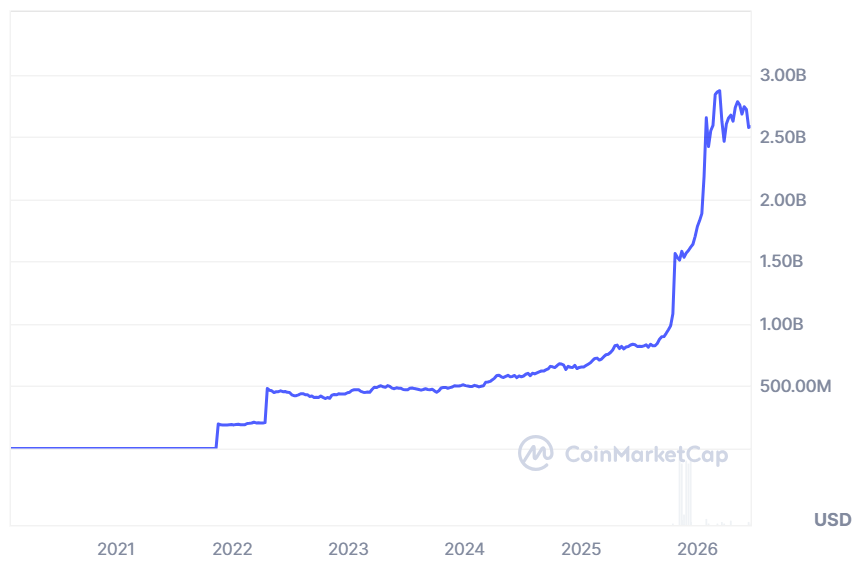
The market capitalization of Tether Gold peaked at around $2.89 billion. Source: CoinMarketCap
Related: Tether makes $150M investment in Gold.com in latest gold play
Tokenized commodities gain traction in RWA market
The announcement comes as commodities play an increasingly prominent role in the tokenization market. According to a recent Token Terminal report, tokenized financial assets have surpassed $43 billion, with commodities accounting for nearly 17% of the market.
Unlike commodity derivatives and futures, tokenized assets such as gold are backed by the underlying asset, giving holders direct ownership while enabling faster transfers and trading on blockchain networks.
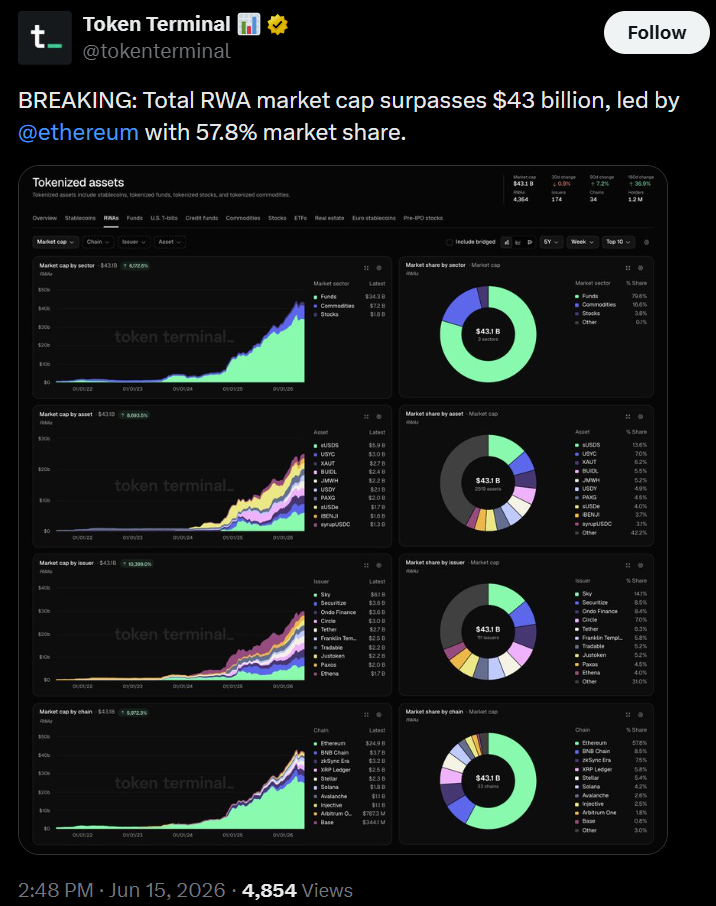
Commodities account for a bigger share of the tokenization market.
Source: Token Terminal
Tether Gold benefited from this year’s rally in bullion prices, with the token’s market capitalization expanding as gold climbed to record highs above $5,600 per troy ounce. The precious metal has since pulled back to around $4,300 an ounce but remains up on the year.


Google, for example, has warned organizations to begin preparing for the transition to post-quantum cryptography and has been integrating quantum-safe cryptographic standards into parts of its infrastructure with a 2029 completion target. The U.S. National Institute of Standards and Technology (NIST) has been leading efforts to standardize post-quantum algorithms and has set timelines for the eventual retirement of certain legacy cryptographic systems.
Within crypto, several major ecosystems have elevated quantum preparedness as a strategic priority. The Ethereum Foundation earlier this year announced a dedicated post-quantum security initiative aimed at researching migration paths for blockchain’s vast ecosystem of wallets, applications and validators. Solana developers likewise published proposals exploring how users and the network could transition to quantum-resistant cryptography if the threat becomes more immediate.
The Algorand Foundation noted that blockchain networks need to begin making preparations well before a so-called “Q-Day,” the hypothetical moment when a quantum computer becomes capable of breaking the cryptography currently used to secure digital assets.
The foundation said its roadmap builds on work it began in 2022, extending those efforts to the rest of the protocol, with the goal of achieving what Algorand describes as broad quantum resilience by the end of 2027. The foundation said it expects to reach that milestone before NIST retires certain legacy cryptographic standards and three years ahead of a timeline set by the U.S. National Security Agency for national security systems.


- Solana price sits at around $71 with strong resistance at $75.95.
- Indicators and EMAs show a bearish market trend.
- Weekly gains contrast with weak momentum and extreme fear sentiment.
Solana price continues to trade in a tight range around the low $70s, with the asset struggling to reclaim the $72 level.
At the time of writing, SOL was trading near $71.26, after a mild 24-hour decline of about 0.7%.
Despite a stronger weekly rebound of roughly 10%, the broader market pattern still shows clear resistance overhead and weakening momentum across multiple technical indicators.
Over the past 24 hours, the Solana price has remained trapped between $70.69 and $74.24, without a decisive trend forming.
Technical structure still favours sellers
Looking at the charts, Solana (SOL) remains under pressure from a layered resistance structure formed by major moving averages.
Recent price movements show that SOL has only managed to reclaim the 10-day exponential moving average (EMA), while the 20-day, 50-day, 100-day, and 200-day EMAs are all positioned above the current price level.

This configuration confirms that the broader trend remains bearish, as rallies continue to encounter resistance before reaching higher momentum zones.
The most immediate technical barrier is located at $75.95, a level that must be cleared to signal a potential shift in trend direction.
If this level is broken, projections place the next resistance at $83.32.
On the downside, structural support is clearly defined at $62.40.
A breakdown below $62.40 would expose the Solana price to deeper losses, extending the current corrective phase and potentially triggering accelerated selling pressure.
Notably, the daily Relative Strength Index (RSI) is positioned at 44.38, reflecting a neutral condition and suggesting indecision in short-term price direction.
However, the weekly RSI has dropped to around 33.07, placing it near the oversold territory and signalling that while selling pressure has been persistent over a longer timeframe, we could see some bullish recovery soon.
The overall market sentiment remains weak
Sentiment conditions continue to reflect caution across the broader market.
The Fear and Greed Index is positioned near 15, a level typically associated with extreme fear.
Such an environment often coincides with defensive positioning, reduced risk appetite, and lower conviction in upward price movements.
Derivative market data also supports this cautious outlook, with the funding rates remaining negative in recent sessions, while short positioning has increased relative to long exposure.

In addition, the long-to-short ratio has remained below equilibrium levels, indicating that traders are still leaning toward downside protection rather than sustained bullish positioning.
At the same time, Solana has recorded modest institutional inflows, including small allocations into Solana ETFs totalling just over $1 million.

However, these inflows remain limited in size and have not been sufficient to offset broader bearish positioning in derivatives markets.

Key Highlights
-
CoinMENA partners with Standard Chartered for enhanced UAE fiat payment infrastructure
-
Partnership improves funding channels, settlement mechanisms, and operational clarity
-
Standard Chartered broadens services to licensed UAE digital asset platforms
-
CoinMENA strengthens client fund safeguards through enhanced banking infrastructure
-
UAE digital asset platforms increasingly compete on regulated fiat access and settlement quality
The UAE’s digital asset sector has secured another significant banking partnership as CoinMENA announced collaboration with Standard Chartered for fiat payment infrastructure. This arrangement enhances local currency accessibility for platform users and verified partners. The development demonstrates how banking relationships increasingly influence competitive dynamics among licensed digital asset platforms.
CoinMENA Enhances Fiat Payment Infrastructure
Through this partnership, CoinMENA will leverage Standard Chartered’s banking systems to facilitate fiat entry and exit points across the UAE. The platform will implement protected client fund accounts alongside virtual account-based payment mechanisms. Consequently, users can expect improved visibility into funding movements and enhanced settlement workflows.
This collaboration provides CoinMENA with more robust banking foundations as digital asset oversight continues developing throughout the region. The arrangement enables accelerated funding processes, improved transaction monitoring, and enhanced clarity for authorized counterparties. Accordingly, this partnership extends beyond simple payment access to deliver comprehensive operational infrastructure.
CoinMENA functions within an ecosystem where fiat connectivity remains critical for crypto platforms. While users engage with digital assets through blockchain networks, exchanges require traditional banking for local currency operations. Consequently, dependable banking partnerships enhance platform credibility, market liquidity, and user satisfaction.
Standard Chartered Expands Support for Licensed Digital Asset Platforms
Standard Chartered’s involvement illustrates how established financial institutions can facilitate regulated digital asset operations without directly operating trading venues. The institution will deliver payment processing and account management infrastructure rather than proprietary cryptocurrency trading platforms. This model enables banks to participate in sector expansion while maintaining distinct operational frameworks.
The UAE has developed among the region’s most dynamic digital asset ecosystems through comprehensive licensing frameworks and regulatory oversight. Authorities have enabled virtual asset service providers, payment processors, stablecoin initiatives, and financial technology operators. Nevertheless, these enterprises require established banking relationships to achieve meaningful scale.
CoinMENA benefits from this evolution because regulated infrastructure now carries equal importance to platform capabilities. Robust fiat connectivity enables exchanges to accommodate retail customers, high-net-worth individuals, and institutional participants. Simultaneously, Standard Chartered reinforces its presence within UAE digital finance infrastructure development.
UAE Digital Finance Landscape Grows More Competitive
The CoinMENA partnership emerges as additional fintech operators advance their UAE market strategies. Revolut recently obtained Stored Value Facilities and Retail Payment Services authorizations from the UAE Central Bank. These regulatory approvals position the company toward potential market entry.
Revolut intends to deliver multi-currency accounts, payment cards, domestic transactions, and cross-border transfers within a unified application. Its market presence could intensify competition across payments and international money movement. However, these licenses do not necessarily indicate authorization for virtual asset trading activities within the UAE.
CoinMENA advances into this competitive environment equipped with strengthened bank-supported infrastructure for fiat operations. The partnership demonstrates how digital asset platforms require robust compliance frameworks, settlement systems, and client fund governance to achieve sustainable growth. Ultimately, UAE digital finance increasingly depends on regulated infrastructure rather than speculative market momentum.
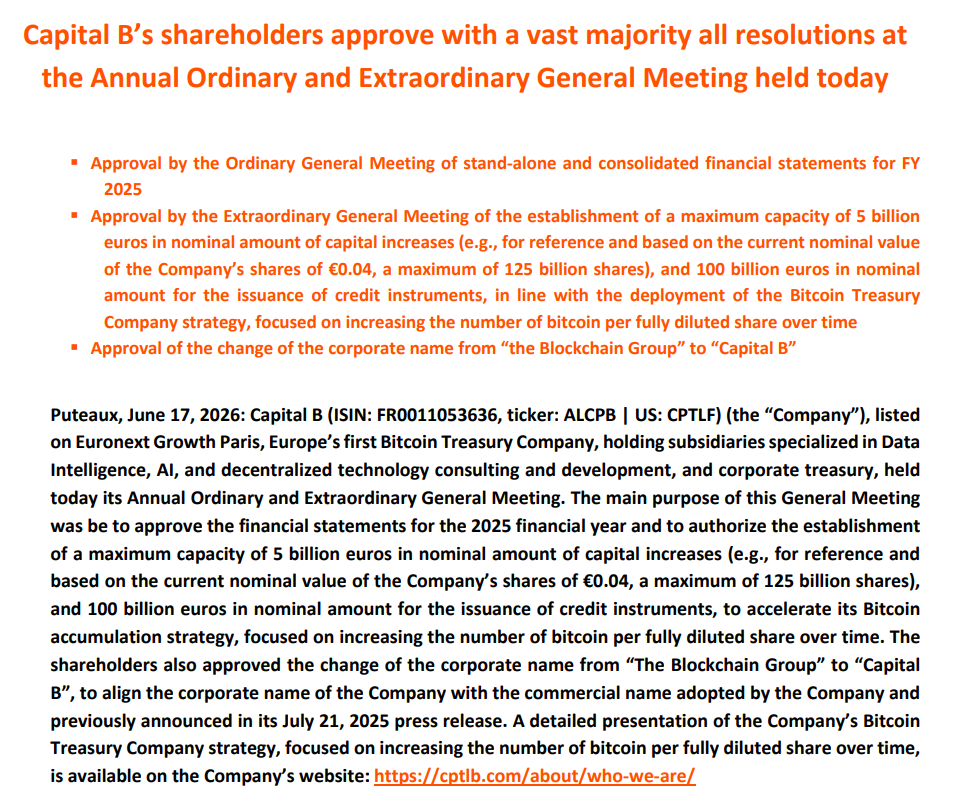
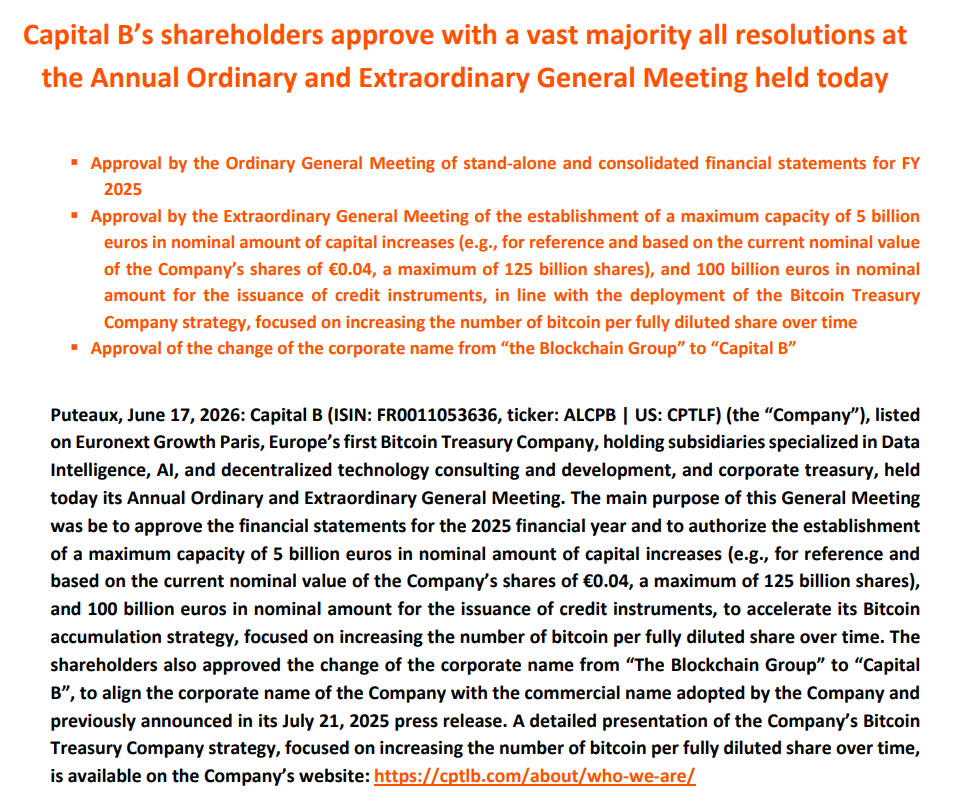
France-listed Bitcoin treasury company Capital B’s shareholders approved authorizations allowing the company to raise up to 105 billion euros ($120.4 billion) to fund future Bitcoin purchases.
Over 95% of shareholders approved the establishment of up to 5 billion euros in capital increases, equivalent to as many as 125 billion new shares at the current nominal value, as well as the issuance of up to 100 billion euros in credit instruments, Capital B announced on Wednesday.
The company said the issuance of the new capital instruments will “accelerate its Bitcoin accumulation strategy, focused on increasing the number of Bitcoin per fully diluted share over time.”
During its general meeting on Wednesday, Capital B reported 300.65 million in total shares with voting rights. If fully exercised, issuing 125 billion in new shares would result in existing shareholders being diluted to about 0.24% of the company’s ownership.
Shareholders also approved changing the company’s name from The Blockchain Group to Capital B, aligning its corporate name with the commercial brand adopted in 2025.
Source: Capital B
Capital B shares were little changed following the announcement, according to Yahoo Finance data.
Crypto treasury companies take different approaches
Capital B is Europe’s second-largest Bitcoin treasury company, holding 3,139 BTC, currently valued at $200 million. It ranks behind Germany-based Bitcoin Group SE, which holds 3,604 Bitcoin, currently worth $230 million, Bitcoin Treasuries data shows.
To date, Capital B said it raised about $325 million in capital, following its $17.8 million raise from strategic investors, including Blockstream CEO Adam Back and Paris-based asset manager TOBAM.
Related: Mystery Bitcoin burn destroys 107 BTC worth about $8.5M
The fundraising initiative contrasts with moves by some treasury companies to reduce or actively manage their Bitcoin exposure.
On May 28, France-based semiconductor company Sequans Communications said it had concluded its previously announced crypto treasury strategy. The company held 658 Bitcoin and said it would “monetize remaining holdings over time,” which led to a share price increase of about 14.5%.
Magazine: Bitcoin, the ‘canary in the coal mine,’ XRP transaction demand falls 91.5%: Market Moves
Crypto World
Ethereum News: ETH Developers Hit Near Record Highs Even as ETH Dumped Below $1,750, Is the Network Stronger Than the Price Suggests?
Ethereum News: ETH price is sitting near $1,750, down roughly 1.4% in the last 24 hours, and the bears are clearly running the short-term narrative.
But strip out the price action, and something more durable is happening underneath. Developer growth tells a story that the chart currently refuses to.
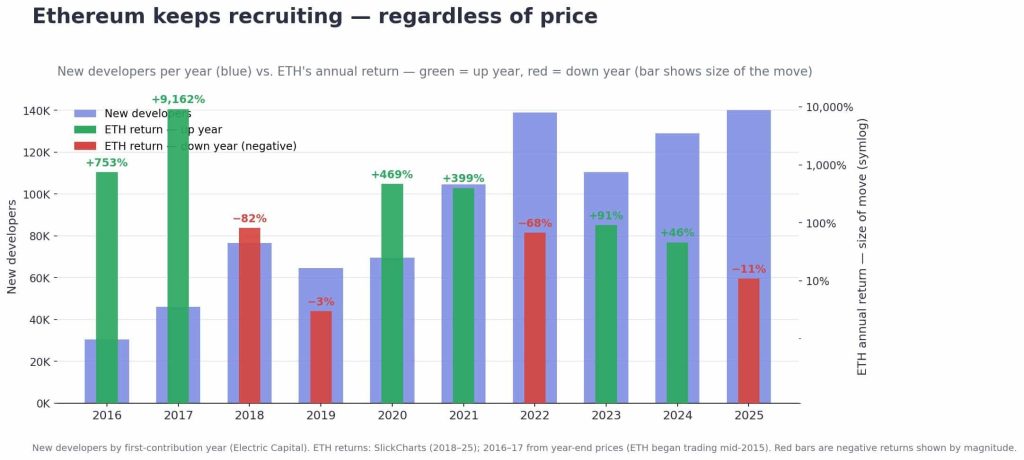
New developers building on Ethereum have climbed from approximately 30,000 in 2016 to nearly 140,000 in 2025, and crucially, that growth did not pause during the brutal drawdowns.
When ETH dropped 82% in 2018, roughly 77,000 new developers joined the network anyway. When ETH shed 68% in 2022, new developer additions hit approximately 139,000, one of the strongest cohort years on record.
Even now, with ETH down around 11% year-to-date, developer intake remains close to that same 140K ceiling. Block production has also stabilized near the 7,000-blocks-per-day range since approximately 2023, regardless of where spot price traded.
The gap between price performance and network health is widening. That divergence is worth taking seriously before the next macro catalyst forces a re-rating. Upcoming protocol decisions and FOMC positioning will likely be the near-term triggers that determine which way that gap closes.
Ethereum News: Can ETH Price Reclaim $2,000 or Is a Drop to $1,500 the More Likely Path?
The technical setup is uncomfortable. ETH broke below a key demand zone, and Yahoo Finance’s technical analysis marks $1,700 as the line in the sand, with the path to $1,400 largely unobstructed if that level fails.
Overhead resistance compounds the problem. The 50-day EMA sits near $2,194 and the 200-day EMA near $2,510, and both have capped every recent bounce attempt.
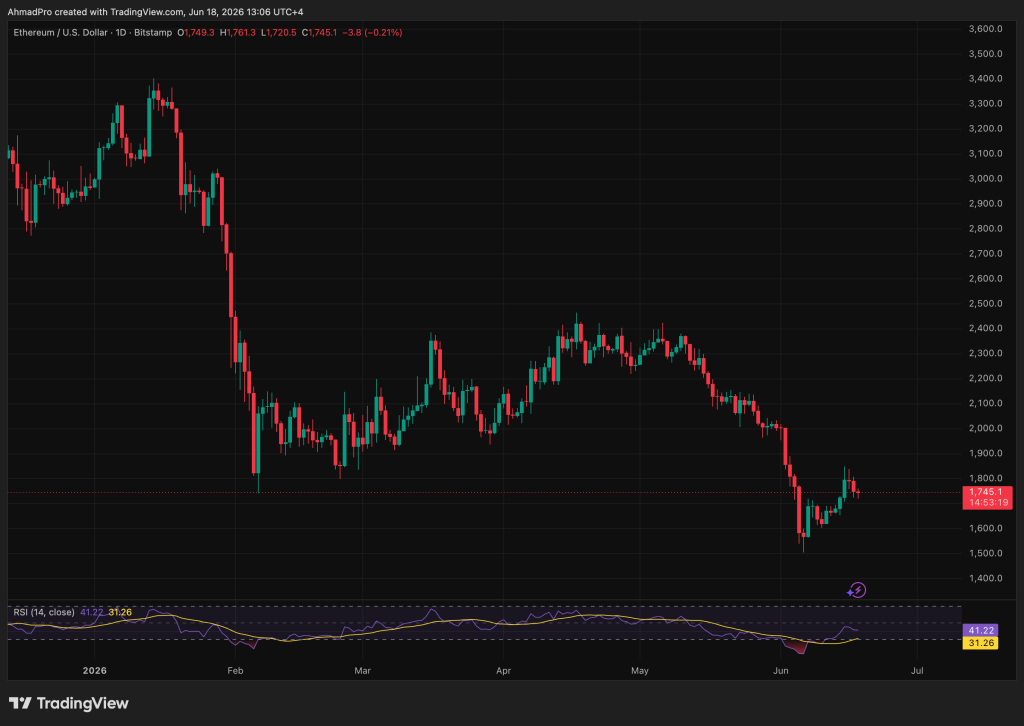
If $1,700 holds as weekly support, macro sentiment stabilizes after FOMC, and ETH reclaims $2,000 within two to three weeks on renewed risk appetite.
However, if $1,700 fails on a daily close, derivatives pressure accelerates the slide toward $1,400-$1,500. Liquidation cascades, not fundamentals, have been the primary driver of recent drawdowns, the flush could move fast rather than gradual.
Standard Chartered and other institutional desks still hold constructive multi-year ETH price targets, which keeps the capitulation thesis incomplete until on-chain accumulation data turns materially bearish.
LiquidChain Could Replace Ethereum For Smart Traders In The Future and Here is Why
When Ethereum bleeds, it tends to flush speculative capital out of the broader ecosystem, and that capital often rotates into early-stage infrastructure plays with asymmetric upside profiles that large-cap ETH can no longer offer at current market cap.
The question is where that rotation lands. Whale accumulation patterns during ETH weakness suggest sophisticated money is positioning in infrastructure, not exiting crypto entirely.
LiquidChain (LIQUID) is an L3 infrastructure project positioning itself as a cross-chain liquidity layer that fuses Bitcoin, Ethereum, and Solana liquidity into a single execution environment.
The core proposition, deploy once, access all three ecosystems, directly addresses the fragmentation problem that costs Ethereum developers time and TVL every cycle.
Key architecture features include a Unified Liquidity Layer, Single-Step Execution, Verifiable Settlement, and a Deploy-Once Architecture designed to reduce cross-chain overhead.
The presale is currently priced at $0.01471 per $LIQUID with $852,080.07 raised to date. As with any early-stage presale, liquidity and execution risk are real — this is not a liquid position and vesting schedules matter.
That said, for traders who want infrastructure exposure without riding ETH’s current technical uncertainty, Visit LiquidChain’s full presale terms here.
The post Ethereum News: ETH Developers Hit Near Record Highs Even as ETH Dumped Below $1,750, Is the Network Stronger Than the Price Suggests? appeared first on Cryptonews.


Key takeaways
- While momentum indicators suggest downside pressure is easing, ETH remains trapped below multiple key moving averages.
- Until buyers reclaim resistance levels above $1,800, the broader technical outlook remains cautious, with support around $1,741 likely to play a crucial role in determining the next major move.
ETH Open Interest falls to a multi-week low
Ethereum (ETH) derivatives markets remain subdued following weeks of price weakness, reflecting a cautious stance among leveraged traders.
After ETH fell below the $1,800 level, futures open interest dropped sharply, reaching 13.64 million ETH on Sunday, its lowest level since early May.
Open interest saw a modest recovery on Monday after Ethereum rebounded above $1,700, but overall participation remains significantly lower than recent highs.
Open interest represents the total value of outstanding futures contracts. Since May 28, Ethereum futures markets have witnessed a decline of roughly 2 million ETH in open interest, highlighting a strong reduction in leveraged exposure and growing risk-off sentiment.
Funding rate data paints a similar picture of caution. Over the past two weeks, Ethereum funding rates have fluctuated between positive and negative territory, signaling a lack of clear conviction from either bulls or bears.
Funding rates are periodic payments exchanged between long and short traders in perpetual futures markets. Positive rates indicate bullish positioning, while negative rates suggest stronger bearish sentiment.
The market’s tone shifted notably after the June 5 correction, which pushed funding rates into negative territory following nearly a month of positive readings.
Although ETH has recovered modestly since then, bullish traders have struggled to regain control.
Spot-market indicators offer little evidence of aggressive accumulation. Ethereum exchange reserves have declined modestly over the past two days, reversing part of the increase recorded last week.
While falling exchange balances can sometimes indicate accumulation, the move remains too small to signal strong demand.
Ethereum price analysis: ETH trapped below key resistance
Ethereum continues to trade within a bearish short-term structure despite recent stabilization.
On the 4-hour chart, ETH remains below its 20-day EMA near $1,794, the 50-day EMA around $1,955, and the 100-day EMA near $2,108
The clustering of these moving averages above current price levels indicates that upside attempts continue to face significant resistance.
Although the broader trend remains bearish, some technical indicators suggest downside momentum may be easing.
The Relative Strength Index (RSI) has climbed toward the mid-50s, indicating selling pressure is weakening but not yet signaling a bullish reversal.
For Ethereum to build a stronger recovery, bulls must reclaim several important resistance zones.
Immediate resistance at $1,794 could pave the way for an extended rally towards the $1,806 and $1,909 psychological levels.
A sustained move above these levels would significantly improve Ethereum’s outlook.

On the downside, Ethereum faces several important support areas. If the bearish trend persists, immediate support is seen at the $1,524 level, with another demand zone at $1,405.
If selling pressure intensifies and these levels fail to hold, ETH could decline toward the next significant support area near $1,156.
Crypto World
Marvell (MRVL) Stock Surges 6% as KeyBanc Boosts Price Target to $385 on Optical Networking Strength

Key Highlights
- KeyBanc elevated MRVL price target by 48% to $385 while maintaining Overweight rating
- Shares climbed approximately 6.4% to $308.60 during premarket hours Thursday
- The stock has surged 51% throughout June and 263% since the start of the year
- Analysts view optical-networking segment as more sustainable than custom AI chip operations
- Company preparing to utilize TSMC’s advanced 1.4-nanometer A14 technology for future AI processors
Shares of Marvell Technology (MRVL) experienced a significant rally during Thursday’s premarket session following a substantial price target increase from KeyBanc Capital Markets, driven by enhanced optimism surrounding the company’s optical-networking division.
Marvell Technology, Inc., MRVL
John Vinh, an analyst at KeyBanc, upgraded his price objective to $385 from the previous $260 level, while maintaining his Overweight recommendation. This new target represents a 33% premium over Wednesday’s closing figure of $289.54.
During premarket trading Thursday, MRVL advanced 6.4% to reach $308.60. The semiconductor stock has demonstrated remarkable momentum with a 51% gain in June and an impressive 263% climb year-to-date, based on data from Dow Jones Market Data.
The bullish revision emerged after KeyBanc conducted an investor meeting with Marvell. Following the discussion, Vinh expressed increased confidence in the optical-networking segment, characterizing it as potentially more “durable” compared to Marvell’s customized AI chip operations.
“Networking represents the most durable growth opportunity,” Vinh stated, projecting that the total addressable market for optical networking could expand to approximately $30 billion by the end of the decade.
Marvell produces digital signal processors that power optical transceivers — critical hardware components responsible for transforming electrical signals into optical transmissions, enabling rapid data transfer within AI-focused data centers. As these facilities continue expanding, the demand for such advanced technology accelerates accordingly.
Networking Business Emerges as Primary Focus
While Marvell’s customized AI application-specific integrated circuits (ASICs) have traditionally captured investor attention, Vinh indicated that the optical networking division is poised to become the primary focus moving forward.
However, the AI chip segment remains a significant revenue contributor. Vinh maintains a “clear line of sight” toward achieving $10 billion in AI chip revenue by 2030, supported by strong demand from major cloud providers including AWS and Microsoft.
Marvell has been strategically expanding its networking capabilities through acquisitions. The company recently completed the purchase of Celestial AI for $3.25 billion and acquired XConn for $540 million. Additionally, Nvidia made a $2 billion investment in Marvell as part of a strategic partnership.
Advanced Manufacturing Process Node Adoption
Adding to Thursday’s positive momentum, a Nikkei Asia report revealed that Marvell intends to leverage Taiwan Semiconductor’s forthcoming A14 1.4-nanometer manufacturing process for its next-generation AI processors.
Marvell’s President and Chief Operating Officer, Chris Koopmans, confirmed the company’s commitment to TSMC, stating they will continue the partnership “if Taiwan Semiconductor maintains the absolute best technology in the world.”
Currently, Marvell’s data center segment generates over 75% of the company’s total revenue.
The company’s next quarterly earnings announcement is scheduled for approximately August 27, 2026. Wall Street analysts are forecasting earnings of 87 cents per share, representing growth from 67 cents in the comparable period last year. Revenue expectations stand at $2.70 billion, compared to $2.01 billion in the year-ago quarter.
MRVL currently trades at a price-to-earnings multiple of 99.5, indicating a premium market valuation.
Additional recent analyst activity includes B. Riley Securities elevating its Buy rating target to $345 on June 12, while Barclays raised its Overweight target to $275 on May 29.
As of Thursday premarket, MRVL was trading up 4.89% at $303.70.
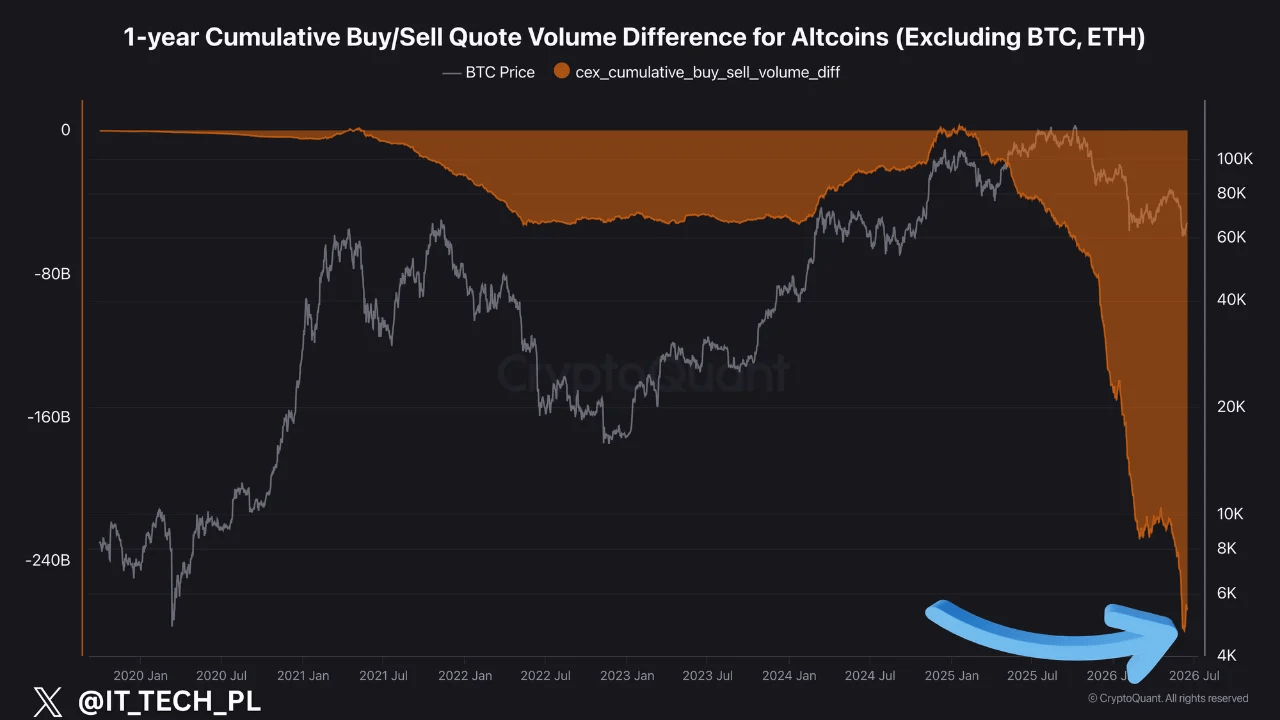
Altcoin sell pressure on spot exchanges has fallen to its deepest level since 2020, marking 15 straight months of net selling across the market outside Bitcoin (BTC) and Ethereum (ETH).
Yet a separate CryptoQuant gauge points in the opposite direction. The platform’s 180-day Altcoin Season Index is edging toward a reading that historically signals the start of an altcoin season.
Two CryptoQuant Signals Pull in Opposite Directions
The metric tracks the cumulative difference between buy and sell volume for altcoins, excluding BTC and ETH. Its drop to the most negative level since 2020 indicates sustained net selling pressure on spot exchanges.
Follow us on X to get the latest news as it happens

The indicator nearly returned to flat in early 2025. It then reversed and continued to decline over the following months. According to CryptoQuant analyst IT Tech,
“This is not a dip. It’s 15 months of continuous net selling on Spot Exchanges.”
The Altcoin Season Index offers the counterweight. CryptoQuant’s 180-day version is 18.48. According to an analyst, “altcoin season begins in earnest” once the indicator crosses 20. The gap suggests rotation building rather than running.
Analysts Split on Altcoin Season Prospects
Joao Wedson, founder of Alphractal, argued that many altcoins that suffered steep declines through 2025 and early 2026 may avoid setting new record lows.
He said a large share of the market has already entered the cycle’s “depression” phase, a period when many investors exit while large holders quietly accumulate.
“The rise in BTC Dominance should come mainly from the top 20 altcoins and stablecoins. This does not mean that all altcoins are going to die. It means that capital will rotate in a very selective way,” he said.
In contrast, Crypto Kid takes the bearish side. The trader says a true altcoin season needs the kind of money printing that drove the 2020 and 2021 cycle. He placed that window around 2028 or 2029.
The two signals leave the near-term path unsettled. One shows altcoins under their heaviest sustained selling in five years. The other shows a rotation gauge approaching its trigger. The next move may hinge on whether selective accumulation or the wait for looser policy proves correct.
Subscribe to our YouTube channel to watch leaders and journalists provide expert insights
The post Altcoins See Deepest Spot Selling Since 2020 as Season Index Nears Trigger appeared first on BeInCrypto.

Tekmar narrows losses as it reports record level of work
International Business Machines (IBM) Stock Slides 4% Following Accenture Revenue Warning
Where is the “Gilmore Girls” cast today? See what Lauren Graham, Alexis Bledel, and the rest of the stars are doing now


-

 Business4 days ago
No Jackpot Winner as $257 Million Prize Rolls Over to $269 Million Monday Draw
-

 Fashion6 days ago
Weekend Open Thread: Tuckernuck – Corporette.com
-

 Crypto World7 days ago
Oppenheimer backs SpaceX as $70 billion retail frenzy builds
-

 Crypto World7 days ago
Markets Rally as SpaceX IPO Looms Amid Iran Tensions and Inflation Surge
-
Crypto World4 days ago
Zimbabwe Requires Crypto Businesses to Register Annually Under New FIU Regulations
-

 Crypto World5 days ago
Bitget enters Argentina’s regulated crypto market through PSAV registration
-

 Tech6 days ago
NanoClaw integrates JFrog registries to secure AI agent downloads
-

 Tech6 days ago
This Week In Security: Microsoft On Microsoft, Register Your Domains, Linux On ARM, And FreeBSD Joins The File Cache Club
-

 NewsBeat7 days ago
El Nino has formed in the Pacific and could set records, forecasters say
-
 Tech7 days ago
Dutton Ranch star claims they ‘didn’t see any disruption’ on set following Chad Feehan’s exit from Yellowstone spinoff fueled by Taylor Sheridan clash rumors
-

 Politics7 days ago
Politics Home | Healey Resignation Is “Colossal Failure Of Government”, Says Former Labour Defence Secretary
-
 Entertainment7 days ago
Donnie Wahlberg & More Heat Up Las Vegas at Circa’s Barry’s Downtown Prime
-
 Tech7 days ago
Opendoor Ends India Operations, Fueling a Bigger Conversation About AI and Outsourcing
-

 Politics7 days ago
Belfast burns, while Met chief points finger at Iran and Russia
-

 Business7 days ago
AT&T: Verizon's 27% Outperformance Sets Up A Solid Entry Point
-

 NewsBeat6 days ago
FBI searches office of Ohio voter registration group
-
 Tech7 days ago
Anthropic is spending $150M to embed 1,000 AI fellows inside nonprofits. No degree required.
-

 Politics7 days ago
Modi thanks Trump for wishes as US attacks Indian seafarers
-
 Entertainment7 days ago
‘The Pitt’s Fan-Favorite Doctor Confirms Noah Wyle Gave His Blessing to Return [Exclusive]
-
 Crypto World6 days ago
Ripple and Bitso Bring MXNB Stablecoin to XRP Ledger
You must be logged in to post a comment Login