

Crypto World
Custodia and Vantage Back Token Switching Between Bank Deposits and Stablecoins

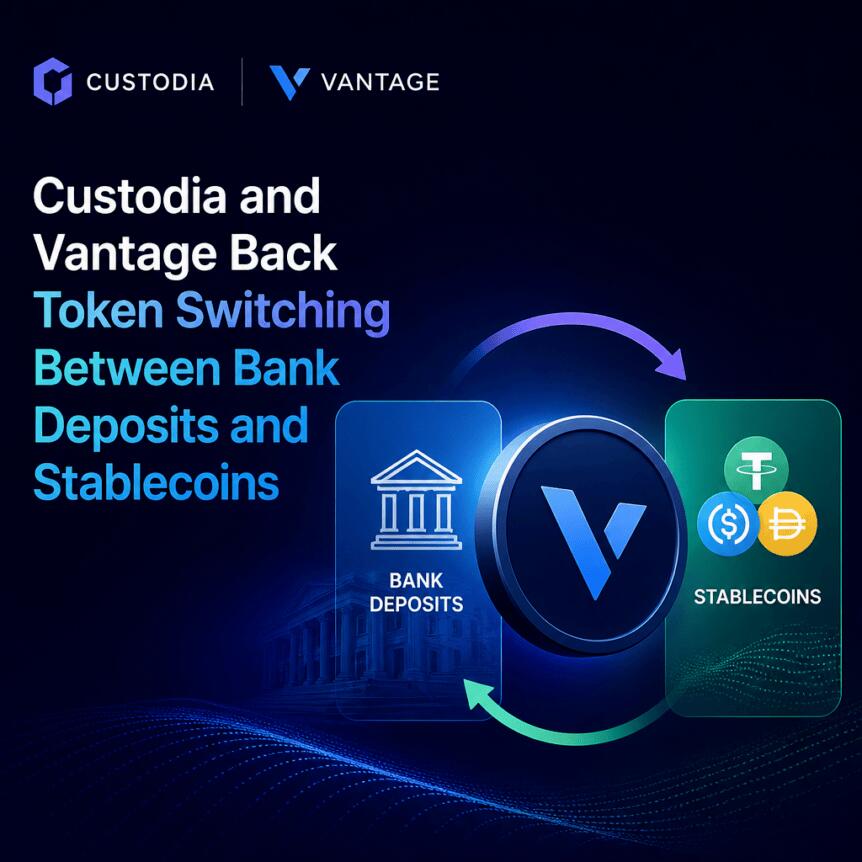
Custodia Bank and Vantage Bank have outlined a new mechanism they say could help traditional lenders experiment with tokenized payments without giving up control of customer deposits. In a white paper shared with Cointelegraph, the firms describe a “switching” token that behaves like a bank deposit within a banking consortium, but converts into a cash-and-Treasury backed stablecoin when transferred to users outside that network.
The proposal is designed to work through what the companies call the Hazel network. According to the paper, the system has been running on Ethereum since March, with participating banks testing the infrastructure and preparing for a wider rollout later this year.
Key takeaways
- The Hazel network token is intended to function as a bank deposit on-network, then as a stablecoin when moved to external users.
- Custodia and Vantage say the platform can run alongside banks’ existing core systems rather than replacing them.
- The companies report the system has been operating on Ethereum since March and is being tested by consortium participants.
- They expect broader availability to banks and their customers in the fourth quarter of 2026.
- The initiative comes as banks explore blockchain payment tooling while resisting risks they associate with stablecoin competition.
A token that changes role across networks
The central idea in the Hazel proposal is a token that adjusts its backing depending on where it is held and how it is transferred. Per the white paper, when the token sits within the participating-banking consortium, it operates as a deposit issued by a bank in that network. When it leaves the Hazel environment and reaches external parties, it would instead act as a stablecoin backed by cash and short-term U.S. Treasuries.
Custodia and Vantage also frame the architecture as a practical bridge between conventional banking records and blockchain settlement. Rather than forcing banks to migrate their entire ledger systems, the firms say the platform can operate alongside current core banking and payment infrastructure.
That “dual-mode” design is meant to address an industry tension that has been growing alongside stablecoin adoption: banks want the benefits of blockchain-based payments, but they are wary of losing deposits to stablecoin issuers or of taking on regulatory and competitive risks they believe could follow from stablecoin-linked products.
How Hazel could fit into banks’ day-to-day operations
According to the companies, participating institutions would not need to replace existing core banking systems. Instead, the Hazel network would integrate with current ledgers and payment channels, enabling banks and credit unions of different sizes—including community banks—to participate in tokenized payments.
The firms say their goal is to allow institutions to use tokenized transfers while keeping customer deposits inside the banking system. If implemented as described, that would reduce one of the biggest barriers to bank involvement in stablecoin-adjacent workflows: the concern that customer funds move away from traditional balance sheets when token settlement becomes the default.
The white paper also states that the platform’s testing is already underway. Custodia and Vantage said the system has been running on Ethereum since March, and participating banks are now testing the solution ahead of a broader rollout planned for later this year.
Stablecoins, deposits, and the search for alternatives
The Hazel proposal lands in a moment when mainstream banking is actively seeking alternatives to stablecoin rails without abandoning blockchain tooling. Earlier this month, The Wall Street Journal reported that The Clearing House—a payments and clearing industry organization whose owners include major U.S. banks such as JPMorgan Chase, Bank of America, and Citigroup—plans to launch a tokenized deposit network in the first half of 2027. That system, as reported by the publication, is intended to let banks settle payments using blockchain-based representations of customer deposits.
These developments highlight a common pattern: banks are pursuing tokenization, but increasingly want it to keep deposits within their control rather than tying settlement to stablecoins issued by non-bank entities.
Regulatory and legislative friction also remains a key backdrop. JPMorgan CEO Jamie Dimon has previously argued that banks should continue opposing provisions in the CLARITY Act—a U.S. crypto market structure bill—on the grounds that such rules could allow crypto firms to compete for deposits without obtaining bank charters. The bill advanced out of the Senate Banking Committee in May and still requires approval from both chambers of Congress, according to earlier reporting summarized in the source text.
At the same time, stablecoins continue to scale. DefiLlama data cited in the source indicates the total stablecoin market capitalization is roughly $315 billion, up from about $251 billion a year earlier. That growth underscores why banks face mounting competitive pressure—and why they may see tokenized deposit approaches like Hazel as a way to participate in blockchain settlement while defending deposit-based revenue streams.
Timeline expectations and what to watch next
Custodia and Vantage say they expect the Hazel network to become broadly available to banks and their customers in the fourth quarter of 2026. They also indicate that participating banks are testing the system now, with a broader rollout planned later this year.
For investors and builders, the most important open questions are practical: whether Hazel can deliver seamless settlement across consortium and external counterparties, and how the “deposit-to-stablecoin” switching model operates under real-world compliance and risk controls. The companies’ emphasis on running alongside existing banking systems suggests they view integration risk as manageable—but outcomes will depend on how quickly banks can operationalize the testing results.
Market participants should also watch whether Hazel’s concept gains traction alongside other bank-led tokenized deposit initiatives. If tokenized deposits become a mainstream alternative to external stablecoin usage, the competitive landscape for settlement could shift—potentially changing how institutions weigh stablecoin exposure versus on-balance-sheet or consortium-backed models.
As Hazel moves from Ethereum-based testing toward broader deployment, the key signals to follow are whether participating banks expand beyond early pilots, how the switching mechanism performs in live transfers, and whether regulators and lawmakers clarify how these tokenized deposits should be treated across on-network and off-network use cases.


BlackRock’s spot Bitcoin ETF is doing more than simply introducing mainstream investors to crypto, according to Jay Jacobs, the firm’s US head of equity ETFs. In remarks shared with Cointelegraph on its Chain Reaction podcast, Jacobs said that many investors who first buy BlackRock’s iShares Bitcoin Trust (IBIT) go on to explore other traditional exchange-traded funds—suggesting a two-way bridge between Wall Street and digital assets.
Jacobs also highlighted BlackRock’s broader framing of market convergence, arguing that investors increasingly view decentralized finance, active strategies, and traditional index products as components of a single portfolio toolkit rather than as mutually exclusive categories. The comments arrived alongside BlackRock’s launch of a new Bitcoin-income product, the iShares Bitcoin Premium Income ETF (BITA), which generates yield by selling covered call options on Bitcoin holdings.
Key takeaways
- BlackRock says a large share of IBIT buyers are first-time ETF investors, implying Bitcoin has functioned as an entry ramp into the wider ETF market.
- Jacobs described a “two-way” shift: after gaining Bitcoin exposure, many investors also add other BlackRock funds such as S&P 500, AI-themed, and gold ETFs.
- BlackRock launched BITA, a Bitcoin strategy designed to produce income through covered call options on its Bitcoin exposure.
- BlackRock’s Jacobs ties the trend to a broader “Great Convergence,” where TradFi and DeFi are increasingly treated as portfolio building blocks.
Bitcoin ETFs as an ETF “on-ramp”
Jacobs’ central point is that IBIT has attracted investors who may not have previously owned ETFs at all. He told Cointelegraph that “around three-quarters” of investors in iShares Bitcoin Trust have never owned an ETF before, positioning the product as a pathway into the ETF ecosystem rather than a standalone crypto vehicle.
BlackRock launched iShares Bitcoin Trust in January 2024 and has since positioned it as its flagship crypto offering. According to the figures cited in Jacobs’ discussion, the fund manages about $48 billion in assets and holds 765,936 BTC. That scale has helped make Bitcoin exposure accessible through familiar brokerage channels and regulated fund structures.
But Jacobs emphasized that the relationship doesn’t stop at Bitcoin. He characterized IBIT as a starting point for many investors who later diversify within BlackRock’s broader lineup—an outcome that matters for both asset managers and investors because it suggests crypto products can change how capital is allocated across traditional market segments.
Where investors go after IBIT
In Jacobs’ account, once investors acquire Bitcoin exposure through IBIT, many “start buying other BlackRock funds,” including traditional benchmark and thematic ETFs. He pointed to examples such as an S&P 500 fund (IVV), an artificial intelligence-focused product (BAI), and a gold ETF (IAU).
This is a meaningful behavioral signal: it implies that crypto ETF adoption may accelerate familiarity with the wider ETF wrapper, potentially reducing the friction that often keeps investors segmented between “crypto” and “traditional” strategies. For traders and portfolio managers, the practical takeaway is that Bitcoin allocations might increasingly behave like a component of an ETF-managed portfolio rather than a separate, stand-alone bet—especially for investors building through mainstream channels.
For BlackRock, the pattern also supports a broader thesis about distribution and product chaining—crypto launches that can feed into traditional fund demand after the investor base expands.
BITA adds a new angle: covered-call income on Bitcoin
BlackRock introduced its newest Bitcoin-related ETF on Wednesday: the iShares Bitcoin Premium Income ETF (BITA). The product is designed to generate income by selling covered call options against its Bitcoin holdings.
Covered call strategies are commonly used in equity and income-focused ETFs to generate option premium, typically with trade-offs such as potential limits on upside during strong rallies. In the context of Bitcoin, the structure gives investors a different risk-and-return profile compared with pure spot exposure—shifting the objective from simply tracking Bitcoin’s price to adding an income mechanism that can support yield generation across market cycles.
What remains to be seen is how investors will differentiate between IBIT (spot exposure) and BITA (income via covered calls). If Jacobs’ “entry ramp” theory holds, investors who first bought IBIT for access could be the same pool considering additional strategies within the same product family.
BlackRock’s “Great Convergence” thesis
Jacobs connected the investor behavior he described to BlackRock’s “Great Convergence” narrative—an idea that the boundaries separating crypto, decentralized finance, and traditional finance are becoming less relevant. He said historically investors held assets in separate silos, such as DeFi versus TradFi, active funds versus index funds, and private assets versus publicly listed instruments.
In his view, those divisions are fading as investors look for portfolio solutions that can mix approaches. Jacobs suggested the conversation is moving from “versus” framing to “ampersands,” arguing that people are increasingly combining strategies instead of choosing between them.
That perspective aligns with broader industry experimentation around how crypto traders access traditionally unavailable opportunities. The discussion referenced a recent high-profile SpaceX IPO where crypto participants reportedly sought ways to get exposure ahead of TradFi trading. According to the article, this included pre-IPO perpetual futures and tokenized stock offerings.
While Jacobs did not provide a direct performance forecast, the linkage underscores the same theme: crypto market participants are increasingly finding routes into TradFi-style assets and events, while TradFi-style wrappers (like ETFs) are increasingly used to bring crypto exposure into conventional portfolios.
Pre-IPO perps show crypto-to-TradFi demand
The text cited CryptoQuant for data showing that pre-IPO perp trading volumes on crypto exchanges rose sharply—from around $1 billion in early May to roughly $22 billion in the period leading up to the comments. It also noted Binance as the largest venue, based on CryptoQuant’s reporting.
For readers, this matters because it provides a concrete example of investor appetite for TradFi-adjacent exposures, even when the underlying asset (private company shares or early access mechanics) doesn’t map cleanly onto traditional market access. It also illustrates why fund and derivative structures are evolving: investors want access through instruments that match their preferred liquidity and execution environment.
At the same time, these numbers also highlight how quickly activity can concentrate once a new access method spreads across venues. If volume growth continues—or reverses—could influence how exchanges and liquidity providers decide which TradFi-linked products to expand next.
Going forward, investors should watch whether BlackRock’s product roadmap reinforces the same behavioral pattern Jacobs described—Bitcoin as an initial entry, followed by broader ETF participation—and whether covered-call Bitcoin strategies like BITA attract meaningfully different demand compared with spot-focused exposure. The pace of “convergence” will likely be measured less by headlines and more by how frequently new ETF buyers expand into additional traditional allocations.


A hawkish Federal Reserve is bolstering the U.S. dollar, bitcoin ETFs have seen persistent outflows, and Strategy, the largest publicly listed bitcoin holder, faces mounting pressure.
Strategy’s preferred stock, STRC, has plunged to record lows well below its $100 par value, complicating the company’s aggressive bitcoin accumulation strategy.
Arca CIO Jeff Dorman highlighted the precarious situation:”Either sell an enormous amount of BTC and MSTR to help bring $STRC back up near par, and at least buy yourself some time, or continue to watch every part of your cap structure melt because of the uncertainty you’ve created,” he said on X.
As of writing, BTC changed hands near $62,400, down 0.8% since midnight UTC hours, according to CoinDesk data. Prices hit highs near $67,000 early this week.


Bitcoin has spent five straight months trading below what it costs to produce, squeezing miners and forcing some to sell, JPMorgan said in a note. The bank pegs the cost to mine one bitcoin at about $78,000, well above the roughly $62,500 the asset fetches now.
The strain is showing and about 20% of miners are now unprofitable, the bank said citing CoinShares data, and publicly traded miners sold more than 32,000 bitcoin in the first quarter to cover operating costs, more than they offloaded in all of 2025.
The network is adjusting on its own. When the price drops below cost, higher-cost miners power down, the hashrate, or total computing power securing the network, falls, and mining difficulty, the automatic setting for how hard it is to mine, resets lower.
That played out in early June, when difficulty dropped 10%, the second decline of that size this year.
Miners are also reacting faster than before. JPMorgan says the sensitivity of difficulty to price has climbed, with more operators sitting near breakeven and flipping machines on or off as prices move. The bank expects larger and more frequent adjustments for as long as bitcoin stays below its production cost.
The outlook is cautious, but JPMorgan flags one upside. The weak sentiment around the sector could itself prove a bullish contrarian signal, echoing the run of accumulation readings, from whale buying to falling exchange reserves, pointing the same way this month.
-
The next crypto user may start outside exchanges
For most of crypto’s history, new users followed a fairly standard path. They signed up on an exchange, completed identity checks, learned how wallets worked, bought their first cryptocurrency and only then started exploring decentralized applications (DApps).
It was rarely a smooth process.
Wallet addresses often looked intimidating. Seed phrases confused beginners and gas fees were hard to understand. Even buying a small amount of Bitcoin could mean using several platforms and dealing with unfamiliar ideas.
This process is slowly changing.
Instead of starting on an exchange or wallet app, tomorrow’s users may begin with a simple conversation. They could ask an AI assistant what Bitcoin is, how to buy it or how to send money abroad. The same assistant could then guide them through the steps or even help complete the transaction.
Recent developments suggest this future could arrive sooner than expected. MoonPay is now available inside ChatGPT for crypto-buying flows. At the same time, Coinbase’s Base ecosystem is building tools that allow AI assistants to work with wallets and blockchain applications.
The result could change how people first enter crypto space.
The next wave of onboarding may not begin inside exchanges or wallets. It may begin inside chatbots.
-
Crypto onboarding has long been a usability problem
One of crypto’s biggest challenges has not been the technology itself. It has been the user experience.
To experienced users, private keys, wallet addresses and blockchain confirmations may feel normal. To newcomers, they can seem intimidating.
Traditional onboarding asks users to learn several unfamiliar systems at once. They need to understand how exchanges, wallets, security tools and transactions work before they can use crypto with confidence.
This complexity has caused many mistakes over the years. People have sent money to the wrong addresses, lost access to their wallets and fallen for scams because they did not clearly understand the tools they were using.
The industry has spent years trying to make this process easier. AI is now becoming the latest attempt to solve that problem.
Did you know? Long before modern AI assistants, crypto users relied on simple Telegram and Discord bots to check prices, send alerts and carry out basic trades. Today’s AI-powered crypto assistants are far more advanced versions of those early tools.
-
ChatGPT becoming more than an information tool
Early AI assistants mainly helped users learn. They answered questions, but they did not complete actions. People could ask questions such as:
- What is Bitcoin?
- How do stablecoins work?
- What is a crypto wallet?
The chatbot would give clear answers, but the actual transaction still happened on another platform. That separation is starting to disappear.
New integrations allow AI systems to do more than explain crypto. They can now connect users directly to services for buying, transferring and using blockchain networks.
Picture a newcomer saying:
“I want to buy $100 worth of Bitcoin.”
Instead of sending the user to another site, the AI could create a purchase link, explain the steps and guide them through the full process.
The conversation itself becomes the onboarding process. For beginners, this may feel natural because it matches how they already use AI for everyday tasks.
-
When chatbots move from answers to actions
The next phase of AI-crypto integration goes beyond simple asset purchases. It is also about letting users manage more crypto tasks through chat.
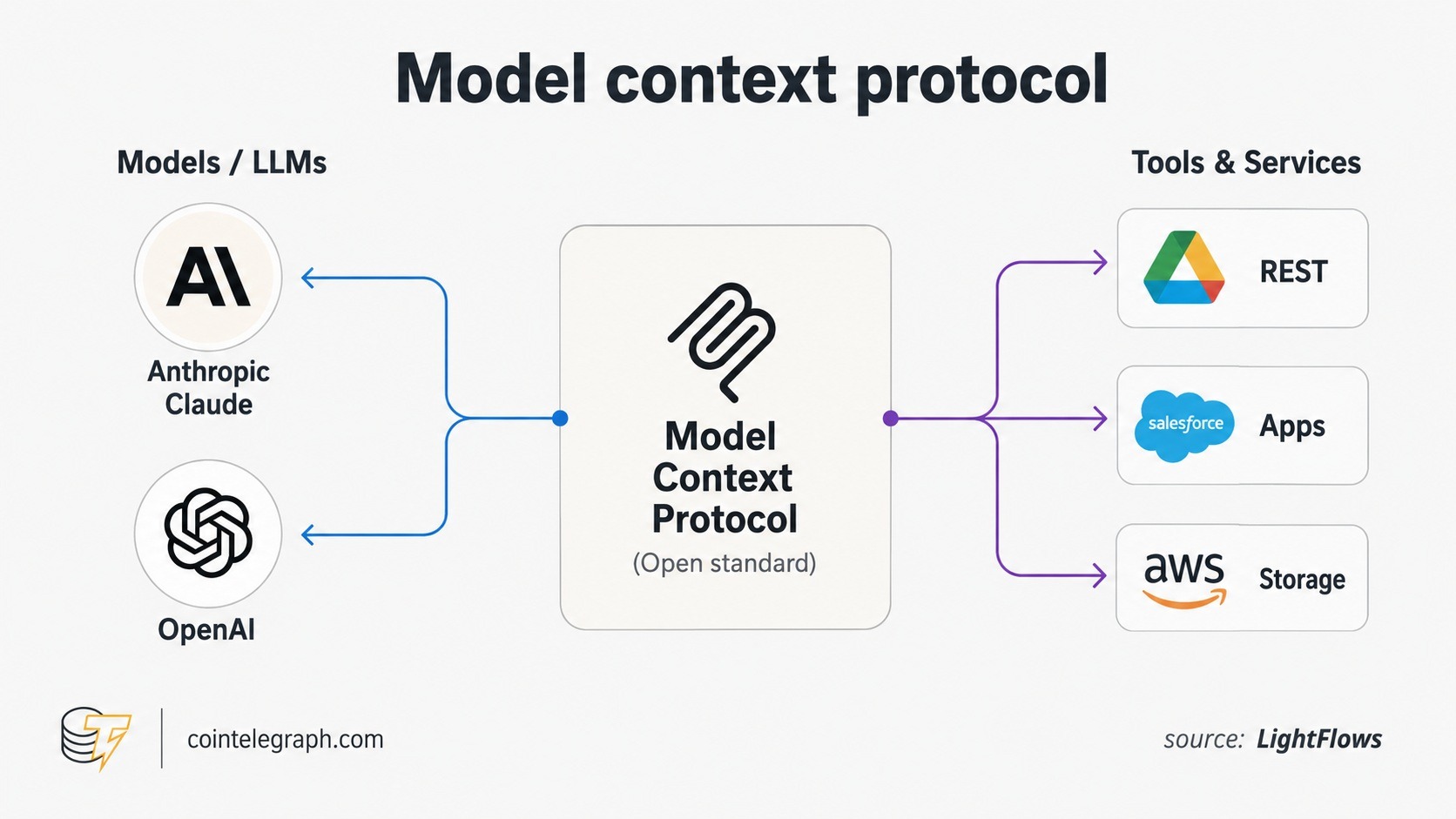
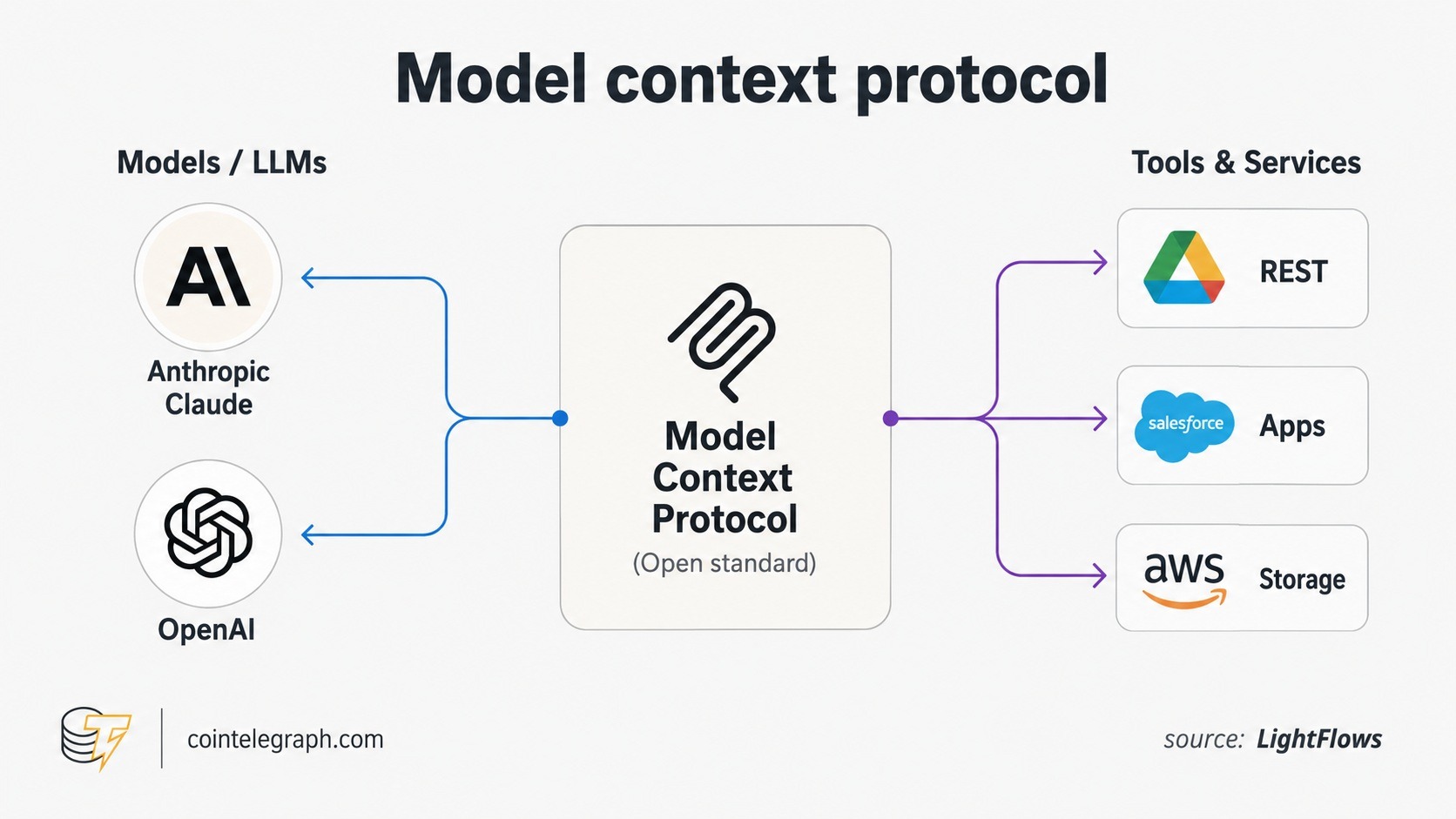
Projects like Coinbase’s Base Model Context Protocol (MCP) gateway aim to connect AI assistants with wallets, blockchain apps and other crypto services.
This could allow users to give instructions such as:
- Send 50 USDC to my friend.
- Swap ETH for USDC.
- Check my wallet balance.
- Find the cheapest route for a token transfer.
Instead of moving between different apps and websites, users would interact through normal language.
This follows earlier changes in computing. Users once had to remember command-line instructions. Graphical interfaces made that easier. Mobile apps made things simpler again.
AI assistants may be the next step. They could let people describe what they want to do instead of learning complex software steps.
-
Understanding MCP and its importance
Much of this change comes from MCP. It gives AI systems a standard way to connect with outside tools and services.
Instead of remaining standalone chatbots, AI assistants can now connect with databases, apps, wallets and other software systems.
MCP acts as a bridge between normal conversation and real action.
Without this kind of setup, AI systems can only provide information. With it, they can carry out tasks for users while keeping the right context.
For crypto, the value is clear. Blockchain apps often involve several technical steps in a specific order. MCP-supported systems can handle many of those steps automatically while the user stays inside a single chat window.
This could make AI the main layer people use to manage financial tasks.
-
When users no longer have to see the crypto layer
The biggest change may not be what users do. It may be what they no longer have to deal with directly.
Today’s crypto experience is still very visible. Users know they are dealing with exchanges, wallets and blockchains because they have to move through each layer themselves.
In a future shaped by AI, much of that complexity could move out of sight.
A user might simply say:
“Send $100 to my brother.”
The AI assistant could identify the steps, explain what will happen and show a clear confirmation before anything goes through.
The blockchain still runs. The wallet still exists. The user simply interacts with them through conversation instead of technical controls.
In this sense, crypto becomes less visible even as more people start using it.
-
Why this approach may appeal to new users
For new users, chat-based crypto tools could offer several practical benefits:
- They lower technical barriers.
- They explain things when users need help.
- They can guide users through unfamiliar steps one at a time.
- Most importantly, they feel familiar.
People already ask AI assistants for help with travel plans, meal ideas and work tasks. Asking the same assistant how to buy Bitcoin may feel like a natural next step, not a completely new behavior.
This could help crypto reach a wider audience.
Many people who once felt uneasy with traditional crypto apps may feel more comfortable using crypto through chat.
Did you know? Future crypto users may never have to copy a wallet address manually. Instead of pasting long strings of characters, they could simply tell an AI assistant who to pay while the technical details stay hidden in the background.
-
The trust issue nobody is talking about
Convenience also creates new problems. Earlier, users dealt directly with crypto platforms. They placed their trust in exchanges, wallets or blockchain networks.
In a chatbot-based setup, much of that trust shifts to the AI assistant. The chatbot becomes the main point of contact. Users may start accepting its suggestions simply because they sound clear and confident.
Most people have limited knowledge of blockchain technology. They also know little about how large language models work.
As a result, they may rely too heavily on systems they do not fully understand. The main concern is not always bad intent. It is overreliance.
A chatbot can make decisions feel so simple that users stop questioning the actions they approve.
-
What happens when AI makes a mistake
AI systems are still far from perfect. Mistakes, misunderstandings and inaccurate answers remain common.
In most cases, these issues may cause little harm if the person using AI reviews the output carefully. A wrong historical detail or a weak suggestion can usually be caught before it creates a major problem.
Financial transactions are different. A mistake involving wallet addresses, token symbols or transaction details could easily lead to financial losses.
Even small errors can matter in blockchain systems, where transactions are usually final and cannot be reversed. That is why human review remains important.
AI can be a useful assistant, but users must still check what they are authorizing. Convenience cannot replace careful review.
-
New security concerns in AI-enabled crypto tools
As AI starts connecting directly with wallets and financial tools, new risks come with it.
Bad actors may try to influence AI systems through prompt injection. Malicious plugins could abuse trusted connections. Scammers may use AI-generated conversations to make scams seem more believable.
These risks are not limited to crypto, but the financial impact can be much higher here. A wrong answer from a chatbot is one problem. A wrong transaction is another.
Security becomes more important as AI moves from giving advice to taking action. The industry will need to keep these tools easy to use while still building strong protections.
-
Could AI replace exchanges as crypto’s main entry point?
One major question is whether exchanges could slowly move into the background as support systems.
Users rarely think about the servers behind their favorite websites. They simply use search engines, browsers and apps. A similar change could happen in crypto.
Exchanges may still provide liquidity and carry out trades while AI assistants become the visible face of the system.
If that happens, control of the user experience could matter more than control of the technology behind it. Companies that shape the conversation may gain more influence over how people find, access and use crypto services.
-
How AI agents could change automated finance
The link between AI and crypto goes far beyond human users. Developers are now building AI agents that can interact with financial systems on their own.
Over time, these agents could handle subscriptions, adjust investment portfolios, make payments and use decentralized finance protocols with limited human input.
Crypto networks are well suited for this kind of activity. They are programmable, available worldwide and open around the clock.
Fully independent financial agents are still a developing idea, but the basic tools are already being built.
Together, AI and blockchain may one day support financial systems where machines interact directly with other machines.


The pressure came from a wider retreat in markets. Global equities slipped in holiday-thinned trading, with US, Chinese, Hong Kong and Taiwanese markets closed, and a gauge of Asian shares falling 0.6% after a five-day run to record highs. Brent crude traded around $79 a barrel, down about 9% on the week, as shipping through the Strait of Hormuz returned to normal under the signed US-Iran deal and eased what had been a historic supply shock.
Attention now turns to talks over Iran’s nuclear program, with Vice President JD Vance saying a 60-day clock to settle the deal’s details has started.
The bigger question hanging over the market is where this cycle goes, and whether the altcoins that usually rally late in a bull run get their turn at all. Michael Egorov, founder of Curve Finance, told CoinDesk he thinks bitcoin is behaving differently this cycle because spot ETFs were approved just before the 2024 halving, the roughly four-yearly event that cuts the rate of new bitcoin issuance, pulling in institutional demand that did not exist before and breaking the old pattern.
The speculative energy that once flowed into altcoins, he said, went instead into “useless memecoins” right after the ETFs launched.
Crypto World
Bitcoin to $145K by October? This Old Post With ‘Crazy Accurate’ BTC Price Predictions Say So
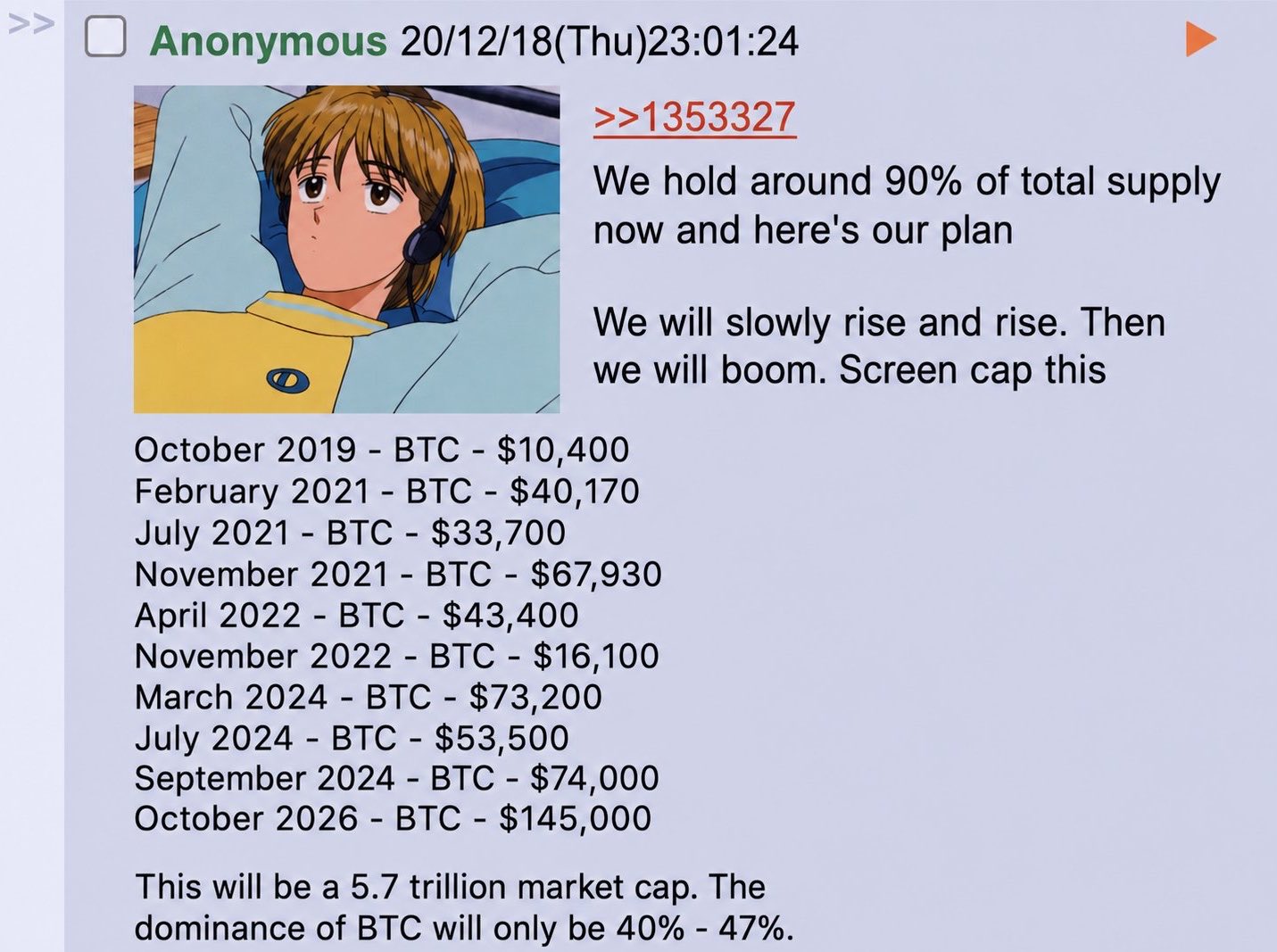
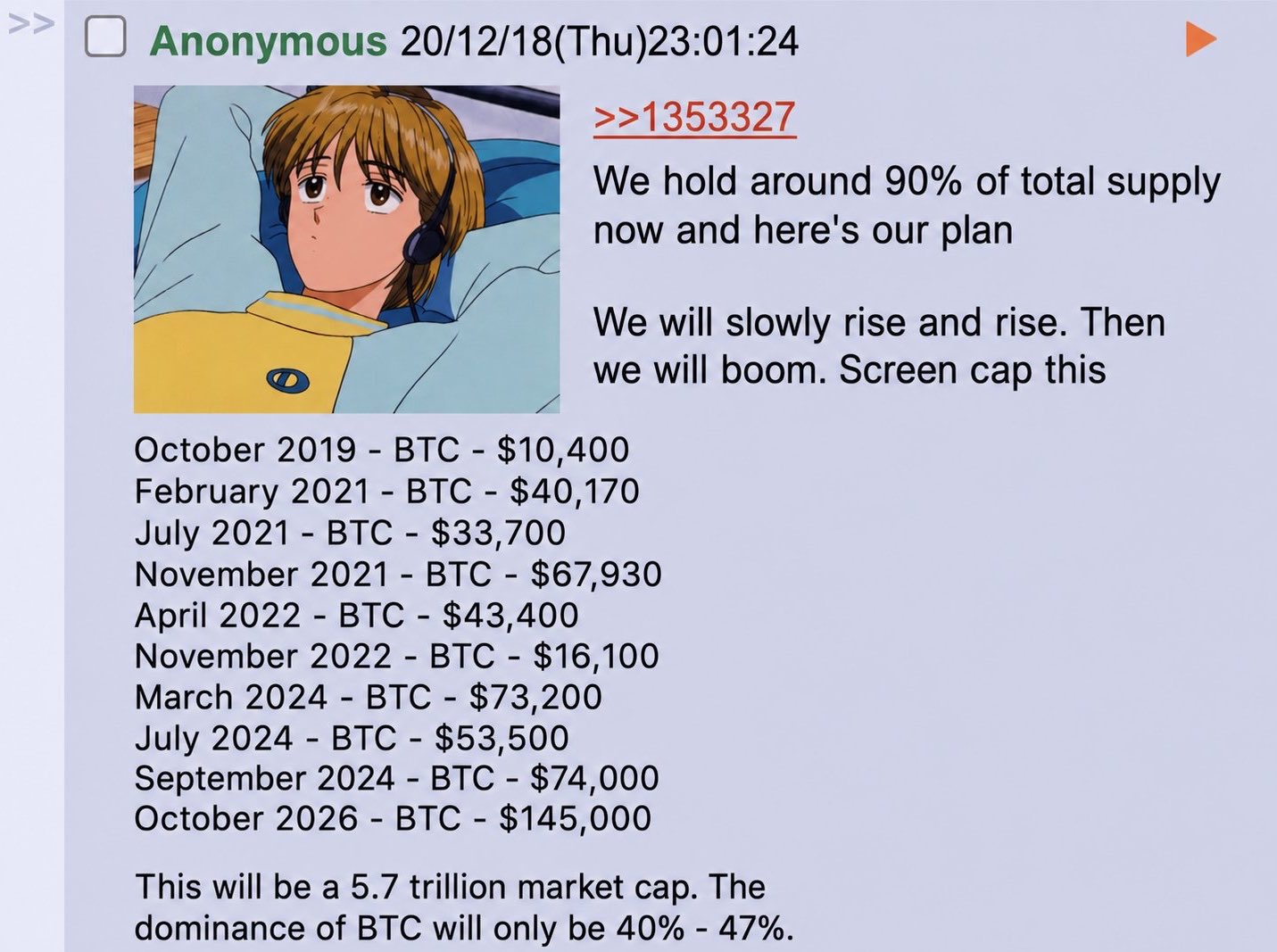
A viral social media post is reviving an alleged Bitcoin prediction that appears to have called several major BTC price levels from 2019 through 2024, with one final target remaining: $145,000 by October 2026.
Key takeaways:
- The new viral post appears to be an iteration of an older post with different Bitcoin price targets.
- It also claims the author holds more than 90% of the Bitcoin supply, which is mathematically impossible.
The Bitcoin target still requires proof
The screenshot, shared by crypto account Corleone, shows an anonymous 4chan-style post dated Dec. 20, 2018.
Bitcoin price prediction screenshot. Source: X/Corleone
It claims that a certain group holds “around 90% of total supply” and lists Bitcoin price targets for October 2019, February 2021, July 2021, November 2021, April 2022, November 2022, March 2024, July 2024, September 2024 and October 2026.
At first glance, the prediction looks unusually correct, with Corleone calling them “crazy accurate.” Bitcoin did trade at several of the listed historical levels, including around $67,000 in November 2021 and near $16,000 during the November 2022 bear-market low.
But there are several problems with treating the screenshot as authentic.
The original post is not publicly verifiable
The biggest issue is provenance. The screenshot does not show a verifiable archive link, tripcode, or any identity marker tying the prediction to a repeatable 4chan user.
That matters because 4chan posts are usually anonymous by design. “Anonymous” is not a single person or account. Without an archived source, there is no reliable way to prove that the same person predicted the events before they happened.
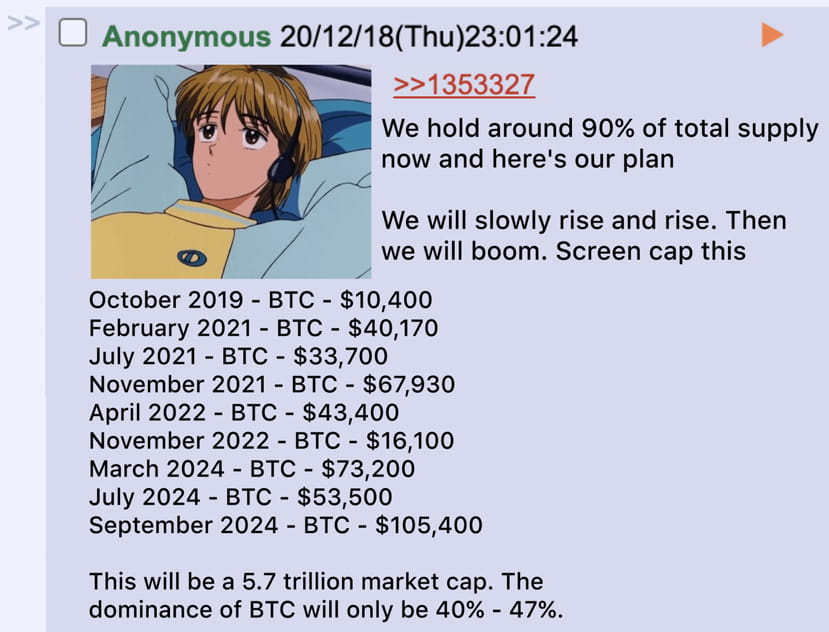
A Binance Square post from July 2024 uses the same “we hold around 90% of total supply” wording and many of the same targets, but lists Bitcoin at $105,400 in September 2024.
Bitcoin price prediction screenshot. Source: Binance Square
The newer viral screenshot instead shows September 2024 at $74,000 and adds the October 2026 target of $145,000.
Related: Bitcoin $150K price calls are ‘drying up,’ which is healthy
That difference is a major red flag. It suggests the image or prediction list may have been edited over time to better match Bitcoin’s historical price action.
The market cap claim does not add up
The screenshot also says the prediction would produce a $5.7 trillion market cap, with Bitcoin dominance at 40%–47%.
If the $5.7 trillion figure refers to Bitcoin alone, it is mathematically wrong. At $145,000 per BTC and roughly 20 million BTC in circulation, Bitcoin’s market capitalization would be about $2.9 trillion.
Even using Bitcoin’s full 21 million maximum supply, the market cap would be around $3.05 trillion.
If the post refers to the total crypto market, the wording is unclear and still does not prove anything about the prediction’s authenticity.
The “90% of BTC supply” claim lacks proof
The screenshot also claims: “We hold around 90% of total supply now.”
Bitcoin has about 20.04 million BTC in circulating supply and a 21 million BTC supply cap, so 90% would imply control of roughly 18 million BTC.
Also, the top 100 richest Bitcoin addresses control about 15.27% of the BTC supply, while the top 10,000 addresses hold about 53.89% of the same, according to data resource Bitinfocharts.
That is far below the 90% supply supposedly held by the viral post’s author.
For now, the claim that an anonymous 4chan user accurately predicted Bitcoin’s major price moves through 2026 should be treated as unproven. It appears more likely to be an edited or recycled crypto meme than proof of a trader who “does not miss.”
BlackRock’s spot Bitcoin exchange-traded fund has been a gateway for new investors to enter the wider ETF market, according to Jay Jacobs, US head of equity ETFs at BlackRock.
Around three-quarters of investors in BlackRock’s iShares Bitcoin Trust ETF have never owned an ETF before, Jacobs told Cointelegraph on the Chain Reaction podcast Thursday.
“IBIT was a way for traditional investors to now get into digital assets. But we have seen a lot of people really kind of enter into IBIT, starting with digital asset ETPs,” he said.
Bitcoin ETFs were heralded as a way to bring traditional investors into the world of digital assets. BlackRock’s Jacob suggests the shift has been two-way.
The iShares Bitcoin Trust, launched in January 2024, is BlackRock’s flagship crypto product with $48 billion in assets under management. It holds 765,936 BTC and has been an on-ramp for many digital asset investors to engage with ETPs.
However, Jacobs said that once investors get exposure to the Bitcoin product, many start buying other BlackRock funds, such as S&P 500 (IVV), artificial intelligence (BAI) and gold (IAU).
“We absolutely see it as this is a way to engage with a different group of people than maybe we’ve engaged with in the past,” he said.
The company launched a new product called the iShares Bitcoin Premium Income ETF (BITA) on Wednesday, which generates income by selling covered call options on Bitcoin holdings.
The “Great Convergence” of TradFi and crypto
Bitcoiners’ engagement with TradFi comes amid a growing overlap between crypto, decentralized finance and traditional finance, which BlackRock is calling the “Great Convergence,” according to Jacobs.
“Historically, you’ve seen a lot of different assets held separately,” he said. “DeFi versus TradFi, actively managed funds versus index funds, private assets versus publicly listed assets… and what’s happening is people are looking for more solutions to manage their portfolios,” he said.
“I think you’re gonna hear a lot less about versus, you know, TradFi versus DeFi, and I think you’re gonna see a lot more ampersands, it’s TradFi and DeFi.”
Related: TradFi advisers want stablecoins, tokenization over Bitcoin: Bitwise
A recent example could be seen during the high-profile SpaceX IPO earlier this month, with crypto traders given an opportunity to get a piece of the action through pre-IPO perpetual futures or tokenized stocks.
Pre-IPO perps enable investors to get exposure to private companies before they start trading on TradFi exchanges.
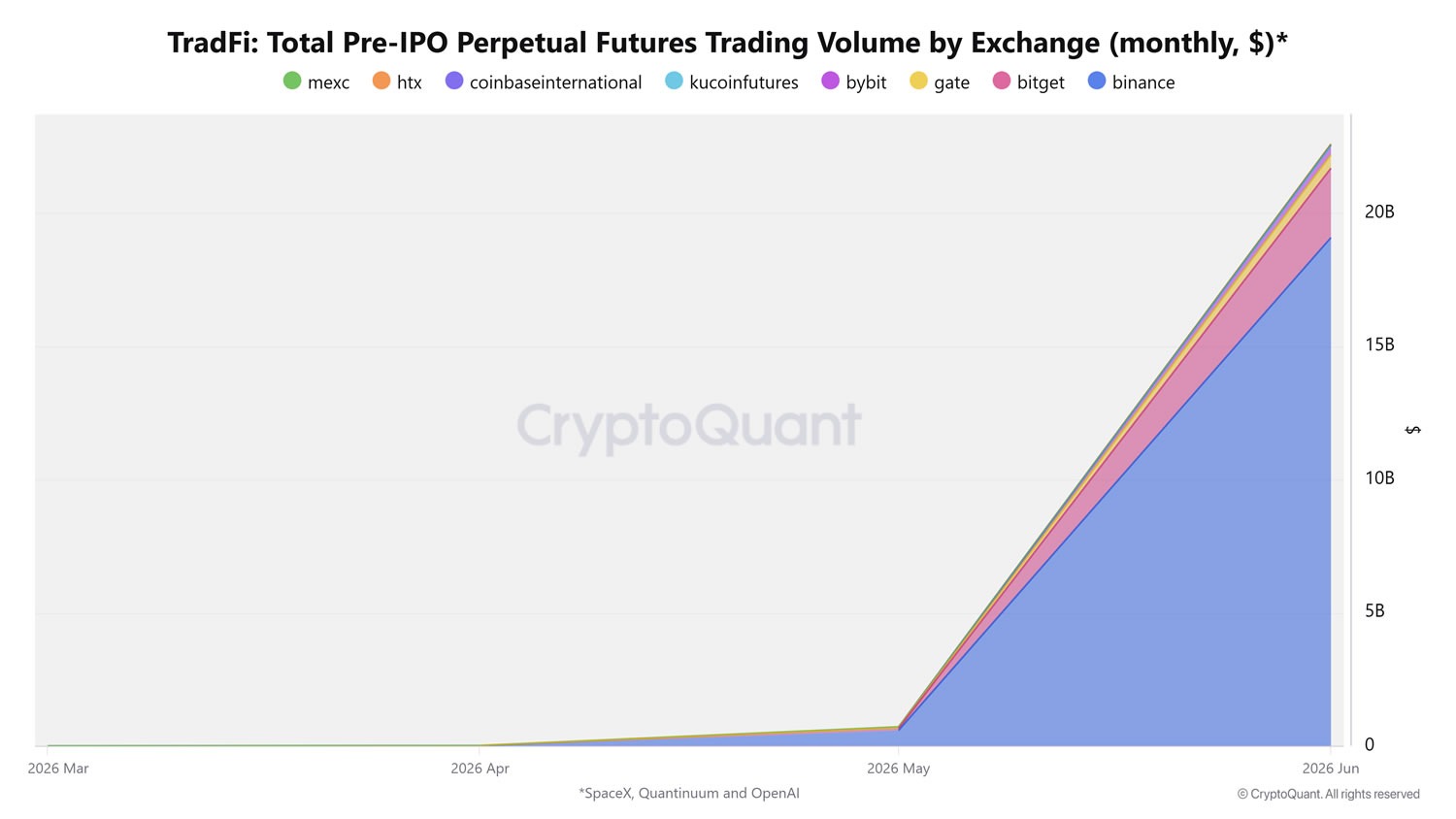
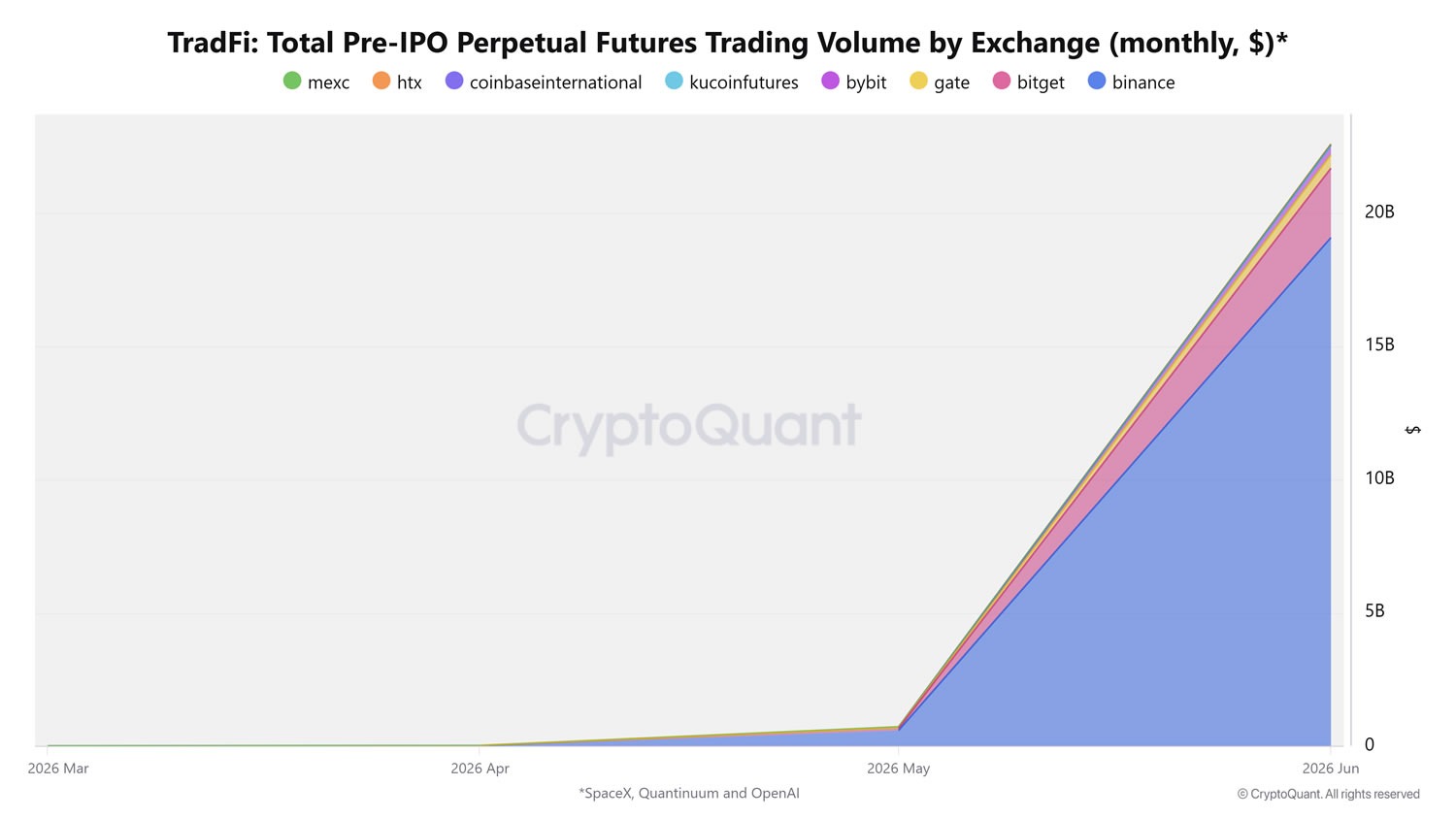
All major crypto exchanges are now offering pre-IPO perps, and trading volume has skyrocketed from around $1 billion in early May to about $22 billion, with Binance establishing itself as the largest venue, according to CryptoQuant.
Pre-IPO perp volumes on crypto exchanges have surged over the past few weeks. Source: CryptoQuant
Magazine: The end of anon? AI could unmask crypto’s hidden identities
XRP has dropped nearly 5% after a Fed-induced risk-off move swept across crypto markets, though traders remain focused on bullish chart signals and a major liquidity cluster near $1.30.
Summary
- XRP fell nearly 5% after a hawkish Fed outlook triggered a broad crypto market selloff.
- Analysts have identified a bullish divergence and key trendline support near the $1.16-$1.18 zone.
- Ripple’s Flutterwave investment and $1 billion revenue target offer fundamental support amid macro uncertainty.
The pullback began shortly after XRP (XRP) failed to break through the $1.25 resistance area. XRP fell nearly 5% in 24 hours to an intraday low of $1.16 on June 18 as heavy spot selling intensified below the recently reclaimed $1.20 level, triggering stop-loss orders and leveraged liquidations.
XRP also fell alongside a broader crypto market retreat after the Federal Reserve kept rates unchanged at 3.50%-3.75% while projecting additional tightening risks in 2026.
Despite the decline, XRP has continued to attract attention from market participants looking for signs that the correction may be nearing exhaustion. Several technical indicators, derivatives metrics, and recent Ripple business developments have kept bullish sentiment alive even as macro conditions remain challenging.
XRP technical structure remains intact above $1.16 support
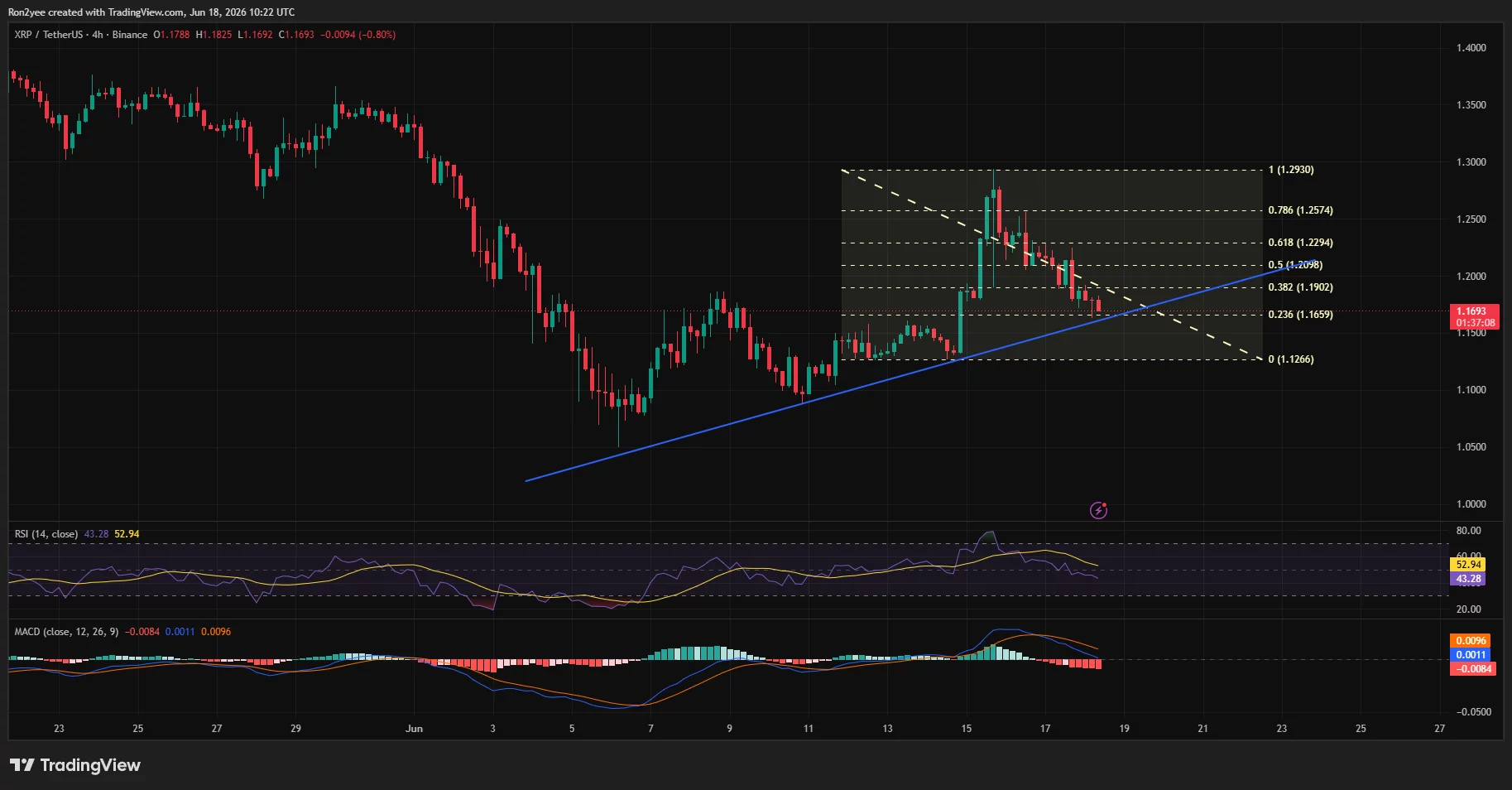
The four-hour chart shows XRP pulling back within a descending channel that formed after the token rallied toward $1.29 earlier this month. The asset’s price is currently testing the 23.6% Fibonacci retracement level near $1.165 while holding above an ascending trendline that has supported the market since early June.
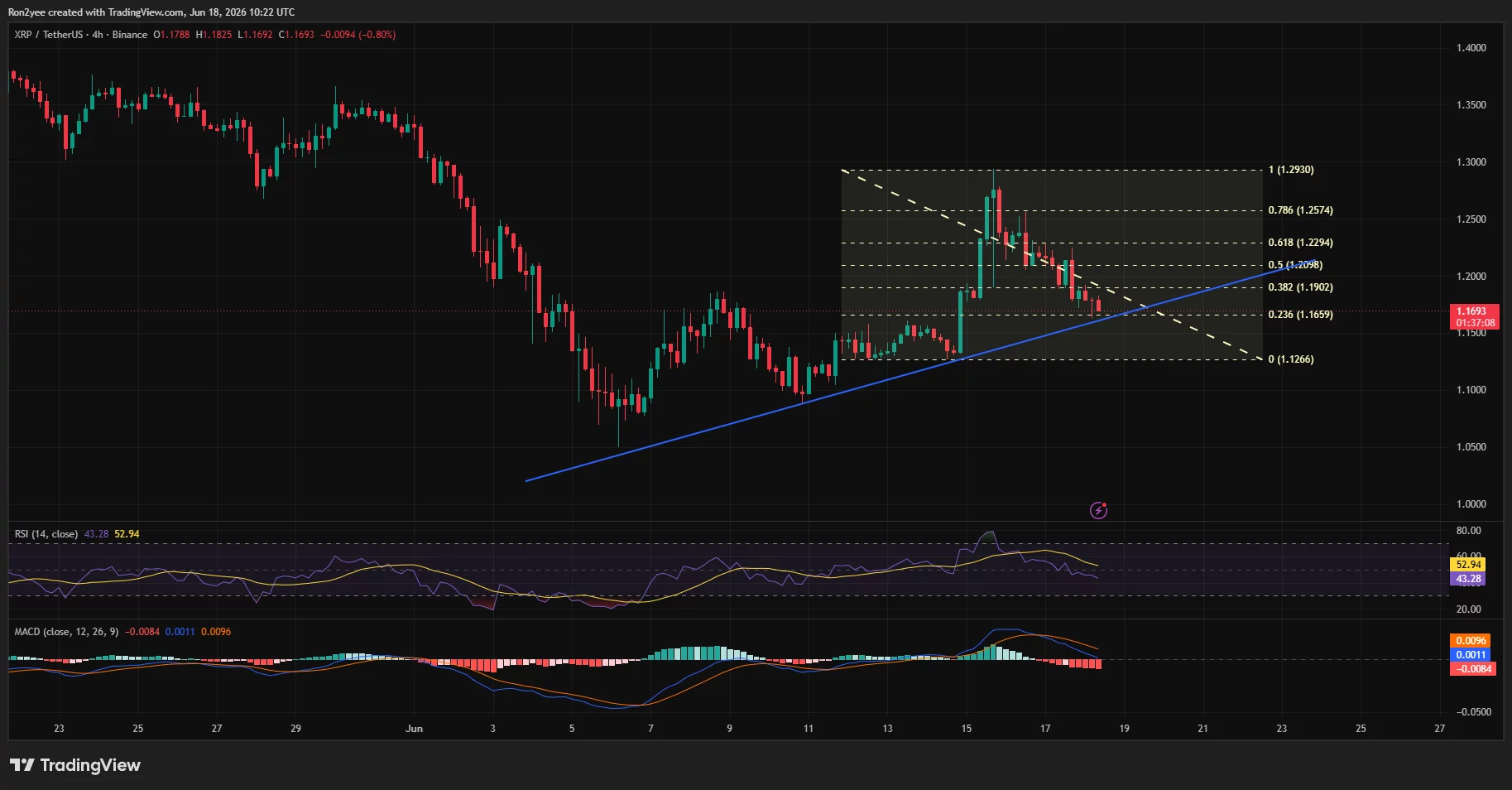
Momentum indicators have weakened but have not yet entered deeply bearish territory. The Relative Strength Index has retreated to around 43, while the MACD histogram remains below zero after a bearish crossover.
A decisive break below $1.16 could expose the June swing low near $1.12, while reclaiming $1.20 would place resistance levels at $1.23, $1.26, and ultimately $1.29 back into focus.
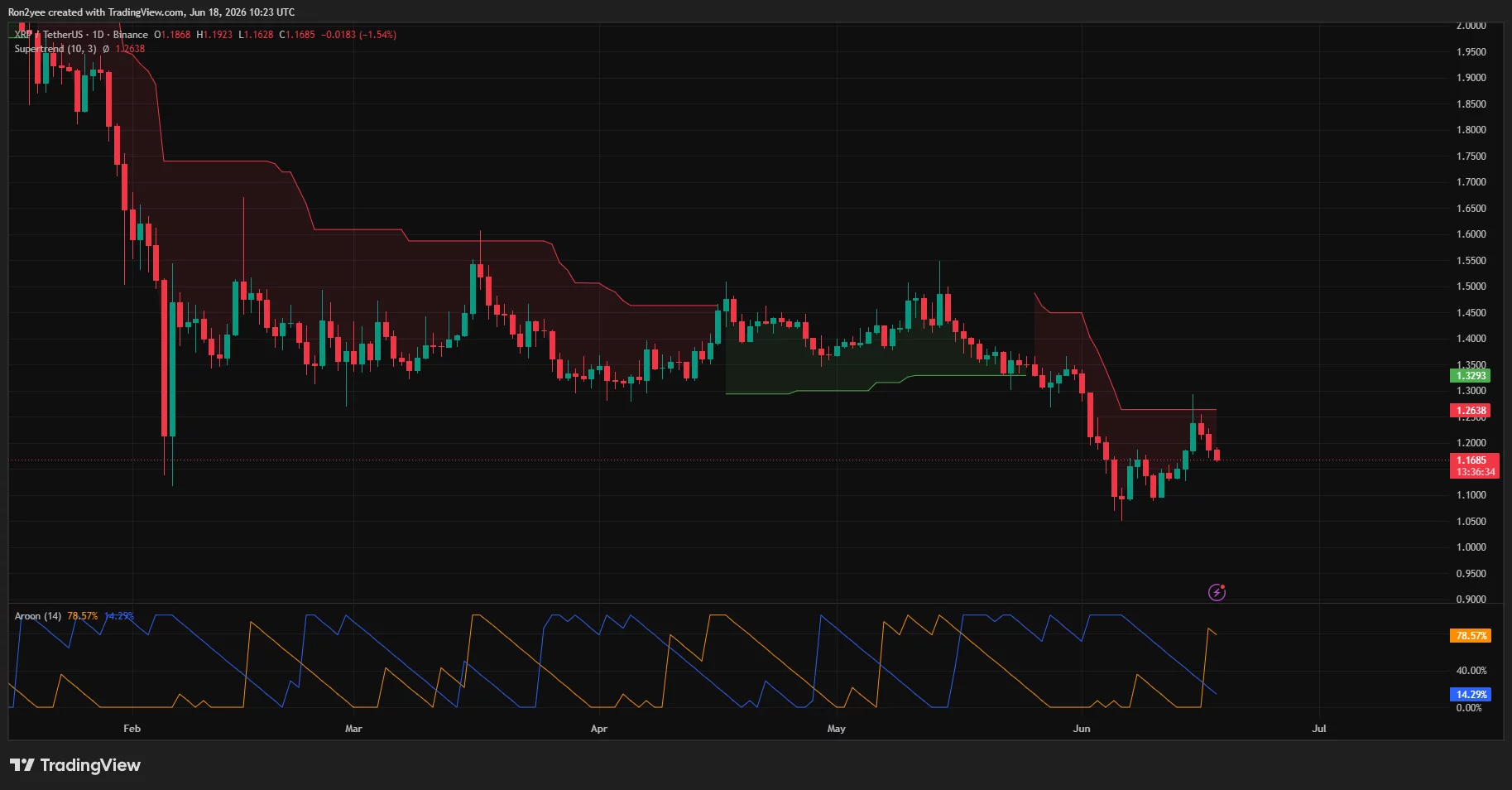
On the daily timeframe, XRP remains below the Supertrend resistance level near $1.26. At the same time, the Aroon indicator shows Aroon Up above 78% and Aroon Down near 14%, suggesting the longer-term trend has not fully shifted in favor of bears despite the recent decline.
Several market commentators continue to watch for reversal signals despite XRP’s recent weakness. According to analyst Gerla, the token has flashed a bullish divergence on the three-day chart.
“$XRP just flashed a bullish divergence on the 3D chart while trading inside a falling wedge. Momentum is turning higher even as price makes lower lows.”
Gerla argued that the divergence suggests selling pressure may be losing strength even as XRP continues printing lower lows, raising the possibility of a breakout if buyers can reclaim nearby resistance levels.
Another trader, Nebraskangooner, highlighted a possible accumulation structure forming on the daily chart. Commenting on the setup, the analyst noted that confirmation would require “a break above $1.34,” which remains a key level to monitor for a larger trend reversal.
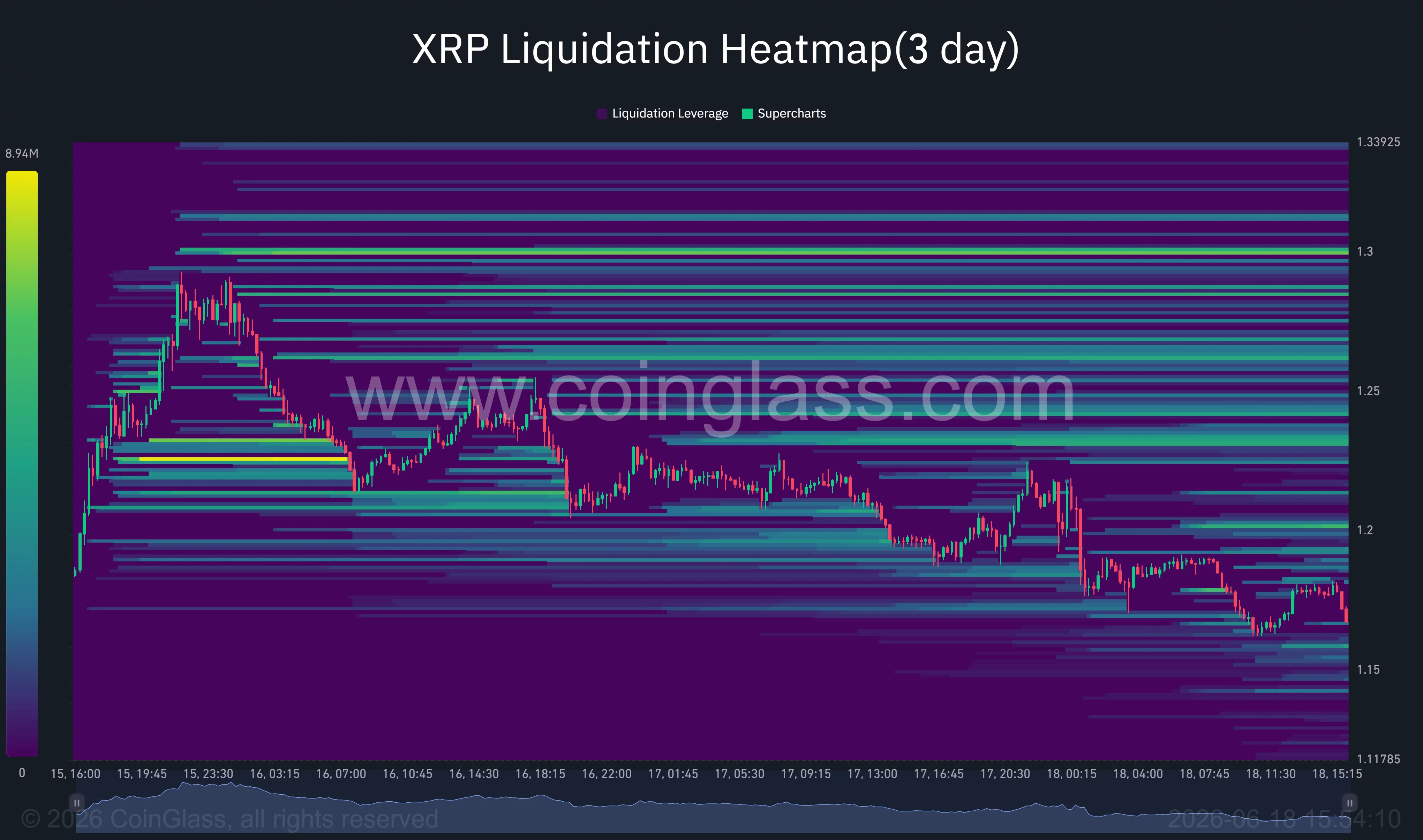
Derivatives positioning also reveals significant liquidity concentration above current prices. CoinGlass liquidation heatmaps show one of the largest leverage clusters sitting near $1.30, with additional liquidation pockets extending toward $1.34. Those levels could act as magnets for price if buyers regain control and trigger a short squeeze.
Ripple business expansion offsets some macro headwinds
Away from the charts, Ripple has continued expanding its payments ecosystem. Earlier this week, the company acquired an equity stake in African fintech firm Flutterwave in a transaction that valued the payments company at $3.3 billion.
While the deal does not include a commercial partnership, it gives Ripple exposure to one of Africa’s largest payments networks as Flutterwave continues expanding across the region.
Ripple has also raised expectations for its operating business. The company recently said it expects to finish 2026 with a $1 billion revenue run rate, excluding XRP held on its balance sheet. The projection provides investors with another fundamental growth metric beyond XRP price performance.
However, macro conditions continue to remain the primary risk factor for the token. Elevated oil prices, uncertainty surrounding Middle East tensions, and the Federal Reserve’s higher-for-longer policy stance continue to limit risk appetite across speculative assets. Any further deterioration in global market sentiment could pressure XRP alongside the rest of the crypto market.
For bulls, holding the $1.16-$1.18 demand zone remains critical. Losing that support would invalidate the current recovery structure and increase the probability of a deeper move toward $1.12. A rebound above $1.20, however, could place the large liquidation clusters near $1.30 back into play and revive momentum toward the upper boundary of XRP’s recent trading range.
Disclosure: This article does not represent investment advice. The content and materials featured on this page are for educational purposes only.


A debate among XRP Ledger community figures has put fresh focus on how stablecoins, payments and XRP may work together on XRPL.
Summary
- XRPL validator Vet said XRP and stablecoins are complementary parts of the payment stack.
- Eri argued Ripple has used stablecoins to bridge ODL while keeping XRPL liquidity important too.
- The debate centers on whether neutral native assets can reduce fragmented liquidity across payment routes.
In an Eri post, the researcher said Ripple has used Tether and USDC stablecoins to support On-Demand Liquidity flows, while liquidity on XRPL remains central.
Eri also said XRP has use cases outside payments, including collateral and DeFi. The post pointed to future financial products on XRPL that may use XRP in ways beyond simple transfer settlement.
Stablecoin sandwich gets clarified
Vet, an XRPL dUNL validator and XRPL Foundation contributor, responded that he sees “XRP and Stablecoins as complementary parts of the stack.” In a Vet post, he said a stablecoin sandwich works like a normal payment, not a cross-currency payment.
He said local currency swaps can happen at the sender and receiver ends. In that setup, the swap does not need to happen on-chain or touch the XRPL DEX. Still, he said quality assets and stablecoins are needed so service providers can build reliable payment flows.
In addition, Vet argued that once many issued currencies exist on-chain, markets still need a bridge asset. Without one, liquidity can split across too many direct pairs. He said XRP can serve that role on the XRP Ledger when a bridge transaction makes sense.
As crypto.news reported earlier, XRPL Foundation’s AMM proposal would add StableSwap and concentrated liquidity to improve stablecoin, RWA and DeFi pricing. The proposal aims to reduce slippage for assets that trade close to the same value, including stablecoins.
XRP’s neutral bridge role stays debated
Vet said an issued asset should not become the main bridge asset on a decentralized network because regulated issuers follow local laws. He argued that native assets are better suited for neutral bridging where no single issuer controls the system.
According to an earlier crypto.news report, RLUSD’s 40-chain rollout expanded Ripple’s stablecoin access for payments, tokenization and institutional liquidity. crypto.news previously reported that XRP Ledger utility beyond payments is moving into tokenized assets, DeFi and lending.
The debate does not settle whether stablecoins reduce or strengthen XRP demand. It shows that XRPL builders see the two as separate tools. Stablecoins may handle routes where price-stable settlement works, while XRP may still matter where neutral cross-asset liquidity is needed.

Opening summary
Ireland has released a new national assessment on the risks associated with digital assets, marking the first such review in seven years. The government’s findings emphasize heightened exposure to money laundering and terrorist financing risks, alongside concerns about fraud, bribery, sanctions evasion, and weak oversight in parts of the crypto ecosystem.
The assessment forms part of Ireland’s policy work toward implementing “standards relating to the acceptance of crypto-related activities as a source of funds” by the second half of 2027. For compliance teams and regulated firms, the document signals that authorities are refining threat models and tightening expectations around monitoring, reporting, and controls for crypto-related flows.
Key takeaways
- Ireland’s finance department describes crypto assets as posing “very significant” risks of money laundering and terrorist financing.
- The 2026 report cites rising money-laundering prosecutions and fraud activity where crypto is “particularly attractive” to criminal groups.
- The assessment flags vulnerabilities including sanctions evasion potential, tax compliance and enforcement challenges, and use of crypto in bribery.
- Ireland identifies regulatory fragmentation and largely unregulated areas (including decentralized finance) as risk multipliers for Irish service providers.
- The review is positioned to support implementation of industry standards on accepting crypto-related activities as a source of funds during 2027.
Ireland’s national risk assessment: scope and main findings
According to the Irish government’s national risk assessment released on Thursday, crypto assets present “very significant” risks connected to money laundering and the financing of terrorism. The assessment frames these risks within a broader set of criminal typologies seen across the last several years, including fraud schemes in which digital assets increase operational anonymity and cross-border reach.
The report also notes that, since Ireland’s previous published risk assessment on digital assets, authorities have observed changes that raise the compliance stakes. It points to an increase in money-laundering prosecutions and to incidents of fraud where the use of crypto has become “particularly attractive” for criminal actors.
In addition to financial crime, the assessment highlights operational and supervisory stress points for the Irish market. It says crypto can facilitate sanctions evasion, create vulnerabilities that complicate tax compliance and enforcement, and be used to pay bribes tied to decisions affecting the industry. The document also identifies “inconsistent international regulation” as a factor that can put Irish service providers under additional pressure—particularly when counterparties and intermediaries operate under different legal regimes.
Regulatory gap analysis: why weak coverage matters
A central theme of the assessment is that Ireland does not yet have the same breadth of crypto-specific laws and regulatory coverage seen in some other jurisdictions, including within the European Union and the United States. While Ireland has a comparatively high level of retail participation relative to some peers, the government argues that the legal and supervisory framework has not kept pace with the threat landscape.
Institutional compliance significance is twofold. First, regulatory gaps can widen the distance between the risks authorities describe and the controls firms are required to deploy. Second, fragmentation across jurisdictions can lead to inconsistent customer due diligence outcomes, uneven monitoring standards, and challenges in building auditable compliance trails for cross-border activity.
The assessment also points to “largely unregulated” segments of the industry, explicitly referencing decentralized finance as an area where typical oversight mechanisms may be less effective. For regulated entities, this creates practical questions around how they manage counterparty and customer exposure to activities that are not subject to the same obligations as centralized platforms.
Criminal misuse and financial integrity risks
Ireland’s assessment expands beyond headline money laundering and terrorism financing concerns by detailing specific misuse pathways that can affect regulated firms. The government notes vulnerabilities that may facilitate sanctions evasion, creating a compliance burden for institutions required to screen counterparties, track origin and destination of funds, and maintain controls capable of responding to fast-moving schemes.
It further links crypto activity to challenges in tax compliance and enforcement. While the assessment does not quantify tax losses, the emphasis indicates authorities view digital assets as complicating standard compliance processes—especially when transactions can be structured across jurisdictions, with limited transparency and varying reporting practices.
On bribery, the assessment states crypto is “increasingly used to make payments to corrupt officials.” This aligns with a broader pattern in anti-corruption enforcement where digital assets can be leveraged to obscure payment trails. The government’s framing is important for institutions because it broadens the compliance perimeter: controls cannot be limited to laundering typologies alone, but must be responsive to broader financial integrity risks, including fraud and corruption-related payment flows.
Connection to licensing and enforcement trends
Although Ireland’s assessment is not presented as a court or regulator-specific action, it is issued against a backdrop of enforcement by Irish authorities in the broader crypto compliance domain. For example, in November 2025 the Central Bank of Ireland fined Coinbase Europe Limited about $24 million for Anti-Money Laundering and Countering the Financing of Terrorism violations, citing delays in reporting failures related to its transaction monitoring system.
This enforcement context underscores the operational relevance of the new risk assessment. A national risk assessment typically informs supervisory expectations, supervisory priorities, and the risk-based approach taken by financial intelligence and regulators. For regulated service providers, the assessment’s emphasis on transaction monitoring, fraud attraction, and cross-border vulnerabilities suggests firms will be expected to ensure monitoring programs are capable of detecting high-risk patterns, documenting decisions, and escalating issues in line with legal requirements.
The report’s attention to areas with inconsistent international regulation also signals the compliance complexity that remains for Irish firms dealing with global counterparties. As European regulatory structures evolve and cross-border standards develop, firms may face continuing pressure to demonstrate that their due diligence and monitoring are effective even when counterparties operate under different regimes.
Political donations and policy constraints
The assessment also addresses the use of crypto for political purposes. While it notes concerns that crypto could be used to make payments to corrupt officials, Ireland has already moved to limit crypto involvement in political financing. The government states that accepting cryptocurrencies for political donations has been banned in Ireland for more than four years.
In April 2022, officials proposed restrictions that would prevent Irish political parties from accepting cryptocurrencies such as Bitcoin, Ether, privacy coins, and other digital assets. The inclusion of this policy detail in the 2026 risk assessment suggests authorities view crypto-linked payments as part of the same broader risk framework that covers bribery, corruption, and the integrity of public decision-making.
Closing perspective
Ireland’s return to publishing a digital asset national risk assessment is likely to influence how regulators and supervised firms interpret and implement financial integrity obligations in the lead-up to 2027. The next phase to watch is how the assessment’s threat analysis translates into practical supervisory priorities—particularly around transaction monitoring effectiveness, sanctions-related controls, and approaches to exposure in less-regulated segments such as decentralized finance.

NSE IPO, Bata revival and Nykaa growth: Gaurang Shah’s market playbook

US Crypto ETFs Draw Bitcoin Investors to TradFi

World Cup Daily: Canada, Switzerland carry momentum into decisive matchup


-

 Business5 days ago
No Jackpot Winner as $257 Million Prize Rolls Over to $269 Million Monday Draw
-

 Fashion6 days ago
Weekend Open Thread: Tuckernuck – Corporette.com
-
 Crypto World4 days ago
Zimbabwe Requires Crypto Businesses to Register Annually Under New FIU Regulations
-

 Crypto World6 days ago
Bitget enters Argentina’s regulated crypto market through PSAV registration
-

 Tech6 days ago
NanoClaw integrates JFrog registries to secure AI agent downloads
-

 Tech7 days ago
This Week In Security: Microsoft On Microsoft, Register Your Domains, Linux On ARM, And FreeBSD Joins The File Cache Club
-

 NewsBeat6 days ago
FBI searches office of Ohio voter registration group
-
 Entertainment4 days ago
Matt Damon’s Viral Sci-Fi Thriller Has Taken Over HBO Max
-

 Business4 days ago
Anthropic staff to meet White House officials next week, Axios reports
-

 Tech5 days ago
As AI companies race to go public, who else is along for the ride?
-
 Crypto World4 days ago
Bitcoin could crash to $48,000, if this historical pattern is triggered
-

 Politics4 days ago
“Israel’s” ban on ICRC visits ruled illegal, but Knesset moves to stop them permanently
-
Entertainment7 days ago
Ana Navarro unleashes explosive tirade on ex-Trump aide, Disney Channel star in epic on-air fight: 'Have you no shame?'
-
 NewsBeat4 days ago
Warning of disruption as Cardiff Crossrail works to start
-

 News Videos4 days ago
Financial Accounting | Last Day Revision Strategy and Booster | CMA Inter – June 2026
-
 NewsBeat4 days ago
Tributes to former deputy head teacher at Cambridge school among death and funeral notices
-
 Crypto World5 days ago
Market Preview: SpaceX (SPCX) IPO Record, Federal Reserve Meeting, and Iran Nuclear Agreement
-
 NewsBeat4 days ago
what doctors are seeing in ebike crashes
-
 Entertainment4 days ago
Kate Middleton Glare Goes Viral After Kids Booed At Royal Event
-

 Entertainment5 days ago
Deion Sanders Shares Powerful Post After Viral Advice To Deiondra
You must be logged in to post a comment Login