

Business
GGT Is Overvalued: Preferreds Offer Better Risk-Adjusted Entry



Business
Monsoon risk, younger investor base, and skewed trading activity define NSE outlook: NSE data

The National Stock Exchange flagged the monsoon as the key macro risk for 2026. NSE said IMD has revised its South-West monsoon forecast to 90 per cent of the long-period average, one of its lowest forecasted values on record, with a 60 per cent probability of deficient rainfall and a further 24 per cent probability of below-normal rainfall. “For 2026, the key challenge is the emergence of El Nino risk,” the report noted. The downside skew is visible across regions, with the probability of below-normal rainfall highest in Northwest India at 46 per cent, followed by the South Peninsula at 45 per cent, and Central India and the Monsoon Core Zone at 43 per cent each. NSE said historical El Nino years warrant caution, with deviations ranging from -5.4 per cent in 2023 to -22.1 per cent in 2002, and deficient rainfall has historically impacted kharif sowing, reservoir levels, rabi production and food inflation.
On investor demography, NSE said the nature of growth is changing as penetration broadens beyond traditional large-market states and the profile becomes younger and gradually more gender-diverse. The registered investor base rose to 13.1 crore as of May 2026, with the last crore of additions taking about seven months. The overall base grew at a 25.3 per cent CAGR during FY21-FY26 compared with 16.3 per cent CAGR during FY16-FY21. Regionally, North India now accounts for the largest share at 36.7 per cent, having surpassed Western India in 2022. States outside the top 10 now account for 27 per cent vs ~22 per cent in FY17, “pointing to a gradual broadening of the investor base beyond the traditional large states,” NSE said.
The investor base is also trending younger. The share of registered investors below 30 years increased from 23.5 per cent in Mar 2020 to 38.3 per cent in May 2026, while the median age fell from 38 years to 33 years. Incremental additions remain even younger, with investors below 30 accounting for 53-59 per cent of new registrations. Female participation improved steadily, with women accounting for around 25 per cent of all individual investors as of Apr 2026.
Trading activity, however, remains skewed. NSE data for May 2026 showed the top 2.6 per cent of active cash market investors accounted for 92.3 per cent of turnover, with investors trading Rs 10 crore and above forming just 0.3 per cent of active investors but contributing 79.4 per cent of turnover. In equity options, the top 0.3 per cent of investors alone accounted for 69 per cent of premium turnover, while in equity futures the top 7.8 per cent accounted for 93.3 per cent of turnover.


SOUTHAMPTON, N.Y. — Halfway through the 2026 U.S. Open and one thing is clear: Wyndham Clark is on a heater.
The 32-year-old has had just one top-10 finish in a major since his 2023 U.S. Open victory. But Clark won in Dallas a few weeks ago at the Byron Nelson and is clearly on top of his game. His 1-under 69 was good enough to leave him at 7 under for the tournament, four shots clear of the field through 36 holes.
The question now is whether Clark will be able to extend his lead, or if anyone — like fellow major champions Xander Schauffele, Matt Fitzpatrick, or even Justin Thomas — can make a move on the leader.
The Leaderboard Entering Round 3
Leaders at the start of Round 3 were led decisively by Clark, with a deep pack of contenders separated by just a handful of strokes behind him. Wyndham Clark sat at 7 under, four shots clear of a tie for second between Matt Fitzpatrick, Xander Schauffele, Sam Stevens, and Tom Kim, all at 3 under. Collin Morikawa followed at 2 under in sole possession of sixth place, while a four-way tie for seventh at 1 under included Justin Thomas, Harry Higgs, Sam Burns, and Sahith Theegala.
Betting Markets Reflect Clark’s Lead
Oddsmakers have installed Clark as the clear betting favorite heading into the weekend, reflecting both his commanding margin and his recent form. According to BetMGM, Clark is priced at +175 to win the championship, with Matt Fitzpatrick and Xander Schauffele both listed at +650. Scottie Scheffler sits at +1000 despite trailing significantly on the leaderboard, while Collin Morikawa is priced at +1400 and Rory McIlroy at +1600.
Notable Names Who Missed the Cut
The weekend field will be missing several recognizable names, most notably the tournament’s defending champion. Among the group of players who missed the cut at the 2026 U.S. Open, defending champion J.J. Spaun stands out most, unable to advance within the top 60 players plus ties. Florida amateur Giuseppe Puebla also missed the cut, along with other former major champions Jon Rahm, Brooks Koepka, and Graeme McDowell.
Saturday’s Tee Times
Round 3 tee times sent the morning groups out starting at 9 a.m. Eastern Time, with the leaders teeing off in the afternoon as the day progressed. The day began with Dylan Wu and Jacob Bridgeman at 9 a.m., followed by groups including Chris Gotterup paired with amateur Eric Lee, and Robert MacIntyre alongside amateur Marek Flemming.
Notable afternoon pairings included Jordan Spieth and Joaquin Niemann at 10:55 a.m., Russell Henley and Dustin Johnson at 11:06 a.m., and Tommy Fleetwood paired with Ludvig Åberg at 12:50 p.m. Scottie Scheffler went out with Brian Harman at 2:01 p.m., while Rory McIlroy was paired with Maverick McNealy at 2:12 p.m.
The leaders rounded out the day’s final groups, with Ryder Cowan, an amateur, paired alongside William Mouw at 2:50 p.m. Sahith Theegala and Sam Burns followed at 3:01 p.m., with Harry Higgs and Justin Thomas at 3:12 p.m., Collin Morikawa and Tom Kim at 3:23 p.m., Sam Stevens and Xander Schauffele at 3:34 p.m., and the final pairing of the day, Matt Fitzpatrick alongside leader Wyndham Clark, set for 3:45 p.m.
TV and Streaming Schedule
Round 3 of the 2026 U.S. Open will broadcast nationally on USA starting at 10 a.m. before switching to NBC at noon. The main broadcast is available to stream via Sling, which carries the NBC networks. Featured group and hole streaming is available on Peacock, NBCUniversal’s subscription streaming service, or for free at USOpen.com when play begins.
A Record Purse on the Line
This year’s championship carries the largest financial stakes in tournament history, reflecting the broader trend of escalating prize money across professional golf’s major championships. The overall purse for the 2026 U.S. Open is a record $22.5 million, an increase of $1 million from the 2025 purse. The winner’s share will be another record — $4.5 million.
About the Venue
The U.S. Open site rotates every year, and this year’s host is Shinnecock Hills Golf Club on Long Island in Southampton, New York. The course opened in 1891 and has hosted five previous U.S. Opens, most recently in 2018. Shinnecock Hills plays at par-70 over 7,440 yards, presenting one of the more demanding tests on the major championship rotation, with its firm, undulating greens and exposed coastal positioning historically producing some of the most dramatic scoring swings in U.S. Open history.
A Look Back at Last Year’s Champion
The current championship follows directly on the heels of a dramatic finish at last year’s tournament, where a relatively unheralded contender claimed his breakthrough title. J.J. Spaun picked up his first career major title when he was the only player to finish under par at the 2025 U.S. Open at Oakmont Country Club in Pennsylvania. His 65-foot birdie putt on the final hole capped a two-stroke victory over Robert MacIntyre.
What’s at Stake This Weekend
With Clark holding a substantial four-shot cushion heading into the third round, the central storyline for the remainder of the weekend centers on whether that lead can hold up against a deep and accomplished chasing pack that includes multiple past major champions. Clark’s recent victory at the Byron Nelson, combined with his existing U.S. Open pedigree from his 2023 title, gives him both the recent form and the championship experience that often proves decisive in closing out a major down the stretch.
For the chasing group — particularly Schauffele and Fitzpatrick, both former major winners sitting four shots back — Saturday’s third round represents a critical opportunity to either close the gap or watch Clark extend his advantage into what would become an increasingly commanding position heading into Sunday’s final round. With Shinnecock Hills’ demanding setup historically capable of producing dramatic swings in either direction, the tournament’s outcome remains far from decided despite Clark’s strong position at the midway point.
Business
NSE’s Rs 30,000 crore IPO set to spotlight exchange’s dominance in Indian markets, dependence on options trading: Zerodha analysis

Calling the NSE “the beating heart” of India’s financial market infrastructure, the analysis noted that the exchange sits at the centre of a rapidly expanding investor ecosystem, with nearly 13 crore registered investors as of March 2026, up from just over 9 crore two years ago.
“India is now the fourth-largest equity market in the world by market capitalisation,” the report said, adding that “India added about 4 crore new investors in just two years.”
The analysis highlighted that NSE generated about Rs 16,600 crore in operating revenue during FY26, with nearly 79 per cent coming from transaction charges collected on trades executed on its platform. Equity options alone contributed around Rs 10,000 crore, accounting for roughly 60 per cent of total revenue.
“The mega-earner, however, were equity options, which singularly generated Rs 10,000 crore – or 60 per cent of NSE’s total revenue,” the report said. “Much of that was the result of a single instrument: the Nifty 50 weekly options contract.”
However, the report noted that such dependence makes NSE highly sensitive to regulatory changes. It pointed to the Securities and Exchange Board of India’s (SEBI) derivatives market reforms in October 2024, which reduced weekly expiries and increased lot sizes, leading to a decline in trading volumes.
“These measures reduced retail speculation, as intended. Derivatives volumes fell sharply, and NSE’s revenue fell with them,” the analysis said. Revenue from operations declined from about Rs 17,100 crore in FY25 to Rs 16,600 crore in FY26, while profit fell from approximately Rs 12,200 crore to Rs 10,000 crore. The report also underscored NSE’s strong profitability. Despite spending around Rs 6,000 crore during FY26, the exchange reported a profit of nearly Rs 10,000 crore, translating into a margin of about 51 per cent.
“For a company with Rs 16,600 crore in revenue, that is exceptionally lean,” the report said while discussing employee expenses, which stood at Rs 790 crore. “This just isn’t a people business. NSE’s product is a matching engine: software that processes millions of orders per second.”
Another key takeaway from the analysis was the role of NSE Clearing Ltd (NCL), the exchange’s subsidiary that guarantees settlement of trades. The report said NCL clears about 88 per cent of all cash market trades and 91 per cent of equity derivatives in India.
“It is the silent guardian ensuring the sanctity of every trade on the NSE,” the report said.
According to the analysis, NSE distributed Rs 8,660 crore as dividends in FY26, representing a payout ratio of 84 per cent, while continuing to hold investments worth Rs 64,771 crore on its balance sheet.
Summing up the exchange’s business model, the report said, “NSE has as privileged a place as the financial markets can offer. It earns whether markets go up or down, and whether individual trades are profitable or not.” It added that unless there is a major collapse in India’s financial markets, “few things can touch this giant”.
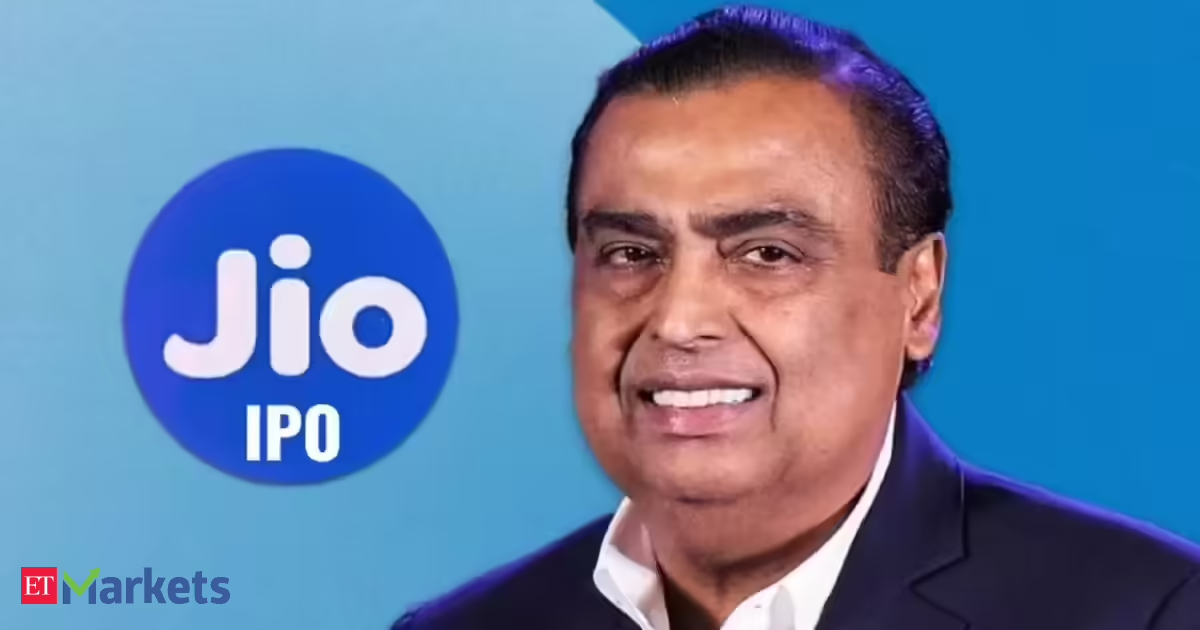
Jio, a crown jewel of billionaire Mukesh Ambani’s oil-to-retail conglomerate, filed the draft documents on Friday for an IPO that includes the issuance of as many as 270 million new shares, kick-starting a long-awaited process of unlocking shareholder value.
While the draft document didn’t specify the potential size of IPO, it mentioned that 275 billion rupees ($2.9 billion) will be used for repaying existing loans while some funds could be used for general corporate purposes.
Reliance Jio Infocomm Ltd., its telecom unit, holds three so-called ECB facilities totaling 300.6 billion rupees in dollar and yen terms, the document showed. Australia & New Zealand Banking Group Ltd., Bank of America Corp., Barclays Bank Plc, BNP Paribas and Citibank are among lenders. The borrowings are proposed to be prepaid in full or in part from Jio Platforms’ IPO net proceeds, according to the draft document.
 Agencies
Such prepayments will help reduce net debt and associated servicing costs, Jio Platforms said in the draft herring prospectus.
“Additionally, the company believes that this would improve our ability to raise further resources in the future to fund potential business development opportunities,” it said.
The deleveraging of the balance sheet will also position Jio Platforms favorably for continued investment in its strategic priorities, including 5G network densification and expansion, fixed broadband penetration, AI and cloud services, it said.
Citigroup Has Two PFDs To Consider: N & R


As an individual investor nearing retirement I am trying to build my financial assets in order to have a fulfilling retirement. I am interested in trading both long and short; or at least using inverse ETFs, to take advantage of market declines. Having long term and short term trading strategies, proper execution of my trading plan, and absolute investing results are my goals. I see my articles as a way to keep me focused on developing winning trades. I also expect to learn much from the feedback that is provided in the comments section.
Analyst’s Disclosure: I/we have no stock, option or similar derivative position in any of the companies mentioned, but may initiate a beneficial Long position through a purchase of the stock, or the purchase of call options or similar derivatives in KMX over the next 72 hours. I wrote this article myself, and it expresses my own opinions. I am not receiving compensation for it (other than from Seeking Alpha). I have no business relationship with any company whose stock is mentioned in this article.
Seeking Alpha’s Disclosure: Past performance is no guarantee of future results. No recommendation or advice is being given as to whether any investment is suitable for a particular investor. Any views or opinions expressed above may not reflect those of Seeking Alpha as a whole. Seeking Alpha is not a licensed securities dealer, broker or US investment adviser or investment bank. Our analysts are third party authors that include both professional investors and individual investors who may not be licensed or certified by any institute or regulatory body.


Financial analyst by day and a seasoned investor by passion, I’ve been involved in the world of investing for over 15 years and honed my skills in analyzing lucrative opportunities within the market.I specialize in uncovering high quality dividend stocks and other assets that offer potential for long term-growth that pack a serious punch for bill-paying potential. I use myself as an example that with a solid base of classic dividend growth stocks, sprinkling in some Business Development Companies, REITs, and Closed End Funds can be a highly efficient way to boost your investment income while still capturing a total return that follows traditional index funds. I created a hybrid system between growth and income and manage to still capture a total return that is on par with the S&P.
Analyst’s Disclosure: I/we have no stock, option or similar derivative position in any of the companies mentioned, but may initiate a beneficial Long position through a purchase of the stock, or the purchase of call options or similar derivatives in ITWO over the next 72 hours. I wrote this article myself, and it expresses my own opinions. I am not receiving compensation for it (other than from Seeking Alpha). I have no business relationship with any company whose stock is mentioned in this article.
Seeking Alpha’s Disclosure: Past performance is no guarantee of future results. No recommendation or advice is being given as to whether any investment is suitable for a particular investor. Any views or opinions expressed above may not reflect those of Seeking Alpha as a whole. Seeking Alpha is not a licensed securities dealer, broker or US investment adviser or investment bank. Our analysts are third party authors that include both professional investors and individual investors who may not be licensed or certified by any institute or regulatory body.

The company said the transition marks a significant milestone in strengthening alignment with parent entity BSE Ltd and reinforces its role within the broader BSE ecosystem.
BSECL will continue to provide clearing, settlement and risk management services across the equity, equity derivatives, currency derivatives, debt, commodity, mutual fund, electronic gold receipt (EGR) and securities lending and borrowing (SLB) segments, among others.
The company said it remains committed to ensuring financial market stability, efficient collateral management and the highest standards of regulatory compliance as mandated by the Securities and Exchange Board of India (SEBI).
“The transition from ICCL to BSE Clearing Limited reflects our strong alignment with the BSE brand and our role as a trusted pillar of India’s financial market infrastructure. Over the years, we have built robust clearing, settlement, and risk management capabilities that support market integrity and investor confidence,” said Vaisshali Babu, Managing Director and Chief Executive Officer of BSE Clearing Limited.
“As we embark on this new chapter, we remain steadfast in our commitment to operational excellence and regulatory compliance while supporting the long-term resilience of India’s capital markets,” she added.
According to the release, the rebranding will have no impact on the corporation’s operations, legal obligations, contracts or service commitments towards members, participants and stakeholders.All existing agreements, memberships and regulatory registrations will continue without interruption, the company said.
BSE, Asia’s oldest stock exchange, is also the world’s largest exchange by number of listed companies. Over the years, it has played a key role in the development of India’s capital markets and serves as a major platform for companies raising capital. Its benchmark index, the Sensex, is widely tracked by domestic and global investors as a gauge of Indian equity market performance.
(Disclaimer: Recommendations, suggestions, views and opinions given by the experts are their own. These do not represent the views of The Economic Times)

The growing push to restrict Americans from using federal food aid to buy certain processed or sugary products is creating a new challenge for some of the biggest U.S. food and beverage companies.
The U.S. Department of Agriculture as of May had approved food restriction waivers for Supplemental Nutrition Assistance Program benefits in 23 states, affecting roughly one-third of all SNAP participants, according to Numerator. The research firm estimates the restrictions could reduce food and beverage sales by as much as $830 million this year as consumers either shift spending to approved products or cut back overall.
Kroger CEO Greg Foran said on the company’s first-quarter earnings call on Thursday that customers remain under pressure in part due to reduced SNAP benefits, as well as higher gas prices, “squeezing budgets.”
“Customers are managing spend carefully and shopping with real intent,” Foran said.
Most waivers focus on limiting consumption of sugar-sweetened beverages and confectionery products, signaling a targeted approach rather than broad food restrictions. As the movement spreads, it’s forcing major packaged food companies to monitor shopper behavior and assess whether they need to remake product lines — though many of them have already been changing what they offer after consumer habits shifted in recent years.
Iowa recently became the first state to codify elements of the “Make America Healthy Again,” or MAHA, movement into law, approving legislation that targets artificial food dyes, ultra-processed foods in school and purchases made through SNAP.
“Altogether, this bill advances the health and wellness for every Iowan today and for generations to come,” said Iowa Gov. Kim Reynolds when she signed the measure last month.
She added the law helps “refocus federal food assistance programs on the actual purpose for which they were created: helping low-income families afford nutritious food.”
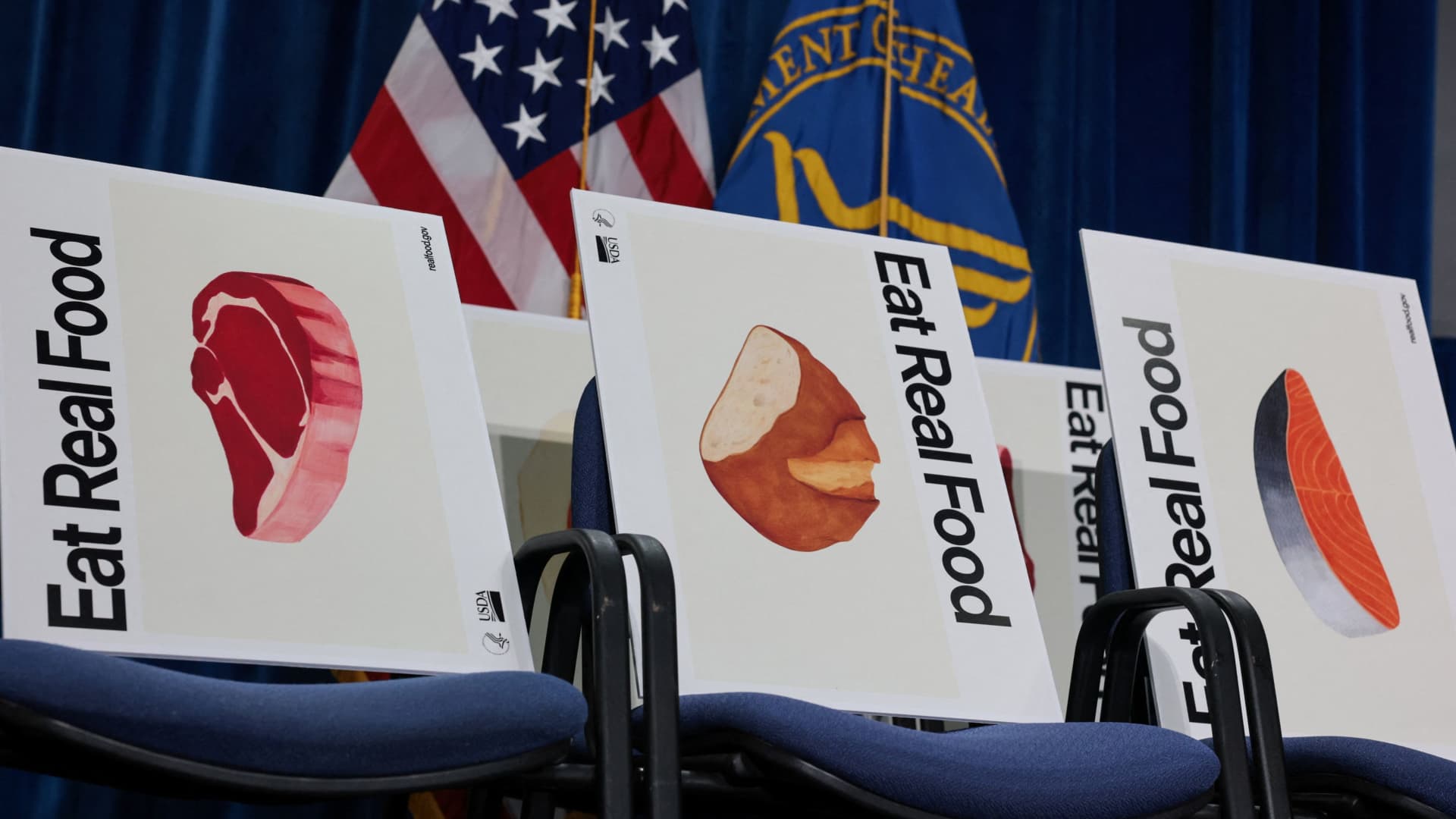
Attendees are greeted with”Eat Real Food” placards as they gather for U.S. Health and Human Services (HHS) Secretary Robert F. Kennedy, Jr. and Agriculture Secretary Brooke Rollins to announce new nutrition policies at the Department of Health and Human Services in Washington, D.C., U.S., January 8, 2026.
Jonathan Ernst | Reuters
The law bans several synthetic dyes, including Red 40 and Yellow 5, from most K-12 school meals and vending machines, while also restricting SNAP recipients from using benefits to buy products such as soda and candy.
Navigating the MAHA era
Many food companies aren’t waiting to see how policies evolve.
At a Goldman Sachs conference in May, Hershey said it has researchers in Texas conducting in-store interviews with shoppers who receive SNAP benefits to understand how purchasing behavior is shifting under new restrictions in the state.
“We’ve observed some consumer uncertainty at the register as new restrictions take effect,” a Hershey spokesperson told CNBC. “We anticipate this will improve as store execution improves, rules become clearer, and SNAP users can plan and budget with more certainty.”
The company is studying everything from product substitutions to budget tradeoffs, offering an early glimpse into how major food manufacturers are preparing for a potentially significant shift in consumer demand.
Many of the products most exposed to the changes are produced by some of the largest companies in the industry like Kraft Heinz, PepsiCo, Coca-Cola, General Mills, Nestle and others.
J.M. Smucker CEO Mark Smucker, however, told CNBC he expects the SNAP policy changes to have a more muted impact.
“I would say the current environment isn’t really that different than what we’ve seen over time, and thus far some of the modifications have really had no meaningful impact to our business,” he said.
Still, the company’s Hostess products like Twinkies and Donettes — the latter of which saw net sales grow 13% in the latest quarter, according to the company — may be impacted under broader state restrictions on “highly processed snacks.”
Current SNAP waivers in states like Texas focus primarily on candy and sugary drinks, not snack cakes. However, some states have proposed broader definitions that could eventually encompass packaged desserts and sweet baked goods.
At the same time, fewer Americans are even receiving the benefits. One analysis estimates 3.5 million people have lost their SNAP aid since President Donald Trump last year signed a sweeping bill that restricts eligibility for SNAP, among other changes.
Many U.S. households have found it harder to pay for groceries following the changes. The restrictions have also meant fewer dollars flowing to major businesses.
Walmart is particularly exposed to SNAP spending, capturing roughly a quarter of all SNAP grocery dollars nationwide, according to Numerator. Kroger, Costco and Amazon follow at about 8%, 6% and 5%, respectively.
The curbs on what consumers can buy with federal assistance are only one shift food companies are watching.
At a hearing of the Senate Committee on Health, Education, Labor and Pensions in April, Health and Human Services Secretary Robert F. Kennedy Jr. went as far as to say he “would support” a ban on junk-food television advertising. The department has not yet taken steps to introduce such a ban.
Responding both to Kennedy’s MAHA initiative and shifting consumer tastes, food manufacturers have also accelerated efforts to reformulate products and reduce synthetic ingredients in products like Kool-Aid, Fanta, Doritos and Flamin’ Hot Cheetos, which contain dyes like Red 40 and Yellow 5.
General Mills, Kraft Heinz and Target have all pledged to phase out certain artificial colors and additives by 2027 or sooner.
Nestle announced Monday it achieved its commitment on time to fully eliminate Food, Drug & Cosmetic colors from its U.S. food and beverage portfolio.

Roku: Fox Deal Changes The Narrative (Rating Downgrade)

The attack on Young Bob is part of an alarming trend

ITV upgrades Emma Hayes’ tactics corner after sexism storm over ‘kitchen’ set

I Found 29 Early Prime Day Deals That Are Worth Shopping Now (2026)


-

 Business6 days ago
No Jackpot Winner as $257 Million Prize Rolls Over to $269 Million Monday Draw
-
 Crypto World6 days ago
Zimbabwe Requires Crypto Businesses to Register Annually Under New FIU Regulations
-

 Fashion19 hours ago
Weekend Open Thread: Miami – Corporette.com
-
 Entertainment6 days ago
Matt Damon’s Viral Sci-Fi Thriller Has Taken Over HBO Max
-

 Tech6 days ago
As AI companies race to go public, who else is along for the ride?
-

 Business6 days ago
Anthropic staff to meet White House officials next week, Axios reports
-
 Crypto World6 days ago
Bitcoin could crash to $48,000, if this historical pattern is triggered
-

 Entertainment7 days ago
Deion Sanders Shares Powerful Post After Viral Advice To Deiondra
-
 NewsBeat6 days ago
what doctors are seeing in ebike crashes
-
 NewsBeat6 days ago
Warning of disruption as Cardiff Crossrail works to start
-
 NewsBeat6 days ago
Tributes to former deputy head teacher at Cambridge school among death and funeral notices
-

 Politics6 days ago
“Israel’s” ban on ICRC visits ruled illegal, but Knesset moves to stop them permanently
-

 News Videos6 days ago
Financial Accounting | Last Day Revision Strategy and Booster | CMA Inter – June 2026
-
 Entertainment6 days ago
Kate Middleton Glare Goes Viral After Kids Booed At Royal Event
-

 Tech6 days ago
Over 400 Arch Linux packages compromised to push rootkit, infostealer
-

 Crypto World6 days ago
XRP ETFs Outperform As Bitcoin And Ethereum Funds Extend Outflow Trend
-

 Business6 days ago
Invesco Quality Income Fund Q1 2026 Commentary
-
 Crypto World6 days ago
Market Preview: SpaceX (SPCX) IPO Record, Federal Reserve Meeting, and Iran Nuclear Agreement
-

 NewsBeat6 days ago
Singer Oliver Tree dies aged 32 in helicopter crash in Brazil
-

 Sports6 days ago
Dick Advocaat’s Curacao scores first-ever World Cup goal against Germany
You must be logged in to post a comment Login