Connect with us

Business

Wyndham Clark Takes Four-Shot Lead Into U.S. Open Round 3 at Shinnecock Hills

Published

on

Rory McIlroy Repeats as Masters Champion, Joins Elite Club with

SOUTHAMPTON, N.Y. — Halfway through the 2026 U.S. Open and one thing is clear: Wyndham Clark is on a heater.

The 32-year-old has had just one top-10 finish in a major since his 2023 U.S. Open victory. But Clark won in Dallas a few weeks ago at the Byron Nelson and is clearly on top of his game. His 1-under 69 was good enough to leave him at 7 under for the tournament, four shots clear of the field through 36 holes.

The question now is whether Clark will be able to extend his lead, or if anyone — like fellow major champions Xander Schauffele, Matt Fitzpatrick, or even Justin Thomas — can make a move on the leader.

The Leaderboard Entering Round 3

Advertisement

Leaders at the start of Round 3 were led decisively by Clark, with a deep pack of contenders separated by just a handful of strokes behind him. Wyndham Clark sat at 7 under, four shots clear of a tie for second between Matt Fitzpatrick, Xander Schauffele, Sam Stevens, and Tom Kim, all at 3 under. Collin Morikawa followed at 2 under in sole possession of sixth place, while a four-way tie for seventh at 1 under included Justin Thomas, Harry Higgs, Sam Burns, and Sahith Theegala.

Betting Markets Reflect Clark’s Lead

Oddsmakers have installed Clark as the clear betting favorite heading into the weekend, reflecting both his commanding margin and his recent form. According to BetMGM, Clark is priced at +175 to win the championship, with Matt Fitzpatrick and Xander Schauffele both listed at +650. Scottie Scheffler sits at +1000 despite trailing significantly on the leaderboard, while Collin Morikawa is priced at +1400 and Rory McIlroy at +1600.

Notable Names Who Missed the Cut

Advertisement

The weekend field will be missing several recognizable names, most notably the tournament’s defending champion. Among the group of players who missed the cut at the 2026 U.S. Open, defending champion J.J. Spaun stands out most, unable to advance within the top 60 players plus ties. Florida amateur Giuseppe Puebla also missed the cut, along with other former major champions Jon Rahm, Brooks Koepka, and Graeme McDowell.

Saturday’s Tee Times

Round 3 tee times sent the morning groups out starting at 9 a.m. Eastern Time, with the leaders teeing off in the afternoon as the day progressed. The day began with Dylan Wu and Jacob Bridgeman at 9 a.m., followed by groups including Chris Gotterup paired with amateur Eric Lee, and Robert MacIntyre alongside amateur Marek Flemming.

Notable afternoon pairings included Jordan Spieth and Joaquin Niemann at 10:55 a.m., Russell Henley and Dustin Johnson at 11:06 a.m., and Tommy Fleetwood paired with Ludvig Åberg at 12:50 p.m. Scottie Scheffler went out with Brian Harman at 2:01 p.m., while Rory McIlroy was paired with Maverick McNealy at 2:12 p.m.

Advertisement

The leaders rounded out the day’s final groups, with Ryder Cowan, an amateur, paired alongside William Mouw at 2:50 p.m. Sahith Theegala and Sam Burns followed at 3:01 p.m., with Harry Higgs and Justin Thomas at 3:12 p.m., Collin Morikawa and Tom Kim at 3:23 p.m., Sam Stevens and Xander Schauffele at 3:34 p.m., and the final pairing of the day, Matt Fitzpatrick alongside leader Wyndham Clark, set for 3:45 p.m.

TV and Streaming Schedule

Round 3 of the 2026 U.S. Open will broadcast nationally on USA starting at 10 a.m. before switching to NBC at noon. The main broadcast is available to stream via Sling, which carries the NBC networks. Featured group and hole streaming is available on Peacock, NBCUniversal’s subscription streaming service, or for free at USOpen.com when play begins.

A Record Purse on the Line

Advertisement

This year’s championship carries the largest financial stakes in tournament history, reflecting the broader trend of escalating prize money across professional golf’s major championships. The overall purse for the 2026 U.S. Open is a record $22.5 million, an increase of $1 million from the 2025 purse. The winner’s share will be another record — $4.5 million.

About the Venue

The U.S. Open site rotates every year, and this year’s host is Shinnecock Hills Golf Club on Long Island in Southampton, New York. The course opened in 1891 and has hosted five previous U.S. Opens, most recently in 2018. Shinnecock Hills plays at par-70 over 7,440 yards, presenting one of the more demanding tests on the major championship rotation, with its firm, undulating greens and exposed coastal positioning historically producing some of the most dramatic scoring swings in U.S. Open history.

A Look Back at Last Year’s Champion

Advertisement

The current championship follows directly on the heels of a dramatic finish at last year’s tournament, where a relatively unheralded contender claimed his breakthrough title. J.J. Spaun picked up his first career major title when he was the only player to finish under par at the 2025 U.S. Open at Oakmont Country Club in Pennsylvania. His 65-foot birdie putt on the final hole capped a two-stroke victory over Robert MacIntyre.

What’s at Stake This Weekend

With Clark holding a substantial four-shot cushion heading into the third round, the central storyline for the remainder of the weekend centers on whether that lead can hold up against a deep and accomplished chasing pack that includes multiple past major champions. Clark’s recent victory at the Byron Nelson, combined with his existing U.S. Open pedigree from his 2023 title, gives him both the recent form and the championship experience that often proves decisive in closing out a major down the stretch.

For the chasing group — particularly Schauffele and Fitzpatrick, both former major winners sitting four shots back — Saturday’s third round represents a critical opportunity to either close the gap or watch Clark extend his advantage into what would become an increasingly commanding position heading into Sunday’s final round. With Shinnecock Hills’ demanding setup historically capable of producing dramatic swings in either direction, the tournament’s outcome remains far from decided despite Clark’s strong position at the midway point.

Advertisement
Continue Reading
Click to comment

You must be logged in to post a comment Login

Leave a Reply

Business

Hims & Hers Health: Still An Undervalued Company With Tremendous Upside (NYSE:HIMS)

Published

on

Hims & Hers Health: Still An Undervalued Company With Tremendous Upside (NYSE:HIMS)

This article was written by

Raul Shah is the Chief Investment Officer of DocShah Financial LLC, a classic value investing firm. We manage investment portfolios and tax planning for clients across the United States. Disclaimer: All writing presented is solely for entertainment purposes and not financial advice. Neither DocShah Financial nor its representatives are responsible for any financial outcome which may occur. We do not give out investment advice to the public nor any individual, unless they are a client under our advisory services and subject to the terms and conditions which apply.

Analyst’s Disclosure: I/we have a beneficial long position in the shares of HIMS either through stock ownership, options, or other derivatives. I wrote this article myself, and it expresses my own opinions. I am not receiving compensation for it (other than from Seeking Alpha). I have no business relationship with any company whose stock is mentioned in this article.

This article is for informational purposes only and is not intended as a recommendation. The information presented here is based on publicly available data, and I have no knowledge of your individual financial circumstances. It should not be construed as a recommendation or a solicitation to become a client of DocShah Financial, nor does it establish any advisory relationship between you, the reader, and DocShah Financial. It’s important to note that conflicts of interest may exist, and I or my clients may have holdings in the stocks discussed and are subject to change at any time without prior notice. Any decision to invest should be based on your own research and consultation with a qualified financial advisor. Investing involves risks, and past performance is not indicative of future results. DocShah Financial or I may stand to gain from stock purchases, and readers should carefully consider their own risk tolerance and financial situation before making any investment decisions. You are fully responsible for any investment outcome.

Advertisement

Seeking Alpha’s Disclosure: Past performance is no guarantee of future results. No recommendation or advice is being given as to whether any investment is suitable for a particular investor. Any views or opinions expressed above may not reflect those of Seeking Alpha as a whole. Seeking Alpha is not a licensed securities dealer, broker or US investment adviser or investment bank. Our analysts are third party authors that include both professional investors and individual investors who may not be licensed or certified by any institute or regulatory body.

Continue Reading

Business

Tempus AI, Inc. 2026 Q2 – Results – Earnings Call Presentation (NASDAQ:TEM) 2026-07-30

Published

on

OneWater Marine Inc. (ONEW) Q1 2026 Earnings Call Transcript

This article was written by

Seeking Alpha’s transcripts team is responsible for the development of all of our transcript-related projects. We currently publish thousands of quarterly earnings calls per quarter on our site and are continuing to grow and expand our coverage. The purpose of this profile is to allow us to share with our readers new transcript-related developments. Thanks, SA Transcripts Team

Continue Reading

Business

South Korea’s Kospi rockets 17% after massive 3-day selloff. What’s behind the surge?

Published

on

South Korea’s Kospi rockets 17% after massive 3-day selloff. What’s behind the surge?
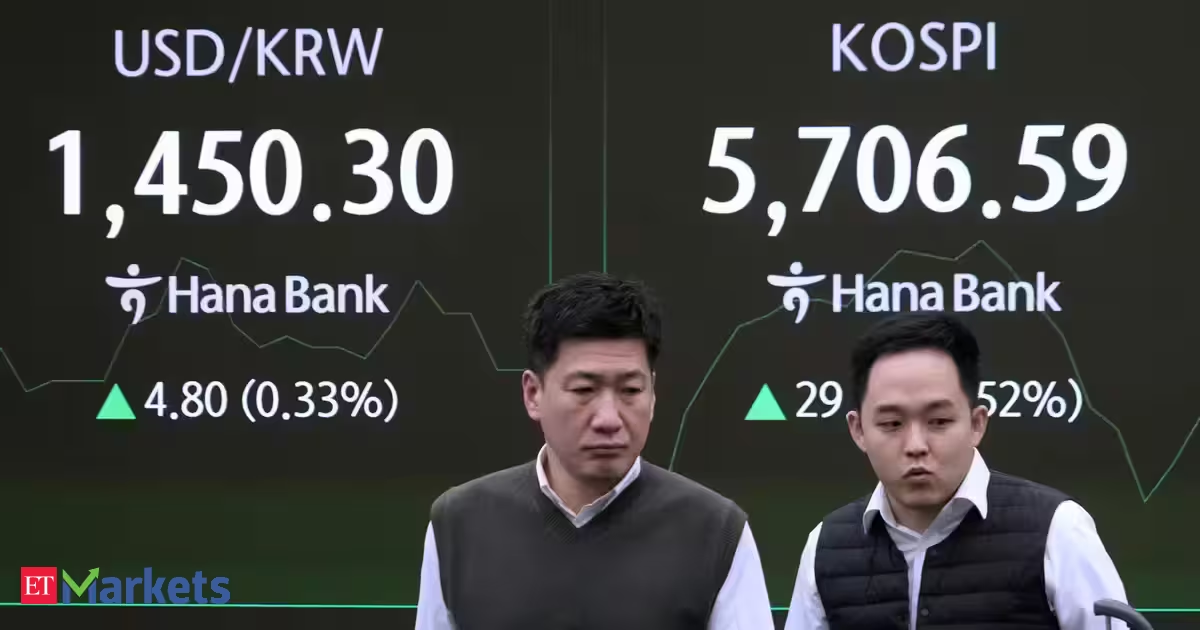
South Korea’s benchmark KOSPI index staged a dramatic comeback on Friday, jumping more than 16% to recoup almost all the losses suffered earlier this week. The rally was powered by sharp gains in heavyweight chipmakers Samsung Electronics and SK Hynix, tracking a strong recovery in U.S. technology stocks. Trading was briefly halted as has been the case this year amid sharp swings.

The KOSPI was up 17% at 6,549 points after tumbling nearly 17% over the previous three sessions, marking one of its steepest weekly declines, as fears of mounting competition from Chinese memory chipmakers triggered heavy selling across semiconductor stocks.

What’s behind the surge?

Investor sentiment improved after Wall Street rebounded strongly on Thursday, led by technology shares. Better-than-expected earnings from Microsoft renewed confidence in artificial intelligence spending and cloud demand, helping reverse concerns that massive AI investments were not translating into adequate returns.

Also read:
Korea’s pain will be India’s gain? Why Nifty bears betting on Kospi crash may get disappointed

Microsoft led the advance after reporting robust Azure cloud growth, easing worries over the payoff from heavy AI infrastructure spending. Further, Amazon jumped more than 9% in extended trading after reporting second-quarter revenue that topped analysts’ expectations, supported by continued strength in its cloud computing business.

Advertisement

The positive momentum spread to Asia, where Samsung shares surged more than 21% and SK Hynix soared over 26%. Both companies had reported strong quarterly results earlier this week. Samsung posted a record quarterly profit, driven by its semiconductor business, and said it expects a favorable supply-demand environment for memory chips to continue through at least 2027 while pointing to an increase in long-term customer contracts. SK Hynix also reported record revenue, although its quarterly profit came in below elevated market expectations.

Strong global cues

U.S. equities also rebounded on Thursday after the previous session’s sell-off that followed the Federal Reserve’s decision to keep interest rates unchanged. Technology stocks and semiconductor companies led the recovery. The Nasdaq Composite rose 2.8% to close at 25,122.18, snapping a six-session losing streak. The Dow Jones Industrial Average gained 613.92 points, or 1.2%, to finish at 52,208.06, while the S&P 500 advanced 1.7% to 7,437.63.Earlier this week, semiconductor stocks had faced additional pressure as investors questioned the scale of artificial intelligence spending.
The key concern for investors remains whether companies investing billions of dollars in artificial intelligence can generate sufficient returns to justify those expenditures.
Further, developments in China further fueled investor concerns. ChangXin Memory Technologies (CXMT) made a blockbuster market debut, with its shares soaring nearly 500%. Reports also indicated that a Chinese state-backed company had begun producing immersion DUV lithography equipment.

Read more:
80% of Indian stocks are in bear market. Is it time to be greedy or fearful?

“The market’s concern lies less in CXMT’s current earnings and more in its potential for accelerated capacity expansion to rival Korean companies and technology development following its IPO,” Kim Seok-hwan, a Seoul-based market analyst at Mirae Asset Securities, told Reuters.

Despite the recent rout, South Korea remains the world’s best performing equity market in 2026. The sharp correction has dragged the benchmark KOSPI nearly 40% below its June peak of 9,386.

Advertisement

South Korea’s government has been scrambling to implement measures to protect investors’ wealth from the crashing stock market. Finance minister Koo Yun-cheol on Wednesday said that the government is reviewing market stabilisation measures, including adjusting regulations related to single-stock leveraged ETFs. Some analysts have said the products exacerbate market volatility.

Earlier this month, the finance ministry said market swings have intensified due to foreign and institutional investor profit-taking, portfolio rebalancing, and changing expectations around the global artificial intelligence sector. “Increasing concentration in the semiconductor sector has become a factor raising financial market volatility, with the impact of fluctuations in the chip sector on the whole stock market growing,” the ministry said in a statement.

(Disclaimer: Recommendations, suggestions, views and opinions given by the experts are their own. These do not represent the views of Economic Times)

Advertisement
Continue Reading

Business

Tesla weighs sale of China business to pave way for potential SpaceX merger, WSJ reports

Published

on


Tesla weighs sale of China business to pave way for potential SpaceX merger, WSJ reports

Continue Reading

Business

From Batch Risk to Brand Strength With the Right Oil Packaging

Published

on

From Batch Risk to Brand Strength With the Right Oil Packaging

Anyone selling natural oils knows that quality is not just about the formula. Essential oils, serums, and botanical blends are sensitive to light and oxygen.

Once an oil starts to oxidise, the difference may show up in its smell, colour or general character. Customers notice those things. A product that seems different from the last bottle can quickly turn into a question, a complaint or a return. For a smaller brand, even a modest number of cases like this can become expensive, particularly when trust and repeat orders are still being built.

This matters even more as natural beauty and wellness products become a bigger part of the market. Many buyers now look closely at ingredient lists and prefer products with fewer preservatives. They also pay attention to what the product comes in, including whether the packaging feels responsible and appropriate for natural oils.That puts pressure on producers to safeguard shelf life without making the formula heavier. This is exactly where packaging becomes a strategic choice.

Why Light and Oxygen Eat Into Your Margin

Many brands default to amber glass or plastic. That is understandable, it is widely available and relatively affordable. But for light sensitive oils, the total cost can end up higher than the purchase price of the bottle itself. Think of:

  • More rejected batches due to instability
    • Shorter shelf life and therefore faster stock turnover
    • Extra customer service due to scent or color deviations
    • Risk of negative reviews

Photodegradation can play a role especially in products with unsaturated fatty acids, natural antioxidants, or volatile aroma components. Packaging that reduces light exposure therefore supports not only product quality, but also predictability across the supply chain and retail.

Biophotonic Violet Glass as an Option for Light Sensitive Formulas

Biophotonic violet glass is designed to protect contents from a large part of the visible light spectrum that can accelerate degradation, while still allowing certain wavelengths through. The premise is simple: less light stress means a better chance of preserving scent, color, and efficacy.

Advertisement

Aromatherapy and wellness oils are often sold in small dropper bottles, which makes sense for products that are used a few drops at a time.In that segment, essential oil bottles in violet glass are relevant when you want to combine premium positioning with protection against light exposure.

In skincare and personal care, ease of use matters alongside protection, think pipettes, pumps, and consistent dosing. For brands seeking a uniform, luxury look, cosmetic bottles in violet glass are a logical option, especially when bringing multiple SKUs into the same design line.

The Closure Matters as Much as the Bottle

The bottle receives most of the attention, but the closure can be just as important for product stability. A high-quality glass container will not compensate for a poorly fitted dropper, loose cap, or pump that allows too much air into the package.

This is particularly relevant for oils with volatile aromatic compounds. Every time the bottle is opened, the formula is exposed to fresh air. The amount of exposure depends on the opening size, the dosing system, how often the product is used, and how well the closure seals between applications.

Advertisement

For that reason, packaging development should consider the bottle and closure as one system. A dropper that works well with a facial serum may not be ideal for a thinner essential oil. Pumps may offer cleaner dosing for some cosmetic products, while reducer inserts can make more sense for concentrated oils.

It is worth checking the smaller parts of the closure too, not just the bottle itself. Strong botanical oils can sometimes react with rubber, plastic, liners or seals in ways that are not obvious at first. Testing the full bottle and closure together before launch can reveal problems such as swelling, softening, leaks or changes in the product.

Headspace Can Influence Product Stability

Even the air left inside the bottle deserves some attention. When there is a lot of empty space above the oil, there is also more oxygen in the container, and that can slowly affect formulas that are sensitive to air.

This is worth thinking about when the bottle is much larger than the amount inside it. A 30 ml oil in an oversized container may look impressive on the shelf, but the extra air inside can work against the effort to keep the product stable.

Advertisement

A better fit between the fill amount and the bottle size can make sense for both protection and presentation. It also avoids using more packaging than the product really needs.

For formulas that react quickly to oxygen, the filling stage may need closer attention as well. Some producers reduce air contact during filling, while others use inert gas where the formula and production setup justify it.These decisions depend on the formula and manufacturing setup, but they show why packaging performance cannot be separated completely from the filling process.

Packaging Choices Affect Inventory Planning

Shelf stability is not only a laboratory concern. The type of packaging a brand uses can also shape its stock planning, including how much product it keeps on hand and when the next production run needs to happen.

For a smaller business, this can be a difficult balance. Minimum order quantities, batch sizes and storage costs all have to be planned around demand that may change from month to month. When an oil has a limited stability window, older stock can become a concern sooner than expected, sometimes leading to smaller production runs or early discounts just to keep inventory moving.

Advertisement

Packaging that gives the formula better protection can make that planning a little less restrictive.

Stock can potentially remain commercially viable for longer, retailers may face fewer quality concerns, and the business has more room to manage slower-moving SKUs.

This does not mean every product automatically needs the highest specification bottle available. It means packaging should be evaluated against the cost of instability. A slightly higher packaging cost can be easier to justify when it helps reduce write-offs, replacements, or emergency production runs.

Storage and Distribution Should Be Part of the Test

A formula may perform perfectly in controlled storage and still experience problems during real-world distribution.

Advertisement

Products can spend days in delivery vans, warehouses, fulfillmentcenters, retail stockrooms, or customer mailboxes. Conditions during delivery are rarely consistent. A package may sit in a warm van, move through a cool warehouse, get shaken during transport, or spend time in direct light before it reaches the customer.

That makes transport testing just as useful as checking shelf stability. The aim is to see what happens to the complete pack under movement and temperature changes. Closures can loosen, droppers can seep, labels can lift, and the formula itself may respond differently after repeated heat exposure.

For online sellers, even a small leak can become a much bigger problem.One failed bottle can ruin the outer packaging, stain other products in the shipment, and create an immediate negative first impression.

Testing packaging under conditions that resemble the actual supply chain gives a more useful picture than testing the formula in isolation.

Advertisement

Premium Packaging Also Shapes Customer Perception

Packaging protection has a technical role, but it also affects how customers interpret the product.

Natural oils often compete in crowded categories where formulas can appear similar at first glance. Bottle weight, glass color, closure quality, label finish, and dispensing experience all influence perceived value before the customer has fully evaluated the product itself.

Violet glass can create a distinctive visual identity compared with conventional clear or amber packaging. For premium wellness, aromatherapy, and skincare brands, that differentiation can support higher-value positioning when it fits the broader brand story.

The important point is consistency. A premium bottle paired with a low-quality dropper, weak label, or poor outer carton creates mixed signals. Everything should work together, from the bottle and cap to the label, dispensing method and how the product feels in the customer’s hand.

Advertisement

Sustainability Needs More Than a Material Claim

There is more to sustainable packaging than deciding between glass and plastic. The amount of material, shipping distance and what happens to the pack once it is empty all count.

Glass has the advantage of being recyclable and suitable for reuse, but its weight can make transport more demanding. A lighter pack may be easier to ship, although it will not always give a sensitive oil the same protection.Refillable systems can reduce packaging use, but only when customers actually reuse them.

Brands therefore need to consider the complete packaging system rather than relying on one environmental claim.

Useful questions include whether the glass can enter established recycling streams, whether components can be separated easily, whether unnecessary secondary packaging can be removed, and whether the container is durable enough for reuse.

Advertisement

There is also a product-waste angle. If stronger protection helps prevent oils from degrading before they are used, that can reduce wasted formula, ingredients, labor, and production energy. Sustainability is therefore connected not only to the container itself, but also to how successfully the packaging preserves the product inside it.

Build Packaging Around Future Growth

A packaging solution that works for the first 500 units may become difficult when monthly production reaches 10,000 units.

Growing brands should consider supply continuity early. That means looking beyond the bottle itself. Brands also need to know whether the supplier can keep the same packaging available, how long orders take to arrive, what quantities must be purchased, and whether matching closures and finishes will still be available as demand grows.

Using some of the same components across several products can make purchasing easier. Different oils, for example, might use the same neck size and closure even when the bottle size or label changes.That reduces the number of separate packaging components the business needs to manage.

Advertisement

It also helps maintain a recognizable visual identity as the product range expands.

Packaging decisions are therefore partly about today’s formula and partly about tomorrow’s assortment. A scalable system can reduce redesign work, supplier changes, and packaging inconsistencies later.

How to Make Claims Measurable Without Marketing Risk

A common pitfall in packaging communication is making absolute claims such as doubles shelf life or 100% protection. In practice, performance depends on the formula, headspace, closure, storage, and logistics. What you can do is test and back up your claims with data.

A small team can keep the testing fairly straightforward:

Advertisement
  1. Start with each formula on its own. Look at how easily it reacts to light, air and changes in storage conditions.
  2. Test the current bottle and the new option side by side, keeping the closure and test conditions the same for both.
  3. Measure not only shelf life, but also sensory attributes (scent and color) and key actives.

A compact stability setup can already reveal where the real gains lie: fewer complaints, less waste, and a more consistent product on the shelf.

Three Checks for Your Next Packaging Decision

  • Does the closure fit the product, and has leakage been tested during transport?
    • Is the packaging scalable in terms of volumes and availability as you grow?
    • Does the material support your brand story around sustainability and premium quality?

These three questions are a useful starting point, but the strongest packaging decisions usually come from looking at the complete journey of the product. That includes filling, storage, transport, retail exposure, customer use, and eventual disposal or reuse.

Unit price still matters, especially for smaller brands working with tight margins. But it should not be considered in isolation. Packaging that reduces product degradation, limits leakage, supports smoother inventory planning, and creates a stronger customer experience can deliver value long after the bottle has been purchased.

For natural oil, wellness, and cosmetic brands, the right packaging is therefore more than a container around the formula. It is part of quality control, logistics, positioning, sustainability, and growth. Choosing it with the same care given to the ingredients can turn a potential source of batch risk into a practical source of brand strength.

Advertisement
Continue Reading

Business

Endeavour Mining plc (EDV:CA) Q2 2026 Earnings Call Transcript

Published

on

OneWater Marine Inc. (ONEW) Q1 2026 Earnings Call Transcript