

Crypto World
Ethereum Price Prediction: Can ETH Reclaim $2K Before Month-End?

After finding support around $1.5K earlier this month, Ethereum has managed to stage a modest recovery. However, the asset remains positioned below critical technical barriers, and sentiment metrics indicate that buyers have not yet regained control of the market. The latter specifically shows a lack of strong institutional demand, suggesting that recovery attempts could face considerable headwinds.
Ethereum Price Analysis: The Daily Chart
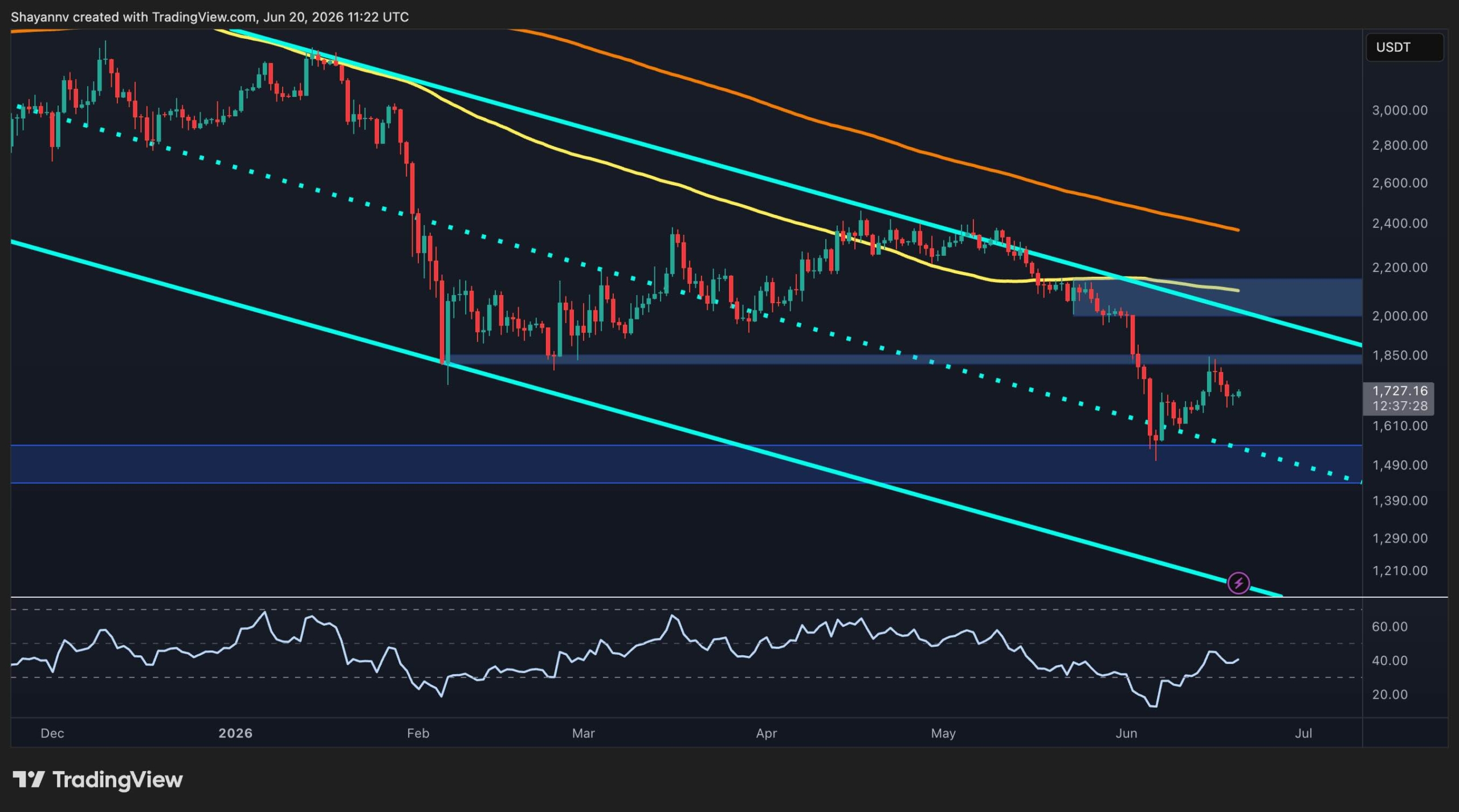
On the daily timeframe, ETH remains firmly inside the large descending channel that has guided price action lower for several months. The asset recently broke below the important $1.85K support area, which has now flipped into resistance. The breakdown accelerated selling pressure toward the major demand zone at roughly $1.5K. This area, coinciding with the mid-line of the channel, has successfully halted the decline so far, producing a relief bounce back toward the $1.8K region.
However, the asset was rejected from the $1.8k zone, and the broader structure remains bearish as ETH continues to trade below both the 100-day and 200-day moving averages, which are sloping downward in the $2.1K-$2.4K range.
The former support zone around $2K now represents the most significant resistance cluster overhead. A recovery into that area would likely attract fresh selling interest unless accompanied by a decisive breakout above the descending channel.
Yet, as long as ETH remains below $1.85K and beneath the channel resistance, the prevailing trend favors sellers. A decline from current levels could expose the $1.5K support region once again, while a breakdown below that demand zone would open the door for a deeper drop toward the lower boundary of the channel below the $1.2K mark.
ETH/USDT 4-Hour Chart
The 4-hour timeframe shows a clearer picture. Following the sharp selloff into the $1.5K support area, ETH formed a rising channel and began carving out higher lows. This recovery structure allowed price to rebound toward the $1.8K resistance zone, where sellers quickly regained control and pushed the asset back lower.
The rejection from that resistance area confirms its importance in the near term. Since then, ETH has broken below the ascending channel and is consolidating around $1.7K. The RSI also currently hovers around neutral territory, indicating that bearish momentum has eased but has not yet shifted decisively in favor of buyers.
Immediate support remains at $1.5K, which served as the origin of the recent bounce. Yet, if the measured move of the broken ascending channel plays out, the market could drop well below this zone. On the upside, buyers must still reclaim the $1.8K resistance region to generate stronger recovery momentum. Yet, as things stand, the overall bearish sentiment is still dominant.

Sentiment Analysis
The Coinbase Premium Index continues to provide a bearish signal for Ethereum. This metric measures the price difference between ETH traded on Coinbase and other major exchanges, often serving as a proxy for U.S. institutional and spot demand. Positive readings generally indicate stronger buying activity from Coinbase participants, while negative readings suggest weaker demand and increased selling pressure.
The latest data shows the Coinbase Premium Index remaining predominantly below zero, with recent readings approaching -0.1. This marks one of the weakest periods of Coinbase demand seen since the beginning of last year. Notably, the deterioration in the premium has occurred alongside ETH’s price decline, which reinforces the view that U.S.-based investors have not yet returned aggressively to the market.
Historically, sustained recoveries in Ethereum have often been accompanied by persistent positive premium readings. Until the metric can reclaim and hold above the neutral line, order flow suggests that rallies may continue to face selling pressure rather than broad-based accumulation.

The post Ethereum Price Prediction: Can ETH Reclaim $2K Before Month-End? appeared first on CryptoPotato.


For many traders, the “altseason” playbook has relied on a familiar pattern: profits from Bitcoin flow into smaller tokens, sparking broad-based rallies across the market. But new on-chain and market-structure indicators suggest that mechanism is weakening—and that could meaningfully change how altcoins move in the next phase of the cycle.
CryptoQuant CEO Ki Young Ju says the Bitcoin-to-altcoin rotation trade has “basically disappeared,” citing data that shows BTC-pair altcoin trading activity has fallen to its weakest levels since 2021. At the same time, the altcoin market appears more concentrated, with fewer large-cap tokens commanding most of the sector’s value—another factor that may reduce the breadth of any future rally.
Key takeaways
- CryptoQuant data cited by Ki Young Ju shows BTC-pair altcoin trading volume has dropped to post-2021 lows, weakening the usual rotation from Bitcoin into altcoins.
- Altcoin liquidity and capital are increasingly concentrated in fewer projects, which can delay or limit broad “altseason” style moves.
- Bitcoin dominance is showing early signs of a rebound that could keep capital favoring BTC over smaller tokens in the near term.
- The next phase of altcoin strength may depend less on “narrative-only” momentum and more on tokens tied to real usage and revenue themes.
Why the classic rotation trade is fading
Ki Young Ju, CEO of CryptoQuant, argues that the traditional “Bitcoin pumps, then alts catch up” sequence is no longer behaving the way it did during prior bull cycles. In a Saturday post on X, he said the Bitcoin-to-altcoin rotation trend has “basically disappeared,” pointing to CryptoQuant data that tracks aggregated altcoin trading volume for BTC-priced pairs.
That metric focuses on mid- and lower-cap altcoins traded against Bitcoin on centralized exchanges, explicitly excluding major assets such as Ether (ETH), XRP, BNB, and Solana (SOL). In other words, it attempts to measure whether traders are using BTC as the funding source for speculative positions in smaller coins.
Historically, that type of flow intensified during two key periods—2017 and again in 2021—helping set the conditions for some of the most aggressive alt rallies. But the chart Young Ju referenced suggests BTC-pair altcoin activity remains near post-2021 lows, implying that Bitcoin is no longer serving as the primary liquidity engine for broad alt speculation.
“The era of alts pumping just because BTC pumps may be over,” Young Ju wrote, framing the slowdown in rotation as a potential structural shift rather than a short-term pause.
More money, fewer tokens
Beyond rotation, the composition of the altcoin market also appears to have changed. Young Ju pointed to increasing concentration across the non-BTC, non-stablecoin segment. Using figures reported for Saturday, the non-BTC, non-stablecoin market value was roughly $600 billion, while the top 10 non-stablecoin altcoins accounted for about $483 billion—around 80.5% of the total.
That implies that instead of value spreading across a wide range of assets, the market’s center of gravity is moving toward a smaller set of larger names. When capital is clustered, rallies often become less uniform, with fewer tokens capturing most of the upside.
The narrowing of large-cap altcoins has also been highlighted by CoinMarketCap snapshots. According to a 2021 historical snapshot referenced in the source, there were roughly 106 altcoins above $1 billion in market valuation at that time. By June 2026, that number had fallen to around 50, suggesting that the pool of sufficiently large assets to dominate flows has shrunk materially.
Young Ju connects those trends to a broader maturity in the market. He also said in a separate thread that “narrative-only altcoins” are losing relevance as crypto develops, arguing that hype alone is no longer enough to sustain sustained attention across the board.
While that doesn’t mean the altcoin market is disappearing, it suggests a different kind of cycle—one where fewer projects benefit from most of the capital and where investor demand may be driven by more concrete fundamentals.
What themes could matter more than broad alt hype
Young Ju’s argument is not simply that altcoins are weaker; it’s that the strongest pockets of the market may be linked to areas with clearer business models and real-world utility. In his view, stronger activity is tied to revenue-generating decentralized finance, stablecoins, tokenized real-world assets, and AI agent-related applications.
That framing matters for traders because it changes the selection problem. If rotation into the entire alt market is less reliable, performance may hinge on identifying which tokens have genuine demand drivers rather than relying on “market beta” from broad speculation.
It also implies that the next alt cycle—if it arrives—may look different from the older playbook. Instead of a sweeping move across many names, the cycle could be characterized by narrower leadership tied to specific sectors where usage and adoption can compound.
Bitcoin dominance could be a near-term headwind
Another factor potentially limiting altcoin momentum is a rebound in Bitcoin’s share of the overall crypto market. The source cites Bitcoin dominance (BTC.D) showing early signs of a lift after interacting with its 100-week exponential moving average (100-week EMA) and the lower trend line of an ascending channel at around the 58.75% level, according to a weekly chart on TradingView.
In the same setup, BTC.D could rise toward the channel’s upper trend line near 60% if momentum continues. If BTC.D moves higher toward that level, the implication is straightforward: Bitcoin would be gaining market share relative to the rest of crypto, which can divert speculative liquidity away from smaller assets.
Analyst Rekt Capital shared a similar perspective on X, citing bullish divergence on Bitcoin dominance. The divergence described in the source follows a common technical interpretation: BTC.D making lower lows while the RSI makes higher lows, often signaling weakening downside pressure and the potential for a rebound—hence the view that “altseason is postponed.”
Rekt Capital, however, also warned that the upside may not be unlimited. He suggested the dominance rebound could represent a post-breakdown relief move before further weakness returns, with a bearish case pointing to BTC.D possibly drifting toward its 200-week EMA at around 57%.
For alt traders, the practical takeaway is that even if smaller coins find their footing, a strengthening BTC dominance trend can cap how broad and how fast alt rallies spread—particularly in the early stages of any rotation attempt.
As rotation signals remain weak and market leadership looks increasingly concentrated, investors may want to watch two things closely: whether BTC-pair altcoin volume starts to recover from its post-2021 lows, and whether BTC dominance sustains its rebound or rolls over again. The answers to those questions will likely determine whether any alt rally becomes broad-based—or stays confined to a narrower group of assets with more durable demand.
Binance founder Changpeng Zhao (CZ) floated freezing Satoshi’s Bitcoin and other dormant, quantum-vulnerable coins if they stay unmoved after a future network upgrade. He raised it as a question for the community, not a personal plan.
The Binance executive shared the idea on the Galaxy Brains podcast with Galaxy Research head Alex Thorn. He has since pushed back on reports that he would personally freeze Satoshi Nakamoto’s address for a year.
Is Freezing Satoshi’s Bitcoin a Good Idea?
The debate grew louder in March, when Google Quantum AI published research on breaking the cryptography that secures digital signatures.
Its team estimated an attack could need fewer than 500,000 qubits and run in minutes, well below earlier projections.
The risk sits in exposed keys. A quantum computer could derive private keys from public keys, then drain the wallets they protect.
The fix is to adopt quantum-resistant cryptography, yet coordinating that across the network takes years.
More than a third of all Bitcoin had revealed a public key on-chain by March. That leaves them in addresses vulnerable to quantum theft.
Satoshi Nakamoto mined an estimated 1.1 million BTC in 2009 and 2010. That estimate rests on the Patoshi pattern traced by researcher Sergio Demian Lerner.

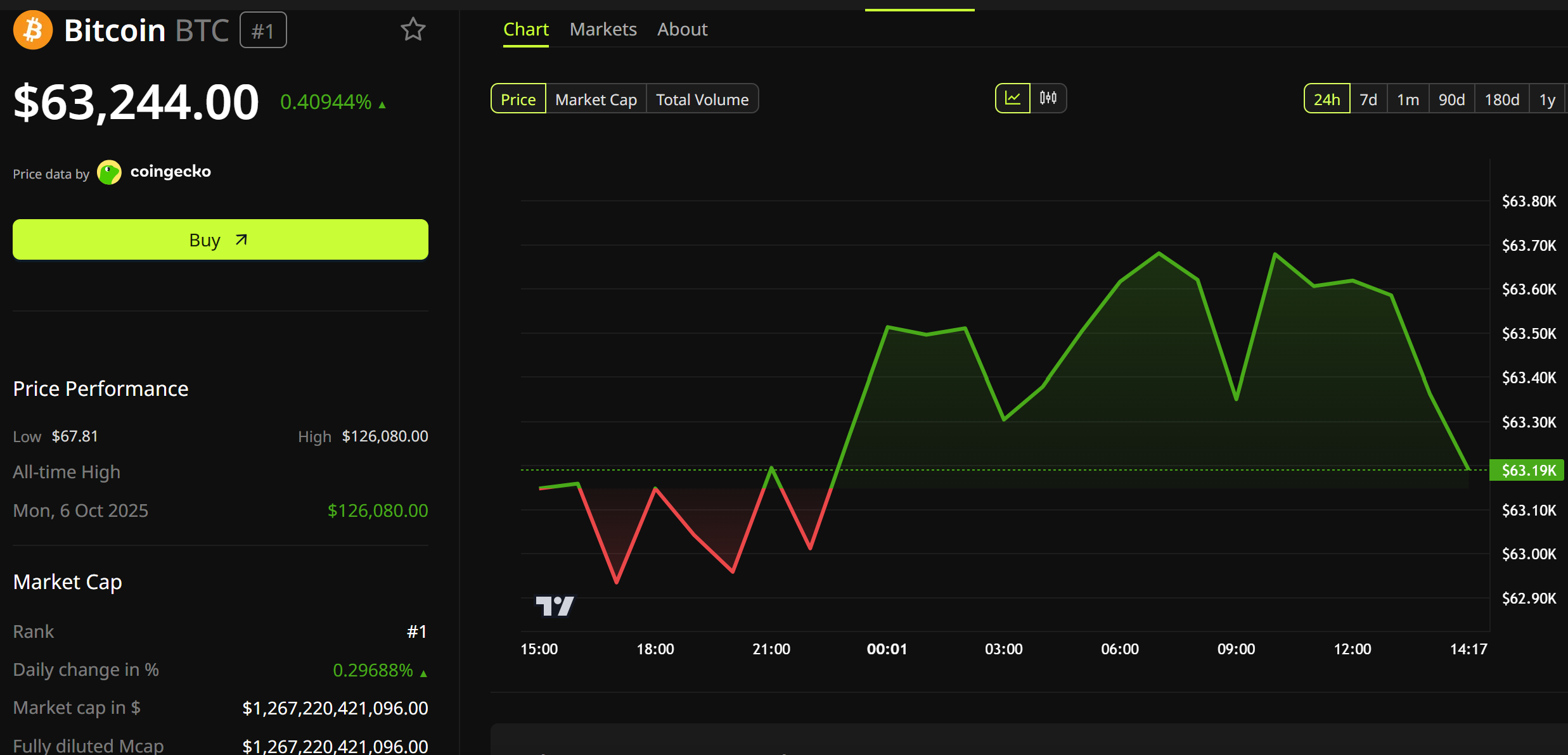
At Bitcoin’s current market price near $63,244, that hoard is worth roughly $70 billion.
What CZ Actually Said
Zhao did not call for a seizure, nor did he say Binance would act. He put the decision to the community, asking why it should not set a roughly 1-year timeline.
Coins left in vulnerable addresses after that point would be locked in by a fork.
CZ said the popular take that he would personally freeze Satoshi’s address was not quite right. He also flagged a snag, that telling Satoshi’s wallets apart from other early miners is hard.
Zhao has urged calm on quantum risk before.
His thinking aligns with BIP-361, a draft by Jameson Lopp and five other researchers. It would block sends to vulnerable addresses about three years after activation, then void legacy signatures two years later.
The authors frame a blunt choice. A quantum thief could grab the exposed coins, or miners could slowly recover them. The network could instead lock them so no one wins.
That proposal even cites Bitcoin’s creator on the issue of lost coins.
“Lost coins only make everyone else’s coins worth slightly more. Think of it as a donation to everyone,” Satoshi Nakamoto, as quoted in the proposal.
The dormant coins are contested on another front. An anonymous plaintiff and two Wyoming LLCs are fighting a New York abandoned-property lawsuit.
They want 39,069 idle addresses, including the Satoshi coins, declared theirs. A Galaxy report by Thorn doubts it will prevail.
Any forced lock still violates a core Bitcoin rule: no one can take another person’s coins. Many would read it as confiscation.
CZ said there is no perfect answer. He warned that doing nothing could prove the worst outcome of all.
The post CZ Floats Freezing Satoshi’s Bitcoin Over Quantum Risk appeared first on BeInCrypto.

Adoption of Solana increases as institutional investment in blockchain infrastructure goes beyond merely investing in crypto products to actual integration.
The Institutional Engagement Has Gone Beyond Investment Exposure
There has been growing traction of Solana as financial institutions turn their attention toward blockchain technology and infrastructure rather than investing in digital assets. The emergence of credit assessments in relation to blockchain technology, along with interest from established financial entities such as Moody’s, points to a gradual shift in perception about decentralized blockchain technology from traditional financial institutions.
For decades, public blockchains have been associated with speculation and diversifying investments. The focus of traditional financial institutions centered on the risk factors and regulatory issues associated with blockchain technology. This shift indicates that institutions are recognizing the usefulness of blockchain in practice.
Traditionally, credit ratings have been used to assess companies, bonds, and sovereign debts. The increased use of these terms in blockchain contexts demonstrates that institutions are starting to assess decentralized blockchain technology using conventional financial risk management models. It shows more engagement than exposure to crypto-assets alone.
Rather than just asking whether digital assets can be invested in, institutions are now looking at whether blockchain technologies can sustain key operations of financial institutions.
Advantages of Solana in the Blockchain Infrastructure Arena
Among prominent blockchain projects, Solana is one of the top candidates expected to be adopted by financial institutions. Its main advantages include high transaction capacity, low costs, and rapid finality, making it well suited for applications that need scalable infrastructure.
Over the past several years, the Solana network has developed in DeFi, gaming, NFTs, and, finally, in tokenizing real-world assets. These processes have turned Solana from an instrument of investment into a working layer of the digital economy.
Institutional adoption of Solana does not relate to custody services and trading anymore. At the moment, some financial companies are considering integrating blockchain infrastructure into their business processes. This means building a payment network, issuing platform, and settlement infrastructure on the blockchain level. All these processes require careful planning, significant industry knowledge, and compliance with regulations.
Market Dynamics Illustrate Resilience of Networks Over Time
The history of Solana’s performance on the market has been characterized by cycles of rapid growth followed by a decline typical of other players in the cryptocurrency industry. When conditions were bullish, the price of SOL previously soared above $200, while total market capitalization reached dozens of billions of dollars due to an increased influx of funds.
As expected for any other digital asset, Solana’s valuation dropped during the bearish period due to reduced risk appetite and lower liquidity in the industry. Nevertheless, the network continued developing actively despite this period.
During subsequent recovery phases, Solana’s valuations grew rapidly, with market capitalization soaring above previously observed levels to exceed $100 billion. While the latest correction has negatively impacted this momentum, valuations are still much higher than during the bearish period. This illustrates changing investor perception of Solana, shifting from short-term prospects to long-term perspectives.
The Part Solana Will Play in the Future of Blockchain Infrastructure
The increasing use of Solana signals a shift happening across the blockchain industry. As organizations transition from exploration to real incorporation, networks that can provide reliable and efficient infrastructure are becoming more prominent. Regardless of market turbulence, Solana is establishing its position in this new environment.
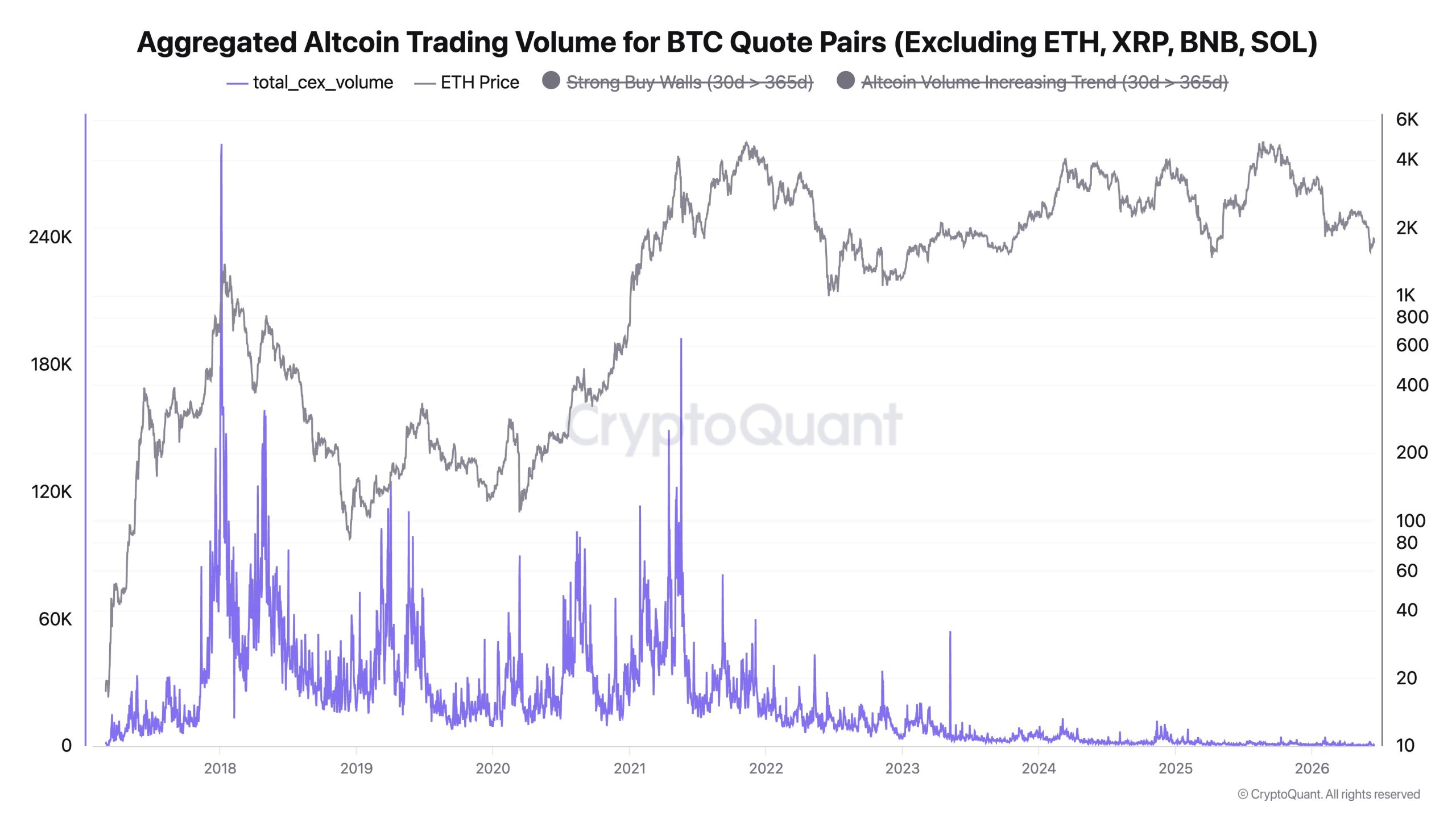
Cryptocurrency traders are no longer using Bitcoin (BTC) profits to buy altcoins as they did in previous bull cycles, raising doubts about whether a broad “altseason” can return.
Key takeaways:
- Bitcoin-to-altcoin rotation trend has collapsed to its weakest level since 2021.
- Altcoin capital is increasingly getting concentrated in fewer projects, delaying the altseason.
Bitcoin-to-altcoin rotation trend has “basically disappeared”
The old altseason trade is no longer working the way it did in previous bull cycles, according to Ki Young Ju, CEO of CryptoQuant.
In a Saturday post, Ju said the Bitcoin-to-altcoin rotation trend has “basically disappeared,” citing CryptoQuant data showing BTC-pair altcoin trading volume has collapsed to its weakest levels since 2021.
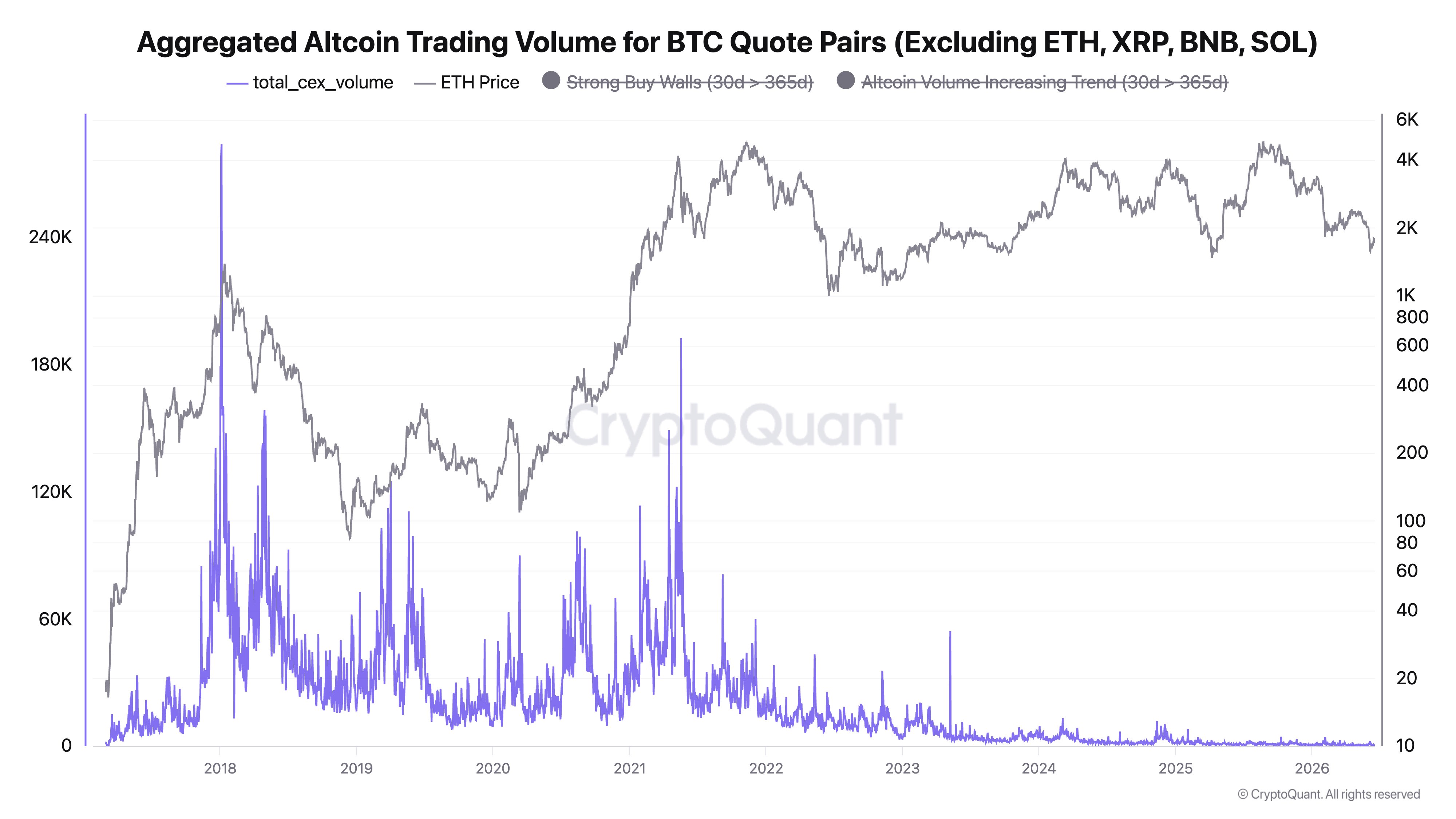
Aggregated altcoin trading volume for BTC-priced pairs. Source: CryptoQuant
The metric excludes major altcoins such as Ether (ETH), XRP (XRP), BNB (BNB) and Solana (SOL), focusing instead on mid- and lower-cap altcoins traded against Bitcoin on centralized exchanges.
In simple terms, it shows whether traders are using BTC to buy smaller altcoins.
That flow surged in 2017 and 2021, helping fuel record altseasons. But Young Ju’s chart shows BTC-pair altcoin volume remains near post-2021 lows, suggesting Bitcoin is no longer the main liquidity source for altcoin speculation.
“The era of alts pumping just because BTC pumps may be over,” Young Ju said.
Altcoin capital is now concentrated in fewer tokens
The wider altcoin market has become more concentrated, excluding stablecoins.
As of Saturday, the non-BTC, non-stablecoin crypto market was worth roughly $600 billion. The top 10 non-stablecoin altcoins accounted for about $483 billion of that total, or roughly 80.5%.
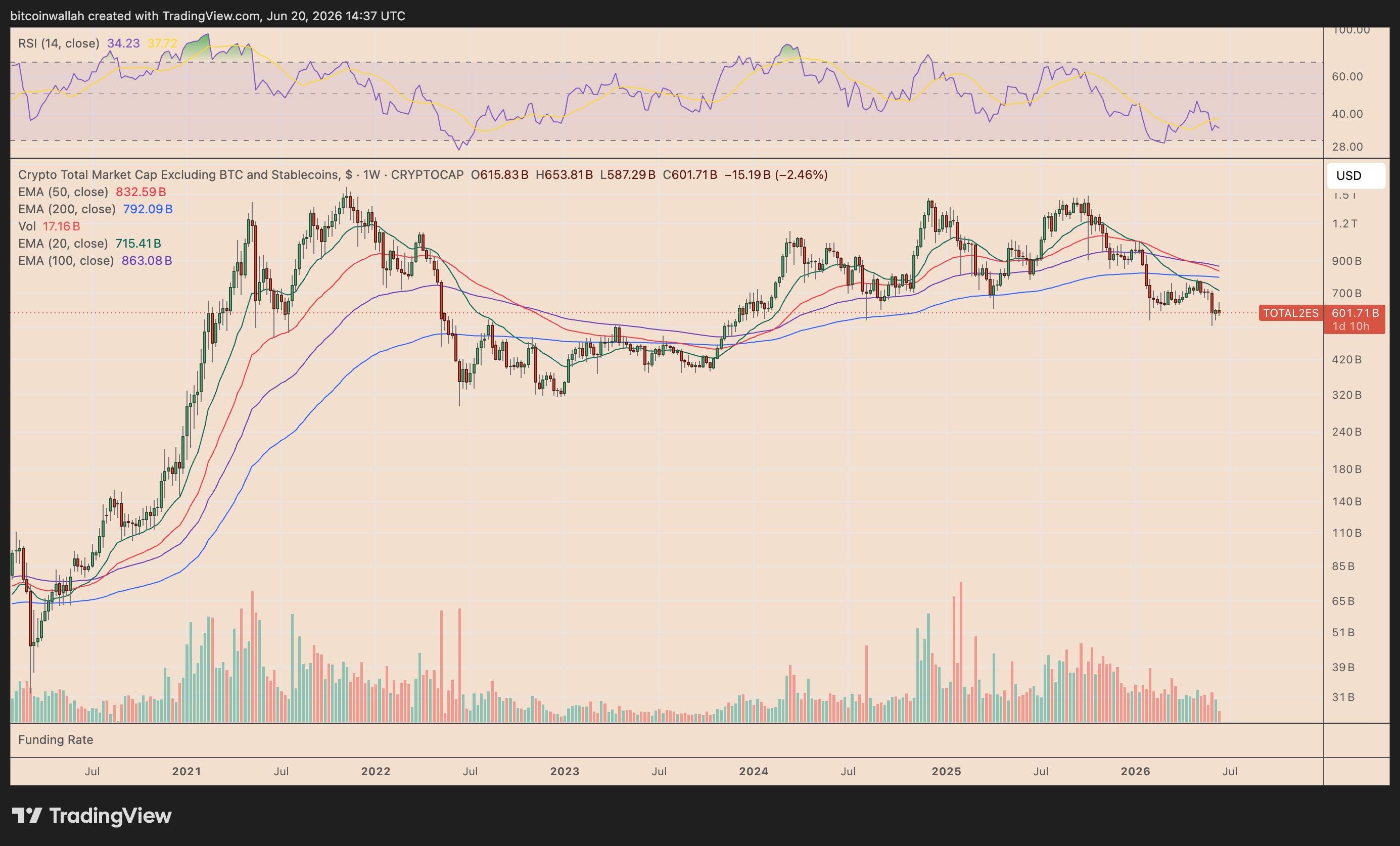
TOTAL crypto market excluding Bitcoin and all stablecoins. Source: TradingView
The number of large market-cap altcoins has also fallen sharply since the last bull cycle.
In 2021, roughly 106 altcoins had above $1 billion in market valuation, according to CoinMarketCap’s historical snapshot. That number fell to around 50 in June 2026.
This echoes Young Ju’s argument that capital is no longer spreading across the altcoin market the way it did in 2021. The market has not disappeared, but it is being comprised of fewer large altcoins.
In a separate thread, Young Ju said that “narrative-only altcoins” are losing relevance as the market matures.
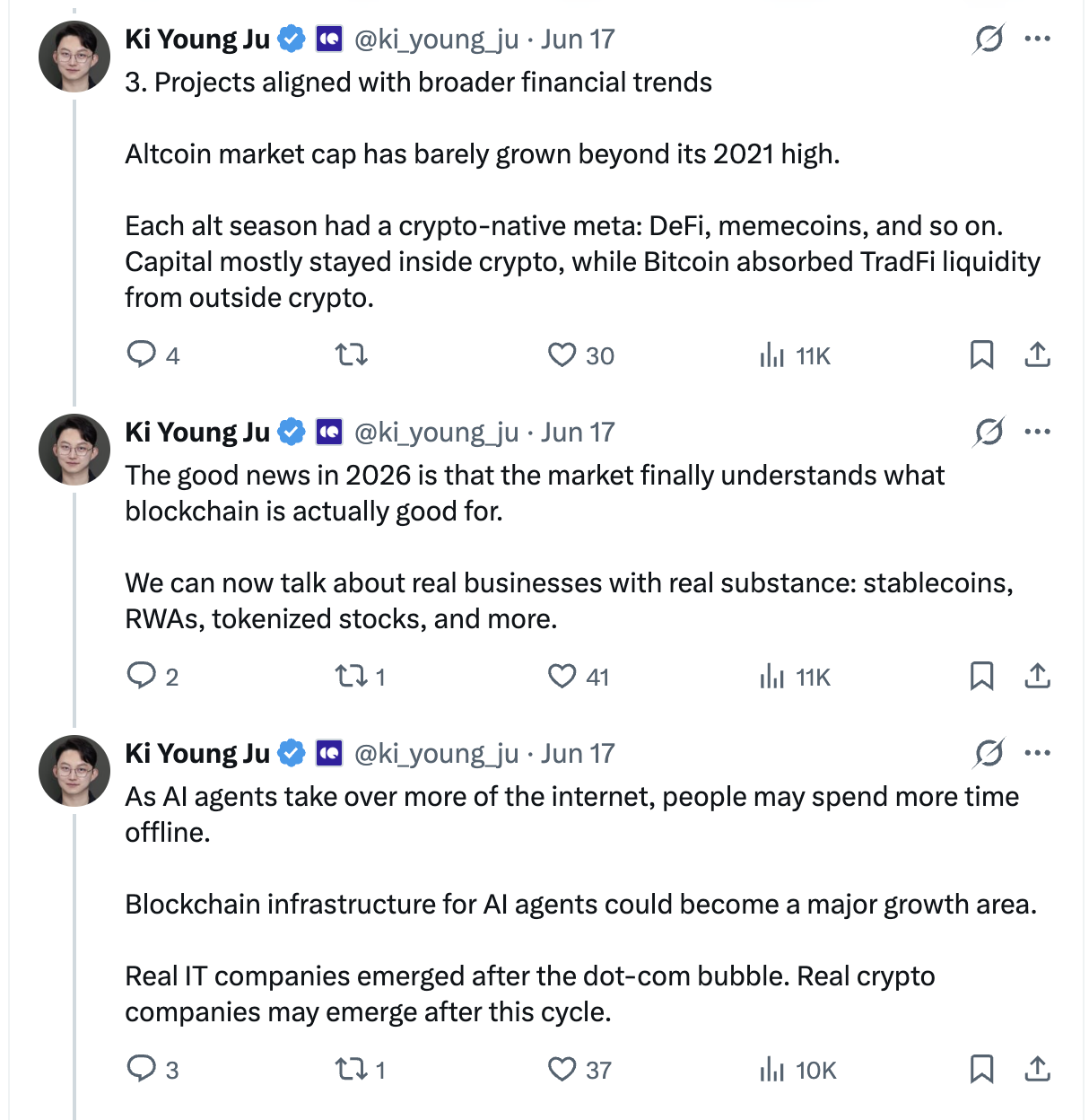
Source: X/Ki Young Ju
Young Ju said hype alone is no longer enough. The stronger areas, he added, are tied to real businesses, revenue-generating DeFi, stablecoins, tokenized real-world assets, and AI agents.
That suggests the next altcoin cycle may be less about rotating into the whole market and more about finding tokens that can find applications and users across the aforementioned fields.
BTC dominance rebound may have “postponed” altseason
Bitcoin’s crypto market dominance (BTC.D) is also showing early signs of a rebound, which could delay a broader altcoin rally.
The BTC.D metric has bounced from its 100-week exponential moving average (100-week EMA, purple) and the lower trend line of an ascending channel, both aligning at the 58.75% level.
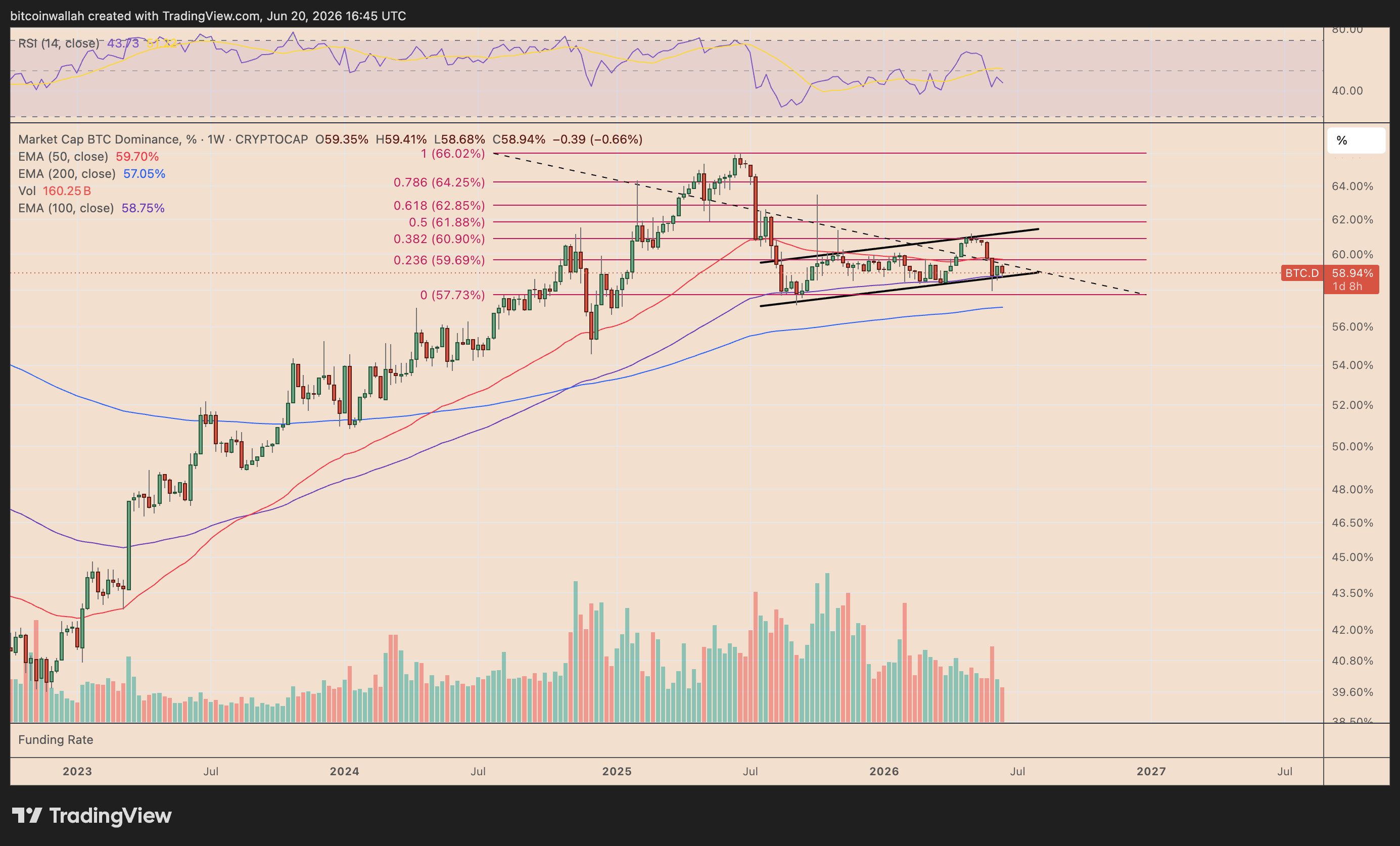
BTC.D weekly performance chart. Source: TradingView
It could rally toward the channel’s upper trend line near 60% if momentum persists.
A move toward 60% would mean Bitcoin is gaining market share against the rest of crypto. In market terms, that suggests capital may continue rotating from altcoins back into BTC, limiting the chances of a near-term altseason.
Analyst Rekt Capital shared a similar view, pointing to a bullish divergence on Bitcoin dominance, which suggests that the “altseason is postponed.”
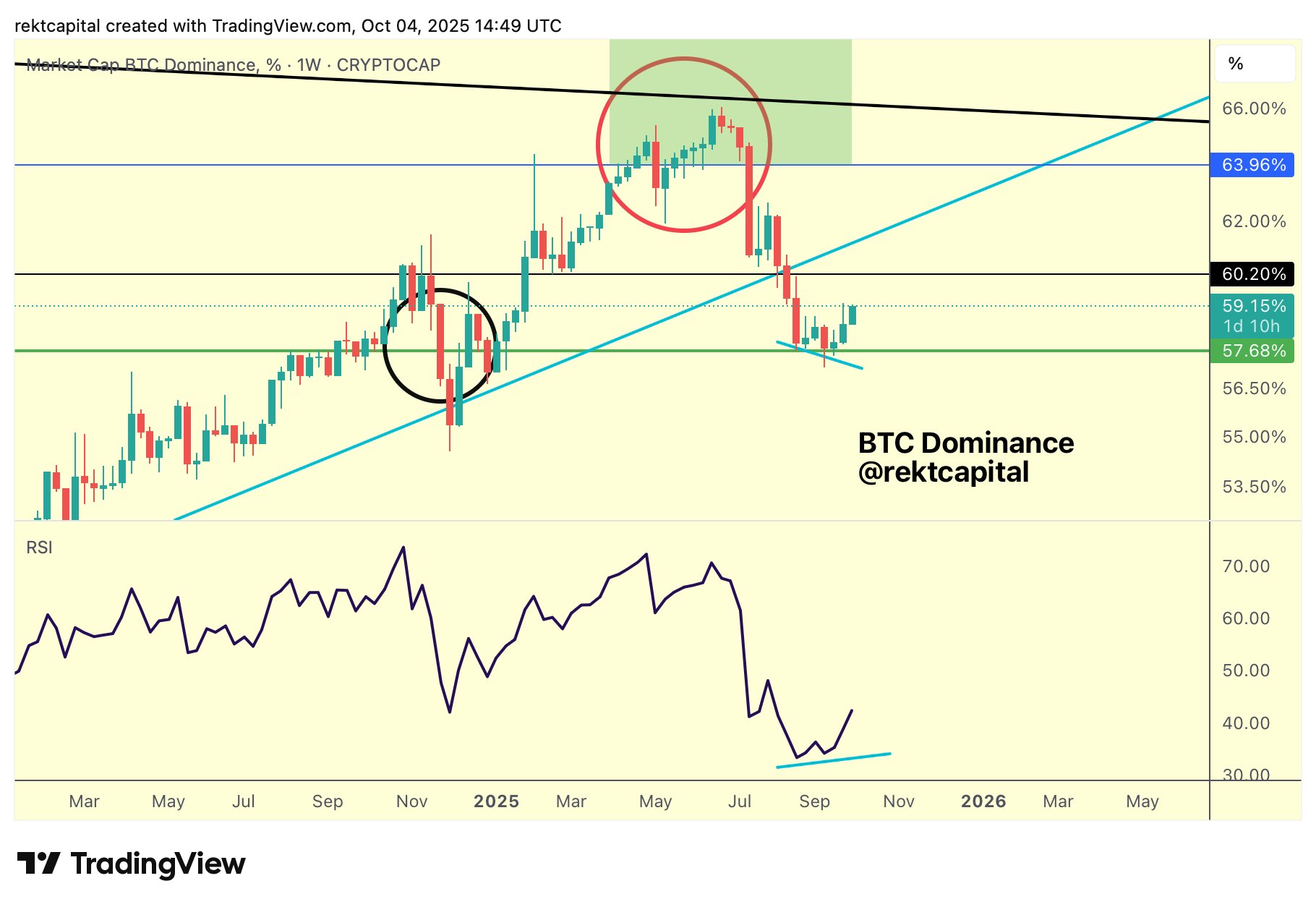
BTC.D weekly performance chart. Source: TradingView/Rekt Capital
A bullish divergence forms when the metric makes lower lows while its RSI makes higher lows. It often signals weakening downside momentum and a potential rebound.
Related: Altcoin selling tops $266B as capital rotates out of crypto: Is altseason extinct?
Nevertheless, Rekt Capital said Bitcoin dominance’s upside may be limited because the metric has already lost its macro uptrend. He said the current bounce may act as a post-breakdown relief rally before further downside.
Bitcoin’s dominance may drop toward its 200-week EMA at 57% if Rekt Capital’s bearish scenario plays out.

TLDR:
- Mastercard and Visa are building stablecoin settlement rails for issuers and payment networks.
- Five major US banks plan a tokenized deposit network targeted for early 2027 launch.
- DTCC’s tokenization service spans 50+ firms, with RWA trades starting in July 2026.
- Standard Chartered’s Zodia Custody deal strengthens institutional digital asset custody offerings.
Wall Street’s institutional embrace of blockchain is accelerating, with Citi, Mastercard, Visa, DTCC, and several major banks now testing infrastructure for stablecoins, tokenized deposits, and settlement.
These moves signal a shift from trading-focused crypto exposure toward core financial plumbing, reshaping how money and assets move across global markets.
Payments and Deposits Drive Early Adoption
Stablecoin settlement has become a focal point for payment networks. Mastercard said in June it would add stablecoin settlement options for issuers and acquirers, while Visa is testing private stablecoin settlement with Brale on the Canton Network, a privacy-focused blockchain built for institutions.
Banks are pursuing a parallel approach centered on tokenized deposits. JPMorgan Chase, Citigroup, Bank of America, Wells Fargo, and The Clearing House are planning a bank-led tokenized deposit network targeted for the first half of 2027, according to a Wall Street Journal report.
Retail banking is also entering the space. SoFi launched its own SoFiUSD stablecoin on its retail banking platform and named Bullish as its first centralized exchange partner. The company’s leadership framed this as removing a long-standing barrier between crypto and traditional finance.
As CoinMarketCap noted in its coverage, Wall Street is entering the next phase of institutional crypto adoption, moving beyond trading desks and exchange-traded funds into core financial infrastructure. This shift extends well past payments into asset management itself.
Tokenization Reaches Private Markets and Fund Products
Private market access is expanding through tokenized structures. Citi launched Digital Depositary Receipts for private-company shares in June, creating a new way for investors to access private markets, amid rising demand for exposure to high-profile IPO candidates.
Fund products are following a similar path onchain. BlackRock has filed to expand its tokenized fund suite following the 2024 launch of BUIDL, its first tokenized money market fund.
Separately, Ondo Finance, Kinexys by J.P. Morgan, Mastercard, and Ripple completed a pilot to redeem a tokenized US Treasury fund on blockchain rails in May.
Equities are also moving toward tokenized formats. Coinbase has outlined plans to offer tokenized US equities to non-US customers, while Kraken’s parent company, Payward, has pushed tokenized IPO access through xStocks.
Behind these products, infrastructure providers are building the systems that support settlement and custody at scale.
DTCC said in May it was rolling out a tokenization service with more than 50 financial firms, with initial limited production trades for select tokenized real-world assets planned for July and a broader launch targeted for October.
Custody infrastructure is consolidating as well. Standard Chartered said in May it would acquire Zodia Custody’s crypto custody business and fold it into its own infrastructure, deepening its digital asset capabilities.
Industry observers describe this custody layer as essential groundwork. Ripple and Quinlan & Associates wrote in a February report that digital asset custody forms the foundational layer underpinning all digital asset use cases for financial institutions.
Together, these developments point toward blockchain becoming embedded in everyday financial operations, moving money, issuing securities, and settling transactions across major institutions.


Solana investors have changed their tactics in the past several days, as on-chain data shows a massive spike in SOL exchange inflows.
According to popular analyst Ali Martinez, such behavior could be the catalyst for a more profound price decline, possibly pushing the asset toward $50, a level not seen in almost three years.
600K SOL Reach Exchanges
Citing data from Glassnode, Martinez outlined the significant uptick in the number of SOL tokens that reached exchanges, going from about 27 million to over 27.6 million, meaning a 600,000 coin deposit. Similar developments suggest that “market participants are moving liquid supply out of private wallets, signaling rising caution around current price levels.”
He added that large-scale token transfers to trading platforms hint at potential de-risking or hedging from investors, potentially leading toward a “short-term drawdown.”
The analyst with over 165,000 followers on X warned that the $50 level might come into focus if this “spot supply triggers an immediate flush.”
“A localized pullback into this key zone would serve to fully absorb the short-term panic and clear the path for a healthy accumulation base before the next major expansion,” he added.
600,000 Solana $SOL were just deposited into trading platforms.
This rapid spike in exchange inflows indicates that market participants are moving liquid supply out of private wallets, signaling rising caution around current price levels.
Historically, large-scale token… pic.twitter.com/hUdZu5XPFd
— Ali Charts (@alicharts) June 20, 2026
Up or Down Next?
Solana’s native token is up by over 4.5% in the past 24 hours, and has seemingly reclaimed the $70 support. However, fellow analyst Crypto Tony warned that the asset could drop toward $60 if this particular level gives in. The token slipped to $60 during the early June crash, but managed to defend that level. It hasn’t traded at Martinez’s lower target at $50 since late 2023.
Daan Crypto Trades also weighed in on SOL’s potential, but he focused on the BTC pair. He believes SOL is “attempting a breakout from this ralling wedge,” which could send it well above the current upper boundary of 0.0011 SAT. This became possible after SOL bounced from the lower boundary in early June at 0.001 SAT.
The post 600,000 SOL Moved to Exchanges: Is a Drop to $50 Next? appeared first on CryptoPotato.
Robert Kiyosaki says he is watching gold, silver, Bitcoin (BTC), and Ethereum (ETH) for a technical reversal before buying, arguing that the macro backdrop, not falling prices, decides whether hard assets are worth holding.
Precious metals extended a steep retreat this week, and a fresh dispute over the Strait of Hormuz tested a days-old US-Iran ceasefire. BTC and ETH edged higher over 24 hours.

Kiyosaki Watches Gold and Silver Context, Not Price
Kiyosaki built his case around the environment rather than the chart. The Rich Dad Poor Dad author said a falling market alone never tells him whether to buy or sell.
He pointed to whether political and banking leaders are fixing the economy or making it worse, and has called dips buying opportunities before.
“I have learned to understand the ‘context’ or the environment the asset is in….not the price… So I am watching prices of gold, silver, Bitcoin, and Ethereum on technical charts and will buy when prices reverse their decline,” Kiyosaki wrote in a post.
Follow us on X to get the latest news as it happens
The metals he is eyeing set records before the pullback. Gold hit an all-time high near $5,595 an ounce in late January and silver topped $100 for the first time.
Both records capped a run nearly doubling gold and quadrupling silver in a year.
This week’s ceasefire then drained the safe-haven premium the February war and Hormuz threats had rebuilt.
Kiyosaki keeps backing silver and Bitcoin and claims the charts point to a rebound, with no price target or timeline.
Hormuz Dispute Keeps the Safe-Haven Bid Alive
The backdrop Kiyosaki described stayed unsettled. Iran’s Revolutionary Guard declared the Strait of Hormuz closed over alleged ceasefire violations and warned vessels away.
Vice President JD Vance countered that no evidence backed the claim. Vance said the waterway stayed open, and CENTCOM reported 55 ships moving more than 17 million barrels of oil through Hormuz on Saturday.
That is close to the 20 million a day, about a fifth of global oil demand, the EIA says the strait normally carries.
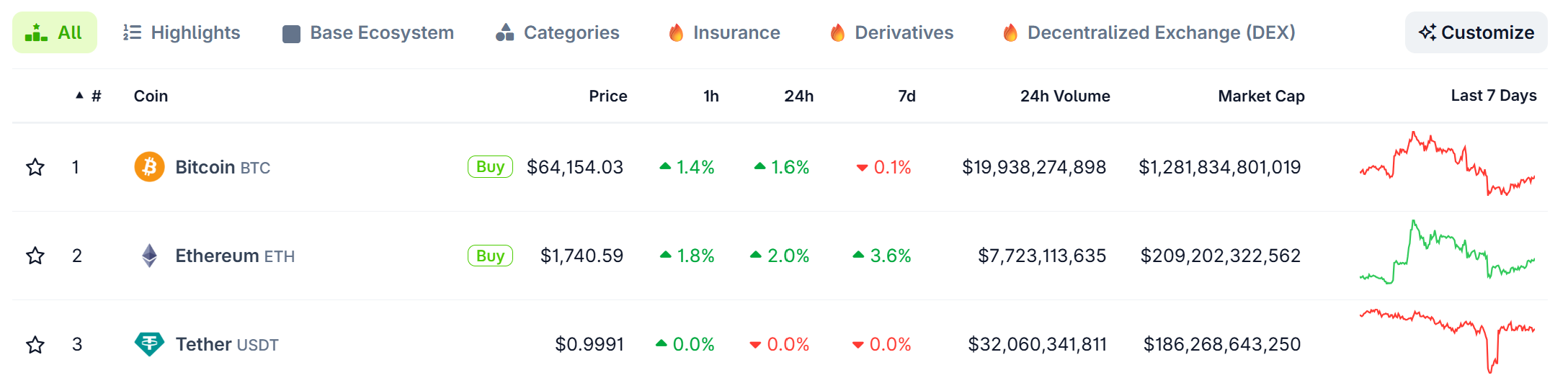
Bitcoin traded above $64,000, up about 1.4%, while ETH held near $1,740, with both gains following developments at the Strait of Hormuz.
Even so, BTC sits roughly 49% below its October record near $126,000 and ETH about 65% under its August peak, with BTC down about 17% and ETH 18% over the past month.
Earlier Hormuz tensions dragged Bitcoin lower, and a US strike on Iran under the truce sent Bitcoin, gold, and oil moving within hours.
With US-Iran talks set for Switzerland on Sunday, the next signal is whether the ceasefire holds. For Kiyosaki, the charts rather than the headlines will decide his next move.
The post Kiyosaki Eyes Gold, Silver Rebound as Hormuz Risks Keep Safe-Haven Case Alive appeared first on BeInCrypto.

Vessels at the Strait of Hormuz, as seen from Musandam, Oman, June 15, 2026.
Stringer | Reuters
Iran declared the Strait of Hormuz closed again on Saturday and warned vessels to stay away from the critical shipping route, but the U.S. denied those claims, stating the waterway remained open.
Tensions between the two countries escalated just days after Tehran and Washington reached an interim agreement to end hostilities in the region.
The announcement by Iran’s military and the country’s Islamic Revolutionary Guard Corps came as Iranian negotiators prepared to travel to Switzerland for technical-level talks with U.S. officials scheduled to begin Sunday.
Iran’s joint military command said the closure of the strait was in response to continued Israeli military operations in Lebanon and what it described as U.S. “bad faith” and a failure to uphold commitments under the truce framework, AP reported. Iranian state television said “subsequent steps have been planned” if what it called aggression continues, according to multiple outlets.
Earlier Saturday, Israeli strikes in southern Lebanon killed at least 16 people, including two children, AP reported, citing Lebanese authorities. Lebanon’s state-run National News Agency said seven people remained trapped beneath rubble in Nabatiyeh and nearby villages following the attacks, according to AP.
The U.S. military said the Strait of Hormuz had not been closed, however, and said that U.S. forces were monitoring the situation to ensure that it remained open, Reuters reported.
“Iran does not control the Strait of Hormuz,” U.S. Central Command spokesperson Navy Captain Tim Hawkins told Reuters. “Traffic continues to flow, and U.S. forces are monitoring the situation to ensure this remains the case.”
The attempt to shut down the strait again raises the stakes ahead of the talks in Switzerland, which are intended to advance the interim agreement reached Wednesday between U.S. President Donald Trump and Iranian President Masoud Pezeshkian after nearly four months of war.
The signed memorandum of understanding had called for the immediate end to military actions by Israel in Lebanon and the full reopening of the Hormuz strait without tolls imposed by Iran for at least 60 days.
U.S. officials disputed Iran’s assertion that it had closed the Strait of Hormuz, Reuters reported.
“Iran does not control the Strait of Hormuz,” U.S. Central Command spokesman Navy Captain Tim Hawkins told Reuters. “Traffic continues to flow, and U.S. forces are monitoring the situation to ensure this remains the case.”
Vance says talks to continue
U.S. Vice President JD Vance struck an optimistic tone Saturday, saying negotiations were advancing despite Iran’s latest threat to shut the strait.
Speaking on Fox News earlier Saturday, Vance said Jared Kushner, Trump’s son-in-law, and special envoy Steve Witkoff in Switzerland were working through the agreement’s technical details. He added that discussions were “going well.”
Vance noted that tanker traffic had rebounded sharply following the ceasefire agreement.
“We actually got 16 million barrels of oil out of the Strait of Hormuz yesterday,” Vance said. “That is a record going back to even before the conflict started.”
He also said negotiators were focused on securing Iran’s enriched uranium stockpile to make it “effectively impossible” for Tehran to rebuild its nuclear program, while emphasizing that the United States retained significant economic leverage if Iran failed to comply with the agreement.
Vance said he expects to travel to Switzerland within days to join the Iran negotiations, though he cautioned that diplomatic arrangements involving Qatari and Pakistani mediators were still being finalized.

Current prices are not the most important thing when it comes to determining whether it’s the right time to acquire a certain asset, said the person behind one of the most popular investment books, Rich Dad, Poor Dad.
Kiyosaki further explained when he is prepared to start acquiring more BTC, ETH, silver, and gold amid all assets’ recent declines.
When Will Kiyosaki Start Buying Again?
It has been a wild year for investors in all assets. Bitcoin’s price began the year with a surge toward $100,000, where it was stopped, and the subsequent months were quite painful. The correction culmination, at least for now, was in early June at $59,100. ETH followed a similar path, dumping to $1,500 a few weeks back. Although both have recovered some ground since then, they are still deep in the red YTD.
Even the two largest precious metals, typically considered more stable and reliable, have bled out. Silver pumped above $120 at the start of the month, but now sits nearly 50% away from that peak. Gold rocketed to $5,600/oz, but its crash has been quite painful, ending the business week at under $4,160/oz (a 25% correction).
Robert Kiyosaki believes these dips are not the only factor that matters. In fact, he admitted that he has recently made this mistake of “letting price determine reasons to buy or sell any asset.” He has now learned to “understand the ‘context’ or the environment the asset is in… not the price.”
The author and investor explained that he has shifted his focus to the technical charts of the four assets mentioned above and “will buy when prices reverse their decline.” Moreover, he predicted that the two precious metals are “poised for a massive rise in prices.”
No Safe-Haven Status?
Being down YTD and since their respective peaks marked in January, both bitcoin and gold raised some analysts’ eyebrows regarding their safe-haven status. Market observer and commentator Charlie Bilello recently pointed out that this decline in both assets’ prices is quite hard to explain, especially since most major stocks are up by double digits.
He believes a major part of this is due to rotation, as investors have turned their attention to the tech sector, mostly because of the AI boom. He added that capital has opted to move to assets with earnings momentum rather than staying on stores of value with negligible yield.
The post Why Isn’t Robert Kiyosaki Buying the Dip in BTC, ETH, Gold, and Silver? appeared first on CryptoPotato.
TLDR:
- OpenAI’s 2025 net loss hit $38.5 billion despite revenue tripling to $13.07 billion overall.
- Uber, Amazon and JPMorgan now restrict employee AI usage after costs spiraled unexpectedly.
- Anthropic and OpenAI filed confidentially for IPOs, both targeting valuations near $850 billion.
- Chinese models DeepSeek and Kimi undercut Anthropic and OpenAI pricing in benchmark cost tests.
Anthropic and OpenAI are pushing toward public markets while facing mounting questions about AI spending sustainability.
OpenAI posted a $38.5 billion net loss in 2025, even as revenue tripled to $13.07 billion. Rising pay-per-token costs have prompted major employers to limit staff usage, raising doubts about near-term profitability for both companies.
Enterprise Costs Spark Internal Crackdowns
Several large corporations have begun restricting employee access to AI tools after expenses climbed sharply. Uber reportedly exhausted its 2026 AI budget by April and now caps spending at $1,500 per employee monthly.
Amazon told staff to avoid using AI tools without clear purpose, following reports that engineers ran automated agents to climb internal usage leaderboards.
JPMorgan circulated an internal memo this month addressing excessive AI spending across departments. Some employees reportedly generated AI bills exceeding their own monthly salaries.
These examples reflect a broader pattern among companies that adopted AI tools aggressively over the past two years.
One pricing shift illustrates the scale of the problem. Workato saw its Anthropic bill increase 700% in a single day after the company moved from flat-rate to pay-per-token pricing in May.
Workato’s chief information officer said earlier subsidized pricing had encouraged widespread adoption before actual costs became visible.
IPO Timing Collides With Spending Concerns
Anthropic and OpenAI filed confidentially for public offerings this month, both reportedly targeting valuations near $850 billion.
Neither company has reached profitability, and OpenAI’s losses nearly tripled year over year. In 2024, the company lost $5.09 billion, a figure that grew to $38.5 billion in 2025.
This timing creates friction for both firms as they court investor confidence. Public offerings typically require evidence of sustainable revenue growth, yet enterprise clients are simultaneously scaling back usage. The same trend driving corporate cost-cutting threatens the growth narrative needed for successful IPO valuations.
OpenAI is reportedly considering token price reductions to retain customers shifting toward Anthropic’s offerings. According to the Wall Street Journal, Anthropic’s Claude Code product helped push annualized revenue from $9 billion to $47 billion within five months. That growth has intensified competitive pressure between the two firms.
Competitive Pricing Pressure Intensifies From Chinese Models
Artificial Analysis tested major AI models on identical benchmark tasks, comparing total operational costs. Anthropic’s flagship model cost $4,811 to complete the test suite, while OpenAI’s model cost $3,357 for the same workload.
Chinese alternatives showed substantially lower costs in the same testing. DeepSeek completed the benchmark for $1,071, while Kimi finished for $948.
These figures suggest Chinese developers prioritize cost efficiency over matching premium-tier performance metrics.
Bain surveyed nearly 1,000 companies regarding AI return on investment, finding that 40% reported actual cost savings below 10%.
One investor told Axios that a corporate finance officer spent $500 million on Claude access in a single month before anyone noticed.
As Anthropic and OpenAI prepare investor pitches, enterprise customers are demonstrating measurable resistance to current pricing structures.

“Tony Khan has given up on her,” “Needs to ask for release”

In the Weights is your new AI-centric vanity search

Readers Site 8 Ideal ‘Safer’ Dividend Buys In May


-

 Business6 days ago
No Jackpot Winner as $257 Million Prize Rolls Over to $269 Million Monday Draw
-

 Fashion1 day ago
Weekend Open Thread: Miami – Corporette.com
-
Crypto World6 days ago
Zimbabwe Requires Crypto Businesses to Register Annually Under New FIU Regulations
-
 Entertainment6 days ago
Matt Damon’s Viral Sci-Fi Thriller Has Taken Over HBO Max
-
 Business16 hours ago
Wall Street Week Ahead: Investors see Micron earnings as pulse check of AI rally momentum
-

 Tech6 days ago
As AI companies race to go public, who else is along for the ride?
-

 Business6 days ago
Anthropic staff to meet White House officials next week, Axios reports
-
 Crypto World6 days ago
Bitcoin could crash to $48,000, if this historical pattern is triggered
-
 NewsBeat6 days ago
what doctors are seeing in ebike crashes
-

 Entertainment7 days ago
Deion Sanders Shares Powerful Post After Viral Advice To Deiondra
-
 NewsBeat6 days ago
Warning of disruption as Cardiff Crossrail works to start
-

 Politics6 days ago
“Israel’s” ban on ICRC visits ruled illegal, but Knesset moves to stop them permanently
-
 NewsBeat6 days ago
Tributes to former deputy head teacher at Cambridge school among death and funeral notices
-

 Crypto World17 hours ago
HIVE shares jump as $220M AI deal speeds Bitcoin mining pivot
-

 News Videos6 days ago
Financial Accounting | Last Day Revision Strategy and Booster | CMA Inter – June 2026
-
 Entertainment6 days ago
Kate Middleton Glare Goes Viral After Kids Booed At Royal Event
-

 NewsBeat6 days ago
Singer Oliver Tree dies aged 32 in helicopter crash in Brazil
-

 Tech6 days ago
Over 400 Arch Linux packages compromised to push rootkit, infostealer
-

 Crypto World6 days ago
XRP ETFs Outperform As Bitcoin And Ethereum Funds Extend Outflow Trend
-

 Sports6 days ago
Dick Advocaat’s Curacao scores first-ever World Cup goal against Germany
You must be logged in to post a comment Login