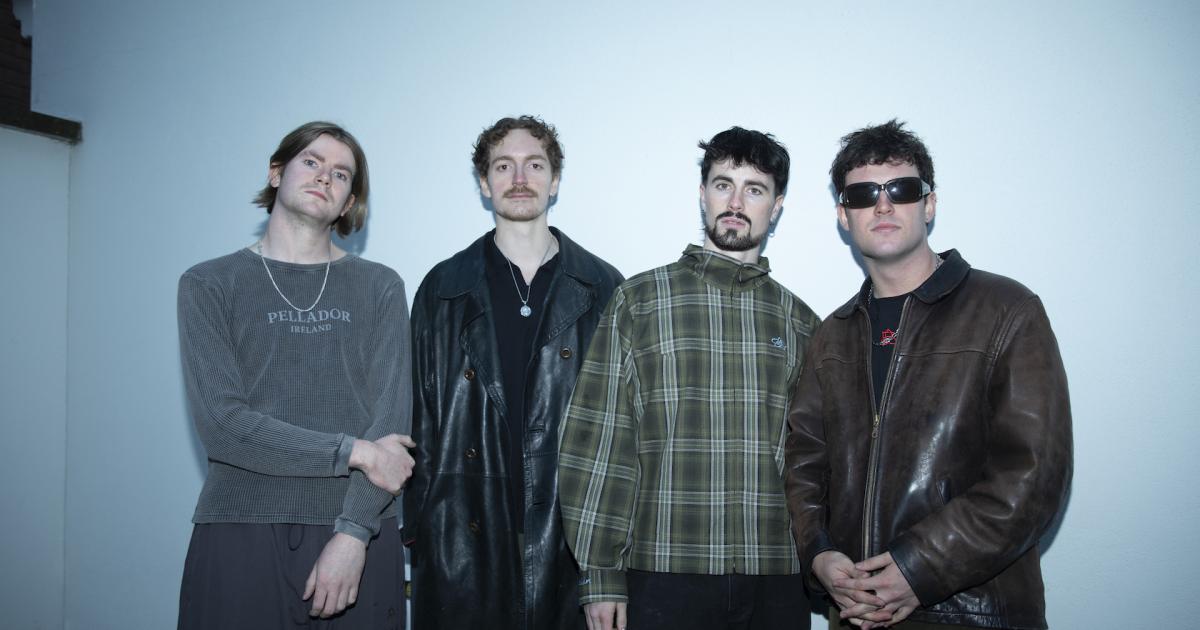
Over the last two years, British singer-songwriter Myles Smith has had the kind of ascent that any performer who’s just starting out would dream of.
After cultivating a loyal following on TikTok, Myles was made an offer to sign a recording contract with the major label RCA, joining a roster that already included hit-makers like Doja Cat, SZA and Mark Ronson.
Now a four-time Brit Award nominee (in addition to his Rising Star win), Myles has racked up a string of UK top 40s, headlined shows all over the world (not to mention serving as the opening act on the stadium tour of his musical hero, Ed Sheeran) and even been praised by former US leader Barack Obama – all before he’d even released his debut album.
Advertisement
So, one of the main things you might be wondering after such a whirlwind rise is if he’s been able to take a moment to appreciate it all?
“Fuck no!” he tells HuffPost UK with a laugh. “I’ve been on tour for, like, 90% of my career. Genuinely, I don’t know what day or time or city I’m in half the time.
“For the last three tours, I’ve said, ‘hopefully, after this tour, I can relax’. And then I book another one. One day it’ll come…”
Myles Smith’s schedule has been jam-packed since his breakthrough moment with 2024’s Stargazing
We’re speaking weeks before the long-awaited release of Myles’ debut album, My Mess, My Heart, My Life., a project he’s poured his heart into, and previously claimed represents “what I wanted it to say, rather than what everyone else wanted me to do”.
Advertisement
“I feel like a world exists where I made 10 Stargazings and put it onto an album,” he explains. “The way that the world is built, that probably would have done amazingly well commercially. But would it build a career? No. It would have just been a really cool, flash-in-the-pan moment.”
For Myles, it was important that his first album showcase “a full 360 on the person that I am”.
“A lot of the songs that I have out at the moment are songs that I love – that I really, really love – I think they show a part of me, but not all of me,” he claims, quipping that “just sticking with four-on-the-floor down your throat for, like, another album” would be “doing myself an injustice”.
Indeed, anyone who knows Myles for radio-friendly hits like Stargazing, Nice To Meet You or the Niall Horan collab Drive Safe might be surprised at some of the dark places that his full-length debut takes the listener to.
Advertisement
The album begins with the aptly-titled My Mess, which opens with the line “sisters crying, slamming doors, plates are flying”, as Myles reflects on his childhood, growing up in a “fractured family, where a word could start a war”.
“I hate the way that I’m still like this,” he laments on the chorus. “I’m still learning to walk on my own.”
From there, we continue on to deeply-personal cuts like Hold Me In The Dark and Grandma’s Place, before Mary’s Song, in which he reflects on the domestic and sexual abuse faced by two women in his life, and the self-explanatory Sertraline (named after the antidepressant medication of the same name), where he laments: “No matter how hard I fight, I’m still not alright.”
Myles Smith’s My Mess, My Life, My Heart. is full of deeply personal songs alongside the hits that fans already know and love
Myles has described his album as a “journey of self-discovery”, born out of reflecting on his own therapy notes from years gone by, and says it was important for him that his listeners hear that he is still a work in progress.
“It’s so movie-like to be like, ‘OK, it was shit, and it got better’,” he says. “The reality is that life is like, ‘it was shit, it got better, but then it also got shit again’.”
Advertisement
He claims: “I’m now in the middle of both. And I feel like that’s how I exist right now. I still have really bad days and I still have absolutely amazing days. I wanted it to mirror real life more than just being a ‘happily ever after’ narrative.”
This kind of candour is a refreshing contrast to the gloss and supposed perfection so often showcased in pop music, with Myles taking inspiration from “so many people, past and present, who have been fantastic at being storytellers of their own lives”.
“When you write authentically you can’t help but connect with it, because it’s true and it’s life experience,” he enthuses. “I don’t feel like I’m a finished product or a finished article – and I don’t feel like I’ve figured shit out any more than the person next to me. If anything, I’ve probably figured less out than the person next to me. I just wanted to get that across.”
For Myles, it was also important to get consent from key people in his life before he committed their shared experiences to record. “My relationships are so important to me, whether it be my friends or family,” he says. “I would hate to put something out there that I hadn’t consulted anyone else with. So, I’ve had conversations with my mum. I’ve had conversations with my brother.
Advertisement
“And with Mary’s Song, for instance, the people that’s written about, I was so, so careful to have that conversation with them. However much it’s my story, and my truth, it still concerns other people, and I think that’s an important part of the journey.”
Myles Smith has admitted he has complicated feelings about opening up about his past on his new album
Understandably, Myles is feeling a mix of emotions at the prospect of fans discovering more about his personal backstory, too.
“It’s really cool, but it’s also really daunting,” he admits. “It’s opening up my world to a bunch of people that I don’t know.
“But also, from all my experiences, when I’ve released something ‘deeper’, the people who’ve enjoyed my music have made me feel less alone, in that they’ve experienced so many similar things.”
“So, I’m excited to see – in a really sadistic way – how many people are fucked up like me!” he jokes.
Advertisement
He also confesses there are a handful of even more personal songs “sitting on a hard drive” that are “just for me and my family and friends”.
“They will never be released,” he insists. “There’s a thin line between speaking your truth, being authentic and writing music, and commodifying trauma for the wrong reasons.
“I never want to slip into the lane of, like… remember how X Factor used to start? I would hate to reach that. So, I am very cautious about how much I share. I will share, but if there are things that feel too far, I will be like, ‘what’s the purpose of this?’. And if I can’t justify the purpose for it, then it probably won’t go into a song.”
However, it was “always” Myles’ intention for his debut album to reveal more about himself.
Advertisement
“It’s been really awesome to have people know the songs, but it’s also so important that people know the person that it’s coming from,” he says. “All of my favourite artists, I feel like I know them, you know? They put so much of themselves into the music, which is the reason why I fell in love with it in the first place.
“And I think, for me, I’ve always aspired for people to listen to my music not just because the songs are really cool to drive to, but because they help people find more out about themselves.”
Myles Smith says he hopes his new album can teach people “about themselves” in the way his favourite artists’ music has done for him
Being a role model for his listeners is an idea Myles returns to numerous times over the course of our conversation. Growing up, he was personally inspired by all kinds of “different musicians for different reasons”, but says it was discovering Labrinth’s music that opened his eyes to the possibilities of a career in music for himself.
“Labrinth being a Black guy making pop music in England was huge, you know?” Myles recalls.
“I grew up in Luton, and most of my listening pre-Labrinth was, like, drill, trap, rap and hip-hop. And don’t get me wrong – there’s absolutely amazing stuff in all those genres. If I’m going home, I’m putting on K-Trap and M Huncho. That’s the way it is.
Advertisement
“But Labrinth inspired me because I was like, ‘oh you can still do music and do it in a different way’, you know?”
From there, he discovered Ed Sheeran’s music (years before the four-time Grammy winner became a friend and mentor to him), and became even more inspired. “I looked at Ed and he was, like, a normal guy, but he was making music that really mattered,” Myles remembers.
“He wasn’t this ‘superstar’ that we’d seen before, in all the glitz and the glam, doing dance breaks. It was like, ‘oh, you can be a little bit chubby and still do alright in music’. And it was like, ‘I’m a little bit chubby, I could probably do alright in music’.
“All of these people made me feel like it was possible,” he continues. “And hopefully I’m just another example of that.”
Advertisement
Long before they were performing live together, Myles Smith says he looked up to Ed Sheeran when he was starting out as a musician
In particular, Myles has young men in mind when he considers his position as a public figure. Examining the current “masculinity crisis”, Myles says he hopes to present a healthy opposite to the distressingly influential voices in the so-called “manosphere” pedalling misogyny and male supremacy.
“I was watching Louis Theroux’s ‘manosphere’ documentary the other day, and I was like, ‘what on earth has happened to people?’. If anything, being the complete opposite of what a man presents to be in that is probably my goal and ambition in life,” he shares. “It’s mental.”
Myles continues: “I was raised in a single-parent household, with just my mum. And so, my experience from the very off-set is very dissimilar to a lot of my peers. But, I think what I learned from that was the beauty in being able to be emotional and being able to be open.
“That definitely comes with its challenges, but I feel more free than a lot of my peers do, in terms of having to fulfill traditional gender roles or having to fulfill, you know, the traditional stance of being a man.”
“Being – I hope, still – a young man, and also being a young Black man, I think it’s really important that the message that I spread and the things that I say are reflective of my truth,” Myles adds, reiterating the need for authenticity in the current political and social climate.
Advertisement
And while Myles hopes to “take people on a bit of an emotional journey” on his new journey, it’s one that goes out on a high, even if – as is so often the case in life – you have to weather some storms to get there.
Towards the end of the album, the double-punch of Myles’ signature tunes Stargazing and Nice To Meet You is followed by the earworm Stay (If You Wanna Dance), almost ABBA-esque in its immediate catchiness (it’s no great surprise to see two Swedish musicians, Oscar Görres and Rami Yacoub, among its co-writers) and the refreshingly optimistic Gold.
“The album was crafted around how my live shows are,” Myles points out. “It’s always about making people really reflective and introspective in the moment, and then just bringing them to pure euphoria and joy.
“All the concerts I used to go to, where I’d take in a really slow and intimate song, and then absolutely sweat buckets with Heineken down my shirt, it was like the best experience. I feel like, because I am a live artist first, I wanted the album to feel like a live experience, where you’re being taken through the motions, and there’s no better way than to end with joy.”
Advertisement
Myles Smith says his album was intentionally structured to feel like one of his live shows
Myles is one of numerous modern artists who can attribute his success, at least in part, to having first made a name for himself on TikTok. The app has undoubtedly revolutionised the music industry in the last decade, and is something with which Myles is happy to admit he now has a “love-hate” relationship.
His attitude to TikTok has “changed significantly” as an established artist.
“I don’t know how to explain it. At the start, it’s a bit like getting a PlayStation for the first time, and just being like, ‘oh my god, this is so new, I just want to do everything and try and everything’,” he says.
“Then, you start to have success, and then, there are 100 people saying, ‘you must now use this app to promote’.”
As a result, he says, what starts out as a “really fun tool, that you use to find community and find people that are alike and build a world, essentially becomes a marketing app”.
Advertisement
“Right now, I’m trying to find the middle ground again,” he shares. “Because I don’t want it to be that.”
One subject Myles has been vocal about throughout his short time in the spotlight is accessibility to the music industry for artists of different backgrounds, and this is one area he says TikTok may have played a role in somewhat levelling the playing field.
“It’s definitely opened up the market to who can be a musician and who can’t be a musician,” he suggests. “Before, it was dictated by people’s predisposition as to what they thought someone who should be a musician should look like and sound like.
“Now, it’s up to the world. So, that’s really awesome.”
Advertisement
He states: “Like, for me, I grew up playing indie music in little indie rock bands, jumping off the stage of a 50-capacity venue, and that was the way I came up. I never in my dreams thought I’d be at a major record label – I was so anti-record label, like, ‘no they’re evil’.
“But now, with TikTok, I was able to build my own community and build enough leverage where I entered a deal where it’s like I can maintain all of the things that are important to me, and control all of the aspects of my creativity.”
Myles Smith says he now has something of a “love-hate” relationship with TikTok since his mainstream breakthrough
Myles does concede, though, that his own experience of being signed to a major label is an atypical one, having signed to RCA raring to go with what would become his biggest hit to date already written.
“I came in, I had Stargazing written, I released Stargazing, it did what it did, and they kind of gave me the keys to my own sort of musical mansion and said, ‘do whatever the hell you want’,” he says. “So, I’ve not had that pressure yet. I don’t know if I ever will – hopefully not.”
“Honestly, I don’t get pressure from anyone else apart from myself,” he continues. “I’ve always been like that. At school, I was like that, at university I was like that, my first job I was like that.
Advertisement
“And now, I feel like I always want to write a better song than I did yesterday, or film a better music video than I did before, or play a bigger room than I did last year. That’s a very me thing. Everyone else is content, but I’m like, ‘what else could I be doing?’.”
And while his own experience as a major-label artist has so far been a positive one, he admits that being a Black musician in the UK does mean he’s occasionally misunderstood or put into boxes that have nothing to do with his own artistry.
“I remember coming in and people didn’t know what to call it,” Myles says. “I won’t say which radio station, but I was their ‘R&B track of the week’. And I was like, ‘for a folk song?’.
“But then, I’ve also experienced the opposite side, where people are like, ‘oh my god, you’re a Black guy who plays guitar, you’re so different’ – and it’s like, that’s also not the right vibe,” he says.
Advertisement
“I mean, when you strip it back, it’s just exceptionalism. You know, the belief that one person is not now reflective of the community, because they’re so different and that can’t possibly exist anywhere else, where that’s just not the truth.
“There are millions of people who look like me and sound like me and enjoy the music that I do. And so, I hate being seen as both the wrong genre – and being seen as one-of-a-kind for doing what I’m doing, when that is just not the case. So yeah, that’s been a really weird experience.”
Myles Smith’s debut album My Mess, My Life, My Heart. is now available to buy and stream
As for what Myles wants people to take away from his debut album now that it’s finally out in the world, he deadpans: “I want them to be miserable.”
“No, I’m joking,” he adds, grinning. “I want people to just listen to it with an open heart, and maybe try and learn something about themselves from it.
“If anyone who listens to it learns or questions one thing in their life after it, I feel like it will have done what I wanted it to do.”
Advertisement
Considering all he’s achieved in a relatively short space of time, Myles claims that “people forget” that My Mess, My Heart, My Life. is only his first album.
“I want to go on a journey of being a real career musician – I don’t expect the world to shift after I drop album one, maybe not even album two, it could be album three or four,” he says.
He points to recent examples like Olivia Dean, Sabrina Carpenter and Noah Kahan, who’ve had major breakthroughs and commercial success with their third or fourth releases, reiterating a point he made in his first Brit Awards acceptance speech about labels not immediately abandoning artists who can’t follow up on their early chart hits.
“Noah Kahan is the number-one listened-to artist in America, above Drake and Justin Bieber, and no one knew who he was [until recently],” he enthuses. “It’s amazing, because he’s been touring for six years. And I love that!”
Advertisement
“So, for me, it’s not about sprinting to the finish line, it’s about making a career the way that I want to make it,” he says. “It’s about, ‘what are the important milestones in my journey that, when I look back, I can be super proud of?’.”
Myles Smith made a plea for change within the music industry while accepting his first Brit Award in March 2025
James Veysey/Shutterstock
Right now, he says his “fulfilment comes from playing live”. He highlights sharing the stage with Ed Sheeran in Milan and headlining at London’s Hammersmith Apollo with his mum “sat right in the middle of the balcony” as two particular highlights.
“All the other shit… honestly… money or whatever, that stuff really doesn’t matter to me,” he continues. “I know how that sounds, and I’m very aware it’s a privilege because I grew up broke as fuck.
“I don’t just say that to sound like a normal artist in these interviews going ‘oh my god, money doesn’t matter’. It does matter! I know what it’s like not to [be able to] pay your bills – and fortunately, I’m in a position where I don’t have to think about my bills now.
Advertisement
“But genuinely, the fulfilment I get from music, live, being in a room, seeing the visceral reactions from people really enjoying shows, all the other stuff is just… it’s cool. But this is sick.”
Regardless of how it performs, Myles says that, for him, the album is “already successful in my head”.
“I wrote something that meant something to me, and I feel like I wouldn’t change,” he beams. “And it took three years to get there. So, everything else is like a benefit.”
He notes: “It’s like when people always ask me, at awards shows, ‘what would it feel like to win?’. Just being there in the first place is good enough.”
Advertisement
“Like, I started off making fucking music in Luton, in my bedroom,” he adds. “I am winning!”
Myles Smith’s debut album My Mess, My Life, My Heart. is out now. Watch the music video for the opening track, My Mess, below:
Some weeds, called “indicator weeds”, can reveal “clues” relating to soil health, existing nutrients, growing site conditions, and the potential health of the turf, UC said.
White clover
Black medick
Plantain (especially broadleaf and ribwort plantain)
Prostrate knotweed
Red sorrel (sheep’s sorrel)
Yellow woodsorrel
Crabgrass
Silver cinquefoil.
UC also listed American goosegrass, or Eleusine indica (which is different to UK cleavers, also sometimes called goosegrass here) and spotted spurge in the list – however they’re less common in the UK.
What should I do if I have drought-prone soil?
Drought-prone soils tend to be sandy. They usually feel gritty to the touch.
Advertisement
Help them to retain water by mulching them, adding potassium as needed, and avoiding heavy traffic on these soils (like walking or driving on them, especially during periods of drought).
Organic matter is especially helpful for improving the quality of sandy soils. Manure and composted bark, wood chips, leaves, and straw can be very useful.
Once clover has sprouted and the flowers are blooming, you’ll easily spot this perennial.
The best way to remove clover and not rely on any chemicals is to pull it out by hand.
Cory Tanner, Horticulture Program Team Director for Clemson University Cooperative Extension, says: “Hand digging and hand pulling of clover is the main way to remove it without herbicides”.
If you have a large area full of clover, you can dig it out and put down new turf. “Larger patches can be dug out and the area resodded or reseeded,” he says. If clover is something you don’t want in any part of your lawn or landscape, it’s best to consider managing the plant rather than focusing on eliminating it entirely.
Bellringers from across the country have gathered at the Minster for the National 12-Bell Striking Contest Final on Saturday (June 20).
It is the first time the competition has been held in York since 1999, when the home band won its own bells.
As The Press reported, the Minster’s bells will ring for six hours straight, finishing at 5.30pm when the winner of the Taylor Trophy is announced.
Advertisement
Finalists this year include bands from London, Birmingham, Bristol, Cambridge, Guildford, Leeds and York.
Read next:
The National 12-Bell Striking Contest has been held annually since 1975 and is regarded as the premier competition in the art of change ringing.
A Minster spokesperson said people are encouraged to visit the cathedral during the competition.
Advertisement
“Whether you are a dedicated contest follower, an occasional listener, or simply curious to experience the sound of world-class ringing in a great cathedral, you will be warmly welcomed,” they said.
TYRE, Lebanon (AP) — Iran on Saturday said it closed the Strait of Hormuz because of Israel’s attacks in Lebanon and warned that while negotiators were going to Switzerland for talks with the United States on their interim agreement, not much likely will happen if the fighting doesn’t stop.
U.S. President Donald Trump, in response, threatened to impose American tolls in the crucial waterway if a final deal with Iran isn’t reached in 60 days, saying the money would be for “services rendered as the Guardian Angel to the countries of the Middle East.” His social media post underscored that the agreement calls for toll-free travel for 60 days.
The announcements indicated a rough start to technical-level U.S.-Iran talks that key mediator Pakistan said will begin Sunday, with Qatari mediators also participating.
U.S. Vice President JD Vance left for Switzerland on Saturday evening, just as Iranian state TV posted video showing Iran’s negotiators arriving there. They include parliamentary Speaker Mohammad Bagher Qalibaf, Foreign Minister Abbas Araghchi and central bank and oil officials, among others. The deal calls for billions of dollars of Iran’s assets to be unfrozen.
Advertisement
Talks were meant to start Friday, but the Iranians initially canceled their plans to attend because of escalating fighting in Lebanon. Negotiators for the U.S. and Qatar, with help from Iran, worked out an agreement between Israel and Hezbollah to tamp down hostilities, according to U.S. and regional officials who were not authorized to comment publicly and spoke on the condition of anonymity.
Vance told reporters he would be in Switzerland “for a day or two” but was optimistic on making progress in the nuclear talks and on a ceasefire in southern Lebanon.
Negotiations toward a final agreement will begin once key commitments are upheld, Iranian Foreign Ministry spokesperson Esmail Baghaei said. If they are not, “the memorandum of understanding as a whole will be jeopardized.”
The strait once again becomes a challenge
But the strait has emerged again as a focus. Iran’s joint military command said it was closed because of the U.S. “clear breach of its commitments” by failing to end the war. The interim deal is meant to stop fighting on all fronts.
Advertisement
The U.S. disputed Iran’s announcement.
“Iran does not control the Strait of Hormuz. Traffic continues to flow, and U.S. forces are monitoring the situation to ensure this remains the case,” said Capt. Tim Hawkins, a spokesperson for U.S. Central Command. The military said that 55 merchant ships transited Saturday with more than 17 million barrels of oil.
The global economy braced for more uncertainty.
Advertisement
Sign up for Morning Wire:
Our flagship newsletter breaks down the biggest headlines of the day.
Advertisement
Ships began transiting after the interim U.S.-Iran agreement was signed earlier in the week, a milestone that left plenty of questions unanswered. The U.S. lifted its blockade of Iran’s ports and now allows Tehran to sell its oil freely — terms that have left some in U.S. Congress asking whether the war was worth it.
Vance earlier confirmed that top negotiators Jared Kushner and Steve Witkoff were already in Switzerland and working through technical details of anticipated negotiations on Iran’s nuclear program. The interim deal gives negotiators 60 days to reach a nuclear agreement, but the issue is intricate and the time can be extended.
Advertisement
Relatives of missed victims weep, as they gather at the site of destroyed buildings that were hit in an Israeli airstrike in Qannarit village, southern Lebanon, Saturday, June 20, 2026. (AP Photo/Mohammed Zaatari)
Advertisement
Relatives of missed victims weep, as they gather at the site of destroyed buildings that were hit in an Israeli airstrike in Qannarit village, southern Lebanon, Saturday, June 20, 2026. (AP Photo/Mohammed Zaatari)
Advertisement
Advertisement
Advertisement
Israeli attacks in Lebanon kill at least 16
A Hezbollah official told The Associated Press that Iran informed the militant group that Tehran won’t reopen the strait until Israel announces publicly that it will comply with a “comprehensive ceasefire” in Lebanon and an end to military operations there. The official spoke on condition of anonymity because he wasn’t authorized to speak publicly.
Advertisement
The official said that Hezbollah would commit to a ceasefire if Israel does.
An Israeli military official, speaking on condition of anonymity in line with regulations, later said that the military had received “updated directives from the political echelon to cease fire.” The official said that the military is operating in a defensive manner in Lebanon, which includes the right to respond to Hezbollah attacks.
The official also said that five Israeli soldiers had been killed in the past 48 hours in southern Lebanon.
Earlier Saturday, Israeli strikes on southern Lebanon killed at least 16 people, including two children, hours after reports emerged of a ceasefire agreement there. Seven people were trapped under rubble after strikes hit the southern city of Nabatiyeh and nearby villages, Lebanon’s National News Agency said.
Advertisement
The death toll in the latest Israel-Hezbollah war has surpassed 4,000, Lebanon’s health ministry later announced.
An Israeli military official said that Hezbollah fired more than 50 projectiles at Israeli forces in southern Lebanon overnight. Israel’s army said that it struck dozens of Hezbollah targets and militants.
On Friday, the Israeli ambassador to Washington, Yechiel Leiter, said that Israel “remains firmly committed to an immediate ceasefire,” if Hezbollah honors the agreement and ceases hostilities.
The conflict could sink the US-Iran deal
Neither Israel nor Hezbollah are signatories to the deal between the U.S. and Iran.
A new round of U.S.-backed talks between the Lebanese government, and Israel is expected in Washington next week.
Israeli Prime Minister Benjamin Netanyahu has vowed to keep Israeli forces in southern Lebanon until any threat to Israel is eliminated. Hezbollah has refused to halt its attacks unless Israel commits to withdrawing from Lebanon.
Fighting continues near the Israel-Lebanon border
A strike on Lebanon’s Barish village killed four members of a family: parents and two children. In Arab Salim village, a body was pulled from a destroyed house, and in Doueir and Kfar Rumman villages, drone strikes killed a person on a motorcycle and a Lebanese soldier. Nine people were killed in strikes in Qannarit, Sohmor and Shehour villages.
Advertisement
Israeli jets flew low over the coastal city of Tyre.
“Our entire lives would change if there’s a ceasefire,” said one resident, Hussein Khoshman.
Some residents of northern Israel doubted the fighting would stop.
“I don’t believe in a ceasefire because it doesn’t exist,” said Miriam Hod in Metula.
Advertisement
___
Bassem Mroue reported from Beirut, and Munir Ahmed from Islamabad. Abby Sewell in Beirut, Samy Magdy in Cairo, Seung Min Kim and Konstantin Toropin in Washington, Josef Federman in Jerusalem, and Jamey Keaten in Zurich, Switzerland, contributed to this report.
___
A previous version of this story corrected the spelling of the Iranian Foreign Ministry spokesperson’s last name to Baghaei, not Bagahei.
ROME (AP) — The head of Latin America’s top development bank made a pitch to Pope Leo XIV this week in the face of the Vatican’s call to divest from the mining industry: that the mistakes of the past can be avoided in extracting rare earth minerals to supply a global tech boom.
Ilan Goldfajn, head of the Inter-American Development Bank, met privately with the pope on Friday and asserted the potential of rare earth mining, saying it could be a boon to Latin America provided there are safeguards and value is added locally.
It’s probably not an easy sell. The Vatican for years has taken a firm stand against multinational mining corporations, especially in Latin America and in favor of the Indigenous peoples, whose lands and livelihoods are often ravaged when mining projects come to town.
Goldfajn’s visit, which followed one earlier this year by mining executives, suggests that he recognizes the weight of the pope’s words in the majority-Catholic region, and a desire to sensitize him to the possibility of a better way of doing business. Whether Leo can be swayed is another matter, given his own experience in the region and criticism of the often corrupt deals mining companies ink with governments in the developing world.
Advertisement
Pope Leo XIV celebrates the funeral service for late Cardinal Camillo Ruini, in St.Peter’s Basilica at the Vatican, Thursday, June 18, 2026. (AP Photo/Andrew Medichini)
Advertisement
Pope Leo XIV celebrates the funeral service for late Cardinal Camillo Ruini, in St.Peter’s Basilica at the Vatican, Thursday, June 18, 2026. (AP Photo/Andrew Medichini)
Advertisement
Advertisement
Advertisement
Advertisement
Countries have identified dozens of minerals, including copper, cobalt, lithium and nickel, as critical because they are essential for new technologies. The 17 rare earth elements are a subset of them. They’re used in a wide range of products, including smartphones, semiconductors, electric vehicles and jet engines.
“It’s a unique opportunity for the region, but you need to do it in the right way with the standards, the labor conditions, with the environmental conditions, the governance,” Goldfajn said in an interview in Rome on June 18, one day before his meeting.
“We have exactly the tools to do that,” he added, noting the IADB has a roughly $4 billion pipeline of critical mineral projects in the region, mostly in Chile, Argentina and Brazil, and three-quarters of that amount with private companies. He had just delivered a presentation on rare earth minerals at a finance conference, with an eye on potential European investors.
A pope who knows Peru
Mining has a checkered, centuries-long history in Latin America, from forced labor and displacement of Indigenous peoples to deforestation, poisoning of waterways and deadly dam collapses. Foreign companies withdrew much of the wealth from the earth without enriching local populations. In colonial times, silver and gold made its way across the ocean to adorn Catholic churches.
Advertisement
Leo, who spent two decades working as a missionary in Peru, would be intimately familiar with the plight of Indigenous peoples in mining areas and the environmental impact of extraction industries on the land. He ministered in Chulucanas, in the archdiocese of Piura, which has huge copper mining projects, and in Trujillo, known for its gold deposits. His final Peruvian posting, Chiclayo, is a big logistical hub for northern Peru’s extraction industries.
Advertisement
Sign up for Morning Wire:
Our flagship newsletter breaks down the biggest headlines of the day.
“He must have seen both sides: the promise, the future, but also the challenges,” Goldfajn said of Leo’s time in Peru. He noted that Leo held a private audience with a group of top mining executives in January, which he heard from them had been “very constructive.”
Advertisement
The President of the Inter-American Development Bank Ilan Goldfajn speaks to the Associated Press during an interview in Rome, Thursday, June 18, 2026. (AP Photo/Domenico Stinellis)
Advertisement
The President of the Inter-American Development Bank Ilan Goldfajn speaks to the Associated Press during an interview in Rome, Thursday, June 18, 2026. (AP Photo/Domenico Stinellis)
Advertisement
Advertisement
Advertisement
But two months later, the Vatican launched a campaign to encourage divestment from mining companies. At a Vatican news conference, top officials held up an ecumenical Christian network, known as the Church and Mining Network, that is active in particular in Latin America. The campaign seeks to encourage local churches to review their investment strategies and divest where needed, and to share information especially with Indigenous groups about the types of extraction occurring on their lands.
Advertisement
Leo is expected to visit Peru in November, including places where he ministered. In each of the three sub-Saharan countries he visited during his April trip to Africa — Cameroon, Angola and Equatorial Guinea — he blasted the “colonization” of Africa’s minerals by mining companies.
It makes sense for people like Goldfajn to try to engage Leo, even if the pope alone won’t move investment decisions, Bryan Harris, managing partner at Sabio, a Latin America-focused strategic advisory firm, wrote in an email.
“The decades he spent in Peru give him personal credibility and his messaging on mining sets the tone for how dioceses and parishes across the continent will engage with mining companies and projects,” said Harris, who consults for international mining companies in the region. “These groups are often the basis of local opposition movements to mining, so the Pope has considerable sway on whether relations are confrontational or conciliatory.”
Advertisement
A mine operated by Serra Verde Mining in Minacu, Goias state, Brazil, Monday, July 28, 2025, produces rare earth elements, including neodymium, praseodymium, terbium and dysprosium which are essential for the production of permanent magnets. (AP Photo/Eraldo Peres, File)
Advertisement
A mine operated by Serra Verde Mining in Minacu, Goias state, Brazil, Monday, July 28, 2025, produces rare earth elements, including neodymium, praseodymium, terbium and dysprosium which are essential for the production of permanent magnets. (AP Photo/Eraldo Peres, File)
Advertisement
Advertisement
Harris noted that processing of rare earths can be extremely dirty, involving heavy chemical use that can contaminate water resources without close monitoring of companies’ sustainability commitments and enforcement by federal regulators.
Mining as colonization in modern day
Leo’s predecessor, Pope Francis, a native of Argentina, singled out the toll of mining in his 2015 environmental encyclical “Praised Be,” noting the pollution of underground water systems as a result of runoff, the mercury pollution in gold mining or sulfur dioxide pollution in copper mining.
Advertisement
Francis said it was “essential” for Indigenous communities to be the principal dialogue partners when large projects affecting their land are being considered.
The Vatican didn’t provide any readout of Leo’s private audience with Goldfajn. In a separate audience Friday, Leo met with participants in a conference at the Vatican’s environmental educational center named for Francis’ 2015 encyclical. He denounced the profit-at-all cost mentality of those who seek to plunder the earth “at the expense of the most vulnerable and enhances the risk of dehumanization.”
There are 75 million tons (82.7 million U.S. tons) of rare earth oxides around the world, more than half in China, and with Brazil home to the second-largest reserves, according to the U.S. Geological Survey’s most recent estimate.
Advertisement
A front-end loader transports phosphogypsum in Phalaborwa, South Africa, Monday, Sept. 8, 2025. (AP Photo/Themba Hadebe, File)
Advertisement
A front-end loader transports phosphogypsum in Phalaborwa, South Africa, Monday, Sept. 8, 2025. (AP Photo/Themba Hadebe, File)
A Peterborough City Council cabinet member has suggested the Embankment could become home to a state-of-the-art youth activity hub as part of plans to redevelop the city centre.
Councillor Mohammed Jamil revealed the ambitious initiative on the council’s monthly ‘Ask the Cabinet’ podcast while discussing the new Cygnet Bridge with Council Leader Shabina Qayyum.
Advertisement
“We’re looking at a Youth Zone to go on the Embankment to go with the Lido and the new swimming pool,” Cllr Jamil said.
Cllr Jamil said the new purpose-built hub would be a “very innovative” space that would be “very successful in attracting youths and trying to keep them off the streets”. The councillor added: “They’ve set these things up in places like Wigan, Bolton and East London.”
The existing Youth Zones mentioned by Cllr Jamil are expansive, state-of-the-art facilities developed by OnSide, a national youth charity.
According to its website, the charity’s aim is to “build a network of state-of-the-art, multimillion-pound youth centres in the UK’s most disadvantaged areas [that] are incredible spaces filled with energy, inspiration and highly skilled youth workers who truly believe in young people”.
Advertisement
OnSide’s Youth Zone in Wigan town centre boasts 15 dedicated areas, including four 40-metre floodlit football pitches, an art room, music room, and climbing wall. It is open to all young people across the town aged from 8 to 19 (up to 25 with additional needs). Cllr Jamil explained that “different youth zones are different in different places”.
The Youth Zone in East London typically offers 20 activities, including fitness, dance, arts, music, media, self-improvement, and sport. A four-court sports hall offers facilities for badminton, football, netball, and basketball, as well as a separate climbing wall.
Elsewhere there is a fitness suite with the latest gym equipment, an outdoor kick pitch, and a kitchen and café area selling healthy food and drink. Dedicated areas for dance, music, film, and multi-media, arts and crafts, gaming and DJ-ing, martial arts, and boxing facilities also feature.
Speculating on how a Youth Zone specific to Peterborough would look, Cllr Jamil said: “It could be computers, it could be employment skills, it could be a whole host of things that youth are interested in.
Advertisement
“We’re just looking to see what the concepts are around the country. Once we’ve sat down and said ‘this is the model we want’ then we’ll let [people] know.”
The Councillor, who is also Cabinet Member for Finance and Corporate Governance and Deputy Leader of the Labour Group, acknowledged that the plans are still in the early stages.
“We’re still at the infancy stage of doing it and it’s a concept for us,” he said, “but we’re very serious as an administration about getting this done.”
Adding newly constructed buildings to the city centre would require funding. “We’re looking to secure funding to be able to put that on the Embankment,” he said. “We [the council] would have to fund some of it but we are actively looking to make sure that it happens.”
WASHINGTON (AP) — The question hangs in the halls at the Capitol: Was it worth it?
Congress, which never authorized the war against Iran yet never fully objected to it, now must grapple with the consequences of President Donald Trump’s nearly four-month conflict: the lives lost, the billions spent and the national security fallout that has reordered the political dynamics in the Middle East.
“Pathetic. Failure. Inevitable conclusion of a combination of never making the case to the American people, flawed strategic vision, lack of grasp of the regional dynamics,” said Delaware Sen. Chris Coons, a Democrat on the Senate Foreign Relations Committee.
Advertisement
“How many ways, can I say, bad, bad, bad?”
Yet Republican Sen. Ron Johnson of Wisconsin, a past chairman of the Senate Homeland Security and Governmental Affairs Committee, said that because of the president’s actions, “We are safer today.”
“You can criticize — Oh, he didn’t totally win,” Johnson said. “Well, that was always going to be very difficult.”
As Trump moves on to the next phase, it is left to the Congress to pick up the pieces: explaining the war to voters back home, restocking the military arsenal that has run low from bombing runs and trying to ensure the fragile ceasefire holds as the United States seeks to halt Iran’s nuclear ambitions and work toward an uneasy peace.
Advertisement
More money for the Pentagon
Defense Secretary Pete Hegseth made the rounds on Capitol Hill this past week as lawmakers consider Defense Department funding as part of the Republican majority’s next big budget package.
The White House has asked for a remarkable $1.5 trillion for the Pentagon this year, on top of the extra money that Republicans delivered as part of the Trump’s tax cuts package last year.
Republicans are mulling a sizable $350 billion plus-up for Hegseth on par with the White House’s budget request that the GOP could pass on its own, through the reconciliation process that allows majority rule over potential objections from Democrats.
Senators, meanwhile, are seeking to set some guardrails on Hegseth with a provision to block a portion of his travel fund until the Pentagon delivers various reports. One such report is on an investigation into the strike on an elementary school in Iran that killed more than 165 people, a flashpoint at the start of the war.
Advertisement
Officials have said they believe the U.S. was responsible for the strike and that it was based on faulty intelligence.
Questions swirl over what’s next in Iran
Lawmakers are still processing what just happened after Trump swiftly signed a memorandum of understanding with Iran and opened a window of 60-day talks toward ending Tehran’s nuclear program.
“I understand the president’s trying to find a peaceful solution to this,” said Sen. Mike Rounds, R-S.D., who serves on the Senate Armed Services and Intelligence committees. “I commend him for that. But we’ve got a lot of questions.”
Senators are particularly concerned about the tentative deal’s provision for a potential $300 billion fund for the “reconstruction and economic development” of Iran.
Advertisement
To many skeptical Republicans, that money sounds similar to the planeloads-of-cash narrative they used against the Obama-era Iran nuclear deal, which offered a slim fraction of that amount, some $1.7 billion overall. To this day, Trump tells an exaggerated story of how that payment to Iran, for U.S. military equipment it never received, was made.
“The only concerns I have are the money and the conditions,” said Sen. Thom Tillis, R-N.C.
“If we send a trainload, a shipload, it’s gonna age as well as that,” he said.
Circumspect over what was gained and lost
Over and again Congress tried and failed to exert its authority under the war powers act to halt the U.S. military action in Iran.
Advertisement
The House ultimately passed a war powers resolution that sought to force an end to the war after a small number of Republicans joined the Democratic measure last month. The Senate has voted nine times, including this past week, but failed to reach the majority needed.
At the same time, Congress did not affirmatively authorize the war with a use of force resolution, as has been done in certain other conflicts, including the Iraq War.
“I’m glad that the conflict has finally ended and hope the ceasefire holds,” said a statement from Sen. Jeanne Shaheen of New Hampshire, the top Democrat on the Senate Foreign Relations Committee.
But Shaheen said the country must be clear-eyed about what has come about.
Advertisement
Not one of the president’s objectives has been achieved, she said, and Iran won significant concessions.
“The American people are paying the price with higher costs in every aspect of life and tens of billions in tax dollars spent,” she said.
Republican Sen. Lisa Murkowski of Alaska said it’s hard to see what leverage the U.S. gained to force Iran to a better negotiation.
“You want to be able to give the benefit of the doubt,” she said.
Advertisement
But Murkowski said, “I think we’re in a place where there is a deal that has been signed, but it doesn’t appear to me that it puts us in that much of a different position than prior to the beginning of the war.”
___
Associated Press writer Mary Clare Jalonick contributed to the report.
Utah has spent the past year fighting measles outbreaks — a grim milestone that could affect whether the United States can keep its measles-free designation.
More than 680 people have gotten sick since the state’s first outbreak began on June 20, 2025.
Unlike measles outbreaks in Texas, South Carolina and Arizona, the spread in Utah has been tough to contain to one region — infecting undervaccinated communities in nearly every county.
Measles popped up in healthcare settings, big-box stores and restaurants, and youth sporting events. In February, an exposure at a state high school wrestling championship sparked at least 46 cases among attendees.
Advertisement
Measles is one of the most contagious diseases known to medicine. It causes a tell-tale rash, high fevers, strong cough, ear infections and diarrhea.
While most recover, some — including young babies, pregnant people and those with weak immune systems — are at higher risk of developing dangerous complications like pneumonia, brain swelling, blindness or even dying. Even healthy people can develop issues years down the road, including a rare but fatal degenerative brain disease that manifests about a decade after infection.
The measles vaccine is safe and 97% protective after two doses.
Though Utah’s spread has slowed in recent weeks, state epidemiologist Leisha Nolen sees little opportunity to rest. She’s worried the start of school and arrival of colder weather in the fall will cause measles to surge again.
Advertisement
“It’s still here, it’s still transmitting,” she said. “We just need those few cases to hit the wrong community and it could flare up really big again.”
Utah sees the impacts of dropping vaccination rates
The worst spread has been in the southwestern part of the state, where 265 people have fallen ill with the vaccine-preventable disease since last summer. Overall, measles infections hit 22 of the state’s 29 counties.
In the state’s rural northeast, the conditions were also ripe for measles to spread. Daggett, Duchesne and Uintah counties — collectively dubbed the “tricounty” health region — has seen the second-largest decline in childhood vaccination rates in the state.
More than 16% of the region’s kindergarteners were missing their measles vaccines in the last school year, according to state data. Statewide, 12.8% were missing their vaccine, putting the state far short of the 95% vaccination rate needed to prevent measles outbreaks.
Advertisement
The TriCounty Health Department logged 74 cases of measles this spring, after people who got sick at the youth wrestling tournament spread the virus in school and later within their households.
The frontier region had seen a rise in vaccine hesitancy for some time, said Sydnee Lyons, the health department’s public information officer.
Despite the large number of cases, local and state health officials consider TriCounty’s measles response a success.
Health officials focused efforts on mitigating the inevitable spread. Unvaccinated students were excluded from in-person school and people who were sick were told to isolate themselves. And their appeal to care for one’s neighbors led to more people coming in to get vaccinated, officials said.
Advertisement
TriCounty’s infectious disease specialist Cyndie Mattinson recalled a parent who told a school nurse she didn’t want to talk to the health department because “she was worried that we would be angry with her and be judgmental because her children were unvaccinated.”
The nurse vouched for the health department staff, and told the mom to let her know if she felt judged. Mattinson ultimately had a great conversation with the mother.
“The perceptions were changed that we weren’t out there to police, we were there to be a help and a resource to the community,” Mattinson said.
Health experts will meet to decide on US measles status
Utah’s lengthy battle with measles will likely affect whether the U.S. can keep its measles-free designation. Public health officials consider measles to be eliminated from a country when it shows it stopped continuous spread within local communities for at least a year.
Advertisement
The national measles case count was 2,104 as of June 18, nearly surpassing last year’s record total.
Utah has fought measles for a year, but it’s not clear if the earliest clusters are connected with the major outbreak on the Utah-Arizona state line, which was detected in August, Nolen said.
But since then, most of the state’s measles cases have come from within Utah, not from other parts of the country.
International health experts will gather in November to determine if the U.S. and Mexico have lost their measles elimination status. Canada lost its status last year after ongoing outbreaks.
Advertisement
In Utah, doctors continue to reassure scared patients and lobby for better public health policy.
Dr. Ellie Brownstein, president-elect of the state chapter of the American Academy of Pediatrics and a pediatrician in Salt Lake City, spent the height of the outbreak opposing a bill that would have made school vaccine waivers easier to get. It failed, but she says there hasn’t been a clear cultural reckoning over measles’ resurgence.
“I don’t know that we get it to end,” Brownstein said. “I don’t know that we’re going to get this genie back in the box because there’s enough people out there to spread it.”
___
Advertisement
The Associated Press Health and Science Department receives support from the Howard Hughes Medical Institute’s Department of Science Education and the Robert Wood Johnson Foundation. The AP is solely responsible for all content.
The affected product is Dunnes Stores Velvety & Mild French Brie, sold by Traditional Cheese Company.
The FSA (Food Standards Agency) said: “The presence of Listeria monocytogenes in the products listed above.
“Symptoms caused by Listeria monocytogenes can be similar to flu and include high temperature, muscle ache or pain, chills, feeling or being sick and diarrhoea.
Advertisement
“However, in rare cases, the infection can be more severe, causing serious complications, such as meningitis.
Friday 19 June 2026 – Traditional Cheese Company recalls French Bries because of contamination with Listeria monocytogenes – https://t.co/E690u4jiOi
“Some people are more vulnerable to listeria infections, including those over 65 years of age, pregnant women and their unborn babies, babies less than one month old and people with weakened immune systems.”
Advertisement
The company stated: “Traditional Cheese Company is recalling the above products. Point of sale notices will be displayed in all retail stores that are selling the products.
“These notices explain to customers why the products are being recalled and tell them what to do if they have bought the products.”
If you have bought any of the above products, do not eat them. Instead, return them to where you bought them from for a full refund.
What are product recalls and withdrawals?
If there is a problem with a food product that means it should not be sold, then it might be ‘withdrawn’ (taken off the shelves) or ‘recalled’ (when customers are asked to return the product).
Advertisement
The FSA issues Product Recall Information Notices to let consumers and local authorities know about problems associated with food. In some cases, a ‘Food Alert for Action’ is issued.
This provides local authorities with details of specific action to be taken on behalf of consumers.
What’s your favourite type of cheese? Let us know in the comments
Sir Bob Murray, the former Sunderland chairman, has supported the Bradley Lowery Foundation in building the purpose-built respite home in Scarborough, called Super Brad’s Pad.
The chairman of Omega Kitchens has donated a kitchen for the property, which is being built by the charity set up in memory of six-year-old Sunderland fan Bradley Lowery who died from a rare form of childhood cancer in 2017.
Bradley Lowery who died from a rare form of childhood cancer in 2017 aged six (Image: Bradley Lowery Foundation)
Bradley’s mother, Gemma Lowery, leads the foundation and has spent years raising almost £1 million to bring the project to life.
The facility is due to open this summer and is designed to provide families with a peaceful and private place to spend time together away from hospitals and treatment environments.
Advertisement
Sir Bob has called on businesses and the wider football community to help complete the final stages of the home.
Sir Bob Murray (Image: Foundation of Light)
“Gemma and the foundation have created something genuinely special that will help families at the moments they need it most,” he said.
“The finish line is now in sight and I hope people across football and the business community will help them complete it.
“Donating the kitchen was simply our family’s way of helping in a small way, but there are still opportunities for others to support the project and make a real difference.”
Advertisement
One of the Omega kitchens that has been donated to Super Brad’s Pad in Scarborough (Image: Bradley Lowery Foundation)
Ms Lowery said the facility will “help lots of families for many years to come and keep Bradley’s memory alive in the most positive way possible”.
“We wanted to create something that would help families make happy memories together during some of the hardest times in their lives because we know exactly what that feels like,” she said.
Read next:
“Nothing like this existed for Bradley and we know how much families need somewhere private, peaceful and safe where they can spend proper time together away from hospital wards.
Advertisement
“We wanted the home to feel bright and open because not every child is well enough to go outside.
“We thought carefully about every part of it and what families really need.
How Super Brad’s Pad in Scarborough could look (Image: Bradley Lowery Foundation)
“We hope this place helps other families create memories like that together.
“More than anything, we hope lots of the children who stay here go on to recover and look back on happy memories made with their families at Super Brad’s Pad.”
Advertisement
The foundation is seeking support to complete the final interior and outdoor spaces within the home, including commercial-grade furniture for bedrooms, family living spaces and outdoor areas. For more information or to support the project, visit the Bradley Lowery Foundation website:https://bradleyloweryfoundation.com/holiday-home/
Mary-Margaret Humes played James Van Der Beek’s on-screen mother, Gail Leery, on iconic ’90s TV drama Dawson’s Creek and is still heatrbroken over his death five months ago
Dawson’s Creek star Mary-Margaret Humes has paid tribute to James Van Der Beek ahead of Father’s Day following his tragic death. Fans of the iconic TV drama will recall that Mary-Margaret, 72, played Gail Leery – the on-screen mother of James’s character, Dawson, on the smash hit show from 1998 to 2003.
This Sunday will mark the first Father’s Day James’s family will experience since his tragic death. Taking to social media on Saturday, Mary-Margaret shared an image of herself with James and her on-screen husband John Wesley Shipp, who played Mitchell ‘Mitch’ Leery on the show.
Referencing her on-screen son’s death, the American actress urged followers to embrace those closest to them as she contemplated the fragility of life. She wrote: “Wishing all of the amazing dads throughout this vast universe a Happy Father’s Day weekend.”
She continued: “My advice? Give big meaningful hugs and tell them you love them … a shout-out to simpler times with @vanderjames @johnwesleyshippjr.”
Fans of Dawson’s Creek were heartbroken five months ago when it was announced that James had died following his cancer diagnosis. His family announced the news in a social media post, writing at the time: “Our beloved James David Van Der Beek passed peacefully this morning.”
The statement continued: “He met his final days with courage, faith, and grace. There is much to share regarding his wishes, love for humanity and the sacredness of time. Those days will come. For now we ask for peaceful privacy as we grieve our loving husband, father, son, brother, and friend.”
Mary-Margaret was among those to take to social media to pay tribute to the actor. She wrote at the time: “Rarely am I at a loss for words … today would be the exception. James, my gracious warrior, you fought a hard battle against all odds with such quiet strength and dignity.”

She continued: “I will always love and admire you for that. Our last conversations, merely a few days ago, are forever sitting softly in my heart for safe keeping.”
Advertisement
And she added: “To our extended Dawson’s Creek family of friends … please be respectful of our silences at the moment as Beautiful Kimberly and family have asked for peaceful privacy for now.”
James is survived by his wife, Kimberly, 44, and their children Olivia, 15, Joshua, 14, Annabel, 12, Emilia, 10, Gwendolyn, eight, and Jeremiah, four.
Last month, Kimberly took to social media to express her continued heartbreak over her husband’s death. She wrote on Instagram: “Yesterday was three months since we lost @vanderjames. To say I’m heartbroken is a severe understatement.
“Words just don’t capture what grief is. The comforts of shock have worn off. The reality is settling in … and I miss him. We all miss him. Yet, there is a different kind of magic in the air. I feel him. I know him more deeply.”

Advertisement
Thanking fans for their support, the mum-of-six added: “The outpouring of support has been tremendous. It’s held our family in the most beautiful of ways.
“You all went absolutely above and beyond anything I could have ever expected in supporting us and honoring James. I am deeply grateful.”
You must be logged in to post a comment Login