

Crypto World
CZ Says AI Agents Could Drive Crypto’s Next Adoption Wave


Binance founder Changpeng Zhao, known in crypto circles as CZ, has said that AI agents could become one of the industry’s biggest adoption drivers.
That, according to him, is because the autonomous software will likely rely on blockchain-based payments long before traditional financial systems adapt to their needs.
CZ Says AI and Crypto Are Natural Partners
CZ made the comments in a wide-ranging interview with Galaxy Research’s Alex Thorn, and his argument was fairly mechanical. He said that today, AI can find you the cheapest flight, but it can’t actually buy the ticket. This is because payment methods like cards need humans to swipe them, or at least authenticate them, and the moment two-factor authentication or KYC document checks show up, AI agents hit a wall they can’t get past.
Blockchain, by contrast, is built on APIs from the ground up, which means an autonomous system can interact with it in the same way it interacts with any other piece of software.
“Agentic trading and payments will come in a matter of months, not years, I think. And they will use crypto,” Zhao told Thorn.
He framed it as less of a prediction and more of an inevitability given how the infrastructure is built, with an AI agent that needs to transact on someone’s behalf having to plug into something programmable, and most of the legacy financial system isn’t.
CZ also pushed back on the idea that AI is pulling capital and attention away from crypto, pointing out that people are already trading AI-related stocks using crypto rails, meaning, in his telling, that the AI hype is actually adding to trading volumes on blockchains rather than competing with it.
“Even the money that went there still flows on the blockchain,” he said.
Essentially, his point was that blockchain, AI, and the internet are three separate technologies that will all keep expanding side by side rather than cannibalizing each other, the same way the internet didn’t disappear when blockchain showed up.
The ex-CEO also tied that back to financial inclusion, telling Thorn that with billions of adults still outside the traditional banking system, permissionless payment infrastructure could open up participation in ways legacy banking rails haven’t managed to.
AI Adoption Comes With Both Opportunities and Risks
Zhao’s view isn’t exactly new. Venture capital firm a16z crypto made the same point in a December 2025 report, arguing that AI agents will require payment systems capable of moving value at internet speed. At the time, it suggested that stablecoins and blockchain networks could become the preferred settlement layer for machine-to-machine transactions.
But early experiments at integrating these agents haven’t been without incident. For example, in April, a company called PocketOS lost its entire production database after an AI coding agent deleted it, along with all backups, in one API call. Elsewhere, another AI agent known as Lobstar Wilde accidentally sent $450,000 worth of tokens to somebody who had begged for 4 SOL, apparently to fund a relative’s tetanus treatment.
The post CZ Says AI Agents Could Drive Crypto’s Next Adoption Wave appeared first on CryptoPotato.



Ethereum’s well-known MEV bot JaredFromSubway was drained after an attacker used contracts that made its automated trading system grant token approvals, according to Blockaid.
Summary
- Blockaid says attacker-controlled contracts tricked JaredFromSubway’s automated system into granting approvals later used for draining.
- Jared publicly claimed a $15 million loss, while Blockaid’s public estimate stood near $7.5 million.
- Crypto.news previously tied JaredFromSubway to Vitalik Buterin’s swap and heavy Ethereum gas use in 2023.
The security firm said the incident was not a normal phishing case and not a direct bug in the victim contract.
“This is not a classic phishing attack and not a traditional smart-contract vulnerability in the victim contract,” Blockaid said.
The firm said the bot approved attacker-controlled contracts during routes that appeared to be profitable MEV trades.
Blockaid says approvals stayed open
Blockaid said the attacker first tested routes where approvals were used at once, leaving no open allowance. Later, the attacker changed the route design so the bot gave approvals that were not spent or revoked.
One example cited by Blockaid involved an approval of about 92.16 WETH to an attacker helper contract. Etherscan data for the transaction showed jaredfromsubway.eth interacting with its MEV Bot 2 contract before the later sweep. The transaction record also showed ERC-20 movements tied to the same automated route.
Final sweep hit WETH, USDC and USDT
The final transaction used the open approvals to pull WETH, USDC and USDT from the JaredFromSubway MEV bot contract through transferFrom. Etherscan showed transfers from “jaredfromsubway: MEV Bot 2” to the attacker wallet beginning with 0x3e37.
Blockaid put the drained amount at about $7.5 million. The JaredFromSubway account later claimed the loss was $15 million and offered a $1 million bounty for the full return of the funds. That difference has not been fully explained in the public posts reviewed.
How the attacker turned the bot’s logic against it
The attack appears to have targeted the bot’s own trading workflow. MEV bots watch Ethereum activity and act on transactions that look profitable. In this case, attacker-controlled contracts made the route look useful enough for the bot to approve spending rights.
The attacker used 66 fake token contracts that copied the look and function of WETH, USDC and USDT. These contracts were paired with fake liquidity pools. The setup pushed the bot toward approvals that later became the path for the drain.
JaredFromSubway’s record is back in focus
JaredFromSubway is one of Ethereum’s most watched sandwich bots. In a sandwich attack, a bot places trades before and after a user’s swap. This can give the user a worse price while the bot captures the spread.
As previously reported by crypto.news, JaredFromSubway targeted a small swap by Ethereum co-founder Vitalik Buterin in April, using about $1.14 million in WETH volume across SushiSwap and Uniswap V2. Crypto.news also reported in 2023 that the bot used 455 ETH in gas within 24 hours and accounted for about 7% of Ethereum gas use during that period.
The exploit now puts attention on token approvals used by automated systems. The case shows how a system built to act quickly on open market data can be steered into unsafe permissions when controls around approvals are weak. It also adds a new chapter to the wider debate over MEV, sandwich trades and user protection on Ethereum.
For now, the key public details remain split between Blockaid’s technical thread, the on-chain records and posts from the JaredFromSubway account. No recovery had been confirmed in the reviewed updates.

US-listed spot Bitcoin exchange-traded funds (ETFs) are experiencing another period of heavy selling pressure, with Galaxy Research data indicating the largest 30-day net outflow since the products began trading in January 2024. The renewed outflow streak comes amid a broader risk-off environment for crypto that has weighed on Bitcoin’s price and investor positioning.
According to Galaxy Research, US spot Bitcoin ETFs recorded $6.35 billion in net outflows across a trailing 30 trading-day window. The figures also align with a longer-running pattern: Galaxy Research said the ETFs logged their sixth consecutive week of net outflows last week, bringing cumulative net flows to $53.4 billion, down from a $63 billion peak reached in October 2025.
Key takeaways
- Galaxy Research reports US spot Bitcoin ETFs saw $6.35B in net outflows over the last 30 trading days.
- ETFs have now entered their sixth straight week of net outflows, with cumulative net flow down from a $63B peak in October 2025.
- BlackRock’s iShares US equity ETFs head Jay Jacobs said day-to-day ETF flows can have many causes beyond “bearish” sentiment.
- Bitcoin has been under pressure from macro factors, with trading at $64,167 at the time of writing, down 17.4% over the past month.
Biggest recent 30-day outflow highlights ongoing ETF stress
The latest ETF flow data points to a sustained rotation away from spot Bitcoin exposure rather than a one-off pullback. Galaxy Research’s assessment that daily outflows are “still deepening day over day” suggests pressure has not stabilized, even as the market continues to digest a relatively mature product lineup.
In earlier phases of the January 2024 rollout, inflow dynamics were closely watched as a signal that institutional demand was building. This time, however, Galaxy Research’s tracking shows the ETFs are moving further into negative territory relative to their earlier peak, implying that the market is currently in a different behavioral regime—one where outflows are not only recurring, but intensifying.
Why outflows happen: Jacobs points to internal ETF switching
While outflows can be interpreted as reduced institutional interest, BlackRock ETF executives caution against treating every day of selling as a single narrative. Speaking to Cointelegraph, Jay Jacobs, BlackRock US head of equity ETFs, argued that observers may be overreading short-term flow prints.
Jacobs said a day of outflows might reflect a portfolio reshuffle among ETF products rather than broad withdrawal from the asset class. He noted that transfers can occur within the ETF ecosystem—for example, an investor could sell one Bitcoin ETF and buy another.
“What I think is maybe sometimes misunderstood by the market is that if we see a day of outflows, there could be a million reasons why. It could be someone selling IBIT and buying BITA,” Jacobs said. His comments referenced BITA, an iShares Bitcoin Premium Income ETF launched on Wednesday.
This distinction matters for readers because it changes how flow data should be interpreted. If part of the outflow is simply switching between products, then net outflow numbers may understate underlying demand for Bitcoin exposure, at least in the very short run. That said, Galaxy Research’s broader multi-week pattern still indicates investors are leaving the spot Bitcoin sleeve overall, even if some flows may represent internal reallocations.
Macro pressure and geopolitical risk sit alongside ETF weakness
ETF outflow data is arriving as Bitcoin faces multiple headwinds outside the funds themselves. The article notes Bitcoin was trading at $64,167 at the time of writing, down 17.4% over the month, with the coin “pressured by macroeconomic factors,” including an increase in US inflation and the ongoing war involving the US and Iran.
Macro variables can influence Bitcoin’s attractiveness to both institutions and retail traders, especially during periods when liquidity conditions and risk appetite deteriorate. In such environments, investors often reduce exposures that are perceived as volatile, or they demand higher compensation for risk—both of which can show up as ETF outflows.
However, ETF flows also do not always move strictly in tandem with price. Even when Bitcoin declines, flow can sometimes remain steady as new investors enter or as existing holders rebalance. Here, though, Galaxy Research’s “deepening” language suggests that both price weakness and investor behavior are aligned toward reducing spot ETF exposure.
BlackRock maintains a longer-term view despite volatility
In response to the current outflow environment, Jacobs emphasized that volatility itself does not necessarily alter the long-term investment case for Bitcoin. He framed ETF flow variability as common across asset classes managed by large index and ETF providers.
Jacobs said BlackRock continues to view Bitcoin as a “global, decentralized” and “nonsovereign monetary alternative,” adding that short-term fluctuations are expected within a broad ETF lineup. He referenced the scale of iShares products, saying the firm manages “over 450 exchange-traded funds” within iShares.
“Every asset class has volatility… we have over 450 exchange-traded funds within iShares,” Jacobs said. He added that inflows and outflows occur across a wide range of assets—ranging from large cap and small cap equities to Bitcoin and gold—and that, in the short term, daily fund flow movement does not change how BlackRock views the asset’s utility.
For investors, the practical takeaway is that ETF flow cycles may not be a clean proxy for conviction. At the same time, persistent, multi-week outflows—as Galaxy Research describes—still deserve attention, because sustained selling reduces net demand for spot Bitcoin exposure and can compound downside if it drives additional hedging or portfolio adjustments.
Going forward, readers should watch whether outflows stabilize or continue to deepen week over week, and whether any of the newly launched or expanding ETF lineup leads to more visible switching patterns rather than pure reduction in Bitcoin exposure. With macro conditions and geopolitics still in the background, the key uncertainty remains whether current fund outflows represent temporary repositioning—or a longer retreat from spot Bitcoin demand.

US-listed spot Bitcoin exchange-traded funds (ETFs) are enduring a prolonged stretch of withdrawals, registering their largest 30-day net outflow since trading began in January 2024. The move comes during a broader risk-off period for crypto markets and underscores how ETF flows can diverge from short-term price headlines.
According to Galaxy Research data shared on social media, US spot Bitcoin ETFs recorded $6.35 billion in net outflows over the trailing 30 trading days. This also marks a continuation of negative momentum, with the funds completing six straight weeks of outflows, bringing cumulative net flow to $53.4 billion—down from a $63 billion peak reached in October 2025.
Key takeaways
- Galaxy Research reports $6.35B in net outflows across US spot Bitcoin ETFs over the last 30 trading days, the worst since January 2024.
- Six consecutive weeks of withdrawals have reduced cumulative ETF net flows to $53.4B, below an $63B high in October 2025.
- BlackRock’s iShares ETFs chief for US equity ETFs, Jay Jacobs, said day-to-day outflows can have multiple drivers that don’t necessarily reflect a single bearish thesis.
- Bitcoin’s spot market remains pressured by macroeconomic factors and geopolitical risk, though Jacobs argued volatility alone doesn’t change ETF issuers’ long-term positioning.
The worst 30-day outflow since launch
While spot Bitcoin ETFs have not been uniformly positive since their launch, Galaxy Research’s latest tally highlights how quickly the flow picture can worsen when sentiment turns. The firm characterized ongoing daily withdrawals as “still deepening day over day,” suggesting the recent outflows are not merely a short-lived dip.
Galaxy’s figures also frame the withdrawals against the ETFs’ earlier accumulation phase. The current cumulative net flow of $53.4 billion remains positive overall since launch, but it is now well below the $63 billion peak registered in October 2025—indicating that inflows earlier in the cycle have been partially given back.
Why ETF outflows don’t always mean “institutional exit”
Some market participants may read persistent outflows as confirmation of weakening institutional demand. However, BlackRock’s Jay Jacobs pushed back against a simplistic interpretation of daily ETF flow prints.
Speaking to Cointelegraph, Jacobs argued that outflows can result from routine reallocations rather than a broad selloff. In his view, a single day of withdrawals may reflect internal fund switching—such as investors moving exposure from one ETF to another.
“What I think is maybe sometimes misunderstood by the market is that if we see a day of outflows, there could be a million reasons why. It could be someone selling IBIT and buying BITA,” Jacobs said, referring to BlackRock’s iShares Bitcoin Premium Income ETF (BITA), which launched on Wednesday.
This distinction matters for traders and allocators trying to interpret flows as a directional signal. Galaxy Research’s data points to a negative trend over weeks, but Jacobs’ comments suggest that even during such periods, component funds within the broader Bitcoin ETF complex can experience opposite movements as investors rebalance.
Bitcoin price pressure continues alongside flow weakness
At the time of writing, Bitcoin was trading around $64,167, down 17.4% over the past month. Cointelegraph previously reported that Bitcoin has been pressured by macroeconomic factors, including increased US inflation, as well as geopolitical risk tied to the ongoing conflict between the US and Iran. Those drivers can weigh on liquidity and investor risk appetite—conditions that often affect both spot crypto demand and ETF flow behavior.
Even so, Jacobs said BlackRock does not treat BTC volatility as a reason to reconsider the asset’s longer-term role. He characterized volatility as a feature of many markets and pointed to the breadth of assets held across iShares’ ETF lineup.
“Every asset class has volatility… we have over 450 exchange-traded funds within iShares,” Jacobs said, noting that daily inflows and outflows occur across different asset categories including large-cap, small-cap, Bitcoin, and gold.
In his framing, short-term flow reversals do not necessarily change the underlying investment utility. “So we see inflows and outflows every day across a wide range of assets from large cap, small cap, Bitcoin, gold, etc. So in the short term, it’s absolutely not something that changes the way we view the asset or the utility of the asset.”
What investors should watch next
The immediate takeaway is that the ETF complex is still bleeding, with Galaxy Research pointing to deepening daily outflows and the worst trailing 30-day result since launch. The longer question is whether this pattern continues to consolidate into sustained outflow pressure—or whether it stabilizes as investors rotate between funds and as macro and geopolitical conditions evolve.
For market participants, the next milestone will be whether ETF outflows remain concentrated over multiple weeks (supporting a bearish flow narrative) or start to narrow in magnitude as rebalancing activity and sentiment shifts take hold.
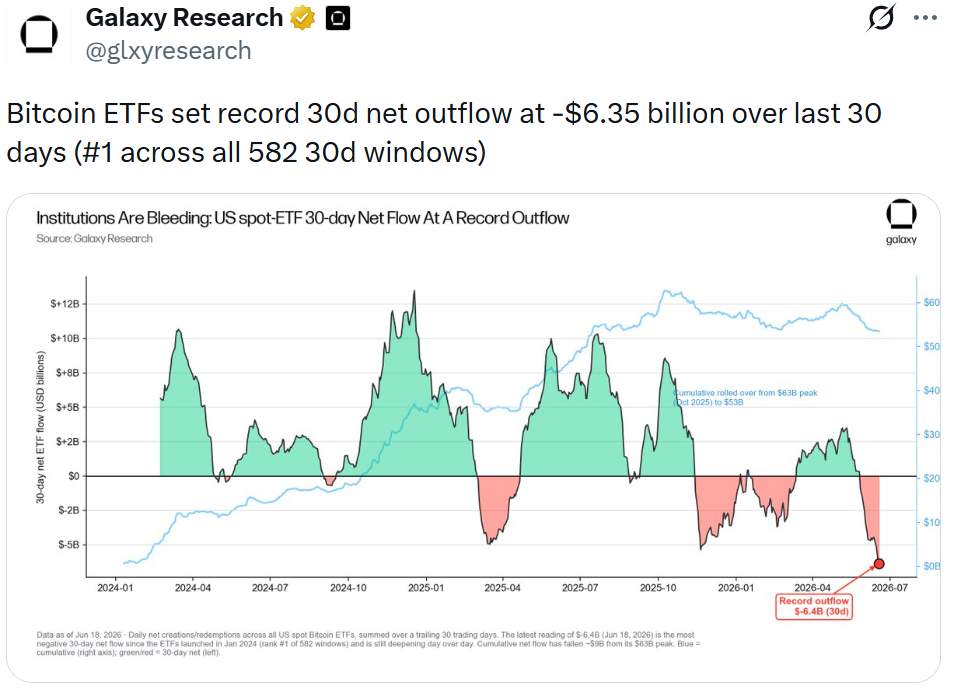
US-listed spot Bitcoin exchange-traded funds recorded their largest 30-day net outflow since launching in January 2024 amid a crypto bear market.
According to data from Galaxy Research, US Bitcoin ETFs saw $6.35 billion in net outflows over a trailing 30 trading days. It also comes as they registered their sixth week of outflows last week, bringing their cumulative net flow to $53.4 billion, down from their $63 billion peak in October 2025.
Galaxy Research said the daily outflows are “still deepening day over day.”
The outflows could reflect waning sentiment from institutional investors for Bitcoin. However, BlackRock US head of equity ETFs Jay Jacobs told Cointelegraph on Thursday that there are many other reasons why outflows occur day to day.
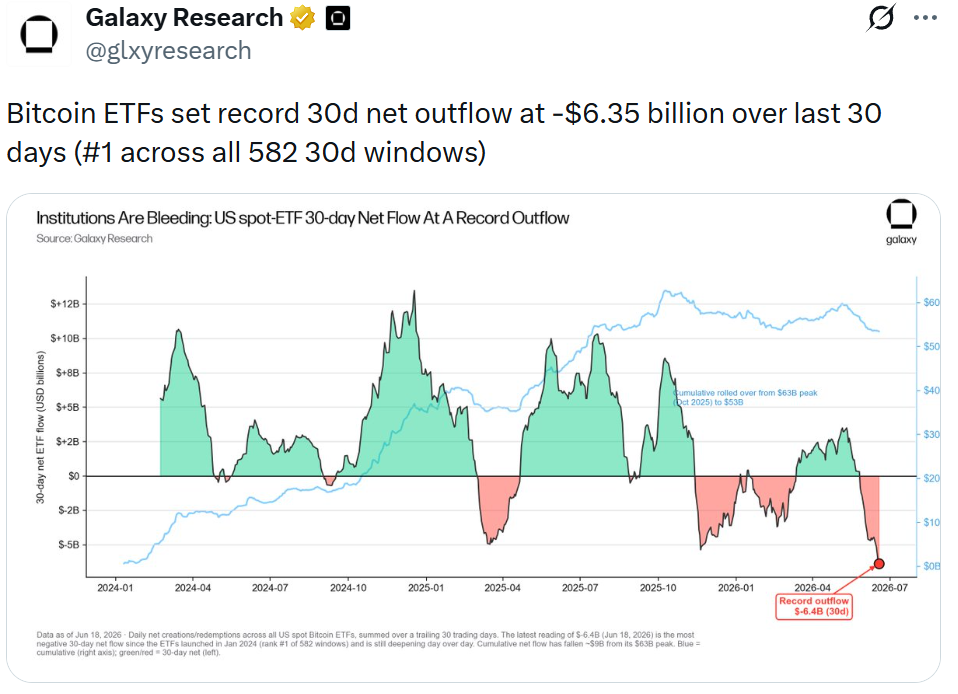
Source: Galaxy Research
“What I think is maybe sometimes misunderstood by the market is that if we see a day of outflows, there could be a million reasons why. It could be someone selling IBIT and buying BITA,” Jacobs said, referring to its iShares Bitcoin Premium Income ETF (BITA), which launched on Wednesday.
Bitcoin is trading at $64,167 at the time of writing, down 17.4% over the past month. The asset has been pressured by macroeconomic factors, including an increase in US inflation, along with the ongoing war between the US and Iran.
Related: Bitcoin activity nears record highs on microtransaction surge
However, Jacobs said the volatility hasn’t impacted BlackRock’s view of Bitcoin as a global, decentralized, nonsovereign monetary alternative.
“Every asset class has volatility… we have over 450 exchange-traded funds within iShares,” said Jacobs, referring to the family of ETFs and index mutual funds managed and marketed by BlackRock.
“So we see inflows and outflows every day across a wide range of assets from large cap, small cap, Bitcoin, gold, etc. So in the short term, it’s absolutely not something that changes the way we view the asset or the utility of the asset.”
Magazine: Bitcoin decouples from tech stocks, Ether eyes ‘selling wave’: Market Moves

A leading Ethereum MEV bot, Jaredfromsubway.eth, has reportedly been drained of more than $7.5 million after an attacker exploited weaknesses in the bot’s automated execution workflow. The incident highlights a critical, often underappreciated risk for MEV infrastructure: once a bot is trusted with permissions, attackers only need to trick it into granting the right approvals to move funds.
According to Blockaid, the attacker used attacker-controlled contracts to manipulate Jaredfromsubway.eth’s automated MEV execution system into issuing token approvals that were later used to drain funds. Blockaid described the event as neither a classic phishing attempt nor a straightforward smart-contract vulnerability in the bot’s victim contracts.
Key takeaways
- Blockaid attributes the theft to malicious approvals: attacker-controlled contracts induced Jaredfromsubway.eth to authorize spending before sweeping funds.
- The attack was “counter-MEV” in design, targeting the bot’s trust-minimized decision logic and execution pipeline rather than attempting to directly compromise the bot’s private keys.
- Fake token and liquidity artifacts played a central role, with the attacker deploying dozens of contracts designed to resemble major Ethereum assets and venues.
- The event reinforces systemic MEV exposure—even bots that target profitable opportunities can become liabilities if they approve the wrong spending permissions.
What Blockaid says happened
In its account of the incident, Blockaid said the attacker’s main move was to exploit how automated MEV bots operate: by monitoring activity and then executing trades based on what appear to be profitable on-chain opportunities. In this case, the “profitable” paths were set up by the attacker using contracts that behaved like bait.
Blockaid noted that the event on Saturday did not resemble a typical phishing scenario, and it was not characterized as a traditional smart-contract bug in the bot’s victim logic. Instead, the focus was on the automated execution system itself—specifically the token approval steps that enable a bot to interact with assets and helper contracts during MEV operations.
A “honeypot” aimed at the bot’s approvals
Blockaid’s chief technology officer, Raz Niv, told Cointelegraph that the attack functioned as a counter-MEV honeypot. The strategy, he explained, was to target the bot’s trust-minimized decision-making logic—the part that determines which trades to pursue and which contracts to empower.
Over several weeks, the attacker allegedly deployed 66 fake token contracts designed to imitate familiar assets such as Wrapped ETH (WETH), USDC, and USDT, pairing them with fake liquidity pools. The goal was to create the appearance of trade opportunities that automated systems like Jaredfromsubway.eth are programmed to seek.
Once the bot interacted with these counterfeit contracts, Jaredfromsubway.eth reportedly approved certain attacker-controlled helper contracts that would later be used to move real funds. As Niv put it, the bot effectively handed over “the keys” to its treasury—an important reminder that approvals can be as dangerous as vulnerabilities when automation is involved.
“And then in a single transaction, the attacker called all 66 backdoors and swept all the ETH, USDC, and USDT at these addresses, amounting to millions of dollars.”
Why this matters beyond one wallet
MEV bots are typically described as automation that scans unconfirmed or pending activity and then reorders or manipulates transactions to extract profit. In doing so, they can impose an “invisible tax” on DeFi users—an issue that has drawn substantial research attention over the years.
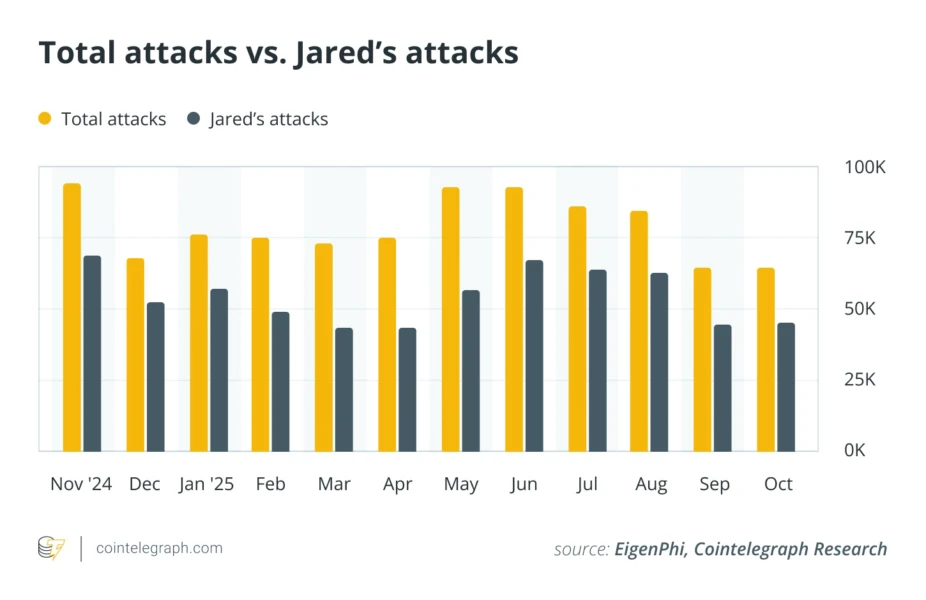
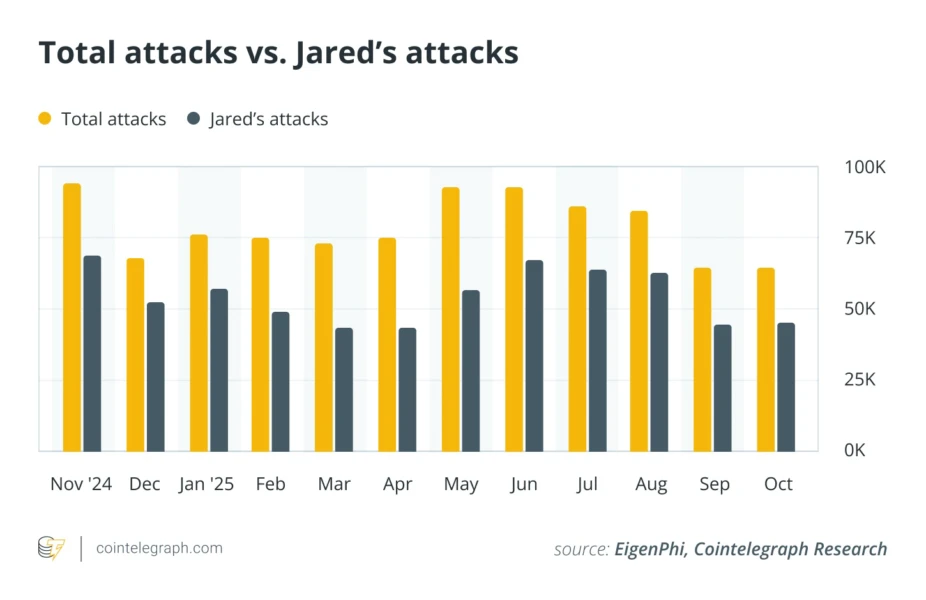
Earlier Cointelegraph Research found that sandwich attacks on Ethereum caused roughly $60 million in annual losses for traders, with the analysis also reporting 60,000 to 90,000 sandwich attacks per month between November 2024 and October 2025. That same research said around 70% of those attacks were associated with Jaredfromsubway.eth.
This new development turns the spotlight from the bot’s profit extraction methods to the security assumptions that power those same operations. When an MEV system depends on automated approvals and execution pathways, attackers may not need to break cryptography or exploit a bug in victim contracts. They may only need to engineer on-chain interactions that cause the bot to authorize spending to attacker-controlled addresses.
MEV’s reach has been wider than people realize
While this reported drain is by far the most serious outcome, Cointelegraph noted another instance involving Jaredfromsubway.eth: in May, Ethereum co-founder Vitalik Buterin was sandwich attacked while swapping 26,544 DigitalBits (worth $2.11 at the time of Cointelegraph’s writing). The losses in that case were reportedly small, but it underscored that MEV bots can target even relatively modest transactions.
The broader point for market participants is that MEV activity is not limited to high-profile trades. It can reach across liquidity conditions and transaction sizes, depending on how opportunities appear to bots in real time. For users and integrators, that reality has been part of the ongoing debate around fairness, transparency, and how encrypted transaction infrastructure changes the incentives for adversaries.
It’s also a reminder that the line between attacker and victim in MEV is frequently thinner than the public narrative suggests. The same operational patterns that enable profit extraction can be subverted—particularly when bots must make rapid execution decisions and grant permissions without full guarantees about the counterparties they’re dealing with.
Going forward, investors, DeFi users, and builders should watch for two signals: whether this incident triggers wider scrutiny of how MEV bots handle approvals and “helper” contracts, and whether similar “counter-MEV honeypot” tactics appear against other automated systems. The technical details of token-approval misuse are often portable, and the next exploit may be less about one bot’s identity and more about the shared automation patterns that many MEV tools rely on.

MEV bot operator Jaredfromsubway.eth has reportedly lost more than $7.5 million after an attacker used a “counter-MEV” strategy to trick the bot into authorizing spending approvals that were later used to drain its funds. The incident, discovered on Saturday, highlights a growing security risk for automated trading systems: even bots built to exploit market opportunities can be turned against themselves.
Blockaid said the compromise stemmed from attacker-controlled contracts manipulating Jaredfromsubway.eth’s automated MEV execution logic into issuing token approvals. Those approvals—part of the bot’s normal workflow—were then leveraged to transfer assets out of the bot’s treasury.
Key takeaways
- Blockaid attributes the $7.5M+ loss to fake contracts that induced Jaredfromsubway.eth to grant token approvals used for a subsequent sweep.
- The attack was not framed as classic phishing or a flaw in the victim contract itself, but as a targeted manipulation of the bot’s automated decision-making.
- Blockaid’s technical description includes 66 counterfeit token contracts paired with fake liquidity pools to appear like profitable trades.
- The incident underscores that MEV strategies can create predictable authorization paths that attackers may try to repurpose.
- Earlier Cointelegraph Research linked Jaredfromsubway.eth with a large share of sandwich attacks, showing how high-profile MEV actors can become high-value targets.
A rare turnabout for a prominent MEV bot
MEV bots operate by monitoring unconfirmed transactions and attempting to reorder or manipulate trades to extract profit. In practice, this behavior often translates into an “invisible tax” for some DeFi users, especially during sandwich attacks—where an attacker places trades around a target transaction to capture value from price movement.
Cointelegraph Research previously estimated that sandwich attacks on Ethereum have produced around $60 million in annual losses for traders. That same research reportedly found 60,000 to 90,000 sandwich attacks per month between November 2024 and October 2025, with roughly 70% associated with Jaredfromsubway.eth. Against that backdrop, the Saturday incident is notable precisely because it shows an automated profit-seeking system can be engineered to fail in a way that benefits an adversary.
Blockaid: the exploit used approvals, not a direct “victim contract” bug
Blockaid emphasized that this was not a traditional victim-side vulnerability. In a statement on X, the company said the event was neither a classic phishing attack nor a standard smart-contract exploit of the victim contract.
According to Blockaid, the attacker exploited an aspect of how Jaredfromsubway.eth executes MEV strategies. The goal was to steer the bot’s “trust-minimized” automation—its automated, contract-driven decision logic—toward approvals that the attacker could later use to move funds.
Blockaid chief technology officer Raz Niv described the technique as a counter-MEV honeypot attack. Rather than attacking the bot’s private keys directly, the approach aimed to influence what the bot would do once it encountered transactions and on-chain artifacts that looked like opportunities aligned with its programmed objectives.
The “66 backdoors” narrative: fake tokens and liquidity pools
In a conversation with Cointelegraph, Niv said the attacker deployed fake token contracts over a period of weeks. He stated that there were 66 counterfeit token contracts designed to mimic well-known assets, including Wrapped ETH, USDC, and USDt. These fakes were paired with fake liquidity pools intended to make the ecosystem appear to offer profitable trades.
The counterfeit setup was engineered to resemble the kinds of transactions MEV bots typically chase. By presenting plausible trading conditions, the attacker “lured” Jaredfromsubway.eth into executing its normal logic—specifically, approving certain attacker-controlled helper contracts to spend funds on the bot’s behalf.
“Ironically, in the process, it provided the attacker the keys to millions in the bot’s treasury,” Niv said.
“And then in a single transaction, the attacker called all 66 backdoors and swept all the ETH, USDC, and USDT at these addresses, amounting to millions of dollars.”
The attack’s structure matters for investors and builders because it demonstrates a common automation pitfall: when systems rely on broad or reusable token allowances to operate efficiently, a malicious actor may focus on obtaining those allowances rather than breaking the underlying execution engine.
Why this matters for DeFi and automated trading
MEV activity is often discussed in terms of profitability and market mechanics, but the Jaredfromsubway.eth incident shifts attention to operational security. Even if a bot’s trading logic is intended to be automated and “trust-minimized,” that automation still has to interact with external contracts and grant permissions in order to operate.
The broader implication is that attackers can design environments that comply with the bot’s assumptions while quietly redirecting the outcome. In this case, the environment included fake token contracts and pools meant to look legitimate enough to trigger approvals—turning expected functionality into an exit path.
The timing and visibility of the story also add context. Earlier this year, Cointelegraph reported that Ethereum co-founder Vitalik Buterin was sandwiched by Jaredfromsubway.eth while swapping 26,544 DigitalBits, which was worth $2.11 at the time of writing. The harm in that example was reportedly minimal, but it illustrated that MEV bots may target transactions of any size. Saturday’s loss claim suggests the inverse is also true: high-profile MEV infrastructure can be targeted using the same automation pathways it uses to function.
Crypto investor and commentator David Gokhshtein reacted publicly to the news on X, framing it as a response to a bot that has benefited from sandwiching before—though he also cautioned against celebration.
What to watch next
For now, the key questions are how widespread similar approval-based counter-MEV tactics could be and whether bot operators will adjust their permissioning and contract interaction patterns to reduce exposure to authorization-driven drains. The next signal to monitor will be whether Blockaid’s described counter-MEV honeypot approach becomes a repeatable playbook—or prompts faster defensive changes across automated MEV systems.
One of the most successful MEV bots in crypto, Jaredfromsubway.eth, has been drained for more than $7.5 million, with an attacker exploiting the bot’s automated systems, the same ones that have netted it hundreds of millions over the years.
According to Blockaid, the incident on Saturday resulted from attacker-controlled contracts tricking Jaredfromsubway.eth’s automated MEV execution system into granting token approvals that were later used to drain funds.
“This is not a classic phishing attack and not a traditional smart-contract vulnerability in the victim contract,” Blockaid said on X.
It’s a rare comeuppance for MEV (maximal extractable value) bots like Jaredfromsubway.eth, which are automated programs that monitor unconfirmed transactions on blockchain networks and manipulate their order to extract profit, a kind of “invisible tax” on DeFi users.
Cointelegraph Research previously found that sandwich attacks on Ethereum have resulted in about $60 million in annual losses for traders. The research also found that between November 2024 and October 2025, there were 60,000 to 90,000 sandwich attacks per month, with roughly 70% of them associated with Jaredfromsubway.eth.
How Jaredfromsubway.eth was exploited
The attacker created fake wrapper tokens and pools, including fake Wrapped Ether (fWETH), fake USDC (fUSDC) and fake USDt (fUSDT) routes paired with fake Cap (fCAP), Blockaid explained.
The fakes were designed to look like profitable trades, the kind the MEV bot is programmed to chase. It then did what it was designed to do, approving certain attacker-controlled helper contracts to spend real money on its behalf.
While in normal cases, the bot would use up the approval during the trade, in this case, the attacker crafted routes that allowed the approvals to stay open.
Once enough approvals were in place, the attacker conducted a “final sweep” to pull WETH, USDC and USDT from the Jaredfromsubway.eth MEV bot contract via transferFrom.
“The attacker exploited the bot’s mechanism: its automated system detected what looked like profitable MEV opportunities and generated approvals to attacker-controlled helper contracts.”
“We shouldn’t be happy about this; no one should celebrate … but if you’ve ever been sandwiched by this … I’m pretty sure you’re not upset about this news,” crypto investor and commentator David Gokhshtein said.
Magazine: The end of anon? AI could unmask crypto’s hidden identities

Bitcoin network activity index crossed above its 365-day moving average for the first time since December 2024, entering what CryptoQuant research news officially classifies as a bull phase, the same threshold that preceded significant price advances in 2024 and 2025.
Daily Bitcoin transactions have exceeded 800,000 in 2026, more than doubling from 2025 lows, and the network activity index has jumped from roughly 3,320 to approximately 3,600. BTC price at time of writing sits at $62,500, down 2.5% over 24 hours.
The timing carries macro weight. Partial de-escalation from the Iran peace deal has removed some of the geopolitical risk premium that had been suppressing risk appetite across crypto markets, with BTC holding just above the 200-week SMA near $62,000, a level that has historically functioned as long-cycle support.

The combination of a bull-phase network signal and a macro tailwind makes the bottom question legitimate. What the data actually shows, however, is more complicated than the headline implies.
Strip out the price action, and something structurally notable is happening underneath. Whether it is signal or noise is the entire question.
Discover: The Best Token Presales
Bitcoin News: On-Chain Activity, What the 365-Day MA Break Actually Tells Us
CryptoQuant’s network activity index measures a composite of transaction count, active addresses, and block utilization.
Breaking above its 365-day average has historically marked the transition into sustained bull-phase behavior, it happened in late 2024 and again briefly in April 2025, both of which preceded upward price moves. The index is now in that band again for the first time in over a year, with average transactions per block running near record levels for several consecutive weeks, which CryptoQuant describes as structural rather than transient.
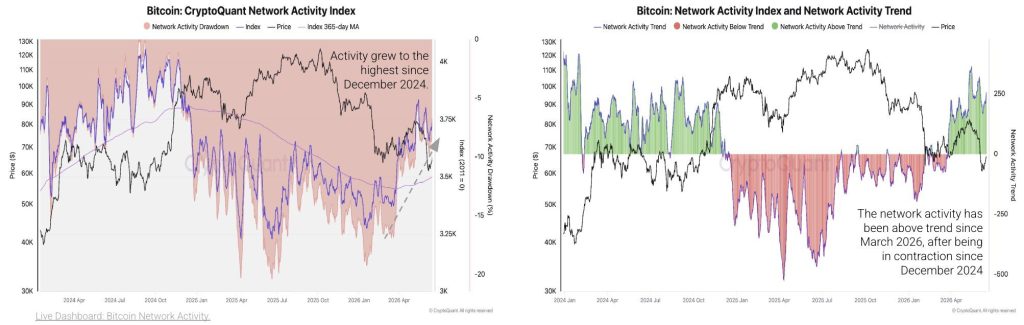
The accumulation data reinforces the signal. Long-term holders, the so-called HODL-oriented cohorts, now hold more than 4.37 million BTC, up from roughly 2 million BTC in early 2024.
That is a meaningful illiquid supply lock-up that historically tightens available float ahead of price recoveries. VanEck’s analysis shows roughly 43% of supply dormant for more than three years, in the upper percentiles historically.
The caveat is direct: CryptoQuant said “the economic content of these transactions differs materially from prior high-activity periods.” Transactions below 0.01 BTC, roughly $630 at current prices, now account for approximately 80% of all daily on-chain activity, up from 44% in 2023.
The surge in the sub-0.001 BTC and sub-0.01 BTC cohorts toward their previous 2024 highs is being driven almost entirely by OP_RETURN-based protocols: Runes, Ordinals, BRC-20 tokens, and data timestamping services.
CryptoQuant noted OP_RETURN usage has “spiked to near-record levels in 2026,” with these protocols generating large volumes of dust-value microtransactions that “directly explain the low-value cohort surge.” The transferred value per transaction, as the firm put it plainly, “is tiny.”
The mempool has expanded to approximately 128,000 pending transactions, its highest level since late February 2025, with congestion concentrated in the low-fee tier. CryptoQuant warns that sustained expansion of protocol-driven activity “could drive fee increases for time-sensitive economic transactions,” which would eventually impose real costs on genuine economic throughput. That dynamic is worth tracking, but it is not yet at the threshold where it meaningfully disrupts settlement flows.
Discover: The Best Token Presales
The post Bitcoin Network Activity Erupts After Iran Peace Deal: Is The Bottom In For BTC? appeared first on Cryptonews.
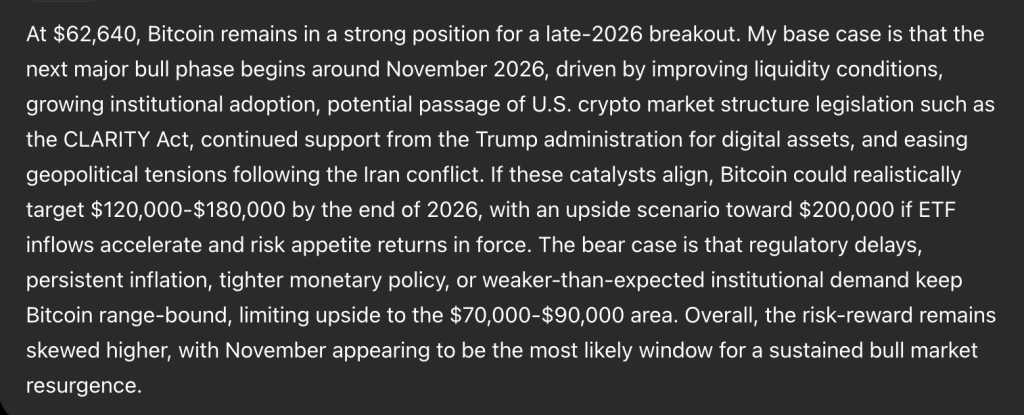
There is one word in this prediction that carries more weight than any of the Bitcoin price predictions for November. ChatGPT AI is not hedging on timing the way a lot of these predict do.
It names a specific month as the most likely window for a sustained bull market resurgence, and everything else in the prediction is built to support that single calendar bet.
When an AI commits to a date rather than just a price, the entire thesis becomes easier to grade later, which makes this one of the more accountable calls in the series.
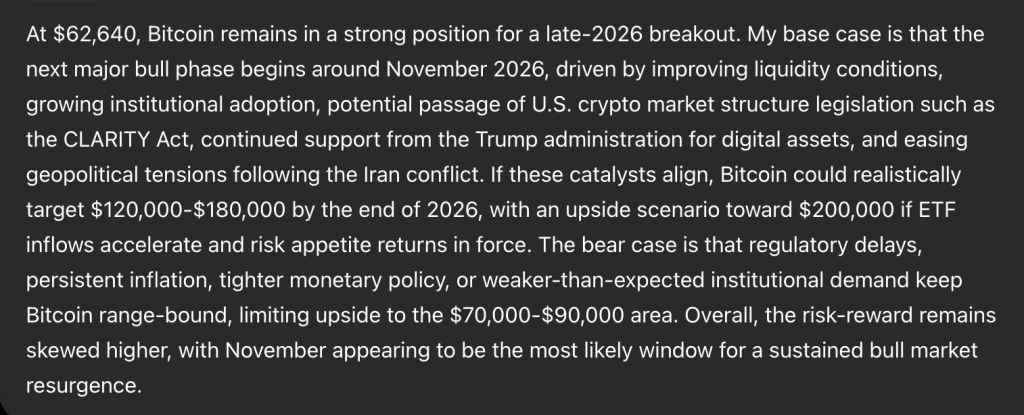
At $62,640, ChatGPT’s base case has the next major bull phase beginning around November 2026, driven by improving liquidity conditions, growing institutional adoption, potential passage of U.S. crypto market structure legislation such as the CLARITY Act, continued support from the Trump administration for digital assets, and easing geopolitical tensions following the Iran conflict.
That is five distinct tailwinds converging on roughly the same window, and if even most of them land together, the base target sits at $120,000 to $180,000 by year’s end, with an upside scenario stretching to $200,000 if ETF inflows accelerate and risk appetite returns in force.
From current levels, that base case alone represents nearly a 2x to almost 3x move.
The bear case is where this prediction earns some credibility by being specific rather than vague. Regulatory delays, persistent inflation, tighter monetary policy, or weaker-than-expected institutional demand could keep Bitcoin range-bound, limiting upside to the $70,000 to $90,000 area.
That is not a doomsday scenario; it is a stall scenario, and the distinction matters because it means even in the bear case, ChatGPT still expects the price to be above where it sits today. The overall framing leans firmly toward risk-reward skewed higher.
Bitcoin Price Prediction: The Calendar Bet The Chart Has To Earn
Bitcoin price is at $62,568 today, and the daily chart shows price sitting almost exactly where it has traded multiple times before across this entire cycle, a level that keeps getting revisited rather than decisively broken in either direction.
From the $128,000 peak last October, the decline has been steep, but what stands out on this chart is the repeating rhythm, sharp drops followed by multi-month recoveries that each stall out before reaching the previous high.
The June low near $60,000 is the third meaningful test of that general zone since the correction began, and each prior test has produced a bounce rather than a breakdown.
For ChatGPT’s November thesis to have any technical credibility, the chart needs months of quiet base-building between now and then, exactly the kind of consolidation pattern that has actually been forming since February.
The $60,000 to $70,000 range has effectively become the holding zone for this entire correction, and the longer price stays contained within it without making a new low, the more that range starts to look like accumulation rather than distribution.
The first real test above is $72,000, the level that has capped every recovery attempt since the May rejection, and reclaiming it would be the earliest technical signal that the chart is starting to lean into the bull phase the prediction is calling for.
The RSI sits at 34.11 with the signal line at 32.45, a gap of less than 2 points, among the flattest readings seen anywhere in this prediction series. Momentum is neither building decisively nor collapsing further, it is essentially asleep, hovering in the same depressed zone it has occupied through most of this multi-month range.
That flatness is oddly consistent with a November target. A genuine bull phase igniting months from now does not require momentum to already be screaming higher today, it requires exactly this kind of quiet, sideways grind first, the calm before whichever catalyst from ChatGPT’s list actually shows up to break the range.
LiquidChain Is Catching the Attention of Bitcoin holders: ChatGPT AI Predicts It’s the Next 100x
The rotation is already happening. Most people will only see it in hindsight.
Large-cap crypto is not failing. It is capped. Bitcoin, Ethereum, and XRP have been pressing against the same resistance bands for weeks. The macro tailwinds keep getting delayed.
The institutional inflows keep getting pushed to next quarter. Holding assets where the upside depends on catalysts you cannot control is not a strategy. It is waiting.
A capital that has navigated enough cycles does not wait at resistance. It moves before the destination becomes obvious.
Early-stage infrastructure plays operate on different math entirely. A small enough market cap means a modest rotation produces dramatic price movement. The asymmetry exists because the market has not priced in what is being built yet. That gap between current valuation and what the project is actually worth is where the returns come from.
Multi-chain fragmentation costs DeFi real money every single day. Bitcoin, Ethereum, and Solana run completely isolated liquidity systems with no native way to connect them. Every user moving value between ecosystems absorbs that cost directly in fees, slippage, and failed transactions.
LiquidChain collapses all 3 networks into a single execution layer. One deployment. Full ecosystem access. No cross-chain tax on every interaction.
The market has not found this yet. That is the entire point.
The presale is at $0.01454 with just over $820,000 raised. Ground floor is not a marketing phrase here. It is a description of where this actually sits in its lifecycle.
Execution is unproven. Adoption is unknown. Those risks are real and worth naming directly. Established assets offer a smoother ride toward a ceiling that is already visible. This offers an earlier seat at a table that has not been set yet.
Explore the LiquidChain Presale
The post Sam Altman ChatGPT AI Predicts Stunning Bitcoin Price By End Of 2026 appeared first on Cryptonews.

Ethereum’s layer-1 network set all-time highs across every usage metric in Q1 2026, with monthly active users climbing 53.5% quarter-over-quarter to 13.2 million and transaction count reaching 200.4 million, even as ETH’s market cap dropped 30% and fees on the base layer fell nearly 50%.
But according to Token Terminal’s Q1 2026 Ethereum Report, the divergence between the rising activity and falling revenue is the whole point.
Ethereum Usage Hits Record Despite Falling Fees and Valuation
The report, published on June 17, showed the numbers splitting cleanly along two lines. On the usage side, everything went up, including active monthly users, which rose 85.9% year-over-year; transactions, which increased 81.5% YoY to just over 200 million; and throughput, which hit 25.78 transactions per second, an 81.7% jump YoY.
However, on the dollar side, things weren’t so glossy. Ecosystem total value locked averaged $316.2 billion, down 11% from Q4 2025 but still up nearly 23% year-over-year. Meanwhile, base layer transaction fees came in at $39.9 million, an almost 48% fall from the previous quarter and 81.9% below where they were a year ago.
Per Token Terminal, the fee compression had a direct cause, namely the Fusaka upgrade cycle’s second Blob Parameters Only fork (BPO #2) in January, which raised Ethereum’s data capacity and made blockspace cheaper. As a result, the transaction count went up 38% while total fees dropped by almost half in the same period.
Etherealize, the group that’s working to push Ethereum’s capabilities to traditional finance and a contributor to the report, framed it this way:
“Ethereum is deliberately scaling the network at the expense of near-term fee capture, betting that cheaper blockspace unlocks far more demand (and eventually network revenue) in the long run.”
They are looking ahead to the Glamsterdam upgrade, which is targeting a more than 3x increase in the gas limit in Q3 2026, with Ethereum’s roadmap ultimately guiding toward 10,000 TPS and near-instant finality by 2029.
On Ethereum’s structural position in tokenized assets, the report noted that it had stayed largely intact through the quarter, with the total tokenized asset market cap averaging $203.4 billion, just 0.7% lower than the quarter before. However, it was up 42.9% year-over-year, with stablecoins leading at $178.9 billion, of which Tether’s USDT ($94.1 billion) and Circle’s USDC ($54.5 billion) accounted for the bulk.
Tokenized assets turned out to be the fastest-growing segment, increasing 60% QoQ and 325.9% YoY to $4.7 billion, most of which were represented by tokenized gold, that is, Tether Gold and PAX Gold. Tokenized funds also experienced similar growth rates, rising 5% to 19.4 billion within the period under discussion. Regulated institutional products from BlackRock’s BUIDL, WisdomTree, and Superstate were among the larger holdings, alongside yield-bearing on-chain dollar products from Sky and Ethena.
And out of the top 5 blockchain networks, Ethereum had a share of 71% of the total TVL, worth $316.2 billion, against the $129 billion on Tron, Solana, BNB Chain, and Plasma collectively. It also holds more than 79% of active DeFi loans, nearly 62% of stablecoins, and 73% of tokenized funds, as well as 84% of tokenized commodities.
However, DEX trading volume was the one area where Ethereum did not lead, with BNB Chain processing $162.5 billion against its $134.5 billion, as Solana came third after pulling in $104.9 billion.
ETH Price Under Pressure
Interestingly, none of the activity described above translated into price strength for Ethereum’s native token. For one, the coin’s fully diluted market cap averaged $290 billion in Q1 2026, which was a 30.3% dip QoQ and almost 10% across one year.
At the time of writing, it was sniffing around the $1,700 level after briefly hitting a 14-month low near $1,500 earlier in June before recovering somewhat on news of a peace deal between the United States and Iran.
Analyst sentiment regarding it is divided, with some like Daan Crypto Trades noting that ETH is on track for its second-worst first half of the year since 2022 after a 29% plunge in Q1 and another 21% decline so far in Q2. That puts it on course for three double-digit quarterly losses in a row.
The post The Revenue Divergence: Why Record-Breaking Ethereum Activity Isn’t Boosting ETH Price appeared first on CryptoPotato.

The four Cambridgeshire car parks where you can park for free from August
Israel says it ’eliminated’ two Hamas and Islamic Jihad operatives tied to major funding network

Shoppers Say This $40 Dress ‘Camouflages Tummy Issues’


-

 Business7 days ago
No Jackpot Winner as $257 Million Prize Rolls Over to $269 Million Monday Draw
-

 Fashion2 days ago
Weekend Open Thread: Miami – Corporette.com
-
 Crypto World6 days ago
Zimbabwe Requires Crypto Businesses to Register Annually Under New FIU Regulations
-
 Business1 day ago
Wall Street Week Ahead: Investors see Micron earnings as pulse check of AI rally momentum
-
 Entertainment6 days ago
Matt Damon’s Viral Sci-Fi Thriller Has Taken Over HBO Max
-

 Tech7 days ago
As AI companies race to go public, who else is along for the ride?
-

 Business6 days ago
Anthropic staff to meet White House officials next week, Axios reports
-
 Crypto World6 days ago
Bitcoin could crash to $48,000, if this historical pattern is triggered
-
 NewsBeat6 days ago
what doctors are seeing in ebike crashes
-

 Crypto World1 day ago
HIVE shares jump as $220M AI deal speeds Bitcoin mining pivot
-
 NewsBeat6 days ago
Warning of disruption as Cardiff Crossrail works to start
-
 NewsBeat6 days ago
Tributes to former deputy head teacher at Cambridge school among death and funeral notices
-
 Entertainment6 days ago
Kate Middleton Glare Goes Viral After Kids Booed At Royal Event
-

 Politics6 days ago
“Israel’s” ban on ICRC visits ruled illegal, but Knesset moves to stop them permanently
-

 News Videos6 days ago
Financial Accounting | Last Day Revision Strategy and Booster | CMA Inter – June 2026
-

 Crypto World6 days ago
XRP ETFs Outperform As Bitcoin And Ethereum Funds Extend Outflow Trend
-

 Tech6 days ago
Over 400 Arch Linux packages compromised to push rootkit, infostealer
-

 NewsBeat6 days ago
Singer Oliver Tree dies aged 32 in helicopter crash in Brazil
-

 Business6 days ago
Invesco Quality Income Fund Q1 2026 Commentary
-
 Crypto World7 days ago
Market Preview: SpaceX (SPCX) IPO Record, Federal Reserve Meeting, and Iran Nuclear Agreement
You must be logged in to post a comment Login