

Business
Vietnam’s Industrial Surge Redefines the “Single-Location” Investment Strategy

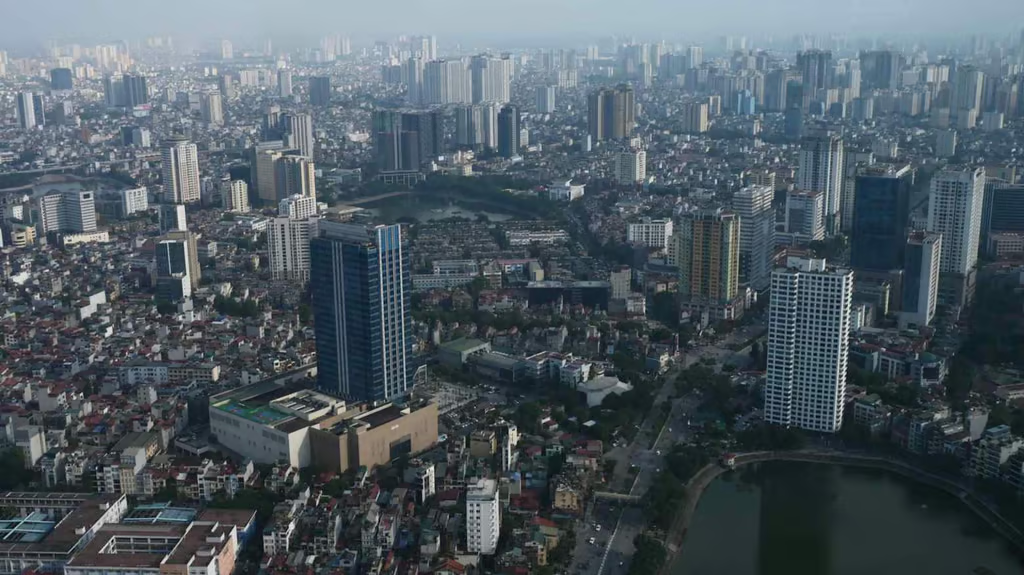
Vietnam’s industrial landscape is transitioning from a uniform manufacturing market into a complex system of distinct regional ecosystems, requiring investors to move beyond a “one-location” playbook. While Northern, Central, and Southern regions offer unique advantages—ranging from tight integration with Chinese supply chains to emerging low-cost opportunities—infrastructure developments like the Long Thanh International Airport are reshaping the country’s economic gravity faster than policy frameworks. Consequently, long-term success in Vietnam now depends on navigating regional divergence and leveraging tailored business intelligence rather than relying on oversimplified, national-level data.
Key Points
- Northern Vietnam has solidified its role as a “China-plus-one” hub, specifically optimized for time-sensitive supply chains and seamless cross-border component flows.
- Central Vietnam is emerging as a competitive, lower-cost alternative for manufacturers seeking first-mover advantages and an escape from the congestion of primary industrial hubs.
- Southern Vietnam remains the leader in FDI volume and market access but faces increasing challenges from rising labor costs, logistical bottlenecks, and regulatory complexity.
- Infrastructure projects, most notably the Long Thanh International Airport in Dong Nai, are redrawing the industrial map by creating new high-tech and smart-logistics corridors.
- Vietnam is shifting from siloed provincial planning toward integrated industrial ecosystems and corridors, such as the Hanoi–Hai Phong–Quang Ninh and Ho Chi Minh City–Binh Duong–Ba Ria-Vung Tau zones.
- Provincial authorities are becoming more selective, increasingly prioritizing high-value, environmentally sustainable projects while discouraging low-tech, labor-intensive investments.
- The primary risk for modern investors is no longer regulatory uncertainty but the oversimplification of a market where incentives, labor availability, and land pricing vary sharply between regions.
- Effective investment strategies for 2026 require sector-specific and location-specific intelligence to align with future infrastructure and evolving provincial policy priorities.
Vietnam’s manufacturing triumph is commonly highlighted through national figures such as FDI investments, export increases, and growing industrial production. However, for investors actively engaged in the market, these prominent statistics often mask a more intricate truth: Vietnam has evolved beyond a single industrial market. It now comprises a network of competing, merging, and developing industrial ecosystems.
How do the specific operational advantages of Northern Vietnam’s ‘China-plus-one’ hub compare to the emerging cost efficiencies of Central Vietnam for high-tech manufacturers?
The comparison between Northern Vietnam’s well-established “China-plus-one” hub and the rising efficiencies of Central Vietnam highlights a trade-off between rapid supply chain responsiveness and sustainable cost-effectiveness.
Northern Vietnam: The ‘China-plus-one’ Operational Hub
Northern Vietnam is positioned as a specialized hub for high-tech manufacturers who require tight integration with Chinese production networks. Its specific advantages include:
- Logistical Proximity: Its close proximity to China significantly reduces logistics costs for manufacturers that rely heavily on importing components from across the border.
- Time-Sensitivity: The region is optimized for time-sensitive supply chains and seamless cross-border component flows.
- Specialization: The document notes that production, infrastructure, and labor in the North are more specialized than in other regions, such as the South.
- Strategic Goal: It is the primary choice for companies seeking to quickly relocate operations while maintaining high integration with Chinese supply chains.
Central Vietnam: Emerging Cost and Long-term Efficiencies
Central Vietnam is characterized as a “long overlooked” region that offers a different strategic value proposition based on cost and first-mover advantages:
- Cost and Congestion: It serves as a lower-cost, lower-congestion alternative to the more saturated hubs in the North and South.
- Efficiency over Scale: Manufacturers in this region often trade immediate scale for long-term efficiency and “first-mover advantage.”
- Operational Flexibility: The region offers lower costs and “room to relocate” for both manufacturers and their partners/suppliers.
- Strategic Goal: It is best suited for companies with a long-term investment strategy who are willing to relocate the majority of their supply chain over time.
Comparative Summary for High-Tech Manufacturers
| Feature | Northern Vietnam | Central Vietnam |
|---|---|---|
| Primary Advantage | Speed and integration with China. | Lower costs and reduced congestion. |
| Supply Chain Focus | Importing components from China. | Relocating the entire supply chain over time. |
| Infrastructure Status | Specialized and established. | Supplier networks/high-end zones not yet fully established. |
| Investment Timeline | Rapid relocation/Immediate operation. | Long-term strategy/First-mover advantage. |
The choice between the two regions depends on the manufacturer’s specific needs. The North is superior for those needing immediate, high-tech specialization and Chinese component access. In contrast, Central Vietnam is positioned for manufacturers prioritizing long-term cost savings and efficiency who are prepared to deal with a less established local supplier network initially.
Bottom Line
Vietnam remains a compelling manufacturing destination, but in 2026 and beyond, resilience will come from understanding internal complexity and leveraging tailored advisory support rather than relying on generic comparisons.
Other People are Reading

Controversial changes to both the tax system and the NDIS are under negotiation as Labor tries to land a deal with the Greens before parliament breaks.

Motorists will benefit as a cut to fuel taxes is extended for another month, although at half the previous discount.

The combined market cap of the two companies of the RIL group is expected to be around ₹32 trillion. It will nearly match the current combined market value of ₹33 trillion for HDFC Bank, Bharti Airtel, and ICICI Bank.
At present, the market cap of the companies listed on the BSE is nearly ₹478 trillion. For the Nifty 50 set of companies, the market cap is ₹194 trillion, which implies that the RIL group’s market cap will be over 16% of the benchmark index’s market value.
 Agencies
Group share of BSE’s m-cap to rise to nearly 7%, and almost match combined value of HDFC Bank, Bharti Airtel & ICICI Bank
Globally, Elon Musk promoted Tesla and SpaceX together account for nearly 5% of the total market cap of the US companies. After a strong debut on Nasdaq on June 12, SpaceX commands a market cap of $2.4 trillion, while Tesla’s is $1.3 trillion. The market cap of listed companies in the US is over $77 trillion, according to the data from Bloomberg.
Internationally, technology led companies have been driving overall market valuations to record levels. For instance, Samsung Electronics and SK Hynix, the top South Korean companies based on market value, account for nearly 50% of the country’s market cap. In the case of Taiwan, chip maker TSMC contributes over 40% to the country’s market cap.


With crude oil prices falling, would growth be better than the central bank forecast? If yes, then do you think that the need to hike rates is lesser?
Yes, RBI growth and inflation forecasts were based, among other assumptions, on crude oil prices averaging $95 / barrel, which, based on oil futures, now appear likely to be lower. However, disruptions in supply chains could persist for some time, and hence it is difficult to predict the extent of growth recovery in FY27.
The MPC minutes have said that second-order input cost transmission getting embedded in retail inflation will have to be monitored. What would be the first signs visible via data that would suggest visible impact?
Second order effects are likely to manifest in core (non-food and fuel) CPI components, particularly in underlying components (excluding precious metals), indicating the extent of higher input cost pass through to retail inflation. However, it is difficult to forecast second order effects of higher input costs, which will depend on demand elasticities, input substitution and other pass through variables.The RBI Governor’s statement noted a revised FY27 core inflation at 4.7%, up from 4.4% at the April review, and headline at 5.1%, up from 4.6%. Factoring in price trends in other components, it might be possible to estimate specific inflation components.
Are current financial conditions already restrictive enough that a rate hike is unnecessary?
Although the policy repo rate is currently only 15 basis points above the FY27 forecast CPI inflation, money market and short term interest rates remain higher. RBI has also maintained system liquidity at appropriate levels. In addition, the gap between the repo rate and longer term bond yields have also risen much beyond steady state levels. Although MPC quarter wise forecasts of CPI inflation peaks in Q3 FY27, close to the upper band of the target, underlying inflation remains much lower and there are little signs of the economy overheating.
Have conditions eased after the FCNR(B) and ECB packages? Would strong inflows from these schemes reduce the need for any future monetary tightening?
Prima facie, the expected foreign currency inflows will add to autonomous domestic liquidity if even some of the inflows are absorbed by the central bank to replenish its foreign currency reserves. However, financial conditions will depend on RBI’s system liquidity management.Can it be said that growth is a bigger concern for the RBI in the current scenario, especially since inflation is projected at 5.1% and the repo rate is at 5.25%?
At the time of the MPC review, there were risks to both inflation and growth. While high frequency indicators suggested continuing resilience, they indicated a loss of momentum. This was the reason FY27 GDP forecast was a lower 6.6%, compared to the then FY26 estimate of 7.6%.
Softbank-backed robotics firm Coowa plans Hong Kong IPO- WSJ

The biggest difference between the upcoming IPOs in India and the US is not their size but the market mood they are arriving in.
OpenAI and Anthropic are preparing to tap the primary market at a time when enthusiasm over AI has pushed US equities to record highs, creating an almost ideal backdrop for IPOs. In contrast, Jio and NSE are heading to the market in a far less ideal IPO milieu.
While OpenAI and Anthropic enjoy the luxury of launching their IPOs in a market where investors are looking to lap up anything linked to AI, Jio and NSE must do all the heavy lifting, as appetite for Indian equities is far from its peak.
This difference is consequential. Historically, mega IPOs have signalled market tops as issuers look to capitalise on investor frenzy. The logic here is that investors are willing to pay just about anything to be part of the euphoria, ignoring valuation concerns.
This theory, to some extent, resonates with what’s happening in the US, where the loss-making SpaceX listed at a record valuation of $1.8 trillion, making it one of the most valuable companies. Though SpaceX shares are stuttering after the blockbuster debut, the strong showing in the IPO has set the stage for OpenAI and Anthropic in the coming months. There is nothing, for now, to suggest that their IPOs would not sail through unless investors lose faith in the AI theme as a whole.
Shift focus to India: Jio and NSE are preparing to list at a time when Indian markets have delivered no or marginal returns in the past two years. While foreign investors have fled Indian stocks in large numbers, individual investors-the street’s current backbone-are showing less enthusiasm towards equities. Moreover, most recent listings have been far from inspiring.That’s good news for investors. The IPO valuations of both these issuances are likely to be far more sober, with fewer deviations from their listed peers and in sync with the overall large-cap space. Early indications suggest that global investors are considering deploying money in these IPOs, judging them on a standalone basis rather than as part of an India portfolio, given their dominant presence in sectors with high entry barriers.
Some optimists are counting on the Jio and NSE IPOs to give the secondary market a boost, the way Maruti Suzuki‘s IPO in 2003-04 proved to be a turning point for Indian markets. The carmaker’s IPO, coming after the dot-com bubble burst and in the aftermath of the Ketan Parekh scam, was credited with reviving retail participation in equities and improving investor sentiment, signalling the start of one of India’s best bull runs-between 2003 and 2007.
Whether Jio and NSE can have a similar effect is debatable, given the vastly different market and economic conditions prevailing today. Currently, the market is far more mature, with domestic equity ownership at record levels, creating less scope for the entry of a new army of domestic retail investors.
The real test for the Jio and NSE IPOs will not be whether they get fully subscribed; it will be whether the issues can rekindle foreign investor interest in Indian markets. Maruti’s IPO helped bring domestic investors back to the market. Two decades later, Jio and NSE face a bigger task: persuading global investors to give India another look.

Australia’s largest poultry producer has plunged its chicken farms and processing plants into lockdown to protect itself from a deadly avian flu strain.

AMOL ATHAWALE
VP—TECHNICAL RESEARCH, KOTAK SECURITIES
Where is the Nifty headed? The weekly charts display a Doji candlestick pattern, signalling uncertainty and indecision between bulls and bears. Trading Strategy The short-term market outlook remains optimistic, with traders advised to buy on dips and sell on rallies. For the Nifty, the 50-day SMA around 23,850–23,750 is expected to act as a key support zone, while resistance is seen at 24,200–24,400. A fall below 23,750 may prompt traders to exit long positions.
TOP BETS FOR THE WEEK
Britannia Industries: Buy; CMP: Rs 5,195; stop loss: Rs 5,100; target: Rs 5,450
After finding support near Rs 5,050, the stock reversed and is undergoing positive consolidation near its 20-day SMA, indicating that the pullback may continue. Rs 5,100 is likely to act as a crucial support level, and sustaining above it could extend the move towards Rs 5,450.
Grasim Industries: Buy; CMP: Rs 3,150; stop loss: Rs 3,085; target: Rs 3,300
On both the daily and weekly charts, the stock remains in a strong uptrend, with Rs 3,090 emerging as a critical support level. As long as it stays above this mark, the rally could extend towards Rs 3,300, while a fall below Rs 3,090 may warrant an exit from long positions.
AgenciesRUCHIT JAIN
HEAD – EQUITY TECHNICAL RESEARCH, MOTILAL OSWAL FINANCIAL SERVICES
Where is the Nifty headed? The Nifty has recovered steadily from the 23,000 mark, forming a higher bottom near the 61.8% Fibonacci retracement level and reclaiming its 50-day DEMA, signalling improving momentum. If the upmove sustains, the index could head towards 24,500, where the 200-day DEMA and a previous swing high may act as key resistance. On the downside, immediate support is placed at the 20-day DEMA near 23,700, and holding above this level would keep the short-term bullish bias intact.
Trading Strategy: Traders are advised to maintain a positive bias and use corrective declines to create fresh long positions. Dips towards 23,900–23,850 can be used as buying opportunities, with a stop loss below 23,700, while the Nifty may target 24,250 initially and 24,500 if momentum strengthens.
TOP BETS FOR THE WEEK
Aditya Birla Capital: Buy; CMP: Rs 376; stop loss: Rs 360; target: Rs 405
The stock is on the verge of breaking out of a sixmonth consolidation range, suggesting a continuation of its broader primary uptrend. A decisive breakout could trigger fresh momentum and attract follow-up buying.
Premier Energies: Buy; CMP: Rs 1,080; stop loss: Rs 1,020; target: Rs 1,180.
The stock has been forming a higher-top, higher-bottom structure. Prices are respecting the support range of the 20- and 50-day DEMAs, while the RSI oscillator indicates positive momentum.
PABITRO MUKHERJEE
DEPUTY VICE PRESIDENT— TECHNICAL, BAJAJ BROKING
Where is the Nifty headed?
The bias remains positive, and the Nifty is expected to extend its upmove towards 24,300 and 24,600 in the coming weeks. While some consolidation after the recent 1,100-point rally cannot be ruled out, dips towards the 23,800–23,900 support zone should be used to accumulate quality stocks. The broader market is likely to continue outperforming, with the Nifty Midcap 100 targeting 63,500 and the Nifty Smallcap 100 moving towards its CY25 high of 19,225. Trading Strategy Buy Nifty futures at current levels and on dips towards 23,900 for targets of 24,300 and 24,600.
TOP BETS FOR THE WEEK
Bharat Electronics: Buy; CMP: Rs 427; stop loss: Rs 411; target: Rs 452
The stock has broken out above the falling channel that contained its two-month decline and has also closed above its 20- and 50-day EMAs, offering a fresh entry opportunity. The stock is likely to gradually move towards Rs 452, which marks the 80% retracement of the previous decline from Rs 464 to Rs 399.
Eternal: Buy; CMP: Rs 264; stop loss: Rs 249; target: Rs 290
The stock is on the verge of breaking out above its eight week consolidation range of Rs 234–265, offering a fresh opportunity. A bullish crossover of the 20-day EMA above the 50-day EMA supports positive bias, with the stock expected to move towards Rs 290–295 in the coming months.


Lime plans to name Uber as anchor investor in IPO, The Information reports

The Nifty gained 1.65% last week. However, the long-short ratio of foreign portfolio investors’ positions in Nifty futures-a measure of bullish bets relative to bearish ones-stood at 12.95% on Friday. While the increase in the ratio from 8.1% two weeks earlier shows some reduction in short positions, the reading remains far too high to conclude that foreigners have turned bullish.
In the cash market, foreign investors were net buyers in four of the five trading sessions last week, purchasing shares worth a net ₹7,778 crore.
“The long-short ratio has improved marginally due to some short covering alongside fresh long additions by FIIs following the US-Iran peace deal. However, the benchmark Nifty index has not shown an over-optimistic reaction to the peace deal,” said Vipin Kumar, AVP- derivatives and technical research at Globe Capital Market.
AgenciesAnalysts say equities yet to become attractive relative to Asian peers; weak rupee, Iran deal uncertainty also weigh
Iran said it was once again closing the vital Strait of Hormuz on Saturday over Israeli attacks in Lebanon ahead of the weekend negotiations between Washington and Tehran to end the West Asia conflict, underscoring the fragility of the talks.
Analysts said Indian equities are yet to become compelling enough for overseas investors.
“While crude has been correcting, levels of $80 are still high. A dip to $70 or pre-war levels can be a tailwind driving covering from funds that are running short positions in India,” said Sriram Velayudhan, senior vice president, IIFL Capital Services.Velayudhan also said that other regions like South Korea and Taiwan have not yet seen a meaningful reversal or underperformance.
South Korea’s Kospi is up 110% in 2026 so far, while Taiwan’s Taiex Index has gained 58% this year, compared with the Nifty’s decline of 8.2%.
Kumar said the rupee’s underperformance against the dollar and the risk of higher inflation due to a below-average monsoon forecast remain key concerns.
Where will the markets go?
The Nifty ended the previous week at 24,013.10.
Kumar said the index continues to trade within a range, with positional resistance around the 24,600 level.
“A positive weekly breakout in the Nifty index above the 24600 spot level on a closing basis, alongside improvement in the concerned areas, might trigger significant short covering by FIIs,” he said.
Velayudhan said that while the Nifty has been trading in a broad range of 23,800-24,500 for some time, it could test the upper end of that band in the near term.

Source Reveals The Exact Moment Zendaya Fell For Tom Holland

First look inside venue where iconic singers debuted relaunching after 10 years | News UK

Labor's reform outlook cools before long winter break


-

 Fashion2 days ago
Weekend Open Thread: Miami – Corporette.com
-
 Crypto World7 days ago
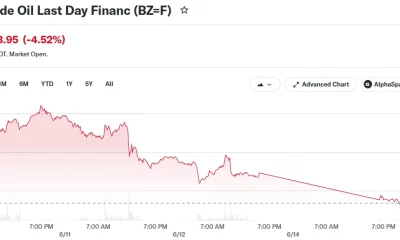
Crude Oil Plunges Over 4% as US-Iran Agreement Reopens Hormuz Strait
-
 Tech5 days ago
The Adder At The Heart Of Intel’s 8087 FPU
-
 Business2 days ago
Wall Street Week Ahead: Investors see Micron earnings as pulse check of AI rally momentum
-

 Crypto World2 days ago
HIVE shares jump as $220M AI deal speeds Bitcoin mining pivot
-

 Sports3 days ago
FIFA World Cup 2026: Canada beat 9-men Qatar 6-0 to register first ever win | FIFA World Cup 2026
-

 Business3 days ago
Brexit cost 6% of UK economy, Bank of England company data suggests
-

 Crypto World2 days ago
Jake Chervinsky accuses CME of protecting derivatives monopoly
-

 Business1 day ago
Soccer-U.S. defends Iran World Cup travel restrictions, says discussions ongoing
-

 Business1 day ago
MHP SE 2026 Q1 – Results – Earnings Call Presentation (OTCMKTS:MHPSY) 2026-06-20
-

 Crypto World4 days ago
Anthropic’s Dario Amodei Urged AI Unity at G7, Even as US Banned His Models
-

 Tech4 days ago
Weeks Of In-The-Field Testing And A Verdict
-

 Tech4 days ago
Adobe adds its AI assistant to Premiere, Illustrator and InDesign
-

 Entertainment1 day ago
Renter of Home in Anne Heche Crash Denies Settlement With Son
-

 Politics2 days ago
Andy Burnham and the meaning of Makerfield
-
 Crypto World2 days ago
Can Charles Hoskinson Really Rescue Cardano?
-
 Crypto World3 days ago
Iren (IREN) Stock Surges on Jefferies Buy Rating: AI Infrastructure Play Gains Momentum
-

 Politics3 days ago
BBC Reporter Discusses Cross Party Criticism Of Trumps Iran Deal
-

 Tech3 days ago
Instagram Now Lets You Add A Unique Caption To Each Carousel Slide
-

 News Videos3 days ago
IMPACT ON BITCOIN IF NO GOLD IS FOUND IN FORT KNOX
You must be logged in to post a comment Login