

Crypto World
Crude Oil Plunges Over 4% as US-Iran Agreement Reopens Hormuz Strait

Key Takeaways
- Brent crude tumbled more than 4% to trade under $84 per barrel following news of a US-Iran interim agreement
- The framework includes reopening the Strait of Hormuz, a critical waterway handling approximately 20% of worldwide oil shipments
- President Trump announced the “toll free opening” of Hormuz alongside the lifting of America’s naval blockade
- Officials plan to sign the formal agreement in Switzerland this Friday, followed by a 60-day ceasefire window
- Market experts caution that challenges persist, including potential mines in the passage and ambiguity surrounding implementation details
Global oil markets experienced a significant downturn Monday following confirmation that Washington and Tehran have negotiated an interim framework to conclude their extended confrontation and restore access through the Strait of Hormuz.
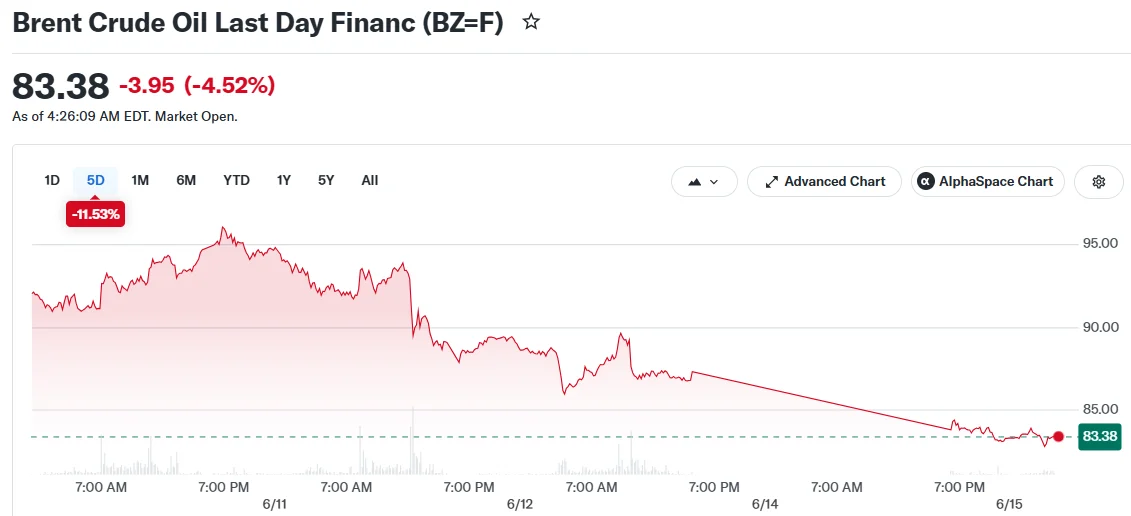
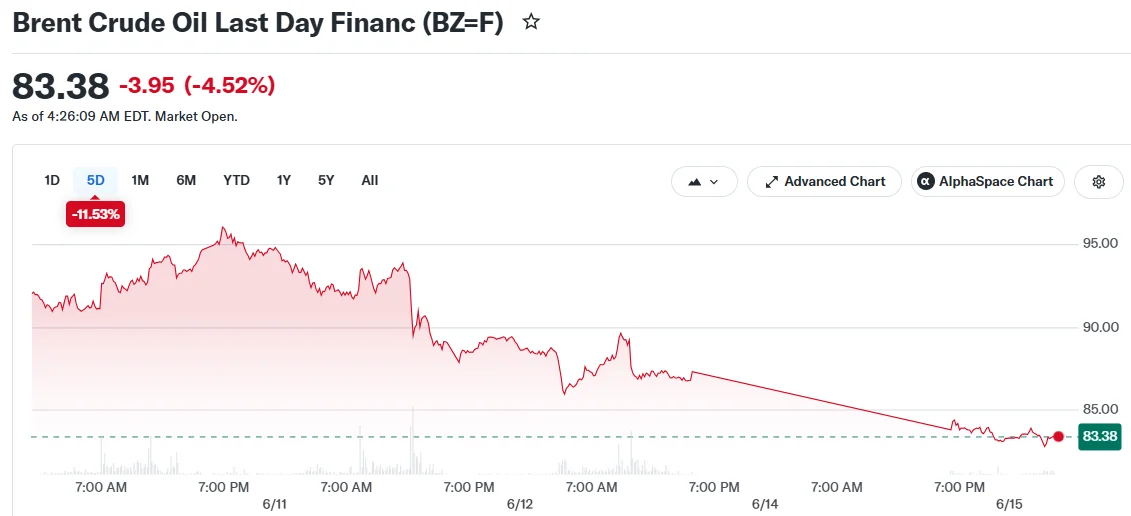
Brent crude declined more than 4% to approximately $83.79 per barrel. West Texas Intermediate slumped 4.6% to hover near $81. Both primary benchmarks reached their lowest points since March 10.
President Donald Trump unveiled the arrangement via social media platforms, declaring his authorization for the “toll free opening” of the Strait of Hormuz while simultaneously lifting the US naval blockade. “Ships of the World, start your engines. Let the oil flow!” his post proclaimed.
Iran’s Deputy Foreign Minister Kazem Gharibabadi verified that negotiators had finalized a deal. He indicated the complete text would remain confidential until the formal signing ceremony in Switzerland, scheduled for Friday.
The conflict erupted in late February following coordinated US and Israeli military operations against Iran concerning its nuclear development program. Tehran retaliated by blocking the Strait of Hormuz and executing attacks throughout the Persian Gulf region. Washington countered with its own naval blockade targeting Iranian-affiliated vessels.
During the height of tensions, Brent crude surged beyond $120 per barrel. Maritime disruptions, elevated insurance premiums, and concerns about extended supply constraints combined to drive prices upward.
Pre-Deal Price Decline Already Underway
Prices had been retreating over recent weeks as indicators mounted that negotiators were approaching an agreement. Reports suggested limited crude shipments through the strait had quietly resumed, while major industrialized nations accessed strategic petroleum reserves to alleviate supply pressures.
China, ranking among the globe’s largest oil consuming nations, simultaneously reduced its purchasing activity throughout the crisis period.
Framework Agreement Components
The preliminary accord establishes provisions for ceasing military operations and restoring Hormuz access within 30 days under Iranian management. Reports indicate the framework additionally encompasses sanctions relief, constraints on Iran’s nuclear activities, and measures to restore normal Iranian oil export operations.
The arrangement establishes a 60-day negotiating period focused on Iran’s nuclear program. Trump revealed to the New York Times that failure to secure an agreement on nuclear matters could prompt renewed military intervention.
Despite encouraging developments, market analysts recommended measured expectations. The waterway potentially contains uncleared mines requiring removal operations. Insurance companies may maintain elevated premium rates for vessels transiting the route.
“We still need to understand what the deal means,” said Chris Weston of Pepperstone Group. “Even with the strait slated to open on Friday, there could be mines still.”
Energy producers cautioned that reactivating oil production from idled Persian Gulf facilities could require several months due to infrastructure damage and operational complexities.
Reduced crude prices may diminish inflationary pressures confronting central banking institutions. The US Federal Reserve convenes for its policy meeting on June 16-17 and is anticipated to maintain current interest rates.



Kohl’s KSS -3.95%decrease; down pointing triangle named a former Foot Locker executive as its next chief operating officer, marking the department-store chain’s latest leadership appointment as it continues its turnaround efforts.
Elliott Rodgers will assume the role on Sept. 9, taking on responsibility for Kohl’s enterprise operations including its stores, global supply chain and distribution centers, procurement and loss prevention, the retailer said Monday.
Copyright ©2026 Dow Jones & Company, Inc. All Rights Reserved. 87990cbe856818d5eddac44c7b1cdeb8
Strategy’s perpetual preferred stock STRC fell near record lows on Tuesday as investors seemingly balked at the company’s latest Bitcoin acquisitions.
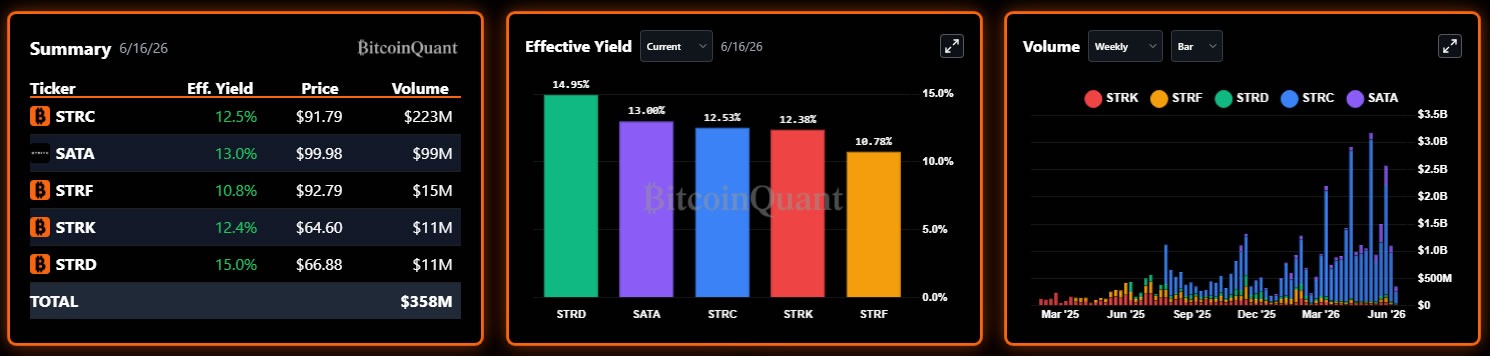
Michael Saylor’s variable-rate perpetual “Stretch” Bitcoin yield product declined by 3.58% to $91.79 on Tuesday, 8.2% below its target value of $100. Markus Thielen, CEO of 10x Research, said the dip is linked to Strategy’s recent Bitcoin buying.
“The market would rather see [Strategy] not acquiring more BTC and rather keep the cash for dividend payments,” Thielen told Cointelegraph. “It appears traders are seeing the latest BTC acquisition as an unsustainable path for STRC.”
Stretch is designed to return a dividend of 11.5%, trading at a par value of $100, but the current effective yield, now that the shares have dipped, is 12.5%. This means the firm may need the cash to support the yield rather than spending it to buy more BTC.
On Monday, Strategy said it acquired 1,587 Bitcoin for around $100 million last week. The week before, it purchased 1,550 BTC, also for about $100 million. The combined purchases brought its holdings to 846,842 Bitcoin.
Risk-off sentiment and pressure from competitors
Nick Ruck, director of LVRG Research, told Cointelegraph that “broader risk-off sentiment in crypto markets has weighed on investor appetite.”
“While the variable dividend delivers an effective yield above 12% to anchor the perpetual preferred near its $100 par value, persistent selling pressure and concerns over Strategy’s expanding capital structure and ATM issuance appear to be testing that resilience in the near term,” he added.
Related: Strategy’s Saylor signals BTC buy as preferred dividend pay date vote looms
The company’s stock (MSTR) has also taken a hit this week, dropping 6.35% on Tuesday to end the day at $122.81, down 67% over the past 12 months.
Meanwhile, Stretch is also facing stiff competition from the Strive perpetual variable-rate preferred shares (SATA), which are trading at $100 and offering an effective yield of about 13%.
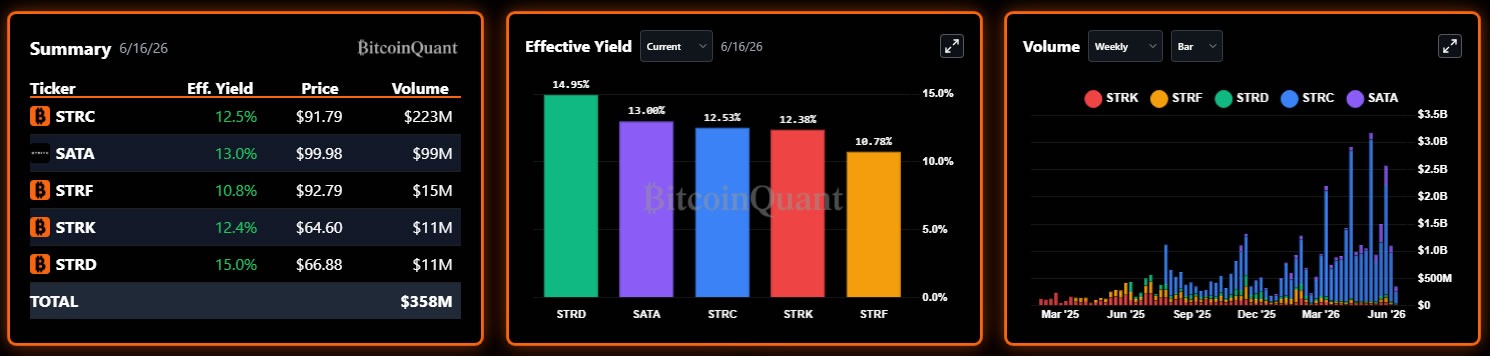
BTC variable-rate perps comparison. Source: BitcoinQuant
Magazine: China’s 107 Bitcoin memory thief, Bithumb CEO booked: Asia Express
Crypto World
Casual Dining’s Comeback Is Winning Over Wall Street. Cava and Dutch Bros Are Worth a Look.

Casual dining isn’t usually where investors look for market leaders. But some restaurant chains are quietly outperforming expectations, delivering steady traffic, healthier profits, and stock gains that have outpaced much of the broader consumer sector.
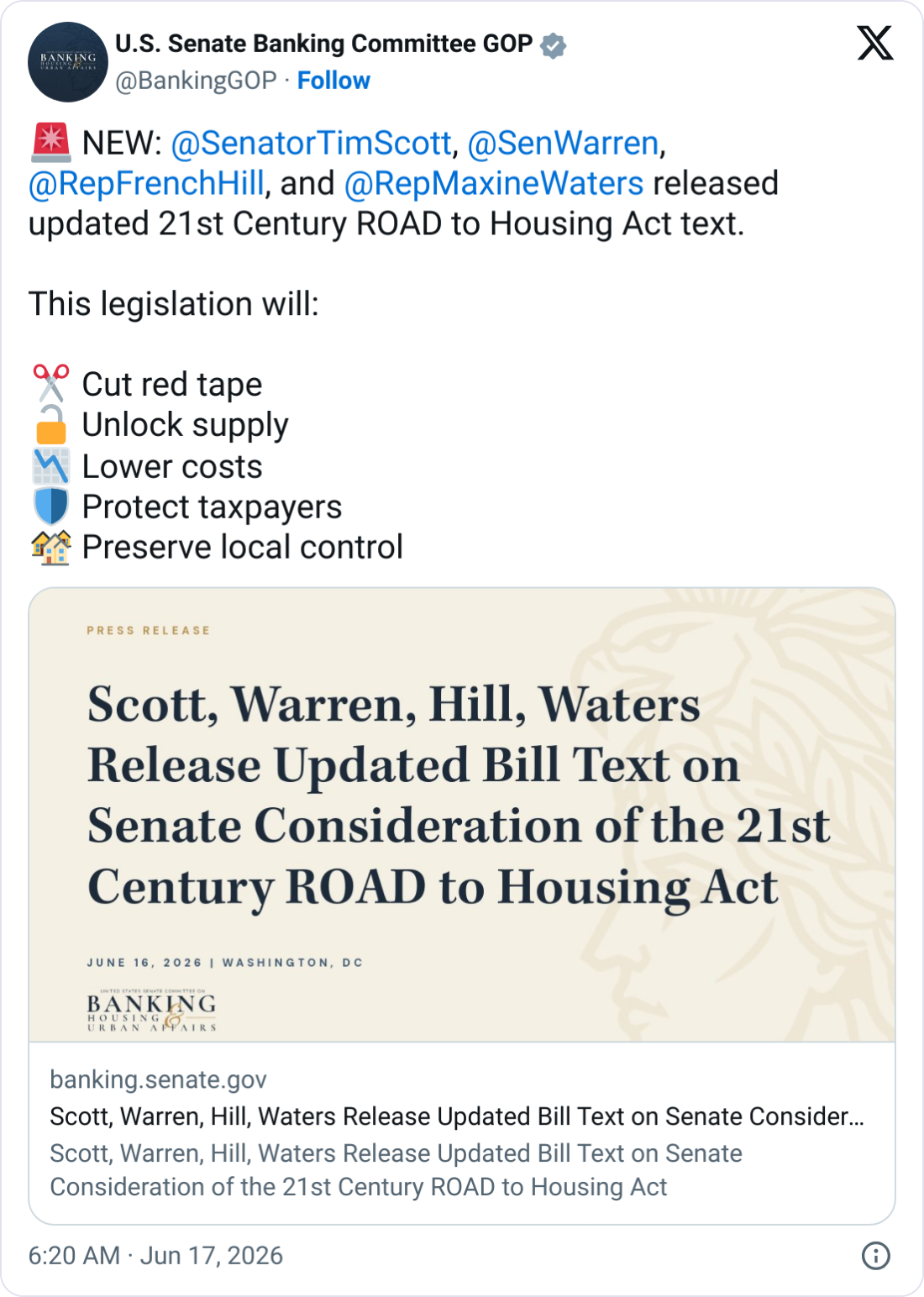
The US House and Senate have reached a deal to move forward with a housing bill that includes a ban on the Federal Reserve creating a central bank digital currency (CBDC) until 2030.
A bipartisan group of House and Senate leaders released an updated version of the 21st Century Road to Housing Act on Tuesday, which aims to address housing affordability and bans institutional investors from buying existing single-family homes to rent out.
The bill has included a CBDC ban since the Senate passed it in March. The House also passed its version of the bill with strong support in May, but the House and Senate disagreed on some aspects. The Senate has now added further amendments that will be put before the House for a final vote.
The bill is likely to pass quickly and would hand a win to Republicans who have tried to pass a CBDC ban for years, as earlier standalone bills had stalled in Congress. Crypto advocates have long criticized CBDCs, which they see as an attempt by governments to repurpose crypto technology to a centrally-controlled asset.
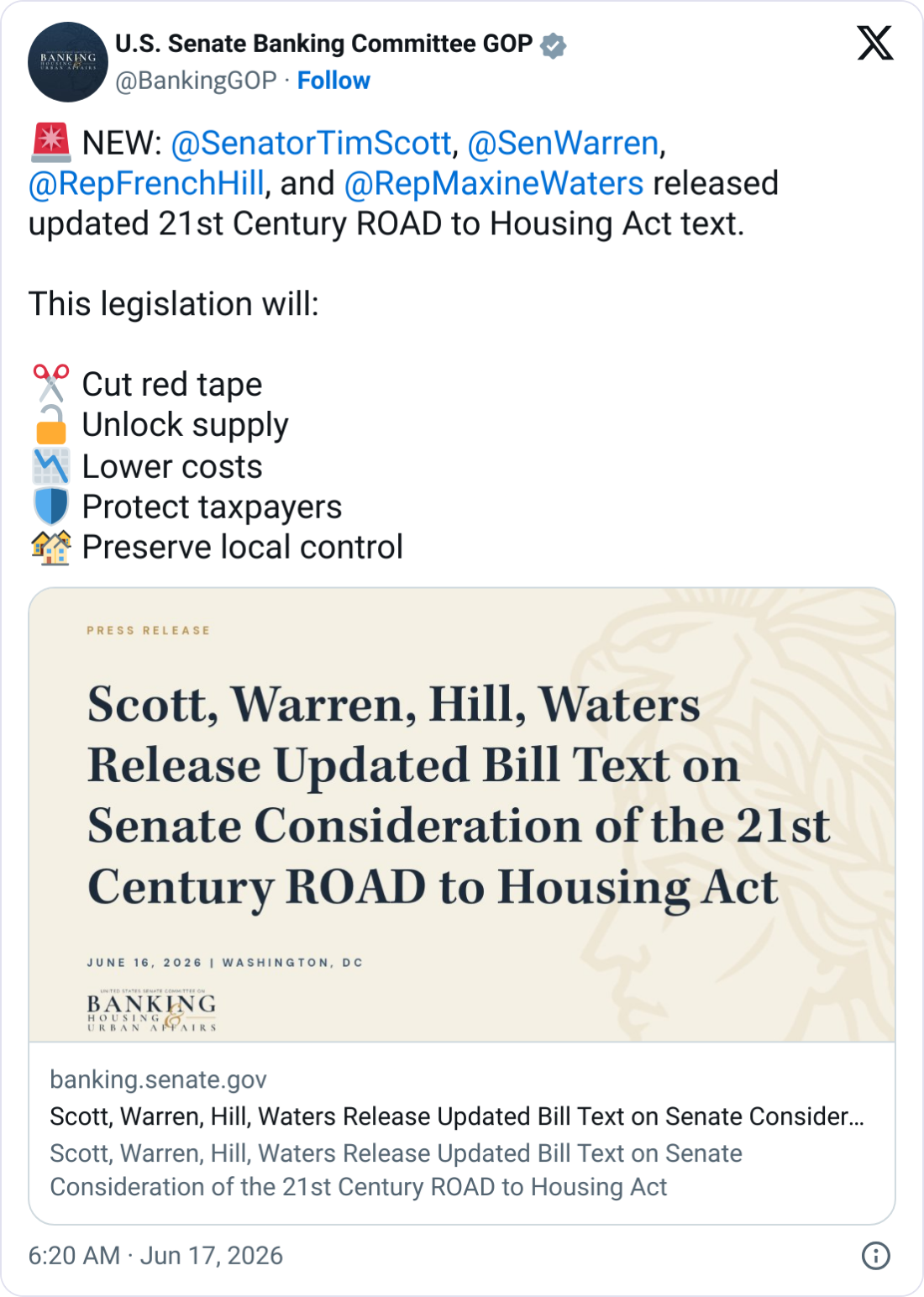
Source: US Senate Banking Committee GOP
The deal also means Congress can focus on passing other legislation before the August recess and the November midterm elections, in particular, the crypto-regulating CLARITY Act that many lawmakers have been pushing to advance.
House Republican leaders plan to put the bill up for a vote after the House returns from recess on June 23, two people familiar with the plan told Politico.
The housing bill includes language that says the Federal Reserve may not, directly or indirectly, “issue or create a central bank digital currency or any digital asset that is substantially similar to a central bank digital currency.”
Related: South Carolina governor signs bill protecting Bitcoin miners, banning CBDC
It adds the clause will expire on Dec. 31, 2030, and creates a carveout for crypto stablecoins, or “dollar-denominated currency that is open, permissionless, and private.”
The clause revives much of the language from Republican Representative Tom Emmer’s Anti-CBDC Surveillance State Act, which was introduced in June 2025, passed by the House the next month, but was never picked up in the Senate.
US President Donald Trump signed an executive order in January 2025 banning federal agencies from all work related to CBDCs, saying they threatened “the stability of the financial system, individual privacy, and the sovereignty of the United States.”
Magazine: How crypto laws changed in 2025 — and how they’ll change in 2026

The days of altcoins making money from token launches and hype alone are over.
This is according to CryptoQuant CEO Ki Young Ju, who says there are now only three categories that can survive into the future.
The Era of Narrative-Only Tokens Is Over
The analyst made his blunt assessment in an early Wednesday thread on X, where he started by pointing out that “altcoins aren’t dead,” but those that only made money from selling narratives would soon disappear from the crypto world.
He then made a structured case for why a selective exposure to a small subset of the asset class still makes sense in 2026, putting emphasis on those with real revenue, real businesses, and alignment with where global finance is actually heading.
The first category he identified is what he called “global internet companies with tokenized market layers,” where he pointed to Binance’s BNB Coin and the TON blockchain’s recently rechristened GRAM token. According to Ju, such tokens are backed by businesses with revenue, have an established user base, and have shown long-term operational commitment. He suggested that for such companies, it sometimes made more sense to issue a token and list it on a crypto exchange than to pursue traditional equity listings.
The second group the market watcher identified were DeFi protocols also with actual revenue. Here, he namechecked Hyperliquid’s DEX, noting that tokens from such “high-quality” projects can still offer huge upside, especially if the teams behind them are credible, they have money coming in, and their governance systems respect holders.
Highlighting Hyperliquid was no mistake on Ju’s part, considering the HYPE token associated with the platform has been doing crazy numbers lately, jumping over 31% in the last seven days and almost 70% across the last month. That push, supported by ETF inflows and strong trading activity tied to SpaceX-linked perpetual contracts, saw it reach a new all-time high just above $76 on June 16.
Lastly, the analyst also suggested that projects “aligned with broader financial trends,” including stablecoins and real-world asset tokenization, as well as AI agents, which he believes could be a “major growth area.”
Market Shifts Push Investors Toward Utility and Revenue
Ju’s take reflects a wider change in crypto markets, with the speculative sectors that dominated past cycles currently struggling for traction. For instance, data recently published by CryptoRank showed that meme coins, which once boasted a collective market cap north of $135 billion, have seen their value shrink to just $24.5 billion in the last two years, with the sector falling by about 31% this year alone.
Meanwhile, according to the on-chain technician, there’s been growing interest in stablecoins and tokenized stocks, sectors which, in his view, are showing where blockchain technology can support actual business activity rather than just speculative trading.
The post Analyst Identifies 3 Altcoin Sectors Positioned to Survive Market Shakeout appeared first on CryptoPotato.
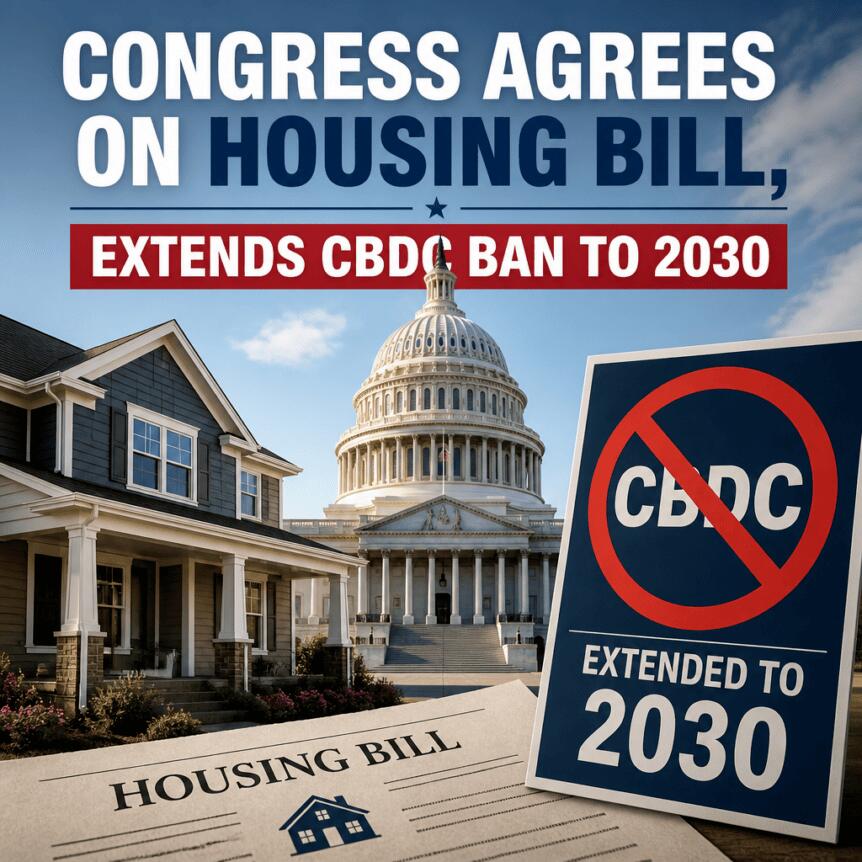
The US House and Senate have reached an agreement on a housing package that includes a ban on the Federal Reserve creating a central bank digital currency (CBDC) until the end of 2030, according to an updated bill text released by bipartisan lawmakers on Tuesday. The deal also addresses housing affordability and would block institutional investors from buying existing single-family homes to rent them out.
The updated version of the 21st Century Road to Housing Act will now move back to the House for consideration after the Senate added additional amendments. House Republican leaders are expected to put the measure to a vote after members return from recess on June 23, two people familiar with the plan told Politico.
Key takeaways
- The housing bill would restrict the Federal Reserve from issuing or creating a CBDC (or a substantially similar digital asset) until Dec. 31, 2030.
- The restriction includes a stated carveout for certain dollar-denominated stablecoins that are described as open, permissionless, and private.
- The Senate and House versions previously differed; the Senate’s added amendments must be approved by the House before final passage.
- Backers expect the agreement to advance quickly, potentially freeing Congress to focus on other crypto-related legislation, including the proposed CLARITY Act.
- The CBDC language revives concepts similar to an earlier House-passed “Anti-CBDC Surveillance State Act.”
How the CBDC ban ends up inside a housing bill
A bipartisan group of House and Senate leaders released updated bill text on Tuesday, launching the next stage of the 21st Century Road to Housing Act’s path to a final vote. As in earlier versions, the measure includes a CBDC prohibition aimed at limiting federal experiments with central-bank-issued digital money.
The CBDC ban was first added after the Senate passed the amendment in March, and the House supported its own version in May. But the two chambers could not immediately reconcile differences, leaving the bill in limbo. The new agreement reflects the latest round of negotiations, with Senate amendments now requiring House approval.
Crypto advocates have criticized CBDCs for what they view as the potential for government-controlled financial infrastructure and surveillance concerns—criticisms that have helped shape years of congressional pushback against standalone CBDC proposals.
What the law would actually restrict
The housing package’s CBDC language states that the Federal Reserve may not, directly or indirectly, “issue or create a central bank digital currency or any digital asset that is substantially similar to a central bank digital currency.” The provision is time-limited and would expire on Dec. 31, 2030.
Importantly for market participants, the clause includes a carveout for specific stablecoins—described as “dollar-denominated currency that is open, permissionless, and private.” That wording matters because it suggests the bill’s authors are drawing a boundary between central-bank-issued digital currency and privately issued stablecoins that meet the bill’s stated attributes.
In practical terms, the decision to embed this restriction in a housing bill may influence the bill’s momentum: housing legislation typically attracts broader coalitions than narrow crypto bills, potentially giving CBDC opponents a more workable legislative vehicle.
Connections to earlier CBDC proposals
The clause in the updated bill “revives much of the language” from Republican Rep. Tom Emmer’s Anti-CBDC Surveillance State Act, which was introduced in June 2025 and passed by the House the following month—but did not advance in the Senate.
That history highlights a key tension in Washington’s approach: even when House support for CBDC limits is strong, Senate action has been less predictable. By folding CBDC language into a broader measure, the current bill may sidestep some of that earlier gridlock.
The broader policy pressure also follows executive action. US President Donald Trump signed an executive order in January 2025 directing federal agencies to avoid work related to CBDCs, arguing the technology would threaten “the stability of the financial system, individual privacy, and the sovereignty of the United States,” as described in the order published by the White House.
What happens next for Congress and the crypto policy agenda
Lawmakers expect the housing bill to pass quickly once the House considers the Senate’s updated amendments. If House leadership proceeds on the June 23 timeline mentioned by Politico, the legislation could clear the final procedural hurdle before the August recess and the November midterm elections.
That timing may also shape what comes next on crypto regulation. The agreement is expected to allow Congress to devote attention to other proposals, including the CLARITY Act, which many lawmakers have pushed to advance. While the housing bill focuses on CBDCs and housing affordability, a separate regulatory framework would determine how the industry is supervised in the absence of a CBDC.
For investors and builders, the immediate watch-items are procedural: whether the House adopts the Senate’s amendments without further changes, and how the carveout for “open, permissionless, and private” dollar-denominated stablecoins is interpreted once lawmakers move from text to implementation.
Until the final vote and any subsequent clarification, market participants should also monitor whether the time-limited nature of the ban—ending at Dec. 31, 2030—affects planning for any future central-bank digital currency efforts, including how regulators and policymakers might revisit the question after the expiration date.
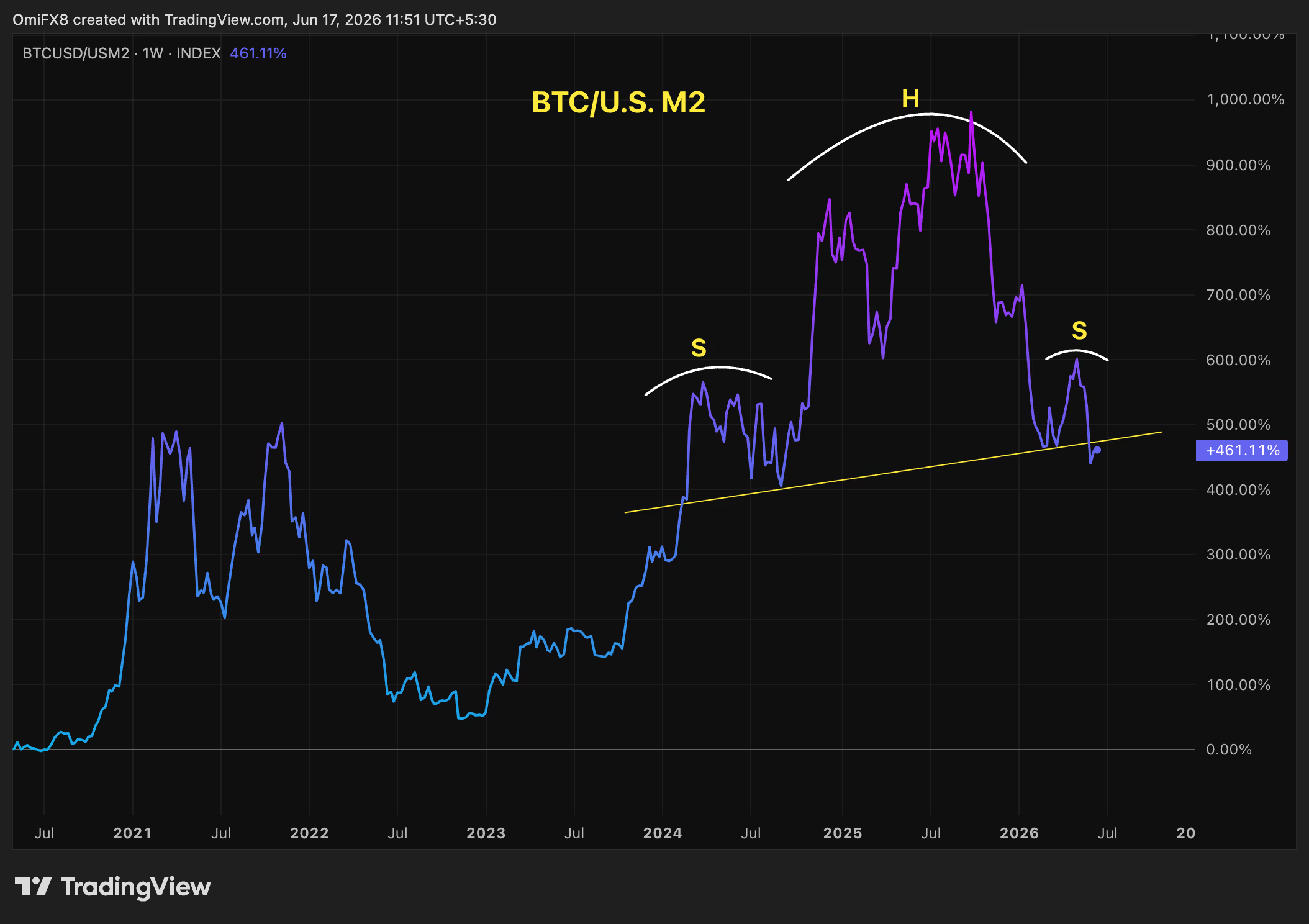
If you’re only looking at the dollar price of your portfolio, you may be missing part of the picture, which is significantly shaped by money supply growth.
To the casual observer, the markets look like business as usual. While bitcoin has nearly halved to $66,000 since its $126,000 peak in October of last year, the decline could be dismissed as just another brutal, quadrennial crypto bear market. Meanwhile, the S&P 500 continues to hover near record highs.
But beneath the surface, a more interesting signal emerges when both prices are adjusted for the U.S. M2 money supply. M2 is the Federal Reserve’s estimate of liquid assets, including cash on hand, money deposited in checking and savings accounts, and other short-term saving vehicles such as money market funds and certificates of deposit.
Monetary exhaustion?
Some observers see bitcoin as a high-beta barometer for dollar liquidity, and the BTC/M2 ratio, bitcoin’s price adjusted for money supply growth, is now flashing a warning. The ratio, after a sharp climb from 2023 through 2025, appears to have formed what technical analysts call a head-and-shoulders pattern, typically read as a bearish signal.

If the pattern holds, it would suggest bitcoin’s exponential edge over money supply growth — the dynamic that let it outrun debasement so convincingly in prior cycles — is fading. Bitcoin’s ability to outpace the flood of new dollars may be approaching diminishing returns, at least for now.
Eligible businesses may also continue to evaluate or pursue their own MiCA-focused crypto asset service provider (CASP) licenses in parallel while integrating BitGo Europe’s infrastructure, BitGo said.
The final deadline for crypto firms to have transitioned to the MiCA regime is the end of this month, a regulatory reckoning that will force some firms to close down their businesses.
Industry estimates suggest that Europe had more than 3,000 registered crypto firms as of 2024, with Poland alone accounting for over 1,400 registrations. As of May 2026, there are 194 authorised CASPs (including credit institutions) and it is expected that around 75% of the pre-MiCA population will lose registration status as transitional periods expire, according to law firm Hogan Lovells.
Belshe said firms don’t need to go bust because of MiCA’s regulatory requirements, adding that regulators are aware of BitGo’s compliance-enhancing infrastructure offering. In terms of fees for the crypto compliance service, Belshe said it’s relatively cheap and varies product by product.
“There’s some amount of monthly minimum that you pay similar to what’s always been there. That’s a couple of $1,000 a month type of thing that can scale with volume,” he said. “Then clients can either go to variable-based plans, where they’re paying per transaction more, or they can use static-based plans, where they have kind of a fixed fee, and they pay less.”

Why Fertilizer Stocks Didn’t Sell Off on Iran Peace Deal Announcement
Key Takeaways
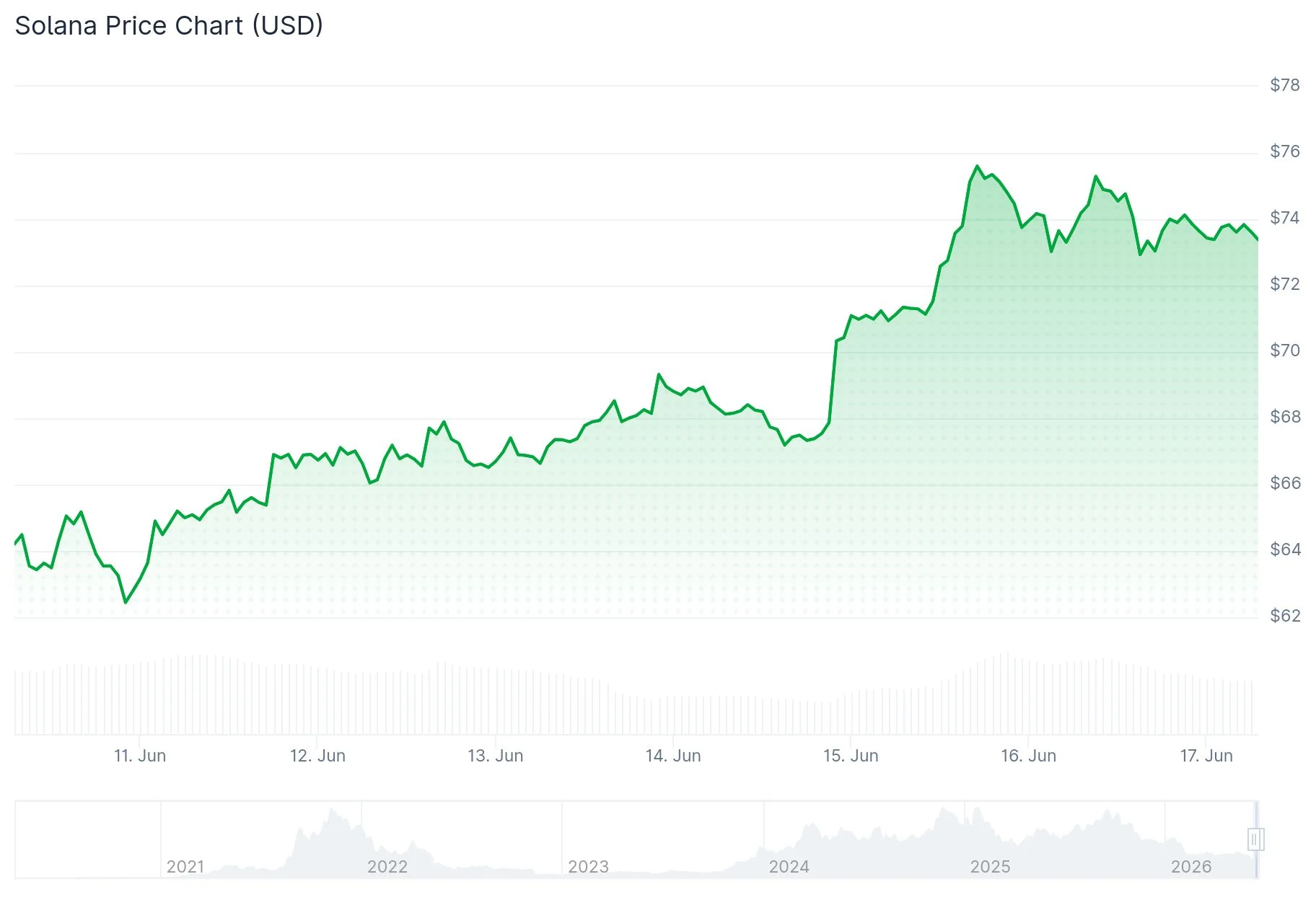
- SOL has rallied more than 20% from its June bottom around $60, currently hovering near $75
- The token faces a pivotal test at the $75.7 zone, previously a critical support level that could unlock moves to $83.5, $90, and $98
- Technical analyst Satoshi Flipper identified a falling wedge pattern break suggesting potential upside toward $250
- Daan Crypto Trades noted SOL’s breakout from a consolidating wedge against Bitcoin, monitoring for confirmation
- Contrarian view from Crypto Coral highlights bearish flag pattern risks and potential for renewed downside pressure
Solana has mounted an impressive comeback from its June bottom, posting gains exceeding 20% in recent days. This rally has positioned SOL at a technical crossroads that may determine its trajectory in the weeks ahead.
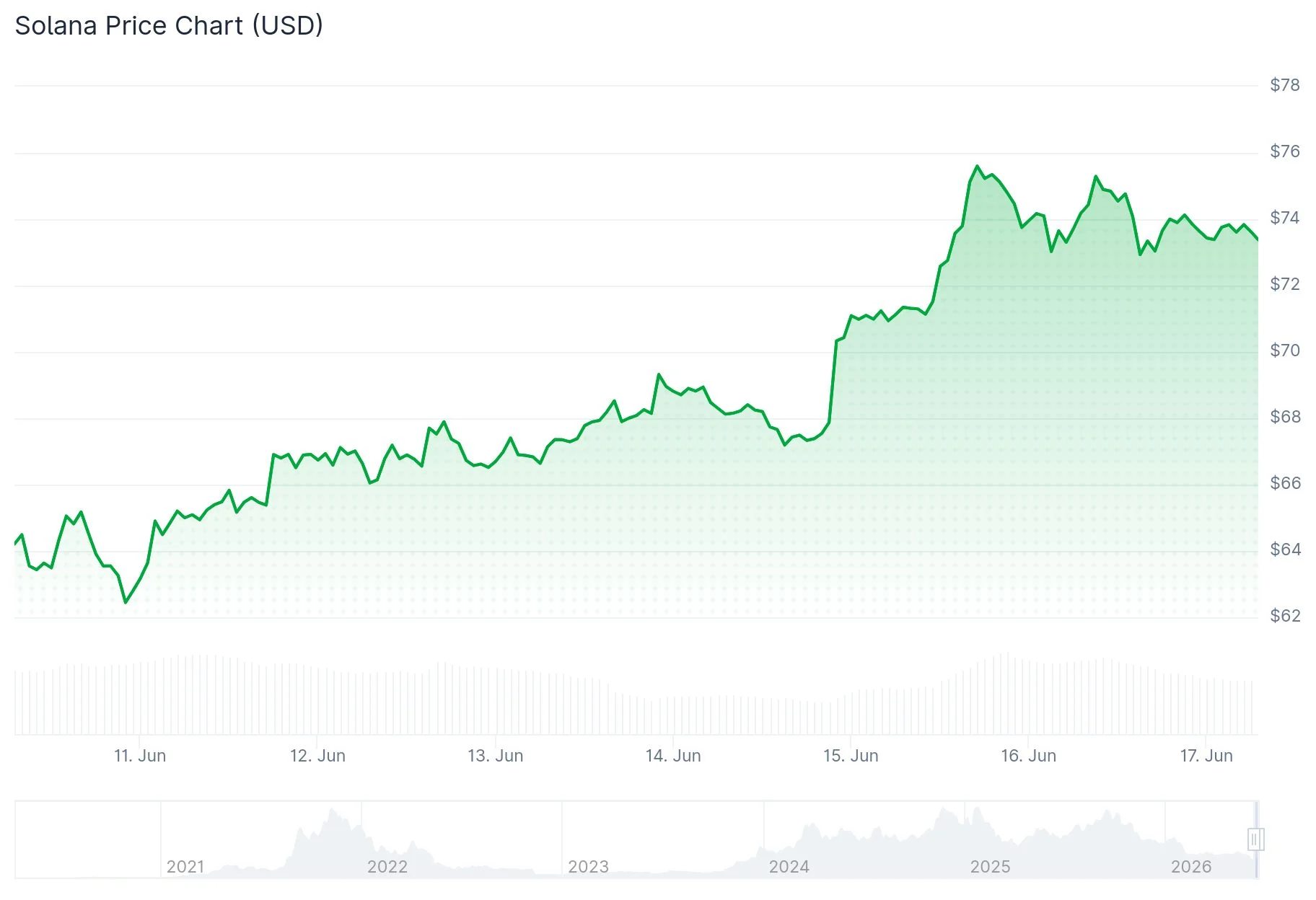
As of June 16, SOL was changing hands around $75, marking a substantial recovery from the $60 region tested earlier this month.
The upward momentum received support from broader market catalysts. News emerged that the United States and Iran had negotiated a preliminary deal to maintain open access to the Strait of Hormuz, alleviating inflationary pressures. Crude oil prices declined following the announcement, while Bitcoin, Ethereum, and other digital assets caught a bid.
Derivatives metrics confirmed the bullish shift. Data from CoinGlass indicated rising open interest alongside the price advance. Short squeeze activity also contributed momentum, as leveraged bearish positions were liquidated during the climb from the low $60s.
On the business front, Solana Company turned down an unsolicited takeover bid from Forward Industries on June 15. The proposal offered a premium valuation and emerged amid growing competition among companies developing SOL-focused treasury operations.
Technical Picture Takes Shape
The daily timeframe reveals that Solana consolidated within a defined range for approximately four months, bounded by support at $75.7 and resistance at $98.3. This structure collapsed in early June when price breached the lower boundary and descended toward $60.
SOL has now circled back to challenge that previous support zone. A decisive reclaim of this area would negate the earlier breakdown and bring $83.5, $90, and ultimately $98.3 back into play as upside objectives.
Zooming into the four-hour perspective, SOL has pierced through a downward-sloping trendline that contained rallies since late May. The Relative Strength Index has climbed back above the neutral 50 mark after dipping into oversold territory, while the MACD indicator shows early signs of bullish crossover.
Trader Daan Crypto Trades shared on X that Solana appears to be escaping from a consolidation wedge pattern relative to BTC. He suggested that a confirmed breakout could trigger follow-through buying and lift related ecosystem tokens, though he emphasized the current zone represents meaningful resistance.
Analyst Satoshi Flipper spotted a falling wedge breakout pattern on the daily timeframe, with price successfully reclaiming the upper boundary near $70. His analysis projects a longer-term objective at $250, a level that would match peaks achieved during Solana’s previous bull market phase.
Critical Zones Above and Below Current Price
Technical analyst More Crypto Online identified a concentrated Fibonacci resistance cluster spanning $69.44 to $72.58 on the four-hour chart. This zone represents the convergence of the 38.2% retracement level, 100% Elliott Wave extension, and 50% retracement—creating a formidable obstacle.
Not every market observer shares the optimistic view. Crypto Coral cautioned on June 16 that Solana had violated a bearish flag formation and is now retesting significant EMA resistance. According to this analysis, failure to recapture that level could trigger another downward move.
Should the $75 zone fail to provide support, traders are eyeing $71.8, $69.1, and the June low near $60 as successive downside targets.
The Supertrend indicator on the four-hour chart currently places support in the vicinity of $70.9.
Kohl’s Names Former Foot Locker Exec as Chief Operating Officer
Where is the cast of “NYPD Blue” now? See the 15th precinct more than 20 years after the finale

Starmer Promises Cabinet Role For Rival Burnham If He Wins Makerfield


-

 Business3 days ago
No Jackpot Winner as $257 Million Prize Rolls Over to $269 Million Monday Draw
-

 Crypto World6 days ago
Oppenheimer backs SpaceX as $70 billion retail frenzy builds
-

 Fashion5 days ago
Weekend Open Thread: Tuckernuck – Corporette.com
-

 Crypto World6 days ago
Markets Rally as SpaceX IPO Looms Amid Iran Tensions and Inflation Surge
-
 Crypto World2 days ago
Zimbabwe Requires Crypto Businesses to Register Annually Under New FIU Regulations
-

 Tech4 days ago
NanoClaw integrates JFrog registries to secure AI agent downloads
-

 Tech5 days ago
This Week In Security: Microsoft On Microsoft, Register Your Domains, Linux On ARM, And FreeBSD Joins The File Cache Club
-

 Crypto World4 days ago
Bitget enters Argentina’s regulated crypto market through PSAV registration
-
 Tech6 days ago
Dutton Ranch star claims they ‘didn’t see any disruption’ on set following Chad Feehan’s exit from Yellowstone spinoff fueled by Taylor Sheridan clash rumors
-

 NewsBeat5 days ago
El Nino has formed in the Pacific and could set records, forecasters say
-
 Tech7 days ago
‘This is Seattle’s position on AI’: City Council votes unanimously to pause big new data centers
-

 Politics6 days ago
Politics Home | Healey Resignation Is “Colossal Failure Of Government”, Says Former Labour Defence Secretary
-
 Entertainment6 days ago
Donnie Wahlberg & More Heat Up Las Vegas at Circa’s Barry’s Downtown Prime
-
 Tech6 days ago
Opendoor Ends India Operations, Fueling a Bigger Conversation About AI and Outsourcing
-

 Sports6 days ago
First Time Since 1971: Australia Register Historic Low In ODI Cricket
-

 Politics6 days ago
Belfast burns, while Met chief points finger at Iran and Russia
-

 Business6 days ago
AT&T: Verizon's 27% Outperformance Sets Up A Solid Entry Point
-

 NewsBeat5 days ago
FBI searches office of Ohio voter registration group
-
 Tech5 days ago
Anthropic is spending $150M to embed 1,000 AI fellows inside nonprofits. No degree required.
-

 Politics6 days ago
Modi thanks Trump for wishes as US attacks Indian seafarers
You must be logged in to post a comment Login