

Crypto World
Bitcoin Weekly Liquidations ‘Insane’ as Price Passes $65,000 on Oil Weakness

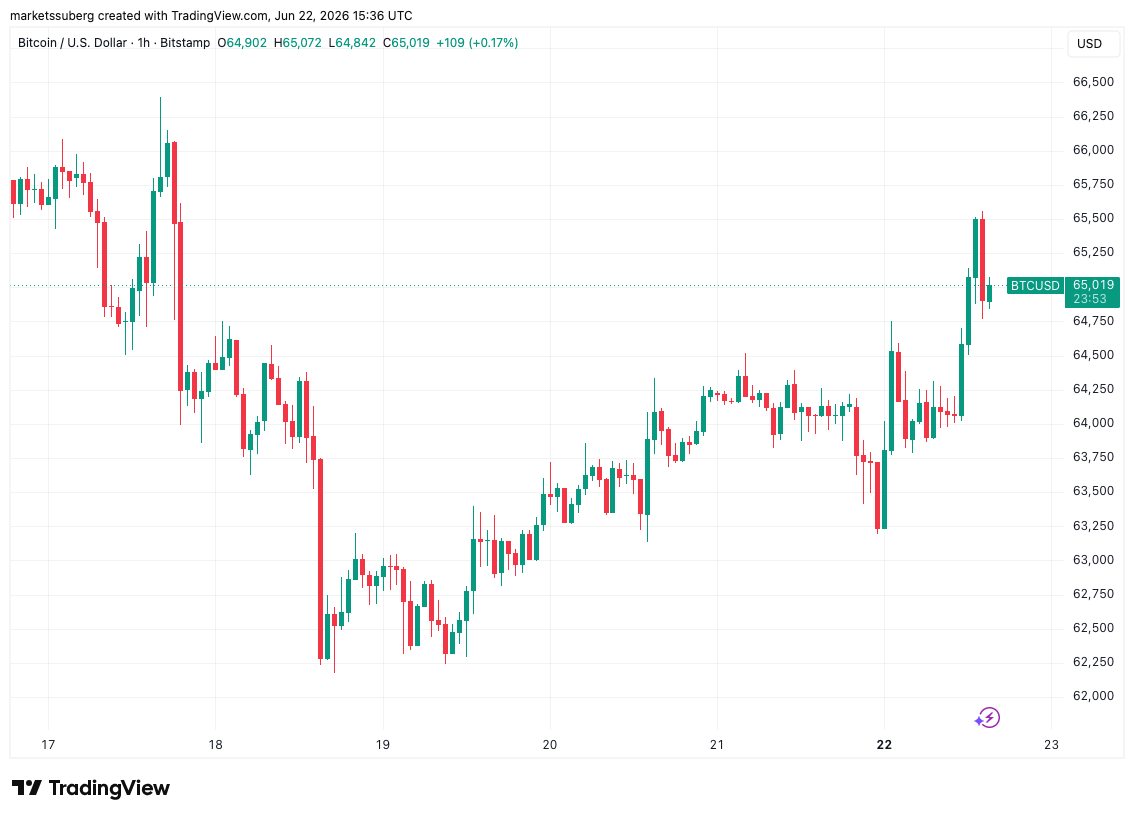
Bitcoin (BTC) passed $65,000 at Monday’s Wall Street open as exchange order-book liquidity dictated price moves.
Key points:
- Bitcoin hits a new week-to-date high despite US stocks rolling over at the start of trading.
- Traders’ targets include a move toward $70,000 next.
- Liquidations are described as “completely insane” as both long and short BTC positions get chopped up.
Bitcoin surfs $65,000 as oil eyes new lows
Data from TradingView showed BTC/USD hitting $65,555 on Bitstamp — its highest since Wednesday.
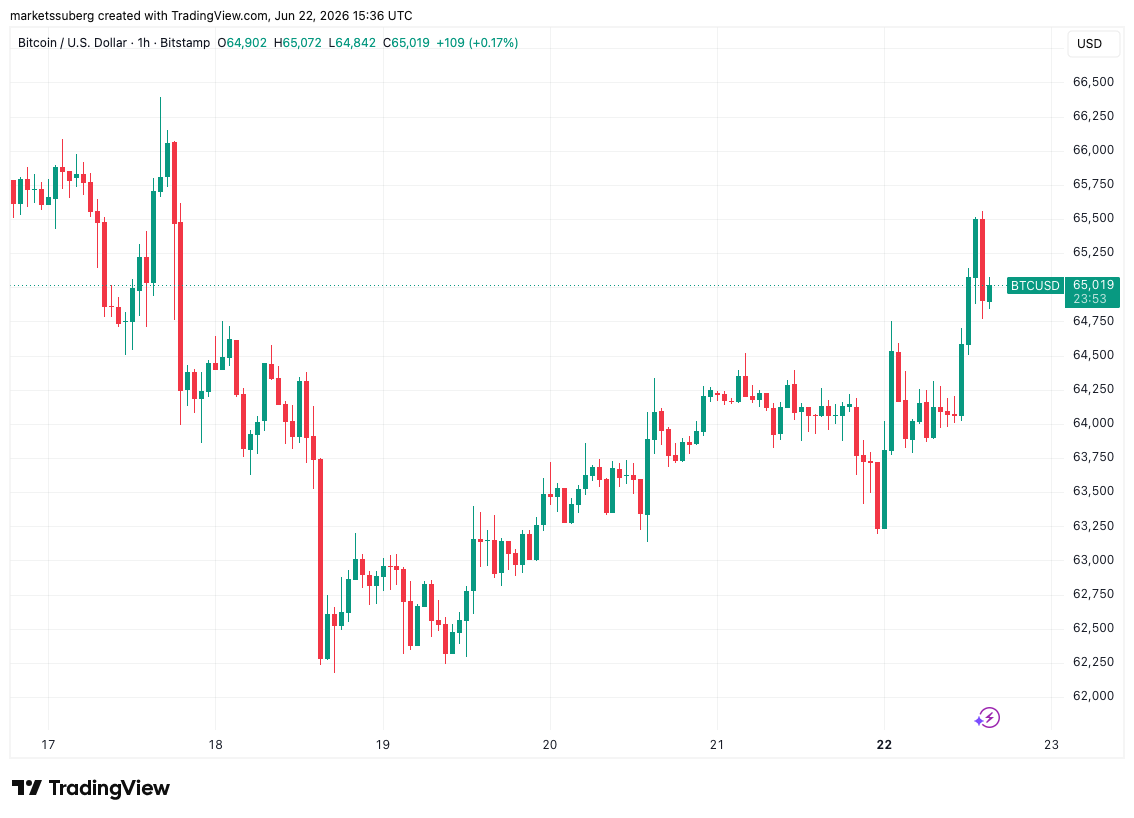
BTC/USD one-hour chart. Source: Cointelegraph/TradingView
The move contrasted with US stock markets, which opened lower on continued uncertainty over the fate of the US-Iran peace deal. The mood settled as the US allowed Iranian oil trading for two months.
“Iranian oil is officially returning to global markets for the first time since 2018,” trading resource The Kobeissi Letter responded in a post on X.
US WTI crude returned to near $73 per barrel, marking some of its lowest levels since early March and the start of the war.
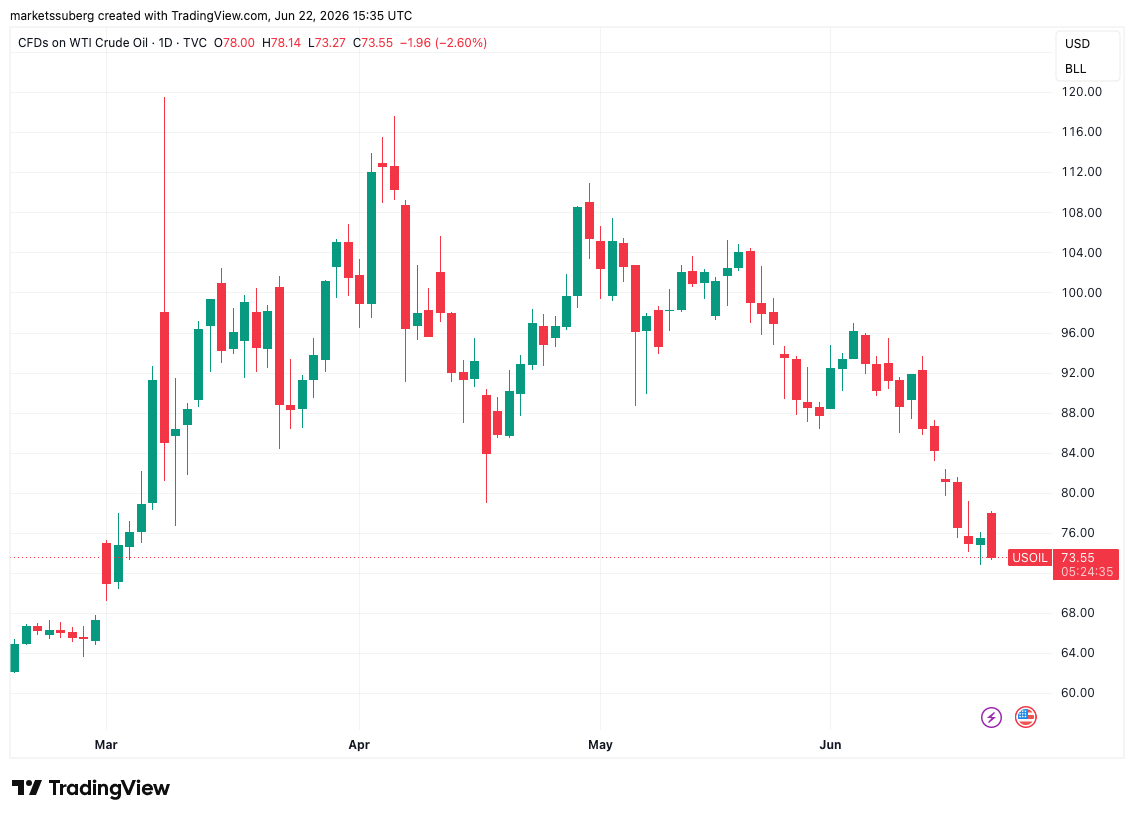
CFDs on WTI crude oil one-day chart. Source: Cointelegraph/TradingView
For Bitcoin traders, it was all about nearby pockets of liquidity around the spot price on the day.
“Took out that thick liquidation cluster above $65K. Right after the US Market open. Going to be important where this moves in the next few hours,” Daan Crypto Trades commented alongside data from CoinGlass.
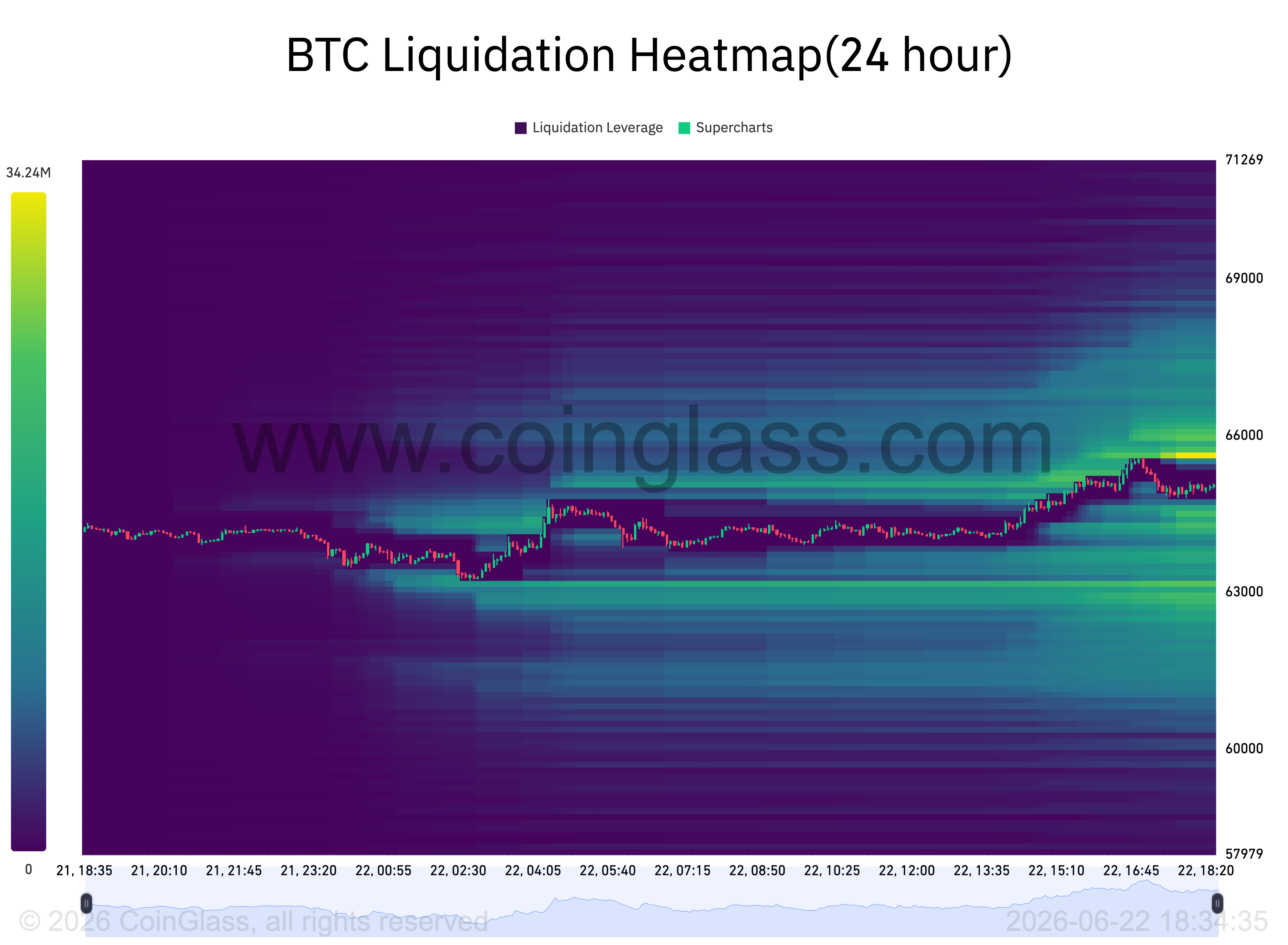
BTC liquidation heatmap. Source: CoinGlass
“If it rejects here, it will likely try to clean up some liquidity lower. So this is $65K area is a good level to gauge for low timeframe strength/weakness I’d say.”
Trader CrypNuevo eyed a potential trip toward $70,000 should bulls manage to sustain the low-time frame breakout.
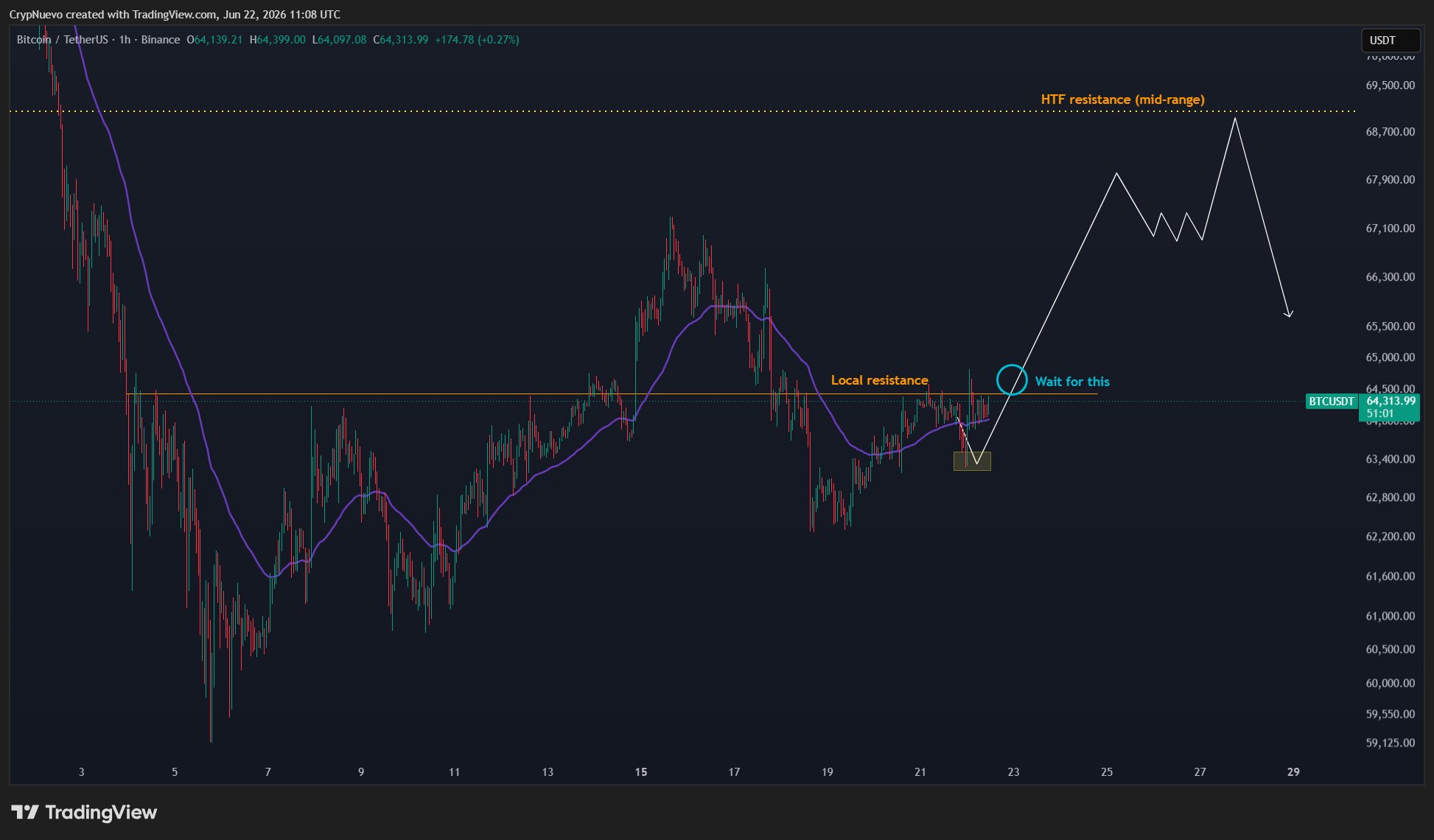
BTC/USDT one-hour chart. Source: CrypNuevo/X
BTC sees “insane” multibillion-dollar liquidations
Trading and liquidity analysis account CryptoReviewing, meanwhile, described recent liquidations as “completely insane.”
Related: US dollar strength hits highest since May 2025: Five things to know in Bitcoin this week
Bitcoin, it noted, had liquidated $2.5 billion in just seven days.
“Now, $65,000 – $67,000 has sizable liquidity above that could be swept next – potentially leading to higher levels,” an X post read.
“However, $61,000 – $63,000 has significantly larger liquidation clusters stacked up, making this the ‘higher probability’ zone to visit next.”
A cautionary note came from trader Killa, who noted that Mondays had tended to mark the week’s swing high for Bitcoin in recent months.
“Over the past six weeks, 6 out of 6 Mondays have marked a local pivot high before price moved lower. Worth keeping an eye on if we start seeing strength and a push higher heading into Monday,” they told X followers.
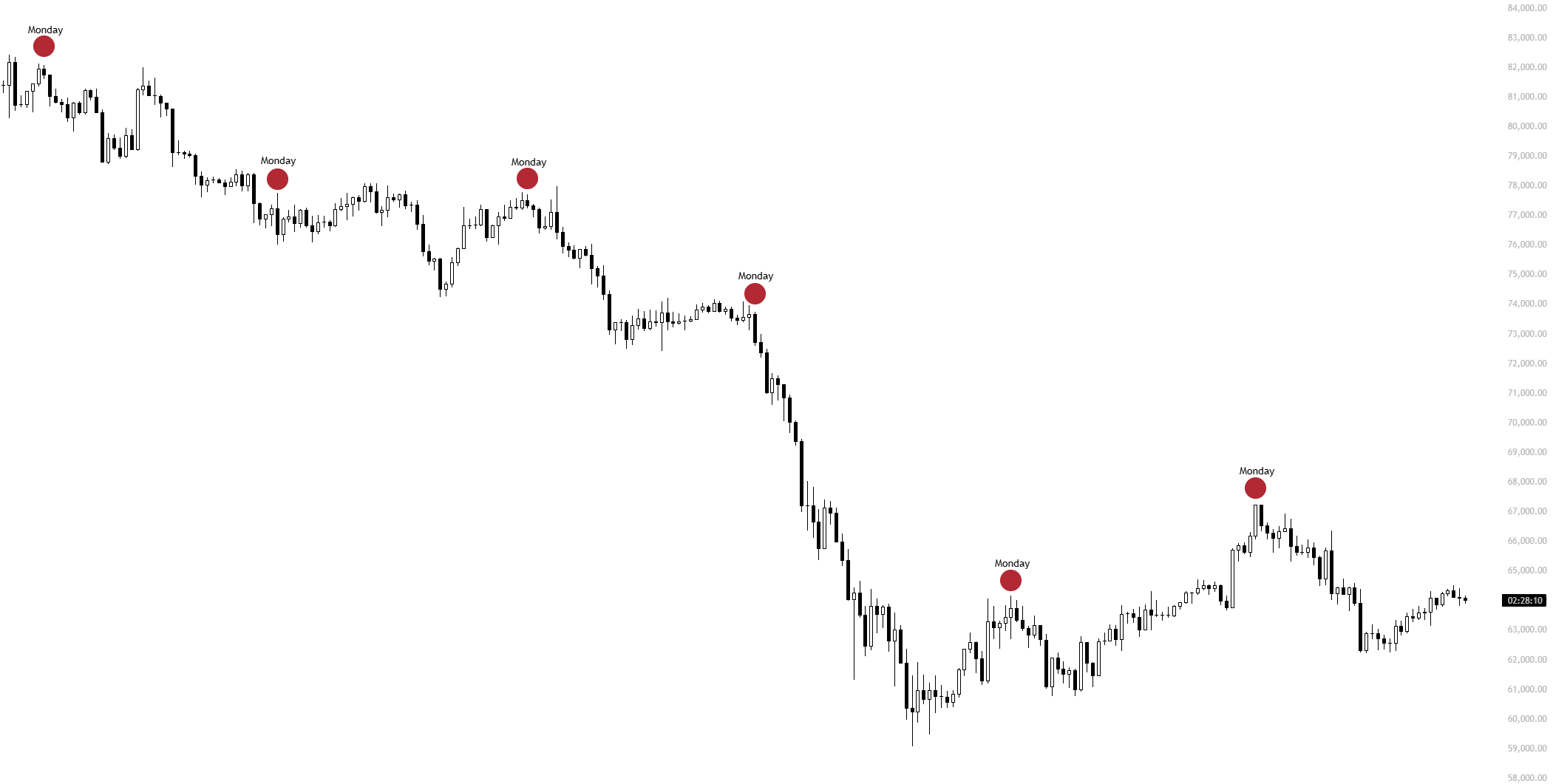
BTC/USD with Monday peaks marked. Source: Killa/X


TLDR:
- Strategy acquired 520 BTC at $67,068 avg, below its $75,651 overall cost basis
- 2.71M MSTR shares sold June 15–21 generated $335.5M in net proceeds
- Total bitcoin holdings now stand at 847,363 BTC worth $64.1B in cumulative cost
- USD Reserve reached $1.4B to cover preferred dividends and debt interest
Strategy Inc. disclosed a new 8-K filing on June 22, 2026, revealing fresh equity sales and bitcoin purchases. The company sold 2.71 million MSTR shares between June 15 and June 21, generating $335.5 million in net proceeds.
A portion of those proceeds funded the acquisition of 520 BTC at an average price of $67,068 per coin. The move brings Strategy’s total bitcoin holdings to 847,363 BTC, valued at a cumulative cost of $64.1 billion.
Strategy Converts ATM Proceeds Into Bitcoin
The share sales occurred through Strategy’s at-the-market offering program, a mechanism the company regularly uses to raise capital.
The 2,714,839 MSTR shares sold during the week generated $335.5 million in net proceeds after commissions. No preferred stock was sold during the same period across the STRF, STRC, STRK, or STRD programs.
Strategy deployed $34.9 million of those proceeds directly into bitcoin purchases. The 520 BTC were acquired at an average price of $67,068, inclusive of fees and expenses. That purchase price sits below the company’s overall average cost basis of $75,651 per bitcoin.
The company still has approximately $25.4 billion available under its MSTR stock offering program. That figure reflects remaining capacity across both the current offering and a $21 billion expansion announced in March 2026.
Proceeds from preferred stock programs remain untouched, with over $25.2 billion in combined issuance capacity still on the table.
The bitcoin purchases confirm that Strategy continues converting equity capital directly into digital asset reserves. The company’s acquisition pace has remained active throughout 2026 as it steadily grows its treasury position.
USD Reserve Climbs to $1.4 Billion
Alongside the Bitcoin update, Strategy reported that its USD Reserve reached $1.4 billion as of June 21. The company established this reserve in December 2025 as a designated liquidity buffer. It is intended to support dividend payments on preferred stock and interest on outstanding debt obligations.
The $1.4 billion figure includes expected cash proceeds from ATM share sales that had not yet settled by June 21. Strategy tracks this balance separately from its bitcoin holdings and considers it part of its broader capital management structure.
Strategy said it plans to replenish the reserve over time based on market conditions. The company frames the reserve as a tool for maintaining the credit quality of its Digital Credit securities. That approach ties equity capital markets activity directly to liability management.
The reserve balance reinforces Strategy’s multi-layered financial structure, which now combines a growing bitcoin treasury with a dedicated dollar liquidity cushion.
Both are funded through the same ATM equity issuance framework the company has used consistently throughout its bitcoin accumulation strategy.



A New York attorney has asked a state judge to unmask an anonymous claimant who wants to take legal ownership of roughly 3.8 million BTC, including Satoshi Nakamoto’s holdings.
The request landed in the New York State Courts Electronic Filing system a few weeks before an in-person hearing on July 14.
Soon, a judge will have the ability to decide whether one of the boldest property claimants in crypto history — seeking ownership of near a quarter trillion dollars worth of BTC — may keep its mask on.
The claimant calls itself “Noah Doe,” an obvious play on the John and Jane Doe placeholder names for legal procedures. Alongside two unnamed Wyoming companies, listed as “ABC Company” and “XYZ Company,” Doe sued in New York County Supreme Court.
Doe wants to obtain legal title to approximately 39,000 supposedly “dormant” crypto wallets holding roughly 3.8 million BTC.
At Monday’s BTC price near $64,500, that stash is worth approximately $245 billion.
The $10 loophole
Despite the enormous value based on today’s BTC price, the plaintiffs pegged each wallet’s value below $10.
That dollar amount is no accident. New York’s lost property statute, Article 7-B of the Personal Property Law, can hand a finder a quicker path to legal title when a found item is worth under $10.
For this reason, Doe valued each wallet under $10, which might have been true in the past when the price of BTC was much lower.
Disturbingly, New York law defines “lost property” broadly.
Indeed, according to New York Personal Property Law Article 7‑B, § 251(3), “the term ‘lost property’ includes lost or mislaid property. Abandoned property, waifs and treasure trove, and other property which is found, shall be presumed to be lost property and such presumption shall be conclusive unless it is established in an action or proceeding commenced within six months after the date of the finding that the property is not lost property.”
On its face, that definition seems to favor Noah Doe. However, plenty of people disagree entirely.
$10 claims and a quarter trillion dollars
New York attorney Ian Cohen is among those who disagree, filing an amicus brief on May 29 calling Doe’s theory preposterous.
“A ruling accepting plaintiffs’ theory could open the door to systematic exploitation of long-dormant bitcoin wallets… effectively creating a private industry of ‘Bitcoin finders’ operating under color of lost property law,” Cohen wrote.
Protos reached out to Cohen, who referred us to his filings, including his granted motion to appear as amicus curiae, and his June 19 response.
Because Doe wants to repossess the property of people who prefer to remain anonymous — such as Satoshi Nakamoto — they’re unlikely to appear as defendants in court.
“Amicus curiae” allows a lawyer or organization who isn’t a party to the lawsuit, such as Cohen, to submit information to help the court decide.
Judge Kathy King granted Cohen’s request for amicus curiae and stayed the entire case pending the oral hearing on July 14. Cohen will participate in-person as amicus curiae.
The judge’s stay order ended the plaintiffs’ ideal outcome of a quiet, default judgment.
Back in the courtroom on July 14
Plaintiffs’ lawyer, David Lin of Brooklyn firm Lewis & Lin, tried to vacate that stay, but as it stands, will probably appear on July 14 to represent Doe.
As amicus curiae, Cohen has been clear: “If you want a judge to hand you Satoshi’s coins you should have to say your name out loud,” he posted on X.
Although Cohen is one of many people who’d like Doe to unmask themselves, Cohen hasn’t demanded that Doe personally appear, since Lin is technically allowed to represent his plaintiff.
Cohen has, however, asked Lin to justify the pseudonym. There should be a very good reason a party seeking hundreds of billions of dollars should get to use a fake name, Cohen argued.
Defendants in Doe’s action are approximately 39,000 wallet addresses. Each address received a “dust” transaction carrying an OP_RETURN output notice with a short blurb of text about the lawsuit.
Cohen called that method of legal service as indistinguishable from spam. “This is not service,” he said. “It is a broadcast into a void.”
Satoshi Nakamoto’s right to remain anonymous
Another problem with Doe’s claim is that supposedly abandoned wallets keep waking up.
Galaxy Research head Alex Thorn counted 52 named addresses that moved 34,335 BTC after the suit’s initial filing. Of those, 29 shifted 12,302 BTC after an OP_RETURN messaging scheme occurred.
These movements certainly weaken the premise that owners ever meaningfully abandoned their wallets in the first place.
This OP_RETURN dusting campaign surfaced last year under the revived “Salomon Brothers” brand name. Protos has previously documented that scheme, which sent tiny amounts of BTC and text to old BTC wallets.
Read more: BTC from 2011 moves after ‘Salomon Brothers’ repossession notice
Protos wasn’t able to easily verify whether the well-known Salomon Brothers actually published the messages.
A legal victory for Doe wouldn’t actually hand Doe private keys to the BTC, but it would grant legal title from the State of New York.
The court has scheduled oral arguments for July 14 at 60 Centre Street, in an open courtroom where members of the public may attend.
Got a tip? Send us an email securely via Protos Leaks. For more informed news and investigations, follow us on X, Bluesky, and Google News, or subscribe to our YouTube channel.
Crypto World
Andrew Cuomo to Lead Joint TradFi-Crypto Venture between OKX and Intercontinental Exchange


Cryptocurrency exchange OKX and the Intercontinental Exchange (ICE), parent company of the New York Stock Exchange, announced that former New York Governor Andrew Cuomo would co-lead a joint venture focused on digital assets.
In a Monday notice, OKX and ICE said Cuomo, who lost his bid to be New York City’s mayor in 2025, would co-chair the joint project between the two companies “focused on building next-generation infrastructure for tokenized and digitally native financial products.” The venture, which the companies said would allow OKX users to “access ICE futures and NYSE tokenized equities markets,” is subject to regulatory approval.
Cuomo has largely been out of the public eye since his failed 2025 mayoral run, in which he said he intended to make New York City the “global capital for cryptocurrency.” He had the endorsement of the crypto-aligned Innovate NY political action committee (PAC), but lost to Democratic candidate Zohran Mamdani, who secured more than 50% of the vote. The former governor began working with OKX in 2023.
The joint venture notice followed a partnership between ICE and OKX announced in March in which the former invested an undisclosed amount in the exchange at a $25 billion valuation. ICE’s ventures into the crypto industry also included a $2 billion investment pledge into prediction markets platform Polymarket.
Related: NYSE owner ICE to launch oil-linked futures with OKX
Since taking office on Jan. 1, Mamdani has not announced any significant policies related to crypto or blockchain. He confirmed in January that he holds no digital assets as New York City mayor.
New York to hold party primaries on Tuesday
On Tuesday, New York, Utah and Maryland will hold primaries to determine candidates for US House of Representatives and Senate seats in the November general election. Cryptocurrency-aligned PACs, including Fairshake, have poured money into advertising and other campaign efforts to support candidates they view as favorable to the digital asset industry.
Magazine: Bitcoin decouples from tech stocks, Ether eyes ‘selling wave’: Market Moves

Senator Lummis has made Section 604 of the CLARITY Act the centerpiece of her case for developer protection, citing the August 6, 2025 conviction of Tornado Cash co-founder Roman Storm as the clearest evidence that open-source developers face genuine criminal exposure under current law.
The provision would codify a federal safe harbor exempting non-custodial software builders from classification as money transmitters, a direct statutory response to the prosecution theory that put Storm in front of a jury.
The bill cleared the House 294-134 in July 2025 and the Senate Banking Committee 15-9 in May 2026, but has not received a Senate floor vote.

What the provision actually covers is more specific than the industry framing implies, and what it leaves intact is more significant than its supporters tend to acknowledge.
CLARITY Act Section 604: What the Legislative Record Actually Shows
The Digital Asset Market Clarity Act passed the House with a 294-134 bipartisan margin in July 2025, a vote count that reflected genuine cross-party support for bringing regulatory structure to crypto markets.
The Senate Banking Committee followed in May 2026 with a 15-9 vote advancing the bill to the full chamber. Senate floor action has remained procedurally uncertain, with no scheduled vote and active inter-committee friction still unresolved.
Senator Lummis has pointed explicitly to the Roman Storm case as the bill’s animating example. Storm, a co-founder of Tornado Cash, an open-source privacy protocol built on Ethereum, was convicted of conspiracy to operate an unlicensed money transmitting business.

The jury deadlocked on the two more serious charges: conspiracy to commit money laundering and conspiracy to violate sanctions. The conviction carries a maximum five-year sentence.
More than 60 CEOs and founders, including executives from Coinbase, Uniswap, Kraken, a16z crypto, and Paradigm, signed a letter to Senate leadership in June calling Section 604 a non-negotiable condition of their support for the broader bill.
“Software developers should not need an army of lawyers to know if their code is legal. The Clarity Act ends that absurdity,” Lummis said. That framing captures the legislative intent. Whether the provision delivers on it depends on the specific legal architecture of Section 604 itself.
Section 604 Decoded: The Non-Custodial Developer Exemption
Section 604 is drawn directly from the Blockchain Regulatory Certainty Act (BRCA), legislation first introduced in 2018 and folded into the CLARITY framework after years of reintroduction.
Its operative text specifies that a non-controlling developer or provider shall not be treated as a money transmitting business under 31 U.S.C. § 5330, nor as engaged in money transmitting under 18 U.S.C. § 1960, solely because they publish distributed ledger software, provide self-custody tools, or run infrastructure nodes.
The provision codifies what FinCEN’s 2019 guidance already stated administratively: that non-custodial developers who never control user funds are not money transmitters.
The threshold is the “non-controlling” test. A developer qualifies only if they lack the legal right to control user transactions, lack unilateral ability to initiate transactions on demand, and cannot effectuate transfers without another party’s approval.
Non-custodial protocols, by design, meet all three conditions, the smart contract executes autonomously, and the developer has no key that moves funds. Tornado Cash fits that architecture precisely.
Under Section 604, the act of writing and deploying that code would not, standing alone, make Storm a money transmitter under federal law.
Section 604 is also paired with Section 601, which limits SEC registration obligations for non-custodial software builders, and a commodities-law carve-out under Section 207, together creating a three-part framework that treats open-source developers as technical publishers rather than financial intermediaries.
That architecture matters for the broader DeFi regulation landscape, not just privacy tools.
The post Roman Storm’s Conviction Exposes the Limits of CLARITY Act Section 604 appeared first on Cryptonews.
Crypto World
Ethereum Price Prediction: The notorious jaredfromsubway.eth Drained, Vitalik Buterin was a Victim, and The Quest to Make ETH Saver and Faster
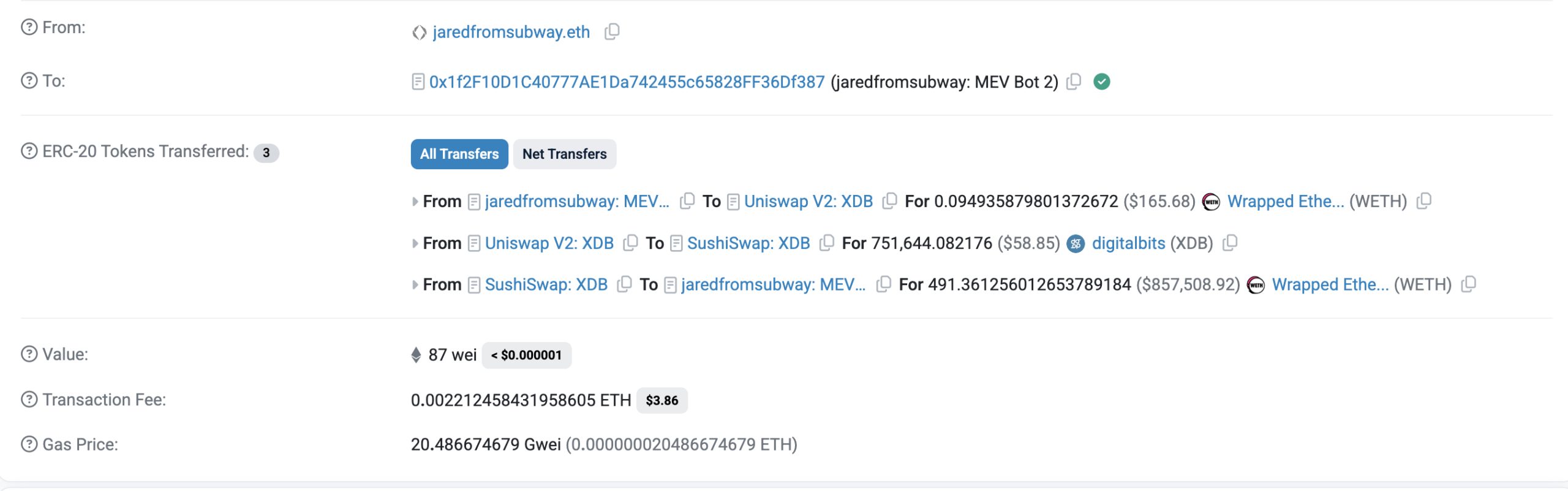
Ethereum price is holding boringly, while the network’s MEV story just escalated the prediction from abstract protocol debate to front-page embarrassment. The infamous jaredfromsubway.eth sandwich bot has reportedly been drained, the same wallet that Vitalik Buterin himself was sandwiched. It happened while Buterin was actively campaigning to kill this exact class of attack.
Blockchain data shows Buterin’s April 30 transaction, a swap of 26,544 XDB tokens, was sandwiched by jaredfromsubway.eth. The bot deployed $1.14 million in WETH across SushiSwap and Uniswap V2 to manipulate the XDB price.
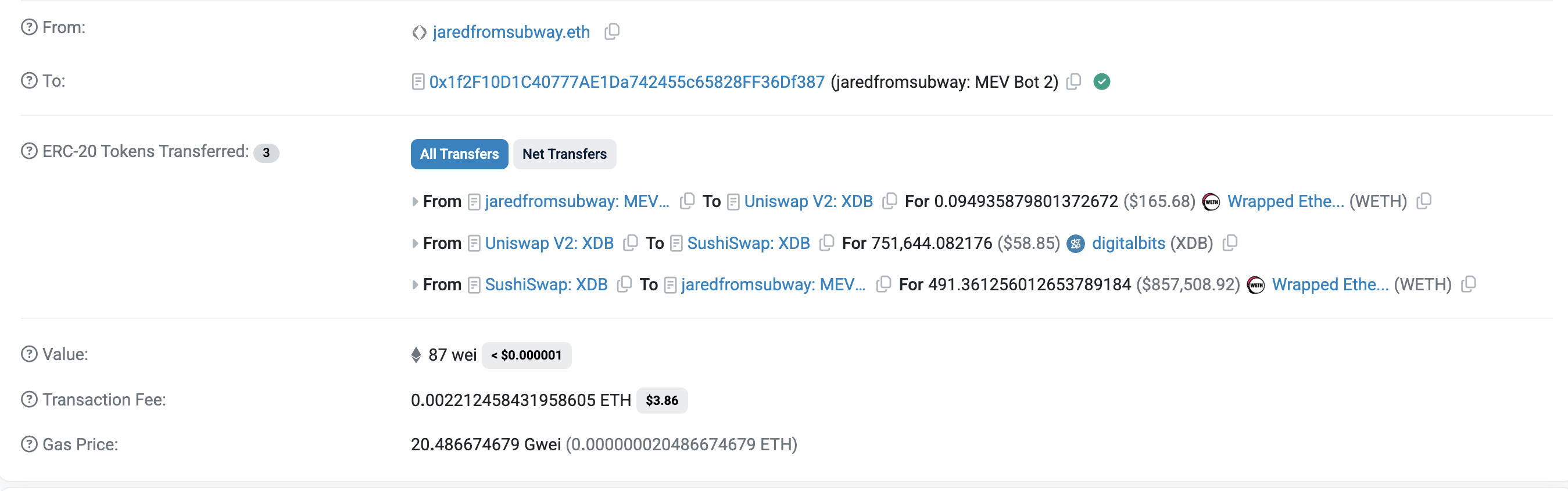
Sometimes, Jared actually lost money after gas, because the bot is so automated that it attacks without a profitability check. The encrypted mempools and MEV reform aren’t just research priorities for ETH; they’re now an overdue infrastructure.
This exact narrative is shaping how we read ETH’s medium-term setup, and it’s worth tracking how Ethereum Foundation development momentum holds up under continued scrutiny.
Discover: The Best Crypto to Diversify Your Portfolio
Ethereum Price Prediction: Hit $1,800 This Week as Consolidation Holds?
ETH is grinding through a consolidation band, not a breakout. Current data places the price around $1,730–$1,750, with the pivot point at $1,740. Intraday behavior has been flat for roughly eight hours, classic pre-move compression, though direction remains unclear.
Key levels to watch: support sits at $1,710, then $1,690 and $1,670 if that gives way. On the upside, resistance is stacked at $1,760, $1,770, and $1,800. Short-term data project a move toward $1,760 by late June, or just about 1.5% upside from current levels if the range holds.

Longer-term, our analysts put ETH at $3,300 in 2026 and $5,200 by 2030, while more conservative estimates cluster around $2,000–$2,500 through 2026. Those ranges imply meaningful upside, but also suggest ETH at current prices is essentially range-bound until a clear protocol or macro catalyst shifts the setup.
For context on how the tokenization thesis intersects with ETH’s demand picture, this companion analysis is worth reading alongside the current technical setup.
Discover: The Best Token Presales
LiquidChain Targets Early-Mover Upside as Ethereum Tests Key Levels
ETH at $1,730 with 1.5% projected near-term upside is a real number. For traders who’ve already sized into ETH and are looking at the infrastructure layer where the next leg of value potentially accrues, the fragmentation problem that jaredfromsubway.eth exploited is exactly what early-stage L3 projects are being built to solve.
LiquidChain ($LIQUID) is a Layer 3 infrastructure project positioning itself as a cross-chain liquidity layer, fusing Bitcoin, Ethereum, and Solana liquidity into a single execution environment.
POV: You read the about section on the LiquidChain site. — LiquidChain (@getliquidchain) June 22, 2026

 https://t.co/vqvBcdSQYC pic.twitter.com/UKD6iXNK8i
The pitch is structural: a Unified Liquidity Layer with Single-Step Execution, Verifiable Settlement, and a Deploy-Once Architecture that lets developers access BTC, ETH, and SOL ecosystems without rebuilding for each chain.
The presale is live at $0.01472 per $LIQUID, with $850K raised to date. For traders tracking where DeFi friction gets priced out next, the cross-chain liquidity gap is the right thesis to be watching.
The post Ethereum Price Prediction: The notorious jaredfromsubway.eth Drained, Vitalik Buterin was a Victim, and The Quest to Make ETH Saver and Faster appeared first on Cryptonews.
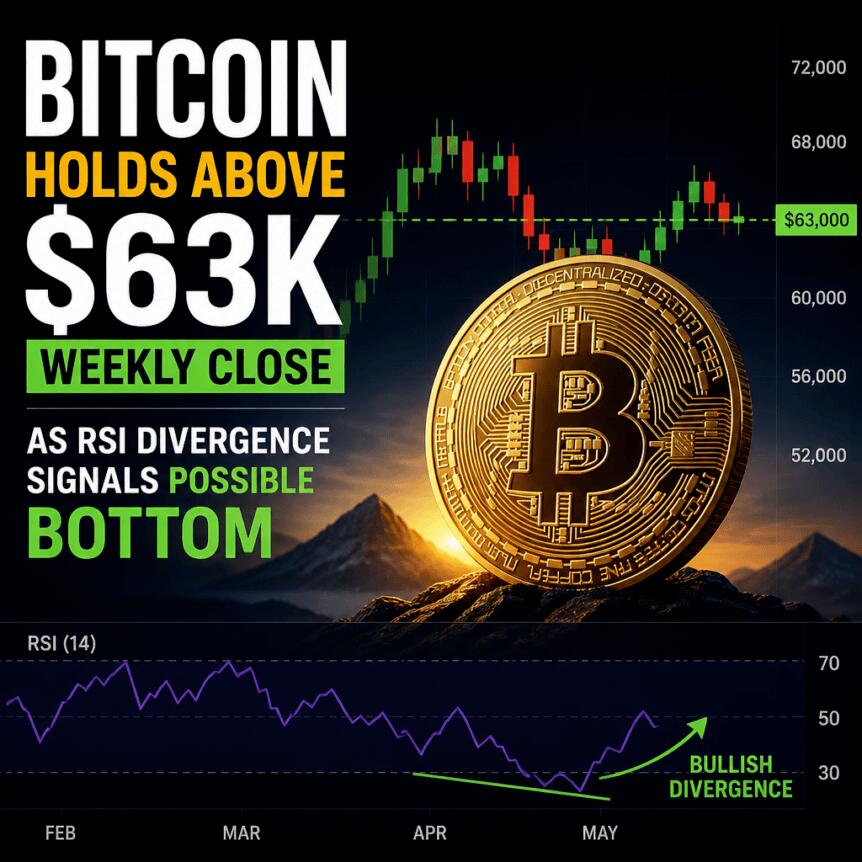
Bitcoin is showing signs of stabilization after putting in a new 2026 low around $59,000 and then maintaining a weekly close above $63,000 for three straight weeks. Market observers say this behavior resembles earlier bottom-building phases, where BTC trades within a defined range for weeks before a more sustained trend develops.
That technical picture is being supported by derivatives and spot ETF flow data. Bitcoin futures open interest has dropped 19.5% from its June peak, funding rates have cooled to about 0.02% (from roughly 0.1%), and spot Bitcoin ETF outflows have slowed dramatically—falling to about $540 million over the past two weeks from $5.5 billion in the prior month.
Key takeaways
- Weekly closes above $63,000 have held for three weeks after a 2026 low near $59,000, suggesting range-building rather than immediate breakdown.
- Bitcoin futures open interest fell 19.5% from its early-June peak, indicating reduced leverage and position unwinds.
- Funding rates have cooled sharply, dropping to around 0.02% from about 0.1%, which points to less aggressive long positioning.
- Spot Bitcoin ETF selling pressure has eased, with outflows of roughly $540 million over two weeks compared with $5.5 billion earlier.
- Long-term holder supply metrics indicate maturation, while “sales pressure” has remained inactive for 1,256 consecutive days.
Weekly structure looks like earlier “bottom-building” behavior
According to the technical pattern described in the source analysis, Bitcoin’s recent weekly price action echoes setups that have appeared multiple times since 2023. The general theme in those periods: after a local bottom is put in place, BTC often trades near that zone for an extended stretch, and only later transitions into a clearer uptrend.
The article notes one notable exception in November 2025, when Bitcoin spent roughly 10 weeks moving sideways above $88,000 before falling back toward the $60,000 area. In contrast to that breakdown scenario, the current setup is characterized by repeated weekly closes above $63,000, which keeps price from testing—at least for now—the recent low near $59,000.
The comparison also draws on the late-2022 to early-2023 period. During that timeframe, the weekly relative strength index (RSI) moved through oversold conditions, then recovered. BTC later printed a lower low while RSI formed a higher low, creating a bullish divergence. The source frames that divergence as a turning point that preceded Bitcoin’s broader 2023 uptrend.
In the present case, the focus is again on the $63,000 region, where the same analyst argument is that a positive RSI divergence is forming. If this holds, the implication is not that the market has confirmed a full reversal yet, but that BTC may be building a base—trading between support and resistance rather than accelerating lower.
Derivatives cooling suggests leverage is being removed, not added
Beyond price charts, the derivatives data points to a market that is less crowded than it was in early June. Funding rates across exchanges have fallen to around 0.02% from roughly 0.1% at the start of June, a move that typically signals that the market is paying less to maintain leveraged long exposure.
The source attributes additional context to CryptoQuant analyst Woominkyuu, who noted that total Bitcoin open interest across exchanges peaked at $25.96 billion on June 1 and dropped to $20.89 billion by June 21. That represents a 19.5% decline in open interest, which the analysis says exceeded the 11.4% price drop over the same interval.
This relationship matters because open interest usually reflects how much leverage is embedded in outstanding derivatives positions. When price and open interest both decline, it often suggests that traders are closing positions or being forced out via liquidations—rather than new leveraged positions building up at current levels. In other words, the source argues that signs of excess leverage appear to be fading, and there is limited evidence (based on these metrics alone) of aggressive new short positioning at the current price range.
ETF flow data shows selling pressure has eased
Spot Bitcoin ETF flows provide a separate lens on demand and selling intensity. The source cites SoSoValue data showing about $5.5 billion leaving spot ETFs between May 15 and June 11. Importantly, it then narrows to the most recent period: over the past two weeks, outflows total roughly $540 million, indicating a sharp slowdown in sell pressure.
For market participants, this shift can be significant. ETF outflows are often interpreted as a proxy for broader spot selling, including systematic reallocations by traditional investors. A slowdown doesn’t automatically imply net buying, but it reduces the urgency of persistent spot absorption from the market’s side, which can help prices stabilize—especially when derivatives leverage is also cooling at the same time.
That combination—less leverage in futures alongside easing spot ETF outflows—fits the broader thesis that BTC is not only holding key support, but also losing some of the “forced selling” dynamics that can accelerate drawdowns.
On-chain signals point to supply maturation and absent capitulation
The source also brings in on-chain evidence from Bitcoin research analyst Axel Adler Jr. It states that long-term holder (LTH) realized supply has recently reached 12.42 million BTC, a level associated with supply maturation and coins moving into stronger hands. In practical terms for investors, LTH behavior is often watched as a proxy for whether earlier holders are distributing supply or whether they are holding through volatility.
At the same time, the source highlights that a Bitcoin sales pressure metric has stayed inactive for 1,256 consecutive days—described as the longest stretch on record. While on-chain metrics can never guarantee near-term price direction, the claim here is that extended inactivity in “sales pressure” aligns with the idea that Bitcoin may be stabilizing near a cycle low.
Taken together, the on-chain picture in the article is “mixed but constructive”: supply maturation appears to be progressing while forced selling conditions remain absent. When paired with the cooling derivatives landscape and reduced ETF outflows, the overall message is that BTC may be transitioning from a high-stress selling phase into something closer to consolidation.
Traders and long-term investors will likely watch whether Bitcoin can hold weekly support near $63,000 as futures positioning continues to unwind and spot ETF flows remain subdued. The next signals to monitor are whether open interest stops falling and whether ETF outflows stabilize into a net-neutral or net-positive pattern—changes that would help confirm that a base is actually forming rather than merely delaying the next move.
Crypto World
Crypto News, June 22: Jared from Subway Big Exploit and Its Legal Battle, UK Advances Stablecoin Regulations, Polymarket Accused of Fake Betting
Crypto markets woke up to pure chaos this Monday, and the Jared from Subway exploit, advancing UK stablecoin regulation, and Polymarket allegations are among the biggest crypto news stories dominating every feed. The hunter has become the hunted, regulators finally admitted they overreached, and one prediction market alleged for staging its own success.
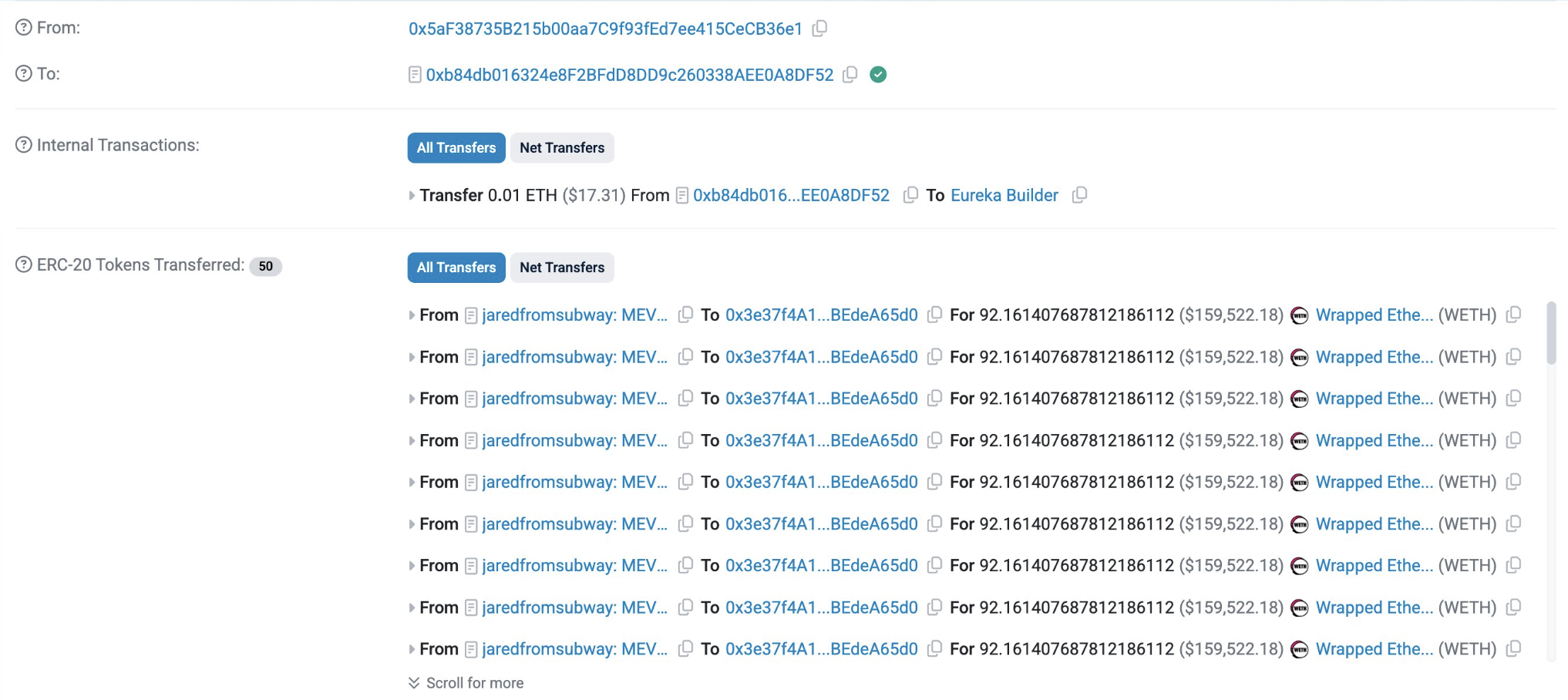
Fresh developments are still landing this morning, and the biggest story rocking on-chain right now involves the infamous Jared from Subway MEV bot. After years of sandwiching traders and raking in millions, the bot got drained for $15 million over the weekend.
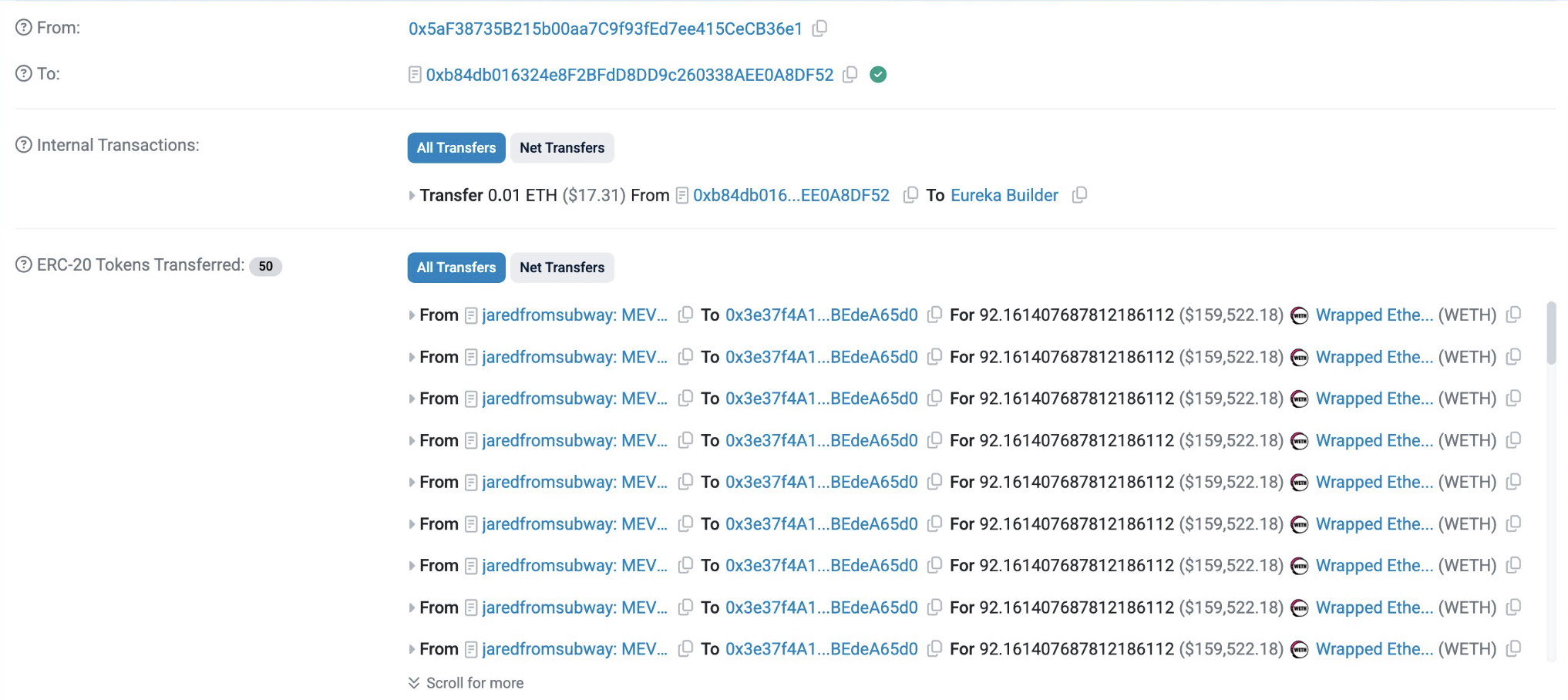
What’s interesting is that the attacker didn’t hack any smart contract code; it simply tricked the bot’s automated logic with fake tokens and liquidity pools that appeared to be profitable MEV opportunities. Once the approvals were granted, the funds in WETH, USDC, and USDT disappeared in a classic counter-MEV honeypot play.
Just this morning, Jared from Subway dropped an on-chain message offering a 50% white-hat bounty if the attacker returns 2,150 ETH within 48 hours. Otherwise, they threatened to pursue every legal and law enforcement remedy available.
Now, can Jared from Subway actually pursue this in court? Sandwich attacks sit in a legal gray zone because they exploit public mempool data. That’s why Jared from Subway was able to operate so openly for years. The extractor’s move, however, looks more like fraud, using deceptive contracts to trick the bot into granting approvals it would never have given.
The bounty-plus-legal-threat approach makes practical sense with permanent on-chain evidence, and if the attacker tries to cash out on centralized exchanges, KYC could eventually link identities.
Discover: The Best Token Presales
UK Advances Its Stablecoin Regulations
UK stablecoin rules have also gotten a glow-up this morning. The Bank of England published its long-awaited policy statement and draft Code of Practice for systemic stablecoins. They openly admitted earlier proposals were too strict and scrapped the £20,000 individual and £10 million business holding caps.
— Coin Bureau (@coinbureau) June 22, 2026
 JUST NOW: UK SOFTENS ITS STABLECOIN RULES AFTER ADMITTING THEY WERE TOO STRICT
The Bank of England has released new draft rules, allowing regulated UK stablecoins to operate from 2027.
Changes include dropping its £20,000 individual holding cap, while keeping a £40 BILLION… pic.twitter.com/Rj1xviIiUp
As for now, the new rules require issuers to keep at least 30% of reserves in deposits at the Bank, with the rest in high-quality UK assets, plus a temporary £40 billion issuance cap per stablecoin. Regulated UK stablecoin products could now realistically launch as early as 2027 under joint oversight.
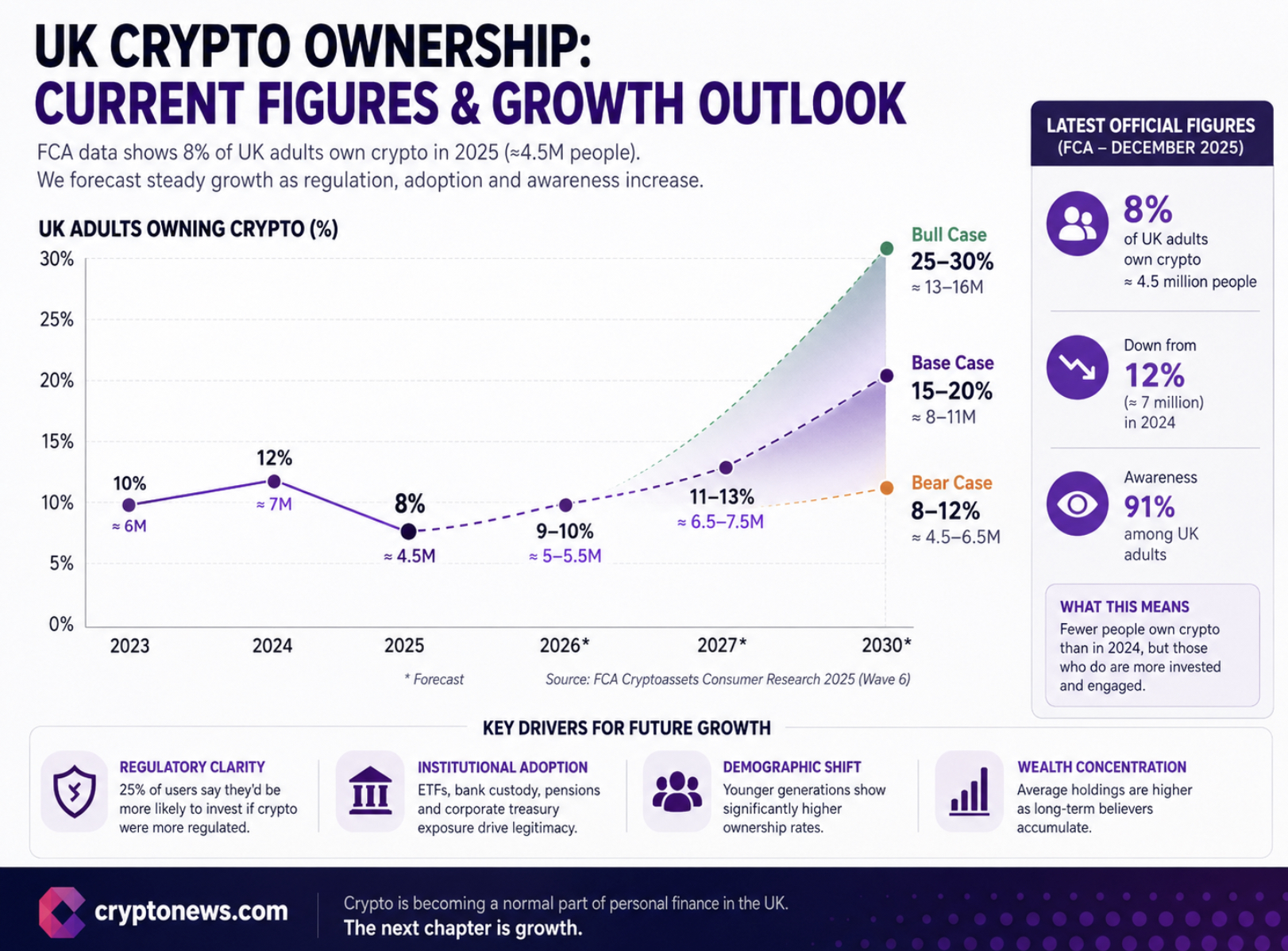
As of today, data shows that 8% of adults are holding crypto assets, or more than 4.5 million people, although awareness is pretty high at 91%. With the Bank of England’s new stablecoin rules removing strict holding caps and setting a clearer framework, the high level of public awareness could translate into stronger adoption and a gradual rise in ownership over the coming years.
Discover: The Best Crypto to Diversify Your Portfolio
WSJ Accused A Big Polymarket Scandal: FIFA World Cup 2026 Extraction?
The drama didn’t stop there. A Polymarket alleged scandal broke late yesterday. The Wall Street Journal reviewed 1,105 videos from creators paid through a contractor. None of the big “winning bets” shown was actually real.
According to WSJ, these creators used dummy sites that looked like Polymarket to stage everything, depicting roughly $1.9 million in fake wagers. Some quietly added partner tags after journalists started asking questions. Polymarket has since said it will audit its promotional content.
Discover: The Best Token Presales
The Awaited Clarity ACT and Regulations Could Battle Jared From Subway Like Exploits
Moving away from the prediction market, reports indicate the US Senate is resuming negotiations on the Bitcoin and Crypto Clarity Act today. The bill has already cleared the Senate Banking Committee and now needs final polishing.
NEW: US SENATE TO RESUME #BITCOIN AND CRYPTO CLARITY ACT NEGOTIATIONS TODAY — The Bitcoin Historian (@pete_rizzo_) June 22, 2026
LIKE, IF YOU WANT THE UNITED STATES TO PASS THE THIS BILL IMMEDIATELY pic.twitter.com/dm6MtHLubI
Why is this big? Clearer rules around digital commodities versus securities would be a massive win for the entire industry. Every exploit and regulatory admission is just another data point proving the space is maturing. Projects are hardening their code, regulators are finally listening instead of overreacting, and lawmakers are moving from endless talk to actual legislation.
Despite today’s drama, we are expecting healthy growing pains. The same infrastructure that lets bad actors get rugged also allows white-hat recoveries and better rules to emerge faster than traditional finance could ever manage. With the Senate back at the table and clearer UK stablecoin pathways opening, the foundation for the next leg up is quietly being laid.
Bullish? Absolutely. The clowns provide entertainment, but the builders and institutions keep stacking.
Follow us here for more updates from the crypto market today.
Discover: The Best Crypto to Diversify Your Portfolio
The post Crypto News, June 22: Jared from Subway Big Exploit and Its Legal Battle, UK Advances Stablecoin Regulations, Polymarket Accused of Fake Betting appeared first on Cryptonews.


Digital assets are attempting to decouple from a complex macro environment following a dramatic sequence of central bank shifts, headlined by the Bank of Japan’s historic push to 1.0% interest rates and newly appointed Federal Reserve Chair Kevin Warsh’s restructured FOMC policy framework.
Traders enter the week balancing an apparent drop in concerns over energy-driven inflation against a stark warning of tighter liquidity in the near-term.
While the official signing of the U.S.-Iran peace treaty provides relief by opening the Strait of Hormuz, it’s also stripped haven assets of their immediate momentum. Instead, capital is reorganizing around a heavy U.S. data cluster, with the market bracing for Thursday’s crucial Core PCE print to evaluate the trajectory of consumer inflation.
With the bitcoin price stabilizing above major psychological support at $64,000, the macro weight that pressed on digital assets for months may finally be dissipating.
What to Watch
(All times ET)
- Crypto
- June 22: The U.S. SEC and CFTC open their newly issued joint public comment window targeting data reporting frameworks. The 60-day window invites industry feedback to harmonize and streamline regulatory reporting across swap and digital-asset derivatives markets.
- Macro
- June 23, 4:00 a.m: Eurozone Flash Manufacturing and Services PMIs for June
- June 25, 8:30 a.m: U.S. Final Q1 GDP growth annualized est. 1.6% (Prev. 1.6%)
- June 25, 8:30 a.m: U.S. May Core PCE Price Index YoY est. 3.3% (Prev. 3.3%); MoM est. 0.24% (Prev. 0.2%)
- June 25, 8:30 a.m: U.S. Initial Jobless Claims for period ending June 20 est. 224K (Prev. 226K)
- Earnings
Token Events
- Governance Votes & Calls
- Lido DAO is voting on various network matters, including approving the Staking Router v3 architecture, migrating to upgraded community and curated staking modules to support the Ethereum Pectra hard fork, winding down simple DVT clusters, revoking specific multichain bridge endpoints, and appointing a new director for the Lido Labs Foundation. Voting ends June 22.
- Ssv.network DAO is voting on a proposal to conclude its Incentivized Mainnet Program for validator clusters paying network fees in SSV on June 30. The transition framework offers full rewards for July to any SSV cluster that migrates to an ETH-denominated cluster. Voting ends June 23.
- Goldfinch DAO is voting on a proposal to begin an orderly wind-down of Goldfinch Prime and transition the protocol into a “maintenance mode” focused solely on managing the recovery and collection of remaining legacy borrower pool payments. Voting ends June 23.
- GnosisDAO is voting on a “treasury redemption” proposal that allows GNO holders to voluntarily exchange their tokens for a pro-rata distribution of the DAO’s liquid assets at net asset value (NAV), along with a discounted share of capital called by GnosisVC. Voting ends June 26.
- Unlocks
- June 22: MegaETH Bridge (MEGA) to unlock 2.5% of its circulating supply worth $13.71 million.
June 23: Toncoin (TON) to unlock 0.72% of its circulating supply worth $59.63 million. - June 24: Humanity (H) to unlock 2.93% of its circulating supply worth $52.67 million.
- June 22: MegaETH Bridge (MEGA) to unlock 2.5% of its circulating supply worth $13.71 million.
- Token launches
Conferences
Crypto World
Bank of England backs down on strict stablecoin holding limits, sets $50 billion issuance cap


The Bank of England officially reversed its controversial proposal to limit how much stablecoin individuals and consumers could hold, bowing to pressure from a U.K. House of Lords committee and the crypto industry.
The central bank said it will abandon its plans to impose a £20,000 ($27,000) holding limit on individuals and a £10 million limit on corporations, in a statement on Monday, Instead, the BOE is pivoting to a macro-level “temporary issuance guardrail,” capping the total circulation of any single systemic stablecoin at £40 billion ($50.6 billion).
The central bank also lowered to 30% the amount of backing assets in central deposits yielding no interest they require issuers of stablecoins, digital currency pegged to fiat, to have. This allows for stablecoin firms permitting companies to allocate up to 70% of their reserves into yield-generating, short-term U.K. government debt (T-bills) with maturities under six months, according to the statement.
While issuers can harvest yield from these T-bills, the BoE is strictly banning companies from paying interest or dividends directly to users for simply holding the stablecoin. However, the bank is explicitly permitting activity-based rewards, such as cash-back tokens or loyalty points linked directly to payment transactions via Web3 apps.
Bank of America has projected three Federal Reserve interest-rate hikes this year, adding to concerns that tighter monetary policy could create fresh pressure for Bitcoin and other risk assets.
Summary
- Bank of America now expects three Fed rate hikes in September, October, and December, citing a more hawkish policy outlook.
- Deutsche Bank and BNP Paribas have also raised their rate forecasts, adding to expectations of tighter monetary policy.
- Traders are watching the upcoming PCE inflation report as Bitcoin holds near $64,000-$65,000 amid growing rate-hike concerns.
According to a Reuters report, Bank of America Global Research now expects the Federal Reserve to raise rates by 25 basis points at its September, October, and December meetings, bringing the policy rate to a range of 4.25%-4.50% by year-end.
The forecast represents a sharp departure from the bank’s earlier expectation that rates would remain unchanged throughout the year. The revised outlook arrives as investors prepare for the release of the U.S. Personal Consumption Expenditures inflation report, the Fed’s preferred gauge of inflation.
Economists surveyed ahead of the June 24 release expect headline PCE inflation to rise 0.5% month-over-month in May after a 0.4% increase in April. Annual inflation is expected to accelerate to 4.1% from 3.8%, while core PCE is forecast to increase 0.3% on a monthly basis and 3.4% from a year earlier.
A stronger-than-expected reading could reinforce expectations that policymakers will keep borrowing costs elevated for longer or even tighten policy further.
Wall Street forecasts point to a more hawkish Fed
In explaining its revised outlook, Bank of America said the Federal Reserve appears more focused on inflation risks than previously anticipated.
The bank wrote that the Fed’s June economic projections and comments from Chair Kevin Warsh suggested policymakers were operating with a more hawkish reaction function than earlier estimates indicated.
Another large institution has moved in a similar direction. Per the Reuters report, Deutsche Bank has also adopted a more hawkish outlook, forecasting two quarter-point rate hikes this year in September and December.
The bank additionally outlined a scenario in which policymakers could consider a July increase, while noting that easing energy prices and improving inflation expectations may reduce the need for immediate action.
A separate forecast from BNP Paribas points to additional tightening as well. As previously reported by crypto.news, the French bank expects three rate hikes beginning in December after abandoning its prior assumption that policy would remain unchanged.
BNP Paribas linked its outlook to resilient labor-market conditions, stronger-than-expected employment data, and rising inflation pressures that it partly associates with the ongoing U.S.-Iran conflict. The bank also projected the unemployment rate could fall toward 4% by year-end, potentially giving policymakers more room to concentrate on inflation.
Bitcoin traders watch inflation and rate signals
Recent pricing in prediction and futures markets shows investors remain divided on the Fed’s next move.
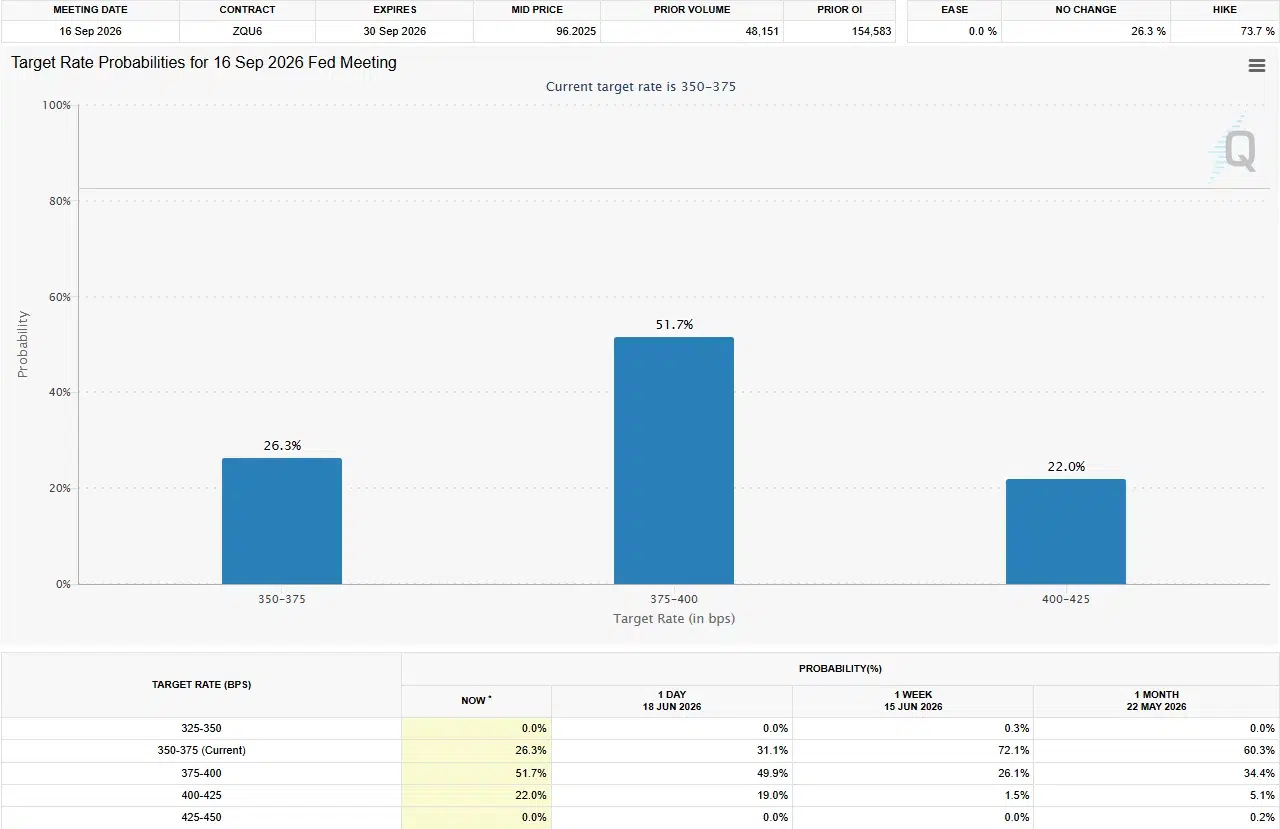
Data from Kalshi indicates a 22% probability of a rate increase in July, while a pause remains the most likely outcome. Separately, CME FedWatch data shows traders assigning a 51.7% probability to a quarter-point hike at the September meeting.
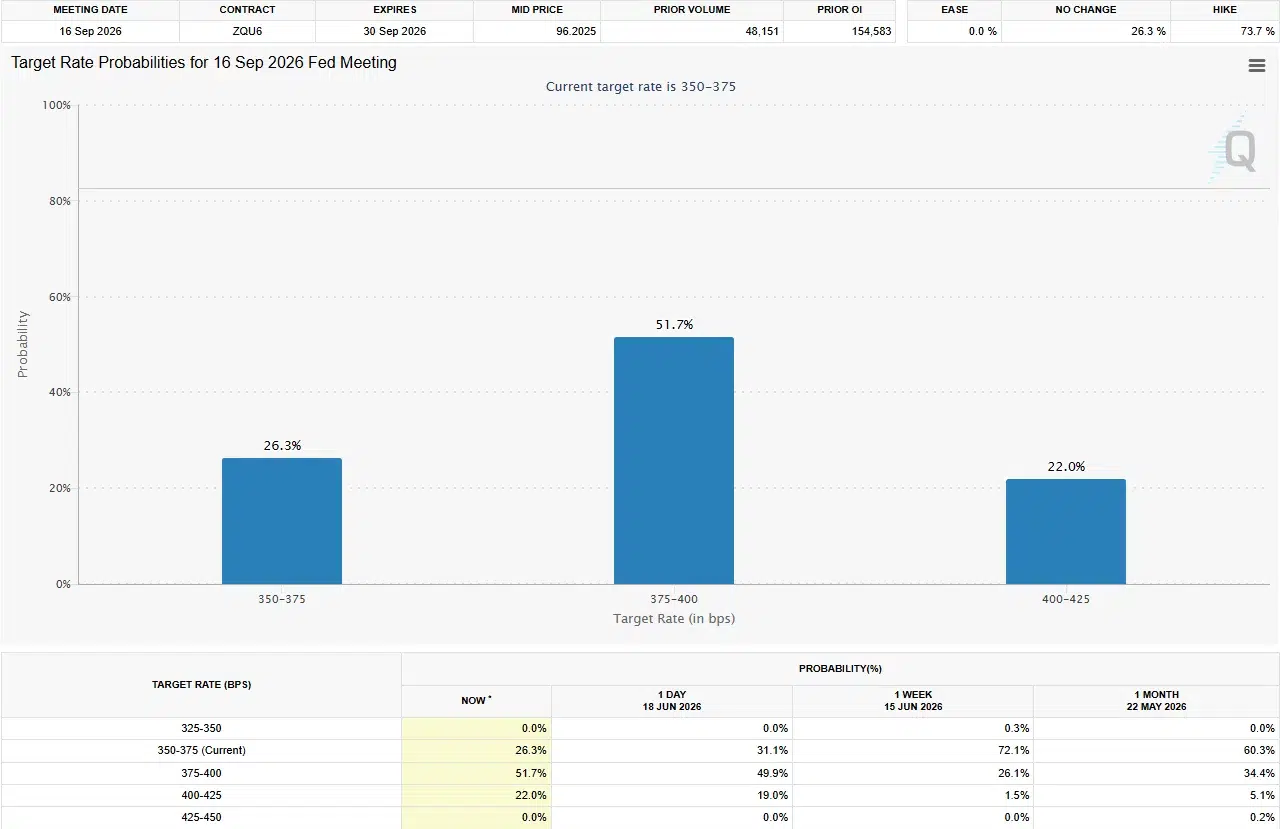
Market-based expectations also point toward tighter policy. According to LSEG pricing data, traders have priced in approximately 41.2 basis points of additional tightening over the course of the year.
Higher interest rates typically reduce liquidity available for speculative investments while increasing the appeal of yield-bearing assets such as U.S. Treasuries. Because of that relationship, digital assets often face pressure when investors anticipate tighter monetary conditions.
Bitcoin (BTC) has recently traded within the $64,000-$65,000 range despite improving geopolitical sentiment following developments related to the U.S.-Iran situation. With inflation data due this week and major banks raising their forecasts for future rate increases, traders are closely watching whether incoming economic data strengthens the case for additional Fed tightening.
Disclosure: This article does not represent investment advice. The content and materials featured on this page are for educational purposes only.

Asake – Amen (Official Visualizer)

Lionel Messi’s historic World Cup moment sheds light on a vital quality

Market Brief: One More Rate Hike, Just A Gesture


-

 Fashion3 days ago
Weekend Open Thread: Miami – Corporette.com
-
 Tech6 days ago
The Adder At The Heart Of Intel’s 8087 FPU
-

 Entertainment2 days ago
Renter of Home in Anne Heche Crash Denies Settlement With Son
-

 Business2 days ago
Soccer-U.S. defends Iran World Cup travel restrictions, says discussions ongoing
-

 Tech7 hours ago
Microsoft accidentally kills epic Outlook email threads
-
 Business3 days ago
Wall Street Week Ahead: Investors see Micron earnings as pulse check of AI rally momentum
-

 Politics4 days ago
BBC Reporter Discusses Cross Party Criticism Of Trumps Iran Deal
-

 Crypto World3 days ago
HIVE shares jump as $220M AI deal speeds Bitcoin mining pivot
-

 Crypto World2 days ago
Jake Chervinsky accuses CME of protecting derivatives monopoly
-
 Crypto World2 days ago
Can Charles Hoskinson Really Rescue Cardano?
-

 Sports4 days ago
FIFA World Cup 2026: Canada beat 9-men Qatar 6-0 to register first ever win | FIFA World Cup 2026
-

 Business2 days ago
MHP SE 2026 Q1 – Results – Earnings Call Presentation (OTCMKTS:MHPSY) 2026-06-20
-

 Business4 days ago
Brexit cost 6% of UK economy, Bank of England company data suggests
-

 Politics2 days ago
Andy Burnham and the meaning of Makerfield
-

 Crypto World5 days ago
Anthropic’s Dario Amodei Urged AI Unity at G7, Even as US Banned His Models
-

 Crypto World7 days ago
Robinhood opens AI-powered trading to all users, sending HOOD stock past $100
-
 Tech1 day ago
Signal’s Meredith Whittaker says AI chatbots ‘are not your friends’ and calls Copilot agents a backdoor
-

 Tech5 days ago
Weeks Of In-The-Field Testing And A Verdict
-

 Tech4 days ago
Adobe adds its AI assistant to Premiere, Illustrator and InDesign
-

 Tech4 days ago
AWS enters the context layer race with a graph that learns from agents, not manual curation
You must be logged in to post a comment Login