

Crypto World
Ripple wins with JPMorgan, so why is XRP still stuck?

Ripple keeps winning. A five-second cross-border Treasury settlement with JPMorgan and Mastercard, ten major deals this year, an IPO the chief executive keeps hinting at. XRP keeps trading near a dollar and change. The gap between the company and the token is the entire story.
Summary
- Ripple’s institutional wins are real, but they do not always create XRP demand.
- The JPMorgan Treasury settlement used RLUSD, not XRP, as the cash leg.
- Ripple equity and XRP remain separate assets with different value drivers.
- XRP needs utility to become token demand before the price can break its range.
In June 2026, Ripple completed something that should have been a milestone for its token. Working with JPMorgan, Mastercard, and Ondo Finance, it settled the redemption of a tokenized United States Treasury fund across borders and across banks on the XRP Ledger, and the blockchain leg finalized in under five seconds, against the one to three business days the same transaction takes on traditional rails.
The participants were real, the speed was real, and the headline wrote itself: Wall Street is settling Treasuries on Ripple’s blockchain. And yet XRP, the token, barely moved, and where it did move it often fell.
The asset spent most of 2026 trading in a narrow band near a dollar and change, while news exactly like this piled up around it. That disconnect, a company stacking institutional wins while its token goes nowhere, is one of the most instructive puzzles in crypto.
The answer is more revealing than either the bulls or the bears usually admit.
This piece takes the puzzle apart. It covers the settlement that did not move the token and the detail the headlines skipped, the structural separation between Ripple the company and XRP the asset, the supply overhang that quietly weighs on the price, the genuine catalysts XRP does have, and why those catalysts keep getting priced as maybes.
The aim is to explain, without spin in either direction, why good news for Ripple so often fails to become good news for XRP, and what would actually have to change for the token to break out of its range.
The win that did not move the token
The June settlement was not a small thing. For years the tokenization story has been mostly demonstrations on private chains, so a live, cross-border, cross-bank redemption of a real tokenized Treasury on a public ledger, with JPMorgan’s settlement platform delivering dollars to Ripple’s bank in Singapore in the same flow, is a credibility win for the XRP Ledger.
It connected one of the largest settlement institutions in the world to a public blockchain, outside normal banking hours, in seconds. As a proof that the rails work, it was about as strong as these announcements get.
That is the settlement broken down in detail. The transaction matters because it shows that regulated institutions are willing to test the XRP Ledger for real-world asset settlement.
The market’s reaction told a different story. XRP did not rally on the news in any durable way, and on the day of an earlier version of the same pilot it actually fell almost 5%, erasing a brief pop.
This was not an anomaly. It fit a pattern that has defined XRP through 2026, where Ripple partnership headlines arrive, the token spikes briefly or not at all, and then drifts back down.
Traders have a weary phrase for it: every Ripple deal seems to be followed by the XRP price dropping. When a genuinely impressive institutional milestone produces a shrug or a selloff, the explanation is rarely that the milestone was fake.
It is usually that the milestone has less to do with the token than the headline implies.
The detail the headlines skipped: XRP was barely in the trade
Here is the part that reframes everything. In that landmark Treasury settlement, XRP the asset did almost no work.
The bridging and settlement were done with RLUSD, Ripple’s dollar-pegged stablecoin, not with XRP. The tokenized Treasury, Ondo’s product, was redeemed by exchanging it for RLUSD, and XRP appeared only as the tiny network fee that every XRP Ledger transaction pays.
Those fees are fractions of a cent on a trade moving far larger sums. The asset that the headlines attached to the news was, in the actual mechanics, a bystander.
This is not an accident or an oversight; it is by design, and the reason matters. Institutional settlement needs a stable, audited, dollar-denominated instrument, because no treasurer is going to settle a Treasury redemption in an asset that can swing 10% in a day.
RLUSD is built for exactly that role: dollar-pegged, backed by cash and Treasuries, and regulated. XRP’s price volatility rules it out of the settlement leg by definition, which is why Ripple deliberately built the product to use RLUSD as the cash leg.
That is the RLUSD that did the settlement work. It is useful precisely because it is not supposed to move.
So when Ripple wins an institutional settlement deal, the direct beneficiary is the XRP Ledger as infrastructure and RLUSD as the settlement token, while XRP the asset captures only the minuscule fee. The headline says XRP.
The transaction says RLUSD. The price reflects the transaction.
Ripple the company versus XRP the token
Step back and the deeper issue comes into focus: Ripple the company and XRP the token are not the same thing, and the market has started pricing them separately.
Ripple is a private company that sells software and payment services, signs deals with banks, holds a large treasury, and may one day go public. XRP is a cryptocurrency that trades on its own supply and demand.
Owning XRP does not make you a shareholder in Ripple, does not entitle you to its profits, and does not give you a claim on its corporate success. The two are linked by association and by Ripple’s large XRP holdings, but they are distinct assets with distinct drivers.
This is why the IPO chatter, which intensified after chief executive Brad Garlinghouse called the moment real ahead of a company event, is more complicated than it sounds for token holders. An initial public offering would let people buy Ripple equity, and it would reward Ripple’s shareholders.
It would not, by itself, pay anything to XRP holders, who own a separate asset.
That is the IPO question for token holders. The most realistic answer is that any benefit would be indirect unless Ripple deliberately created a program for XRP holders, and no such program exists.
Garlinghouse’s strongest argument is an indirect one, and it has genuine merit: because Ripple remains the largest single holder of XRP, the company has a built-in incentive to drive the token’s value, and its partnerships and integrations do plausibly increase XRP’s long-term utility and demand.
That alignment is real. But it is indirect, a rising tide the company hopes to create, not a dividend it pays, and a holder who treats a possible IPO as a direct reward is counting on a maybe attached to a maybe.
The market’s persistent refusal to rally Ripple’s wins into XRP’s price is, in effect, the market enforcing this distinction.
The supply overhang nobody wants to discuss
There is also a more mechanical weight on the token, and it sits on the supply side.
Ripple holds an enormous quantity of XRP in escrow, a locked reserve it releases on a schedule, and that release is a structural source of new supply hitting the market. Each month Ripple can release up to one billion XRP from escrow, then re-locks most of it, but the net amount that actually reaches circulation still runs into the hundreds of millions of tokens monthly.
That is a steady stream of potential selling pressure built into the token’s design.
The significance is that it sets a high bar for any bullish supply story. Some XRP optimists point to the tiny fees burned on each ledger transaction as a deflationary force, but at current transaction volumes the burn is a rounding error next to the escrow releases.
For fee burn to tighten supply in any meaningful way, on-chain activity would have to grow by orders of magnitude, enough to offset hundreds of millions of newly released tokens every month. A single institutional settlement test does not move that needle.
So even when Ripple announces real adoption, a holder has to weigh it against a supply schedule that keeps running on its long-set path. The demand side has to climb a down escalator, and one impressive pilot does not change the speed of the steps.
What XRP actually has going for it
None of this means XRP is a lost cause, and a fair account has to give the bull case its due, because the token’s position has improved in ways that are concrete.
The years-long legal cloud has lifted. The Securities and Exchange Commission’s case against Ripple ended in 2025 with the courts’ finding that XRP sold on public exchanges was not a security, and a later joint classification treated XRP as a digital commodity, giving the token more regulatory clarity than almost any other asset of its size.
That clarity is real and durable, even if it rests partly on interpretation rather than statute.
The institutional door has also opened. Spot XRP exchange-traded funds launched in late 2025 from a roster of established issuers and pulled in well over a billion dollars in assets, with major institutions appearing among the disclosed holders.
That is where XRP demand is actually coming from. ETF flows are not enough by themselves to erase the supply overhang, but they are measurable demand in a way that partnership headlines are not.
Ripple’s stablecoin, RLUSD, crossed a billion dollars in market value in under a year and is being woven into real settlement and card products. Ripple has also kept expanding its payments footprint, including a Bitso partnership around a regulated MXN-backed stablecoin on XRPL and a Flutterwave investment aimed at expanding RLUSD settlement across African payment corridors.
Those are not trivial supports. They show Ripple pushing both sides of its strategy: the ledger as institutional settlement infrastructure and stablecoins as the cash leg that enterprises actually want to use.
The single biggest potential catalyst is legislative. If the CLARITY Act passes and writes XRP’s digital-commodity status into federal law, analysts have projected several billion dollars of additional XRP ETF inflows.
That is the catalyst that could codify XRP’s status. It is the one event that could turn today’s regulatory interpretation into statutory certainty.
These are the ingredients of a genuine bull case, and they explain why XRP has held a floor rather than collapsing, even as it refuses to break out.
Why the catalysts keep getting priced as maybes
So the puzzle resolves into a simpler observation: XRP has real catalysts, but the market keeps pricing them as possibilities instead of facts, and there is a logic to that caution.
A proof-of-concept settlement is priced as a proof of concept until it becomes recurring volume. An ETF is priced on the flows it actually attracts, not the flows it might.
A legislative catalyst is priced on the probability of passage, which for the CLARITY Act has hovered well short of certainty as the bill grinds through the Senate. Each of these is a maybe, and a token sitting on a stack of maybes trades like a token sitting on a stack of maybes: range-bound, reactive, and quick to sell the news.
The pattern of selling Ripple’s wins is the market expressing exactly this. When XRP spiked after its legal victory in 2025, long-term holders used the burst of volume to sell, and the token settled back into its range.
Every subsequent partnership has met a version of the same response, because the partnerships, however real, have not yet produced measurable, sustained demand for the token itself.
The market is not being irrational. It is distinguishing between infrastructure adoption, which benefits Ripple and the ledger, and token demand, which is what actually moves XRP, and it is waiting for proof that the first turns into the second.
What the chart has been saying all year
If you want a blunt summary of everything above, look at what XRP’s price actually did around its biggest catalysts, because the chart has been telling the story in plain language.
When Ripple’s long legal fight with the Securities and Exchange Commission finally ended in 2025, XRP spiked hard, touching levels far above where it trades now, and then it faded. Long-term holders used the surge of volume and attention to sell into strength, and the token drifted back down through the rest of the year and settled into the narrow range it has occupied for months.
Each subsequent institutional headline produced a smaller version of the same shape: a brief pop, a fade, a return to the range. The 200-day moving average, a common gauge of the longer trend, has sat well above the price for much of the year, which is a technical way of saying the market has been in a patient holding pattern, neither convinced enough to break out nor scared enough to break down.
A second signal is easy to overlook because it points the other way. While Ripple was landing marquee partnerships, the payments company MoneyGram, once one of Ripple’s most-cited real-world users, moved its on-chain settlement work toward a rival blockchain.
One defection does not undo a year of deals, and the strategic damage may be small, but it punctures the simplest version of the bull narrative, the one where every institution that touches Ripple stays forever and compounds XRP demand.
Adoption is not monotonic. Partners arrive and partners leave, and the network effect that XRP optimists count on is more contested than the announcement cadence suggests.
The chart reflects this ambivalence honestly: a market that has seen real progress and real setbacks, and has priced the token as a thing that might work out, with the proof still pending.
The lesson in the price action is the same lesson the mechanics teach. Markets are forward-looking, and they will pay up in advance for catalysts they believe will convert into demand.
XRP’s refusal to sustain its rallies is the market saying, repeatedly, that it does not yet see the conversion, that the partnerships and pilots have not become the recurring, token-level demand that would justify a rerating.
That is not a permanent verdict. It is a standing challenge, and the chart will be the first place the answer shows up, long before any press release confirms it.
The bigger pattern: when the network wins and the token waits
XRP’s predicament is not unique, and seeing it as one case of a broader pattern makes the whole situation less mysterious.
Across crypto, there is a recurring gap between the success of a network and the price of the token attached to it. A blockchain can attract real usage, real institutions, and real volume while its native token languishes, because adoption of the infrastructure and demand for the token are two different things that only sometimes move together.
A network captures value for its token when using the network requires buying, holding, or burning that token in volume large enough to matter against its supply. When the network can be used without much of the token changing hands, the usage and the price decouple, and the token becomes a spectator to its own success.
XRP sits squarely in that trap. The XRP Ledger is being adopted for serious settlement work, but those settlements lean on RLUSD as the cash leg and use only a sliver of XRP as a fee.
So the network’s growth does not pull much demand through to the token. This is the same dynamic that has frustrated holders of other infrastructure tokens whose chains saw heavy use that never translated into proportional token demand.
The token is not useless; it secures the ledger, pays the fees, and provides liquidity. But the volume of XRP that the network’s growth actually requires is small relative to the token’s large and steadily expanding supply, and that imbalance is the core of the disappointment.
The market is not failing to notice Ripple’s progress. It is noticing, correctly, that the progress runs largely through rails that do not require much XRP.
Understanding this reframes what a holder is really betting on. To own XRP in expectation of price appreciation is to bet not merely that Ripple succeeds, but that Ripple’s success comes to require XRP itself in growing quantities, through settlement volume, ecosystem use, and demand that finally outpaces the escrow supply.
That is a more specific and more demanding bet than simply believing in the company, and it is the bet the market keeps declining to front-run.
The network can keep winning for years while the token waits, and the waiting ends only when usage and token demand finally converge. Until they do, the gap that has defined XRP through 2026 is less a puzzle than a predictable feature of how value accrues, or fails to accrue, to a token whose network can succeed without it.
What would actually break the range
If you want to know when XRP might finally move, the framework above tells you where to look, and it is not the next partnership headline.
The thing that breaks the range is the conversion of utility into token demand: settlement volume large enough that fees and ecosystem use begin to matter against the escrow supply, ETF flows that compound instead of trickle, and a regulatory catalyst like the CLARITY Act actually crossing the line and pulling institutional money off the sidelines.
Those forces aligning, not any one of them alone, is the strongest version of the XRP thesis.
Until then, the disconnect is likely to persist, and understanding why is the most valuable thing a holder can take from the past year. Ripple is winning, genuinely and repeatedly, in the institutional arena it has targeted for a decade.
But Ripple’s wins flow first to Ripple the company, to the XRP Ledger as a piece of infrastructure, and to RLUSD as a settlement instrument, and only indirectly, slowly, and conditionally to XRP the token.
A holder who watches the partnerships and wonders why the price will not follow has been watching the wrong variable. The variable that matters is whether all that institutional adoption ever turns into durable demand for XRP itself, and so far, the market has decided it has not seen enough proof.
The deal with JPMorgan was a milestone. It was just a milestone for the ledger, not yet for the coin.
Frequently asked questions
What did Ripple and JPMorgan actually do?
Ripple, JPMorgan, Mastercard, and Ondo Finance completed the first cross-border, cross-bank redemption of a tokenized United States Treasury fund on the XRP Ledger. Ondo’s tokenized Treasury product was redeemed on the ledger while Mastercard’s network and JPMorgan’s settlement platform delivered dollars to Ripple’s bank in Singapore, with the blockchain leg settling in under five seconds versus one to three business days on traditional rails. It is a real milestone for tokenized settlement and for the XRP Ledger as infrastructure.
Why did XRP not go up after the JPMorgan deal?
Because XRP the asset was barely involved in the transaction. The settlement used RLUSD, Ripple’s dollar-pegged stablecoin, as the cash leg, while XRP appeared only as the tiny network fee. Institutional settlement needs a stable, audited dollar instrument, and XRP’s price volatility rules it out of that role by design. So the deal benefited the XRP Ledger and RLUSD far more than XRP, which is why the token did not rally and, on an earlier version of the pilot, actually fell.
Is XRP the same as owning a stake in Ripple?
No. Ripple is a private company, and XRP is a separate cryptocurrency. Owning XRP does not make you a Ripple shareholder, does not entitle you to its profits, and would not give you a claim in a Ripple IPO. The two are linked because Ripple is the largest holder of XRP and its business can increase the token’s utility over time, but that benefit is indirect. A Ripple IPO would reward Ripple’s equity holders, not XRP holders directly.
Why is XRP stuck in a range?
A mix of supply and demand factors. On the supply side, Ripple releases large amounts of XRP from escrow each month, a steady source of selling pressure that small fee burns cannot offset at current volumes. On the demand side, Ripple’s institutional wins have not yet produced sustained demand for the token itself, so the market prices each partnership, ETF, and legislative catalyst as a maybe instead of a confirmed driver, leaving XRP range-bound and quick to sell the news.
What could actually push XRP higher?
The conversion of utility into real token demand. That means settlement volume large enough that ecosystem use begins to matter against the escrow supply, ETF flows that compound instead of merely trickling, and a regulatory catalyst such as the CLARITY Act passing and writing XRP’s digital-commodity status into federal law, which analysts project could draw billions in additional ETF inflows. Those forces aligning together, not any single headline, is the strongest case for a breakout.
Does XRP have a real bull case at all?
Yes. XRP has more regulatory clarity than almost any major token after the SEC case ended and a later classification treated it as a digital commodity. Spot XRP ETFs launched in late 2025 and gathered over a billion dollars, with major institutions among the holders, and RLUSD crossed a billion dollars in market value quickly. The CLARITY Act could codify XRP’s status and unlock further ETF demand. These are genuine supports, which is why XRP has held a floor, even as it waits for adoption to translate into token demand.
This article is information, not investment advice. Prices, partnership details, and corporate and legislative plans change quickly and reflect reporting available as of June 24, 2026. Verify current data with official sources before relying on anything described here.

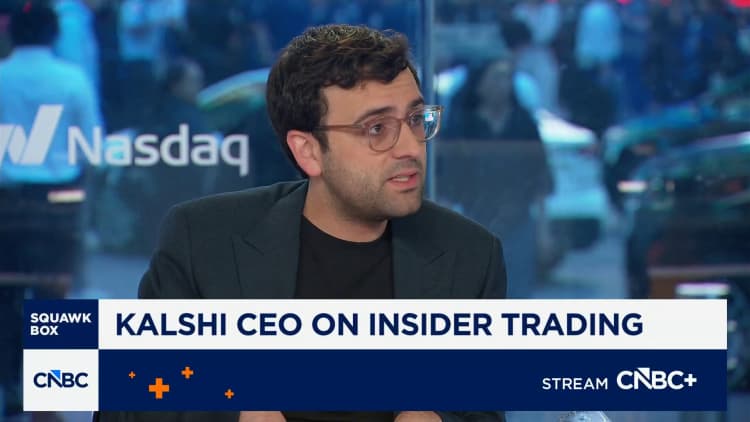

Prediction market platform Kalshi’s CEO Tarek Mansour confirmed the company is in the early stages of planning a potential IPO in an appearance on CNBC’s “Squawk Box.”
Mansour said a public markets debut of the company won’t come this year, but that it makes sense for Kalshi at this stage of its growth to begin thinking about an IPO.
“A company of our financial profile with the rate of growth that we’re seeing, that sort of conversation has to happen,” he said. “People start asking that question. And we’re basically thinking about it, but obviously, we don’t have an answer yet.”
The Information reported last week that Kalshi was in early talks for a potential IPO, though noted that a listing was unlikely to come until late 2027 or 2028. Mansour on Wednesday did not get specific with a timeline beyond stating that an IPO won’t happen in 2026.
Kalshi has experienced huge growth over the past year. At the end of June 2025, the company was valued at $2 billion. In May, the company announced a Series F funding round that put its valuation at $22 billion.
Driving that valuation, prediction market industry watchers say, is the opportunity these markets have with institutional traders. While retail users have driven Kalshi’s growth, the company has begun shifting its rhetoric and product development to increase its appeal to Wall Street.
To gain Wall Street adoption, though, Kalshi will need to quell concerns over potential insider trading on the platforms. Mansour highlighted on Wednesday initiatives the company has taken to do that, including enhanced measures to know who are traders’ employers and its “Know Your Customer” verification requirements.
He also pointed to cases that Kalshi has brought against individuals to show that its efforts to curb insider trading worries are working.
“It’s a hard problem,” Mansour said about creating market integrity on the prediction market platform, “but it’s not an impossible one.”
Disclosure: CNBC and Kalshi have a commercial relationship that includes customer acquisition and a minority investment.
Crypto World
Chainlink Lands Major Banking Deal Across Europe and South Korea: Why Isn’t LINK Crypto Price Moving?

Chainlink just secured one of the most structurally significant banking partnerships in its history, but LINK barely flinched. The token is trading slightly higher on the day, holding a tight, quiet range.
The Project Pangea brings together more than 50 financial institutions. The deal itself includes some of the biggest names, Qivalis, a euro stablecoin consortium backed by 37 European banks, and UniKA, a South Korean banking alliance anchored by Shinhan Bank and Kbank, collectively managing over $10 trillion in assets across a $150 billion annual EUR/KRW trade corridor.
The initiative targets T+0 atomic settlement of FX transactions, compressing the current T+2 cycle to near-real-time PvP swaps via regulated stablecoins on a dedicated Pangea Layer-1 chain. Industry coverage frames this as Chainlink embedding itself into international banking plumbing with structural demand. But why LINK stalls?
Discover: The Best Crypto to Diversify Your Portfolio
Why is Chainlink Price Stuck in Range?
Let’s start from the chart perspective. LINK is consolidating in a horizontal range following its most recent swing higher, a pattern that reflects broad market indecision rather than outright distribution.
Volume on the Project Pangea announcement was modest relative to prior catalyst-driven sessions. This is not surprising as it typically signals that large participants aren’t aggressively positioning ahead of confirmed revenue flows from the deal. The 12-month timeline to live transactions means no near-term fee generation is yet hitting Chainlink’s economic model.
On the technical structure, immediate support sits in the mid-range of the current consolidation band at $7.50, with a stronger demand zone below that has held across multiple retests. Resistance overhead is clustered at the prior swing high at $9 a level that has capped two recovery attempts. Momentum indicators remain neutral, neither overbought nor generating a fresh bearish signal, which keeps the range intact rather than flagging imminent breakdown.

Don’t Miss Out on Our $1,000 USDT Airdrop on ByBit
A confirmed pilot transaction announcement or disclosed fee model could trigger a breakout above $9 resistance, opening a measured move toward the upper $10 range. But a loss of near-term support below $7 on elevated sell volume would expose the lower demand zone and materially delay any breakout thesis.
Discover: The Best Token Presales
LiquidChain Targets Early Mover Upside as Link Tests Key Levels
LINK’s range-bound behavior after a genuinely significant fundamental event illustrates a recurring pattern: by the time institutional adoption is confirmed and priced in, the asymmetric upside has already compressed. That’s the structural argument for looking one layer earlier in the stack at infrastructure projects still in presale, before market cap expands.
LiquidChain ($LIQUID) is a Layer 3 infrastructure project positioning itself as the cross-chain liquidity layer, fusing Bitcoin, Ethereum, and Solana liquidity into a single execution environment through its Unified Liquidity Layer architecture.
POV: You read the about section on the LiquidChain site. — LiquidChain (@getliquidchain) June 22, 2026

 https://t.co/vqvBcdSQYC pic.twitter.com/UKD6iXNK8i
With Liquid, developers deploy once and access all three ecosystems; settlement is verifiable; execution is single-step. The presale is currently priced at $0.01473 with $860K raised to date. That fundraising number signals early traction without the liquidity overhang that comes after a public listing.
Research LiquidChain before the presale ends.
Don’t Miss Out on Our $1,000 USDT Airdrop on ByBit
The post Chainlink Lands Major Banking Deal Across Europe and South Korea: Why Isn’t LINK Crypto Price Moving? appeared first on Cryptonews.
The company recently secured a key regulatory approval, which is vital for its operations in the European Union, while institutional interest in XRP remains solid.
Despite these positive developments, Ripple’s cross-border token hasn’t managed to rebound and is down nearly 70% from its all-time high registered last summer.
The License in Europe
Earlier this week, Ripple obtained preliminary approval for a Crypto Asset Service Provider (CASP) license from Luxembourg’s Commission de Surveillance du Secteur Financier under the European Union’s Markets in Crypto-Assets (MiCA) regulation.
It was granted through a Green Light Letter and remains subject to final conditions. If fully confirmed, it would enable the company to offer regulated cryptocurrency services across the entire EEA, which consists of 30 countries. Commenting on the matter was Cassie Craddock, Managing Director, UK & Europe at Ripple, who said:
“Financial market infrastructure is moving on-chain – from cross-border payments and settlement to collateral management and tokenized assets – and banks and fintechs are actively building the digital asset capabilities they need to remain competitive. With our growing European presence, regulatory track record and institutional-grade infrastructure, we’re ready to meet the moment and support that transition at scale.”
The ETF Front
Over the past several weeks, institutional investors have drastically reduced their exposure to Bitcoin (BTC) and Ethereum (ETH). However, this is not the case for Ripple’s native token, which continues to attract substantial capital.
SoSoValue’s data shows that inflows into spot XRP ETFs have surpassed outflows, with the last red day being March 6. The financial giants offering such products include Canary Capital, Bitwise, Franklin Templeton, 21Shares, and Grayscale, while the cumulative net inflow generated to date exceeds $1.45 billion.

XRP Price Outlook
The inflows into spot ETFs require the issuers of these investment vehicles to purchase real XRP on the market, which could positively impact the price.
Nonetheless, the asset remains heavily suppressed during the prolonged bear market and currently trades at around $1.10, representing a 20% decline on a monthly scale and a whopping 70% crash from the historic peak reached in 2025.
It’s worth noting that the steep decline hasn’t dampened the strong optimism shared by some analysts. A few days ago, X user Tom claimed that the token has formed a pattern similar to its 2024 run, which took the price from $0.50 to $3.30. This time, though, it could result in a major upswing to $8.42.
JAVON MARKS was even more bullish, arguing that “XRP’s breakout stands, which means the measured move target near $17 does as well.”
The post Ripple (XRP) News Today: June 24 appeared first on CryptoPotato.

TLDR
- Qualcomm confirmed its acquisition of AI infrastructure software provider Modular, with the transaction reportedly valued at approximately $4 billion according to Bloomberg.
- The acquisition brings software capabilities that enable AI model deployment across various hardware platforms, supporting Qualcomm’s data center ambitions.
- Modular’s valuation has surged significantly from $1.6 billion following a $250 million funding round completed nine months prior.
- Shares of QCOM gained 1.1% in premarket hours following an 8% decline Tuesday, with the stock posting 57% gains over the last three-month period.
- The acquisition announcement coincided with Qualcomm’s investor day Wednesday, where the company planned to reveal a major data center chip partnership and unveil next-gen processor details.
Qualcomm (QCOM) announced its agreement to purchase Modular, a company specializing in AI infrastructure software, in a transaction that Bloomberg sources estimate at roughly $4 billion. The chipmaker has not publicly disclosed the official acquisition price.
Shares of QCOM advanced 1.1% during premarket Wednesday trading, rebounding from an 8% slide in the previous session. The semiconductor company’s stock has surged 57% during the past three-month timeframe.
Established in 2022, Modular has secured $380 million in total capital, with its most recent financing being a $250 million investment round completed in September 2025. The company carried a $1.6 billion valuation following that funding round — meaning the reported $4 billion purchase price represents more than a 2.5-fold increase in less than twelve months.
Qualcomm indicated the transaction should finalize during the latter half of 2026.
Modular’s technology provides software infrastructure that allows developers and enterprises to deploy AI models with optimized performance across diverse hardware architectures. This cross-platform compatibility represents a strategic asset for Qualcomm’s broader objectives.
“The acquisition is expected to strengthen Qualcomm Technologies’ ability to deliver a more optimized AI compute layer across a broad range of platforms and use cases,” Qualcomm said in a statement.
The company added that it “deepens the software foundation for Qualcomm Technologies’ data center strategy.”
The chipmaker has intensified its data center expansion efforts as part of a strategy to diversify beyond the smartphone chip sector, which experiences significant market fluctuations.
What Analysts Are Saying
Patrick Moorhead, an analyst at Moor Insights & Strategy, provided commentary on the transaction, highlighting the difference between Qualcomm‘s existing strengths and Modular’s complementary capabilities.
“Qualcomm is very good at edge enabling software, but that’s not the same as data center software capability,” Moorhead said. “Strategically, this could help to better answer the data center question.”
The observation holds merit. While Qualcomm has established strong AI chip positioning in edge computing applications — including smartphones, personal computers, and automotive systems — the data center segment presents distinct challenges, and Modular’s technology addresses that capability gap.
Investor Day in Focus
Qualcomm’s investor day also took place Wednesday, an event drawing significant market attention as analysts anticipated the company would identify a major data center chip client.
Information regarding Qualcomm’s upcoming processor architecture was also expected to be shared, further heightening investor attention surrounding the stock.
In separate reporting, The Information indicated that Qualcomm is pursuing discussions to acquire AI chip developer Tenstorrent in a transaction estimated between $8 billion and $10 billion. Neither company has confirmed those negotiations.
Qualcomm has not publicly revealed the financial terms of the Modular acquisition, and company representatives declined to provide pricing details when approached by Barron’s.

The world’s largest crypto exchange has recently faced significant regulatory challenges that could ultimately force it to stop serving clients in the European Union.
Earlier this month, Reuters reported that the company’s application through Greece’s Hellenic Capital Market Commission (HCMC) is expected to fall short: a development that may strip Binance of the license it needs to stay in the bloc after the June 30 deadline.
The firm assured that it remains fully committed to securing the necessary MiCA approval. Speaking on the matter was CEO Richard Teng, who said:
“Binance is dedicated to Europe. We are committed to our European users and to operating under a clear, fair, and harmonized MiCA framework. We are dedicated to securing our MiCA license and remain ready to operate under a fair, predictable, and genuinely harmonized European framework. We will continue to keep users updated as we make progress.”
Just recently, Reuters revealed that the exchange will make a fresh push for permission to operate in the EU. Gillian Lynch, Binance’s head of Europe and the United Kingdom, reportedly said that the firm “may just have a different pathway to being authorized,” adding that “if it is not Greece, I’m looking at other alternatives.”
According to the media, Binance has already held talks with regulators in Ireland, Latvia, and Greece but has been rejected in all three nations due to concerns such as the company’s past penalties for money laundering and its complex international structure.
Lynch said the exchange had contacted several regulators in the European Union but made only one application, to Greece. She is unaware why the Greek authorities refused approval, arguing that Binance has no outstanding issues related to the filing.
The post Binance Makes a New Push to Secure EU Approval appeared first on CryptoPotato.

- KuCoin Pay expands crypto payments to Bangladesh, Mexico, and Zambia.
- Platform links stablecoins with local banks and mobile money rails.
- KuCoin targets real-world crypto use in high-growth emerging markets.
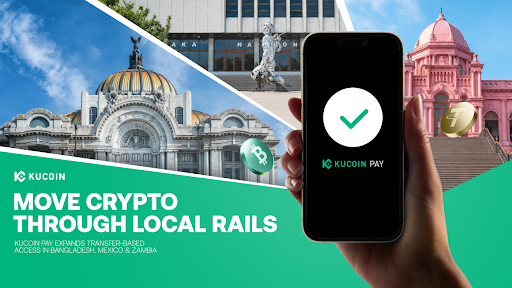
KuCoin Pay, the cryptocurrency payment platform developed by KuCoin, has expanded its transfer-based payment capabilities across Bangladesh, Mexico, and Zambia.
The move aims to connect digital assets with widely used local payment systems in high-growth markets.
The rollout integrates cryptocurrencies and stablecoins with established banking and payment networks across the three markets.
These include the bKash and Nagad mobile payment platforms in Bangladesh, SPEI-compatible bank transfer routes in Mexico, and mobile money services offered by MTN Group and Airtel Africa in Zambia.
The expansion reflects the growing role of local bank transfers and mobile money services in emerging economies, where consumers increasingly rely on these systems for salary payments, remittances, merchant transactions, and peer-to-peer transfers.
Integration with local financial infrastructure
KuCoin Pay said its platform is designed to integrate digital assets with familiar financial systems, reducing the complexity often associated with moving cryptocurrencies into everyday financial activity.
The company noted that its technology supports localized payment routing through deep integration with local banking and payment rails.
Rather than requiring users to navigate complex backend processes, the platform identifies appropriate payment routes through a unified technical interface.
According to the company, this approach allows digital asset transactions to function more like traditional e-wallets, mobile money services, or local bank transfer tools.
By connecting cryptocurrencies and stablecoins with existing financial infrastructure, KuCoin Pay aims to make digital assets more practical for real-world use cases while reducing friction and simplifying the transfer process.
Focus on practical crypto applications
KuCoin executives said payments represent one of the most important pathways for digital assets to gain broader utility within the real economy.
“Crypto is emerging as a new asset class with growing relevance in the real economy, and payments are one of the most important ways for this value to reach users,” said Alicia Kao, Managing Director of KuCoin.
“Through KuCoin Pay, we are building trusted and localized connections between digital assets and existing banking, mobile money and transfer rails. By integrating crypto with the financial systems people already use, we are helping digital assets move beyond holding and trading into practical financial activity, while supporting more inclusive and future-ready financial ecosystems in high-growth markets.”
The company said the expansion is intended to improve accessibility to digital assets by enabling users to interact with cryptocurrencies through payment systems they already use in their daily lives.
Further expansion planned
Looking ahead, KuCoin Pay said it plans to continue expanding compatibility with local banking and payment systems in additional markets.
The company also intends to improve technical response speeds and broaden practical cryptocurrency payment applications across supported regions worldwide.
The latest expansion underscores a broader industry trend toward integrating digital assets with existing financial infrastructure, particularly in emerging markets where mobile money and local transfer networks play an increasingly central role in everyday commerce and financial inclusion.


An Ethereum address linked to the HashFlare cloud-mining fraud transferred 10,600 ETH worth about $18.5 million on Monday morning after sitting idle for roughly three and a half years. Blockchain investigator ZachXBT flagged the movement, the first activity tied to the address since the… Read the full story at The Defiant
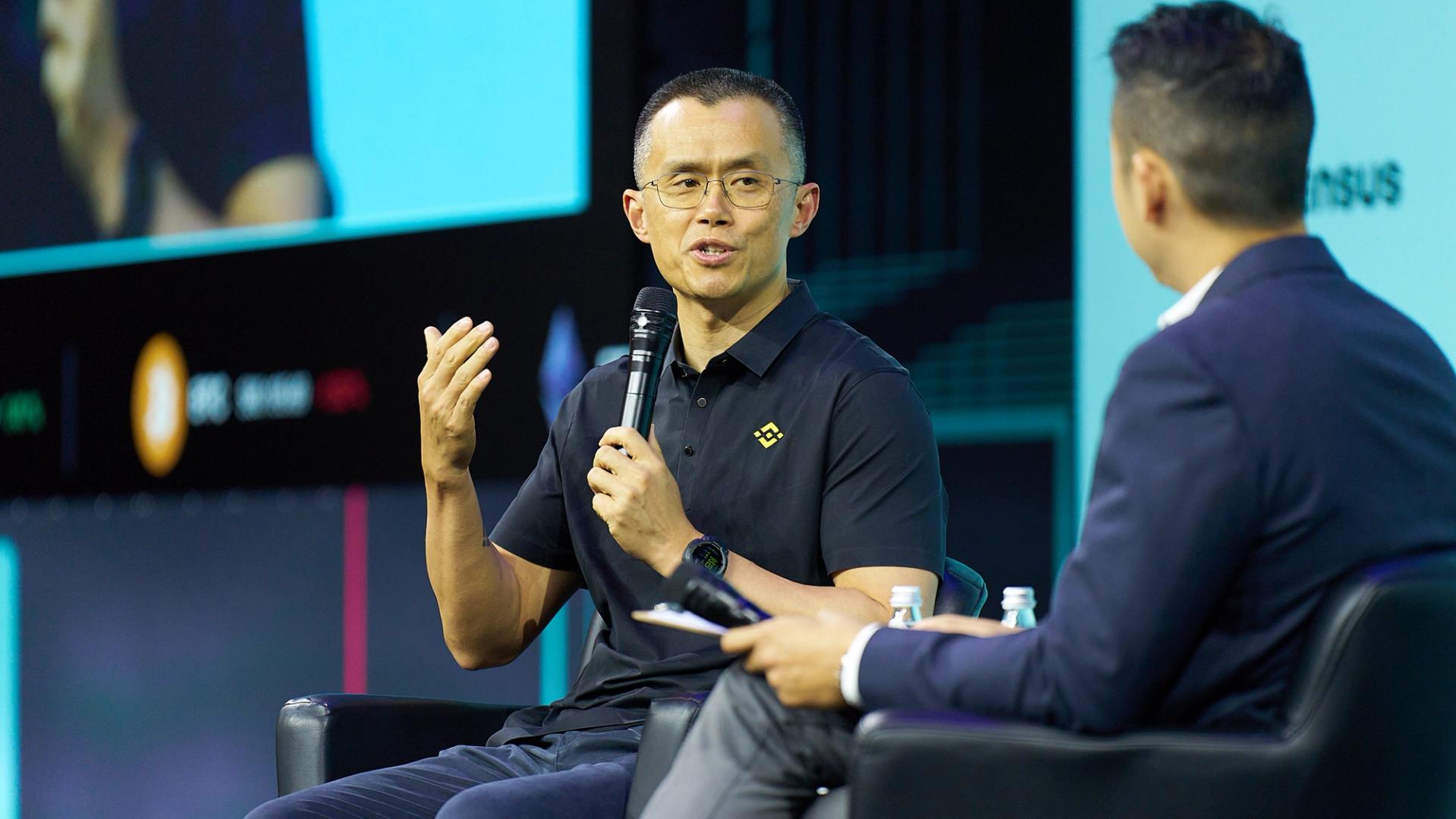
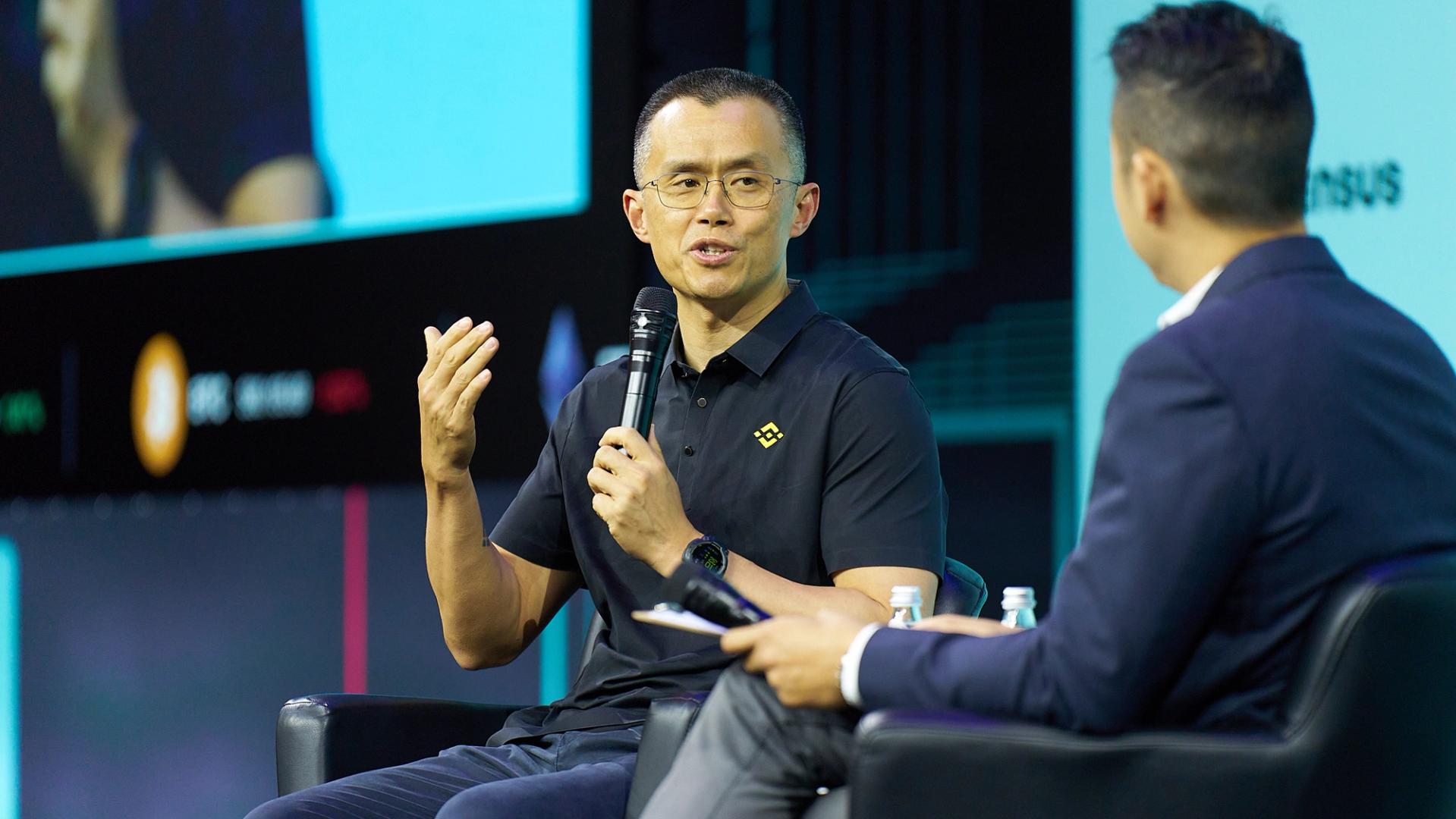
“Binance.US has a CEO, Binance.com has two co-CEOs,” he said. “They almost never talk to each other. Actually, I don’t think they ever talk to each other. So, yes, two independent teams. Binance.US does license the product and technology from Binance Global, but they have a licensing agreement.”
CZ can’t see himself running the U.S. business, he said, adding that he did not think he was the best candidate to run a U.S. platform. “It needs to be somebody local; it needs to be somebody who’s on the ground,” he said.
The other companies CZ is heavily invested in — Giggle Academy and YZi Labs — are similarly independent, he said.
This independence extends to CZ’s personal life, he said. Yi He, one of Binance’s co-CEOs, is CZ’s partner, and the two share a home in the United Arab Emirates. Despite this, CZ said they do not talk about Binance at home, and the two keep their respective work lives separate.
“To be very frank, even when I was CEO of the company, she had a lot of strategic input into the company,” he said. “She was probably giving me more instructions even when I was CEO. So now, [after] stepping down, she’s running it. Our conversations at the max would be like ‘oh two days ago the bitcoin price dropped because of this policy,’ but we don’t even talk about that anymore.”
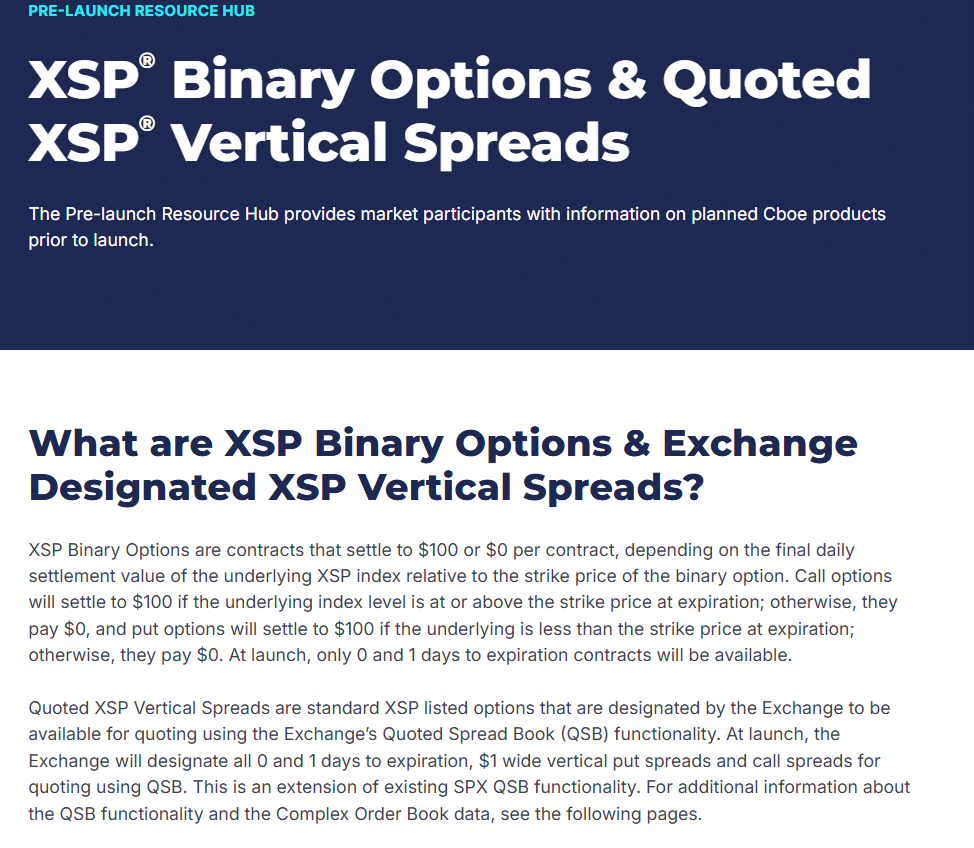
Market operator Cboe Global Markets has entered the prediction markets business with the launch of Cboe Predicts, a platform debuting with binary contracts tied to the S&P 500.
The contracts are now available through Interactive Brokers and are expected to launch at Charles Schwab and other retail brokerage platforms in the coming months, according to a Tuesday press release.
The contracts allow traders to take “yes” or “no” positions on whether the S&P 500 will close above or below a specified price level.
Cboe is the latest traditional finance firm to expand into prediction markets as investor interest in outcome-based contracts grows. The launch comes days after reports that Charles Schwab was seeking to enter the sector through a partnership with Cboe that would offer customers similar S&P 500-linked contracts.
Contracts tied to the S&P 500’s daily closing price are already available on prediction market platforms such as Polymarket and Kalshi.
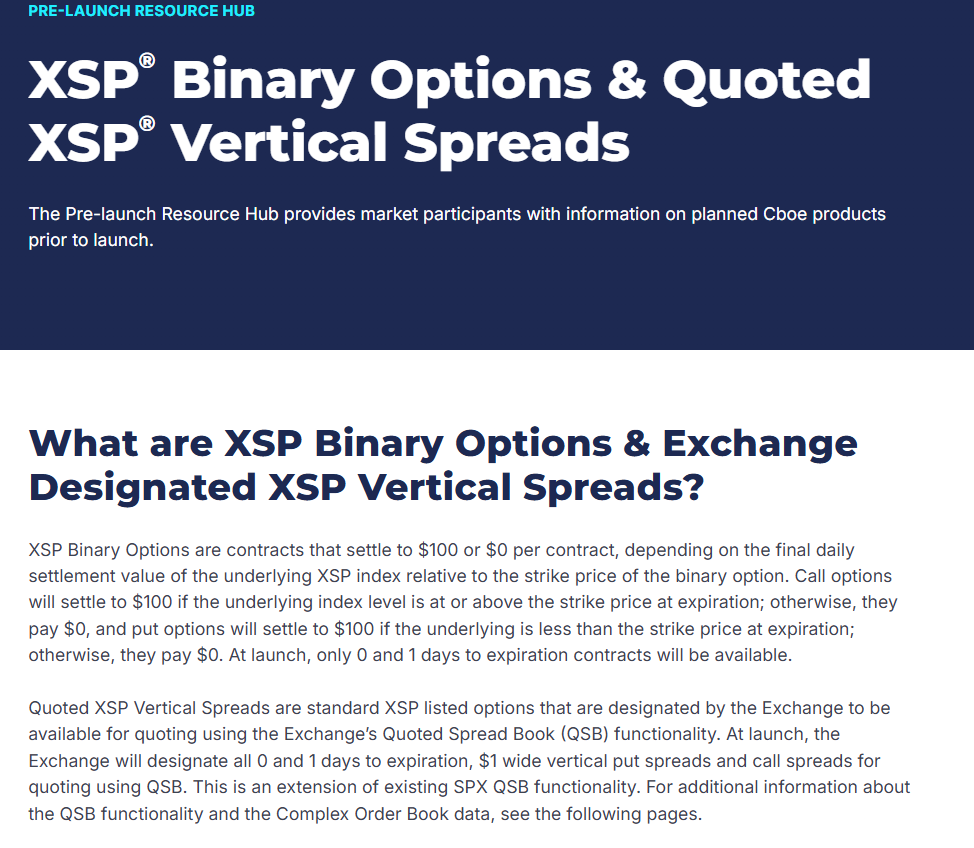
Cboe launches XSP Binary Options in prediction markets offering. Source: Cboe
Traders seek more binary event contracts
Cboe’s customers are showing more demand for shorter-dated, outcome-based trading opportunities, which led to the debut of the prediction market offering, according to JJ Kinahan, head of retail expansion and alternative investment products at Cboe.
Cboe’s new contracts are security options that will trade within the same regulatory framework as US-listed options, providing “institutional-grade liquidity” and transparency, Cboe said.
Related: Kalshi adds India to growing list of restricted jurisdictions
Meanwhile, prediction market platforms have drawn increased regulatory scrutiny over political betting and sports-related event contracts.
Kentucky was the latest state to sue five prediction market platforms, including Kalshi and Polymarket, accusing them of “operating unlicensed and illegal sports betting and gambling platforms,” as Cointelegraph reported on Thursday.
In January, US lawmakers proposed legislation aimed at restricting political prediction market trading by government officials after a Polymarket user netted over $400,000 on a contract related to the removal of then-Venezuelan President Nicolás Maduro, fueling insider trading concerns.
Magazine: Should users be allowed to bet on war and death in prediction markets?
Crypto World
Jaredfromsubway.eth, Ethereum's Most Active Sandwich Bot, Drained for $7.5M Over the Weekend
An attacker drained more than $7.5 million from jaredfromsubway.eth, the Ethereum address widely considered the single most-active sandwich-attack operator on the network, over the weekend. The loss is a rare public setback for an MEV bot that has run as one of Ethereum's largest priority-fee… Read the full story at The Defiant

The Brighton clinic that defied the puberty-blockers ban

Money is Energy: Once You Shift Your Frequency, Making Money Becomes Effortless

What to do if a dog is in a hot car and can you smash window


-

 Fashion5 days ago
Weekend Open Thread: Miami – Corporette.com
-

 Entertainment4 days ago
Renter of Home in Anne Heche Crash Denies Settlement With Son
-

 Tech2 days ago
Microsoft accidentally kills epic Outlook email threads
-
 Sports19 hours ago
Two goals and an assist by sheer aura: Cristiano Ronaldo just entered the World Cup chat
-

 Business4 days ago
Soccer-U.S. defends Iran World Cup travel restrictions, says discussions ongoing
-

 Politics6 days ago
BBC Reporter Discusses Cross Party Criticism Of Trumps Iran Deal
-
Crypto World10 hours ago
Bitcoin (BTC) Dips Below $62K, Ethereum (ETH) Plunges 6% Daily: Market Watch
-

 Crypto World7 hours ago
Securitize Wraps Roubini's SEC-Registered ETF as Dubai VARA Digital Security
-
Business13 hours ago
Entergy settles forward sale agreements, raises $672 million in cash proceeds
-
 Business4 days ago
Wall Street Week Ahead: Investors see Micron earnings as pulse check of AI rally momentum
-

 Politics4 days ago
Andy Burnham and the meaning of Makerfield
-

 Tech6 days ago
AWS enters the context layer race with a graph that learns from agents, not manual curation
-
 Crypto World4 days ago
Can Charles Hoskinson Really Rescue Cardano?
-

 Crypto World4 days ago
HIVE shares jump as $220M AI deal speeds Bitcoin mining pivot
-

 NewsBeat5 days ago
Keir Starmer Allies Question His Chances For No 10
-

 Crypto World4 days ago
Jake Chervinsky accuses CME of protecting derivatives monopoly
-

 Tech2 days ago
Nearly 7,000 fake Amazon domains registered ahead of Prime Day 2026, researchers warn
-
 Tech3 days ago
Signal’s Meredith Whittaker says AI chatbots ‘are not your friends’ and calls Copilot agents a backdoor
-

 Business6 days ago
Brexit cost 6% of UK economy, Bank of England company data suggests
-

 Sports6 days ago
FIFA World Cup 2026: Canada beat 9-men Qatar 6-0 to register first ever win | FIFA World Cup 2026
You must be logged in to post a comment Login