







Connect with us
DAPA Banner
DAPA Coin
DAPA
COIN PAYMENT ASSET
PRIVACY · BLOCKDAG · HOMOMORPHIC ENCRYPTION · RUST
ElGamal Encrypted MINE DAPA
🚫 GENESIS SOLD OUT
DAPAPAY COMING

Business

EES Chaos: Europe’s Airports Chief Warns of ‘Complete Collapse’

Published

on

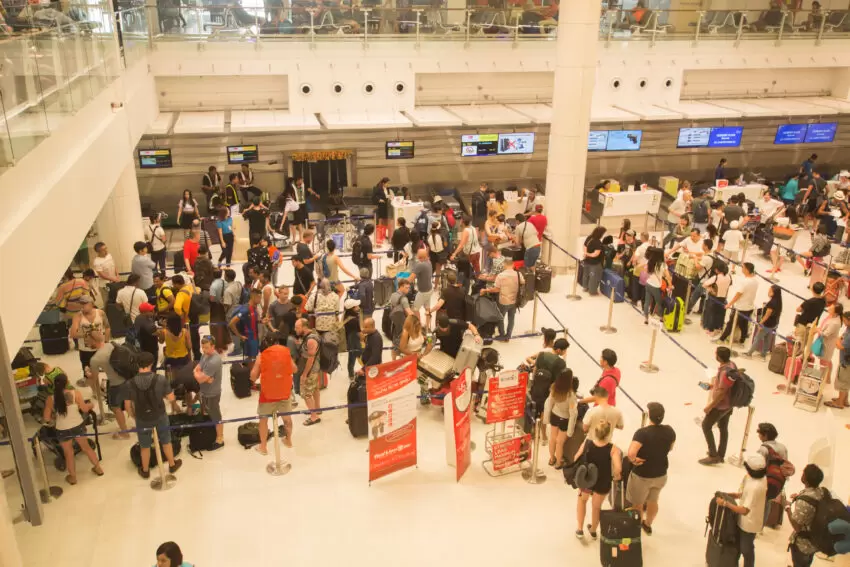
Passport e-gates across key UK airports experienced a widespread malfunction, triggering chaotic scenes as travellers faced lengthy queues and manual checks by border officers.

The head of Europe’s airports trade body has urged politicians to “stop pretending” that the European Union’s new digital border system is working, warning that the chaos now unfolding at passport control is keeping industry bosses awake at night.

Earlier this year the EU completed the roll-out of its Entry-Exit System (EES), which requires travellers from outside the bloc to register biometric information, including facial scans and fingerprints, when they enter most European countries. That data is then checked each time they cross the borders of the Schengen free-travel zone. For Britain’s roughly four million summer holidaymakers heading to the continent, it has become the most consequential change to cross-Channel travel since Brexit.

While the system has bedded in smoothly in some countries, it has been blamed for significant delays at a number of airports, with some passengers missing flights altogether.

Stefan Schulte, president of ACI Europe and chief executive of the company that owns Frankfurt Airport, did not mince his words at an industry gathering in Prague. Politicians, he said, should “stop pretending that EES is working just fine. It is not.” He added: “Passengers are queueing for hours at peak traffic times and I just do not know how we will be able to cope in the coming weeks with the expected increase in traffic.”

The warning lands at the worst possible moment for the travel industry, with the summer peak now under way and passenger volumes climbing week on week.

Advertisement

The disruption is no longer hypothetical. Earlier this month, dozens of Ryanair passengers were left stranded in Athens after their flight to London Luton departed without them. Ryanair blamed border delays, while the airport pointed to congestion linked to “additional processing requirements”. Neither party stated directly that EES was the culprit, but the episode fits a now familiar pattern.

In April, passengers due to fly from Milan Bergamo and Milan Linate to Manchester also missed their flights because of problems at passport control. Wizz Air, meanwhile, has gone as far as advising British holidaymakers to arrive at European airports three hours before their return flights to absorb the lengthening queues.

The friction is a direct consequence of the new requirement for most travellers from outside the European Economic Area to register biometric data on entry, a process that takes considerably longer than the old practice of stamping a passport. As Business Matters has reported, the Port of Dover has warned that the EU border system carries lasting “negative impacts” for cross-Channel traffic, and UK officials had already feared port chaos well before the scheme went live.

Schulte is pressing for the system to be made far more flexible. “We urgently need full flexibility for border control authorities to suspend the EES whenever needed to avoid further chaos, along with a rethink of those processes,” he said. “This is about showing respect and decency for those who chose to travel to the EU, and safeguarding our reputation as a welcoming and efficient destination.”

Advertisement

The European Commission is permitting EES to be suspended in certain circumstances until September. But Schulte told the BBC’s World at One that the decision to suspend rests with individual governments rather than airports, and that queues simply grow longer while those decisions are being weighed. He cautioned that the summer peak runs well beyond early September, after which the industry could be staring at the “complete collapse of the system”.

The official UK government guidance confirms that British travellers should expect biometric checks under the EU’s Entry-Exit System, with the requirements rolling out in phases across member states. The House of Commons Library has set out in detail how EES interacts with the forthcoming travel authorisation scheme, underlining how much remains in flux.

For travellers, part of the frustration is the inconsistency between countries. Earlier this year Greece’s tourism minister, Olga Kefalogianni, said she did not want visitors “burdened” by bureaucratic procedures, and promised British passengers would not face biometric checks when travelling to Greece this summer. The picture was muddied when the Greek Foreign Ministry subsequently disputed that any exemption existed.

There were also reports that Portugal and Italy were weighing exemptions for British nationals at their airports, only for the European Commission to insist no such plans were in place.

Advertisement

The confusion is unlikely to reassure an industry already braced for a difficult summer, and it comes ahead of a further layer of bureaucracy: from next year, British holidaymakers will also need to pay for an EU visa waiver under the ETIAS scheme. For now, the message from Europe’s airport bosses is blunt. The system, as it stands, is not coping, and pretending otherwise will not make the queues any shorter.


Amy Ingham

Amy is a newly qualified journalist specialising in business journalism at Business Matters with responsibility for news content for what is now the UK’s largest print and online source of current business news.

Advertisement
Continue Reading
Click to comment

You must be logged in to post a comment Login

Leave a Reply

Business

Truist raises KB Home stock price target to $56 on margin outlook

Published

on


Truist raises KB Home stock price target to $56 on margin outlook

Continue Reading

Business

Chemours settles PFAS claims with EPA for $112.5 million

Published

on


Chemours settles PFAS claims with EPA for $112.5 million

Continue Reading

Business

Credo Is Not Micron; Sell (Rating Downgrade)

Published

on

Credo Is Not Micron; Sell (Rating Downgrade)

Credo Is Not Micron; Sell (Rating Downgrade)

Continue Reading

Business

How It Actually Works, and How to Choose a Service That’s Legitimate

Published

on

Remember when you had to wait all week for one new episode of a TV show? Yeah, those days are gone. Now you can binge ten seasons, watch a hundred TikToks, and still have time to check out a new game, all before dinner.

Television in the UK has changed fast. Aerials and satellite dishes are no longer the default, and more households now watch live channels, catch-up, and on-demand content entirely over broadband.

That’s IPTV — Internet Protocol Television — and it’s quietly become one of the most talked-about, and most misunderstood, categories in consumer tech.

The appeal is obvious: fewer cables, no dish, and access on any device. But the same growth that’s made iptv uk viewing mainstream has also created a market in unauthorised resellers who distribute premium content without a licence. Knowing the difference protects you legally and financially — a properly run iptv subscription shouldn’t carry either risk.

What IPTV Actually Is

IPTV delivers television over the internet instead of through an aerial, cable, or satellite signal. A typical setup has three parts:

  • A source, where the provider hosts channels and on-demand content.
  • A delivery format, usually an M3U playlist or a similar streaming API.
  • A player app that turns the playlist into a normal-looking TV guide with an Electronic Programme Guide (EPG).

This is the same underlying technology used by mainstream broadcaster apps and major pay-TV streaming services across the UK. The tech itself is neutral. What makes a service legal is simple: does the provider actually hold the rights to the content it’s selling?

The Legitimate Market

The legitimate side includes free broadcaster apps, officially licensed pay-TV streaming bundles, and licensed aggregators that combine channels under proper rights agreements. They share common traits: transparent pricing, published contact details, and a channel list that matches what you’re paying for. None of them need to dodge ISP blocking, because none of them are blocked.

Advertisement

How to Choose a Legitimate Service

  • Pricing that makes sense. Real content licences cost real money. If the price looks impossible, it is.
  • No anti-blocking gimmicks. A legitimate service has no reason to bundle a VPN specifically to bypass ISP blocks.
  • Real, reachable support. Proper support channels, not just an anonymous chat app.
  • Clear, published pricing. No “message us for a deal.”

This is the standard FastIPTVHD is built around: straightforward pricing, real support, and no reliance on workaround tools to function.

Warning Signs of an Unauthorised Reseller

  • Channel counts that don’t add up economically (tens of thousands of channels for the price of a coffee).
  • Built-in VPN tools marketed as a way around ISP blocking.
  • A vague “fully legal” claim with zero specifics.
  • Support only through anonymous messaging apps, with no traceable payment processor.
  • Heavy “anti-freeze” and uptime marketing — usually a sign of an unstable, unlicensed source feed.

Why It Matters

UK rights holders and regulators actively pursue unauthorised IPTV resellers, and UK courts have handed down convictions, including prison sentences. Customers face less legal exposure than resellers, but still risk services vanishing overnight, no consumer protection, and exposure to malware.

Quick Checklist

  • Does the price plausibly cover the content?
  • Is pricing published and fixed, not negotiated?
  • Does it need a bundled VPN to dodge blocking?
  • Is there a traceable way to pay and get refunded?
  • Can you reach real support?

The Bottom Line

IPTV is where TV was always heading — delivered over the same connection as everything else. The legitimate side, including straightforward providers of united kingdom iptv services, is genuinely good for consumers. The unauthorised side trades on the same convenience while skipping the part that pays for the content — and that’s the part worth real scepticism.

Continue Reading

Business

World Service – Listen Live

Published

on

The Inquiry

We hear how a childhood in Guatemala, a fascination with computers and a belief that education should be accessible to everyone helped inspire the world’s most popular learning apps. Luis von Ahn tells us how he went from creating CAPTCHA and selling reCAPTCHA to Google, to building Duolingo into a multi-billion-dollar education technology company used by millions around the world.
He reflects on his mother’s sacrifices to fund his education, the lessons he learned as an entrepreneur, and why he struggles with conflict in his life as a tech CEO.

Presenter: Leanna Byrne
Producer: Amber Mehmood

If you’d like to get in touch with the team, our email address is businessdaily@bbc.co.uk

Programme Website

Continue Reading

Business

OSF Flavors offers framework for beverage innovation

Published

on

OSF Flavors offers framework for beverage innovation

Formulation template was created to aid in developing clear whey and carbonated protein beverages.

Continue Reading

Business

Foreign direct investment into the North East drops to 10-year low, research shows

Published

on

Business Live

Despite the fall EY directors say there remain reasons for optimism in the North East

The Newcastle skyline, viewed looking across from Gateshead towards the Tyne Bridge and the Glasshouse

The latest EY UK Attractiveness Survey has been published(Image: Newcastle Chronicle)

The North East has seen its biggest drop in foreign direct investment (FDI) projects in a decade, new research has shown. New research from accountancy firm EY shows the region chalked up 22 inward investment projects last year – a 48% year-on-year fall and the region’s lowest total across the last decade.

The figures come in the latest EY UK Attractiveness Survey, with ranked 259 regions across Europe according to the number of FDI projects each attracted in 2025. The region’s year-on-year fall in foreign direct investment meant that its overall share of UK projects fell from 4.9% in 2024 to a decade-low of 3% in 2025.

Advertisement

Business and professional services was the sector that drove the North East region’s highest volume of FDI projects in 2025, with a total of five. The finance, software and IT services, and transportation manufacturers and suppliers sectors were joint-second with a total of three projects each.

Meanwhile, Newcastle was ranked the UK’s sixth best-performing city outside London for securing FDI projects with a total of 11, in line with last year’s ranking despite projects falling marginally from 13 in 2024. The majority of UK regions saw FDI projects fall year-on-year in 2025, with just Greater London (5%), Wales (56%) and Northern Ireland (65%) seeing increases. The South West saw projects stagnate year-on-year, while all other regions saw a decline.

Investment in the region was led by business services and manufacturing activities, but the number of jobs created by FDI projects fell to 998, down by a significant 47% from the 1,864 recorded in 2024. The region was ranked 11th in the UK for FDI-related employment last year, with the North East securing 3.5% of total UK FDI-related employment, down from 4.9% in 2024.

A breakdown of activity revealed that there were six business services projects, followed by five within manufacturing and three in logistics. A key indicator of a region’s ability to draw in fresh investment is in the number of ‘new’ projects chalked up, as opposed to re-investments or extensions.

Advertisement

In 2025, the North East recorded 10 new projects, down 55% from 2024, when 22 projects were recorded. As a result, the UK market share for new projects secured by the North East decreased to 2.1% in 2025, down from 4.1% the previous year. Despite the fall, EY directors remained cautiously optimistic – but warned over the widening gap between London and the regions.

Michael Scoular, EY Newcastle office managing partner, said: “There remain reasons for optimism in the North East, including the fact that Newcastle has retained its position among the top 10 UK cities for attracting inward investment, and that the region was still able to secure several high-value projects creating more than 100 jobs each in 2025. “However, the decline in FDI projects in the North East last year was more pronounced than in any other UK region, which emphasises the need for improvement.

“There is undoubtedly a need for resilience and innovation in boosting the North East’s attractiveness as a destination for foreign investment. EY’s investor sentiment survey highlighted access to skilled workforces, robust local transport and infrastructure and access to regional grants and incentives as top priorities for global investors when considering locations outside of London – which should all be key considerations for the region going forward.

“The regional gap between London and the rest of the UK has widened, so it’s crucial that the North East builds on its industrial strengths and heritage as well as capitalising on emerging opportunities around technology, Artificial Intelligence (AI) and future talent to increase its competitiveness both nationally and globally.”

Advertisement
Continue Reading

Business

Energy stocks slide as oil prices drop on Hormuz tanker movement

Published

on


Energy stocks slide as oil prices drop on Hormuz tanker movement

Continue Reading

Business

McKee launches Sunny Doodle Dogs cakes

Published

on

McKee launches Sunny Doodle Dogs cakes

New LTO launches alongside Drakes’s Bigger Pack Devil Dogs.

Continue Reading

Business

Travere Therapeutics stock hits 52-week high at 56.9 USD

Published

on


Travere Therapeutics stock hits 52-week high at 56.9 USD

Continue Reading

Trending

Copyright © 2025

















