TL;DR
Anthropic accused Alibaba’s Qwen lab of using 25,000 fake accounts for nearly 29 million Claude exchanges, the biggest such campaign yet.




Anthropic accused Alibaba’s Qwen lab of using 25,000 fake accounts for nearly 29 million Claude exchanges, the biggest such campaign yet.
Anthropic has accused Alibaba of waging the largest distillation campaign yet against a US AI company, telling senators and White House officials that operators linked to Alibaba’s Qwen AI lab used nearly 25,000 fraudulent accounts to extract Claude’s capabilities between April and June. The letter, a copy of which was seen by Bloomberg, described nearly 29 million exchanges with Claude targeting software engineering and agentic reasoning, the model’s most commercially valuable skills.
The accusation marks the first time Anthropic has named a major Chinese technology conglomerate as the source of a distillation attack. Previous allegations in February targeted smaller Chinese AI startups, including DeepSeek, MiniMax, and Moonshot AI, which Anthropic said had collectively generated more than 16 million exchanges through about 24,000 fake accounts. The Alibaba campaign alone exceeded the combined volume of all three earlier efforts.
Distillation is the practice of feeding carefully constructed queries to a frontier AI model, collecting its responses, and using those responses to train a cheaper rival system that approximates the original’s capabilities. The White House flagged the technique as a national security concern in April, when OSTP Director Michael Kratsios published a memo committing the government to share intelligence with US AI labs about foreign distillation campaigns. Anthropic said in its letter that the Alibaba campaign took place after the Kratsios memo, in defiance of the administration’s warnings.

The 💜 of EU tech
The latest rumblings from the EU tech scene, a story from our wise ol’ founder Boris, and some questionable AI art. It’s free, every week, in your inbox. Sign up now!
Alibaba had no comment on the allegations. An Anthropic spokesperson declined to discuss specifics but emphasised the importance of combating distillation through coordinated action between government and industry.
Alibaba’s American depositary receipts fell more than three percent on the news, dropping below $100 in afternoon trading on Wednesday. The stock decline adds to a difficult period for the company in Washington, where it faces pressure on multiple fronts.
The Pentagon added Alibaba to its Chinese military companies blacklist on 8 June, a designation Anthropic cited in its letter. Alibaba sued the Defense Department this week to win removal from that list, calling the label baseless and arguing it has no military affiliation. The distillation accusation now opens a second front, framing Alibaba not just as a company with alleged military ties but as an active participant in what Anthropic calls the systematic theft of American AI capabilities.
In its letter, Anthropic warned that adversarial distillation lets Chinese labs replicate frontier AI at a fraction of the training cost, and that models built this way often lack safety guardrails. The company urged the Trump administration to clarify antitrust guidelines so US labs can share more information about distillation attempts, reiterated its support for export controls on advanced AI chips, and called for penalties against firms that use the technique.
Lawmakers are moving in parallel. Senators Bill Hagerty and Andy Kim plan to introduce an amendment to must-pass defence legislation that would blacklist or sanction any Chinese firm found to be improperly accessing US AI model output. A related bipartisan bill in the House, backed by Representatives Bill Huizenga and Sydney Kamlager-Dove, is also being considered, though whether either proposal survives to the final version of the defence bill is uncertain.
The timing is sensitive for Anthropic as well. The company, now valued at $965bn after a $65bn Series H round, filed confidentially for an IPO this month and is preparing for a listing that could come as soon as this autumn. US officials have estimated that unauthorised distillation costs Silicon Valley labs billions of dollars, and the threat of cheaper imitation products from China that siphon away customers is a material risk for a company heading to public markets.
Anthropic’s calls for government support may not find a fully receptive audience, given that the company is embroiled in a separate dispute with the Trump administration over export controls imposed on its Fable 5 and Mythos 5 models less than two weeks ago. Commerce Secretary Howard Lutnick signed an order blocking foreign nationals from accessing those models, citing security concerns, and Anthropic disabled them to comply. Even after meetings between the company’s technical staff and White House officials, little progress has been made to restore service.
The result is a company caught between two fronts of its own. Anthropic needs the government to crack down on Chinese labs extracting its technology, but it is simultaneously fighting the same government’s decision to restrict its own products. The letter to senators is an attempt to separate the two issues, arguing that protecting US models from distillation and allowing those models to be deployed commercially are complementary rather than contradictory goals.
Whether Washington agrees will shape both the regulatory environment for US AI companies and the competitive dynamics of the industry’s most consequential rivalry. Anthropic has now named four Chinese labs as distillers of its technology, with the Alibaba accusation by far the largest in scale. If the legislative proposals gain traction, the consequences could extend well beyond Anthropic’s models to the broader question of how the US enforces an intellectual property border around AI systems that exist as software, not hardware, and that can be copied over the internet through nothing more than a well-crafted prompt.

The Ultimate AWS Data Master Class Bundle has 9 courses to get you up to speed on Amazon Web Services. The courses cover AWS, DevOPs, Kubernetes Mesosphere DC/OS, AWS Redshift, and more. It’s on sale for $40.

Note: The Techdirt Deals Store is powered and curated by StackCommerce. A portion of all sales from Techdirt Deals helps support Techdirt. The products featured do not reflect endorsements by our editorial team.
Filed Under: daily deal

Data governance is unglamorous work. It is also the reason most AI strategies stall before they scale.
Spending on models, platforms and use cases keeps growing. But the disciplines that make those investments effective – data quality, ownership and governance – often receive far less attention.
Part of the challenge is that data governance is neither “fun” nor “sexy.” It lacks the excitement of new technologies and the appeal of quick wins, so it is consistently deprioritized.
Yet as organizations scale their AI ambitions, governance is increasingly the factor that determines whether those efforts succeed or stall.
Head of Engineering Growth at Optima Partners.
The imbalance in attention is now starting to show. While AI adoption continues to grow, many organizations still struggle to move beyond pilot stages into enterprise-scale deployment. The gap between ambition and execution is widening, and weak data governance is often at the center of it.
The issue is not awareness. Most business leaders recognize that governance matters. The challenge is that governance demands structural decisions, cultural alignment and sustained discipline – the hard parts of the job. And, unlike a new platform or tool, its value often only becomes fully apparent when it is missing.
Weak governance rarely fails loudly at first. The problems accumulate.
Early AI initiatives often prioritize delivery, with dashboards, models and applications taking precedence over governance. Silos form, data definitions diverge and access controls become inconsistent. A common pattern: two teams – one in marketing, one in data science – train separate models against different definitions of the same metric.
Both definitions look correct in isolation. In production, the predictions conflict, neither team can explain why, and the investigation takes weeks longer than building either model did. Quality issues are patched rather than fixed, and new projects begin to rely on shaky assumptions.
As complexity grows over time, confidence in the data declines.
Data dictionaries and permission frameworks are not administrative overhead – they are what makes scalable AI possible. Building them early demands investment before visible returns but postponing that effort is far costlier.
Left unchecked, governance gaps eventually land hard, resulting in delayed projects, compliance failures and decisions made on unreliable data. At that point, organizations are forced into reactive fixes – or even total rebuilds – that are far more expensive and disruptive than addressing governance from the start.
Regulators are placing increasing importance on accountability in how data is used. The UK’s Information Commissioner’s Office (ICO) has made it clear that organizations must be able to demonstrate control over data use, particularly as AI systems become more prevalent. Scotland’s new National AI Strategy also highlights that organizations must follow best practice in responsible AI governance aligned with OECD principles.
This has reinforced the perception that governance is primarily a compliance exercise – something important but not necessarily prioritized at the prototype stage. Effective governance is far more than that: it shapes how data flows through an organization, how decisions are made and how confidently teams can act. It defines accountability and sets the standards needed to maintain consistency at scale.
In that sense, governance is a design choice, and businesses need to make the right one to effectively scale their innovation ambitions.
Governance is not one-size-fits-all – nor it is purely a technical problem to be addressed through tools or platforms alone. In fact, the harder initial challenge is often a people and accountability one. Before designing a governance model, organizations need to define the who as much as the how. Who owns the data? Who is responsible for its quality and who decides how it should be used?
In many organizations, these responsibilities are unclear. Management is shared, and ownership is (often wrongly) assumed rather than defined. But it is only once those questions have been answered – in practice as well as on paper – that businesses can turn their attention to developing a governance model that fits their structure.
Some take a centralized approach to this, with control sitting in a single function. This can provide consistency and clarity, but the model may struggle to scale across complex organizations with diverse needs.
Others adopt a federated model, combining central standards with local ownership. This can be more flexible and scalable, but only if the business is committed to those shared standards and has defined clear roles and accountability. Without them, federated models risk furthering data fragmentation.
The key is alignment. Governance models should match how teams actually use data and AI, not how they’re assumed to operate.
A practical test: ask three different teams how they define a key business metric – revenue, active users, or customer churn. If the answers differ, the governance problem already exists. The operating model question is not how to prevent that divergence in future; it is who has the authority to resolve it now.
Governance is rarely the most visible part of an AI strategy. It’s detailed, structural work that often goes overlooked, but that is precisely why it matters.
For business leaders, the challenge is to move beyond acknowledging its importance and begin making early, deliberate decisions about how it is implemented. That means defining data ownership, aligning operating models and investing in the capabilities that support long-term success.
Technology choices are reversible. Data ownership decisions compound. The governance model you design – or neglect – in the next twelve months will shape what your AI strategy can actually deliver in three years.
We’ve featured the best small business software.
This article was produced as part of TechRadar Pro Perspectives, our channel to feature the best and brightest minds in the technology industry today.
The views expressed here are those of the author and are not necessarily those of TechRadarPro or Future plc. If you are interested in contributing find out more here: https://www.techradar.com/pro/perspectives-how-to-submit

An anonymous reader quotes a report from Barron’s: Walmart is signing a long-term contract to buy nuclear power for the first time ever, a promising sign that the industry’s future is supported by more than just the AI data center boom. The retail giant agreed on Tuesday to buy power from a nuclear plant in Illinois owned by Constellation Energy for its operations in the area, including its stores and a high-tech warehouse in Illinois that stores and sorts perishable food.
Walmart will buy 176 megawatts of power from the plant over a 15-year period, or enough power to serve around 150,000 homes. The Walmart deal will allow Constellation to expand the capacity of the Illinois plant by 30 megawatts, a process known as an uprate, which can involve replacing older equipment and improving efficiency. Walmart, which has pledged to eliminate net carbon emissions from its U.S. operations by 2040, will also receive the environmental attributes associated with the nuclear energy, which generates electricity without carbon emissions. Further reading: Trump Admin Announces $17.5 Billion In Loans For 10 New Large Nuclear Reactors

The iPhone 18 Pro is still a few months away, however a new leak suggests one of its biggest upgrades may already be taking shape.
According to respected Weibo leaker Setsuna Digital, Apple’s 2026 flagship is expected to receive a major camera upgrade.
Supply chain information reportedly points to noticeable hardware changes inside the phone. In addition, the leak backs up several earlier rumours. These suggest Apple is preparing a more substantial camera overhaul for the iPhone 18 Pro and iPhone 18 Pro Max that can could make the best camera phones around.
The biggest clue is the phone’s thickness. Recent dummy models have already suggested that Apple’s next Pro iPhones could be around 2mm thicker than their predecessors. Setsuna Digital now claims the camera system is the main reason why.
Exactly what’s changing remains unclear. Yet the leading theory is the addition of a variable aperture system. If accurate, it would give photographers greater control over depth of field and light intake. This change would bring the iPhone camera experience closer to dedicated cameras. It’s a feature that’s appeared on a handful of Android phones over the years, but Apple has yet to implement it on an iPhone.
There are also suggestions that Apple could pair the new hardware with an upgraded 48-megapixel sensor. However, it’s not yet known whether the company plans to increase the size of the current 1/1.28-inch main sensor.
The thicker chassis may bring benefits beyond photography too. Reports indicate Apple could use the additional space for a slightly larger battery. This could potentially improve endurance alongside the company’s expected 2nm A20 chipset. A more efficient processor combined with extra battery capacity would likely translate into longer battery life. This applies even if the design becomes marginally bulkier.
At this stage, none of the details have been officially confirmed. Apple is unlikely to discuss the iPhone 18 lineup for many months. However, the latest supply chain claims line up with previous reports. These reports point to a larger camera module and a thicker overall design.
If the leaks prove accurate, the iPhone 18 Pro could deliver one of the most meaningful camera upgrades Apple has made in years. Unlike many internal improvements, this is one that users may be able to spot the moment they pick up the phone.

OpenAI and Broadcom have unveiled Jalapeno, OpenAI’s first custom AI chip, designed primarily to handle inference for ChatGPT and other services. It’s a major step in OpenAI’s plan to “build the full stack behind its models and products,” says OpenAI. “By designing more of the stack ourselves, we can serve more intelligence with greater efficiency and keep pushing advanced AI toward broader access.” CNBC reports: The chip with Broadcom is an ASIC, which industry experts say is less flexible than Nvidia’s GPU, but is also less expensive and can be designed for specific AI tasks. OpenAI said that it designed the chip in nine months, and that it also crafted large parts of the computer system where it will be used.
The companies are calling the chip an “Intelligence Processor” and describe it as the first “AI accelerator” in a platform they’re building “to make advanced AI faster, more reliable, and more accessible to more people.” […] A physical sample of the new chip will be delivered to OpenAI on Wednesday. The companies said they’re aiming for initial deployment of the Jalapeno chips by the end of 2026, “expanding in the years ahead.”

Slate Auto says its stripped-down electric pickup will start at $24,950 before fees, with the base model’s estimated range increased from 150 to about 205 miles. The company has started taking preorders on Wednesday. “The aggressive pricing — half the average cost of a new car in the United States — puts Slate in position to capture a share of the lowest end of the new car market, which has few gas and fewer electric options these days,” reports TechCrunch. From the report: The price reveal comes more than a year after Slate Auto emerged from stealth. Since then, the company has been steadily detailing the extremely basic, transforming EV, which starts as a two-seater pickup truck, but can be modified into a five-seater SUV. The SUV version will start at $29,950, Slate said Wednesday. Slate has said the conversion can be done by professionals or by owners themselves. On Wednesday, it finally showed off some of the first of its “Slate University” how-to videos, which guide people through the steps for doing everything from the SUV conversion to adding headlight covers.
Everything else about the truck is bare, though it’s customizable. It has hand-crank windows, lacks an infotainment system, and all orders start with the same gray composite material, with no paint options, as Slate plans to let buyers order customizable wraps for the vehicle. That likely helps cut out a major cost center, as factory paint shops can run in the hundreds of millions of dollars. The company did not offer more details about the buying process. Slate has said it “won’t have traditional dealerships,” and plans to sell directly to customers, similar to other EV companies like Tesla, Rivian, and Lucid Motors.

NASA’s Perseverance rover has detected complex organic carbon in ancient Martian mudstones. The measurements were taken by the rover’s Sherloc instrument and the organic carbon that was identified was from the Bright Angel outcrop, “a dried-up river that carried water into the planet’s Jezero crater billions of years ago,” notes The Guardian. From the report: The form of carbon detected, known as macromolecular carbon or MMC, can originate from living organisms. Geological processes can also produce the material, meaning its detection does not amount to proof of past Martian life. Dr Ashley Murphy at the Planetary Science Institute in Arizona said MMC can be found in different settings and types of rocks. “It may originate from biological sources such as fossilized organic matter found in microbial mats and coal,” she said, but could also form in reactions between rocks and water or arrive on impacting meteorites.
The mudstone rocks from the Bright Angel outcrop caused a stir in 2024 when the Perseverance rover discovered intriguing surface spots and nodules that resemble features produced by fossilized microbes on Earth. When the scientific details were published last year, Sean Duffy, the former acting head of Nasa, said: “This very well could be the clearest sign of life that we’ve ever found on Mars.” […] The discovery means Nasa rovers have now found organic-bearing mudstones more than 2,000 miles apart on Mars. The others were reported by the Curiosity rover which is exploring the planet’s Gale crater. It “indicates that the habitability of Mars, and the availability of organics, may have been widespread across the planet billions of years ago,” the authors write in Science Advances.
Why you can trust TechRadar
We spend hours testing every product or service we review, so you can be sure you’re buying the best. Find out more about how we test.
Two years ago, Netflix dramatically let me down. As a massive anime fan, I tuned into the first season of their live-action Avatar: The Last Airbender remake and was horrifically disappointed within minutes. In fact, the most positive critique you could give it is that it was better than the live-action movies, which are widely considered to be garbage.
Why? The action was all there, but the heart of Aang’s story wasn’t. Spectacular VFX tried to cover up the hollow, mundane narrative underneath. In fact, to quote a fantastic jaw-dropping writer called Jasmine Valentine: “There’s little room to learn, with life-changing realizations made in a ridiculously short amount of time. If a tale can’t be paid its due diligence in a certain remit, should we even bother at all?”
In 2026, my excitement for Avatar: The Last Airbender season 2 is non-existent. I’ve approached its seven-episode run with complete trepidation, honestly wondering if there is anything better that I could be covering this week. However — while a long way from being a masterpiece — the hit Netflix show has clearly been listening.
Now that all of the exhausting worldbuilding is out of the way (for the most part), fans can finally focus on the character relationships that they want to invest in. There’s a lot of tenderness and vulnerability on display, which is the most fulfilling part of our cast having grown up so much between seasons.
But there’s still something obvious that’s really bothering me… and it comes back to Netflix’s “cookie-cutter” mold that none of its programs can escape.

Read it and weep (for joy), kids — Avatar: The Last Airbender season 2 actually has heart. If we’re being honest, nobody had to put any effort into achieving this, with the mere fact that the lore of the Four Nations is fully established meaning there’s now room for bigger, better things.
A mature Aang (Gordon Cormier) now straddles his inner struggles of legacy and constant imposter syndrome even more effectively, with the likes of Katara (Kiawentiio), Sokka (Ian Ousley), and Suki (Maria Zhang) now all settled into their selves, wants and needs.
If anything, Zuko (Dallas Liu) is going through it the most. After deserting his family and retreating into hiding at the end of season 1, we’ve got a lot more sympathy with him this time around as he grapples with his supposed destiny of capturing Aang for the Fire Nation’s glory. Unlike Lord Ozai (Daniel Dae Kim), he’s no longer a villain, but a victim.
The standout character of season 2 is easily Toph (Miya Cech), who has finally been introduced after not appearing in season 2. Coming from a complicated family background that routinely dismisses her Earthbending, she comes into her own sassy self after teaming up with Aang to teach him the next element.
Collectively, the team is now firing on all cylinders, and it’s nothing short of a joy to watch. Now we understand who they are and what the bigger picture looks like; intimacy, fun, and genuinely satisfying friendships are now flourishing. The jokes land, the serious moments stab you in the heart, and whimsy is flying around like Appa the sky bison.

Everything else in Avatar: The Last Airbender season 2 feels like more of the same — and that’s a huge problem when it comes to the visuals. Broadly speaking, the Four Nations are jaw-droppingly gorgeous, and the detail that the creative team has packed into the landscapes is nothing short of impressive.
The immediate VFX, such as the bending that our characters use, leave a lot to be desired. It’s obviously not a usual thing for people to have fire and water shooting out of their hands, so we’re suspending a great deal of belief anyway… but being in the moment doesn’t help when seeing it happen looks so fake.
This lumps season 2 into the same visually poor category as The Witcher, which is another comparison I made during season 1’s debut. Cover the faces of the actors, stick them in the woods for a combat scene, and you’d be hard-pressed to tell the shows apart. Netflix is determined to make all of its genre programs look exactly like one another, and I’m baffled as to why.
Then there’s the ultimate ending, which we already know without including spoilers. Much like other long-running anime series like One Piece (with its Netflix adaptation also guilty of this), we’ve known about the final endgame from its first five minutes. Here, it’s for Aang to learn his bending skills, become all-powerful, and defeat Lord Ozai and the Fire Nation.
With a third series already confirmed, this is being drawn out for as long as humanly possible. It was obvious that none of the above was going to be achieved by the time season 2 wrapped up, so we’ve made little substantial progress from when Aang’s goal was first introduced.
For me, the constant theme of “Oh no! Danger is on the horizon, and the Fire Nation must be stopped” is going to wear thin quickly. I’d really like to see season 3 mix things up, but I’m guessing that it won’t.
Did I enjoy seeing Aang and the gang in 2026 more than in 2024? Absolutely. Has it renewed my interest in seeing them again at the end of 2027 (season 3’s assumed release window)? Far from it.

Follow TechRadar on Google News and add us as a preferred source to get our expert news, reviews, and opinion in your feeds.


New details have been revealed on how hackers exploited a Cisco Catalyst SD-WAN vulnerability tracked as CVE-2026-20245 in zero-day attacks to create rogue root accounts on targeted devices.
The CVE-2026-20245 vulnerability is a high-severity command injection flaw in Cisco Catalyst SD-WAN Manager (vManage), Controller (vSmart), and Validator (vBond) that allows authenticated attackers to execute arbitrary commands as root by uploading a crafted file.
Cisco said the vulnerability stemmed from insufficient validation of user-supplied input and could be exploited by authenticated attackers with local access to affected devices.

When Cisco disclosed the flaw earlier this month, the company warned that it had been exploited in a limited number of attacks but did not provide any details.
Cisco only stated that successful exploitation allowed attackers to gain root privileges and that some incidents involved unauthorized configuration changes being pushed to edge devices.
The company released security updates and urged customers to upgrade to fixed software versions, stating that no workarounds were available.
In a report published today, Mandiant revealed that CVE-2026-20245 was exploited as a privilege-escalation vulnerability after attackers had already gained access to targeted SD-WAN devices.
According to the researchers, the intrusion began with unauthorized SD-WAN peering connections observed on a service provider’s infrastructure.
Beginning in March 2026, the threat actor established new rogue peer connections and authenticated to affected SD-WAN Manager devices using the vmanage-admin account.
Mandiant believes the rogue peering may have been created by exploiting previously disclosed Cisco SD-WAN authentication bypass zero-days, CVE-2026-20127 and CVE-2026-20182, though the exact method remains unclear.
After gaining access, the attackers changed the default admin account password, logged in to the SD-WAN Manager web interface, and extracted configuration information for edge devices, controllers, and SD-WAN templates.
Mandiant says the attackers subsequently restored the admin account to its original password after completing their activity, likely to reduce detection.
The researchers say the attackers then exploited CVE-2026-20245 through a tenant-upload feature in the SD-WAN command-line interface by uploading a malicious CSV file named “evil_tenant.csv.”
“CVE-2026-20245, a vulnerability reported to Cisco by Mandiant, exists in the command-line interface (CLI) of Cisco Catalyst SD-WAN Controllers that could allow an authenticated, local attacker to execute arbitrary commands as root by supplying a crafted file to the affected system,” explains Mandiant.
Mandiant says the malicious payload first created backups of system configuration files, including /etc/passwd and /etc/shadow, before creating a new account named “troot” with root-level privileges.
The attackers then used the Linux “su” command to switch from the compromised administrative account to the newly created root account, giving them full control over the device.
Mandiant says the attackers heavily relied on anti-forensic tactics to evade detection.
This includes backing up configuration files before modifying them and then restoring them after exploitation. They also cleaned up traces of exploitation by deleting the malicious CSV payload, removing temporary files created during the attack, and erasing evidence of the rogue root account.
The researchers also observed the execution of a validation script to confirm that all traces of the compromise had been removed from the device.
Mandiant says some rogue peering activity observed in March 2026 occurred on systems that were not vulnerable to any of the previously disclosed authentication-bypass flaws.
Cisco told the researchers that the breach did not involve CVE-2026-20182 and said it was possible the attackers used certificates stolen during a previous compromise to regain access to devices.
Mandiant has published indicators of compromise, attacker IP addresses, and guidance to help organizations determine whether they were compromised.
Organizations should collect diagnostic data from SD-WAN devices, check for signs of unauthorized peering connections, and upgrade to the latest software releases if they have not already done so.

Security teams log 54% of successful attacks and alert on just 14%. The rest move through your environment unseen.
The Picus whitepaper shows how breach and attack simulation tests your SIEM and EDR rules so threats stop slipping by detection.


Zoox just released a new version of their autonomous robotaxi, and the vehicle retains its original no-nonsense purpose-built design, but with a few important modifications derived directly from real-world experience on the streets of Las Vegas, San Francisco, Austin, and Miami. More than half a million cyclists had already completed the route, and they had clearly made their stamp on the most recent round of changes.
The basic layout stays same; you still have the familiar boxy shape that allows you to move forward or in reverse. That design allows the large sliding doors to swing wide open on both sides, resulting in a perfectly symmetrical and comfortable cabin within. That cabin can accommodate four people, with two pairs of seats facing inwards, allowing you to either converse with your fellow passengers or relax on your own for a while.
Sale

Inside, you’ll see that the color scheme has lightened slightly, with the seats now a soft green and the floor and trim a subtle grey. It all gives the car a relaxed atmosphere and is intended to assist people remember things that would otherwise slip their memory. They’ve added extra cushioning and softer edges to the seats and headrests to make them more comfortable on all of the twists and turns, all in response to rider comments on how to make the car more comfortable for longer excursions.
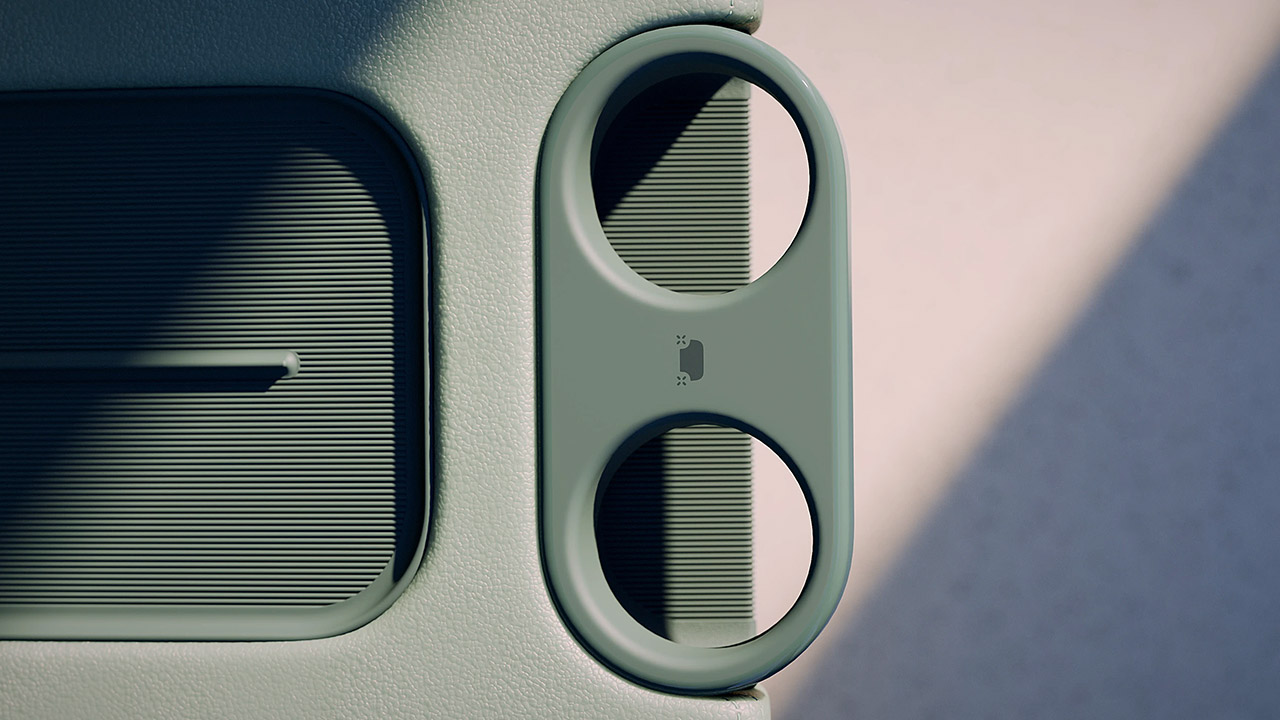
Daily use has now become easier, with much larger cupholders to keep your drink from dripping everywhere. They’ve also added microscopic ridges to the phone tray to prevent your phone from sliding around when you’re on the road. The screen is also considerably brighter now, allowing you to swiftly glance over and see all of your flight information.
Outside, the reflectors have been updated, changing color to indicate which end of the car is in front. Handy for bikers, pedestrians, and emergency personnel who may need to know which direction your car is facing, plus they’ve added a mic and speaker to the door area so you can have a clearer conversation with anyone who needs to communicate with you when you stop.

However, the core technology remains unchanged, since all of the cameras, sensors, and other devices continue to provide a detailed picture of what is going on around you. Four-wheel steering is still beneficial for maneuvering through tight city streets, and the maximum speed remains around 75 mph, with the cabin seating up to four passengers as before.

Now, the primary focus is on getting this thing ready for production. The final design is complete, and they will produce 100 automobiles per week at the Hayward factory in California. If they keep up that pace, they should be able to produce around 10,000 units per year. The first replacement cars will arrive in existing fleets later this year, once all formalities (government approval) have been completed.
[Source]



Weekend Open Thread: Miami – Corporette.com


Renter of Home in Anne Heche Crash Denies Settlement With Son

Two goals and an assist by sheer aura: Cristiano Ronaldo just entered the World Cup chat


Microsoft accidentally kills epic Outlook email threads


Soccer-U.S. defends Iran World Cup travel restrictions, says discussions ongoing
Bitcoin (BTC) Dips Below $62K, Ethereum (ETH) Plunges 6% Daily: Market Watch


Andy Burnham and the meaning of Makerfield


BBC Reporter Discusses Cross Party Criticism Of Trumps Iran Deal


Securitize Wraps Roubini's SEC-Registered ETF as Dubai VARA Digital Security
Entergy settles forward sale agreements, raises $672 million in cash proceeds


Keir Starmer Allies Question His Chances For No 10

Wall Street Week Ahead: Investors see Micron earnings as pulse check of AI rally momentum


AWS enters the context layer race with a graph that learns from agents, not manual curation

Can Charles Hoskinson Really Rescue Cardano?


HIVE shares jump as $220M AI deal speeds Bitcoin mining pivot


Jake Chervinsky accuses CME of protecting derivatives monopoly


Jose Alvarado Wants Taylor Swift at More Knicks Games

Signal’s Meredith Whittaker says AI chatbots ‘are not your friends’ and calls Copilot agents a backdoor

Nearly 7,000 fake Amazon domains registered ahead of Prime Day 2026, researchers warn


FIFA World Cup 2026: Canada beat 9-men Qatar 6-0 to register first ever win | FIFA World Cup 2026




You must be logged in to post a comment Login