Connect with us
DAPA Banner
DAPA Coin
DAPA
COIN PAYMENT ASSET
PRIVACY · BLOCKDAG · HOMOMORPHIC ENCRYPTION · RUST
ElGamal Encrypted MINE DAPA
🚫 GENESIS SOLD OUT
DAPAPAY COMING

Tech

Avatar: The Last Airbender season 2 review: Netflix show has finally improved

Published

on

Why you can trust TechRadar


We spend hours testing every product or service we review, so you can be sure you’re buying the best. Find out more about how we test.

Two years ago, Netflix dramatically let me down. As a massive anime fan, I tuned into the first season of their live-action Avatar: The Last Airbender remake and was horrifically disappointed within minutes. In fact, the most positive critique you could give it is that it was better than the live-action movies, which are widely considered to be garbage.

Why? The action was all there, but the heart of Aang’s story wasn’t. Spectacular VFX tried to cover up the hollow, mundane narrative underneath. In fact, to quote a fantastic jaw-dropping writer called Jasmine Valentine: “There’s little room to learn, with life-changing realizations made in a ridiculously short amount of time. If a tale can’t be paid its due diligence in a certain remit, should we even bother at all?”

Advertisement

Source link

Advertisement
Continue Reading
Click to comment

You must be logged in to post a comment Login

Leave a Reply

Tech

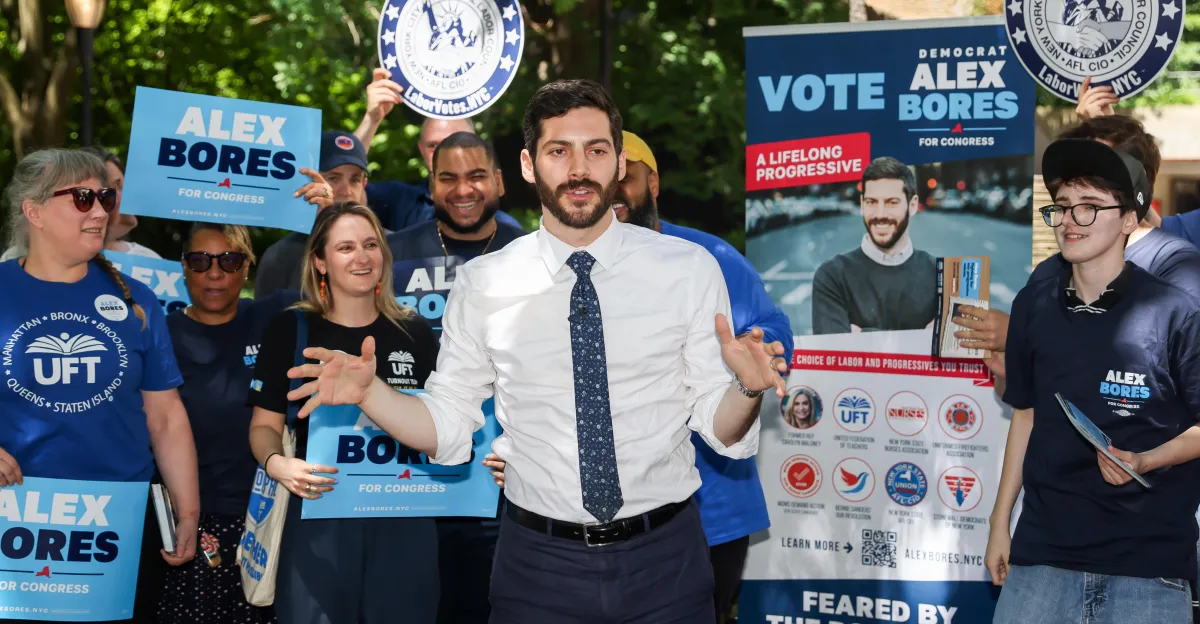
Alex Bores lost in New York. But so did his enemies in the AI industry.

Published

on

New York’s congressional primaries on Tuesday were supposed to be the moment AI’s top backers definitively proved they could bend US politics to their will. Instead, they left behind a muddy stalemate that only raises more questions about whether their spending can keep pace with an anti-AI backlash.

The stage for the battle was set last year, when some of America’s leading tech investors launched a new, $100 million super PAC dedicated to electing candidates who were “aligned with the pro-AI agenda” and defeating those who weren’t.

Months later, this group — dubbed Leading the Future (LTF) — named its first target: New York Assembly member Alex Bores.

Bores had been the chief sponsor of the Empire State’s “RAISE Act,” which required developers of frontier AI models to follow various safety protocols or face steep fines. LTF fiercely opposed that bill. Thus, when Bores launched a congressional run, the super PAC sought to teach him — and his fellow Democrats — a lesson: Purse sweeping AI regulations and your next campaign will drown in a flood of opposition spending.

Advertisement

At first glance, it may look like LTF just achieved that objective. Bores lost his bid on Tuesday night to represent New York’s 12th District. Headlines deemed the race a victory for “Big Tech.”

But appearances can be deceiving. In truth, Silicon Valley’s libertarians are losing the fight over AI regulation — and the NY-12 race only underscores this reality.

Bores lost. So did his enemies.

Contrary to LTF’s hopes, Bores’s loss is unlikely to dissuade Democrats from backing far-reaching regulations on AI, for at least four reasons:

Advertisement

First, the race’s winner, Assembly member Micah Lasher, is about as hostile to LTF’s vision as Bores was. Lasher co-sponsored the RAISE Act and campaigned on pausing data center construction nationwide, launching antitrust investigations into the major AI labs, protecting artists from “AI-driven copyright infringement,” prioritizing organized labor’s interests in debates over AI deployment, and myriad other regulatory constraints on the technology. In his victory speech, Lasher directly addressed the AI companies who took an “unusual interest” in the race, saying he “won’t be taking my cues from either of you when it comes to protecting our kids, our jobs and our families.”

Silicon Valley’s proponents of light-touch AI regulation are losing.

Simply put, if the tech industry wants to convince Democrats that backing strict AI regulations is politically self-defeating, they’ll need better evidence than a race won by…a Democrat who backs strict AI regulations.

Second, it’s far from clear that Bores’s candidacy was actually hurt by industry opposition. As my former Vox colleague Kelsey Piper notes at The Argument, when LTF announced it was targeting Bores, betting markets gave him only a 10 percent chance of victory, placing him behind both Lasher and Kennedy scion Jack Schlossberg. Bores ultimately came in a close second, trailing Lasher by only 4 percentage points (or about 4,000 votes).

Advertisement

It’s plausible that LTF unintentionally aided Bores’s rise to contention by validating his bonafides as the bane of Big Tech. Certainly, that identity earned the assembly member abundant media coverage. “For voters, tech billionaires spending millions to beat a state legislator wasn’t a flex; it was a tell,” Jesse Ferguson, a Democratic strategist who advised the Bores campaign, told me.

Third — and related — the race ended up becoming a fight between AI companies, not just about them.

Bores’s candidacy was not solely powered by a grassroots backlash to industry meddling. Rather, he was himself the recipient of massive Silicon Valley donations, albeit from the segment of the tech industry that worries about AI safety. Anthropic, the maker of the cha6bot Claude, was an enthusiastic supporter of the RAISE Act. And when LTF came for that law’s chief sponsor, the AI giant’s super PAC rallied to his support, supplying Bores with at least $11 million in outside funding. The crypto billionaire Chris Larsen, meanwhile, tossed another $19 million Bores’s way.

Importantly, this flood of financing was a reaction to LTF’s intervention. In other words, by targeting Bores, the super PAC arguably made it easier for him to raise money — and highlighted the existence of a pro-regulation, tech industry donor network. It is hard to see how this will make Democrats more afraid to meddle with AI.

Advertisement

Finally, Lasher’s victory probably didn’t have that much to do with artificial intelligence, one way or another. Lasher has been involved in New York politics for about a quarter century longer than Bores has, and boasts personal ties to Michael Bloomberg, Kathy Hochul, and other power players in the state’s Democratic Party. He was the race’s favorite for more or less the entirety of the race. Therefore, even if Lasher favored light-touch AI regulation, his narrow victory over Bores wouldn’t prove much. Given his actual positions on AI, his win does nothing to advance LTF’s argument.

The push for AI regulation is coming from inside the (White) House

Meanwhile, since Leading the Future launched last year, the national political climate has turned sharply against them.

In a recent Fox News poll, 80 percent of respondents said they favored regulating AI to protect public interests, even if doing so slows innovation. Other surveys show a large majority of Americans opposing the construction of new data centers in their areas.

Advertisement

By itself, public opinion might not be an insuperable obstacle to Big Tech libertarians’ agenda. Voters are increasingly skeptical of AI, but still don’t typically consider it a top priority.

Yet the national security state is also turning against laissez-faire in the AI sector. And its will is harder to ignore. Amid growing concerns about AI’s capacity to aid cybercrime, the White House released an executive order earlier this month encouraging labs to seek the government’s approval before releasing new models. Weeks later, the Trump administration took the extraordinary step of essentially ordering Anthropic to remove its Fable model from the market, on national security grounds. This represented a more radical and capricious government intrusion into the AI industry than Bores’s signature law ever contemplated.

Leading the Future knows that the ground has shifted beneath its feet. When it first announced its targeting of Bores, it lambasted the RAISE Act as a “clear example of the patchwork, uninformed, and bureaucratic state laws that would slow American progress and open the door for China to win the global race for AI leadership.”

Last month, however, the super PAC announced that it actually supported the RAISE Act, as the law “gets the combination of innovation and safety right.” LTF reconciled these positions by insisting that, while Bores’s initial draft of the legislation was ruinous, the final version was excellent.

Advertisement

This is unconvincing. It’s true that the RAISE Act got watered down before enactment. But the idea that these changes were large enough to transform the bill from an act of catastrophic national sabotage — into a model of pro-innovation lawmaking — is implausible. And LTF’s supposed support for the measure is belied by the months it spent vigorously lobbying the federal government to preempt New York’s law.

In reality, the group has simply retreated in the face of shifting political winds. Silicon Valley’s proponents of light-touch AI regulation are losing. And Bores’s loss did nothing to change that.

Source link

Advertisement
Continue Reading

Tech

You Can Preorder Slate Auto’s $25K Electric Pickup Now

Published

on

Slate Auto’s much-discussed sub-$25K electric truck is one step closer to reality. It’s now available for preorder on the company’s website. However, it could still be a year or two before drivers who preorder a Slate actually get their vehicles.

The base model of the car is priced at $24,950 and there are a number of color and accessory options available. But Car and Driver points out that it’ll end up costing more than $25,000 after factoring in a destination and delivery fee that the company says will be lower than typical. Even so, that fee could still run $1,200 to $1,500.

Even with that fee, however, Slate’s truck would stand apart in a US car market where SUVs rule the land and the average car price rose above $50,000 earlier this year before settling back down, according to Kelley Blue Book. Electric vehicles are typically priced about $5,000 to $7,000 more, making the Slate even more of an anomaly. 

Advertisement

This week, as it opened up preorders for the electric truck, Slate gave more details about its range and capabilities, which have changed since the truck was announced last year. New battery specs have raised the truck’s range from 150 miles per charge to 205. Slate is also banking on the truck’s custom options to draw customers: It’s offering more than 100 wrap colors and different ways to convert the two-seater truck to other builds, even after the vehicle is purchased.

Preordering the Slate truck costs $300 and is nonrefundable. The company says the 180,000 customers who already placed refundable reservations for $50 can put that $50 toward a preorder.  

According to Slate’s website, the first deliveries of the truck will be later this year. But full production of the Slate truck isn’t expected to ramp up completely until sometime in 2027. Slate has raised $1.3 billion and counts Amazon founder Jeff Bezos as one of its investors.

Reviewers have posted new impressions of the Slate

Not everyone is impressed with the concept, or even the pricing of the Slate, with The Wall Street Journal dismissing the company’s updates with the headline, “Will Anyone Buy This Cheap EV Truck With Hand-Crank Windows and No Radio?

Advertisement

But those who’ve actually seen and ridden in the vehicle are singing its praises. Nick Yekikian at Edmunds wrote that the truck “is cute and has real charm in person” and said it has evolved since the last time he saw it. He wrote, “The build quality is generally more solid, and it looks ready to hit the road.” He also posted a video about his experiences with Slate.

Aaron Gold at MotorTrend wrote, after riding in the Slate, that it’s “pretty much what we were expecting, which is a good thing, as we at MotorTrend have high hopes for this cute, inexpensive electric truck.”

David Tracy at The Autopian called driving the truck “insanely fun.” He wrote, “It’s a simple pickup truck, and it’s reasonably cheap. Is it the cheapest? No. Is it the most practical for families? No. But what the Slate has going for it is this: It is, by far, the most soulful new vehicle an American consumer will be able to buy for $25,000.”

At least one other inexpensive EV is in the pipeline

As far as competition for inexpensive electric vehicles, the closest to Slate’s planned price is likely the Chevrolet Bolt at just under $30,000. But other automakers are working on less expensive electric vehicle models. 

Advertisement

Ford is expected to release a low-cost electric truck in the $30,000 range, due out in 2027. And political changes could open up the possibility of Chinese-built EVs, which have their fans in the US but are not widely available due to tariffs and other factors. As Reuters points out, some Chinese EVs are priced below $12,000; for the average cost of an American car, you could buy three or more of the cheapest EVs in China.

Source link

Advertisement
Continue Reading

Tech

Polymarket Says Its Markets Reveal The Truth. Its Ad Strategy Was To Have Influencers Fake Wins.

Published

on

from the seems-bad dept

In theory, there’s a way to build a prediction market that actually provides valuable insight on issues through the wisdom of the crowds. But that’s not at all what we have with the current crop of prediction markets, mainly Kalshi and Polymarket, which seem to have leap-frogged FanDuel and DraftKings as the deservedly hated gambling apps that pretend not to be gambling apps. While we haven’t spent too much time talking about those markets here on Techdirt, we have mentioned some examples of where they are found to be distorting information, rather than revealing deeper insights.

But, really, if your entire marketing pitch is that you’re a tool for revealing truths, it should be existentially embarrassing for it to be revealed that your advertising strategy is to have influencers blatantly fake bets to pretend they had won, when they really would have lost. It’s like the opposite of a truth market. It’s false advertising.

A piece published over the weekend by the Wall Street Journal (whose publisher actually has a deal with Polymarket) is incredibly damning, suggesting pretty clearly that Polymarket and a crew of young influencers it has hired have engaged in outright fraud that both the FTC and the CFTC would go after, if either agency were inclined to act:

In his videos, George Makihara appears to have a lucrative side hustle making bets on Polymarket.

In January, the college student posted a video that showed him winning $100,000 on a wager that President Trump would publicly say the word “McDonald’s” that month.  

Advertisement

The bet was one of 145 that Makihara appeared to place on Polymarket’s website between January and mid-May, based on his videos—bets adding up to almost $410,000. 

But none of those bets were real, according to a Wall Street Journal investigation.

The basics of the scam are pretty straightforward: Polymarket hired one of those “influencer marketing” companies to round up college kids to make social media videos showing them winning bets on Polymarket. Except, it turns out that the bets shown in those videos aren’t real. They’re faked, using a fake version of Polymarket, with the clever domain name Poiymarket (that’s a lower case i rather than an l there). And, of course, none of the influencers disclosed they were being paid by Polymarket, let alone that the bets shown in the videos were made up.

This doesn’t seem to be a one-off case of a rogue influencer either. The WSJ found over 1,100 videos by multiple creators, and determined that in 70% of the videos, no actual bets were placed, even as the videos showed the influencers winning $1.9 million. Within that, one smaller segment of the videos used faked or outdated news coverage to pretend the influencers had won about a million dollars — when, the WSJ worked it out, those same bets would actually have lost $166,000 if anyone had actually placed them.

Advertisement

And according to the reporting, this isn’t just a case of the marketing firm Polymarket hired going too far. The article reports that Polymarket created the fake website and required the influencers send them all their videos for approval before posting:

Creators said they send the finished videos to Polymarket for review. If a video isn’t engaging enough, or if it bears obvious signs of being faked, Polymarket will ask for the videos to be reshot, the creators said.

All of this clearly violates the FTC’s rules on disclosing paid promotion, not to mention being clearly deceptive advertising. That isn’t even mentioning that Polymarket apparently demanded that the ads target Americans, even as Polymarket isn’t supposed to be operating its prediction market in the US (even though tons of people are using it there via VPNs and proxies).

This is where the CFTC should step in. Polymarket has been doing the whole “nudge, nudge, wink, wink” thing about supposedly not targeting the US. But this report makes it clear that they absolutely are targeting the US and that it’s an important market to them. In a normal administration, the CFTC would take note of this and take action:

As of early June, it only paid clippers if at least 60% of their audience was in the U.S., according to instructional materials.

There’s also this excuse given by one of the influencers, who may be about to learn about deceptive advertising laws:

Advertisement

Razeen Khan, a college student in California, worked as a Polymarket creator for several months until March. He compared the videos to fast-food commercials, where food can appear more appealing than it does in real life. 

“We’re depicting what actually happens,” he said. “You’re still going to buy the burger.”

This is quite the choice in what to compare things to, Razeen, because the FTC now has a few decades on the record of going after companies for representing food in ads in a deceptive manner. In 1968, there was the Campbell’s Soup case, in which the FTC dinged the soup company for placing clear marbles in the bottom of bowls so that photos of the soup made it look like there were more noodles and vegetables in the soup than there really were.

The general rule of thumb to avoid having the FTC come down on you is that if any food is shown in an ad, it has to be the actual food. Everything else around it can be faked or made to look better. But the food has to be real. Hell, there was just a case against Burger King (which appears to have settled earlier this year), alleging that the burgers it showed in commercials were bigger than what was actually sold.

So, yeah, Razeen, I’d suggest maybe talking to a lawyer before you claim that you’re just doing the same thing that you think fast food companies do… when those fast food companies know that they can face serious legal penalties for faking things. Like you appear to have done.

Advertisement

Of course, the real question is whether this FTC will do anything about it. On the merits, it’s about as clean a case as the agency is ever going to get — so blatant that looking the other way carries its own cost. But part of the reason Kalshi and Polymarket seem to be everywhere these days is that the Trump administration has gone to bat for both companies in their fights with state regulators — and that Donald Trump Jr. has financial links to both companies. So the agency that should be the natural enemy of a company building fake websites to run faked ads, instead answers to a White House championing that company, while the president’s son personally profits from its success.

Which is its own kind of tell. A prediction market’s entire pitch is that it surfaces the truth — that the wisdom of the crowd, with real money on the line, produces better information than anyone else can. Polymarket just demonstrated what it actually thinks of that promise: when it needed to sell itself, it didn’t trust the real numbers. It hired college kids, built a counterfeit version of its own site, and manufactured the wins. The product that’s supposed to reveal the truth couldn’t market itself without faking it.

This is the rare case clean enough to force the question. If the FTC does nothing with a fraud this obvious, it won’t be because the case is too weak. Instead, it will tell you exactly whose interests the Trump FTC thinks are worth protecting.

Filed Under: cftc, deceptive advertising, false advertising, fraud, ftc, influencers, prediction markets

Companies: polymarket

Advertisement

Source link

Continue Reading

Tech

Prime Day Live: We Picked Out the 128+ Best Deals Worth Buying on Day 2

Published

on

plaud-ai-pin-cnet-lanxon-3

The NotePin S AI wearable, seen here on the wrist of CNET’s Katie Collins, could be really useful for my job. And it’s on sale for Prime Day.

Andrew Lanxon/CNET

I took over the role of CNET’s editorial leader earlier this year, and while I’ve participated in Prime Day sales as a TV reviewer and general deals editor here for (literally) decades, this is my first Prime Day as EIC. In case you’re wondering what purchases a person like me is considering this time around, here’s a sampling.

iPad 11-inch A16 ($300): My artistic daughter has been asking for an iPad and if my wife approves, I’ll likely get her this basic version, our top pick for most people. I’d also get her the Apple Pencil (on sale for $60). We’d save both of these for Christmas presents.

Advertisement

Belkin Portable Charger Bank ($38): My family and I always need portable chargers. Half our devices call for Lightning and the other half for USB-C. This does both and I like the built-in cables.

Plaud NotePin S AI Notetaker ($152): In my new role I take more meetings than ever, and I also have plenty of valuable face-to-face conversations in the office and beyond. I currently depend on the Otter app on my phone and Gemini+Google Meet recordings at work to take notes (with appropriate permission, of course). This AI wearable could be my “secret weapon” to consolidate everything in one place.

JBL Go 4 Bluetooth Speaker ($38): I actually bought this one a few days ago when it was $40 – still a great deal, but now even better. It’s no longer one of our best Bluetooth speakers but it’s good enough for my (other) daughter, who wants one for the beach. At this price, I won’t be too annoyed if (when?) it gets destroyed by sand and surf. And yes, I got her the pink one which I know she’ll love. We’re saving this for her birthday.

Anker Solix F2000 portable power station ($749): I own a travel trailer and upgraded to solar with an inverter, but at a recent (shady) campsite, I still had to break out my loud, annoying propane generator. Sure, I could just add more standard 12V LiPo4 batteries, but this portable power station is so much more versatile. It includes a 30A RV outlet, and the wheels make it worth the extra $50 over the Bluetti AC200L. No way my wife approves this one, but it stays on the list anyway because I’m camping tech obsessed.

Advertisement

Source link

Continue Reading

Tech

Google Home Speaker debuts with Gemini AI and Matter support

Published

on

The new Google Home Speaker brings Gemini and expanded smart home capabilities, and Matter hub support. Reviews highlight its more natural voice experience, though some note that audio quality doesn’t clearly surpass the older Nest Audio.

Read Entire Article
Source link

Continue Reading

Tech

The US government wants a working quantum computer by 2028 and quantum-resistant encryption by 2031

Published

on


One order directs federal agencies to work with private companies and universities to deliver a quantum computer capable of supporting scientific research by 2028. The Department of Energy has been tasked with identifying the technical benchmarks that will define the system.
Read Entire Article
Source link

Continue Reading

Tech

Daily Deal: The Ultimate AWS Data Master Class Bundle

Published

on

from the good-deals-on-cool-stuff dept

The Ultimate AWS Data Master Class Bundle has 9 courses to get you up to speed on Amazon Web Services. The courses cover AWS, DevOPs, Kubernetes Mesosphere DC/OS, AWS Redshift, and more. It’s on sale for $40.

Note: The Techdirt Deals Store is powered and curated by StackCommerce. A portion of all sales from Techdirt Deals helps support Techdirt. The products featured do not reflect endorsements by our editorial team.

Filed Under: daily deal

Source link

Advertisement
Continue Reading

Tech

Scaling AI is about governance, not technology

Published

on

Data governance is unglamorous work. It is also the reason most AI strategies stall before they scale.

Spending on models, platforms and use cases keeps growing. But the disciplines that make those investments effective – data quality, ownership and governance – often receive far less attention.

Source link

Continue Reading

Tech

Walmart’s First Nuclear Deal Shows Demand Beyond AI Data Centers

Published

on

An anonymous reader quotes a report from Barron’s: Walmart is signing a long-term contract to buy nuclear power for the first time ever, a promising sign that the industry’s future is supported by more than just the AI data center boom. The retail giant agreed on Tuesday to buy power from a nuclear plant in Illinois owned by Constellation Energy for its operations in the area, including its stores and a high-tech warehouse in Illinois that stores and sorts perishable food.

Walmart will buy 176 megawatts of power from the plant over a 15-year period, or enough power to serve around 150,000 homes. The Walmart deal will allow Constellation to expand the capacity of the Illinois plant by 30 megawatts, a process known as an uprate, which can involve replacing older equipment and improving efficiency. Walmart, which has pledged to eliminate net carbon emissions from its U.S. operations by 2040, will also receive the environmental attributes associated with the nuclear energy, which generates electricity without carbon emissions. Further reading: Trump Admin Announces $17.5 Billion In Loans For 10 New Large Nuclear Reactors

Source link

Continue Reading

Tech

Apple iPhone 18 Pro’s camera upgrade could make it worth the upgrade

Published

on

The iPhone 18 Pro is still a few months away, however a new leak suggests one of its biggest upgrades may already be taking shape.

According to respected Weibo leaker Setsuna Digital, Apple’s 2026 flagship is expected to receive a major camera upgrade.

Supply chain information reportedly points to noticeable hardware changes inside the phone. In addition, the leak backs up several earlier rumours. These suggest Apple is preparing a more substantial camera overhaul for the iPhone 18 Pro and iPhone 18 Pro Max that can could make the best camera phones around.

The biggest clue is the phone’s thickness. Recent dummy models have already suggested that Apple’s next Pro iPhones could be around 2mm thicker than their predecessors. Setsuna Digital now claims the camera system is the main reason why.

Advertisement

Exactly what’s changing remains unclear. Yet the leading theory is the addition of a variable aperture system. If accurate, it would give photographers greater control over depth of field and light intake. This change would bring the iPhone camera experience closer to dedicated cameras. It’s a feature that’s appeared on a handful of Android phones over the years, but Apple has yet to implement it on an iPhone.

Advertisement

There are also suggestions that Apple could pair the new hardware with an upgraded 48-megapixel sensor. However, it’s not yet known whether the company plans to increase the size of the current 1/1.28-inch main sensor.

The thicker chassis may bring benefits beyond photography too. Reports indicate Apple could use the additional space for a slightly larger battery. This could potentially improve endurance alongside the company’s expected 2nm A20 chipset. A more efficient processor combined with extra battery capacity would likely translate into longer battery life. This applies even if the design becomes marginally bulkier.

Advertisement

At this stage, none of the details have been officially confirmed. Apple is unlikely to discuss the iPhone 18 lineup for many months. However, the latest supply chain claims line up with previous reports. These reports point to a larger camera module and a thicker overall design.

If the leaks prove accurate, the iPhone 18 Pro could deliver one of the most meaningful camera upgrades Apple has made in years. Unlike many internal improvements, this is one that users may be able to spot the moment they pick up the phone.

Source link

Advertisement
Continue Reading

Trending

Copyright © 2025