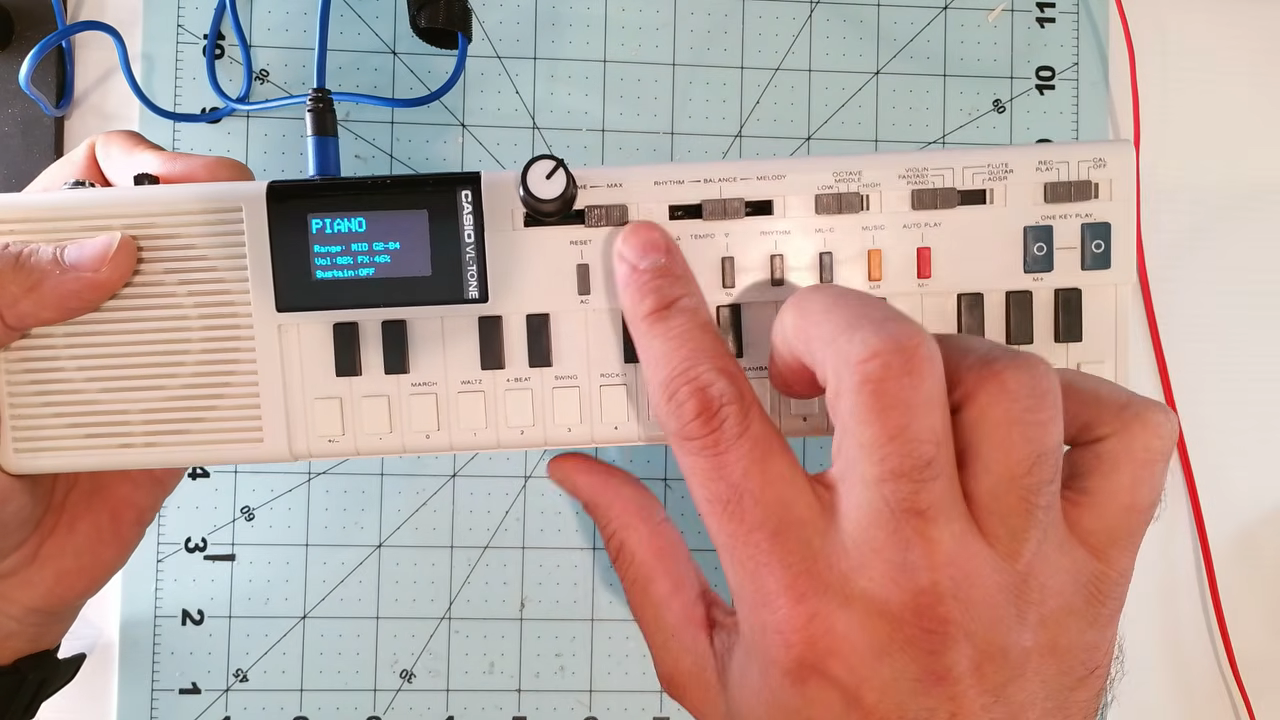
The original electronics of the VL-1 were largely surplus to requirements for this build. The original interface and speaker were kept in service, while the rest of the monophonic sound synthesis hardware was removed. [Max Vega] enlisted an ESP32-C3 to run the show, turning the VL-1 into a ROMpler instead. If you’re unfamiliar with the term, it refers to a keyboard or other instrument that relies on hardcoded sample playback instead of raw synthesis. The ESP32 loads its samples from a microSD card, which provides an enormous amount of storage for different sound packs. Selecting different instruments is handled with a simple interface built around the original buttons and a OLED screen. Playing the instrument is still the same using the simple keyboard, though [Max] also implemented some extra fun modes that play chords at a single touch.
If you want a fun, versatile keyboard instrument that fits perfectly in a backpack, it’s hard to go wrong with a build like this. We’ve seen similar Casio keyboard hacks before, too. Video after the break.
Amperity co-founders and co-CEOs Kabir Shahani, left, and Derek Slager. (Amperity photo).
Seattle-based customer data startup Amperity conducted layoffs this week, the company confirmed to GeekWire, citing a transformation related to its use of more artificial intelligence.
The company did not specify how many jobs were cut, only that “a number of talented people are leaving.” Amperity’s headcount remains over 200 globally in offices across Seattle, New York, the U.K., Australia and Argentina.
“Amperity is transforming how it operates as a company, building AI into how we work across the organization,” a spokesperson said in an emailed statement. “That shift changes where we’re investing and the shape of the team we need going forward.”
That move replaced Tony Alika Owens — a former Salesforce executive recruited as CEO in 2024 — in what Amperity called a planned “mutual transition.” Longtime CFO Amy Kelleran Pelly also took on added responsibilities and became president while retaining her CFO role.
Advertisement
Slager and Shahani said at the time that the rise of AI created a major opportunity for the company. And Thursday’s statement about layoffs reiterated that view.
“These decisions are about building a stronger Amperity for our customers. That’s where our focus is, and that’s what this next chapter is about,” the company said.
Founded in 2016, Amperity is one of Seattle’s most prominent enterprise software startups. It built its business around helping large consumer brands unify customer information from multiple systems into a single profile.
The company has raised more than $180 million from investors including HighSage Ventures, Tiger Global, Declaration Partners, Madrona and others.
Advertisement
Amperity is ranked No. 32 on the GeekWire 200, a list of the top privately-held tech companies in the Pacific Northwest.
from the the-open-web-includes-the-ability-to-scrape dept
The ability to access publicly available information using automated tools is a central value and benefit of a free and open internet. Automated access—often called crawling or scraping—powers important, useful tools for locating, preserving, and analyzing online information. For example, crawling and scraping helps journalists, researchers, and watchdog organizations report the news, find security flaws, and investigate discrimination. Crawling the web allows non-profits like the Internet Archive to preserve historical copies of websites. Tools for automated comparison shopping allow consumers to find the best deals on items they want to buy. And so on.
Yet the open internet access is increasingly under threat from publishers and Big Tech companies alike. Fearing lost advertising and licensing revenues, website operators increasingly claim that they need to lock down their sites from bots that crawl public web content to train or operate AI models. Some companies are even trying to embed their business models into internet standards by changing Internet Engineering Task Force (IETF) technical standards that shape much of the internet.
Many of their economic anxieties are understandable. AI bots can strain websites’ infrastructure, in some cases, degrading site performance or taking them offline altogether. Upgrading systems costs money that some sites may not have. And AI is likely to disrupt the business models many publishers adopted in response to the rise of the internet, if users rely on AI overviews instead of visiting source websites.
However reasonable these fears may be, the answer is not to changethe IETF standards from neutral protocols thatencourage openness to restrictive requirements designed to monetize internet access.
Advertisement
The worst of these proposed standards would give websites far greater ability to automatically block legitimate, lawful scraping and crawling. For example, the AI Preferences working group is working on proposals to give publishers a way to express “preference signals” against crawling web data for AI-related purposes, including to train models, generate outputs, and help users search the web. These preference signals would be expressed through robots.txt and could potentially become legally binding in some jurisdictions.
Another working group, called Web Bot Auth, is pursuing efforts to protect sites from overly-aggressive bots that strain website resources—a positive goal that could meaningfully improve the internet in the AI era. But Web Bot Auth is simultaneously pursuing a much more dangerous path as well: standards changes that would enable sites to cryptographically identify bots so that they can more easily block anyone they wish—not just “bad” actors, but competitors, dissidents, or anyone who hasn’t paid for the right to access sites using automated tools. If sites restrict crawling to a preapproved list of cryptographically authenticated bots, they could require licensing payments from those wishing to crawl their sites. This would close off the open web to researchers, archivists, and startups without the ability to pay for automated access.
Websites may have legitimate reasons to worry about AI’s impacts on their traffic and advertising revenue, but those reasons must be weighed against the benefits of the open web. These proposals would effectively give website operators veto power over a wide range of important uses—from the investigations and archival works described above to accessibility tools for people with disabilities, to research efforts aimed at holding governments accountable.
That is why we are fighting back against these threats to open access. EFF and our allies in the open internet community have successfully resisted some of the most dangerous IETF proposals thus far—and won’t stop working to protect the open web from efforts to manipulate internet standards to undermine the right to freely access the internet in any legal way, including with automated tools.
Liquid AI, founded by former MIT computer scientists, today released its smallest AI language model yet, LFM2.5-230M, and enterprises would do well to consider it for their uses in data extraction and local deployment on smartphones, laptops and robotics.
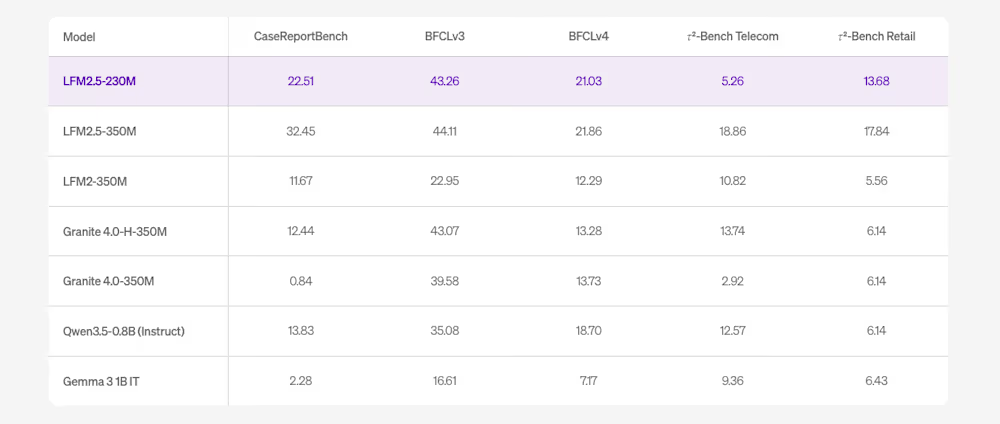
This is a 230-million-parameter foundation model explicitly designed for on-device agentic workflows, and as Liquid states in its release blog post, that small size makes it possible to run nearly “anywhere.” According to Liquid, it also outperforms models more than 4X its size on selected benchmarks, specifically doing better at data extraction than the 800 million parameter count Alibaba Qwen3.5-0.8B (Instruct) and 1-billion parameter Google Gemma 3 1B.
Liquid AI LFM2.5-230M benchmark comparison chart. Credit: Liquid AI
The model targets developers and engineers building lightweight data extraction pipelines and autonomous edge systems.
Advertisement
Operating under a dual-use commercial license, the model remains free for individuals and companies generating less than $10 million in annual revenue, while requiring a paid enterprise agreement for larger corporations.
This release distinguishes itself from other small AI models by utilizing the LFM2 architecture to achieve high inference speeds without the massive memory overhead typical of parameter-heavy transformers.
While major AI companies Anthropic, OpenAI, Google, Microsoft, Meta and others push parameter counts into the hundreds of billions or trillions to achieve frontier performance, a parallel race focuses entirely on the edge and local deployments.
Liquid AI’s launch of LFM2.5-230M signals a pivotal shift toward architectural efficiency over brute-force scaling. By squeezing 19 trillion tokens of pre-training into a 230-million-parameter footprint, the company demonstrates that edge devices do not need massive computational power or persistent cloud connections to execute complex, multi-step agentic workflows.
Advertisement
How LFM2.5-230M works
The LFM2.5-230M model diverges from standard transformer architectures, relying instead on the LFM2 framework. This architecture functions as a hybrid system, interleaving gated short-range convolutions with grouped-query attention to process information efficiently.
For those tracking the evolution of efficient architectures, Liquid’s approach shares a similar conceptual goal: managing long contexts and sequential data effectively on edge hardware without the quadratic memory costs of pure attention mechanisms. The model supports an expansive 32K context window, allowing it to ingest substantial documents or continuous streams of robotic telemetry.
When analyzing the performance charts provided in the release, the architectural efficiency becomes visually apparent. The model maintains a memory footprint of under 400MB while achieving prefill and decode speeds that outpace comparable models like Gemma 3 1B IT and Granite 4.0-H-350M.
On a Samsung Galaxy S25 Ultra equipped with a Qualcomm Snapdragon Gen4 CPU, the model reaches a decode speed of 213 tokens per second. Even on a highly constrained Raspberry Pi 5, the model maintains a decode rate of 42 tokens per second. Furthermore, internal benchmarking shows the GPU inference stack delivers lower end-to-end latency than competing small models across all concurrency levels.
Advertisement
Why it matters for enterprises
To understand why a 230-million-parameter model is necessary, one must look at how enterprises currently manage data.
Organizations have traditionally relied on rigid, rule-based Extract, Transform, Load (ETL) scripts to move and process data. However, these legacy systems are notoriously brittle; a simple change in a document’s layout or a schema update can break the entire pipeline.
To solve this, the industry is shifting toward “AI ETL,” where machine learning infers mappings, detects schema drift, and adapts to changes automatically. In a modern lightweight data extraction pipeline, an AI model connects to unstructured sources—like PDFs, emails, or web forms—and structures the data into formats like JSON without requiring hardcoded rules.
For enterprises, using a massive flagship model like Claude Opus 4.6 (which costs $5.00 per million input tokens) to parse routine invoices, format addresses, or route telemetry data is economically unviable.
Advertisement
This is where models like LFM2.5-230M become critical. Designed explicitly as a lightweight extraction engine, it allows companies to automate repetitive formatting and data parsing at a fraction of the compute cost and latency, running directly on local hardware rather than relying on expensive, continuous cloud API calls.
Small Model Benchmarks: LFM vs. The 3B Class
The AI industry in mid-2026 is seeing a renaissance in “small” models, but the definition of “small” varies wildly.
Recently, the open-weight community was stunned by Weibo’s VibeThinker-3B, a 3-billion-parameter model built on a Qwen2-style backbone that achieved a massive 94.3 on the AIME 2026 math benchmark, rivaling 600-billion-parameter behemoths through aggressive data curation and reinforcement learning.
Similarly, Google’s Gemma 4 family — which recently crossed 200 million downloads — pushes frontier AI to the edge, including the E2B (2 billion parameters) designed specifically for mobile and IoT deployments.
Advertisement
By contrast, Liquid AI’s LFM2.5-230M operates in a completely different weight class. At just 230 million parameters, it is roughly one-tenth the size of Google’s smallest Gemma 4 model and VibeThinker-3B.
Because of its microscopic footprint, LFM2.5-230M is not designed to compete on reasoning-heavy workloads like advanced math, coding, or creative writing—a constraint Liquid AI explicitly acknowledges.
However, in its intended domains of data extraction and tool calling, the model punches well above its weight class.
Benchmarks released by Liquid AI show LFM2.5-230M scoring 43.26 on the BFCLv3 tool-use benchmark, dominating IBM’s Granite 4.0-350M (39.58) and completely outpacing larger 1-billion-parameter models like Google’s Gemma 3 1B IT (16.61).
Advertisement
Liquid AI LFM2.5-230M benchmark comparison bar chart. Credit: Liquid AI
On CaseReportBench for data extraction, it scores 22.51, decimating the Qwen3.5-0.8B (Instruct).
LFM2.5-230M proves that while 3-billion-parameter models like VibeThinker are solving advanced calculus, a 230-million-parameter model is the superior, highly optimized choice for executing structured tool calls and keeping agentic pipelines running efficiently on constrained hardware.
Advanced research uses
Because it excels at tool calling, LFM2.5-230M functions primarily as a skill-selection layer. Liquid AI demonstrated this capability by deploying the model on a Unitree G1 humanoid robot.
Advertisement
Running entirely on-device via the robot’s onboard NVIDIA Jetson Orin compute module, the model successfully processes complex environmental commands.
As noted in the company’s technical blog, the model takes a free-form instruction like, *”Hold still for 2 seconds, then walk forward at 1 meter per second for 3 meters, hold a forward one-leg kneel for 5 seconds, and walk backward at 0.5 meters per second for 3 meters,”* and automatically translates it into a structured multi-step plan calling on pre-trained low-level skills provided by NVIDIA’s SONIC framework.
The base and post-trained models are available immediately on Hugging Face, with native day-one support across the inference ecosystem for llama.cpp (GGUF), MLX, vLLM, SGLang, and ONNX.
Dual-use, custom LFM Open License
Liquid AI ships LFM2.5-230M under the LFM Open License v1.0. Despite the word “open” in the title, this is not an Open Source Initiative (OSI) compliant license; it operates as a restricted, dual-use commercial framework.
Advertisement
For independent developers, researchers, and early-stage startups, the license functions identically to open-source software.
Users receive a perpetual, worldwide, royalty-free license to reproduce, modify, and distribute the model, provided they retain original copyright notices and prominently state any modifications.
However, the license includes a strict “Commercial Use Limitation”. Any legal entity generating $10 million or more in annual revenue loses the right to use the model commercially under this agreement.
Large enterprises crossing this financial threshold must negotiate a separate, paid commercial agreement with Liquid AI to deploy the model in production.
Advertisement
This strategy protects the company from having its intellectual property absorbed by major technology conglomerates for free, while still seeding the model at the grassroots developer level.
However, Notion urged users to export drafts and scheduled emails by September 21, since those won’t automatically carry over to an alternative app. Notion noted that users can also save their Notion Mail setups and “export your snippets and auto label instructions to use elsewhere.”
“If you have auto label set up in Notion Mail, you won’t have to rebuild it. Create a Custom Agent in a few clicks, and we’ll bring your existing rules over for you,” the X post explained. “And if you’re already running Notion agents to manage email, they’ll continue running. Your email connection in Notion stays in place.”
Organizations that relied on Notion Mail in a regulated environment might have to transition from Notion Mail earlier.
“If you rely on HIPAA coverage, you should plan to transition off Notion Mail by June 30, 2026,” Notion’s support page reads.
Advertisement
Skiff reportedly served 2 million users, giving rivals like Proton Mail a run for their money before the Notion acquisition. As a Gmail client that didn’t support end-to-end encryption, Notion’s AI-centric approach to email lacked the privacy focus that Skiff carried as an email provider. Still, Notion Mail was built with Skiff’s infrastructure and by former Skiff executives, making its impending demise feel like a sort of swan song for Skiff.
Although Notion is killing its Skiff-influenced email client, it may continue leveraging the human resources and other productivity ideas (around calendars and storage, for instance) gained through its Skiff acquisition as it tries to compete more strongly against rivals like Google Workspace. Notion, however, has strayed from releasing direct follow-up products to Skiff’s portfolio.
Jazz centennial campaigns can become a lazy excuse to wheel out the same greatest-hits package with a new hype sticker. Craft Recordings is taking a more credible route. Its Original Jazz Classics series will mark the 100th birthdays of Miles Davis and John Coltrane on August 14 with new vinyl editions of Cookin’ with the Miles Davis Quintet and Coltrane’s self-titled 1957 Prestige debut; two records that capture both men before history turned them into monuments.
Cookin’ documents Davis’ First Great Quintet—Miles, Coltrane, Red Garland, Paul Chambers, and Philly Joe Jones during the legendary 1956 Prestige sessions that also yielded Relaxin’, Workin’, and Steamin’. Meanwhile, Coltrane captures Trane’s first session as a leader, recorded at Rudy Van Gelder’s studio in May 1957, just as his unmistakable voice was beginning to emerge from the hard-bop crowd.
Both reissues will feature AAA lacquers cut from the original tapes at Cohearent Audio, 180-gram vinyl pressed at RTI, and Stoughton Tip-On jackets with obi strips; the same sensible formula that has made the revived OJC line one of the more reliable modern options for collectors who want the real albums, properly presented, without being asked to sell a kidney for a One-Step. Digital editions will arrive simultaneously in 24-bit/192kHz hi-res formats.
They also continue a busy run for OJC, which has recently returned Wes Montgomery’s Full House, Vince Guaraldi and Bola Sete’s From All Sides, Thelonious Monk’s Alone in San Francisco, The Young Lions, Lee Morgan’s Introducing Lee Morgan, and Bobby Timmons’ This Here Is Bobby Timmons to vinyl with the same core AAA, RTI, and tip-on-jacket approach.
Advertisement
Related Reviews:
Miles and Trane at Full Boil
There are jazz records that arrive carrying the weight of history so heavily that listeners forget to enjoy them. Cookin’ with the Miles Davis Quintet is not one of those records. Yes, it documents Miles Davis’ First Great Quintet with John Coltrane on tenor saxophone, Red Garland on piano, Paul Chambers on bass, and Philly Joe Jones on drums, but it still moves like a great band caught on a particularly historic night.
Recorded on October 26, 1956, at Rudy Van Gelder’s Hackensack studio, Cookin’ was drawn from the same pair of Prestige sessions that also produced Relaxin’, Workin’, and Steamin’. Davis had already signed with Columbia and needed to finish his Prestige obligations, but there is nothing contractual or dutiful about the results. The quintet had spent months refining this material on the road, and the sessions were approached much like a club set: little fussing, few second guesses, and enough confidence to make difficult music sound almost casual.
The album opens with “My Funny Valentine,” a beautiful reminder that Davis did not need volume or velocity to take command of a room. With Coltrane sitting out, Miles works against Garland, Chambers, and Jones with a measured, almost conversational sense of space. From there, the temperature rises quickly. “Blues by Five” has all the relaxed authority of a band that knows exactly where the pocket lives, while “Airegin” lets Coltrane begin to push against the tune’s hard-bop architecture with the restless energy that would soon define his own work.
Advertisement
The closing pairing of “Tune Up” and “When Lights Are Low” gives the full group room to stretch without ever losing the plot. Garland brings elegance, Chambers keeps everything grounded, and Philly Joe Jones drives the proceedings with the kind of alert, propulsive swing that makes lesser drummers sound like they are waiting for a bus.
Cookin’ is not Miles at his most radical, nor is it Coltrane at his most searching. That is precisely why it remains so essential. This is a great working band at the moment when its collective instinct, individual brilliance, and pure sense of swing were all firing at once.
Coltrane’s Coltrane: The First Step Toward a New Jazz Language
Before John Coltrane became the spiritual force behind Giant Steps, A Love Supreme, and some of the most searching music ever committed to tape, he was a gifted but unsettled tenor player trying to establish his own voice. Coltrane, recorded on May 31, 1957, at Rudy Van Gelder’s Hackensack studio, is his first album as a leader and it catches that voice coming into focus in real time.
The timing matters. Coltrane had spent much of the previous two years alongside Miles Davis in the First Great Quintet, including the 1956 Prestige sessions that produced Cookin’, Relaxin’, Workin’, and Steamin’. By the time of this date, he was no longer in Miles’ band and had begun the difficult work of rebuilding both his career and his life. Later that summer, he would join Thelonious Monk, beginning one of the most important short-term partnerships in jazz. But Coltrane is where the transition becomes audible.
This is not yet the relentless Coltrane of the early ’60s, but the hunger is already there. “Bakai,” written by Calvin Massey, opens with a slightly off-kilter, almost teasing arrangement before the band settles into a muscular groove. “Straight Street” and “Chronic Blues,” both Coltrane originals, reveal a player determined to stretch hard-bop language without throwing away its swing, blues feeling, or melodic discipline in the process.
The personnel shifts across the two sides. Red Garland, Paul Chambers, and Albert “Tootie” Heath bring some of the easy authority associated with the Miles Davis orbit to the first half, while Mal Waldron’s more percussive and angular piano work gives the latter half a different edge. Trumpeter Johnnie Splawn and baritone saxophonist Sahib Shihab add weight and contrast to several of the arrangements, but this remains Coltrane’s statement from beginning to end.
Advertisement
There are softer moments, most notably the elegant “Violets for Your Furs” and “While My Lady Sleeps,” yet even those ballads carry an underlying tension. Coltrane was not interested in pretty sounds for their own sake. He was already pushing through the chord changes with a directness and urgency that made clear he had far more on his mind than simply becoming another excellent tenor saxophonist.
Coltrane is not the finished monument. It is more interesting than that. This is the sound of an artist standing at the threshold, still rooted in hard bop but beginning to see a much larger horizon.
Although paperbacks are a much-loved aspect of the literary world, they are not really intended to last the decades the way that hardcover books are. Beyond the typical ravaged covers, paperbacks also tend to suffer from a warped spine, where the formally flat spine gets a definite inwards curve due to the ravages of moisture, temperature, failing glue and the passing of time in general. If this bothers you, then [Book Care Studio] shows a simple technique using which these spines can be flattened again.
All that you need for this approach are two cutting boards and two clamps to provide some clamping force on the book, along with a heat gun and some patience.
The book is clamped between the two boards with the spine sticking out. By putting said spine flat on e.g. a table and pushing on the opposite side while alternatingly briefly releasing the clamps, the spine can be forced into a flatter state. Without forcing this and then flipping the paperback sandwich around to heat the spine with the heat gun, the glue of the binding in the spine can then be softened sufficiently that a few of these push-heat cycles should be enough to straighten the spine.
Other than rebinding the book as for example public libraries are wont to do with a hardcover conversion of flimsy paperbacks, this simple approach should clean up a ratty-looking paperback collection. While one can definitely argue that half the charm of old paperbacks are the wrinkles, curves and intense smell of acidifying paper, it’s always good to have options like this at one’s disposal.
The Trump administration has reportedly asked OpenAI to stagger the release of GPT-5.6 over security concerns. The model will initially be offered to a small group of partners, with the government “approving access customer by customer during this preview period,” reports The Information. The request came from conversations with the Office of the National Cyber Director and the Office of Science and Technology Policy, the report said.
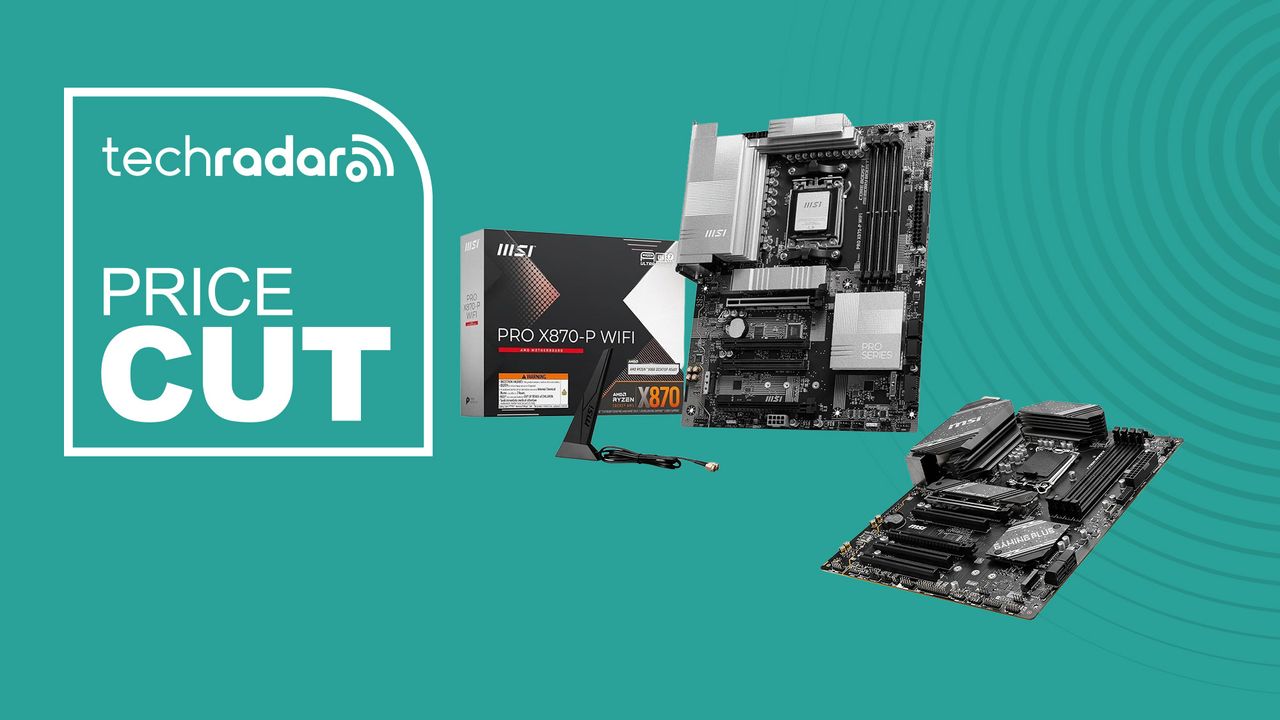
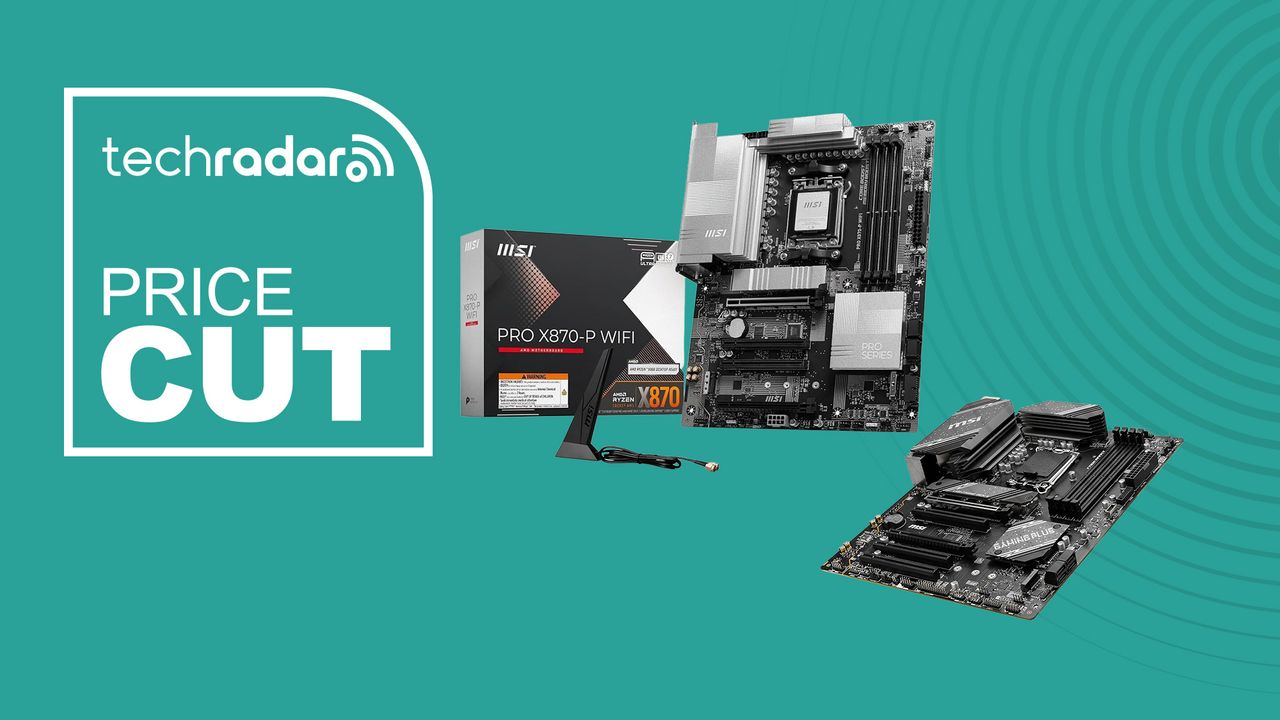
Both are well-regarded ATX boards with built-in Wi-Fi, and both represent meaningful savings if you’re mid-build or planning an upgrade. And both punch above their discounted price.
The two boards target different platforms entirely — one is AMD AM5, the other Intel LGA 1700 — so this isn’t a true apples-to-apples comparison. Think of them as two separate opportunities: one for Ryzen 7000/8000/9000 builders, and one for 12th/13th/14th Gen Intel builders.
Advertisement
Today’s top computer deals
More on the PRO X870-P WiFi — AMD AM5
At this price, the PRO X870-P Wi-Fi sits in an interesting spot: it’s the X870 chipset — AMD’s current-gen platform with full PCIe 5.0 support — at a price that previously would have bought you a mid-range B650 board. The X870 chipset brings wider PCIe 5.0 support and Wi-Fi 7 as a platform requirement (rather than an optional add-on), and AMD has committed to AM5 support through at least 2027, which means whatever Ryzen processor you pair with this board today will have a clear upgrade path for several years.
The connectivity package at this price is genuinely impressive. Wi-Fi 7 with its 320MHz channel width delivers noticeably lower latency and higher throughput than Wi-Fi 6E — the kind of upgrade you notice on a busy home network. The 5Gbps Ethernet port, USB4 at 40Gbps, and Thunderbolt 4 are the kind of specs that usually appear on more expensive boards. Three M.2 slots (including one Gen5) gives you flexibility for fast SSDs now and room to expand later.
MSI’s PRO series is positioned more toward productivity and professional use than the flashier gaming-branded boards, which means the design is restrained — minimal RGB, clean silver heatsinks, no aggressive aesthetics. Whether that’s a positive depends entirely on what you want your build to look like. Best Buy reviewers have praised it as straightforward to install and stable from the first boot, with multiple builders noting it’s working well with everything from Ryzen 7700X to the 9800X3D.
Advertisement
One honest note: the PRO X870-P is tuned more for stability and accessibility than aggressive overclocking. If you’re planning to push DDR5 kits to their absolute limits or run a flagship Ryzen 9 chip at sustained all-core maximum TDP, a higher-end X870E board would give you more VRM headroom. For the majority of builds — including enthusiast setups — it handles everything without issue.
More on the B760 Gaming Plus WiFi Gaming Motherboard
The B760 Gaming Plus WiFi is the more straightforward recommendation of the two — it’s a well-established board with a substantial real-world track record. The 840+ reviews on Amazon at 4.4/5 tell a consistent story: this board works reliably, installs without drama, and delivers good performance across a wide range of Intel builds.
Intel’s LGA 1700 platform supports 12th, 13th, and 14th Gen Core processors, which means there’s a wide choice of CPUs available at various price points — everything from a budget Core i3 to the Core i9-14900K. It’s worth noting that Intel has moved on to the LGA 1851 socket for its newest Arrow Lake generation, so this platform won’t support 15th Gen CPUs. That said, for builds centered on a 13th- or 14th-Gen processor, the B760 remains a very solid foundation.
Advertisement
Wi-Fi 6E built-in is a practical inclusion at this price — it saves you from buying a separate wireless adapter and keeps the build clean. 2.5 Gbps Ethernet provides fast wired connectivity for those who prefer a cable. Two M.2 Gen4 slots comfortably handle primary and secondary NVMe SSDs, and PCIe 4.0 x16 is more than adequate for any current GPU.
Reviewers have specifically praised the B760 Gaming Plus WiFi for its stability across sustained workloads — one reviewer noted it handled “AAA applications and multitasking effortlessly” over ten months of use without a single stability issue. The reinforced PCIe slots and robust VRM heatsinks contribute to a build quality that feels more substantial than budget Intel boards at a similar price.
Artificial intelligence is becoming an increasingly visible part of healthcare. From administrative workflows and clinical decision support to remote monitoring and wellness technologies, organizations are exploring how AI can help process information more efficiently and provide greater visibility into health-related data. Yet as adoption accelerates, one challenge continues to influence whether these technologies gain meaningful acceptance.
Trust has become a central issue in the broader conversation around artificial intelligence. The World Economic Forum’s Global Risks Report 2026 ranked misinformation and disinformation as the second most severe short-term global risk, while concerns about the adverse outcomes of AI technologies rose significantly in the report’s long-term outlook. As organizations introduce AI into increasingly sensitive areas, including healthcare, the findings underscore the importance of transparency, governance, and accountability in building public confidence.
Doug Benoit, CEO of FacialDx, believes trust begins with clarity. FacialDx is an AI-powered wellness intelligence company that uses facial analysis technology to identify visual biomarkers associated with wellness indicators and provide structured observations intended to support awareness. Benoit explains that users increasingly want to understand how conclusions are reached rather than simply receiving results.
Doug Benoit, CEO of FacialDx
Advertisement
“People want access to the information behind the outcome,” Benoit says. “Trust grows when organizations are willing to show the methodology, the data, and the reasoning that support what the technology is presenting.”
That expectation reflects a broader shift taking place across healthcare and technology. Organizations are facing growing pressure from regulators, providers, employers, and consumers to demonstrate how AI systems function, how data is managed, and where human judgment remains involved. “Transparency is no longer viewed as a supplementary feature,” Benoit notes. “For many stakeholders, it is becoming a prerequisite for adoption.”
Privacy represents an equally important consideration. Benoit explains that healthcare information remains among the most sensitive categories of personal data, which places significant responsibility on organizations developing AI-enabled solutions. Research shows that AI systems handling sensitive health information raise significant concerns around privacy, data protection, and the risk of data breaches, while also highlighting the importance of ensuring that AI supports rather than overrides the judgment of healthcare professionals. Benoit believes those considerations reinforce the need for strong governance, security safeguards, and clearly defined human oversight as AI becomes more integrated into health-related environments.
Benoit notes that conversations around AI have evolved considerably during the past several years. According to him, many organizations have moved beyond asking whether AI should be used and are now focused on understanding how it can be implemented responsibly within existing workflows.
“The concern we hear most often is not whether AI exists,” Benoit explains. “Organizations want to know how it integrates into what they already do, how information is protected, and whether the technology supports the people responsible for making decisions.”
Advertisement
Human oversight remains central to that discussion. He explains that while AI can help identify patterns, organize information, and improve efficiency, healthcare decisions often involve context, judgment, and interpersonal considerations that extend beyond data analysis alone.
Benoit believes AI should be viewed as a support tool rather than an autonomous authority. “Technology can help surface information faster and more consistently,” he says. “But people still need people. Human oversight provides accountability, interpretation, and the ability to apply professional judgment in ways that technology alone cannot.”
This distinction is becoming increasingly important as organizations define governance frameworks around AI deployment. “Successful implementation often depends on clearly establishing what a system is designed to do, what it is not designed to do, and how outputs should be interpreted within existing professional processes,” Benoit says.
For FacialDx, that philosophy shapes the company’s position within the healthcare ecosystem. Benoit emphasizes that the platform is intended to provide wellness intelligence and observational insights rather than diagnostic conclusions. According to him, maintaining clearly defined boundaries helps support responsible adoption while reinforcing the role of healthcare professionals in evaluating information and determining appropriate next steps.
Advertisement
He also points to governance and controlled access as important components of trust. “The goal is to make information accessible, understandable, and secure,” Benoit says. “People should know who can access their information, how it is being handled, and what safeguards exist around it.”
As AI continues to expand across healthcare, enterprise wellness, and telehealth environments, trust may ultimately become the factor that separates short-term experimentation from long-term adoption. Innovation remains important, but sustained success will likely depend on whether organizations can balance technological advancement with accountability, transparency, privacy protection, and human oversight.
Benoit believes the future of AI health intelligence will be shaped by that balance. “The organizations that earn trust will be the organizations that remain transparent, stay focused on their purpose, and use AI to support better decisions,” he says. “When innovation and accountability move forward together, people gain confidence in the technology and confidence in how it is being used.“
Xbox console prices are jumping $100 for the 512GB model and $150 for the 1TB models. Microsoft says it will discontinue the 2TB version of the Xbox Series X. Here’s the new breakdown of prices:
Series S 512GB: $500
Series S 1TB: $600
Series X 1TB digital: $750
Series X 1TB disc drive: $800
Microsoft’s blog post said the company spent several months working with suppliers, hoping to avoid another price increase. “Unfortunately, console storage and memory prices have increased by more than 2.5x, and we expect another doubling by the fall of 2027.” It noted that the the components crisis — which was also behind the latest price hike for Apple products — is hitting consoles particularly hard.
That same blog post introduced buy now, pay later and zero-interest financing options, which the company framed as “programs to make XBOX consoles more accessible.”
New products aren’t immune, either. On Monday, Valve revealed the price of its PC gaming console, the Steam Machine, which starts at $1049. The price tag shocked many gamers, as the company had telegraphed that its new hardware should be similarly priced as other home consoles when it was first revealed last November. Instead, it’s $150 more expensive than the PS5 Pro. Valve also hiked the price of its Steam Deck portable console last month.













 Although paperbacks are a much-loved aspect of the literary world, they are not really intended to last the decades the way that hardcover books are. Beyond the typical ravaged covers, paperbacks also tend to suffer from a warped spine, where the formally flat spine gets a definite inwards curve due to the ravages of moisture, temperature, failing glue and the passing of time in general. If this bothers you, then [Book Care Studio]




































You must be logged in to post a comment Login