
TL;DR
OpenAI released Sol, its most powerful model, to about 20 government-approved partners under Trump’s AI order.



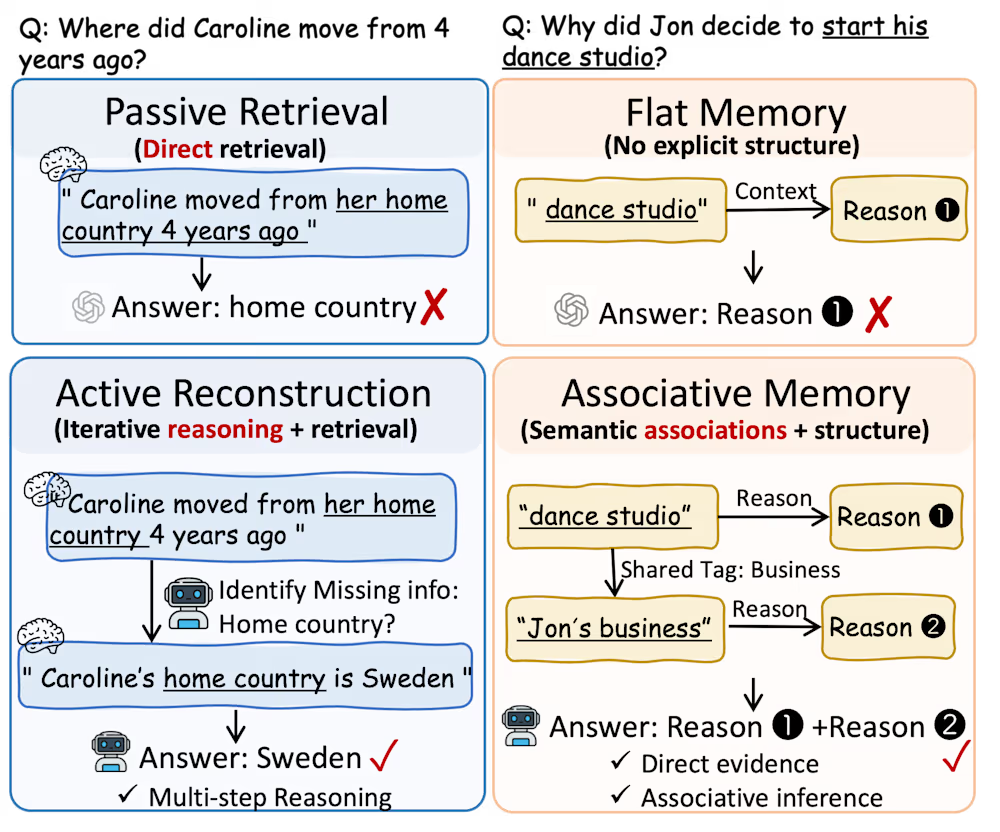
Long-horizon reasoning exposes a core weakness in AI agents: context windows fill up fast, and retrieval pipelines return noise instead of signal.
To solve this, researchers at the National University of Singapore developed MRAgent, a framework that abandons the static “retrieve-then-reason” approach. Instead, it uses a mechanism that allows an agent to dynamically develop its memory based on accumulating evidence.
This multi-step memory reconstruction is integrated into the reasoning process of the large language model (LLM). While not the only framework in this space, MRAgent significantly reduces token consumption and runtime costs compared to other agentic memory management approaches.
In classic retrieval pipelines, documents are retrieved through vector search or graph traversal and passed on to an LLM for reasoning. This passive approach fails because it cannot combine reasoning with memory access, creating three major bottlenecks:
These systems cannot revise their retrieval strategy mid-reasoning. If an agent fetches a document and discovers a crucial missing cue — a specific date or person — it has no way to issue a new query based on that finding.
Fixed similarity scores and predefined graph expansions return surface-level matches that flood the LLM’s context window with irrelevant noise, degrading reasoning.
Current systems rely heavily on pre-constructed structures such as top-k results and static relevance functions, limiting the flexibility required to scale across unpredictable, long-horizon user interactions.
The researchers argue that to overcome these limitations, developers must shift toward an “active and associative reconstruction process,” a concept inspired by cognitive neuroscience.

Under this paradigm, memory recall unfolds sequentially rather than operating as a passive read-out of a static database. The system starts with small, specific triggers from the user’s prompt, such as a person’s name, an action, or a place. These initial hints point to connecting concepts or categories instead of massive blocks of text.
By following these metadata stepping stones, the agent gathers small pieces of evidence one by one. It uses each new piece of information to guide its next step until it successfully pieces together the full, accurate story.
Instead of viewing memory as a static database, MRAgent (Memory Reasoning Architecture for LLM Agents) treats it as an interactive environment. When processing a complex query, the agent uses the backbone LLM’s reasoning abilities to explore multiple candidate retrieval paths across a structured memory graph.
At each step, the LLM evaluates the intermediate evidence it has gathered and uses it to iteratively optimize its search. It infers new search constraints, pursues the paths with the best information, and prunes irrelevant branches. This allows MRAgent to piece together deeply buried information without filling the LLM’s context with noise.

To make this active exploration computationally efficient and scalable, the framework organizes its database using a “Cue-Tag-Content” mechanism. This operates as a multi-layered associative graph with three node types:
Cues: Fine-grained keywords, such as entities or contextual attributes extracted from user interactions.
Content: The actual stored memory units. These are divided into multi-granular layers, such as episodic memory for concrete events and semantic memory for stable facts and user preferences.
Tags: Semantic bridges that summarize the relational associations between specific Cues and Content.
This structure enables a highly efficient two-stage retrieval process. The LLM first navigates from Cues to candidate Tags. Because Tags explicitly expose the semantic relationships and structural associations of the data, the agent evaluates these short summaries to judge their relevance. The LLM identifies promising traversal paths and discards irrelevant branches before spending compute and prompt tokens to access the detailed, heavy memory contents.
For example, a user might ask an AI agent, “How did Nate use the prize money when he won his third video game tournament?”
MRAgent first extracts fine-grained starting cues from the prompt, such as “Nate,” “video game tournament,” and “win.”
The agent maps these initial cues to the memory graph and looks at the available associative Tags connected to them. The agent sees tags like “Tournament Victory” and “Tournament Participation.” Since it is only concerned with what the person did after they won the championship, MRAgent drops the tournament participation tag and pursues the victory tag.
The agent retrieves the episodic content linked to the chosen Cue-Tag pair, retrieving three distinct memory episodes where Nate won a tournament.
MRAgent looks at the three memories, decides one of them in particular is relevant to the query, and discards the other two.
With this information, it updates its cues and starts another round of discovery and pruning. From the new episodic memory it has retrieved, the agent adds “tournament earnings” to its cues and uses that to traverse new tags and home in on new memories. It repeats this process until it gathers enough information to answer the query, which could be something like “Nate saved the money.”
MRAgent operates alongside several other frameworks addressing agentic memory building. Alternatives include A-MEM, a graph-based agentic memory framework, and MemoryOS, a hierarchical memory framework. Other persistent memory frameworks include LangMem and Mem0.
The researchers tested MRAgent on the LoCoMo and LongMemEval industry benchmarks. These test the abilities of agents to resolve queries on long-horizon tasks and conversations across dozens of sessions and hundreds of turns of dialogue. The backbone models used were Gemini 2.5 Flash and Claude Sonnet 4.5. The system was tested against standard RAG, A-MEM, MemoryOS, LangMem, and Mem0.
MRAgent consistently outperformed every baseline across both models and all question types by a significant margin.
However, for enterprise developers, the most critical metric is often computational cost. In the LongMemEval tests, MRAgent slashed prompt token consumption to just 118k per sample. By comparison, A-Mem consumed 632k tokens, and LangMem burned through 3.26 million tokens per query. MRAgent also effectively halved the runtime compared to A-Mem, dropping from 1,122 seconds to 586 seconds.

What makes MRAgent efficient in practice is its on-demand behavior. Evaluating tags and pruning irrelevant paths before retrieval saves money and context space. Furthermore, the system autonomously evaluates its accumulated context and inherently knows when to stop searching, completely avoiding redundant data exploration.
While MRAgent is highly effective, the Cue-Tag-Content structure needs to be prepared before the agent can query it. Developers must figure out how to architect the underlying memory database to enable the LLM to efficiently navigate associative items and prune irrelevant paths without exploding compute costs.
Fortunately, developers do not have to manually label or structure this data. The authors designed MRAgent with an automated distillation pipeline that uses LLMs to process raw interaction histories and automatically populate the memory graph. For a developer, the job is to implement and orchestrate this automated ingestion pipeline, rather than manually tag data.
You need to set up a background job or streaming pipeline that passes raw user interactions through prompt templates to extract this metadata before storing it in your graph database.
However, the authors emphasize that this is a lightweight construction phase and MRAgent intentionally keeps ingestion simple.
The authors have released the code on GitHub.


We may receive a commission on purchases made from links.
Maintaining a yard the neighbors will envy, starts with a high-quality mower. However, even if you’re running the best riding lawn mower brand available from Home Depot, it won’t solve all your turf problems. Take for instance, situations where you might have visibly uneven sections that include bumps or dips. Not only can this diminish your properties appearance, but it also creates trip hazards and areas where water can pool, negatively impacting grass health.
There are a variety of methods to tackle this issue, such as pull-behind heavy rollers and drag mats. Unfortunately, these options have downsides. First, they can cost quite a bit, depending on the size and brand. You’ll also need a vehicle like a riding mower, or ATV to pull them. However, there is a less expensive choice that still performs admirably — a lawn leveling rake.
Unlike a standard rake, with tines that spread out and curl down on the ends for grabbing leaves, a leveling rake has horizontally mounted, flat tines that slide over the ground. You can find many budget options, such as the Vivosun Stainless Steel Lawn Leveling Rake for $56.99 at HomeDepot.com. The low price makes it an easy investment for those looking to improve their lawns without significant disruption to existing vegetation.

The first step in the process is to mow your grass short but try not to scalp it. Lowering the cutting height too much goes against the 1/3 rule for mowing, as it can invite pests and disease, turning your green space brown. Next, you’ll need to dethatch the grass with something like the Walensee Thatch Rake on Amazon.com for $34.99. This tool essentially scoops up the loose grass clippings and other organic matter that’s built up in the grass which prevents water from seeping into the soil.
Next, you’ll need something to fill in those dips in your yard. Referred to as “top dressing,” the main ingredient is topsoil; however it’s recommended to add in some compost, which helps your soil hold more moisture. While it’ll be a bit a work, spreading out the top dressing is as simple as using a shovel and focusing on the bumpiest spots of your turf.
It’s at this point where the leveling rake finally makes an entrance. While holding the leveling rake handle, you can drag or simply push it a back-and-forth, guiding the tines over the loose top dressing. The taller sections of soil will be caught in the tool and distributed elsewhere. Meanwhile, the tines won’t disturb lower sections or dips, instead focusing on areas that rise above the rest. Eventually the levelling rake will redistribute the top dressing to the lower areas and make the whole area level — it’s in the name.


OpenAI released Sol, its most powerful model, to about 20 government-approved partners under Trump’s AI order.
OpenAI has released GPT-5.6 Sol, its most powerful model, to roughly 20 partners whose names were individually approved by the US government. The release is the first time an American AI company has launched a frontier model under a government-managed access list, a step beyond the voluntary pre-release review framework Trump’s AI executive order established on June 2.
Sol is the most capable model in a new three-tier series that also includes Terra, a mid-range option, and Luna, which is optimized for speed and cost. OpenAI described Sol as excelling at coding, biology, and cybersecurity, and introduced a new “max reasoning effort” mode that gives the model extended time to work through complex problems. The company plans to add an “ultra” mode that splits tasks among multiple sub-agents.
The limited preview follows a direct request from the Trump administration to stagger the release, with the government approving access customer by customer during the preview period, according to Bloomberg. OpenAI said in a blog post that it does not believe “this kind of government access process should become the long-term default,” but agreed to participate.
The arrangement is the first practical test of the executive order Trump signed earlier this month, which asks AI companies to voluntarily give the government up to 30 days of pre-release access to models deemed to have advanced cyber capabilities. The order explicitly rejects mandatory licensing, but the Anthropic precedent gave it teeth. Two weeks ago, Washington ordered Anthropic to shut down Fable 5 and Mythos 5 after a reported jailbreak, the first time the government forced a commercial AI model offline.
OpenAI’s decision to cooperate contrasts with Anthropic’s experience. Anthropic complied with the shutdown order but publicly called the action disproportionate, warning it would halt all frontier model deployments if applied across the industry. OpenAI appears to be taking the opposite approach, framing voluntary compliance as a way to avoid a more coercive outcome while preserving its ability to push back on the principle.
Sol is also available through Amazon Bedrock, making it the first model in the new series accessible on a competing cloud platform. OpenAI said it plans to make all three tiers generally available in the coming weeks, though it has not set a public date.
The broader question is whether government-gated releases become the template for every frontier model that follows. OpenAI clearly wants to prevent that, and said so publicly. But with Anthropic’s models still offline and the executive order’s voluntary framework already producing mandatory-looking outcomes, the line between cooperation and compliance is getting harder to draw.

Elon Musk is eyeing an acquisition of Mesh Optical Technologies, a startup founded by three former SpaceX engineers last year developing hardware for fast data center communications.
The potential acquisition, which was revealed in a Federal Trade Commission filing and first reported by Bloomberg, confirmed the agency expedited its antitrust review.
Mesh Optical came out of stealth in February when it announced that it raised a $50 million Series A led by Thrive Capital.
Before founding Mesh Optical, the startup’s co-founders, Travis Brashears, Cameron Ramos, and Serena Grown-Haeberli, developed the optical communication links that keep thousands of SpaceX’s Starlink satellites interconnected.
The Mesh co-founders saw an opportunity to develop optical transceivers for terrestrial data centers, as light-based hardware is faster and more energy-efficient than traditional electrical-based systems.
SpaceX has recently entered into agreements with Anthropic, Google, and the open-source AI developer Reflection AI to provide them with compute capacity at its data centers, generating a substantial new revenue stream for the newly public company. Acquiring Mesh could eventually allow SpaceX to improve the efficiency of its data centers, whether they are located on Earth or, in the future, in space.

Amazon Prime Day hits different in 2026, even if it is the last day of the week-long event. Prime Day is often a moment to pick up a big-ticket item—and there are great Amazon Prime Day TV Deals, Prime Day Apple Deals, and Prime Day Tech Deals aplenty for those in need of a serious life upgrade.
But honestly, this year has been a bear for most people I know. I’m shopping on a budget. That’s why I’ve assembled these great Amazon Prime Day Deals under $100. Each is a chance to pick up a necessity, a level-up, or a little treat without having to explain anything to yourself later—whether a low-cost Kindle or a great budget Fitbit. With only hours left in Prime Day, it’s your last chance to snag all of these with such a good price.
For the best of the best of the best deals this Prime Day, check out WIRED’s Absolute Best Prime Day Deals. For lightning deals of the moment, see our Amazon Prime Day live blog for updates in real-time.
Updated 9PM ET on Friday, June 26: We’ve updated this story with a final refresh on deals you can still buy in the last hours of Prime Day.
WIRED Featured Deals

Even after three years, this Charge 6 is still the Fitbit WIRED recommends for most people. The AMOLED touchscreen is bright and easy to read, and it does all the basic stuff that you want a fitness watch to do. It will monitor your blood oxygen, your heart rate, and your skin temp—plus monitor sleep and flag signs of stress or irregular heart rhythms. It’s not as ultra-accurate as some, but it’s good enough for most enthusiasts, and the price is very, very right at the moment.
A good power bank is actually life-changing. It means never having to race to a cafe, hunting desperately for a table near an outlet. This compact little puppy is our top power bank for good reason: Ample 25,000-mAh capacity. Fast-charging capability for phones or laptops. Ability to fast-charge two devices at the same time, with a retractable flat 2-foot USB-C cable, and another 1-foot USB-C that doubles as a carry loop.


Most of us weren’t born tech enthusiasts. Somewhere along the way, a game, a gadget, a PC upgrade, or a new technology grabbed our attention and we never really let go.
Read Entire Article
Source link

Looking for the most recent Mini Crossword answer? Today’s puzzle is long, and there are a few tricky clues. (I did NOT know the answer to 10-Across, though it was fairly easy to figure out.) Click here for today’s Mini Crossword hints, as well as our daily answers and hints for The New York Times Wordle, Strands, Connections and Connections: Sports Edition puzzles.
Need some help with today’s Mini Crossword? Read on. And if you could use some hints and guidance for daily solving, check out our Mini Crossword tips.
If you’re looking for today’s Wordle, Connections, Connections: Sports Edition and Strands answers, you can visit CNET’s NYT puzzle hints page.
Read more: Tips and Tricks for Solving The New York Times Mini Crossword
Let’s get to those Mini Crossword clues and answers.
1A clue: Halloween costumes with eye patches
Answer: PIRATES
8A clue: “That’s great!”
Answer: AWESOME
9A clue: One with an aggressive savings plan?
Answer: PACKRAT
10A clue: Insect that has two stomachs, curiously enough
Answer: ANT
11A clue: U.S. medical research org.
Answer: NIH
12A clue: Like music that sounds good to the ear
Answer: TONAL
14A clue: Wear away, as the soil
Answer: ERODE
15A clue: “Good lord!”
Answer: MYGOD
1D clue: Nickname for Dad
Answer: PAPA
2D clue: “Gimme those!”
Answer: IWANTEM
3D clue: Minister’s house
Answer: RECTORY
4D clue: Pose a question
Answer: ASK
5D clue: Weather phenomenon measured from EF-0 to EF-5
Answer: TORNADO
6D clue: Corresponded by computer
Answer: EMAILED
7D clue: Rogen of “The Studio”
Answer: SETH
13D clue: Seasonal drink topped with nutmeg, maybe
Answer: NOG


Hubble has delivered a crisp new view of NGC 6723, a globular cluster tucked in the constellation Sagittarius. The image shows a tight swarm of stars that fills the frame with countless points of light, each one a distinct sun shining across 27,000 light-years of space. Blue stars crowd the center while warmer orange stars appear more often near the edges, and many of the brighter ones carry the sharp, cross-shaped spikes created by the telescope’s optics.
Globular clusters are some of the Milky Way’s oldest structures, containing a wealth of ancient history and celestial knowledge. We have one in particular, NGC 6723, which originated over 10 billion years ago and is still going strong, with tens of thousands to millions of stars gravitationally linked together in a roughly spherical shape. As you move through this region, you can’t help but notice how dense and brilliant everything is, as the stars are far away from those near the Sun and move through a much smaller volume of space.

For a long time, scientists believed that these clusters created all of their stars in a single huge burst, but this was before Hubble got involved. New data from the reliable space telescope has thrown that notion out the window for NGC 6723. It turns out that there were two independent rounds of star creation, the second of which began only 634 million years after the first. That may not seem like much, but given the age of this object, it’s more like a brief halt in the big scheme of things, demonstrating that globular clusters have more complex histories than the older model anticipated.
Hubble gathered the raw data through two coordinated programs. The first examined 65 globular clusters using visible and near-infrared light, allowing researchers to observe how heavier stars shift towards the center over time while lighter stars drift away. A follow-up experiment adds UV sensitivity to the combination, allowing it to detect variations in the stars’ chemical makeup and sharpen the timeframe of those two formation phases.

The colors in the image aren’t simply for show, as they also offer information about the stars in the cluster. The hotter, bluer stars are usually younger or have been impacted by close encounters with other stars or mergers deep within the cluster’s dense core. The cooler, orange stars, on the other hand, are frequently older, having emerged from the main sequence and developed into the giants you see before you. The contrast between these two populations gives the cluster a layered appearance and reveals information about the mechanisms that caused its creation.
NGC 6723 is located in the Milky Way’s halo, not the flat disk around which the Sun orbits. That’s significant because clusters like this one presumably formed before the galaxy took on its current shape. This shows that the stars in this cluster have some of the earliest chemical traces from our galaxy’s first star formation generations. Studying them in this way helps us to track how the Milky Way grew from its basic building blocks.

Even though Steve Jobs could be demanding, Ron Johnson says he still managed to make Apple Stores “the most productive in the world.”
Ron Johnson joined Apple in 2000 and served as the company’s head of retail until 2011. During his time at Apple, Johnson says he employed unique strategies and helped make Apple Store locations the success they are today.
Speaking to WWD, Johnson also detailed his experiences working with Steve Jobs, Apple’s co-founder and CEO at the time. Jobs often needed convincing, and Johnson periodically experienced pushback for his ideas.
Ron Johnson recounts that, for instance, Steve Jobs hated the idea of having retail locations in malls. Jobs apparently said malls were “full of crappy stores,” and absolutely hated stores with columns. Johnson eventually had to move a few retail locations to appease Jobs.
Even though Jobs was demanding, he recognized Johnson’s expertise in the retail industry. Over the years, the two built a lasting friendship and partnership.
In the wide-ranging interview which covered far more than just Apple, Johnson also recounts his most significant accomplishments, including Apple’s iconic cube-shaped Fifth Avenue store in New York.
Beating records in a glass cube
Johnson explained that for an Apple Store to become profitable, it needed to hit $15 million in volume. On its first night, the New York store generated $1 million in sales and made $350 million in a single year.
The stores routinely surpassed these figures. Every Apple Store location hit around $50 million annually by the time he left Apple in 2011.
“The stores were the most productive in the world, but it didn’t happen overnight,” he said.
“It took time to get there,” Johnson continued, “There was a lot of refinement, but we never gave up on our vision.”
That vision included a unique take on retail locations, which meant ensuring that customers could quickly learn about the products they intended to purchase.
In an era of poorly-maintained super-stores like CompUSA and Circuit City, and smaller venues like Apple Specialists who often didn’t have demo units, customers had a vastly improved experience at Apple Retail. In the new locations, those customers didn’t just get to see a new Mac or iPod; they were able to find out everything they could do with a new device, how it worked with existing accessories like cameras, printers, and so on.
Apple wanted them to know how they could use a Mac to burn CDs, upload and edit photos, and more. That’s why Apple retail locations have a Genius Bar.
Johnson says that Apple Store employees “[tried] to understand what you came to the store for, and solve that for you through a new product or help.”
Apple Stores were built around that idea, and Johnson had the freedom to create his vision and to pick the team who would make it happen. Still, any stores with columns had to be approved by Steve Jobs personally.
Johnson recounted how he informed Steve Jobs of his decision to leave Apple. Jobs was supportive, acknowledging Johnson’s love for the retail industry.
However, Johnson planned to leave Apple during a particularly difficult time for the company in 2011. Jobs had just found out that he only had six months to live.
Out of respect, Ron Johnson agreed to stay with Apple until Steve Jobs passed away. Johnson ultimately left Apple for JCPenney and eventually became CEO of the company, but his accomplishments at Apple have left a lasting mark.
Ron Johnson’s new book, written together with Zander Nethercutt, is set to debut on September 22. It is called “Shop Different: How Retail Revealed Apple’s Genius.”

Two weeks into the ban that caused Anthropic to pull its powerful cybersecurity-oriented models, Mythos 5 and Fable 5, from the market, the Trump administration is softening its stance.
It is now allowing Anthropic to make Mythos 5 available to more than 100 specific U.S. government agencies and companies, including allowing the non-American employees at those organizations to access to the model, both Semafor and Reuters report. This list also includes Anthropic’s own non-American employees, who were included in the original ban that forbade non-Americans from accessing the models.
“I have determined that appropriate safeguards are in place to permit certain trusted partners to access the Claude Mythos 5 Model,” Commerce Secretary Howard Lutnick wrote to Anthropic’s chief compute officer Tom Brown on Friday, according to the missive seen by Semafor.
Apparently, the administration did not address the release of Fable 5 in this directive. This is a version of Mythos 5 that was widely released a couple of days before the ban because it was said to have more protections. Both models were pulled after those guardrails were allegedly bypassed easily by security researchers. Anthropic did not immediately respond to our request for comment.
Anthropic on Friday publicly acknowledged the progress in a post on X, writing: “Since June 12, we’ve been working closely with the US government to restore access to Claude Mythos 5 and Fable 5. Today, the government notified us that Mythos 5, our strongest cybersecurity model, can be redeployed to a set of US organizations that operate and defend critical infrastructure. We’re restoring access for these organizations quickly, and we’re continuing to work with the government to expand access to Mythos 5 and make Fable 5 available for general use again.”


Apple’s latest 11th-generation iPad, priced at $299 on Prime Day (was $349), with its stunning 11-inch Liquid Retina display, provides a viewing experience that is just delightful to immerse yourself in, whether you’re learning about a new subject, binge-watching the latest series, or simply sketching some half-baked ideas that come to mind. The A16 processor in there is the true brains behind the operation, as it does all of the regular tasks like juggling numerous tabs, messing with the odd photo edit, and running educational programs with no problems. The battery life is also impressive, as you can get an entire day of pretty varied use out of it.
The nutribullet Pro 900W is a highly effective personal blender which is fitted with a highly powerful motor that crushes hard ingredients such as frozen fruits, vegetables, and ice cubes without leaving any bits or pieces behind. Simply place your ingredients into the cup, screw on the blade tightly, push the button and you have yourself a highly nutritious beverage ready in no time. There is absolutely nothing to fuss about, all you have to do is just fill your cup with whatever you wish and go. Another advantage of having this appliance is its convenience since there is no need to take along a number of different containers and cups with you. Also, some extra cups and lids are provided in case you want to make a couple of smoothies right away without wasting your ingredients. Product page
QQH’s triple screen laptop monitor extender hooks directly onto your laptop and instantly divides up your desktop area into three separate screens, helping you maintain one email open in one place, your references in another place, and working on the main screen without constantly switching windows or tabs. The portable screens can be folded flat for convenience during travel and hook up to your laptop using just a single USB-C cable that powers everything and sends out the video signal, making the installation process just a matter of clamping them together and connecting just one cable. All three screens offer sharp, vivid visuals that do not get affected by either ambient light inside or outdoors and the screens can also be tilted conveniently thanks to the adjustable stands/clamps. Product page.
Google’s TV Streamer 4K with 32GB storage turns any ordinary television into a fast-streaming device with the help of its dedicated processor. This device provides fast loading of programs and films and also recommends personalized programs to watch based on your preferences on the screen itself. The included voice remote enables users to search or control playback using their voice without having to type anything. The Google TV interface ensures that all apps are neatly arranged so that users do not have to struggle with navigation. Plus, the device supports HDR content with vivid colors and great details regardless of whether you are watching the latest releases or old classics. It only requires connection via Wi-Fi and Google account in order to be operational. Product page.
Eufy’s Security 2K Video Doorbell E340 is simple to set up and use; before long, you’ll have a crystal-clear live video of your front door appearing on your phone as soon as someone arrives in 2K detail. It will record faces, parcels, and everything else even when it is dark, the lights are out, or whatever you want to call it. It features built-in intelligence that can distinguish between a person, a car, and a package, and it will only warn you when it detects something significant, rather than bombarding you with “random motion” alerts. Of course, you can have a two-way chat with whoever is at the door, as you simply use the app to communicate. Footage lands straight on the device or base station you must have, letting you to check up on what transpired at any time without having to pay monthly fees or maintain a cloud account. Product page.
DJI’s Mini 4K Drone Combo is small enough to fit in a backpack and takes off quickly after a simple setup. That means you may capture stunning 4K video footage of sunsets, family events, or your travels without having to deal with onerous rules or additional permits in most countries, which is a huge advantage. The built-in stabilization keeps your film stable even when the drone is dodging gusts of wind or following something, and the accompanying replacement batteries and charging device allow you to fly for a long time without having to wait for your batteries to recharge between shots. The automatic QuickShots mode allow you to accomplish a variety of fancy things like orbiting or rising shots with a single swipe in the app, so even if you’re absolutely new to this, you can get some very polished results straight away. Product page.




Renter of Home in Anne Heche Crash Denies Settlement With Son

Two goals and an assist by sheer aura: Cristiano Ronaldo just entered the World Cup chat


Microsoft accidentally kills epic Outlook email threads


Soccer-U.S. defends Iran World Cup travel restrictions, says discussions ongoing


Weekend Open Thread: Staud – Corporette.com


The House | Manchesterism won’t survive the painful trade-offs unless it gets citizens on board


Andy Burnham and the meaning of Makerfield


Potential 2028er World Cup attendee leaderboard


Asia stock markets slide as tech shares slump


A Look At A Gaggle Of Transputer Boards
Bitcoin (BTC) Dips Below $62K, Ethereum (ETH) Plunges 6% Daily: Market Watch


Securitize Wraps Roubini's SEC-Registered ETF as Dubai VARA Digital Security

Dell (DELL) Shares Tumble Over 5% Following Analyst Downgrade to Hold
Entergy settles forward sale agreements, raises $672 million in cash proceeds

Can Charles Hoskinson Really Rescue Cardano?


FIH Pro League: India defeat Pakistan 7-1, register biggest win of campaign | Other Sports News


RTX holders must register wallets before token distribution begins

Hyperliquid Named on Singapore MAS Investor Alert Register


Jake Chervinsky accuses CME of protecting derivatives monopoly


India vs Bangladesh LIVE Score, Women’s T20 World Cup: Bangladesh Opt To Bat; India Enter ‘Do-Or-Die’ Stage As Semi-Final Race Heats Up
-Reviewer-Photo-SOURCE-Simon-Hill.jpg)


You must be logged in to post a comment Login