

Crypto World
Bitcoin Trader Says ‘It’s 2022 Again’ As RSI Offers A Classic Bull Signal

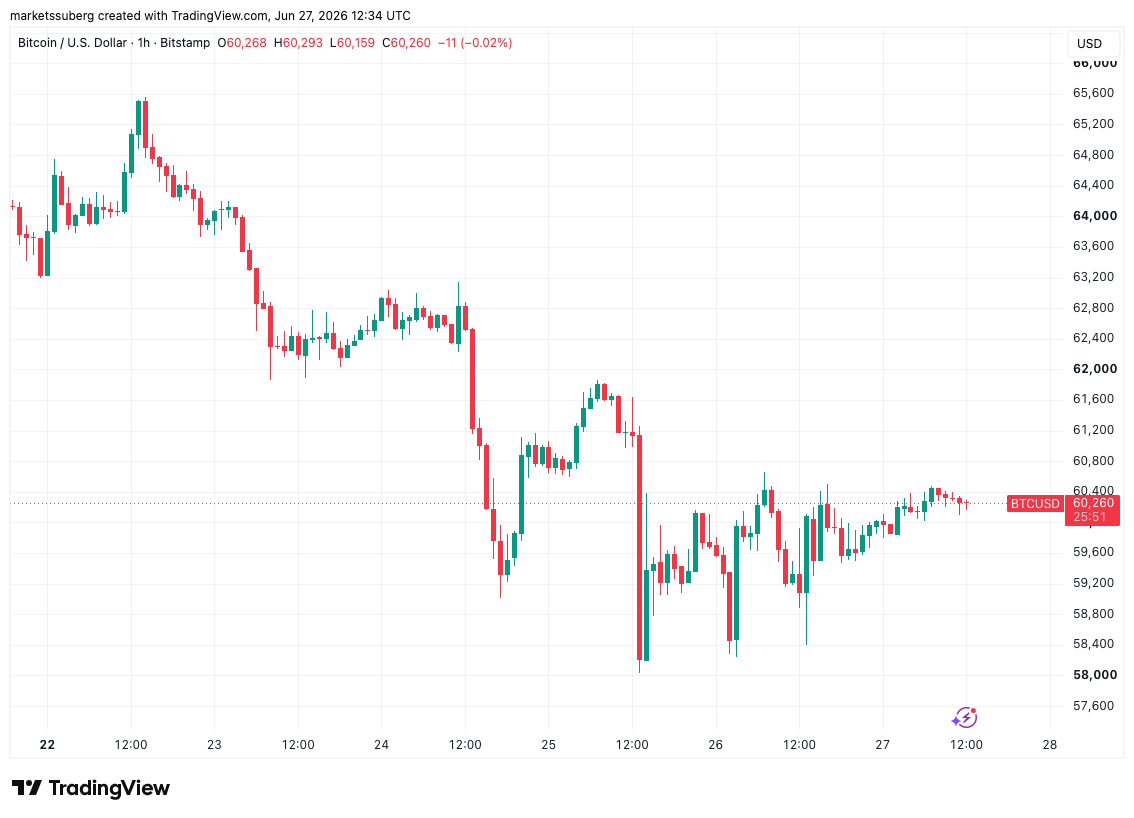
Bitcoin (BTC) continued its battle to reclaim $60,000 into the weekend as chart cues fueled hopes of a recovery.
Key points:
- Bitcoin RSI signals spark comparisons to the end of the 2022 bear market as a bullish divergence filters through.
- Analysis sees “encouraging” evidence of buyers defending the market at $60,000.
- Some traders still see new lows coming, but these could take until August.
Analysis on Bitcoin RSI: “It’s 2022 again”
Data from TradingView showed BTC/USD cooling volatility after returning above the $60,000 mark.
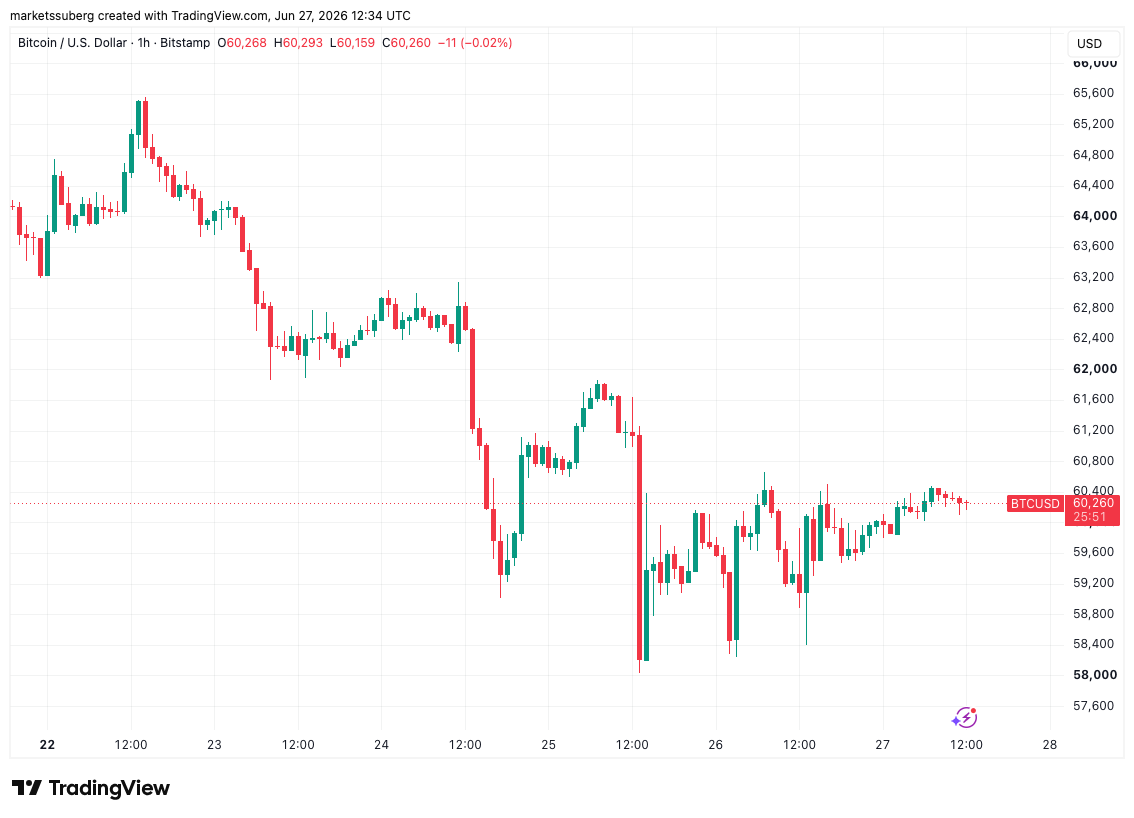
BTC/USD one-hour chart. Source: Cointelegraph/TradingView
A series of higher swing lows on hourly time frames combined with encouraging readings from the relative strength index (RSI) indicator.
On the four-hour chart, a bullish divergence was occurring, where RSI makes higher lows while price makes lower lows. This caught the attention of market participants, who began to anticipate a BTC price reversal as a result.
Uploading a chart comparing the current bear market with 2022, pseudonymous trader Rod argued that history was repeating itself.
“Once you see it, you can’t unsee it,” they wrote in a post on X.
“It’s 2022 again.”
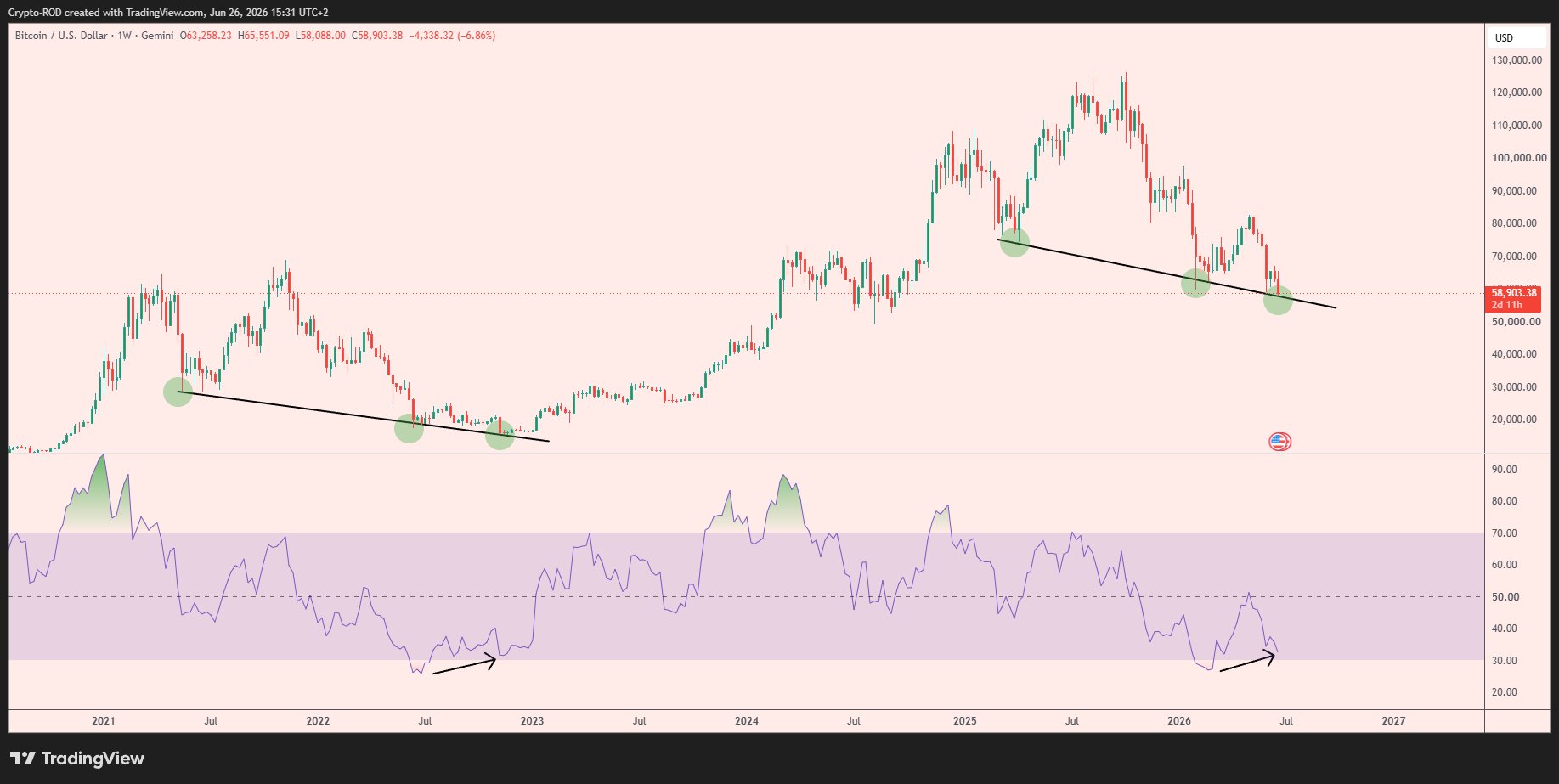
BTC/USD one-week chart with RSI data. Source: Rod/X
At the time, a weekly RSI bullish divergence kicked in while BTC/USD set its bear-market low of $15,600 — an event that subsequently provided a durable market floor.
Four-hour RSI, meanwhile, fell to just 11.4 at the start of June, marking one of its lowest levels on record.
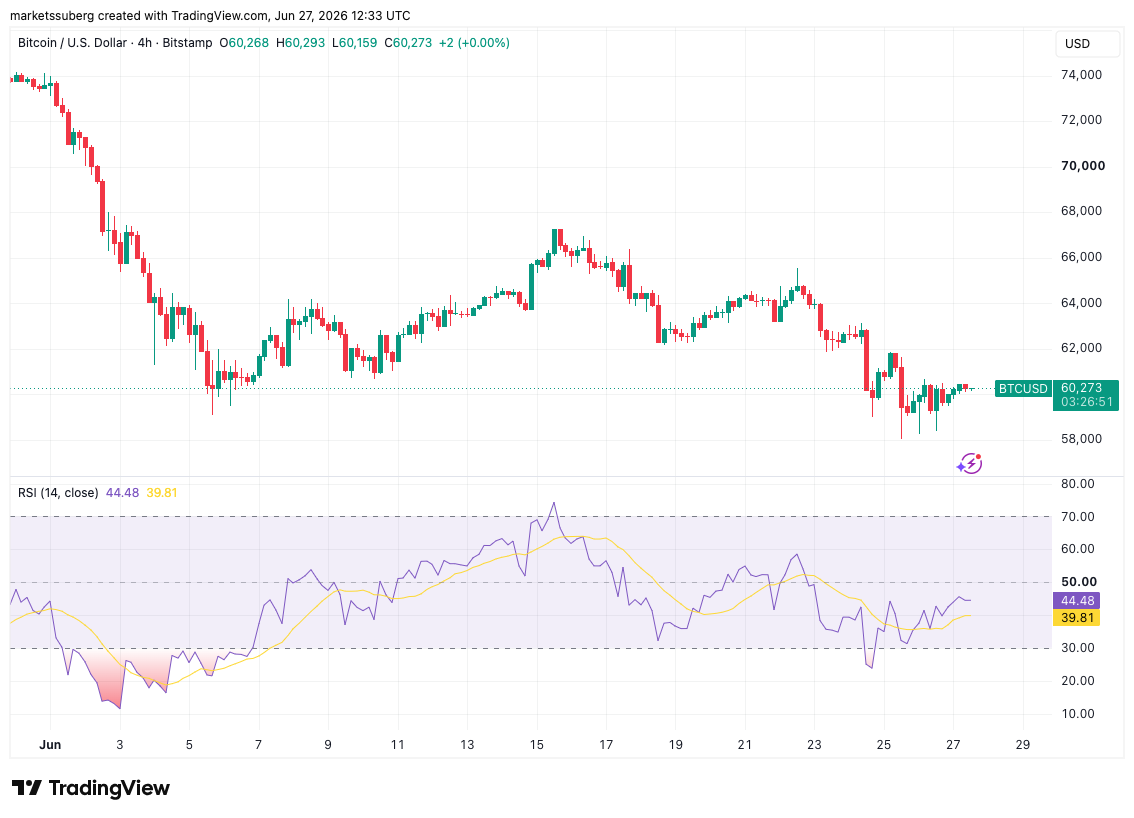
BTC/USD four-hour chart with RSI data. Source: Cointelegraph/TradingView
On Friday, crypto analyst Lukasz Wydra added daily time frames to the mix of RSI bull signals.
“The bullish RSI divergence on the Bitcoin chart has now been officially confirmed. It may still deepen, but at the same time we can clearly see that Binance continues to defend the price,” he told X followers.
Wydra described the RSI signals as an “encouraging sign.”
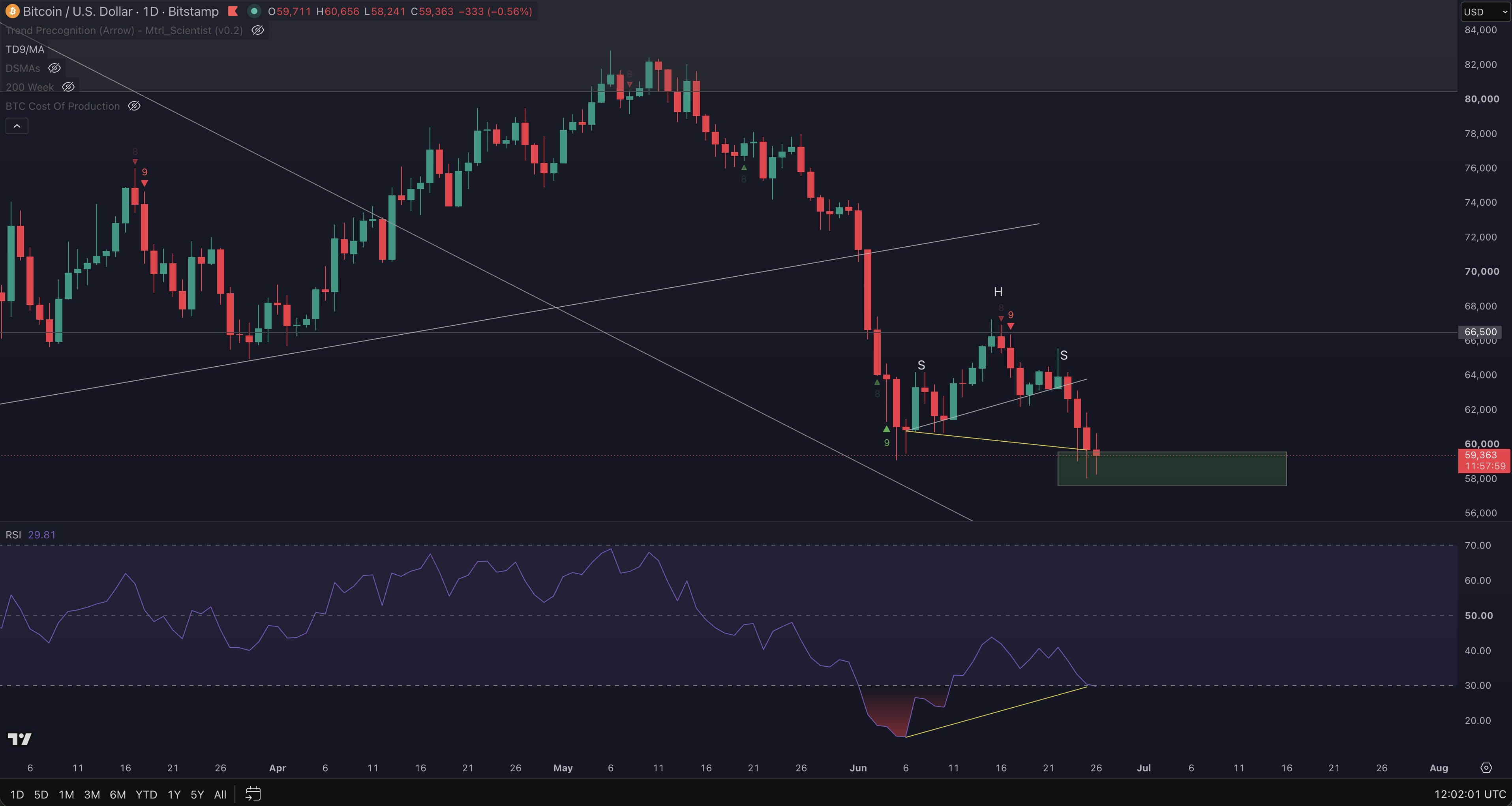
BTC/USD one-day chart. Source: Lukasz Wydra/X
New BTC price lows remain popular target
Other traders stuck to existing predictions of further downside pressure entering sooner or later.
Related: BTC price four-year trend calls for $76K as analysis says Bitcoin ‘not broken’
Niels Klaver, cofounder of crypto platform STABL Agency, repeated calls for a trip to $55,000 “before any big move” to change the status quo.
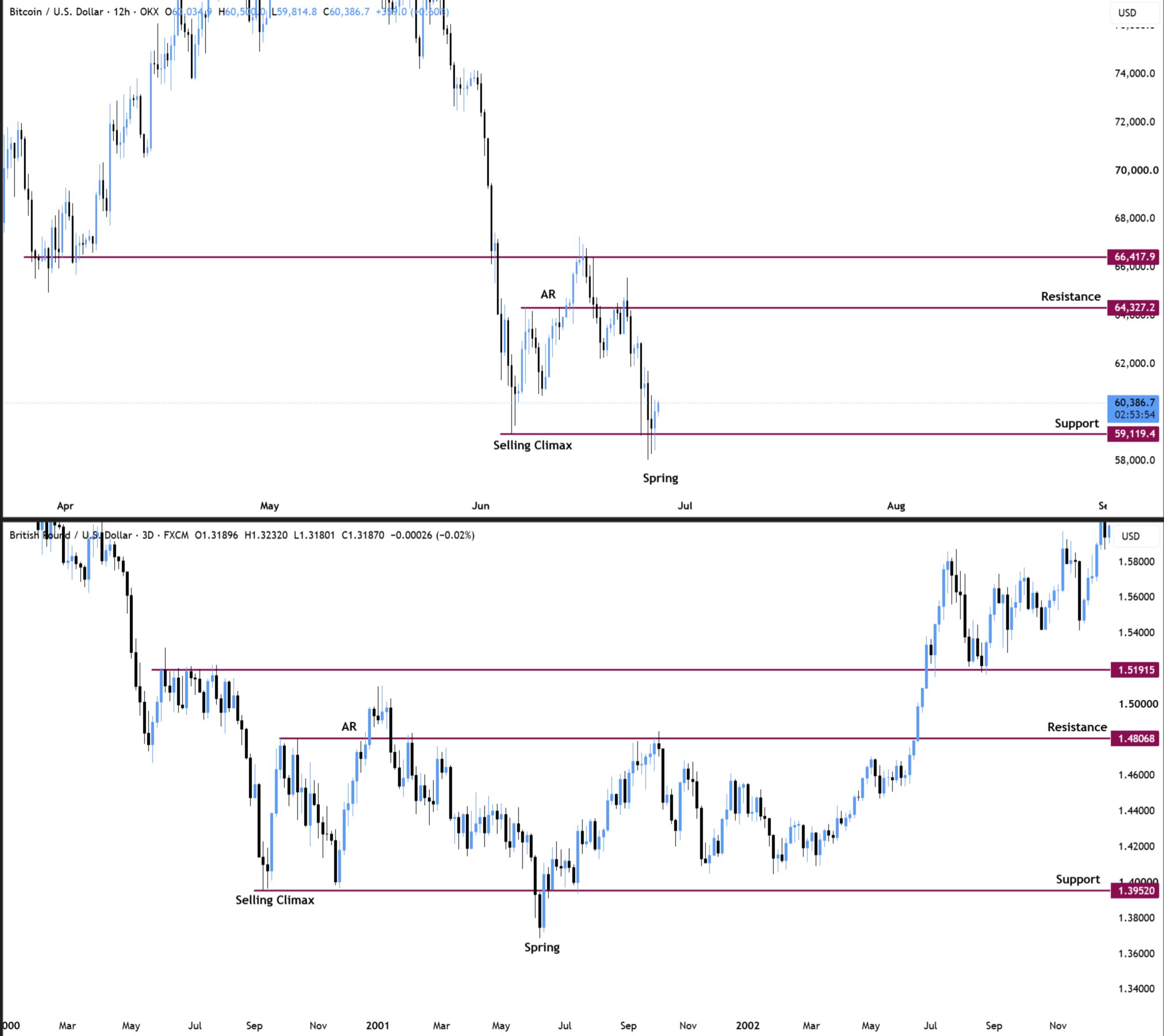
BTC/USD comparison. Source: Niels Klaver/X
Trader and analyst Rekt Capital suggested that a relief bounce could characterize the market next month thanks to July typically contrasting with June price action.
Once it confirmed the 50-month exponential moving average (EMA) as new resistance, BTC/USD would then see “August cancellation of relief and additional downside due to $60k weakening as support,” he wrote this week.
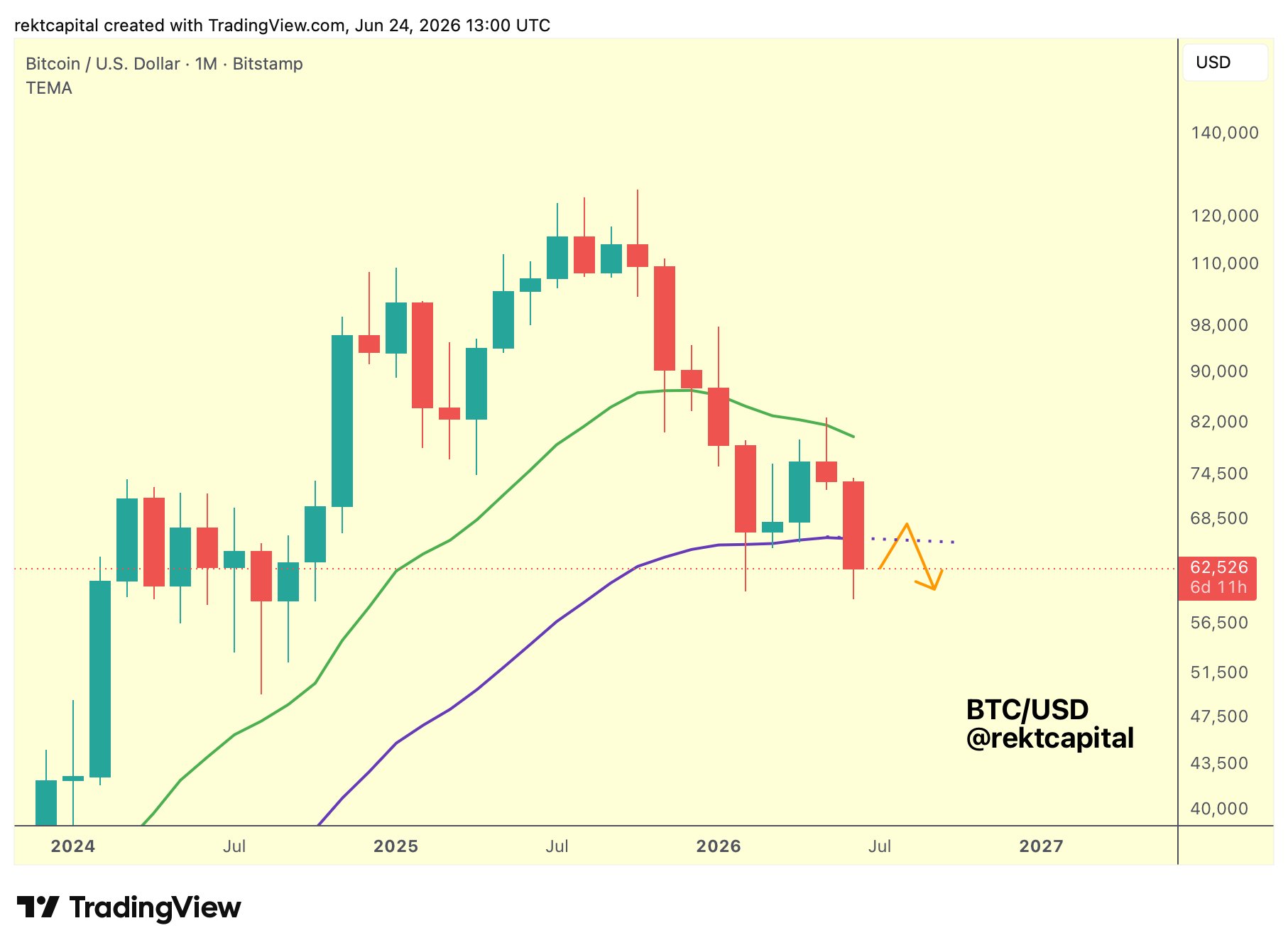
BTC/USD one-month chart with 21, 50EMA. Source: Rekt Capital/X

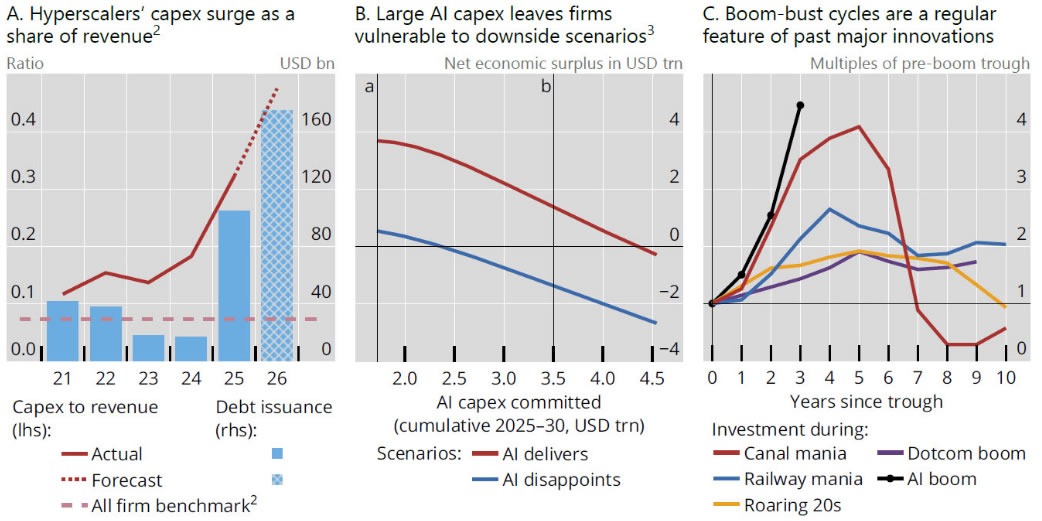
The Bank for International Settlements has warned that artificial intelligence “exuberance” could have major financial consequences, as heavy reliance on debt financing in AI ventures raises the risk of cascading defaults if investor optimism fades.
The five largest hyperscalers are set to spend more than $1 trillion on AI-related capital expenditures from 2025 through 2026, and these commitments are outpacing earnings, the Basel-based institution said in its annual economic report released Sunday.
“Equity valuations are elevated, particularly for firms at the core of AI development … sustaining such high growth could become increasingly challenging,” the bank said.
AI investment enthusiasm has surged with the recent SpaceX IPO and planned public offerings from Anthropic and OpenAI, leading some market observers to draw parallels to previous boom-bust cycles such as electrification exuberance in the late 1920s and the dot-com bubble in the late 1990s.
The global economy displayed “surprising resilience” in 2025 despite successive shocks, partly driven by AI investments, the bank said.
However, “perils have grown” in 2026, with concerns over the risks of persistent inflation, which rose to a three-year high of 4.2% in the US in May, according to TradingEconomics.
The sustainability of AI-related investments, “growing financial vulnerabilities and weakening fiscal positions,” has added to those perils, the BIS report said.
“Should inflation rise significantly or AI-led investment turn to a bust, the macroeconomic consequences could be amplified by existing financial vulnerabilities.”
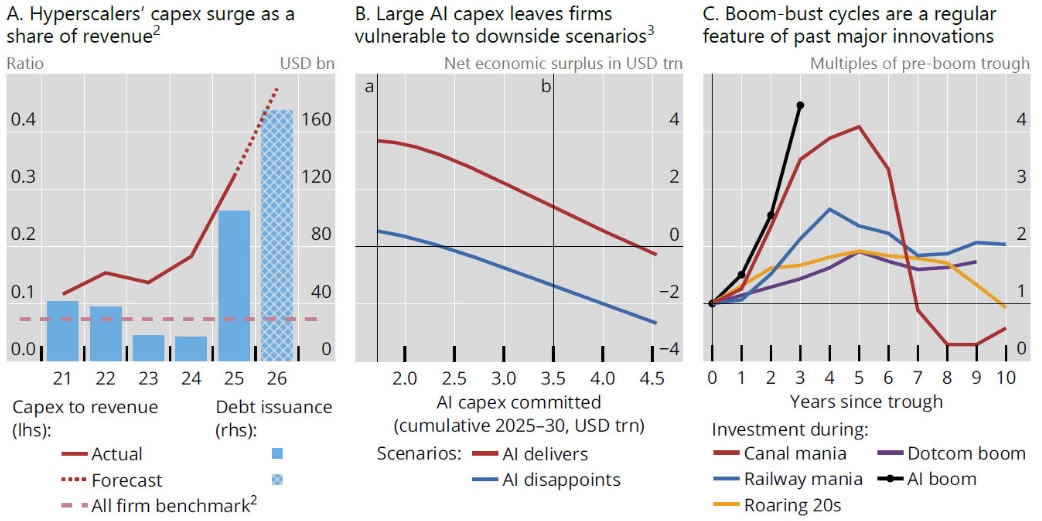
Rapid AI boom raises questions about its sustainability. Source: BIS
If central banks tighten policy to contain inflation, this could precipitate a “sharp pullback in [AI] asset prices after a prolonged period of exuberant risk-taking,” which could trigger “disruptive macro-financial feedback loops,” the BIS said.
“A reversal of AI optimism could likewise have major financial consequences, given AI firms’ rising leverage and growing footprint in credit markets.”
A potential flashpoint for systemic risk
The BIS cautioned that a large correction in AI valuations could have more pronounced wealth effects and a “sharper consumption pullback” than in the past, given US market dominance. “Financial stability could also be at risk in the event of an AI bust.”
Related: AI agents with crypto could escape and become ‘unstoppable,’ experts warn
Nick Ruck, director of LVRG Research, told Cointelegraph that the BIS was right to flag the AI investment surge as a potential flashpoint for systemic risk, “as financing has relied on enormous debt and highly leveraged nonbank structures that can rapidly unwind and amplify this cycle into a crisis.”
“The current macroeconomic environment is already fragile from being stretched by inflation, record national debt, and disrupted commodity markets, so a bust of the AI capital stack could send shockwaves through an already strained global economy.”
The BIS also cautioned about stablecoins, which risk fragmenting the global monetary system and could weaken sovereign monetary control, it said.
Chipflation could compound the problem
The AI industry could also become a victim of its own success, as surging semiconductor and memory chip prices, driven by increasing AI data center demand outstripping supply, could compound inflation, which consumers will ultimately have to bear.
This phenomenon, known as “chipflation,” is causing prices for devices from smartphones to laptops to climb, Morgan Stanley analysts cautioned earlier in June.
In March, BlackRock reported that surging semiconductor prices were “posing upside risks to global goods inflation.”
Meanwhile, Apple is already passing costs on to customers by hiking prices. The tech giant announced Thursday that a wide array of products, from iPads to Macs and home devices, would see increases from 18% to nearly 33% due to soaring memory and storage chip costs.
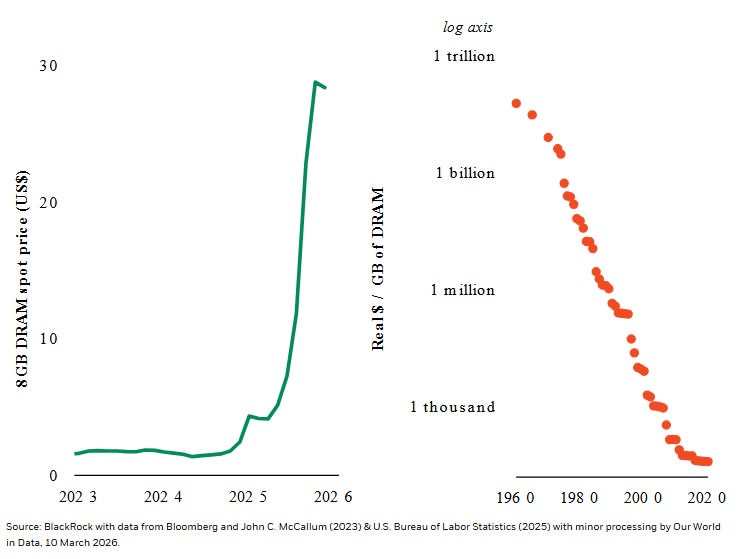
Price jumps for DRAM chips defy deflationary price dynamics. Source: BlackRock
Magazine: AI is banking the unbanked in Africa… faster than crypto
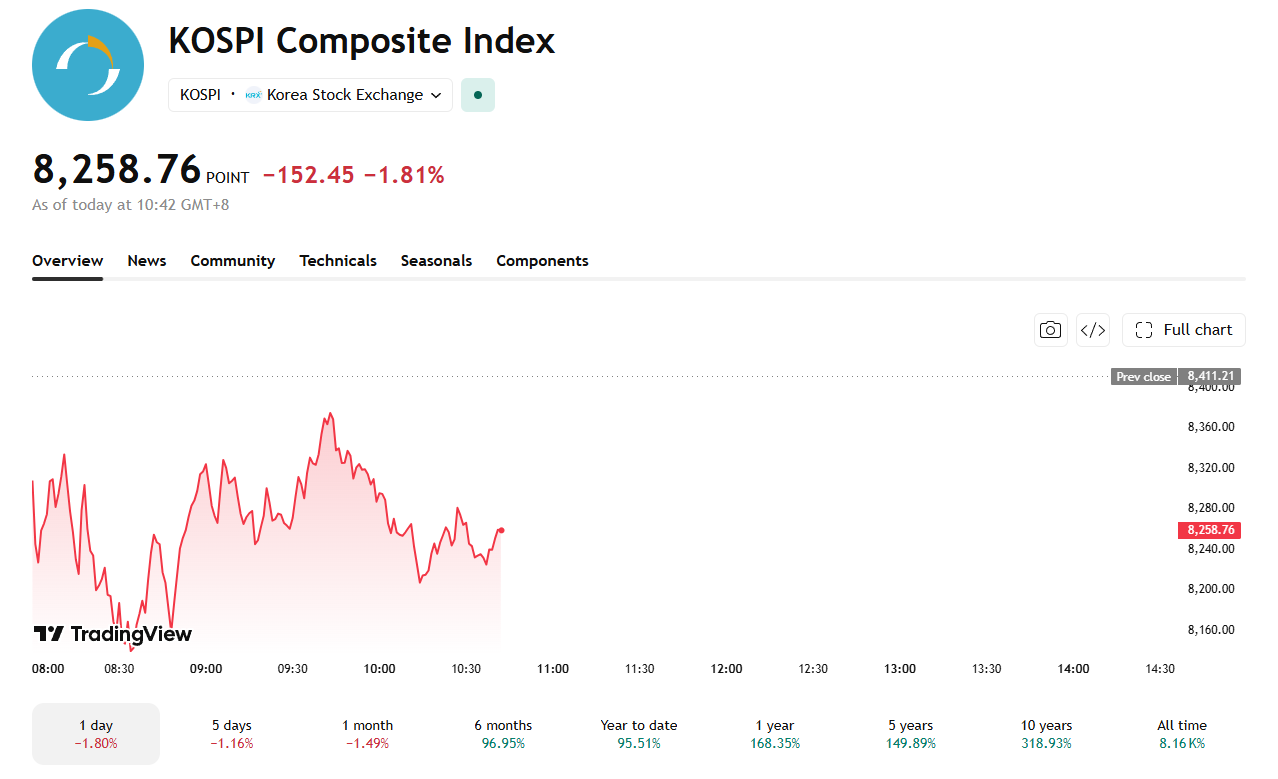
Samsung Electronics and SK Hynix each unveiled major chip investment plans Monday at a presidential briefing in Seoul. Neither announcement stopped their stocks from falling sharply.
Samsung dropped 5.3% to 321,500 won from a Friday close of 339,500 won. SK Hynix fell 3.4% to 2,583,000 won from 2,673,000 won. The KOSPI settled near 8,258, down from 8,411.
Why the Announcements Didn’t Move Markets Higher
Samsung Group presented a roughly 1,000 trillion won spending package to President Lee Jae-myung. SK Group followed with a separate 1,000 trillion won plan. Both cover new semiconductor fabs, AI data centers, and chip cluster development over the next decade. Fortune reported the combined figure at around $1.3 trillion.
Markets shrugged. The Korea Exchange scrapped its planned launch of weekly options contracts tied to Samsung, SK Hynix, Hyundai Motor, and LG Energy Solution. Regulators pulled the product after retail investors poured into daily double-leveraged ETFs, pushing KOSPI volatility to record highs. That decision removed a key tool for short-term traders and hit speculative appetite immediately.

Chip Selloff and Middle East Pressure Compound the Pain
Global tech sentiment stayed negative. Last week, South Korea’s market triggered circuit breakers twice on fears over AI chip valuations. Samsung and SK Hynix make up roughly 42% of the KOSPI, so chip selling anywhere hits Seoul hard. South Korean retail investors who borrowed heavily during recent rallies now face compounding losses.
Middle East tension added pressure. The US struck Iranian military targets over the weekend. Both sides then agreed to halt attacks and meet on Tuesday in Doha. Japan’s Nikkei 225 also fell as SoftBank retreated, extending a pullback after six consecutive record sessions.
The post Samsung and SK Hynix Fall Despite Separate $1.3 Trillion Chip Plans appeared first on BeInCrypto.
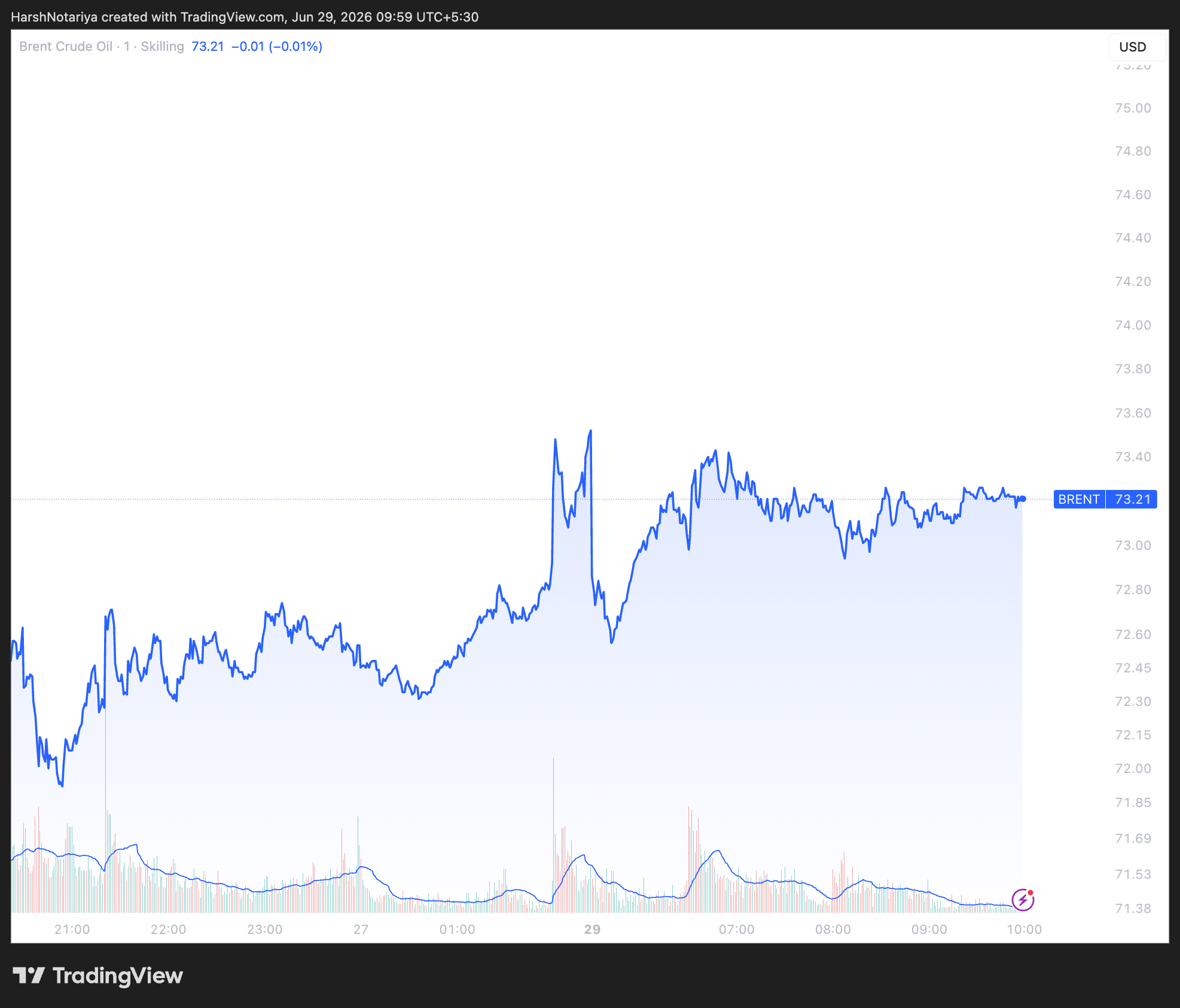
Oil clawed back above $70 a barrel on Monday, June 29, after a new round of US-Iran strikes over the Strait of Hormuz rattled energy markets over the weekend. This is despite both sides agreeing to stand down and return to the negotiating table.
West Texas Intermediate futures rose 1.3% to $70.17. Brent climbed to $73.21. Both benchmarks had settled at their lowest levels since late February by last Thursday, June 25, before the latest exchange of strikes broke out.
What Happened Over the Weekend
The trigger was a June 25 drone strike by Iran’s Islamic Revolutionary Guard Corps (IRGC) on the Singapore-flagged Ever Lovely, a container ship operated by Taiwan’s Evergreen Marine. The vessel was transiting the southern corridor near the Omani coast when the IRGC hit it, just days after the UN launched an evacuation plan for hundreds of stranded ships.

The US launched retaliatory strikes on Iranian military sites on June 26. The IRGC hit US forces in Bahrain with drones on June 27. The US struck Iran again that same day. By June 28, Iran had targeted US positions in both Bahrain and Kuwait.
President Donald Trump warned of devastating consequences on Truth Social, writing that US aircraft had struck Iranian missile and drone storage facilities for violating the ceasefire “AGAIN!”
“United States aircraft just struck Iranian missile and drone storage locations, and coastal radar sites, for violating the Cease Fire Agreement, AGAIN!… If that happens, the Islamic Republic of Iran will no longer exist!”
— Donald Trump, Truth Social

Markets Caught Between War and Diplomacy
A US official told Reuters that “both sides will stand down for now and vessels can move freely,” with technical talks set for Doha on Tuesday. Iran’s Foreign Minister Abbas Araghchi held firm, insisting Tehran alone manages Hormuz traffic and will not yield that authority.
Shipping data showed only 48 vessel transits through Hormuz between June 26 and June 28, down from 70 on the Wednesday before the escalation. Traders have watched this Hormuz oil dynamic play out all month.
Oil rises hard on war signals and barely moves on peace ones. Tuesday’s Doha session will test whether both sides can resolve the dispute over who controls the waterway.
The post Trump Threatens Iran Annihilation as Oil Price Staggers Toward Doha Talks appeared first on BeInCrypto.

Dubai’s crypto licensing ecosystem continues to expand. The emirate’s Virtual Assets Regulatory Authority (VARA) has granted its 50th virtual asset service provider (VASP) license, with tokenized-assets platform Tribe Tokenisation FZE receiving the latest approval on Monday.
While VARA’s license count is a useful headline for market growth, a regulator spokesperson cautioned that a granted license does not automatically mean a firm has already started commercial operations. Newly authorized companies may be required to go through a controlled operationalization period before offering services or onboarding customers.
Key takeaways
- VARA has issued its 50th VASP license to Tribe Tokenisation FZE, adding to Dubai’s rapidly growing authorization pipeline.
- VARA says an active license does not necessarily reflect that a company has completed its commercial launch.
- According to VARA, 39 licensed VASPs were considered fully operational at the end of 2025, with an updated 2026 figure being validated.
- Dubai’s licensing totals are higher than those seen in Hong Kong and Singapore, but the categories being counted are not directly comparable across jurisdictions.
What the 50th VASP license signals for Dubai
VARA’s approval of Tribe Tokenisation FZE reflects the continued rollout of Dubai’s standalone regulatory framework for virtual assets, created to attract digital asset businesses while keeping a distinct compliance track. VARA was established in March 2022 as Dubai’s dedicated crypto regulator.
The milestone matters most for firms planning expansions or new product launches, because licensing can influence whether customers, counterparties, and institutional partners treat a business as compliant and operationally ready. At the same time, VARA’s clarification helps calibrate expectations: the regulator indicated that licensing is only one step in a broader process that may include a period of controlled operationalization.
That distinction is important for investors and market observers because license approvals can outpace the moment when services actually become available to the public. Without additional context, a growing VASP count could look like instant market activation even when new entities are still preparing their infrastructure, controls, and customer-facing workflows.
Operational numbers: licenses versus “fully operational” status
VARA also pointed to the difference between being licensed and being active in the market. A spokesperson told Cointelegraph that holding an active license “does not necessarily” indicate a firm has completed its commercial launch. In practice, newly licensed companies may move through a controlled operationalization phase before they offer services or begin onboarding customers.
As of the end of 2025, VARA classified 39 licensed VASPs as fully operational. The spokesperson added that VARA is validating an updated figure for 2026, implying that the operational count may change as firms complete their rollout and as the regulator updates its assessment criteria.
For market participants, this creates a more nuanced way to interpret Dubai’s regulatory momentum: instead of treating license totals as a proxy for active competition, investors and users may want to monitor operationalization progress and VARA’s periodic “fully operational” updates.
How Dubai compares with Hong Kong and Singapore
Dubai’s 50 licensed VASPs place it above the headline numbers reported in Hong Kong and Singapore—two jurisdictions also attempting to position themselves as regulated destinations for crypto-related activity. However, VARA’s spokesperson emphasized that totals across jurisdictions are not directly comparable because each regime licenses different types of businesses.
In Singapore, the Monetary Authority of Singapore (MAS) listed 37 major payment institutions (MPI) authorized to provide digital payment token (DPT) services. Singapore regulates DPT services within its payments framework rather than operating a standalone VASP regulator that mirrors VARA’s approach.
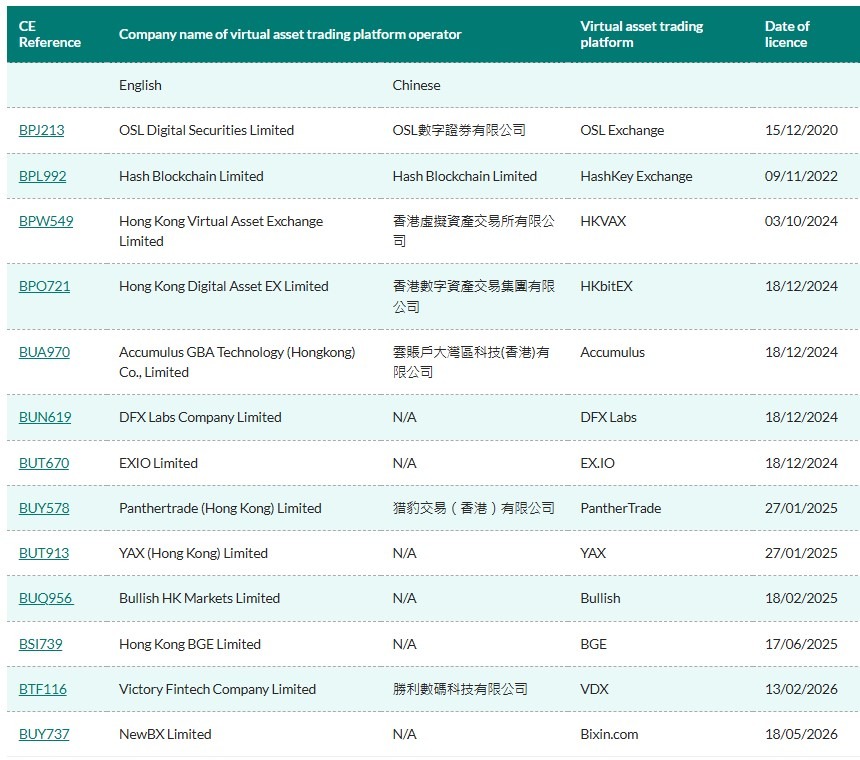
Hong Kong provides another contrast. The Securities and Futures Commission (SFC) lists 13 formally licensed virtual asset trading platforms, but the scope is narrower because the regime is specifically limited to operators of trading platforms, rather than covering the broader range of VASP activities that VARA may license under its framework.
VARA attributed Dubai’s market growth to an activity-based regulatory framework and a wider financial ecosystem supporting digital asset businesses. Beyond licensing categories, VARA said it also evaluates evidence of market activity such as transaction volumes, assets under management, employment, and audited financial data when assessing how the sector is developing.
Why the “activity-based” approach may affect market quality
A key takeaway from VARA’s explanation is that the regulator appears to be measuring more than just compliance paperwork. By considering transaction volumes, assets under management, staffing, and audited financial information, VARA is effectively pushing regulated firms to demonstrate real operational substance—not only formal authorization.
This approach can influence how quickly regulated firms convert from “licensed” to “business generating activity.” It also suggests why VARA’s operational figure (39 fully operational at the end of 2025) may lag behind the total license count as the regulator processes new entrants and as firms transition through operationalization.
For the broader market, these differences are especially relevant at a time when jurisdictions are competing for crypto business but varying significantly in how they structure oversight, define licensing categories, and evaluate readiness to operate. Dubai’s latest license adds another data point, but the more informative metric may be how many of those approvals translate into fully operational entities capable of meeting the regulator’s broader activity checks.
Next, investors and builders looking at Dubai’s regulatory landscape should watch for VARA’s updated “fully operational” count for 2026 and for signals on how quickly newly licensed firms complete their operationalization stages—because that is where licensing momentum is most likely to translate into real market activity.


U.S. spot bitcoin ETFs have recorded $4.06 billion in net outflows this month, according to data from SoSoValue. It marks the largest monthly redemption on record, exceeding the previous high of $3.56 billion in February 2025.
Last week, the funds saw redemptions of about $1.79 billion, the second-highest weekly outflow since trading began in January 2024. (These figures could shift slightly based on flows over the final two trading days of the month.)
This trend runs counter to expectations early in the month of renewed demand following SpaceX’s IPO on June 12.
Spot ETFs serve as a widely followed barometer for institutional investors seeking regulated exposure to bitcoin without directly holding the cryptocurrency.
June’s outflows followed $2.43 billion in net redemptions in May, bringing the two-month total close to $6.5 billion. That figure is comparable to the current market capitalization of zcash (ZEC), currently ranked among the world’s 15 largest cryptocurrencies by market cap.
On a year-to-date basis, net outflows tally roughly $5 billion in the first half of 2026.
The impact of this collapse in institutional demand is evident in bitcoin’s price performance, which has declined around 30% in the first half, underperforming nearly every major asset class except Strategy (MSTR). Shares in the bitcoin-holding publicly listed firm have tanked by 45%.
The Virtual Assets Regulatory Authority (VARA), Dubai’s crypto regulator, has granted its 50th virtual asset service provider (VASP) license.
On Monday, VARA said its latest approval went to tokenized assets platform Tribe Tokenisation FZE.
The milestone provides one measure of the growth of Dubai’s crypto licensing regime, though license totals alone do not show how many firms are operational or the level of business they generate.
A VARA spokesperson told Cointelegraph that holding an active license does not necessarily mean a firm has completed its commercial launch. Newly licensed companies may go through a controlled operationalization period before offering services or onboarding customers.
Related: Senate Dems urge probe into $500M crypto deal between Trumps, UAE
At the end of 2025, VARA classified 39 licensed VASPs as fully operational. The spokesperson said the regulator is validating an updated figure for 2026.
Dubai’s bid to attract crypto firms
Dubai has spent the past several years positioning itself as a global hub for digital asset businesses. As part of that effort, the emirate established VARA in March 2022 as a dedicated crypto regulator and has sought to attract crypto businesses through a standalone licensing framework.
Against that backdrop, Dubai’s 50 licensed VASPs exceed the totals reported in Hong Kong and Singapore, two other jurisdictions competing to attract regulated crypto businesses. Each jurisdiction licenses different types of crypto businesses, meaning the headline totals do not represent identical categories of firms.
As of Friday, the Monetary Authority of Singapore (MAS) listed 37 major payment institutions (MPI) authorized to provide digital payment token (DPT) services. Singapore regulates DPT services within its broader payments regime rather than through a standalone VASP regulator like VARA.
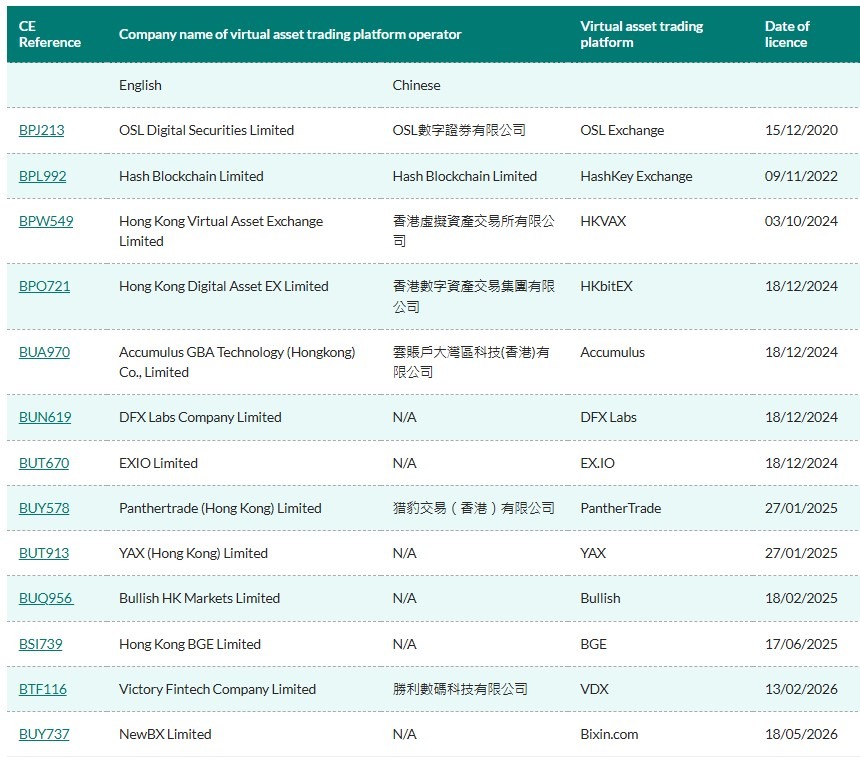
List of licensed virtual asset trading platforms in Hong Kong. Source: SFC
Hong Kong’s Securities and Futures Commission (SFC) has listed 13 formally licensed virtual asset trading platforms. The count is narrower because the regime is specifically limited to platform operators.
The VARA spokesperson attributed Dubai’s market growth to its activity-based regulatory framework and broader financial ecosystem, and said the regulator also considers transaction volumes, assets under management, employment and audited financial data when assessing market activity.
Magazine: Japanese pension fund tips 1% in crypto, G7 urges action on NK hackers: Asia Express
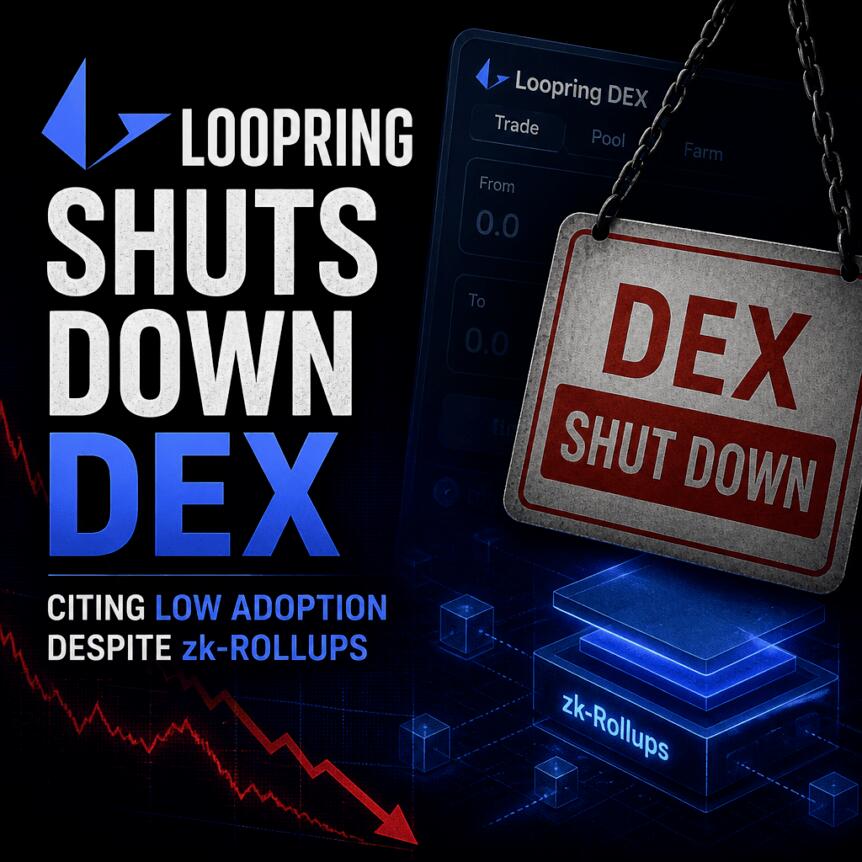
Loopring, Ethereum’s earliest zero-knowledge (zk) rollup and a long-running decentralized exchange (DEX) built on zk proofs, has announced the shutdown of its DEX and automated market maker (AMM). In a post published on X on Sunday, the team said trading services will end immediately and that relayer operations will also halt.
Loopring’s developers framed the decision as the end of an “inevitable” path: the protocol, they argued, never achieved meaningful adoption; the team lacked the business-development skills needed to scale; and newer zkEVM-based rollup designs have left its specialized architecture increasingly obsolete.
Key takeaways
- Loopring will close its DEX/AMM and stop relayer services effective immediately, ending trading on the platform.
- The team cites limited adoption, a gap in business development execution, and technological displacement by newer zkEVM rollups.
- Loopring already shut down its wallet services in July 2025, and the DEX closure follows that earlier contraction.
- Loopring says it will reconcile user balances and distribute funds directly to users’ Ethereum wallets in batches while covering gas fees.
- L2Beat data shows Loopring’s total value locked (TVL) fell to about $8 million, down nearly 99% from its November 2021 peak.
Shutdown announced: DEX, AMM and relayer go dark
Loopring’s announcement, made via an X post on Sunday, specifically ended three parts of its offering: its DEX and AMM trading services, plus the relayer that supports the system. The team described the move as a “graceful” exit, emphasizing that continuing to run a service that no longer matches market expectations would be worse than ending it.
After the closure, Loopring said it would calculate and publish all final user balances. The next step, according to the post, is direct distribution to users’ Ethereum wallets. The team also said it will handle gas fees during these payouts and complete transfers in batches.
Why Loopring says it failed to keep up
Loopring’s reasoning was both technical and operational. In its post, the team acknowledged that the project “never gained meaningful adoption.” It tied that outcome to the original design choice of being an early zk rollup without a virtual machine, which it said limited composability and reduced real-world payment and application use cases.
The developers also said the organization’s capabilities did not align with what the ecosystem later required. Loopring described itself as “engineers at heart,” noting that while the team excelled at writing code, it did not develop the “passion or skills for business development” necessary to grow as the market matured.
Technological change, however, was central to the argument. Loopring said competitors built on modern approaches—described as “fully compatible with Ethereum smart contracts”—have compounded the gap. In that context, it said its “specialised architecture now feels obsolete,” making a discontinued service a preferable outcome to maintaining an inactive or hollow platform.
Earlier milestones—then a shrinking rollup market
Loopring’s history helps explain why the closure resonates beyond a single product. The project was a technical pioneer when zk rollups were still being validated. The team has pointed to its 2017 initial coin offering that raised $45 million, alongside its role in demonstrating that Ethereum scaling via zk proofs was feasible.
But the same early “first mover” status can become a liability as the sector standardizes around features modern builders expect—especially a general-purpose execution environment and compatibility patterns that make deployment and composition easier. Loopring said later successors helped it inspire, including zkSync, Scroll, and StarkNet, ultimately brought more capable designs.
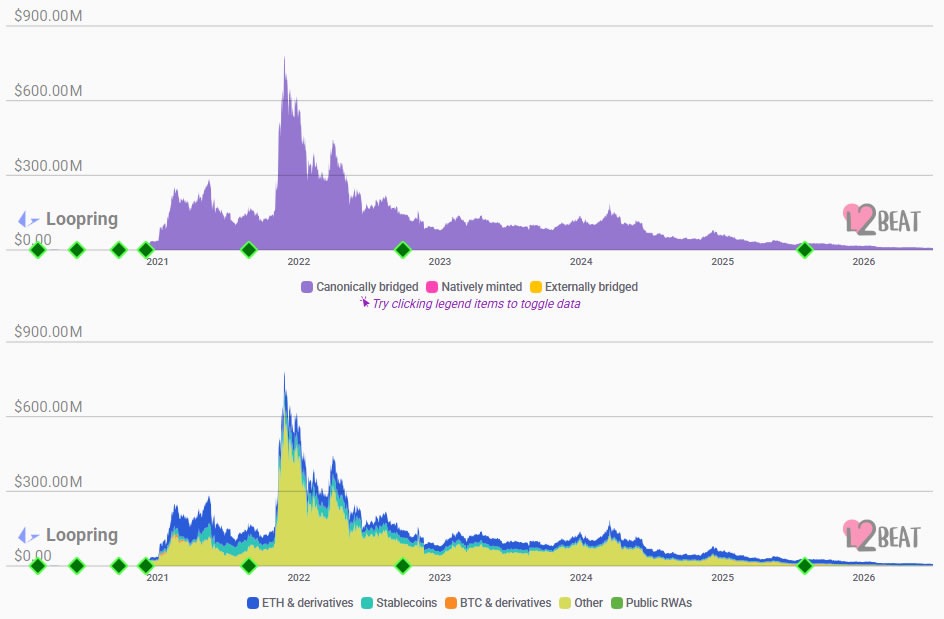
Loopring’s token and usage trajectory also mirrored broader shifts. According to L2Beat, Loopring’s total value locked is about $8 million. The same data shows TVL down nearly 99% from roughly $760 million at its November 2021 peak. L2Beat tracking also indicates that Loopring’s native token, LRC, fell by a similar magnitude—down to about $0.01 from its all-time high of $3.75 in that same month of November 2021.
One of Loopring’s better-known milestones was a partnership with GameStop in 2021 to support GameStop’s NFT platform, which launched the following year. The DEX shutdown suggests that, while parts of the ecosystem may have found moments of traction, the core trading infrastructure did not remain competitive as the rollup landscape shifted.
Broader closures and what to watch next
Loopring’s exit lands amid a wider wave of operational wind-downs in crypto. The article cites that more than 60 crypto projects and protocols had already shuttered services in 2026, according to RootData, and points to additional closures referenced in earlier coverage—such as Syndicate Labs, which reportedly shut down after five years citing a shrinking rollup market.
For users, the immediate priority is the settlement process. Loopring says it will reconcile final balances and distribute funds directly to users’ Ethereum wallets, covering gas fees during batch payouts. Readers should watch for the team’s published balance calculations and confirm that their wallet addresses are included correctly in the settlement queue.
More broadly, Loopring’s closure underlines a key shift for Ethereum scaling businesses: early technical novelty is not enough to sustain a product if adoption fails to materialize and newer architectures outcompete with stronger compatibility and developer ecosystems. Investors and builders should monitor how remaining rollup-focused services position their technical roadmaps—particularly around execution environments and how effectively they convert protocol capability into sustained user demand.
Ethereum’s first zero-knowledge rollup, Loopring, announced Sunday the closure of its decentralized exchange and automated market maker, ending all trading services and halting the relayer effective immediately.
In a post on X on Sunday, the team cited three main reasons for the closure: its failure to gain meaningful adoption, a lack of business development skills and being technologically surpassed by modern zkEVM solutions.
“To be honest, Loopring never gained meaningful adoption,” the team said. “As the first zk-rollup, we lacked a virtual machine – no composability, no real‑world payment use cases. That limitation kept our ecosystem from growing.”
Loopring was a technical pioneer of its time, raising $45 million in a 2017 initial coin offering and helping to prove that scaling Ethereum via zk-rollups was viable. But technology evolves fast in the crypto industry, and it was ultimately surpassed by the more capable successors it helped inspire, such as zkSync, Scroll and StarkNet.
The team said they are “engineers at heart,” not business operators, excelling at writing code but never developing the “passion or skills for business development.”
“External pressures – including major exchange delistings of LRC in 2026 – only accelerated the inevitable,” they said.
The team added that pressure from more advanced competitors, which are fully compatible with Ethereum smart contracts, “while our specialised architecture now feels obsolete,” compounded the decision to gracefully end it, “rather than running a hollow service.”
Loopring had already shut down its wallet services in July 2025, citing scaling challenges.
Related: Syndicate Labs winds down after 5 years, citing shrinking rollup market
With the DEX closure, the team said it will be calculating and publishing all final user balances, then distributing funds directly to users’ Ethereum wallets in batches and covering gas fees.
Loopring’s total value locked is about $8 million, down almost 99% from the $760 million peak in November 2021, according to L2Beat. Its native token, LRC, has collapsed by a similar amount to $0.01 from its all-time high in the same month of $3.75.
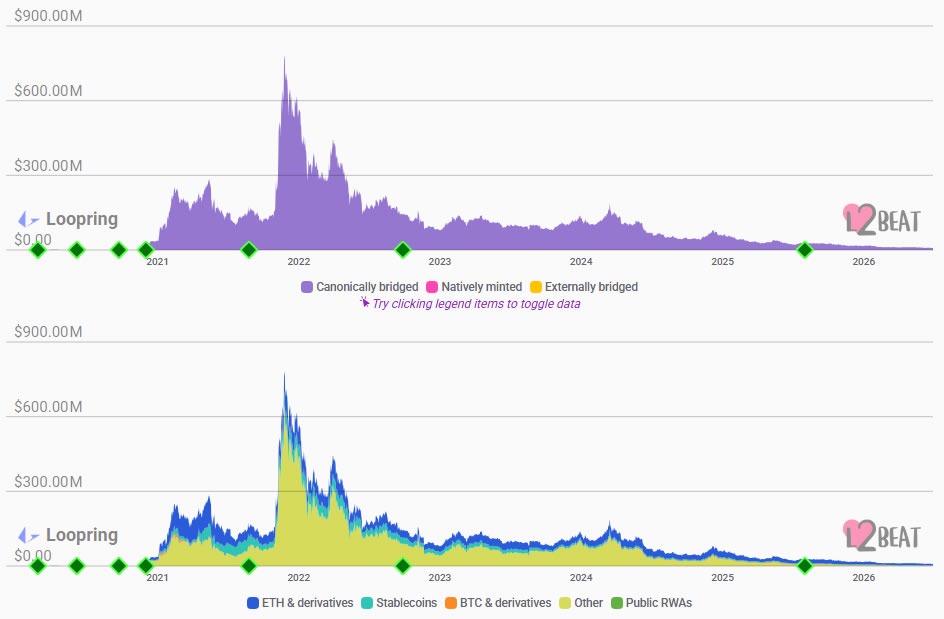
Loopring’s total value locked has collapsed over the past five years. Source: L2Beat
One of Loopring’s biggest milestones was a 2021 partnership with GameStop to power its NFT platform, launched the following year.
Crypto winter bites deep this year
The demise of Loopring adds to the growing list of crypto closures this year, as the bear market deepens and previous-cycle narratives no longer apply.
More than 60 crypto projects and protocols have already shuttered services in 2026, according to RootData. Some of the more notable ones include a16z-backed decentralized self-custody solution Entropy, app-chain infrastructure protocol Syndicate and AI blockchain platform Yupp.
Magazine: Bitcoin slides to $58K, XRP hits $1 but onchain data promising: Market Moves
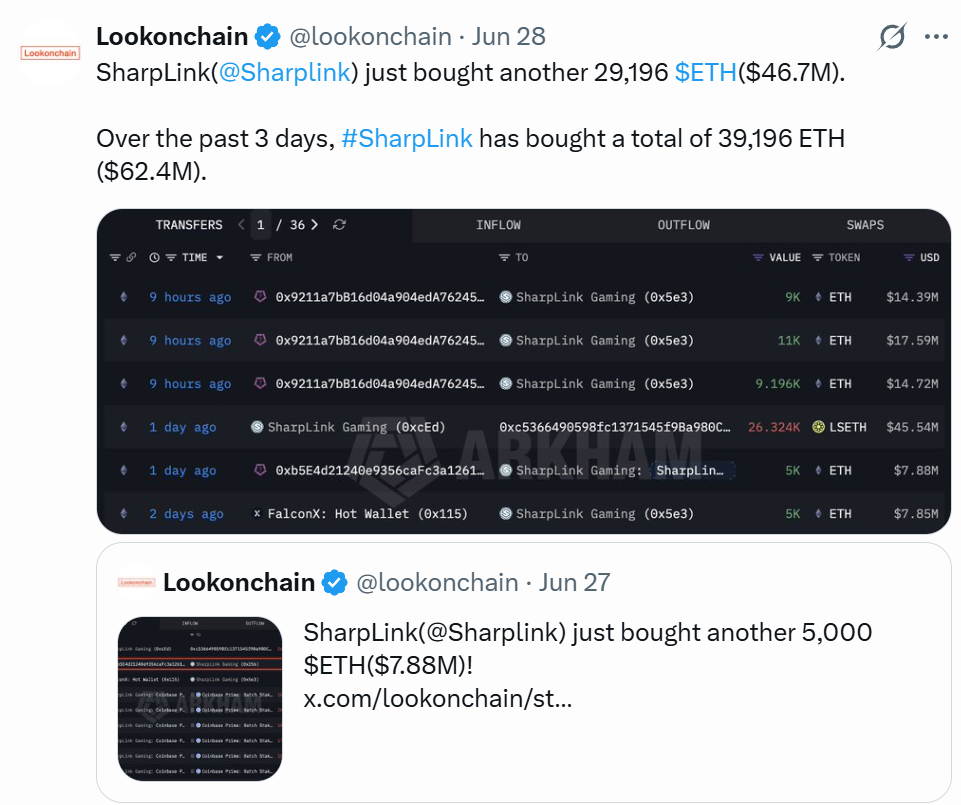
Crypto treasury company Sharplink, which resumed buying Ether last week after an eight-month pause, has bought a total of $62.4 million worth of Ether since Thursday.
Onchain data from Arkham shows that after Sharplink bought 5,000 ETH on Thursday, it bought another 5,000 ETH (worth $7.9 million) on Friday, followed by 29,196 ETH (worth $46.7 million) across three over-the-counter transactions on Saturday.
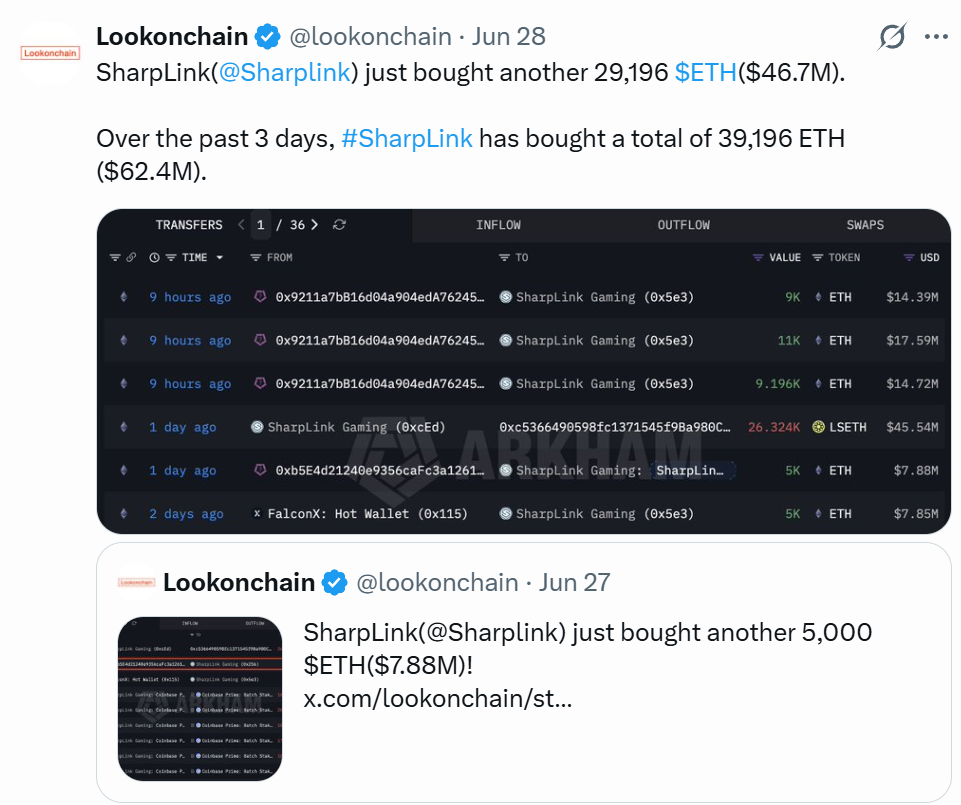
Source: Lookonchain
The three-day buying spree adds to evidence that Sharplink has revived its active Ether accumulation strategy. The crypto treasury company was once a close competitor to Bitmine as the world’s largest ETH treasury company.
Sharplink declined to comment on the reason and timing of the Ether purchase when first contacted on Thursday.
Sharplink backs Ethlabs
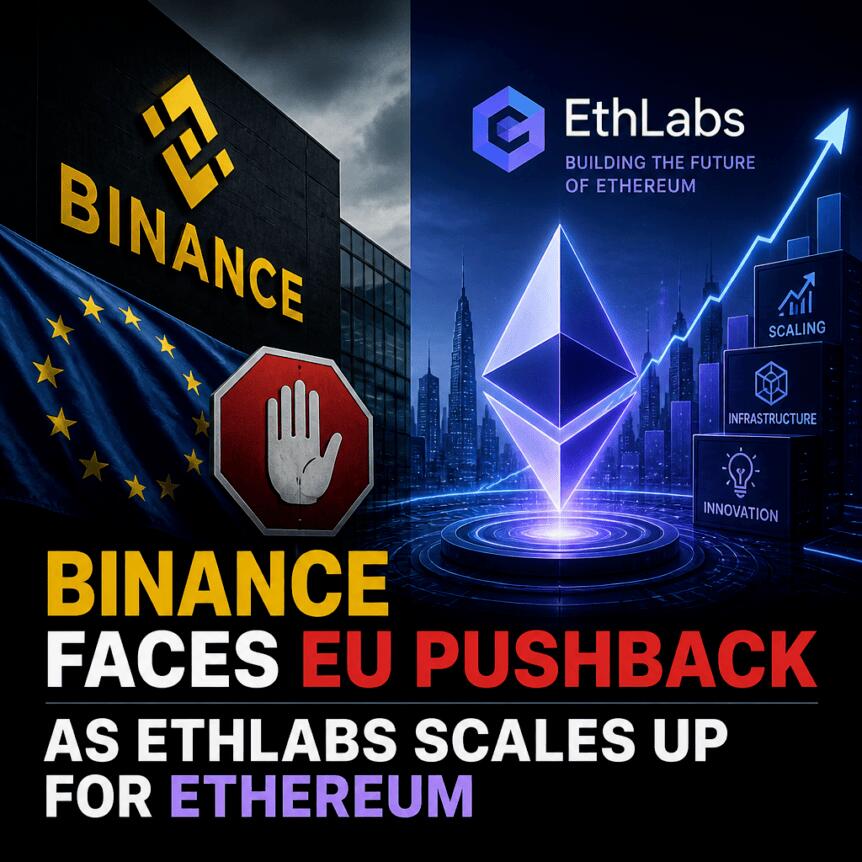
However, the purchases came the same week that both Bitmine and Sharplink backed a new research and development nonprofit that aims to make Ethereum ready for institutional use.
Sharplink said on Monday that the organization, Ethlabs, was formed to “ready Ethereum for the next phase of institutional adoption,” with the company joining Bitmine, Ethereum co-founder Joe Lubin and other Ethereum contributors in backing the initiative.
Related: Sharplink, Forward Industries among crypto firms considered for Russell indexes
“As stablecoins, tokenized real-world assets, funds and autonomous AI commerce move on-chain, they are converging on Ethereum as the neutral, credibly permissionless settlement layer for the global economy,” Sharplink said. “Ethlabs exists to ensure the network is ready to absorb that demand at scale.”
Ether slump
The purchases also come as the cryptocurrency is down 22.8% month-on-month, and nearly 50% compared to the start of the year, allowing Tether stablecoin USDt (USDT) to briefly surpass Ether in market capitalization last week.
Meanwhile, US spot Ether ETFs recorded their seventh week of outflows last week, recording $12.9 million in net outflows, driven mainly by withdrawals from BlackRock’s iShares Ethereum Trust (ETHA).
Magazine: Bitcoin slides to $58K, XRP hits $1 but onchain data promising: Market Moves
Prediction markets are quietly becoming a new on-ramp to crypto. A 90-day Bitget Wallet study tracking onchain activity from 857,000 active Polymarket users found that about 60% of people who placed their first World Cup bets on the platform had never interacted with blockchain protocols before.
Separately, US crypto policy is still moving—albeit amid political crosswinds—after Donald Trump canceled the signing ceremony for a housing bill that includes a ban on central bank digital currencies (CBDCs). Meanwhile, Ethereum’s ecosystem is seeing fresh institutional positioning efforts, including new research-and-development backing aimed at supporting the network’s next adoption phase.
Key takeaways
- Bitget Wallet data suggests prediction markets can draw first-time crypto users without requiring prior blockchain familiarity.
- Trump’s delay of a housing bill highlights how CBDC-related provisions may remain entangled with broader US legislative priorities.
- New backing for an Ethereum R&D nonprofit, Ethlabs, targets “institutional adoption” readiness as ecosystem funding concerns persist.
- Crypto market coverage this week also pointed to growing scrutiny of US regulatory proposals and ongoing pressure on large holders’ liquidity management.
Prediction markets as a practical crypto on-ramp
According to the Bitget Wallet study, roughly six in ten Polymarket users who made their first World Cup bets had no prior experience with blockchain protocols. That pattern matters because onboarding into crypto has historically focused on teaching users the mechanics—wallets, custody, signing transactions—or at least easing those steps through better interfaces.
In an interview with Cointelegraph, Bitget Wallet COO Alvin Kan said earlier onboarding approaches often assumed users would still need to learn how crypto works before they could participate. Prediction markets, he argued, change the incentive: users arrive because they already have a view about what could happen in the real world, and the crypto component becomes secondary to the outcome betting.
“Prediction markets shifted that dynamic. Users show up because they have a view on something happening in the world,” Kan said.
The implication for the broader industry is straightforward: if prediction markets can repeatedly attract people who have never touched crypto, they may function like a bridge between mainstream “event-driven” behavior and onchain settlement. For builders, the operational question is how well these first-time users can be retained after the initial activity—whether they continue using wallets, understand transaction flows, and eventually seek out other onchain services beyond betting.
US housing bill CBDC ban delayed amid SAVE America Act linkage
US President Donald Trump canceled the signing ceremony for the 21st Century ROAD to Housing Act, a measure that had already passed the US House and Senate and includes a provision barring the Federal Reserve from issuing or creating a CBDC—or a digital asset “substantially similar”—until the end of 2030.
In a Truth Social post, Trump said the signing would be postponed “until such time as we pass the desperately needed SAVE America Act.” He has previously indicated he would not sign other bills until that voting-related legislation moves forward.
Coverage noted that the housing bill had been widely expected to be signed without complications, but the president’s stated approach ties the CBDC-adjacent timeline to a separate political objective in Congress. The SAVE America Act would require proof of US citizenship in person to register, a point that critics argue could disenfranchise eligible voters.
For crypto stakeholders, the immediate takeaway is less about the final fate of the housing bill and more about pacing: even when legislation includes concrete restrictions on CBDCs, political sequencing can still reshape when (and whether) the public policy signal fully lands.
Ethereum pushes for institutional readiness as funding pressures persist
Ethereum-related efforts this week centered on institutional readiness. Sharplink—backed by former Ethereum Foundation contributors and funded by Bitmine and Joe Lubin among others—announced the launch of Ethlabs, a new research and development nonprofit designed to help prepare Ethereum for what it described as a “next phase of institutional adoption.”
The group framed the moment in terms of market convergence: stablecoins, tokenized real-world assets, funds, and autonomous AI commerce are increasingly moving on-chain, and Ethlabs aims to ensure Ethereum can absorb the demand “at scale.”
The launch arrives against a backdrop of ecosystem concern about development resources. Cointelegraph previously reported warnings from former Ethereum Foundation contributor Trenton Van Epps about a potential core development funding crisis, and the Ethereum Foundation has also faced notable leadership departures, including the exit of co-executive director Hsiao-Wei Wang reported earlier.
What’s particularly relevant for investors and protocol participants is that Ethlabs signals parallel capacity-building outside the Foundation structure—an approach that may be increasingly common as the ecosystem searches for sustainable long-term funding models. However, readers should watch how these R&D efforts translate into measurable improvements—whether in scaling, privacy, security, or censorship resistance—rather than only in organizational announcements.
Strategy’s dividend strain revives liquidity and purchasing debate
While not tied to a single legislative or institutional headline, CryptoQuant’s analysis highlighted stress points in one of the largest Bitcoin treasury strategies. The analytics firm said Strategy’s dividend coverage fell to about 14 months from seven years, and recommended the company led by Michael Saylor pause Bitcoin purchases while replenishing its cash reserve, which it estimated has fallen 38% year-to-date.
CryptoQuant said Strategy’s dividend obligations have nearly quadrupled to $1.2 billion after the firm issued new STRC preferred stock with an 11.5% yield. In a Wednesday X post, CryptoQuant CEO Ki Young Ju urged a systematic framework for when Bitcoin purchases occur and also called for a “disciplined selling framework” for the next bull cycle.
Cointelegraph had earlier reported that Strategy repurchased $1.5 billion of its 2029 senior notes at a discount on May 26, and that its cash coffers recovered later after selling MSTR shares and adding $300 million to its US dollar reserve. Even so, CryptoQuant framed the remaining runway as near a record-low level of funds available to cover dividends.
For market participants, the broader lesson is that even in a Bitcoin-linked thesis, capital allocation discipline and liquidity planning remain the real constraints. Dividend mechanics can change the shape of risk regardless of long-term asset convictions.
Going forward, the most important thing to monitor is how these separate threads interact: whether prediction markets continue to widen crypto access without losing first-timers, whether US policy timelines involving CBDC restrictions accelerate or stall, and whether Ethereum’s new institutional readiness push can address ongoing development funding concerns with concrete, network-impacting outcomes.

Jack Kruse Reveals How Fast The Bitcoin ATTACK is SPREADING…

Work begins to build more than 85 affordable homes in Cambridgeshire village
Sampo completes share buyback of 2.96 million shares in week 26


-
 Sports5 days ago
Two goals and an assist by sheer aura: Cristiano Ronaldo just entered the World Cup chat
-

 Tech7 days ago
Microsoft accidentally kills epic Outlook email threads
-

 Fashion2 days ago
Weekend Open Thread: Staud – Corporette.com
-

 Politics3 days ago
The House | Manchesterism won’t survive the painful trade-offs unless it gets citizens on board
-

 Politics3 days ago
Potential 2028er World Cup attendee leaderboard
-

 Business3 days ago
Asia stock markets slide as tech shares slump
-

 Tech3 days ago
A Look At A Gaggle Of Transputer Boards
-
Crypto World5 days ago
Bitcoin (BTC) Dips Below $62K, Ethereum (ETH) Plunges 6% Daily: Market Watch
-
 Crypto World3 days ago
Dell (DELL) Shares Tumble Over 5% Following Analyst Downgrade to Hold
-

 Crypto World5 days ago
Securitize Wraps Roubini's SEC-Registered ETF as Dubai VARA Digital Security
-
Business5 days ago
Entergy settles forward sale agreements, raises $672 million in cash proceeds
-

 Crypto World2 days ago
Kraken's xStocks Opens Bending Spoons IPO Registration to EEA Retail
-

 Sports2 days ago
FIH Pro League: India defeat Pakistan 7-1, register biggest win of campaign | Other Sports News
-

 Crypto World2 days ago
Coinbase, Circle Deepen Crypto Stock Losses Despite Resilient S&P 500
-

 Crypto World3 days ago
RTX holders must register wallets before token distribution begins
-
 Crypto World3 days ago
Hyperliquid Named on Singapore MAS Investor Alert Register
-

 Tech1 day ago
Bluekit phishing kit adopts browser-in-the-middle for login theft
-

 Sports4 days ago
India vs Bangladesh LIVE Score, Women’s T20 World Cup: Bangladesh Opt To Bat; India Enter ‘Do-Or-Die’ Stage As Semi-Final Race Heats Up
-
Crypto World3 days ago
The DATA Foundation Launches to Tackle AI’s Multi-Billion Dollar Training Data Bottleneck
-

 Crypto World3 days ago
21Shares Cuts 2026 Crypto Forecasts as Institutional Demand Rises
You must be logged in to post a comment Login