

Crypto World
Sharplink Adds $62.4M in Ether to Treasury in Weekly Purchase

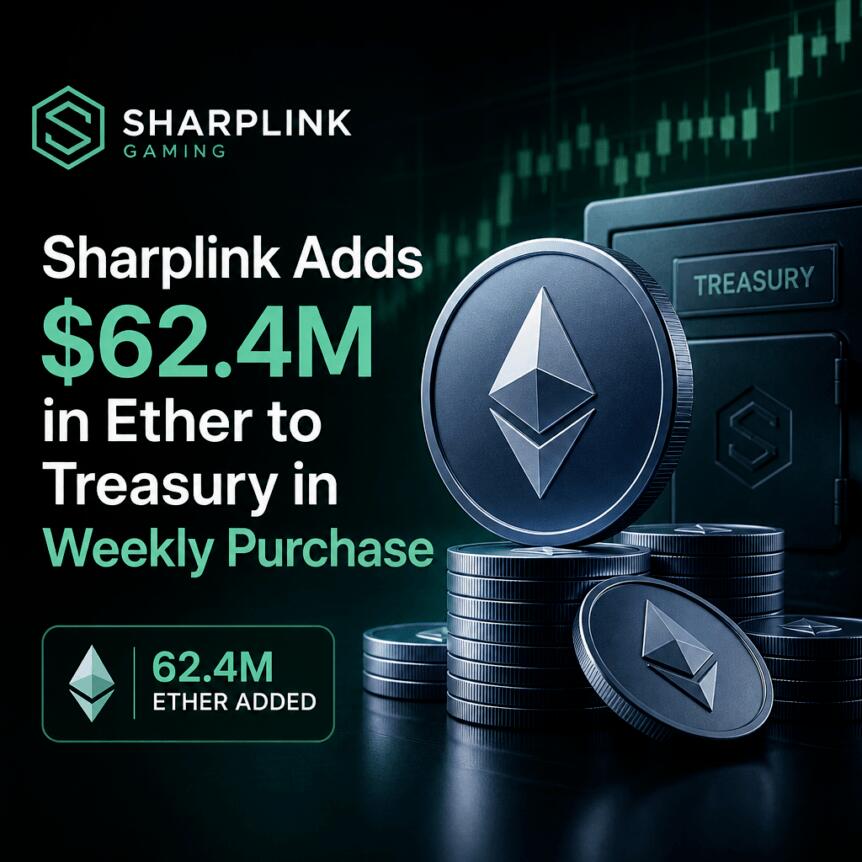
Sharplink, a crypto treasury firm that had paused its Ether purchases for roughly eight months, has restarted accumulation with a concentrated buy program. Arkham on-chain records reviewed by Cointelegraph show the company spent a total of $62.4 million on Ether purchases over the last three days.
According to Arkham data, Sharplink bought 5,000 ETH on Thursday, then added another 5,000 ETH (about $7.9 million) on Friday. On Saturday, it reportedly purchased 29,196 ETH (about $46.7 million) across three separate over-the-counter transactions, bringing the total to 62.4 million USD worth of Ether acquired since the resumption.
Key takeaways
- Arkham on-chain tracking indicates Sharplink accumulated 5,000 ETH on Thursday, 5,000 ETH on Friday, and 29,196 ETH on Saturday via OTC trades.
- The reported three-day total purchase value is $62.4 million, reinforcing the view that Sharplink has restarted active Ether treasury management.
- Sharplink has not publicly explained the timing or rationale for resuming buys after an eight-month pause.
- The Ether purchases coincided with Sharplink’s participation in backing Ethlabs, a new Ethereum-focused research and development nonprofit.
- Despite the accumulation, broader indicators cited in the report point to ongoing pressure on Ether investment flows, including continued outflows from spot Ether ETFs.
A renewed accumulation sprint after an eight-month break
The size and cadence of Sharplink’s recent purchases suggest the firm is not merely topping up occasionally. After halting Ether buying for eight months, it returned to the market last week and, based on Arkham entity tracking, quickly escalated the pace across three consecutive days.
The company was historically regarded as one of the closest competitors to Bitmine in the race for the largest ETH treasury holdings. While the latest trades do not provide an explicit reason for the restart, the pattern—multiple large orders concentrated over just a few days—implies a deliberate re-engagement with Ether as a core treasury asset.
When Cointelegraph initially reached out for comment, Sharplink declined to explain why it resumed buying Ether and why it did so at that specific time.
Ethlabs timing highlights a different angle: institutional readiness
Beyond treasury strategy, the buy activity arrived alongside a separate development tied to Ethereum’s longer-term positioning for institutional use. The same week that Sharplink restarted Ether purchases, both Bitmine and Sharplink—along with Ethereum co-founder and Sharplink chairman Joe Lubin—backed the launch of a new research and development nonprofit called Ethlabs.
In a Monday statement, Ethlabs was described as an effort to “ready Ethereum for the next phase of institutional adoption.” The organization’s stated aim is to ensure the network can handle demand at scale as tokenized assets, stablecoins, and other on-chain economic activity continue to move toward Ethereum as a settlement layer.
Sharplink’s accompanying remarks framed Ethereum’s role in terms of convergence: as stablecoins, tokenized real-world assets, funds, and AI-enabled commerce increasingly operate on-chain, the firm argued that Ethereum is becoming a “neutral, credibly permissionless settlement layer” for global economic activity. Ethlabs, in that view, exists to help the network absorb that demand.
For investors and builders, the practical relevance is twofold. First, large treasury operators signaling renewed commitment to Ether can be read as confidence in the asset’s role within the ecosystem. Second, an R&D initiative focused on institutional readiness points to a narrative push beyond price—toward infrastructure and capability that could support wider adoption over time.
Ether weakness persists as ETF outflows continue
Sharplink’s restarting buys comes at a moment when Ether has faced notable headwinds in the broader market. The report notes Ether is down 22.8% month-on-month and nearly 50% compared with the start of the year. It also references a period in which Tether’s USDT briefly surpassed Ether by market capitalization, underscoring how quickly sentiment can shift even as large holders accumulate.
Separately, the article highlights spot Ether ETFs as a near-term sentiment indicator. CoinShares data referenced in the piece shows US spot Ether ETFs recorded their seventh straight week of outflows last week, with $12.9 million in net outflows. Those withdrawals were reportedly driven mainly by outflows from BlackRock’s iShares Ethereum Trust (ETHA).
Taken together, the picture is uneven: while ETF investors appear to be reducing exposure, at least one major treasury player is increasing its Ether holdings with rapid, concentrated purchases. That divergence often matters for traders because it can influence how liquidity and narrative react during dips—particularly if treasury buyers provide consistent spot demand while exchange-traded demand remains soft.
What to watch next
Sharplink has not disclosed a reason for the resumption or provided guidance on whether the current pace is temporary or part of a longer accumulation cycle. Investors should watch for continued on-chain buying signals from the Sharplink entity and for whether ETF outflows persist or reverse, since those two data streams may increasingly determine Ether’s near-term market tone.



SharpLink has continued its renewed Ether buying campaign by acquiring another 39,196 ETH worth about $62.4 million over the past three days after returning to the market last week.
Summary
- SharpLink has bought another $62.4 million worth of Ether over three days after ending an eight month buying pause.
- The company has backed Ethlabs alongside BitMine and Joe Lubin to support Ethereum’s institutional development.
- Ether has remained under pressure as ETF outflows continued and the token traded well below SharpLink’s average purchase price.
According to on-chain data from Arkham, the crypto treasury company bought 5,000 ETH on Friday worth about $7.9 million, before adding another 29,196 ETH valued at roughly $46.7 million through three over the counter transactions on Saturday. The latest purchases followed a 5,000 ETH acquisition on Thursday, its first direct Ether purchase in eight months.
The fresh accumulation comes days after SharpLink resumed buying ETH as the token traded near its lowest price of 2026. As previously reported by crypto.news, a wallet linked to the company received 5,000 ETH from FalconX on Thursday, ending a buying pause that had lasted since October.
SharpLink resumes active accumulation
Taken together, the recent transactions suggest SharpLink has restarted active treasury accumulation after relying largely on its existing holdings and staking rewards for several months. As per Lookonchain data, the company held 876,285 ETH after Thursday’s purchase, including 22,102 ETH earned through staking, with an average acquisition price of about $3,609.
Lookonchain also estimated that SharpLink’s Ether treasury was sitting on an unrealized loss of roughly $1.71 billion as ETH continued trading well below the company’s average purchase price.
Alongside the treasury expansion, SharpLink announced on Monday that it has joined BitMine, Ethereum co-founder and SharpLink chairman Joe Lubin, and other Ethereum contributors in supporting Ethlabs, a new research and development nonprofit focused on preparing Ethereum for institutional use.
According to the company, Ethlabs will work on improving Ethereum’s readiness as stablecoins, tokenized real world assets, investment funds, and AI-driven commerce increasingly settle on the network. SharpLink said the organization was created to help Ethereum handle institutional demand at scale.
Ether remains under pressure
The renewed buying has come during a difficult period for Ethereum. Market data cited in the original report showed ETH was down 22.8% over the past month and nearly 50% since the beginning of the year. The decline briefly allowed Tether’s USDt stablecoin to overtake Ether by market capitalization last week.
Institutional demand through exchange traded funds has also remained weak. U.S. spot Ether ETFs posted their seventh consecutive week of net outflows, losing $12.9 million last week, with most of the withdrawals coming from BlackRock’s iShares Ethereum Trust.
The latest purchases also arrive ahead of SharpLink’s expected inclusion in the Russell 2000 and Russell 3000 indexes following the latest FTSE Russell reconstitution. Earlier, CEO Joseph Chalom said the additions could increase the company’s shareholder base and improve access to capital markets while supporting its long term Ether treasury strategy.
David “JoelKatz” Schwartz has proposed a transaction reservation plan for the XRP Ledger after fresh claims that users may still face front-running and sandwich attacks on payments, offer crossing, DEX trades and AMM swaps.
Summary
- Schwartz proposed reserved XRPL transaction slots to place protected trades before later disclosed transactions first.
- XRPresso claimed queue visibility may expose payments, offers, DEX trades and AMM swaps to targeting.
- XRPL’s growing DeFi roadmap makes transaction ordering fairness a larger concern for users and builders.
The debate started after XRPresso said some actors may be able to view pending transactions before a ledger closes and use that information to target trades.
“A serious front-running issue continues on the XRPL that disadvantages regular users.” XRPresso said validators and well-connected nodes can view transactions in the pre-validation queue, then submit their own transactions to seek a better position in the final ledger order.
XRPresso said the issue matters most for users trading through wallets and dApps. According to the post, the final order inside each ledger follows a known deterministic process, and repeated submissions may raise the chance of landing near a target trade. That could worsen slippage for the original trader when a sandwich strategy succeeds.
Schwartz lays out a reservation scheme
“For the reasons I’ve explained, I’m not that concerned about this issue.” Schwartz wrote that the concern still deserved a practical answer. He then proposed a transaction reservation scheme that could make a disclosed transaction execute before any transaction formed after it became visible.
The plan would add a new ledger object called ReservedTxns. That object would hold a ledger sequence number and an array of transaction IDs. A new TxnReserve transaction would let a user reserve a slot for a transaction in a future ledger, as long as the request meets fee, timing and execution rules.
Schwartz said a reservation should cost at least twice the normal transaction fee. The target ledger would need to be greater than the current ledger and no more than 16 ledgers ahead. Each reserved object would hold fewer than 32 transaction IDs, unless the design later expands the cap.
Reserved transactions would run first
Under the proposal, a reserved transaction would be broadcast close to the point when the prior ledger’s proposals are known. Schwartz said XRPL software could add a feature to hold such transactions and release them only when that condition is met. The transaction should also set its last valid ledger to the ledger where it is expected to run.
When that ledger executes, the network would first check whether a ReservedTxns object exists for the ledger sequence number. If it exists, the network would execute listed transactions that are in the consensus set before other transactions. It would then remove them from the set to stop repeat execution and delete the reservation object.
XRPL documentation says canonical ordering is built to be deterministic, efficient and hard to game. Its DEX documentation also says transaction order is designed to discourage front-running because trades execute when a new ledger closes. However, XRPL’s algorithmic trading documentation says front-running is difficult, but not impossible.
DeFi upgrades raise the stakes
The timing comes as XRPL developers continue to expand the network’s DeFi stack. The XRPL Foundation recently proposed AMM Swappable Curves, a draft upgrade that would add StableSwap and concentrated liquidity options to the native automated market maker. XRPL is also preparing native lending and programmable escrow tools.
Those upgrades could bring more on-chain trading, credit and settlement activity to XRPL. Recent coverage also showed institutional use cases, including a tokenized Treasury settlement involving Ripple and JPMorgan. As activity grows, transaction ordering and pending trade visibility may draw more attention from builders, traders and validators.
Schwartz also addressed possible denial-of-service risks. He said an attacker could try to fill reservation slots across many ledgers, but rising fees could make that costly. Under one example, fees would rise once 16 slots are filled and could reach several times the base reserve near 30 slots. The proposal is not yet a formal amendment, but it gives the XRPL community a clear technical path to review.
Bitcoin (BTC) price is sliding toward a make-or-break trendline as July opens. The chart structure now points to deeper downside risk after one of its worst months on record.
BTC now enters the month trading near $59,500, far below its spring peak. Three forces frame the weeks ahead: a bearish chart pattern, fading on-chain demand, and the largest fund outflows the market has ever seen.
Bitcoin Breaks Its Bullish June Script
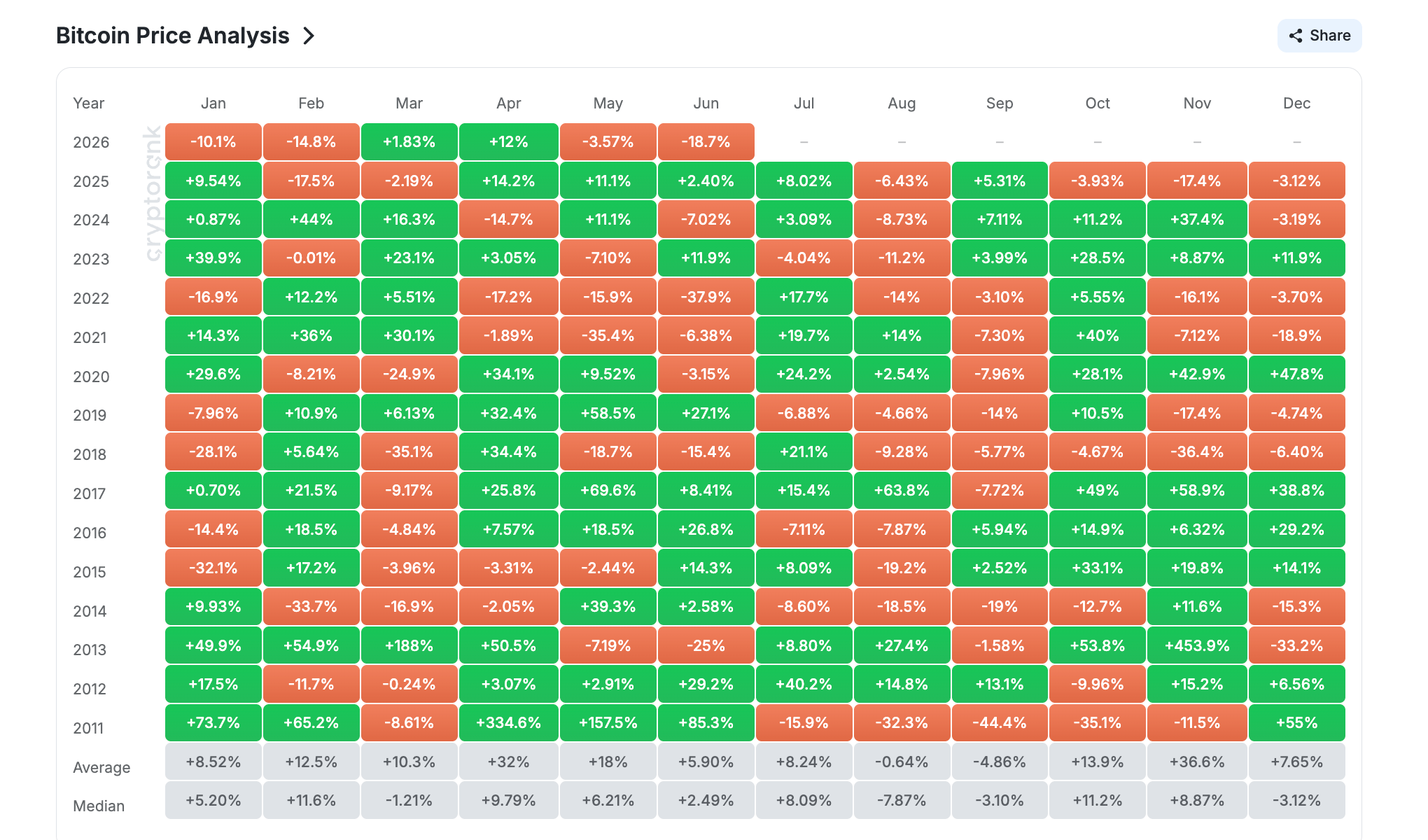
History sets the warning first. June has historically been a positive month for Bitcoin, averaging a 5.90% gain with a 2.49% median. This June, Bitcoin price fell roughly 19%.

May broke the same way, dropping 3.57% against an +18% average. The only month in 2026 that beat its own median was April. That marks a clean shift from 2025, when both May and June closed green.
Want more token insights like this? Sign up for Editor Harsh Notariya’s Daily Crypto Newsletter here.
The weakness shows up on the chart. On the three-day timeframe, Bitcoin is trading inside a head and shoulders pattern, a bearish formation where a high (the head) sits between two lower peaks (the shoulders), with price now drifting toward the lower trendline. Sell volume surged between June 15 and June 24, adding weight to the 26% breakdown risk.

Volume alone, however, does not show whether large holders are preparing to sell.
Exchange Whale Ratio Climbs as Retail Rotates Away
On-chain data flags the next pressure point. The Bitcoin exchange whale ratio, a metric that tracks the proportion of the ten largest inflows relative to total exchange inflows, has pushed to a local high near 0.69.
The last time it spiked, to 0.67 on June 19, Bitcoin slid from $63,481 to $59,501, a 6.30% dip. A rising ratio suggests larger deposits are possibly moving toward exchanges, which often precedes added selling pressure.

Retail is leaning the same way. According to The Kobeissi Letter, US gold and Bitcoin ETFs have posted roughly $12 billion in outflows since April, while semiconductor ETFs pulled in about $20 billion. The largest Bitcoin ETF is down around 12% over that window as money rotates into chip stocks.
The mood music is just as sour.
Legendary investor Jeremy Grantham this week called Bitcoin a “useless, speculative mechanism” that will “dwindle away with a whimper,” a view that captures the apathy now bleeding into spot demand.
That alignment of whale inflows, fund exits, and weak sentiment raises the obvious question: crash or slow bleed?
Open Interest Slump Argues for a Trickle
The derivatives market tilts the answer toward a grind. Bitcoin open interest, the total value of active futures contracts, peaked near $31.3 billion around May 30. It now sits near $21.6 billion.
The Bitcoin funding rate, the periodic cost traders pay to hold leveraged positions, is slightly positive at 0.003%, hinting at mild long bias. Crucially, the lower open interest means there is far less leverage to fuel a violent liquidation cascade than a month ago.

The pressure, though, is building in institutional spot flows rather than leverage.
Record Bitcoin ETF Outflows Deepen the Drag
The exit is now historic. US spot Bitcoin ETF outflows reached roughly $4.06 billion in June, the largest monthly redemption since the products launched, topping the prior $3.56 billion record set in February 2025.


Stacked against the whale data and retail rotation, the steady withdrawal of fund money explains why downside pressure looks persistent rather than explosive for the Bitcoin price prediction.
Bitcoin Price Prediction: The Levels That Decide July
This is where the levels matter. The head and shoulders pattern projects a measured move of about 26% if the neckline gives way. The Bitcoin price prediction for July hinges on that line.
A close under $55,298, the 0.5 Fibonacci level, would confirm the breakdown. Below it sit $52,458 and $48,413, opening the path toward the measured target near $42,000.

To invalidate the setup, buyers must reclaim $61,654 and then $67,335. A pattern nuance applies here. Head and shoulders breakdowns can fail, and with open interest this thin, a sharp short squeeze remains possible.
The $55,298 level separates a slow grind sideways from a 26% bleed toward the $42,000 zone.
The post Bitcoin Price Prediction for July 2026: Worst-Ever ETF Month Opens $42,000 Risk appeared first on BeInCrypto.

Galaxy Digital has cut its odds of the CLARITY Act becoming law in 2026 to 50%, warning that the US Senate is running out of time to move the crypto market structure bill before its August recess.
“We are reducing our odds of CLARITY Act passage in 2026 to 50-50,” wrote Galaxy’s head of firmwide research, Alex Thorn, citing the lack of a unified Senate Banking-Agriculture text, no firm floor schedule and a narrowing legislative window before lawmakers leave Washington.
Thorn said the downgrade was about the bill’s timing, not substance and added that the congressional competition for floor time “intensified” after US President Donald Trump abruptly canceled the signing of the bipartisan housing bill and said he would not sign it until Congress passed the SAVE Act, to introduce a proof-of-citizenship elections bill.
The downgrade comes after Galaxy lowered its previous estimate of the bill from 75% to 60% on June 9. On May 22, the company had raised its CLARITY Act estimate to 75%.
The CLARITY Act is set for a House hearing on July 17. The bill aims to establish the first regulatory framework for digital assets in the US, but it has been met with criticism. It cleared the Senate Banking Committee in May, with most Democrats and the banking industry pushing back, arguing that it would allow crypto firms to offer yields on stablecoins without facing the same requirements as traditional financial institutions.

Source: Alex Thorn
Congressional calendar squeezes crypto bill
The latest cut reflects mounting concern that even a bill with bipartisan support may not get enough floor time in a crowded Senate calendar.
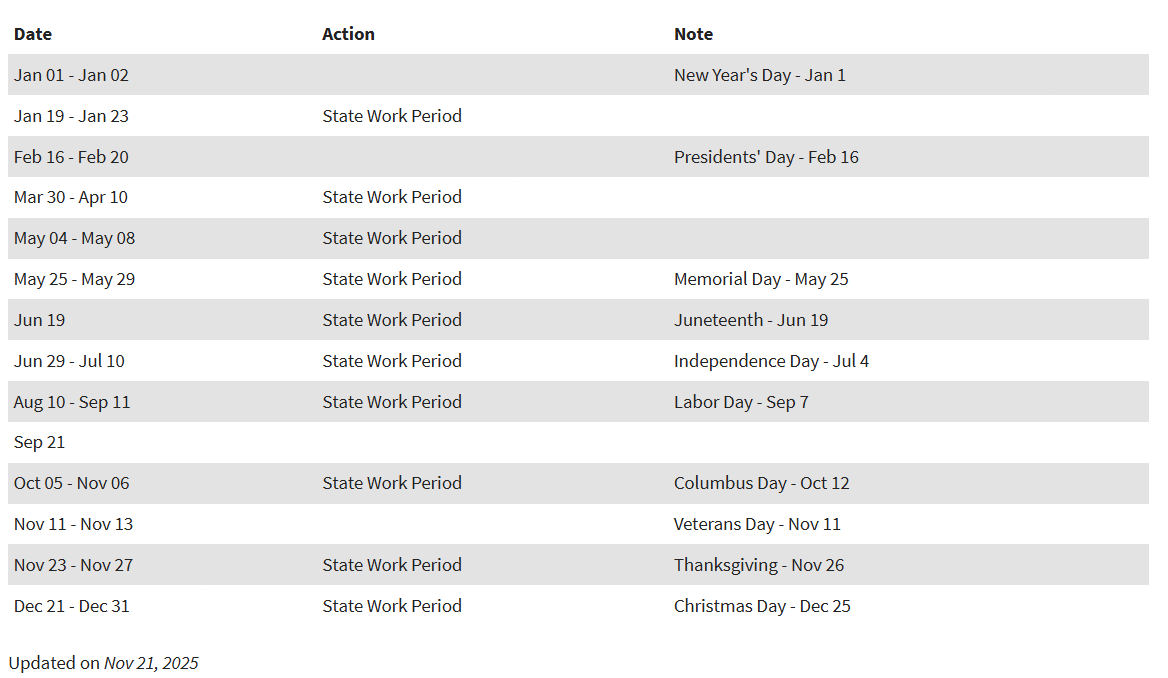
Senate legislative schedule. Source: Senate.gov
The US Senate has entered a state work period from Monday until July 10. The Senate is also scheduled to begin its traditional August recess on Aug. 8 for five weeks before returning to Washington on Sept. 14, according to its legislative schedule.
Related: Hyperliquid added to Singapore’s Investor Alert List
The runway to pass the bill is quickly declining, said Thorn, adding that the debate over the SAVE Act “injects another contentious, leadership-consuming fight into an already crowded queue.”
He added that the Senate is also working on two unfinished developments, including Section 702 of the Foreign Intelligence Surveillance Act (FISA), to which the House failed to pass a reauthorization and the National Defense Authorization Act (NDAA) for the fiscal year of 2027, which is considered “must-pass” legislation and is often the target of political debate.
At the beginning of June, over 200 crypto companies and organizations urged the US Senate to pass the CLARITY Act in a letter shared by crypto lobby group Stand With Crypto.
Later in June, a group of law enforcement organizations and a coalition of Catholic organizations reached out to White House officials with concerns that the CLARITY Act could create oversight gaps regarding illicit activity.
Magazine: How crypto laws changed in 2025 — and how they’ll change in 2026
South Korean brokerage Kiwoom Securities has entered negotiations to acquire a stake in cryptocurrency exchange Bithumb through a planned purchase of newly issued shares, local media reported on Monday.
Summary
- Kiwoom Securities is negotiating to acquire a stake in Bithumb through a planned purchase of newly issued shares.
- Bithumb continues preparing for a 2028 IPO as South Korea advances discussions on new digital asset ownership rules.
- The investment talks follow recent regulatory action against Bithumb over personal data transfers and anti money laundering compliance.
According to a ChosunBiz report, Kiwoom and Bithumb are discussing a third-party share allocation under which the exchange would issue new shares for Kiwoom to buy. The report added that both sides are still negotiating the size of the investment and the percentage stake, with no final terms agreed.
The proposed investment would add another major financial institution to South Korea’s digital asset sector as Hana Bank, one of the country’s four largest banks, disclosed plans last month to acquire a $670 million stake in Dunamu, the operator of Upbit. Local media later reported that three Samsung affiliates would purchase about $407.7 million worth of Dunamu shares, securing a combined 4% ownership interest.
Meanwhile, international cryptocurrency firms have also expanded their investments in the country. OKX Ventures announced in May that it would purchase a 19.6% stake in Coinone, while Binance completed its acquisition of Gopax after several years of regulatory delays.
Bithumb prepares for IPO as ownership talks continue
The investment negotiations come days after South Korea’s Personal Information Protection Commission fined Bithumb 210 million won, or about $136,000, for violating rules governing overseas transfers of personal information.
The regulator also ordered the exchange to revise its cross border data transfer procedures after finding that user information had been sent overseas without fully meeting requirements under the Personal Information Protection Act.
The privacy case followed earlier enforcement action against Bithumb over anti money laundering compliance. As previously reported by crypto.news, South Korean regulators imposed a 36.8 billion won penalty after identifying deficiencies related to customer due diligence, transaction monitoring, and transfers involving unregistered overseas virtual asset service providers.
The Personal Information Protection Commission also published new blockchain privacy guidelines that require firms to address personal data protection when designing blockchain-based services.
In the meantime, Bithumb has continued preparations for a public listing while pursuing the investment discussions. The exchange has signed an IPO advisory agreement with Samjong KPMG that runs through the end of 2027, and Chief Financial Officer Jeong Sang-gyun said in April that the company expects to list in 2028.
South Korean lawmakers are also working on the Digital Asset Basic Act, which seeks to establish a comprehensive legal framework for cryptocurrencies. The proposed legislation would limit a single shareholder’s ownership in a cryptocurrency exchange to 20% in most cases, while allowing holdings of up to 34% under specific conditions that remain under discussion.
June 28 is widely celebrated within the broader Pi Network community as Pi2Day due to being 2x of March 14 (the resemblance to the mathematical constant π). It usually arrives with major expectations about potential token listings or new features.
The latest was announced earlier today by the team, but the native token’s correction has only worsened after the news went live.
Extending the Focus
The days leading up to the event were full of speculation from both the team and the community, with some anticipating major new features, while others spread rumors about potential token listings on large exchanges, similar to what happened around Pi Day (March 14) with Kraken.
The actual announcement outlined the introduction of SoloHost, Pi Sign-in, and PiVerify, all of which aim to expand the ecosystem beyond native applications and into AI, identity, and third-party services. These updates want to position Pi as a platform for AI applications, decentralized computing, and digital identity, rather than being focused only on blockchain functionality.
The three launches extend Pi’s services beyond its native ecosystem by enabling devs, businesses, and third-party apps to leverage Pi’s computing infrastructure, user base, and KYC capabilities.
Actual Releases
The main release is probably SoloHost, which supports locally-run AI apps, including the newly introduced Homes AI assistant. It processes and stores data entirely on a user’s device instead of relying on cloud infrastructure. The team said this approach improves privacy and reduces dependence on centralized servers.
Pi Sign-in is the second major feature, allowing users to log into supported third-party websites and apps using their Pi credentials. It gives external devs access to Pi’s verified user base while simplifying authentication for existing Pioneers.
The third is PiVerify. It serves as a new identity verification service that opens Pi’s KYC infrastructure to external businesses.
The team also outlined Pi’s hybrid AI-and-human verification system, which has verified over 18 million users across more than 200 countries and regions. PiVerify will work in tandem with that system and will enable fintech companies, exchanges, Web3 apps, and other businesses to leverage Pi’s identity infrastructure for customer onboarding, AML screening, duplicate account detection, and compliance workflow.
PI Still Slides
Although the team has announced new features aiming to improve the overall user experience, the protocol’s native token has reacted with a similar ‘buy the rumor, sell the news’ manner. PI has plummeted by over 4% in the past 24 hours, even though most of the market has rebounded from the weekend lows.
PI dipped to just under $0.12 but managed to remain inches above its all-time low of $0.1189. It now trades above $0.12, but it’s still 10.5% down weekly. Moreover, it remains 96% away from its all-time high of $2.99 registered in February 2025.

The post Pi2Day Is Here: What Every Pi Network Pioneer Needs to Know appeared first on CryptoPotato.
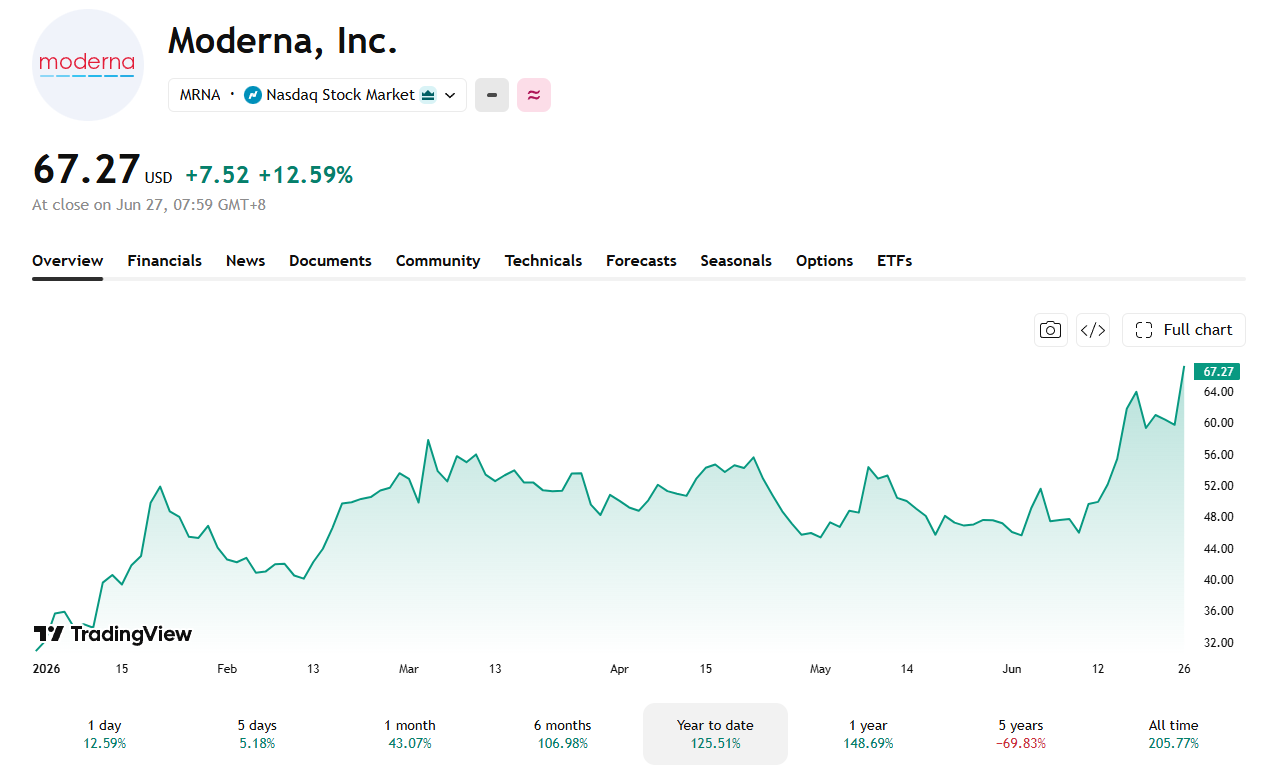
Moderna (NASDAQ: MRNA) shares closed up 12% on Friday, June 26, extending a run that has pushed the stock 125.51% higher since January.
The move caps a multi-week climb from lows near $46 in early June. A few story lines have driven the recovery.
FDA Flu Vote Removes a Major Overhang
The FDA’s Vaccines and Related Biological Products Advisory Committee voted 9-0 on June 18 that mFLUSIVA (mRNA-1010) carries a favorable benefit-risk profile for adults aged 50 and older. A unanimous panel verdict is rare in biotech.
It sharply cuts regulatory uncertainty ahead of the August 5 PDUFA decision date. If the FDA approves, mFLUSIVA would become the first mRNA-based seasonal flu product licensed in the US.
Wall Street Stays Cautious
Piper Sandler raised its price target to $77. Jefferies moved its target up to $53 but kept a Hold rating. The consensus analyst target sits at $43.45, well below where MRNA trades today.

Sixteen Hold ratings dominate the Street. Insider transactions have tilted toward selling, with 75 recent transactions on the sell side. Analysts see real flu revenue starting no earlier than 2027.
Beyond Vaccines
Moderna restructured its operating model around three commercial franchises in vaccines, oncology, and rare diseases. Shares jumped roughly 6.3% on that news alone. Moderna’s high came when it produced its Covid-19 vaccine, topping out at $497 in August 2021.
A June 25 Science Day then put the company’s broader pipeline on display, covering in vivo CAR-T and T-cell engager programs across oncology and autoimmune disease.
Plans to invest in German manufacturing facilities, including sites BioNTech plans to close, pushed MRNA up 8% to 12% across several sessions as traders read the move as a long-term capacity bet ahead of a 2027-2028 wave of launches.
The post This COVID Stock Market Winner Is Making a Comeback, Up 125% Year to Date appeared first on BeInCrypto.

Key Takeaways
- The company maintains 847,363 BTC valued at approximately $50.8 billion, though with bitcoin hovering around $60,000 and an average purchase price of ~$75,646, unrealized losses exceed $13 billion.
- Executive Chairman Michael Saylor shared his customary “we’re gonna need more charts” message on social media, suggesting another bitcoin acquisition announcement could arrive as soon as Monday.
- MSTR shares plummeted to approximately $82, marking the lowest point since February 2024, while preferred shares STRC reached a record low of roughly $71 last week.
- For the first time ever, Strategy’s enterprise mNAV dropped below 1, indicating the market now assigns a lower valuation to the company than its bitcoin reserves.
- Industry voices including Ripple’s Brad Garlinghouse and analytics platform CryptoQuant have openly questioned Strategy’s financing approach, with CryptoQuant recommending a halt to additional purchases.
Shares of Strategy (MSTR) have tumbled to their weakest point since February 2024, hovering around $82 following an approximately 8% decline last Thursday. The company’s preferred shares, STRC, similarly touched a record low near $71 during the previous week.
Despite the downturn, Michael Saylor remains unfazed.
Sunday morning saw Strategy’s executive chairman share the firm’s bitcoin purchase tracking chart on X, accompanied by his signature phrase “We’re gonna need more charts.” This mirrors his actions preceding verified acquisitions on June 7 and June 21. Market watchers anticipate a potential Monday 8-K disclosure.
We’re gonna need more charts. pic.twitter.com/xVASOEnSw8
— Michael Saylor (@saylor) June 28, 2026
The company’s bitcoin treasury comprises 847,363 BTC acquired at an average price of approximately $75,646 per token. With bitcoin currently trading beneath $60,000, the portfolio carries an unrealized loss approaching $13 billion. Industry publication The Block suggests the deficit could reach as high as $14 billion amid continued market weakness.
Strategy’s latest acquisition represented its most modest purchase in recent memory. A June 22 filing revealed a 520 BTC purchase totaling roughly $35 million, alongside a $300 million cash reserve addition that brought total reserves to $1.4 billion. Saylor has indicated these reserves provide approximately 10 months of runway for STRC dividend requirements.
Capital Structure Faces Headwinds
The dual pressures of declining equity values and discounted preferred shares have driven Strategy’s enterprise mNAV below 1 for the first time in company history. This measurement weighs the organization’s complete market capitalization — encompassing debt instruments and preferred equity — against its bitcoin position. When this ratio falls beneath 1, the company’s ability to raise additional capital through equity issuance becomes severely constrained.
STRC features an 11.5% annual yield and was structured to maintain trading proximity to its $100 par value. Current pricing stands around $74.57.
According to Block Research analysis, MSTR common shareholders effectively sit behind approximately $6.7 billion in convertible debt obligations and roughly $15.5 billion in perpetual preferred stock, positioning common equity as a highly leveraged residual interest rather than a straightforward bitcoin exposure vehicle.
The company executed its first bitcoin sale since 2022 on June 1, liquidating 32 tokens for approximately $2.5 million to satisfy a STRC dividend obligation, before returning to its weekly purchasing pattern.
Industry Voices Express Concern
During a Friday CNBC interview, Ripple CEO Brad Garlinghouse suggested Saylor’s organization “wasn’t focused on the right stuff” and argued Strategy’s methodology had negatively impacted broader market sentiment. He cited STRC’s trading discount as proof of structural vulnerabilities.
Blockchain analytics provider CryptoQuant issued a stronger statement on June 23, recommending Strategy immediately suspend acquisitions and prioritize cash accumulation. Research director Julio Moreno highlighted that annual dividend requirements have surged fourfold to approximately $1.2 billion, while STRC coverage has contracted from over seven years to roughly 14 months. CryptoQuant’s analysis suggests the company requires around $2.8 billion in reserves to restore two-year coverage adequacy.
Bitcoin traded below $60,000 on Sunday, approaching its lowest valuation since October 2024.


Key Takeaways
- Dogecoin is consolidating within a narrow $0.073 to $0.076 corridor, facing crucial resistance around $0.078
- An upward-sloping trendline indicates continued buyer presence, though no decisive breakout has materialized
- Open interest has surged while price action remains stagnant, creating vulnerability for overleveraged long traders
- Technical analyst Ali Charts identified a TD Sequential buy indication, emphasizing $0.073 as a critical support threshold
- The meme coin has declined 2.3% in the last 17 hours and 11.7% across the weekly timeframe, mirroring broader market weakness
Dogecoin continues to trade within a confined range between $0.073 and $0.076 as market participants await a definitive directional move. The popular meme cryptocurrency has underperformed relative to other major altcoins throughout the past seven days.
The token experienced approximately 2.3% depreciation during a 17-hour period and has surrendered roughly 11.7% of its value over the weekly span. This positions it among the more significant decliners within the large-capitalization cryptocurrency segment.
The wider digital asset market has faced sustained selling pressure. Bitcoin continues hovering beneath the $60,000 threshold, United States spot Bitcoin exchange-traded funds have recorded net capital outflows, and Federal Reserve policy stance remains restrictive. A strengthening US dollar has compounded these challenges.
Bitcoin’s market dominance has expanded to approximately 58.2%, signaling a capital rotation from elevated-risk altcoins such as DOGE toward the flagship cryptocurrency.
Technical analyst Carlos Garcia Tapia published a chart on X platform illustrating DOGE maintaining position above a significant wick formation near $0.07408. The price action continues respecting a near-term ascending trendline, indicating that buyers remain engaged in protecting lower price zones.
The initial resistance barrier stands near $0.0759. A successful breach of this level could establish a pathway toward $0.0783 to $0.0784. Following that zone, the $0.0803 area represents the subsequent target, with additional resistance positioned at $0.0850 and $0.0876.
Open Interest Surge Amid Stagnant Price Action
An additional chart from analyst CW on X platform demonstrates open interest climbing substantially while price movement remained confined. This configuration typically signals market uncertainty and potential volatility ahead.
$DOGE has remained flat since the last large-scale long position buying. pic.twitter.com/liwHuBp6Jk
— CW (@CW8900) June 28, 2026
Concentrated long positions can fuel upward momentum if buyers successfully breach resistance levels. However, if price action remains sideways or deteriorates, these crowded long positions face liquidation risk during a potential flush-out event.
Market analyst Ali Charts shared on X that the TD Sequential indicator has generated a buy signal for DOGE. “My focus is squarely on $0.073,” Ali Charts stated. “Maintaining this level opens the door to $0.081. A breakdown invalidates the technical setup.”
The TD Sequential has flashed a buy signal on Dogecoin $DOGE.
I’m watching $0.073 closely. Hold it, and $0.081 is in play. Lose it, and the setup is no longer valid. pic.twitter.com/lihmmw0Rg5
— Ali Charts (@alicharts) June 26, 2026
The $0.073 price point has emerged as a widely-monitored support benchmark among traders and technical analysts.
Development Team Addresses Community Concerns
From a fundamental perspective, the official Dogecoin account responded to assertions that the project lacks active development resources. The team emphasized a dedicated core contributor base and ongoing ecosystem initiatives.
This statement was interpreted as neutral to marginally constructive for DOGE’s long-term narrative and did not generate observable selling activity.
No DOGE-specific adverse developments are responsible for the recent price deterioration. The decline corresponds with comprehensive macroeconomic headwinds affecting the cryptocurrency marketplace.
Downside support resides near $0.072. A violation of this threshold would intensify pressure on current long position holders.

Loopring, the first project to launch a zero-knowledge rollup on Ethereum, has announced that its decentralized exchange will immediately stop all trading services. The relayer has already been taken offline.
The team said the decision was made with regret after years of trying to keep the platform operating.
Outdated Technology and Poor Adoption
According to the announcement, one of the main reasons behind the closure was the platform’s technical limitations. Loopring said its early zkRollup design did not include a virtual machine, which limited composability and prevented broader real-world applications, including payment use cases. These restrictions hindered ecosystem growth and made it difficult for the platform to compete with newer technologies.
The team also admitted that it had stronger engineering capabilities than business development skills, while describing itself as “engineers at heart, not business operators.” In addition, the delisting of LRC from major exchanges in 2026 added further pressure to the project.
“We poured countless late nights into building the very first zkRollup on the market. That achievement still fills us with pride. But today, we must face reality and announce, with deep regret, that Loopring DEX will cease all trading services effective immediately.”
Loopring explained that newer zkEVM solutions, which support Ethereum smart contracts and offer broader compatibility, have surpassed its specialized architecture. The team said its technology now feels outdated and that shutting down the service was preferable “rather than running a hollow service.”
The company stated that user funds remain safe and announced a distribution process to return assets. Instead of requiring users to submit Merkle proofs through the original self-custody withdrawal mechanism, Loopring said it will handle the entire process itself and cover all transaction fees. The team acknowledged that this method is more centralized but described it as the simplest option for users.
Loopring also revealed plans to publish a complete list of final account balances over the coming days. This includes spot holdings and liquidity pool positions, which will be converted into underlying tokens. A two-week review period will allow users to verify balances before distributions begin.
Loopring Hack
In June 2024, attackers stole an estimated $5 million from users of the Loopring wallet who relied solely on the platform’s Official Guardian service for account recovery.
The breach was traced to a flaw in the service’s two-factor authentication system, which allowed attackers to impersonate wallet owners and gain access to their accounts.
The post ‘Engineers, Not Business Operators’: Why Loopring Is Shutting Down Its DEX appeared first on CryptoPotato.

Swindon’s old Honda site transformed into huge new industrial park

SharpLink buys 29,196 Ether worth $46.7M in Saturday OTC deals

Teyana Taylor Shares Question She Asked Amid 2026 BET Awards


-
 Sports6 days ago
Two goals and an assist by sheer aura: Cristiano Ronaldo just entered the World Cup chat
-

 Tech7 days ago
Microsoft accidentally kills epic Outlook email threads
-

 Fashion3 days ago
Weekend Open Thread: Staud – Corporette.com
-

 Politics3 days ago
The House | Manchesterism won’t survive the painful trade-offs unless it gets citizens on board
-

 Politics3 days ago
Potential 2028er World Cup attendee leaderboard
-

 Business3 days ago
Asia stock markets slide as tech shares slump
-

 Tech4 days ago
A Look At A Gaggle Of Transputer Boards
-
Crypto World5 days ago
Bitcoin (BTC) Dips Below $62K, Ethereum (ETH) Plunges 6% Daily: Market Watch
-
 Crypto World4 days ago
Dell (DELL) Shares Tumble Over 5% Following Analyst Downgrade to Hold
-

 Crypto World5 days ago
Securitize Wraps Roubini's SEC-Registered ETF as Dubai VARA Digital Security
-
Business5 days ago
Entergy settles forward sale agreements, raises $672 million in cash proceeds
-

 Crypto World2 days ago
Kraken's xStocks Opens Bending Spoons IPO Registration to EEA Retail
-

 Sports2 days ago
FIH Pro League: India defeat Pakistan 7-1, register biggest win of campaign | Other Sports News
-

 Crypto World2 days ago
Coinbase, Circle Deepen Crypto Stock Losses Despite Resilient S&P 500
-

 Crypto World3 days ago
RTX holders must register wallets before token distribution begins
-
Crypto World3 days ago
Hyperliquid Named on Singapore MAS Investor Alert Register
-

 Tech1 day ago
Bluekit phishing kit adopts browser-in-the-middle for login theft
-

 Tech2 days ago
Russian hackers now target Signal backup recovery keys
-

 Politics7 days ago
Wes Streeting abandons leadership bid and backs Burnham
-

 Sports4 days ago
India vs Bangladesh LIVE Score, Women’s T20 World Cup: Bangladesh Opt To Bat; India Enter ‘Do-Or-Die’ Stage As Semi-Final Race Heats Up
You must be logged in to post a comment Login