

Crypto World
CLARITY Act Faces Tougher Odds as Galaxy Research Downgrades 2026 Passage to 50%


TLDR
- Analyst Alex Thorn at Galaxy Research lowered the CLARITY Act’s 2026 passage probability from 60% to 50%
- The crypto bill cleared the Senate Banking Committee 15-9 on May 14 but lacks a scheduled floor vote
- Limited Senate floor time remains available before the late July August recess begins
- Unresolved ethics requirements from Senate Democrats continue to stall progress
- Without a concrete schedule by early July, passage may delay until post-September
The CLARITY Act, a cryptocurrency market structure bill, secured bipartisan approval from the Senate Banking Committee on May 14 with a 15-9 vote. Yet despite this legislative advancement, Alex Thorn from Galaxy Research has reduced his probability estimate for the bill’s 2026 enactment to 50%, down from the previous 60% projection made just weeks earlier.
Currently positioned at number 423 on the Senate’s legislative calendar, the bill awaits scheduling for floor consideration.
The primary obstacle is the ticking clock. With the Senate’s August recess approaching at July’s end, only a handful of productive legislative weeks remain on the schedule.
Competing Priorities Consume Senate Session Time
Recent Senate proceedings lost an entire week to disputes surrounding an anti-weaponization funding measure. Additionally, efforts to reauthorize Section 702 of FISA collapsed when a procedural vote failed 47-52.
Section 702’s authorization expires June 12. Consequently, much of the upcoming week’s available floor time will address that urgent matter rather than cryptocurrency legislation.
While each individual delay appears minor, collectively they erode the already-limited window the CLARITY Act requires for passage.
For successful passage, Senate Majority Leader John Thune must allocate floor time during July. The legislation still requires floor debate, an amendment process, and reconciliation with corresponding Senate Agriculture Committee language before any House consideration can begin.
This represents a substantial procedural checklist with minimal calendar availability to accomplish it.
Democratic Support Remains Uncertain
Beyond scheduling challenges, a critical substantive obstacle persists. Senator Ruben Gallego and fellow Senate Democrats have established ethics provisions as mandatory requirements for their support. These provisions remain unaddressed after the committee deferred resolution to floor consideration.
The legislation requires a minimum of 60 votes for advancement. Galaxy Research anticipates two Republican opposition votes from Josh Hawley and Rand Paul, both of whom opposed last year’s GENIUS Act.
This vote arithmetic provides Thune limited incentive to schedule floor time without confirmed Democratic support.
Potential Factors That Could Improve Prospects
Thorn indicated he would increase his probability assessment if Thune publicly commits to scheduling floor time in early-to-mid July, and if the ethics and illicit finance concerns are demonstrably resolved with confirmed support from nine or more Democratic senators.
Announcement that the Banking and Agriculture Committee versions have been consolidated into a unified legislative package would also boost prospects.
Absent these developments within the next two to three weeks, Galaxy Research suggests the realistic timeline shifts to September. However, autumn legislative action encounters midterm election pressures, when floor availability becomes scarce and members concentrate on campaign activities.
Presently, Galaxy Research maintains the CLARITY Act is more likely than not to pass in 2026, though the probability margin continues narrowing.



Key Takeaways
- ASML shares currently hover around $1,841, within a 52-week trading band of $683.48 to $1,959.04, commanding a $724 billion market valuation
- The company’s order backlog stays robust as semiconductor manufacturers reserve EUV machinery years ahead, guaranteeing revenue visibility
- Revenue from installed base operations reached €2.49 billion in Q1 2026, climbing from €2.13 billion in the preceding quarter
- Management elevated full-year 2026 sales outlook to €36–€40 billion, while earnings per share are projected to surge 33% in the coming year
- Analyst consensus leans Moderate Buy with a mean price objective of $1,772.62; Bank of America maintained its Buy stance and increased its target
ASML began Friday’s session at $1,841.18. This represents a dramatic recovery from the 52-week floor of $683.48, and approaches the ceiling of $1,959.04. Following such a substantial appreciation, investors naturally wonder: does meaningful upside remain?
The current valuation demands attention. ASML commands approximately 49.9x this year’s anticipated EPS of just under $36. This multiple significantly exceeds its historical average in the mid-30s range. For typical corporations, such pricing would trigger caution.
Yet ASML operates in a category of its own.
The Dutch company maintains an uncontested monopoly on Extreme Ultraviolet lithography equipment — the critical machinery enabling cutting-edge semiconductor production. Manufacturing 2-nanometer chips is impossible without this technology. No competing suppliers exist.
Each unit commands a price exceeding $350 million and requires months for assembly, precision calibration, and delivery. Customers don’t simply submit purchase orders — they reserve manufacturing capacity years into the future. This represents far more than a healthy sales funnel. It constitutes structural market control.
Order Backlog and Service Revenue Drive Fundamentals
Q1 2026 net revenue totaled €8.77 billion, representing a decline from Q4 2025’s €9.72 billion. At first glance, this suggests weakening momentum. The reality differs considerably.
ASML’s quarterly revenue fluctuates based on delivery schedules rather than underlying demand. Every system the company manufactures already has a committed buyer. The quarter-over-quarter decrease reflects production capacity constraints, not softening customer appetite.
The more revealing metric comes from installed base management. This revenue category — encompassing maintenance and enhancement of existing deployed systems — registered €2.49 billion in Q1, advancing from €2.13 billion the prior quarter. It delivers predictable, margin-rich, and expanding cash flows.
Executives lifted full-year 2026 guidance to a revenue corridor of €36 billion to €40 billion. The latter half of the year should show acceleration, powered by increasing system deliveries.
TSMC, Intel, and Samsung are all expanding fabrication facilities to satisfy AI infrastructure requirements. These facilities require ASML’s equipment. Hyperscaler capital spending is forecast to nearly double from $427 billion in 2025 to beyond $860 billion by 2027.
Profit Margin Improvement Represents the Upcoming Driver
EPS consensus forecasts indicate 33% expansion next year. This figure anchors the bullish investment thesis.
The route to that outcome flows through margin enhancement. ASML is shifting from limited-volume, early-phase production of its latest systems — including the high-margin High-NA EUV platform and the NXE:3800 series — toward standardized, volume-scale manufacturing. Fixed expense allocation improves across larger unit counts. Gross margins should progress toward management’s 2030 objective of 56%–60%.
One notable risk persists. China continues to represent approximately 19% of ASML’s revenue, and export limitations remain an active concern. Dutch government representatives are reportedly advocating against stricter restrictions on equipment sales to Chinese customers. Any intensification on this front could constrain sales.
Decker Retirement Planning recently established a fresh $4.23 million stake in ASML. Dimensional Fund Advisors maintains ownership exceeding 990,000 shares. Institutional holdings comprise 26.07% of outstanding equity.
Goldman Sachs, Citigroup, Morgan Stanley, and Deutsche Bank all maintain Buy ratings or equivalents. Bank of America elevated its price objective citing improved earnings projections for 2027 and 2028.
The consensus mean target stands at $1,772.62, though an alternative analyst cohort establishes it at $2,019 — suggesting approximately 12.5% appreciation potential from present levels.

Key Takeaways
- ASTS shares rallied approximately 11% Thursday following the company’s announcement of three additional BlueBird satellites scheduled for August launch via SpaceX Falcon 9.
- The updated deployment timeline positions AST for launches every two months, enabling up to 18 satellite deployments annually.
- Twenty-four satellites (BlueBirds 14-37) are currently in production, with orbital deployment expected by late 2027.
- Institutional ownership stands at roughly 61% of outstanding shares; company insiders have liquidated over $280 million in stock during the past 90 days.
- Wall Street consensus leans toward “Reduce” with an average price target of $85.09; shares opened Monday trading at $71.57.
AST SpaceMobile (ASTS) shares surged approximately 11% during Thursday’s session, closing at $71.58. While no immediate news triggered the rally that day, the momentum followed the company’s recent announcement of an accelerated satellite deployment strategy that captured investor attention.
Earlier during the week, the company disclosed that its upcoming trio of BlueBird satellites—units 11, 12, and 13—are slated for an August liftoff using SpaceX’s Falcon 9 launch vehicle. This announcement arrives on the heels of the successful June 17 deployment of BlueBirds 8, 9, and 10.
The consecutive launch schedule establishes a rhythm of approximately one deployment every eight weeks, potentially enabling an annual deployment rate of 18 satellites.
AST is presently manufacturing 24 additional satellites—BlueBirds 14 through 37. Maintaining the current timeline, the company projects these units will achieve orbit before 2027 concludes, coinciding with the planned commencement of beta operations for its direct-to-cell (DTC) connectivity network.
The European market is also entering the picture. Statements connected to a Vodafone-supported deployment identified Spain as a potential early commercial territory, with service potentially beginning in 2027—strengthening the company’s international monetization narrative.
Wall Street’s Take: Ratings and Target Prices
Despite investor optimism reflected in recent price action, analyst sentiment remains tepid. The consensus rating on ASTS currently registers as “Reduce,” with analysts projecting an average fair value of $85.09.
Deutsche Bank recently downgraded the stock from buy to hold while trimming its price objective from $117 down to $106. B. Riley shifted to a “neutral” stance with an $85 valuation. Among the more optimistic voices, Roth MKM maintains a “buy” recommendation alongside a $108 price target.
Among the ten analysts providing coverage, just one rates the stock a buy. Six recommend holding. Three advise selling.
Technically, the stock’s 50-day moving average sits at $87.18, while the 200-day average rests at $89.23—both considerably above current price levels.
Heavy Insider Liquidation Draws Attention
A notable development that investors cannot overlook: significant insider selling activity.
During the past three months, company insiders have offloaded more than 3.1 million shares valued at approximately $280.6 million. This includes CFO Andrew Martin Johnson, who disposed of 45,809 shares at an average price of $93.81 on June 11, trimming his holdings by 8.34%.
Director Julio A. Torres separately sold 15,000 shares at $76.34 during May, reducing his position by roughly 26%.
Insiders currently control 20.89% of outstanding shares, while institutional investors hold 60.95%.
SG Americas Securities LLC expanded its ASTS position by 18.6% during Q1, purchasing an additional 11,813 shares to reach a total holding of 75,157.
Regarding financial performance, AST’s first quarter results disappointed. The company reported an EPS loss of -$0.66, significantly worse than the -$0.23 consensus estimate. Revenue totaled $14.73 million, falling short of the $39.01 million analyst projection.
Full-year EPS is forecast at -$1.47. The stock has traded within a 52-week range spanning from $36.08 to $133.86.
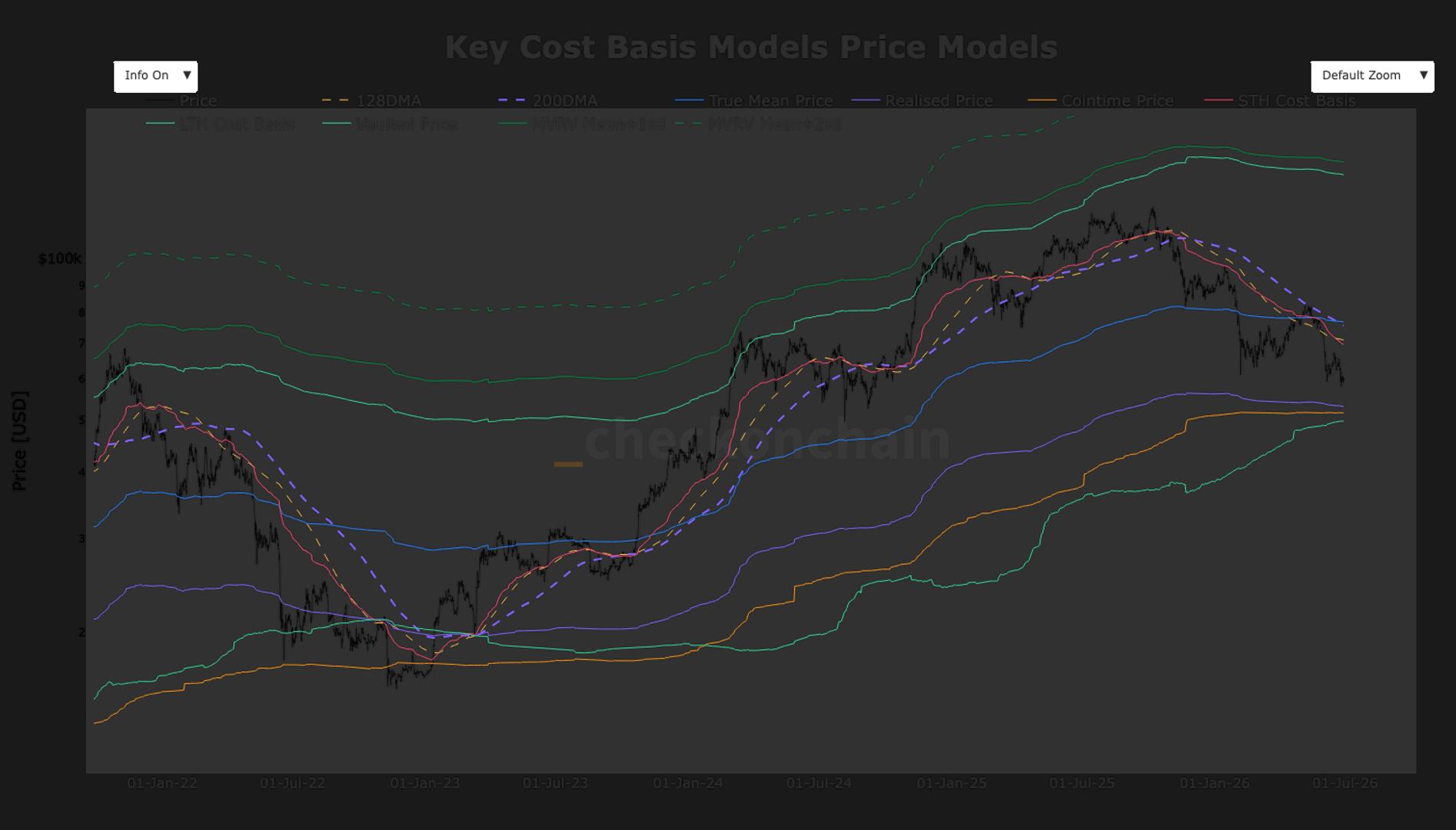
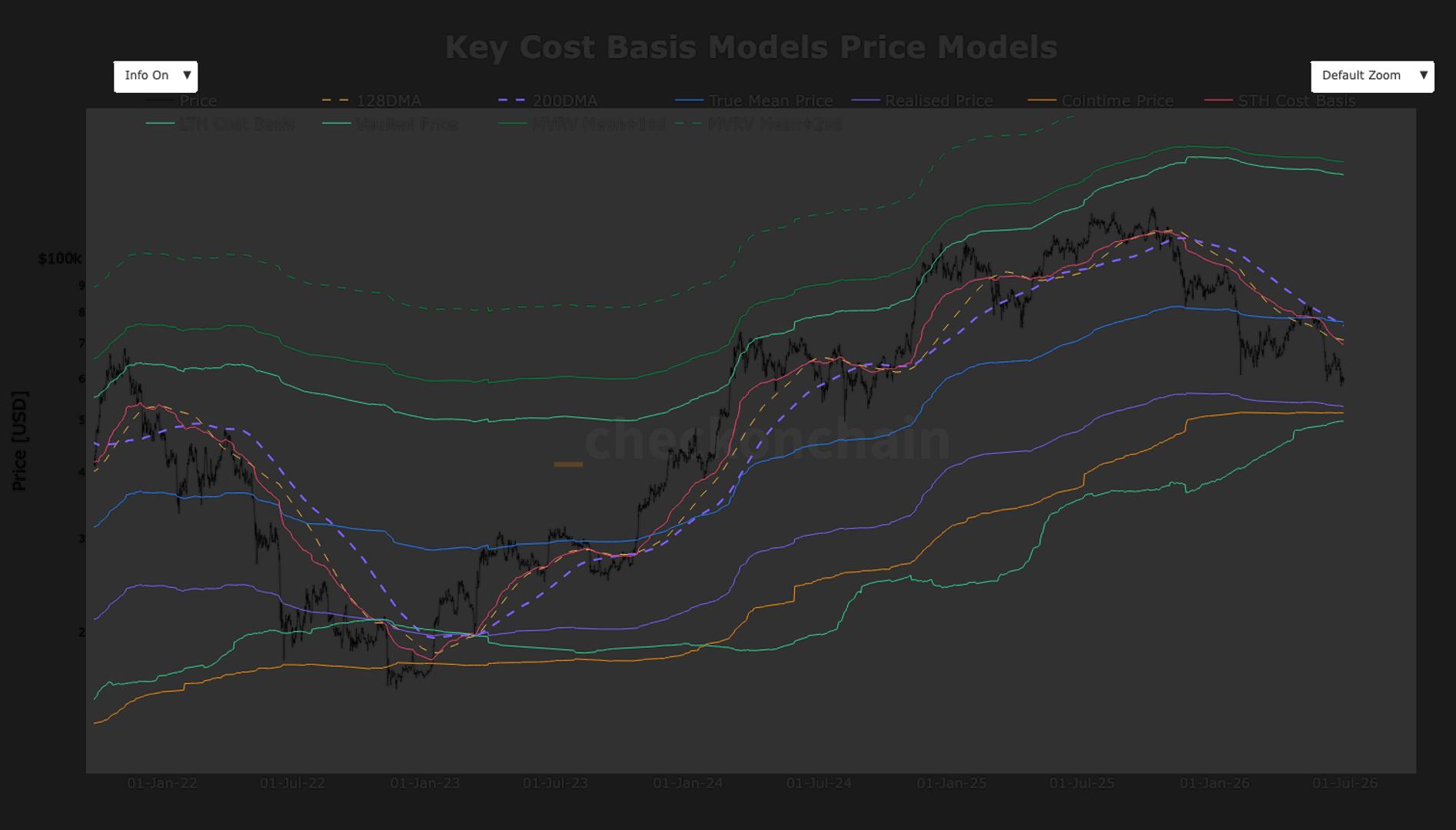
Bitcoin is currently trading below $60,000, placing it in “no man’s land,” a zone where price sits between major on chain support and resistance levels. BTC has failed to reclaim several important technical and on chain thresholds, so the path of least resistance appears to remain to the downside.
Several key valuation metrics now sit above the current price. The True Mean Price, currently around $76,300, estimates the average acquisition cost of coins after adjusting for lost or inactive supply, providing a more accurate measure of the network’s economic cost basis.
The 200-Day Moving Average, at $75,500, is a widely followed technical indicator that smooths price action over the past 200 days and is often used to distinguish long term bull and bear trends. The 128-Day Moving Average, at $70,900, tracks bitcoin’s intermediate trend, while the Short Term Holder Cost Basis, at $69,600, represents the average purchase price of investors who have held bitcoin for less than roughly 155 days.
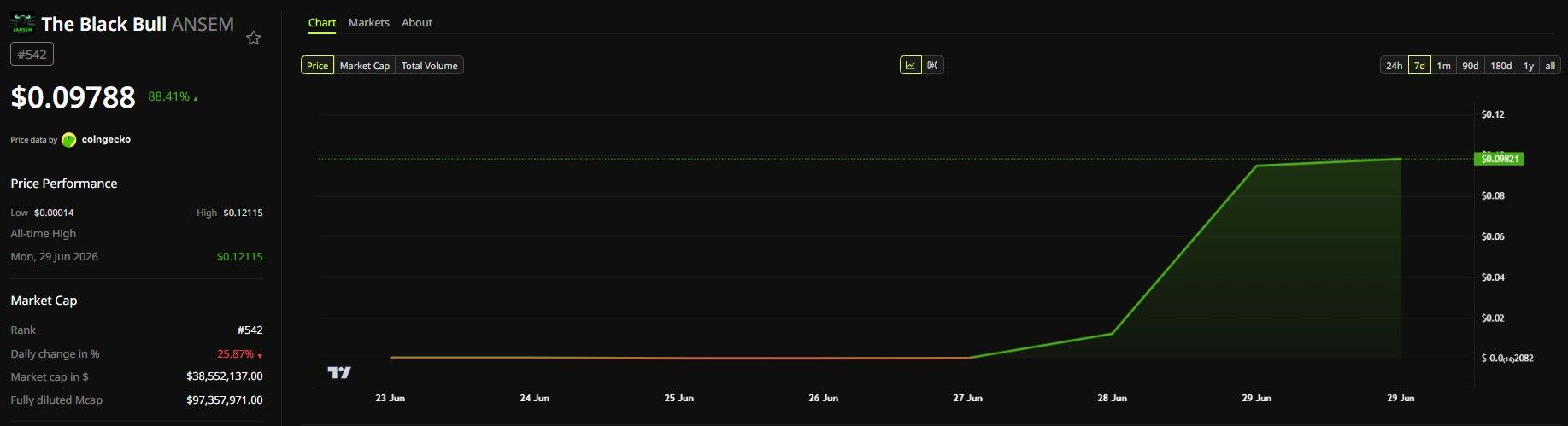
The Black Bull (ANSEM) climbed nearly 20,000% in seven days on Solana after crypto influencer Ansem announced plans to distribute his accumulated creator fees as weekly airdrops to community members.
The announcement came through X. Ansem told followers he would redirect his Pump.fun creator fees as weekly airdrops, selecting winners at random each week.
A Single Post Triggers a Market Move
The airdrop announcement pushed ANSEM’s 24-hour trading volume past $80 million as traders moved quickly to accumulate the token. The token’s price reached an all-time high of $0.121 on June 29. At that level, its fully diluted valuation sat near $121 million.
Some traders who entered before the announcement reported gains between 100x and 261x their original investment. ANSEM now trades at $0.108, up 79.7% in the past 24 hours. Its current market cap sits near $42.8 million. Over seven days, the token has climbed roughly 19,878%.
The speed of the move highlights how sharply the Solana meme coin market reacts to social catalysts.
Creator Fees Repurposed as Community Incentive
Ansem, known on X as @blknoiz06, is a prominent Solana-focused trader with a large following. Historically, his activity has moved prices in the Solana meme coin space.
Pump.fun routes a portion of trading fees to the creator of each token on the platform. As a result, creators of high-volume tokens accumulate significant fee income over time. In turn, that mechanic gave Ansem a fund to redistribute without launching a new token from scratch.
While Ansem utilized his accumulated fees for the incentive, it is worth noting that the ANSEM token itself was launched as an independent community project rather than by the influencer himself.

Solana’s Memecoin Landscape Sets the Stage
Solana meme coin trading had already been recovering before the announcement, with the network continuing to draw speculative volume toward new token launches. Meanwhile, Pump.fun DEX volume reached record highs earlier in 2026, reflecting renewed appetite for tokens on the network.
However, Solana DEX volumes have reversed sharply before, and single-catalyst rallies on the network have a mixed record of sustaining momentum. ANSEM’s $80 million in 24-hour volume represents a meaningful slice of Solana’s daily memecoin activity, but the next test is whether airdrop participation continues to generate new buyer demand week over week.
ANSEM price data and trading activity remain the key metrics to watch as the first airdrop date approaches.
The post ANSEM Climbs 19,878% After The Black Bull Ansem Announces Creator Fee Airdrops appeared first on BeInCrypto.


Grayscale has said Bitcoin may be near its current cycle low if three key risks ease in the coming months. In a new market note, the asset manager said the outcome depends on the CLARITY Act, Strategy’s balance sheet and Federal Reserve policy. Its base case assumes the bill clears the Senate, Strategy improves its financial position and the Fed avoids more rate hikes.
Summary
- Grayscale says Bitcoin may be near its low if policy and treasury risks ease soon.
- A stalled CLARITY Act could keep regulatory pressure high as Bitcoin trades near stress levels.
- Fed rate hikes and DAT deleveraging remain the main downside risks in Grayscale’s scenario now.
“If downside risks materialize, we could see bitcoin fall moderately further,” Grayscale’s head of research, Zach Pandl, said. He said a weaker case would involve the CLARITY Act failing to pass this year, digital asset treasuries deleveraging further and the Fed raising rates because inflation stays high.
The warning comes after Bitcoin fell below $60,000 during a sharp reset across crypto markets. Recent Bitcoin price analysis showed ETF outflows and liquidations added pressure as traders tried to defend the $60,000 area. Grayscale said older Bitcoin bear markets saw drawdowns of around 80%, but it does not expect the current cycle to fall that deeply because institutional demand has remained firmer.
CLARITY Act path remains uncertain
The CLARITY Act remains one of the main policy factors in Grayscale’s outlook. The bill would create a federal market structure framework for digital assets and give clearer rules to exchanges, developers and token issuers. A recent Senate update showed the bill had moved to the Senate calendar after committee approval, but still needs floor debate, possible amendments and 60 votes.
The bill’s path has narrowed as the Senate calendar fills up. A separate timeline report said the bill still needs coordination between the Senate Banking and Agriculture committees before a final floor vote can begin. The report also said disputes over conflict-of-interest language, stablecoin rules, illicit finance provisions and floor time remain unresolved.
Grayscale’s view is that a successful vote could reduce policy risk and support the next phase of institutional participation. A delay would leave the market without the clear rulebook many investors expected this year. For Bitcoin, that means regulation remains tied to price sentiment, especially while risk appetite stays weak.
Fed hikes and Strategy risks weigh on BTC
The Fed is the second major risk in Grayscale’s downside case. Recent coverage on rate-hike risk showed Citadel Securities warning that the Fed could raise rates as early as September 2026 if inflation remains firm. Another report said the Fed’s June projections shifted away from rate cuts, with several officials now seeing hikes before year-end.
Higher rates can weigh on Bitcoin because the asset does not pay yield. A stronger dollar and higher real yields make cash and Treasuries more attractive for some investors. That has already pressured Bitcoin and gold this year, with recent analysis showing both assets under stress during a stronger-dollar and higher-rate environment.
Strategy also remains central to the market’s risk view. A recent report said Strategy’s position moved about $12 billion below cost after Bitcoin fell below $60,000, while MSTR traded below the value of its Bitcoin holdings. Another analysis said the company’s Bitcoin flywheel began to reverse as its stock premium weakened and financing became harder.
Grayscale’s scenario does not call for a full repeat of past bear markets. It frames the next move around policy, rates and balance-sheet stress. If CLARITY passes, Strategy steadies its finances and the Fed stays on hold, Bitcoin may already be close to its low. If those factors move the other way, Grayscale says more moderate downside remains possible.
Crypto World
New MiCA regime in Europe, U.S. nonfarm payrolls for June: Crypto Week Ahead: Crypto Week Ahead


Crypto market participants are entering July with a critical shift in Europe as the MiCA framework’s transitional period expires. Exchanges are now competing to lure in Binance users in the region after the firm failed to secure a license.
On top of that, investors will see new product reveals from Robinhood, in an event where CEO Vlad Tenev is speaking alongside the company’s general manager for crypto, Johann Kerbrat.
There is also a packed week of U.S. macroeconomic data, including employment and manufacturing reports, while potential black swan events surrounding geopolitics could also help shape the market’s direction.
What to Watch
(All times ET)
- Crypto
- July 1: Transitional period for the European Union’s Markets in Crypto Assets (MiCA) framework expires.
- July 1: Robinhood (HOOD) to hold product reveal event titled “The World is Flat.”
- July 2: Tokenization firm Securitize to start trading on NYSE after SPAC merger.
- Macro
- June 30, 9:00 a.m.: U.S. House Price Index YoY for April (Prev. 1.7%)
- June 30, 10:00 a.m: U.S. JOLTs Job Openings for May est. 7.28M (Prev. 7.618M)
- July 1, 5:00 a.m: Eurozone Inflation Rate YoY Flash for June est. 3% (Prev. 3.2%)
- July 1, 8:15 a.m: U.S. ADP Employment Change for June est. 118K (Prev. 122K)
- July 1, 9:00 a.m: U.S. Fed Chair Warsh speaks at European Central Bank Forum
- July 1, 10:00 a.m: U.S. ISM Manufacturing PMI for June est. 53,7 (Prev. 54)
- July 2, 8:30 a.m: U.S. nonfarm payrolls for June est. 114K (Prev. 172K)
- July 2, 8:30 a.m: U.S. unemployment rate for June est. 4.3% (Prev. 4.3%)
- July 2, 8:30 a.m: U.S. initial jobless claims for period ending June 27 est. 220K (Prev. 215K)
- July 2, 4:30 p.m: U.S. Fed Balance Sheet for July 1 (Prev. $6.736T)
- Earnings
Token Events
- Governance Votes & Calls
- Aave DAO is voting on upgrading the Pendle PT risk oracle stack to an automated pipeline. Voting ends on June 30.
- Arbitrum (ARB) is voting on narrowing Arbitrum Gaming Ventures (AGV) to exclusively manage its existing portfolio. The proposal seeks DAO approval to terminate forward investment activity and return surplus capital to the DAO treasury for redeployment. Voting ends on July 2.
- is voting on transferring the intellectual property of the protocol from Pixelcraft Studios to the AavegotchiDAO Foundation. Voting ends on July 4.
- Redbelly Networm (RBNT) is voting on temporarily suspending the operational activities of the Redbelly Community DAO until the broader ecosystem reaches greater maturity. Voting ends on July 4.
- Unlocks
- Token launches
Conferences
Bitcoin is attempting to reclaim the $60,000 level heading into the weekend, as technical traders point to cooling volatility and renewed momentum signals on multiple time frames. The move comes with renewed comparisons to late-2022, when similar relative strength patterns preceded a major shift in market direction.
Despite pockets of bullish read-through, some traders continue to expect another leg lower—framing any recovery as potentially temporary unless key resistance levels hold. For market participants, the immediate question is whether $60,000 can flip from a ceiling back into dependable support.
Key takeaways
- Traders using TradingView data cite a developing RSI bullish divergence as price struggles below recent levels.
- Analysis highlights higher RSI swing lows on the four-hour chart alongside lower price lows, a pattern often associated with improving downside momentum.
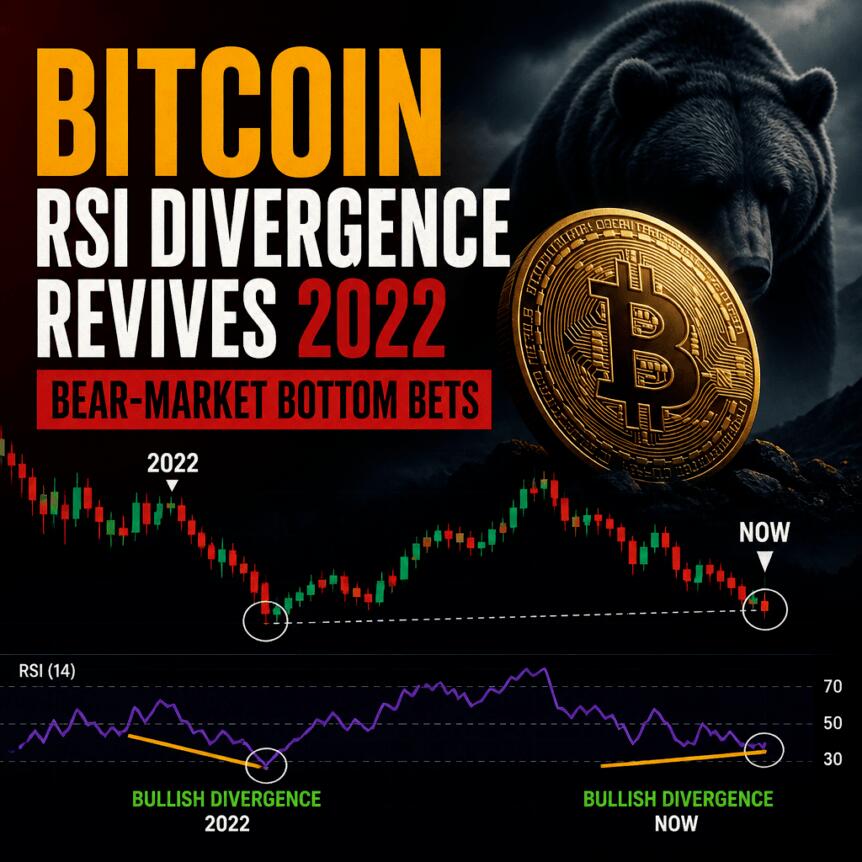
- Weekly RSI divergence is being compared to a 2022 setup that preceded Bitcoin’s durable bear-market floor near $15,600.
- Some analysts still project further downside, potentially extending into August, even if a relief bounce occurs sooner.
- Commentary from analysts suggests $60,000 is being defended, but it remains unclear whether that defense can withstand a confirmed trend reversal.
RSI divergence draws renewed 2022 parallels
According to TradingView charting, BTC/USD has shown signs of “cooling” volatility after returning above $60,000. On the hourly time frame, market observers noted a sequence of higher swing lows paired with relative strength index (RSI) readings that suggest selling pressure may be easing.
The more widely circulated signal, however, is on the four-hour chart. A bullish divergence appears to be forming when RSI prints higher lows while price makes lower lows—an arrangement traders interpret as a potential shift in the balance between buyers and sellers.
Pseudonymous trader Rod explicitly framed the situation as history repeating itself, pairing current signals with how RSI behavior changed during the 2022 bear market. In a post on X, Rod wrote: “It’s 2022 again,” aligning the current backdrop with the earlier period when RSI divergence preceded a durable base.
What traders point to from the 2022 bear-market setup
In the 2022 episode cited by traders, a weekly RSI bullish divergence coincided with Bitcoin establishing its bear-market low near $15,600. That low later functioned as a lasting market floor, reinforcing the idea—at least for technical analysts—that multi-time-frame RSI divergence can matter when the broader downtrend starts to lose momentum.
More recently, four-hour RSI levels fell to around 11.4 at the start of June, according to the same chart-based commentary. That reading is described as one of the lowest levels on record, underscoring that RSI has already tested extreme oversold conditions before bouncing back toward the $60,000 area.
Daily confirmations and the debate over next support
On Friday, crypto analyst Lukasz Wydra added daily perspective to the ongoing RSI discussion. According to his post on X, the bullish RSI divergence has been “officially confirmed,” though he cautioned that it could still deepen before any sustained recovery takes hold.
Wydra characterized the RSI development as an “encouraging sign,” while also pointing to what he described as continued defense of the price by Binance. The core takeaway for traders: even if divergence signals are improving, confirmation through price action still determines whether buyers can hold the current range.
For investors and traders, this distinction is critical. RSI divergence can indicate changing momentum, but without a follow-through move—such as reclaiming and holding major resistance—markets can remain prone to “false starts” where dips resume after brief bounces.
Calls for $55,000 and the risk that relief fades in August
Not all participants are comfortable treating $60,000 as a turning point. Niels Klaver, cofounder of STABL Agency, reiterated expectations for Bitcoin to visit around $55,000 “before any big move” in his post on X. His view implies that a larger downside objective could still be ahead even if RSI-based signals continue to improve.
Similarly, trader and analyst Rekt Capital suggested the market could experience a relief bounce next month, arguing that July tends to behave differently than June. But he also tied the follow-up to a key mechanical level: once BTC/USD confirms the 50-month exponential moving average (EMA) as new resistance, Rekt Capital expects “August cancellation of relief and additional downside” linked to weakening around $60,000 support, as described in his weekly update on X.
Under this framework, the near-term path would be less about a straight reversal and more about a sequence: a bounce first, then renewed pressure if resistance levels prevent buyers from sustaining higher prices. That view matches the broader tension in the current technical narrative—RSI divergence hints at improving momentum, while other chart targets suggest further downside risk remains active.
What to watch next
Traders should focus on whether Bitcoin can hold $60,000 after testing it, and whether RSI improvements translate into sustained breakouts rather than short-lived mean reversion. The next decisive clues are likely to come from how BTC reacts to the highest-probability resistance levels highlighted by analysts and whether downside projections from $55,000 toward later-month scenarios gain confirmation.
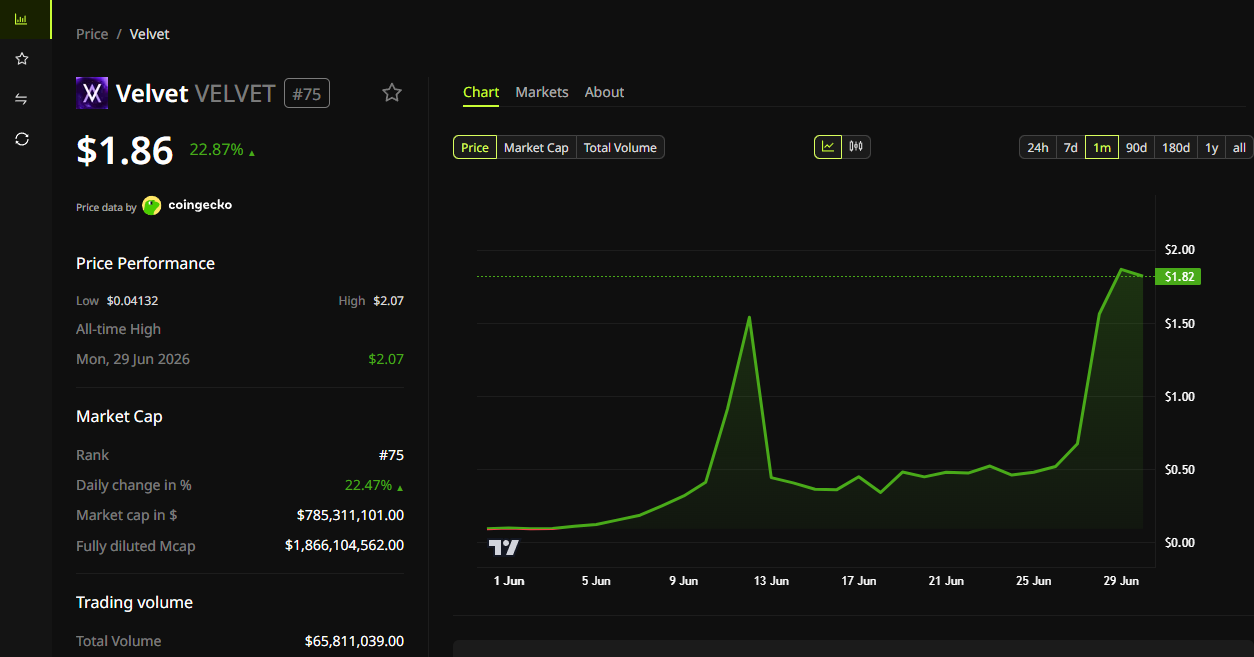
Velvet gained 306% over the past seven days, making it last week’s top-performing altcoin. The token now trades over $1.80 as buyers push it toward its $2.
That rally follows a large correction earlier in June that dragged VELVET down towards $0.30. Two product developments pulled buyers back in.
Aerodrome Migration and Pre-IPO Markets Drove Velvet Recovery
The project moved 100% of its protocol-owned liquidity on Base to Aerodrome Finance, the chain’s leading decentralized exchange. The move concentrates depth into one venue, giving traders tighter spreads and better fills on every trade through the platform.
Velvet also launched synthetic pre-IPO markets, letting users trade exposure to private companies before public listings. The SpaceX feature drew significant speculative interest and helped push VELVET token price sharply higher in mid-June.
Trading volume surged alongside the price move, confirming buyers stepped in with conviction rather than thin-market drift.
However, its market cap sits just around $800 million while its total value locked remains around $770,000. That disconnect points to speculation driving the rally rather than underlying platform usage.

What the Broader Market Shows
VELVET’s surge stands out against a weak broader backdrop. Bitcoin (BTC) is hovering just under $60,000, weighed down by persistent macro uncertainty and subdued risk appetite. Most large-cap altcoins have struggled to gain traction in that environment.
Capital rotating into low-cap tokens like VELVET during a broad market slump is a pattern worth noting. It often reflects speculative positioning rather than a wider recovery in sentiment.
The post VELVET Jumps 300% in a Week on Aerodrome Move, Despite Market Downturn appeared first on BeInCrypto.

Galaxy Digital CEO Mike Novogratz believes Bitcoin’s latest decline is linked to growing concerns around Strategy, along with macroeconomic stress and weak crypto market sentiment.
According to Novogratz, Strategy’s 32 BTC sale rattled the market, while investors are also concerned about the company’s funding model, which has undermined confidence in the broader cryptocurrency market.
Novogratz Raises Strategy Concerns
Novogratz believes these concerns could lead to a crisis of confidence across the Bitcoin and cryptocurrency markets. Strategy is the largest public corporate holder of Bitcoin, with 847,363 BTC. As a result, traders use the company’s stock and preferred securities to judge risk across the Bitcoin market.
Strategy has been under substantial pressure in recent weeks as its stock value fell below the value of its Bitcoin holdings. This has made it harder for the company to raise fresh capital, impacting market confidence.
Strategy Under Pressure
Novogratz also highlighted that Strategy’s preferred products were under pressure. STRC, the company’s preferred stock product, is currently trading around $74.57, significantly lower than its intended $100 mark. Additionally, annual dividend obligations have risen to $1.2 billion, while dividend coverage dropped to 14 months thanks to declining cash reserves. Macroeconomic pressures are another reason behind Bitcoin’s decline. The Federal Reserve remains hawkish, while a stronger dollar could reduce demand for risk assets, including Bitcoin.
Substantial ETF outflows have also put pressure on Bitcoin. Bitcoin ETFs have recorded a seven-day outflow streak, with investors pulling out over $1.8 billion since June 17.
Bitcoin Sale Undermined Confidence
Novogratz added that Strategy’s decision to sell 32 BTC after claiming it would never sell rattled the market. The company sold the Bitcoin for $2.5 million between May 26 and May 31, at an average price of $77,135. While the amount was insignificant, the symbolism was not, with Strategy barely making a profit on the sale. The sale has raised uncomfortable questions about the impact of future sales on Bitcoin’s price. A larger sale could drag Bitcoin prices lower and put more pressure on Strategy’s balance sheet.
Novogratz highlighted Strategy’s $14 billion in unrealized losses as another factor that has bogged down investor sentiment.
Bitcoin Could Slip Below $50,000
Novogratz also warned of a drop below $50,000 if Bitcoin loses the $59,000 to $60,000 zone. A drop below these levels could trigger a wave of liquidations. A drop below $50,000 could see Bitcoin decline as low as $45,000 before rebounding. However, if the flagship cryptocurrency manages to stay above $59,000 to $60,000, it could help calm a jittery market.
Disclaimer: This article is provided for informational purposes only. It is not offered or intended to be used as legal, tax, investment, financial, or other advice.

Galaxy Digital has cut its probability estimate for the US Senate passing the CLARITY Act in 2026 to a 50-50 proposition, arguing that lawmakers have less time than before to secure a floor vote before the Senate’s August recess. The adjustment underscores how procedural calendar constraints—rather than broad political debate—may ultimately decide whether the bill reaches the finish line.
Galaxy’s chief firmwide research officer, Alex Thorn, said the downgrade is primarily about timing and Senate logistics, including the absence of a single, unified Senate Banking-Agriculture text and the lack of a set schedule for floor consideration. In a separate comment, Thorn also pointed to intensified competition for agenda time in Washington after President Donald Trump cancelled the signing of a bipartisan housing bill and linked a potential path forward to passage of the SAVE Act.
Key takeaways
- Galaxy Digital now assigns a 50% chance the CLARITY Act will clear the US Senate in 2026, down from 60% (June 9) and 75% (May 22).
- Alex Thorn attributed the latest cut mainly to timing: no unified Senate Banking-Agriculture bill text, no confirmed floor schedule, and a narrowing legislative window before August recess.
- The Senate’s work period runs until July 10, followed by the traditional August recess beginning Aug. 8 and resuming Sept. 14, tightening the window for action.
- Thorn said political and procedural fights elsewhere—particularly debate connected to the SAVE Act—are further crowding the Senate’s legislative queue.
- CLARITY has already cleared the Senate Banking Committee in May, but critics have argued it could allow crypto firms to pay yields on stablecoins without the same constraints as traditional financial institutions.
Galaxy halves the odds, citing Senate timing
In the update shared by Galaxy’s research head, Alex Thorn, the firm reduced its estimate for the CLARITY Act’s passage in 2026 to 50-50. The reasoning is grounded in process: Thorn highlighted that the Senate Banking-Agriculture committee work does not appear to have converged into a single consolidated text, and lawmakers have not established a clear floor timetable.
That uncertainty matters to market participants because the practical path for a major crypto regulatory framework depends on whether a bill can be scheduled for debate and voting when the chamber is already managing a crowded docket. Thorn emphasized that Galaxy’s recalibration concerns the bill’s timeline rather than changes in the underlying policy direction.
The downgrade also arrives after Galaxy previously lowered its estimate in stages. According to Galaxy’s own prior positioning, it cut the odds from 75% to 60% on June 9, after raising them to 75% earlier on May 22.
The legislative calendar is narrowing before the August recess
Thorn’s remarks place the CLARITY Act’s prospects in the context of the Senate’s near-term schedule. The US Senate has entered a work period from Monday until July 10. The chamber is then expected to start its traditional five-week August recess on Aug. 8, returning to Washington on Sept. 14, according to the Senate’s legislative schedule posted at Senate.gov.
With that timeline in mind, Thorn argued that even bipartisan bills can struggle when leadership has to balance multiple items for floor consideration. He said the debate over the SAVE Act has “inject[ed] another contentious, leadership-consuming fight into an already crowded queue,” suggesting that calendar pressure is compounding political complexity.
Thorn also pointed to other “unfinished developments” that could compete for attention, including Section 702 of the Foreign Intelligence Surveillance Act (FISA) and the National Defense Authorization Act (NDAA) for fiscal year 2027, which he characterized as must-pass legislation and a frequent focus of political negotiation. In practical terms, that means CLARITY may need to secure a narrow slot in a pipeline already filled with issues that leadership may treat as higher priority.
House progress and the debate over stablecoin yield rules
The CLARITY Act is designed to create what proponents describe as the first comprehensive US regulatory framework for digital assets. The bill is scheduled for a House hearing on July 17, and it already advanced in the Senate when it cleared the Senate Banking Committee in May.
However, the bill’s political reception has not been uniform. The measure faced criticism from within the debate in the Senate Banking process, with many Democrats and representatives of the banking industry arguing that the legislation could allow crypto firms to offer yields on stablecoins without meeting the same regulatory requirements imposed on traditional financial institutions.
That critique highlights a central tension in US digital-asset policymaking: whether regulators should treat stablecoin-linked financial products similarly to conventional banking and securities activities, or whether the crypto sector’s unique architecture calls for a distinct framework. While the bill has moved past one legislative checkpoint, those substantive concerns could still influence how quickly—or whether—leadership is willing to allocate floor time.
Outside pressure and competing concerns
The CLARITY Act has attracted significant outside engagement, including industry lobbying and law-enforcement concerns that the measure could create oversight gaps.
Earlier in June, more than 200 crypto companies and organizations urged the Senate to pass the CLARITY Act in a letter shared by the crypto lobby group Stand With Crypto, according to earlier coverage at Cointelegraph. Later in June, reporting referenced that a coalition involving law enforcement organizations and Catholic groups reached out to White House officials raising concerns about potential weaknesses in how illicit activity might be supervised under the bill. Earlier coverage at Cointelegraph described those concerns.
While these competing positions do not by themselves determine the bill’s fate, they can affect whether leadership believes a floor vote is politically manageable—particularly when, as Thorn argues, the Senate is already squeezed for time.
For traders and long-term investors, the key question now is whether CLARITY can secure the procedural steps needed for a floor schedule before the Senate’s August recess begins. Galaxy’s revised odds suggest that even a bill with committee momentum may stall if leadership cannot find room in the calendar—so readers should watch closely for any sign of a unified Senate bill text and for whether floor timing becomes more concrete after July 10.
ASML (ASML) Stock: Should Investors Chase This Rally Past $1,800?

Brittany Mahomes Wears Matching Swimwear With Patrick, Kids

Money (That’s What I Want) (Remastered 2009)


-
 Sports6 days ago
Two goals and an assist by sheer aura: Cristiano Ronaldo just entered the World Cup chat
-

 Tech7 days ago
Microsoft accidentally kills epic Outlook email threads
-

 Fashion3 days ago
Weekend Open Thread: Staud – Corporette.com
-

 Politics3 days ago
The House | Manchesterism won’t survive the painful trade-offs unless it gets citizens on board
-

 Politics3 days ago
Potential 2028er World Cup attendee leaderboard
-

 Business3 days ago
Asia stock markets slide as tech shares slump
-

 Tech4 days ago
A Look At A Gaggle Of Transputer Boards
-
Crypto World5 days ago
Bitcoin (BTC) Dips Below $62K, Ethereum (ETH) Plunges 6% Daily: Market Watch
-
 Crypto World4 days ago
Dell (DELL) Shares Tumble Over 5% Following Analyst Downgrade to Hold
-

 Crypto World5 days ago
Securitize Wraps Roubini's SEC-Registered ETF as Dubai VARA Digital Security
-
Business5 days ago
Entergy settles forward sale agreements, raises $672 million in cash proceeds
-

 Crypto World2 days ago
Kraken's xStocks Opens Bending Spoons IPO Registration to EEA Retail
-

 Sports3 days ago
FIH Pro League: India defeat Pakistan 7-1, register biggest win of campaign | Other Sports News
-

 Crypto World2 days ago
Coinbase, Circle Deepen Crypto Stock Losses Despite Resilient S&P 500
-
Crypto World3 days ago
Hyperliquid Named on Singapore MAS Investor Alert Register
-

 Crypto World3 days ago
RTX holders must register wallets before token distribution begins
-

 Tech1 day ago
Bluekit phishing kit adopts browser-in-the-middle for login theft
-

 Tech2 days ago
Russian hackers now target Signal backup recovery keys
-

 Politics7 days ago
Wes Streeting abandons leadership bid and backs Burnham
-

 Sports4 days ago
India vs Bangladesh LIVE Score, Women’s T20 World Cup: Bangladesh Opt To Bat; India Enter ‘Do-Or-Die’ Stage As Semi-Final Race Heats Up
You must be logged in to post a comment Login