

Crypto World
Galaxy Digital Cuts 2026 CLARITY Act Odds to 50%

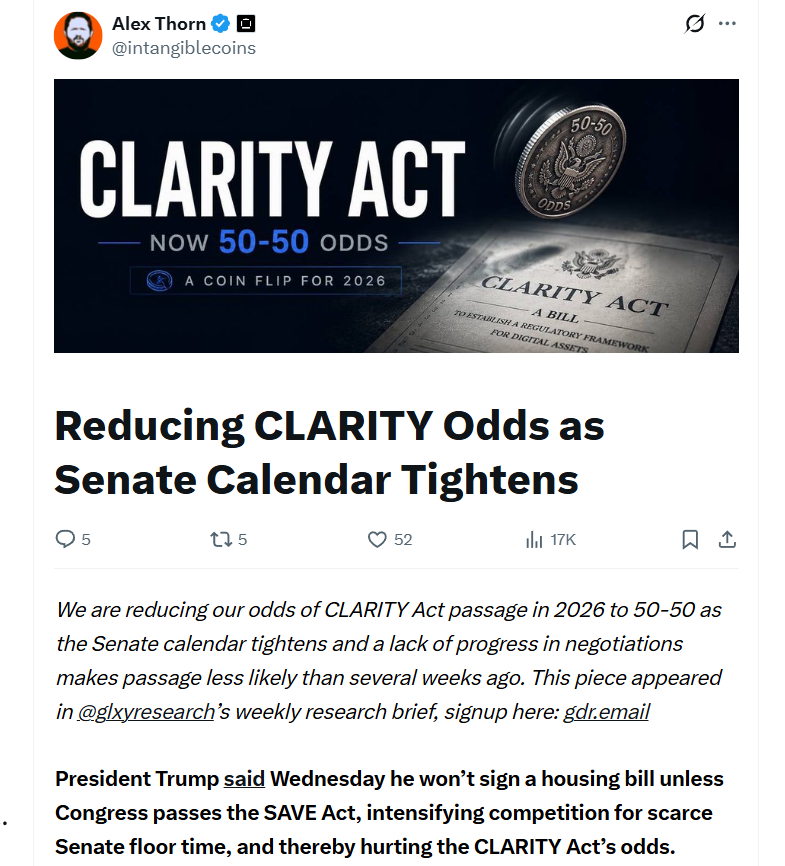
Galaxy Digital has cut its odds of the CLARITY Act becoming law in 2026 to 50%, warning that the US Senate is running out of time to move the crypto market structure bill before its August recess.
“We are reducing our odds of CLARITY Act passage in 2026 to 50-50,” wrote Galaxy’s head of firmwide research, Alex Thorn, citing the lack of a unified Senate Banking-Agriculture text, no firm floor schedule and a narrowing legislative window before lawmakers leave Washington.
Thorn said the downgrade was about the bill’s timing, not substance and added that the congressional competition for floor time “intensified” after US President Donald Trump abruptly canceled the signing of the bipartisan housing bill and said he would not sign it until Congress passed the SAVE Act, to introduce a proof-of-citizenship elections bill.
The downgrade comes after Galaxy lowered its previous estimate of the bill from 75% to 60% on June 9. On May 22, the company had raised its CLARITY Act estimate to 75%.
The CLARITY Act is set for a House hearing on July 17. The bill aims to establish the first regulatory framework for digital assets in the US, but it has been met with criticism. It cleared the Senate Banking Committee in May, with most Democrats and the banking industry pushing back, arguing that it would allow crypto firms to offer yields on stablecoins without facing the same requirements as traditional financial institutions.
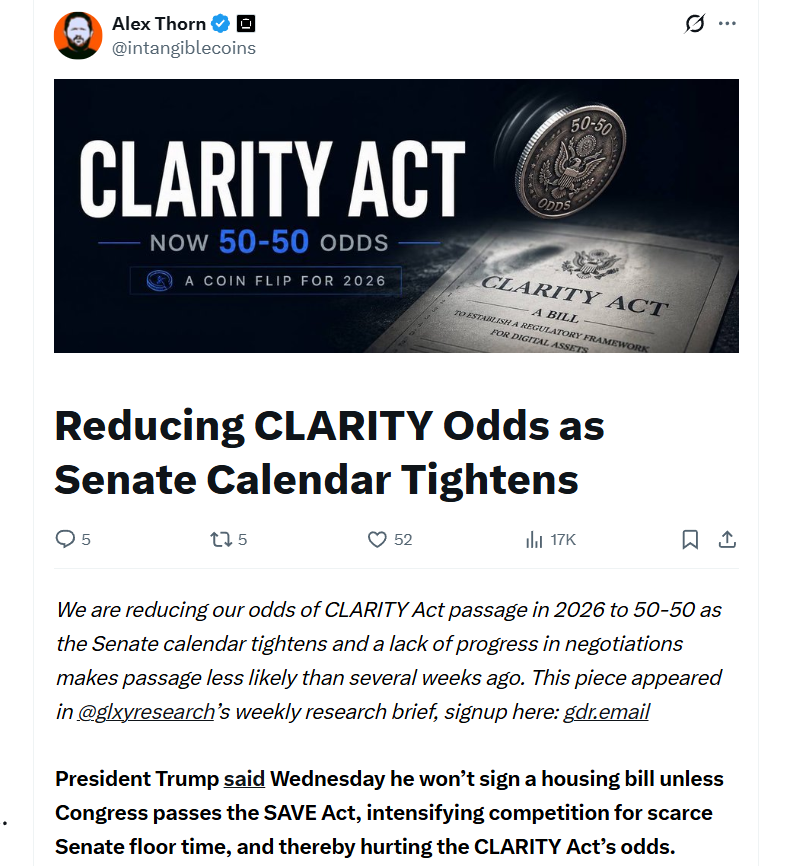
Source: Alex Thorn
Congressional calendar squeezes crypto bill
The latest cut reflects mounting concern that even a bill with bipartisan support may not get enough floor time in a crowded Senate calendar.
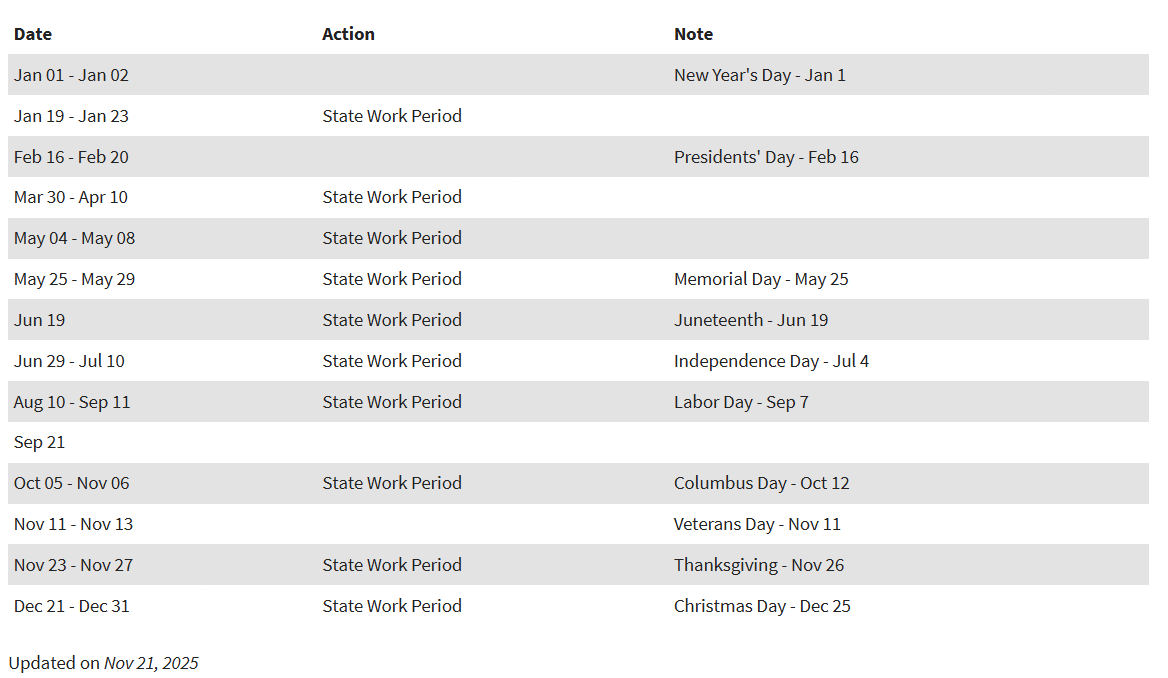
Senate legislative schedule. Source: Senate.gov
The US Senate has entered a state work period from Monday until July 10. The Senate is also scheduled to begin its traditional August recess on Aug. 8 for five weeks before returning to Washington on Sept. 14, according to its legislative schedule.
Related: Hyperliquid added to Singapore’s Investor Alert List
The runway to pass the bill is quickly declining, said Thorn, adding that the debate over the SAVE Act “injects another contentious, leadership-consuming fight into an already crowded queue.”
He added that the Senate is also working on two unfinished developments, including Section 702 of the Foreign Intelligence Surveillance Act (FISA), to which the House failed to pass a reauthorization and the National Defense Authorization Act (NDAA) for the fiscal year of 2027, which is considered “must-pass” legislation and is often the target of political debate.
At the beginning of June, over 200 crypto companies and organizations urged the US Senate to pass the CLARITY Act in a letter shared by crypto lobby group Stand With Crypto.
Later in June, a group of law enforcement organizations and a coalition of Catholic organizations reached out to White House officials with concerns that the CLARITY Act could create oversight gaps regarding illicit activity.
Magazine: How crypto laws changed in 2025 — and how they’ll change in 2026

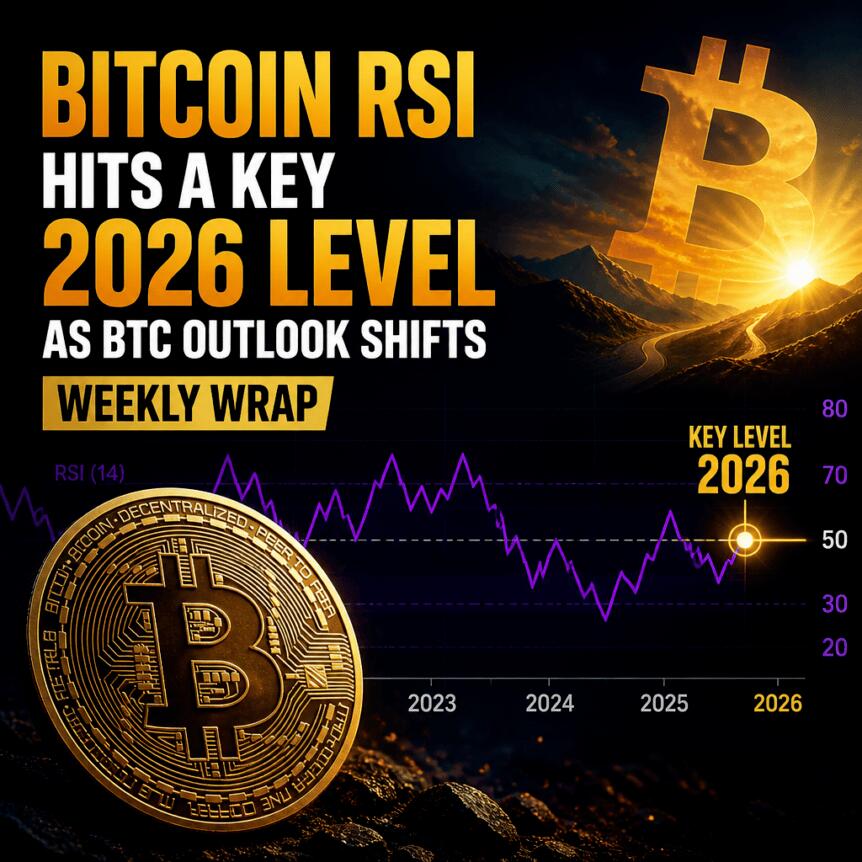
Bitcoin is heading toward the end of June with traders focused on a potential make-or-break area near $60,000—an important level that bulls have struggled to defend as bearish momentum has carried into the second quarter. At the same time, several widely watched momentum and onchain signals are flashing early “stabilization” clues that could complicate the bearish narrative.
Technical traders point to bullish divergences in RSI across multiple time frames, while onchain analytics from CryptoQuant highlights a “first bottoming flag” tied to how broadly Bitcoin’s unspent outputs remain in profit versus loss. Separately, macro traders are preparing for a tight window of economic releases—especially the U.S. manufacturing PMI—and the market’s sensitivity to U.S. labor data and geopolitical developments.
Key takeaways
- RSI divergences are appearing across several time frames in Bitcoin’s charts, an indication that selling pressure may be losing traction.
- June’s performance has been weak—CoinGlass data cited in the report shows nearly a 19% loss for BTC/USD in June, its worst since the 2022 bear market.
- Traders are comparing the current $60,000 test to prior bear-market behavior, arguing that support often breaks only after repeated attempts.
- CryptoQuant says a UTXO profitability indicator is at its lowest level since 2022, suggesting an early stage of internal “market clean-up.”
- Seasonality research cited by traders suggests July has historically been a better month than June in many years, though outcomes can vary.
RSI divergences revive recovery odds as June nears its close
As June approaches its end, analysts and traders are watching whether Bitcoin can hold a key structural level. According to TradingView data cited in earlier coverage, RSI signals across multiple time frames are showing bullish divergences—instances where price behavior and momentum diverge in a way that historically can precede reversals or at least a pause in decline.
Cointelegraph previously reported that RSI cues across time frames are aligning into bullish divergences with price as June ends. The article also referenced a comment from Bitcoin whale “Gerla” (CryptoGerla) on X, saying the four-hour chart is showing a bullish RSI divergence while a potential double bottom forms.
Other traders have emphasized that such divergence signals have not consistently appeared in prior dips during 2026. Pseudonymous commentator “Heisenberg” noted on X that recent oversold RSI divergences had not shown up in the same way during earlier drops—until the current setup—suggesting the present decline may be maturing rather than simply accelerating.
Still, the presence of divergences is not the same as confirmation. The same coverage points out that $60,000 has increasingly acted as resistance, with bulls unable to push through decisively—an issue that keeps traders wary of a breakdown scenario heading into month-end.
Why $60,000 matters: the “mid-2022” support test comparison
One reason traders treat the $60,000 level as more than just a psychological number is historical patterning. In the source reporting, commentators compared the current situation to 2022, when Bitcoin repeatedly interacted with the $30,000 area before it finally failed and later produced a bear-market low.
CoinGlass data cited in the article places Bitcoin’s June drawdown at nearly 19% for BTC/USD—described as the worst since the 2022 bear market and the sharpest performance so far this year. That framing matters because it puts current price weakness into context: the market is not just drifting lower, it is experiencing a month that resembles the intensity of prior major risk-off phases.
On X, commentator “Exitpump” argued that significant support and resistance levels rarely break on the first attempt, often requiring repeated tests before momentum flips decisively. The same post likened the current $60,000 dynamics to the way $30,000 behaved earlier in the 2022 cycle. Importantly, the argument here is conditional: even if June is fragile, it may not be a single-day event that determines the next trend leg.
Macro pressure points: PMI, labor data, and geopolitical risk
Even with technical setups improving, Bitcoin’s short-term direction often depends on what happens in U.S. economic data. The source highlights a “short but busy” four-day trading week ending Q2, with the manufacturing PMI as a potential swing factor.
According to the report, the Institute for Supply Management (ISM) is set to publish the manufacturing Purchasing Managers Index (PMI) on Wednesday. The source notes that the PMI has been breaking out from a multiyear downtrend and that estimates call for a score around the mid-50s, with a possible mild decrease versus the prior month. In prior coverage, Cointelegraph had described PMI strength as a potential tailwind for crypto markets.
Thursday’s June nonfarm payrolls report is another key focus. As trading resource The Kobeissi Letter summarized in a thread on X, the market is also set to react to geopolitical developments as the U.S. and Iran agree to discuss their fragile peace agreement. The same note tied the week’s schedule to the end of Q2, with earnings season on the horizon—factors that can amplify cross-asset volatility.
The report also stresses that Bitcoin’s correlation with equities has been inconsistent in recent months, and it includes an example of trader Daan Crypto Trades pointing to BTC versus the S&P 500 returning to a level seen during earlier risk-stress periods. That matters for investors because it implies the market may not be moving in a straight line with stock indices—meaning both crypto-specific and macro drivers can compete.
Seasonality and “first bottoming flag” signals: early stabilization vs. full reversal
Two separate narratives are being used to explain why July could look different from June. The first is historical seasonality. The source cites research shared by Rekt Capital on X, arguing that in previous years July has often offset June’s weakness—sometimes followed by August weakness that cancels July’s upside. CoinGlass data referenced in the article supports this pattern by showing only a few exceptions since 2013, while 2025 is noted as a case where both months finished green.
The second narrative is onchain. The report highlights a CryptoQuant QuickTake post by contributor I. Moreno, who described an “early clear sign” of deeper market clean-up. Moreno focuses on the UTXO Block P/L Count Ratio Model, an indicator that compares how blocks of unspent outputs are distributed between profit and loss across the network.
In Moreno’s explanation as quoted in the source, a high ratio can indicate many UTXO blocks still sit in profit—often associated with higher distribution risk. When the ratio falls toward lower ranges, profitability compresses, losses spread more widely, and the market enters a more advanced reset phase.
The report states that the ratio is currently 5.9, described as the lowest since 2022 and one of the lowest readings on record, which Moreno called Bitcoin’s “first bottoming flag” of the current bear market. However, the same source cautions that this may only indicate the start of internal reset rather than the completion of a full bottom—history suggests additional stress absorption may still be required.
What this combination of signals implies is not certainty, but a shift in balance: momentum indicators are improving at the same time an onchain metric suggests distribution pressure may be moving into an earlier phase of exhaustion. The unresolved question is whether $60,000 holds long enough for those signs to translate into a sustained reversal.
Going forward, traders and investors should watch month-end price acceptance around $60,000, the immediate reaction to U.S. PMI and labor data, and whether the RSI divergences persist as July starts—alongside onchain follow-through on the “bottoming flag” theme highlighted by CryptoQuant.

Bitcoin News: El Salvador’s Bitcoin reserve stands at 7,696 BTC, worth approximately $460M as of June 28, but the number is doing more political work than the accounting behind it can cleanly support.
President Nayib Bukele’s government continues to publicly promote a one-BTC-per-day BTC accumulation strategy, even as the country operates under a $1.4Bn Extended Fund Facility with the IMF that imposes a hard zero ceiling on voluntary public-sector Bitcoin purchases.
That gap between public messaging and loan conditionality is the central tension the next IMF review will force into the open.
Bitcoin was trading in the $59,000 to $60,000 range at the time of publication, down roughly 19% over 30 days. That drawdown matters here because it compounds the fiscal optics: at the reserve’s peak valuation near $800M in early 2026, the strategy looked like a winning sovereign bet.

At current prices, the same 7,696 BTC position represents a significant unrealized loss and a balance-sheet line item that the IMF is watching closely.
The country occupies a unique position in the history of sovereign Bitcoin. It made BTC legal tender in September 2021, built the state-run Chivo wallet infrastructure to support public adoption, and turned BTC purchases into a national brand. That era is now constrained by the terms of the IMF deal, which it needed to stabilize public finances.
Don’t Miss Out on Our $1,000 USDT Airdrop on ByBit
Bitcoin News: The IMF Ceiling Is Precise. The Reserve Growth Is Not.
The IMF’s Extended Fund Facility, approved by the Fund’s Executive Board in early 2025, includes a continuous quantitative performance criterion with a zero ceiling on voluntary BTC accumulation by the public sector.
A parallel ceiling covers public-sector BTC-denominated or BTC-indexed debt and tokenized instruments. These are not aspirational targets; they are performance criteria tied to disbursement. Missing them has consequences.
The complication is that El Salvador’s reported holdings have risen since the program began. Official data showed 5,968 BTC at the program’s December 2024 start; BitcoinTreasuries now lists 7,696 BTC as of late June 2026. On its face, that trajectory contradicts a no-accumulation pledge.
The IMF’s explanation, confirmed by spokesperson Julie Kozack, is that increases in the Strategic Bitcoin Reserve Fund reflect consolidation of BTC across various government-owned wallets, notably from a BANDESAL cold-storage address, rather than net new market purchases by the public sector. The total BTC controlled across all government wallets, the IMF says, has remained unchanged.
That distinction is technically defensible under international public-sector accounting standards, which treat all government-controlled wallets as a consolidated position.
But it is not self-evident from the public-facing reserve tracker, and it leaves El Salvador’s one-BTC-a-day narrative in a structurally ambiguous place: the claim may describe internal wallet movements rather than fresh sovereign accumulation, or it may not.
Discover: The Best Token Presales
Bukele’s Bitcoin Brand Versus the Loan’s Hard Conditions
The political logic of Bukele’s sovereign Bitcoin strategy was always layered. BTC purchases were simultaneously a hedge against dollar dependency, a brand-building exercise for international Bitcoin audiences, and a domestic political signal.
The one-BTC-a-day narrative still travels effectively on social media and still positions El Salvador as the flagship experiment in crypto regulation by adoption rather than restriction. None of that political value disappears under IMF oversight.
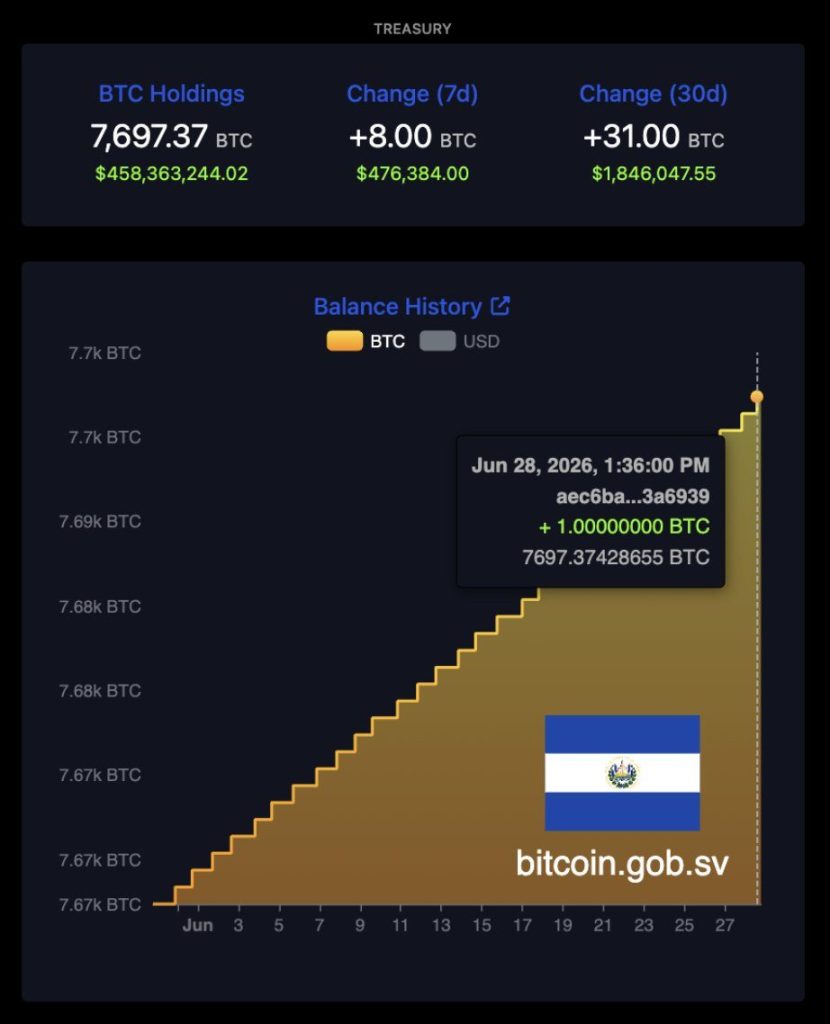
What changes is the accountability structure. The IMF program required El Salvador to report all public-sector hot and cold wallet addresses and corresponding BTC balances, with deadlines at the end of March 2025, the end of June 2025, and the end of December 2025.
It also required the government to exit its public involvement in the Chivo wallet by July 2025, to liquidate the Fidebitcoin trust, and to publish audited financial reports for all Bitcoin-linked public entities. The Fund’s stated position is that “efforts will continue” to ensure El Salvador does not accumulate additional BTC, phrasing that signals ongoing scrutiny rather than a settled compliance verdict.
A government reserve cannot be redeemed the way ETF shares can. US spot Bitcoin ETFs absorbed roughly $5.94 billion in outflows over six consecutive weeks during the same period El Salvador’s reserve was under pressure, illustrating exactly how quickly institutional Bitcoin demand can reverse.
El Salvador has no equivalent exit mechanism. Its reserve must coexist with budget targets, IMF disbursement conditions, and public accounting requirements simultaneously. That is a different kind of constraint than a corporate treasury or an ETF sponsor faces.
Discover: The Best Crypto to Diversify Your Portfolio
The post El Salvador Claims It’s Buying Bitcoin Daily, But the IMF Disagrees appeared first on Cryptonews.
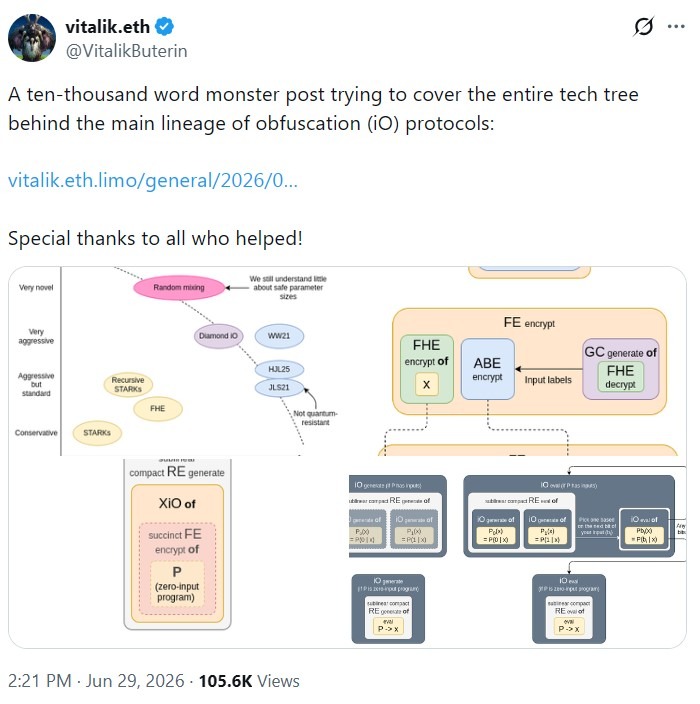
Ethereum co-founder Vitalik Buterin published a technical essay outlining how cryptography could one day enable people to vote privately onchain without relying on a trusted group to manage ballots or reveal the result.
In a blog post on Monday, Buterin said a cryptographic approach called indistinguishability obfuscation (iO), combined with blockchain infrastructure, could support private and collusion-resistant voting with “almost no trust assumption.” The approach would replace threshold committees, which jointly decrypt voting data, with protected programs designed only to reveal the outcome.
Private onchain voting remains dependent on groups of operators safeguarding information and behaving honestly. Removing that dependency could make decentralized governance harder to manipulate, reduce the risk of insider interference and allow voters to participate without exposing how they voted, according to Buterin.
However, Buterin said the technology remains impractical. He said the most conservative constructions require what he described as “galactic” amounts of computation. He said faster approaches rely on less-tested security assumptions, which means that the idea presents a more long-term research direction rather than a deployment-ready system.
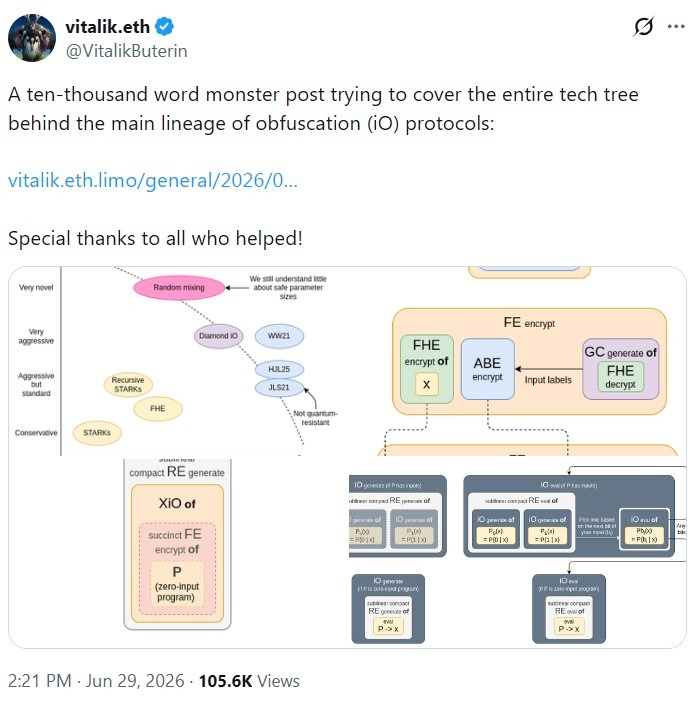
Source: Vitalik Buterin
How indistinguishability obfuscation could protect onchain votes
According to Buterin, iO is a form of cryptography that turns software into a protected program. People can run the program and receive the intended output, but they cannot inspect its internal code or extract the data stored inside it. Buterin described the concept as hiding the code rather than the information being processed.
For onchain voting, Buterin said an obfuscated program could contain the logic needed to process encrypted ballots and reveal the final tally without exposing individual votes, essentially removing the need for a threshold committee whose members collectively hold the keys required to decrypt the result.
Buterin said blockchains would still play a key role because an obfuscated program cannot prevent itself from being copied or independently maintain changing information.
Related: Ethereum whale who shorted October 2025 crash opens $19.7M ETH short position
Buterin’s broader privacy push
Buterin previously connected iO with private voting in his Ethereum roadmap published in October 2024. He said the approach could provide stronger privacy and resistance to coercion. His latest essay expands on that earlier proposal by examining how the underlying cryptography could be constructed, the security assumptions it requires and the technical barriers preventing it from becoming practical.
In April 2025, Buterin proposed a more immediate privacy roadmap for Ethereum, calling for privacy tools to be integrated into existing wallets. The proposal also advocated for stronger protections against data collection by infrastructure providers that wallets use to access Ethereum.
Buterin also drew funding from his personal holdings to fund privacy-preserving technologies. On Jan. 30, he earmarked 16,384 Ether (ETH), worth about $45 million at the time, to fund initiatives focused on privacy, open infrastructure and self-sovereign tools.
Magazine: Japanese pension fund tips 1% in crypto, G7 urges action on NK hackers: Asia Express

Key Highlights
-
Verizon shares gained following announcement of strategic BT partnership worth $4B.
-
Equal ownership structure establishes balanced control between both telecom leaders.
-
Combined platform will deliver services to 3,000 enterprise customers in over 180 nations.
-
Agreement includes $625M equalization payment from Verizon to BT.
-
Industry veteran Martijn Blanken selected to helm the new enterprise entity.
Shares of Verizon Communications (VZ) experienced upward movement following the revelation of a strategic international partnership with BT Group. The telecommunications giants unveiled plans for an equally controlled enterprise joint venture that merges their worldwide corporate operations. The initiative focuses on delivering services to multinational corporations operating in more than 180 nations. Verizon’s stock finished trading at $46.54, representing a 1.02% increase, though pre-market activity showed a modest 0.30% decline to $46.37.
Verizon Communications Inc., VZ
Telecommunications Powerhouses Forge International Enterprise Alliance
BT Group and Verizon have agreed to merge their worldwide corporate operations into a single jointly managed entity. The arrangement establishes equal governance rights for both telecommunications providers. As part of the financial terms, Verizon will transfer an equalization sum of $625 million to BT.
The newly formed organization will cater to over 3,000 corporate clients spanning international territories. Combined yearly revenues are projected to reach approximately $4 billion. This strategic alliance provides both corporations with an expanded infrastructure for delivering enterprise connectivity solutions.
According to company statements, the framework will enable multinational corporations to access protected communication and networking capabilities. The partnership merges BT International with Verizon’s overseas enterprise wireline division. Consequently, the operation will emphasize international connectivity, cloud-based networks, and regulatory compliance services.
Partnership Delivers Enhanced Scale for Corporate Network Services
The collaborative enterprise focuses on corporations requiring protected worldwide networks spanning diverse geographic areas. It will address data management, operational demands, and compliance standards for large-scale organizations. Furthermore, both companies anticipate that the unified network infrastructure will generate operational efficiencies following completion.
The entity will be legally established in the Bailiwick of Jersey. Nevertheless, primary operations and tax residency will be maintained in the United Kingdom. The venture will also establish commercial arrangements with both founding organizations after finalization.
BT and Verizon will maintain direct service to their respective home markets while backing the new corporate platform. BT will concentrate on its United Kingdom initiatives, while Verizon will continue direct customer service within United States territories. This organizational approach enables both corporations to streamline overseas operations while preserving dominance in core markets.
Industry Veteran Martijn Blanken Tapped as Future Leader
BT and Verizon have designated Martijn Blanken as the prospective chief executive officer of the collaborative venture. His official appointment is contingent upon successful completion of the agreement. Blanken is scheduled to join BT on September 1, 2026, ahead of the anticipated launch date.
Blanken brings extensive experience from senior positions throughout telecommunications, technology, and digital infrastructure sectors. His professional background encompasses executive leadership at Telstra, Openwave Systems, EXA Infrastructure, and KPN. The partners chose an executive with substantial expertise managing international network operations.
Clive Selley will maintain his position as chief executive of BT International throughout the transition period. Verizon’s management framework will continue without modification. Both international divisions will function autonomously until regulatory authorities approve the transaction.
Agreement Awaits Regulatory Clearance Process
The partnership remains subject to regulatory approvals and mandatory employee consultations in applicable jurisdictions. During this interim period, BT and Verizon will maintain separate operations for their international businesses. Both organizations have committed to upholding service obligations to existing customers throughout the approval process.
Goldman Sachs served as primary financial advisor to BT throughout the transaction. Deloitte provided transaction services advisory support, while Freshfields LLP delivered legal representation. Morgan Stanley advised Verizon, with Kirkland & Ellis LLP serving as its legal counsel.
The arrangement provides Verizon with enhanced positioning in worldwide enterprise connectivity markets. It simultaneously enables BT to restructure its international operations under a more concentrated framework. The transaction must successfully navigate the requisite approval procedures before the venture commences active operations.

South Korea’s DAT (Digital Asset Treasuries) crypto firms face fresh delisting risk under revised KOSDAQ regulations taking effect on July 1. Several companies that profited from Bitcoin holdings now sit directly in the crosshairs of the new retention rules.
The reform reshapes how Korean markets treat publicly listed crypto treasury players going forward.
What the New Korean Regulations Mean for DAT Crypto Firms
A Digital Asset Treasury, or DAT, is a publicly listed company that stockpiles cryptocurrencies as a core strategic asset on its balance sheet. The model mirrors what Strategy (formerly MicroStrategy) pioneered in the United States, and what Metaplanet has rolled out across Japanese capital markets.
In this way, South Korea has accelerated the implementation of stricter KOSDAQ listing regulations, effective July 1, 2026. The market capitalization threshold rises to 200 billion KRW (~$145 million) by the end of 2026 and 300 billion KRW (~$217 million) from January 2027.
Firms failing to meet the minimum for 30 consecutive trading days face managed stock status and risk automatic delisting within 90 days unless they recover the required level for 45 consecutive days.
Follow us on X to get the latest news as it happens.

The trigger for DAT crypto firms is specific. Several of these companies recorded major paper profits through their crypto holdings as Bitcoin rallied across the past year. However, those gains may now fall within the scope of the new retention threshold, exposing the firms to immediate delisting review.
The reform signals a broader regulatory stance. Korean authorities continue tightening every layer of the digital asset ecosystem, from exchange ownership caps to stablecoin frameworks. Moreover, the KOSDAQ revisions now extend that pressure directly to publicly listed firms holding crypto on their corporate balance sheets.
How DAT Crypto Firms Like Bitplanet Are Now Positioned
Bitplanet is the most visible example of South Korea’s emerging DAT crypto sector. The company was created in July 2025 when a consortium led by Asia Strategy and Sora Ventures acquired KOSDAQ-listed SGA. Furthermore, Bitplanet now holds 300 BTC and aims to accumulate 10,000 BTC over the long term.
The firm’s playbook draws directly from international precedents. CEO Lee Seong-hoon has publicly cited Strategy and Metaplanet as the inspiration behind Bitplanet’s model. As a result, the company has positioned itself as Korea’s first true treasury-focused listed crypto vehicle.

Bitplanet is also expanding into operational businesses. The firm recently signed an MOU with Nasdaq-listed Antalpha to deploy Bitcoin mining equipment valued at approximately 15 billion won (~$10.8 million) across sites in Oman and Paraguay. Moreover, AI data center plans add a second revenue stream alongside the core treasury accumulation business.
The broader question is structural. South Korea remains one of the largest retail crypto markets in the world. However, the path for listed DAT crypto firms now depends on how strictly regulators apply the July 1 threshold and whether transparency can outweigh formal compliance gaps under the new framework.
The post South Korea’s New Rules Put Crypto Treasury Firms at Risk of Major Delisting appeared first on BeInCrypto.
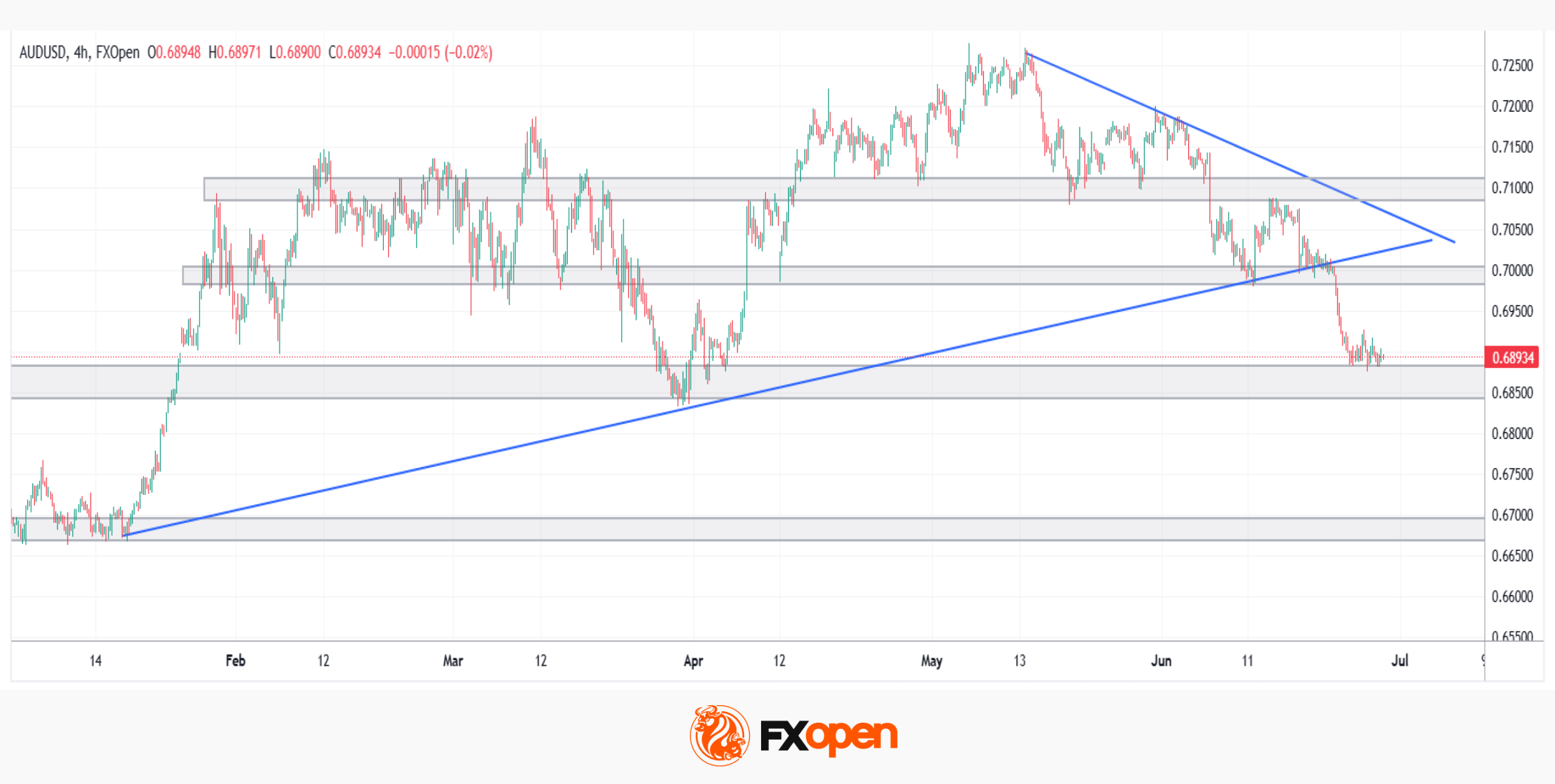
As the chart shows, AUD/USD has entered a distinctly bearish phase in recent weeks, reflecting the broader consolidation — and in some cases outright weakness — that the US dollar has begun imposing across most major currency pairs.
Fundamental Analysis
The Reserve Bank of Australia concluded its June meeting by holding the cash rate steady at 4.35%, opting to monitor the effects of the three consecutive hikes already delivered since the start of the year. The board acknowledged that financial conditions have tightened and that the economy is showing early signs of slowing, while maintaining a vigilant stance on inflation, which remains above target.
In theory, a pause after a tightening sequence — with a cash rate at 4.35%, the highest in the G10 — is a structurally supportive signal for the Australian dollar, as elevated rate differentials tend to attract flows toward AUD-denominated assets. However, markets had already fully priced in this outcome, stripping the decision of any surprise. AUD/USD has consequently failed to post any meaningful bullish impulse, sliding toward almost three-month lows near 0.6890, weighed down by renewed US dollar strength on growing Federal Reserve rate hike expectations. Adding further complexity to the outlook, the ongoing Middle East conflict continues to weigh on global risk sentiment, acting as an additional headwind for a currency that markets have long treated as a barometer of global risk appetite.
Technical Analysis
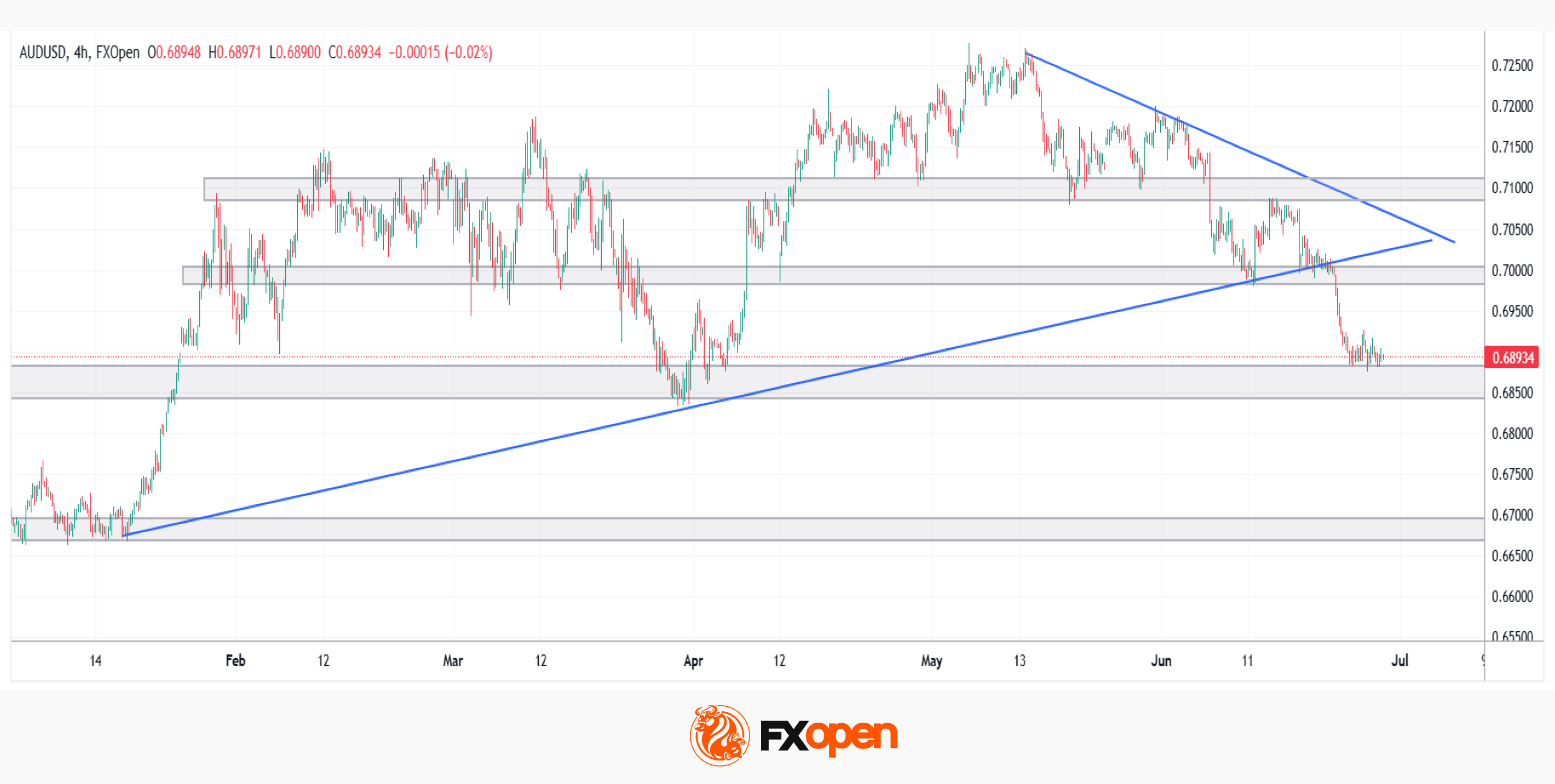
The most representative benchmark for the Australian dollar’s momentum, AUD/USD seems to have already shifted his path. Following a prolonged period of broad greenback strength, the pair has gradually developed a bearish structure over recent weeks.
→ Bullish scenario: a key support zone sits in the 0.6880–0.6850 area. Should this level hold, it could restore some of the strength lost in recent weeks and bring the pair back to test the resistance between 0.6980 and 0.7000 — a threshold that will be decisive for the next directional move. A sustained recovery would also require a more relaxed geopolitical backdrop, as risk sentiment continues to cap AUD’s upside potential.
→ Bearish scenario: should support fail to hold — or should the pair test the descending trendline in play and reject it, confirming the prevailing downtrend — AUD/USD could revisit levels last seen at the start of the year, with the 0.6700–0.6600 zone as the next significant area of interest.
With a more relaxed geopolitical environment and a hawkish central bank behind it, will the Australian dollar manage to reclaim its strength on the forex stage?
Trade over 50 forex markets 24 hours a day with FXOpen. Take advantage of low commissions, deep liquidity, and spreads from 0.0 pips (additional fees may apply). Open your FXOpen account now or learn more about trading forex with FXOpen.
This article represents the opinion of the Companies operating under the FXOpen brand only. It is not to be construed as an offer, solicitation, or recommendation with respect to products and services provided by the Companies operating under the FXOpen brand, nor is it to be considered financial advice.
Key Takeaways
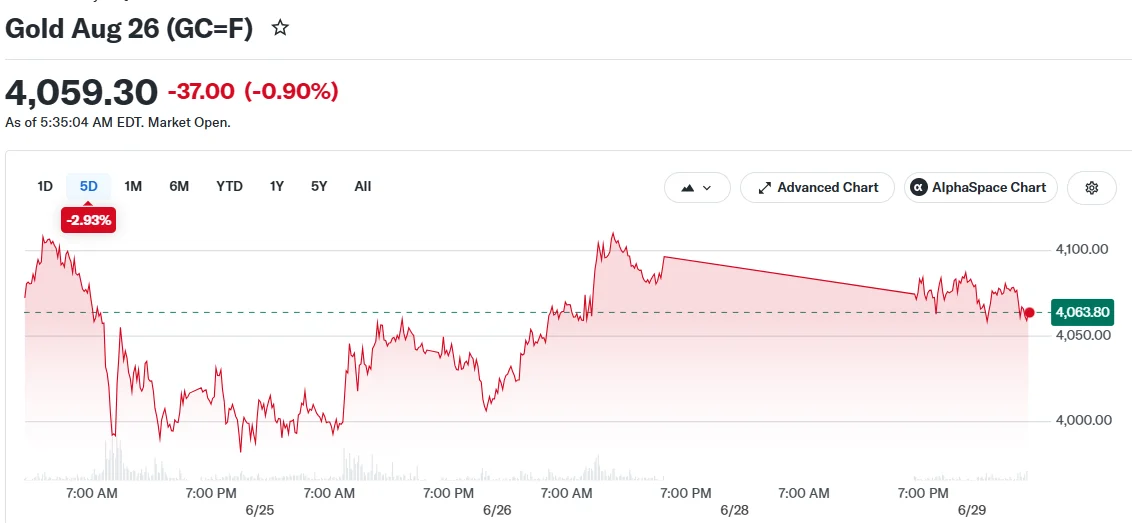
- Precious metal declined more than 1% on Monday, approaching $4,000 per ounce following renewed military exchanges between the US and Iran
- Washington and Tehran have committed to suspending hostilities and will convene for diplomatic discussions in Doha this Tuesday
- The yellow metal has surrendered approximately 23% of its value since joint US-Israeli military operations against Iran commenced in late February
- Derivative markets indicate over 30% probability of Federal Reserve rate increases before 2026 concludes
- Critical employment statistics scheduled for release this week may shape the central bank’s policy direction
Renewed military confrontations between Washington and Tehran during the weekend drove precious metal valuations downward on Monday, bringing the commodity close to the $4,000 threshold as inflationary pressures re-emerged in financial markets.
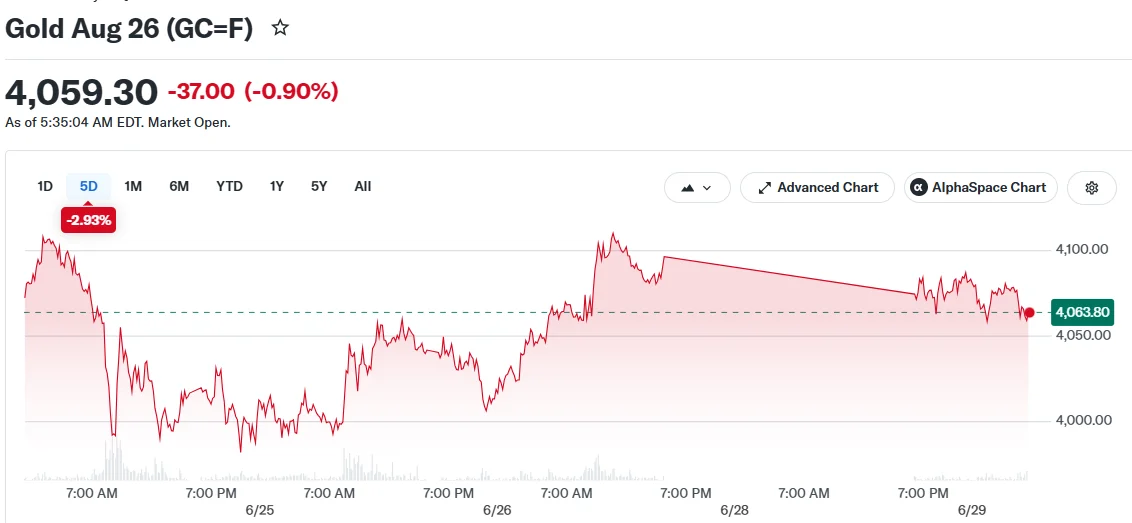
Spot bullion decreased 1.1% to $4,043.62 per ounce during early Asian trading sessions. Futures contracts for gold retreated 1% to $4,056.77.
The United States and Iran engaged in military operations across the Persian Gulf throughout the weekend, undermining a temporary cessation of hostilities that had previously stabilized energy commodity markets. A vessel transporting Qatari petroleum was damaged during these confrontations, interfering with maritime traffic through the Strait of Hormuz.
Notwithstanding the escalating tensions, both nations have committed to cease military operations. Diplomatic representatives are scheduled to convene in Doha on Tuesday, as reported by Axios through confidential government sources.
Bullion Weakens Under Rate Expectations and Dollar Strength
Gold has experienced sustained downward momentum for several months. The precious metal has depreciated roughly 23% since coordinated US-Israeli strikes against Iranian targets began in late February.
Elevated energy commodity valuations stemming from the regional conflict have accelerated inflationary trends, prompting market participants to anticipate prolonged restrictive monetary policies from central banking institutions. This dynamic has particularly disadvantaged gold, which generates no income for holders.
Derivative market pricing currently reflects greater than 30% likelihood of Federal Reserve rate increases materializing before the conclusion of 2026, based on CME Fedwatch analytics.
A robust American currency combined with elevated Treasury bond yields have compounded downward pressure. The Federal Reserve’s June policy meeting conveyed a restrictive stance, while recent inflation measurements registered elevated levels, though consistent with analyst projections.
The central bank’s preferred inflation metric, the personal consumption expenditures price index, advanced 0.4% during May. Government bond yields experienced modest declines following that data release.
Additional precious metals similarly declined on Monday. Silver retreated 1.8% to $58.11 per ounce. Platinum decreased 0.4% to $1,612.20.
Employment Report Poised to Dominate Market Attention This Week
Market participants are monitoring numerous economic indicators scheduled for release this week to assess future monetary policy trajectories.
Japanese manufacturing output figures, Chinese purchasing managers surveys, and European inflation measurements are all anticipated.
However, the primary focus remains the United States nonfarm payrolls report covering June. Resilient labor market conditions would provide the Federal Reserve additional justification for implementing rate increases.
Any indication that employment growth maintains momentum could accelerate gold’s decline, as elevated borrowing costs amplify the opportunity cost of maintaining non-income-producing assets such as bullion.
The diplomatic negotiations scheduled in Doha on Tuesday will also command significant attention. A sustainable peace agreement could alleviate energy price pressures and diminish inflationary expectations, fundamentally altering the trajectory for gold.
Currently, the metal remains confined near multi-month lows, suspended between geopolitical instability and the probability of ascending interest rates.
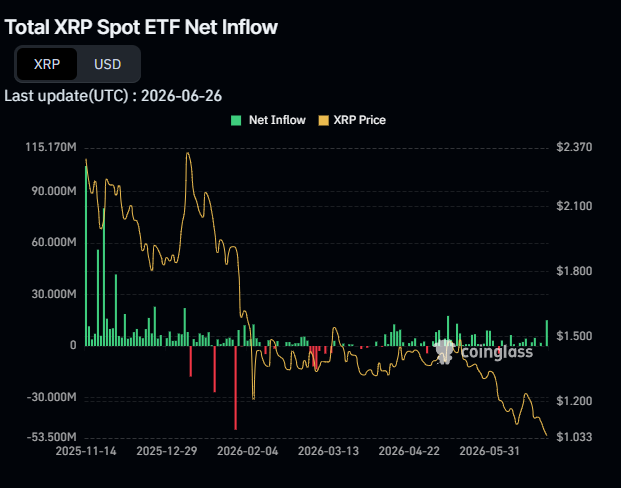
XRP (XRP) spot exchange-traded funds extended their inflow streak to eight consecutive weeks through June 26, pulling in $22.99 million. Bitcoin (BTC) ETFs shed hundreds of millions over the same period as BTC slid to its lowest price since late 2024.
The gap between the two assets widened sharply last week. Bitcoin ETFs recorded $444.50 million in net outflows in a single session, per CoinGlass data. XRP ETFs posted zero outflow days across the week.
XRP Holds Steady While Bitcoin Bleeds
Last week’s $22.99 million XRP ETF print was the largest single-week figure in June. Bitwise’s XRP ETF led flows, contributing $11.18 million on June 26. Franklin Templeton’s XRPZ added $3.80 million the same day.

Canary Capital and Grayscale recorded minimal movement across most sessions. The seven active funds hold combined assets under management approaching $1 billion.
Bitcoin ETFs have now posted seven consecutive weeks of net outflows. Total net assets across the BTC ETF complex fell to $81.85 billion from roughly $107.8 billion in mid-May.

BTC Falls Below $60,000 as Macro Pressures Mount
Bitcoin fell to below $60,000 on June 25, its lowest level since October 2024. Several factors hit at once. A selloff in semiconductor and AI stocks pushed investors away from risk assets. Reports of a potential CLARITY Act delay added regulatory uncertainty. ETF redemptions created additional mechanical selling as issuers sold underlying BTC to meet withdrawals.
BTC now sits roughly 31% lower year-to-date and more than 50% below its October 2025 all-time high of $126,272.
XRP has also dropped from its January 2026 peak of $2.40. However, the XRP price has held up better than BTC on a relative basis. The eight-week ETF inflow streak signals that institutions view XRP’s regulatory clarity as a separate factor from the broader market selloff.
Whether that bid holds into July will depend on CLARITY Act progress and macro conditions in the weeks ahead.
The post XRP ETF Inflows Hit 8-Week Streak: Will Bitcoin ETF Outflows Continue? appeared first on BeInCrypto.
A container ship is berthed at the container terminal in Qingdao, China’s eastern Shandong province on June 25, 2026.
– | Afp | Getty Images
China’s economy is showing signs of picking up, thanks in part to a rebound in shipments to the U.S.
“Manufacturing saw the clearest improvement. Retail sales recovered nicely,” according to the China Beige Book, an independent survey of Chinese businesses, on Monday. The survey, covering 1,321 businesses from June 1 to 22, pointed to a surge in luxury goods sales, but weaker tourism-related spending.
“The second quarter is ending on a more positive note than it began, but this performance will need to repeat itself in July and August for there to be legitimate cause for celebration,” the report said.
The world’s second-largest economy lost steam in April and May after a strong first quarter. In May, China’s retail sales fell for the first time since the pandemic, official figures showed, while data from the 618 shopping festival, which ran from mid-May through mid-June, showed a sharp slowdown in sales growth.
Investment in manufacturing, dragged down by declines in metals, chemicals and auto production, fell in May on a year-to-date basis for the first time since December 2020, according to Chinese financial-data provider Wind Information.
But in June, the Beige Book said factory activity “accelerated,” and “U.S.-bound orders again saw sharp year-on-year gains.” China’s exports to the U.S. have picked up in recent months, growing 11.3% and 35.4% in April and May, respectively, following double-digit declines for most of last year when President Donald Trump ratcheted up levies on Chinese goods.
Freight rates for shipping between Asia and the U.S. have climbed to their highest in nearly two years, S&P Global said last week, attributing the surge to importers frontloading shipments ahead of higher fuel surcharges and price hikes from Asian suppliers. The stockpiling could taper off by late July, it said.
China’s export order growth to Asia and other developing countries, however, slowed in June from May, while growth of those to Europe held steady, the Beige Book found.

Trump’s meeting with Chinese President Xi Jinping signaled tariffs will likely remain lower for now, while the U.S. has yet to impose additional duties that could emerge from Washington’s Section 301 probes targeting countries identified for overcapacity and forced labor practices. The 10% duty on goods from most major trading partners that Trump imposed under Section 122 is set to expire on July 24.
Businesses are rushing to ship goods to the U.S. before tariffs potentially surge again, said Tianchen Xu, senior economist at the Economist Intelligence Unit.
Reflecting a trade recovery, China’s exports to the U.S. in May reached nearly 90% of levels seen in 2024, according to official data. In contrast, May 2025 figures showed China’s exports to the U.S. had dropped to 70% of their 2024 levels.
“China’s weak momentum likely turned around in June,” said Xu, adding that “the improvement was still first and foremost led by the external sector.”
He added that strong demand for artificial-intelligence technology and components, as well as falling oil prices in the wake of easing tensions around the Strait of Hormuz, will help soften the pressure on China’s economy.
China is scheduled to release retail sales and industrial data for June, as well as second-quarter GDP, on July 15. It is expected to report June trade data on July 14.
The earliest official read on June economic performance is due out Tuesday, with the National Bureau of Statistics scheduled to release the official manufacturing purchasing managers’ index. The measure of business activity is expected to climb into expansionary territory with a 50.1 print in June, according to a Reuters poll.
Goldman Sachs on Sunday revised up its third-quarter GDP growth forecast to 5% from 4.5% quarter-on-quarter annualized, on the anticipation of lower oil prices and faster fiscal spending over the next few months, after a tepid second quarter for which it predicts growth of 3.5%.

Key Highlights
-
HPQ stock experiences modest gains following announcement of enhanced OpenAI collaboration.
-
Company deploys AI solutions to accelerate customer service and partner engagement.
-
OpenAI Frontier platform to power HP’s operational infrastructure and workforce tools.
-
Initiative includes advanced governance frameworks and enterprise-grade data management.
-
Partnership aligns with HP’s comprehensive workplace transformation and AI hardware initiatives.
HP Inc. (HPQ) announced an expansion of its collaboration with OpenAI, integrating artificial intelligence capabilities throughout its business operations as HPQ stock demonstrated modest upward movement. The technology giant will leverage OpenAI’s Frontier platform to enhance customer engagement, strengthen partner relationships, boost employee efficiency, and accelerate software innovation. HPQ shares settled at $22.88, declining 0.17%, though pre-market activity showed improvement with prices reaching $22.97.
HP Integrates AI Technology Throughout Customer And Partner Ecosystems
HP outlined plans to transform operational processes across its worldwide infrastructure through this strategic alliance. The technology company intends to integrate AI capabilities with retail locations, partner platforms, messaging services, and voice communication channels. Consequently, both customers and business partners should experience accelerated support delivery and enhanced workflow clarity.
According to the company’s statement, Frontier will enable more unified interactions across multiple customer engagement platforms. HP intends to deploy the technology for standard operations, problem-solving workflows, and technical assistance. Furthermore, the organization anticipates AI-driven tools will enhance analytics capabilities and customer data monitoring.
This implementation follows an evaluation period that commenced in February 2026. Throughout this testing phase, HP assessed Frontier’s technological capabilities, security architecture, platform functionality, and enterprise compatibility features. Following successful pilot programs, HP committed to a comprehensive strategic alliance with OpenAI.
OpenAI Frontier Powers HP’s Enterprise-Wide Digital Evolution
HP represents among the initial major multinational corporations to implement OpenAI’s Frontier platform across enterprise-level operations. The organization intends to optimize applications as the collaboration expands throughout various divisions. Target areas encompass customer assistance, partner enablement, workforce efficiency, and application development.
HP additionally intends to jointly create emerging AI applications with OpenAI. Nevertheless, these solutions must satisfy HP’s stringent requirements for data connectivity, oversight protocols, and security measures. Accordingly, the collaboration emphasizes both operational effectiveness and regulated enterprise implementation.
The organization positions AI as a fundamental operational infrastructure throughout its enterprise. This methodology transitions AI from experimental projects into comprehensive internal platforms and customer-facing operations. It further demonstrates HP’s extensive initiative to embed AI within routine business functions.
HP Advances Workplace Evolution Through AI Hardware And WXP Solutions
HP connected the OpenAI collaboration to its comprehensive workplace modernization vision. The corporation anticipates collaborative interactions between personnel and AI systems throughout professional settings. HP is engineering autonomous AI hardware designed to integrate with current organizational infrastructure.
The company additionally plans equipment featuring specialized processors for persistent AI computation. These offerings address operations requiring uninterrupted processing capabilities and dependable local performance. Ultimately, HP seeks to position AI functionality closer to employee work locations.
HP’s Workforce Experience Platform complements this organizational approach. The system coordinates entire inventories of personal computers, professional workstations, printing equipment, and teamwork technologies through a unified dashboard. Through OpenAI Frontier and WXP integration, HP pursues expanded AI-enabled workflows spanning customers, partners, and workforce members.

SECRET XRP ANNOUNCEMENT NO ONE IS TALKING ABOUT #xrp #crypto #trump

Tesco is offering free kids meals throughout the summer
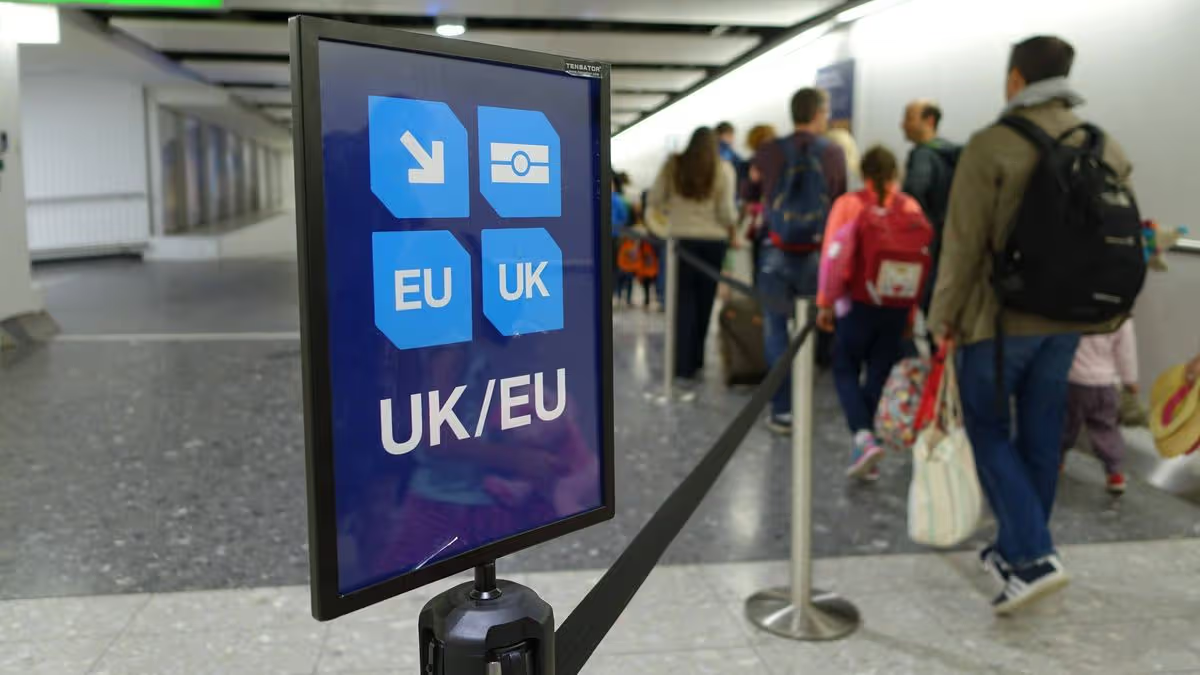
Brexit has been hugely damaging to the freight and logistics sector


-
 Sports6 days ago
Two goals and an assist by sheer aura: Cristiano Ronaldo just entered the World Cup chat
-

 Tech7 days ago
Microsoft accidentally kills epic Outlook email threads
-

 Fashion3 days ago
Weekend Open Thread: Staud – Corporette.com
-

 Politics3 days ago
The House | Manchesterism won’t survive the painful trade-offs unless it gets citizens on board
-

 Politics3 days ago
Potential 2028er World Cup attendee leaderboard
-

 Business3 days ago
Asia stock markets slide as tech shares slump
-

 Tech4 days ago
A Look At A Gaggle Of Transputer Boards
-
Crypto World5 days ago
Bitcoin (BTC) Dips Below $62K, Ethereum (ETH) Plunges 6% Daily: Market Watch
-
 Crypto World4 days ago
Dell (DELL) Shares Tumble Over 5% Following Analyst Downgrade to Hold
-

 Crypto World5 days ago
Securitize Wraps Roubini's SEC-Registered ETF as Dubai VARA Digital Security
-
Business5 days ago
Entergy settles forward sale agreements, raises $672 million in cash proceeds
-

 News Videos16 hours ago
MAJOR BITCOIN & MARKET UPDATE!!!! (MUST WATCH ASAP!!!)
-

 Crypto World2 days ago
Kraken's xStocks Opens Bending Spoons IPO Registration to EEA Retail
-

 Crypto World2 days ago
Coinbase, Circle Deepen Crypto Stock Losses Despite Resilient S&P 500
-

 Sports3 days ago
FIH Pro League: India defeat Pakistan 7-1, register biggest win of campaign | Other Sports News
-
Crypto World3 days ago
Hyperliquid Named on Singapore MAS Investor Alert Register
-

 Crypto World3 days ago
RTX holders must register wallets before token distribution begins
-

 Tech1 day ago
Bluekit phishing kit adopts browser-in-the-middle for login theft
-

 Tech2 days ago
Russian hackers now target Signal backup recovery keys
-

 Sports4 days ago
India vs Bangladesh LIVE Score, Women’s T20 World Cup: Bangladesh Opt To Bat; India Enter ‘Do-Or-Die’ Stage As Semi-Final Race Heats Up
You must be logged in to post a comment Login