If approved, an existing building would be demolished to make way for the new science and technology building
A developer is hoping to build a new eight-storey science and technology building at a science park. Stanhope PLC has submitted an Environmental Impact Assessment (EIA) application to Greater Cambridge Shared Planning for the development of a new building at Cambridge Science Park (CSP).
Advertisement
The site sits within the science park campus, owned by Trinity College Cambridge. If approved, ‘building 163’ would be demolished for the new science and technology building to be built in its place.
The site area is approximately 0.366 hectares and is located on the eastern edge of the science park. The building will have a ground level plus seven storeys (eight storeys in total).
If approved, the building would predominantly be used for offices with dry lab space on the lower floors. With regards to car parking, the screening report states: “Parking for CSP 163 is currently proposed to be undercroft car stackers located within the current parking area of the Site, to accommodate 125 car parks.”
Vehicular access for the proposed development would be via Cambridge Science Park Road from Milton Road. Additionally, 248 cycle parking spaces would also be provided if approved.
Advertisement
The developer wishes to bring forward the development at “as soon as possible”. According to the proposals, construction would start at the site no earlier than autumn 2027 and be completed by 2030.
Cambridge Science Park is an 152-acre site in north Cambridge, founded by Trinity College Cambridge in 1970. It is reportedly the UK’s oldest science park.
Paraguay, meanwhile, looked to be down and out after losing 4-1 to USA in their World Cup opener but have shown great powers of recovery, recording a shock 1-0 win over Turkey – with ten men after Miguel Almiron’s controversial red card – before playing out a goalless draw with Australia which was enough to progress as the seventh best third-place finisher.
One suspect has been arrested as officers continue to investigate
Carrington Walker Live News Journalist and Simon Hamalienko
19:01, 29 Jun 2026
A gunman has opened fire at a welfare facility understood to house mothers and their children in northern Germany, leaving six adults dead and several others injured.
Police confirmed the attack unfolded at a residential centre in the city of Stade, that provides accommodation for pregnant women and young mothers, with officers confirming that five victims, four women and a man, died at the scene. A sixth adult later succumbed to their injuries in hospital.
Advertisement
Emergency services were deployed to the building on Dankersstrasse, south of the town centre, as detectives worked to establish a motive. Police said a main suspect had been detained, with two other individuals subject to further inquiries, the Daily Star reports.
A huge police presence was spotted in video footage uploaded to social media along with other emergency service personnel and several ambulances on a residential street.
“The whole area was cordoned off right away,” said Vitali Mertens, who lives across the street from the scene, and heard gunshots. Roughly 50,000 people live in the city of Stade, which is located about 25 miles from Hamburg.
Advertisement
In a statement, the police force said: “According to the current state of the investigation, a homicide occurred at a youth care facility on Dankersstraße, resulting in multiple victims.
“Five people were fatally injured, and others sustained injuries. As part of the immediate search and police operation, two suspected perpetrators, including the alleged shooter, were arrested. The investigation into the background and the exact sequence of events is ongoing.”
Police also warned of misinformation being shared on social media. They added: “The circulating accounts do not correspond to the current state of affairs confirmed by the police. Please do not forward unverified reports, voice messages or rumours. This can cause uncertainty and hinder police action.”
Germany’s gun laws are more restrictive than those in the United States, and mass shootings are rare but not unheard of.
Advertisement
Want to see more of the stories you love from Belfast Live? Making us your preferred source on Google means you’ll get more of our exclusives… To add Belfast Live as a preferred source, simply click here.
Teddy Sheringham has urged Manchester United to step up their pursuit of Adam Wharton, having failed to secure Elliot Anderson, reports Aaron Morris.
Manchester City have reached an agreement with Nottingham Forest for the midfielder to the tune of around £116million.
And with the news of his arrival imminent, it’s one less engine room component for United to chase, as they look for a long-term successor to an outgoing Casemiro. The Reds have been linked with a wealth of talent since the Brazilian’s departure was announced earlier this year, and weeding the speculation from the truth has been a difficult task for football fans.
But according to Sheringham, who represented United between 1997 and 2001, the club should be targeting Crystal Palace’s Wharton as a number one priority.
Advertisement
Adam Wharton has been linked with a move to Manchester United(Image: Getty Images)
Jannik Sinner needed five sets to beat Miomir Kecmanovic in the first round of Wimbledon on Monday afternoon, as the world No. 1 avoided an embarrassing early exit
Having suffered a major upset at the French Open, unable to cope with the sweltering heat, cooler conditions at SW19 were not to blame on this occasion. Instead, Sinner bled heavily from his foot, to such an extent that it soaked through his shoe, staining his pristine white footwear a deep crimson.
Following the match, Sinner admitted on court that he had feared being removed by tournament officials for breaching Wimbledon‘s all-white dress code.
Officials ultimately decided against taking any action, a decision that appeared to catch the BBC panel off guard.
“This was another unexpected element, the blood on Sinner’s right foot from early on,” Tim Henman remarked while analysing the match. “I’ll be interested to see what he’s got to say about that.”
Advertisement
Two-time semi-finalist Tracy Austin then replied: “And I don’t think red is allowed like that out there! It’s not an all-white shoe!”
Henman quipped in response: “Tough fine for breaking the rules.”
Host Balding then weighed in, noting that the possible infringement had been raised in the previous interview: “Lee McKenzie said that to him in the interview: ‘you’re nearly contravening the rules’.”
Advertisement
New BBC pundit Eugenie Bouchard, appearing on the broadcast for the first time, elaborated further: “It’s a little more than 10 per cent [fine], we do have to realise that’s a lot of blood to go through a shoe like that.”
Sinner confessed that he had contemplated the possibility of being withdrawn from the match after tournament officials noticed the crimson staining on his shoe.
Sky Sports, HBO Max, Netflix and Disney+ with Ultimate TV package
This article contains affiliate links, we will receive a commission on any sales we generate from it. Learn more
Sky has upgraded its Ultimate TV and Sky Sports bundle to now include HBO Max, Netflix, Disney+, discovery+ and Hayu, as well as 135 channels and full Sky coverage of the Premier League and EFL.
Sky broadcasts more than 1,400 live matches across the Premier League, EFL and more with at least 215 live from the top flight alongside Formula 1, darts and golf.
Advertisement
“I’m actually very surprised they let me keep playing because, you know, all-white, it turned into a little red,” he said in his on-court interview.
“No, no, it just you know a nail. I didn’t want to also disturb Miomir, I think we both had you know a good rhythm. It was a great match from both of us, so I didn’t want to take any time. It’s all good, thank you.
“Coming back here as defending champion means a lot to me, even though every year is different, every year can be very tough. So first of all, very happy to win the first one. Of course, we will try to plan a couple of improvements for the next match, but I can be very, very happy.”
Sinner also endured a nasty fall in the opening stages of the match, yet managed to recover sufficiently to avert what would have been a stunning first-round defeat.
The determined nursing graduate is channeling her own premature birth journey to empower other parents
Meet Victoria Craig, who has transformed her personal experience with premature birth into a lifelong commitment to empowering and supporting other parents facing similar challenges.
Advertisement
In 2006, as Victoria, from Broughshane, Co Antrim, approached the end of her Nursing degree, her world shifted dramatically when her daughter Catherine was born 12 weeks early, beginning a 10 week stay in the Neonatal Unit at Antrim Area Hospital.
Looking back, Victoria says: “Catherine’s birth was a very traumatic time in my life. I often say she changed my life in so many ways. She was born by emergency c-section at 28 +1 weeks gestation, which is very early. Although I felt very supported by the nurses in the Neonatal Unit at the time, I was on autopilot and the impact of the trauma was felt for a very long time afterwards.”
Victoria went on to pursue a career in the same neonatal unit that her daughter Catherine was born, caring for premature babies: “My job as a neonatal nurse was an unexpected career option following my first-hand experience of neonatal care. I like to think that my experience can help other parents in the same situation.
“I also encourage nurses to be the best they can be, growing in knowledge so that we can provide the best possible care to infants and parents in the Neonatal Unit.”
Advertisement
Victoria had just turned 40 when a PhD opportunity arose that inspired her to go back to Queen’s University as a mature student, which was not without its challenges: “As a dedicated mum, I had to juggle studying and caring for my three children, Catherine, Adam and Sarah, which was extremely difficult within itself.”
However, it wasn’t just the demands of parenting that Victoria had to overcome during her PhD studies, as her family faced life-changinghealth issues and loss: “Just a few months after I began my studies, my dad had a stroke. I had to be on hand for appointments and help my mum when he had a series of falls. We were already grieving the recent loss of my mother-in-law, so we were trying to navigate an overwhelming amount of change all at once.”
Victoria was adamant to keep going and managed to overcome many hurdles with the support of those closest to her: “My husband Stephen has been incredibly supportive throughout my studies. Returning to university was a major decision that affected the whole family, but he stood behind me completely.”
Her PhD compared the Butterfly Hug and Safe Calm Place techniques with playing Tetris to explore their impact on parents with PTS symptoms, she said: “The Butterfly Hug and Safe Calm Place technique involves crossing the arms so each hand rests on the opposite collarbone, then gently tapping for 30–40 seconds while focusing on a safe, calming place, such as a childhood home.
Advertisement
“When used after a traumatic experience, this method can help reduce the emotional intensity of the memory, which may in turn lessen symptoms of posttraumatic stress. My study explored this technique alongside Tetris to assess whether both were acceptable and feasible tools for parents to use in the Neonatal Unit.”
Today, Victoria is extremely happy working as a clinical educator in the unit, using her expertise to support pre-term infants and their parents, nursing staff, and students and aspires to pursue a career in Neonatal Education within Queen’s.
As she graduates with a Doctor of Philosophy from the School of Nursing and Midwifery at QUB on Monday, most importantly, her daughter, Catherine is now a fit and healthy 20-year-old who has never looked back after her rocky start in life.
Pacitto opened on Redcar seafront in 1924, and is credited with creating the famous Teesside Lemon Top – a standard soft serve ice cream topped with yellow citrus sorbet.
Rumours, which have since been dismissed as false, emerged on social media over the weekend suggesting the shop would have to close one of its seafront trading windows during the busy summer season due to building work next door.
Steve Turner, former Police and Crime Commissioner for the Cleveland force, took to Facebook on Sunday (June 28), claiming: “Due to the work going on next door they have been told they must close their sea front window just as we approach their busiest weeks of the year.”
Advertisement
It sparked concern with some saying it was “out of order” and others suggesting it was “totally disgusting”.
But it has since been confirmed that the shop will not have to close.
A spokesperson for Redcar and Cleveland Council said: “The contractor for the Lookout has no plans to close the Pacitto’s trading window on the Esplanade as part of their works. The window continues to remain open as usual, as it has throughout the works.
“We know Pacitto’s is well loved across the region and recently won a national award for its legendary lemon top.
Advertisement
“We recognise the importance of summer trading and would never ask them to close during this period.
“We spoke with the contractor this morning and received confirmation that the window will continue to remain open at all times. They are currently using cantilever scaffolding specifically to ensure the Pacitto’s window stays accessible and recognise the importance of maintaining this access.
“Any works in the vicinity of the window have been and will continue to be completed out of hours. We are also working to ensure the footpath outside the site is reopened as soon as the works allow.”
Pacitto’s confirmed they have been given reassurances by the council and do not expect the building work to cause any disruption to the business.
Advertisement
Anna Turley, MP for Redcar and Cleveland, took to Facebook to help spread the good news. (Image: Anna Turley)
Anna Turley, Labour MP for Redcar, also took to social media to help set the record straight.
She said: “Pacitto’s is not closing – please share the truth. Unfortunately, yet again Reform UK – Redcar Branch rushed to spread outrage before checking the facts. Pacitto’s is a Redcar institution and, like everyone else, we want to see it continue thriving for generations to come.”
“Our community deserves facts, not fearmongering.”
The Ministry of Defence has warned the public not to enter the range if they see red flags of lights
09:25, 29 Jun 2026Updated 09:35, 29 Jun 2026
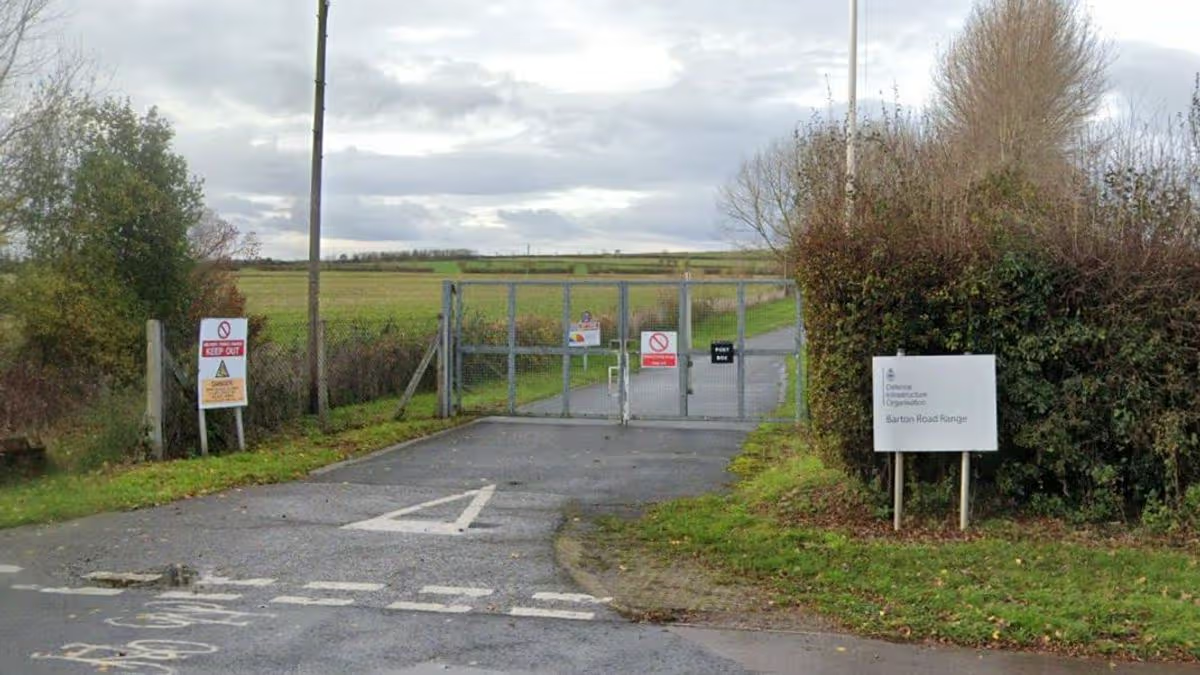
Weekend firing is scheduled at the Barton Road Range throughout July, the Ministry of Defence (MoD) has announced. It has warned people not to enter the range “danger area” if they see the red flags flying or red lights on.
The MoD said: “Due to operational commitments firing including night firing may take place at extremely short notice, after the date of this publication. For your own safety do not enter the range danger area if red flags are flying or red lights are displayed.”
The weekend firing will take place at Barton Road Range on most weekends in July 2026. There are also animal controls being scheduled, a spokesperson for the MoD added.
Advertisement
They said: “Pest Species control and Deer Management, using shotguns and rifles, will also take place on these ranges and training area and members of public are therefore warned of this potential risk when entering the training area and ranges.”
Anyone with queries about when it is safe and whether the range is in use should contact the Training Area Team Leader on 01223 262403. If there is no answer, call 07769282947 to get in touch with the Training Safety Marshall East Anglia Training Area or 01842 855367 for the DTE Ops Room.
A well-known forestry worker remembered for his larger-than-life personality and dedication to his family has been honoured following his tragic death.
Stephen Jones, widely known as Steve Peg, died on June 8 in what his loved ones described as a “forestry accident”. The 36-year-old, originally from Cynwyd and living in Acrefair, is survived by his wife Emma and their two children, Cai and Ffion.
Hundreds of people have paid their respects, and a Just Giving campaign set up to assist with funeral costs and support the family has raised approximately £30,000, reports North Wales Live.
Steve’s wife Emma said: “I want to thank everyone for all their support and kindness. Everyone has been amazing.” For the biggest stories in Wales first sign up to our daily newsletter here
Advertisement
Steve’s brother Mike also expressed his gratitude for the overwhelming support, describing Steve as the “best big brother that anyone could want”.
Friend Lee Parry, who launched the page, said: “Our hearts are broken by the loss of our beloved friend Peg who tragically passed away due to a fatal forestry accident. He was a lovable rogue who worked hard to provide for his family. His larger than life personality will be missed by all who knew him.
Advertisement
“We made this page to hopefully raise as much money as we possibly can to give him the send off he deserves, and to help support his beloved wife and his two beautiful young children, who he adored, at this heartbreaking time.”
He added: “We would like to thank everyone for their overwhelming kindness for giving so generously to Steve Peg’s [Just Giving] page. This money will be an incredible help to Steve’s wife Emma, and their children, at such a difficult time. It’s a testament to Steve’s character that so many people have shown their support. The [Just Giving] page will be closing on Monday, July 6 if anyone would still like to donate. We really can’t thank you all enough.”
His funeral service will take place on July 3 at 3pm at Pentrebychan Crematorium LL14 4EP.
Lee added: “This is a public funeral. We are asking that his hunting friends wear hunting clothes. And for everyone else wear what you feel comfortable in as he absolutely hated suits and ties! Refreshments afterwards at Tower Hill barns LL20 7TN.”
Get daily breaking news updates on your phone by joining our WhatsApp community here. We occasionally treat members to special offers, promotions and ads from us and our partners. See our Privacy Notice
The number of homes across the site will increase from 127 to 165
Plans to knock down more than 100 “ageing” buildings and replace them with new ones in Cambridge have been given the go-ahead after a meeting on Wednesday (June 24). Cambridge City Council has now approved plans to knock down buildings at Hanover Court and Princess Court to replace them with 165 new homes.
Advertisement
The now-approved plans, on the site off Hills Road, will see 72 new council homes and 93 private sale homes built in its place. The existing buildings have been described as “ageing” by Councillor Gerri Bird, cabinet member for housing at Cambridge City Council.
The existing two residential blocks consists of 127 one, two, and three-bedroom homes – 82 being council homes and 45 privately owned homes. The redevelopment would see a reduction of 10 council homes (from the existing 82 to 72).
The council stated that the redevelopment at Hanover Court and Princess Court combined with plans to redevelop Stanton House will see the overall number of council homes in the city centre increase.
The city council said the amount of space provided for the 72 new council homes will be bigger than the current 82, as the homes will meet modern space standards and be of a higher quality than the homes being demolished.
Advertisement
It said that doing nothing at Hanover and Princess Courts was “not an option” as the existing buildings had been deemed unsafe due to structural issues and fire risks.
The city council claimed refurbishing the current buildings to meet today’s standards would be incredibly costly. It said that even then, the homes would still fall short of modern space and energy efficiency requirements.
The redevelopment is expected to deliver brand new, high-quality homes that are comfortable, energy-efficient, and affordable to live in.
Cllr Bird said: “These homes need to be demolished as they are not fit for purpose for current residents, so we’ve been looking at the most cost-effective way to redevelop the site to provide new, high-quality council homes for current and future council tenants.
Advertisement
“We are committed to improving the quality of housing for tenants living in ageing council properties like these, and building new high-quality council and market homes to meet growing demand – including more accessible homes for disabled residents.”
Cambridge City Council is working with Cambridge Investment Partnership (CIP) and The Hill Group to deliver this redevelopment.
The Nottingham University Hospitals NHS Trust report has identified serious failings in care at one of England’s largest maternity services, with lessons for maternity units nationally. Among its findings was a repeated problem at the very start of labour: women and families struggled to access timely assessment and felt dismissed during telephone triage.
In several cases, women were discouraged from attending hospital when they believed labour had started, only to arrive later in established or advanced labour. In some cases, poor care during this period had serious consequences.
Across hospital-based maternity services, attention and resources tend to focus on women in more advanced labour, and those requiring induction of labour or caesarean section. This can mean services miss the chance to identify problems, offer reassurance and build trust at the very start of labour.
Listening to women and providing supportive care at the start of labour sets a woman up for a positive birth experience. Instead, research consistently shows that women report feeling unsupported and discouraged from coming to hospital in early labour.
Advertisement
Right at the start of labour, there is often a mismatch between the needs and expectations of women and the expectations and priorities of maternity services. Many women have long been told that hospital is the safest place to give birth. It is therefore unsurprising that they expect to be welcomed to the maternity unit where they are booked to give birth when labour starts.
The drivers of decision-making on the maternity services side are more complex. They include beliefs about early labour care, national guidance, unsuitable environments and workforce pressures.
Early labour
There is a widespread belief in many maternity systems that while women should give birth in hospital, they should not be admitted until they are in established labour.
Advertisement
This can result in midwives gatekeeping: discouraging or refusing admission in early labour. Women report receiving inconsistent advice, feeling unwelcome and dismissed and having to negotiate permission for admission.
This belief is influenced by international, national and local guidance. NICE guidance states that if a woman seeks advice or attends a midwifery-led unit or obstetric unit with painful contractions but is not in established labour, she should be encouraged “to remain at or return home”, unless doing so could mean she gives birth without a midwife present or becomes distressed.
The same guidance also says early labour assessment should include listening to the woman’s story, asking about her wishes, expectations and concerns, asking about the baby’s movements, offering support and agreeing a plan of care. The problem arises when “return home” becomes the default response, rather than the outcome of careful assessment and discussion.
A practical problem is that many maternity units are not designed or staffed to provide sustained early labour care. Historically, women in early labour were more likely to have access to antenatal ward beds or early labour areas, where they could receive midwifery support outside the labour ward.
Advertisement
As maternity care has shifted towards shorter stays, outpatient monitoring and day-case assessment, many services now have fewer options for supporting women before established labour.
The number of maternity beds in England fell by around 52% between 1987-88 and 2019-20, mainly because women spend less time in hospital before and after birth. Antenatal beds were removed or repurposed to streamline maternity processes, but this also reduced care options.
The result is that many maternity units now lack a suitable environment to care for women in early labour. When there is nowhere appropriate for women to be supported, they are more likely to be encouraged to go home.
Workforce pressures
At the same time, workload and the complexity of women’s care needs have increased. There has been a rise in caesarean birth rates in England, with NHS maternity statistics showing that 45% of deliveries in NHS hospitals in England in 2024-25 were by caesarean section.
Advertisement
Induction of labour has also become more common. These changes increase care requirements for women and babies, particularly on labour wards. Staffing models have often struggled to keep pace with workload and the need for safe, personalised care.
Organisational demands exert significant pressure on midwives to keep women out of hospital and to make decisions based on bed availability and staffing rather than on the care needs of mother and baby.
Midwives have described not admitting women in early labour because of staff and bed shortages. Some have even described hiding women on labour wards because they knew they needed care, while trying to avoid disapproval from senior staff.
The result is a service that can fail to support women at a time when they and their birth partners feel most vulnerable. It is time for a rethink.
Advertisement
Early labour care must be organised around women’s needs and safety, rather than institutional pressures alone. That means properly staffed assessment, clear return plans, dedicated early labour spaces where possible, and workforce models that include time for assessment, reassurance and support.
Research from Denmark, Sweden and Switzerland suggests that early labour care works best when it is accessible, individualised and organised around women’s needs rather than simply her stage of labour. In the Danish study, women had access to a dedicated early labour unit and staff received training to emphasise the importance of early labour care. The wider findings highlighted the value of clear plans, emotional support, continuity and flexible care. This change was brought about in one of Denmark’s busiest units (6,500 births), and is a lesson on how UK maternity units could work with women to improve care.
The Nottingham report shows what can happen when women’s concerns are minimised at the very start of labour. Getting that first contact right will not solve every problem in maternity care, but it is a practical place to begin.
Women need to know that if they call because they are worried, in pain or unsure, someone will listen properly. Early labour may be the beginning of birth, but it should never be the point at which care is weakest.



















































You must be logged in to post a comment Login