

Crypto World
Bitcoin ETFs Just Posted Their Third-Worst Week Ever And BTC Can’t Hold $60,000

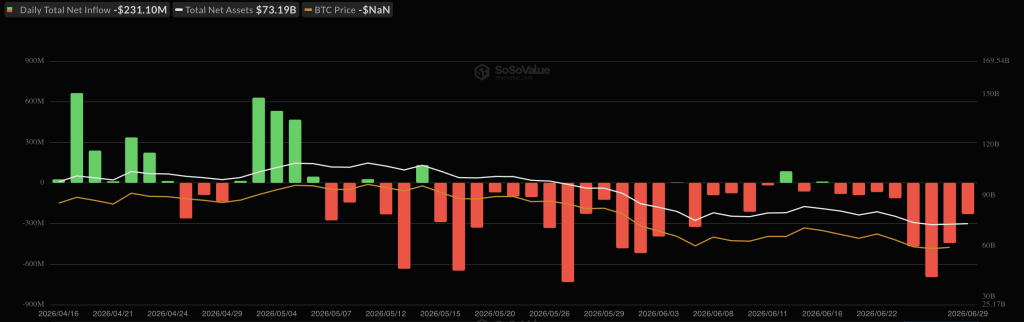
Spot bitcoin ETFs just posted their third-worst week on record, bleeding $1.79 billion in net outflows between June 22 and June 26، and BTC hasn’t been able to hold the $60,000 handle since.
Ethereum is trading near $1,585, up a marginal 0.7% over 24 hours but still down roughly 8% on the week, while ether ETFs just extended their outflow streak to seven consecutive weeks.
There’s a detail buried in the fund-flow breakdown that most headline readers are missing.
BlackRock’s IBIT alone accounted for $1.3 billion of the bitcoin ETF exodus, with Fidelity’s FBTC adding $314.9 million and Grayscale’s GBTC shedding another $135.3 million. Smaller pockets of demand, Grayscale’s Bitcoin Mini Trust picked up $71.7 million, Morgan Stanley’s MSBT brought in $26.2 million, were nowhere near enough to offset the tide.

Meanwhile, analysts are flagging BTC’s current state as a fragile recovery phase, with roughly $448 million in leveraged long liquidations clearing out in the last 24-hour window alone. The macro backdrop isn’t helping: Federal Reserve meeting minutes and U.S. Treasury General Account movements are the two catalysts traders are stacking their scenarios around this week.
What happens at $60,000 over the next 48 hours will answer most of the near-term questions.
Can Bitcoin and Ethereum Hold Support as ETF Outflows Mount?
Bitcoin is currently oscillating between $60,000 and $59,400. The $60,000 level has now been a firm rejection zone across multiple breakout attempts, with sell-side pressure consistently materializing as the price approaches that level.
Rebuilding open interest suggests some traders are re-entering, but short-dated put options are still trading at a premium to calls; the market is hedging downside, not loading for upside.

Key support sits at $59,000, with a deeper floor in the mid-$50,000s if that level fails. The bull case depends on Fed minutes landing dovish enough to trigger a risk-on rotation; if that materializes, a move back toward the $64,000–$66,000 prior resistance zone becomes credible.
The base case is a continued range chop between $59,000 and $62,000 until a macro catalyst forces a directional decision. Bear case invalidation: a clean close below $59,000 with volume opens the mid-$50,000s as the next structural reference.
Ethereum’s picture is marginally more stable but not materially better. At $1,585, ETH is holding above the $1,530–$1,550 intraday low zone, and the $1,500 level remains the line that matters. A break there, per technical consensus, opens further downside with limited structural support until the low-$1,400s.
The recovery target is $2,000, but ETH needs to reclaim $1,700 first, and seven straight weeks of ETF outflows don’t suggest that institutional rotation is imminent. The $3 billion-plus outflow pattern is becoming a structural overhang, not a one-week anomaly.
Bitcoin Hyper Could be The Next 1000x In Crypto And Here is Why
When BTC consolidates in a range defined by macro uncertainty and institutional de-risking, the asymmetric opportunity shifts to early-stage infrastructure with direct Bitcoin exposure, but without the ETF wrapper or the spot price ceiling.
Smart money accumulation in Bitcoin Layer 2s during ETF outflow cycles is a pattern that’s begun attracting serious attention precisely because the infrastructure thesis doesn’t require BTC to immediately reclaim $64,000.
Bitcoin Hyper ($HYPER) is positioning itself as the first Bitcoin Layer 2 with full Solana Virtual Machine (SVM) integration, targeting the core limitations that have kept Bitcoin’s programmability behind Ethereum and Solana: slow transactions, high fees, and no native smart contract layer.
The presale is currently priced at $0.0136824, with $32,898,380.61 raised to date. Staking is live with a high APY, and the architecture includes a Decentralized Canonical Bridge for BTC transfers alongside sub-second finality claims that, if delivered, would make it faster than Solana on its own infrastructure. The $32M raised during the current BTC dip isn’t noise; it reflects genuine appetite for scalable Bitcoin infrastructure ahead of a potential macro pivot.
The post Bitcoin ETFs Just Posted Their Third-Worst Week Ever And BTC Can’t Hold $60,000 appeared first on Cryptonews.

Crypto World
Crypto News, July 1: Bitcoin Price Holds $59K as Ethereum Stays Steady on MiCA Day Zero

Markets opened Q3 steadily, Bitcoin price is holding the $59K level, Ethereum shows strength at what could be the bottom, and MiCA full enforcement just hit with almost no fireworks. Crypto has been bracing for liquidity trouble as MiCA takes effect, especially with Binance among others thinning the liquidity.
The expected moves were obvious for months; Bitcoin price and Ethereum price were already baked in the changes, so the actual day zero passed quietly.

On the other side of the world, Trump’s latest financial filing has dropped. It showed over $1.4 billion in crypto earnings last year, with Bitcoin exposure in a healthy sum. This likely sends a signal that he’s not walking away from this space anytime soon.
Discover: The Best Crypto to Diversify Your Portfolio
Bitcoin Price Holding Its Ground

Although Bitcoin price took a hit from record ETF selling with $4.51 billion in outflows last month, or the worst since they launched, it has found support and has not broken lower. Some profit-taking and money rotating into AI stocks are some of the reasons that took the blame for the recent plunges.
As of today, the total ETF assets sit above $70 billion, so the selling looks more like a pause than a collapse. It’s not a good day for spot holders when US spot Bitcoin ETFs saw $4.51B in net outflows in June. However, it looks more like a temporary adjustment than a deeper pullback.
Discover: The Best Token Presales
Ethereum Price Stays Calm, MiCA Day Zero Passes Quietly

Ethereum price traded flat around $1,570–$1,590, with no big swings even as MiCA rules were locked in today. The Ethereum Foundation has also just staked another 4,938 ETH worth close to $8 million on Lido. It shows they’re comfortable parking more capital in the staking system right when Europe tightens up, and foundation rebalancing is going on.
BREAKING: As of today, the most used dollar on earth cannot be bought or sold by a single European on a single licensed exchange. — Shanaka Anslem Perera
It did not break. It refused to bend, and a 27-nation bloc decided that was enough.
That is Tether… pic.twitter.com/PUYV5d8A2N
 (@shanaka86) June 30, 2026
Don’t Miss Out on Our $1,000 USDT Airdrop on ByBit
Ethereum price has been grinding along as MiCA full rules are live. Unlicensed platforms like Binance have now stopped serving EU users or shut down, with a lot of smaller operators already pulling back or moving. On top of that, UK investors filed a $200 million lawsuit against Binance and CZ over unauthorized derivatives sold to retail traders.
The MiCA shift and the Binance legal noise haven’t moved the market much. Liquidity concerns turned out lighter than expected, Trump’s big crypto profits, and the Ethereum Foundation’s fresh Lido stake tell that some are still bullish. Big players are still putting money to work instead of running for the exits.
Discover: The Best Token Presales
The post Crypto News, July 1: Bitcoin Price Holds $59K as Ethereum Stays Steady on MiCA Day Zero appeared first on Cryptonews.

As Bitcoin fell to a 21-month low of $58,100, Santiment said on-chain data shows a widening gap between the behavior of large holders and retail investors.
Wallets holding between 10 and 10,000 BTC reduced their combined holdings by 0.37% since June 15, according to Santiment’s Supply Distribution metric. This indicates continued selling by whales and sharks during the market decline. On the other hand, wallets holding less than 0.01 BTC increased their holdings by 0.51% over the same period, suggesting that smaller investors are continuing to buy the dip.
Rare Bottom Signal
Santiment said this divergence is indicative of how retail traders appear convinced that the market is nearing a bottom and is “treating the dip like a buying opportunity”, while larger stakeholders remain on the sidelines and “refusing to bite for now.”
The analytics firm added that Bitcoin and the broader crypto market may need more time to establish a convincing bottom until large holders resume accumulation.
Meanwhile, a separate analysis by Ali Martinez highlighted that Bitcoin has entered a rare on-chain phase that has historically appeared only around major market bottoms. The analyst found that around 10.45 million BTC are currently held at a loss, while about 9.60 million BTC remain profitable. This is the first time in the current market cycle that Bitcoin’s supply in loss has exceeded its supply in profit.
Martinez said the crossover suggests that more than half of the circulating BTC supply is now underwater, meaning much of the speculative froth has been washed out of the market. Looking at historical cycles, he said that the same pattern has occurred only a handful of times over the past 15 years.
The first crossover appeared in September 2011, following which Bitcoin established its bottom by November that year before beginning a new bull market. A second crossover emerged in September 2014 and remained in place until October 2015, when the next major expansion began.
The pattern repeated in November 2018 before the crypto asset started a new bull market in March 2019. During the market crash in March 2020, the crossover lasted just 17 days before prices recovered sharply in April.
Martinez explained that the first crossover in the current cycle occurred in June 2026 and remains active. While the analyst acknowledged that these periods have historically lasted anywhere from a few weeks to several months, he added that the current setup places Bitcoin in what he described as a high-conviction accumulation zone.
Macro Catalysts Still Needed
Looking beyond on-chain metrics, Bitget’s Chief Analyst, Ryan Lee, believes that the market needs a stronger catalyst. This includes better macro data, a rebound in Bitcoin ETF inflows, cooling geopolitical risk, or renewed institutional positioning. In a statement to CryptoPotato, Lee said,
“The next major signals will be US inflation data and how it reshapes expectations for Fed policy. We see crypto remaining highly sensitive to any shift in the rate outlook because Bitcoin, Ethereum, and altcoins are still trading as liquidity-sensitive risk assets. If inflation stays sticky, the Fed would have less room to cut rates and could maintain a more hawkish stance for longer. It eventually pressures crypto prices by reducing risk appetite, tightening liquidity, and making non-yielding assets less attractive.”
The post Bitcoin Whales Are Dumping: But This Rare Signal Says the Bottom May Be Close appeared first on CryptoPotato.
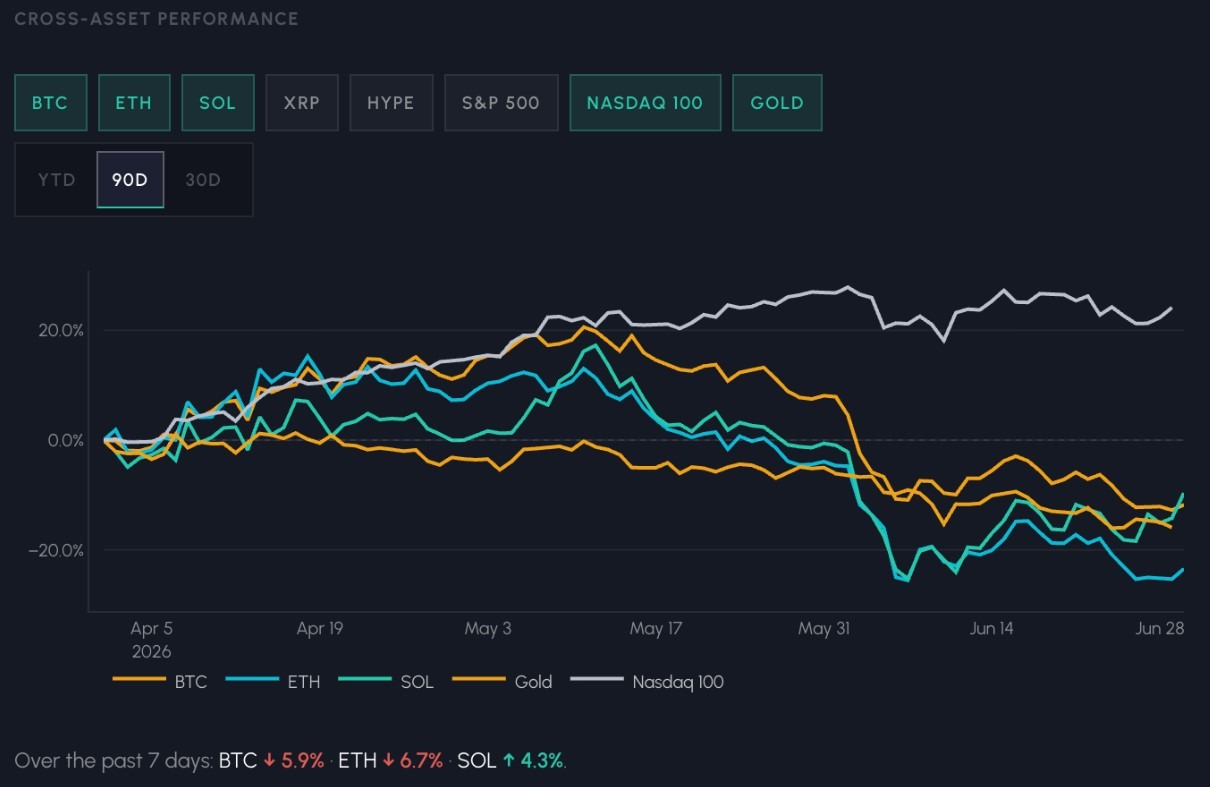
Cryptocurrency markets entered the third quarter of 2026 with less leverage but thinner liquidity after a wave of liquidations cleared speculative positions while major sources of demand weakened during the second quarter.
According to a market update from institutional data provider Talos, Bitcoin (BTC) and Ether (ETH) long liquidations totaled $8.35 billion in Q2. The data provider pointed out that the deleveraging coincided with spot Bitcoin exchange-traded fund (ETF) outflows, reduced Bitcoin buying by Strategy and a contraction in stablecoin supply.
While the reset left the market more stable heading into Q3, Talos said reduced order-book depth weakened its ability to absorb renewed selling pressure. This means the market could be less vulnerable to a chain reaction of forced selling, but prices may still swing sharply because there’s less trading activity to absorb large orders.
Cross-asset performance chart. Source: Talos
At last look on Wednesday, Bitcoin was trading hands at $58.656, after trading earlier in the day to $57,742, its lowest price since Sept. 17, 2024.
Talos said the liquidation wave reduced the amount of leveraged money in the market. Bitcoin open interest, which measures the value of outstanding derivatives contracts, fell to $33.5 billion, down 32% from its Q2 peak, while Ether open interest dropped to $16.2 billion, a 40% decline, according to the data provider.
Related: Swan’s Cory Klippsten sees record Bitcoin holder supply revealing early bottom
To be sure, the market became less liquid: Bitcoin’s 2% order-book depth, the value of buy and sell orders close to its market price, fell to between $35 and $40 million by late June from about $70 million in early May. Spot exchange volume also declined 28% quarter-over-quarter to $2.32 trillion, according to Talos.
ETF outflows and Strategy slowdown weigh on demand
Weakening demand was evident before the end of Q2. US spot Bitcoin ETFs recorded $696.3 million in net outflows in a single day on June 25. In total, June recorded about $4.5 billion in outflows, pushing year-to-date totals to $5.5 billion.
Strategy also purchased roughly 3,600 BTC in June, down from about 25,000 BTC in May and more than 50,000 BTC in April, according to company disclosures. The company also recorded a net sale of 32 BTC earlier in June and ended the month with 847,363 Bitcoin in its treasury, purchased at an average price of $64,103 apiece.
Magazine: Japanese pension fund tips 1% in crypto, G7 urges action on NK hackers: Asia Express
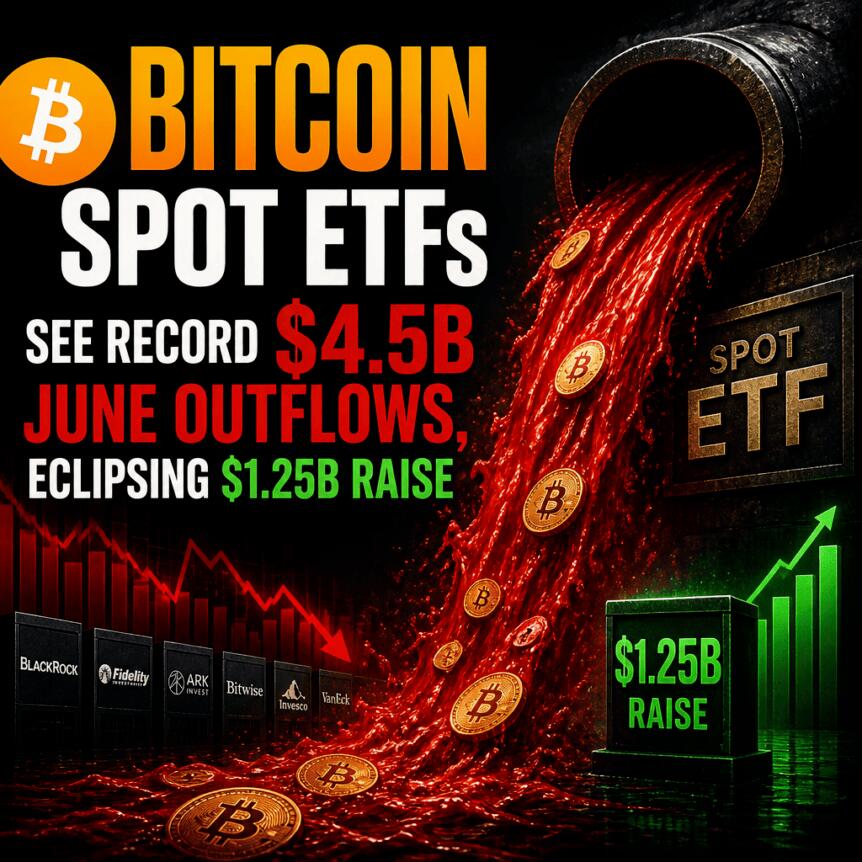
US-listed spot Bitcoin exchange-traded funds (ETFs) saw another sharp drawdown in June, recording $4.5 billion in net outflows—an amount that vastly exceeds the $1.25 billion Strategy is authorized to raise under its recently announced Bitcoin monetization program.
SoSoValue data updated Wednesday shows the record withdrawals pushed US spot Bitcoin ETFs to about $5.5 billion in year-to-date net outflows for 2026. Even with a still-positive overall position since launch, cumulative net inflows have fallen to roughly $51.2 billion, underscoring cooling investor demand for the product.
Key takeaways
- June’s $4.5 billion net outflows represent the largest monthly outflow figure cited for US spot Bitcoin ETFs in this period.
- That drawdown widened year-to-date net outflows for 2026 to roughly $5.5 billion, according to SoSoValue.
- BlackRock’s iShares Bitcoin Trust (IBIT) accounted for about 79% of June’s withdrawals, with $3.55 billion in net outflows (Farside Investors).
- Despite net inflows rising 4.6% year-over-year, CryptoQuant says ETF holdings remain below year-ago levels and total holdings are now under 1.25 million BTC.
- The scale of ETF outflows highlights a broader mismatch between renewed corporate Bitcoin monetization plans and fund-level investor behavior.
June outflows hit a record, led by IBIT
SoSoValue’s tracking shows June produced $4.5 billion in net outflows from US spot Bitcoin ETFs. The same period saw a heavy concentration in IBIT, which posted $3.55 billion in net outflows—about 79% of the total, according to Farside Investors.
For traders and long-term allocators, this concentration matters. When the majority of withdrawals are coming from a single flagship vehicle, it can signal that institutional allocation decisions are shifting in a coordinated way rather than being spread across the ETF complex. It also means changes in sentiment around the most liquid fund can ripple through broader ETF flow patterns.
Year-to-date flows remain negative even as lifetime inflows persist
The June outflows have pushed US spot Bitcoin ETFs toward a deeper negative 2026 trajectory. SoSoValue data indicates year-to-date net outflows are approximately $5.5 billion, while cumulative net inflows since the funds launched stand at about $51.2 billion.
In other words, the ETFs are not losing their overall historical inflow advantage—but the direction of travel is becoming more challenging. Record monthly withdrawals make it harder for new inflows to offset earlier net selling pressure, particularly if outflows remain elevated beyond a single month.
Holdings trail the year-ago baseline, signaling weaker underlying demand
SoSoValue reports cumulative net inflows into US spot Bitcoin ETFs have increased 4.6% compared with roughly $49 billion a year earlier. However, CryptoQuant’s data suggests that this net inflow picture does not translate into higher Bitcoin holdings at the same point in time.
CryptoQuant head of research Julio Moreno wrote on X on Tuesday that “US-based Bitcoin ETF holdings are now lower than at this same day last year.” He also said that overall demand for Bitcoin is weakening, pointing to total holdings across US spot Bitcoin ETFs falling below 1.25 million BTC.
This distinction—between net inflows and actual ETF holdings—can be crucial for interpretation. Net flow measures can move differently from holdings when redemption and creation activity, custody changes, or other accounting effects alter the timing relationship between “fund flows” and the amount of Bitcoin sitting inside the ETFs. For investors, the practical takeaway is that the balance sheet reality inside the funds is not matching the improved net inflow comparison.
Moreno’s commentary is consistent with the larger message investors may be trying to reconcile: ETFs can attract capital in aggregate while still losing BTC exposure year-over-year, which is often a sign that demand is not as resilient as headline inflow numbers imply.
Strategy’s $1.25 billion authorization runs into ETF outflows of a larger magnitude
Against this backdrop, Strategy announced a Bitcoin monetization program earlier this week. The company said it would seek authorization to raise up to $1.25 billion, framed as part of a broader capital framework intended to support dividend obligations tied to its preferred securities. The move was widely interpreted as responding to funding pressure within Strategy’s capital structure.
Community reactions were mixed. Some investors viewed the plan as financial flexibility, while others questioned the long-term sustainability of the new structure and argued it could lead to selling more Bitcoin than the initial authorization amount suggests.
In market reaction, Strategy’s Class A common stock (MSTR) initially rose as much as 12% above $90 after Monday’s announcement, according to Yahoo Finance, before reversing course and closing at $86.93 on Tuesday, down 6.2% on the day. Strategy’s preferred stock (STRC) traded higher at $84.86 on Tuesday, as reported by Yahoo Finance.
What stands out for readers is the scale mismatch between the corporate financing target and the ETF market’s behavior. June’s $4.5 billion in US spot ETF net outflows is more than three times the $1.25 billion Strategy is authorized to raise. While the two are not directly comparable in mechanism—corporate monetization versus retail/institutional ETF allocations—the comparison helps frame an important tension: renewed corporate efforts to manage capital around Bitcoin exposure are occurring as ETF-level demand is showing clear signs of cooling.
Going forward, investors will likely watch whether the ETF flow weakness is a temporary dip or a continuing trend—especially given CryptoQuant’s warning that ETF holdings remain below year-ago levels. If outflows persist, Strategy’s monetization plan may become part of a wider debate about where incremental Bitcoin demand will ultimately come from.


Taiwan’s Legislative Yuan passed the Virtual Asset Service Act on its third reading on June 30, moving crypto oversight beyond narrow anti-money-laundering rules.
The law rewrites how virtual asset service providers (VASPs) and stablecoin issuers operate, introducing licensing requirements, reserve rules, and criminal penalties.
Taiwan Lawmakers Pass Sweeping Crypto Regulation Law
The Financial Supervisory Commission (FSC) said the framework lifts supervision of virtual asset service providers (VASPs) from a money-laundering focus toward full operational and market-conduct standards.
The Act defines seven VASP categories, spanning:
- Virtual asset exchanges
- Trading platform operators
- Transfer service providers
- Custodians
- Underwriters
- Lending service providers
- Other virtual asset service providers
The law requires VASPs to segregate customer assets and comply with internal control, cybersecurity, audit, and financial reporting requirements.
The Act grants a transition period to existing VASPs that completed anti-money laundering (AML) registration before the law takes effect, as well as financial institutions already providing virtual asset services under FSC regulations.
These entities must apply for an FSC license within 12 months of the Act’s implementation. They must also obtain regulatory approval and an operating license within 21 months. If necessary, the licensing deadline may be extended once by up to three additional months.
Follow us on X to get the latest news as it happens
Meanwhile, the Act also establishes regulatory requirements for stablecoin issuance. It requires entities seeking to issue stablecoins in Taiwan to obtain approval from the Central Bank of the Republic of China (Taiwan) and authorization from the FSC.
Furthermore, issuers must maintain full reserve backing for all issued stablecoins, place reserve assets in trust, undergo regular audits, and comply with periodic information disclosure requirements.
“At the same time, issuing stablecoins within the Republic of China will help Taiwan align with international standards and secure a place in the global virtual asset market, greatly benefiting the long-term, sound development of Taiwan’s virtual asset market,” the press release said.
Penalties escalate sharply for misconduct. Fraud or price manipulation carries a sentence of 3 to 10 years in prison, plus fines of NT$10 million to NT$200 million ($314,000 to US$6.3 million).
The Executive Yuan will determine when the legislation comes into force.
Subscribe to our YouTube channel to watch leaders and journalists provide expert insights
The post Taiwan Advances Crypto Regulation With New VASP and Stablecoin Framework appeared first on BeInCrypto.


A MiCA license issued in any EU country gives the holder access to the entire 27-nation bloc as well as Iceland, Liechtenstein, and Norway. That means Polish companies are likely to apply in countries such as Lithuania, Latvia or Germany before passporting their services back home.
“The business simply moves somewhere else,” Wojciech Kaszycki, chief strategy officer of Warsaw-based fintech BTCS, told CoinDesk in a video interview. “None of the Polish companies can receive the authorization in Poland.”
Nawrocki says the law, which he rejected for a third time earlier this month, gives regulators excessive powers, including the ability to block crypto companies’ websites and impose rules that could push businesses abroad. He’s also said it favors banks and large corporations over startups while creating an overly complex regulatory framework.
Kaszycki said he agreed with Nawrocki’s criticism that parts of the law went beyond MiCA itself. The draft, which has been passed by both houses of parliament, allows the Financial Supervision Authority (KNF) to freeze customer funds for months and block websites before companies have exhausted legal appeals.
Mateusz Kara, CEO of Morphic Financial Group, headquartered in London and with deep roots and operations in Poland, said the cost of a MiCA license and the political deadlock could “wipe out Polish crypto.”


Several threads are feeding the attention. Aave is rolling out the Ethereum version of its V4 upgrade, a rebuild of how the protocol handles lending, and has seen active governance debate over borrowing limits alongside a growing focus on protocol revenue through a mechanism it calls Smart Value Recapture, which routes value back to the system.
Standard Chartered also published a long-term price outlook in June, forecasting a $3,500 level by 2030 if it capitalizes on the growing tokenized assets trend. The mix has drawn renewed notice to DeFi at a moment when most of the market has been falling.
“For price, this is the kind of signal traders usually want to see as July begins,” Santiment said. “New wallets showing up at this pace suggests interest is growing beneath the surface and supporting the price momentum.”
Whether that holds is the open question, as new wallets show attention, not commitment, and the number matters only if it converts into deposits, borrowing and the revenue that follows.
Meanwhile, AAVE faces headwinds in the near term amid a tepid crypto market. Bitcoin , the largest cryptocurrency, is stuck below $60,000 and most large tokens fell in the first half.
If the participation deepens into real usage, it gives AAVE a firmer base than a price bounce alone. If it fades with the market, the wallet spike will read as a burst of speculative interest rather than the start of a recovery.

European Union crypto clients should be served through a Markets in Crypto-Assets Regulation (MiCA)-authorized legal entity after the bloc’s July 1 transitional deadline, the European Securities and Markets Authority (ESMA) told Cointelegraph, adding to questions over how global exchanges can keep servicing users in the region.
Crypto asset service providers (CASPs) must hold MiCA authorization to serve clients across the EU and European Economic Area, an ESMA spokesperson told Cointelegraph on Monday.
“EU clients should be serviced through a MiCA-authorized entity,” the ESMA representative said, adding that MiCA protections apply only to the legal entity that is licensed in the EU.
The clarification came shortly after Binance told its users it was adjusting services in certain EU countries, including Poland, France, Spain and Italy, as part of its MiCA transition. Binance said users in other countries would not need to take action if they were not based in a jurisdiction where the exchange operates through a local registered entity, saying in those cases that “no action is required at this time.”
ESMA cites “narrow exemption” for non-EU CASPs
The ESMA said CASPs based outside the EU cannot provide their services to local customers unless they fall under the “narrow exemption” of reverse solicitation provided by Article 61 of MiCA.
Article 61 allows a non-EU crypto company to serve an EU client without a MiCA license only when the client initiates the relationship entirely on their own, without any solicitation, marketing or promotion by the company.
However, the regulation makes clear that the exemption does not apply if a third-country company solicits clients in the EU.
“MiCA established that where a third-country firm solicits clients or prospective clients in the Union […] it shall not be deemed to be a service provided on the client’s own exclusive initiative,” an ESMA spokesperson told Cointelegraph.

Excerpt from ESMA’s list of examples of solicitation by third-country companies. Source: ESMA
The regulator also cited its official solicitation guidelines, which include activities such as operating websites, mobile apps, social media, online advertising, sponsorships and influencer campaigns targeting EU users.
Lawyer questions Binance’s Abu Dhabi servicing model
Screenshots of Binance customer support messages circulating on social media appeared to suggest that some EU users could be serviced through Binance’s Abu Dhabi Global Market entity.
Yuriy Brisov, a lawyer at Digital & Analogue Partners, said an Abu Dhabi license has no effect under MiCA because the jurisdiction is treated as a third country, alongside markets such as the United States or Singapore.
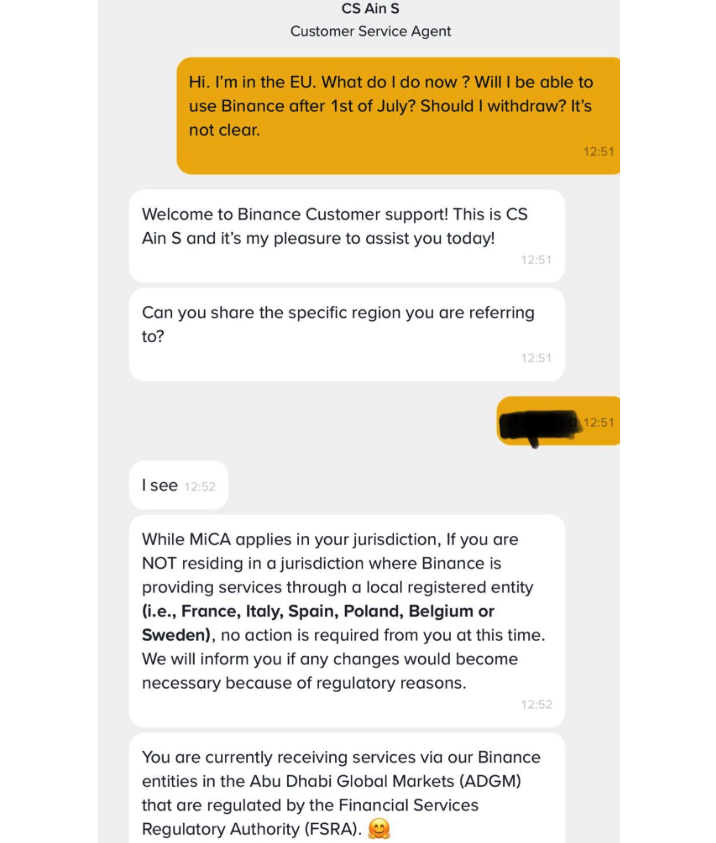
Source: Satoshi Club
“Being regulated in Abu Dhabi does nothing for Binance under MiCA,” Brisov said. “When Binance says some EU users are serviced through the ADGM entity, in MiCA terms that means a non-EU company is serving those users,” he added.
Related: Germany leads MiCA crypto authorization race as Europe’s deadline looms
Brisov said that the reverse solicitation exemption was designed for isolated cases where an EU customer independently approaches a non-EU company, not for maintaining an existing customer base built through years of marketing.
Binance did not respond to repeated Cointelegraph requests for clarification on whether any EU users would be serviced through its ADGM entity after the MiCA deadline.
Magazine: How crypto laws changed in 2025 — and how they’ll change in 2026

A former CEO of Goliath Ventures, Christopher Alexander Delgado, has entered a guilty plea in the U.S. Department of Justice’s cryptocurrency fraud case that prosecutors say relied on investor money to sustain promised returns. The DOJ said the scheme raised at least $400 million from investors through what it described as digital asset “liquidity pools,” with Delgado admitting to wire fraud conspiracy and related offenses.
According to the DOJ, Goliath marketed monthly returns between January 2023 and January 2026. Prosecutors contend that investor funds were not used as represented, but instead were diverted to pay earlier participants, handle withdrawal requests, cover personal luxury spending, and fund business events.
Key takeaways
- Delgado pleaded guilty to conspiracy to commit wire fraud, along with wire fraud and money laundering counts tied to the Goliath Ventures scheme.
- Prosecutors said Goliath promised monthly returns from crypto liquidity pools while using new investor money for withdrawals, payments, and expenses.
- The plea agreement states the scheme resulted in at least $250 million in investor losses and includes forfeiture of extensive luxury assets.
- Sentencing is scheduled for Oct. 8, with Delgado facing substantial prison time if convicted on the fraud and money laundering counts.
- The case has also raised questions about how financial institutions handled Goliath-related transactions, including litigation claims involving major banks and crypto custody.
What the DOJ says Delgado admitted
In a Tuesday announcement, the DOJ said Delgado pleaded guilty to a set of charges stemming from the cryptocurrency investment operation. Prosecutors described a program that promised regular returns using digital asset liquidity pools, spanning January 2023 through January 2026.
Delgado’s plea included admissions that the funds collected from investors were used for purposes inconsistent with the representations made to customers. The DOJ said money from the scheme went toward paying earlier investors and processing withdrawal requests, while also being used for luxury spending and to finance business events.
Under the plea agreement, Delgado admitted that investor losses linked to the scheme totaled at least $250 million. The agreement also requires forfeiture of a portfolio of luxury assets, according to the DOJ.
Forfeiture and sentencing exposure
The DOJ said Delgado agreed to surrender eight properties, 11 vehicles, and more than 50 luxury bags and wallets, along with at least 29 pieces of jewelry. The forfeiture list also includes bank accounts and crypto wallets identified by prosecutors.
From a potential punishment standpoint, the DOJ’s filing indicates that each fraud count carries up to 20 years in prison, while money laundering carries up to 10 years. Delgado’s sentencing has been set for Oct. 8.
Apology on television precedes the plea
Delgado’s guilty plea follows a public apology and television appearance that drew attention to the case. Earlier this year, on May 12, Delgado appeared in an interview with Florida television station WFTV, where he acknowledged he had let investors down and said he had returned to the U.S. and was cooperating with authorities.
In that interview, Delgado claimed that only about $160,000 remained in the company’s bank account at the time of his arrest. He also said other former colleagues were involved in the broader operation.
Scrutiny expands to banks and payment rails
Beyond Delgado’s plea, the Goliath case has drawn scrutiny regarding the financial institutions that processed transactions connected to the scheme. On March 12, investors reportedly filed a proposed class-action lawsuit against JPMorgan Chase, alleging that the bank ignored suspicious activity and allowed Goliath to route investor funds through its accounts.
That lawsuit, as described in earlier coverage, claimed that roughly $253 million moved through a JPMorgan account. It further alleged that about $123 million later transferred to Goliath’s wallets at Coinbase. A separate federal complaint, according to the DOJ, also identified flows involving Bank of America and transfers directly to Coinbase wallets.
For market participants and builders, these allegations underscore a recurring challenge in crypto markets: even when digital assets are involved, traditional banking channels can remain critical bottlenecks for detecting suspicious activity—or, if the system fails, for facilitating fraudulent structures.
With sentencing approaching on Oct. 8, investors and compliance professionals will likely focus on what the court order clarifies about the scheme’s mechanics, the scale of losses, and how payments moved between bank accounts and crypto wallets. The plea does not end the broader questions raised by parallel claims about financial institutions’ role, and future rulings could further shape expectations for safeguards across both traditional and on-chain settlement pathways.
Crypto World
FedEx (FDX) Shares Decline Nearly 4% Amid $1.4 Billion Logistics Unit Sale Negotiations

Key Highlights
- FDX shares declined 3.7% during Wednesday’s pre-market session following news of potential $1.4B Supply Chain unit divestiture
- CMA CGM, the globe’s third-largest container shipping operator, is identified as the prospective purchaser
- The company exceeded Q4 FY2026 expectations with earnings of $6.31 per share and revenue of $25.01B, reflecting a 12.5% annual increase
- Company insiders have divested 48,104 shares totaling approximately $17.6M in the previous quarter
- Analyst consensus points to a “Moderate Buy” rating with a mean price objective of $349.60
Shares of FedEx (FDX) experienced a 3.7% decline in Wednesday’s pre-market session, beginning trading at $313.44, following a Financial Times report indicating that negotiations to divest its third-party logistics division have reached an advanced phase.
The business unit under discussion is FedEx Supply Chain, responsible for warehousing operations, distribution services, and managing product returns. According to reports, CMA CGM, ranked as the world’s third-largest container shipping enterprise, stands as the potential acquirer.
Sources suggest the transaction carries an estimated valuation of approximately $1.4 billion.
This development represents another strategic step in FedEx’s initiative to concentrate on its primary air and ground transportation services. The logistics giant recently separated FedEx Freight (FDXF) into an independent trucking entity.
Divesting the Supply Chain business would further streamline FedEx’s operational structure and intensify its concentration on package delivery services.
Strong Quarterly Performance Amid Strategic Transitions
FedEx delivered impressive Q4 FY2026 financial results on June 23. The shipping giant reported earnings per share of $6.31, surpassing Wall Street projections of $5.91 by $0.40. Total revenue reached $25.01 billion, exceeding the consensus estimate of $24.04 billion and representing a 12.5% increase from the previous year.
FedEx also highlighted enhanced package volume metrics and ongoing cost reductions stemming from its comprehensive transformation initiative.
Stifel’s analyst J. Bruce Chan expressed optimism regarding continued enhancement in profit margins and asset efficiency.
Looking ahead to FY2027, FedEx has provided earnings guidance ranging from $16.90 to $18.10 per share. Wall Street analysts project an average of $20.89 in full-year earnings.
Notwithstanding the earnings outperformance, FDX shares have faced headwinds. The company’s transition to calendar-year financial reporting has introduced some investor ambiguity.
Notable Insider Transactions and Institutional Activity
Regarding insider activity, Executive Vice President Gina F. Adams divested 20,450 FDX shares on April 14 at a price of $366.45 per share, generating approximately $7.49 million in proceeds. This transaction reduced her holdings by 51%.
Board member Susan C. Schwab sold 5,795 shares the following day at $369.00 per share, totaling roughly $2.14 million — representing a 36.6% decrease in her ownership stake.
Cumulatively, company insiders have disposed of 48,104 FDX shares valued at approximately $17.6 million during the past 90-day period.
Institutional investor Janney Montgomery Scott reduced its FedEx holdings by 16.6% during Q1, selling 10,993 shares. The firm maintains ownership of 55,268 shares with an estimated value of $19.7 million.
Institutional investors control 84.47% of FedEx stock.
Wall Street analysts have recently adjusted their price projections. Truist reduced its target from $425 to $365 while retaining a Buy recommendation. Stifel decreased its objective from $442 to $326, also maintaining Buy. HSBC lowered its forecast to $289.89 with a Hold rating. Sanford C. Bernstein established a $397 target.
Morgan Stanley maintains the sole Underweight rating, projecting a $230 price target.
The prevailing Wall Street consensus stands at Moderate Buy, featuring an average price objective of $349.60.
FedEx’s 52-week trading range extends from a minimum of $172.88 to a maximum of $345.36. The equity’s 50-day moving average currently rests at $361.08.
A quarterly dividend distribution of $1.22 per share was issued on July 7, yielding 1.6%.


Mariska Hargitay’s Chic Embroidered Jeans Style Is on Amazon

Explained: Why Tata Elxsi shares crashed 7% after KPI Tech’s Q1 revenue, profit guidance warning

Crypto News, July 1: Bitcoin Price Holds $59K as Ethereum Stays Steady on MiCA Day Zero





-

 Fashion5 days ago
Weekend Open Thread: Staud – Corporette.com
-

 Politics5 days ago
The House | Manchesterism won’t survive the painful trade-offs unless it gets citizens on board
-

 Crypto World1 day ago
Strategy authorizes up to $1.25B in Bitcoin sales under new capital plan
-

 Politics5 days ago
Potential 2028er World Cup attendee leaderboard
-

 Business5 days ago
Asia stock markets slide as tech shares slump
-

 News Videos3 days ago
MAJOR BITCOIN & MARKET UPDATE!!!! (MUST WATCH ASAP!!!)
-

 Tech6 days ago
A Look At A Gaggle Of Transputer Boards
-
 Crypto World6 days ago
Dell (DELL) Shares Tumble Over 5% Following Analyst Downgrade to Hold
-

 Crypto World4 days ago
Coinbase, Circle Deepen Crypto Stock Losses Despite Resilient S&P 500
-

 Business1 day ago
Australia treasurer says alleged access of prime minister’s bank data ’incredibly concerning’
-

 Crypto World4 days ago
Kraken's xStocks Opens Bending Spoons IPO Registration to EEA Retail
-

 Sports5 days ago
FIH Pro League: India defeat Pakistan 7-1, register biggest win of campaign | Other Sports News
-

 Crypto World5 days ago
Bitcoin Sparks $600M Hourly Liquidations With $65,000 Set To Become Resistance
-

 Tech3 days ago
Bluekit phishing kit adopts browser-in-the-middle for login theft
-

 Tech4 days ago
Russian hackers now target Signal backup recovery keys
-
 Crypto World5 days ago
Hyperliquid Named on Singapore MAS Investor Alert Register
-

 Crypto World6 days ago
Ripple and SBI launch RLUSD in Japan after JFSA approval
-

 Crypto World5 days ago
RTX holders must register wallets before token distribution begins
-

 Tech1 day ago
Anonymous researcher drops 0-day ‘exploitarium’ repo
-
 Business2 days ago
The AI boom won’t burst all at once. It will pop in ‘rolling bubbles’: Macquarie
You must be logged in to post a comment Login