
Business
USMCA Review Deadline Arrives | Seeking Alpha


Listen on the go! A daily podcast of Wall Street Breakfast will be available by 8:00 a.m. on Seeking Alpha, iTunes, Spotify.

Getty Images
Good morning! Here’s the latest in trending:
Resolving dispute: U.S. lifts export controls on Anthropic’s (ANTHRO) Claude Fable 5 and Mythos 5.
U.S. IPO: South Korean AI memory chipmaker SK Hynix (HXSCL) files to list its shares on Nasdaq.
Big money: Trump’s 927-page financial disclosure report reveals over $1.4B in crypto-related income.
The deadline for the joint review of the U.S.-Mexico-Canada Agreement is here, and the Trump administration is expected to announce that it will not extend the free trade deal. This could potentially start the process of winding down the 32-year-old North American free trade zone.
What to expect: The deadline for the USMCA’s joint review is today, with trade representatives of the three countries scheduled to meet virtually to decide if the pact should be extended for another 16 years. If they don’t agree on revising or extending the USMCA, the countries will hold annual reviews for the next 10 years. If an agreement is not reached, the pact will expire on July 1, 2036. The USMCA, which replaced the North American Free Trade Agreement in 2020 during Trump’s first term, accounts for about 30% of the world’s GDP. In 2024, trilateral trade totaled around $1.99T. It’s important to note that even if the U.S. decides against renewing the USMCA, this won’t terminate the deal right away.
Mexico’s President Claudia Sheinbaum has called for extending the USMCA for 16 years. Canada also favors extension, but Prime Minister Mark Carney downplayed the possibility of that happening. “We’re expecting a constructive exchange,” he told reporters on Tuesday. “I wouldn’t expect any drama. I’m not looking for my pen.” The U.S. wants to rework the deal with tighter rules of origin for North American-built vehicles, stricter limits on Chinese goods in the region, greater access for U.S. farm exports, among other demands. “I see a prolonged period of negotiation and review likely resulting in a final agreement that looks somewhat like today, but maybe with a couple side-car agreements on rules of origin, supply chains and other issues that the U.S. wants resolved,” said Christian Medeiros, vice president at TD Asset Management.
What’s at stake: Experts flagged the risks of annual reviews over the next decade. “A 10-year expiration window may be a lifetime in politics, but it introduces significant uncertainty for global businesses that make large-scale expansion plans on multi-decade timelines,” wrote Scott Lincicome, vice president of General Economics and Stiefel Trade Policy Center, Cato Institute. “So, on the margins, missing the July 1 deadline will likely reduce North American investment.” He said new rules of origin or labor and environmental conditions would impose new costs on North American businesses. “Compliance costs under USMCA’s existing automotive rules of origin — just documentation, classification and reporting burdens — amount to an invisible 2% tariff on cross-border trade.”
Here’s the latest Seeking Alpha analysis
Beyond The SpaceX IPO: 3 Top Aerospace And Infrastructure Stocks
I Am Buying The Dip In Dividends As Others Sell
It’s Time To Go All-In On SCHD
Micron Technology: The Replaceable Role Of Memory In The AI Value Chain
Forget Bonds: Build A Rock-Solid 6.5% Yield From Investment Grade Preferreds
What else is happening…
Microsoft (MSFT) plans to lay off under 2.5% of workforce.
Brookfield, Bloom Energy (BE), expand AI power partnership.
Apple (AAPL)-Epic Games battle heads to Supreme Court.
Micron Technology (MU) commits $250M to Trump Accounts.
Nike’s (NKE) earnings beat not enough to win over Wall Street.
Michael Burry says he shorted Caterpillar (CAT) for first time.
UK scrutiny for Paramount (PSKY)-Warner Bros. (WBD) deal?
Zyn (PM) can be marketed as a less harmful tobacco product.
Emergency order for largest U.S. power grid as heatwave nears.
Supreme Court upholds birthright citizenship in loss for Trump.
Today’s Markets
In Asia, Japan +0.6%. Hong Kong closed. China +0.4%. India +0.6%.
In Europe, at midday, London -0.4%. Paris -0.6%. Frankfurt +0.4%.
Futures at 6:30, Dow -0.2%. S&P -0.2%. Nasdaq -0.4%. Crude -1.2% to $68.70. Gold -1.1% to $3,995.50. Bitcoin -1% to $58,657.
Ten-year Treasury Yield unchanged at 4.47%.
On The Calendar
Companies reporting today include General Mills (GIS) and FactSet Research (FDS).
See the full earnings calendar on Seeking Alpha, as well as today’s economic calendar.


The research report noted that opportunities may increasingly emerge from the broader space ecosystem and its supply chain, rather than only from companies directly involved in launching rockets. Semiconductor, electronics, software, advanced materials, manufacturing and communications infrastructure companies could benefit as the commercialisation of space accelerates.
Goldman Sachs said its custom basket of US space and satellite stocks had gained around 13 per cent in 2026 through July 14, outperforming the 9.8 per cent rise in the S&P 500 over the same period. The basket has risen more than 360 per cent over the past two years, although its rally has cooled from its late-May peak.
The report noted that the space theme has evolved significantly, with investors increasingly focusing on rocket launches, satellites, global communications and potential future markets enabled by space technologies. Some companies in the basket are also seeing rising sales linked to US government defence contracts, particularly in satellite imagery and connectivity.
A key factor supporting the sector’s outlook is the improving economics of space activity. Goldman Sachs said the cost of rocket launches and satellites has declined, while opportunities in global communications services are developing. Some companies in the space and satellite basket could become profitable as early as next year, according to analyst Louis Miller.

The report also highlighted growing investor interest in orbital broadband services, including companies such as SpaceX’s Starlink. Potential future applications such as orbiting data centres are also attracting attention, although these remain longer-term opportunities.
Goldman Sachs said demand for space-related investments is coming from retail, private wealth and institutional investors, with many seeking differentiated secular growth themes rather than traditional sector allocations.
However, the sector remains highly volatile. The Goldman Sachs space basket is roughly twice as volatile as a comparable AI basket and about five times as volatile as the S&P 500. The report cautioned that investor enthusiasm could periodically run ahead of fundamentals even if the sector’s long-term structural direction remains positive.
Business
Red-Hot Inflation And (Inflation-Adjusted) Strong Domestic Private-Sector Demand Marks Q2 GDP – Debt-To-GDP Ratio Dips To 121.5%

Red-Hot Inflation And (Inflation-Adjusted) Strong Domestic Private-Sector Demand Marks Q2 GDP – Debt-To-GDP Ratio Dips To 121.5%
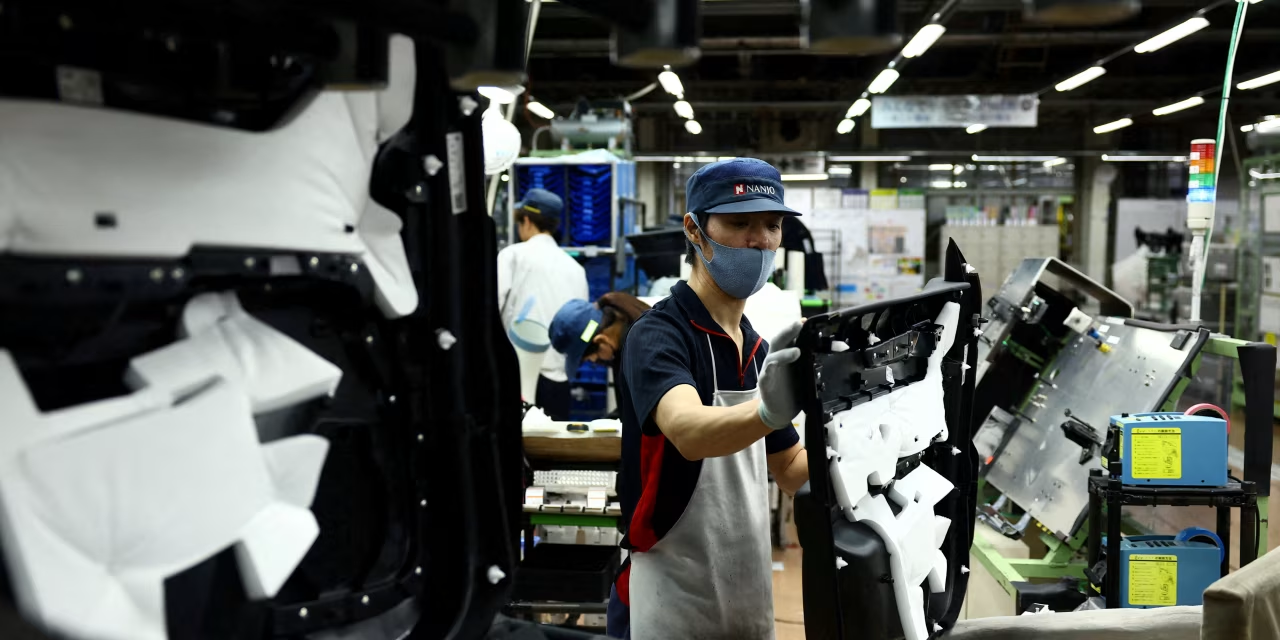
The latest Market Talks covering the Auto and Transport sector. Published exclusively on Dow Jones Newswires at 4:20 ET, 12:20 ET and 16:50 ET.
0921 ET — Magna International is improving its margins even while the world produces fewer vehicles. TD Cowen’s Brian Morrison says in a report 2Q results “reinforce Magna’s margin improvement story with adjusted EBIT margin expanding y/y to 6.2% despite lower y/y global light vehicle production.” At the same time, sales increased 3% to $10.98 billion, on “anticipated benefit of FX y/y and new program launches, partially offset by lower global production y/y.” This bodes well for the company. Morrison says that along with strong free cash flow, he sees upside potential to consensus and the applied multiple.” (adriano.marchese@wsj.com)
Copyright ©2026 Dow Jones & Company, Inc. All Rights Reserved. 87990cbe856818d5eddac44c7b1cdeb8

Organon Co earnings missed by $0.50, revenue fell short of estimates

This is the forum for daily political discussion on Seeking Alpha. A new version is published every market day.
Please don’t leave political comments on other articles or posts on the site.
The comments below are not regulated with the same rigor as the rest of the site, and this is an ‘enter at your own risk’ area as discussion can get very heated. If you can’t stand the heat… you know what they say…
More on Today’s Markets:
Moderation Guidelines:
We remove comments under the following categories:
- Personal attacks on another user account
- Anti-Vaxxer or covid related misinformation
- Stereotyping, prejudiced or racist language about individuals or the topic under discussion.
- Inciting violence messages, encouraging hate groups and political violence.
Regardless of which side of the political divide you find yourself, please be courteous and don’t direct abuse at other users.
For any issue with regards to comments please email us at : moderation@seekingalpha.com.
Seeking Alpha’s Disclosure: Past performance is no guarantee of future results. No recommendation or advice is being given as to whether any investment is suitable for a particular investor. Any views or opinions expressed above may not reflect those of Seeking Alpha as a whole. Seeking Alpha is not a licensed securities dealer, broker or US investment adviser or investment bank. Our analysts are third party authors that include both professional investors and individual investors who may not be licensed or certified by any institute or regulatory body.
SpaceX Stock Hits a Record Low. Starship’s Heat Shield Is Just One More Hurdle.


I have a masters degree in Analytics from Northwestern University and a bachelors degree in Accounting. I have worked in the investment arena for over 10 years starting as an analyst and working my way up to a management role. Dividend investing is a personal hobby and I look forward to sharing my thoughts with the Seeking Alpha community.
Analyst’s Disclosure: I/we have no stock, option or similar derivative position in any of the companies mentioned, and no plans to initiate any such positions within the next 72 hours. I wrote this article myself, and it expresses my own opinions. I am not receiving compensation for it (other than from Seeking Alpha). I have no business relationship with any company whose stock is mentioned in this article.
Seeking Alpha’s Disclosure: Past performance is no guarantee of future results. No recommendation or advice is being given as to whether any investment is suitable for a particular investor. Any views or opinions expressed above may not reflect those of Seeking Alpha as a whole. Seeking Alpha is not a licensed securities dealer, broker or US investment adviser or investment bank. Our analysts are third party authors that include both professional investors and individual investors who may not be licensed or certified by any institute or regulatory body.

Fires on more than 250,000 acres of Washington state prompt evacuations

These Were the Best and Worst S&P 500 Stocks in July


I have been involved in the financial world for over 25 years with experience as an advisor, teacher, and writer. I am a full believer in the free-market system and that financial markets are efficient with most stocks reflecting their real current value. The best opportunities for profits on individual stocks come from stocks that are less-widely followed by the average investor or from stocks that may not accurately reflect the opportunities that currently exist in their markets.
Analyst’s Disclosure: I/we have no stock, option or similar derivative position in any of the companies mentioned, and no plans to initiate any such positions within the next 72 hours. I wrote this article myself, and it expresses my own opinions. I am not receiving compensation for it (other than from Seeking Alpha). I have no business relationship with any company whose stock is mentioned in this article.
Seeking Alpha’s Disclosure: Past performance is no guarantee of future results. No recommendation or advice is being given as to whether any investment is suitable for a particular investor. Any views or opinions expressed above may not reflect those of Seeking Alpha as a whole. Seeking Alpha is not a licensed securities dealer, broker or US investment adviser or investment bank. Our analysts are third party authors that include both professional investors and individual investors who may not be licensed or certified by any institute or regulatory body.

Asake – MCBH (Official Visualizer)
Goldman Sachs sees a bigger space opportunity beyond launch providers

Kansas City Chiefs rookie Cyrus Allen suffers shin bruise at camp


-
 Sports6 days ago
Commonwealth Games boxing: Jadumani Singh seals dominant 5-0 win over Pakistan’s Sumama Rehman to enter quarter-finals | Commonwealth Games News
-

 Business3 days ago
Why Trees Belong on the Risk Register
-

 Fashion1 day ago
Weekend Open Thread: Wit & Wisdom
-

 Tech6 days ago
Intel is reversing course and bringing hyper-threading back to its server chips
-

 Politics1 day ago
Meta enters AI-training agreement with far-right ‘propaganda rag’ Newsmax
-

 Politics6 days ago
Luke Littler dismantles Gerwyn Price to retain title in Blackpool
-

 Crypto World14 hours ago
MicroStrategy Post-Earnings CLARITY Act Push Could Add New Catalyst for Its Stock
-

 Politics5 days ago
The Part of the Electric Transition Nobody Wants to Discuss
-
 Entertainment4 days ago
‘Stargate’ Creator’s New Sci-Fi Series Returns for Season 3 Tomorrow
-

 News Videos6 days ago
BITCOIN JUST ENTERED THIS CRITICAL ZONE…
-

 Business4 days ago
Major shareholder moves on Canyon
-

 Crypto World7 days ago
XRP Ledger adds $2.6B as RWA inflows rank second
-

 Politics7 days ago
Spain sweeps the board at 2026 World Cup with individual awards
-

 News Videos3 days ago
Bitcoin Enters the 3rd Stage of the Bear Market
-
Crypto World22 hours ago
XRP Ledger v3.3.0 brings five institutional features
-

 Crypto World4 days ago
Kraken Enables Retail Access to Jersey Mike’s IPO via Tokenized Shares
-

 Tech5 days ago
New macOS Sequoia & Sonoma security updates for older Macs
-

 News Videos4 days ago
Claude: Build Financial Dashboards in Minutes (2026)
-

 Sports2 days ago
Seema Kaliramna Wins Discus Throw Bronze, Takes India’s CWG Medals Tally To 17
-

 Politics3 days ago
Luke Littler’s dominance sparks GOAT debate
You must be logged in to post a comment Login