

Crypto World
Swan’s record Bitcoin holder supply hints at early bottom


Bitcoin’s “long-term holder” supply has climbed to new highs, a development that some analysts say could point to an earlier end to the current drawdown. Swan Bitcoin CEO Cory Klippsten highlighted that long-term investors are holding a record amount of BTC, a pattern he argues has historically coincided with cycle lows.
At the same time, other market watchers continue to stress that macro signals and US regulatory uncertainty may still weigh on demand. Grayscale, for instance, tied potential downside pressure to the uncertain fate of the US CLARITY Act, while Galaxy Digital later reduced its odds that the bill would become law in 2026.
Key takeaways
- Long-term holders reportedly reached 14.7 million BTC, described by Swan Bitcoin’s Cory Klippsten as “cycle low” territory in prior market turns.
- Glassnode data cited in the discussion links the increase in long-term holder supply to “continued conviction” among experienced investors.
- Coinglass data shows long-term holder supply is up about 14% since Nov. 26, reflecting renewed accumulation after earlier market stress in October.
- Some forecasts based on corporate treasury metrics suggest Bitcoin may still bottom later, potentially after Strategy’s mNAV hits its own low.
- Grayscale and Galaxy Digital both flagged uncertainty around the CLARITY Act as a factor that could keep near-term selling pressure elevated.
Record long-term holder supply revives “earlier bottom” arguments
Klippsten said Bitcoin supply held by long-term holders has reached an all-time high, pointing to a level of BTC held in “addresses of long-term holders” that he characterized as having “marked cycle lows historically.” In an interview with Cointelegraph shared via X, Klippsten attributed the reading to long-term investor behavior rather than speculative turnover.
According to Glassnode, the amount of BTC held by long-term holders reached 14.7 million BTC on Wednesday, a record level that the analytics firm said signals “continued conviction.” The core idea behind this metric is that long-term holder cohorts—typically understood as holders that have not moved their coins for extended periods—tend to be less sensitive to short-term price fluctuations. When that cohort grows, it can be interpreted as reduced willingness to sell during weaker markets.
Klippsten’s interpretation takes this one step further: he suggested that the data could imply Bitcoin’s cycle bottom may arrive sooner than in previous downturns. That view stands in tension with at least one prominent alternative framework referenced in the discussion.
Why treasury-based models still point to a later cycle low
Earlier coverage cited a forecast from Lebit Mining Pool founder Jiang Zhuoer, who argued Bitcoin would bottom between October and December 2026—roughly six months after Strategy’s Multiple to Net Asset Value (mNAV) measure found its own cycle low.
Zhuoer’s reasoning, as presented in the referenced post, centers on mNAV. He wrote that Strategy’s mNAV had already declined to 0.72, approaching the lowest level of 0.7 seen on May 11, 2022. Under this model, the time gap between a company-level valuation trough (mNAV) and the broader market’s cycle low could remain consistent across cycles.
Zhuoer also suggested that such a lag could place Bitcoin’s cycle low closer to the $42,000 to $44,000 region. While that range is model-derived rather than a direct price target, it highlights an important disagreement among analysts: long-term holder accumulation may be suggesting early stabilization, while valuation compression in major treasury buyers could still imply additional downside before the market bottoms.
For investors and traders, the practical takeaway is that “accumulation signals” and “valuation timing signals” are not necessarily synchronized. If long-term holder supply continues to rise, it may reinforce a case for faster stabilization. But if treasury-driven downside pressures extend, any improvement may be slower than accumulation data alone would imply.
Accumulation restarted after October’s liquidation shock
The long-term holder narrative gains additional context from supply trends tracked by Coinglass. Coinglass reports that long-term holder supply stood at 16.65 million BTC at the time of publication, up 14% from 14.6 million BTC on Nov. 26.
Coinglass defines long-term holders as addresses that have held BTC for at least 155 days. In its framework, rising long-term holder supply often indicates that participants are reluctant to sell at current levels—an observation that aligns with Klippsten’s broader thesis about conviction during weaker periods.
The report also notes that long-term holders resumed accumulation at the end of 2025, nearly two months after early October’s record $19 billion liquidation event. That linkage matters because it suggests the observed behavior change is not purely random: a major stress event may have forced a reassessment among longer-term participants, who then positioned more conservatively as the market stabilized.
At the same time, the renewed accumulation doesn’t automatically resolve the question of price depth. If the market continues to absorb forced selling or if demand is delayed by regulation-related uncertainty, long-term holder accumulation can coexist with further price weakness.
CLARITY Act uncertainty could keep pressure on Bitcoin demand
Beyond on-chain and corporate valuation signals, the discussion also points to policy uncertainty that could affect Bitcoin demand in the US. Grayscale linked the potential for additional “deleverage” by treasury companies to whether the CLARITY Act passes.
In a Friday report, Grayscale’s head of research Zach Pandl wrote that if the CLARITY Act does not pass this year, companies such as Strategy and other treasury operators may continue to “deleverage,” which Grayscale suggested could cause Bitcoin to “fall moderately further.”
Galaxy Digital separately reduced its odds estimate, cutting the likelihood that the CLARITY Act would become law in 2026 to 50%. Galaxy Digital’s warning, as cited in the referenced coverage, emphasized that the US Senate may be running out of time to advance the broader crypto market structure bill before its August recess.
The bill is scheduled for a House of Representatives committee hearing on July 17. It aims to create the first regulatory framework for digital assets in the US, but has faced resistance from parts of the banking industry, particularly over the bill’s approach to allowing yield on stablecoin holdings.
For market participants, this policy dimension matters because it can directly influence institutional appetite—especially among firms whose balance-sheet strategies depend on clear regulatory pathways. When legislation is uncertain, even structurally bullish long-term investors may slow their risk-taking, affecting the pace at which demand can offset any sell-side pressure.
Next, readers should watch whether long-term holder supply continues rising alongside improving liquidity conditions, and whether the CLARITY Act’s legislative timeline shifts closer to or further from passage. Those two forces—on-chain conviction and regulatory clarity—may ultimately determine whether current accumulation translates into a quicker cycle turn or a longer grind lower.

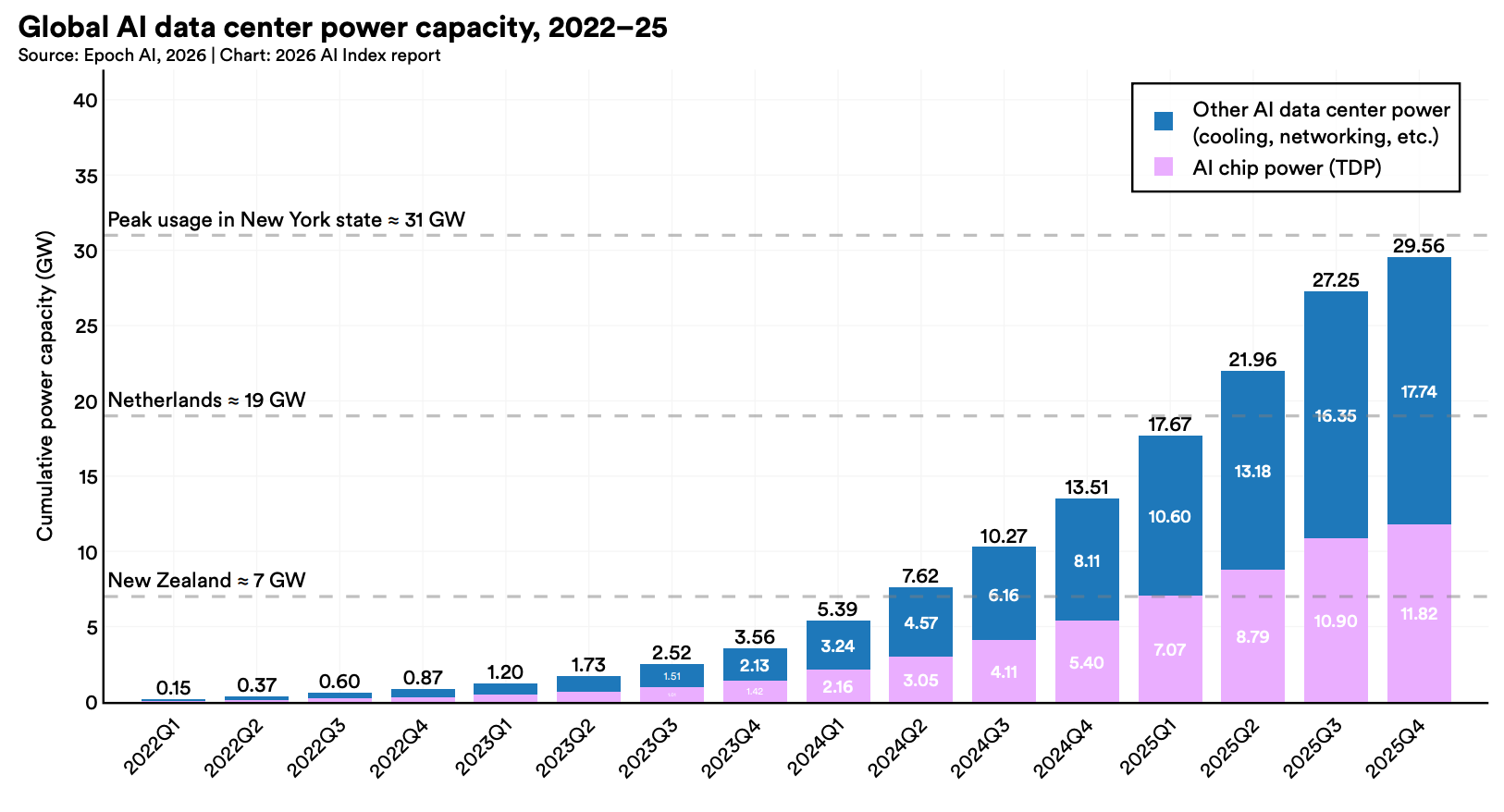
By the end of 2025, the power capacity tied to artificial intelligence data centers worldwide had reached about 29.6 gigawatts (GW), enough to run all of New York state at peak demand, according to Stanford University’s annual report on the AI industry.
The report, released in April, suggests that compute itself is abundant and getting cheaper. Permitted, grid-connected, ready-to-draw electricity is in high demand, but the sources to power it are much harder to come by. One industry has spent the past decade quietly building exactly that infrastructure for a different reason: Bitcoin mining.

AI data center power capacity reached about 29.6 GW by the end of 2025, comparable to New York state at peak demand. Source: Stanford University
Chips get more efficient, but total demand rises
The economics of chips are moving in the opposite direction. Stanford said the cost of GPU computation has dropped more than 99% since 2006, while leading chips now perform far more work per watt than they did a decade ago. But efficiency gains have not reduced total demand. They are instead poured back into larger models rather than banked as savings, keeping the pressure on the power grid.
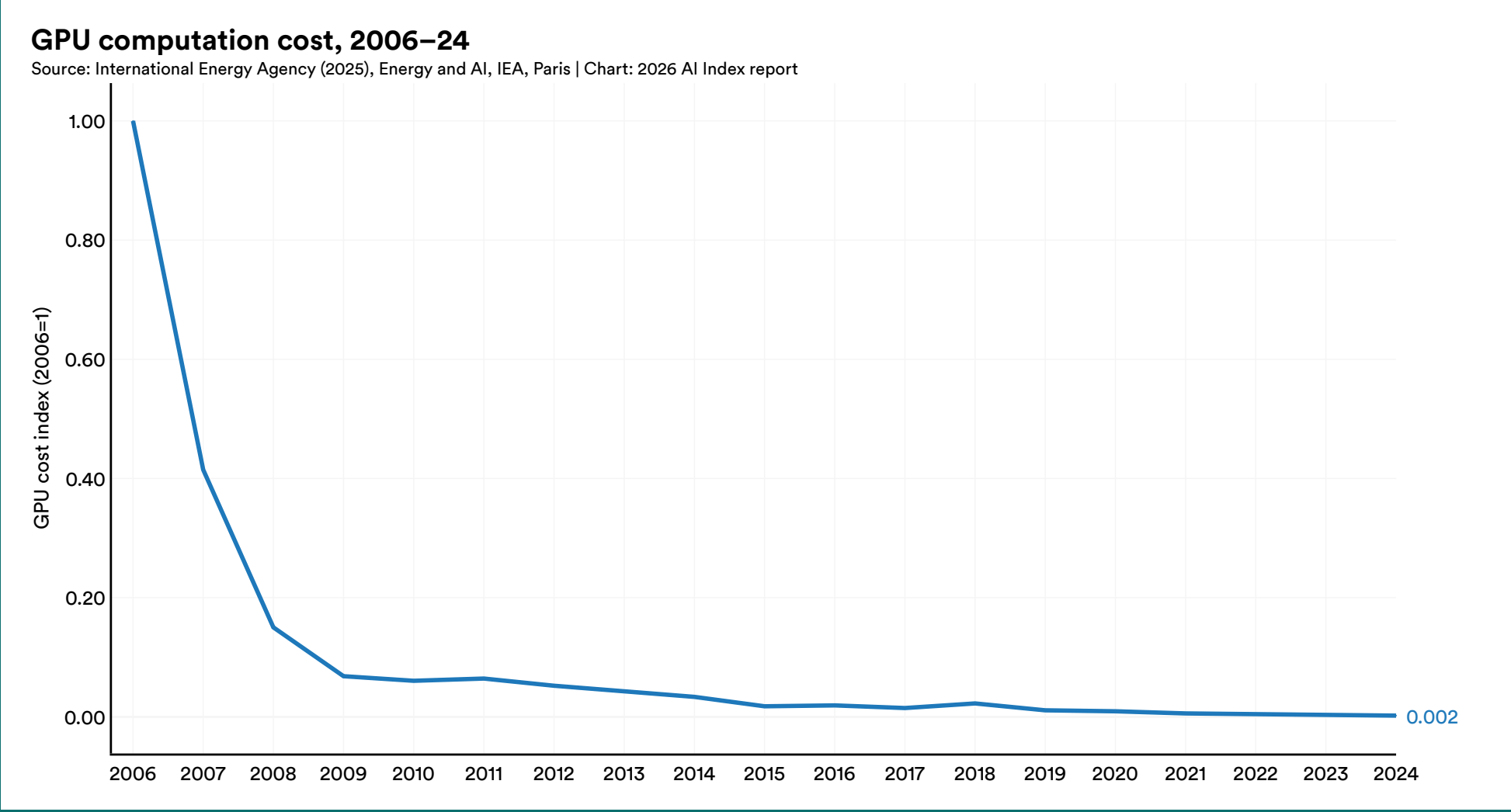
The cost of GPU computation has fallen more than 99% since 2006, even as total power draw climbed. Source: Stanford University
Stanford estimates that the most demanding training runs, including for systems such as Llama 4 Behemoth, have pulled upward of 100 megawatts (MW), comparable to a small power plant. Capacity dedicated to AI has risen some 200-fold in three years, from under a gigawatt in 2022, and data center electricity use is projected to keep rising through 2030.
The squeeze is geographic as much as numerical. The United States hosts 5,427 data centers, more than 10 times any other country, according to Stanford.
Chips can be ordered and delivered in months, but energizing a site, with its substation, interconnection approval and cooling, takes years.
Counted across full systems rather than the accelerators alone, AI’s cumulative power demand through 2024 reached an estimated 9.4 GW, close to the national electricity use of Switzerland or Austria and about half the estimated draw of Bitcoin mining.
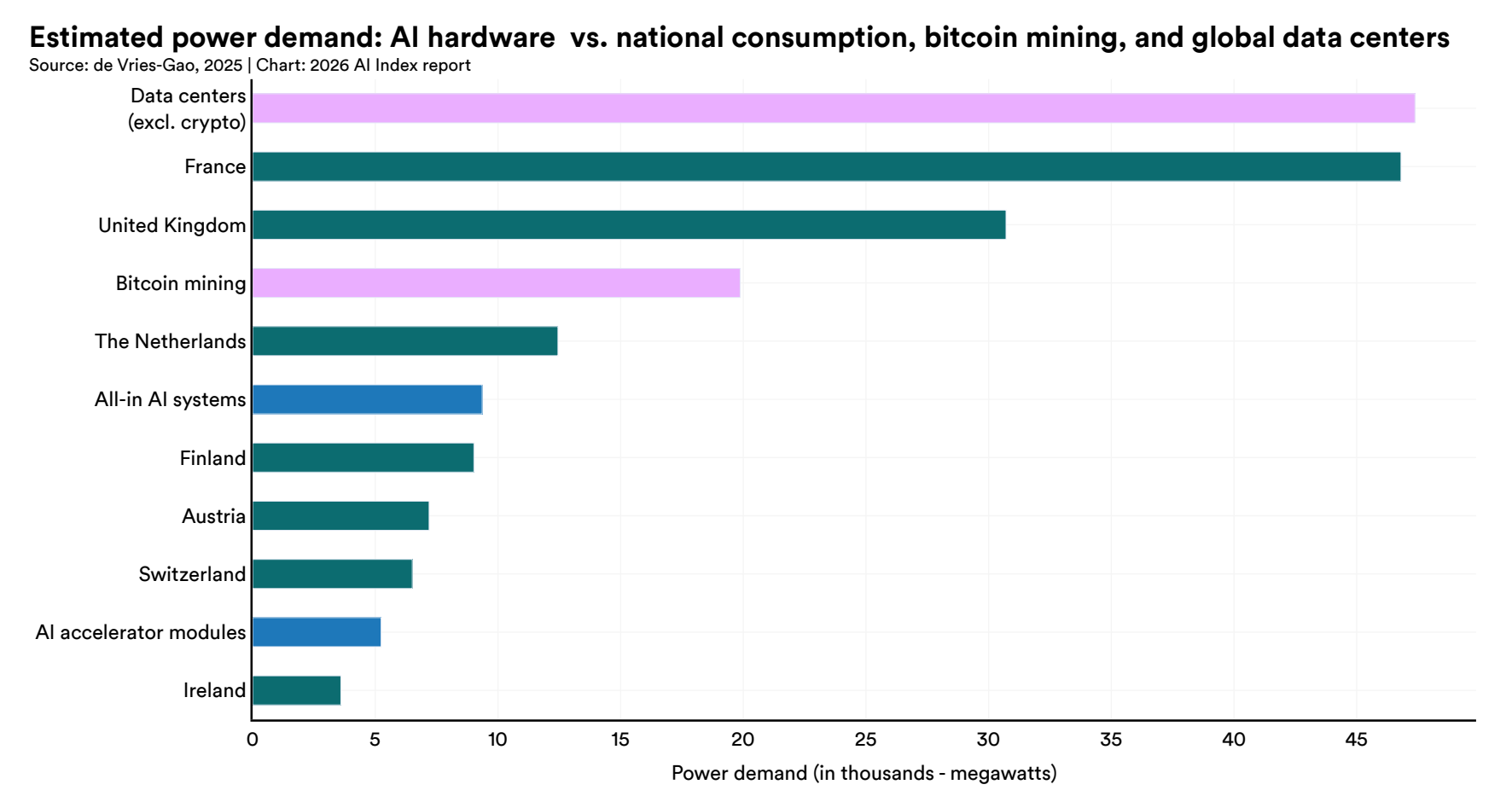
Estimated all-in AI power demand (through 2024) sits near half of Bitcoin mining’s. Source: de Vries-Gao, Stanford University
The asset was never the hardware
But Bitcoin miners cannot just hand their machines to an AI lab. Mining ASICs (the chips that solve Bitcoin calculations) do one narrow job and are useless for training or inference. What does transfer is everything around the chips, such as the energized sites, power contracts, grid hookups and the shells to cool dense racks.
A Bitcon miner that already has a grid connection has infrastructure ready to fill the gaps for the AI developers, and renting that capacity beats starting over. Miners also tend to sit where AI wants to be anyway, in cheap-power US states like Texas and the Gulf Coast.
Mining economics is itself a numbers-crunching game. JPMorgan recently estimated Bitcoin’s all-in production cost at about $78,000 per coin, well above BTC’s market price of around $53,400 at the time of writing, down by more than 34% year-to-date, according to CoinGecko.
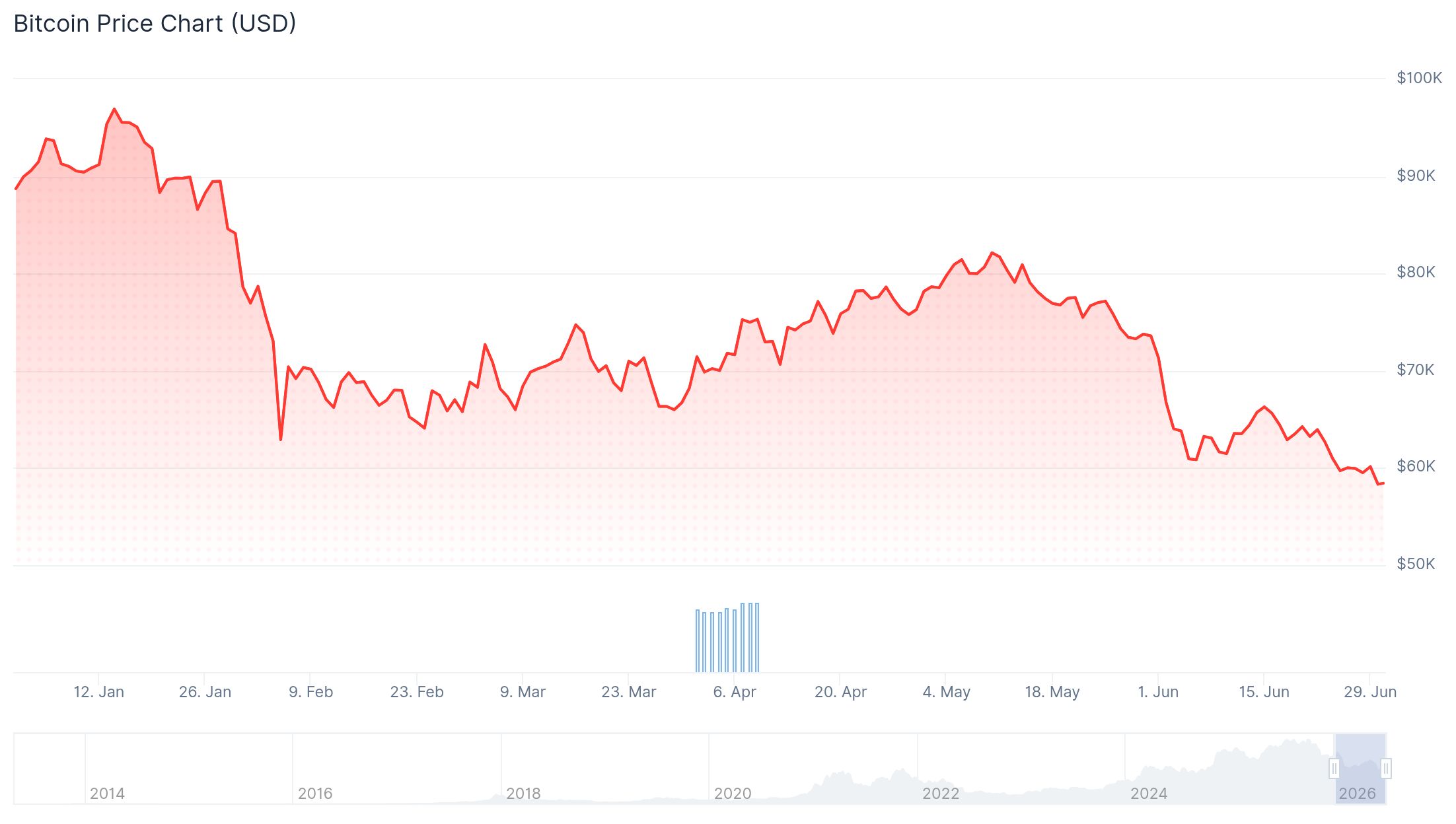
Bitcoin is down by around 34% in 2026. Source: CoinGecko
Cointelegraph previously reported that hashprice had fallen below breakeven for many miners, putting about 20% of the industry in unprofitable territory.
Some major contracts between miners and AI infrastructure operators followed. In November 2025, Iren signed a five-year GPU cloud deal with Microsoft worth about $9.7 billion, served from a 750-megawatt campus in Childress, Texas. In December, Bitcoin miner Hut 8 signed a 15-year, $7 billion lease with Fluidstack for 245 megawatts at its River Bend site in Louisiana, with the payments backstopped by Google.
TeraWulf reported $12.8 billion in contracted high-performance computing (HPC) revenue and now earns more from leasing than mining. Core Scientific has expanded its CoreWeave agreement to $10.2 billion over 12-year terms. Across the listed miner sector, CoinShares counts more than $70 billion in announced AI and HPC contracts, but much of the value is years out. Hut 8’s River Bend site, for example, is not due to start commissioning until the second quarter of 2027.
Related: TeraWulf doubles AI revenue but posts $427M quarterly loss as mining income declines
Investors have nonetheless rewarded the shift. Hut 8 stock jumped about 20% in premarket trading the day its lease was announced, Reuters reported, and across the sector, valuations are increasingly tied to compute pipelines rather than the Bitcoin price alone. Indeed, CoinShares said the miners with HPC contracts were trading at 12.3 times the value of their 12-month revenue vs 5.9 times for pure play miners. CoinShares’ projects listed miners could derive as much as 70% of revenue from AI by the end of 2026, up from roughly 30% in Q1.
Why it is not a free pivot
However, the conversion is far from cheap, and is not just a matter of plug-and-play. CoinShares estimates that mining infrastructure costs about $700,000 to $1 million per MW, while AI-grade, liquid-cooled infrastructure can cost $8 million to $15 million per MW. Hyperscalers also demand power density, redundancy and uptime guarantees that many mining facilities were never designed to provide.
Related: Celsius-linked Bitcoin miner Ionic Digital seeks Nasdaq direct listing amid AI pivot
Miners are covering that gap with debt and new capital raises. Iren had already disclosed about $3.75 billion in convertible note debt at the end of March, then raised another $3 billion through a new convertible note sale in May.
The sector is also leaning on a small group of hyperscalers and AI infrastructure buyers. If demand cools, customers renegotiate or projects slip, miners that have torn out ASICs may have fewer options to fall back on.
Whether that shift away from BTC mining pays off remains an open question. Signing multibillion-dollar AI contracts is one thing, but delivering the earnings investors expect is another.
For now, the market is placing a premium on miners making the transformation rather than those that simply produce new BTC. If AI demand continues to outpace electricity supply, those assets could prove more valuable than the machines they were originally built to support. If not, some of today’s biggest AI plans could prove to be costly bets, rather than real second acts for former Bitcoin miners.
Magazine: Bitcoin miners are pivoting to AI, so why is the hashrate near ATHs?

Disclosure: This article does not represent investment advice. The content and materials featured on this page are for educational purposes only.
An XRP Power user shares a story of financial recovery, encouraging users to explore its platform and AI-powered digital asset services.
On a winter night, the temperature on the streets of New York dropped to freezing. A ragged man huddled on a bench near a subway station, his only old coat wrapped tightly around his body. At that time, he had no job, no fixed address, only a few coins in his pocket, and he didn’t even know if he would have a hot meal the next day.
Few passersby stopped, and no one would have imagined that this seemingly insignificant homeless man would, a few months later, achieve financial freedom and own a million-dollar fortune.

The low point of life
Before becoming homeless, he lived an ordinary life, with a family, a job, and expectations for the future. But all of this was quickly shattered by reality, bit by bit.
His marriage ran into problems, and the breakdown of his family plunged him into both emotional and financial hardship. Not long after, his company laid off employees, and he lost his only stable source of income.
To get back on his feet, he decided to start his own business, investing all his meager savings. However, due to inexperience and an unfavorable market environment, the business quickly failed. Instead of recovering, he was burdened with debt.
When all possible avenues were exhausted, he lost his home and was forced to move between shelters, his car, and the streets. During that time, he truly experienced for the first time what it meant to have “no way out.”
Turning point
During his most difficult time, a chance encounter changed circumstances.
Through a former colleague, he saw discussions and introductions about XRP Power in the Global Times. This caught his attention. Hiscolleague had been with XRP Power for some time and had earned a considerable amount of money there, but when he told him, he didn’t have the funds to risk investing.
For the next two months, he focused primarily on observation and understanding, gradually familiarizing himself with the platform’s operation and only making very small trial investments.
After confirming the basics, he officially joined. Although the earnings weren’t high, during his most difficult time, he successfully withdrew $100 for the first time, enough to support his basic living expenses for several days.
From then on, he gradually increased his investment while continuing to learn and adjust his strategies.
In the following months, his income began to stabilize, his life gradually emerged from its lowest point, and a real turning point began to appear.
The process
After gradually seeing a glimmer of hope, he began to plan each step more cautiously.
Initially, he only used a small amount of about $100 to try it out, mainly to familiarize himself with the rules and control risk, rather than pursuing a complete change in his situation.
After things stabilized somewhat, he gradually increased hisinvestment to about $5,000, then $50,000, and only later, when he felt more confident, did he gradually moved to the $100,000 level. Throughout this process, he maintained a phased and controlled pace, rather than a one-time investment.
In this process, he learned to adjust his strategy according to different stages, making his financial arrangements more stable, rather than chasing short-term fluctuations.
From the initial cautious attempts to the gradual expansion, he was more focused on managing his own rhythm than simply pursuing results.
Looking back, the real change wasn’t a single investment, but rather long-term adjustments and perseverance.
In conclusion
Looking back on this experience, he has returned to a stable life from living on the streets.
For him, this isn’t a story of “sudden success,” but rather the result of taking it one step at a time. The low point taught me to calmly face reality and made him understand the importance of perseverance and making the right choices.
He says, the hardest thing in life isn’t falling down, but whether someone can start over after falling down.
From homelessness to regaining his footing, there were no shortcuts, only continuous attempts and adjustments.
What truly changes your destiny isn’t the starting point, but the step taken forward even at someone’s lowest point.
Join XRP Power achieve a better life and be the starting point for financial freedom.
Disclosure: This content is provided by a third party. Neither crypto.news nor the author of this article endorses any product mentioned on this page. Users should conduct their own research before taking any action related to the company.


Bitcoin Core has released version 31.1rc1, fixing a privacy flaw in PrivateBroadcast while introducing software, wallet, and validation improvements ahead of the next stable mainnet release.
Summary
- Bitcoin Core 31.1rc1 fixes a privacy flaw that could expose users’ IP addresses during PrivateBroadcast.
- The release also improves blockchain validation, wallet accuracy, networking, and MuSig2 security.
- Developers are encouraging community testing before the stable version is released.
According to the Bitcoin Core development team, version 31.1rc1 is now available as a release candidate, giving users, node operators, and developers an opportunity to test nearly finished software before the official production release. The developers said the testing period is intended to uncover any remaining issues that may not have appeared during internal development.
The most notable change addresses a privacy issue affecting the PrivateBroadcast feature. According to the release notes, certain network conditions could expose a user’s internet address by allowing a connection outside the intended privacy network. The updated software removes that behavior, making transaction broadcasting more consistent for users who rely on privacy-focused network configurations.
Privacy protections and node performance receive upgrades
Alongside the privacy fix, the Bitcoin Core developers introduced several changes to improve blockchain validation and long-term node performance. According to the project documentation, the software now manages transaction-related data more efficiently while maintaining a leaner blockchain database, a change designed to reduce unnecessary storage growth and improve performance as the chain expands.
Networking behavior has also been refined. The developers said Bitcoin Core now handles proxy settings and PrivateBroadcast connections more intelligently, providing more predictable behavior for users routing traffic through privacy tools such as proxy networks.
Wallet functionality received additional maintenance updates as well. According to the release notes, migration checks have been improved, and transaction input size estimation has been refined, allowing wallet operations to calculate transaction data more accurately behind the scenes without changing the user experience.
Security improvements extend to signatures and developer tools
Security-related updates also include additional safeguards for MuSig2, the signature aggregation protocol supported by Bitcoin Core. According to the developers, the software now rejects empty public key lists that contain invalid public keys, preventing incorrect signature aggregation and improving validation during multi-signature operations.
Several changes were introduced for developers maintaining or building software around Bitcoin Core. The release notes state that testing utilities have been cleaned up, race conditions have been removed, fuzz testing has been expanded, and build systems have been updated to improve software reliability during development.
Configuration handling has also been strengthened. Before saving important settings, Bitcoin Core now performs checks for failed write operations, a safeguard the developers said can help prevent configuration errors caused by unsuccessful disk writes.
Version 31.1rc1 is available for current versions of Linux, macOS, and Windows. According to the Bitcoin Core team, users running recent software versions can upgrade directly, although systems upgrading from much older releases may require additional time to migrate existing blockchain data.
Because version 31.1rc1 remains a release candidate rather than the final production version, the developers are encouraging the community to install the software in test environments, verify its behavior under real-world conditions, and report any bugs before the stable release reaches the Bitcoin network. The project said feedback collected during this testing phase will help identify remaining issues before the software is finalized.


Disclosure: This article does not represent investment advice. The content and materials featured on this page are for educational purposes only.
A new guide explains how crypto trading bots automate strategies, manage risk, and execute trades across spot and futures markets around the clock.
Summary
- This guide explains how crypto trading bots automate strategies, manage risk, and operate across volatile markets 24/7.
- Learn how grid, DCA, and other crypto trading bots work, plus setup tips, backtesting, and strategy basics.
- Explore crypto trading bots, popular strategies, and practical guidance for automating trades across crypto markets.
A crypto trading bot can help users automate their trading strategies across volatile markets without staring at charts around the clock. This guide covers everything from grid trading and signal bot management to setup and optimization, so anyone can decide if automated crypto trading fits their plan.
Key takeaways
Modern trading bots automate buy and sell orders on a crypto exchange 24/7, executing trades based on predefined parameters while sleeping, working, or simply stepping away. Automated trading reduces stress and emotional mistakes, letting a strategy run without hesitation. Here are the essentials:
- Grid bots and DCA bots dominate retail bot trading in 2026, profiting from market volatility by buying low and selling high across multiple levels.
- Bots support long and short positions on both spot and futures markets, depending on the exchange and configuration.
- Backtesting and paper trading are non-negotiable before committing real money. Setting up a profitable trading bot requires an understanding of trading strategies and market mechanics.
- Profitability is never guaranteed. In comparative tests, only 3 of 8 bots produced consistent profit over six months. Success depends entirely on strategy and discipline.
What is a crypto trading bot?
A crypto trading bot is software that automatically executes buy and sell orders on a crypto exchange based on predefined rules or algorithms. Bots connect to exchanges via APIs to manage, buy, and sell cryptocurrencies, acting on real-time price data without manual intervention. Automated trading can operate 24/7 without human intervention across dozens of trading pairs simultaneously.
Common bot types include: grid trading bot, DCA bot, arbitrage bot, market-making bot, and trend-following bot. Each uses different indicators and logic to automate decisions. Since 2017–2018, crypto trading bots have evolved from simple scripts into full platforms with dashboards, mobile apps, cloud hosting, and a growing community of traders sharing custom strategies.
How crypto trading bots work in practice
A typical workflow looks like this: connect an exchange via api keys, select a strategy, define risk parameters, enable the bot, then track performance over time. Crypto trading bots continuously monitor market data, including price and volume, evaluate conditions against a setup, and submit orders via exchange APIs.
Market analysis involves monitoring price, volume, order books, and technical indicators. Bots use limit orders, market orders, stop-loss, take-profit, and trailing stops to manage positions. They handle position sizing, scaling in, and scaling out for both long and short positions. Advanced bots can use machine learning or statistical models, but most retail bots in 2026 rely on rule-based strategies and backtested parameters. Automated bots can execute trades based on predefined parameters consistently, whether users configure a simple grid or a complex signal-based system.
Popular types of crypto trading bots
Bots differ mainly by strategy logic and how they respond to market volatility. No single bot type is best for making money; performance depends on configuration, risk limits, and market regime.
Grid trading bots
A grid trading bot places a series of buy and sell limit orders at predefined price levels, creating a grid that profits from price oscillations. Grid trading bots buy low and sell high automatically, and a grid bot operates within a predefined price range. Automated trading can profit in sideways markets with grid strategies, where price bounces between support and resistance.
Visually, the grid looks like horizontal lines between a lower price bound and a higher price bound, with buy orders on lower levels and sell orders on higher levels across multiple levels. Variations include:
- Neutral Grid bots profit in sideways markets by buying low and selling high
- Long Grid bots accumulate profits during upward trends by buying dips
- Short Grid bots automate short-selling in bearish market conditions
- Infinity Grid bots expand upward without an upper price limit
- Futures Grid bots operate on derivatives markets using leverage
Grid bots can be configured for bullish or bearish markets. Key parameters include grid range, number of grid levels, order size, base vs quote currency, and safety stops. A short grid bot works best during bearish conditions, while a long grid bot captures upside in trending markets. Users can also run hedge mode to maintain positions in both directions simultaneously.
DCA bots
Dollar-Cost Averaging (DCA) purchases a set amount of cryptocurrency regularly, and DCA bots automate this process by buying more as the price drops. For example, a DCA bot might buy $50 every time the price drops 5%, averaging entry at a lower price across multiple steps.
DCA bots combine with take-profit targets and trailing exits to lock gains once the average entry returns to profit. Be cautious: aggressive DCA without caps can lock all capital into a losing position. Always set a maximum number of safety orders and a fixed allocation.
Signal-based and copy trading bots
A signal bot executes trades automatically when it receives external signals from TradingView signals, custom APIs, or third-party providers. Traders connect indicators from platforms like TradingView to trigger automated orders on their crypto exchange account.
Copy trading bots mirror trades from a strategy provider onto the user’s balance, making automation accessible to beginners. Always evaluate any new signal source with paper trading first, apply strict risk limits per trade, and verify the provider’s data and track record before committing real money.
Key features to look for in a crypto trading bot platform
Not every platform delivers equal results. Feature set, security, and reliability determine long-term success.
Essential features include support for major exchanges (spot and futures), backtesting, paper trading, robust risk management tools, and a responsive support team. Look for a visual strategy builder, pre-made templates for grid trading and DCA, clear performance analytics, and detailed documentation. Security risks include vulnerabilities in API keys used by bots for trading, which always require encrypted key storage, no withdrawal permissions, 2FA for account access, IP whitelisting, and activity logs. No credit card is required to start on most platforms.
Exchange connectivity and market coverage
A serious platform in 2026 should support multiple top-tier exchanges like Binance, OKX, Bybit, Coinbase, and Kraken for spot and derivatives. Users might notice the OKX logo alongside Binance and Bybit on most bot platforms. Check exchange-specific limits-minimum order size, tick size, and leverage caps-that affect bot configuration. Running the same grid strategy on two exchanges can produce different outcomes due to liquidity and fee differences.
Backtesting, paper trading, and optimization
Backtesting means running a strategy on historical market data to estimate performance before risking capital. Backtesting strategies on historical data increases trading confidence. Grid trading strategies can be backtested over 15 days or longer to see how they handle both sideways phases and sharp breakouts.
Paper trading simulates live conditions with virtual balances. Optimize by adjusting grid width, number of levels, and take-profit distances. But beware of overfitting-strategies that perform perfectly on past data may fail in future volatile markets.
Risk management for bot trading
Successful bot trading requires strict risk management strategies. Automated trading amplifies both good and bad strategies, so risk controls are non-negotiable.
- Never invest money that someone cannot afford to lose
- Diversify across strategies and pairs
- Cap maximum exposure per bot to 1–3% of total account equity
- Use stop loss, equity limits, and max daily loss rules
Always start with a small size in live mode, even after successful paper trading, to account for slippage and execution differences.
Specific risks of grid trading bots
Range break risk occurs when price trends strongly beyond the grid range, leaving unclosed positions and large unrealized losses. Grid bots can also tie capital in numerous open orders, reducing flexibility. If grid steps are too narrow, trading fees (0.1–0.2% per cycle) consume most of the profit. Set an emergency stop loss beyond grid boundaries and monitor an account daily.
Leverage and futures Bots: Long and short positions
Futures grid bots and DCA bots can use leverage to open long and short positions, amplifying both profits and losses. Isolated margin limits risk to a single position; cross margin exposes the entire account. Moderate leverage (2x–5x) suits most automated strategies. A short grid bot on BTC during a rapid short-covering rally can face liquidation. Understand the exchange’s funding fees, liquidation mechanics, and margin requirements before enabling any futures bot.
How to get started with a crypto trading bot in 2026
Start by learning basic crypto trading concepts, then choose a reliable exchange, enable 2FA, and create api keys with trading-only permissions. Select a platform that supports grid trading, DCA bots, paper trading, and clear tools to track performance. Begin with a simple predefined template instead of complex custom strategies on day one.
Step-by-Step Setup Checklist
- Create an exchange account, complete KYC, and enable 2FA
- Generate API keys-trading permissions only, no withdrawals, restrict by IP
- Connect a bot platform and enable paper trading
- Select a bot type (e.g., BTC/USDT neutral grid: wide range, 5–10 levels, small order size)
- Run simulation for 2–4 weeks, then go live with minimal capital
- Monitor logs, open orders, and realized PnL daily in the first week
After several weeks of stable results, gradually scale positions or deploy additional bots. Document every setup, result, and adjustment in a trading journal format to optimize an approach over time. Send a message or alert for any configuration change.
Advanced topics: Strategy design and optimization
Serious traders eventually design or configure their own trading strategies, combining indicators like RSI, moving averages, and Bollinger Bands with grid or DCA logic. Regime detection-distinguishing sideways vs trending markets-helps decide when to switch bots on or off. Multi-timeframe analysis (1-minute entries, 1-hour trend direction) improves robustness, and simple statistical filters like volatility thresholds can boost consistency.
Monitoring, analytics, and troubleshooting
Track metrics beyond profit: win rate, average trade size, maximum drawdown, and profit factor. Set up alerts (email, mobile, Telegram) for key events-bot stopped, API errors, equity drawdown thresholds. Common problems include a bot not trading due to a too-narrow grid, an incorrect position mode (hedge vs one-way), or an invalid symbol mapping. Manage a regular review schedule: daily quick check, weekly deeper analysis, monthly parameter review to keep performance aligned with current market conditions.
Legal, tax, and ethical considerations
Regulations and tax rules vary by country and change frequently-consult local professionals. Some jurisdictions classify certain automated strategies as investment services requiring licensing. Profits from bot trading are typically taxed like manual crypto gains, but the higher trade volume means heavier record-keeping. Use exportable trade histories from your platform to simplify reporting. Avoid market manipulation tactics and respect exchange terms of service.
FAQ
Is a crypto trading bot profitable for beginners?
Bots do not guarantee profits-they execute a strategy consistently, so a bad strategy will still lose money. Beginners should use simple grid bots or dca bots with low risk settings and focus on learning risk management. Start with paper trading for at least 2–4 weeks, then go live with very small amounts.
How much money do I need to start bot trading?
Some exchanges allow orders as small as $10–$20, but the recommended capital for grid trading is $200 to properly cover multiple grid levels and minimum order sizes. Don’t deploy all capital into a single bot-keep a cash buffer and diversify.
Can I run multiple crypto trading bots at the same time?
Most modern platforms support running many bots simultaneously on different pairs or even the same pair with different strategies. Track total exposure to avoid over-allocating across overlapping bots on correlated assets, and cap active bot allocation at 30–50% of an account.
What hardware and internet connection do I need?
Cloud-hosted platforms remove most hardware requirements. Self-hosted bots need a stable VPS (1–2 vCPUs, 2–4 GB RAM) with low-latency internet and a system clock synchronized via NTP. Avoid hosting critical bots on unreliable home connections without power backup or remote access.
How do I know if my API keys are safe on a bot platform?
Always disable withdrawal permissions and enable 2FA on both the exchange and bot platform. Choose platforms with encrypted key storage, IP whitelisting, and transparent security documentation. Rotate keys every 3–6 months and revoke immediately if suspicious activity is detected.
Disclosure: This content is provided by a third party. Neither crypto.news nor the author of this article endorses any product mentioned on this page. Users should conduct their own research before taking any action related to the company.

Almost 1,700 UK investors are reportedly suing Binance and its founder Changpeng Zhao for 150 million British pounds ($200 million), alleging the crypto exchange offered and sold crypto derivatives without regulatory approval.
The law firm representing the investors, KP Law, said Binance’s leverage tokens, futures contracts and options offerings breached the Financial Services and Markets Act 2000 and that these products continued to be offered after the Financial Conduct Authority banned such products from being offered to retail customers in January 2021.
“There appeared to be no effective barrier preventing UK customers from accessing them,” the law firm said.
Binance told Cointelegraph it would “defend against these claims through the appropriate legal process” and it “remains committed to its obligations to users and to operating in accordance with applicable law.”

Source: Cointelegraph
The lawsuit adds to a growing list of legal and regulatory challenges for the crypto exchange, including recently failing to secure a Markets in Crypto-Assets-compliant license from a European Union member state before the July 1 deadline.
Binance has also been facing allegations that it facilitated $850 million in transactions tied to a sanctioned Iranian financier that flowed to Iran’s Islamic Revolutionary Guard Corps. The crypto exchange strongly denied the allegations.
Binance UK customers lost “tens of thousands of pounds”
One of the affected customers, Tomas Sutas, was a financial controller who allegedly invested more than 100,000 British pounds ($132,400) into Binance’s derivatives products before the value of his investments was wiped out, the Financial Times reported.
Reuters also reported that multiple UK users lost “tens of thousands of pounds” through the products.
Related: Australia’s crypto travel rule is coming into effect: Here’s what’s changing
KP Law said it is still identifying the full scope of affected customers.
“While the precise number of UK customers affected is not publicly known, Binance is one of the world’s largest cryptocurrency exchanges, meaning that a substantial number of users could potentially have been exposed to these issues.”
Binance’s operations in the UK became heavily restricted in June 2021 when the FCA informed Binance Markets Limited that it couldn’t operate in the region without written consent.
Reuters noted that the lawsuit was filed in the London High Court.
The Binance-affiliated Nest Exchange and “persons unknown” were also named as defendants.
Magazine: Bitcoin slides to $58K, XRP hits $1 but onchain data promising: Market Moves
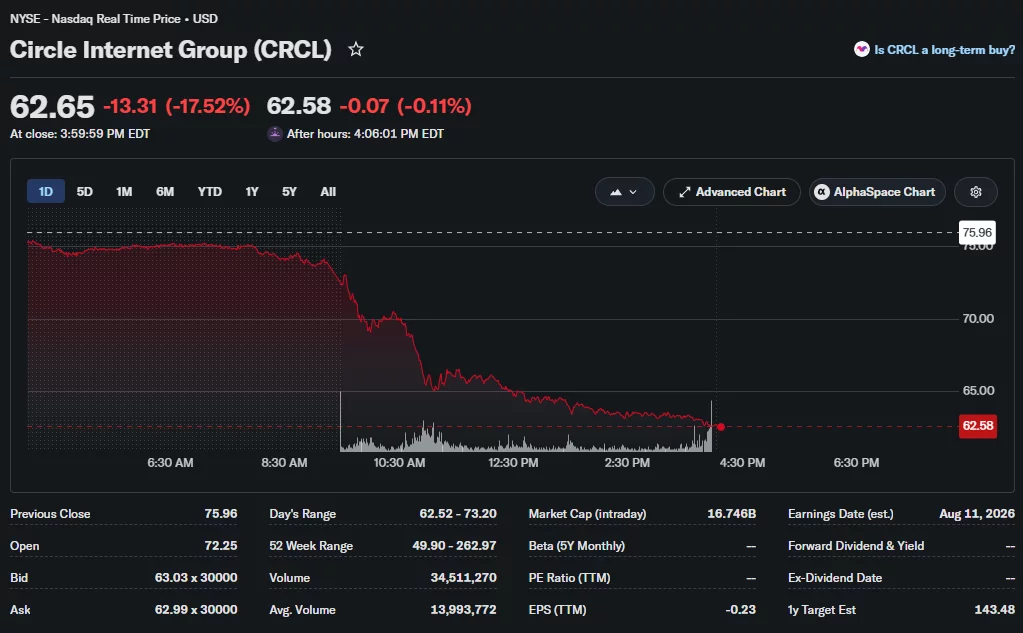
Circle Internet Group shares have dropped more than 17% after a consortium backed by BlackRock, Google, Visa, Coinbase, and more than 140 other companies unveiled a competing revenue-sharing stablecoin.
Summary
- Circle shares fell 17.5% after Open USD launched with backing from BlackRock, Google, Visa, Coinbase, and 140+ partners.
- Open USD introduces a revenue-sharing model that distributes most reserve income to ecosystem participants.
- Circle CEO Jeremy Allaire said USDC will continue expanding despite growing competition in the stablecoin market.
According to Yahoo Finance market data, Circle closed at $62.65 on Tuesday, down 17.52% from the previous session after falling as low as $62.52 during intraday trading. The stock opened at $72.25 and extended losses throughout the day before stabilizing near its session low.
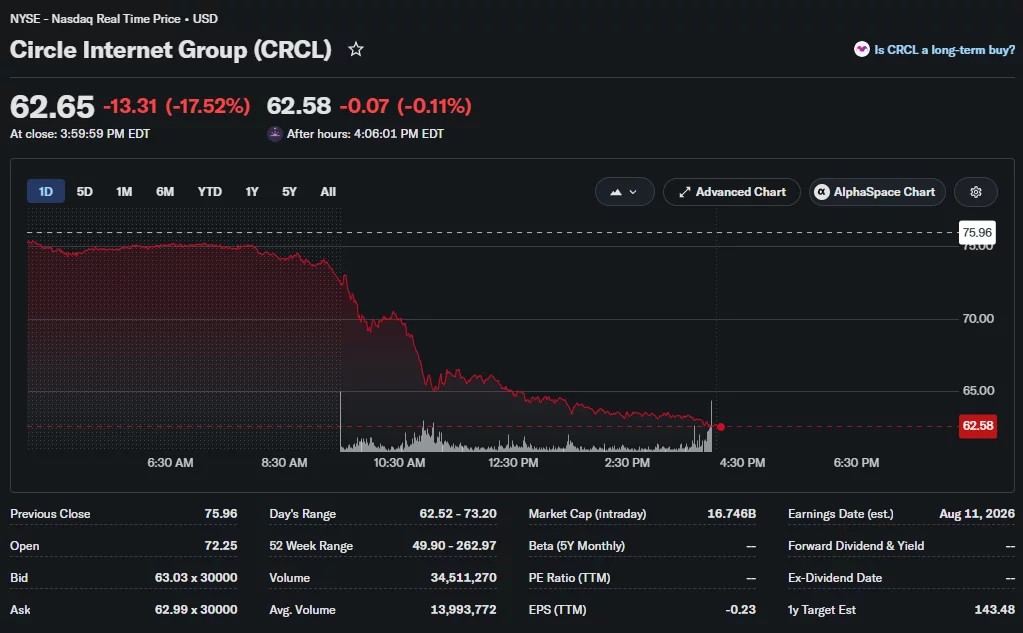
Trading volume climbed to more than 34.5 million shares, well above its average daily volume of about 14 million, as investors reacted to the latest development in the stablecoin market.
Open USD introduces a different revenue model
The selloff followed the launch of Open USD (OUSD), a new stablecoin developed by Open Standard, an industry initiative led by Bridge co-founder Zach Abrams. The network is backed by more than 140 companies, including BlackRock, Google, Visa, Coinbase and other financial and technology firms seeking to build shared stablecoin infrastructure.
Unlike traditional issuer-led models, Open USD offers fee-free minting and redemption while distributing most reserve income to participating ecosystem members. Governance will also be handled by an independent partner-led organization instead of a single issuing company.
The structure directly challenges one of Circle’s core business models by allowing ecosystem participants to share reserve income that has traditionally accrued to stablecoin issuers. The design is similar to the incentive framework used by Paxos’ Global Dollar Network, which also shares reserve revenue with partners.
Open USD enters the market as stablecoins continue to expand beyond crypto trading into cross-border payments, merchant settlement and corporate treasury management. Growing institutional interest has encouraged multiple companies to launch new dollar-backed tokens with different economic models to attract banks, payment firms and fintech platforms.
Circle says competition will not slow USDC expansion
Responding to the announcement, Circle Chief Executive Officer Jeremy Allaire dismissed suggestions that the new entrant poses a significant threat to USDC, arguing that the stablecoin sector is large enough to support multiple successful issuers.
According to Allaire, Circle will continue expanding USDC’s institutional network by adding banking, payment, and capital markets partners while investing in infrastructure that improves interoperability across blockchain networks.
“USDC remains the most trusted, widely adopted, institutional-ready stablecoin in the world, and we count thousands of institutions as partners in our ecosystem across nearly every major sector.”
Allaire added that Circle plans to keep building on additional blockchain networks while integrating USDC more deeply with banks, payments companies, capital markets firms and enterprises. He also said the company intends to expand opportunities for partners to participate economically in the continued growth of the USDC ecosystem.
Although Circle maintains that its long-term strategy remains unchanged, Tuesday’s market reaction showed investors closely watching how new revenue-sharing models could influence competition in the fast-growing stablecoin industry.
With Open USD backed by some of the largest names in finance and technology, the launch introduces another well-funded rival as issuers compete for institutional adoption and payment market share.

The US Securities and Exchange Commission (SEC) has requested public comment on exchange-traded funds (ETFs) investing in novel asset classes or using new investment strategies, as the agency reviews how such products should be regulated.
The consultation seeks feedback on whether existing rules adequately address novel ETFs, how such funds should be regulated and whether changes to the registration process are needed as new products enter the market.
According to the regulatory agency, the request focuses on funds investing in innovative asset classes or employing new investment strategies, where it is evaluating whether existing regulations remain appropriate.
The public comment period will remain open for 60 days following publication in the Federal Register, giving market participants an opportunity to weigh in before the SEC considers potential regulatory changes.
Exchange-traded funds have grown rapidly in recent years, with assets under management increasing from about $4 trillion in 2019 to more than $12 trillion at the end of 2025, according to the SEC.
Related: Spot Bitcoin ETFs bleed $1.7B as outflow streak hits four weeks
The request follows another recent consultation by US market regulators. Last week, the SEC and Commodity Futures Trading Commission (CFTC) sought public feedback on harmonizing portfolio margin rules across securities and derivatives markets.
Crypto ETF strategies grow more sophisticated
In recent months, crypto ETF issuers have increasingly expanded beyond simple price-tracking products, introducing funds tied to staking, stablecoin reserves and more specialized investment strategies.
In June, ProShares introduced the GENIUS Money Market ETF, a Treasury-focused fund designed around reserve assets permitted under the GENIUS Act for payment stablecoins, while Grayscale launched the Hyperliquid Staking ETP, offering exposure to HYPE (HYPE) while seeking to generate staking rewards.
Bitcoin investment products are becoming more specialized as well. BlackRock proposed an options-based Bitcoin income ETF in January, followed by Goldman Sachs in April with a fund combining spot Bitcoin products and covered-call strategies.

BlackRock’s Bitcoin Premium Income ETF filing. Source: SEC.gov
Earlier this month, Franklin Templeton proposed two ETFs that would systematically reinvest stock dividends into Bitcoin-linked investments, combining US equities with a rules-based Bitcoin allocation. The proposed funds would gain Bitcoin (BTC) exposure through instruments including exchange-traded products, futures, options and Bitcoin-backed depositary receipts.
ETF issuers are also experimenting with portfolios that combine digital assets with traditional asset classes. In January, Bitwise launched an actively managed ETF pairing Bitcoin with gold, precious metals and mining equities.
Magazine: Bitcoin decouples from tech stocks, Ether eyes ‘selling wave’: Market Moves

Bitcoin slid toward the $58,000 area during the early Tuesday Wall Street session, extending a broader risk-off feel that has left crypto lagging behind equities into the quarter’s final stretch. With traders heading into a “quarterly close” backdrop, BTC’s weakness stood out as US stocks logged strong gains for Q2.
At the same time, macro pressures tied to a firmer US dollar and renewed attention on Japan’s currency policy risk added another layer of uncertainty for crypto traders. On-chain signals from CryptoQuant also pointed to growing sell-pressure from investors associated with prior cycle highs, reinforcing the idea that hands are being shaken as price compresses.
Key takeaways
- Bitcoin fell toward about $58,000 during the US open, with volatility picking up into the session.
- US equities reported strong Q2 momentum while BTC continued to underperform, with Q2 losses approaching the high teens.
- A multi-decade USD/JPY move toward the mid-160s raised the odds of Japanese intervention and added pressure to risk assets.
- CryptoQuant analysis highlighted exchange inflows dominated by coins last moved around cycle-high periods, consistent with capitulation among late-cycle buyers.
Volatility rises as Bitcoin struggles to hold key levels
TradingView price action captured a shift toward bearish control as the US session began. Commentators noted that with $60,000 looking increasingly fragile as support, the market’s short-term “bulls vs. bears” battle remained active—particularly on lower time frames.
Exitpump, referencing open interest and positioning changes, suggested that the market could accelerate: “Open Interest pumping… it’s about to get spicy,” according to a fresh X post. Other traders described the price action as compressed, with BTC consolidating in a relatively narrow range and marginally higher lows alongside equal highs.
That type of structure can matter because it often sets up sharp directional moves when liquidity thins. As Daan Crypto Trades argued, the next breakout could arrive quickly after the consolidation tightens further. For short-term participants, the practical takeaway is that the range itself may be less important than what happens when it finally breaks—especially with volatility increasing into the session.
Crypto diverges from stocks as Q2 performance gaps widen
Bitcoin’s slide gained context when compared with US market performance. According to The Kobeissi Letter, the S&P 500 was up about 14% for the quarter—its best showing since 2020—while the Nasdaq 100 was up roughly 25%, also described as on track for its strongest quarterly performance in about five years.
That kind of divergence matters because it challenges a simple “crypto follows stocks” narrative. Even as equities absorbed risk positively into Q2, BTC remained under pressure. For investors, this gap suggests that crypto may currently be reacting more to its own internal liquidity/positioning dynamics and macro cross-asset stress—rather than simply mirroring equity beta.
Dollar strength and yen policy risk re-enter the trade
Macro conditions added a notable headwind. The US dollar pushed to new multi-decade highs versus the Japanese yen, raising the probability of government action—an issue traders often watch closely because intervention expectations can influence carry trades and global liquidity conditions.
In the reporting cited by Cointelegraph, USD/JPY reached 162.50 on the day, the highest level since the mid-1980s. The level is important not just as a data point, but as a proxy for how quickly currency volatility can transmit into broader risk sentiment—including markets where leverage is common.
Analyst George Gammon framed it in terms of “dollar liabilities” and the need to source dollars, warning that selling assets for dollar liquidity can place downward pressure on a range of holdings—from local currency exposures to speculative assets like Bitcoin. While that’s a general macro argument rather than a direct forecast, it aligns with why currency stress can quickly change the tone for crypto traders.
On-chain data points to capitulation pressure from late-cycle buyers
Beyond price charts, CryptoQuant’s latest work warned of a renewed capitulation dynamic among Bitcoin investors associated with cycle-top entries. In a new research Quicktake published by CryptoQuant, the platform argued that exchange inflows have been rising notably at sub-$70,000 price levels.
Crypto Sunmoon, a contributor to the Quicktake, noted that the coins moving into exchanges appear to be held for roughly six to twelve months—an age band often linked with accumulation during earlier bull phases, including portions of late-cycle buying near prior highs. The core claim was that “cycle-top buyers” are now selling at a loss, with the observed exchange flow pattern matching capitulation behavior.
CryptoQuant’s framing emphasizes not only the existence of selling, but the composition of it. When exchange inflows are skewed toward coin lots that last moved around all-time-high periods, it can indicate investors who bought during the mania phase are exiting during the drawdown. The report added that these capitulation events among cycle-top investors have historically coincided with long-term bottom formation, citing patterns seen in both the 2018 and 2022 cycles.
Importantly, CryptoQuant did not claim an immediate bottom is guaranteed—capitulation can occur over multiple stages. Still, the on-chain angle provides traders and longer-term holders with a clearer map of who may be selling (and why). If the inflows represent forced or loss-driven exit rather than fresh liquidation from new entrants, the market may be closer to a “supply digestion” phase than it would be if only new buyers were being squeezed.
As of this report, the data suggests investors are beginning to reduce exposure rather than fully capitulating through a one-off event. That nuance matters: steady distribution can keep price capped, while concentrated capitulation sometimes clears the way for a more durable reversal later.
Going forward, traders will likely watch two things closely: whether BTC breaks out of its compressed range on accelerating volatility, and whether exchange inflows tied to those late-cycle coin cohorts continue to rise or begin to fade. Until either the chart structure resolves or on-chain selling pressure stabilizes, the risk of further downside volatility remains high.
SharpLink (SBET) expanded its Ethereum (ETH) treasury this week, buying 10,000 ETH to reach 886,725 ETH in total holdings. The purchase came while Fundstrat strategist Tom Lee said sentiment looked worse than after the FTX collapse.
The company paired the purchase with a stock buyback, repurchasing 2.13 million shares after raising $75 million last week. SharpLink frames both moves as a single strategy, increasing the amount of ETH backing each share.
SharpLink Buys ETH and Repurchases Stock
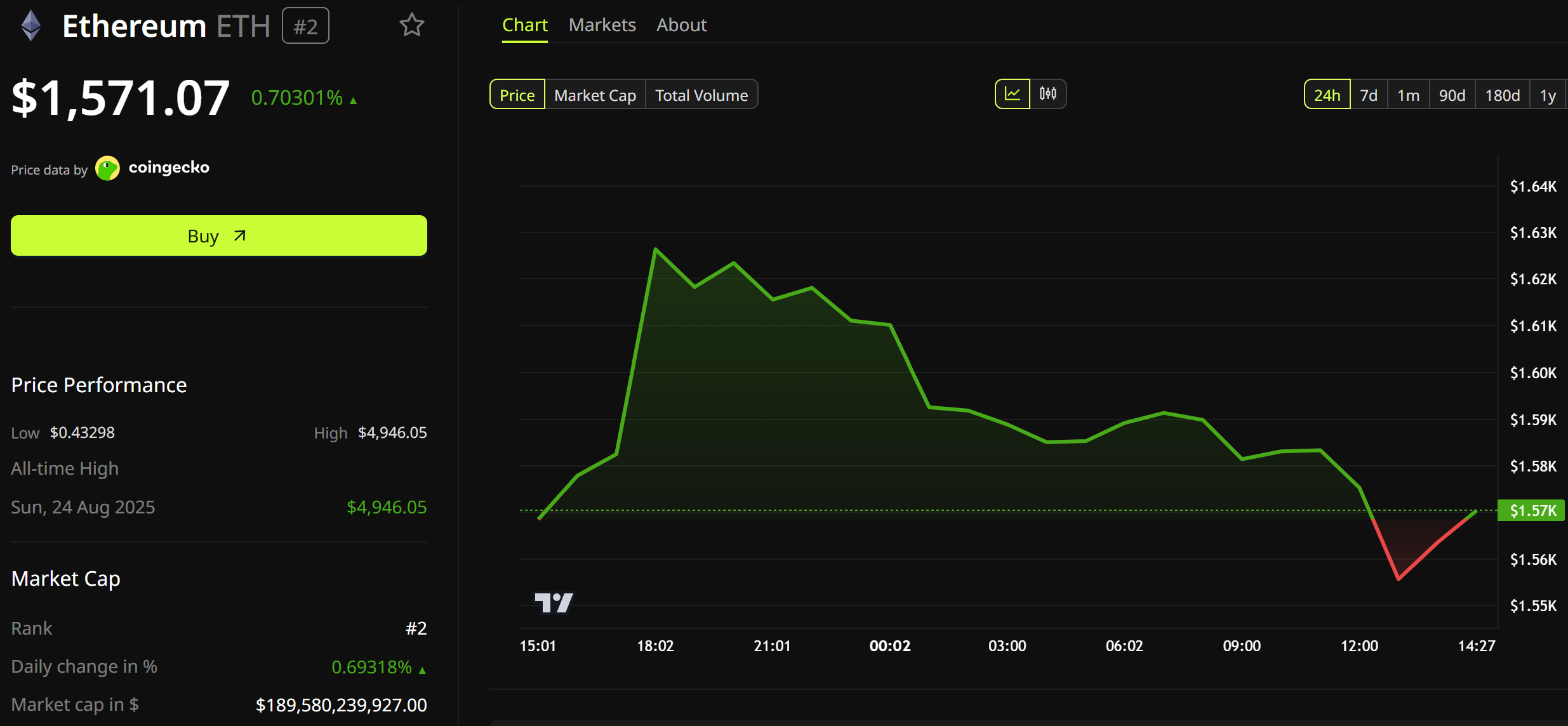
The Ethereum treasury company paid an average of $1,611 per 10,000 ETH, according to a company statement. That price already sits above ETH’s $1,570 level at press time, leaving the fresh tranche underwater within days.

The buy lifted holdings to 886,725 ETH as of June 28, the second-largest corporate stash after BitMine. The position is worth about $1.4 billion at Ethereum’s current price.
ETH set a record near $4,946 in August 2025, then shed roughly 69% of its value. It has dropped about 23% over the past month, well below the level at which SharpLink built most of its treasury.
The company also repurchased 2,132,773 shares at $4.69, spending close to $10 million. That $75 million came from a stock offering priced at about a 41% premium.
“We had the opportunity to buy ETH and repurchase our stock at attractive valuations, so we did both. This past week we added 10,000 ETH and repurchased 2,132,773 shares,” SharpLink CEO Joseph Chalom said in a post, tying the two decisions togethe.
Follow us on X to get the latest news as it happens
The firm had only recently resumed Ethereum purchases after an eight-month pause.
Tom Lee Says Sentiment Has Hit Post-FTX Lows
The buying contrasts with the wider mood. Lee chairs BitMine, the largest Ethereum treasury firm. It disclosed about 5.7 million ETH and $9.8 billion in crypto and cash this week, more than six times SharpLink’s holdings.

In a recent interview, Lee pointed to falling Google searches and a record-low RSI as signs of deep fear.
“The fear greed index is worse today than it was after the FTX debacle. So, usually that’s a good time to be buying something.”
Lee said Ethereum’s price is lagging its fundamentals, citing AI and tokenization as long-term tailwinds. He has also rejected Ethereum funding fears raised after staff exits at the Ethereum Foundation.
Staking income has helped Ethereum treasury firms offset paper losses through the slump. Whether SharpLink’s accumulation marks a bottom or just deeper conviction is not yet clear, but the firm keeps buying while much of the market sits on losses.
The post Ethereum Whale Tom Lee Flags Peak Market Fear as SharpLink Buys 10,000 ETH appeared first on BeInCrypto.


OKX has launched the beta version of an AI marketplace that allows autonomous agents to find work, complete tasks, receive onchain payments, and build portable reputations across transactions.
Summary
- OKX has launched the beta of OKX AI, an onchain marketplace where AI agents can find work and receive payments.
- The platform combines agent discovery, identity, escrow payments, reputation tracking, and decentralized dispute resolution.
- The launch expands OKX’s product lineup as it also advances tokenized finance initiatives and MiCA-regulated operations in Europe.
According to an announcement from OKX, the new platform, called OKX AI, combines agent discovery, identity, payments, reputation tracking, and dispute resolution into a single ecosystem designed for AI-powered services.
Rather than functioning as a simple directory, the marketplace lets software agents independently accept assignments, complete them, and settle payments onchain without relying on centralized intermediaries.
AI agents can now discover work and earn onchain
The platform consists of two connected marketplaces. In the Agent Marketplace, developers can list AI agents and define the services they provide. The Task Marketplace allows those agents to search for available work, complete assignments, and automatically receive payment once tasks are finished, according to OKX.
Payments are handled through either escrow-backed smart contracts or instant pay-per-call transactions. OKX said developers can receive compensation in either USDT or USDG, depending on the payment arrangement used.
At the same time, every completed transaction contributes to a shared onchain identity, allowing an agent’s reputation to grow across different applications instead of remaining tied to a single platform.
Disputes are handled differently from conventional freelance marketplaces. According to OKX, disagreements are reviewed by a decentralized network of evaluators rather than a centralized operator, with the outcome becoming part of the platform’s trust system.
The company also said the marketplace supports widely used AI development tools, including Claude Code and Codex. Launch partners include AWS, CertiK, the Ethereum Foundation, the Solana Foundation, StraitsX, and several other ecosystem participants.
OKX expands beyond crypto trading
The AI marketplace arrives as OKX continues adding products beyond its core exchange business.
As previously reported by crypto.news, OKX and Intercontinental Exchange have appointed former New York Governor Andrew Cuomo to co-chair a venture focused on tokenized and digitally native financial assets. The project, which remains subject to regulatory approval, is expected to connect OKX users with ICE futures products and tokenized equity markets linked to the New York Stock Exchange.
According to the companies, the initiative is intended to build blockchain infrastructure that can work alongside established financial markets rather than replace them.
The AI launch also comes shortly after OKX Europe highlighted the changing regulatory landscape in the European Union. As previously reported by crypto.news, the exchange estimated that more than 80% of crypto exchanges operating in Europe could disappear after the July 1 transition deadline under the Markets in Crypto-Assets regulation if they fail to obtain authorization.
Based on those estimates, OKX said only about 200 crypto asset service providers currently hold MiCA licenses despite between 1,100 and 1,300 firms previously operating under national regulatory frameworks. The company has also introduced a customer incentive program offering deposit bonuses of 5% to 8% for users transferring assets from exchanges that do not secure MiCA authorization.
With the addition of OKX AI, the exchange is extending its product lineup beyond digital asset trading and tokenized finance into infrastructure designed for autonomous software agents, combining identity, payments, reputation, and task execution within an onchain marketplace.

AI Power Crunch Turns Bitcoin Miners Into Data Center Plays

World Cup 2026: Mbappé’s brace sends France into round of 16 as Les Bleus demolish Sweden

Why SUVs Need Rear Wipers, But Most Cars & Trucks Don’t: The Physics Explained

No Jackpot Winner as $257 Million Prize Rolls Over to $269 Million Monday Draw

Renter of Home in Anne Heche Crash Denies Settlement With Son

Two goals and an assist by sheer aura: Cristiano Ronaldo just entered the World Cup chat

Recover Crypto How to Get Your Money Back From Scams

BIS WARNS AI CIRCULAR FINANCING BUBBLE COULD TAKE THE ENTIRE FINANCIAL SYSTEM DOWN -WORSE THAN 2008

Le 3 MIGLIORI CARTE per MINORENNI #finance #money #creditcard #debitcard #stipendio
-

 Fashion4 days ago
Weekend Open Thread: Staud – Corporette.com
-

 Politics5 days ago
The House | Manchesterism won’t survive the painful trade-offs unless it gets citizens on board
-

 Crypto World1 day ago
Strategy authorizes up to $1.25B in Bitcoin sales under new capital plan
-

 Politics5 days ago
Potential 2028er World Cup attendee leaderboard
-

 Business5 days ago
Asia stock markets slide as tech shares slump
-

 News Videos2 days ago
MAJOR BITCOIN & MARKET UPDATE!!!! (MUST WATCH ASAP!!!)
-

 Tech5 days ago
A Look At A Gaggle Of Transputer Boards
-

 Crypto World7 days ago
Securitize Wraps Roubini's SEC-Registered ETF as Dubai VARA Digital Security
-
Crypto World7 days ago
Bitcoin (BTC) Dips Below $62K, Ethereum (ETH) Plunges 6% Daily: Market Watch
-
 Crypto World5 days ago
Dell (DELL) Shares Tumble Over 5% Following Analyst Downgrade to Hold
-

 Crypto World3 days ago
Coinbase, Circle Deepen Crypto Stock Losses Despite Resilient S&P 500
-

 Crypto World4 days ago
Kraken's xStocks Opens Bending Spoons IPO Registration to EEA Retail
-

 Business24 hours ago
Australia treasurer says alleged access of prime minister’s bank data ’incredibly concerning’
-

 Sports4 days ago
FIH Pro League: India defeat Pakistan 7-1, register biggest win of campaign | Other Sports News
-

 Crypto World5 days ago
Bitcoin Sparks $600M Hourly Liquidations With $65,000 Set To Become Resistance
-

 Tech3 days ago
Bluekit phishing kit adopts browser-in-the-middle for login theft
-

 Tech4 days ago
Russian hackers now target Signal backup recovery keys
-
 Crypto World5 days ago
Hyperliquid Named on Singapore MAS Investor Alert Register
-

 Crypto World6 days ago
Ripple and SBI launch RLUSD in Japan after JFSA approval
-

 Crypto World4 days ago
RTX holders must register wallets before token distribution begins
You must be logged in to post a comment Login