

Crypto World
What is a community takeover (CTO)? When a memecoin’s holders seize the wheel



A community takeover, or CTO, is when the holders of an abandoned token band together and run it themselves after the original developer walks away. It is one of the defining rituals of Solana memecoin culture. Here is how a CTO works, why most fail, and what separates the rare survivor from the rest.
Summary
- A community takeover (CTO) is when the holders or broader community of a token take over running it, marketing, socials, and coordination, after the original developers abandon the project, walk away, or lose credibility.
- CTOs are most common with Solana memecoins, where tokens are fully liquid from launch, so the token keeps trading on a decentralized exchange even after the creator leaves.
- The mechanics involve the community seizing the social accounts, organizing on Telegram and X, sometimes getting listing trackers to relabel the token as a CTO, and rallying new marketing and momentum.
- The appeal is an underdog, level-playing-field narrative: with the original developer gone and no insider advantage, holders feel they finally own the project outright.
- The hard reality is that most CTOs fail and the token stays near zero, because a new logo and a Telegram group do not create real demand, and the same speculative dynamics that sank the project remain.
A community takeover, almost always shortened to CTO, is what happens when the people who hold a token decide to take over and run the project themselves after its original developers abandon it, walk away, or lose the community’s trust. It is one of the most distinctive rituals of memecoin culture, particularly on Solana, where the fast, cheap, fully liquid nature of token launches makes both abandonment and revival routine events. In a typical CTO, the founding developer of a memecoin disappears, sells their holdings, or is exposed as untrustworthy, and the token, which would normally just collapse to nothing, instead gets a second life when a group of remaining holders bands together to keep it alive.
They take over the project’s social media accounts, organize themselves in group chats, raise money for marketing, and try to generate fresh momentum around a token that technically has no team behind it anymore. The contract on the blockchain stays the same; what changes is who is steering the narrative and the community around it. The holders, in effect, seize the wheel of a car the driver has jumped out of.
Understanding the CTO is essential to understanding how the memecoin trenches actually work, because abandonment and revival are not edge cases there but core features of the landscape. This guide explains what a community takeover is and why it is possible at all, the mechanics of how a CTO unfolds step by step, why these takeovers happen so often on Solana specifically, a worked example tracing a typical CTO from abandonment to revival attempt, what separates the rare CTO that succeeds from the many that fail, and an honest look at why most CTOs go to zero and how to think about the risks.
The aim is to give you a clear and unromantic picture of a phenomenon that memecoin culture often wraps in heroic, underdog language, because the narrative of a community heroically rescuing an abandoned token is emotionally powerful and frequently used to draw in buyers, and the reality is far more sobering than the story.
This is educational material, not investment advice, and the memecoin environment it describes is among the riskiest corners of crypto.
What a CTO is and why it is possible
Start with why a community takeover can happen at all, because the answer reveals something fundamental about how memecoins are structured. When a memecoin launches on a platform like those common on Solana, the token is created with its liquidity placed in a pool on a decentralized exchange, which means the token can be bought and sold by anyone the moment it exists, with no central party required to keep the market running. The developer who launched it does not control the trading; the market lives on-chain, in a liquidity pool that functions independently of whether the creator is still involved.
This is the structural fact that makes a CTO possible. Even if the original developer completely abandons the project, sells everything, and deletes the social accounts, the token itself keeps existing on the blockchain and keeps trading on the exchange, because the liquidity pool and the contract do not depend on the creator’s presence. The project as a social and marketing entity may be dead, but the token as a tradable asset survives.
This separation between the token and its creator is what gives the community something to take over. In traditional contexts, if a company’s founders walk away, the company often simply ceases to function. But a memecoin is not a company; it is a freely trading token with a community attached, and the community can continue even when the founder does not. A community takeover is the act of that community formally adopting the orphaned token, declaring that they will now run the things the developer used to run, the social media presence, the marketing, the coordination, the narrative, and attempting to carry the project forward on collective effort alone.
Crucially, a CTO does not change the underlying token or its contract; the holders cannot rewrite the code or mint themselves new control. What they take over is everything around the token: the story, the channels, the momentum. The token is the same; the stewardship is new. This is why a CTO is sometimes described as the community inheriting a project rather than acquiring it, they take possession of an asset that was left behind, with all its existing properties intact, good and bad.
How a CTO unfolds
The mechanics of a community takeover follow a recognizable sequence, even though the details vary from case to case. It begins with the trigger: the original developer abandons the project. This can take several forms. The developer might pull the liquidity or sell their entire holding in a rug pull, crashing the price and signaling they have given up; they might quietly disappear, going silent on social media and ceasing all activity; or they might be exposed as having acted in bad faith, destroying the community’s trust even if they have not formally left. Whatever the form, the result is a token with no active team, a collapsed or collapsing price, and a community of holders sitting on losses and a decision: walk away, or try to save it.
If enough holders choose to try, the takeover organizes itself. A core group, often the most committed remaining holders, coordinates through group chats on Telegram and through posts on X, rallying the community around the idea of continuing without the developer. They take over or recreate the social media accounts, establishing new official channels under community control, since the original accounts may have been deleted or abandoned.
They frequently seek to have the token’s listing on price-tracking sites relabeled to reflect the takeover, since major trackers have processes for marking a token as community-run when the original team is gone, which updates the project’s public information to point at the new community channels. The community then tries to do the work a team would normally do: organizing marketing pushes, raising funds for promotion, sometimes coordinating to provide or lock liquidity, and generating social momentum to attract new buyers.
In the best cases, the community also pushes for transparency about who is now leading and takes steps to reassure potential buyers, such as confirming that the liquidity is locked or burned so it cannot be pulled again. The whole effort is a bet that collective enthusiasm can substitute for a founding team and breathe new life into a token the market had written off.
Why CTOs happen so often on Solana
Community takeovers are not unique to Solana, but they are far more common there than anywhere else, and the reasons are structural to how the Solana memecoin ecosystem works. The first reason is the sheer volume of memecoin launches. Solana’s low fees and fast transactions, combined with launch platforms that make creating a token nearly effortless, have produced an enormous number of memecoins, far more than could ever succeed, which means abandonment is constant and the raw material for CTOs, orphaned tokens, is abundant.
Where thousands of tokens launch and the overwhelming majority fail or are abandoned, there is a steady supply of projects a community could potentially take over. The second reason is that Solana memecoins are fully liquid from day one, trading freely on decentralized exchanges, so an abandoned token does not vanish; it keeps trading, which is the precondition for any takeover.
The third reason is cultural and narrative. The Solana memecoin scene has developed a powerful underdog mythology around the CTO, in which a community rescuing a token abandoned by a faithless developer is framed as a triumph of the people over insiders. This narrative has real emotional force in a market where traders are acutely aware that many tokens are stacked in favor of developers and early insiders. When the developer leaves, the community feels it is finally operating on a level playing field, with no insider dumping on them and no hidden team allocation, just the holders and the token.
That underdog framing, the sense of a genuine community reclaiming something and proving the doubters wrong, turns a failed launch into a movement, at least in the storytelling, and movements attract attention and buyers. The combination of constant abandonment, full liquidity, and a culture that celebrates the takeover as a heroic act makes Solana uniquely fertile ground for CTOs. It is worth being clear-eyed that this same narrative is also a marketing device, deployed precisely because it is effective at drawing in new money, which is part of why the romance of the CTO deserves scrutiny rather than acceptance.
A worked example
Trace a representative case to see how a CTO actually plays out, using an illustrative example rather than any specific real token. Picture a memecoin that launches with an appealing theme and a charismatic developer who builds an early community. The token runs up quickly as buyers pile in, reaching a meaningful market value within days. Then the developer, having accumulated a large position at launch, sells their entire holding into the buying, crashing the price by most of its value in minutes, and goes silent, deleting the project’s social accounts. The remaining holders are left with a token that has lost the vast majority of its value, no team, and no official channels. By the normal logic of memecoins, this token is dead, and most would simply go to zero from here.
But a group of holders decides to attempt a community takeover. They form a new Telegram group, recreate the project’s presence on X under community control, and begin coordinating. They publicize that the original developer is gone and frame the situation as an opportunity: the insider who was dumping on everyone has left, the liquidity that remains is now locked so it cannot be pulled again, and the token is in the hands of the community. They petition the major price-tracking sites to relabel the token as a community takeover, updating its public listing to point at the new channels.
They organize a marketing push, pooling funds to pay for promotion and rallying members to post about the revival. For a while, this can work: the CTO narrative attracts fresh attention, new buyers come in drawn by the underdog story and the apparent absence of an insider threat, and the token’s price recovers some ground on the renewed momentum. Whether this recovery lasts is the crucial question, and in the great majority of cases it does not, because, as the next section explains, enthusiasm and a new logo do not generate the durable demand a token needs to hold value. The example shows the mechanism clearly; it does not imply the mechanism usually succeeds.
What separates a rare success from the many failures
Among the flood of community takeovers, a small number achieve a real and lasting revival while most fade, and the differences between them, though they do not guarantee anything, are instructive. The first factor is transparent and credible new leadership. A CTO led by identifiable, communicative people who articulate a clear plan and follow through tends to fare better than one run anonymously with vague promises, because trust is the scarce resource in a project that has already betrayed its community once.
The second factor is the state of the liquidity. A takeover where the remaining liquidity is verifiably locked or burned, so it cannot be pulled out from under buyers again, removes one of the biggest risks and gives new participants a reason to believe the rug cannot happen twice. Checking whether liquidity-provider tokens have been burned or locked is one of the most important pieces of due diligence in any CTO.
The third factor is the distribution of holdings. A CTO where the token supply is spread across many holders is healthier than one where a few large wallets dominate, because concentrated holdings mean a small number of people can crash the price by selling, recreating the very dynamic the takeover was supposed to escape. A diversified holder base gives a revival a more stable foundation. The fourth factor, the hardest and least common, is genuine sustained effort and some reason for the token to attract ongoing attention, real marketing, real community activity, sometimes an attempt to build something beyond pure speculation.
Even with all of these factors present, success is rare, and it is essential to understand that these are markers that improve the odds at the margin, not formulas that produce a winner. The base rate is failure. The point of knowing the success factors is not to identify guaranteed revivals, which do not exist, but to recognize the warning signs in their absence: anonymous leadership, unlocked liquidity, and concentrated holdings are signals that a CTO is especially likely to fail, and their presence should make anyone considering participation far more cautious. The factors are a filter for avoiding the worst, not a recipe for finding the best.
The hard truth about CTOs and how to think about the risk
The unromantic reality, which the heroic CTO narrative tends to obscure, is that the overwhelming majority of community takeovers fail, and the token settles at or near zero regardless of the community’s effort. This is not a cynical exaggeration but the base rate of the phenomenon, and understanding why is essential. A community takeover changes the stewardship of a token, but it does not change the fundamental problem that sank the project in the first place: a memecoin has no inherent product, revenue, or utility, and its price depends entirely on continued speculative demand.
A new Telegram group, a recovered social account, and a wave of marketing can generate a burst of renewed attention, but attention is not the same as durable demand, and once the initial CTO excitement fades, the token is left exactly where it was, a speculative asset with nothing underneath it, now without even the novelty of a fresh launch. The community can work tirelessly and still fail, because the thing they are trying to revive never had a foundation to stand on.
Compounding this, the same dynamics that make memecoins dangerous in the first place persist through a takeover. The people coordinating a CTO are often the same speculators who bought in originally, with the same incentives to sell into any strength, so a price recovery driven by the CTO narrative can itself become an exit opportunity for early holders at the expense of the new buyers the narrative attracted. The underdog story that draws fresh money into a CTO is, viewed coldly, sometimes a mechanism for transferring losses from the people who held through the crash to the people who buy the revival. There are also coordination and trust problems inherent in running anything by committee with anonymous participants and no formal structure.
For anyone weighing involvement in a CTO, the honest framework is this: treat it as among the highest-risk activities in crypto, assume the base rate is failure, do the specific due diligence that can at least rule out the worst cases, checking that liquidity is locked or burned, researching who is now leading, examining whether holdings are concentrated, and never commit money you cannot afford to lose entirely, because losing it entirely is the most common outcome. The CTO is a real and fascinating feature of memecoin culture, and it occasionally produces a genuine revival, but it is a casino bet dressed in the language of community heroism, and seeing it clearly means holding both the appeal and the brutal odds in view at once.
Frequently Asked Questions
What does CTO mean in crypto?
CTO stands for community takeover. It refers to a situation where the holders or broader community of a token take over running the project after its original developers abandon it, walk away, or lose the community’s trust. The community assumes the roles a team would normally fill, controlling the social media accounts, organizing marketing, coordinating through group chats, and trying to generate fresh momentum, even though there is no longer an official team behind the token. CTOs are most common with memecoins, especially on Solana, where tokens trade freely on decentralized exchanges and so keep existing even after the creator leaves. A CTO changes who steers the project’s narrative and community, but it does not change the underlying token or its contract.
How does a community takeover work?
It usually starts when the original developer abandons the project, by selling out in a rug pull, going silent, or being exposed as untrustworthy, leaving a token with a collapsed price and no team. A core group of committed holders then coordinates, typically through Telegram and X, to keep the token alive. They take over or recreate the social accounts under community control, often get price-tracking sites to relabel the token as a community takeover, and organize marketing and fundraising to attract new attention. They may also confirm that the remaining liquidity is locked or burned to reassure buyers. The goal is to substitute collective community effort for the missing team and revive a token the market had written off. The token’s code itself does not change.
Why do community takeovers happen on Solana?
Three structural reasons. First, Solana’s low fees and easy launch platforms have produced an enormous volume of memecoins, the vast majority of which fail or are abandoned, creating a constant supply of orphaned tokens that communities could take over. Second, Solana memecoins are fully liquid from launch, trading on decentralized exchanges, so an abandoned token keeps trading instead of vanishing, which is the precondition for any takeover. Third, the culture has built a powerful underdog narrative around the CTO, framing a community rescuing an abandoned token as a triumph over faithless insiders, which has emotional force and attracts attention. The combination of abundant abandonment, full liquidity, and a celebratory culture makes Solana uniquely fertile ground for community takeovers.
Do community takeovers succeed?
Rarely. The overwhelming majority of CTOs fail, and the token settles at or near zero despite the community’s effort. The reason is that a takeover changes who runs the project but not the underlying problem: a memecoin has no inherent product, revenue, or utility, and depends entirely on speculative demand. A new social account and a marketing push can create a burst of attention, but attention is not durable demand, and once the excitement fades the token is left as a speculative asset with nothing underneath it. A small number of CTOs do achieve real revivals, usually those with transparent leadership, locked or burned liquidity, and a diversified holder base, but these are exceptions. The base rate is failure.
How can I tell if a CTO is legitimate?
There is no way to be certain, but several checks can rule out the worst cases. First, examine the new leadership: transparent, identifiable, communicative people with a clear plan are a better sign than anonymous accounts making vague promises, because the project has already betrayed its community once. Second, verify the liquidity: check whether the liquidity-provider tokens have been burned or locked, which prevents another rug pull and is one of the most important pieces of due diligence. Third, look at the holder distribution: a supply spread across many wallets is healthier than one where a few large holders could crash the price. These checks improve your odds of avoiding disasters, but they cannot identify a guaranteed winner, because most CTOs fail regardless.
Is buying into a CTO a good investment?
It is among the highest-risk activities in crypto, and this is not investment advice. The honest framework is to assume the base rate is failure, because most community takeovers end with the token near zero. The underdog narrative that draws money into a CTO can itself be a mechanism for early holders to exit at the expense of new buyers, transferring losses to the people the story attracted. The same speculative dynamics and trust problems that sank the original project usually persist. If you choose to participate anyway, do the due diligence that can rule out the worst cases, locked or burned liquidity, transparent leadership, diversified holdings, and never commit money you cannot afford to lose entirely, because total loss is the most common outcome.
This article is educational information, not financial or investment advice. Memecoins and community takeovers are among the highest-risk activities in crypto, and most result in total loss. Examples are illustrative and not references to specific tokens. Nothing here is a recommendation to buy or participate in any project. Do your own research and never risk money you cannot afford to lose.

Key Takeaways
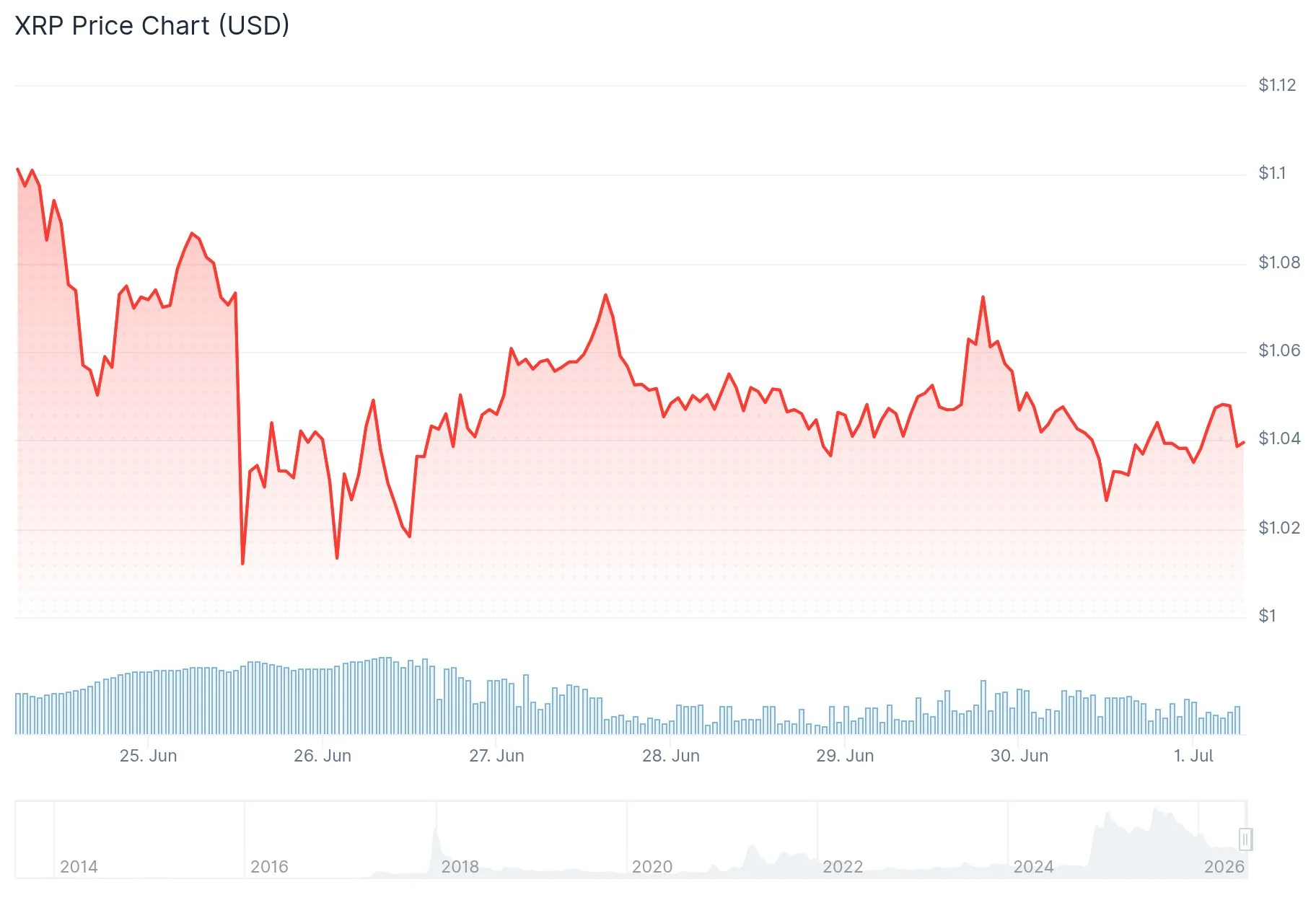
- On June 26, XRP touched $1.009, marking its lowest level since November 2024
- Despite the price decline, XRP spot ETF inflows remained in positive territory
- Technical analysis reveals a sustained downtrend originating from July 2025
- Open Interest has found equilibrium around 400 million XRP, indicating reduced speculative fervor
- Bullish divergence patterns on daily timeframes hint at potentially weakening bearish momentum near the $1 threshold
On June 26, 2026, XRP declined to $1.009, representing the token’s lowest point since it last visited these levels in November 2024.
The decline occurred against a backdrop of continuing positive flows into XRP spot exchange-traded funds. Market participants continued accumulating through these investment vehicles despite downward price momentum.
While ETF accumulation reduces circulating supply available for trading, this dynamic has yet to catalyze upward price movement given prevailing market sentiment.
Overall market appetite for XRP has diminished considerably over recent months, accompanied by a notable contraction in speculative trading activity.
Technical Analysis Overview
The daily timeframe reveals XRP locked in a downward trajectory that originated in July 2025. The decisive break beneath the April 2025 swing low at $1.61, which occurred in February, validated the bearish market structure.
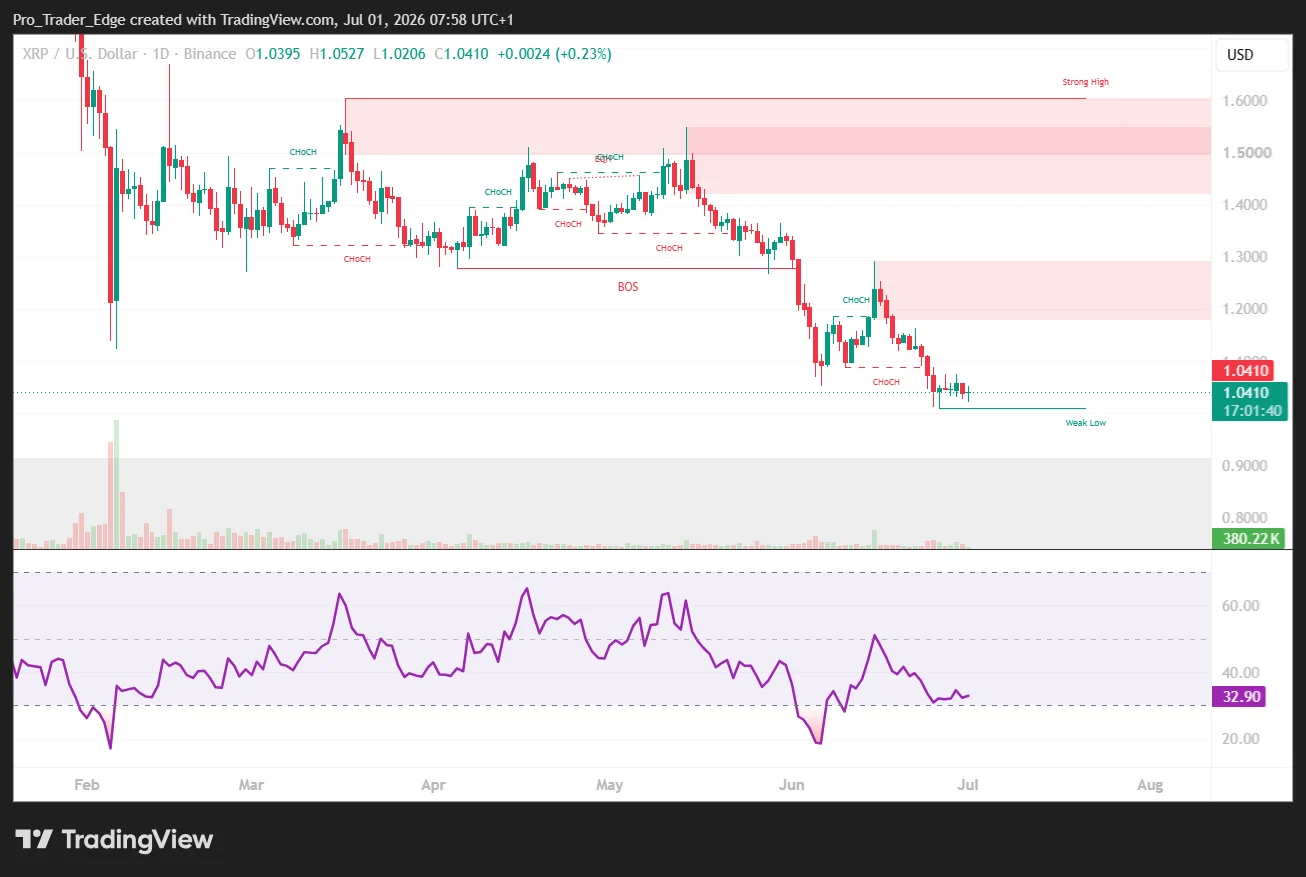
Following this breakdown, XRP consolidated within a defined range for multiple months. Late May witnessed an aggressive selling wave that shattered this consolidation pattern and accelerated the downside move.
A temporary recovery pushed prices toward $1.30 before momentum faded, leaving XRP hovering around $1.05.
Futures market data indicates Open Interest has stabilized at approximately 400 million XRP. The corresponding Open Interest Turnover Ratio has maintained levels near 0.71.
According to analyst Arab Chain, market participants should monitor these indicators for sudden increases. Rapid expansion in either Open Interest or turnover ratio typically precedes elevated volatility periods.
Examining the 4-hour chart, XRP rallied to $1.2935 during mid-June. This advance reached the 78.6% Fibonacci retracement zone around $1.2985 before encountering renewed selling pressure.
Should the bearish trajectory persist, potential downside objectives emerge at $0.975 and $0.854. Market probabilities favored a breach below $1 during July.
Potential Support Dynamics
An alternative technical interpretation presents a more constructive outlook. XRP has consistently rebounded from the $0.90-$1.00 zone, establishing this region as durable support through multiple challenges.
The $1.13 level has transitioned from support into resistance. A successful reclaim of this threshold would indicate emerging bullish momentum.
A bullish divergence pattern on daily charts has persisted for approximately one week. Such formations typically suggest diminishing selling intensity rather than imminent capitulation.
On social platforms, trader Celal Kucuker stated XRP should maintain current support levels and projected a potential climb to $10 within the next twelve months, acknowledging significant volatility along that path.
Technical analyst ChartNerd identified a repeating accumulation structure observed during previous bear cycles, highlighting historical drawdowns ranging from 85% to 96% spanning 14 to 37 months, contrasting with the current 72% retracement over 11 months.
The immediate focus centers on the $1.00 threshold. Maintaining this level preserves the possibility of retesting $1.13 resistance, while a breakdown would expose the $0.87-$0.90 support zone.

Crypto World
What is OpenUSD (OUSD)? Visa, BlackRock, Coinbase, and 140+ Firms Fuel Buzz Around New Stablecoin
Open USD (OUSD) stablecoin has emerged as one of the crypto market’s biggest trending topics after the project drew attention with the announcement of a consortium-backed stablecoin initiative involving more than 140 companies.
Developed by Open Standard, the stablecoin is expected to go live later this year.
Open USD Frenzy
According to the latest findings by Santiment, the scale of participation from major financial and crypto firms has fueled massive discussion across the market. The initiative has attracted some of the biggest names in the industry, making it one of the most talked-about developments in addition to discussions surrounding ANSEM whale activity and Markets in Crypto-Assets (MiCA) licensing.
“The crowd is also debating custody, transparency, liquidity, and whether another major stablecoin can truly compete with USDC and USDT. Either way, the spike in attention shows the market is taking this launch seriously.”
The growing interest follows the official unveiling of OUSD by Open Standard, an independent organization that will oversee the stablecoin. According to the official blog post, Open USD is designed to support global money movement while addressing several issues businesses face when using existing stablecoins.
While stablecoins have become increasingly important because they offer faster, lower-cost, and programmable digital payments, Open Standard said that many businesses still face high minting and redemption fees, limited access to revenue generated by reserve assets, and dependence on third-party issuers for future development.
To address these concerns, OUSD has been built around three core principles. First, businesses will be able to mint and redeem the stablecoin without paying fees or facing volume restrictions. Second, participating partners will receive the earnings generated from the stablecoin’s reserves after a small management fee is deducted to cover operational costs. Third, governance will be handled collectively through Open Standard, whose board will consist of partner organizations rather than a single controlling issuer.
Open Standard said this structure is intended to ensure decisions are made in the interests of the broader ecosystem. The organization also confirmed that more than 140 businesses have already signed up to support or use Open USD, including companies such as Visa, Stripe, Mastercard, American Express, Coinbase, BlackRock, BNY, Standard Chartered, Intercontinental Exchange, Bybit, Solana, Base, OKX, and Ripple.
Commenting on the development, BlackRock’s Global Head of Market Development, Samara Cohen, said,
“We believe stablecoins can play an important role in the evolution of digital markets when supported by trusted infrastructure and practical utility. Open USD is a constructive step toward giving businesses more choice in how they access tokenized value and participate in internet native digital rail.”
Bearish For Circle?
The announcement of OUSD also appeared to weigh on investor sentiment surrounding the USDC issuer, Circle. On Tuesday, CRCL shares fell 17.55% and closed at $62.63.
Former Enterprise Research Analyst at Messari, Sam Ruskin, tweeted that the new stablecoin’s model could pose a competitive challenge to USDC because of its three core design principles. He believes that OUSD’s new model could pressure Circle to expand revenue-sharing agreements, find new distribution partners, or focus on other parts of its stablecoin business.
The post What is OpenUSD (OUSD)? Visa, BlackRock, Coinbase, and 140+ Firms Fuel Buzz Around New Stablecoin appeared first on CryptoPotato.
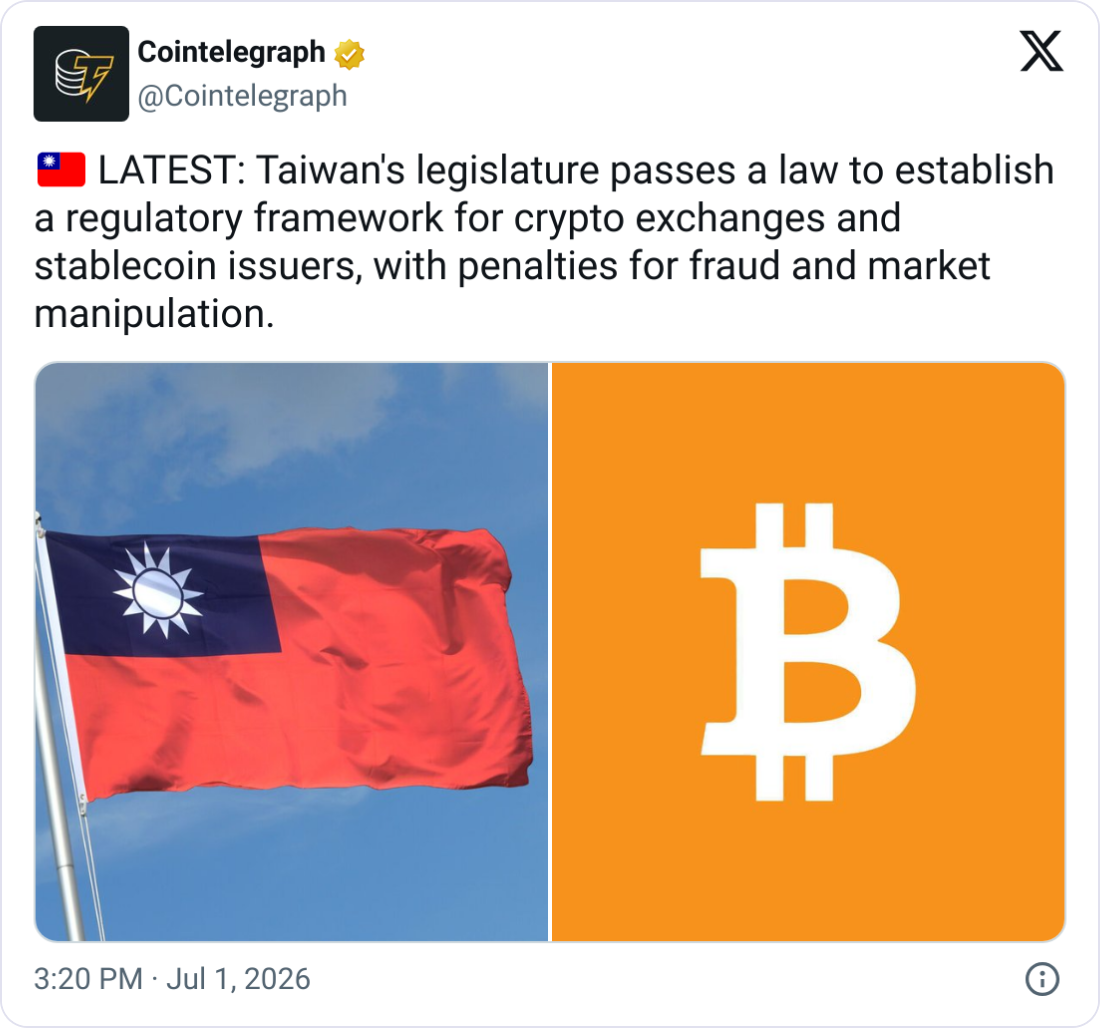
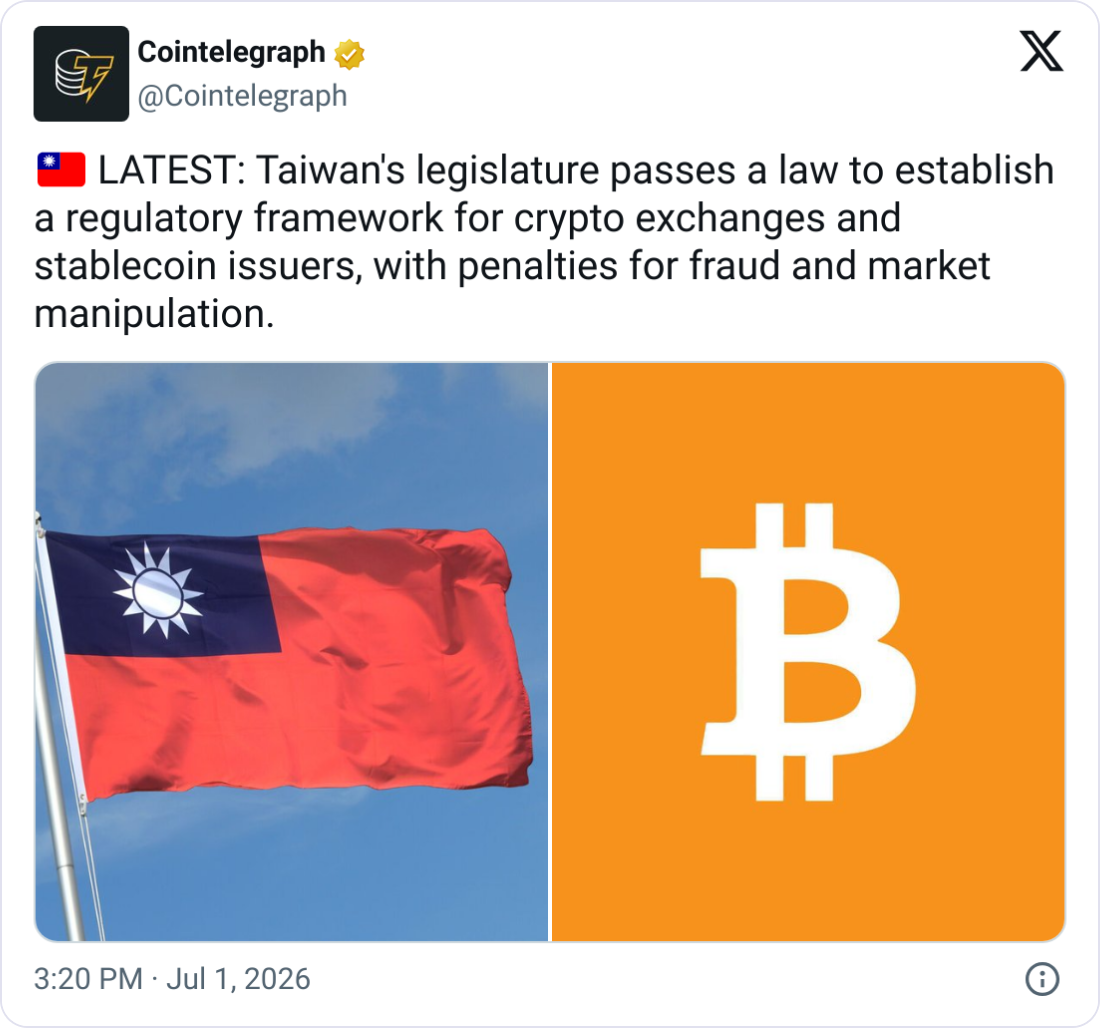
Taiwanese lawmakers on Tuesday passed a law to establish a regulatory framework for crypto, which includes licensing and rules for stablecoins.
The country’s financial watchdog, the Financial Supervisory Commission (FSC), said that the Legislative Yuan passed the law requiring all virtual asset service providers, or VASPs, to get approval from the regulator to operate.
The law also says stablecoins issued in the country must get approval from the central bank and the FSC, and issuers must maintain sufficient reserves with a trustee and undergo regular audits.
The law is the first to regulate crypto and stablecoins in Taiwan, bringing it in line with other nations in the region, such as Japan, Singapore and Hong Kong, that have long passed laws to regulate the sector in a bid to attract the industry.
The FSC said the bill further strengthens the protection of traders’ rights and that issuing stablecoins will help Taiwan integrate with the international market and secure a place in the global crypto market.
Source: Cointelegraph
Taiwan’s rules outline seven types of VASPs, including exchanges, trading platforms, custodians and lenders, which will all be subject to rules for internal control and audits, cybersecurity systems, crypto listing and delisting rules, customer asset segregation and financial reporting.
The rules outlaw crypto-based fraud and price manipulation, with violators facing between three and 10 years in prison and fines ranging from about 10 million New Taiwan dollars ($300,000) to 200 million New Taiwan dollars ($6.3 million).
Those caught operating a VASP or issuing a stablecoin without a license face up to seven years in prison and fines of up to 100 million New Taiwan dollars ($3.1 million), Taiwan’s national news agency, CNA, reported on Tuesday.
Related: US ban on stablecoin yield could see others fill the void: Ledger exec
The implementation date of the bill is still to be determined, and the law will take effect only after it is published by the government’s executive branch.
The FSC said VASPs that complete anti-money laundering registration before the bill is implemented, and institutions that provide related services under the agency, should apply for a license within 12 months after the bill is implemented.
CNA reported that lawmakers also passed a resolution asking the FSC to propose a plan within a year outlining how the crypto industry can provide derivative crypto commodity services, with the aim of providing diversified investments and improving the sector’s health.
Asia Express: Japanese pension fund tips 1% in crypto, G7 urges action on NK hackers


Anthropic is restoring access to its two most advanced AI models after the U.S. government lifted the export controls that forced it to pull them last month.
The controls on Claude Fable 5 and Claude Mythos 5 were removed on June 30, the company said. Fable 5 returns globally on July 1 across Anthropic’s platforms, while Mythos 5, which shares the same underlying model but carries fewer safety restrictions, is being restored to a set of U.S. organizations after government approval on June 26.
The freeze dated to June 12, when the government applied export controls, rules that limit which foreign nationals can access a technology, to both models.
Because the order took effect immediately and Anthropic could not verify users’ nationality in real time, it suspended access for everyone rather than risk breaching the rule.
The trigger was a cybersecurity finding after Amazon researchers reported a way to bypass Fable 5’s safeguards, a technique known as a jailbreak, prompting the model to identify software vulnerabilities and, in one case, produce code showing how one could be exploited.
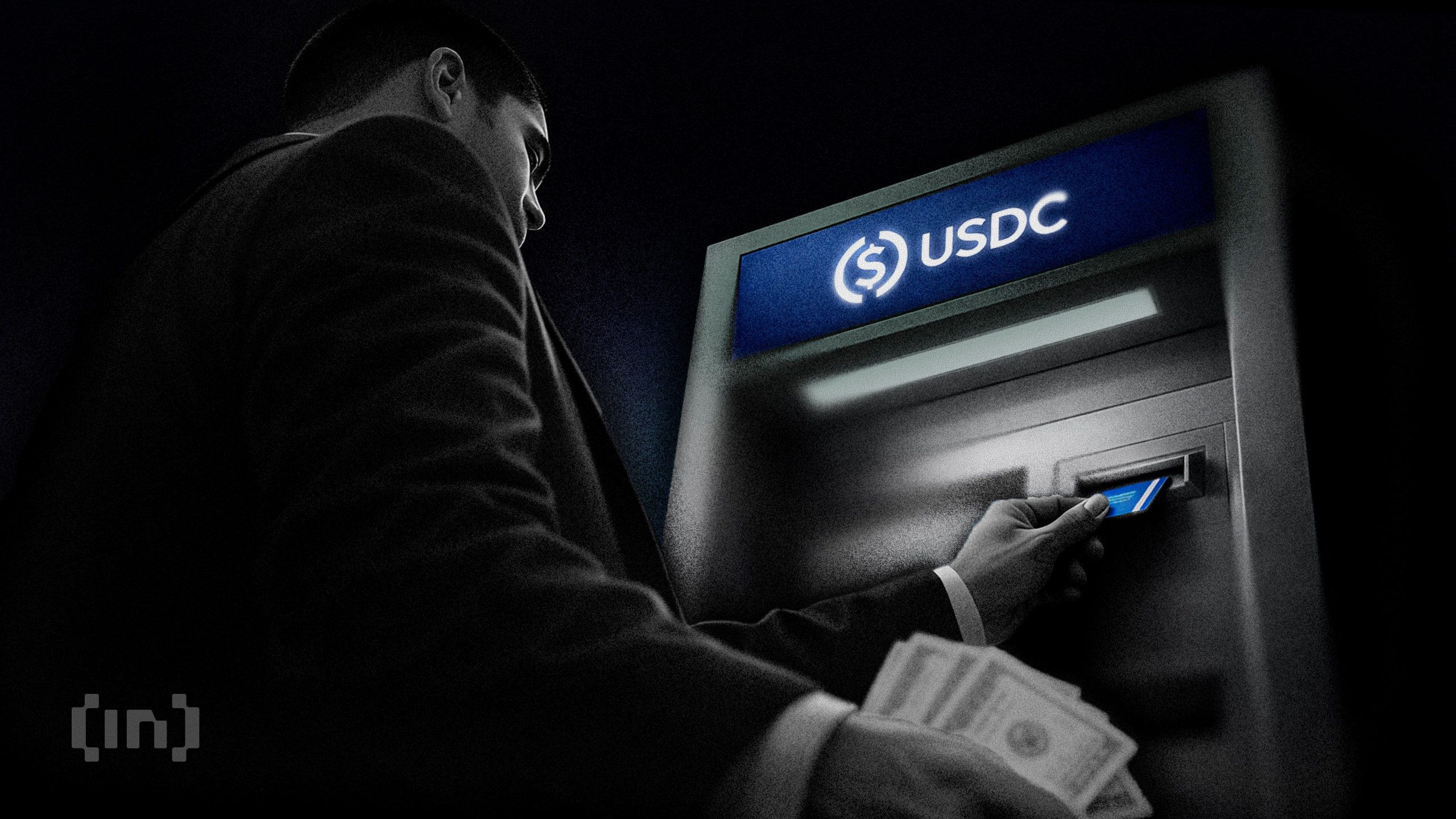

The EU’s Markets in Crypto-Assets regulation hits its final deadline today, July 1. Licensed exchanges are pulling Tether’s USDT from their platforms. Circle is stepping into the gap.
The split falls cleanly along regulatory lines. One issuer spent years building toward this deadline. The other bet Europe wasn’t worth the compliance cost.
Why Circle Is Walking Away With Europe
Circle prepared for this moment years in advance. The company secured MiCA compliance for both USDC and its euro-denominated EURC. Among the top ten stablecoins by market cap, Circle is the only issuer that cleared that bar.
Tether never applied for the e-money-token authorization MiCA requires. That decision now locks its roughly $185 billion USDT out of licensed European exchanges.
Tether’s decision wasn’t an oversight. CEO Paolo Ardoino has publicly defended the company’s stance, arguing that MiCA’s requirement to hold 60% of e-money token reserves in European bank deposits introduces its own risk. Rather than restructure its reserve model to meet that bar, Tether’s leadership has chosen to prioritize markets outside the EU.
The timing sharpens Circle’s advantage. A day before the deadline, BNY (Bank of New York Mellon) confirmed it made USDC the first stablecoin on its Digital Asset Custody platform.
Institutional clients can now store, transfer, mint, and burn USDC there. Together with the EU exchange shift, the move gives Circle regulatory validation on two continents in the same week.
A Business Story, Not Just a Compliance One
The shakeout extends well beyond stablecoins. Of the roughly 1,200 virtual-asset firms that held pre-MiCA national registrations across the EU, only around 210 converted to full CASP authorization, a conversion rate near 17%.
The more durable story is what Circle built toward for years. Regulated venues can no longer route liquidity through USDT, and Circle stands ready to absorb it. Tether may still seek authorization someday, but nothing signals that shift is coming.
The real test arrives over the next few weeks: how much EU trading volume actually migrates to USDC.
The post Circle Emerges as MiCA’s Quiet Winner While USDT Exits Europe appeared first on BeInCrypto.

For years, Bitcoin has been viewed primarily as a store of value—a digital asset designed to preserve wealth rather than actively generate it. While decentralized finance (DeFi) has transformed blockchains like Ethereum by enabling lending, borrowing, staking, and yield generation, Bitcoin has largely remained on the sidelines.
That narrative is rapidly changing.
Bitcoin Finance, commonly known as BTCFi, is emerging as one of the fastest-growing sectors in decentralized finance. By unlocking Bitcoin’s liquidity and allowing BTC holders to participate in financial applications without selling their assets, BTCFi has the potential to become the next multi-billion-dollar market.
What Is BTCFi?
BTCFi refers to the ecosystem of decentralized financial services built around Bitcoin. Rather than simply holding BTC in a wallet, users can now:
- Earn yield on idle Bitcoin
- Borrow stablecoins using BTC as collateral
- Provide liquidity to decentralized exchanges
- Participate in decentralized lending markets
- Trade Bitcoin-based assets
- Access structured financial products
- Use Bitcoin in cross-chain DeFi ecosystems
The goal is simple: transform Bitcoin from passive capital into productive capital.
Why the Timing Is Right
Several major developments have aligned to make BTCFi more viable than ever.
Bitcoin Holds Massive Untapped Liquidity
Bitcoin remains the largest cryptocurrency by market capitalization, representing hundreds of billions of dollars in value. Yet only a small fraction of this capital is actively used in DeFi.
Even modest participation from long-term Bitcoin holders could inject enormous liquidity into decentralized financial markets.
Institutional Interest Is Growing
The approval of Bitcoin exchange-traded funds (ETFs), increasing corporate treasury adoption, and rising institutional investment have strengthened Bitcoin’s position as a mainstream financial asset.
As institutions seek additional yield opportunities, BTCFi offers ways to generate returns while maintaining Bitcoin exposure.
Better Infrastructure Is Finally Here
Early attempts to bring DeFi to Bitcoin struggled due to limited programmability.
Today, new technologies are changing the landscape:
- Bitcoin Layer-2 networks
- Sidechains
- Cross-chain bridges
- Smart contract platforms secured by Bitcoin
- Native Bitcoin lending protocols
These innovations make sophisticated financial applications possible without compromising Bitcoin’s core security model.
The Rise of Bitcoin Layer-2 Networks
Scaling solutions are becoming the backbone of BTCFi.
Modern Layer-2 ecosystems enable:
- Faster transactions
- Lower transaction fees
- Smart contract execution
- Better user experiences
- Expanded developer ecosystems
These improvements create the foundation necessary for a thriving Bitcoin financial ecosystem.
New Yield Opportunities
One of BTCFi’s biggest attractions is allowing Bitcoin holders to earn passive income.
Instead of letting BTC sit idle in cold storage, users can:
- Supply liquidity
- Lend assets
- Participate in decentralized money markets
- Stake wrapped or tokenized Bitcoin in supported ecosystems
- Earn protocol incentives
This represents a significant shift from Bitcoin’s traditional “buy and hold” strategy.
Expanding Use Cases
BTCFi is moving beyond basic lending.
Emerging applications include:
- Decentralized exchanges
- Stablecoin collateralization
- Prediction markets
- Tokenized real-world assets
- On-chain derivatives
- Cross-chain liquidity protocols
- Automated yield strategies
- AI-powered financial management
As these applications mature, Bitcoin becomes increasingly integrated into the broader decentralized economy.
Why Developers Are Paying Attention
Developers are increasingly building products around Bitcoin because of its unmatched security, liquidity, and global recognition.
Innovative startups are creating:
- Native Bitcoin lending markets
- Bitcoin-backed stablecoins
- Cross-chain liquidity hubs
- Decentralized trading infrastructure
- Institutional-grade custody solutions
- Advanced financial automation tools
A growing developer ecosystem typically leads to stronger network effects and increased adoption.
Challenges Still Remain
Despite its promise, BTCFi is still in its early stages.
Some of the biggest challenges include:
- Cross-chain security risks
- Smart contract vulnerabilities
- Limited user education
- Liquidity fragmentation
- Regulatory uncertainty
- User experience complexity
Addressing these issues will be essential for sustainable long-term growth.
Why BTCFi Could Become a Multi-Billion-Dollar Industry
Several factors support BTCFi’s long-term growth potential:
- Bitcoin possesses the largest liquidity base in crypto.
- Infrastructure has matured significantly over the past few years.
- Institutional demand for Bitcoin-based financial products continues to increase.
- Developers are launching innovative protocols at a rapid pace.
- More users are seeking passive income opportunities without selling their BTC.
- Cross-chain technology continues to improve accessibility and capital efficiency.
If only a small percentage of Bitcoin’s total market value becomes actively utilized within decentralized finance, the BTCFi ecosystem could expand into one of the largest sectors in the blockchain industry.
Looking Ahead
BTCFi represents the next phase in Bitcoin’s evolution.
Instead of serving solely as digital gold, Bitcoin is increasingly becoming a productive financial asset capable of powering lending markets, liquidity pools, payments, and decentralized financial infrastructure.
While the sector remains young, its momentum is accelerating. Continued innovation in Layer-2 solutions, interoperability, security, and institutional adoption could transform BTCFi from a promising niche into a foundational pillar of decentralized finance.
For investors, developers, and long-term Bitcoin holders alike, BTCFi is more than just another trend—it is a growing movement aimed at unlocking the full economic potential of the world’s most valuable digital asset.
REQUEST AN ARTICLE
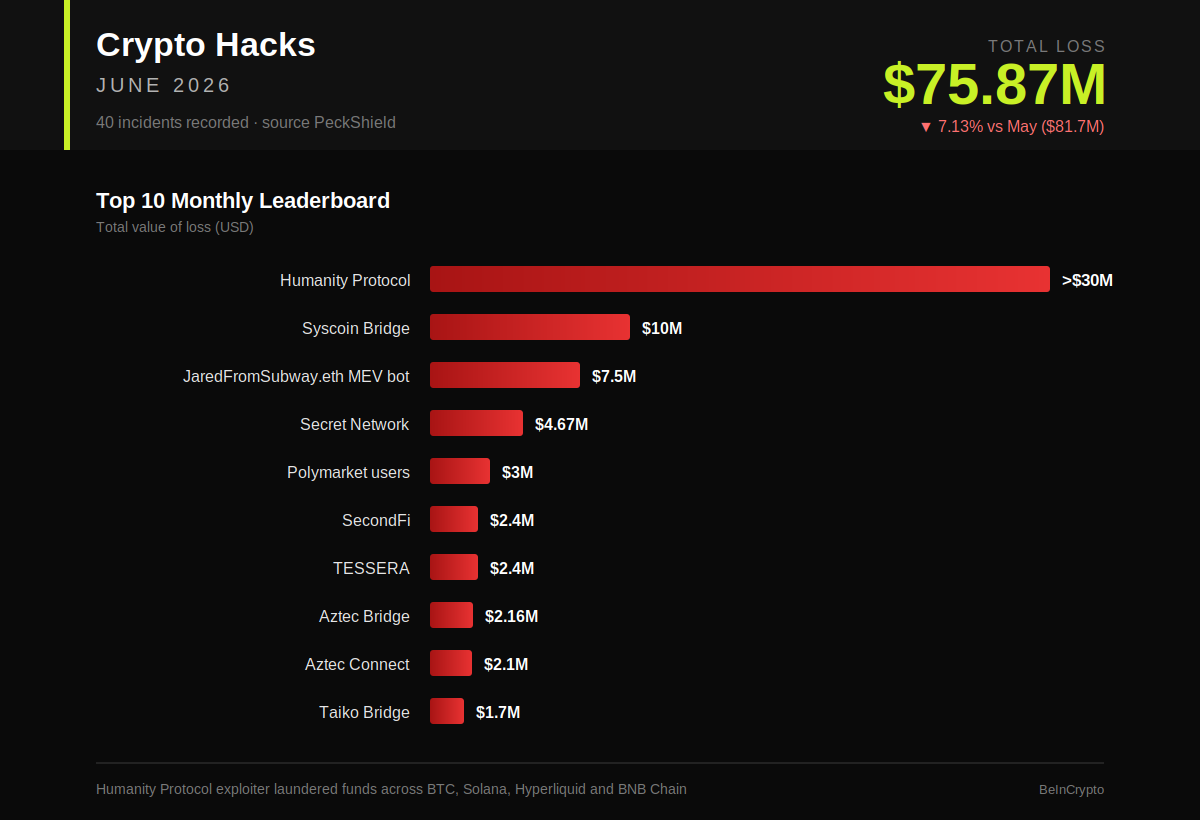
Crypto platforms lost roughly $75.87 million to 40 hacks in June 2026, according to security firm PeckShield.
The monthly total reinforces a familiar pattern for the sector, where bridges, smart contracts, and compromised keys remain the most common failure points.
Humanity Protocol Exploit Tops June Crypto Hacks
According to PeckShield, June’s figure marks a 7.13% decline from May’s $81.7 million. The Humanity Protocol breach headlined June with over $30 million in losses. Attackers compromised private keys that had been backed up to a malware-infected developer machine.
According to Quantstamp, the attacker relied on tooling and techniques commonly associated with North Korean hacking groups.
The exploiter has since laundered proceeds across multiple networks, including Bitcoin (BTC), Solana (SOL), Hyperliquid (HYPE), and BNB Chain.
These funds have also been commingled with proceeds linked to the KelpDAO exploiter, suggesting a potential overlap between the threat actors behind both incidents,” the security firm said.
Follow us on X to get the latest news as it happens

Syscoin Bridge followed with a $10 million loss after an attacker minted unauthorized SYS tokens. The JaredFromSubway.eth Maximal Extractable Value (MEV) bot lost $7.5 million, while Secret Network was drained for $4.67 million.
Aztec Products Hit Despite Years of Dormancy
Two separate attacks targeted Aztec-linked products within the month. Aztec Payments Product lost $2.16 million, and Aztec Connect lost $2.1 million, for a combined total near $4 million.
Both products had been deprecated years earlier, and Aztec Labs said it held no control over the affected systems.
Other June incidents included Polymarket users losing $3 million after reportedly being targeted in a phishing campaign, along with $2.4 million in losses for SecondFi and TESSERA. The Taiko Bridge exploit closed out the top 10 at $1.7 million.
With both deprecated code and cross-chain laundering in play, June showed that old contracts remain in attackers’ crosshairs long after teams walk away.
Subscribe to our YouTube channel to watch leaders and journalists provide expert insights
The post Hackers Steal $75.87 Million From Crypto Platforms in June 2026 appeared first on BeInCrypto.
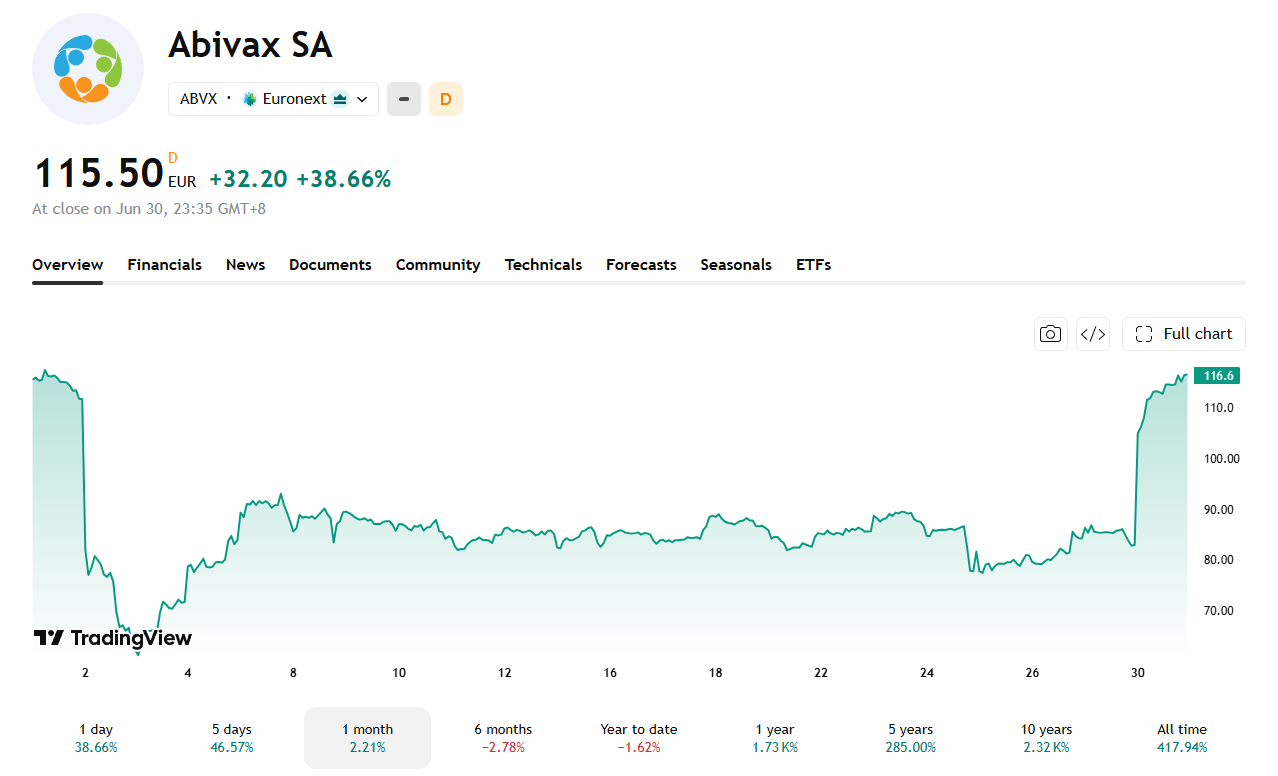
Abivax shares surged over 38% on June 30, 2026, after new Phase 3 data eased cancer-safety fears that had erased 43% of the French biotech’s value earlier in June.
The rally follows fresh results for obefazimod, Abivax’s lead ulcerative colitis drug. The data showed durable remission with no new safety signals.
A Reversed Safety Signal
Abivax’s stock crashed 43% on June 2. Early trial data had shown a rise in malignancies among patients taking obefazimod.
The company released new Phase 3 data on Sunday, June 28, covering patients who failed initial treatment. Researchers found malignancy rates within the range doctors typically see in ulcerative colitis patients. The update calmed the safety concern that triggered the June 2 sell-off.

Among patients who failed initial treatment, 37.2% reached clinical remission and 34.5% reached endoscopic remission at week 44. Those results reinforced the drug’s efficacy case in harder-to-treat patients.
Abivax shares have now climbed more than 1,730% over the past year.
Wall Street Splits on the Risk
Analysts did not agree on how much risk remains. Citizens raised its Abivax price target to $187 and kept its Outperform rating, pointing to the drug’s placebo-adjusted remission benefit.
Wedbush took a more cautious view. The firm upgraded Abivax from Underperform to Neutral but cut its price target to $90. Wedbush cited lingering malignancy questions at the 50 mg dose as a regulatory risk.
Abivax still plans to file a new drug application with the FDA in the fourth quarter of 2026. That filing will keep the stock sensitive to any additional safety data before then.
The post From Cancer Scare to Comeback, Abivax Shares Erase a Month of Losses in a Day appeared first on BeInCrypto.
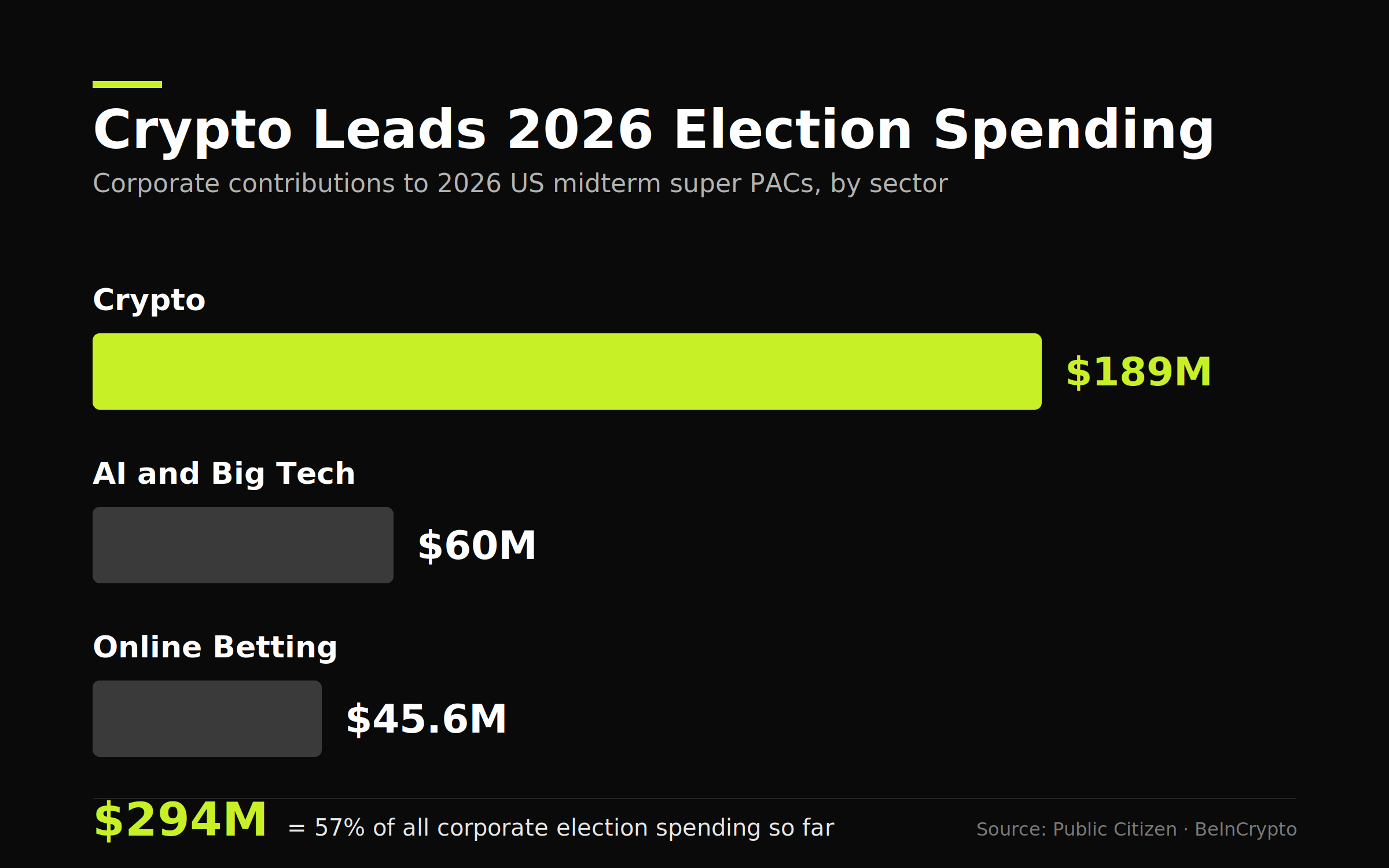
Cryptocurrency corporations have spent $189 million on the 2026 US midterm elections, roughly 37% of all reported corporate election spending, according to a Public Citizen report.
The figure keeps crypto ahead of every other industry in funding federal races this cycle. It reflects a strategy the sector introduced in 2024 that other industries now imitate.
Crypto Leads The Corporate Spending Surge in 2026 Elections
Total corporate spending on the 2026 midterms reached $517 million, according to the watchdog group. That marks a 12% rise over the $461 million corporations spent across the entire 2024 cycle.
“In the 2026 midterm elections, corporate money is poised to play a bigger role than ever before in influencing how Americans vote,” the report read.
Crypto’s $189 million exceeded the combined totals from artificial intelligence and Big Tech firms at $60 million and online betting companies at $45.6 million. Together, these sectors contributed $294 million, or 57% of all corporate spending so far.
Follow us on X to get the latest news as it happens

The report frames the trend as a copycat effect. Crypto firms pioneered the model of routing large sums into sector-focused super PACs during the last presidential cycle. AI and gambling companies have since built their own versions.
Where the Crypto Money Went
Fairshake, the crypto-aligned super PAC, received $82 million in corporate contributions. That sum represents 60% of its total 2026 receipts of $135 million.
The Trump-backing MAGA Inc. super PAC drew a separate $56.2 million from crypto donors. Ripple Labs and Coinbase steered $81.5 million toward Fairshake, while Crypto.com, Gemini, and Blockchain.com directed funds to MAGA Inc.
Crypto.com operator Foris Dax alone gave $35 million to MAGA Inc., making it the largest single corporate backer of that committee across all industries. The Winklevoss twins funded a separate Republican-only vehicle, the Digital Freedom Fund, with $21.3 million.
Public Citizen notes that its total likely undercounts real spending, since dark-money groups and state-level contributions escape federal disclosure rules.
Voter Interest Tells a Different Story
The spending contrasts sharply with public sentiment. A Politico poll conducted with Public First found only 4% of Americans weigh a candidate’s crypto position when voting. Just 18% want Congress to prioritize crypto rules.
Another survey found that 41% of respondents said special interest groups hold too much political influence. Whether that skepticism converts into ballot-box pressure against heavily funded candidates remains an open question for November.
Subscribe to our YouTube channel to watch leaders and journalists provide expert insights
The post Crypto Corporations Fund 37% of All 2026 Corporate Election Spending appeared first on BeInCrypto.
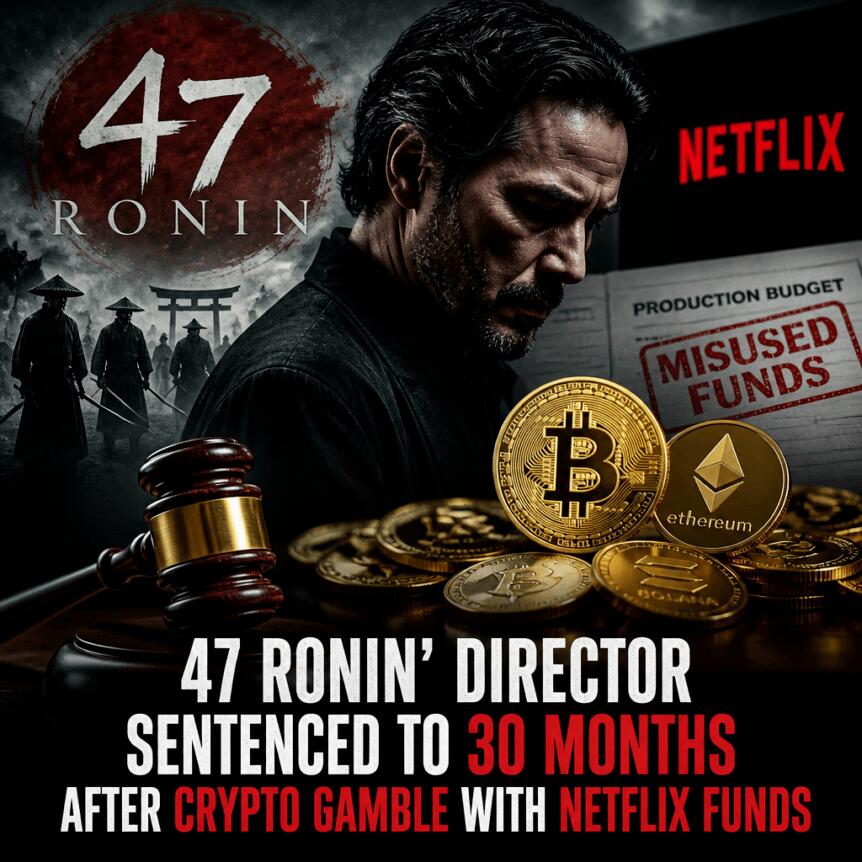
Hollywood director Carl Rinsch has been sentenced to 30 months in federal prison after prosecutors said he defrauded Netflix out of $11 million intended to finance a science-fiction television production. According to U.S. authorities, Rinsch diverted the funds into speculative trading—including cryptocurrency—before spending large portions on personal expenses and luxury purchases.
The case, handled in Manhattan federal court, closes a 15-month legal saga that began with Rinsch’s arrest in March 2025. He was convicted in December on charges that included wire fraud and money laundering and then faced sentencing for additional counts related to financial transactions tied to alleged unlawful activity.
Key takeaways
- Rinsch received a 30-month prison sentence for a scheme prosecutors say involved $11 million wired by a streaming company for a TV project.
- Prosecutors said the money was used for speculative bets in crypto and stocks, rather than completing the show.
- The court ordered $11 million in forfeiture on top of the prison term and supervision.
- The sentence was far below the maximum penalty the government said he faced across all counts, which totaled up to 90 years.
Fraud scheme tied to a streaming production
Manhattan U.S. Attorney Jay Clayton said in a statement that Rinsch “orchestrated a scheme to steal millions” by seeking $11 million from a subscription streaming service, claiming the funds would be used to finance his television show. Prosecutors said that representation was false.
Instead, Clayton stated, Rinsch made what the government characterized as risky bets on speculative stock options and cryptocurrency and also spent millions on luxury goods. “Today’s sentence sends a deterrent message: fraud will not be tolerated,” Clayton added.
Rinsch, best known for directing the 2013 film “47 Ronin” starring Keanu Reeves, was convicted in December on counts including fraud and money laundering. At sentencing, the court also considered defense arguments that he had mental health issues, including support letters submitted by people close to him.
Prosecutors said the case began as a continuation of an earlier funding arrangement. Earlier reporting and court filings cited in the case describe that Rinsch initially received $44 million from the streaming service for a project later renamed “Conquest,” after a show initially titled “White Horse.” The additional $11 million was wired in March 2020, according to the indictment and accounts described in court materials.
Crypto trading and the Dogecoin liquidation
One of the central claims in the case involved how Rinsch allegedly used part of the new $11 million to attempt to multiply the money through market speculation. According to a March 2025 indictment and reporting connected to a confidential arbitration described by the New York Times, Rinsch used $10.5 million from the additional funding to gamble in the stock market and quickly lost about half within weeks, as described in the indictment.
Prosecutors also said Rinsch moved more than $4 million of remaining funds to the crypto exchange Kraken and then “went all in” on Dogecoin (DOGE). The indictment materials referenced by the article state that the DOGE trade generated about $27 million after he liquidated in May 2021, based on a statement described as seen by The Times.
For readers tracking how court cases interpret crypto activity, the case offers a clear example of prosecutors linking on-exchange transfers and concentrated positions to broader alleged intent. Here, the government framed crypto trading not as a detached investment decision but as part of an overall use of client funds that prosecutors argued was deceptive.
Spending that allegedly followed the trades
After the reported DOGE winnings, prosecutors alleged Rinsch spent about $10 million on personal expenses and luxury purchases instead of completing the show or returning the money. The indictment described expenditures including $1.8 million on credit card bills, $1 million for lawyers to sue Netflix, $3.8 million on furniture and antiques, and large purchases of luxury vehicles, including Rolls-Royces and a Ferrari.
The indictment also cited smaller but specific categories such as $652,000 for watches and clothes, alongside other personal spending. Prosecutors said Rinsch never finished the television project and did not return the funds that had been provided.
While the sentence itself is a criminal-law outcome, the underlying narrative—funds intended for production allegedly redirected into speculative markets and then into personal consumption—highlights how financial misuse allegations can draw on both traditional asset trading records and crypto exchange activity.
What prosecutors sought vs. what the court imposed
At trial, Rinsch was convicted of one count each of wire fraud and money laundering. Each of those counts carried a maximum of 20 years in prison, prosecutors said, while five additional counts involving monetary transactions tied to unlawful activity carried maximum penalties of up to 10 years each.
In a mid-June sentencing memo filed in court, prosecutors asked for a five-year prison term, after Rinsch argued for a sentence without incarceration. The court ultimately imposed a 30-month term—shorter than the government’s request.
Along with prison time, prosecutors said the judge ordered three years of supervised release, $11 million in forfeiture, and $700 in mandatory special assessments.
The defense argued Rinsch’s mental health played a role in his behavior around the time of the alleged offenses, and support letters included submissions from friends and family, as well as a letter from Keanu Reeves. Authorities, however, emphasized the deliberate nature of the scheme, including the alleged misrepresentations used to secure the $11 million.
For investors and crypto users, the practical takeaway is less about any single coin and more about how courts may interpret crypto trading activity when prosecutors tie it to alleged fraud, money laundering, and diversion of funds. Readers should watch how similar cases develop evidence standards—particularly how exchange withdrawals, concentrated token bets, and liquidation timing are presented as part of intent and purpose in fraud prosecutions.

Keeping Up Appearances star Anna Dawson dies aged 88: Actress best known for role as affluent Violet in beloved BBC sitcom passes away just six months after her husband

Manchester’s economy grows 34% in a decade, outpacing UK average and rival cities

XRP Price Analysis: Critical $1 Support Level Under Pressure as July 2026 Approaches





-

 Fashion5 days ago
Weekend Open Thread: Staud – Corporette.com
-

 Politics5 days ago
The House | Manchesterism won’t survive the painful trade-offs unless it gets citizens on board
-

 Crypto World1 day ago
Strategy authorizes up to $1.25B in Bitcoin sales under new capital plan
-

 Politics5 days ago
Potential 2028er World Cup attendee leaderboard
-

 Business5 days ago
Asia stock markets slide as tech shares slump
-

 News Videos3 days ago
MAJOR BITCOIN & MARKET UPDATE!!!! (MUST WATCH ASAP!!!)
-

 Tech5 days ago
A Look At A Gaggle Of Transputer Boards
-
 Crypto World6 days ago
Dell (DELL) Shares Tumble Over 5% Following Analyst Downgrade to Hold
-

 Crypto World4 days ago
Coinbase, Circle Deepen Crypto Stock Losses Despite Resilient S&P 500
-

 Business1 day ago
Australia treasurer says alleged access of prime minister’s bank data ’incredibly concerning’
-

 Crypto World4 days ago
Kraken's xStocks Opens Bending Spoons IPO Registration to EEA Retail
-

 Sports4 days ago
FIH Pro League: India defeat Pakistan 7-1, register biggest win of campaign | Other Sports News
-

 Crypto World5 days ago
Bitcoin Sparks $600M Hourly Liquidations With $65,000 Set To Become Resistance
-

 Tech3 days ago
Bluekit phishing kit adopts browser-in-the-middle for login theft
-

 Tech4 days ago
Russian hackers now target Signal backup recovery keys
-
 Crypto World5 days ago
Hyperliquid Named on Singapore MAS Investor Alert Register
-
 Crypto World6 days ago
Ripple and SBI launch RLUSD in Japan after JFSA approval
-

 Crypto World5 days ago
RTX holders must register wallets before token distribution begins
-

 Tech1 day ago
Anonymous researcher drops 0-day ‘exploitarium’ repo
-
 Business2 days ago
The AI boom won’t burst all at once. It will pop in ‘rolling bubbles’: Macquarie
You must be logged in to post a comment Login