Connect with us
DAPA Banner
DAPA Coin
DAPA
COIN PAYMENT ASSET
PRIVACY · BLOCKDAG · HOMOMORPHIC ENCRYPTION · RUST
ElGamal Encrypted MINE DAPA
🚫 GENESIS SOLD OUT
DAPAPAY COMING

Business

Cath Hart, David Cresp join WAPC

Published

on

Cath Hart, David Cresp join WAPC

Former Real Estate Institute of WA chief executive Cath Hart has been appointed the Western Australian Planning Commission’s board.

Continue Reading
Click to comment

You must be logged in to post a comment Login

Leave a Reply

Business

Comcast Splits, Lisa Cook Gets a Reprieve and Tech Stocks Rebound | Markets P.M. for June 29

Published

on

Comcast Splits, Lisa Cook Gets a Reprieve and Tech Stocks Rebound | Markets P.M. for June 29

This is an edition of the Markets P.M. newsletter, a recap of the day’s most important markets moves, delivered after the closing bell. If you’re not subscribed, sign up here.


What Happened in Markets Today

The Supreme Court blocked Trump from firing Lisa Cook. The Court on Monday rejected President Trump’s bid to fire Federal Reserve Gov. Lisa Cook with little legal scrutiny. In a second decision, however, it gave Trump free rein to fire officials at other independent agencies for any reason. The pair of rulings effectively delivers a split verdict on Trump’s second-term effort to exert maximal control over the executive branch, protecting the Fed’s special status but not other agencies.

Copyright ©2026 Dow Jones & Company, Inc. All Rights Reserved. 87990cbe856818d5eddac44c7b1cdeb8

Advertisement
Continue Reading

Business

Euro zone factory output ends first quarter on strong note, cost pressures ease – PMI

Published

on

Euro zone factory output ends first quarter on strong note, cost pressures ease - PMI


Euro zone factory output ends first quarter on strong note, cost pressures ease – PMI

Continue Reading

Business

AeroVironment Reports Higher Fourth-Quarter Profit As Revenue More Than Doubles

Published

on

AeroVironment Reports Higher Fourth-Quarter Profit As Revenue More Than Doubles

AeroVironment AVAV 18.76%increase; up pointing triangle reported a higher profit as revenue more than doubled during the fiscal fourth quarter.

The drone maker on Monday reported a profit of $63.2 million, or $1.25 a share, for the quarter ended April 30. That compares with a profit of $16.7 million, or 59 cents a share, a year earlier.

Copyright ©2026 Dow Jones & Company, Inc. All Rights Reserved. 87990cbe856818d5eddac44c7b1cdeb8

Continue Reading

Business

Rahul Jain sees challenging FY27 for KPIT despite strong deal pipeline

Published

on

Rahul Jain sees challenging FY27 for KPIT despite strong deal pipeline
KPIT Technologies‘ latest business update has reignited concerns over the company’s near-term growth outlook, with analysts pointing to project-related setbacks and a slower-than-expected recovery despite a healthy deal pipeline. While management continues to expect improvement in the second half of FY27, the Street remains cautious about how quickly new wins can offset the impact of recent programme closures.

Rahul Jain from Dolat Capital believes the current weakness is more execution-specific than an indication of a broader structural slowdown.

“In their Q4 call also, they highlighted that there are two SDV programmes they were working on. We are seeing some conclusion, which was unexpected for them. Despite very strong deal wins, it would be difficult for those wins to translate quickly enough to cover the fall from these two programmes. As a result, Q1 looks challenging, and they have also indicated that things might improve only in the second half of the year. Based on our calculations, they are unlikely to see a positive year in FY27,” he said.

Profitability could come under pressure

Advertisement

The weaker revenue outlook also raises questions over KPIT’s ability to maintain its FY27 EBITDA margin guidance of 20.5% to 21.25%.

According to Jain, currency movements remain one of the few supportive factors, but margins could still face pressure if growth continues to disappoint.
“Growth could be a challenge for profitability in general, so that is always a concern. The only supporting factor currently is the currency, which is at least accretive. If they are able to manage costs and the currency remains supportive, profitability can stay within the indicated range. But if it turns out to be a declining year, sustaining those margins will also be challenging,” he said.
Not necessarily a sector-wide problem
While KPIT derives significant business from global automotive clients, including BMW, Jain believes investors should avoid drawing broad conclusions for the entire engineering research and development (ER&D) space.

He noted that performance has often differed across companies despite operating in similar markets.

“We have seen in the past that there has been disparity, with KPIT doing well while others were not, and vice versa. I would not extrapolate this to the broader ER&D space. However, certain OEMs are facing challenges and issuing profit warnings. That could affect several vendors across both IT services and ER&D. I would not directly correlate it, but it is a painful situation where many companies could gradually feel the impact,” he said.

Markets may remain sceptical about H2 recovery
KPIT’s shares have already corrected sharply over the past year, making investors increasingly cautious about management’s expectation of a second-half recovery.

Advertisement

Jain acknowledged that while the company’s sizeable order wins provide some comfort, execution remains the key challenge.

“It is difficult to believe that things could turn around very quickly. The only supporting argument is the nearly $349 million worth of deals, which indicate that new wins are coming in. It is more about managing the transition in existing accounts while scaling business from newer clients. Last year they also spoke about entering the Chinese market, and they have already secured one customer there. If they execute well with Chinese OEMs, that could become an important growth driver and improve the exit trajectory,” he said.

Estimate cuts likely
Following the latest developments, analysts are reassessing their earnings expectations for FY27, with meaningful downgrades now appearing likely.

Jain indicated that current projections are significantly below earlier expectations, while the upcoming quarterly commentary will be crucial in determining whether the recovery narrative remains intact.

Advertisement

“We do not have a precise FY27 outlook yet. But based on our assessment, there is at least a 7-8% reduction compared with the numbers we were building earlier, which is a meaningful change in estimates. We now look forward to management’s commentary on how things are progressing, how the deal wins are shaping up, and how the non-affected parts of the business are performing during the Q1 call. At this point, the impact could be around 7%,” he said.

With revenue visibility weakening and recovery pushed further into the fiscal year, investors are likely to focus closely on KPIT’s first-quarter earnings for signs that fresh deal wins are beginning to compensate for the slowdown in existing programmes. Until then, market sentiment towards the stock is expected to remain cautious.

Continue Reading

Business

Rocket Lab Takes a Page From SpaceX’s Playbook With Its Transformative Iridium Buy

Published

on

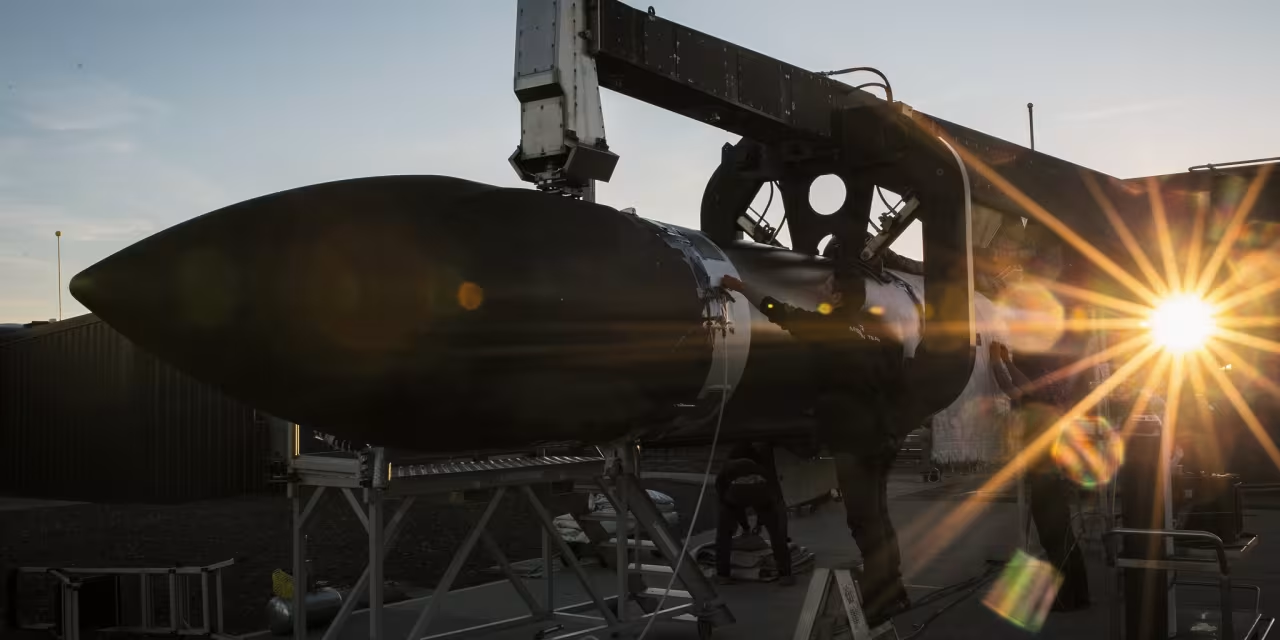
Rocket Lab to Buy Iridium for $8 Billion in ‘Transformative’ Space Deal

Rocket Lab Takes a Page From SpaceX’s Playbook With Its Transformative Iridium Buy

Continue Reading

Business

Putin Admits Fuel Shortages From Ukrainian Strikes Are ‘Not Critical’ in Rare Public Acknowledgment

Published

on

Self-Exiled Chinese Billionaire Guo Wengui Sentenced to 30 Years in

MOSCOW — Russian President Vladimir Putin offered an unusually candid public acknowledgment over the weekend of widespread fuel shortages gripping the country, conceding that Ukrainian missile and drone strikes on energy infrastructure have created real difficulties for Russian motorists, businesses and the agricultural sector, even as he insisted the situation remained under control.

The shortages have been visible across Russia for months, with long lines forming at petrol stations, fuel rationing spreading to dozens of regions, and refineries repeatedly damaged by Ukrainian strikes reaching from Moscow to the Black Sea coast. In Crimea, the Russian-annexed Ukrainian peninsula, drivers have been barred from filling their tanks altogether so that available fuel can be redirected to military vehicles. Despite the visible strain, Putin had largely avoided addressing the crisis directly in public until a weekend meeting with senior officials and oil executives.

Speaking candidly at that meeting, Putin acknowledged the toll the shortages have taken on ordinary Russians.

“You’re well aware that problems persist for both motorists and businesses,” Putin told the assembled officials. “Unfortunately, there are still queues at petrol stations, and finding the right grade of petrol isn’t always easy.”

Advertisement

Putin also pointed to the strain on Russia’s agricultural sector, noting that the country’s harvest depended on fuel supply schedules being met on time, an acknowledgment that ties the energy crisis directly to broader concerns about food production and the domestic economy heading into the back half of the year. According to independent Russian outlet Mediazona, 56 Russian regions are currently enforcing some form of fuel restriction, underscoring how widespread the disruption has become.

In a subsequent interview with Russian state television, Putin went further, offering what diplomatic observers described as an even more open assessment of the crisis than his earlier remarks to officials.

“We are currently seeing a certain shortage, but it’s not critical,” Putin said, while acknowledging that Ukraine’s attacks were “obviously creating problems.”

He pledged to ramp up production of air defense systems to better protect Russian energy infrastructure from further strikes, and said authorities would work to accelerate repairs at refineries that have already sustained damage from Ukrainian attacks. Regarding Crimea specifically, Putin admitted the peninsula currently had only “a few days’ supply” of fuel remaining, though he expressed confidence that additional fuel would be brought in to address the shortfall soon.

Advertisement

The directness of Putin’s comments marks a notable departure from his typical public posture on the war’s domestic costs. BBC diplomatic correspondent James Landale, reporting from Moscow, noted that the scale of the shortages and the resulting public awareness had likely left Putin with little choice but to acknowledge the reality on the ground, even as he continued to insist, as he has throughout the conflict, that Russia’s broader war effort was making progress.

Putin’s admission regarding Crimea’s fuel difficulties carries particular symbolic weight given the peninsula’s outsized importance both to ordinary Russians and to Putin personally. Since Moscow’s occupation of Crimea began in 2014, the Kremlin has transformed the peninsula into a major military base and a strategic anchor for controlling the Black Sea, using it as a launching point for Russia’s full-scale invasion of Ukraine in 2022. Any sign of strain there carries political resonance well beyond its immediate practical impact.

During the televised interview, Putin offered an explanation for why he chose to address the issue so openly, framing Ukraine’s strategy as an attempt to fracture Russian society and erode public support for the war effort, while pushing more Russians toward favoring negotiations to end the conflict.

“We won’t give them that chance,” Putin said, adding that Ukraine’s long-range strikes were having “absolutely no impact on the situation at the front line.”

Advertisement

That assessment is directly disputed by officials in Kyiv, who argue that Ukraine’s deep strikes inside Russian territory serve a dual purpose: bringing the tangible costs of the war home to ordinary Russian citizens while also forcing Russian military commanders to divert air defense resources and personnel away from the front lines in eastern Ukraine to protect domestic energy infrastructure instead.

The acknowledgment comes amid a period of growing confidence in Kyiv that battlefield momentum may be shifting in Ukraine’s favor. In recent months, Ukrainian forces have launched deep strikes against targets in both St. Petersburg and Moscow, intensified attacks on Crimea, and pursued a more aggressive strategy aimed at inflicting maximum casualties along the front line. Despite that shift in tactics, the Kremlin reaffirmed Monday that its core territorial objectives remain unchanged. Kremlin spokesman Dmitry Peskov said Russia’s position continues to be that Ukrainian forces must withdraw from four southeastern regions that Moscow claims as its own, territorial claims that Kyiv categorically rejects.

In the same interview, Putin claimed that Ukraine had signaled willingness to limit hostilities and begin negotiations, though he dismissed any such overture as a tactical maneuver designed to give Kyiv time to regroup and rearm rather than a genuine push toward peace.

“It is clear why this proposal is being made, because our counter-strikes deep into Ukrainian territory are much stronger, have greater impact and are, frankly, more destructive,” Putin said.

Advertisement

He went on to characterize Ukraine’s own strikes against Russia as an attempted “salvation” for what he described as a Ukrainian military that has been “catastrophically” depleted by years of fighting, while making clear that Moscow had no interest in offering Kyiv’s leadership any reprieve.

“But saving the Kyiv regime is not part of our plans,” Putin said.

The rare public airing of Russia’s fuel crisis offers one of the clearest signals yet of how Ukraine’s sustained campaign against Russian energy infrastructure is registering domestically, even as both sides continue to offer starkly different assessments of how much that pressure is actually shaping the broader trajectory of the war.

Advertisement
Continue Reading

Business

Shift4 Payments: Poised To Win As The Experience Economy Continues To Expand

Published

on

Shift4 Payments: Poised To Win As The Experience Economy Continues To Expand

Shift4 Payments: Poised To Win As The Experience Economy Continues To Expand

Continue Reading

Business

Bristol Bears announces ‘landmark’ new partnership

Published

on

Business Live

Chief executive Tom Tainton said it was a ‘ground-breaking moment’ for the Gallagher PREM side

General views as Bristol Bears announce Foot Anstey as Front of Shirt sponsor on March 17, 2026 at the Bears High Performance Centre, England. (Photo by Will Cooper/Bristol Bears)

Bristol Bears has announced a new partnership deal(Image: Will Cooper/Bristol Bears)

Bristol Bears has agreed a “landmark” long-term partnership with a UK law firm. Foot Anstey will become the club’s new principal partner for the 2026-27 season, with shirt branding for both the men’s and women’s teams.

The Gallagher PREM side said the multi-year agreement represented “one of the most progressive partnerships” in the club’s history.

Advertisement

Under the terms of the deal, Foot Anstey, which has 11 offices including in Exeter, Bristol and Manchester, will also become the main partner of the Bristol Bears Foundation – the club’s award-winning charitable arm.

Off the pitch, it will become the Bears’ exclusive legal provider, offering a full range of legal solutions to the club and its players over the term of the partnership.

Foot Anstey managing partner, Martin Hirst, said: “Our partnership with Bristol Bears is built on a shared belief in the impact individuals can have when they come together as a team.

“From our earliest conversations, it was clear this is more than sponsorship, it’s about bringing together two ambitious organisations to drive performance, support our communities and create lasting impact.

Advertisement

“This reflects how we work as a firm: building strong relationships, working collaboratively and focusing on what really matters to our clients and to the communities around us.

“Sport has a unique ability to bring people together and create momentum. We’re excited about what we can achieve, alongside Bristol Bears and the Bristol Bears Foundation, over the coming years.’

Bristol Bears chief executive Tom Tainton said the deal was “a ground-breaking moment” for the club.

“From the beginning of this process, Foot Anstey has been an excellent partner – collaborative, engaging and genuinely excited about using the power of sport to leave a lasting legacy,” he said.

Advertisement

“Having Foot Anstey’s name on our shirts is about far more than a business agreement; it is a statement of intent about our aligned growth journeys. This authentic partnership represents a shared set of values and a long-term commitment to driving success across our men’s, women’s and community programmes.

“Foot Anstey’s support of the Bristol Bears Foundation is particularly significant, enabling us to expand our reach and deepen our impact within the communities we serve.”

The news comes just a day after South West Gallagher PREM club Exeter Chiefs announced it had been acquired in a major deal by US businessman Bill Foley, ending 155 years of member ownership.

Advertisement
Continue Reading

Business

Dow Finally Tops 52,000 With Some Help From Its Newest Member

Published

on

Stocks Little Changed After Fed Decision

The Dow finally closed above the 52,000 the same day its newest member joined a rally in Big Tech and chip stocks.

The blue-chip index rose 306 points, or 0.6%. Alphabet, which replaced Verizon in the Dow this week, led the index. The S&P 500 rose 1.2%. The Nasdaq rallied 2.1%.

Breadth was actually negative, but the stocks that were rising more than overpowered the stocks that were down. Even the Invesco S&P 500 Equal Weight ETF, normally a proxy for breadth, rose solidly.

Continue Reading

Business

Manchester’s economy grows 34% in a decade, outpacing UK average and rival cities

Published

on

Business Live

The Centre for Cities report comes as Andy Burnham plans Number 10 for the North

Deansgate Square skyscrapers, Manchester

Deansgate Square skyscrapers, Manchester(Image: Sean Hansford | Manchester Evening News)

Manchester is outpacing the rest of the country following a decade of growth, according to new research.

Advertisement

London-based think tank Centre for Cities found that Manchester’s economy grew more rapidly than anywhere else in the UK over the last ten years.

Figures revealed the city’s economy expanded by more than 34 per cent between 2013 and 2023, outstripping other ‘top performers’ such as Bristol, Leeds, and Newcastle.

London’s economy grew by nearly 19 per cent over the same period, compared to the UK average of 18.4 per cent across the decade.

The figures were measured by total gross value added (GVA) growth – the value of goods and services produced within the city.

Advertisement

Manchester and the wider city region also recorded a 19.7 per cent rise in job creation, according to the report, surpassing the UK average of 13.9 per cent.

The findings come as significant new announcements by Andy Burnham could herald a dramatic shift in how the country is governed, with a pledge for a ‘No 10 in the North’, potentially based in Manchester, should he go on to become Prime Minister.

The Centre for Cities report stated: “There are encouraging signs, with places such as Leeds and Manchester seeing strong productivity growth in recent years, adding to a sense of growing momentum around their role in raising national living standards.”

The data also laid bare some of the challenges confronting the country’s regions. The report continued: “Currently Manchester, Birmingham and Leeds have the largest ‘density gaps’ compared to their international peers, with estimated shortfalls of 231,000, 202,000 and 196,000 homes in their urban cores respectively.

Advertisement

‘”Other big cities face smaller gaps. Bristol, for example, has a shortfall of around 18,800 homes, though still faces constraints on expanding its urban form.

“Closing these gaps would require a significant increase in housebuilding, especially in the largest of the big cities. “

Manchester council said its strategy to drive employment growth is delivering results. Since implementing the plan, the employment rate in Manchester has climbed to more than 75 per cent – a 6.4 per cent rise since July 2023, the council noted.

This comes alongside a 30 per cent increase in the number of businesses in Manchester since 2015, with the total number of firms in the city growing by approximately 900 in 2024/25.

Advertisement

Councillor Gavin White, the council’s housing and regeneration lead, commented: “Manchester has seen significant population growth in recent years, a testament to a global reputation and strong expansion across key sectors that have helped create tens of thousands of high-quality jobs in the last decade – helping to attract and retain a pool of world class talent.

“With this success comes high demand which is why we are helping to drive a strong supply of quality office space to support businesses to thrive and attract new global names to Manchester. While also creating a strong and diverse housing sector – including record numbers of social, council and genuinely affordable homes being built in every part of our city.

“But we also know that far too many households still face high levels of deprivation and it’s vital that we continue to convert economic growth into better living standards for our residents.

“It’s our vision to make sure that we can create pathways to great jobs, alongside investment in our communities and transport link, that makes sure that everyone living in Manchester has the opportunity to share in the city’s success.”

Advertisement

To find all the planning applications, traffic diversions, road layout changes, alcohol licence applications and more in your community, visit the Public Notices Portal.

Continue Reading

Trending

Copyright © 2025