
Business
Putin Admits Fuel Shortages From Ukrainian Strikes Are ‘Not Critical’ in Rare Public Acknowledgment

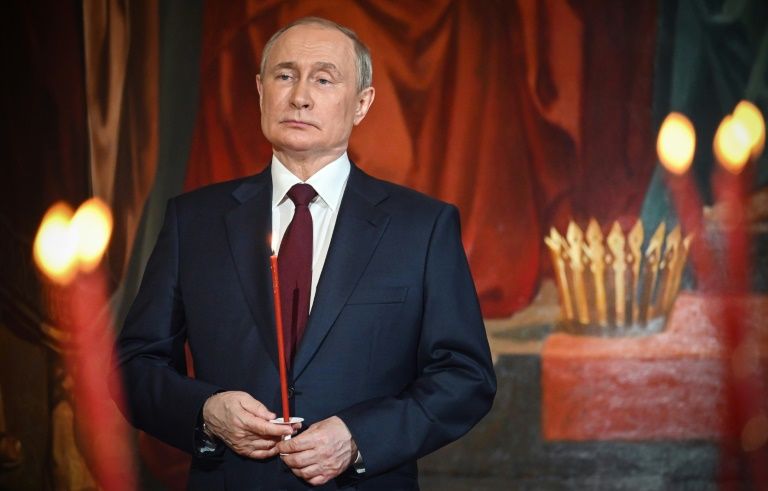
MOSCOW — Russian President Vladimir Putin offered an unusually candid public acknowledgment over the weekend of widespread fuel shortages gripping the country, conceding that Ukrainian missile and drone strikes on energy infrastructure have created real difficulties for Russian motorists, businesses and the agricultural sector, even as he insisted the situation remained under control.
The shortages have been visible across Russia for months, with long lines forming at petrol stations, fuel rationing spreading to dozens of regions, and refineries repeatedly damaged by Ukrainian strikes reaching from Moscow to the Black Sea coast. In Crimea, the Russian-annexed Ukrainian peninsula, drivers have been barred from filling their tanks altogether so that available fuel can be redirected to military vehicles. Despite the visible strain, Putin had largely avoided addressing the crisis directly in public until a weekend meeting with senior officials and oil executives.
Speaking candidly at that meeting, Putin acknowledged the toll the shortages have taken on ordinary Russians.
“You’re well aware that problems persist for both motorists and businesses,” Putin told the assembled officials. “Unfortunately, there are still queues at petrol stations, and finding the right grade of petrol isn’t always easy.”
Putin also pointed to the strain on Russia’s agricultural sector, noting that the country’s harvest depended on fuel supply schedules being met on time, an acknowledgment that ties the energy crisis directly to broader concerns about food production and the domestic economy heading into the back half of the year. According to independent Russian outlet Mediazona, 56 Russian regions are currently enforcing some form of fuel restriction, underscoring how widespread the disruption has become.
In a subsequent interview with Russian state television, Putin went further, offering what diplomatic observers described as an even more open assessment of the crisis than his earlier remarks to officials.
“We are currently seeing a certain shortage, but it’s not critical,” Putin said, while acknowledging that Ukraine’s attacks were “obviously creating problems.”
He pledged to ramp up production of air defense systems to better protect Russian energy infrastructure from further strikes, and said authorities would work to accelerate repairs at refineries that have already sustained damage from Ukrainian attacks. Regarding Crimea specifically, Putin admitted the peninsula currently had only “a few days’ supply” of fuel remaining, though he expressed confidence that additional fuel would be brought in to address the shortfall soon.
The directness of Putin’s comments marks a notable departure from his typical public posture on the war’s domestic costs. BBC diplomatic correspondent James Landale, reporting from Moscow, noted that the scale of the shortages and the resulting public awareness had likely left Putin with little choice but to acknowledge the reality on the ground, even as he continued to insist, as he has throughout the conflict, that Russia’s broader war effort was making progress.
Putin’s admission regarding Crimea’s fuel difficulties carries particular symbolic weight given the peninsula’s outsized importance both to ordinary Russians and to Putin personally. Since Moscow’s occupation of Crimea began in 2014, the Kremlin has transformed the peninsula into a major military base and a strategic anchor for controlling the Black Sea, using it as a launching point for Russia’s full-scale invasion of Ukraine in 2022. Any sign of strain there carries political resonance well beyond its immediate practical impact.
During the televised interview, Putin offered an explanation for why he chose to address the issue so openly, framing Ukraine’s strategy as an attempt to fracture Russian society and erode public support for the war effort, while pushing more Russians toward favoring negotiations to end the conflict.
“We won’t give them that chance,” Putin said, adding that Ukraine’s long-range strikes were having “absolutely no impact on the situation at the front line.”
That assessment is directly disputed by officials in Kyiv, who argue that Ukraine’s deep strikes inside Russian territory serve a dual purpose: bringing the tangible costs of the war home to ordinary Russian citizens while also forcing Russian military commanders to divert air defense resources and personnel away from the front lines in eastern Ukraine to protect domestic energy infrastructure instead.
The acknowledgment comes amid a period of growing confidence in Kyiv that battlefield momentum may be shifting in Ukraine’s favor. In recent months, Ukrainian forces have launched deep strikes against targets in both St. Petersburg and Moscow, intensified attacks on Crimea, and pursued a more aggressive strategy aimed at inflicting maximum casualties along the front line. Despite that shift in tactics, the Kremlin reaffirmed Monday that its core territorial objectives remain unchanged. Kremlin spokesman Dmitry Peskov said Russia’s position continues to be that Ukrainian forces must withdraw from four southeastern regions that Moscow claims as its own, territorial claims that Kyiv categorically rejects.
In the same interview, Putin claimed that Ukraine had signaled willingness to limit hostilities and begin negotiations, though he dismissed any such overture as a tactical maneuver designed to give Kyiv time to regroup and rearm rather than a genuine push toward peace.
“It is clear why this proposal is being made, because our counter-strikes deep into Ukrainian territory are much stronger, have greater impact and are, frankly, more destructive,” Putin said.
He went on to characterize Ukraine’s own strikes against Russia as an attempted “salvation” for what he described as a Ukrainian military that has been “catastrophically” depleted by years of fighting, while making clear that Moscow had no interest in offering Kyiv’s leadership any reprieve.
“But saving the Kyiv regime is not part of our plans,” Putin said.
The rare public airing of Russia’s fuel crisis offers one of the clearest signals yet of how Ukraine’s sustained campaign against Russian energy infrastructure is registering domestically, even as both sides continue to offer starkly different assessments of how much that pressure is actually shaping the broader trajectory of the war.

Israeli strikes kill at least four in Gaza despite Trump announcing breakthrough
Three dead in Idaho shopping center shooting

Retailers’ second-quarter earnings season is poised to begin in mid-August, and it may look a bit like a sandcastle being reclaimed by the sea: lumpy, all over the place, and with plenty of moving parts.
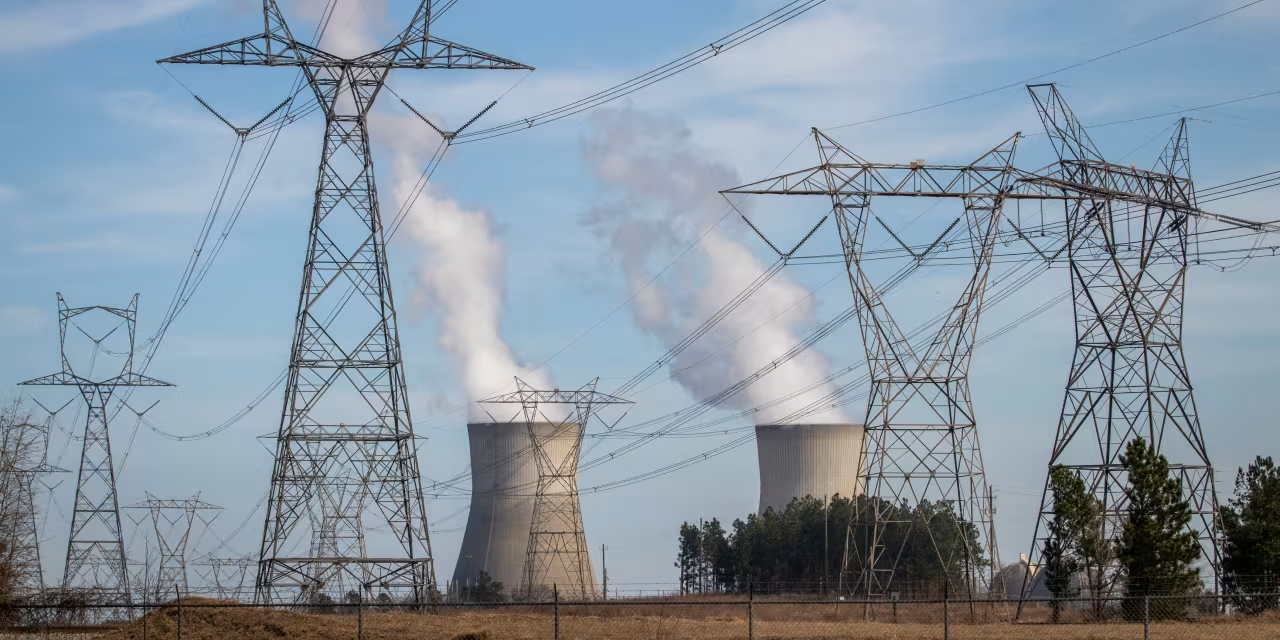
Westinghouse IPO Could Be America’s Biggest Nuclear Offering Yet

While 13 of the 14 present in the latest list have taken a dip in their rankings, four companies — Mukesh Ambani-led Reliance Petroleum, state-run Indian Oil Corp (IOC), realty major Unitech and housing loan giant HDFC — have completely moved out of the league.
The latest FT Global 500 list was published by the UK business daily Financial Times over this weekend, is based on the companies’ market capitalisation as on March 31, 2008. The previous rankings were based on December 2007-end figures.
Reliance Industries, flagship company of India’s biggest corporate house Mukesh Ambani group, is top ranked 80th in the latest list, topped by the US energy giant ExxonMobil.

Except for tobacco-to-consumer goods major ITC, ranked 484th, all other Indian companies have seen their rankings decline from the previous list.
Together, the market value of these 14 firms has dropped by about $ 150 billion since December last year and currently stands at about $ 440 billion.
There were 17 Indian companies in the previous list and had a total market capitalisation of about $ 590 billion.
In the country-wise ranking based on total market cap of all their companies present in the list, India has been placed 15th. The US is at the top with 169 companies worth a total $ 9.6 trillion, followed by UK, China, France and Japan.
Other countries ranked ahead of India include Germany, Canada, Switzerland, Russia, Spain, Brazil, Hong Kong, Italy and Australia.
In terms of the number of companies present in the list, India and Russia are jointly ranked ninth after the US (169), the UK (35), Japan (39), France (31), China (25), Canada (24) and Germany (22). Among the Indian firms, RIL is followed by two state-run firms ONGC and NTPC at 148th and 206th positions respectively.
While RIL has slipped 15 positions from its 65th rank in the previous list, ONGC and NTPC have also moved down from their 115th and 163rd ranks previously.
Other Indian firms include Sunil Mittal-led telecom giant Bharti Airtel at 218th (down from 193), realty major DLF at 329th (down from 195) and Anil Ambani-led Reliance Comm at 350th position (down from 252).
However, ITC climbed six spots to the 484th place, even as its market cap fell to $ 19.38 billion from $ 20.8 billion previously.
Realty major DLF saw the steepest market value fall of $ 40.66 billion, followed by the country’s biggest private sector lender ICICI Bank with a plunge of $ 38.51 billion and Steel Authority of India ($ 35.46 billion).
RIL, the country’s most valued firm, saw its market cap falling by about $ 21 billion, dipping from about $ 105 billion to $ 82 billion in the latest list.
In the global list, ExxonMobil has replaced China’s PetroChina at the top, while US industrial conglomerate GE has retained its third position. Other firms in the top 10 include Gazprom, China Mobile, Industrial and Commercial Bank of China, Microsoft, AT&T, Royal Dutch Shell and P&G.

8 ETF Winners in the ‘Pay Me Now’ Trade
Business
lastminute.com N.V. 2026 Q2 – Results – Earnings Call Presentation (OTCMKTS:LSMNF) 2026-08-01


Seeking Alpha’s transcripts team is responsible for the development of all of our transcript-related projects. We currently publish thousands of quarterly earnings calls per quarter on our site and are continuing to grow and expand our coverage. The purpose of this profile is to allow us to share with our readers new transcript-related developments. Thanks, SA Transcripts Team
NEW DELHI: Notwithstanding the turmoil in global economic environment, as many as six Indian firms, including Reliance Comm and Bharti Airtel, have been named among top 100 best-performing infotech companies in the world by a US magazine BusinessWeek.
The BusinessWeek’s latest annual list ‘The Infotech 100’, which ranks the firms on the basis of shareholder return, return on equity, total revenues and revenue growth, has ranked telecom major Bharti Airtel at the 21st position followed by Reddington India (55th) and RCom (66th).
The list is topped by US firms –Amazon.com and Apple– who have taken the top two spots this year. However, the magazine said in an accompanying report that “the dominance of US companies is in decline, the country has 33 companies among the IT 100 this year, down from 43 in 2007.”
Other Indian firms on the list, includes — Azim Premji-led Wipro at the 74th position, Satyam at 91 rank and HCL Technologies has been ranked at the 95th position among the list of 100 firms.
South African telecom firm MTN Group, which is in exclusive talks with Anil Ambani Group flagship firm Reliance Communications, has been ranked at the 12th position in the global list even ahead of global IT giants IBM and Microsoft, which are at 13th and 23rd ranks in the list, respectively.
Besides, the other fast emerging country China also has six companies among the top 100 Infotech companies in the world.
The magazine has compiled the information for the list by sorting through the financial results of 30,500 publicly traded companies and has ranked the technology players on four criteria –shareholder return, return on equity, total revenues and revenue growth.
The companies leading the list are those with the lowest aggregate ranking.
The companies which qualified had to have revenues of at least 300 million dollar then the collection of about 800 companies was divided into eight industry categories, such as software and semiconductors.
“Companies whose stock price has dropped more than 75 per cent, whose sales shrank, or where other developments raised questions about future performance were eliminated from contention.
“We also dropped some phone companies whose monopoly or near-monopoly power gives them an unfair advantage over competitors,” the magazine added.
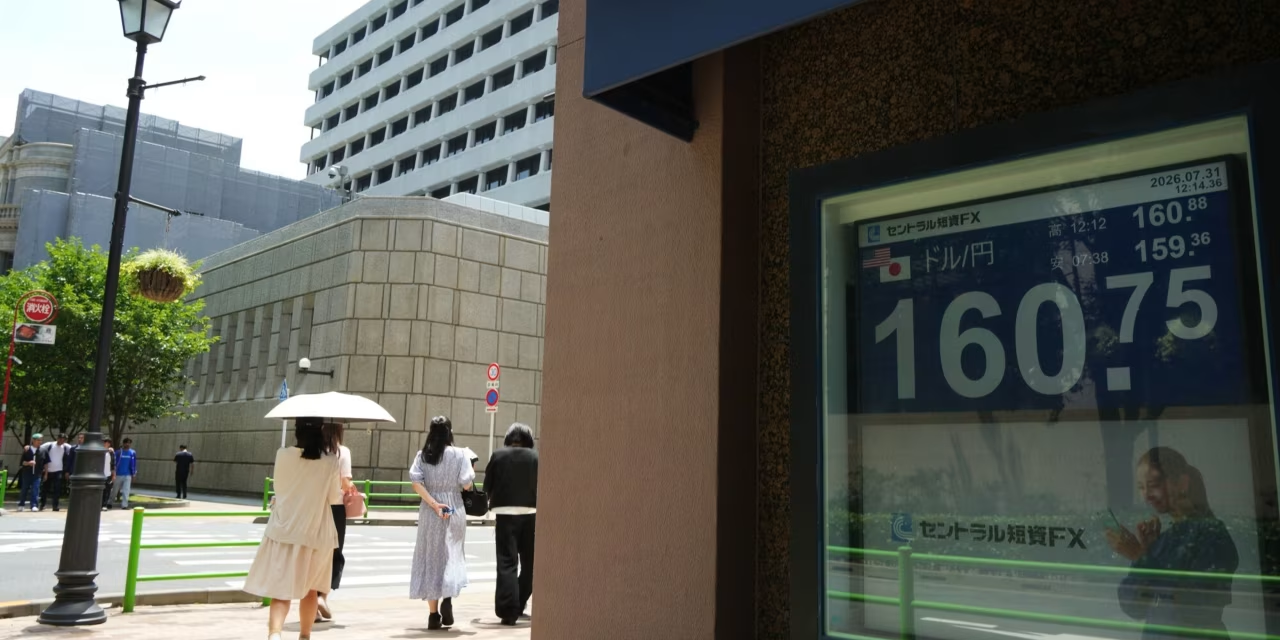
The U.S. Treasury Department has informed banks that it might make currency trades on Friday to support the Japanese yen and strengthen its exchange rate against the dollar, according to a person familiar with the matter.
The message was delivered by the Treasury to major banks on Friday via the New York Fed, which acts as the Treasury’s agent for trades in financial markets. Some banks were told to have executable trades ready to exchange Japanese yen for euros, according to people familiar with the matter. The U.S. holds some of its foreign-currency reserves in euros.
Copyright ©2026 Dow Jones & Company, Inc. All Rights Reserved. 87990cbe856818d5eddac44c7b1cdeb8

Chip stocks are on track for their worst monthly performance in nearly two decades.
The Philadelphia Semiconductor Index, or SOX, was up 2% on Friday, extending Thursday’s tech-dominated relief rally.
However, Friday’s gains were far from enough to offset what’s been a tough month for the semi group. In fact, the SOX is on track for its worst monthly performance since 2008, according to Dow Jones Market Data.

How is your enterprise tracking AI agent telemetry? Groundcover thinks it should never leave your cloud

@edwinRG #editz #shorts #money #stacks #Money #spread #fortnite #snoopdogg #dababy #lildurk #liluzi
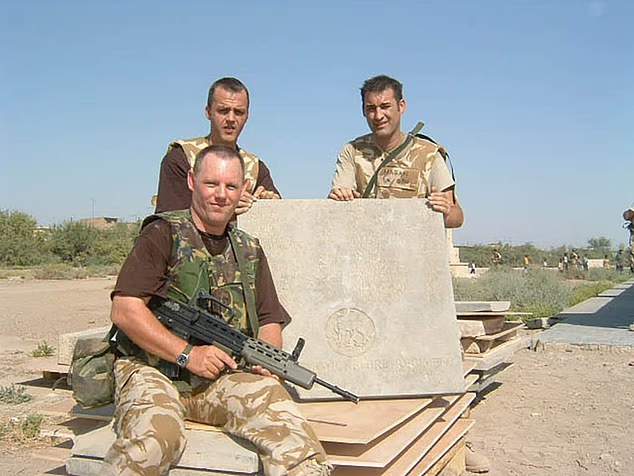
Fury of heroes’ families as Army crushes hundreds of war graves into gravel for drainage ditch


-
 Sports6 days ago
Commonwealth Games boxing: Jadumani Singh seals dominant 5-0 win over Pakistan’s Sumama Rehman to enter quarter-finals | Commonwealth Games News
-

 Business3 days ago
Why Trees Belong on the Risk Register
-

 Fashion1 day ago
Weekend Open Thread: Wit & Wisdom
-

 Tech6 days ago
Intel is reversing course and bringing hyper-threading back to its server chips
-

 Politics1 day ago
Meta enters AI-training agreement with far-right ‘propaganda rag’ Newsmax
-

 Politics6 days ago
Luke Littler dismantles Gerwyn Price to retain title in Blackpool
-

 Crypto World10 hours ago
MicroStrategy Post-Earnings CLARITY Act Push Could Add New Catalyst for Its Stock
-

 Politics5 days ago
The Part of the Electric Transition Nobody Wants to Discuss
-

 News Videos6 days ago
BITCOIN JUST ENTERED THIS CRITICAL ZONE…
-
 Entertainment4 days ago
‘Stargate’ Creator’s New Sci-Fi Series Returns for Season 3 Tomorrow
-

 Business4 days ago
Major shareholder moves on Canyon
-

 Crypto World7 days ago
XRP Ledger adds $2.6B as RWA inflows rank second
-

 Politics7 days ago
Spain sweeps the board at 2026 World Cup with individual awards
-

 News Videos3 days ago
Bitcoin Enters the 3rd Stage of the Bear Market
-
Crypto World19 hours ago
XRP Ledger v3.3.0 brings five institutional features
-

 Entertainment7 days ago
Sara Gilson Killed By Husband After Viral “Pedophile” TikTok Video
-

 Crypto World4 days ago
Kraken Enables Retail Access to Jersey Mike’s IPO via Tokenized Shares
-

 Tech5 days ago
New macOS Sequoia & Sonoma security updates for older Macs
-

 News Videos4 days ago
Claude: Build Financial Dashboards in Minutes (2026)
-

 Sports2 days ago
Seema Kaliramna Wins Discus Throw Bronze, Takes India’s CWG Medals Tally To 17
You must be logged in to post a comment Login