

Crypto World
AI Agents are Starting to Handle Money. This Blockchain Wants to Build Their Bank



For now, most AI agents still live inside safe boxes. They summarize documents. Write code. Search databases. Help customer support teams move faster.
In finance, they are already creeping into fraud detection, compliance, research, and back-office workflows. Cambridge Judge Business School found this year that 52% of financial firms are actively adopting agentic AI, with 23% already scaling or transforming around it.
Bond Labs, a blockchain superapp network, is betting on the next step. It wants AI agents to trade, borrow, lend, move funds, and eventually spend money across crypto and traditional payment rails.
The company has launched on 0G, an AI-native blockchain network, with a DeFi platform designed for both humans and autonomous AI agents.
Bond says its platform combines
- A spot decentralized exchange,
- Perpetuals exchange
- Lending and borrowing markets,
And also a planned neobank layer with fiat on/off ramps, global transfers, on-chain IBAN access, Visa debit cards, and yield-bearing accounts.
That is a large promise. It also arrives at a moment when the financial industry is trying to work out how much autonomy it can safely give to software that can reason, plan, and act.
The Agent Needs a Wallet
The idea behind Bond is simple enough. If AI agents are going to become economic actors, they need financial infrastructure.
A chatbot can tell a user how to rebalance a portfolio. An agent could, in theory, do it. It could move idle funds into a yield account, borrow against collateral, hedge exposure, or route money across chains and payment systems.
That shift requires more than a prompt window. It needs liquidity, execution venues, credit markets, identity checks, payment access, and risk controls.
Bond is trying to put those pieces into one environment.
Its DeFi layer includes a spot DEX based on Uniswap V3-style automated market-making, a perpetual DEX using a central limit order book model, and lending markets with dynamic interest rates.
The company also plans to add a neobank layer within the next three months, bringing fiat access, global transfers, Visa card functionality, and accounts connected to 0G Chain.
Bond also says it will build a real-world asset division, giving users and agents exposure to tokenised assets for trading, settlement, and investment.
In plain terms, Bond wants to be the financial operating system for AI agents.
The Money Is Following the Thesis
The launch comes with direct ecosystem support from 0G Labs.
Bond is backed by a $10 million incentive programme from 0G Labs, a $3.5 million direct investment, and a stated $50 million TVL target. The incentive programme will run over 12 months and will be tracked on-chain. Bond says AI-agent trades will be included in the rewards structure.
The goal is liquidity. Without it, an agent-facing financial platform is just an interface. With it, agents can actually execute trades, access lending markets, and move value without waiting for a human to manually approve every step.
“The vision of AI agents managing someone’s finances has been held back by fragmented infrastructure,” said Bond Labs CEO Taweh Beysolow. “Bond provides the missing layer DeFi primitives and a neobank where agents can trade, borrow, spend, and earn, all within a single platform.”
Michael Heinrich, CEO of 0G Labs, framed Bond as part of a wider AI economy.
“0G is building the foundational infrastructure for an AI-native economy, and a core part of that vision is giving autonomous agents the ability to transact, manage assets, and access financial services as easily as any human,” Heinrich said. “Bond is the first platform to fully realize that vision, combining institutional-grade DeFi with a user-friendly neobank, all on a blockchain designed from the ground up for AI agents.”
The Pipes Behind the Platform
Bond has also lined up infrastructure and liquidity partners.
The company says Turtle will support liquidity and incentive distribution, Re7 will act as a DeFi vault curator, Midas will provide vault infrastructure, and Wormhole will support cross-chain interoperability.
It has also named Cicada Capital, Diffuse, GSR, and Flow Traders as liquidity providers.
Those names are important because AI-agent finance will not work without deep markets. An agent that manages capital needs execution quality, reliable settlement, and enough liquidity to avoid poor pricing.
Essi, CEO of Turtle Club, said the pre-deposit campaign had to work for different types of participants.
“Bond is building a superapp for an audience that spans retail and institutional. The pre-deposits campaign needed DeFi-native LPs who could underwrite both ends. We structured it with the Bond team until the economics held without compromising what Bond was committing to its users. Proud to be working alongside them.”
The Risk Is No Longer Theoretical
Deloitte’s 2026 enterprise AI survey found that 74% of companies expect to use AI agents at least moderately by 2027. In finance, Cambridge found agentic AI adoption is already further along among fintechs than traditional institutions.
Regulators are watching the same trend. The Financial Stability Board has warned that AI is spreading across AML, KYC, fraud detection, credit risk, cybersecurity, portfolio management, and compliance.
The Bank of England has gone further, warning that autonomous agents could eventually transact for consumers, execute trading strategies, and amplify market volatility if many systems behave in similar ways.
That makes security central to Bond’s pitch. The company says it has taken a security-first approach, including smart contract audits by Hashlock. That will matter as DeFi platforms remain exposed to exploits, oracle failures, bridge risk, liquidity shocks, and bad incentive design.
The harder question is governance. If an AI agent makes a trade, approves a payment, or borrows against collateral, the system needs clear rules for consent, limits, liability, and emergency shutdowns.
Bond’s launch is an early test of whether AI agents can move from assistants to financial actors. The infrastructure is starting to appear.
But the market now has to prove that autonomous finance can work without turning speed into fragility.
The post AI Agents are Starting to Handle Money. This Blockchain Wants to Build Their Bank appeared first on BeInCrypto.



Strategy has received another Wall Street price target cut after Canaccord lowered its valuation on the company while maintaining that Bitcoin’s long-term investment case remains intact.
Summary
- Canaccord cut Strategy’s price target to $130 but said its long-term Bitcoin investment thesis remains unchanged.
- The brokerage believes Strategy’s Bitcoin-focused business model is still viable if Bitcoin posts moderate annual gains.
- Other analysts, including TD Cowen, Cantor Fitzgerald, and Benchmark, continue backing Strategy despite lowering or maintaining price targets.
Bitcoin outlook remains intact despite lower valuation
According to a research note from Canaccord, the brokerage reduced its price target for Strategy to $130 from $163, citing the company’s prolonged share price decline rather than any change in its long-term view on Bitcoin. The revision comes as Strategy stock has struggled for months, even though the firm said its underlying investment thesis for the cryptocurrency remains unchanged.
Strategy shares closed the previous trading session at $86.93, only slightly above their 52-week low of $81.81 and roughly 77% below where they traded a year ago. The stock later rebounded 8.12% to $93.96 after the company introduced its new Digital Credit Capital Framework.
Canaccord said Bitcoin continues to benefit from limited supply and growing adoption of blockchain technology. The brokerage added that the cryptocurrency has become more established within financial markets and is no longer facing the same uncertainty over whether it should be viewed primarily as a speculative asset or a long-term store of value.
The firm also maintained that Strategy’s Bitcoin-focused corporate model remains workable as long as Bitcoin delivers moderate annual appreciation. At the same time, Canaccord acknowledged that recent market performance has fallen short of those expectations.
“We think there is nothing broken here, either in the company’s model or in bitcoin, which suggests a pendulum swing back makes sense sometime over the medium term.”
Separately, data cited in the report showed Strategy’s Relative Strength Index has moved into oversold territory, while Fair Value analysis suggested the shares could be trading below their estimated intrinsic value.
Capital strategy continues to receive support from analysts
The latest revision follows another recent target cut from TD Cowen, which, as previously reported by crypto.news, lowered its price target on Strategy to $260 from $400 while keeping a “buy” rating. According to TD Cowen, the lower valuation was driven by a more conservative long-term Bitcoin price forecast rather than concerns about Strategy’s newly introduced Digital Credit Capital Framework.
TD Cowen said its revised target still implies roughly 200% upside from current trading levels. The brokerage also described the new capital framework as a constructive step that could improve Strategy’s financial flexibility, even after the stock surrendered part of its initial gains following the announcement.
In a regulatory filing dated June 29, Strategy disclosed that its Digital Credit Capital Framework allows the company to raise up to $1.25 billion through Bitcoin sales if needed. According to the filing, those proceeds may be used to maintain U.S. dollar reserves, fund preferred dividend payments, meet interest obligations, strengthen cash balances, and finance future share repurchases.
The same filing also authorized up to $1 billion in repurchases of the company’s Digital Credit Securities, including STRC, STRF, STRD, and STRK, when management determines buybacks would improve the firm’s capital structure. Strategy further disclosed that it has paused additional Bitcoin purchases while selling about $1.15 billion worth of MSTR shares as part of its capital management plan.
Elsewhere on Wall Street, Cantor Fitzgerald reaffirmed its Overweight rating and $212 price target, citing confidence in Strategy’s liquidity plans. Benchmark also reiterated its Buy rating and maintained its $570 price target, noting that although the company’s preferred shares have weakened in recent months, Strategy has continued adding Bitcoin to its balance sheet.
Crypto World
Ark Invest bought more than $75 million of COIN, CRCL, BLSH shares during June bloodbath


Ark Invest has a tendency to load up on shares in cryptocurrency companies when their prices are depressed, and June was no exception.
Bitcoin , the largest cryptocurrency, recorded its worst month in four years, and digital asset firms’ share prices suffered accordingly, which Ark read as a buying opportunity.
The St. Petersburg, Florida-based investment manager bought $44 million worth of shares in crypto exchange Coinbase (COIN), based on the closing prices of the days on which purchases were made. It purchased $25.25 million worth of equity in Circle Internet (CRCL), issuer of the world’s second-largest stablecoin USDC, and $8.2 million worth of crypto exchange Bullish (BLSH), the parent company of CoinDesk, according to emailed disclosures.
Shares of Circle slumped 40% in June, ending the month at $62.63. The decline included an 18% drop on June 30 following the debut of rival stablecoin Open USD, which is backed by more than 140 companies, including Coinbase, Stripe, Visa, Mastercard and BlackRock.
COIN ended June just under 20% lower at $146.19, while BLSH fell 27% to $23.43.


The Winklevoss twins have transferred about $67 million worth of Bitcoin and Ethereum to Gemini wallets, with Arkham Intelligence identifying the transactions as matching their usual selling pattern.
Summary
- Arkham Intelligence flagged the Winklevoss twins’ $67 million Bitcoin and Ethereum transfers to Gemini as matching previous selloff patterns.
- Bitcoin remains under pressure as Citigroup cuts its price target and ETF outflows continue weighing on market sentiment.
- Ethereum holds near key support despite continued treasury purchases from SharpLink and Bitmine failing to offset whale selling.
According to blockchain analytics firm Arkham Intelligence, Cameron and Tyler Winklevoss moved roughly $60 million in Bitcoin (BTC) and another $7 million in Ethereum (ETH) from custody to hot wallets linked to the Gemini crypto exchange on July 1. Arkham characterized the transfers as consistent with the twins’ previous selloff behavior, although the firm did not confirm that the assets had already been sold.
The latest transfers come as Bitcoin and Ethereum continue trading under pressure following quarter-end selling and persistent weakness in investor sentiment. Recent price declines have also coincided with reduced expectations that the CLARITY Act will pass this year after U.S. President Donald Trump disclosed a $1.4 billion crypto-related windfall, a development some market participants have linked to shifting legislative expectations.
Since accumulating Bitcoin in 2015, the Winklevoss twins have realized about $1.7 billion in profit, according to Arkham Intelligence. Despite the latest transfers, they still control more than $300 million worth of Bitcoin. The July movement also follows earlier transfers to Gemini, including about $67.5 million in Bitcoin during June and another $130 million moved in March.
Bitcoin continues to face selling pressure
Citigroup has turned more cautious on the two largest cryptocurrencies, lowering its 12-month Bitcoin price target to $82,000 from $112,000 while reducing its Ethereum forecast to $2,240 from $3,175.
Bitcoin fell as low as $57,747 over the past 24 hours before recovering to trade near $58,600. Trading volume rose about 9% during the same period, while June recorded roughly $4.5 billion in net outflows from U.S. spot Bitcoin exchange-traded funds, adding to the pressure on market sentiment.
Commenting on current market conditions, crypto analyst Ted Pillows wrote, “Sellers are still dominating, while Coinbase Bitcoin Premium is at its lowest level this cycle.” He added that losing the $57,000-$58,000 support region could expose Bitcoin to a deeper decline toward the $50,000 level.
Ethereum buyers continue accumulating despite weakness
Ethereum has also remained under pressure even as several companies continue adding the asset to their corporate treasuries. As previously reported by crypto.news, quarter-end selling, whale distribution, and weak institutional flows have kept Ether pinned near the $1,500 support area despite ongoing buying from public companies.
Corporate accumulation has nevertheless continued. SharpLink recently disclosed the purchase of another 10,000 ETH at an average price of $1,611, spending about $16.1 million to expand its treasury.
Separately, Bitmine acquired 27,084 ETH over the past week, increasing its holdings to more than 5.7 million ETH. According to crypto.news, those purchases have so far failed to offset continued selling by whales and institutional investors.
Ether was trading around $1,572 at the time of writing, down about 1% over the past 24 hours after moving between an intraday low of $1,549 and a high of $1,600. Trading volume also declined during the session.
Crypto.news reported earlier today that the $1,500-$1,510 region remains Ethereum’s most important support zone. A break below that level would invalidate the current consolidation structure and could open the door to declines toward $1,400 before attention turns to the $1,200 area identified by several market participants.

US spot Bitcoin ETFs continued to see money leaving the funds on June 30, as investors pulled out $223 million – for the last nine days in a row. In total, the ETFs saw $4.51 billion exit during June, their biggest monthly outflows since launching in January 2024.
Tim Sun, Senior Researcher at HashKey Group, said that while the ETF outflows certainly reflect a weakening of marginal buying pressure for Bitcoin, the core issue isn’t just that ETF funds are flowing out – it’s where those outgoing funds are actually headed.
Bitcoin ETF Exodus
In a statement to CryptoPotato, Sun said that if investors were simply moving their funds into cash or short-term bonds, it would indicate a temporary shift toward safer assets while markets waited for macroeconomic uncertainty to ease. Instead, the researcher said that fund flows since the beginning of the year suggest that institutional investors are reallocating capital to sectors such as artificial intelligence (AI), semiconductors, and the GPU supply chain.
“The market hasn’t completely lost its risk appetite; rather, it is re-selecting its preferred risk assets.”
Sun explained that Bitcoin and AI-related stocks share several characteristics, such as long duration, high volatility, and high narrative elasticity. However, institutional investors currently favor the AI supply chain because companies in that sector are able to turn revenue and capital spending into business results much faster than Bitcoin can deliver returns through its investment narrative.
As a result, he believes the current ETF outflows should be viewed as a sign that Bitcoin’s short-term appeal has weakened compared with AI and semiconductor investments, rather than evidence that the long-term investment case for crypto has disappeared. Sun described the trend as a “capital reallocation within risk assets: Bitcoin’s marginal attractiveness is temporarily weaker than that of AI and semiconductors.”
At the same time, he noted that Bitcoin could attract institutional capital again if the AI trade becomes overcrowded and experiences a correction or if macro liquidity improves.
The Strategy Crisis
ETF outflows aren’t the only headwind for Bitcoin. Strategy, the largest corporate holder of BTC, also faces growing challenges in maintaining its financing model. Sun acknowledged that downside risks remain significant. He said the market’s main concern is not any single development but the simultaneous weakening of the two major sources of marginal buying demand that previously supported Bitcoin’s rally.
On one side, ETFs have shifted from consistent inflows to outflows, while on the other, the market is re-pricing the financing capacity of Strategy. Even so, Sun stressed that the company’s biggest risk is not necessarily that it will trigger a broader market sell-off, but that its ability to keep purchasing BTC at the same pace could decline.
“What truly needs to be observed is whether it will be forced to alter its financing cadence, replenish cash reserves, slow down its buying pace, or even pause purchases altogether.”
If Strategy pauses its buying, Sun stated that it “might not necessarily be a bad thing, because it means the previous distortion of true supply and demand – caused by Strategy’s financial flywheel model – will be alleviated.” In that case, he added Bitcoin would have the opportunity to establish price support based on genuine market demand instead of relying primarily on ETF inflows and Strategy’s purchases.
The post The Vanishing Bitcoin Bid: Where Are the ETF Billions Going? appeared first on CryptoPotato.


Edel said it detected and contained the exploit, then paused all of its version-one contracts, which remain frozen, and warned users not to interact with them.
The team added it had traced the attacker’s transactions and is coordinating with exchanges, and that it has offered the attacker a whitehat settlement, a deal that lets a hacker return most of the funds in exchange for a fee and no legal pursuit, within a set window.
No depositor will take a loss, Edel noted, with the team absorbing the bad debt and restoring balances one for one. It is deploying a version two with a redesigned pricing setup meant to block this kind of manipulation, and promised a full technical breakdown to follow.
While the amount is small, the method sits in one of DeFi’s most persistent categories of exploit.
Manipulating the price a protocol reads, rather than breaking into it, ranks as the second most common smart-contract vulnerability in the OWASP Smart Contract Top 10 vulnerabilities for 2025, and security researchers at CertiK describe oracle price manipulation as one of the field’s most common attack vectors.
Alongside cross-chain bridges, which produced the year’s largest single thefts, including the $292 million drained from Kelp DAO in April, price manipulation is where much of the money keeps going, and in most of these, the code works as written.

Key Takeaways
- Shares of SanDisk tumbled 9.44% during Tuesday’s session even as Bank of America issued an optimistic price target increase
- Bank of America elevated its SNDK price objective from $2,100 to $2,500 while reiterating its Buy recommendation
- BofA’s Wamsi Mohan anticipates average selling prices could surge as much as 35%, while bit growth may increase 13% sequentially
- The memory maker has soared 800% in 2024 and an eye-popping 4,755% over the trailing year, reaching a $323 billion market capitalization
- Valuation concerns include a forward price-to-earnings ratio of 33 — exceeding both Nvidia and Micron — alongside troubling technical indicators
SanDisk shares experienced a steep decline on Tuesday, surrendering 9.44% of their value during the trading session. The selloff occurred paradoxically on the very day that Bank of America Securities announced an upward revision to its price target, moving from $2,100 to $2,500.
Bank of America’s equity analyst Wamsi Mohan maintained his Buy recommendation on the shares. His optimistic thesis centers on the persistent mismatch between NAND flash memory supply and demand, a condition he anticipates will persist through 2027.
Mohan’s research indicates SanDisk’s average selling prices could experience gains of up to 35%. Additionally, he projects bit growth — representing the total volume of memory units delivered — will expand by 13% on a sequential quarter basis.
Using these assumptions as a foundation, Bank of America now forecasts that SanDisk will report $9.1 billion in revenue for the June quarter alongside earnings per share of $37.01. These projections exceed the Street’s current consensus estimates of $8.35 billion in revenue and $34.26 in EPS.
For the subsequent quarter, BofA’s model anticipates revenue reaching $11.5 billion with EPS climbing to $48.55.
Multi-Year NAND Supply Deals Enhance Earnings Predictability
A critical element supporting Mohan’s optimistic outlook involves SanDisk’s strategic emphasis on securing long-term NAND supply agreements, referred to as NBMs. These multi-year commitments guarantee future revenue streams and provide greater clarity for investors modeling future profitability.
Bank of America anticipates widespread adoption of these contractual arrangements among cloud infrastructure providers and enterprise clients. The investment bank also highlighted that these agreements are designed to preserve gross margin levels within SanDisk’s established target parameters.
This strategic pivot has contributed significantly to SanDisk’s extraordinary market performance. The stock has skyrocketed 800% since the beginning of the year and an astonishing 4,755% over the past twelve months. This explosive growth has transformed what began as a Western Digital spinoff into a company valued at $323 billion.
The bullish sentiment extends beyond Bank of America. Mizuho Securities increased its target from $1,825 to $2,200. Cantor Fitzgerald established an even higher objective at $2,900. Susquehanna Financial Group represents the most aggressive bull case with a $3,250 price target.
The analyst community’s consensus rating stands at Strong Buy — featuring 14 Buy ratings, two Hold ratings, and zero Sell recommendations over the most recent three-month period. The mean price target across all analysts sits at $1,979.38, suggesting approximately 3% downside from present trading levels.
Growing Concerns About Valuation and Market Dynamics
Notwithstanding the widespread analyst enthusiasm, multiple risk factors deserve consideration — and Tuesday’s sharp decline serves as a cautionary reminder.
SanDisk’s forward price-to-earnings multiple has expanded to 33 times, surpassing Nvidia at 22 times and Micron Technology at 18 times. This valuation premium has begun attracting scrutiny from market participants.
Supply-side dynamics present another concern. Elevated memory pricing could incentivize rival manufacturers including Micron, Kingston Technology, and Kioxia Holdings to accelerate production capacity, which would ultimately exert downward pressure on pricing.
From a technical analysis perspective, the weekly chart reveals a bearish divergence in the Relative Strength Index. The RSI has been declining even as the stock price has continued advancing — a formation that frequently precedes price corrections.
The equity currently trades at $2,238, substantially above its 50-day moving average of $1,458.

Bitcoin has climbed back above $60,000 after Federal Reserve Chair Kevin Warsh declined to signal the direction of future interest rate decisions during an ECB policy discussion.
Summary
- Bitcoin rebounded above $60,000 after Fed Chair Kevin Warsh declined to signal the future path of interest rates.
- CME FedWatch shows markets still expect rates to remain unchanged in July despite lingering inflation concerns.
- Polymarket continues to price in a chance of a 2026 rate hike, while Morgan Stanley expects rates to stay on hold this year.
According to data from crypto.news, Bitcoin (BTC) traded around $60,175 at the time of writing after rebounding about 3% from an intraday low below the key $58,000 level. The move followed comments from Warsh, who again avoided offering forward guidance on monetary policy while reiterating that future decisions will depend on incoming economic data.
Bitcoin rebounds as Warsh avoids policy signals
Speaking during an ECB Forum panel, Warsh declined to say whether the Federal Reserve would raise interest rates at the July Federal Open Market Committee meeting. Instead, he repeated the position he adopted after taking office that the central bank would not pre-commit to future policy moves and would continue responding to economic data as it becomes available.
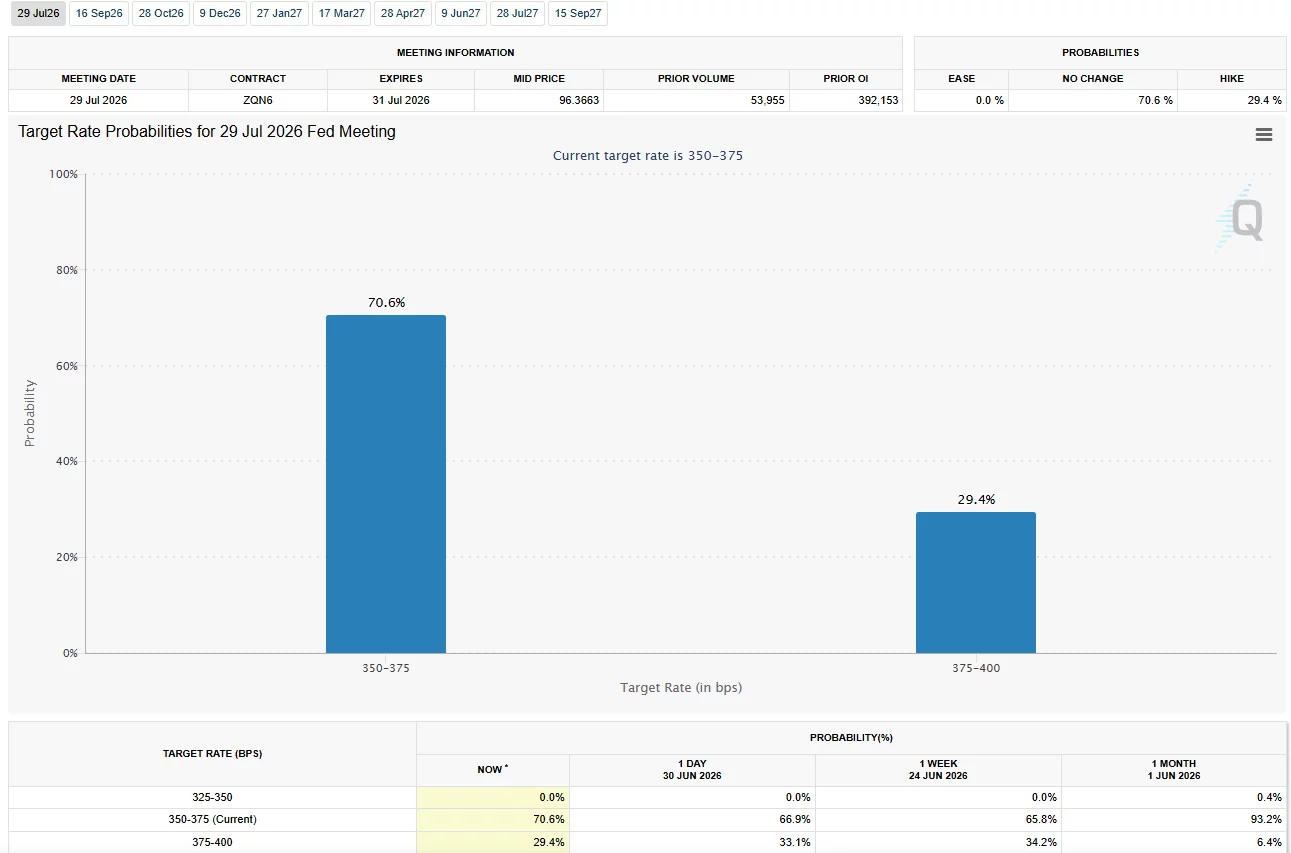
His remarks came as traders largely continued to expect no change in interest rates later this month. According to CME FedWatch data, markets currently assign a 70.6% probability that the Federal Reserve will leave rates unchanged at the July FOMC meeting.
Warsh also addressed inflation, saying expectations had declined during the first four weeks of the recent period despite concerns tied to the U.S.-Iran conflict. He added that inflation risks had eased while reaffirming the Federal Reserve’s commitment to returning inflation to its 2% target.
As crypto.news reported after the June FOMC meeting, Warsh also left rates unchanged at that gathering. Bitcoin fell to around $65,430 following the decision, while Ethereum traded near $1,770. The Federal Reserve’s updated projections at the time showed that nine policymakers expected at least one rate increase before the end of the year.
Those projections have continued to shape market expectations even after Warsh reiterated at the ECB Forum that future policy decisions would depend on incoming economic data.
Rate hike expectations continue to pressure crypto
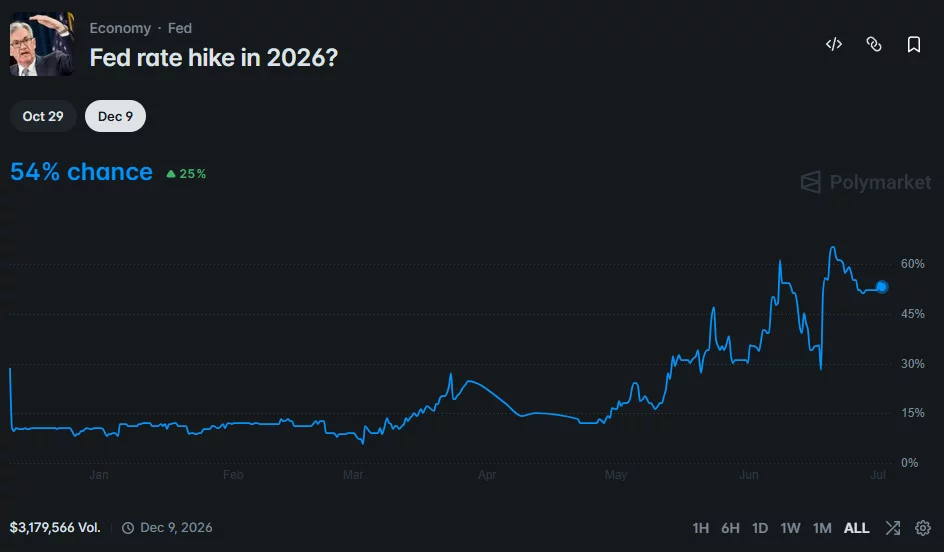
Although traders see little chance of a July rate increase, expectations for additional tightening later this year have not disappeared. According to Polymarket data, there is currently a 54% probability that the Federal Reserve will raise interest rates before the end of 2026.
Higher borrowing costs have generally remained a headwind for cryptocurrencies because elevated interest rates tend to support demand for cash and short-term fixed-income assets over riskier investments such as Bitcoin.
Separate reporting by crypto.news also noted that Morgan Stanley expects the Federal Reserve to keep rates unchanged through the rest of the year. The bank nevertheless warned that rate hikes could return if inflation remains persistent or if the unemployment rate falls further.
Outside monetary policy, another source of uncertainty for Bitcoin has come from corporate supply. As previously reported by crypto.news, the possibility that Strategy could sell as much as $1.25 billion worth of Bitcoin has remained one factor contributing to selling pressure in the market.
Political attention has also stayed on Federal Reserve policy. Before Warsh became chair, President Donald Trump repeatedly called for lower interest rates. After the June decision to keep rates unchanged, however, Trump responded without strong criticism and continued to praise the new Fed chair while receiving no timeline for future rate cuts.


The downgrade marks a sharp reversal from Citi’s previous outlook, which assumed passage of U.S. digital asset market structure legislation would spur adoption among financial advisors and traditional investors. The bank now believes that timeline has slipped, leaving the market without a meaningful catalyst.
Saunders said ETF flows continue to be the main force behind crypto prices, with recent demand turning negative as investors pulled back from risk.
According to the bank’s analyst, sentiment has also been hurt by concerns that digital asset treasury (DAT) companies could become net sellers of bitcoin. Recent corporate actions by Strategy amplified those fears despite involving relatively modest BTC sales.
The report noted that bitcoin and ether both remain below key technical levels, including their 200-day moving averages, while speculative capital has shifted toward AI-related investments.
The bank’s revised forecasts assume flat ETF flows in its base case. In its bull case, stronger retail and institutional adoption lifts bitcoin to $108,000 and ether to $2,932. Its bear case, based on recessionary macro conditions and continued ETF outflows, sees BTC falling to $53,000 and ETH to $1,094.
While the bank’s equity strategists have become more constructive on U.S. stocks, providing some support through crypto’s equity correlation, the report said that positive macro factors are insufficient to offset weakening flows.


A new independent non-profit, Ethereum Institutional, has launched with the goal of accelerating institutional adoption of Ethereum, its layer-2 networks and the broader ecosystem.
The organization is led by David Walsh, Marius Smith and Matthew Dawson. Walsh previously led the Ethereum Foundation’s enterprise efforts, while the organization said its leadership brings experience spanning institutional engagement, capital markets and Ethereum ecosystem development. It said its mission is to provide institutions with a neutral, independent point of contact as they evaluate Ethereum for tokenization, stablecoins and other onchain financial infrastructure.
In announcing the initiative on X, Ethereum Institutional said institutions need “a credible, independent front door” to the Ethereum ecosystem. While Ethereum’s neutrality is one of its defining strengths, the group argued, that neutrality has often left enterprises without a clear organization to engage as they make long-term infrastructure decisions.
The launch comes as the Ethereum Foundation continues to narrow its role to stewarding the core protocol, with ecosystem participants increasingly spinning up independent organizations focused on specific areas such as business development, institutional outreach and developer support. The shift follows broader changes at the foundation, including leadership restructuring and longstanding community calls for greater transparency.


Investment bank Standard Chartered has initiated coverage of Morpho, calling the lending protocol a dual-play on decentralized finance (DeFi) that combines a lending market with infrastructure for onchain banks and asset managers.
The bank has a $60 price target for MORPHO by the end of 2030, implying roughly 33x upside from its current price. This would see the token outperform both bitcoin and ether (ETH) over the same period.
MORPHO was more than 13% higher over 24 hours, trading around $2.13 at publication time.
“Given its status as one of the largest DeFi lending protocols and its comfortable financial position (it just raised $175 million in VC funding), we think Morpho can scale to meet the expanding base of assets deployed in DeFi,” wrote Geoff Kendrick, head of digital assets research at Standard Chartered, in the Wednesday report.
Decentralized finance has rebounded sharply over the past year as institutional interest in tokenized real-world assets and onchain lending accelerated. Lending protocols have benefited from rising stablecoin adoption and renewed demand for crypto credit, while infrastructure providers that enable asset managers and financial institutions to deploy capital onchain have emerged as one of the sector’s fastest-growing segments.

Inside the Royal Family Rift Divide Ahead of Harry’s Visit

Why isn't Donald Trump at the US match against Bosnia?

Matt Cardona names Shotzi, Richard Holliday and Ben Bishop as indie stars to watch




![BIS Just Gave XRP Holders Another Massive Clue! The XRP Connection Is Impossible To Ignore! [INSANE]](https://wordupnews.com/wp-content/uploads/2026/07/1782927079_maxresdefault-80x80.jpg)

-

 Fashion5 days ago
Weekend Open Thread: Staud – Corporette.com
-

 Politics5 days ago
The House | Manchesterism won’t survive the painful trade-offs unless it gets citizens on board
-

 Crypto World2 days ago
Strategy authorizes up to $1.25B in Bitcoin sales under new capital plan
-

 Politics6 days ago
Potential 2028er World Cup attendee leaderboard
-

 Business5 days ago
Asia stock markets slide as tech shares slump
-

 News Videos3 days ago
MAJOR BITCOIN & MARKET UPDATE!!!! (MUST WATCH ASAP!!!)
-

 Tech6 days ago
A Look At A Gaggle Of Transputer Boards
-
 Crypto World6 days ago
Dell (DELL) Shares Tumble Over 5% Following Analyst Downgrade to Hold
-

 Crypto World4 days ago
Coinbase, Circle Deepen Crypto Stock Losses Despite Resilient S&P 500
-

 Business2 days ago
Australia treasurer says alleged access of prime minister’s bank data ’incredibly concerning’
-

 Crypto World5 days ago
Kraken's xStocks Opens Bending Spoons IPO Registration to EEA Retail
-

 Sports5 days ago
FIH Pro League: India defeat Pakistan 7-1, register biggest win of campaign | Other Sports News
-
 Crypto World6 days ago
Bitcoin Sparks $600M Hourly Liquidations With $65,000 Set To Become Resistance
-

 Tech4 days ago
Bluekit phishing kit adopts browser-in-the-middle for login theft
-

 Tech4 days ago
Russian hackers now target Signal backup recovery keys
-
 Crypto World5 days ago
Hyperliquid Named on Singapore MAS Investor Alert Register
-

 Crypto World5 days ago
RTX holders must register wallets before token distribution begins
-

 Crypto World7 days ago
Ripple and SBI launch RLUSD in Japan after JFSA approval
-

 Tech2 days ago
Anonymous researcher drops 0-day ‘exploitarium’ repo
-

 Sports5 hours ago
Broncos roster: OL Ben Powers (No. 74) entering final year of contract
You must be logged in to post a comment Login