Connect with us
DAPA Banner
DAPA Coin
DAPA
COIN PAYMENT ASSET
PRIVACY · BLOCKDAG · HOMOMORPHIC ENCRYPTION · RUST
ElGamal Encrypted MINE DAPA
🚫 GENESIS SOLD OUT
DAPAPAY COMING

Business

Intel Stock Slides 7% Today as Profit-Taking Hits One of 2026’s Most Remarkable Chip Stock Turnarounds

Published

on

AMD CEO Lisa Su unveiled the chip giant's latest line of products during a keynote speech at Computex 2024 in Taipei

Intel shares fell sharply Wednesday, declining more than 7% in a session of heavy profit-taking that pulled back one of the stock market’s most dramatic turnaround stories of the year, even as the broader context for the company’s recovery over the past 12 months remained extraordinary by nearly any measure.

Shares of the Santa Clara, California-based chipmaker were trading at $129.38 as of 10:44 a.m. EDT, down $10.25, or 7.34%, on the day. The pullback follows a run that has taken Intel from a 52-week low of just $18.97, reached on August 1, 2025, to a 52-week and all-time closing high of $141.45 hit on June 22, a gain of more than 645% over less than 12 months that ranks as one of the most stunning single-stock recoveries in the semiconductor sector’s recent history.

Wednesday’s decline represents the stock pulling back from that all-time high after a remarkable sprint higher, consistent with what several technical analysts had flagged as a likely correction point. Chart watchers had noted a double-top formation developing near the $140 to $142 zone over the past week, with a bearish engulfing candlestick pattern on the weekly chart suggesting the kind of rejection at resistance that often precedes a consolidation phase, particularly in a stock that had appreciated as rapidly and as dramatically as Intel has over the past several months.

The stock’s six-month return stands at approximately 273%, while its year-to-date gain through the end of June was roughly 270%, making Intel one of the standout performers not just within the semiconductor sector but across the entire S&P 500 for the first half of 2026. CNBC reported that record chip stock gains in the second quarter added $2 trillion in combined value to Micron, Intel and AMD.

Advertisement

That extraordinary run has been driven by a combination of a broader AI semiconductor boom and company-specific catalysts tied to Intel’s restructuring under Chief Executive Lip-Bu Tan, who took over the company in March 2025 following a turbulent period of leadership transitions and strategic uncertainty. Tan inherited a company that had lost significant ground to rivals TSMC and AMD in the foundry and client computing markets, respectively, and whose stock had fallen to historically low levels by mid-2025 amid persistent revenue declines and doubts about whether the company’s next-generation manufacturing processes could be executed on schedule.

The recovery began in earnest following Intel’s first-quarter 2026 results, which showed the company’s turnaround plan gaining traction. Revenue for the quarter came in at $13.57 billion, modestly below the prior quarter’s $13.67 billion but within range of analyst expectations, while the company reported ongoing progress on its 18A manufacturing process node, a key technology milestone that management has framed as critical to Intel’s ambitions in the contract foundry market. Intel’s Intel Foundry division, formerly known as Intel Foundry Services, signed new customers during the quarter and advanced existing commitments with major technology companies that had agreed to test the 18A process for potential high-volume production.

Cantor Fitzgerald analyst C.J. Muse raised the firm’s price target on Intel to $150 from $90 and maintained a Neutral rating, noting the AI infrastructure buildout as the primary driver of Intel’s improved positioning. Muse also said Intel has a cost advantage over key rivals in certain segments, a factor that had contributed to Intel stock surging on word of that cost advantage over a key competitor.

Beyond the foundry narrative, Intel has continued to expand its presence in the AI accelerator market, where the company’s Gaudi 3 chip has won incremental customer commitments from cloud service providers and enterprise customers looking for alternatives to Nvidia’s dominant GPU lineup, particularly in cost-sensitive deployments where the performance-per-dollar calculation favors Intel’s offering. The company has also continued to build out its AI PC product line under the Intel Core Ultra brand, positioning itself to capture a wave of consumer and enterprise PC upgrades driven by the increasing integration of AI capabilities directly into device hardware.

Advertisement

TipRanks reported that Intel is taking advantage of America’s 250th birthday promotional opportunities in AI and robotics production, with commentary describing the current moment as “a pivotal moment for the nation” and Intel’s positioning within domestic AI semiconductor manufacturing as central to its near-term narrative.

A note of caution, however, came in a report citing ByteDance racing to mass-produce custom AI chips by 2027, cutting out both AMD and Intel from certain Chinese AI workloads. That development, combined with broader investor concerns about the pace of AI infrastructure capital spending and the increasingly competitive landscape for data center processors, has contributed to some erosion in the bull case for Intel’s AI revenue growth assumptions in recent analyst commentary.

Intel’s next major milestone is its second-quarter 2026 earnings report, scheduled for after the close of trading on July 23. That report will give investors their clearest view yet of whether the first-quarter momentum in foundry customer wins and AI chip revenue has continued into the second quarter, and whether management’s guidance for the back half of the year reflects the kind of acceleration that would justify the stock’s current premium valuation relative to where it sat less than a year ago. The stock currently trades at a normalized price-to-earnings ratio of approximately 245, a figure that reflects how far forward investors are looking rather than any near-term profitability milestone, given that the company is still in the early stages of its foundry buildout and is not expected to generate the kind of earnings that would support that multiple on a near-term basis.

For now, Wednesday’s pullback appears to be a healthy, technically driven consolidation following one of the sharpest runs in the stock’s multidecade history, rather than a fundamental shift in the investment thesis. Whether the stock can recover back toward its all-time highs in the weeks ahead will likely depend on how Intel’s earnings report later this month addresses the outstanding questions about the pace of foundry customer adoption, the competitive standing of the Gaudi AI accelerator lineup and the broader trajectory of the 14A manufacturing process that management has targeted for the 2028 to 2029 timeframe as the next step beyond its current 18A node.

Advertisement
Continue Reading
Click to comment

You must be logged in to post a comment Login

Leave a Reply

Business

Comcast’s Breakup Is Overdue. It Shouldn’t Rush Into a New Marriage.

Published

on

Comcast’s Breakup Is Overdue. It Shouldn’t Rush Into a New Marriage.

Comcast CMCSA 0.47%increase; up pointing triangle is finally undoing its own bundle. Investors shouldn’t hold their breath for a new one. 

The cable giant’s plan to separate from its media business is largely drawing cheers from Wall Street. Comcast shares rose more than 4% Monday on the news, though that was well off their morning highs. Other media stocks rose as well, with the S&P Media & Entertainment Group gaining nearly 4%. As is typical in media-related transactions, the Comcast breakup sparked speculation that more deals could follow, such as Netflix NFLX 2.56%increase; up pointing triangle buying the soon-to-be-independent NBCUniversal.

Copyright ©2026 Dow Jones & Company, Inc. All Rights Reserved. 87990cbe856818d5eddac44c7b1cdeb8

Continue Reading

Business

Hidden Supply Chain Risks in Indonesia’s Tier-1 and Tier-2 Regions

Published

on

Hidden Supply Chain Risks in Indonesia's Tier-1 and Tier-2 Regions

Foreign investment risks in Indonesia vary across regions due to infrastructure disparities, congestion, regulation, and supplier performance, demanding localized intelligence for optimal supply chain and site decisions.

Assessing Indonesia’s Supply Chain Risks

Foreign investors often evaluate Indonesia’s logistics by analyzing national indicators and regulations. However, the country’s archipelagic geography, decentralized governance, and uneven infrastructure can pose significant risks at the provincial and district levels. Variations in port capacity, transportation reliability, licensing procedures, and supplier stability mean that localized issues may strongly impact overall supply chain performance.

Regional Variations in Logistics and Operating Costs

Tier-1 regions such as Jakarta, Surabaya, Batam, and Bekasi boast better connectivity but face challenges like congestion, industrial saturation, and tight labor markets. These factors may increase operational costs and prolong delivery cycles. For example, Tanjung Priok port, which handles over half of Indonesia’s international container traffic, exemplifies the pressure points that can disrupt planning in key hubs.

Evolving Infrastructure and Performance Factors

Tier-2 regions like Makassar, Medan, and Palembang typically offer lower costs but lack comprehensive multimodal links and bonded facilities, affecting reliability. As infrastructure projects, including toll roads, port upgrades, and the new capital Nusantara unfold, regional conditions will shift. Without localized insight, investors risk selecting sites that seem viable but may not perform as expected, especially where supply chains are complex and opaque.

Advertisement


Read the original article : How Business Intelligence Identifies Hidden Supply Chain Risks in Indonesia’s Tier-1 and Tier-2 Regions

Continue Reading

Business

Atom Bank sale process fails to attract desired bids, report suggests

Published

on

Business Live

The challenger bank is said to have seen interest from a number of potential suitors

Atom Bank is moving into the Pattern Shop in Newcastle

Atom Bank is now based in the Pattern Shop building in Newcastle.(Image: Atom bank)

Digital bank Atom has failed to attract a desired £600m bid amid a sale process led by its investors, a report suggests.

The Newcastle-based lender is said to been offered below asking price by London-based investor Pollen Street Capital, according to the Financial Times. Atom’s key backers – including BBVA and Toscafund – are reported to be considering halting the sale process as a result.

Yorkshire Building Society and Leeds Building Society are also said to have considered bids for Atom, which last year moved into new headquarters in Newcastle’s Stephenson Quarter. The sale process comes after many years of a mooted flotation for the challenger bank which last year reported it had more than 270,000 customers and mortgage balances of £4.2bn.

Atom was founded in 2013, secured a banking licence in 2015 and after nine years of losses struck a first pre-tax profit of £7m in 2023. The branch-less bank, which now employs more than 500 people, was valued at about £362m when it raised £100m in new equity capital in 2023.

Advertisement

A deal with Pollen Street Capital could have preceded a merger with Tandem, another digital-based lender which Pollen owns. The private equity firm is also linked to Newcastle-registered LSL Property Services via its Pivotal Growth joint venture which aims to grow a tech-led UK mortgage broker.

Atom has been a pioneer of the four-day week, and has talked positively of remote working. Last year, it made a multimillion-pound move from Durham to Tyneside, taking up residence in the historic Pattern Shop building. At the time, the bank said the shift of headquarters was “an important investment in the future of the franchise and one that will help us to drive delivery of the business plan and the realisation of our strategic vision”.

The sales process behind Atom comes after a period of big deals in the UK banking market, including Nationwide Building Society’s £2.9bn takeover of Newcastle-based Virgin Money and Coventry’s acquisition of Co-op Bank. In the bank’s 2025 report, Atom chairman Lee Rochford said valuations in the sector has progressed strongly and that the deals “further entrenched the dominance of high street brands”, raising questions about competitiveness in the market.

Nationwide earned a £2.3bn windfall from its acquisition of Virgin, where it has pledged to keep all branches open until at least 2030 – even where the two brands have locations close to each other.

Advertisement

Atom Bank did not comment on the reports.

Continue Reading

Business

Low-key tribute to singular boss of Samuel Smith’s brewery

Published

on

Business Live

Samuel Smith’s Old Brewery in Tadcaster, North Yorkshire, is one of the most private and secretive businesses in the UK – its reclusive owner Humphrey Smith rarely spoke to the media and ran a unique brewing empire rooted in 1950s pub tradition

A seasonal ale by Samuel Smith

A seasonal ale by Samuel Smith(Image: Newcastle Chronicle)

The half-mast Union flag atop The Old Brewery provided the sole indication at the notoriously tight-lipped Samuel Smith organisation that its reclusive proprietor had passed away.

It was flying beside the 140ft (43m) chimney, which dominates the centre of Tadcaster, situated just a couple of hundred metres from its marginally taller counterpart at the competing John Smith’s brewery.

Advertisement

While Heineken-owned John Smith’s has long been absorbed into the global corporate brewing industry, Eton-educated Humphrey Smith devoted the past 60 years to ensuring Sam Smith’s became synonymous with family-run traditional beer-making anchored in a vision of pub culture from the 1950s.

The company’s website declares: “Our pubs are havens from the digital world – there are no TVs or background music. The use of mobile phones, laptops and other tech is not allowed in our pubs. Friendly pub conversation is encouraged (no swearing! ) together with the responsible enjoyment of our beers.”

Numerous accounts exist of Smith arriving in person to reprimand both customers and landlords, including an episode at a pub in Sheffield in 2020 when a couple claimed they were dismissed after they couldn’t serve his preferred pudding. In 2011, campaigners organised a “kiss-in” when a Sam Smith’s pub in Soho, central London, purportedly ejected two men for a public display of affection.

Mr Smith himself never granted interviews to the press and his company maintained the same approach. His appetite for confidentiality – particularly surrounding his wealth and commercial affairs – meant that Samuel Smith’s is amongst a tiny minority of British enterprises not to submit public financial accounts.

Advertisement

Mr Smith transformed the firm into a private unlimited company in 1982, rendering it exempt from filing accounts or disclosing its assets, though this structure also means all owners bear personal liability for its debts.

The company’s website proudly boasts that its pubs exclusively stock Sam Smith’s beer and cider, with all other produce sourced locally. A post on a real ale enthusiasts’ page described Smith as “an absolute titan of the British brewing world”.

It read: “Love him or hate him for his strict rules banning smartphones, tablets, music, and even swearing, he ran his pubs entirely his own way to preserve the classic, tech-free British pubs experience. Whether you cherished the peace or found the rules baffling, there is no denying his massive impact on our pub heritage.”

York Campaign for Real Ale (Camra) chairman Christopher Tregellis commented: “It is difficult to differentiate between him as a man and the business itself. The two seem to have been closely aligned.

Advertisement

“The business had a reputation as being very traditional and sometimes arbitrary. They seemed prepared to keep large parts of their pub estate empty and unused and would often close pubs at very short notice, depriving local customers of community assets without them knowing why.

“Their pubs are known as purveyors of fairly priced beer and they have a commitment to cask ale which is obviously valued by Camra. The passing of Mr Smith presents the brewery with an opportunity to modernise its approach whilst preserving its good aspects, and we hope to see this happen.”

Continue Reading

Business

Templeton Dragon Fund Inc. Q1 2026 Commentary

Published

on

Templeton Dragon Fund Inc. Q1 2026 Commentary

Franklin Resources, Inc. [NYSE:BEN] is a global investment management organization with subsidiaries operating as Franklin Templeton and serving clients in over 150 countries. Franklin Templeton’s mission is to help clients achieve better outcomes through investment management expertise, wealth management and technology solutions. Through its specialist investment managers, the company offers specialization on a global scale, bringing extensive capabilities in fixed income, equity, alternatives and multi-asset solutions. With more than 1,300 investment professionals, and offices in major financial markets around the world, the California-based company has over 75 years of investment experience and over $1.4 trillion in assets under management as of June 30, 2023. For more information, please visit franklintempleton.com and follow us on LinkedIn, Twitter and Facebook.

Continue Reading

Business

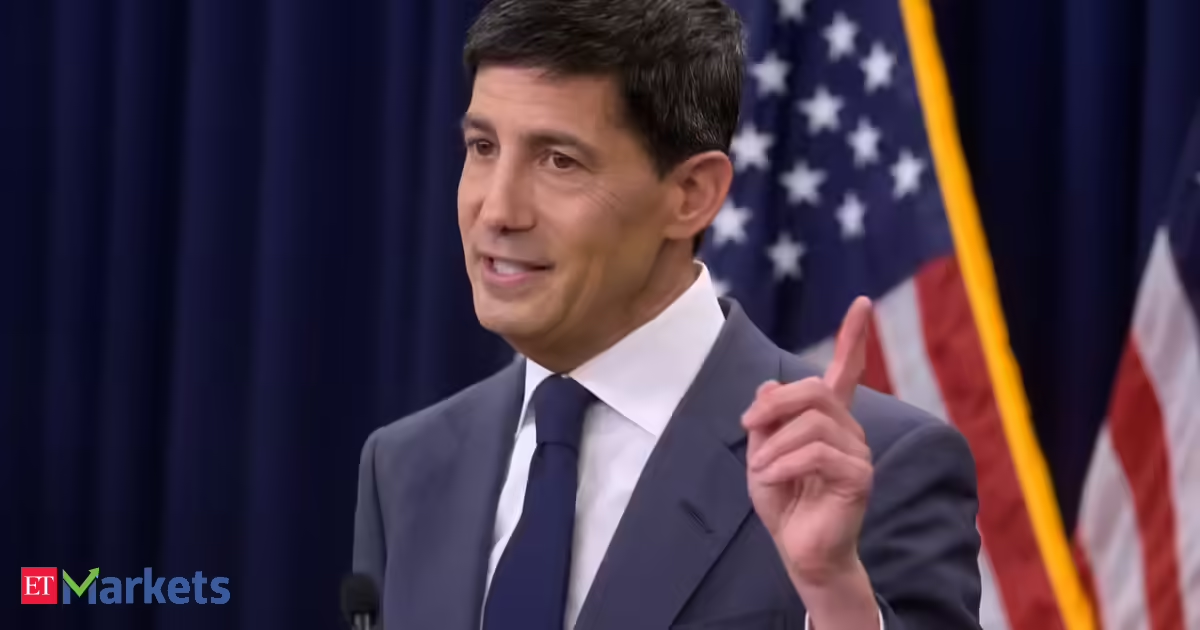
US Federal Reserve chair Kevin Warsh says he will stick by 2% inflation target, vows to bring in real-time economic data for making interest rate decisions

Published

on

US Federal Reserve chair Kevin Warsh says he will stick by 2% inflation target, vows to bring in real-time economic data for making interest rate decisions
Federal Reserve Chairman Kevin Warsh on Wednesday said he will firmly go by the U.S. central bank’s 2% inflation target and will “disappoint” anyone who expects monetary policy easing despite President Donald Trump’s repeated demands for rate cuts.

“If people thought this central bank was going to be comfortable with an inflation objective above 2%, they would be disappointed,” Warsh told a European Central Bank panel in Sintra, Portugal, adding, “We have been an independent central ⁠bank for ⁠a long time. We are going to be an independent central bank at this moment and you will see no changes on that.”

He further restated that he would give little hints on monetary policy projections.

Warsh also promised to bring in real-time economic data that will help the US central bank make better policies, replacing what he termed problematic government reports.

Advertisement

“My aspiration is that nine to 12 months from now we’re going to be using new technologies to understand what’s happening in the real economy ‌in a contemporaneous, real-time ⁠way that ⁠positions us as central bankers to make better decisions, that we’re no longer going to have to rely solely on data that we get from government agencies with mismeasurement problems that have surveys that are no longer relevant,” Warsh told a monetary policy forum in Portugal. “My favorite data is upon us, and if we do our jobs, we’ll be here a year from now, and we’ll say we’ve discovered data that helps us make better decisions.”


The Federal Reserve relies on a broad mix of government, private-sector and internal data — both public and non-public — to assess economic conditions and guide interest rate decisions aimed at supporting employment and keeping inflation under control.
Warsh has argued that the Fed places excessive reliance on official data, which he believes often lags or fails to accurately reflect current economic conditions. He contends that flawed data has contributed to poor policymaking, allowing inflation to remain above the central bank’s target for more than five years.Fed officials, however, say they guard against the risk of relying on data that may later be revised or fail to capture current conditions by focusing on longer-term trends — an approach Warsh himself appeared to endorse on Wednesday when he avoided drawing monetary policy conclusions from recent economic data.

They also argue that regular consultations with business leaders and organisations across the country, summarised in the Fed’s Beige Book, provide timely insights into economic developments that may not yet be reflected in official data.

Task Force members to be named soon
Warsh also said he would start naming members of his five new task forces from next week, one of which focuses on finding new data-gathering sources ‌and methods.

Warsh says his task force may have ideas about how to improve official data but also about how to generate more up-to-date information about the economy.

Advertisement
Continue Reading

Business

Northern Powerhouse Rail Risks HS2-Style Disaster, MPs Warn

Published

on

Thousands of high-value manufacturing jobs are at risk because Britain’s largest train assembly plant is due to run out of work by the end of the year after delays in the contract to build high-speed rolling stock for HS2.

After 12 years in the planning, the north’s flagship rail scheme still has no detailed design and a £45 billion budget that the public accounts committee says was set before anyone knew what it would build.

The plan to transform train services across the north of England is at risk of sliding into the same fiasco that has engulfed HS2, according to parliament’s spending watchdog, which says the scheme still lacks a proper design and a realistic budget after more than a decade of planning.

In a withering report, the Commons public accounts committee (PAC) said Northern Powerhouse Rail had no detailed design to speak of after 12 years on the drawing board, and warned that its £45 billion budget had become “decoupled from reality”. As it stands, the committee said, the project is likely to fail to deliver the improvements promised and risks becoming yet another government infrastructure albatross.

Originally conceived as a high-speed line linking Liverpool, Manchester and Leeds, the scheme has since been pared back to a series of local upgrades intended to deliver faster and more frequent services. The government revived the programme in January with a phased £45 billion vision for the north, but the PAC is unconvinced the numbers stack up.

The committee said it was “not confident that the Department for Transport (DfT) has learnt all the lessons from its past failures in its management of other rail projects”, pointing above all to the truncated HS2 north-south link. HS2 has busted its budget and could cost well in excess of £100 billion despite now running only as far as Birmingham, and is expected to be at least five years late.

Advertisement

On the money, the PAC was blunt. There was “no convincing plan” to deliver Northern Powerhouse Rail’s aims within the £45 billion cap, it said, and no explanation of how the Treasury had arrived at the figure in the first place, with no formal design, scope or costing yet published.

Clive Betts, the PAC’s deputy chair, said there was no doubt that railways in the north needed transforming to deliver jobs, mobility and productivity. But having taken evidence from interested parties, he warned: “Our committee has heard troubling echoes of the same mistakes in loose governance that HS2 made early on.

“Much of the project remains almost impressionistic. Both the Treasury and DfT have questions to answer about the project’s £45 billion funding cap. We need to know how this figure was arrived at and how DfT will keep to it. Capping a project’s funding before it was even designed or costed feels like putting a roof on a house before the foundations are laid.”

Betts reserved particular scorn for the decision to let HS2 Ltd, the agency set up to deliver HS2, advise on Northern Powerhouse Rail, calling it laughable that a body with such a record of failure should be shaping the north’s next big scheme.

Advertisement

The report lands as northern leaders press for a firmer commitment to the region. Greater Manchester mayor Andy Burnham, a vocal champion of devolution who has warned the north faces “Armageddon” without proper rail links, has continued to push for better transport connections and a shift of power away from Westminster.

The committee wants clarity, and quickly. It called on the DfT, already stretched by HS2 and the creation of Great British Railways, the new publicly controlled operator, to front up: “Within six months, the department should write to us to confirm whether Northern Powerhouse Rail is a mega-project or not.”

That question matters because the answer determines how the scheme is governed, scrutinised and funded, and the committee’s frustration is that, 12 years in, it still cannot be answered. Ministers have also faced pressure over cheaper alternatives elsewhere on the network, including a cut-price “HS2-light” line beyond Birmingham being weighed up by officials.

The Department for Transport pushed back firmly. “Northern Powerhouse Rail will deliver the biggest investment in rail connectivity in a generation, giving the north the transport links it deserves and driving growth, jobs and investment across the region,” a spokesperson said.

Advertisement

“NPR will not repeat the mistakes of HS2, which is why we accepted all the recommendations of the James Stewart review and are taking a disciplined, phased approach, completing detailed technical work with all stakeholders before fixing precise choices for major infrastructure.

“Since announcing NPR in January, we have worked closely with mayors to take the project forward. New joint partnership forums are already overseeing the next stage of development and Network Rail has begun developing engineering designs.”

The full findings are set out in the PAC’s report on Northern Powerhouse Rail, which draws on National Audit Office analysis showing the DfT will have spent some £410 million on the programme by March 2026. For a scheme meant to rebalance the economy, the watchdog’s message is uncomfortable: design first, cost second, and cap the budget only once you know what you are building, rather than the other way round.


Jamie Young

Jamie Young

Jamie is Senior Reporter at Business Matters, bringing over a decade of experience in UK SME business reporting.
Jamie holds a degree in Business Administration and regularly participates in industry conferences and workshops.

When not reporting on the latest business developments, Jamie is passionate about mentoring up-and-coming journalists and entrepreneurs to inspire the next generation of business leaders.

Advertisement

Continue Reading

Business

Danny Glover Reveals He Has Alzheimer’s Disease in Emotional Interview Just Weeks Before His 80th Birthday

Published

on

orthostatic hypotension and dementia

Actor Danny Glover publicly disclosed his Alzheimer’s disease diagnosis Wednesday in an interview with NBC’s Lester Holt that aired on the “Today” show, saying he has been living with the progressive brain disease for several years and that it has already begun to affect his speech, movement and memory.

Glover, 79, sat down with Holt at his home for the conversation, which he said he chose to have publicly in part to promote awareness of a condition that affects nearly 7 million Americans age 65 and older. The actor, best known for his role as homicide detective Roger Murtaugh in the “Lethal Weapon” franchise alongside Mel Gibson, said he received his diagnosis in 2023 and has been processing it with the help of family and close friends since then.

“I could live with it, in a sense,” Glover told Holt during the “Today” interview, but acknowledged the path ahead, adding that as the disease progresses, “things are going to be different and changing.”

The announcement came just weeks before Glover’s 80th birthday on July 22.

Advertisement

In a separate conversation with People magazine, Glover described coming to terms with the diagnosis and offered a philosophical reflection on what living with Alzheimer’s has meant for his sense of self.

“I still have my daughter, I have friends,” Glover told People. “I want to just say, your life continues.”

He also acknowledged the uneven nature of memory as the disease progresses.

“I’m still not accepting in my mind all parts of it,” Glover said. “There are the moments that you keep remembering that validate the fact that you can remember stuff. And there are moments I’ll never forget.”

Advertisement

Despite the gravity of the diagnosis, Glover made clear he does not view his condition as a reason to surrender.

“There’s work to do,” he said, adding that the disease does not feel like “the end of my life.”

Glover’s daughter, Mandisa, also spoke with People about her experience as a caregiver, describing the emotional complexity of watching a parent navigate the condition’s progression.

“He is aware sometimes and then sometimes not,” Mandisa said. She described the diagnosis as “a change in the core of who you think you are or don’t think you are.”

Advertisement

Alzheimer’s disease is the most common form of dementia and is classified as a progressive brain disorder that typically begins with mild memory loss before advancing to affect an individual’s ability to carry on conversations, complete daily activities or respond to their surroundings, according to the Centers for Disease Control and Prevention. There is currently no cure for the disease, though treatments are available that can help manage symptoms and slow some aspects of its progression for certain patients.

The scale of Alzheimer’s in the United States is significant. According to data from the Mayo Clinic, nearly 7 million Americans age 65 and older are currently living with the disease, and that number is expected to grow as the population ages over the coming decades. The Alzheimer’s Association has estimated that by 2050, as many as 13 million Americans could be living with the disease if no major medical breakthrough occurs in the interim.

Glover has spent decades as one of Hollywood’s most recognizable and broadly respected figures, with a career spanning more than 50 years across film, television and stage. His role as Roger Murtaugh, the long-suffering Los Angeles police detective partnered with Mel Gibson’s volatile Martin Riggs across four “Lethal Weapon” films between 1987 and 1998, cemented his status as a mainstream cinema fixture. Among his other notable film credits are “The Color Purple,” directed by Steven Spielberg in 1985, in which Glover played the emotionally complex Mister; “Places in the Heart,” in which he starred alongside Sally Field; and “Predator 2.” His work in television earned him five Emmy Award nominations, including one for his portrayal of Nelson Mandela in a biographical television film of the same name.

Beyond his film and television career, Glover built a parallel reputation as one of the entertainment industry’s most committed and outspoken social activists, a role that earned him Hollywood’s highest humanitarian recognition. In 2022, he received the Jean Hersholt Humanitarian Award, an honorary Oscar presented to individuals whose humanitarian efforts have brought credit to the film industry by promoting human welfare and contributing to addressing systemic inequities.

Advertisement

At the ceremony marking that award, actress Alfre Woodard paid tribute to Glover’s decades of activism, which included his role as a student organizer during his years at San Francisco State University, where he was a driving force behind a campus walkout that helped lead to the creation of the Department of Black Studies, one of the first such academic departments in the United States.

“Danny Glover always does the right thing first, without testing the prevailing winds of public opinion,” Woodard said in her tribute. “The places in his heart where he has put his time and his resources outnumber his years.”

Glover’s decision to speak openly about his Alzheimer’s diagnosis follows a pattern of public figures choosing to disclose the condition in order to reduce the stigma associated with cognitive decline in older adults and to encourage others facing similar circumstances to seek help and remain engaged with their communities. Several prominent figures across politics, entertainment and other fields have shared similar disclosures in recent years, each raising awareness of a disease that researchers have characterized as a growing public health concern for which current treatment options remain limited relative to the scale of need.

For Glover, the decision to share the news publicly also appears grounded in the same sense of purpose and engagement that has defined his personal and professional life for more than five decades, the conviction that there is always something meaningful to offer, regardless of circumstances.

Advertisement

“There’s work to do,” he said simply.

Continue Reading

Business

Tarsus shares fall after short seller report

Published

on


Tarsus shares fall after short seller report

Continue Reading

Business

You’ve Got Mail, Again: AOL Is Headed Back to Wall Street in a Quirky IPO

Published

on

You’ve Got Mail, Again: AOL Is Headed Back to Wall Street in a Quirky IPO

You’ve Got Mail, Again: AOL Is Headed Back to Wall Street in a Quirky IPO

Continue Reading

Trending

Copyright © 2025