
Business
Intel Stock Slides 7% Today as Profit-Taking Hits One of 2026’s Most Remarkable Chip Stock Turnarounds

Intel shares fell sharply Wednesday, declining more than 7% in a session of heavy profit-taking that pulled back one of the stock market’s most dramatic turnaround stories of the year, even as the broader context for the company’s recovery over the past 12 months remained extraordinary by nearly any measure.
Shares of the Santa Clara, California-based chipmaker were trading at $129.38 as of 10:44 a.m. EDT, down $10.25, or 7.34%, on the day. The pullback follows a run that has taken Intel from a 52-week low of just $18.97, reached on August 1, 2025, to a 52-week and all-time closing high of $141.45 hit on June 22, a gain of more than 645% over less than 12 months that ranks as one of the most stunning single-stock recoveries in the semiconductor sector’s recent history.
Wednesday’s decline represents the stock pulling back from that all-time high after a remarkable sprint higher, consistent with what several technical analysts had flagged as a likely correction point. Chart watchers had noted a double-top formation developing near the $140 to $142 zone over the past week, with a bearish engulfing candlestick pattern on the weekly chart suggesting the kind of rejection at resistance that often precedes a consolidation phase, particularly in a stock that had appreciated as rapidly and as dramatically as Intel has over the past several months.
The stock’s six-month return stands at approximately 273%, while its year-to-date gain through the end of June was roughly 270%, making Intel one of the standout performers not just within the semiconductor sector but across the entire S&P 500 for the first half of 2026. CNBC reported that record chip stock gains in the second quarter added $2 trillion in combined value to Micron, Intel and AMD.
That extraordinary run has been driven by a combination of a broader AI semiconductor boom and company-specific catalysts tied to Intel’s restructuring under Chief Executive Lip-Bu Tan, who took over the company in March 2025 following a turbulent period of leadership transitions and strategic uncertainty. Tan inherited a company that had lost significant ground to rivals TSMC and AMD in the foundry and client computing markets, respectively, and whose stock had fallen to historically low levels by mid-2025 amid persistent revenue declines and doubts about whether the company’s next-generation manufacturing processes could be executed on schedule.
The recovery began in earnest following Intel’s first-quarter 2026 results, which showed the company’s turnaround plan gaining traction. Revenue for the quarter came in at $13.57 billion, modestly below the prior quarter’s $13.67 billion but within range of analyst expectations, while the company reported ongoing progress on its 18A manufacturing process node, a key technology milestone that management has framed as critical to Intel’s ambitions in the contract foundry market. Intel’s Intel Foundry division, formerly known as Intel Foundry Services, signed new customers during the quarter and advanced existing commitments with major technology companies that had agreed to test the 18A process for potential high-volume production.
Cantor Fitzgerald analyst C.J. Muse raised the firm’s price target on Intel to $150 from $90 and maintained a Neutral rating, noting the AI infrastructure buildout as the primary driver of Intel’s improved positioning. Muse also said Intel has a cost advantage over key rivals in certain segments, a factor that had contributed to Intel stock surging on word of that cost advantage over a key competitor.
Beyond the foundry narrative, Intel has continued to expand its presence in the AI accelerator market, where the company’s Gaudi 3 chip has won incremental customer commitments from cloud service providers and enterprise customers looking for alternatives to Nvidia’s dominant GPU lineup, particularly in cost-sensitive deployments where the performance-per-dollar calculation favors Intel’s offering. The company has also continued to build out its AI PC product line under the Intel Core Ultra brand, positioning itself to capture a wave of consumer and enterprise PC upgrades driven by the increasing integration of AI capabilities directly into device hardware.
TipRanks reported that Intel is taking advantage of America’s 250th birthday promotional opportunities in AI and robotics production, with commentary describing the current moment as “a pivotal moment for the nation” and Intel’s positioning within domestic AI semiconductor manufacturing as central to its near-term narrative.
A note of caution, however, came in a report citing ByteDance racing to mass-produce custom AI chips by 2027, cutting out both AMD and Intel from certain Chinese AI workloads. That development, combined with broader investor concerns about the pace of AI infrastructure capital spending and the increasingly competitive landscape for data center processors, has contributed to some erosion in the bull case for Intel’s AI revenue growth assumptions in recent analyst commentary.
Intel’s next major milestone is its second-quarter 2026 earnings report, scheduled for after the close of trading on July 23. That report will give investors their clearest view yet of whether the first-quarter momentum in foundry customer wins and AI chip revenue has continued into the second quarter, and whether management’s guidance for the back half of the year reflects the kind of acceleration that would justify the stock’s current premium valuation relative to where it sat less than a year ago. The stock currently trades at a normalized price-to-earnings ratio of approximately 245, a figure that reflects how far forward investors are looking rather than any near-term profitability milestone, given that the company is still in the early stages of its foundry buildout and is not expected to generate the kind of earnings that would support that multiple on a near-term basis.
For now, Wednesday’s pullback appears to be a healthy, technically driven consolidation following one of the sharpest runs in the stock’s multidecade history, rather than a fundamental shift in the investment thesis. Whether the stock can recover back toward its all-time highs in the weeks ahead will likely depend on how Intel’s earnings report later this month addresses the outstanding questions about the pace of foundry customer adoption, the competitive standing of the Gaudi AI accelerator lineup and the broader trajectory of the 14A manufacturing process that management has targeted for the 2028 to 2029 timeframe as the next step beyond its current 18A node.

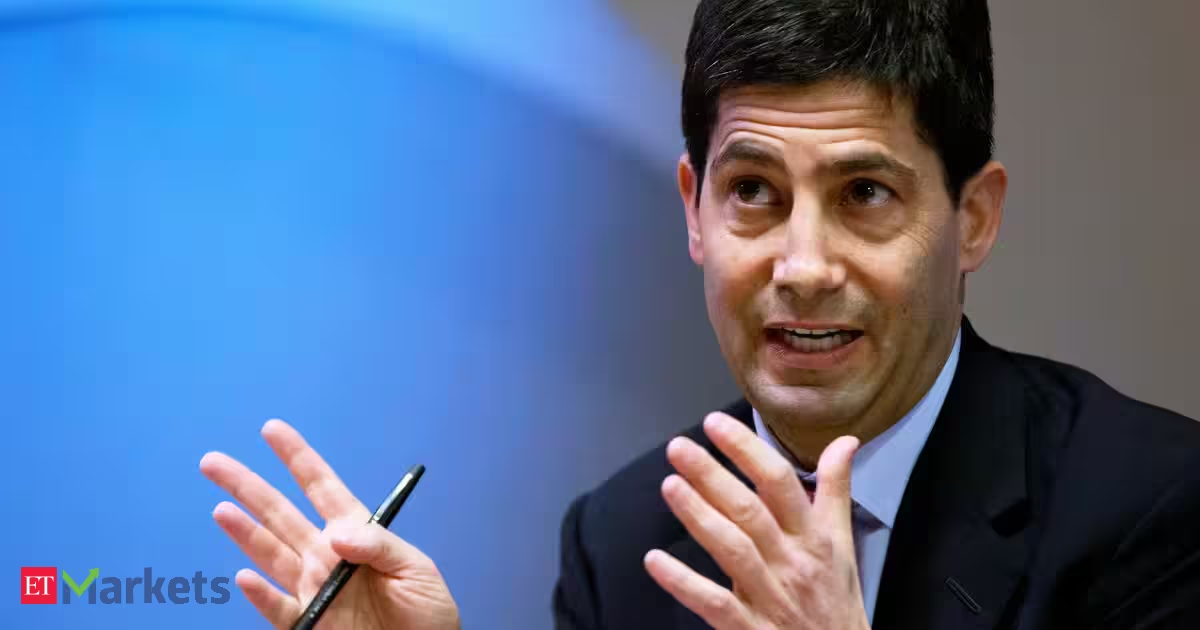
Complicating matters was Warsh’s hint that he may try to switch up the Fed’s yardstick for successfully containing inflation, for years defined as a 2% year-over-year rise in the Personal Consumption Expenditures Price Index. “That’s our number, we’re sticking with it,” Warsh said in a press conference after the end of a two-day policy meeting, before adding, “Who knows, come after next January, what we might say about strategy. I suspect the task forces might have something to add.”
Warsh handpicked 15 outside experts in May to deliver recommendations by the end of 2026 on the Fed’s conduct of monetary policy, including its inflation framework. Warsh said on Wednesday he will check in with them in the next couple of weeks and may share any thoughts that are “ready for prime time” at the Fed’s global central bankers’ conference in Jackson Hole, Wyoming. Past Fed chiefs have used that late-August meeting to prefigure what the central bank may do at its meetings in September. Warsh has so far stuck to his promise to provide no guidance on the Fed’s likely rate path. The combination of Warsh’s repeated assertions of the need to tame inflation with no action to move it toward the 2% target and a hint that the goalposts themselves may change helped send 30-year Treasury yields above 5.2% on Wednesday, a 19-year high. They extended their rise on Thursday.
“That’s almost seen in that building as the markets voting ‘no confidence’ on the Fed and the Fed’s willingness and capacity to bring inflation down,” said Nathan Sheets, the global chief economist at Citigroup. “He highlighted a problem and gave no strategy for solving it other than, ‘I’m a hawk, trust me,’ and the markets wanted more than that,” said Sheets, who worked at the Fed for 18 years. “I think part of it is if you lean too far into future hikes, then he’s disappointing the White House. And it is a balancing act between Warsh the hawk, which he is, and trying to stay on sides relative to 1600 Pennsylvania Avenue.” Sheets said Warsh will need to make a choice by September.
THE BREWING STORM
Warsh’s colleagues are already calling for action. Three of the Fed’s 12 voting policymakers dissented on Wednesday against the decision to leave the central bank’s benchmark interest rate on hold in the 3.50%-3.75% range. On Friday they and any others at the table are free to have their say, and analysts expect a deluge of commentary, given what Sheets called the “absolute red flag” of rising long-term bond rates. “While Warsh may try to constrain the Fed’s official communications and substitute ‘talk’ for action while waiting for ‘task forces’ to return a verdict, the regional Fed presidents, and perhaps members of the Board (of Governors), are willing to discuss their views in the open and will be doing so over the next few days and weeks,” said Thierry Wizman, global FX & rates strategist at Macquarie Group. “We expect them to do a lot of damage control, and to highlight how they, if not Warsh, are ready to tighten policy.” Before the Fed’s meeting this week, some policymakers including two of those who dissented on Wednesday – Dallas Fed President Lorie Logan and Cleveland Fed President Beth Hammack – had signaled their discomfort with leaving rates unchanged despite rising inflation. Others who voted with Warsh on Wednesday to keep rates on hold, including Fed Governors Christopher Waller and Lisa Cook, have said they too may call for rate hikes if they don’t see improvement in inflation soon. The U.S. Bureau of Economic Analysis reported on Thursday that PCE inflation eased in June to 3.7% from 4.1% in May, and underlying core inflation rose 3.3% last month after advancing 3.4% in May. The slight improvement had been widely anticipated after the release of other inflation data earlier this month, and policymakers have said they are worried about renewed upward price pressures due to the ongoing Middle East conflict and surging investment in technology related to artificial intelligence. Business spending on equipment increased at a 15.2% pace in the second quarter, the BEA said in a separate report on Thursday, marking a second straight quarter of double-digit growth. Trump so far has refrained from attacking Warsh for not delivering lower rates, blaming the new Fed chief’s fellow board members instead. “Board members have put Warsh on notice they intend to push for a hike in September if inflation does not meaningfully ease over the summer,” Tim Duy, chief U.S. economist at SGH Macro Advisors, wrote in a note. “If Warsh is indeed a dove in hawk’s clothing, he will not have as much support on the board to hold rates steady again in the face of persistently high inflation.”

BlackRock, a 10% owner, sells $3.1m in York Space Systems stock
Treasury sell-off shows Fed must reinforce inflation credibility, Musalem says

In Asia, India holds a crucial central bank meeting against a complex backdrop, while Friday’s U.S. non-farm payrolls report comes as traders grow increasingly convinced that the Federal Reserve may have to hike interest rates again.
1/AI-WATERING MOVES
The AI-driven bull run has gone from seemingly unstoppable to spectacularly volatile in a matter of weeks.
Investors are increasingly uneasy about profitability, competition and who’s paying for it all. Unprecedented volatility in chipmakers and other AI-related stocks is the result. South Korea’s KOSPI, which jumped 18% on Friday after tumbling 40% over the previous six weeks, is the prime example.
Pressure is emerging elsewhere too. The cost of insuring against default by some AI hyperscalers has risen as debt levels climb, while earnings reports are triggering increasingly dramatic market reactions.

More turbulence may lie ahead. Elon Musk’s SpaceX reports its first results since its blockbuster June IPO. Since then, its market value has slumped by an eye-watering $1 trillion.
2/WAR WORRIES
Markets will remain focused on the Middle East, where a U.S.-Iran ceasefire announced in mid-June now appears a distant memory and oil prices have climbed back towards $90 a barrel.
A drone strike on two U.S.-owned gas tankers in Egypt’s Mediterranean port of Damietta this week has opened a potential new front in the five-month conflict, raising concerns that traffic through the Suez Canal, one of the world’s most important trade routes, could come under threat. In another first, Saudi Arabia publicly joined military strikes alongside U.S. forces this week, targeting Iran-aligned groups in eastern Iraq. The U.S. military also carried out what it described as a “heavy wave” of strikes against Iran after an attempted ballistic missile attack on U.S. forces in the region.
Diplomatic efforts continue, however. Saudi Arabia is seeking to lead a 14-country coalition to boost maritime defence in the Bab el-Mandeb strait, the Red Sea and the Gulf of Aden, all critical chokepoints for global energy supplies.
3/JOLT FROM JOBS?
Markets get a fresh read on the U.S. economy on Friday when closely watched non-farm payrolls data are released.
Economists polled by Reuters expect the July report to show payrolls increased by 91,000 jobs and the unemployment rate held at 4.3%. A stronger-than-expected reading could raise bets that the Fed may need to resume raising rates to contain persistently above-target inflation at its next meeting in September.
The central bank held rates steady on Wednesday, but three policymakers voted for a hike and Chair Kevin Warsh reiterated the Fed’s commitment to returning inflation to its 2% target.
4/ EUROPE’S BURNING ISSUES
Europe’s record-breaking heatwave looks set to continue with fears mounting that wildfires that have devastated parts of Spain and France are spreading to Italy, Central Europe and Greece.
Markets should pay attention.
The economic costs are mounting, from healthcare spending and insurance claims to reconstruction bills and higher food prices, at a time when many heavily indebted governments are already grappling with the fallout of the Iran war. Adding to concerns, a ‘super’ El Nino event appears increasingly likely, raising the risk of further extreme weather globally.
In Britain, also facing wildfires and drought, major supermarket groups warn another food-price shock could be looming. In Germany, meanwhile, a contentious cabinet reshuffle has renewed pressure on Chancellor Friedrich Merz as the country also battles record temperatures.
DRUPEE
The Reserve Bank of India announces its latest policy decision on Wednesday, with most economists polled by Reuters expecting no change to the benchmark interest rate of 5.25%.
However, authorities will be attempting to prop up the rupee , one of Asia’s worst-performing currencies this year.
In June, the central bank unveiled measures designed to boost capital inflows and strengthen the balance of payments. The moves attracted more than $20 billion in their first month, but renewed strength in oil prices has since clouded the outlook.
For those thinking an interest rate increase might help, retail inflation has just breached the central bank’s target for the first time in over a year. Nevertheless, economists still expect the risks to growth to keep policymakers from acting, for now at least.
Business
Resona Holdings, Inc. 2027 Q1 – Results – Earnings Call Presentation (OTCMKTS:RSHGY) 2026-08-01


Seeking Alpha’s transcripts team is responsible for the development of all of our transcript-related projects. We currently publish thousands of quarterly earnings calls per quarter on our site and are continuing to grow and expand our coverage. The purpose of this profile is to allow us to share with our readers new transcript-related developments. Thanks, SA Transcripts Team
In the personal loan segment, loans against gold jewellery, which include certain agriculture loans, remained the fastest-growing sector, surging 93% YoY, data published Friday by the Reserve Bank of India (RBI) showed. Vehicle loans with a 17% growth were the second-fastest in the personal loan segment. Credit card outstanding growth decelerated to 2% compared to 7% recorded a year ago.
Growth in education loans also remained strong at 13% versus 14% recorded a year ago.
Seeking Alpha’s transcripts team is responsible for the development of all of our transcript-related projects. We currently publish thousands of quarterly earnings calls per quarter on our site and are continuing to grow and expand our coverage. The purpose of this profile is to allow us to share with our readers new transcript-related developments. Thanks, SA Transcripts Team
The regulator on Friday disposed of the June 19, 2024 interim order-cum-show cause notice without imposing any fresh directions, holding that the remedial objective of the proceedings had already been achieved. Sebi had launched proceedings alleging that Religare and its board failed to cooperate with the mandatory open offer triggered after the Burman Group sought to raise its stake beyond the 25% threshold under the takeover rules.
The regulator alleged that the company violated its takeover code by delaying the process.
Sebi had alleged that REL repeatedly questioned the Burman Group’s ‘fit and proper’ status and refused to apply for approvals from the Reserve Bank of India, IRDAI and the market regulator despite being advised to do so.
The regulator had said the open offer could not progress because the RBI would accept the application only from the target company.
The interim order had directed Religare to facilitate the open offer, seek the necessary regulatory approvals and ensure the constitution of the committee of independent directors.
During the proceedings, several independent directors argued they had relied on representations made by Saluja, whom they alleged later misled them about the Burman Group. They maintained that they were not involved in the company’s day-to-day affairs and had acted on independent legal advice. Saluja, in her defence, contended that the obligation to obtain statutory approvals rested with the acquirers and that REL acted in good faith over governance and ‘fit and proper’ concerns.
TELUS Corporation 2026 Q2 – Results – Earnings Call Presentation
US to make visa bond program permanent for people from dozens of countries

Where To Find Germany’s Stars After The 2026 World Cup

Rivian spinoff Also to start delivering e-bikes after months of delays

LISA – ‘MONEY’ DANCE PRACTICE VIDEO


-
 Sports5 days ago
Commonwealth Games boxing: Jadumani Singh seals dominant 5-0 win over Pakistan’s Sumama Rehman to enter quarter-finals | Commonwealth Games News
-

 Business2 days ago
Why Trees Belong on the Risk Register
-

 Fashion11 hours ago
Weekend Open Thread: Wit & Wisdom
-

 Tech5 days ago
Intel is reversing course and bringing hyper-threading back to its server chips
-

 Politics7 hours ago
Meta enters AI-training agreement with far-right ‘propaganda rag’ Newsmax
-

 Crypto World6 days ago
Ripple bought a bank in pieces. The $4 billion audit
-

 Politics5 days ago
Luke Littler dismantles Gerwyn Price to retain title in Blackpool
-

 Politics4 days ago
The Part of the Electric Transition Nobody Wants to Discuss
-

 News Videos5 days ago
BITCOIN JUST ENTERED THIS CRITICAL ZONE…
-
 Entertainment3 days ago
‘Stargate’ Creator’s New Sci-Fi Series Returns for Season 3 Tomorrow
-

 Crypto World6 days ago
XRP Ledger adds $2.6B as RWA inflows rank second
-

 Business3 days ago
Major shareholder moves on Canyon
-

 Politics6 days ago
Spain sweeps the board at 2026 World Cup with individual awards
-

 News Videos2 days ago
Bitcoin Enters the 3rd Stage of the Bear Market
-

 Entertainment6 days ago
Sara Gilson Killed By Husband After Viral “Pedophile” TikTok Video
-

 Crypto World3 days ago
Kraken Enables Retail Access to Jersey Mike’s IPO via Tokenized Shares
-

 Tech4 days ago
New macOS Sequoia & Sonoma security updates for older Macs
-

 News Videos3 days ago
Claude: Build Financial Dashboards in Minutes (2026)
-

 Politics2 days ago
Luke Littler’s dominance sparks GOAT debate
-

 Crypto World6 days ago
Upbit expands KRW market with two major DeFi token listings
You must be logged in to post a comment Login