

Crypto World
XRP, HYPE funds are the bright spots as investors flee bitcoin, ether ETFs: Crypto Daily



XRP and Hyperliquid’s HYPE have emerged as notable bright spots amid record outflows from U.S. spot crypto exchange-traded funds (ETFs).
XRP-linked ETFs added $59.4 million in June, a third straight month of net inflows, albeit at a slower pace than during the previous two months, according to SoSoValue data. HYPE funds notched up $161 million in net inflows during the month.
In contrast, bitcoin ETFs suffered record outflows of more than $4 billion, ether (ETH) ETFs saw $528.99 million in outflows and solana (SOL) ETFs shed $786,000.
The positive flows into both XRP and HYPE funds signal potential for significant spot price appreciation, particularly if bitcoin and the broader market stabilize.
HYPE also has support at the fundamentals level. Its parent, the decentralized exchange Hyperliquid, generated just over $80 million in fees over the past 30 days, according to DefiLlama. This places it third among all protocols and behind only stablecoin giants Tether ($486.9 million) and Circle Internet ($184.07 million).
Speaking of potential for market stability, July offers hope. According to Alex Kuptsikevich, the chief market analyst at the FxPro, July tends to be a positive month for the largest cryptocurrency.


Key Highlights
- Aave V3 protocol deploys comprehensive lending infrastructure on Monad Network supporting a dozen digital assets.
- Native GHO stablecoin becomes available on Monad for enhanced borrowing capabilities and liquidity provision.
- $15 million liquidity incentive program launched by Monad Foundation for first-year ecosystem growth.
- Chainlink Smart Value Recapture technology integrated to redirect liquidation proceeds to protocol treasury.
- Strategic deployment positions Monad as emerging DeFi hub with plans for tokenized asset integration.
The decentralized finance landscape has expanded as Aave deployed its V3 lending protocol on the Monad Layer 1 blockchain. This integration delivers comprehensive lending and borrowing capabilities through a dozen supported digital assets while introducing GHO stablecoin functionality to the network. The deployment incorporates Chainlink’s Smart Value Recapture mechanism from the outset.
Comprehensive Lending Platform Arrives on Monad
The Aave V3 deployment on Monad includes support for USDT0, USDC, GHO, USDe, mUSD, AUSD, WETH, and cbBTC at the initial launch phase. Additional assets including wstETH, weETH, syrupUSDC and sUSDe round out the initial offering. This diverse selection provides network participants with extensive options for borrowing activities, yield generation, and collateral deployment immediately upon launch.
This strategic expansion broadens Aave’s presence across multiple blockchain ecosystems while simultaneously reinforcing Monad’s nascent decentralized finance infrastructure. Development teams gain immediate access to battle-tested lending mechanisms. Monad’s compatibility with Ethereum development standards enables seamless deployment of Solidity-based smart contracts with minimal modifications required.
Aave‘s implementation includes Chainlink Smart Value Recapture functionality activated at launch. This innovative feature channels a portion of liquidation-derived value directly back to protocol reserves. Consequently, the deployment delivers both enhanced liquidity infrastructure and sophisticated protocol revenue mechanisms.
Strategic Incentive Program Targets Early Adoption
Monad Foundation has pledged $15 million in incentive allocations during the inaugural year following Aave’s deployment. Additionally, the foundation committed to purchasing and maintaining 10 million GHO tokens for a minimum six-month duration. Aave DAO supplemented this initiative with an additional 500,000 GHO allocation designated for user engagement.
These financial commitments target initial liquidity establishment and stimulate borrowing demand during the critical early phase. Nevertheless, long-term platform viability depends on organic activity levels once incentive programs diminish. Monad requires genuine market participation beyond superficial total value locked metrics.
The Monad mainnet and MON token officially launched on November 24, 2025. By early June, network statistics indicated approximately $359.5 million in aggregate value locked across protocols. LlamaRisk provided assessment support for the Aave deployment while advocating conservative initial parameter settings given Monad’s limited operational track record.
Stablecoin Expansion Aligns with Tokenized Asset Momentum
GHO’s integration on Monad represents another milestone in Aave’s native stablecoin distribution strategy across diverse blockchain networks. The digital currency previously expanded operations to Base and Arbitrum networks following its 2023 introduction. Within the Monad ecosystem, GHO facilitates borrowing mechanisms, liquidity provision, and broader stablecoin utility throughout Aave markets.
This deployment coincides with accelerating interest in tokenized real-world assets within decentralized finance protocols. Centrifuge previously announced intentions to introduce tokenized Treasury securities, private credit instruments, and AAA-rated collateralized loan obligations to Monad. These asset categories could underpin sophisticated lending markets and collateral frameworks as the ecosystem matures.
Standard Chartered projects substantial expansion in decentralized finance asset valuations approaching 2030. The financial institution identified tokenized real-world assets and crypto-native demand as primary growth catalysts. Aave’s presence on Monad establishes a proven infrastructure foundation for anticipated future lending activity.

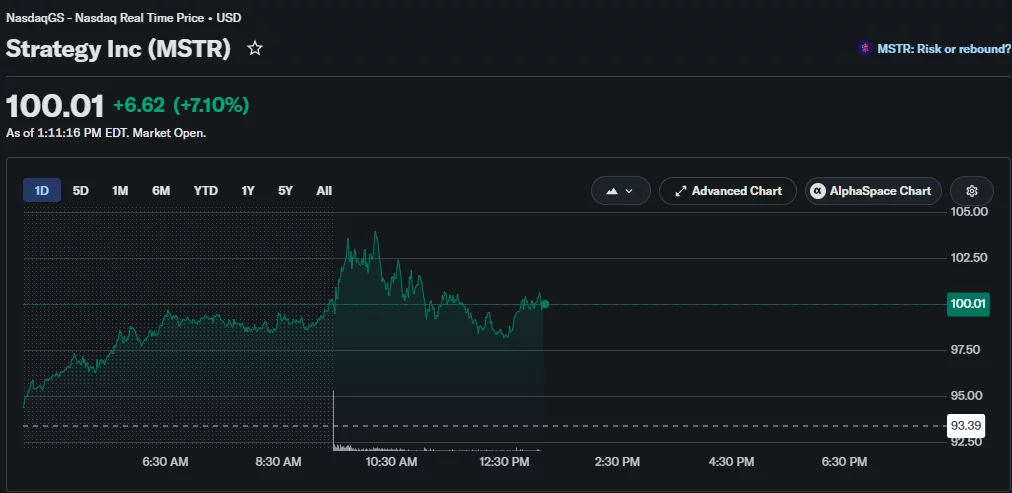
Michael Saylor has highlighted that Strategy’s open interest-to-market-cap ratio has climbed to nearly 72%, far exceeding the levels seen across the largest U.S. technology stocks as MSTR rebounds above $100 alongside Bitcoin’s recovery.
Summary
- Michael Saylor says MSTR’s open interest-to-market-cap ratio has reached nearly 72%, far ahead of major U.S. tech stocks.
- MSTR rebounded above $100 as Bitcoin climbed past $62,000, lifting other crypto-related stocks.
- Bitwise and Wall Street remain positive on Bitcoin despite recent Strategy price target cuts from Canaccord and TD Cowen.
According to a July 2 X post by Strategy co-founder Michael Saylor, MSTR currently carries an open interest-to-market-cap ratio of almost 72%, making it the highest among the companies he compared.
Tesla ranked a distant second at 16%, followed by Meta at 11%, Microsoft at 6.1%, Nvidia at 5.8%, Amazon at 4.4%, Alphabet at 4.2%, and Apple at 3.2%. The comparison comes as investors increase activity around the Bitcoin-focused stock after its recent rebound.
Heavy derivatives positioning has outpaced Big Tech peers
Open interest measures the total number of outstanding derivatives contracts tied to a stock. A high open interest-to-market-cap ratio points to unusually large positioning relative to the company’s size, although the metric alone does not indicate whether traders are betting on gains or losses because it includes both long and short positions.
Recent price action has coincided with the elevated derivatives activity. Yahoo Finance data showed MSTR rising to an intraday high of about $104 after reclaiming the psychologically important $100 level. The stock gained more than 10% during the session and has climbed over 23% from its recent low near $82 over the past five trading days. Even after the rebound, however, MSTR remains down more than 37% over the last six months.
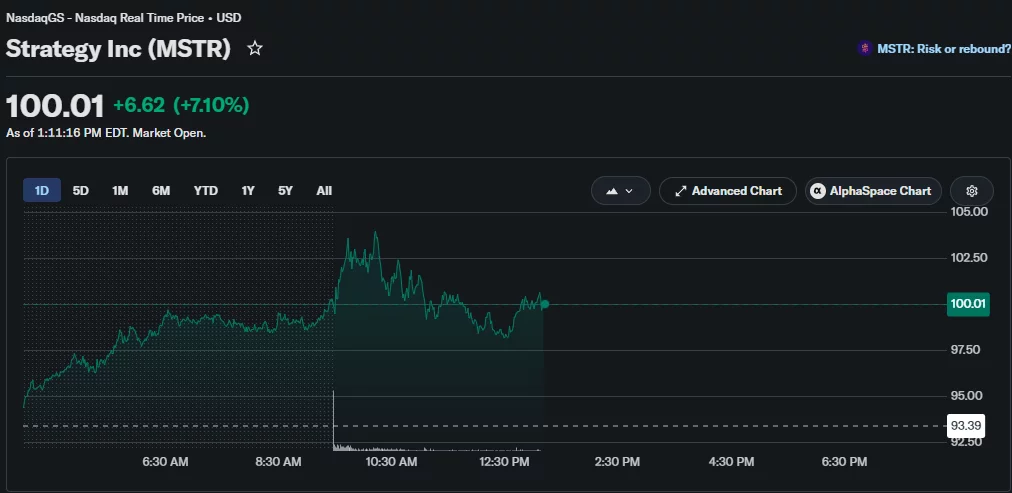
The recovery in Strategy shares came as Bitcoin briefly traded above $62,000 after weaker-than-expected U.S. jobs data improved sentiment across risk assets. Other crypto-linked equities, including Coinbase, Robinhood, Marathon Digital, the iShares Bitcoin Trust, and Hut 8, also recorded notable gains during the session.
Wall Street still sees Bitcoin strength despite lower Strategy targets
Bitwise Chief Investment Officer Matt Hougan pointed to Strategy’s valuation as one of the indicators worth monitoring as investors search for signs that Bitcoin may be approaching a market bottom.
In his latest memo, Hougan wrote that MSTR trading at a discount to its net asset value would be one of the few signals to watch while also discussing Strategy’s recently introduced digital credit framework, under which the company could sell up to $1.25 billion worth of Bitcoin.
Hougan argued that institutional investors are likely to overtake Strategy as the largest buyers of Bitcoin over time. At the same time, he maintained that the company is unlikely to become a forced seller because, in his view, no mechanism currently exists that would require it to liquidate large portions of its Bitcoin holdings.
Commenting on the current weakness in Strategy’s securities, Hougan described the decline in MSTR and STRC as part of Bitcoin’s cyclical process rather than an isolated event.
“This is a painful but necessary part of the current crypto market cycle, as it is with all cycles.”
Wall Street analysts have nevertheless become more cautious on Strategy’s stock valuation. As previously reported by crypto.news, Canaccord lowered its price target on the company to $130 from $163, attributing the revision to Strategy’s prolonged share price decline rather than any change in its long-term Bitcoin outlook. The brokerage said its investment thesis for Bitcoin remains intact despite the lower target.
The Canaccord revision followed another recent adjustment by TD Cowen, which cut its Strategy price target to $260 from $400 while maintaining its Buy rating, indicating that although valuation expectations have been reduced, some analysts continue to back the company’s long-term exposure to Bitcoin.
BlackRock-backed Securitize has become the first newly public company to tokenize its own common stock on the same day it began trading on the New York Stock Exchange.
Summary
- Securitize has tokenized its own NYSE-listed common stock on Solana and Avalanche on its first trading day.
- The company said tokenized SECZ represents the same common shares, not a separate class of stock.
- The listing follows a $400 million SPAC deal as Securitize expands its tokenized real-world asset business.
According to Securitize, the company has launched tokenized versions of its NYSE-listed common stock under the ticker SECZ on the Solana and Avalanche blockchains. Eligible U.S. investors can access the tokenized shares through the firm’s regulated platform, while the stock itself trades publicly on the NYSE following the completion of its business combination with Cantor Equity Partners II.
The company stated that shareholder participation has already made tokenized SECZ the largest tokenized stock globally. It added that bringing its own equity onchain from the first day of public trading demonstrates the regulated infrastructure it has spent years building for tokenized securities.
Tokenized SECZ represents the same NYSE-listed shares
According to Securitize, the blockchain-based SECZ tokens represent the same common stock that trades on the New York Stock Exchange rather than a separate class of shares. The company explained that tokenization changes only the ownership format, while shareholders remain subject to the same legal, contractual, and transfer restrictions that apply to the underlying stock.
Securitize also said it expects to establish an onchain shareholder base from the first day of trading, with additional functionality and market infrastructure expected to develop as regulated tokenized securities continue to mature.
The listing follows shareholder approval of Securitize’s merger with Cantor Equity Partners II. As previously reported by crypto.news, fewer than 30% of the special purpose acquisition company’s shareholders redeemed their shares, leaving more than 71% of the trust intact before the transaction closed.
Last week, Securitize said the deal is expected to generate about $400 million in gross proceeds, including proceeds from related private investment in public equity financing and excluding transaction costs. Crypto.news previously reported that the financing included an oversubscribed $225 million private investment round.
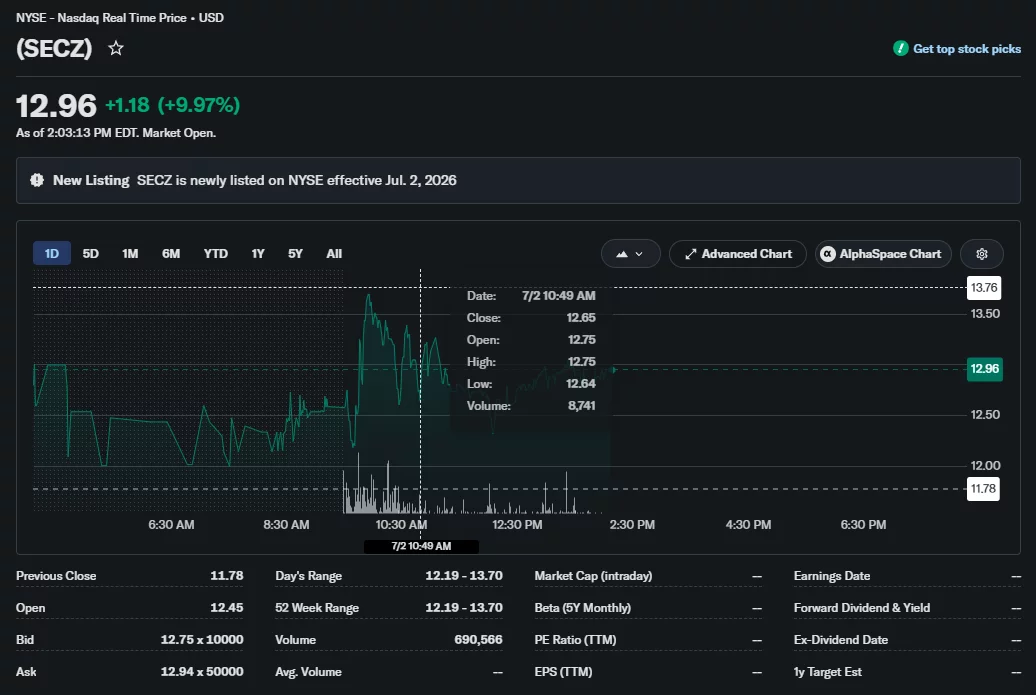
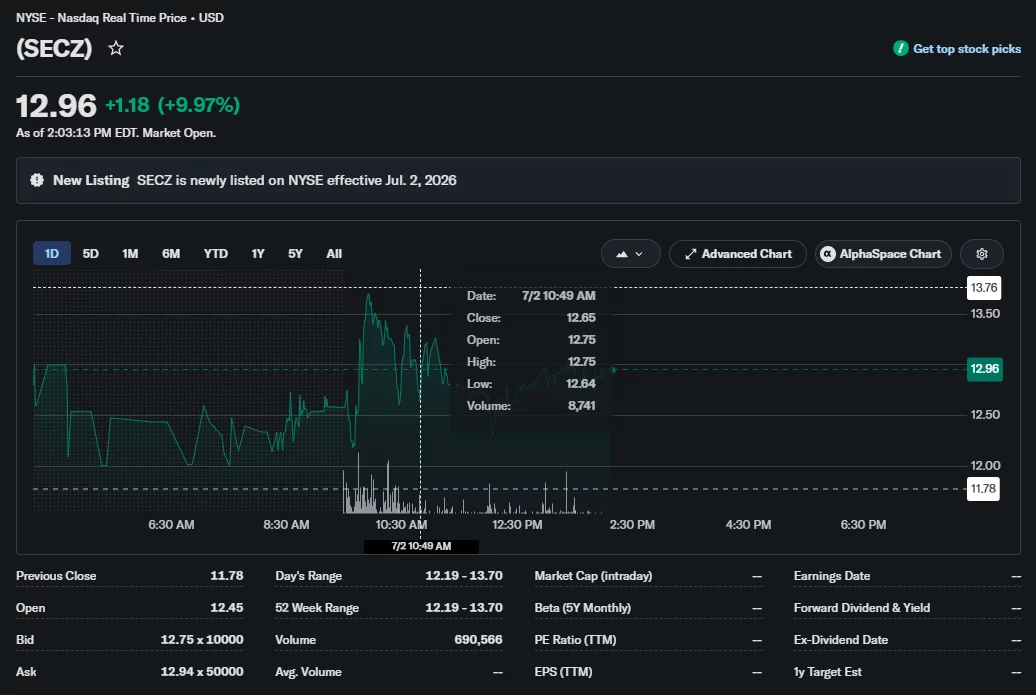
Shares of SECZ climbed by more than 10% during their first trading session, reaching above $12, according to Yahoo Finance. The gains came as Bitcoin rebounded to around $62,000, lifting several publicly traded crypto-related companies alongside the wider digital asset market.
Expansion continues beyond tokenized money market funds
Securitize’s latest move comes as the company continues expanding its tokenized asset offerings beyond money market funds. As previously reported by crypto.news, Ethena Labs plans to allocate $250 million to Securitize’s tokenized AAA-rated collateralized loan obligation fund after the product expanded to Solana.
According to crypto.news, the fund invests in U.S. dollar-denominated AAA-rated collateralized loan obligation tranches, with BNY serving as custodian of the underlying assets and acting as sub-adviser through BNY Investments.
The company has consistently stated that traditional financial assets will increasingly move onto blockchain networks through regulated, issuer-sponsored platforms. By placing its own publicly traded shares onchain at listing, Securitize is applying that approach to its own equity instead of limiting tokenization to third-party assets.
Interest in tokenized traditional financial products has also continued to grow across the asset management industry. As previously reported by crypto.news, firms including BlackRock and Franklin Templeton have expanded their presence in tokenized money market funds, adding momentum to the use of blockchain infrastructure for regulated financial products.
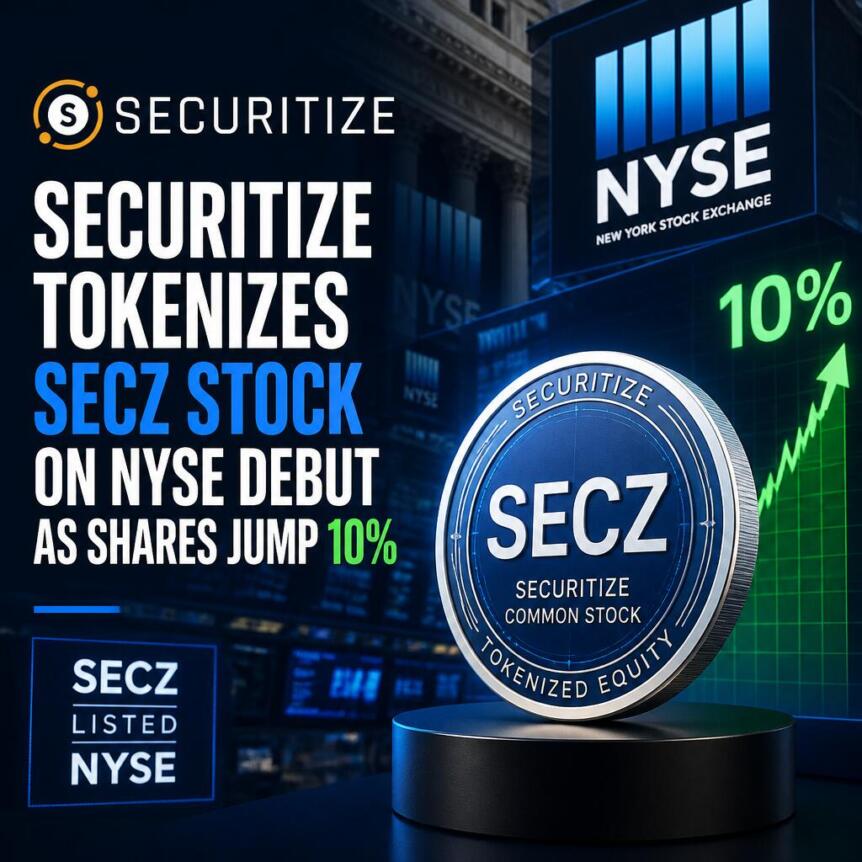
Securitize entered the public market with an onchain push that ties its NYSE debut to tokenized equity. The BlackRock-backed platform tokenized its common stock, SECZ, on Solana and Avalanche as trading began. The move also came as crypto-linked stocks rallied, while Bitcoin recovered to the $62,000 level.
Securitize Brings SECZ Shares Onchain
Securitize launched its tokenized common stock on the same day it listed on the New York Stock Exchange. The company trades under the ticker SECZ after completing its merger process with Cantor Equity Partners II. Therefore, the listing gives the tokenization firm a public-market platform and an onchain equity structure together.
The company made tokenized SECZ available to eligible U.S. users through its regulated platform. It selected Solana and Avalanche for the initial rollout, giving the stock exposure across two major blockchain networks. However, the company said the tokenized version represents the same common stock listed on the NYSE.
Securitize has long built its business around regulated tokenized assets and issuer-led market infrastructure. The company has supported tokenized funds and real-world asset products across public blockchains. As a result, its own stock tokenization marks a direct test of the model it promotes.
Tokenized Stock Keeps The Same Share Rights
Securitize said the tokenized SECZ does not create a separate share class or change the underlying stock. Instead, tokenization changes the form of ownership while the traditional share remains the same. Therefore, legal limits, transfer rules, and contractual restrictions still apply to the equity.
The company expects the launch to create an onchain shareholder base from its first day as a public firm. It also expects future market tools and utility to develop around the tokenized shares. However, the current rollout focuses on regulated access and direct representation of listed common stock.
The launch adds fresh context to the wider tokenization market, which has gained stronger institutional interest. Asset managers and blockchain firms have moved more bonds, funds, and securities onto digital rails. Consequently, Securitize’s public listing places tokenized equity closer to mainstream market infrastructure.
SECZ Stock Rises As Crypto Market Rebounds
SECZ gained more than 10% during its first trading session, according to TradingView data cited in the report. The stock traded near $12 as broader crypto-linked equities also advanced. Meanwhile, Bitcoin’s rebound to around $62,000 helped improve sentiment across the digital asset sector.
The rally followed a stronger session for several companies connected to crypto markets and blockchain infrastructure. Securitize benefited from its public debut and its tokenization announcement on the same day. Moreover, the BlackRock connection added further attention to the company’s market entrance.
The debut also arrived after Cantor Equity Partners II shareholders approved the merger that allowed the listing. That approval cleared the path for Securitize to enter public markets through the transaction. Now, the company has positioned SECZ as both an NYSE-listed stock and a regulated onchain equity product.
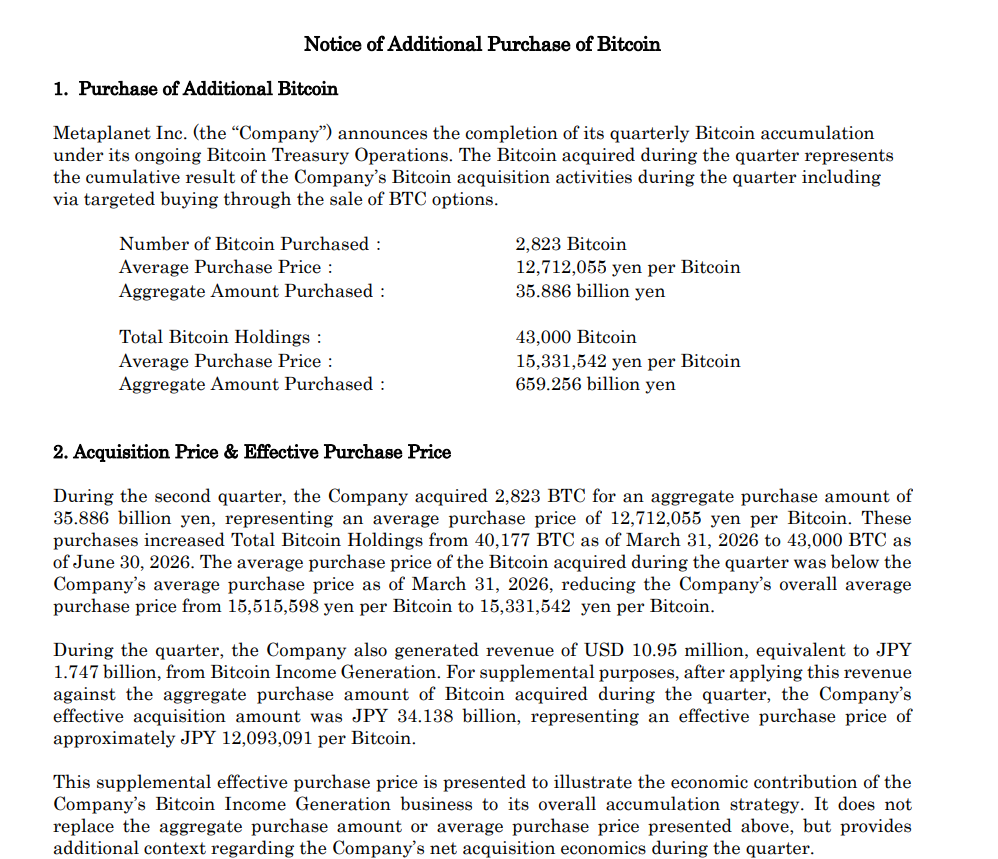
Japanese investment company Metaplanet acquired 2,823 Bitcoin during the second quarter at a price below its average purchase price, as its holdings surpassed 43,000 BTC.
The company acquired its latest trove at an average price of about 12.71 million yen ($78,850 at current exchange rates), reducing its average acquisition cost to about $95,117 per BTC from $96,258, according to a Thursday announcement.
Metaplanet now holds 43,000 Bitcoin acquired for about $4.1 billion. It also reported about $10.95 million in revenue from its Bitcoin income generation strategy in the quarter, which earns premiums by selling cash-secured options and employing other Bitcoin-related yield strategies.
The purchase extends Metaplanet’s aggressive accumulation strategy, which has made the company one of the world’s largest corporate Bitcoin holders. The acquisition comes days after Michael Saylor’s Strategy, the world’s largest corporate Bitcoin holder, skipped its usual weekly Bitcoin purchase while unveiling a new capital framework designed to support dividends and expand its cash reserves.
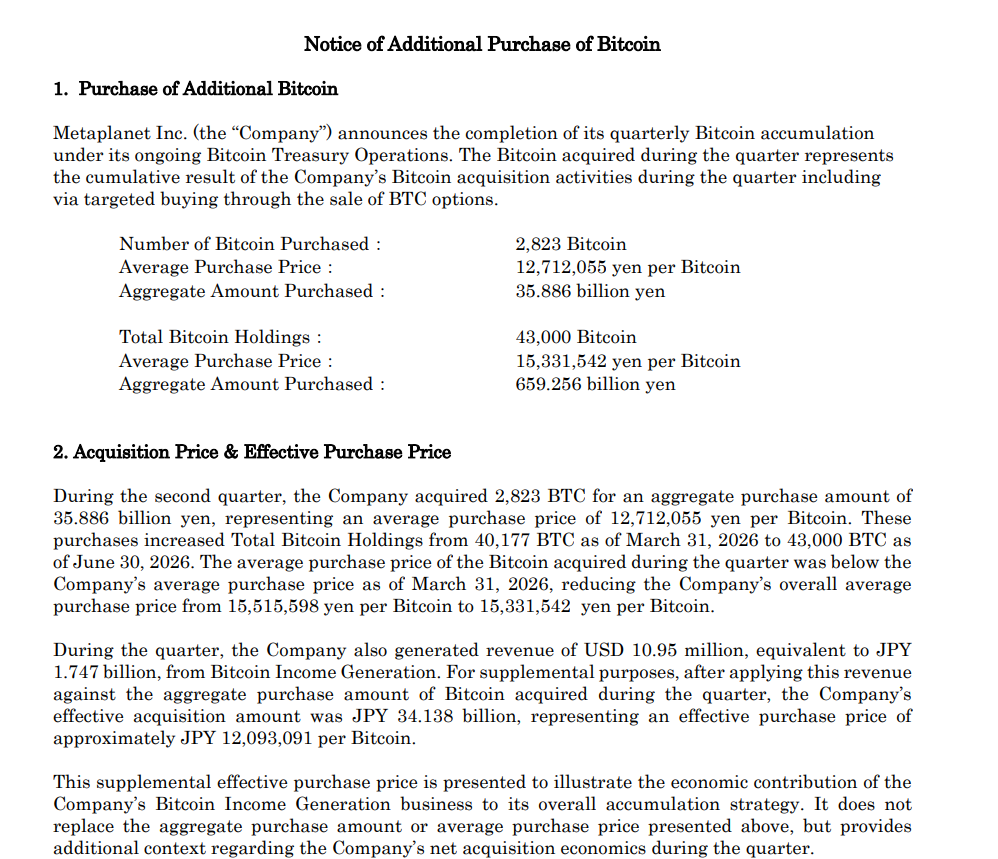
Metaplanet Notice of Additional Bitcoin Purchase. Source: Metaplanet
Metaplanet shares closed 3.5% higher on Thursday but remain down 48% year-to-date, underperforming Bitcoin, which has fallen 31% over the same period.
K Wave latest company to exit Bitcoin treasury strategy
While companies such as Metaplanet continue buying more Bitcoin, a handful of treasury companies are scaling back their exposure.
Nasdaq-listed South Korean company K Wave Media sold its remaining 88 BTC to repay $6 million in debt, exiting the Bitcoin treasury strategy, according to a Tuesday filing with the US Securities and Exchange Commission.
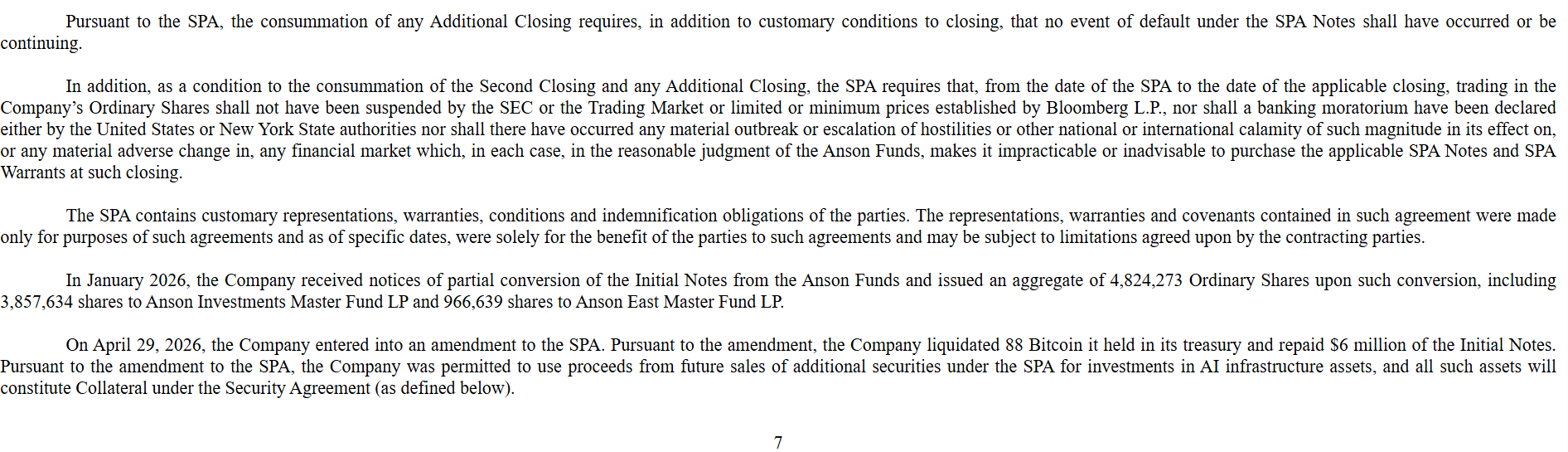
K Wave Media, FORM F-3 filing. Source: SEC.gov
The move marked a sharp reversal as the company previously announced plans to expand its holdings to 10,000 BTC after securing $1 billion in capital capacity to drive its Bitcoin treasury strategy in July 2025.
Related: Swan’s Cory Klippsten sees record Bitcoin holder supply revealing early bottom
On May 28, France-based semiconductor company Sequans Communications said it would monetize its remaining Bitcoin holdings over time. The company held 658 BTC at the time, and its shares rose about 14.5% following the announcement.
Magazine: Bitcoin, the ‘canary in the coal mine,’ XRP transaction demand falls 91.5%: Market Moves
Key takeaways:
- Soft US jobs market data triggered a rotation of capital from overheated AI stocks into Bitcoin and gold.
- Bitcoin onchain indicators hint at seller exhaustion while the decline in oil prices opens room for monetary expansion.
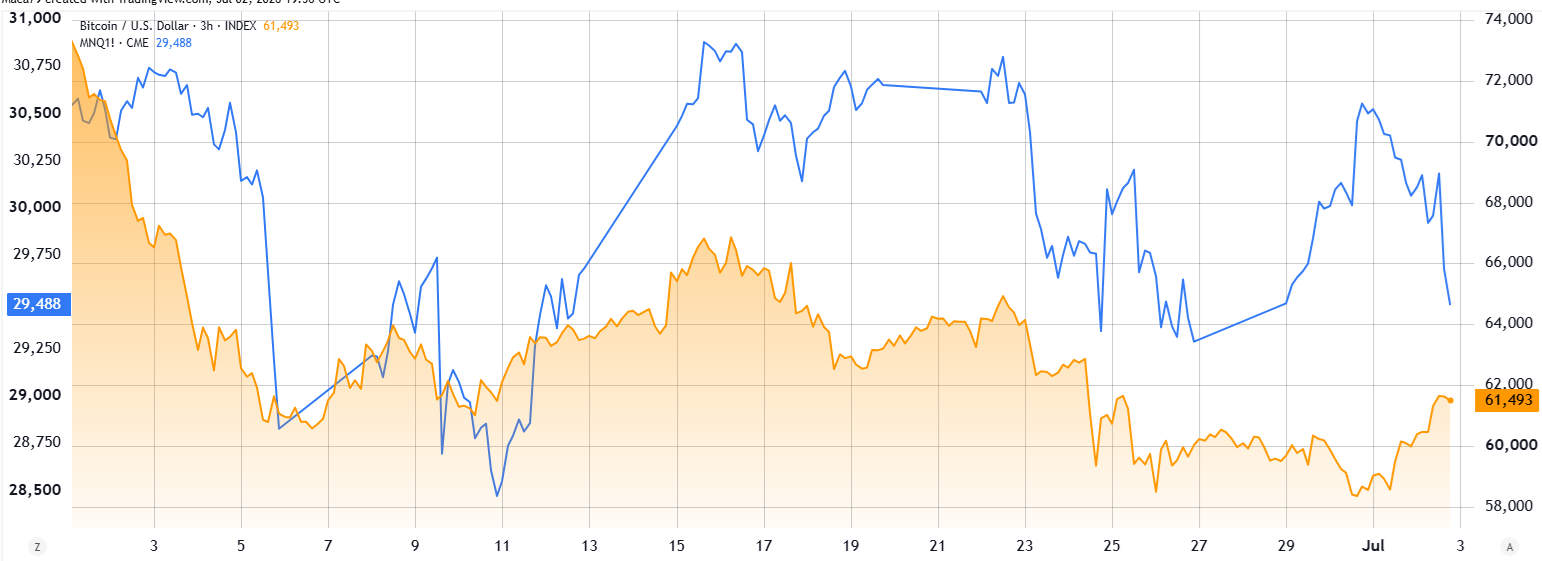
Bitcoin reclaimed the $61,000 mark following a disappointing US job market report. Traders grew less certain of a near-term interest rate hike from the US Federal Reserve (Fed) given the worsening labor data. The tech-heavy Nasdaq index sold off, fueling hopes of a capital rotation favoring Bitcoin.

Nasdaq 100 Index futures (blue) vs. Bitcoin/USD (orange). Source: TradingView
The Nasdaq 100 Index erased gains from the three prior days, while Bitcoin distanced itself from Wednesday’s $57,750 low. US non-farm payrolls increased by only 57,000 in June, missing the 113,000 expected, according to Yahoo Finance. The US Labor Department also revised data for April and May downward by 74,000 jobs.
Gold prices reacted positively on Thursday, hinting at potential bullish momentum for scarce assets. The weak economic data prompted investors to cut odds of Federal Reserve interest rate hikes by September to 54% from 64% the prior day, according to the CME FedWatch Tool. Meanwhile, crude WTI oil prices stabilized below $70, opening the door for possible economic stimulus measures

Gold/USD (red) vs. Crude WTI oil (teal). Source: TradingView
Oil prices dropped after the Qatar Foreign Ministry cited “positive progress” in the latest round of discussions between US and Iranian representatives on Wednesday. Gold recovered some of the 8% losses accumulated over the prior two weeks, a possible sign that investors anticipate a less tight monetary policy and further FED balance sheet expansion.
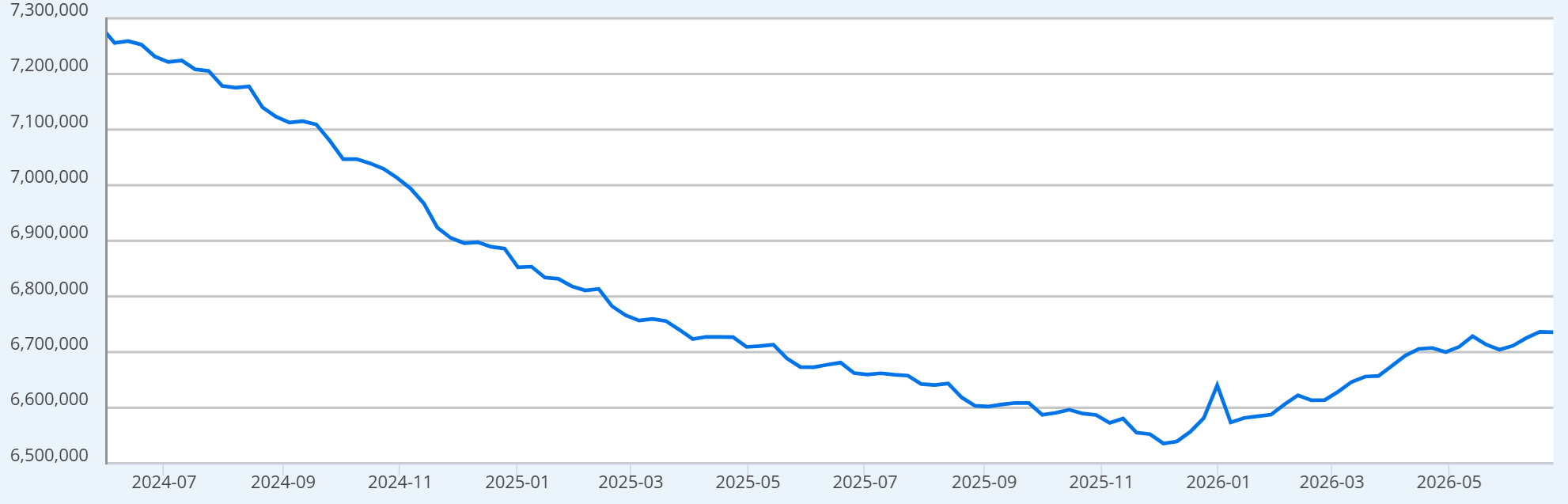
US Federal Reserve total assets, USD millions. Source: FED St Louis
The Federal Reserve balance sheet stagnated at $6.73 trillion, although its mandate allows for $40 billion monthly purchases in short-term Treasuries and bonds. Weak job market data and reduced inflationary pressure are widely seen as catalysts for accelerated liquidity injection, creating incentives to invest in scarce assets, including gold and Bitcoin.
Overheated AI stocks clash with Bitcoin flashing a bottom
Weakness in the AI sector, especially among chipmakers, has led traders to anticipate capital shifting toward alternative assets. Shares of SanDisk, Seagate, Western Digital, and Applied Materials saw intraday losses of 9% or higher on Thursday. In contrast, Bitcoin is showing signs of seller exhaustion two months after rejection at $82,500.
Related: Bitcoin tops $60K amid Fed inflation talks–Is bull trap or $65K next?
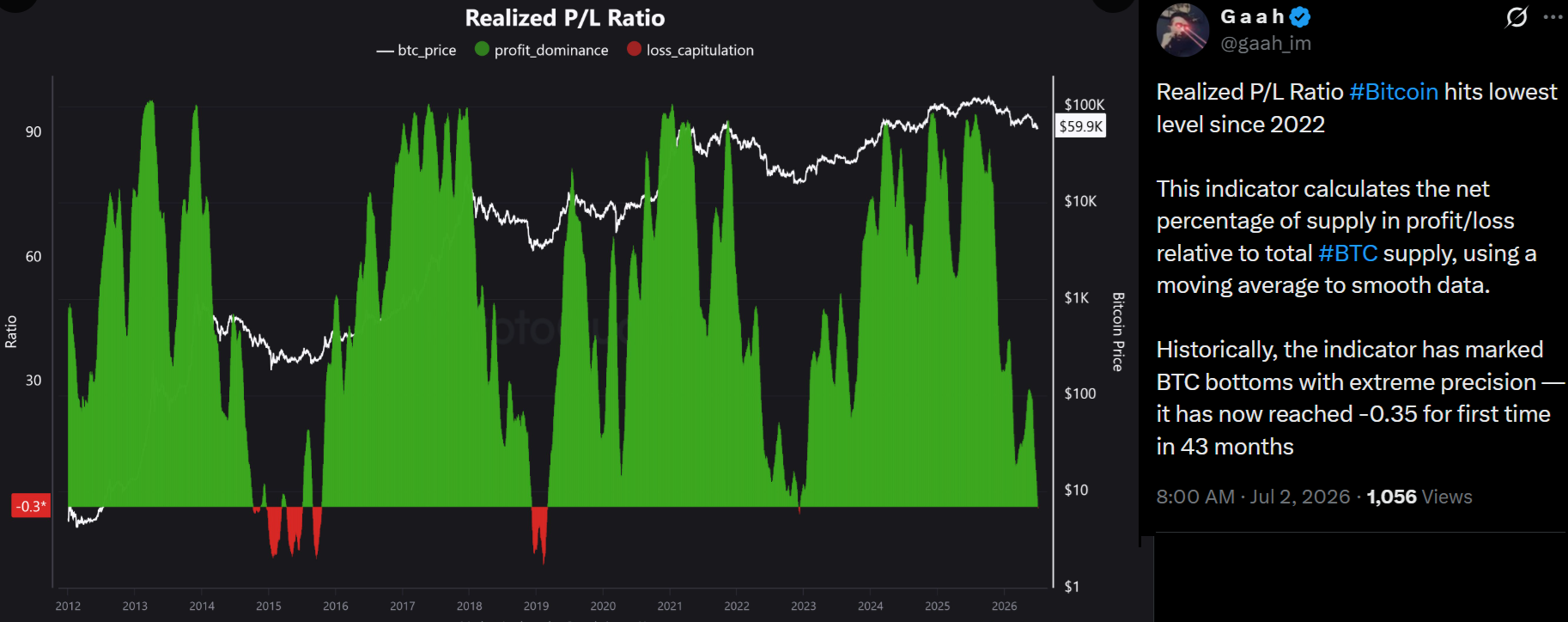
Source: X/gaah_im
Onchain analyst and CryptoQuant author gaah_im said that Bitcoin’s realized profit-to-loss ratio has hit its lowest level since 2022. The net percentage of supply in profit relative to the total supply has turned negative, which historically has marked cycle bottoms with “extreme precision,” according to the analyst. In essence, onchain data hints at further Bitcoin upside.
Part of Bitcoin’s recent weakness stems from traders’ disappointment with Strategy. Despite a healthy 8% net leverage and $56.8 billion in enterprise value, holders faced dilution from accelerated MSTR share issuance used to buy back some debt and cover dividends on preferred stocks.
If weakness in the AI sector accelerates, some of that money will likely rotate into gold and Bitcoin, making a near-term recovery to $70,000 possible.


Anchorage Digital has integrated Lido into its institutional platform, allowing clients to access wrapped staked Ether (wstETH) while keeping assets inside its regulated custody environment.
Summary
- Anchorage Digital has integrated Lido, letting institutions mint and burn wstETH without leaving regulated custody.
- Clients can access Ethereum staking rewards while keeping custody, governance, reporting, and settlement on one platform.
- Lido says rising institutional demand and its audited staking infrastructure are driving adoption of custody-based staking.
According to a July 2 announcement from Anchorage Digital, institutional clients can now connect directly to the Lido application to mint and burn wstETH without transferring assets outside the firm’s custody platform.
The integration lets investors earn Ethereum staking exposure while continuing to use the custody, governance, reporting, and settlement processes they already rely on.
Institutions can stake Ethereum without moving assets
The newly added service centers on wstETH, a liquid staking token that represents staked Ether while remaining transferable. Instead of distributing staking rewards directly, the token’s value increases relative to stETH over time, allowing institutions to retain liquidity alongside staking exposure.
Commenting on the launch, Anchorage Digital co-founder and CEO Nathan McCauley said liquid staking has become one of Ethereum’s most important components for institutional participation.
“By integrating with Lido, we’re giving institutions access to wstETH without the operational or security tradeoffs that have historically kept large allocators on the sidelines.”
Anchorage Digital, which operates the first federally chartered crypto bank in the United States, said clients can now complete staking-related activity without moving assets across multiple providers. The company said keeping custody, staking, governance, and settlement within one regulated platform simplifies institutional operations.
Earlier this week, as reported by crypto.news, Anchorage Digital also expanded its institutional infrastructure through a partnership with Binance. The agreement allows eligible institutional clients to trade on Binance while keeping assets in segregated custody through Anchorage’s Atlas platform. Binance said the arrangement separates custody from trade execution, mirroring practices commonly used in traditional financial markets.
Lido highlights security and institutional demand
Interest from institutional investors has continued to grow as staking infrastructure and regulation have matured, according to Kean Gilbert, head of institutional relations at the Lido Ecosystem Foundation.
Gilbert told Crypto Briefing that asset managers, liquid funds, and Ether treasury holders have increasingly sought custody-based access to staking because it reduces operational complexity and compliance concerns while fitting existing institutional workflows.
The first phase of the integration focuses on minting and burning wstETH inside Anchorage Digital. Institutions can convert ETH into wstETH and redeem it back through the platform, while the token remains transferable for collateral use or deployment into other investment strategies.
Unlike conventional staking positions that often require investors to wait before withdrawing funds, wstETH can be transferred without first exiting the underlying staking position. According to Lido, this gives institutions additional flexibility while preserving exposure to Ethereum staking rewards.
Gilbert also pointed to Lido’s security record as institutional adoption continues to expand. He said the protocol has spent more than $4 million on smart contract audits, received an A+ security rating from independent firms including Credora, and has operated since 2020 without a smart contract exploit.
He added that Lido distributes staked Ether across more than 900 node operators, with no individual operator controlling more than 1% of the network, reducing reliance on any single participant.
Looking ahead, Gilbert said that institutional adoption will depend on whether staking products fit existing operational requirements. He said making wstETH available through Anchorage Digital brings the token onto a major U.S. institutional platform and strengthens the role of Lido’s staking infrastructure for professional Ethereum investors.
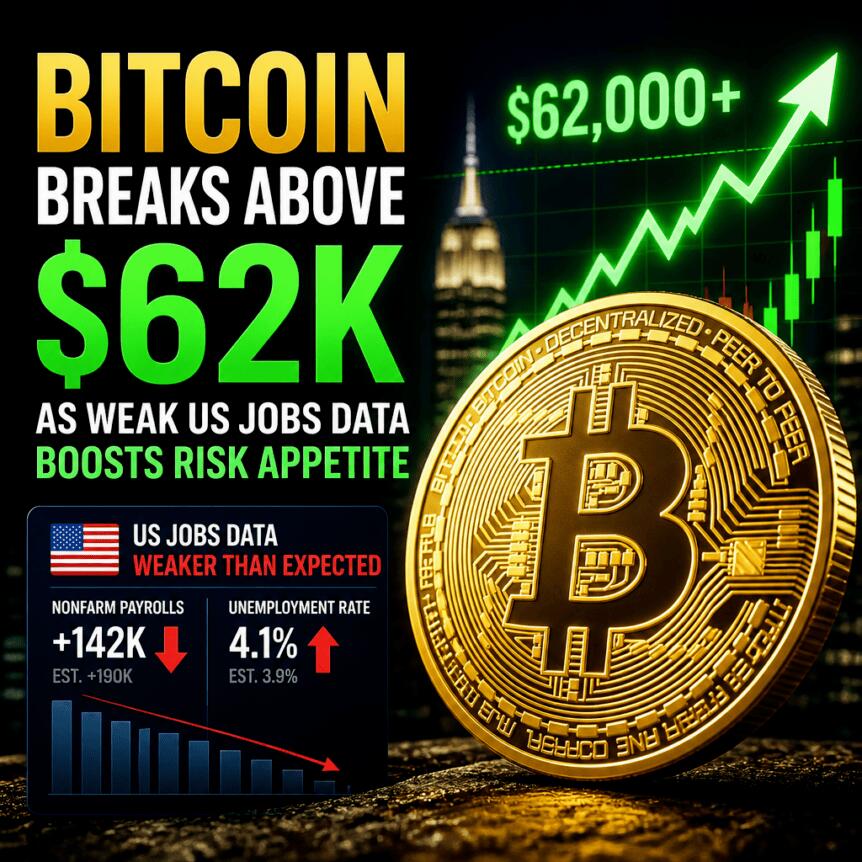
Bitcoin pushed through the $62,000 level at the start of Thursday’s Wall Street session, gaining as traders digested softer-than-expected US employment data. The move came alongside renewed optimism that inflation pressures may continue to cool—an outlook that typically supports risk assets, including crypto.
According to TradingView data cited in the market coverage, BTC/USD rose to a new July high of $62,137 on Bitstamp, up nearly 4% on the day. While the rally remains sensitive to macro headlines, crypto traders also pointed to a visible short squeeze beginning for “green July.”
Key takeaways
- US June nonfarm payrolls came in well below expectations, with 57,000 jobs added versus 114,000 forecast, helping lift Bitcoin.
- BLS data showed the unemployment rate held at 4.2% and the number of unemployed people was largely unchanged at 7.1 million.
- Traders highlighted an unwind of short positions, with CoinGlass reporting nearly $450 million in crypto short liquidations over 24 hours at the time of writing.
- Some analysts framed the move as buyers returning via exchange order-book dynamics, even as they caution the broader trend may still be choppy.
US jobs data shifts the macro tone for crypto
The immediate catalyst was the Bureau of Labor Statistics (BLS) nonfarm payrolls release for June. The report indicated that the US economy added far fewer jobs than expected—57,000 compared with the 114,000 consensus forecast.
The BLS also said the unemployment rate remained at 4.2% and the number of unemployed people changed little, staying around 7.1 million. In market terms, the combination of weaker job growth without a sharp deterioration in unemployment can be read as less immediate pressure on inflation—at least in the short run.
That interpretation is important for Bitcoin because expectations around Federal Reserve policy often drive rates-sensitive flows. A softer labor print can revive speculation that financial conditions may ease, benefiting assets that trade like a high-beta alternative to traditional markets.
Still, the data also carried a reminder that the labor narrative remains unstable. One trading-focused commentary, the Kobeissi Letter, noted that May’s jobs figure was revised down by 43,000 jobs, suggesting the picture is still being recalibrated in official statistics.
“The labor market remains in a volatile situation.”
Analysts see “signals” for markets, but watch $65,000
As Bitcoin and broader altcoins moved higher, at least one widely followed trader argued that the macro setup is improving. Crypto analyst Michaël van de Poppe pointed to falling inflation expectations alongside the job-market trend, adding that unemployment is at its lowest level in close to a year.
In an X post, he said these are “strong, public signals about the direction of the markets,” while also setting a technical condition for his outlook. He stated that he does not expect another drop in Bitcoin “if Bitcoin can clearly break through $65,000 from here.”
“I don’t think we’ll see another drop on Bitcoin if Bitcoin can clearly break through $65,000 from here.”
For traders, that framing matters because it ties the macro tailwind to a specific market level. If price fails to clear resistance, the relief rally can fade quickly—even when macro data is supportive.
Short liquidations and exchange order books fuel the rally
Alongside macro drivers, crypto-specific positioning appeared to worsen for short sellers. CoinGlass data—referenced in the coverage—showed nearly $450 million in 24-hour crypto short liquidations at the time of writing.
Liquidations are often a catalyst for sharp intraday swings: when leveraged short positions are forced out as price rises, buying pressure can accelerate through automated and discretionary rebalancing. While liquidations do not guarantee a sustained trend, they can help explain why Bitcoin climbed quickly through key psychological levels during the session.
Market participants also cited order-book dynamics on major venues. Commentator Exitpump said “price drilling through large asks on Binance perps orderbook is actually sign of strength,” arguing that “chasing bids” were supporting aggressive buyers as BTC moved higher.
“Buyers are back and strong.”
This kind of exchange liquidity reading is closely watched by day traders because it can reveal whether buy pressure is broad and persistent or simply the result of a short-lived burst of market orders.
Rekt Capital’s “green July” view: relief rally possible, but trend risk remains
Beyond the immediate squeeze, longer-cycle chart commentary continued to shape how investors interpret the rally. Trader and analyst Rekt Capital echoed the “green July” idea, referencing a view that Bitcoin may experience a relief move before bearish momentum resumes later.
The prior market framing cited in the coverage suggested a pattern where relief rallies occur in summer months, followed by a return of downtrend pressure into August. In additional commentary, Rekt Capital highlighted that Bitcoin could face headwinds once it flips key moving averages into resistance—specifically pointing to the 50-month exponential moving average (EMA) after a relief advance.
“And once Bitcoin turns the 50 EMA into new resistance on this relief rally, it will likely enter additional Bearish Acceleration over time,”
For investors, the practical takeaway is that the rally’s durability may hinge on whether buyers can keep pushing without triggering the reversal that longer-term chart followers expect. In other words, the macro surprise may be acting as the spark, but the technical path will determine whether it becomes a sustained trend or a tactical bounce.
As July begins, traders will likely keep watching both sides of the equation: further labor and inflation signals that can move expectations for Fed policy, and BTC’s ability to hold above resistance areas such as the $65,000 level referenced by van de Poppe. The combination of ongoing liquidation dynamics and moving-average behavior could decide whether this “green July” starts as a short squeeze—or develops into something more enduring.


TradingView has expanded its market coverage by adding real-time data for Hyperliquid and Trade[XYZ], giving users access to onchain perpetual and spot markets directly through its charting platform.
Summary
- TradingView has added real-time Hyperliquid and Trade[XYZ] market data to its charting platform.
- Users can now track crypto, equities, commodities, forex, and pre-IPO perpetual markets around the clock.
- The integration comes days after Singapore’s MAS placed Hyperliquid on its Investor Alert List.
According to TradingView, the new integration brings live pricing for Hyperliquid’s crypto perpetual and spot markets alongside Trade[XYZ] markets covering equities, commodities, foreign exchange, and pre-IPO companies.
The data is available through TradingView’s Supercharts, allowing traders to follow price movements throughout the day, including when traditional financial markets are closed.
The addition extends the range of assets available on TradingView without requiring users to leave the platform for onchain market data. Hyperliquid markets appear under the HYPERLIQUID symbol prefix, while Trade[XYZ] listings can be accessed using the HIP3XYZ prefix through the platform’s symbol search.
Hyperliquid expands beyond its core exchange
Built on its own layer-1 blockchain, Hyperliquid operates an onchain perpetual futures exchange that currently supports more than 300 perpetual and spot markets across cryptocurrencies, commodities, and indices.
The ecosystem has also grown through HIP-3, a protocol upgrade that allows third-party developers to launch perpetual markets using Hyperliquid’s infrastructure. Under that framework, Trade[XYZ] has become the first major deployment, offering perpetual markets tied to multiple asset classes, including cryptocurrencies, equities, as well as crypto spot trading.
By adding both Hyperliquid and Trade[XYZ] feeds, TradingView has made those markets available alongside its existing charting tools, enabling traders to monitor perpetual contracts and spot assets from a single interface.
Regulatory attention has continued alongside platform growth
The TradingView integration comes days after the Monetary Authority of Singapore added Hyperliquid to its Investor Alert List, as previously reported by crypto.news.
According to the regulator, the listing covers both the Hyper Foundation website and the Hyperliquid trading application. MAS said the Investor Alert List is intended as a consumer protection measure identifying entities that could be mistakenly viewed as licensed or regulated by the authority. The regulator also stated that inclusion on the list does not constitute a ban or an enforcement action.
Following the listing, Hyperliquid said it had never claimed to be licensed or authorized by MAS.
Despite the regulatory attention, the decentralized exchange has remained one of the largest trading platforms in the sector. According to CoinGecko, Hyperliquid ranks as the sixth-largest decentralized exchange by trading volume. Separately, DefiLlama estimates that the protocol currently secures about $5.76 billion in total value locked.
The latest TradingView integration gives market participants another way to follow activity across Hyperliquid’s expanding ecosystem, combining live data from crypto perpetuals, spot assets, and Trade[XYZ]’s cross-asset markets within a single charting environment.
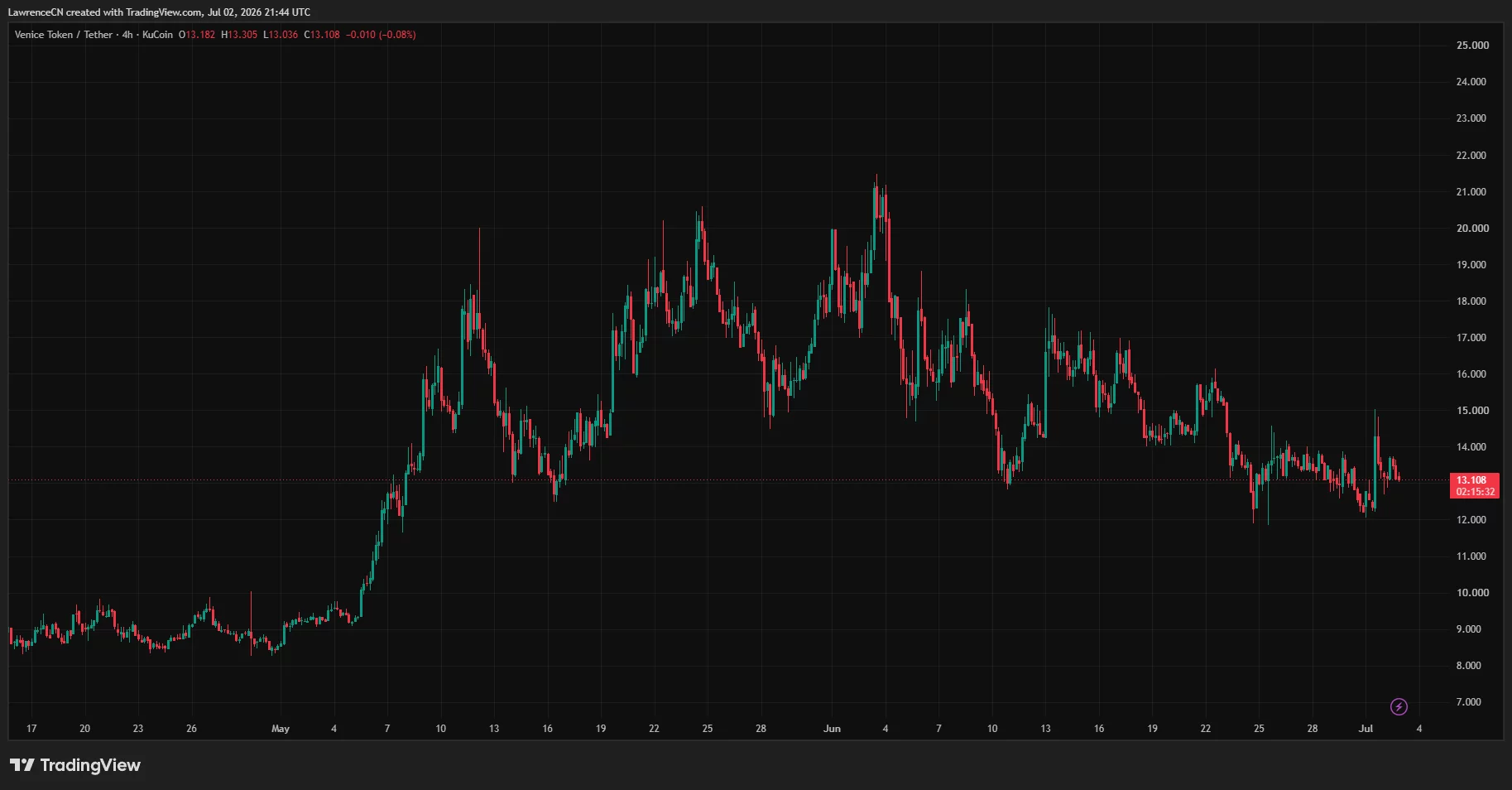
Venice pairs a real product, private, uncensored AI used by millions, with a buy-and-burn token and shrinking emissions. VVV touched $21 in June, then pulled back. Here is the bull case, the bear case, and where VVV could head next.
Summary
- Venice is a private, uncensored generative-AI platform, and VVV is its utility token, used to stake for access to the platform’s AI capacity instead of paying per request.
- VVV stands out among AI tokens for real product traction, with more than 2 million users and millions of monthly visits, plus a buy-and-burn model and staged emissions cuts that add deflationary pressure.
- The token reached an all-time high above $21 in early June 2026 before pulling back into the mid-teens, leaving it below that peak but well above its late-2025 lows.
- The bull case rests on genuine usage, deflationary tokenomics, and the private-AI narrative, while the bear case centers on a weak AI token sector, a history of sharp post-rally retracements, and ongoing token emissions.
- A reclaim of the $21 high is plausible if the AI narrative and burn mechanics align, while a break of support near $14.50 would point back toward the low teens.
Venice and its VVV token occupy an unusual spot in the crypto market: an artificial-intelligence project with an actual product that millions of people use, instead of a token attached to a promise.
VVV climbed to an all-time high above $21 in early June 2026, outperforming Bitcoin over the surrounding month, before retracing into the mid-teens as the AI trade cooled. The combination of real traction, deflationary tokenomics, and a volatile AI narrative makes VVV both compelling and difficult to forecast.
This price prediction covers what Venice is, why VVV is trending, the strongest arguments on each side, the technical picture, and bull, base, and bear scenarios. It is not financial advice, and VVV is a volatile token, so the ranges here are wide.
What is Venice, and why is VVV trending?
Venice is a private, permissionless generative-AI application that lets users produce text, images, and code without accounts, data storage, or surveillance. It emphasizes privacy by keeping conversations on the user’s device and encrypting data in transit, and it positions itself as an uncensored alternative to mainstream AI services that filter outputs and log activity.
VVV is the utility token that powers access to the platform. Instead of paying per request, users, agents, bots, and third-party apps stake VVV to unlock a proportional share of the platform’s inference capacity, and staking can also earn income. In effect, holding and staking VVV is how you buy ongoing access to private AI compute.
What makes VVV unusual among AI tokens is that the product genuinely has users. Venice reports more than 2 million registered users and millions of monthly visits, a level of real traction that most tokens riding the AI narrative simply do not have. That usage matters because it connects the token to an actual service with demand, instead of a roadmap.
When an AI token is backed by a product people use every day, the investment case rests on something more durable than sentiment, even if sentiment still drives the short-term price.
The trend in VVV comes from the intersection of that traction with a strong tokenomic design and a hot narrative. The token surged to an all-time high above $21 in early June 2026, part of a broader wave of interest in AI and privacy-focused crypto, and it has remained one of the more actively searched and discussed tokens since.
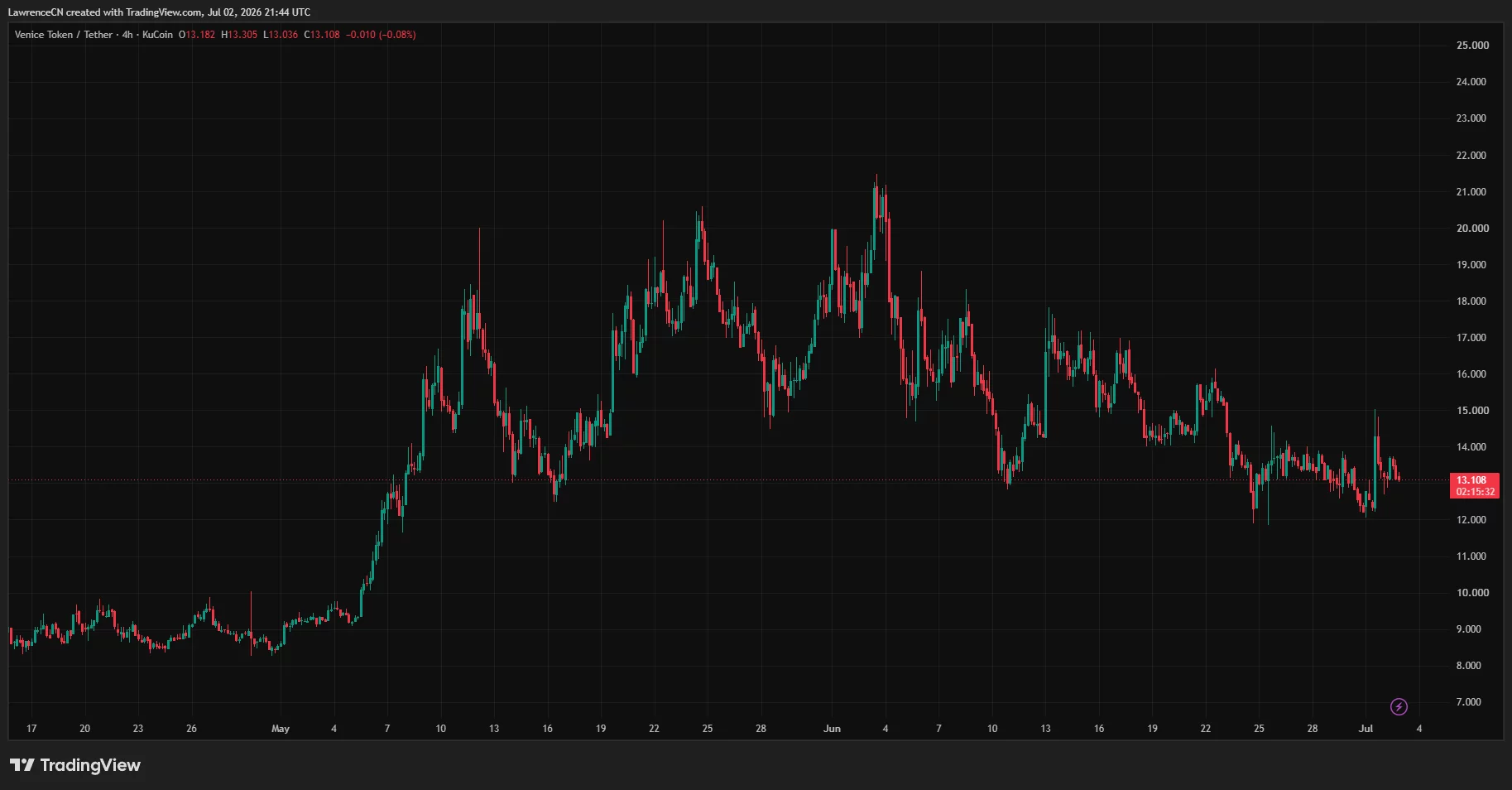
The pullback that followed is typical of parabolic moves, but the underlying story, a real private-AI platform with a deflationary token, is why VVV keeps drawing attention instead of fading into the long tail of AI launches.
The bull case for VVV
The bull case begins with product traction that is rare in its category. More than 2 million users and millions of monthly visits give Venice a genuine, revenue-relevant user base, which is exactly what most AI tokens lack. That usage creates real demand for the token, because access to the platform’s AI capacity runs through staking VVV. As more agents, bots, and third-party applications need private, uncensored inference, they have a functional reason to acquire and stake the token, which ties token demand to actual platform adoption rather than to speculation alone.
The second pillar is the tokenomics. Venice uses a buy-and-burn model, where platform revenue is used to buy VVV and remove it from supply, and it has been reducing token emissions in stages, targeting a sharply lower issuance rate, with a further cut scheduled.
Buy-and-burn plus declining emissions is a deflationary combination: it shrinks or slows the growth of supply while usage-driven demand rises. Compared with AI tokens that rely purely on narrative, VVV’s burn mechanics offer structural support that can cushion downturns and amplify upturns, because the supply side is actively working in holders’ favor.
The third pillar is the narrative and the niche. Private, uncensored AI is a distinct and defensible position in a world increasingly worried about surveillance, censorship, and data control. When the AI narrative runs hot, VVV has shown it can move fast, and its differentiated positioning gives it a story that resonates beyond generic AI exposure.
Sitting within an active ecosystem and maintaining strong trading volume adds liquidity to that story. The bull case is that Venice is one of the few AI tokens with real usage, deflationary tokenomics, and a defensible niche, and that a return of the AI trade could carry VVV back to and beyond its highs.
The bear case for VVV
The bear case starts with the sector. Artificial-intelligence tokens have been among the weaker performers in 2026, and a token is not immune to its category: when the AI trade cools, even fundamentally stronger names like VVV get pulled down. If capital continues rotating out of AI tokens, VVV faces a headwind that its product traction cannot fully offset in the short term, because sentiment and sector flows dominate price action over weeks and months even when fundamentals are sound.
The second problem is VVV’s own volatility and history of sharp retracements. The token has a documented pattern of retracing meaningfully after parabolic moves, and its price history is a series of dramatic swings, including an earlier all-time high, a deep decline to near $1, and then a fresh high many months later. That kind of boom-and-bust behavior means buying after a rally carries real risk of a large drawdown, and the move to $21 was itself parabolic. Entry timing relative to the trend matters enormously for a token that can shed a third or more of its value in a normal correction.
The third pressure is on the supply side, which is a double-edged sword. While buy-and-burn and emissions cuts are deflationary forces, VVV still has ongoing token emissions and does not have a hard-capped supply in the way some assets do, so new tokens continue to enter circulation even as the rate slows.
If usage-driven burns fail to keep pace with emissions, or if platform revenue softens, the deflationary thesis weakens. Add competition from the many other AI and privacy tokens vying for the same narrative and capital, and the bear case is that VVV is a strong project whose token remains hostage to a weak sector, its own volatility, and the need for burns to outrun emissions.
The technical picture
VVV’s chart is defined by its June 2026 peak and the pullback that followed. The token set an all-time high above $21 in early June, then retraced into the mid-teens, a decline of roughly a quarter to a third from the top that fits its familiar pattern of post-rally corrections. Despite that pullback, VVV has held well above its late-2025 lows near $1, and over the surrounding month it outperformed Bitcoin, so the medium-term structure has been constructive even as the short-term move cooled.
The levels traders are watching are clear. On the downside, support sits around $14.50, with a deeper level near $12; losing $14.50 would suggest the correction has further to run toward the low teens. On the upside, resistance stands near $18.30, then around $20.40, and finally the all-time high above $21; reclaiming those in sequence would signal renewed momentum. Momentum readings have been broadly neutral, with the token holding above its longer-term moving average, which points to an intact broader uptrend even during the consolidation. That mix, a neutral short-term posture inside a constructive longer-term structure, describes a token digesting a big move instead of breaking down.
The honest technical read is that VVV is consolidating beneath its all-time high, bounded by support near $14.50 and resistance running up to the $21 peak. As with any volatile token, these levels are guides rather than certainties, and a shift in the AI narrative or the broader market can override the chart quickly.
For a price prediction, the technicals frame a wide band: a hold of support keeps a run back toward the highs on the table, while a break of $14.50 tilts the odds toward a deeper retracement into the low teens.
What could move VVV next
The clearest token-specific catalyst is the emissions schedule and burn rate. Venice has been cutting emissions in stages, with a further reduction planned, and each cut tightens supply. If those cuts land while platform usage and revenue keep the buy-and-burn engine running, the deflationary pressure builds, which is supportive for price.
The metric to watch is whether burns are outpacing emissions on a net basis, because that balance determines whether the token’s supply is actually shrinking or merely growing more slowly.
The second driver is user and usage growth. Because token demand is tied to staking for platform access, continued growth in Venice’s user base, and in the agents and applications that need private inference, translates into structural demand for VVV. Evidence that the more than 2 million user base is expanding, and that more third-party demand is flowing through staking, would strengthen the fundamental case. Stagnating usage would do the opposite, leaving the token more dependent on narrative.
The third set of catalysts is external: the AI narrative and the broader market. VVV is sensitive to how the AI token sector trades, so a rotation of capital back into AI would lift it, while continued weakness in the sector would weigh on it regardless of fundamentals. The ecosystem VVV sits within, and its overall liquidity also matter, as does the macro backdrop that sets risk appetite across all of crypto.
The interplay of tightening supply, growing usage, and a recovering AI narrative is the combination that could push VVV back toward its highs, while the absence of any of them keeps it consolidating or sends it lower.
How VVV compares to other AI tokens
To judge VVV fairly, it helps to place it against the wider field of artificial-intelligence tokens, because that comparison is where its case is strongest and its risks are clearest. The defining feature of most AI tokens is that they are narrative first and product second: they attach a token to the idea of AI, often with little real usage, revenue, or working software behind it.
In a strong AI market, these tokens can run hard on story alone, but they have little to fall back on when sentiment turns, which is part of why the AI token sector as a whole has been weak in 2026. Against that backdrop, the single most important thing about VVV is that Venice is a real, used product, not just a narrative.
That product traction is VVV’s main differentiator. A platform with more than 2 million users and millions of monthly visits generates the kind of genuine demand that most AI tokens cannot claim, and because access to the platform runs through staking VVV, that usage connects directly to token demand.
Where a typical AI token asks buyers to believe a future will arrive, VVV points to a service people already use for private, uncensored inference today. That does not make it immune to the sector’s swings, but it gives it a floor of real utility that narrative-only tokens lack, and it is the reason VVV tends to be discussed as one of the more fundamentally grounded names in the category.
The tokenomics deepen the contrast. Many AI tokens have inflationary or loosely defined supply schedules that work against holders, whereas VVV pairs a buy-and-burn mechanism with staged emissions cuts, actively tightening supply as usage grows. That combination of real demand and shrinking or slowing supply is uncommon among AI tokens and is the structural reason bulls argue VVV can outperform its peers over a full cycle. The catch, as always, is that the burns have to keep pace with ongoing emissions for the deflationary story to hold, so the comparison is favorable but conditional.
The honest conclusion is that VVV screens as one of the stronger AI tokens on fundamentals, but it still lives inside a weak and volatile sector. Being the best house on a bad street helps on a relative basis and offers some downside cushion, but it does not fully protect a token when capital rotates out of AI entirely.
For anyone weighing VVV, the comparison cuts both ways: its real product and deflationary design set it apart from the narrative-only crowd, while its membership in a struggling sector means it can still fall with its peers regardless of how it stacks up against them.
Venice price prediction scenarios
Because VVV is a volatile token whose price depends heavily on the AI narrative and its own supply dynamics, the most honest forecast is a set of scenarios rather than a single figure. The levels below are illustrative reasoning based on the drivers and technicals above, not guarantees, and VVV can move outside these ranges quickly.
Bull case
In the bull scenario, the AI narrative reignites, capital rotates back into AI tokens, and Venice’s user growth continues while its emissions cuts and buy-and-burn tighten supply on a net basis. Demand for staking rises as more agents and applications need private inference, and the deflationary tokenomics amplify the move. In this case, VVV reclaims resistance near $18.30 and $20.40 and pushes back to and potentially beyond its all-time high above $21, with further upside if the supply keeps shrinking against rising usage. This is the reward side of owning an AI token with real traction and deflationary mechanics.
Base case
In the base scenario, Venice remains a strong product in a mixed market, with steady but not explosive user growth and an AI sector that trades sideways. Burns roughly offset emissions, and the token consolidates beneath its all-time high, ranging between support near $14.50 and resistance around $18 to $20 without a decisive breakout. This is a digestion outcome, where VVV holds its medium-term gains and waits for a clearer catalyst from either the AI narrative or its own supply dynamics. Given the current environment, this range-bound path is a realistic central expectation.
Bear case
In the bear scenario, the AI token sector stays weak, capital keeps rotating away from AI, and VVV follows its category lower despite its fundamentals. Usage growth stalls, burns fail to outpace emissions, and the token’s history of sharp post-rally retracements plays out again. Support near $14.50 breaks, and VVV slides toward the low teens or lower, giving back much of its June rally. For a volatile AI token in a hostile sector, this downside is real, which is why timing and risk management weigh heavily on any position instead of any single target.
Frequently Asked Questions
What is Venice (VVV)?
Venice is a private, uncensored generative-AI platform that lets users create text, images, and code without accounts, data storage, or surveillance, keeping conversations local and encrypting data in transit. VVV is its utility token: instead of paying per request, users, agents, and applications stake VVV to access a share of the platform’s AI capacity, and staking can earn income. Holding and staking VVV is effectively how you buy ongoing private AI access.
Why is VVV trending?
VVV is trending because it combines rare product traction with strong tokenomics and a hot narrative. Venice has more than 2 million users and millions of monthly visits, unusual for an AI token, and VVV uses a buy-and-burn model with staged emissions cuts. The token surged to an all-time high above $21 in early June 2026 during a wave of AI and privacy interest, and it has remained heavily searched and discussed since.
Can VVV reach $21 again?
It is plausible but not guaranteed. Reclaiming the $21 all-time high would likely require
the AI narrative to reignite, Venice’s usage to keep growing, and its emissions cuts and
burns to tighten supply on a net basis. VVV would need to clear resistance near $18.30
and $20.40 first. Because the token is volatile and sensitive to the AI sector, it could
return to that level in a strong phase or fall further in a weak one.
How do Venice’s tokenomics work?
Venice uses a buy-and-burn model, where platform revenue buys VVV and removes it from supply, combined with staged reductions in token emissions. Together, these create deflationary pressure by shrinking or slowing supply growth. On the demand side, access to the platform’s AI capacity requires staking VVV, so usage translates into token demand. The key question is whether burns outpace ongoing emissions on a net basis.
What are the biggest risks for VVV?
The main risks are a weak AI token sector that can drag VVV down regardless of fundamentals, the token’s history of sharp retracements after parabolic moves, and ongoing emissions that require burns to keep pace to preserve the deflationary thesis. Competition from other AI and privacy tokens and the token’s general volatility add to the risk, so entry timing and position sizing matter a great deal.
Is VVV a good investment?
That depends on your risk tolerance and research, and this is not financial advice. VVV offers exposure to a rare AI token with real product traction and deflationary tokenomics, but it is volatile, sensitive to a weak AI sector, and prone to large drawdowns after rallies. Anyone considering it should weigh the strong fundamentals against the sector and volatility risks and size any position accordingly.
What levels should I watch for VVV?
On the downside, support sits around $14.50, with a deeper level near $12; a break of $14.50 would suggest a further slide toward the low teens. On the upside, resistance runs near $18.30, then around $20.40, and finally the all-time high above $21. Reclaiming those levels in sequence would signal renewed momentum. The token holding above its longer-term moving average points to an intact broader uptrend.
What could push VVV higher from here?
The main catalysts are the emissions cuts and burn rate tightening supply on a net basis, continued growth in Venice’s user base and in third-party demand that flows through staking, and a rotation of capital back into the AI token sector. A recovering broader market that lifts risk appetite would help too. The combination of shrinking supply, rising usage, and a warmer AI narrative is what could carry VVV back toward its highs.
Disclaimer: This article is for information and educational purposes only and does not constitute financial, investment, or trading advice. Price predictions are speculative scenarios, not guarantees, and VVV is a volatile asset that can lose value rapidly. Nothing here is a recommendation to buy or sell any asset. Always do your own research and consider consulting a qualified financial professional before making investment decisions. Information is accurate as of July 2, 2026, and will change.
Marketwise general counsel Forney’s $13,608 stock withholding for taxes

‘The Bear’s Final Twist Is the Perfect Ending Fans Have Been Waiting For
Aave V3 Protocol Deploys on Monad with GHO Stablecoin Integration


-

 Fashion6 days ago
Weekend Open Thread: Staud – Corporette.com
-

 Politics7 days ago
The House | Manchesterism won’t survive the painful trade-offs unless it gets citizens on board
-

 Crypto World3 days ago
Strategy authorizes up to $1.25B in Bitcoin sales under new capital plan
-

 Politics7 days ago
Potential 2028er World Cup attendee leaderboard
-

 Business7 days ago
Asia stock markets slide as tech shares slump
-

 News Videos4 days ago
MAJOR BITCOIN & MARKET UPDATE!!!! (MUST WATCH ASAP!!!)
-

 Crypto World5 days ago
Coinbase, Circle Deepen Crypto Stock Losses Despite Resilient S&P 500
-

 Tech3 days ago
Anonymous researcher drops 0-day ‘exploitarium’ repo
-

 Business3 days ago
Australia treasurer says alleged access of prime minister’s bank data ’incredibly concerning’
-

 Crypto World6 days ago
Kraken's xStocks Opens Bending Spoons IPO Registration to EEA Retail
-

 Sports6 days ago
FIH Pro League: India defeat Pakistan 7-1, register biggest win of campaign | Other Sports News
-

 Crypto World7 days ago
Bitcoin Sparks $600M Hourly Liquidations With $65,000 Set To Become Resistance
-

 Tech5 days ago
Bluekit phishing kit adopts browser-in-the-middle for login theft
-

 Tech6 days ago
Russian hackers now target Signal backup recovery keys
-
Crypto World6 days ago
Hyperliquid Named on Singapore MAS Investor Alert Register
-

 Crypto World6 days ago
RTX holders must register wallets before token distribution begins
-
 Crypto World7 days ago
Tether (USDT) Passes Ether in Market Cap as ETH Drops Toward $1.5K
-

 Sports1 day ago
Broncos roster: OL Ben Powers (No. 74) entering final year of contract
-
 Business3 days ago
The AI boom won’t burst all at once. It will pop in ‘rolling bubbles’: Macquarie
-

 Tech5 days ago
Claude Code turned every engineer into three. Now companies need more product thinkers
You must be logged in to post a comment Login