

Crypto World
Strategy’s Saylor Doubles Down on $100 STRC Target Despite Being $13 Off

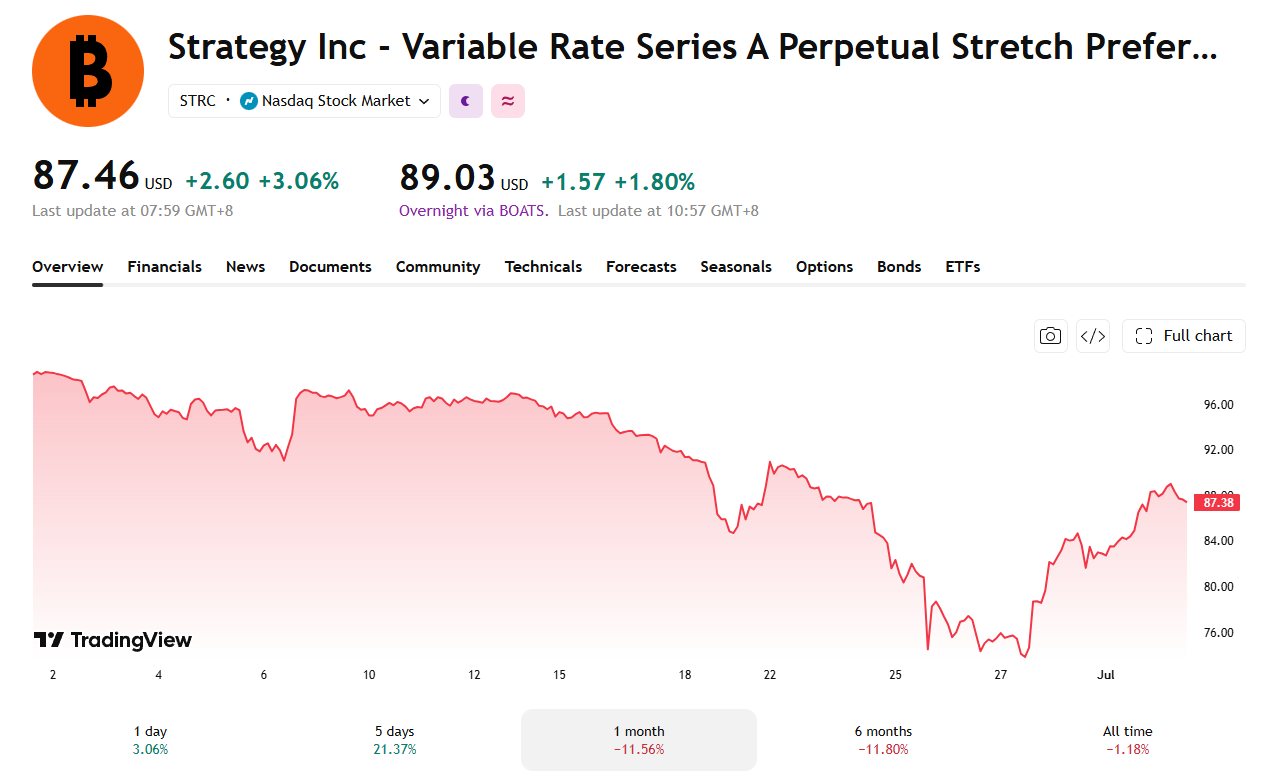
Michael Saylor reiterated on X that Strategy’s corporate objective remains for STRC to trade between $99 and $100, as the preferred stock attempts to climb back from its all-time low set on June 26.
The comment came as STRC rebounded from that record low of $71.25 to around $87.46 off the back of a new capital framework announcement. Even so, the gap to par remains wide with Bitcoin’s price also languishing.
STRC Still Trades Below Saylor’s Target
STRC, Strategy’s Variable Rate Series A Perpetual Stretch Preferred Stock, is not common stock. It is a preferred security designed to trade near a $100 face value. Strategy adjusts its dividend rate monthly to keep the price anchored, unlike common shares.
Bitcoin (BTC) had dropped below $60,000 in the same week STRC recorded its low, deepening a preferred stock crash that had already alarmed investors. STRC has since recovered but the stock is still about $13 short of the par value Saylor says remains the company’s goal.

On Monday, June 29, Strategy raised STRC’s dividend rate by 50 basis points to 12%. The increase takes effect for July record dates and is part of the capital management overhaul Strategy announced the same day.
Strategy reviews the rate using STRC’s trading level, Bitcoin’s price and volatility, and its own cash reserves. It will not raise the rate automatically just because the stock trades below par.
“As Strategy disclosed Monday: our corporate objective is for $STRC to trade over time at $99–$100.”
The tweet repeats language from Monday’s press release without adding new detail. Its timing during STRC’s rebound suggests Strategy wants the market to read the recovery as validation of its plan.
The reiteration follows weeks of criticism from Ripple (XRP) CEO Brad Garlinghouse. He called STRC’s slide a damning indictment of Strategy’s financing model. Rosen Law Firm has also opened a securities investigation into the company’s disclosures.
Whether STRC can climb back to par depends largely on Bitcoin’s trajectory. Bitcoin remains the primary driver of Strategy’s capital structure and dividend coverage.
The post Strategy’s Saylor Doubles Down on $100 STRC Target Despite Being $13 Off appeared first on BeInCrypto.

Bitcoin traded above $60,700 on Thursday after a quick overnight reversal after Federal Reserve Chair Kevin Warsh said inflation risks had eased, giving a market that spent most of June grinding lower its first clear lift in weeks.
Speaking at the European Central Bank’s annual forum in Sintra, Portugal, on Wednesday, Warsh said “inflation risks have come down” while reaffirming the Fed’s commitment to returning inflation to 2%.
He declined to signal what the central bank will do at its meeting later this month, saying policymakers would weigh incoming data first. Bitcoin pared earlier losses and pushed back above $60,000 after the remarks, according to CoinDesk reporting.
Solana led the majors. The token rose about 4% on the day to around $78 and is up roughly 16% over the past week, per CoinDesk data, the only large token with a meaningful weekly gain. Ether traded near $1,630, up about 3% on the day, while XRP held at about $1.06. BNB, dogecoin and Tron were softer over the week.
Forward Industries has expanded its Solana treasury after buying more than 500,000 SOL during fiscal Q3 2026.
Summary
- Forward Industries bought over 500,000 SOL, raising its treasury to 7.55M SOL by June 30.
- The company reported 36% annualized SOL-per-share growth while selling 93,642 shares during fiscal Q3 2026.
- Earlier losses show Solana treasury firms remain exposed to price swings and U.S. accounting rules.
The Nasdaq-listed company said its total holdings reached 7.55 million SOL as of June 30.
The company bought the tokens at an average price of about $79 per SOL. It also said SOL per fully diluted share rose to 0.0729 from 0.0669 at the end of the prior quarter.
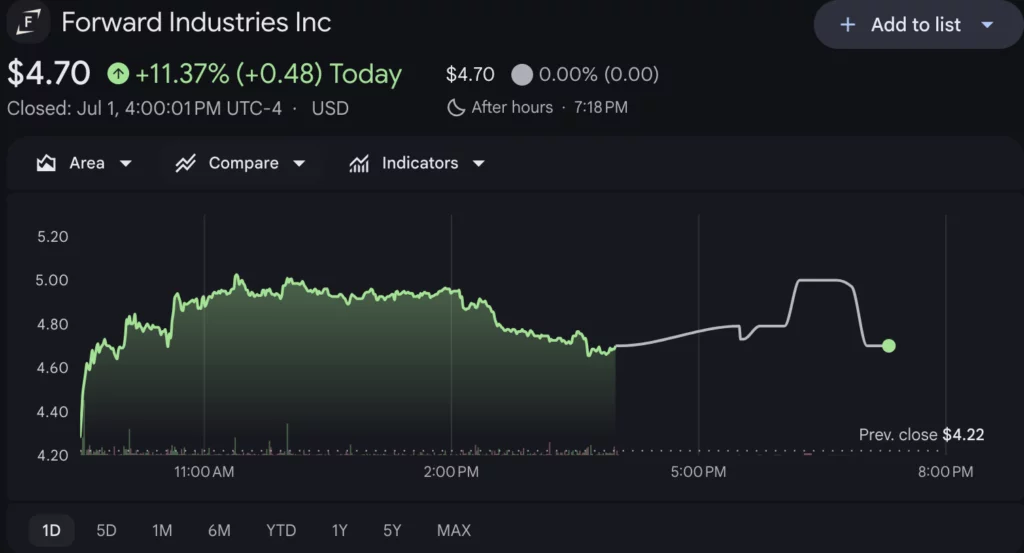
Forward Industries stock recently traded at $4.70 on Nasdaq, up more than 10% in the past day, with an intraday high of $5.04 and volume above 3 million shares (per Google Finance data).
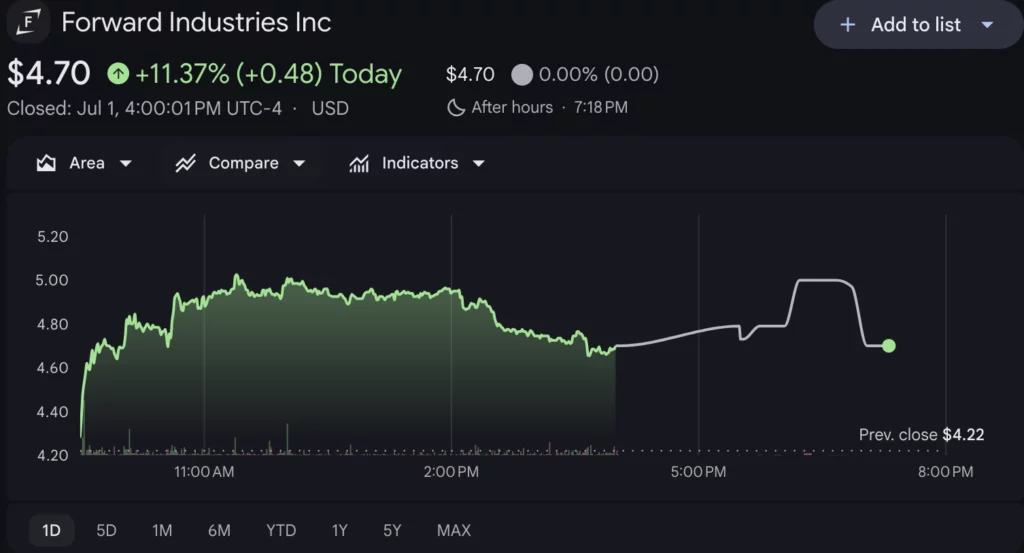
Forward Industries said the increase represented 36% annualized SOL-per-share growth. The update comes as the company continues to build its Solana treasury while earlier filings show how crypto price moves have shaped its reported results.
Forward Industries expands Solana holdings
In a July 1 company release, Forward Industries said it sold 93,642 common shares through its At The Market offering during fiscal Q3. The company said it used public market capital in a way that raised SOL per share for existing shareholders.
Forward described itself as the largest Solana treasury company. It said its recent inclusion in the Russell 2000 and Russell 3000 indexes gives it wider access to institutional investors when its shares trade above net asset value.
The company also said it can borrow against fwdSOL collateral through institutional partners. Forward said this lets it seek liquidity at a lower cost than its staking yield, which it placed between 6.4% and 7.3%.
Forward links strategy to SOL per share
“Our mandate is simple: maximize SOL per share and create long-term shareholder value,” said Chief Investment Officer Ryan Navi. He said the company uses several capital formation methods to add SOL in a way it views as accretive.
Navi added that Forward can repurchase shares when they trade below net asset value and issue equity when they trade above it. He said the Russell index additions could also widen the company’s investor base and help fund more SOL purchases.
Forward also pointed to Solana network activity in a separate X post. The post quoted SolanaFloor data saying daily, weekly, and monthly Solana transaction counts had reached record levels across measured timeframes.
Earlier losses remain part of the story
The latest purchase follows a period of reported losses tied to SOL price changes. As previously reported, Forward Industries neared a $1 billion Solana paper loss after the company reported a $585.6 million net loss for the quarter ended Dec. 31, 2025.
That earlier result included a $560.2 million loss on digital assets and a $33 million impairment under U.S. GAAP treatment. The company said the loss reflected fair-value accounting for its SOL holdings, not a direct cash outflow.
In addition, Forward also transferred 455,784 SOL to Coinbase Prime in June. That move drew attention because deposits to prime brokerage platforms can serve several purposes, including custody, liquidity management, collateral use, or asset sales.
Solana treasury model faces market test
Forward launched its Solana treasury strategy in September 2025 with backing from investors and partners including Galaxy Digital, Jump Crypto, and Multicoin Capital. The company says its strategy includes buying, holding, staking, trading, and investing in SOL-related assets and projects.
The broader digital asset treasury sector has faced pressure during crypto market declines. As crypto.news reported, treasury companies tied to Bitcoin, Ethereum, and Solana have carried large unrealized losses as token prices fell.
Forward’s Q3 update shows that the company is still adding SOL despite earlier losses. The central measure it is asking investors to watch is SOL per fully diluted share. That metric now sits higher than the prior quarter, while the value of the treasury still depends on SOL market prices, staking revenue, borrowing costs, and shareholder dilution.


Binance said its Direct Stocks product crossed $1 billion in U.S. equities acquired within 30 days of launch.
Summary
- Binance’s Direct Stocks crossed $1B in user-held U.S. equities within 30 days of launch globally.
- Emerging markets made up 73% of users, showing demand for app-based access to U.S. stocks.
- Stablecoins helped users buy fractional equities beside crypto without traditional brokerage and bank transfer barriers.
The product went live on June 1 and gives eligible users access to more than 7,000 U.S. stocks and ETFs in the same app they use for crypto.
The exchange said the product also processed close to $3 billion in trading volume during the same period. The 30-day window included 22 trading days, according to a Binance blog post.
Binance said about 73% of Direct Stocks users came from emerging markets. The company framed the data around demand from regions where brokerage accounts, bank wires, minimum balances, and foreign market access have often limited retail participation.
Binance stock access gains early demand
Direct Stocks lets users buy fractional U.S. stocks and ETFs with stablecoins and selected crypto balances. As previously reported, Binance opened U.S. stock trading access for eligible non-U.S. users in June, offering more than 7,000 equities and ETFs with purchases starting from $5.
The product places equities beside crypto balances in one interface. Binance said the setup removes some steps tied to traditional brokerage access, including separate bank transfers and new account flows. The company said users acquired more than $150 million in U.S. equities per day during the first 30 days.
Emerging markets drive the user base
Binance said emerging markets accounted for most Direct Stocks users. The company also said about one in seven visitors to its stock trading page registered an account, and nearly 90% of those new sign-ups placed a trade.
The data follows earlier Binance Research claims about broader demand for equity access through crypto exchanges. As reported by crypto.news, Binance Research projected that crypto exchanges could bring 300 million new equity investors and $2 trillion in new capital into global stock markets by 2031. The report linked that growth to stablecoins, crypto exchange reach, and users in underbanked regions.
Shunyet Jan, Binance’s Head of Spot and Derivatives Business, said, “A billion dollars in 30 days is a sign of the demand that’s been waiting decades for a door to walk through.” He added that Binance built the product for users who “never had a way in.”
Stock trading uses broker-linked rails
Binance does not custody the securities traded through Direct Stocks. Binance disclosed an Alpaca stake as its stock trading service expanded. Nest Trading acts as introducing broker, while Alpaca handles execution, clearing, settlement, custody, dividends, and corporate actions.
The model gives Binance exposure to traditional equities while keeping securities activity linked to regulated brokerage partners. Users fund stock purchases with stablecoins and supported crypto assets. Binance said the product targets eligible users outside the U.S.
Tokenized equity race widens
The direct stock rollout comes as exchanges add more equity-linked products. Crypto.news reported that Binance launched bStocks, letting eligible users convert supported U.S. stock holdings into tokenized assets that can trade around the clock.
Moreover, other exchanges are also moving into stock access. Bitget launched Stock+, allowing eligible users to buy real U.S. stocks with crypto converted into USDC through regulated brokers.
Binance said technology stocks made up the largest share of Direct Stocks holdings. It said the technology sector accounted for about 71% of holdings, while semiconductor names made up around 48%. The company also projected that Direct Stocks could exceed $10 billion by the end of 2026 if current growth continues, though it said the projection was illustrative and not a guarantee.
Crypto World
FBI Director Kash Patel caught sleeping on required disclosure of six-figure MSTR investment
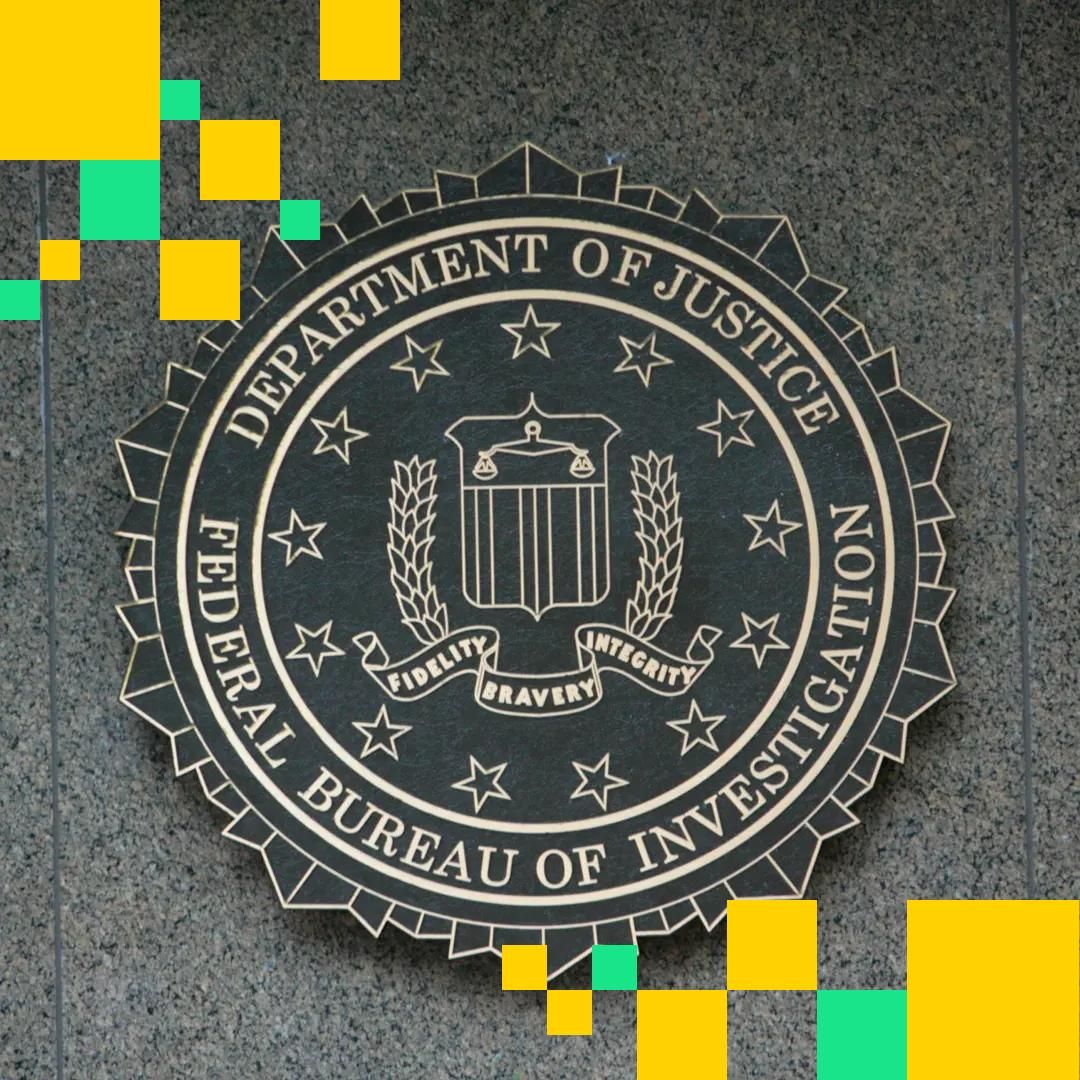
FBI Director Kash Patel failed to timely disclose a six-figure purchase of stock in Strategy (MSTR), the world’s largest publicly-listed bitcoin holder, according to a report by nonpartisan news outlet NOTUS.
Patel supposedly purchased between $100,001 and $250,000 worth of MSTR on Nov. 21, but did not report the trade to regulators until May 26.
The reason for the delay? miscommunication. Patel informed the Office of Government Ethics that he “inadvertently omitted” the transaction due to an unspecified “miscommunication.”
According to the Stop Trading on Congressional Knowledge (STOCK) Act, high-ranking executive branch officials need to publicly disclose individual stock trades over $1,000 within 45 days from the transaction.
The trade has drawn intense scrutiny from government watchdogs due to Strategy’s BTC accumulation business and its previous business with federal agencies.
The company, which according to NOTUS has done millions of dollars in business over the years with the Justice Department, calls itself as a “Bitcoin Treasury Company,” and aggressively accumulates BTC as its primary reserve asset. Since 2020, the company has built a coin stash of 847,363 BTC, worth over $50 billion as of this writing.
French Interior Minister Laurent Nuñez has promised a “more ambitious” approach to tackling crypto ransom attacks after confirming there were 77 kidnapping, extortion or attempted extortion incidents linked to crypto in the first half of 2026.
Nuñez said Tuesday that the 77 incidents recorded so far this year are up sharply from the 45 recorded in all of 2025, according to local outlet BFM Business.
“These are serious matters, and your concern is legitimate,” he told the Association for the Development of Digital Assets (ADAN) as he promised more government support.
France has become one of the biggest hot spots for crypto wrench attacks, where criminals use physical violence to coerce victims into handing over crypto. Approximately 11% of French people own cryptocurrencies, according to ADAN, which equates to about 7.3 million people.
France’s rapid alert and protection system
Earlier this year, French authorities launched a dedicated prevention platform and a rapid-alert and protection system for crypto holders and professionals, which has attracted 724 sign-ups so far, Nuñez said.
Nuñez said that emergency measures have resulted in 200 arrests, with one recent attacker being arrested within eight hours on Friday, thanks in part to the victim using an emergency identification hotline.
Related: StarkWare introduces ‘Private KYC’ to address personal data breaches
Nuñez promised a “more ambitious” three-part plan to reinforce security measures for the crypto sector. This includes stronger intelligence-sharing, since criminal networks are often based abroad, a deeper partnership with ADAN and better operational coordination between security services.
French wrench attacks on the rise
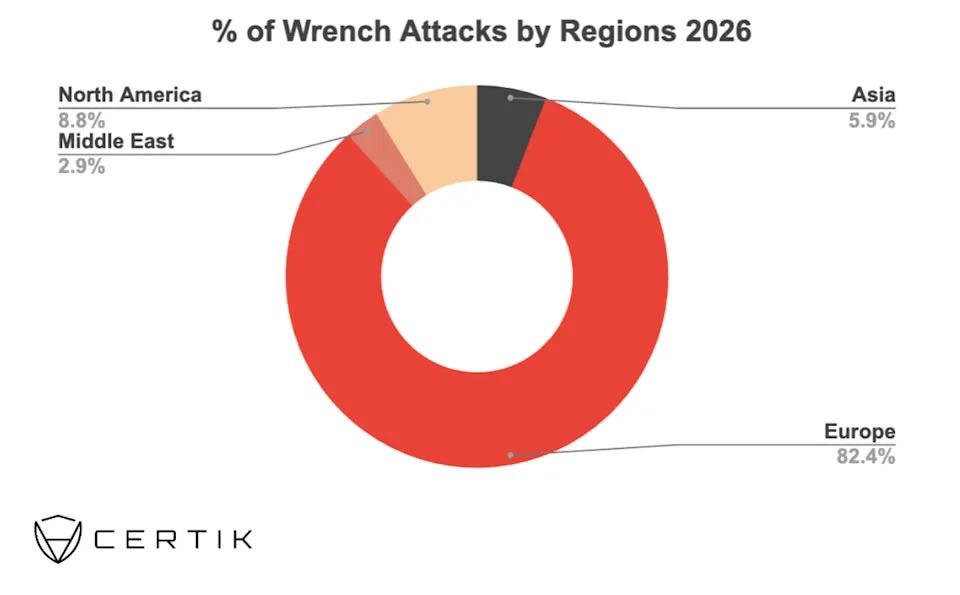
Blockchain security firm CertiK reported in May that wrench attacks globally were up 41% in the first four months of 2026, compared with the same period last year, with most attacks in Europe.
The firm said France is the “epicenter” of attacks because of the presence of several flagship industry companies and their executives, a “culture of flexing and voluntary doxxing that remains deeply embedded in the community,” and proven exposure from numerous sensitive data leaks.
David Balland, co-founder of French hardware wallet maker Ledger, was kidnapped and held for ransom along with his partner in January 2025 before being rescued by police.
Ledger suffered one of the industry’s most damaging data breaches when its customer database was hacked in 2020, resulting in the leak of more than 270,000 personal records and a wave of phishing and wrench attacks that continue to this day.
“France ranks among the most targeted countries in the world for this type of breach,” CertiK said.
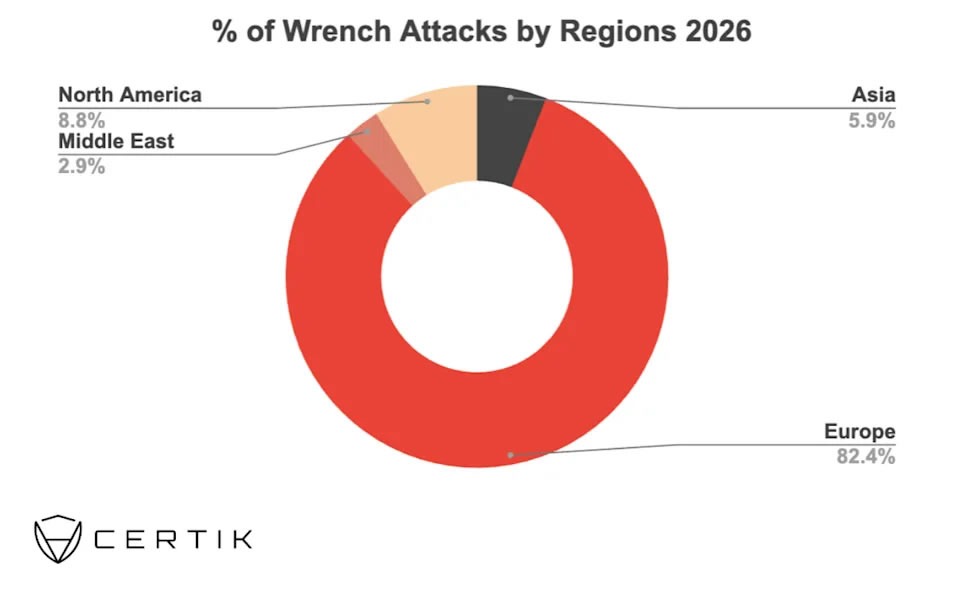
Europe is becoming a hotbed for wrench attacks in 2026. Source: CertiK
Magazine: Bitcoin slides to $58K, XRP hits $1 but onchain data promising: Market Moves
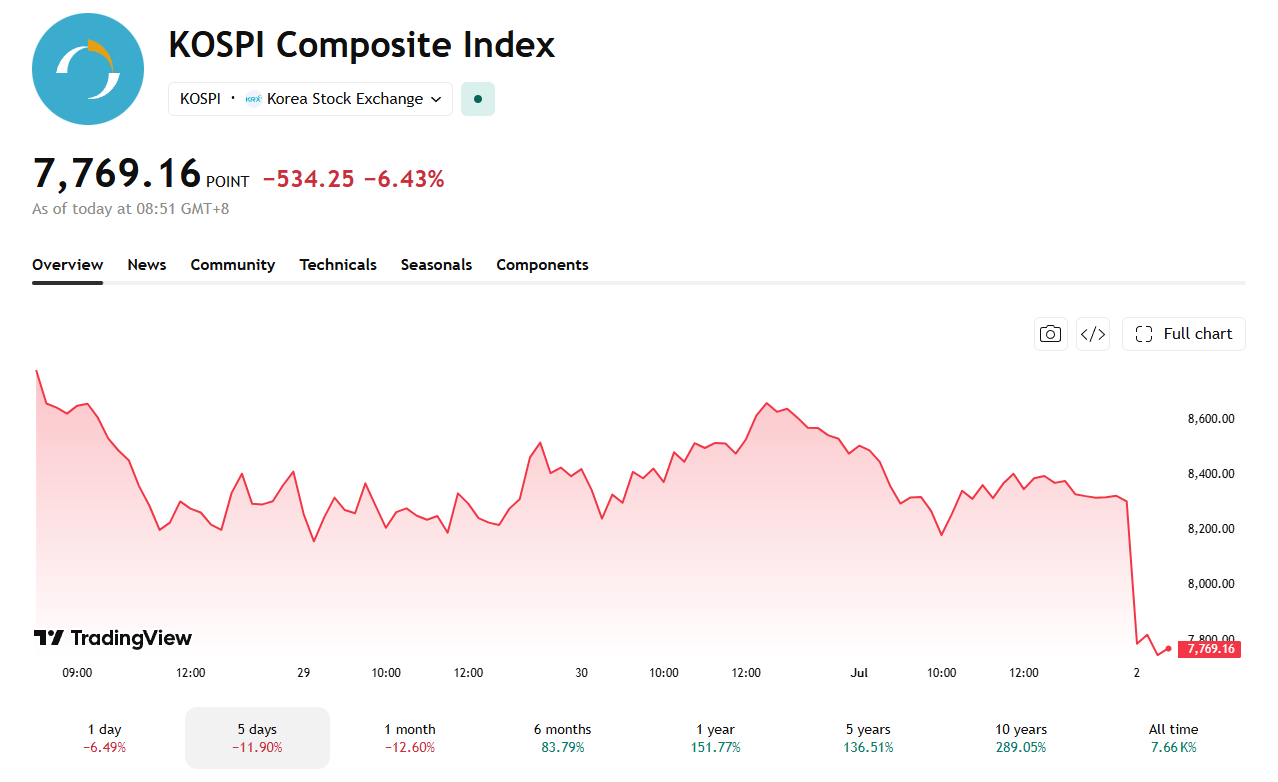
The KOSPI sank below 8,000 on July 2. The drop pushed the Korea Exchange (KRX) to activate a sell-side sidecar within minutes of the opening bell.
The Korea Exchange suspended program trading on KOSPI-listed shares for five minutes. Heavy selling in semiconductor stocks drove the move. The benchmark opened 4.46% lower and kept falling from there.
Another Halt in a Record-Breaking Year
The index had dropped 534.25 points, or 6.43%, to 7,769.16 by 9:51 a.m. local time. A sell-side sidecar triggers automatically once KOSPI 200 futures fall 5% or more for at least one minute.

Thursday’s pause is far from an isolated event. The exchange has repeatedly triggered sidecars and circuit breakers throughout 2026. Volatility this year has already topped the 2008 financial crisis, when the KOSPI set its prior annual sidecar record of 26 halts.
By late June, the KRX had logged close to 30 sidecar activations and five circuit breakers this year alone. Both figures already beat that 2008 tally.
Chipmakers Bear the Brunt
Samsung Electronics and SK Hynix together make up roughly half of the KOSPI’s market capitalization. The two chipmakers have repeatedly driven these swings. Their shares extended losses again Thursday, tracking a global chip stock selloff that started on Wall Street overnight.
The Nasdaq Composite slid 0.66% Wednesday. The VanEck Semiconductor ETF lost 5.4%. Micron Technology and Sandisk each dropped more than 10%. The rout followed weeks of sharp reversals in the KOSPI’s chip-driven rally, a rally that had pushed the index to record highs earlier this year.
Semiconductor stocks still dominate the index. Traders now face a familiar question: will Thursday’s selloff deepen further, or fade as quickly as prior swings have this year.
The post KOSPI Drops Below 8,000, Triggers Yet Another 2026 Trading Halt appeared first on BeInCrypto.
Senator Cynthia Lummis defended the Clarity Act against Senator Elizabeth Warren, rejecting claims that the digital-asset bill creates illicit finance loopholes and pointing to more than 16 safeguards written into the legislation.
The Wyoming Republican responded after Warren argued that adversaries exploit crypto to move billions and that the bill would weaken standards. Their clash comes as the Senate races against a narrow legislative calendar.
Follow us on X to get the latest news as it happens
Lummis Points to Built-In Safeguards
Lummis countered that the Clarity Act strengthens illicit finance rules rather than weakening them. She listed specific provisions in a public rebuttal.
Lummis noted that Section 201 applies the Bank Secrecy Act and anti-money laundering (BSA/AML) rules to crypto. Section 303 adds new sanctions aimed at Iran. Section 305 lets exchanges freeze dirty money.
“If you don’t like crypto, then say it, but stop these baseless attacks,” she said.
Illicit finance concerns have become a central sticking point for the legislation. Law enforcement groups and Catholic coalitions pushed back in separate letters last month.
Their objections targeted Section 604, the bill’s developer safe harbor. Critics say broad exemptions could weaken oversight of criminal fund flows.
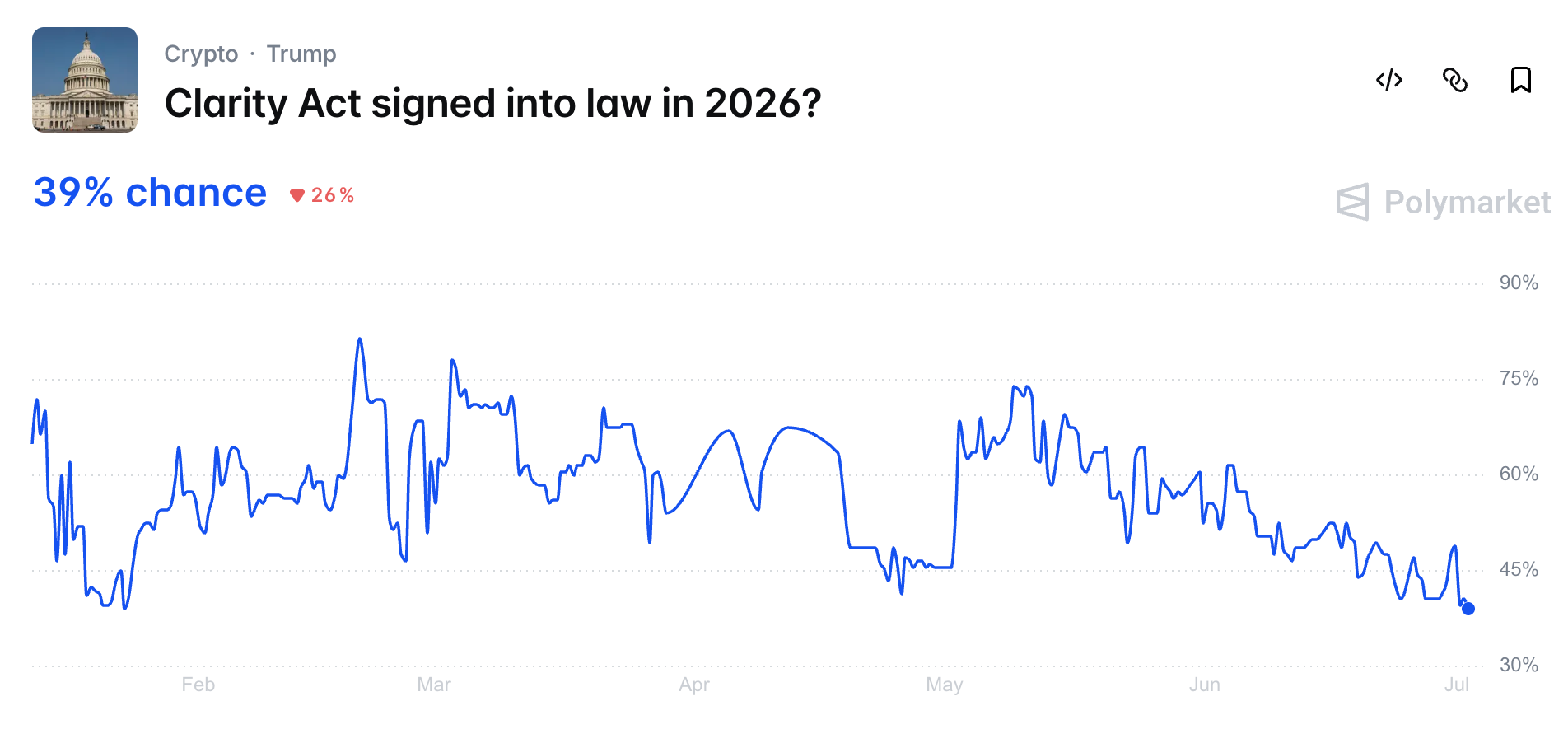
Clarity Act Passage Odds Slide on Polymarket as Deadline Nears
Meanwhile, the timing raises the stakes for the bill. The Senate returns from recess on July 13, leaving a narrow window before the August break.
The bill must clear the Senate by then to stand a chance of becoming law this year. That path requires 60 votes, including at least seven Democrats.
Prediction markets have turned cautious. On Polymarket, the odds of the Clarity Act becoming law in 2026 fell to 39%, down from 64% in early June.

Analysts have shifted, too. Galaxy Research now puts the odds of the CLARITY Act becoming law in 2026 at 50%, down from 60% on June 5, citing the shrinking Senate calendar.
Subscribe to our YouTube channel to watch leaders and journalists provide expert insights
The post Senator Lummis Calls to Stop ‘Baseless Attacks’ on the Clarity Act appeared first on BeInCrypto.


Tether has frozen USDT balances in 131 TRON wallets linked to ISIS-K after U.S. sanctions officials added more than 100 crypto identifiers tied to the group.
Summary
- Tether froze USDT balances across 131 ISIS-K-linked TRON wallets after OFAC updated its sanctions identifiers.
- Chainalysis said the TRON wallets received over $1.4 million and sent over $880,000 since 2023.
- The action adds pressure on VASPs to update sanctions screening for newly listed crypto addresses.
The move places stablecoin issuer controls at the center of a new terrorism-financing action involving TRON and Monero addresses.
Chainalysis said the U.S. Treasury’s Office of Foreign Assets Control updated its ISIS-K designation on July 1. The update added 134 crypto wallet identifiers, including 131 TRON addresses and three Monero addresses.
“Tether has frozen the balances on all 131 TRON addresses,” said Chainalysis.
The official OFAC update lists the wallets under ISIL Khorasan, also known as ISIS-K. The group is the Islamic State’s Afghanistan and Pakistan branch. OFAC had already designated ISIS-K as a terrorist group before adding the new crypto wallet identifiers.
Chainalysis tracks Tether flows across TRON wallets
Chainalysis said the 131 TRON addresses had received more than $1.4 million since 2023. The same wallets sent out more than $880,000 over that period. The blockchain analytics firm said several listed wallets had exposure to mainstream services and also sent funds to Syria-based crypto exchangers.
The report said ISIS-K’s media branch, al-Azaim Media Foundation, has used websites and messaging platforms to seek crypto donations. Chainalysis said it had collected past donation addresses on TRON, Monero, and Bitcoin. The firm also noted that earlier public terrorism-financing campaigns often used smaller donations, rather than a few large transfers.
Stablecoin freeze role keeps growing
The latest freeze follows a wider rise in issuer-level enforcement around USDT. As previously reported, Tether’s T3 Financial Crime Unit passed $450 million in frozen suspected illicit assets since its 2024 launch. The unit is backed by Tether, TRON, and TRM Labs, and focuses on USDT activity on the TRON network.
Moreover, Tether froze more than $514 million across 370 addresses during one 30-day period earlier this year. Most of the frozen funds were on TRON. BlockSec data cited in that report showed Tether blacklisted 4,163 addresses in 2025, freezing $1.26 billion across Ethereum and TRON.
Sanctions pressure reaches compliance teams
The ISIS-K action also comes after other terrorism-linked wallet freezes this year. Victims with U.S. terrorism judgments asked a New York court to order Tether to turn over 344,149,759 USDT held in two OFAC-blocked TRON wallets linked to Iran’s IRGC. That case centers on whether frozen stablecoins can be transferred to judgment creditors.
Chainalysis said the July 1 actions require virtual asset service providers and financial institutions to update sanctions screening and transaction monitoring. The firm also said it labeled the relevant addresses in its products. The step gives compliance teams a way to detect exposure to the newly listed ISIS-K wallets and related networks.


Circle co-founder and CEO Jeremy Allaire published a lengthy rebuttal on X on July 1 to the pitch behind OUSD, the stablecoin launched by the Open Standard consortium, arguing that USDC's advantages in distribution, liquidity and regulatory licensing are not easily replicated. "We've had lots of… Read the full story at The Defiant


K Wave Media has sold its remaining Bitcoin holdings, ending a short-lived treasury push that once aimed to turn the Nasdaq-listed Korean media company into a major corporate BTC holder.
Summary
- K Wave Media sold its remaining 88 BTC to repay $6 million in debt obligations.
- The company once said it wanted to expand Bitcoin holdings toward 10,000 BTC quickly afterward.
- K Wave’s filing shows it halted Bitcoin strategy while shifting focus toward AI infrastructure investments.
The sale came less than a year after the company said it had access to up to $1 billion in financing for its Bitcoin strategy.
K Wave sells 88 BTC to repay debt
In a June 30 SEC filing, K Wave said it liquidated 88 Bitcoin held in its treasury and used the proceeds to repay $6 million of Initial Notes. The transaction was tied to an April 29 amendment to its securities purchase agreement with Anson Funds.
The same filing says K Wave sold all of its Bitcoin holdings on May 6. It also says the company has not abandoned its treasury strategy, but has decided to halt it and focus on AI infrastructure. That shift puts its Bitcoin balance at zero after it once marketed itself as a Korean media company with a Bitcoin-backed treasury model.
Company once aimed for 10,000 BTC
K Wave’s exit marks a sharp turn from its July 2025 announcement. At the time, the company said it had secured $1 billion in total capital capacity through a $500 million convertible note agreement with Anson Funds and a $500 million standby equity purchase deal with Bitcoin Strategic Reserve.
The company said it had completed an initial purchase of 88 BTC and planned to scale its holdings.
“Our objective is clear: to scale our holdings toward 10,000 Bitcoin as soon as possible,” said CEO Ted Kim.
The company also said at least 80% of net proceeds from the first Anson tranche had to be used to buy Bitcoin.
AI strategy replaces Bitcoin plan
K Wave later changed course. As previously reported, K Wave redirected up to $485 million from its Bitcoin treasury plan toward AI infrastructure, including data centers, GPU compute operations, and possible acquisitions. Its shares fell about 25% after that update.
The SEC filing adds more detail to that pivot. K Wave said it has started a strategic transformation toward AI infrastructure and is pursuing data centers, GPU clusters, AI cloud platforms, power systems, cooling systems, and related technology assets. The company also expects shareholders to consider the planned sale of Play Company and the disposal of its Solaire stake.
K Wave is also dealing with Nasdaq compliance issues. The filing says Nasdaq notified the company in January that its shares failed to meet the $1 minimum bid rule. Nasdaq sent another notice in June after the company failed to meet the required $15 million market value of publicly held shares.
Treasury firms face wider pressure
K Wave’s move adds to stress across the digital asset treasury sector. As crypto.news reported, Sequans sold half of its Bitcoin as debt pressure tested its treasury plan. That report also cited K Wave’s earlier Bitcoin-to-AI shift as another case of public firms rethinking BTC reserves.
The wider model has also come under review. Crypto.news explained that Bitcoin treasury companies often depend on investor demand, share premiums, and access to fresh capital. When those conditions weaken, debt and dilution can make the structure harder to maintain.
Previously, crypto.news reported that Strive’s Ben Werkman warned that a long Bitcoin downturn could force some treasury firms to restructure, especially those that relied on convertible debt. K Wave’s sale shows how a company can move from an aggressive BTC target to debt repayment and a new business focus within one year.

FIFA World Cup Golden Boot race: Harry Kane draws level with Erling Haaland, closes in on Lionel Messi and Kylian Mbappé | Football News

Hostinger Promo Code: 79% Off for July 2026

Successful day of spending no money #nospend #budget #financial #nospendchallenge

No Jackpot Winner as $257 Million Prize Rolls Over to $269 Million Monday Draw

Renter of Home in Anne Heche Crash Denies Settlement With Son

Weekend Open Thread: Staud – Corporette.com
Successful day of spending no money #nospend #budget #financial #nospendchallenge

yo bailando en vez de estudiar #money #onlineshop #memes

WHICH MONEY? (Official Video) NITIN CHHANIAALA | LAMBA | New Haryanvi Song 2026 |Haryanvi Songs 2026
-
 Fashion6 days ago
Weekend Open Thread: Staud – Corporette.com
-

 Politics6 days ago
The House | Manchesterism won’t survive the painful trade-offs unless it gets citizens on board
-

 Crypto World2 days ago
Strategy authorizes up to $1.25B in Bitcoin sales under new capital plan
-

 Politics6 days ago
Potential 2028er World Cup attendee leaderboard
-

 Business6 days ago
Asia stock markets slide as tech shares slump
-

 News Videos3 days ago
MAJOR BITCOIN & MARKET UPDATE!!!! (MUST WATCH ASAP!!!)
-

 Tech6 days ago
A Look At A Gaggle Of Transputer Boards
-
 Crypto World7 days ago
Dell (DELL) Shares Tumble Over 5% Following Analyst Downgrade to Hold
-

 Crypto World5 days ago
Coinbase, Circle Deepen Crypto Stock Losses Despite Resilient S&P 500
-

 Business2 days ago
Australia treasurer says alleged access of prime minister’s bank data ’incredibly concerning’
-

 Crypto World5 days ago
Kraken's xStocks Opens Bending Spoons IPO Registration to EEA Retail
-

 Sports5 days ago
FIH Pro League: India defeat Pakistan 7-1, register biggest win of campaign | Other Sports News
-

 Crypto World6 days ago
Bitcoin Sparks $600M Hourly Liquidations With $65,000 Set To Become Resistance
-

 Tech4 days ago
Bluekit phishing kit adopts browser-in-the-middle for login theft
-

 Tech2 days ago
Anonymous researcher drops 0-day ‘exploitarium’ repo
-

 Tech5 days ago
Russian hackers now target Signal backup recovery keys
-
 Crypto World6 days ago
Hyperliquid Named on Singapore MAS Investor Alert Register
-

 Crypto World6 days ago
RTX holders must register wallets before token distribution begins
-

 Sports17 hours ago
Broncos roster: OL Ben Powers (No. 74) entering final year of contract
-
 Business3 days ago
The AI boom won’t burst all at once. It will pop in ‘rolling bubbles’: Macquarie
You must be logged in to post a comment Login