


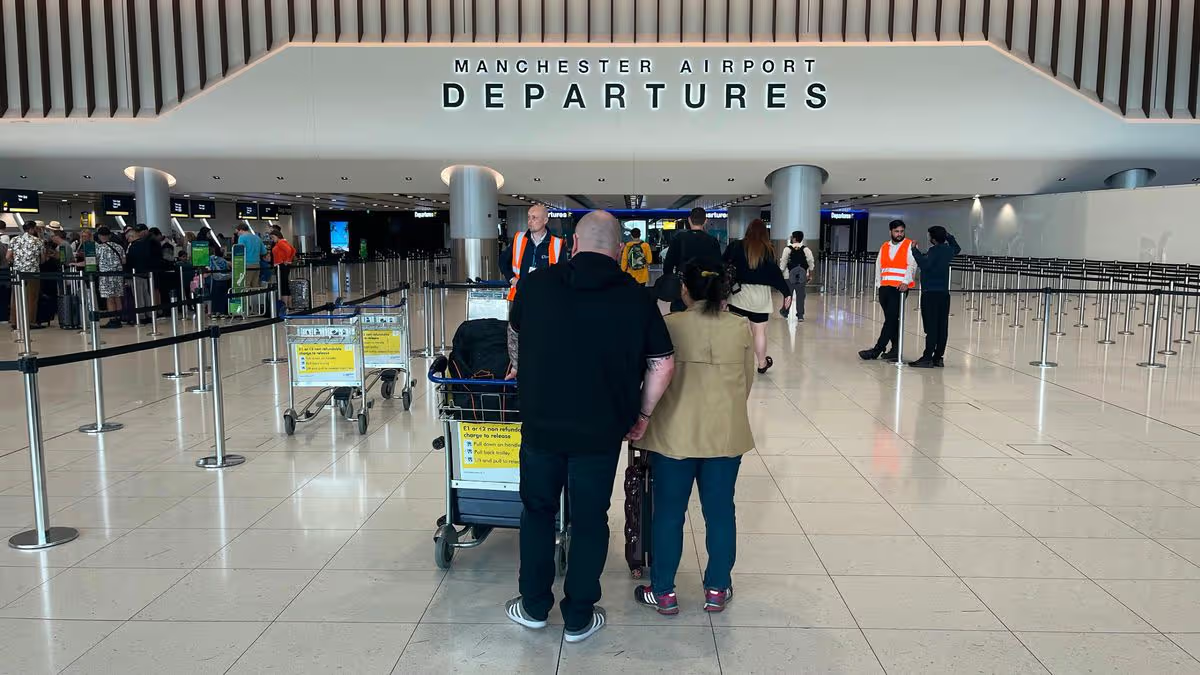
Groups owns Manchester, Stansted and East Midlands airports

MAG has invested £1,5bn in Manchester Airport(Image: Daily Mirror/Andy Stenning)
The owner of Manchester and London Stansted airports has reported a slowdown in passenger growth amid the Iran conflict – but says it remains resilient and ready to invest.
Manchester Airport Group (MAG), which also owns East Midlands Airport, recorded passenger growth of 1.9% to 66.3 million for the year to 31 March – a notable drop from the 6% growth achieved in the prior year.
Manchester Airport delivered the strongest performance across the group’s terminals, with passenger numbers climbing 3.6% to 32.3 million, though this still represented a considerable fall from the 8% growth recorded in 2024-25.
London Stansted saw passenger numbers edge up by just 0.4%, compared with a rise of 4.9% the previous year, while East Midlands suffered a 1.3% decline.
The group saw cargo volumes rise 12.5% thanks to strong growth at East Midlands Airport where seven new airlines started operating in the past year.
Despite the slowdown in footfall, pre-tax profits for the parent group climbed 4.5% to £227.4 million for the year ending March, as revenues surged 12.8%.
MAG CEO Ken O’Toole said: “We are pleased to release these solid results, underpinned by record passenger volumes at our airports. That reflects our steadfast focus on maximising the choice of direct destinations people can access through our airports, which serve catchments areas covering 70% of the UK population.
“We work hard with our airlines to provide this connectivity at great value and invest in our people, facilities and systems to provide a good airport experiences for our 66m passengers.
“By growing our route networks, we help people experience new places and enable trade and investment in high-value sectors that will power growth and productivity in regions across the UK. That has seen MAG deliver its biggest ever economic contribution to the UK, at £14bn.
“We have continued to invest for growth, in particular by delivering the final phases of Manchester Airport’s £1.5bn Transformation Programme. It unlocks spare capacity on its exiting two runways and paves the way for it to play an even greater role in the creation of a globally-competitive Northern Growth Corridor.
“We were pleased to secure permission to grow passenger numbers at London Stansted up to 51m and are poised to deliver a £1.1bn investment programme to take us towards that.”
But Mr O’Toole said the UK airline industry needed to “reach a predictable, proportionate, fair and objective agreement” with the Government on business rates to support its investment plans.
“Our long-term ability to continue growth-enabling investments of this nature is influenced by the fiscal environment in which we operate. The current Government has been hugely supportive of aviation in policy terms, but risks undermining that with a tax regime that creates a barrier to investment-led growth.
“MAG’s business rates have already more than doubled and there remains no clarity on what airports’ future liabilities will look like. We have recently responded to a government consultation on business rates, with MAG stating that any change needs to deliver outcomes that are fair, predictable, proportionate and encourage future private sector investment.”
Mr O’Toole said the group’s services business CAVU had also seen good growth. And he added: “The diversity of our business gives us a resilience that leaves us well placed to navigate the macroeconomic factors our industry faces and look forward to delivering a robust summer season.”
MAG increased the amount of cargo it handled by 12.5%, driven primarily by strong growth at East Midlands, the UK’s largest pure freight airport. It accounted for a third of all cargo growth in the UK, with seven new airlines starting operations at the airport.

MAG owns East Midlands Airport(Image: Derby Telegraph)
The results come as the broader aviation sector continues to grapple with the repercussions of the Iran-US conflict. West London’s Heathrow Airport revealed last month that it anticipates passenger numbers to fall by 1.1% this year as a direct consequence of the conflict.
The airport is projecting between 80.1 million and 84.5 million passengers to pass through its four terminals this year, with a “base case” of 83.6 million, down from 84.5 million in 2025.
Heathrow stated that its forecast for 2026 “reflects the risk that continued volatility in the Middle East could dampen broader traffic volumes, with impacts extending beyond the region to global travel demand over the remainder of the year”.
An interim peace deal was signed by Iran and the US late last month.























































You must be logged in to post a comment Login