

Crypto World
Bitcoin is trading like a tech stock, not gold



Bitcoin was sold as digital gold, an uncorrelated hedge that would hold up when markets broke. In 2026 it fell roughly 50% alongside the Nasdaq while gold hit record highs. So what is Bitcoin now, and did the hedge thesis ever survive contact with Wall Street?
Summary
- Bitcoin has spent 2026 moving with the Nasdaq rather than against it, with rolling correlations to U.S. tech indices reaching as high as 0.80 early in the year while its link to gold fell toward zero.
- The change traces to the spot ETF era: once institutions could hold Bitcoin inside the same portfolios as tech stocks, the same capital flows began driving both, tying Bitcoin to equity risk appetite.
- Analysts describe the current setup as the worst of both worlds, with Bitcoin taking the downside when stocks fall but not the full upside when they rally, behaving as a high-beta tail of macro risk instead of a standalone store of value.
- The counter-case is that Bitcoin is not a clean tech proxy either, since it fell on crypto-specific shocks even when tech rose, and that long-term holders kept accumulating, pointing toward an independent asset class instead of a tech clone.
- Whether the correlation is structural or a feature of the current tight-liquidity regime is the open question, and it decides whether the digital gold thesis is dead or merely dormant.
Bitcoin was supposed to be the asset that zigged when everything else zagged. For years it was sold as digital gold, an uncorrelated hedge that would protect a portfolio when stocks fell and uncertainty rose. In 2026, it has done close to the opposite. Bitcoin is down roughly 50% from its October 2025 record near $126,200, and it fell in near lockstep with technology stocks while gold climbed to record highs above $5,000 an ounce.
The asset marketed as a crisis hedge behaved like a leveraged bet on the same risk appetite that drives the Nasdaq. This piece works through the evidence that Bitcoin now trades like a tech stock, why that happened, and the serious counter-argument that the story is more complicated than a simple correlation chart suggests. The answer matters because it changes how investors should size Bitcoin, how they should compare it with gold, and whether the ETF era strengthened the asset or quietly rewired it into the same macro trade it was supposed to diversify away from.
The evidence: Bitcoin moves with the Nasdaq now
The correlation data is the starting point, and it is stark. Rolling 30-day correlations between Bitcoin and the Nasdaq 100 reached about 0.80 early in 2026, the highest level in close to four years, and Bitcoin’s longer-run five-year correlation with the tech-heavy index sits near 0.54. Standard Chartered analysts have pegged the Bitcoin-Nasdaq correlation around 0.5 with peaks near 0.8, while short-term readings against U.S. tech indices have ranged between roughly 0.55 and 0.68 through the year. However you measure it, Bitcoin and the Nasdaq have been moving together.
The relationship with gold has gone the other way. As Bitcoin’s tie to tech strengthened, its correlation with gold fell toward zero, at points reaching just 0.2. And the price paths made the divergence impossible to ignore. While Bitcoin dropped through 2026, gold surged to record highs above $5,000 and briefly toward $5,600 an ounce, outperforming Bitcoin by a wide margin over the same stretch.
The clearest test came under real stress. When conflict in the Middle East pushed oil higher and rattled markets, gold did what a safe haven does and climbed, while Bitcoin fell alongside risk assets. A hedge is supposed to prove itself precisely in those moments, and Bitcoin did not. The pattern that defined 2026 is simple to state: when the tech trade got hit, Bitcoin got hit, and when investors fled to safety, they chose gold.
Why the digital gold thesis mattered
To understand what has been lost, it helps to recall what the digital gold pitch actually claimed. Bitcoin’s founding appeal to institutions was not only its potential for gains but its supposed independence from everything else. It had a fixed supply capped at 21 million coins, no central issuer, and no cash flows tied to the economy, which in theory made it a store of value that would not move with stocks, bonds, or the business cycle. In its early years, Bitcoin was not just uncorrelated with equities; it was uncorrelated with nearly every major asset class, which made it look like the ultimate portfolio diversifier.
That property was the entire institutional case. A diversifier that zigs when the rest of a portfolio zags reduces overall risk, and that is worth paying for. Wall Street bought into the idea that Bitcoin could serve as a hedge against monetary debasement, market volatility, and economic uncertainty, a role gold has played for centuries. The digital gold narrative underpinned much of the adoption story, from corporate treasuries to the campaign for spot ETFs, because it promised something distinct from a simple speculative growth bet.
The trouble is that an asset’s identity depends not only on its design but on who owns it and how it is traded. Bitcoin’s code did not change in 2026. What changed is the profile of the people holding it and the machinery through which they buy and sell. That shift, more than anything about the protocol, is what turned the hedge into a high-beta risk asset.
What changed: the ETF made Bitcoin a portfolio asset
The pivotal event was the arrival of spot Bitcoin ETFs in January 2024, and the irony is sharp. The ETFs were celebrated as the moment Bitcoin was legitimized, folded into the regulated financial system at last. That same integration is what tied it to the equity market. Research published in late 2025 found robust evidence that ETF approval structurally altered Bitcoin’s role, marking a shift from an independent, idiosyncratic asset toward a conventional risk asset whose correlation with the S&P 500 rose sharply after the launch.
The mechanism is straightforward once you follow the money. Before ETFs, much of Bitcoin sat with crypto-native holders who traded it on its own logic. After ETFs, large institutions could hold Bitcoin exposure inside the same portfolios as their technology stocks, managed by the same risk desks using the same tools. When those desks adjust risk, they buy or sell Bitcoin and tech at the same time, for the same reasons, which welds the two together.
The marginal dollar in Bitcoin became, increasingly, the same dollar chasing artificial intelligence and growth equities, so when that dollar turned cautious, it sold both at once. This is the deeper story behind capital rotating into AI stocks that has drained crypto momentum all year. It is not only that money left Bitcoin for semiconductors; it is that the money still in Bitcoin now behaves like the money in tech, responding to the same Federal Reserve signals, the same liquidity conditions, and the same growth expectations. Bitcoin did not choose to become a tech stock. Its new owners made it one.
The worst of both worlds: downside without the upside
If Bitcoin simply tracked the Nasdaq one for one, that would be a clean story. The reality analysts have flagged is worse for holders. Trading firm Wintermute has argued that while Bitcoin’s directional correlation with the Nasdaq stayed high, the quality of that correlation deteriorated into what it called a bearish skew. In plain terms, Bitcoin has kept the downside beta, falling hard when equities fall, while losing much of the upside participation, failing to rally proportionally when equities recover.
Wintermute’s Jasper De Maere tied this to a shift in investor attention. As mindshare and risk-on capital crowded into mega-cap tech, Bitcoin remained correlated when global sentiment turned negative but stopped benefiting fully when optimism returned. He described Bitcoin as reacting like a high-beta tail of macro risk rather than a standalone narrative, keeping the downside beta while shedding the upside premium. The Kobeissi Letter put the same idea more bluntly, noting that Bitcoin was increasingly behaving like a leveraged technology stock.
That combination, all of the downside and only part of the upside, is the least attractive profile an asset can have. It means Bitcoin has been amplifying the pain of equity selloffs without delivering the diversification that justified holding it, and without matching the gains of the tech names it now mirrors. For a portfolio manager, an asset that adds volatility without adding either diversification or reliable upside is hard to defend, which is part of why some funds have re-labeled Bitcoin from a long-term hedge to a tactical growth position sized like any other speculative bet.
The counter-case: Bitcoin is decoupling, just not how bulls hoped
Here the story turns, because the simple tech-proxy narrative has a serious flaw. If Bitcoin were purely a leveraged Nasdaq, it would have risen when tech rose. Instead, for stretches since the October 2025 peak, Bitcoin fell while the Nasdaq strengthened, a divergence that some analysts said had rarely been so wide. Tech stocks climbed on strong earnings while Bitcoin dropped more than 30% from its high, driven by forces that had nothing to do with corporate profits.
Those forces were crypto-specific. The October 10 flash crash triggered a cascade of leveraged liquidations that hit Bitcoin while barely touching equities. Spot ETF outflows accelerated, pulling out the marginal buyer. The reflexive feedback loop around Bitcoin treasury companies like Strategy, most visibly Strategy, threatened to reverse from a buyer of last resort into a source of supply. And post-halving mining economics added their own pressure through miner selling pressure. None of that is in a Nasdaq chart.
So the honest reading is that Bitcoin is not a clean tech proxy: it takes the downside when tech falls, but it also falls on its own crypto-native shocks when tech rises. That is a worse outcome than pure correlation, but it also means Bitcoin is not simply a technology stock in disguise. The distinction matters for anyone trying to model the asset. A pure tech proxy would at least be predictable, rising and falling with the Nasdaq. What Bitcoin actually did in 2026 was absorb equity-market downside through the ETF-era ownership channel while simultaneously generating its own downside through leverage unwinds, ETF redemptions, treasury-company stress, and miner selling. It behaved less like gold, less like a clean tech stock, and more like a uniquely fragile hybrid during a bad year.
The maturation argument: a third asset class
There is a more optimistic frame that some analysts and long-term holders favor, which is that Bitcoin is becoming its own asset class instead of a copy of gold or tech. On this view, the correlation to equities is a phase driven by who happens to hold the marginal coin today, not a permanent identity. Bitcoin still has properties neither gold nor a tech stock shares: a hard-capped supply that cannot be expanded by decision, no cash flows or earnings to miss, and no management team or governance structure that can fail. Those features do not disappear because a correlation chart spikes.
The behavior of long-term holders supports the maturation read. During the same 2026 window when the ETF complex bled, the supply held by long-term holders moved in the opposite direction, with those flows running far larger in magnitude than ETF flows and skewing toward net accumulation. In other words, the traders treating Bitcoin as a high-beta risk asset were selling through ETFs, while conviction holders who treat it as a long-term store of value were buying. Two different populations, two different theses, playing out in the same asset at the same time.
Which group defines Bitcoin’s identity depends on which one is setting the marginal price, and that can change. Standard Chartered, for its part, has kept multiyear price targets well above current levels even while acknowledging the rotation into AI, framing the moment as a question of timing and competition for capital rather than a verdict on what Bitcoin fundamentally is. The maturation argument does not deny that Bitcoin trades like a risk asset right now. It argues that the current correlation is a snapshot of a particular ownership mix and liquidity regime, not the final word on an asset that is still only in its second decade.
Is this structural or cyclical?
The whole debate reduces to one question: is Bitcoin’s correlation with tech a permanent feature of the ETF era, or a temporary product of the current environment? The case for structural is that the ownership change is not reversing. ETFs are here to stay, institutions will keep managing Bitcoin alongside equities, and as long as they do, the flows that link the two assets will persist. If that is right, the digital gold thesis is effectively dead for as long as this ownership base dominates, and Bitcoin is a growth allocation that happens to be more volatile than most.
The case for cyclical rests on how correlations behave over time. Cross-asset correlations tend to spike during tight-liquidity, risk-off regimes and to loosen when liquidity returns and assets trade more on their own fundamentals. Bitcoin’s correlation with the Nasdaq has swung dramatically before, from deeply negative to strongly positive within weeks, which is not the signature of a fixed relationship. A shift in Federal Reserve policy, a change in the liquidity backdrop, or a rotation of capital away from the crowded AI trade could all loosen the tie and give Bitcoin room to trade on its own narrative again.
Some analysts even argue the correlation has already begun to break, though so far in the unhelpful direction of falling while tech rose. What would restore the digital gold thesis is a period where Bitcoin holds up while equities fall, proving the hedge in the only way that counts. That has not happened in 2026, which is why the thesis is on the ropes. But a single bad year in which a leverage-driven crypto drawdown collided with an AI-fueled equity rally is not a controlled experiment, and reading a permanent identity change off it may be as premature as the original digital gold claim was.
What it means for how to hold Bitcoin
For anyone actually holding Bitcoin, the practical takeaway is to match the thesis to the timeframe. Over the horizon that matters in 2026, Bitcoin has behaved as a high-beta risk asset, so treating it as a crisis hedge or a portfolio insulator has not worked and is not supported by the data. An allocation sized as if Bitcoin will hold up when stocks crash is mis-sized, because this year it fell harder than the stocks it was meant to hedge. The more defensible approach in the current regime is to treat Bitcoin as a volatile growth position, size it to risk tolerance, and watch the Nasdaq and AI-stock sentiment as closely as the crypto charts, because that is where much of the near-term direction is being set.
Over a longer horizon, the store-of-value case does not depend on short-term correlation. The fixed supply, the absence of governance and cash-flow risk, and the accumulation behavior of long-term holders are the pillars of that argument, and they survive a year of trading like a tech stock. The honest conclusion is that Bitcoin is currently being priced as a leveraged expression of risk appetite, not as digital gold, and that this reflects who owns it in the ETF era more than any change in what it is. Whether it grows into the independent, hedge-like asset its supporters imagine, or stays a high-beta satellite of the tech trade, will be settled by the next regime, not this one.
For now, the market has given its answer, and it is not gold. The strongest near-term read is not ideological; it is practical. In a world of a hawkish Fed and tight liquidity, Bitcoin behaves like a risk asset, and risk-off market sentiment matters as much as on-chain conviction. The digital gold thesis is not dead by definition, but in 2026 it has not been the trade.
Frequently asked questions
Is Bitcoin still considered digital gold?
Less and less in practice. Through 2026, Bitcoin behaved like a high-beta risk asset instead of a safe haven, falling alongside technology stocks while gold climbed to record highs. Its correlation with the Nasdaq reached as high as 0.80 while its link to gold fell toward zero. The digital gold label describes Bitcoin’s design and long-term thesis, but its 2026 trading behavior did not match it.
Why does Bitcoin move with tech stocks now?
The main driver is the spot ETF era that began in January 2024. Once institutions could hold Bitcoin inside the same portfolios as technology stocks, managed by the same risk desks, the same capital flows started moving both. When those desks adjust risk exposure, they buy or sell Bitcoin and tech together, which ties Bitcoin to equity market sentiment and Federal Reserve policy the same way growth stocks are.
How correlated is Bitcoin with the Nasdaq?
Correlation varies with the time window, but it has been high in 2026. Rolling 30-day correlations with the Nasdaq 100 reached about 0.80 early in the year, the highest in nearly four years, and the five-year correlation sits near 0.54. Short-term readings against U.S. tech indices have ranged roughly between 0.55 and 0.68. Correlations shift over time and have swung from negative to strongly positive within weeks.
Did the Bitcoin ETFs cause this?
They appear to be the central cause. Research from late 2025 found that spot ETF approval structurally raised Bitcoin’s correlation with the S&P 500, marking a shift from an independent asset to a conventional risk asset. The ETFs legitimized Bitcoin by integrating it into traditional finance, and that same integration tied its price to equity flows and institutional risk management.
What is the bearish skew analysts mention?
It refers to Bitcoin keeping the downside of its tech correlation while losing much of the upside. Trading firm Wintermute described Bitcoin as falling hard when equities fall but failing to rally proportionally when they recover, behaving as a high-beta tail of macro risk. That combination, full downside and partial upside, is a poor profile because it adds volatility without reliable gains or diversification.
Is Bitcoin just a leveraged tech stock then?
Not cleanly. If Bitcoin were purely a leveraged Nasdaq, it would have risen when tech rose, but for stretches in 2026 it fell while tech strengthened, driven by crypto-specific shocks: the October flash crash, ETF outflows, treasury-company stress, and miner selling. So Bitcoin took equity downside while also generating its own downside, which is a fragile hybrid instead of a simple tech proxy.
Could Bitcoin become a hedge again?
It is possible, and it hinges on whether the correlation is structural or cyclical. Cross-asset correlations tend to spike in tight-liquidity, risk-off regimes and loosen when liquidity returns. A shift in Federal Reserve policy or a rotation away from the crowded AI trade could let Bitcoin trade on its own narrative again. Restoring the hedge thesis would require Bitcoin to hold up while equities fall, which has not happened in 2026.
How should investors treat Bitcoin given this?
Match the thesis to the timeframe. In the current regime, Bitcoin trades as a volatile growth asset, so sizing it as a crisis hedge is not supported by the data, and investors may watch the Nasdaq and AI sentiment as closely as crypto charts. Over a longer horizon, the store-of-value case rests on fixed supply, no governance risk, and long-term holder accumulation, which do not depend on short-term correlation.
Disclaimer: This article is for information and educational purposes only and does not constitute financial, investment, or trading advice. Cryptocurrency prices are highly volatile, and correlations between assets change over time and may not persist. Nothing here is a recommendation to buy or sell any asset. Always do your own research and consider consulting a licensed financial professional before making investment decisions. Information is accurate as of July 2, 2026, and may change.


TLDR:
- Ironwood testnet activates with two independent consensus implementations built by separate teams.
- Zcash reduced ten-note wallet migration times from around 15 minutes to about 2.5 minutes.
- Multi-transaction signing now supports more than 11 transactions through a single QR code.
- Mainnet activation could occur around July 21 as audits and ZIP specifications near completion.
Zcash is moving forward with its Ironwood network upgrade after confirming a scheduled testnet activation. The update introduces new consensus changes and major wallet performance improvements ahead of a planned mainnet deployment.
Development teams have also completed two independent consensus implementations for the upgrade. The work marks one of the most advanced testnet preparations recorded for a Zcash network upgrade.
Zcash Ironwood Testnet Upgrade Brings Dual Consensus Implementations
Zcash developer Dev announced that the Ironwood testnet upgrade would activate on July 4. The release includes two independently developed consensus implementations.
One implementation came from Valar Group, while the other was built by the Zcash Foundation. According to Dev, the Valar Group version has already entered the audit process.
The teams also released a desktop wallet fork that supports migration testing on the testnet. Users with Keystone development devices can update firmware and test migration functions before the mainnet launch.
The upgrade introduces multi-transaction signing through a single QR code. Dev said the feature required extensive work behind the scenes and represented a major technical milestone for the testnet.
Contributors from zodl also participated in the process. The group worked on technical specifications, wallet libraries, circuit updates, and application programming interfaces supporting Ironwood.
Zcash Wallet Performance Improves Ahead of Mainnet Activation
Development updates shared by Dev showed major gains in wallet migration performance. The time needed to complete a ten-note migration fell from around 15 minutes to approximately two and a half minutes.
Inbound QR scanning dropped from three minutes to one minute. Loading and transaction review declined from two minutes to 45 seconds.
The signing process posted the largest improvement. Signing time fell from roughly nine minutes to about 37 seconds.
Outbound QR scanning also became faster. The process now takes about 10 seconds compared with roughly one minute previously.
In a separate update, Zcash developer Sean Bowe said all Ironwood consensus rule changes had been implemented and were undergoing audits.
He added that the specifications and Zcash Improvement Proposals, known as ZIPs, were approaching their final state.
Bowe also said developers expected readiness for a mainnet activation around July 21. He confirmed that the official testnet activation was scheduled for the following day and noted that the Zebra release supporting Ironwood should become available around the same time.
According to Bowe, sufficient mining hash rate already signals technical readiness for the mainnet upgrade. He noted that some wallets may not support Ironwood immediately, although alternative options and testnet preparation time remain available before activation.

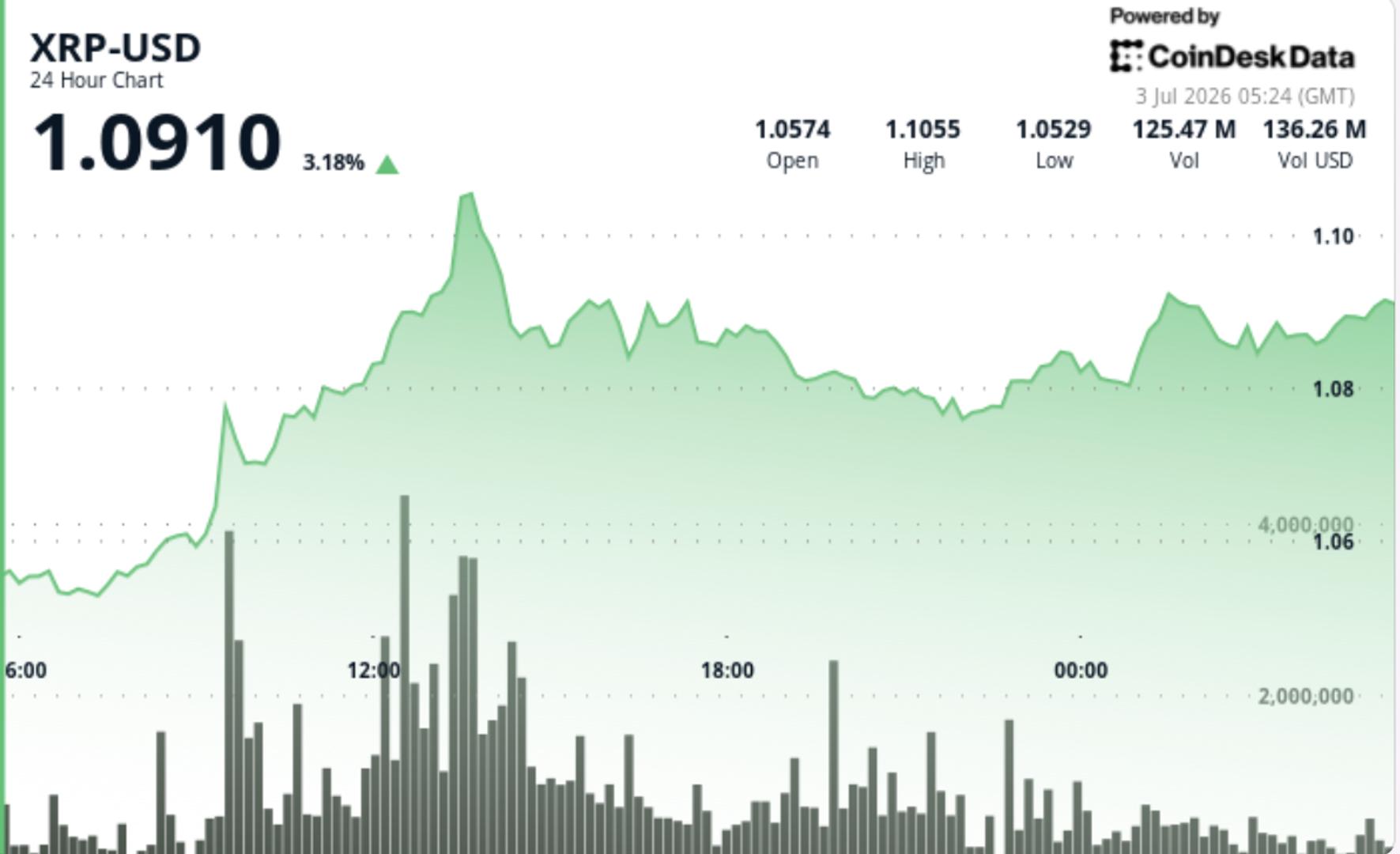
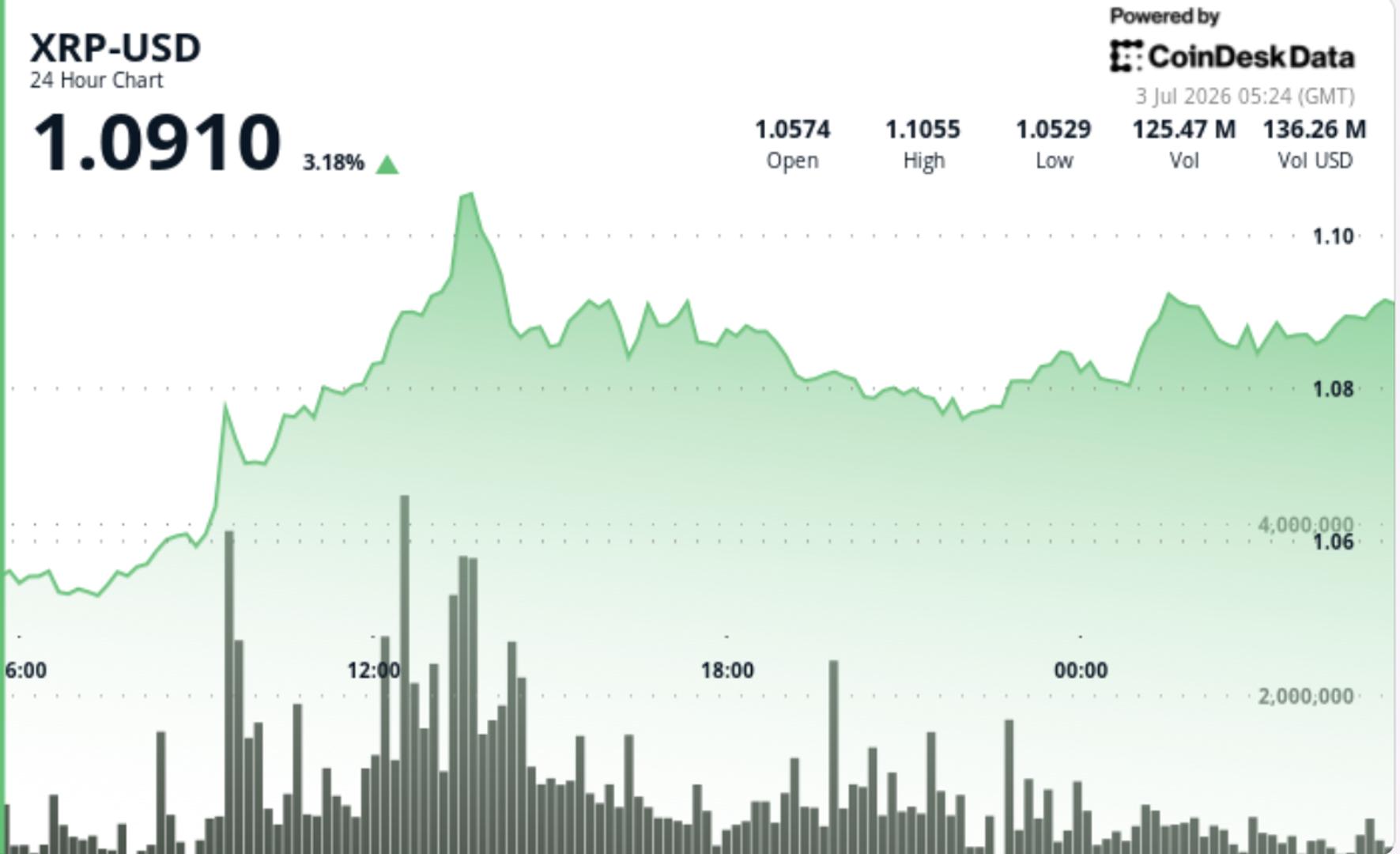
XRP is starting to build a higher base above $1 following last week’s sell-off. The token edged higher through the U.S. session, held $1.08 on repeated tests and pushed toward $1.10 before sellers slowed the move. That keeps the setup constructive, but still unfinished, with traders watching whether the latest accumulation turns into a clean breakout.
News Background
• XRP wallet creation rose to 4,941 daily addresses, the strongest single-day growth in 14 weeks.
• Bullish social sentiment reached a three-month high, with positive comments outnumbering bearish ones by 3.7 to 1.
• Ripple completed its scheduled 1 billion XRP escrow unlock without a meaningful price shock.
• XRP’s move tracked the broader crypto market closely, with idiosyncratic variance against CD5 staying well below the level that would suggest a major asset-specific catalyst.
Price Action Summary
• XRP rose from $1.0611 to $1.0894 during the 24-hour session, gaining 0.62%.
• The token established higher lows at $1.0552, $1.0589 and $1.0799, showing buyers stepped in at progressively higher levels.
• Volume rose 26.92% above the seven-day average, pointing to steady participation around the move.
• The strongest push came at 13:00 UTC, when volume reached 117.5 million XRP, about 142% above the 24-hour average.
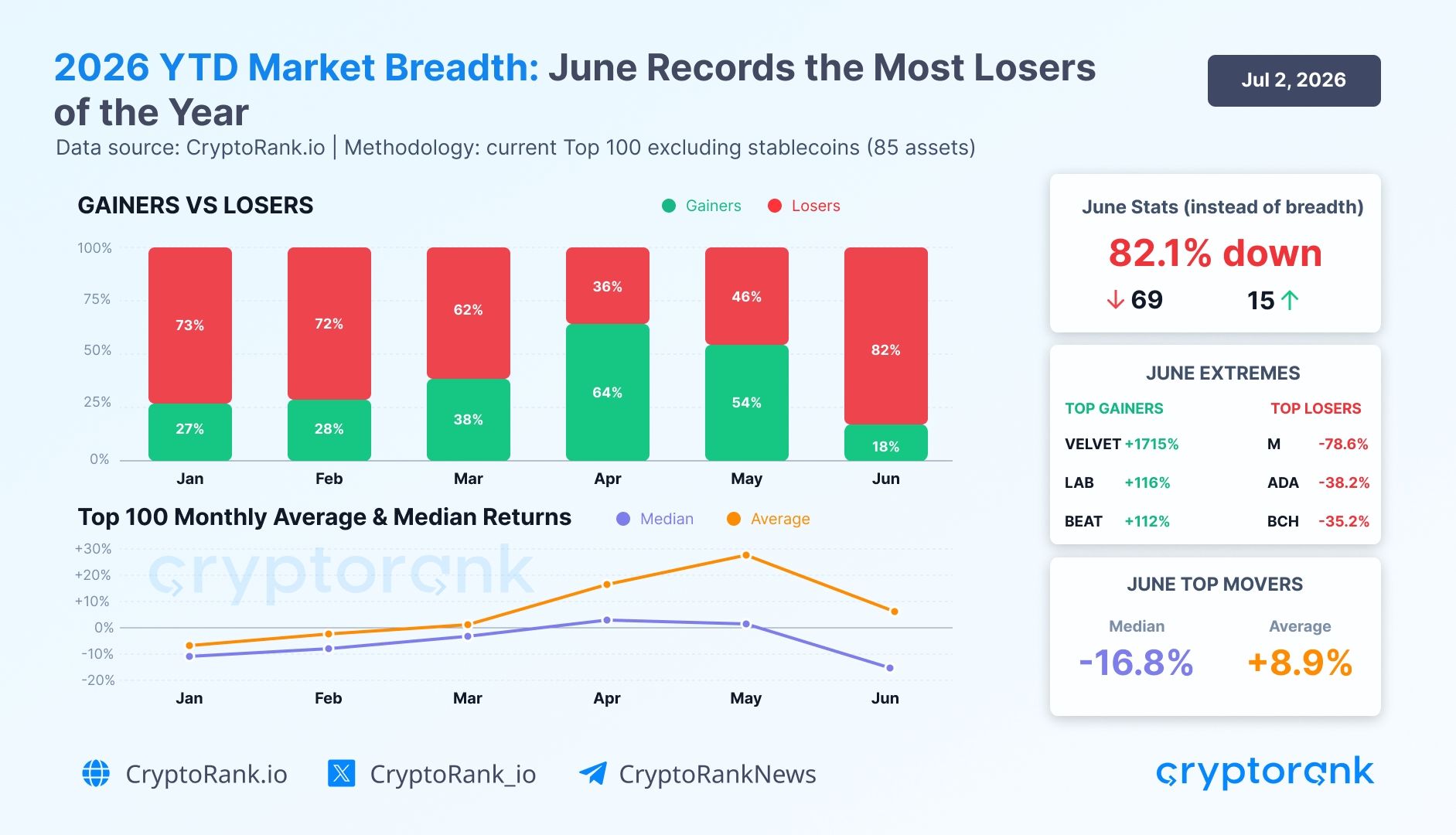
Roughly 82.1% of the top-100 crypto assets declined in June, the worst market breadth of 2026, even as the group’s average return stayed positive.
That split defined the month. A single outlier lifted the average into positive territory while the median return dropped 16.8%, according to a second-quarter recap from CryptoRank.
A Headline Average That Hid the Damage
Across the current top-100 assets excluding stablecoins, CryptoRank recorded a positive average return of 8.9% for June. That figure reflected a single outlier rather than the broader market.
“The market breadth data shows a clear deterioration in participation across the current non-stablecoin Top 100 assets. In June, breadth weakened to its worst level of 2026 so far,” the report read.
Follow us on X to get the latest news as it happens

The report noted that the average was affected by Velvet (VELVET), which surged 1,715% during the month, lifting the aggregate. The 25-point gap between the positive average and the negative 16.8% median showed how few tokens carried the upside.
Besides VELVET, other top gainers included LAB (LAB) at 116% and Audiera (BEAT) at 112%. June also reversed a stronger start to the quarter.
April saw 64% of top-100 assets gain, the best month of 2026. Meanwhile, May showed a more fragile structure, and the June breakdown confirmed the reversal.
Weakness Reached Major Crypto Narratives in June
The decline was not limited to the largest assets. Across all traded tokens with 24-hour volume of more than $1 million, every one of the eight tracked narratives posted a negative median return.
Layer 2 chains led the losses at -24.9%, followed by Decentralized Physical Infrastructure Networks (DePIN) at -24.8% and Layer 1 chains at -22.8%.
“All 8 tracked narratives posted negative median returns, with losers outnumbered gainers in nearly every category, confirming that the market remained defensive and narrow through Q2 without a broad recovery in breadth,” CryptoRank said.

The gainers-versus-losers split showed how narrow the market became. Decentralized Finance (DeFi) recorded 42 gainers against 117 losers, while Artificial Intelligence (AI) posted 21 gainers against 35 losers.
The pattern pointed to a defensive market. Bitcoin (BTC) dominance held near 56% at quarter-end as capital rotated away from weaker altcoins.
Whether June marks a base or another leg lower depends on breadth recovering in the second half.
Subscribe to our YouTube channel to watch leaders and journalists provide expert insights
The post Crypto’s Positive June Average Masked an 82% Decline Across Top Assets appeared first on BeInCrypto.


Russia’s central bank says the digital ruble is ready for a Sept. 1 rollout, keeping the country’s central bank digital currency plan on schedule.
Summary
- Russia’s Sept. 1 digital ruble rollout moves ahead despite EU sanctions targeting related financial infrastructure.
- Bank rules require major lenders and large retailers to support digital ruble payments in stages.
- U.S. lawmakers are moving toward a temporary CBDC ban while Russia expands state digital money.
Governor Elvira Nabiullina said “everyone is ready” for the launch, according to a July 2 report by RIA Novosti.
The digital ruble will circulate alongside cash and non-cash rubles, not replace them. The Bank of Russia has said people will be able to open digital wallets through banking apps connected to its platform. It has also said individuals will not pay fees on digital ruble transactions.
The rollout begins with banks and large merchants
The Bank of Russia’s timeline requires major banks to offer digital ruble services from Sept. 1, 2026. Large retailers with annual revenue above 120 million rubles must also accept digital ruble payments from that date.
The rules will expand in stages. Banks with universal licenses and retailers with annual revenue above 30 million rubles must join from Sept. 1, 2027. Other banks and smaller retailers will follow from Sept. 1, 2028, while very small merchants will remain exempt.
Sanctions pressure frames the rollout
The launch comes as the European Union has already moved against Russia-linked digital finance. In its 20th sanctions package, the EU Council banned transactions involving RUBx and all EU support for the development of the digital ruble. It linked the measures to Russia’s war against Ukraine and wider concerns over sanctions evasion.
In addition, the EU also proposed broader restrictions on foreign crypto services tied to Russian sanctions evasion. That plan followed growing scrutiny of ruble-linked crypto rails, including platforms and tokens that authorities say may support cross-border payments outside Western controls.
Russia has tested digital ruble use cases for more than a year. As previously reported, the Central Bank of Russia piloted digital ruble smart contracts in Tatarstan, including tests on conditional spending for public funds. The latest timeline shows that Moscow now wants to move the project from testing into broader payment use.
U.S. policy moves in the opposite direction
Russia’s CBDC push contrasts with U.S. policy, where lawmakers have moved toward a temporary ban on a Federal Reserve digital dollar. As crypto.news reported, the 21st Century ROAD to Housing Act would block the Fed from creating a CBDC or similar asset through 2030 if it becomes law.
The U.S. debate reflects concerns over privacy, state control, and the role of private stablecoins. The Russian approach is different. Moscow is building a state-run digital currency while also testing other digital asset rules for trade and financial access under sanctions.
A February report by Jack Jarmon for the Australian Institute of International Affairs said Russia could face limits if it relies on Bitcoin or other proof-of-work assets to bypass sanctions. The report pointed to old power infrastructure and limited access to foreign technology. Those limits may explain why the digital ruble remains central to Moscow’s state-led payment strategy.
The Sept. 1 launch will test whether Russia can drive adoption among banks, merchants, and users. Nabiullina said the central bank wants the digital ruble to be “in demand by people and businesses” and “convenient.”
For now, the rollout places Russia among the countries pushing CBDCs forward while sanctions and U.S. policy debates keep digital state money under close review.


eToro has led a $12.5 million strategic funding round in Extended, an onchain exchange for perpetual futures.
Summary
- eToro’s Extended investment links Zengo self-custody tools with onchain perpetual futures trading access for users.
- Jump Crypto joined the round as brokerages move deeper into decentralized derivatives and market infrastructure.
- Perp DEX growth is pulling trading platforms toward self-custody, tokenized assets, and onchain execution.
Extended announced the round in a July 2 post on X, saying eToro led the investment and Jump Crypto also joined the deal.
Meanwhile, the funding is tied to a partnership between Extended and Zengo, the self-custody wallet eToro acquired earlier this year. The companies plan to work on access to global financial markets through onchain infrastructure. eToro said the partnership will explore ways to connect traditional financial assets with decentralized trading venues.
Self-custody becomes part of the plan
Zengo gives eToro a direct route into self-custody products. The wallet uses multi-party computation technology, which removes the need for seed phrases while still giving users control over assets. It also supports swaps, staking, and access to decentralized applications.
eToro completed its Zengo acquisition on April 30 while reporting a sharp drop in crypto trading profit. The company said at the time that Zengo would support its plan to connect traditional financial products with onchain systems. The Extended deal now gives that plan a derivatives-focused path.
Extended builds onchain perps market
Extended was founded by former Revolut employees and opened trading to all users in late 2024. In its public launch announcement, the company said it planned to add unified margin with technical support from StarkWare.
The exchange is built on StarkWare’s StarkEx scaling engine. It focuses on perpetual futures, a type of derivative contract that has no expiry date. Extended says its model supports self-custody trading while aiming to keep execution fast enough for active traders. That structure places it between centralized crypto futures venues and fully decentralized trading platforms.
Perps growth draws larger firms
Perpetual futures remain one of the largest crypto trading markets. As crypto.news reported, CoinGecko’s 2026 Crypto Perpetuals Report found that perp DEX open interest share rose from 3.6% in early 2025 to 13.5% in 2026. The same report showed Binance and OKX still leading centralized perps trading, even as decentralized venues gained share.
That growth has drawn more attention from brokers and trading apps. Previously, crypto.news reported that Robinhood launchedperpetual futures tied to commodities, ETFs, and currencies for eligible European users. The rollout showed how crypto-style trading tools are moving into traditional markets.
Deal follows weaker crypto trading income
The investment comes after eToro reported lower crypto-related trading profit in the first quarter of 2026. As reported by crypto.news, crypto generated $13 million in profit during the quarter, or about 5% of eToro’s total net trading profit of $258 million. That was down from $46 million in the same period in 2025.
The Extended round shows that eToro is still building around digital assets despite weaker short-term crypto revenue. The company is using Zengo to strengthen its self-custody stack and Extended to enter onchain derivatives more directly.
Moreover, the move also places eToro closer to a market where trading apps, crypto exchanges, and decentralized platforms are competing for users who want faster access, direct asset control, and broader exposure to global markets.

Blockchain technology has evolved rapidly over the past decade, giving rise to hundreds of networks optimized for different use cases. Some prioritize speed, others focus on security, privacy, scalability, or specialized applications like gaming and decentralized finance (DeFi). While this diversity has fueled innovation, it has also created one of Web3’s biggest challenges: blockchain silos.
Today, the industry is moving toward a future where blockchains no longer operate as isolated ecosystems. Instead, they’re becoming interconnected networks that can communicate, exchange assets, and share data seamlessly. This shift could redefine how decentralized applications (dApps), users, and institutions interact with blockchain technology.
What Are Blockchain Silos?
A blockchain silo exists when a network operates independently without native communication with other blockchains. Assets, data, and smart contracts remain confined to their respective ecosystems.
For example:
- Bitcoin primarily serves as a secure store of value.
- Ethereum powers a vast ecosystem of smart contracts.
- Solana focuses on high-speed transactions.
- BNB Chain emphasizes affordable and scalable DeFi.
- Avalanche offers customizable blockchain infrastructure.
Each blockchain has unique strengths, but moving assets or information between them has traditionally required third-party bridges or centralized exchanges.
This fragmentation often creates unnecessary complexity for users and developers alike.
The Problems Caused by Blockchain Silos
1. Fragmented Liquidity
Liquidity scattered across multiple blockchains reduces capital efficiency. Instead of one unified financial ecosystem, liquidity is divided among separate networks, making markets less efficient.
2. Poor User Experience
Managing several wallets, switching networks, paying different gas fees, and learning multiple interfaces discourages mainstream adoption.
3. Limited Application Potential
Developers often build applications for a single blockchain, restricting access to users and liquidity from other ecosystems.
4. Security Risks
Traditional cross-chain bridges have become attractive targets for hackers. Billions of dollars have been lost through bridge exploits over the past several years, highlighting the need for more secure interoperability solutions.
The Rise of Blockchain Interoperability
Instead of competing in isolation, blockchain ecosystems are increasingly embracing interoperability—the ability for different blockchains to communicate securely.
Modern interoperability solutions aim to allow:
- Cross-chain asset transfers
- Cross-chain messaging
- Shared liquidity
- Multi-chain smart contract execution
- Unified user experiences
Rather than forcing users to choose one blockchain, interoperability allows them to benefit from many simultaneously.
Technologies Driving the End of Silos
Cross-Chain Messaging
Instead of merely transferring tokens, cross-chain messaging enables smart contracts on one blockchain to trigger actions on another.
This opens the door to far more sophisticated decentralized applications.
Interoperability Protocols
Dedicated interoperability layers provide standardized communication between independent blockchains.
These protocols reduce fragmentation while allowing each network to maintain its own security and governance.
Chain Abstraction
One of the biggest emerging trends is chain abstraction.
Instead of asking users to manually manage networks, wallets, bridges, and gas tokens, applications handle the complexity behind the scenes.
Users simply interact with the application while the infrastructure determines the optimal blockchain for each transaction.
Intent-Based Architecture
Intent-based systems allow users to specify their desired outcome rather than manually executing every blockchain interaction.
For example:
Instead of bridging tokens, swapping assets, and staking manually, a user simply requests:
“Stake my stablecoins in the highest-yield lending protocol.”
The protocol automatically completes every required cross-chain action.
Benefits of an Interoperable Future
Better Capital Efficiency
Assets can move freely across ecosystems, creating deeper liquidity and more efficient markets.
Improved User Experience
Users no longer need to understand every blockchain’s technical details. Applications become as simple as traditional fintech apps.
More Powerful Applications
Developers gain access to users, assets, and services across multiple chains, enabling richer decentralized applications.
Greater Ecosystem Collaboration
Instead of competing for users, blockchain networks can specialize while remaining connected through shared infrastructure.
Challenges That Still Need Solving
Although interoperability has advanced significantly, several challenges remain.
Security
Cross-chain infrastructure must maintain strong security guarantees without introducing centralized trust assumptions.
Standardization
The industry still lacks universal standards for messaging, identity, and asset transfers across every blockchain.
Scalability
As interoperability grows, systems must efficiently process increasing volumes of cross-chain communication.
Governance
Coordinating upgrades across multiple decentralized ecosystems remains a complex challenge.
What This Means for DeFi
The end of blockchain silos could dramatically reshape decentralized finance.
Future DeFi platforms may automatically source liquidity from multiple chains, optimize yields across ecosystems, and execute transactions wherever conditions are most favorable—all without requiring users to manually bridge assets or switch networks.
This could make decentralized finance significantly more accessible to everyday users while improving efficiency for institutional participants.
Beyond DeFi: A Unified Web3
Interoperability extends far beyond finance.
Potential applications include:
- Cross-chain gaming assets
- Portable digital identities
- Interoperable NFTs
- Multi-chain DAOs
- Unified social networks
- Enterprise blockchain integration
- AI agents coordinating across decentralized ecosystems
Rather than existing as separate blockchain islands, these services could operate within one connected Web3 ecosystem.
Conclusion
The next phase of blockchain evolution isn’t about finding a single “winning” blockchain—it’s about enabling all blockchains to work together.
As interoperability protocols, chain abstraction, and intent-based systems mature, users may no longer need to think about which blockchain they’re using. Just as internet users rarely consider which servers deliver a website, future Web3 users may simply interact with applications while the underlying infrastructure seamlessly coordinates across multiple networks.
The end of blockchain silos represents more than a technical milestone. It marks the transition from isolated blockchain ecosystems to a truly interconnected decentralized internet—one where assets, applications, and information flow freely across networks, unlocking the full potential of Web3.
REQUEST AN ARTICLE


U.S.-linked wallets appear to be the largest political trading group on Polymarket’s global platform, even though the platform lists the United States as a blocked country.
Summary
- U.S.-linked wallets dominate Polymarket political trading despite geoblocks, according to new Allium on-chain research findings.
- Researchers say offshore activity raises fresh oversight questions as prediction markets face tougher global controls.
- Polymarket restrictions list the United States as blocked, but demand appears to continue offshore globally.
Blockchain data firm Allium said in a July 3 report that the U.S. was the biggest national political market by contracts traded among wallets it could link to a country.
The firm said its data covered only about 6% of wallets with country tags, so the results should be treated as directional. Still, Allium said the pattern was clear enough to show that US demand did not disappear after access blocks. “Blocking access did not end U.S. participation,” the report said. It added that activity had moved offshore and outside direct U.S. oversight.
Geoblocks face fresh questions
Polymarket’s own geographic restriction page says the platform is unavailable in the United States and other blocked countries. It also says users must not use VPNs or similar tools to bypass location rules. The page lists 33 fully blocked countries, along with several regions where trading is not allowed.
That policy traces back to earlier U.S. enforcement. In 2022, the Commodity Futures Trading Commission ordered Polymarket to pay a $1.4 million civil penalty and wind down markets that did not comply with US rules. The platform later developed a separate U.S.-regulated product, while the global platform continued to block U.S. users.
Trading patterns point to politics and conflict
Allium said U.S.-linked wallets on Polymarket showed more interest in foreign conflict markets than the wider platform. Five of the top 12 markets by notional volume for the U.S.-linked group related to the Iran war, according to the report. “U.S. money pours into foreign wars,” Allium said, while adding that U.S.-linked traders showed less interest in election markets.
A separate analysis by Rutgers statistician Harry Crane reached a similar view in June. Crane estimated that U.S. users may account for about 30% of total Polymarket volume by studying sports preferences and trading times. His work said Polymarket’s activity pattern looked global, but still showed a large U.S. share.
Rules tighten as markets grow
The report comes as prediction markets face wider regulatory pressure. As crypto.news reported, the CFTC is preparing new prediction market rules that could affect Polymarket and Kalshi. The proposed review process would give regulators more tools to assess event contracts tied to politics, sports, and real-world events.
Previously, crypto.news reported that Spain moved to block Polymarket and Kalshi over gambling license concerns. That action followed similar blocks or restrictions in several other countries. As crypto.news reported in May, Polymarket also said it had no plan to require mandatory KYC on its main global market, even as legal and sanctions pressure increased.
The latest Allium report adds a new point to that debate. If U.S. users still reach global markets despite geoblocks, regulators may ask whether location controls can work at scale. For Polymarket, the data may add pressure at a time when the platform is also dealing with security concerns, including a recent $2.9 million frontend theft that led to promised user refunds.
The issue also puts Polymarket’s split model under closer review. Its U.S.-regulated platform offers a narrower product set, while global markets still draw interest from users who appear to be in blocked regions. That gap may become harder to defend if more data show steady activity from restricted jurisdictions.

US users remain the most active force behind Polymarket’s political prediction markets, even after the platform moved to geoblock Americans from its global, decentralized service. New analysis from blockchain research firm Allium finds that the United States is the largest single country for political contracts on Polymarket when measured by trading volume and wallet participation—suggesting the demand simply shifted outside formal US oversight.
The findings add another layer to the regulatory and compliance challenges surrounding Polymarket, which has already faced scrutiny from US authorities and was compelled to restrict access under a settlement with the Commodity Futures Trading Commission (CFTC) in 2022.
Key takeaways
- Allium’s report ranks the US as Polymarket’s biggest political market by both contracts traded and wallet count.
- Despite access restrictions, the study argues that US demand did not disappear—it moved offshore.
- US traders appear more drawn to foreign conflict-related markets, with Iran-war themes dominating the top US markets by volume.
- Election-focused markets attract less US participation on the global Polymarket, where such markets are comparatively more prominent on Kalshi and Polymarket US.
- Independent research has previously estimated a large share of Polymarket activity originates from the US, even with geoblocking and VPN countermeasures.
US activity persists after Polymarket’s geoblock
Allium’s analysis, published on Thursday, estimates that US-based users form the largest single political crowd on Polymarket across all countries it tracks. The report emphasizes that this is based on tagged wallets—specifically, the 6% of wallets Allium could associate with a country—so the figures are directional rather than definitive.
Still, Allium frames the result as a clear outcome of Polymarket’s restrictions. Blocking access, the firm argues, did not stop US participation; instead, it concentrated it into a way that makes the US look even larger by volume within the offshore-access model.
“Blocking access did not end US participation; it made the US the largest single political market on Polymarket by volume,” the report said. “The demand is still there, now offshore and beyond US oversight.”
This is an important distinction for investors and market participants watching the political prediction market space: the restriction regime may be affecting where and how US users participate, but it has not eliminated US influence over global outcome bets.
Foreign conflict markets draw more US bets than elections
Allium’s breakdown suggests that US participants disproportionately favor foreign conflict-related topics. In the report’s assessment, five of the top 12 markets for US users by notional volume relate to the Iran war.
At the same time, US interest in election-related markets appears comparatively weaker on Polymarket’s global platform. Allium notes that election markets are a category that is allowed on Kalshi and Polymarket US—meaning the global audience’s incentives and the market landscape may differ from what US users most actively trade.
“US money pours into foreign wars, lately Iran, and largely skips the elections the global crowd trades,” said Allium.
For readers tracking adoption and behavior in prediction markets, the takeaway is not just who is trading, but what they are trading. If US demand continues to show up most strongly in geopolitical risk and away from election positioning, that may shape how liquidity, volatility, and information demand evolve across the different platforms.
Polymarket US vs. the global platform: restrictions and regulatory pressure
Allium’s report also clarifies an often-confused distinction: Polymarket US is a US-regulated platform launched in December and offers a narrower selection of markets. The research discussed here concerns the global Polymarket environment, where access was curtailed for US users.
Polymarket was forced to cut off US users from its global platform as part of a $1.4 million settlement with the CFTC in 2022. That enforcement backdrop has continued to cast a spotlight on how prediction market operators handle jurisdictional boundaries and user verification.
Cointelegraph previously reported that US policy makers and regulators have raised concerns about Polymarket, including issues connected to its marketing and compliance approach. Those broader concerns remain relevant in light of Allium’s findings that US involvement has not gone away—only changed form.
Evidence from other researchers: US share remains large
Allium’s results align with an earlier study by Rutgers University statistician Harry Crane. In a June publication, Crane estimated that 30% of Polymarket trading volume comes from the US, despite Polymarket blocking US-based IP addresses and VPNs that can be used to bypass geofencing.
Crane’s analysis estimated that US-based traders sent between $10.6 billion and $26.7 billion through Polymarket between May 2025 and April 2026. The researcher tied activity to likely US participants by comparing trade timing and the specific markets where trades occurred.
There have also been reports that Polymarket has moved to clamp down on VPN usage by blocking certain IP addresses associated with VPN services, reinforcing the idea that the company is actively attempting to reduce circumvention. However, the existence of US-heavy participation in outcome bets—whether directly or via offshore access—suggests countermeasures may not be fully effective.
Where Polymarket is blocked and where it is “close only”
Geographic restrictions are not limited to the United States. Polymarket is completely blocked in more than 34 countries, with Spain cited as the latest example where authorities took action as a “precautionary measure” while investigating whether the companies are operating without necessary licensing.
In an additional tier, four countries—including Singapore, Thailand, Taiwan, and Poland—operate under “close only” rules. In those jurisdictions, users can close existing positions but cannot open new trades.
Polymarket also maintains restricted regions within countries, according to published information: Ontario in Canada, and Crimea, Donetsk, and Luhansk in Ukraine, where Polymarket is blocked locally but remains accessible elsewhere in the same nation.
These layers of access—complete blocks, close-only allowances, and region-level restrictions—highlight how uneven enforcement and licensing frameworks can be across jurisdictions. For traders, it means the practical reach of a prediction market can remain broader than what top-line policy statements might suggest.
Going forward, the key question is how Polymarket will adapt its geoblocking and compliance tooling as scrutiny grows. Readers should watch whether enforcement tightens enough to materially change participation patterns—or whether US influence continues to reappear offshore in ways that keep global political markets effectively driven by the same demand.


CFTC Chair Michael Selig criticized Illinois lawmakers over a new 0.2% tax on crypto transactions, saying the state had moved against financial technology at the wrong time.
Summary
- Illinois’ 0.2% crypto tax drew sharp CFTC criticism before its planned 2027 start date.
- The law requires broker registration, monthly reports, and tax collection on covered digital asset activity.
- Federal crypto tax and market structure talks are moving while Illinois pursues its own rule.
In a July 1 statement, Selig said Illinois lawmakers “slammed the brakes on technological progress” when they approved the measure.
The tax forms part of Illinois’ fiscal 2027 budget and is set to take effect on Jan. 1, 2027. It applies to certain digital asset activity carried out by brokers, including exchange, transfer, custody, and wallet services. The rule has drawn criticism from crypto firms, policy groups, and some market figures.
Selig says state risks falling behind
Selig said blockchains could change how value moves across markets, much as the internet changed how information moves. He argued that tokenized assets may cover commodities, currencies, stocks, and bonds. His statement said Illinois could place residents and businesses at a disadvantage if the state taxes crypto transfers differently from other financial activity.
The CFTC chair also said Illinois lawmakers “decided they know better” than federal lawmakers working on crypto market rules. His comments came as Washington continues to review market structure bills, tax proposals, and agency roles. The remarks show a growing split between state-level tax policy and federal efforts to set national digital asset rules.
Brokers face new duties
Illinois’ Digital Asset Tax Act requires brokers to register with the Illinois Department of Revenue before covered activity begins. Brokers must collect the tax as a separate line item and file monthly reports on covered digital asset activity.
The law can also reach firms outside Illinois if they serve users in the state. Tax advisers have said customer records, mailing addresses, IP addresses, and other data may help decide whether activity falls under Illinois rules. That has raised questions about how exchanges, wallet firms, and custody providers will track and apply the tax in practice.
Industry criticism grows
Previously, crypto.news reported that Strategy co-founder Michael Saylor called the Illinois tax a “Big Mistake” after Governor JB Pritzker signed the budget. Industry groups also warned that the law could raise costs for users and push crypto firms away from the state.
Some critics have focused on the design of the tax. They argue that it applies to activity itself, not only to profits or capital gains. Others have raised concerns about routine wallet transfers, broker reporting systems, and whether the rule treats digital assets differently from stocks, bonds, or derivatives.
Federal talks add pressure
The Illinois dispute comes while Congress reviews broader crypto tax rules. As previously reported, lawmakers have split the Digital Asset PARITY Act into seven tax discussion drafts covering stablecoin payments, mining, staking, lending, wash-sale rules, charitable donations, and disclosure duties.
Moreover, Federal agencies are also reviewing crypto market rules. The SEC and CFTC opened a joint rules review covering derivatives, margining, and market structure questions. Against that backdrop, Selig’s criticism frames the Illinois tax as a state-level move that may clash with wider federal attempts to build clearer rules for digital assets.


Microsoft is investing $2.5 billion in a new operating business that embeds 6,000 engineers and industry experts directly inside enterprise customers to build and run AI systems.
The company, called Microsoft Frontier Company, launched on Thursday. It ties its work to measurable business results.
How the Microsoft Frontier Company Works and Who Runs It
The unit delivers what Microsoft calls Frontier Transformation. Experts embed with customers to co-design, deploy, and continuously improve AI systems at scale.
Follow us on X to get the latest news as it happens
Judson Althoff, CEO of Microsoft’s Commercial Business, positioned the effort beyond standard industry practice. He argued it combines deep industry knowledge with enterprise AI engineering.
“This goes beyond what has been labeled as Forward-Deployed Engineering, and will be the largest, most capable, outcome-driven engineering organization in the industry,” he said.
Microsoft Frontier Company will include salespeople, support staff, technical consultants, and forward-deployed engineers already at the company, many with experience in specific industries, CNBC reported.
The company stressed that customers keep control of their own intelligence. It pledged that client data will not be used to train models in ways that erode a customer’s competitive edge.
The platform also stays model-diverse. Customers can run models from OpenAI, Anthropic, Microsoft, open source, or specialized industry options for each task. Rodrigo Kede Lima will serve as president of the new organization.
Microsoft Enters a Crowded AI Deployment Race
The launch puts Microsoft in a fast-growing market. Rivals have moved quickly to sell hands-on AI deployment, not just tools.
Amazon Web Services committed $1 billion to its own deployment venture two days earlier. Both OpenAI and Anthropic also launched their own deployment ventures in May.
The OpenAI Deployment Company is a standalone entity backed by more than $4 billion in funding. Anthropic teamed up with Goldman Sachs, Blackstone, and Hellman & Friedman on a $1.5 billion venture to deploy Anthropic’s Claude AI model directly inside businesses.
Subscribe to our YouTube channel to watch leaders and journalists provide expert insights
The post Microsoft Commits $2.5 Billion to New AI Deployment Business appeared first on BeInCrypto.

Politician who investigated spyware abuses had his phone hacked with Pegasus spyware

WORST dressed guests at Taylor Swift and Travis Kelce’s star-studded wedding party

Padwick Farm livery sees bookings rise as horse owners struggle with costs


-

 Fashion7 days ago
Weekend Open Thread: Staud – Corporette.com
-

 Politics7 days ago
The House | Manchesterism won’t survive the painful trade-offs unless it gets citizens on board
-

 Crypto World3 days ago
Strategy authorizes up to $1.25B in Bitcoin sales under new capital plan
-

 Business7 days ago
Asia stock markets slide as tech shares slump
-

 News Videos4 days ago
MAJOR BITCOIN & MARKET UPDATE!!!! (MUST WATCH ASAP!!!)
-

 Tech3 days ago
Anonymous researcher drops 0-day ‘exploitarium’ repo
-

 Crypto World6 days ago
Coinbase, Circle Deepen Crypto Stock Losses Despite Resilient S&P 500
-

 Business3 days ago
Australia treasurer says alleged access of prime minister’s bank data ’incredibly concerning’
-

 Crypto World6 days ago
Kraken's xStocks Opens Bending Spoons IPO Registration to EEA Retail
-

 Sports6 days ago
FIH Pro League: India defeat Pakistan 7-1, register biggest win of campaign | Other Sports News
-

 Tech5 days ago
Bluekit phishing kit adopts browser-in-the-middle for login theft
-

 Crypto World7 days ago
Tether (USDT) Passes Ether in Market Cap as ETH Drops Toward $1.5K
-
Crypto World7 days ago
Hyperliquid Named on Singapore MAS Investor Alert Register
-

 Tech6 days ago
Russian hackers now target Signal backup recovery keys
-

 Crypto World7 days ago
RTX holders must register wallets before token distribution begins
-

 Sports2 days ago
Broncos roster: OL Ben Powers (No. 74) entering final year of contract
-
 Business3 days ago
The AI boom won’t burst all at once. It will pop in ‘rolling bubbles’: Macquarie
-

 Tech5 days ago
Claude Code turned every engineer into three. Now companies need more product thinkers
-
 Crypto World7 days ago
SpaceX Called a Market Top Signal Just 2 Weeks After Its $86 Billion IPO
-

 Tech6 days ago
Silicon Valley paid to kill AI regulation, now it wants the rules back
You must be logged in to post a comment Login