

Crypto World
Bitcoin ETFs Bleed $8.95 Billion in Two Months, and the Selling Isn’t Over

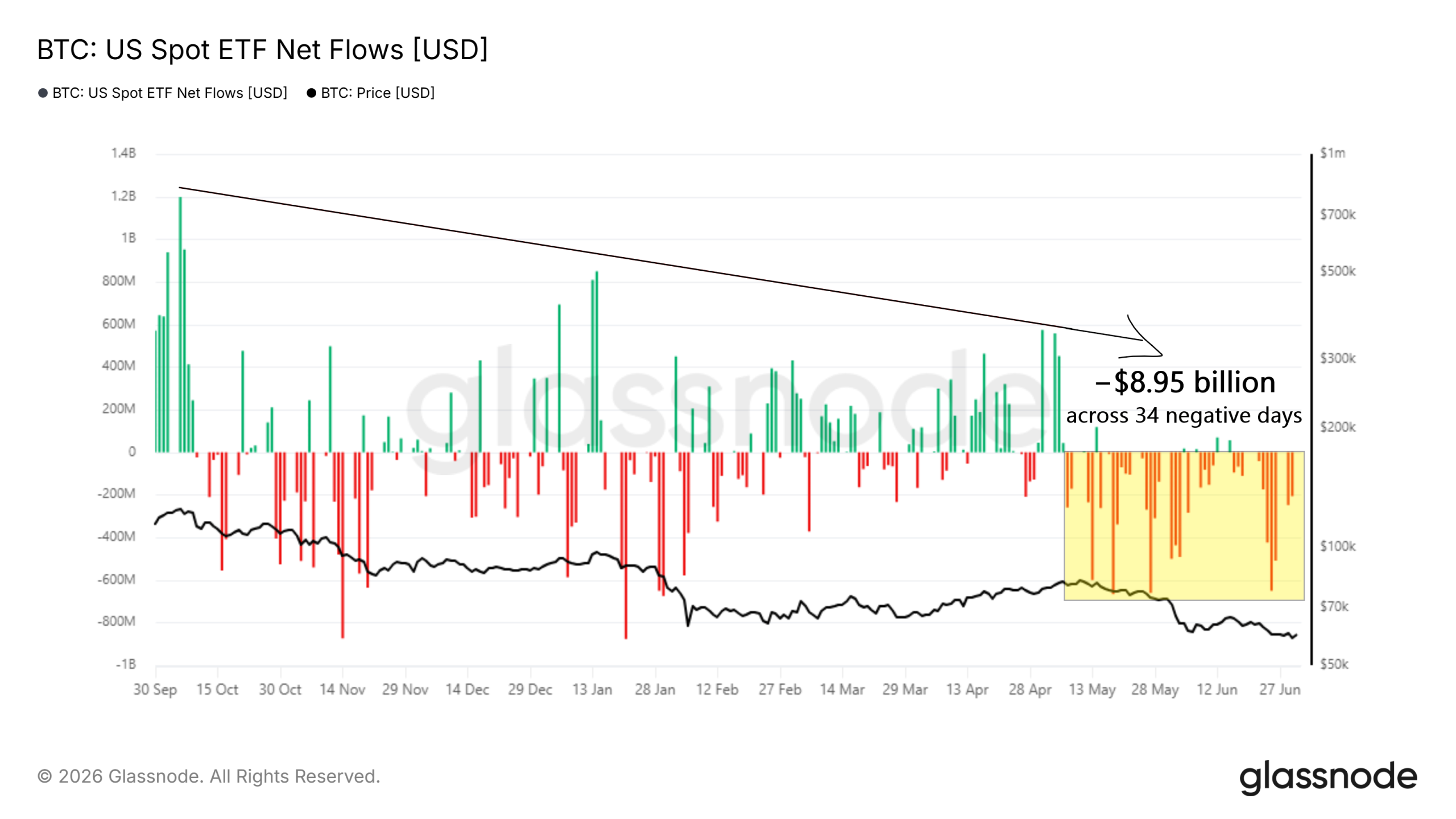
US spot Bitcoin (BTC) exchange-traded funds (ETFs) recorded another $296 million in net outflows over the past 24 hours, equal to roughly 5,050 BTC. BlackRock led the redemptions, with Grayscale, Fidelity, and ARK Invest also posting losses.
Glassnode data shows the sell-off has now reached $8.95 billion since May 7. Bitcoin trades near $61,600, up 2.4% in 24 hours, but flow data suggests the bounce rests on fragile ground.
ETF Outflows Total $8.95 Billion Across 34 Negative Days
Glassnode’s US spot ETF net flow data shows demand weakening since late September 2025. Daily inflows peaked above $1.2 billion back then. Since then, positive days have grown smaller and less frequent.
The decisive shift arrived on May 7. Since that date, the funds have posted only five positive sessions. The remaining 34 trading days were negative, draining $8.95 billion in total.

June alone accounted for $4.5 billion, the worst monthly outflow since the products launched in January 2024. Meanwhile, bitcoin fell 20.48% over the month, its steepest drop since June 2022.
In an X post, analyst That Martini Guy argued that the latest rebound changes little.
“Everyone got excited by yesterday’s bounce. But ETF selling hasn’t stopped. Funding is starting to shift, sentiment still looks fragile, and I don’t think the market structure has changed just yet.”
For the pressure to ease, the ETFs would need a sustained run of net inflows rather than isolated green days. So far, no such streak has appeared.
Coins Leave Exchanges, Yet Bitcoin Keeps Falling
Exchange balance data complicates the bearish picture. Glassnode’s net position change metric shows coins flowing out of exchanges since late May. Traders usually read such withdrawals as accumulation, because coins move into long-term storage.
However, history offers a warning. The current move is the third deep negative stretch since bitcoin’s all-time high in late 2025. The first ran from late October through December 2025. The second lasted from late January to early March 2026, when the metric dipped near minus $100 billion.

Each episode coincided with a continuation of the downtrend rather than a reversal (blue boxes). In contrast to the usual bullish reading, apparent accumulation has repeatedly failed to stop the decline. Deepening capitulation signals elsewhere on-chain tell a similar story.
Moreover, part of the withdrawal may reflect mechanics rather than fresh buying. Coins redeemed from ETFs can move between custody wallets and cold storage without touching order books. Weak US demand readings support that interpretation.
BTC Price Outlook Hinges on Slowing ETF Redemptions
The two datasets point to one conclusion. ETF flows, not exchange balances, currently set the marginal price of Bitcoin. Until redemptions slow, on-chain accumulation looks unable to absorb the selling.
BTC trades near $61,600 after a 2.4% daily gain. Nevertheless, the price has hovered just above $60,000 since mid-June. A decisive close below that area would confirm that redemption pressure still dominates the market.
Conversely, a sustained flip to net inflows could mark the first structural change since early May. Historically, flow reversals of that kind have preceded durable bottoms rather than followed them.
Until either signal appears, caution remains the sober reading of the data. The next leg depends on whether ETF holders stop selling before spot buyers give up.
The post Bitcoin ETFs Bleed $8.95 Billion in Two Months, and the Selling Isn’t Over appeared first on BeInCrypto.



Riot Platforms transferred another 500 BTC to NYDIG Custody, according to Arkham data cited by onchain trackers.
Summary
- Riot Platforms moved another 500 BTC to NYDIG Custody, raising fresh sale speculation among traders.
- The miner already sold 3,778 BTC in Q1 while producing only 1,473 BTC total.
- Public Bitcoin miners continue selling reserves as mining costs rise and margins remain under pressure.
The transfer was worth about $30.72 million at the time of the report and was shared through an Onchain Lens post.
The move may signal that Riot is preparing to sell part of its Bitcoin holdings. Transfers to custody or execution partners do not always confirm a sale, but similar Riot transfers this year have often come before reported selling activity.
Another move in a longer sale pattern
The latest transfer follows earlier Riot activity involving NYDIG. As crypto.news reported in April, Riot sent 500 BTC to an NYDIG deposit address in a move worth about $39 million at the time. That report said the transfer added to a series of Bitcoin moves from Riot over the same period.
Riot had also disclosed large Bitcoin sales in its first-quarter 2026 operations update. The company sold 3,778 BTC in Q1 for about $289.5 million. It sold those coins at an average net price of $76,626 per BTC.
Riot produced 1,473 BTC in the first quarter, down 4% from 1,530 BTC in the same period a year earlier. Its BTC holdings fell to 15,680 at quarter-end, down 18% from 19,223 in Q1 2025. The company said 5,802 BTC were restricted at the end of the quarter.
Riot’s Q1 results also showed pressure in its mining business. Bitcoin mining revenue fell to $111.9 million from $142.9 million a year earlier. Riot linked the decline to lower average Bitcoin prices and higher network hash rate.
Miner selling pressure continues
Riot’s latest BTC movement comes as public miners face tighter economics after the Bitcoin halving. Higher mining difficulty, lower hashprice, energy costs, and capital needs have pushed several listed miners to sell reserves.
As crypto.news reported, publicly traded Bitcoin miners sold more than 32,000 BTC in the first quarter of 2026. That was a record quarterly figure and topped the amount sold by the same firms across all of 2025. Riot, MARA, CleanSpark, Cango, Core Scientific, and Bitdeer were among the miners named in that wider trend.
Riot also continues to expand beyond Bitcoin mining. The company has been building a data center business while using its power assets and infrastructure to serve high-performance computing customers. That shift gives the miner another capital need at a time when mining margins remain tight.
The 500 BTC transfer does not confirm an immediate sale on its own. Still, the timing adds to the market’s focus on Riot’s treasury strategy.


Ether and solana led crypto higher on Friday as a squeeze on bearish traders pushed bitcoin toward $62,000, capping the market’s first genuinely strong week since mid June.
Bitcoin traded around $61,360, up 2.5% over seven days, per CoinDesk data. Ether rose 4.2% in 24 hours to about $1,702 and is up 9.7% on the week, while solana held near $80 with a weekly gain of 18.6%, the strongest among the majors. XRP added 5.7% over the week to $1.09 and Hyperliquid’s HYPE rose 5.1% on the day.
Traders betting against crypto lost $281 million to liquidations over the past 24 hours, against $159 million in longs, out of $440 million in total forced closures across 95,690 traders, according to Coinglass data.
When shorts are forced to close, they buy back the asset, and that buying pushes prices into the next tranche of shorts, the loop that turns a modest bounce into a squeeze.
The largest single liquidation was an $18.2 million ether position on Hyperliquid, fitting a day when ether led the damage to bears at $157 million in wiped positions against bitcoin’s $103 million in an unusual flip.


The U.S.-listed bitcoin ETFs pulled in $221.7 million on Thursday, their largest inflow in two months, according to SoSoValue.
Fidelity’s FBTC led the charge with a hefty $165.96 million inflow, followed by ARKB at $91.84 million and HODL at $4.35 million. BlackRock’s IBIT, the world’s largest Bitcoin ETF, was the outlier with a $40.43 million outflow.
The cumulative inflow ends a painful 10-day outflow streak that saw investors pull $2.73 billion from the funds. Even so, the year-to-date picture remains ugly, with net outflows still sitting at a hefty $5.4 billion.
Thursday’s bounce is therefore a drop in the ocean compared to the selling we’ve seen this year. Still, it’s a welcome sigh of relief for the bulls. At the very least, it helps validate bitcoin’s rebound to around $61,700 after hitting 21-month lows under $58,000 earlier this week.
For a real recovery, though, these inflows need to turn into a consistent trend. Historically, steady money flowing into Bitcoin ETFs has been a hallmark of bull runs.


Binance is reportedly set to lead a new funding round for Mesh, a crypto payments and settlement company, at a valuation of up to $2 billion.
Summary
- Binance’s planned lead role could double Mesh’s valuation from $1B to as much as $2B.
- Mesh’s payments network targets digital asset transfers across wallets, exchanges, stablecoins, and fiat rails globally.
- Growing stablecoin rules and tokenization demand are pushing investors toward crypto settlement infrastructure providers.
The deal was reported by Axios, citing people familiar with the matter. The report said demand for digital asset-to-fiat transfer tools, payment systems, and settlement infrastructure is rising.
Meanwhile, that demand comes as stablecoin rules become clearer and tokenization moves deeper into financial markets. The round has not been formally announced by Binance or Mesh.
Mesh valuation could double
The reported round would mark a sharp rise in Mesh’s valuation. As crypto.news reported, Mesh raised a $75 million Series C in January at a $1 billion valuation. That round was led by Dragonfly Capital, with backing from Paradigm, Moderne Ventures, Coinbase Ventures, SBI Investment, and Liberty City Ventures.
Mesh was formerly known as Front Finance. The company builds payment infrastructure that connects wallets, exchanges, digital assets, and fiat rails. It aims to make crypto payments easier for users while letting merchants receive stablecoins or fiat without handling complex blockchain steps.
Stablecoin rules lift demand
Stablecoins have become a major focus for payment companies, exchanges, and banks. Banking Circle launched regulated stablecoin settlement services after receiving approval in Luxembourg. The bank now supports USDC, USDG, and its own EURI for institutional fiat and crypto conversion.
The market is also moving toward tokenized bank deposits. As crypto.news reported, major U.S. banks are backing a tokenized deposit network through the Clearing House, with a launch targeted for early 2027. That system would let banks settle tokenized deposits around the clock while keeping customer deposits inside regulated banking channels.
Funding race turns to settlement
Mesh sits in the middle of this shift because it focuses on the movement of value between assets, wallets, and payment systems. Its model addresses a common issue in crypto payments: users may hold one asset, while merchants or platforms may want settlement in another asset or in fiat currency.
The company has also worked to expand access through partnerships. Moreover, Mesh partnered with Italy’s crypto wallet Conio in 2024, giving Conio users access to several crypto exchanges and withdrawal options through Mesh’s connection layer.
A Binance-led round would show that large exchanges still see payment and settlement infrastructure as a core growth area. It would also place Mesh closer to the center of the stablecoin and tokenization race, where firms are trying to connect crypto rails with everyday payments, institutional transfers, and fiat settlement.
The reported valuation also reflects a wider shift in crypto funding. Investors have moved beyond trading apps and tokens toward systems that can support regulated payments, cross-border transfers, and asset settlement.
If the round closes near the reported level, Mesh would have doubled its valuation in about six months, showing continued demand for infrastructure that links digital assets with traditional money.

TLDR:
- Ironwood testnet activates with two independent consensus implementations built by separate teams.
- Zcash reduced ten-note wallet migration times from around 15 minutes to about 2.5 minutes.
- Multi-transaction signing now supports more than 11 transactions through a single QR code.
- Mainnet activation could occur around July 21 as audits and ZIP specifications near completion.
Zcash is moving forward with its Ironwood network upgrade after confirming a scheduled testnet activation. The update introduces new consensus changes and major wallet performance improvements ahead of a planned mainnet deployment.
Development teams have also completed two independent consensus implementations for the upgrade. The work marks one of the most advanced testnet preparations recorded for a Zcash network upgrade.
Zcash Ironwood Testnet Upgrade Brings Dual Consensus Implementations
Zcash developer Dev announced that the Ironwood testnet upgrade would activate on July 4. The release includes two independently developed consensus implementations.
One implementation came from Valar Group, while the other was built by the Zcash Foundation. According to Dev, the Valar Group version has already entered the audit process.
The teams also released a desktop wallet fork that supports migration testing on the testnet. Users with Keystone development devices can update firmware and test migration functions before the mainnet launch.
The upgrade introduces multi-transaction signing through a single QR code. Dev said the feature required extensive work behind the scenes and represented a major technical milestone for the testnet.
Contributors from zodl also participated in the process. The group worked on technical specifications, wallet libraries, circuit updates, and application programming interfaces supporting Ironwood.
Zcash Wallet Performance Improves Ahead of Mainnet Activation
Development updates shared by Dev showed major gains in wallet migration performance. The time needed to complete a ten-note migration fell from around 15 minutes to approximately two and a half minutes.
Inbound QR scanning dropped from three minutes to one minute. Loading and transaction review declined from two minutes to 45 seconds.
The signing process posted the largest improvement. Signing time fell from roughly nine minutes to about 37 seconds.
Outbound QR scanning also became faster. The process now takes about 10 seconds compared with roughly one minute previously.
In a separate update, Zcash developer Sean Bowe said all Ironwood consensus rule changes had been implemented and were undergoing audits.
He added that the specifications and Zcash Improvement Proposals, known as ZIPs, were approaching their final state.
Bowe also said developers expected readiness for a mainnet activation around July 21. He confirmed that the official testnet activation was scheduled for the following day and noted that the Zebra release supporting Ironwood should become available around the same time.
According to Bowe, sufficient mining hash rate already signals technical readiness for the mainnet upgrade. He noted that some wallets may not support Ironwood immediately, although alternative options and testnet preparation time remain available before activation.

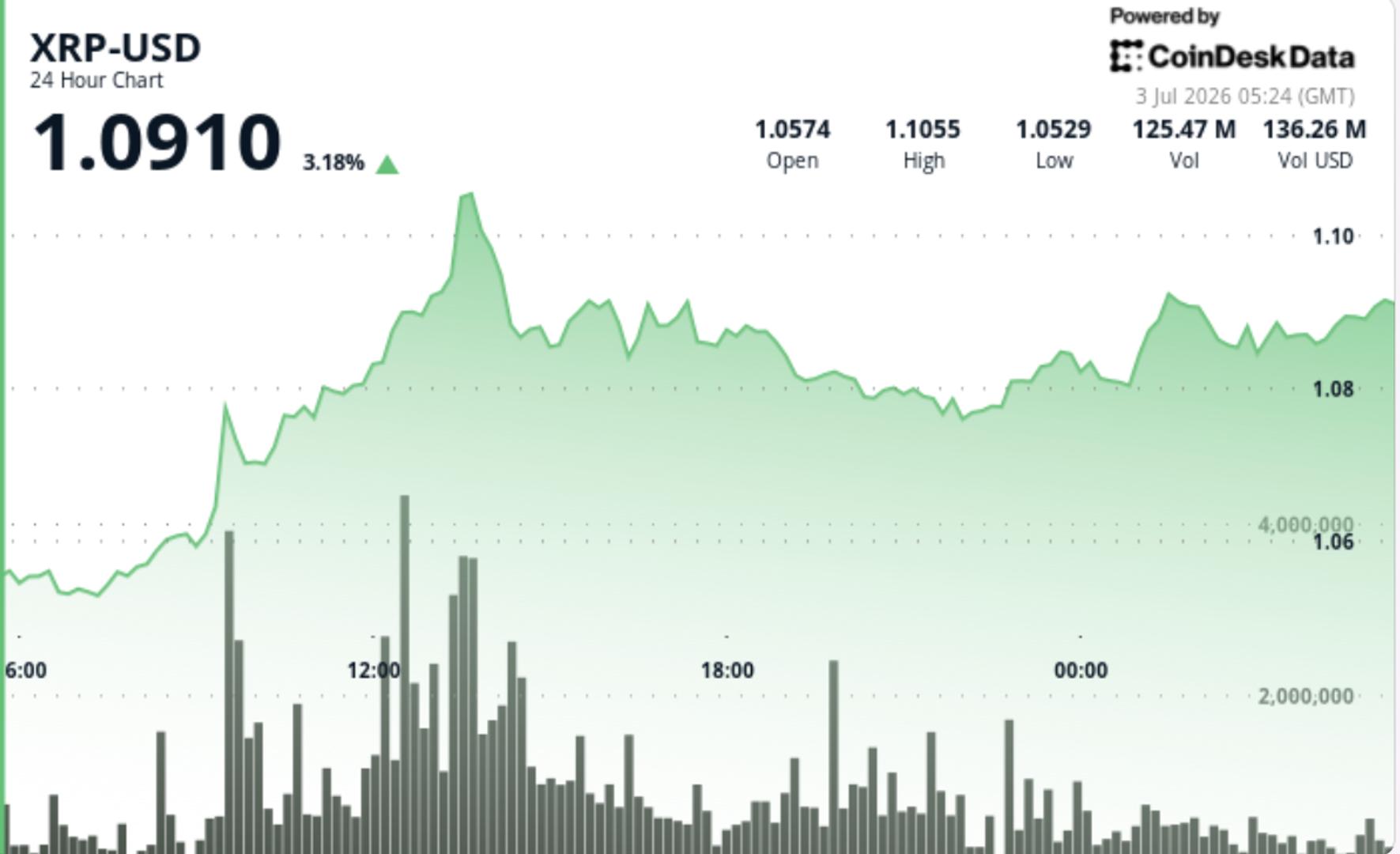
XRP is starting to build a higher base above $1 following last week’s sell-off. The token edged higher through the U.S. session, held $1.08 on repeated tests and pushed toward $1.10 before sellers slowed the move. That keeps the setup constructive, but still unfinished, with traders watching whether the latest accumulation turns into a clean breakout.
News Background
• XRP wallet creation rose to 4,941 daily addresses, the strongest single-day growth in 14 weeks.
• Bullish social sentiment reached a three-month high, with positive comments outnumbering bearish ones by 3.7 to 1.
• Ripple completed its scheduled 1 billion XRP escrow unlock without a meaningful price shock.
• XRP’s move tracked the broader crypto market closely, with idiosyncratic variance against CD5 staying well below the level that would suggest a major asset-specific catalyst.
Price Action Summary
• XRP rose from $1.0611 to $1.0894 during the 24-hour session, gaining 0.62%.
• The token established higher lows at $1.0552, $1.0589 and $1.0799, showing buyers stepped in at progressively higher levels.
• Volume rose 26.92% above the seven-day average, pointing to steady participation around the move.
• The strongest push came at 13:00 UTC, when volume reached 117.5 million XRP, about 142% above the 24-hour average.
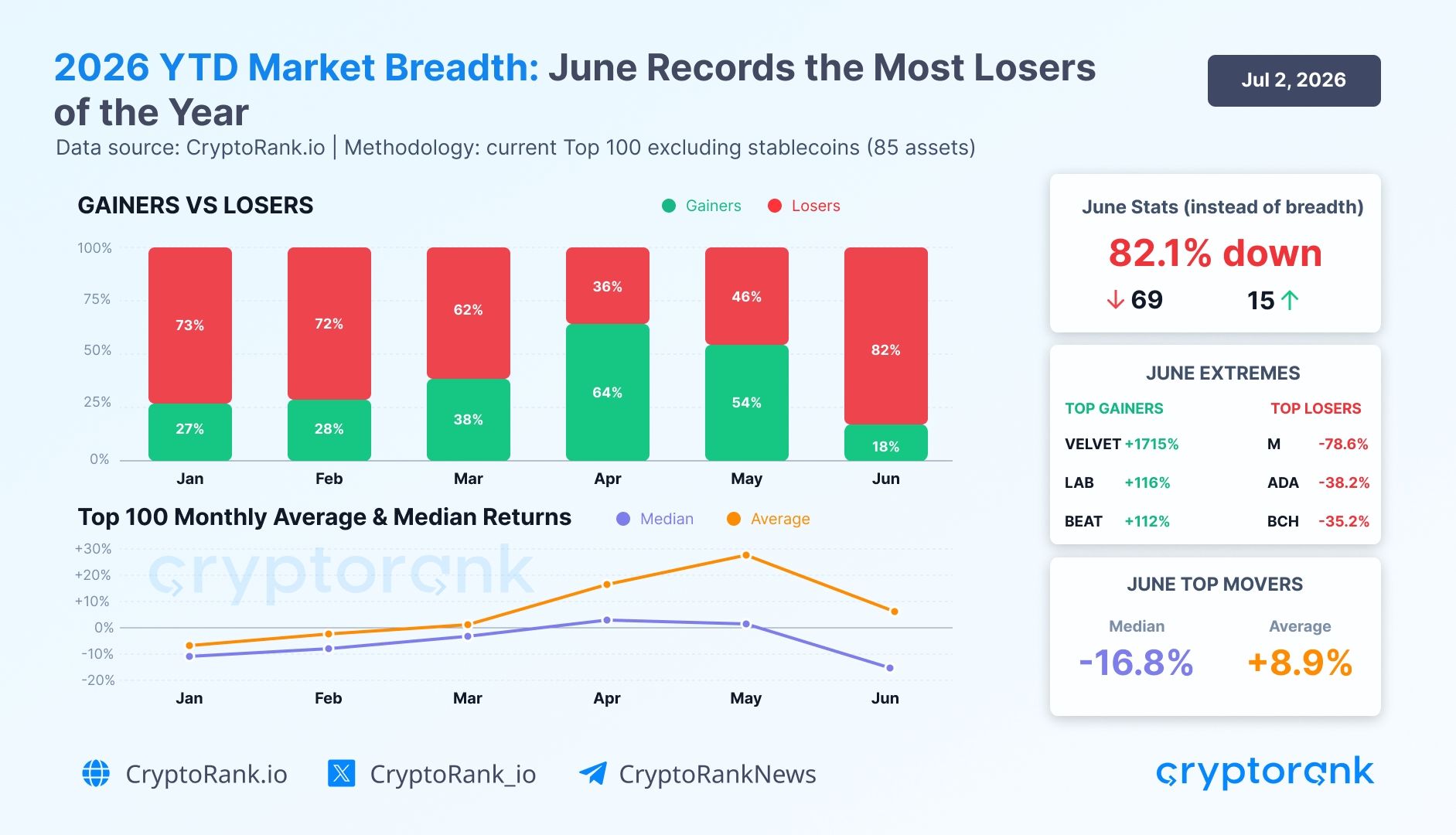
Roughly 82.1% of the top-100 crypto assets declined in June, the worst market breadth of 2026, even as the group’s average return stayed positive.
That split defined the month. A single outlier lifted the average into positive territory while the median return dropped 16.8%, according to a second-quarter recap from CryptoRank.
A Headline Average That Hid the Damage
Across the current top-100 assets excluding stablecoins, CryptoRank recorded a positive average return of 8.9% for June. That figure reflected a single outlier rather than the broader market.
“The market breadth data shows a clear deterioration in participation across the current non-stablecoin Top 100 assets. In June, breadth weakened to its worst level of 2026 so far,” the report read.
Follow us on X to get the latest news as it happens

The report noted that the average was affected by Velvet (VELVET), which surged 1,715% during the month, lifting the aggregate. The 25-point gap between the positive average and the negative 16.8% median showed how few tokens carried the upside.
Besides VELVET, other top gainers included LAB (LAB) at 116% and Audiera (BEAT) at 112%. June also reversed a stronger start to the quarter.
April saw 64% of top-100 assets gain, the best month of 2026. Meanwhile, May showed a more fragile structure, and the June breakdown confirmed the reversal.
Weakness Reached Major Crypto Narratives in June
The decline was not limited to the largest assets. Across all traded tokens with 24-hour volume of more than $1 million, every one of the eight tracked narratives posted a negative median return.
Layer 2 chains led the losses at -24.9%, followed by Decentralized Physical Infrastructure Networks (DePIN) at -24.8% and Layer 1 chains at -22.8%.
“All 8 tracked narratives posted negative median returns, with losers outnumbered gainers in nearly every category, confirming that the market remained defensive and narrow through Q2 without a broad recovery in breadth,” CryptoRank said.

The gainers-versus-losers split showed how narrow the market became. Decentralized Finance (DeFi) recorded 42 gainers against 117 losers, while Artificial Intelligence (AI) posted 21 gainers against 35 losers.
The pattern pointed to a defensive market. Bitcoin (BTC) dominance held near 56% at quarter-end as capital rotated away from weaker altcoins.
Whether June marks a base or another leg lower depends on breadth recovering in the second half.
Subscribe to our YouTube channel to watch leaders and journalists provide expert insights
The post Crypto’s Positive June Average Masked an 82% Decline Across Top Assets appeared first on BeInCrypto.


Russia’s central bank says the digital ruble is ready for a Sept. 1 rollout, keeping the country’s central bank digital currency plan on schedule.
Summary
- Russia’s Sept. 1 digital ruble rollout moves ahead despite EU sanctions targeting related financial infrastructure.
- Bank rules require major lenders and large retailers to support digital ruble payments in stages.
- U.S. lawmakers are moving toward a temporary CBDC ban while Russia expands state digital money.
Governor Elvira Nabiullina said “everyone is ready” for the launch, according to a July 2 report by RIA Novosti.
The digital ruble will circulate alongside cash and non-cash rubles, not replace them. The Bank of Russia has said people will be able to open digital wallets through banking apps connected to its platform. It has also said individuals will not pay fees on digital ruble transactions.
The rollout begins with banks and large merchants
The Bank of Russia’s timeline requires major banks to offer digital ruble services from Sept. 1, 2026. Large retailers with annual revenue above 120 million rubles must also accept digital ruble payments from that date.
The rules will expand in stages. Banks with universal licenses and retailers with annual revenue above 30 million rubles must join from Sept. 1, 2027. Other banks and smaller retailers will follow from Sept. 1, 2028, while very small merchants will remain exempt.
Sanctions pressure frames the rollout
The launch comes as the European Union has already moved against Russia-linked digital finance. In its 20th sanctions package, the EU Council banned transactions involving RUBx and all EU support for the development of the digital ruble. It linked the measures to Russia’s war against Ukraine and wider concerns over sanctions evasion.
In addition, the EU also proposed broader restrictions on foreign crypto services tied to Russian sanctions evasion. That plan followed growing scrutiny of ruble-linked crypto rails, including platforms and tokens that authorities say may support cross-border payments outside Western controls.
Russia has tested digital ruble use cases for more than a year. As previously reported, the Central Bank of Russia piloted digital ruble smart contracts in Tatarstan, including tests on conditional spending for public funds. The latest timeline shows that Moscow now wants to move the project from testing into broader payment use.
U.S. policy moves in the opposite direction
Russia’s CBDC push contrasts with U.S. policy, where lawmakers have moved toward a temporary ban on a Federal Reserve digital dollar. As crypto.news reported, the 21st Century ROAD to Housing Act would block the Fed from creating a CBDC or similar asset through 2030 if it becomes law.
The U.S. debate reflects concerns over privacy, state control, and the role of private stablecoins. The Russian approach is different. Moscow is building a state-run digital currency while also testing other digital asset rules for trade and financial access under sanctions.
A February report by Jack Jarmon for the Australian Institute of International Affairs said Russia could face limits if it relies on Bitcoin or other proof-of-work assets to bypass sanctions. The report pointed to old power infrastructure and limited access to foreign technology. Those limits may explain why the digital ruble remains central to Moscow’s state-led payment strategy.
The Sept. 1 launch will test whether Russia can drive adoption among banks, merchants, and users. Nabiullina said the central bank wants the digital ruble to be “in demand by people and businesses” and “convenient.”
For now, the rollout places Russia among the countries pushing CBDCs forward while sanctions and U.S. policy debates keep digital state money under close review.
eToro has led a $12.5 million strategic funding round in Extended, an onchain exchange for perpetual futures.
Summary
- eToro’s Extended investment links Zengo self-custody tools with onchain perpetual futures trading access for users.
- Jump Crypto joined the round as brokerages move deeper into decentralized derivatives and market infrastructure.
- Perp DEX growth is pulling trading platforms toward self-custody, tokenized assets, and onchain execution.
Extended announced the round in a July 2 post on X, saying eToro led the investment and Jump Crypto also joined the deal.
Meanwhile, the funding is tied to a partnership between Extended and Zengo, the self-custody wallet eToro acquired earlier this year. The companies plan to work on access to global financial markets through onchain infrastructure. eToro said the partnership will explore ways to connect traditional financial assets with decentralized trading venues.
Self-custody becomes part of the plan
Zengo gives eToro a direct route into self-custody products. The wallet uses multi-party computation technology, which removes the need for seed phrases while still giving users control over assets. It also supports swaps, staking, and access to decentralized applications.
eToro completed its Zengo acquisition on April 30 while reporting a sharp drop in crypto trading profit. The company said at the time that Zengo would support its plan to connect traditional financial products with onchain systems. The Extended deal now gives that plan a derivatives-focused path.
Extended builds onchain perps market
Extended was founded by former Revolut employees and opened trading to all users in late 2024. In its public launch announcement, the company said it planned to add unified margin with technical support from StarkWare.
The exchange is built on StarkWare’s StarkEx scaling engine. It focuses on perpetual futures, a type of derivative contract that has no expiry date. Extended says its model supports self-custody trading while aiming to keep execution fast enough for active traders. That structure places it between centralized crypto futures venues and fully decentralized trading platforms.
Perps growth draws larger firms
Perpetual futures remain one of the largest crypto trading markets. As crypto.news reported, CoinGecko’s 2026 Crypto Perpetuals Report found that perp DEX open interest share rose from 3.6% in early 2025 to 13.5% in 2026. The same report showed Binance and OKX still leading centralized perps trading, even as decentralized venues gained share.
That growth has drawn more attention from brokers and trading apps. Previously, crypto.news reported that Robinhood launchedperpetual futures tied to commodities, ETFs, and currencies for eligible European users. The rollout showed how crypto-style trading tools are moving into traditional markets.
Deal follows weaker crypto trading income
The investment comes after eToro reported lower crypto-related trading profit in the first quarter of 2026. As reported by crypto.news, crypto generated $13 million in profit during the quarter, or about 5% of eToro’s total net trading profit of $258 million. That was down from $46 million in the same period in 2025.
The Extended round shows that eToro is still building around digital assets despite weaker short-term crypto revenue. The company is using Zengo to strengthen its self-custody stack and Extended to enter onchain derivatives more directly.
Moreover, the move also places eToro closer to a market where trading apps, crypto exchanges, and decentralized platforms are competing for users who want faster access, direct asset control, and broader exposure to global markets.

Blockchain technology has evolved rapidly over the past decade, giving rise to hundreds of networks optimized for different use cases. Some prioritize speed, others focus on security, privacy, scalability, or specialized applications like gaming and decentralized finance (DeFi). While this diversity has fueled innovation, it has also created one of Web3’s biggest challenges: blockchain silos.
Today, the industry is moving toward a future where blockchains no longer operate as isolated ecosystems. Instead, they’re becoming interconnected networks that can communicate, exchange assets, and share data seamlessly. This shift could redefine how decentralized applications (dApps), users, and institutions interact with blockchain technology.
What Are Blockchain Silos?
A blockchain silo exists when a network operates independently without native communication with other blockchains. Assets, data, and smart contracts remain confined to their respective ecosystems.
For example:
- Bitcoin primarily serves as a secure store of value.
- Ethereum powers a vast ecosystem of smart contracts.
- Solana focuses on high-speed transactions.
- BNB Chain emphasizes affordable and scalable DeFi.
- Avalanche offers customizable blockchain infrastructure.
Each blockchain has unique strengths, but moving assets or information between them has traditionally required third-party bridges or centralized exchanges.
This fragmentation often creates unnecessary complexity for users and developers alike.
The Problems Caused by Blockchain Silos
1. Fragmented Liquidity
Liquidity scattered across multiple blockchains reduces capital efficiency. Instead of one unified financial ecosystem, liquidity is divided among separate networks, making markets less efficient.
2. Poor User Experience
Managing several wallets, switching networks, paying different gas fees, and learning multiple interfaces discourages mainstream adoption.
3. Limited Application Potential
Developers often build applications for a single blockchain, restricting access to users and liquidity from other ecosystems.
4. Security Risks
Traditional cross-chain bridges have become attractive targets for hackers. Billions of dollars have been lost through bridge exploits over the past several years, highlighting the need for more secure interoperability solutions.
The Rise of Blockchain Interoperability
Instead of competing in isolation, blockchain ecosystems are increasingly embracing interoperability—the ability for different blockchains to communicate securely.
Modern interoperability solutions aim to allow:
- Cross-chain asset transfers
- Cross-chain messaging
- Shared liquidity
- Multi-chain smart contract execution
- Unified user experiences
Rather than forcing users to choose one blockchain, interoperability allows them to benefit from many simultaneously.
Technologies Driving the End of Silos
Cross-Chain Messaging
Instead of merely transferring tokens, cross-chain messaging enables smart contracts on one blockchain to trigger actions on another.
This opens the door to far more sophisticated decentralized applications.
Interoperability Protocols
Dedicated interoperability layers provide standardized communication between independent blockchains.
These protocols reduce fragmentation while allowing each network to maintain its own security and governance.
Chain Abstraction
One of the biggest emerging trends is chain abstraction.
Instead of asking users to manually manage networks, wallets, bridges, and gas tokens, applications handle the complexity behind the scenes.
Users simply interact with the application while the infrastructure determines the optimal blockchain for each transaction.
Intent-Based Architecture
Intent-based systems allow users to specify their desired outcome rather than manually executing every blockchain interaction.
For example:
Instead of bridging tokens, swapping assets, and staking manually, a user simply requests:
“Stake my stablecoins in the highest-yield lending protocol.”
The protocol automatically completes every required cross-chain action.
Benefits of an Interoperable Future
Better Capital Efficiency
Assets can move freely across ecosystems, creating deeper liquidity and more efficient markets.
Improved User Experience
Users no longer need to understand every blockchain’s technical details. Applications become as simple as traditional fintech apps.
More Powerful Applications
Developers gain access to users, assets, and services across multiple chains, enabling richer decentralized applications.
Greater Ecosystem Collaboration
Instead of competing for users, blockchain networks can specialize while remaining connected through shared infrastructure.
Challenges That Still Need Solving
Although interoperability has advanced significantly, several challenges remain.
Security
Cross-chain infrastructure must maintain strong security guarantees without introducing centralized trust assumptions.
Standardization
The industry still lacks universal standards for messaging, identity, and asset transfers across every blockchain.
Scalability
As interoperability grows, systems must efficiently process increasing volumes of cross-chain communication.
Governance
Coordinating upgrades across multiple decentralized ecosystems remains a complex challenge.
What This Means for DeFi
The end of blockchain silos could dramatically reshape decentralized finance.
Future DeFi platforms may automatically source liquidity from multiple chains, optimize yields across ecosystems, and execute transactions wherever conditions are most favorable—all without requiring users to manually bridge assets or switch networks.
This could make decentralized finance significantly more accessible to everyday users while improving efficiency for institutional participants.
Beyond DeFi: A Unified Web3
Interoperability extends far beyond finance.
Potential applications include:
- Cross-chain gaming assets
- Portable digital identities
- Interoperable NFTs
- Multi-chain DAOs
- Unified social networks
- Enterprise blockchain integration
- AI agents coordinating across decentralized ecosystems
Rather than existing as separate blockchain islands, these services could operate within one connected Web3 ecosystem.
Conclusion
The next phase of blockchain evolution isn’t about finding a single “winning” blockchain—it’s about enabling all blockchains to work together.
As interoperability protocols, chain abstraction, and intent-based systems mature, users may no longer need to think about which blockchain they’re using. Just as internet users rarely consider which servers deliver a website, future Web3 users may simply interact with applications while the underlying infrastructure seamlessly coordinates across multiple networks.
The end of blockchain silos represents more than a technical milestone. It marks the transition from isolated blockchain ecosystems to a truly interconnected decentralized internet—one where assets, applications, and information flow freely across networks, unlocking the full potential of Web3.
REQUEST AN ARTICLE

Inside Taylor Swift and Travis Kelce’s ultimate love story as wedding preparations ramp up

Instagram running ads promoting child sexual abuse material in India, BBC finds

Riot Platforms moves another 500 BTC to NYDIG custody

No Jackpot Winner as $257 Million Prize Rolls Over to $269 Million Monday Draw

Renter of Home in Anne Heche Crash Denies Settlement With Son

Weekend Open Thread: Staud – Corporette.com

The lots made strong money at the farm sale today….what did Michael buy?

99.99% Pure Gold Bitcoin Mass Production Process #allprocessofworld

PayItMonthly Celebrates Financial Times Top 1000 Fastest Growing Companies in Europe ranking!
-
 Fashion7 days ago
Weekend Open Thread: Staud – Corporette.com
-

 Crypto World3 days ago
Strategy authorizes up to $1.25B in Bitcoin sales under new capital plan
-

 Business7 days ago
Asia stock markets slide as tech shares slump
-

 News Videos4 days ago
MAJOR BITCOIN & MARKET UPDATE!!!! (MUST WATCH ASAP!!!)
-

 Tech3 days ago
Anonymous researcher drops 0-day ‘exploitarium’ repo
-

 Crypto World6 days ago
Coinbase, Circle Deepen Crypto Stock Losses Despite Resilient S&P 500
-

 Business3 days ago
Australia treasurer says alleged access of prime minister’s bank data ’incredibly concerning’
-

 Crypto World6 days ago
Kraken's xStocks Opens Bending Spoons IPO Registration to EEA Retail
-

 Sports6 days ago
FIH Pro League: India defeat Pakistan 7-1, register biggest win of campaign | Other Sports News
-

 Tech5 days ago
Bluekit phishing kit adopts browser-in-the-middle for login theft
-

 Tech6 days ago
Russian hackers now target Signal backup recovery keys
-

 Crypto World7 days ago
Tether (USDT) Passes Ether in Market Cap as ETH Drops Toward $1.5K
-
Crypto World7 days ago
Hyperliquid Named on Singapore MAS Investor Alert Register
-

 Crypto World7 days ago
RTX holders must register wallets before token distribution begins
-

 Sports2 days ago
Broncos roster: OL Ben Powers (No. 74) entering final year of contract
-
 Business4 days ago
The AI boom won’t burst all at once. It will pop in ‘rolling bubbles’: Macquarie
-

 Tech5 days ago
Claude Code turned every engineer into three. Now companies need more product thinkers
-
 Crypto World7 days ago
SpaceX Called a Market Top Signal Just 2 Weeks After Its $86 Billion IPO
-

 Tech6 days ago
Silicon Valley paid to kill AI regulation, now it wants the rules back
-

 NewsBeat2 days ago
Presenter Caroline Flack’s brother Paul Flack dies aged 55
You must be logged in to post a comment Login