

Crypto World
What Is zkTLS? Web Proofs and How They Work



Blockchains are excellent at verifying what happens on-chain and nearly blind to everything else. zkTLS, a family of protocols also called web proofs, lets anyone prove facts from an ordinary HTTPS session, a bank balance, a driver rating, a loyalty tier, without revealing the underlying data or asking the website for permission. Here is how it works, who is building it, and where the trust assumptions hide.
Crypto has a data problem that predates every bull market narrative. Smart contracts can verify a token transfer with mathematical certainty, but they cannot see a payroll deposit, a university diploma, an Uber rating, or a frequent flyer tier. All of that information lives behind the login walls of Web2 platforms, reachable only through official APIs that are limited, revocable, and priced at whatever the platform decides. Oracles solved a narrow slice of this, mostly public price feeds, and were never designed to carry personal data.
zkTLS is the attempt to solve the rest of it. The idea is simple to state and hard to engineer: take the secure connection your browser already makes to any website, and turn what you see in that session into a cryptographic proof that anyone can verify, without exposing your password, your session, or the raw data itself. If it works at scale, every piece of information behind every login on the internet becomes portable, provable, and usable on-chain.
Start with TLS
Every website address that begins with https uses Transport Layer Security, or TLS. It is the protocol that secures roughly 95% of web traffic. When your browser connects to your bank, TLS performs a cryptographic handshake that does three things: it confirms you are talking to the real server, it encrypts the traffic so nobody in the middle can read it, and it guarantees the data was not altered in transit.
What TLS does not do is produce evidence. The encryption is symmetric, meaning your browser and the server share the same session keys. Once the session ends, you have no way to prove to a third party what the server sent you. You could screenshot your bank balance, but screenshots are trivially forged. You could hand over your login, but that exposes everything. You could share the session keys, but since the same keys both encrypt and authenticate, whoever holds them could fabricate any transcript they like. TLS was built for private communication, not for portable proof. That gap is what zkTLS fills.
What zkTLS actually is
zkTLS, short for zero-knowledge Transport Layer Security, is an umbrella term for protocols that make TLS sessions verifiable. The core output is a proof with two properties. Authenticity: the data genuinely came from a specific domain during a real TLS session, unaltered. Selectivity: the proof reveals only the specific claim being made, such as balance above $5,000 or rating above 4.8, while everything else in the session, including credentials, stays hidden.
One naming caveat worth knowing: the term is a misnomer. Not every implementation uses zero-knowledge proofs, and the emphasis is often verifiability first, privacy second. Many builders prefer the terms web proofs or TLS attestations. The industry has mostly settled on zkTLS anyway, so this guide uses it while flagging the imprecision.
The hard engineering problem is that TLS was never designed to admit a third-party verifier. Three architectures compete to solve it, each with different trust assumptions.
The three models
MPC-TLS. The oldest approach, pioneered by the nonprofit TLSNotary project, which dates back to 2013. Secure multi-party computation splits the TLS session keys between the user and a verifier node, so neither party ever holds the full keys. The verifier participates in the encrypted session cryptographically, using techniques like garbled circuits, and can attest to what the server sent without seeing the plaintext or being able to forge it. The security is the strongest of the three models, and the cost is overhead: MPC adds heavy network round-trips, which historically made proofs slow. Opacity Network builds on this model and has pushed hard on decentralizing the verifier set. Research directions like vector oblivious linear evaluation could cut MPC networking costs enough for one-second proofs.
Proxy witness. A proxy sits between the user and the website, forwarding the encrypted traffic and attesting that the recorded exchange really happened between that client and that domain. The user then proves claims about the decrypted contents, often with a zero-knowledge proof. This is the fastest model in production. Reclaim Protocol, its leading implementer, generates proofs from a phone in about two to four seconds with no app or extension, supports most major blockchains, and lists 889 community-built data sources. An academic paper titled Proxying is Enough put the probability of breaking Reclaim’s construction at ten to the power of minus forty. The trade-off is a trust shift toward the proxy layer and practical friction, since some platforms firewall known proxy traffic, which Reclaim works around with residential proxies.
TEE-based. Trusted execution environments, the tamper-resistant enclaves inside modern processors, handle the session inside sealed hardware. The enclave logs in, fetches the data, and signs an attestation about what it saw, with minimal performance overhead. The trust assumption moves to the chip: you are trusting the hardware manufacturer and the enclave’s resistance to side-channel attacks, a category with a documented history of breaks. zkPass began as an MPC project and now runs a hybrid, using a proxy witness model in production with MPC as backup, while other teams lean on TEEs for speed.
No model is strictly best. MPC maximizes cryptographic trust and pays in latency, proxies maximize speed and pay in trust assumptions, TEEs maximize convenience and pay in hardware dependence. Serious applications pick based on what breaks their use case first.
A worked example, start to finish
Abstractions aside, here is what a zkTLS flow looks like in practice for one concrete case: a borrower proving to a lending protocol that their bank balance exceeds $5,000, without sharing statements or credentials.
The borrower opens the lender’s app, which hands off to a zkTLS client, typically a lightweight mobile flow with no separate install. The client opens a normal TLS session with the bank’s website, and the borrower logs in exactly as they always do. Their password travels over the same encrypted channel as any ordinary login; the verifier never sees it, because depending on the model, the verifier either holds only a useless share of the session keys, or observes only ciphertext passing through a proxy.
The bank’s server returns the account page, oblivious to anything unusual. From its perspective, this is a routine customer session. The client then isolates the relevant response data, the balance field, and generates a proof of a narrow statement: this TLS session was with the bank’s real domain, the response was not altered, and the balance value in it exceeds $5,000. The actual number stays hidden. The account history stays hidden. The login stays hidden.
The proof lands on-chain or with the lender’s backend, where a verifier contract checks it in milliseconds. The whole round trip takes seconds on the proxy model, and the lender has learned exactly one bit of information: qualified. Compare that against the incumbent process, which involves uploading full statements to a stranger’s server and trusting their retention policy forever, and the appeal writes itself. The same skeleton, swap the bank for any website and the balance for any visible fact, is every zkTLS application in existence.
From 2013 curiosity to 2026 infrastructure
The idea is older than most of the industry using it. TLSNotary shipped its first construction in 2013, before Ethereum existed, as a way to notarize web pages for dispute resolution. For a decade it stayed a cryptographic curiosity: the MPC overhead made proofs slow, the tooling assumed expertise, and crypto had no application layer hungry for private off-chain data.
Three things changed. Zero-knowledge proving systems got fast and cheap on the back of the rollup boom, which industrialized zk engineering talent and libraries. Mobile-first implementations, led by Reclaim’s proxy design, collapsed proof generation from minutes on a desktop to seconds on a phone. And the application layer arrived: identity networks, points programs plagued by sybils, prediction markets processing tens of billions monthly, and AI agents that need to verify what they pay for. By the time Devconnect dedicated a full day to the technology, the question had shifted from whether web proofs work to which trust model wins each vertical.
What people are building with it
The use cases sort into a few families, and most of them were impossible before.
- Proof of personhood and identity. Humanity Protocol, the Worldcoin rival valued at $1.1 billion after a round co-led by Jump Crypto and Pantera, launched its mainnet with zkTLS at the center. Users link Web2 accounts, from airline loyalty programs to professional profiles, to a portable Human ID, proving who they are and what they have achieved without any central party seeing the underlying documents. It is identity verification without iris scans.
- Credit and undercollateralized lending. DeFi lending is overcollateralized because protocols cannot see income. With zkTLS, a borrower proves salary deposits, bank balances, or an off-chain credit score directly from the source, without handing over statements. Projects like Cr3dentials build income and KYC verification for lenders on this rail, and lending protocols use web proofs to unlock on-chain credit against Web2 financial reputation.
- Reputation portability. Opacity’s early demo let Uber drivers export their ratings to a rival platform. The same pattern applies to seller ratings, subscriber counts, and gaming achievements: reputations that platforms hold hostage become assets the user carries. This is the quietly radical part, because data lock-in is the moat under most large internet businesses.
- Marketplaces for gated goods. zkP2P uses web proofs to power a ticket marketplace where a seller proves they own a real ticket inside the vendor’s own system before the trade settles, collapsing the fraud problem that plagues secondary markets.
- Data for markets and AI agents. Prediction markets need trustworthy real-world data, and resolution disputes remain the sector’s biggest weakness. Web proofs offer a way to verify a source document cryptographically instead of arguing about it. The same applies to AI agents that buy data over protocols like x402: projects like MCPay use zkTLS to prove that an API response an agent paid for is authentic and untampered.
Why the timing is 2026
The technology is a decade old in concept, so the fair question is why it matters now. Three currents converged.
First, privacy became the sector’s active narrative. A16z crypto argued that privacy is the moat of crypto’s next phase, a thesis that has pulled privacy coins and privacy infrastructure back into focus. zkTLS is the consumer-facing end of that stack: it lets users prove things about themselves while revealing less, the exact inversion of how the data economy currently works.
Second, the tooling matured. Reclaim’s mobile-speed proofs, TLSNotary’s open-source verifier infrastructure, vlayer’s web proofs for Ethereum developers, and zkPass’s production deployments moved the field from papers to SDKs. Ethereum’s Devconnect conference now runs a dedicated zkTLS Day, with hands-on workshops across the competing implementations, a reliable sign that a primitive has crossed from research to developer adoption.
Third, adjacent security work made verifiable data legible to a mainstream audience. Ethereum’s push to end blind transaction approvals through the ERC-7730 Clear Signing standard trained the industry to ask what users can actually verify on their screens. zkTLS asks the same question about data instead of transactions.
How this differs from oracles, and why both survive
Because zkTLS moves off-chain data on-chain, it gets lumped in with oracle networks, and the comparison is worth drawing precisely. Chainlink, Pyth, and their peers are push systems: node networks fetch public data, mostly prices, aggregate it, and publish it continuously for every application to read. The economics amortize across all users of a feed, and the security model rests on the independence and stake of the node operators. This design is close to unbeatable for its job, which is why DeFi’s core money legos still run on it.
It also cannot do what web proofs do. An oracle network has no mechanism for data that requires logging in as a specific person, and no economics for data only one user will ever need. Nobody runs a Chainlink feed for your bank balance. zkTLS inverts every design choice: pull instead of push, per-user instead of shared, private data instead of public, generated on demand instead of streamed. The user is the oracle, and cryptography replaces the node network as the reason to believe them.
The mature stack will use both. Public market data flows through feed networks; personal, session-gated facts flow through web proofs; and the two already meet in places like prediction market resolution, where a price feed settles the objective markets and a verified source document could someday settle the contested ones.
The limits and the risks
An honest account has to include the ways this can disappoint.
Trust assumptions never disappear, they relocate. The proxy model trusts the witness layer not to collude with the user. The TEE model trusts silicon vendors. Even MPC, the most trust-minimized, typically relies on a verifier network whose decentralization is a work in progress. When a marketing page says trustless, the correct response is to ask which of the three models it runs and what breaks it.
Websites are not passive. Platforms change page structures constantly, which breaks data source integrations, and some actively resist automated access. A protocol whose data sources depend on scrapers dressed in cryptography inherits the fragility of scrapers.
Privacy cuts both ways. The same machinery that lets a user prove facts without exposure can help bad actors move value while revealing less to investigators. Wallet drainers adopting privacy tooling is not hypothetical, and regulatory attention on privacy-preserving infrastructure has a long track record.
And selective disclosure invites coercion. If proving your salary to a landlord becomes possible, it can become expected. A technology built to minimize disclosure can normalize new categories of demanded proof. That is a social risk, not a cryptographic one, and no protocol upgrade fixes it.
The quiet stakes: what happens to data moats
Zoom out from the cryptography and zkTLS is an economic weapon aimed at the deepest moat on the internet. Large platforms defend their positions with data lock-in: your ratings, your history, your follower graph, and your purchase record live on their servers, and leaving means starting from zero. That switching cost is why a five-star driver stays on one app, why a power seller cannot move marketplaces, and why challenger platforms die in the cold-start phase regardless of how good their product is.
Web proofs dissolve the lock without asking the incumbent’s permission. If a new ride platform can accept a cryptographic proof of a competitor’s rating, it inherits the trust the incumbent spent a decade accumulating, and the user carries their reputation the way they carry a passport. A lender can underwrite against a credit history it never stores. A social network can import proof of an audience without an API deal that the incumbent can revoke on a whim, which incumbents historically do the moment a client grows threatening.
Incumbents will not stay passive, and the countermeasure escalation is predictable: aggressive bot detection, page structures that shift weekly, legal pressure on proxy infrastructure, and terms of service amended to prohibit proof generation. None of those measures can break the cryptography, but all of them can raise the maintenance cost of data source integrations, and the protocols that win will be the ones that industrialize that maintenance. The fight over whether users own the facts about themselves is about to move from privacy policy debates into engineering, and for once the users’ side has tooling.
The bridge crypto kept promising
For years the industry described blockchains as a trust layer for the internet while the internet’s actual data sat somewhere the chains could not reach. zkTLS is the most credible attempt yet to close that gap without asking platforms for permission, and permissionlessness is the whole point: no API deal, no data-sharing agreement, no gatekeeper deciding which facts are exportable. Whether it becomes core infrastructure depends on the unglamorous work ahead, decentralizing verifier networks, surviving platform countermeasures, and proving the trust models under adversarial pressure. The primitive, though, is real, the proofs verify, and the fortress walls around Web2 data have their first practical siege engine.
Frequently asked questions
What is zkTLS in simple terms?
zkTLS is a set of protocols that turn an ordinary secure web session into cryptographic evidence. It lets you prove a specific fact you saw on a website, such as an account balance, a rating, or a membership tier, to any third party, without revealing your password, your full data, or anything beyond the claim itself, and without the website’s cooperation.
Is zkTLS the same as a zero-knowledge proof?
Not exactly. Zero-knowledge proofs are one ingredient, used to prove claims about session data without revealing it. zkTLS as a whole is a broader construction that also has to prove the data authentically came from a specific website, which involves MPC, proxies, or trusted hardware. Some implementations use little or no actual zk math, which is why many builders prefer the term web proofs.
What are the main zkTLS projects?
TLSNotary is the open-source pioneer of the MPC approach. Reclaim Protocol leads the proxy witness model with two-to-four-second mobile proofs and 889 data sources. zkPass runs a hybrid proxy and MPC design. Opacity Network builds a decentralized MPC verifier network. vlayer brings web proofs to Ethereum developers, and Humanity Protocol applies the technology to identity at network scale.
What can zkTLS be used for?
Proving identity and credentials without documents, unlocking undercollateralized DeFi loans with verified income, porting reputations like driver ratings between platforms, verifying tickets and gated goods in marketplaces, feeding verified real-world data to prediction markets, and letting AI agents confirm that data they purchase is authentic. Anything visible in a logged-in web session can, in principle, become provable.
Does the website need to approve or integrate anything?
No, and that is the point. zkTLS works from the user’s side of an ordinary TLS session, so no API access, partnership, or permission from the data-holding platform is required. The trade-off is fragility: platforms change their pages, throttle suspicious traffic, and firewall known proxies, so data source integrations require ongoing maintenance.
Is zkTLS private and safe to use?
The proofs themselves reveal only the claim being proven, and credentials never leave the user’s device in readable form. The real questions are about each model’s trust assumptions: proxy designs trust a witness layer, TEE designs trust chip vendors, and MPC designs trust a verifier network. Reputable implementations publish their assumptions; unaudited ones deserve skepticism.
How is zkTLS different from an oracle like Chainlink?
Traditional oracles publish public data, mostly asset prices, through node networks that fetch from APIs, and they scale poorly for personal information. zkTLS produces user-generated proofs about private, session-gated data, at per-user granularity, without the data source’s involvement. The two are complements: oracles for public market data, web proofs for everything behind a login.
Can zkTLS proofs be faked?
Forging a proof would require breaking the underlying model: defeating the MPC protocol, corrupting the proxy attestation, or compromising the hardware enclave. For the leading proxy construction, peer-reviewed analysis put the break probability at ten to the power of minus forty. The realistic risks are subtler: manipulated source pages, stale data, and poorly written claim logic, which is where audits matter.
Disclaimer: This article is for informational purposes only and does not constitute investment advice. Digital asset markets are volatile and you can lose your entire investment. Always do your own research. Information current as of July 3, 2026.

Crypto World
Sandisk Corporation (SNDK) Stock Falls 14% Despite Major NAND Manufacturing Breakthrough

Key Takeaways
-
Sandisk shares fell 14.13% even as manufacturing milestone was achieved.
-
Kioxia partnership launches 10th-generation 3D Flash at Japanese production site.
-
K2 manufacturing facility increases cutting-edge NAND production for AI applications.
-
Partnership extension through 2034 provides sustained NAND development framework.
-
After-hours recovery modest following significant intraday selling pressure.
Sandisk Corporation (SNDK) experienced a steep 14.13% decline, closing at 1,745.00, even as the company achieved significant progress with its Kioxia NAND manufacturing collaboration. After-hours trading saw a modest recovery to 1,762.07, representing a 0.98% gain. Nevertheless, the trading session revealed substantial downward pressure that overshadowed positive manufacturing developments.
Next-Generation 3D Flash Manufacturing Commences at K2 Plant
Kioxia Corporation and Sandisk have initiated manufacturing operations for their 10th-generation 3D Flash memory technology at the Fab2 location in Japan. This manufacturing site operates within the Kitakami Plant complex located in Iwate Prefecture. The production achievement represents a significant expansion in their capacity to deliver advanced NAND solutions for data-intensive use cases.
The K2 manufacturing complex began operations in September 2025, initially focusing on eighth-generation 3D flash memory products. The partners are now implementing their latest 10th-generation technology at the same location. This strategic move aligns with their objective of achieving sustained bit volume expansion over time.
Both technology generations incorporate CBA architecture, which creates direct bonds between CMOS logic and memory arrays. This innovative design delivers enhanced storage density, superior operational speed, and reduced energy consumption. Consequently, these products address the growing requirements of artificial intelligence and data storage sectors.
Enhanced Manufacturing Infrastructure at K2 Location
The Fab2 production site incorporates seismic isolation technology, ensuring consistent manufacturing operations in earthquake-prone regions of Japan. The facility also deploys energy-efficient production systems throughout critical manufacturing stages. As such, the location aligns with the partners’ commitment to sustainable chip fabrication.
Kioxia and Sandisk have integrated artificial intelligence systems throughout the facility to optimize production workflows. The facility architecture maximizes clean-room capacity for manufacturing equipment installation. This strategic layout enables the partners to increase production volume while utilizing available infrastructure efficiently.
The collaboration partners recently renewed their joint venture agreement, extending it through December 2034. This extension reinforces a strategic alliance that has driven NAND innovation for over a quarter century. The agreement provides both organizations with an extended timeframe for coordinated capital deployment.
NAND Capacity Growth Continues Amid Share Price Volatility
Sandisk and Kioxia have constructed their NAND collaboration through synchronized technology development and pooled manufacturing investments. This strategic partnership continues to serve as the foundation for their capacity to manufacture sophisticated flash memory at commercial scale. The alliance also ensures consistent supply availability for clients across multiple technology sectors.
This production launch arrives as artificial intelligence infrastructure drives increased requirements for high-performance storage solutions. Flash memory technology enables rapid data retrieval, expanded storage volumes, and reduced energy demands. State-of-the-art NAND products remain critical for cloud infrastructure, consumer devices, and enterprise computing environments.
Despite these developments, Sandisk shares experienced significant downward movement throughout the trading day. The price action indicated that the manufacturing achievement failed to counterbalance wider market pressures. Nonetheless, the K2 facility expansion positions Sandisk and Kioxia with enhanced manufacturing capabilities for upcoming NAND production cycles.

Crypto World
Cardano News: ADA Shorts Just Got Squeezed $857K in 24 Hours While Whale Wallets Hit an All-Time High, Is the Bottom Finally In?
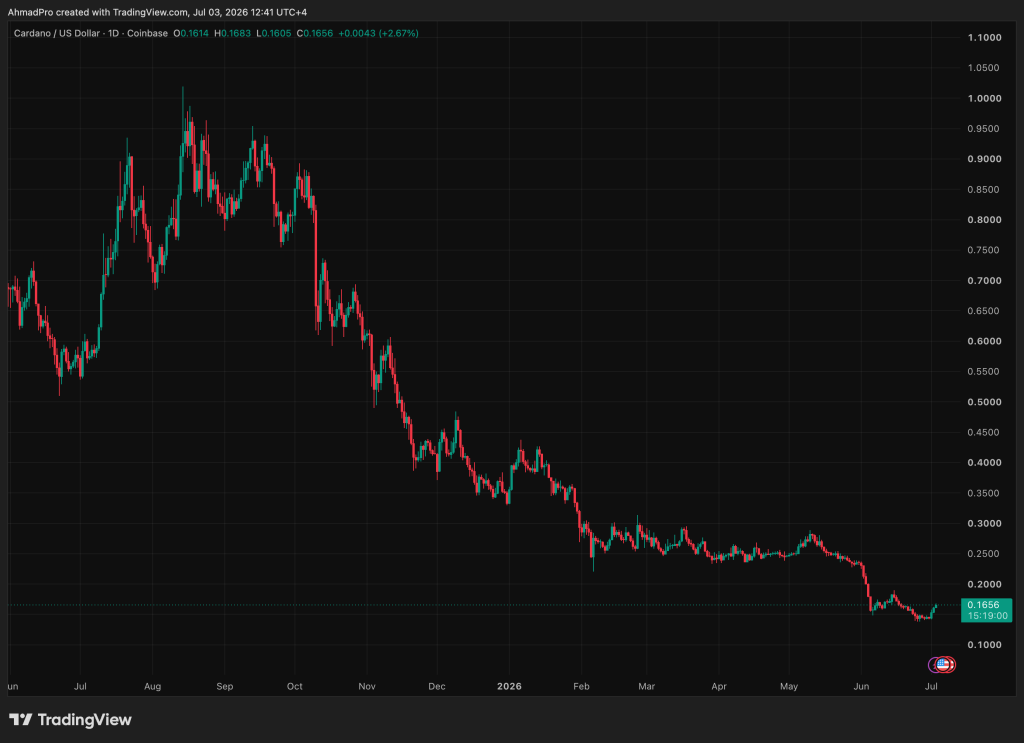
Cardano News: ADA price is drawing blood on the short side. Cardano trades around $0.1650, up 6.50% in 24 hours and 14.1% over the past week, as a technical signal that has been absent since June’s collapse finally reappears, and the traders who leaned short are paying for it.
The full picture, including what the whale data is quietly signaling about the next directional move, is more complex than the headline bounce suggests.
The Parabolic SAR has flipped below spot price for the first time in weeks, sitting at $0.1385 against current trading levels. That alone would be noise, but derivatives data corroborates the move.
Over 24 hours, short liquidations hit $857.14K against just $158.49K for longs, a clean reversal of the pattern that crushed ADA bulls through June. Derivatives volume climbed 8.08% to $544.55M while open interest rose 1.62% to $374.88M, pointing to fresh positioning rather than short covering alone.
On-chain, whale wallets now hold 26.2 billion ADA at an all-time high, while exchange supply hit a new all-time low, a supply squeeze building quietly beneath the surface.
Don’t Miss Out on Our $1,000 USDT Airdrop on ByBit
Cardano News: Can Cardano Price Break $0.20 This Week?
Cardano is navigating bad news and a stacked resistance shelf at current levels.
The 20-day EMA at $0.17 is the immediate ceiling. Price needs to close above it convincingly, not just tap it. Beyond that, the 50-day EMA sits at $0.1858, the 100-day at $0.2204, and the 200-day at $0.2941.
Every major moving average is overhead and declining. This is not a setup for a smooth grind higher. It is a gauntlet.
The horizontal support zone between $0.14 and $0.15 held through repeated tests in June and now acts as the structural floor. The SAR flip is the first technical confirmation that buyers are gaining footing, but a rejection at the 20-day would likely trigger another leg lower, consistent with every prior failed bounce attempt this cycle.
A daily close above $0.17 opens a run toward the 50-day at $0.1858, potentially exacerbating short squeeze conditions given the derivatives imbalance. If price consolidates between $0.15 and $0.1586 instead, the $5.4 million in USDCX minted on Cardano in 48 hours, pushing total reserves past $35 million, slowly builds DeFi narrative support underneath.
A rejection at the 20-day EMA and a close back below $0.145 invalidates the SAR signal and likely flushes longs accumulated during this bounce.
Medium-term quantitative models project ADA around $0.1505 by end-2026, implying the current bounce is a cyclical relief move inside a larger compression rather than a structural reversal.
The next 48 hours are decisive.
Discover: The Best Token Presales
Maxi Doge Targets Early Mover Upside as ADA Tests Critical Resistance
ADA’s bounce is real, but with the 20-day EMA immediately overhead and four declining EMAs stacked above that, the risk-reward on chasing here is asymmetric in the wrong direction.
Traders who missed the dip and want early-stage exposure to a different kind of momentum are looking at the presale market, where entry price isn’t dictated by a chart full of overhead resistance.
Meme coin presales have been absorbing capital even as blue-chip crypto consolidates, and Maxi Doge ($MAXI) sits in that flow.
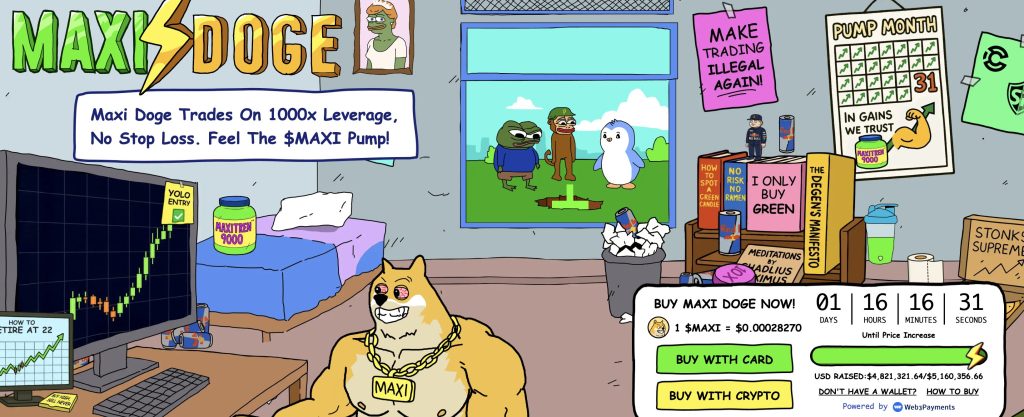
Built on Ethereum as an ERC-20 token, the project positions itself around a “1000x leverage trading mentality”, think gym-bro culture meets derivatives desk, complete with holder-only trading competitions, leaderboard rewards, and a Maxi Fund treasury allocated to liquidity and partnerships.
The tagline is blunt: never skip leg-day, never skip a pump. The presale has raised $4,821,311.89 at a current price of $0.0002827, with dynamic staking APY available for participants. That’s a real fundraise figure, not a projection. Risk caveat applies: presale tokens carry illiquidity risk and no price guarantee at listing.
The post Cardano News: ADA Shorts Just Got Squeezed $857K in 24 Hours While Whale Wallets Hit an All-Time High, Is the Bottom Finally In? appeared first on Cryptonews.
Samsung has distanced itself from the founding consortium behind the proposed OUSD stablecoin after being named among more than 140 partners announced for the project.
Summary
- Samsung says it has not held formal talks with Open Standard despite being named an OUSD founding partner.
- Dunamu, Shinhan Bank, and K-Bank say they are only reviewing participation and have not approved joining the consortium.
- Circle expands institutional USDC services with Standard Chartered as scrutiny grows over OUSD’s founding member claims.
According to a report by Chosun, several South Korean companies listed as founding members of Open Standard’s OUSD consortium have said they either never held formal discussions with the issuer or have not agreed to participate in the initiative. The disclosures have cast uncertainty over the consortium structure that Open Standard unveiled earlier this week.
Open Standard introduced OUSD as a new stablecoin governed by a consortium of more than 140 organizations. The issuer said participating members would jointly oversee the project through a shared governance board while also sharing revenue generated from the stablecoin’s reserve assets.
Samsung says no formal role has been agreed
Speaking to Chosun, a Samsung official said the company had not held official consultations with Open Standard and did not know what role it was expected to play within the consortium. The official’s comments came after Samsung was identified as one of the founding partners in Open Standard’s announcement.
Other companies offered similar responses. According to Chosun, Dunamu, Shinhan Bank and K-Bank confirmed they had received inquiries from Open Standard about joining the project but said they were still reviewing the proposal and had not approved participation.
One company official told the newspaper that the firm first learned it had been listed as a consortium member through domestic media reports. The official said the company had only responded that it would consider the proposal if circumstances developed favorably and expressed surprise at being presented as a member before any agreement had been reached.
The statements contrast with Open Standard’s announcement, which described the listed organizations as founding partners that would participate in collaborative governance and share earnings generated from the stablecoin’s reserves.
Circle partnership gains attention as OUSD faces scrutiny
The questions surrounding OUSD’s founding consortium have emerged only days after the project was unveiled, drawing comparisons with more established stablecoin issuers.
Following Open Standard’s announcement, Circle Chief Executive Jeremy Allaire argued that consortium-based stablecoin models have historically struggled because decision-making tends to be slow and incentives among participants are often misaligned.
“Large groups of large companies coordinate poorly, have misaligned incentives, slow things down and rarely create the space for real durable innovation and competitiveness.”
Meanwhile, Circle has continued expanding institutional access to its USDC stablecoin through new banking partnerships. Standard Chartered recently launched a service that allows eligible institutional clients to mint and redeem USDC directly through the bank’s platform. Developed with Circle, the service lets clients access fiat banking, custody, digital asset infrastructure and public blockchain connectivity through a single banking relationship instead of opening separate accounts with Circle.
The offering has launched through Standard Chartered’s Dubai International Financial Centre operations, with expansion into additional markets planned subject to regulatory approvals and market readiness.
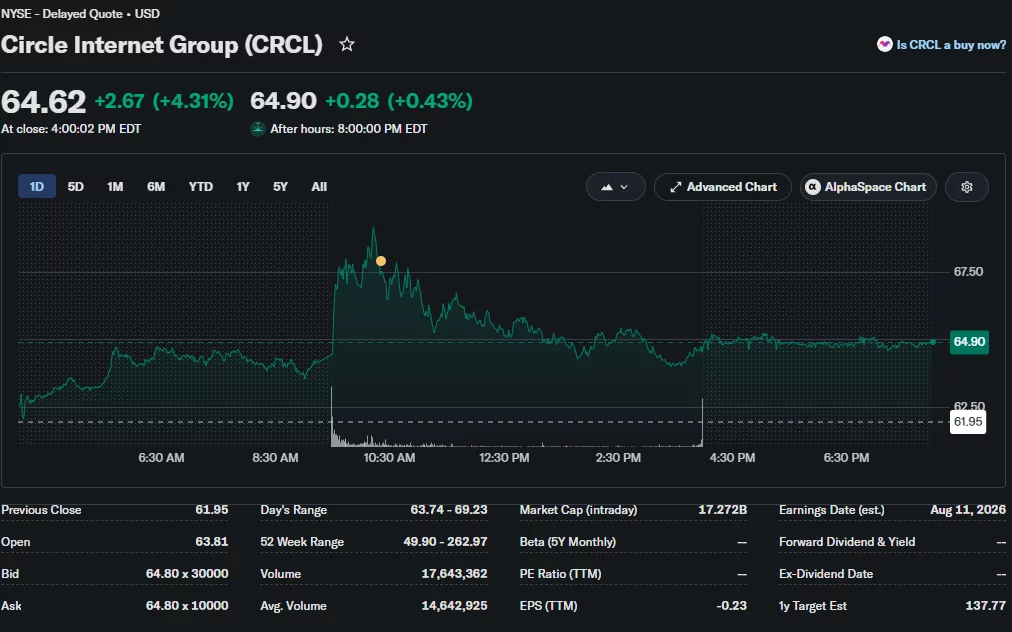
Investor sentiment also shifted after the latest developments. According to data from Yahoo Finance, Circle’s CRCL shares rebounded by as much as 4% to around $64.62 after an earlier double-digit decline that followed the OUSD announcement and the stock’s removal from several Russell indexes.
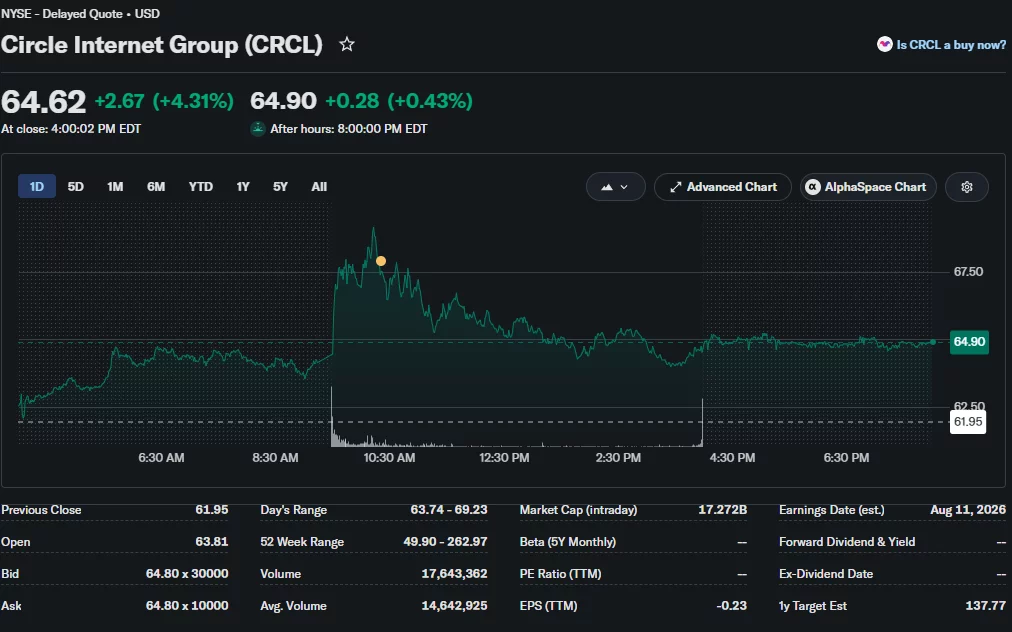
The recovery coincided with gains across crypto-related stocks as Bitcoin climbed back toward the $62,000 level.
The comments from Samsung and other South Korean firms leave Open Standard facing fresh questions over the composition of its announced founding consortium, even as the project continues promoting a governance model built around participation from major corporate partners.
Disclosure: This article does not represent investment advice. The content and materials featured on this page are for educational purposes only.
BM Blockchain is promoting cloud mining as a simpler alternative to traditional Bitcoin mining by removing hardware and maintenance requirements.
Summary
- BM Blockchain expands access to Bitcoin mining with a cloud-based platform and a $108 new-user registration bonus.
- BM Blockchain introduces cloud mining services that simplify Bitcoin mining without requiring hardware or technical expertise.
- The platform offers cloud mining plans and a $108 sign-up bonus to make Bitcoin mining more accessible to newcomers.
Bitcoin mining has long been viewed as a technical and capital-intensive activity. For many individuals, the biggest barriers are clear: specialized mining machines, high electricity costs, cooling requirements, noisy equipment, and ongoing maintenance. These challenges can make traditional mining difficult for everyday users who simply want exposure to Bitcoin mining rewards.
Cloud mining offers a different route. Instead of purchasing and operating physical mining rigs, users can access computing power through an online platform. BM blockchain is presenting this model as a simpler way for users to participate in digital asset mining without managing hardware themselves.
What Is Cloud Mining?
Cloud mining allows users to rent or purchase access to mining power hosted in professional facilities. The equipment is managed by the service provider, while users can monitor mining activity and potential rewards through a website or mobile interface.
This model removes several common obstacles. Users do not need to buy mining machines, handle electricity bills, repair equipment, or set up complicated mining software. Instead, they can choose a suitable mining plan and track performance online.
How BM Blockchain Cloud Mining Works
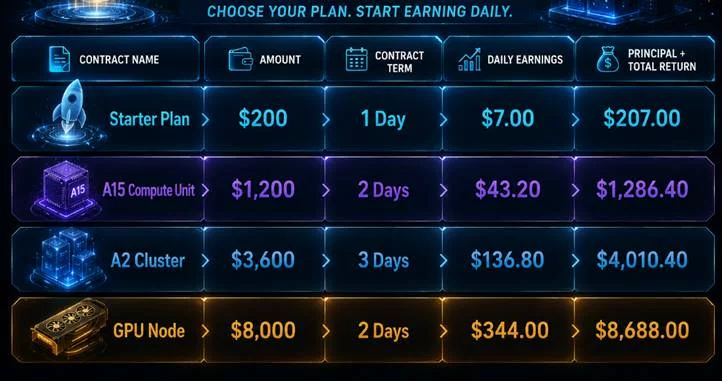
BM blockchain provides cloud mining services designed for users who want a more accessible way to join Bitcoin mining. According to the platform’s model, users can create an account, select a hashrate package, and receive mining rewards based on the computing power connected to their chosen plan.
The platform focuses on simplifying the process for both new and experienced digital asset users. After registration, users can view available mining options, deposit supported cryptocurrencies, and manage their mining activity from one dashboard.
New User Registration Bonus
BM blockchain currently offers a $108 registration bonus for new users. This welcome reward is designed to help beginners explore the platform and understand how cloud mining works before committing to larger mining plans.
Getting started with BM Blockchain
Step 1: Create an account
Users can register through the platform’s website or mobile interface and claim the new-user bonus.
Step 2: Add digital assets
The platform may support major cryptocurrencies such as BTC, ETH, USDT, LTC, DOGE, SOL, BNB, and other digital assets.
Step 3: Choose a hashrate plan
After funding an account, users can select a mining plan based on their budget, expected duration, and risk preference.
Step 4: Track mining performance
Users can monitor mining activity, daily output, and account records through the platform dashboard.
Frequently Asked Questions
How Bitcoin Mining Works
Bitcoin mining is the process through which transactions are verified and added to the Bitcoin network. Miners use computing power to solve complex mathematical problems, and successful participants may receive Bitcoin rewards.
In traditional mining, users usually need ASIC machines, suitable locations, stable electricity, cooling systems, and technical knowledge. These requirements can make mining expensive and difficult to manage, especially for beginners.
Is cloud mining the same as buying Bitcoin?
No. Buying Bitcoin means holding BTC directly. Cloud mining means accessing computing power that may generate mining rewards over time.
Do users need technical knowledge?
Not usually. Cloud mining platforms are designed to simplify setup, allowing users to select plans and track results through an online account.
Are mining rewards guaranteed?
BM Blockchain is a cryptocurrency investment firm founded in 2020 and headquartered in the UK. Regulated by the UK Financial Conduct Authority (FCA), the company focuses on areas such as ASIC mining and blockchain technology. BM Blockchain uses EV SSL encryption to protect user data, ensuring its confidentiality and security, and provides investors with legally protected cryptocurrency asset appreciation services.
Why do people choose cloud mining?
Many users choose cloud mining because it avoids the need to buy hardware, manage electricity, or maintain mining equipment.
Conclusion
Cloud mining is changing how individuals access Bitcoin mining. By removing the need for physical machines and technical setup, platforms such as BM blockchain aim to make mining participation more convenient for everyday users.
With a $108 registration bonus, BM blockchain gives new users a way to explore cloud mining with a lower starting barrier. However, as with all cryptocurrency-related services, users should conduct their own research, understand the risks, and avoid investing more than they can afford to lose.
Disclosure: This content is provided by a third party. Neither crypto.news nor the author of this article endorses any product mentioned on this page. Users should conduct their own research before taking any action related to the company.
Key Takeaways
- SK Hynix delivered historic Q1 2026 results with revenue reaching 52.57 trillion won and profits surging more than five times year-over-year
- As Nvidia’s leading HBM3E supplier, the company holds a strategic position in the AI accelerator ecosystem
- Expanding AI inference workloads are boosting demand across server DDR5 memory and enterprise SSD products
- The memory chipmaker has eclipsed Samsung to become South Korea’s largest public company, achieving a $1 trillion valuation
- Key concerns include intensifying rivalry from Samsung and Micron, aggressive capital spending requirements, and elevated valuation multiples
SK Hynix has delivered a financial performance that represents a watershed moment for the company. The chipmaker’s Q1 2026 results showed revenue of 52.5763 trillion won, accompanied by operating profit of 37.6103 trillion won and net profit of 40.3459 trillion won. Year-over-year profit growth exceeded 500%.
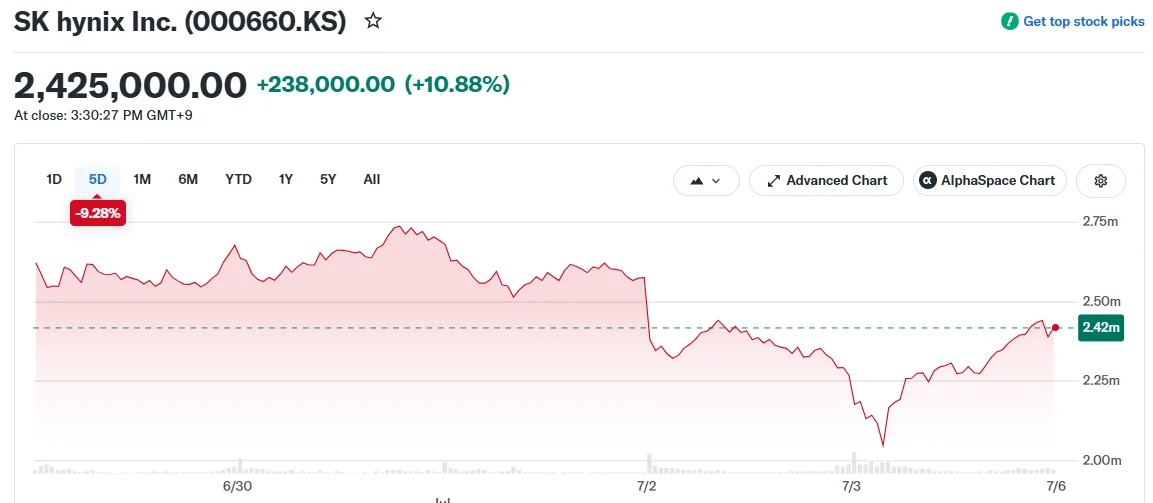
The catalyst behind this remarkable turnaround is clear: high-bandwidth memory technology. HBM has become the critical memory component powering Nvidia’s artificial intelligence processors, and SK Hynix has established itself as the category leader. This singular product line has fundamentally transformed the company’s business model.
The relationship with Nvidia centers on SK Hynix’s 12-layer HBM3E technology, where the company has become an essential supplier. This strategic partnership has granted the Korean manufacturer both pricing leverage and a supply chain position that rivals are working aggressively to replicate.
The demand narrative, however, extends beyond HBM alone. According to SK Hynix, the expansion of AI inference computing is creating pull-through demand for server-grade DDR5 memory modules and enterprise solid-state drives. This diversification across multiple product categories typically signals a more sustainable business trajectory.
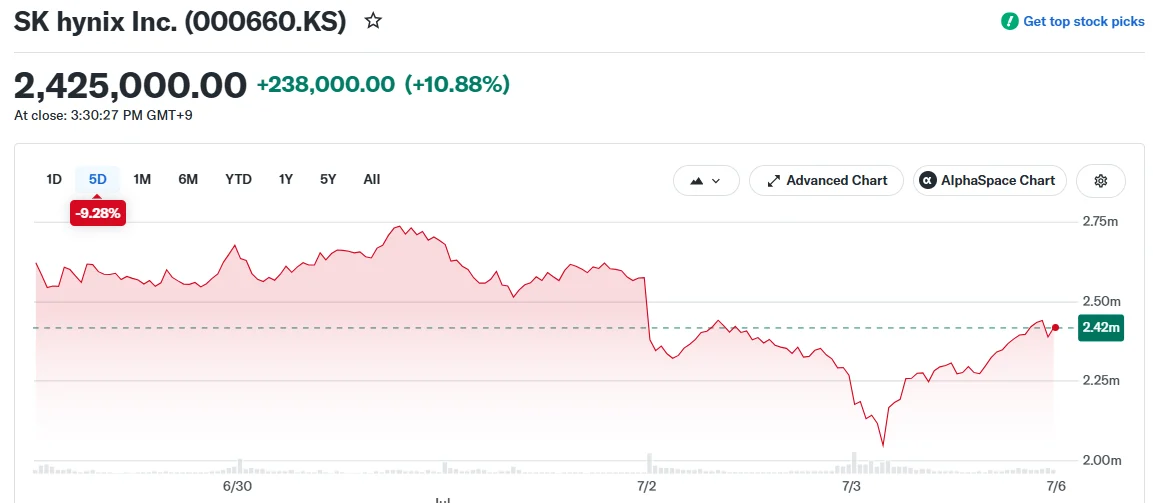
This expanded opportunity set has translated into significant market recognition. SK Hynix achieved a $1 trillion market capitalization milestone earlier this year and subsequently surpassed Samsung to claim the title of South Korea’s most valuable publicly traded enterprise. This represents a dramatic transformation for a company that was recording substantial losses during the previous memory market downturn.
The financial position has strengthened considerably as well. SK Hynix now operates with a net cash balance sheet, providing the flexibility to fund capacity expansions while maintaining financial resilience. In an industry characterized by heavy capital requirements, this foundation carries meaningful weight.
Competitive Dynamics and Capital Intensity
Samsung and Micron are mounting serious competitive challenges. Both manufacturers are investing heavily to capture HBM market share, and given the segment’s profitability, the competition for business will intensify. While SK Hynix currently holds the technological advantage, maintaining that edge requires continuous execution.
Capital expenditure represents another consideration. The company has outlined plans to double wafer fabrication capacity within five years. While this expansion reflects confidence in sustained demand, it also commits the organization to deploying substantial capital without triggering market oversupply conditions.
Valuation Demands a Clear-Eyed Assessment
The substantial appreciation in SK Hynix shares has likely already captured much of the near-term opportunity. Twelve months ago, the stock represented a cyclical recovery trade with depressed valuation metrics. That investment setup no longer exists.
The current trading multiple reflects expectations for a premium AI infrastructure provider. The market is pricing in assumptions of continued technological superiority, persistent HBM demand growth, and durable profitability. These are significantly higher expectations to meet.
SK Hynix arguably remains among the purest ways to gain exposure to AI memory demand globally. The customer base is blue-chip, the technology pipeline leads competitors, and the financial performance validates the investment thesis.
However, today’s buyers are paying for demonstrated success rather than undiscovered potential. Prospective returns will hinge on whether SK Hynix can extend its technological advantage rather than simply benefiting from the initial wave of AI memory adoption.
The most recent milestone underscores this shift: SK Hynix’s ascension past Samsung as South Korea’s most valuable listed company in June 2026 represents a turnaround trajectory that exceeded most analyst expectations in both magnitude and speed.
SpaceX stock has climbed after President Donald Trump said he believes Elon Musk may contribute SpaceX shares to the Trump Accounts program, adding to optimism ahead of the company’s expected Nasdaq-100 inclusion.
Summary
- SpaceX stock rose 3% after Donald Trump said he believes Elon Musk may support the Trump Accounts program with SpaceX shares.
- Investors continue to watch SpaceX’s expected Nasdaq-100 entry on July 7, which JPMorgan estimates could trigger about $4.3 billion in passive buying.
- ARK Invest expanded its SpaceX holdings, while Citadel Securities warned that higher interest rates could pressure high-growth stocks.
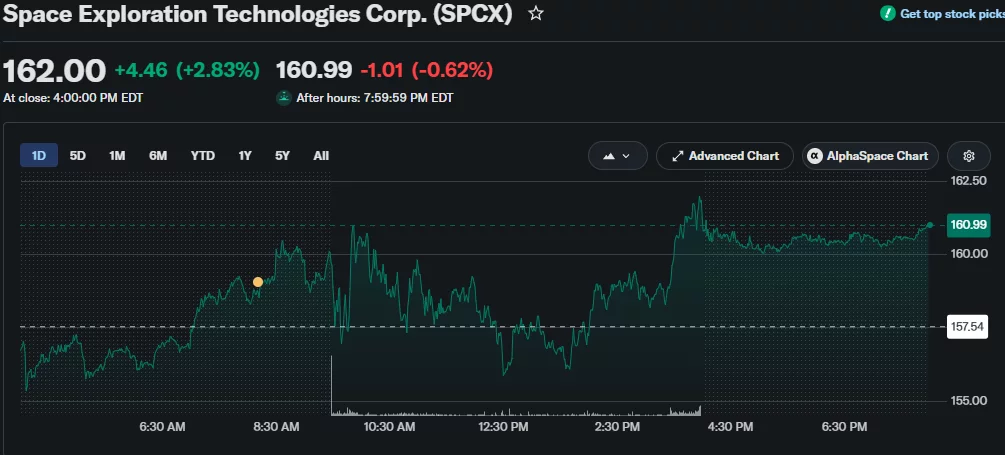
According to market data, SpaceX ticker SPCX rose about 3% to close at $162 on July 3 after recovering from an intraday low near $155, as buyers stepped in following early selling pressure. The advance came as risk assets also strengthened, with Bitcoin, Ethereum, Solana, and XRP trading higher during the session.
Trump comments add to bullish sentiment
Speaking in a Thursday interview with CNBC’s Joe Kernen, President Donald Trump said he believes Elon Musk could donate SpaceX stock to the Trump Accounts initiative, although he noted he had not recently spoken with the billionaire.
Trump described his relationship with Musk as positive and pointed to support from other business leaders, including Michael Dell and Micron, for the children’s investment program.
The Trump Accounts initiative creates investment accounts for children and permits contributions from outside parties. Under U.S. Treasury guidelines, publicly traded shares may be contributed to the accounts. However, neither Musk nor SpaceX has announced any commitment to donate stock, leaving Trump’s remarks as an expectation rather than a confirmed plan.
Trading activity showed buyers defending the $157.50 support area before pushing the stock above $160 later in the session. Afternoon buying accelerated as volume increased toward the close, lifting SPCX near intraday resistance around $162.50. After-hours trading eased to roughly $161, indicating some profit-taking after the rally while the stock continued to hold above the psychological $160 level.
Nasdaq-100 inclusion and institutional buying remain in focus
Investor attention has also stayed on SpaceX’s expected addition to the Nasdaq-100 on July 7. According to Reuters, JPMorgan estimates the index inclusion could trigger roughly $4.3 billion in passive buying as exchange-traded funds and index funds tracking the benchmark purchase SpaceX shares to match the index.
The company has already entered the Russell 1000 Index, while remaining ineligible for the S&P 500 because the index requires newly qualified companies to wait 12 months before consideration, according to Reuters.
Institutional buying has continued ahead of the index change. On June 22, Cathie Wood’s ARK Invest purchased 210,121 SpaceX shares across its ARKK, ARKQ, ARKW, and ARKX funds. Based on SpaceX’s closing price that day, the purchases were worth about $32.5 million.
ARK added another 45,728 shares across the same funds on June 26, a purchase valued at roughly $7 million, extending the firm’s exposure as the stock continued to attract institutional interest.
Despite the positive catalysts, Citadel Securities has warned that investors may be underestimating the Federal Reserve’s commitment to keeping inflation under control.
According to the firm’s report, interest rates remaining higher for longer could pressure high-growth companies and other risk-sensitive assets, while the AI-driven rally could face additional obstacles from softer demand, weaker investment returns, and increasing political and regulatory scrutiny.
Still, SpaceX ended the session on stronger footing as investors balanced Trump’s comments, expected index-driven demand, and continued institutional accumulation against the prospect of a more restrictive interest-rate environment.
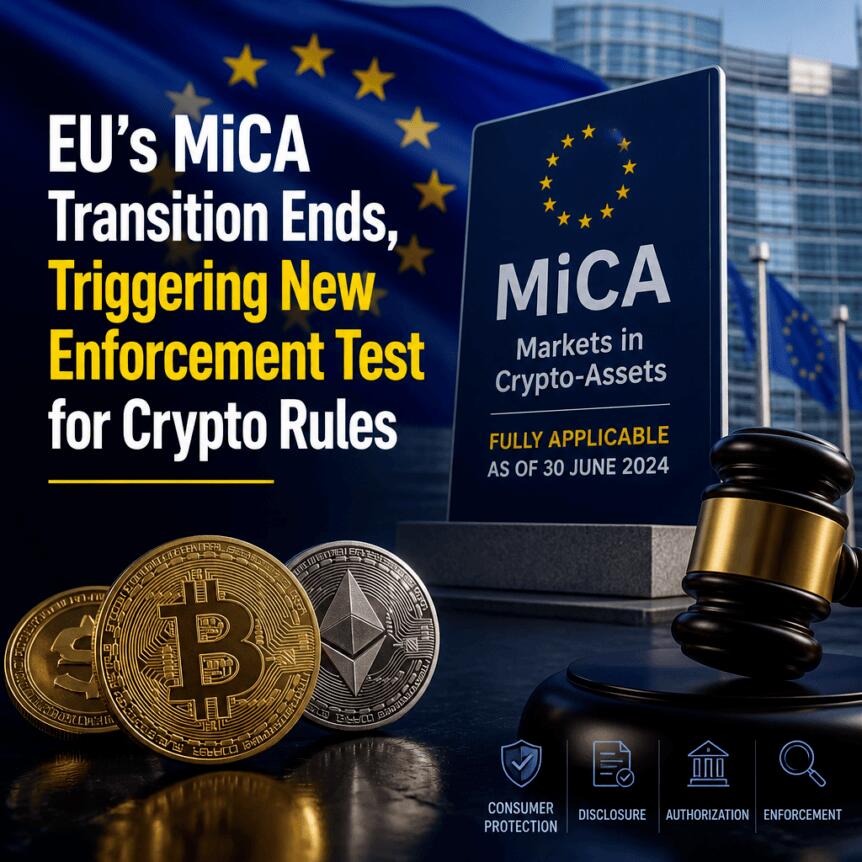
The EU’s MiCA regime has entered its first true enforcement stretch now that the regulation’s transition period has ended. Crypto-asset service providers that were operating under that grace window but have not obtained MiCA authorization can no longer legally serve clients in the European Union, pushing many firms toward either rapid compliance or an orderly wind-down.
Industry lawyers and executives told Cointelegraph that the initial challenge won’t just be understanding the rules—it will be how consistently national regulators apply the bloc’s “single rulebook.” Although MiCA harmonizes the framework, day-to-day supervision is still handled by national competent authorities, and their enforcement posture may differ at first.
Key takeaways
- The MiCA transition deadline has passed, meaning unauthorized crypto companies are now exposed to enforcement action and legal consequences across the EU.
- Compliance costs can be substantial—often hundreds of thousands of euros—but operating without authorization carries higher regulatory and financial risk.
- National regulators (NCAs) conduct authorization and day-to-day supervision, while ESMA coordinates and helps drive supervisory consistency.
- Early enforcement may not look identical in every member state due to differences in resources and priorities, creating potential for regulatory divergence.
- Penalties for MiCA violations can be severe, including multimillion-euro fines and turnover-based calculations proposed by EU bodies.
From transition to enforcement: what changes on July 1
MiCA’s transition period was designed to give the industry time to adapt to a new licensing and compliance framework. With that window closed, the practical effect is immediate: crypto firms without MiCA authorization should stop serving EU clients, and regulators are expected to treat continued activity as non-compliant.
Cointelegraph reported that executives and lawyers view this as MiCA’s first major enforcement test—an inflection point where regulators begin applying the EU crypto rulebook not just on paper, but through formal supervision and penalties.
What MiCA compliance costs can look like—and why firms may still pay
While MiCA compliance can be expensive, experts argue it is often less costly than the alternative. Legal and compliance implementation can range from several hundred thousand euros to multi-million-euro budgets depending on a firm’s size and the services it provides.
According to Nicola Massella, partner at Legal & Resilience, many cryptocurrency companies face MiCA implementation costs estimated around €350,000 to €600,000. Brickken CEO Edwin Mata told Cointelegraph that costs can rise to €2 million depending on a company’s business model and readiness.
Penalty exposure can also start at a high floor. Eckehard Stolz, managing director of Amina EU, said MiCA penalties begin at €5 million or 5% of annual turnover for certain violations. Separately, Massella said the European Banking Authority (EBA) proposed, on June 26, increasing penalties under certain regulatory regimes—at levels that could reach up to 12.5% of annual turnover for some stablecoin-related breaches. The EBA’s consultation is linked in Cointelegraph’s reporting.
For investors and operators, the key takeaway is that MiCA is not only a licensing hurdle; it is also a regime where financial penalties are calibrated enough to make continued unauthorized activity a board-level risk rather than a “wait and see” option.
How MiCA is supervised: ESMA coordination, NCAs enforcement, EBA stablecoin oversight
MiCA establishes a single set of rules across the EU, but its enforcement relies on a distributed supervisory structure. National competent authorities (NCAs) authorize, supervise, and enforce rules for crypto-asset service providers at the local level.
At the EU level, ESMA coordinates supervision across member states and maintains a public register of authorized crypto-asset service providers. In addition, the EBA directly oversees significant stablecoin issuers.
In comments shared with Cointelegraph, Ivo Grlica, founder of GrlicaLaw and G LAB Advisors, said ESMA’s coordination role is especially important to avoid regulatory arbitrage between member states. He also noted that while NCAs are the first line of enforcement, the consequences of underlying harmful conduct can extend beyond supervision into national courts and even criminal-law systems.
Early enforcement is expected to be uneven—at least initially
Even with a harmonized rulebook, enforcement intensity may vary in the short term. Stolz told Cointelegraph that ESMA has made clear it expects NCAs to act against unauthorized providers from July 1, but how aggressively each regulator moves will depend on local resourcing and supervisory priorities.
Peter Bidewell, vice president of institutional product adoption at Parfin, warned that differences in supervisory approaches could create opportunities for regulatory arbitrage—undermining MiCA’s goal of consistent application across the EU.
Grlica, however, suggested that enforcement could become more systematic over time as regulators identify unauthorized providers and share information across member states. The longer-term implication is that companies considering delay may face a shrinking window: continued non-compliance could make later authorization harder as regulators develop clearer patterns and intelligence.
Cointelegraph also noted that multiple regulators have already issued public reminders that the transition period ended and that providers without authorization should wind down. Reported examples include notices from authorities in the Czech Republic, Bulgaria, Luxembourg, and Italy, with the Czech National Bank also outlining its sanction framework.
Examples of national sanction frameworks and enforcement posture
In the Czech Republic, Cointelegraph said the Czech National Bank stated that the Financial Market Digitization Act gives it authority to impose sanctions for MiCA-related violations. According to the reported details, sanctions can be levied for operating without authorization, unlawful token offerings, and failure to cooperate with supervisors.
The law, as described to Cointelegraph, allows fines up to 118.5 million Czech koruna (about $5.6 million), or 5% of annual turnover if higher, or twice the unlawful benefit obtained, whichever is greater. This matters for market participants because it illustrates how MiCA enforcement may be backed by specific domestic legal tools and maximum penalty thresholds.
Cointelegraph contacted France’s Autorité des marchés financiers (AMF), the Netherlands’ Authority for the Financial Markets (AFM), and Germany’s Federal Financial Supervisory Authority (BaFin) to ask about their planned enforcement approach after the transition deadline. None had responded by the time of publication.
Meanwhile, ESMA’s ongoing work to maintain and update its register of authorized providers has been highlighted in related coverage referenced by Cointelegraph. For firms trying to comply quickly, the register functions as a public signal of who is authorized—and a starting point for counterparties and platforms assessing MiCA status.
Over the coming weeks, companies and investors should watch two things closely: whether NCAs demonstrate consistent escalation against unauthorized providers, and how quickly public compliance information—especially ESMA register updates—filters into business decisions across exchanges, custodians, and other market intermediaries. The legal outcome of continued unauthorized activity may vary at first, but the direction is clear: MiCA’s licensing wall is no longer optional.
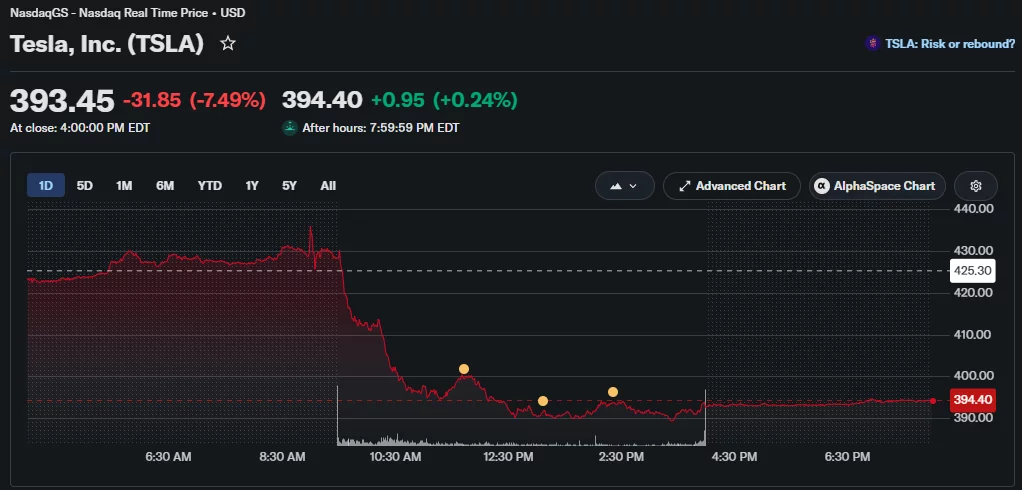
Cathie Wood’s ARK Invest has purchased nearly $38.1 million worth of Tesla shares after the electric vehicle maker suffered its sharpest one-day decline in weeks.
Summary
- Cathie Wood’s ARK Invest bought $38.1 million worth of Tesla shares after the stock fell 7.5% in one session.
- The latest purchase follows ARK’s recent $32.5 million investment in SpaceX, increasing exposure to Elon Musk-led companies.
- ARK also added $2.2 million of Bullish shares as Wood continues backing crypto-related investments.
According to ARK Invest’s latest daily trading disclosure, the investment firm bought 96,935 shares of Tesla across three of its exchange-traded funds on July 2, taking advantage of the stock’s 7.49% drop during the session. Based on Tesla’s closing price of $393.45, the purchases were valued at roughly $38.14 million.
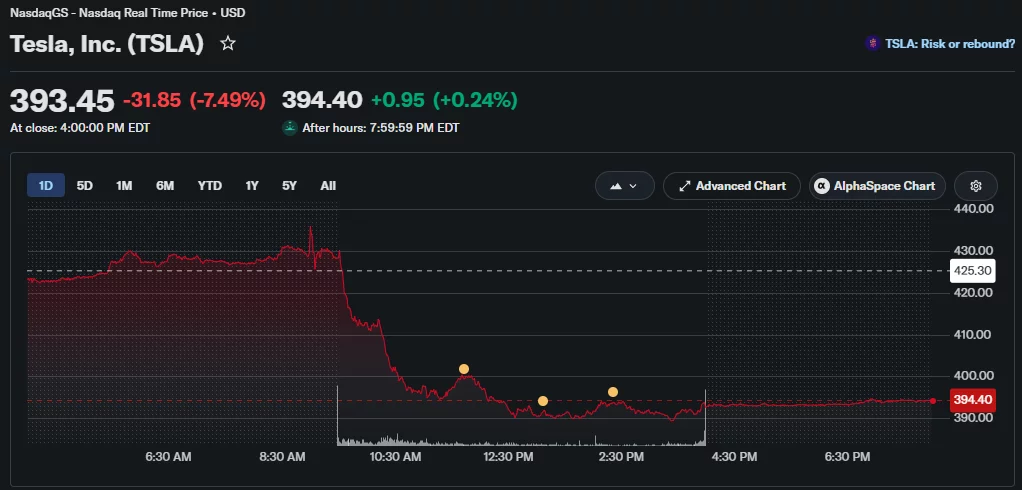
The largest allocation went to the ARK Innovation ETF (ARKK), which added 69,723 Tesla shares worth about $27.44 million. The ARK Next Generation Internet ETF (ARKW) acquired shares valued at around $6.91 million, while the ARK Space Exploration & Innovation ETF (ARKX) bought another $3.80 million. ARK’s trading report showed no Tesla purchases for the ARK Autonomous Technology & Robotics ETF (ARKQ).
ARK continues building exposure to Elon Musk companies
The latest Tesla purchase came a week after ARK Invest disclosed a $32.5 million investment in privately held SpaceX, another company led by Elon Musk. ARK previously noted that the latest transaction had lifted SpaceX into the list of larger holdings across several of its funds, further increasing its exposure to Musk-led businesses.
Tesla shares ended Thursday at $393.45 after falling 7.49% during the session, making the latest purchase appear to be a buy-the-dip move based on ARK’s disclosed transactions. The filing did not state a reason for the trade.
Wood has recently tied her investment outlook to macroeconomic conditions rather than short-term market swings. Speaking last week, she argued that rising geopolitical and economic instability could drive new demand for Bitcoin and other digital assets as investors look for assets that can preserve wealth across borders.
According to Wood, artificial intelligence and cryptocurrencies serve different roles in portfolios rather than competing for the same capital. While AI continues attracting investment because of its growth prospects, she described Bitcoin as an “insurance policy” that becomes more valuable when confidence in traditional financial systems weakens. She also said capital leaving politically and economically unstable countries could “light another fire” under Bitcoin and the digital asset market.
Bullish joins ARK’s latest buying activity
Alongside Tesla, ARK also expanded its position in crypto-focused stock Bullish (NASDAQ: BLSH), according to the same trading report. The firm purchased 77,251 Bullish shares through ARKK and another 9,732 shares through ARKW, bringing the day’s total acquisition to 86,983 shares.
Bullish closed 1.35% higher at $25.57, putting the value of the latest purchase at roughly $2.22 million.
A day earlier, Strategy co-founder Michael Saylor highlighted strong derivatives activity surrounding his own company. As crypto.news reported, Saylor shared data showing Strategy’s open interest-to-market capitalization ratio stood at nearly 72%, a level he compared with other large technology companies, including Tesla, to argue that Strategy commands stronger participation in the derivatives market.
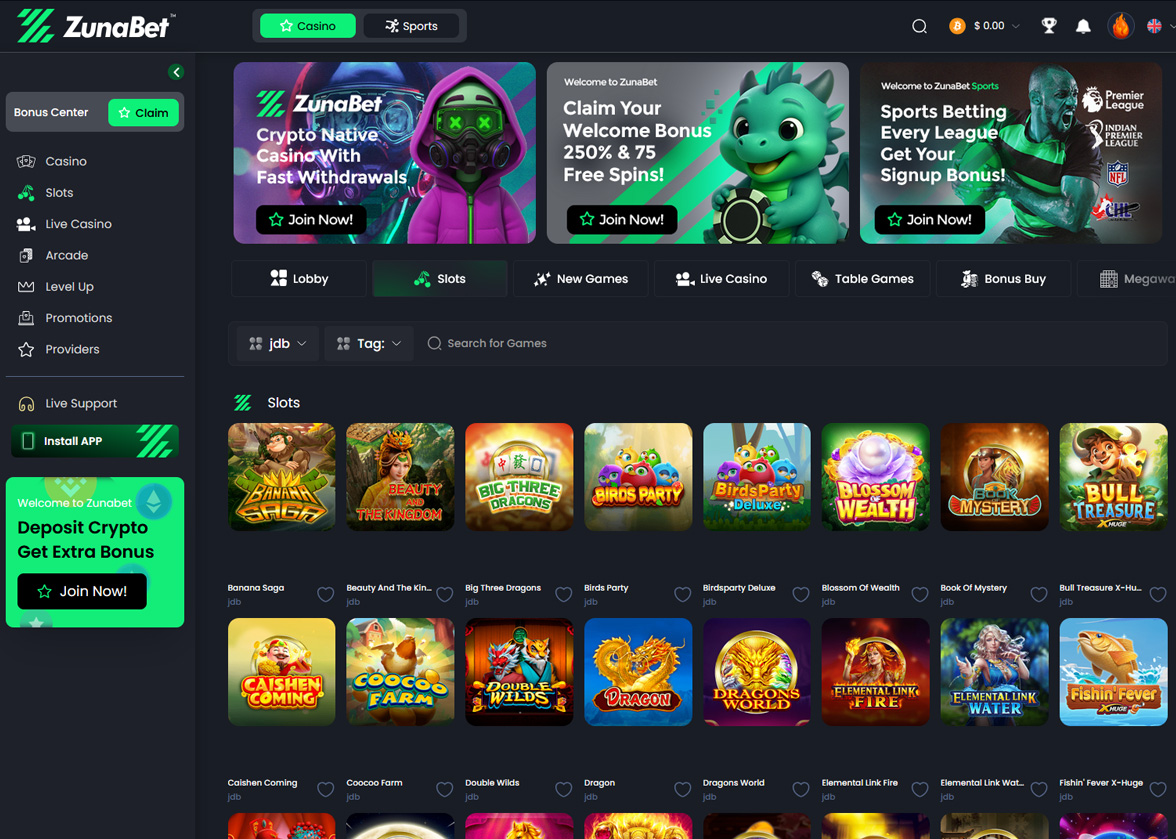
Stake.com and Bet365 represent two sides of online betting that rarely overlap. Stake.com has built a strong following in the crypto space, while Bet365 sits at the top of the long-established fiat-based market. Each operates with a different audience, a different banking approach, and a different regulatory profile. Around both of them, though, a new wave of crypto-first operators is starting to make a real mark. ZunaBet — live since 2026 — is one of the names raising its profile in that emerging group.
What follows looks at how Stake.com and Bet365 hold up today, and where ZunaBet’s setup is starting to attract notice.
Two Brands Defining Different Sides
Stake.com launched in 2017 and quickly became one of the most familiar names in crypto gambling. Built around crypto from day one, the platform supports a wide range of currencies and pairs its casino with a full sportsbook. Sponsorships across UFC and football have brought it mainstream visibility, though it doesn’t operate inside the regulated US market.
Bet365 has been running since 2000, growing from a UK base into one of the largest privately owned betting companies in the world. Sportsbook, casino, poker, and bingo all sit under one account. Banking runs through cards, bank transfers, and e-wallets, with active licensing in every region the operator serves.
Both brands lead in their own areas. Stake.com is at the front of the crypto side; Bet365 leads on the fiat side. Both also carry their own constraints. Bet365 is tied to fiat payments and region-by-region rules. Stake.com is restricted in certain markets and now faces growing competition from newer crypto-first operators.
How ZunaBet Joins the Picture
ZunaBet launched in 2026 under Strathvale Group Ltd with an Anjouan gaming license. The clearest separator from the older brands is the design starting point. Crypto sits at the foundation of ZunaBet rather than being added later, and the platform is positioning itself as a fresh take on the crypto-first model with appeal across player types.
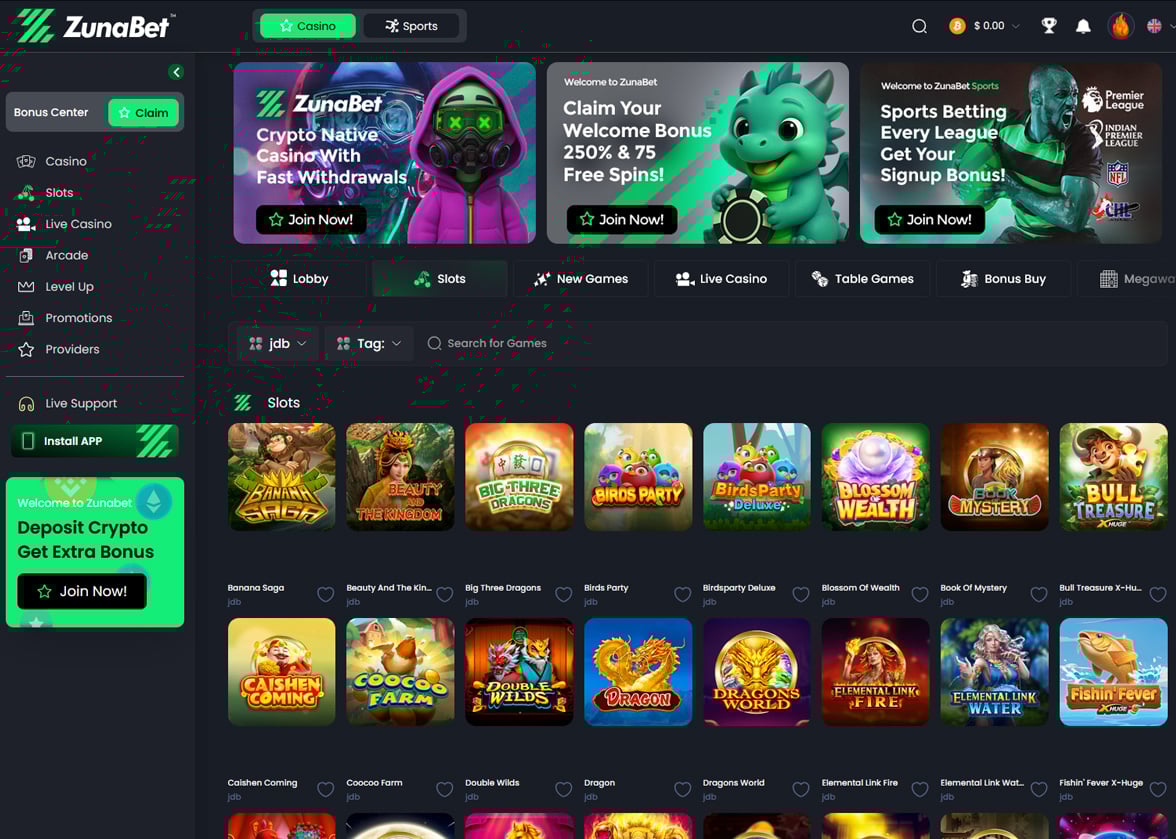
The casino library covers more than 11,000 titles from over 60 providers, including Pragmatic Play, Hacksaw Gaming, Yggdrasil, BGaming, and Evolution. That places it among the larger crypto-focused libraries on the market today, and well beyond what Bet365 stocks in most of its licensed regions. Slots, table games, and live dealer streams all run from one account.
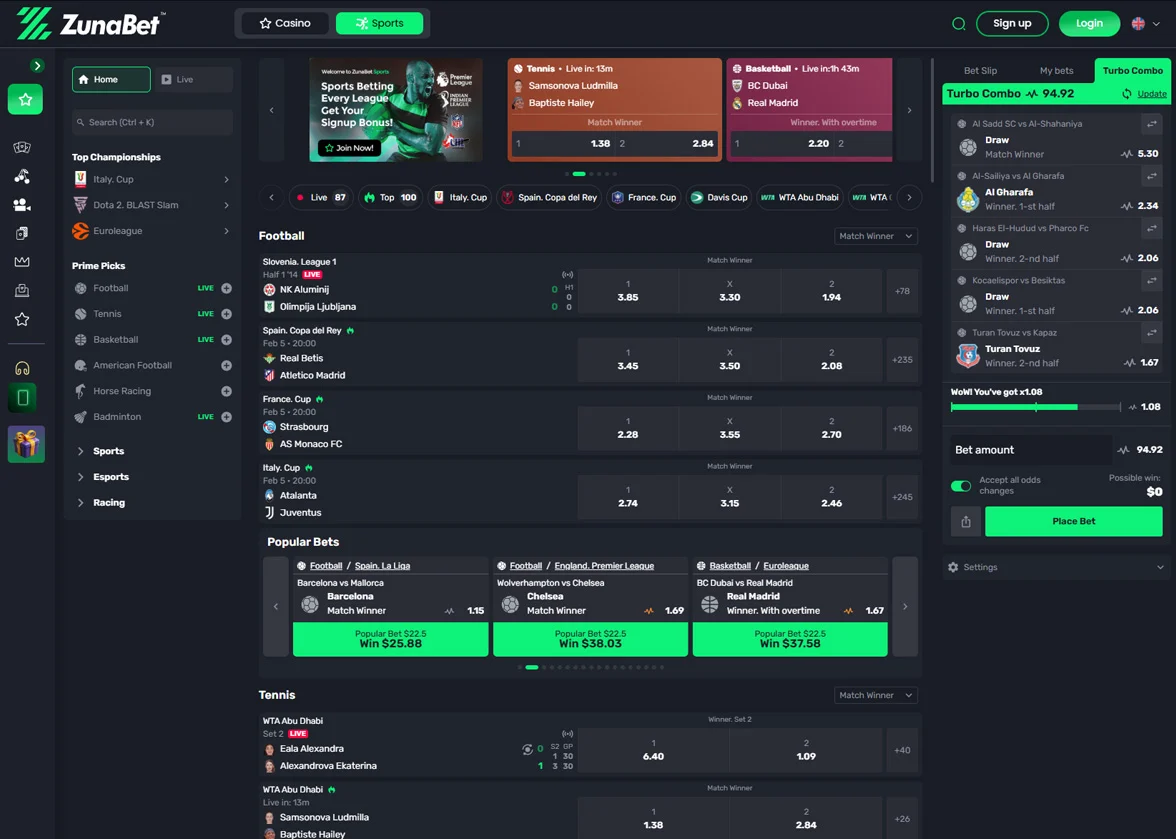
The sportsbook completes the platform. Football, basketball, tennis, NHL, and other major sports cover the standard ground, while CS2, Dota 2, League of Legends, and Valorant sit on the esports side. Virtual sports and combat sports fill out the menu. ZunaBet’s hybrid structure lines up with both Stake.com and Bet365.
The Banking Divide
The biggest gap between these brands shows up in payments. Bet365 operates mainly on fiat, which brings processing windows, possible holds, and withdrawal speeds shaped by which method the player picked. That works for players who value the familiarity of regulated, banking-based platforms — but speed isn’t its strong suit.
Stake.com and ZunaBet both run on crypto. ZunaBet supports more than 20 currencies, with Bitcoin, Ethereum, USDT on multiple chains, Solana, Dogecoin, Cardano, and XRP all in the lineup. No platform fees apply, and withdrawals settle quickly. For players already comfortable with crypto, the workflow removes the friction tied to bank-driven payments.
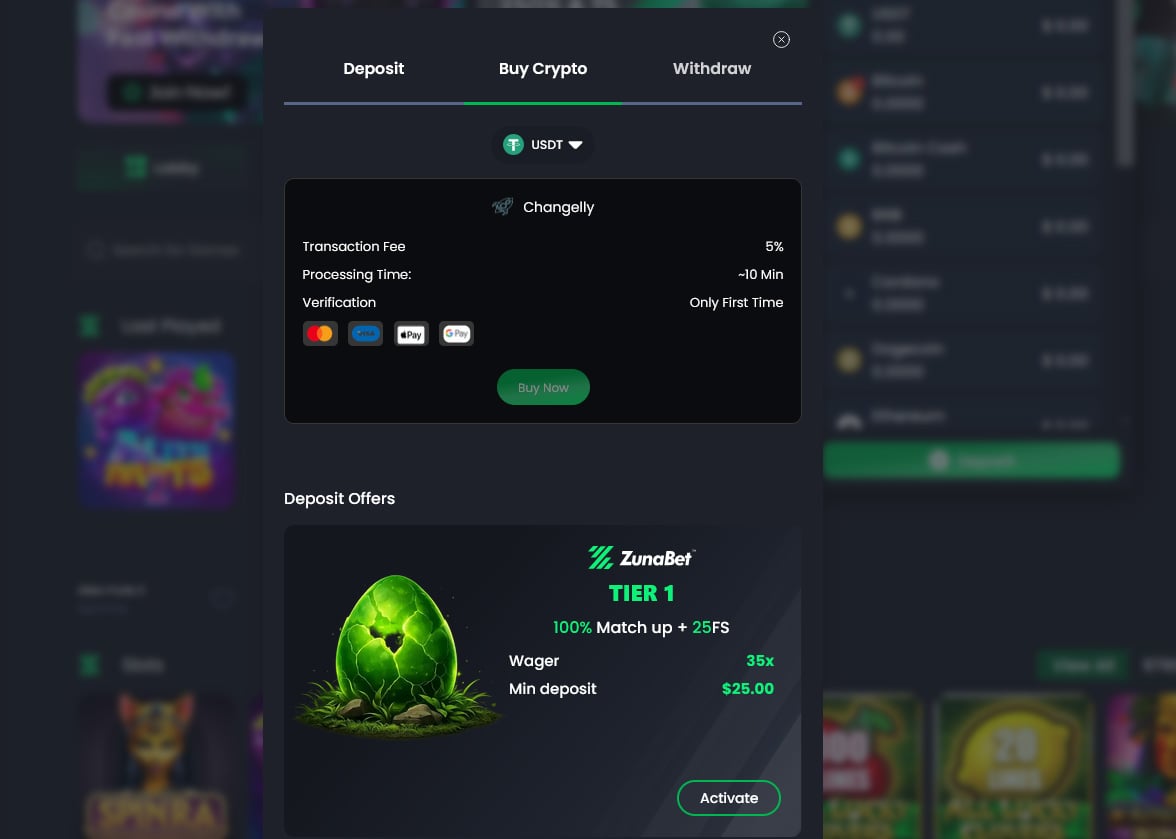
Geographic reach is the other factor. Crypto-first operators aren’t bound by the region-by-region licensing model fiat brands operate within. ZunaBet’s full platform is accessible in regions Bet365 can’t legally serve. For players already moving in digital, crypto-friendly contexts, that aligns with what they expect from a modern platform.
Welcome Offers Side by Side
Bet365 builds welcome offers around region-specific deposit matches or new-player bonuses, with wagering rules that often need close reading. Stake.com runs promotions too, but its welcome offer is lighter than what some crypto-first competitors push — more of the weight sits in reload bonuses and rakeback for active play.
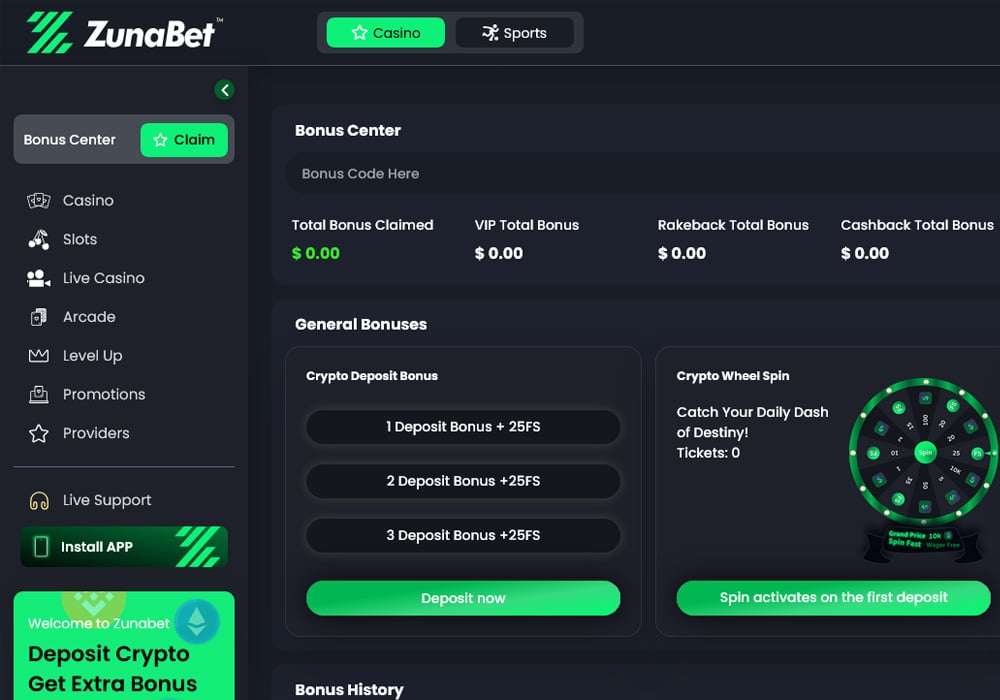
ZunaBet’s welcome package totals up to $5,000 plus 75 free spins across three deposits. The first matches 100% up to $2,000 plus 25 spins. The second adds 50% up to $1,500 plus 25 spins. The third closes with 100% up to $1,500 plus 25 more spins. Marketed as a 250% bonus across three deposits, the structure gives new players more depth and time to explore the platform than a single-deposit format does.
Loyalty Programs Compared
Bet365 keeps loyalty quiet, with personalised offers reaching player accounts based on activity rather than a structured tier system. Stake.com runs a strong VIP program built around rakeback, reloads, and milestone bonuses — a setup that’s helped it retain long-term players. Both work, but Bet365 follows the conventional loyalty card layout while Stake.com leans heavily on rakeback as the main hook.
ZunaBet takes a different approach by combining rakeback with gamified progression. The program runs on a dragon evolution theme, with a mascot named Zuno guiding players through six tiers. Squire opens at 1% rakeback, then Warden at 2%, Champion at 4%, Divine at 5%, Knight at 10%, and Ultimate at the top with 20% rakeback.
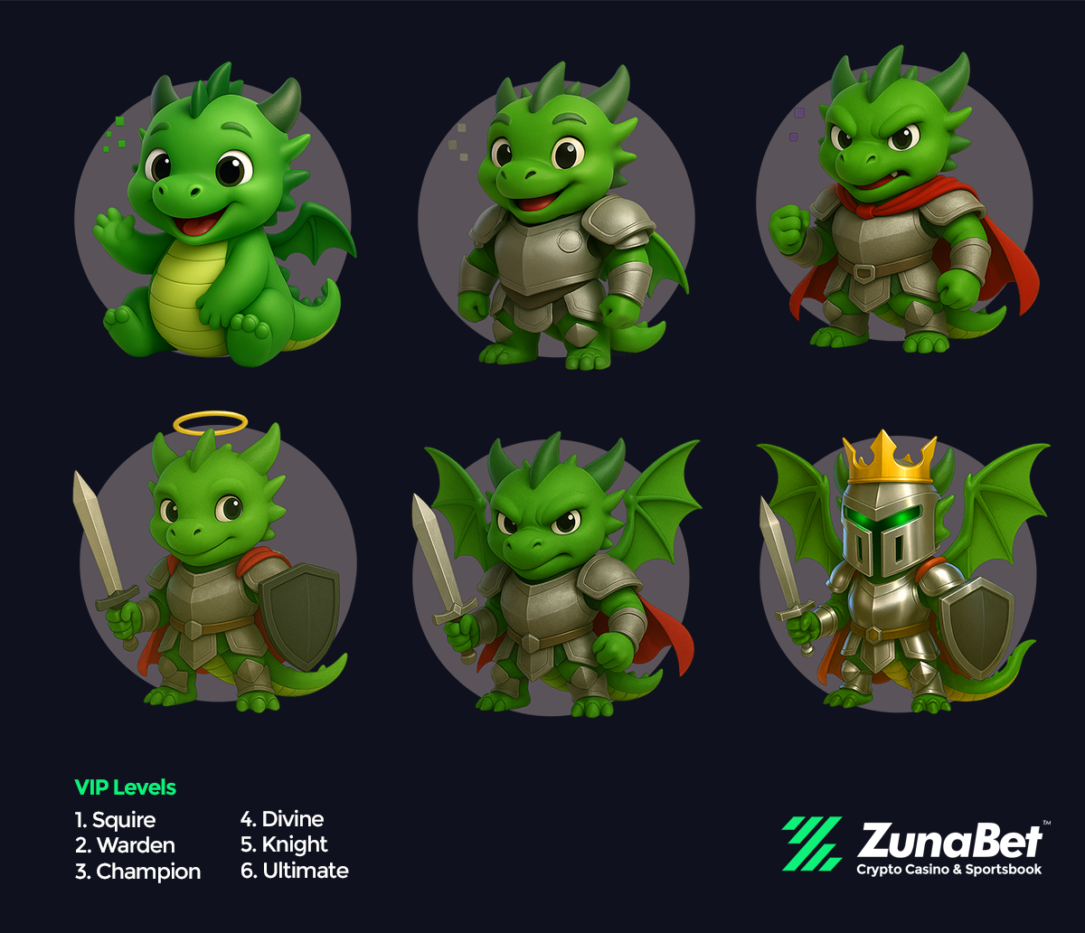
Tier movement unlocks more than rakeback. Free spins scale with tier — reaching 1,000 spins at the highest level — alongside VIP club access and double wheel spins through the climb. The format reads more like in-game progression than chasing flat rakeback or accumulating points. For players drawn to that kind of mechanic, the system shifts how regular play feels relative to either a standard VIP program or a plain rakeback model.
Why ZunaBet’s Profile Keeps Growing
Bet365 remains a solid choice for players who value the security of a long-running, well-regulated brand. Stake.com continues to hold its place as a leading name in crypto casinos. Both have earned their positions. But the expectations players bring to these platforms keep climbing. Quick payments, deep libraries, and engaging loyalty mechanics are turning into starting features rather than premium upgrades.
ZunaBet was designed around those starting features from day one. The crypto-first core delivers fast settlement and minimal fees. The library reaches beyond what most established brands carry. The sportsbook covers traditional sports and esports together. The dragon loyalty program brings direction and progression to regular play.
For players who want speed, variety, and a more current feel, ZunaBet ranks among the more compelling platforms in the market right now. The brand is still in its early growth phase, but the direction is clear. A new generation of players treats crypto support, gamified rewards, and global access as defaults rather than features to ask for.
Stake.com and Bet365 built the online betting world that exists today. ZunaBet is one of the platforms working on what comes next — and the players paying attention now are catching that change early.
India’s central bank wants lawmakers to wall off the banking sector from crypto. The Reserve Bank of India (RBI) told a parliamentary panel that digital assets should not serve as payment instruments.
The Parliamentary Standing Committee on Finance heard the testimony for its study on virtual digital assets. Lawmakers plan to table the report during the monsoon session.
Central Bank Pitches Crypto Containment in India
Committee members said the RBI argued for a containment strategy, not a conventional rulebook. The central bank believes formal regulation could legitimize speculative assets. It warned that clear rules might give retail investors a false perception of safety.
Officials repeated long-standing concerns about illicit finance. They cited risks tied to drug trafficking and terror funding. Similar central bank warnings have appeared in other emerging markets this year.
The stance revives a fight the RBI lost in 2020, when the Supreme Court struck down its banking ban. This time, the central bank wants Parliament to write the separation into law.
No Payments and No Direct Bank Exposure
The RBI advised lawmakers to prohibit crypto for payments and settlements. The bank wants tight limits on direct banking-sector exposure to digital assets. The advice mirrors the caution found in several global regulatory frameworks, although most jurisdictions now prefer licensing over isolation. Washington set its own boundary in June, when senators passed a US CBDC ban lasting through 2030.
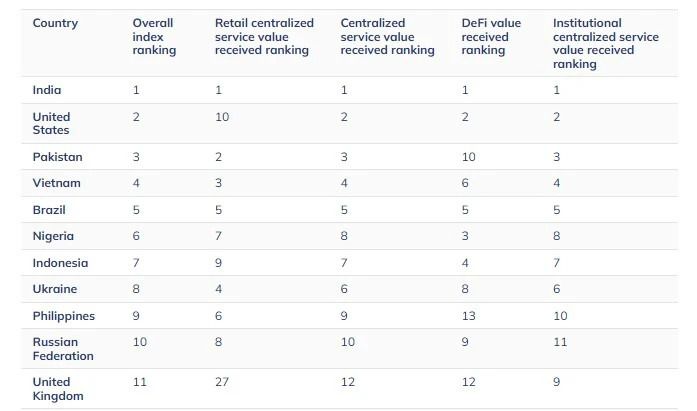
Committee members pushed back during the hearing. They questioned how India can ignore capital flight while Indonesia, Hong Kong, and the UAE regulate the sector. India ranked first in the 2025 Global Crypto Adoption Index, ahead of the US and Pakistan.

However, the officials offered a blunt reply.
“Not having a policy is also a policy,” RBI officials said, according to a committee member quoted by Business Standard.
Meanwhile, the Securities and Exchange Board of India (SEBI) earlier signaled it could regulate tokens classified as securities. The RBI declined to answer that question and promised a written response.
Tokenized Bonds Stay on a Separate Track
The proposal draws a line between cryptocurrencies and tokenized government securities. Growing tokenized bond markets would keep room to develop on a regulated infrastructure. The restriction targets speculation, not blockchain technology itself.
Still, India’s crypto investors face a 30% tax and a 1% levy on every trade. Industry voices keep lobbying for a softer line, including a domestic Bitcoin mining push as an alternative to gold imports.
The panel meets the Department of Economic Affairs on July 15 before it finalizes recommendations. The coming weeks should reveal whether Parliament backs isolation or an EU-style framework such as MiCA.
The post Why India’s Central Bank Wants Crypto Out of the Banking System? appeared first on BeInCrypto.

Eco-hysteria is the real threat to humankind

João Fonseca stunned by qualifier Roman Safiullin
Sandisk Corporation (SNDK) Stock Falls 14% Despite Major NAND Manufacturing Breakthrough


-

 Fashion7 days ago
Weekend Open Thread: Staud – Corporette.com
-

 Crypto World4 days ago
Strategy authorizes up to $1.25B in Bitcoin sales under new capital plan
-

 Tech6 days ago
Claude Code turned every engineer into three. Now companies need more product thinkers
-

 News Videos5 days ago
MAJOR BITCOIN & MARKET UPDATE!!!! (MUST WATCH ASAP!!!)
-

 Politics4 hours ago
The House | “Reframing the debate from a binary discussion of winners and losers”: Yuan Yang reviews ‘We Are Not Machines’
-

 Tech4 days ago
Anonymous researcher drops 0-day ‘exploitarium’ repo
-

 Crypto World6 days ago
Coinbase, Circle Deepen Crypto Stock Losses Despite Resilient S&P 500
-

 Business4 days ago
Australia treasurer says alleged access of prime minister’s bank data ’incredibly concerning’
-

 Crypto World6 days ago
Kraken's xStocks Opens Bending Spoons IPO Registration to EEA Retail
-

 Sports7 days ago
FIH Pro League: India defeat Pakistan 7-1, register biggest win of campaign | Other Sports News
-

 Tech6 days ago
Bluekit phishing kit adopts browser-in-the-middle for login theft
-

 Tech6 days ago
Russian hackers now target Signal backup recovery keys
-

 Crypto World7 days ago
RTX holders must register wallets before token distribution begins
-
 Business4 days ago
The AI boom won’t burst all at once. It will pop in ‘rolling bubbles’: Macquarie
-

 Sports2 days ago
Broncos roster: OL Ben Powers (No. 74) entering final year of contract
-

 Tech6 days ago
Silicon Valley paid to kill AI regulation, now it wants the rules back
-

 NewsBeat3 days ago
Presenter Caroline Flack’s brother Paul Flack dies aged 55
-

 Crypto World1 day ago
Binance stock trading tops $1B in first month after launch
-
 NewsBeat1 day ago
New exhibition reflects five decades of movement between island of Ireland and GB
-

 Tech6 days ago
OpenAI mulls delaying IPO over valuation concerns
You must be logged in to post a comment Login