Connect with us
DAPA Banner
DAPA Coin
DAPA
COIN PAYMENT ASSET
PRIVACY · BLOCKDAG · HOMOMORPHIC ENCRYPTION · RUST
ElGamal Encrypted MINE DAPA
🚫 GENESIS SOLD OUT
DAPAPAY COMING

NewsBeat

Patients with serious fatty liver disease could be prescribed Wegovy under new guidance

Published

on

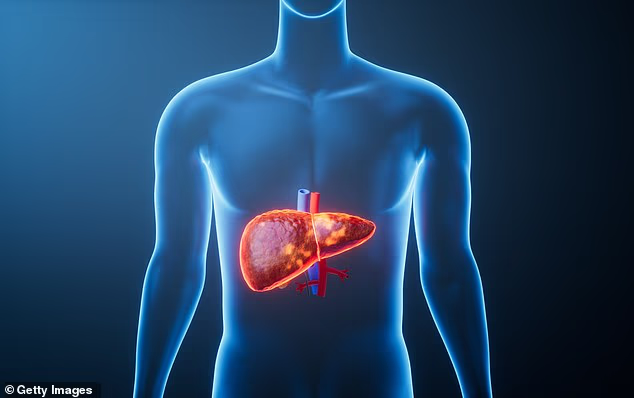
Fatty liver disease is now one of the fastest¿growing health problems globally

Weight-loss drug semaglutide could be prescribed to people with a serious form of fatty liver disease under new guidance announced today.

The medication – sold for weight loss under the brand name Wegovy – has been approved by the MHRA to treat metabolic-associated steatohepatitis, or MASH.

MASH develops when excess fat builds up in the liver, triggering inflammation and scarring. It is more common in people who are obese, have type 2 diabetes or have high levels of fat in the blood.

Under the new guidance, semaglutide can be prescribed to adults with MASH who have moderate to advanced liver fibrosis – scarring of the liver caused by the condition.

Advertisement

Julian Beach, Executive Director of Healthcare Quality and Access at the MHRA, said: ‘The available evidence indicates that semaglutide is a safe and effective treatment option for patients with MASH.

‘As with all GLP-1 receptor agonists, this is a prescription-only medication and should only be taken in consultation with a doctor.’

However, patients with MASH cannot currently get semaglutide on the NHS specifically to treat the condition.

NICE is still assessing whether the drug is clinically effective and cost-effective enough to be offered routinely as a treatment for MASH. Until that decision is made, it will not be available on the NHS for this use.

Advertisement

Fatty liver disease is now one of the fastest-growing health problems globally

The approval is also conditional, meaning regulators want more evidence before granting full marketing authorisation. Further results are expected from an ongoing study in adults with MASH and moderate to advanced liver scarring.

Semaglutide is a GLP-1 receptor agonist and is prescribed alongside diet and exercise. It works by mimicking a hormone released after eating, helping people feel fuller for longer, reducing cravings and supporting weight loss.

Advertisement

Semaglutide is already authorised for weight management in adults and adolescents, and for reducing the risk of cardiovascular events in adults.

Treatment usually starts at a low dose of 0.25mg once a week, before gradually increasing to 0.5mg, 1mg and 1.7mg, with patients spending around four weeks on each dose. The usual maintenance dose is 2.4mg once weekly.

For patients with obesity, defined as a BMI over 30, the dose may be increased to 7.2mg once weekly after at least four weeks on the 2.4mg dose.

The MHRA said it will review new information on semaglutide at least once a year, and update the product information if needed.

Advertisement

As with all medicines, the regulator will continue to monitor the drug’s safety and effectiveness. The most common side effects are gastrointestinal problems, including nausea, diarrhoea, constipation and vomiting.

Anyone who thinks they may be experiencing side effects is advised to speak to a doctor, pharmacist or nurse, and report them through the MHRA Yellow Card scheme.

Liver disease is one of the fastest-growing causes of death in the UK, and often develops silently, leaving many unaware until serious and sometimes irreversible damage has already occurred.

 Incidents of the disease have soared in recent decades, with deaths increasing more than fourfold since the 1970s – even as outcomes for many other major illnesses have improved.

Advertisement

While it is often linked to alcohol, experts warn growing numbers of cases are being driven by obesity, diabetes and poor diet – meaning millions of non-drinkers could also be at risk.

Advertisement

One of the biggest challenges is that symptoms can take years to appear. By the time the condition is diagnosed, patients may already have significant scarring of the liver, known as cirrhosis, or even liver failure or cancer.

The announcement comes shortly after a tablet form of the medication became available in the UK. 

Today Superdrug announced it would be selling the pill for a little as £79 per month.

Around 2.5million adults in the UK are thought to be using fat-busting jabs such as Wegovy and Mounjaro, but the arrival of the new pill has opened the door for millions more.

Advertisement

On average, the lowest dose of the once-weekly injection – 0.25mg – costs between £80 and £140 per month in the UK.

Trial results of the new pill, which is taken daily, found that patients lost around 17 per cent of their body weight after 64 weeks on the highest dose, 25mg. 

This means it is slightly less effective than the jabs, which tend to trigger up to a 20.7 per cent reduction.

Superdrug is currently stocking the pill at doses of 1.5mg and 4mg, with higher doses at 9mg and 25mg coming soon. 

Advertisement

What is fatty liver disease?

MASLD, NAFLD and fatty liver disease are different names for the same condition.

Metabolic dysfunction-associated steatotic liver disease (MASLD) is a long-lasting liver condition caused by having too much fat in the liver. 

It is closely linked with being overweight as well as conditions such as type 2 diabetes and heart and circulatory disease.

Metabolic dysfunction-associated steatohepatitis (MASH, previously called NASH) is a more serious stage of MASLD. 

Advertisement

In a small number of people it can lead to liver cancer or liver failure.

The main treatment is eating a well-balanced diet, being physically active and (if needed) losing weight. 

Research shows these can reduce liver fat and in some cases reverse MASLD.

Source: British Liver Trust 

Advertisement

<!- – ad: https://mads.dailymail.co.uk/v8/de/health/none/article/other/mpu_factbox.html?id=mpu_factbox_1 – ->


Advertisement


Source link

Advertisement
Continue Reading
Click to comment

You must be logged in to post a comment Login

Leave a Reply

NewsBeat

Trump considering pardon for P. Diddy and other high-profile figures to mark America’s 250th: report

Published

on

Trump considering pardon for P. Diddy and other high-profile figures to mark America’s 250th: report

President Donald Trump is reportedly considering a pardon for disgraced music mogul Sean “P. Diddy” Combs, who is currently in federal prison in New Jersey for prostitution-related crimes.

The president is also reportedly considering some kind of reprieve for Prakazrel “Pras” Michel of the hip-hop group The Fugees, who is imprisoned on foreign lobbying-related violations, sources told CBS News.

The alleged clemency considerations may be part of a larger reported effort by the White House to issue “250 pardons for 250 years” as part of Independence Day celebrations.

The Independent has sought comment from Combs.

Advertisement

The White House referred The Independent to comments Trump made this January, in which the president claimed Combs wrote him a letter seeking a pardon. The Republican told The New York Times he is not considering granting the alleged request.

President Trump is reportedly mulling some form of clemency for Sean ‘Diddy’ Combs, though the Republican said as recently as January he was not considering an alleged pardon request from the disgraced music mogul
President Trump is reportedly mulling some form of clemency for Sean ‘Diddy’ Combs, though the Republican said as recently as January he was not considering an alleged pardon request from the disgraced music mogul (AFP/Getty)

The denial joins comments from last year, when the White House batted down speculation a Diddy pardon was imminent.

The president and Combs, both New York City-based businessmen with second careers in reality TV, previously knew each other socially, though Trump has said they lost touch after he entered politics.

“I haven’t seen him. I haven’t spoken to him in years,” Trump said last May. “He used to really like me a lot, but I think when I ran for politics, that relationship busted up, from what I read.”

Combs is currently appealing his conviction and sentence.

Advertisement

President Trump has issued a historic number of pardons, using the power of the presidency to free political and business allies, celebrities and white-collar criminals accused of fraud, bribery and corruption.

The president’s liberal use of the pardon power has reportedly inspired million-dollar lobbying campaigns targeting him and close associates
The president’s liberal use of the pardon power has reportedly inspired million-dollar lobbying campaigns targeting him and close associates (Reuters)

He has granted reprieves to figures including rapper NBA YoungBoy, crypto business parter Changpeng Zhao, former president of Honduras and convicted drug trafficker Juan Orlando Hernández, and more than 1,000 of his supporters charged or convicted of crimes related to the January 6, 2021, insurrection at the Capitol.

The president’s liberal use of the pardon power has reportedly inspired million-dollar lobbying campaigns targeting the administration and allies of the president.

Former crypto billionaire Sam Bankman-Fried is among the high-profile figures seeking a pardon from Trump, according to Justice Department records.

Source link

Advertisement
Continue Reading

NewsBeat

Serena Williams’ Wimbledon doubles return with sister Venus is confirmed – but 44-year-old faces battle with knee injury to be fit

Published

on

Venus and Serena Williams are scheduled to play in the doubles at Wimbledon - though Serena faces a late battle with a knee injury to be fit

Advertisement

Serena Williams and Venus Williams are on the schedule for Saturday’s play at Wimbledon – but time will tell if they take to the court as Serena contends with a knee injury.

Meanwhile, Venus is facing a fine from the All England Club after refusing to conduct her media duties after losing in the mixed doubles on Friday.

Advertisement

Serena, the younger sister at 44, returned to Wimbledon for the first time in four years and lost to Maya Joint in the first round of the singles. She did not appear for her post-match press conference and the reason – eventually – was revealed to be a knee injury suffered during the match.

That put into doubt her planned participation in the women’s doubles, an event she and Venus have won six times together. 

The first round of the women’s doubles was due to be concluded on Friday but the Williams’ were left off the order of play, with tournament director Jamie Baker admitting Wimbledon would give Serena ‘as much time as possible’ to recover.

On Saturday’s schedule, the Williams sisters’ match against Solana Sierra and Camila Osorio is down as ‘to be arranged’, likely indicating that Wimbledon will slot them in on Centre Court or No1 Court – whichever finishes first.

Advertisement

Venus and Serena Williams are scheduled to play in the doubles at Wimbledon – though Serena faces a late battle with a knee injury to be fit

That suggests at least that Serena and her team think there is a chance of her being fit, but it remains possible that she pulls out during the day before the match begins.

One woman who could have thrown some light on the matter is 46-year-old Venus, and she was due to face the media after her defeat in the mixed doubles with German partner Kevin Krawietz. 

Advertisement

She declined to attend a press conference, however, and so faces a fine from Wimbledon of up to £37,000.

The list of first-week fines are due out over the weekend.

Advertisement

Source link

Advertisement
Continue Reading

NewsBeat

Adele gives rare interview about son Angelo, 13, and reveals they’ve bonded over their joint ‘obsession’ with Formula 1 as she admits she ‘doesn’t sing very often now and her job is ridiculous’

Published

on

Adele has given a very rare interview about son Angelo on Friday as she revealed they have bonded over their joint 'obsession' with Formula 1

Adele has given a very rare interview about son Angelo on Friday as she revealed they have bonded over their joint ‘obsession’ with Formula 1. 

The megastar, 38, made a surprise appearance at the McLaren Racing headquarters where she chatted to chief executive Zac Brown and F1 drivers Lando Norris and Oscar Piastri.

Adele couldn’t contain her excitement as she gushed that she has created a close ‘bond’ with her 13-year-old son, who she shares with ex-husband Simon Konecki, after he took an interest in karting, which is how F1 drivers progress into the sport. 

She said: ‘So my son is really into karting and things like that. I don’t know. He just sort of asked about it a couple of years ago and I was like, “All right.”

Advertisement

‘I don’t know many teenagers who have a passion so I’m really trying to encourage it. He’s obsessed but I’m also obsessed. 

Adele has given a very rare interview about son Angelo on Friday as she revealed they have bonded over their joint ‘obsession’ with Formula 1

The singer, 38, made a surprise appearance at the McLaren Racing headquarters and gushed that she has created a close 'bond' with her 13-year-old son after he took an interest in karting

The singer, 38, made a surprise appearance at the McLaren Racing headquarters and gushed that she has created a close ‘bond’ with her 13-year-old son after he took an interest in karting

Advertisement

She continued: ‘But just like when your kid has an interest, you have to lean into it. More importantly, I think you have to be interested in it.

‘And I don’t think I ever expected to bond with my soon to be 14 year-old son about something so passionately where we like argue about drivers, you know. 

‘But it’s fun to have that interaction with a teenage boy in 2026, I wasn’t expecting it’. 

The 16-time Grammy Award winner later sat down for a candid chat with 2025 F1 World Champion Lando, who asked, ‘Do you actually still enjoy singing?’

Advertisement

Adele admitted: ‘I don’t sing very often anymore’, but as she pulled on the driving headset she couldn’t help but belt out a few lines of Britney Spears’ Baby One More Time. 

The Hello singer went on to discuss how ‘ridiculous’ her job is as she opened up about her ‘struggles with fame’. 

‘Oh my god. I think it is ridiculous that my job is being a singer. No, never believed [it would happen]’, she said. ‘I wanted to be an A&R. I never thought that I was the talent. 

‘I knew I was really good with music, which is why I thought I’d be so good at discovering new talent.

Advertisement

‘It is incredibly unlikely that a girl from Tottenham is going to go on to have any kind of career in England, let alone sort of universally and stuff like that. So, it was never an option.

‘It’s very well known that I struggle with the fame side of it. If I remind myself like it’s a joke that my job is being a singer, I just always try and lean into that.’

She said: 'So my son is really into karting. I don't know many teenagers who have a passion so I'm really trying to encourage it. He's obsessed but I'm also obsessed'

She said: ‘So my son is really into karting. I don’t know many teenagers who have a passion so I’m really trying to encourage it. He’s obsessed but I’m also obsessed’

She continued: 'But just like when your kid has an interest, you have to lean into it. More importantly, I think you have to be interested in it. And I don't think I ever expected the bond'

She continued: ‘But just like when your kid has an interest, you have to lean into it. More importantly, I think you have to be interested in it. And I don’t think I ever expected the bond’

Advertisement
The 16-time Grammy Award winner later sat down for a candid chat with Lando Norris who asked, 'Do you actually still enjoy singing?' Adele admitted: 'I don't sing very often anymore'

The 16-time Grammy Award winner later sat down for a candid chat with Lando Norris who asked, ‘Do you actually still enjoy singing?’ Adele admitted: ‘I don’t sing very often anymore’

It comes after Adele’s partner Rich Paul gave a rare insight into his five-year relationship with the singer.

The sports agent, 45, was first linked to the music superstar, 38, back in 2021 after they attended an NBA game together, with Adele then confirming their engagement three years later.

But while the couple are usually quite private about their romance, a new interview has seen Rich open up about his high profile relationship, spilling the beans on how they met and what turned their ‘cordial’ bond into something more.

Advertisement

During a recent appearance on Craig Melvin’s Glass Half Full podcast, Rich revealed that the pair had met ‘through a friend’, adding that he ‘had known her for some time’ before they began dating.

Expanding further, he explained: ‘You know, just when you’re in these circles, man, you’re in these circles. But I never tried to get fresh with people that’s in comfortable circles because they always have to deal with that, so that was never my thing.

‘It was really something that happened very organically, really.’

When pushed further to reveal how they got together, Rich told how they had bumped into each other on numerous occasions, which led to them becoming closer.

Advertisement

He told Craig: ‘We’re all in the same vicinity, we’re all in the same circles, and, you know, we’re hanging and whatnot.

‘We just used to always see each other, laugh and joke. It was just cordial, really, just cordial.’

The entrepreneur, then joked that things between them remained cordial ‘until it became not so cordial’, before he eventually became a ‘person of interest’ for the iconic British singer.

Join the discussion

Advertisement

What’s a hobby or sport that’s helped you connect with your family?

The Hello singer went on to discuss how 'ridiculous' her job is as she opened up about her 'struggles with fame'

The Hello singer went on to discuss how ‘ridiculous’ her job is as she opened up about her ‘struggles with fame’

The Easy On Me songstress shares 13-year-old son Angelo with ex husband Simon Konecki; pictured 2013

The Easy On Me songstress shares 13-year-old son Angelo with ex husband Simon Konecki; pictured 2013 

It comes after Adele's partner Rich Paul gave a rare insight into his five-year relationship with the singer; pictured together in 2023

It comes after Adele’s partner Rich Paul gave a rare insight into his five-year relationship with the singer; pictured together in 2023

Advertisement

During the chat, Rich also admitted that he wasn’t an active listener of Adele’s music, although he ‘can’t help but to hear the monster hits’.

He said of his partner, who has sold over 120 million records worldwide: ‘Obviously, you know, I’m pretty on the pulse of a lot of different things, and so, you know, some of the songs, the big songs, but I didn’t know all of the joints that I know now.’

It comes after Adele opened up about wanting to have more children with Rich.

During one of her shows, she made a candid confession, telling her fans in the audience: ‘I really want to be a mum again soon, so every time I see a name I like, I write it down in my phone.’

Advertisement

She shared two particular names she liked, Parker and Spencer, before adding, ‘I can’t say Parker because Rich likes that name.’

She later added: ‘You know what else, I like Ray for [a girl] spelt like a boy’s name.’

Source link

Advertisement
Continue Reading

NewsBeat

Manchester Airport train fault causes delays today

Published

on

Manchester Airport train fault causes delays today

Trains to and from Manchester Airport have been unable to run normally following a fault with the signalling system.

Services may be cancelled, delayed by up to 30 minutes or revised until 6 pm.

Network Rail staff are on site working to rectify the fault, while Northern has warned passengers to check before they travel.

Advertisement

The disruption is affecting services between Manchester Airport and Barrow in Furness and Windermere, Liverpool Lime Street and Blackpool North, as well as trains between Manchester Piccadilly and Crewe.

Northern said: “Train services are unable to run to and from Manchester Airport in both directions.”

Advertisement

Passengers are being advised to travel on the next available Northern service where possible and to check their full journey before setting off, as other operators may also be affected.

Northern added: “Train ticket restrictions have been lifted in the affected areas, including Advance and Peak restrictions, during this disruption.

“Restrictions will be reinstated once the disruption ends.”

Customers delayed during their journey may also be entitled to compensation.

Advertisement

Passengers have been advised to keep their ticket and make a note of their journey to support any claim.

Source link

Advertisement
Continue Reading

NewsBeat

Trump’s state fair suffers latest meltdown as extreme heat suddenly shuts it down

Published

on

Inside Washington

President Donald Trump’s Great American State Fair has closed down for Friday afternoon amid the blistering heat in Washington, D.C.

The fair will be postponed until 5 p.m. ET “for what we believe are heat related reasons,” Fox News congressional correspondent Bill Melugin wrote on X.

“Everyone is being asked to go to the exits,” Melugin said. “It is miserably hot and humid today, genuinely feels like a sauna when you step outside.”

It was nearly 100 degrees in D.C. shortly after 1 p.m. ET.

Advertisement

This is a developing story…

Source link

Continue Reading

NewsBeat

Tributes paid to ‘incredible’ mother-of-four, 44, after she was killed in plane crash near airfield

Published

on

Nicola Wright, 44, was flying solo when her plane crashed near Dunkeswell Airfield in Devon

Advertisement

The family of a ‘deeply devoted’ mother-of-four who died following a light aircraft crash have paid tribute to her ‘adventurous spirit’.

Nicola Wright, 44, was flying solo when her plane crashed near Dunkeswell Airfield in Devon.

Advertisement

Emergency services attended just after 10am last Friday, but she was pronounced dead at the scene.

Nicola, from Dorset, has now been described as an ‘incredible mother’ and ‘amazing woman’.

Devon and Cornwall Police is currently working with the Air Accident Investigation Branch to investigate the fatal crash.

In a statement, her devastated family said: ‘Nicola was an incredible mother to her four children, a wife, daughter, sister and much-loved friend to many.

Advertisement

‘She was the heart of the family and will be missed beyond words.

‘She was a positive, brave and determined person who lived life with an adventurous spirit.

Nicola Wright, 44, was flying solo when her plane crashed near Dunkeswell Airfield in Devon

Advertisement
Her family have paid tribute to her 'adventurous spirit' following the crash last Friday

Her family have paid tribute to her ‘adventurous spirit’ following the crash last Friday

Nicola Wright was also an accomplished mountaineer and had climbed Mount Kilimanjaro in recent months

Nicola Wright was also an accomplished mountaineer and had climbed Mount Kilimanjaro in recent months

Emergency services arrived at the scene following the crash near Dunkeswell Airfield in Devon

Emergency services arrived at the scene following the crash near Dunkeswell Airfield in Devon 

‘She was an accomplished aerobatic pilot, skydiver, diver and mountaineer who climbed Mount Kilimanjaro earlier this year.

Advertisement

‘She approached everything she did with passion and courage.

‘Nicola was HR director at Medisave, a global medical and pharmaceutical distributor, and was a vital part of building Medisave alongside the founders, Graham Wright, her husband and Melissa Denton her longtime friend.

‘Nicola was an amazing, deeply devoted and loving mother. Her four young children were everything to her, and she has shaped who they are in every way, they are devastated for the loss of their beautiful mother.

‘Nicola was, quite simply, an amazing woman.’

Advertisement

Dunkeswell Airfield is in the Blackdown Hills, about 14 miles northeast of Exeter, and was a US naval base during the Second World War.

At 839ft (255m) above sea level, the site is the highest licensed airfield in the country.

Devon and Cornwall Police said the family are devastated by Nicola’s loss and have asked for privacy as they grieve.

Dunkeswell Airfield has previously been at the centre of three fatalities within the past year.

Advertisement

Skydiver Charles McNeil, known as Chas, plummeted to the ground after his parachute failed to deploy for ‘some unknown reason’, an inquest heard in March.

The 49-year-old former soldier had been doing a wingsuit jump with a friend in February when he died using his own personal parachute equipment, according to Skydive South West.

His death followed that of two people last June when their parachutes failed to open during a tandem jump from 15,000 feet.

Inquests into the deaths of mum-of-four Belinda Taylor, 48, and instructor Adam Harrison, 30, were opened previously by Devon Coroner’s Court in Exeter.

Advertisement

British Skydiving, the police and local authority are all investigating the deaths and inquests have been adjourned to a later date.

Advertisement

Source link

Advertisement
Continue Reading

NewsBeat

Australia vs Egypt – World Cup last-32 LIVE: Latest score, team news and updates as Socceroos take on Mohamed Salah and Co in Dallas

Published

on

Australia vs Egypt - World Cup last-32 LIVE: Latest score, team news and updates as Socceroos take on Mohamed Salah and Co in Dallas

Advertisement

Follow Daily Mail Sport’s live blog for the latest score, team news and updates as Australia take on Egypt in a World Cup last-32 clash at the Dallas Stadium in Texas.


Advertisement

Advertisement

Source link

Advertisement
Continue Reading

NewsBeat

how air conditioning is creating a new climate inequality

Published

on

how air conditioning is creating a new climate inequality

For decades, people in the UK tended to view air conditioning as something that belonged elsewhere. It was associated with office buildings, hotels and hotter countries rather than their own homes. But as summers become warmer and heatwaves more frequent, that picture is beginning to change.

Colleagues and I analysed data from the English Housing Survey, a nationally representative sample of about 16,000 households. This shows that air conditioning remains relatively uncommon, with just 4.3% of households using it in summer. That’s far below countries such as the US (nearly 90%) and Australia (around 75%).

Yet beneath this modest national average lies a far more revealing picture. Air conditioning is not spreading evenly across society. Instead, England is beginning to develop a cooling divide, one in which access to protection from extreme heat increasingly depends on where people live, how much they earn and the type of home they occupy.

During in-depth interviews we conducted with air conditioning users in the UK, people rarely described it as a luxury. Instead, they spoke about trying to sleep through hot nights, remain productive while working the next day, or protect babies or elderly relatives from dangerously high temperatures.

Advertisement

Wealthier people are much more likely to have air conditioned homes.
Elena Gurova / Alamy

The geography of this emerging divide is immediately apparent. London and the east of England have by far the highest levels of residential air conditioning, followed by the East Midlands and the south-east. Northern regions remain much less likely to use cooling.

These patterns are hardly surprising. London experiences both warmer summers and a stronger urban heat island effect, where buildings and hard surfaces trap heat long after sunset. But these regional differences also show how the ability to adapt to a warming climate is likely to be distributed unevenly.

Economic inequalities are equally visible. Households in the highest income group are more than twice as likely to own air conditioning than those on the lowest incomes. Installing and running air conditioning is expensive, making it far more accessible to wealthier households.

Advertisement

As with the higher temperatures, those wealthier households who are more easily able to absorb the cost of air conditioning are also highly concentrated in London and the south-east.

Vulnerable groups at risk

Perhaps the most concerning finding is that several groups most vulnerable to heat currently have relatively low access to air conditioning.

Older people, lone-parent households and many lower-income families are among those least likely to use it, despite facing greater health risks during periods of extreme heat. Social and private renters also lag behind owner-occupiers, reflecting barriers such as upfront costs, landlord permissions and practical constraints on installation.

The picture is not entirely negative. Some vulnerable groups are adopting air conditioning at higher rates than the wider population. Households with babies, young children, disabled people and those living with long-term health conditions are all more likely to use air conditioning.

Advertisement

Given the well-established health risks that high temperatures pose for these groups, this is encouraging. It suggests that many households are taking proactive steps to protect their health.

However, this introduces another challenge. Since air conditioning uses lots of electricity, vulnerable families may find themselves facing a difficult choice between staying cool and keeping their energy bills affordable.

In the UK, fuel poverty has traditionally focused on heating homes during winter. But our research suggests a new form of summer fuel poverty may already be emerging.

Advertisement
Woman sits at table at home with fan in foreground

Home workers are more likely to have air con.
Jittawit Tachakanjanapong / Alamy

Another notable finding reflects how society itself has changed. Households where someone works from home at least two days each week were 42% more likely to have air conditioning.

Before the pandemic, many people spent the hottest part of the day in air-conditioned workplaces such as offices. Hybrid working has shifted that exposure into the home. Increasingly, homes must function not only as places to live, but also as workplaces during periods of extreme heat.

A national cooling plan

These trends have implications far beyond individual households. A rise in air conditioning in homes will increase electricity demand in summer, placing additional pressure on energy networks.

Unless that electricity comes from zero-carbon sources, it will also increase emissions, creating a feedback loop in which hotter summers drive greater demand for cooling. The solution today therefore cannot simply be more air conditioning for everyone.

Instead, the UK needs a national cooling plan – but that does not simply mean installing more air conditioning everywhere. It should be a plan to keep homes cool naturally, through solutions like external shading and shutters, as well as encouraging more trees in cities to provide shade and other cooling effects. Where air conditioning is essential for vulnerable households, they should receive targeted support.

Advertisement

Even at this early stage, a cooling divide is already taking shape. The question is whether we act now to ensure that protection from dangerous heat is available to everyone – especially those most vulnerable to heat – or wait until a cool home becomes a privilege.

Source link

Advertisement
Continue Reading

NewsBeat

The new technologies in the UK defence investment plan

Published

on

The new technologies in the UK defence investment plan

Seventy years ago, Britain confronted a dilemma. It wanted to remain a leading military power but no longer had the economic resources to sustain all the conventional capabilities it had inherited from the second world war.

The solution proposed in the 1957 Sandys defence white paper was technological. Guided missiles, Duncan Sandys argued, were transforming warfare so fundamentally that many traditional capabilities, including some crewed combat aircraft, would become obsolete.

In other words, by embracing this technological revolution, Britain could achieve defence on the cheap. Britain’s new Defence Investment Plan (DIP) reflects a similar strategic instinct. The technologies may have changed but the underlying dilemma has not.

Announcing the DIP in the House of Commons, Dan Jarvis, the defence secretary, said the UK would be making its “largest ever investment in drone warfare: £5 billion for strike, protector and surveillance drones across the Royal Navy, the Army and the Royal Air Force.”

Advertisement

Here are some of the key technologies discussed in the Dip.

Drone ships

At least a quarter of the £5 billion announced for drone warfare is going towards a “hybrid fleet,” a fundamental re-imagining of the Royal Navy. The UK’s sole ballistic missile defence capability – the Type 45 destroyers – will no longer be replaced by a like-for-like. Instead, a network of Crewed Combat Vessels (CCVs) will act as control hubs for specialised, uncrewed boats.

These would include Type 91 missile barges, Type 92 and Type 93 anti-submarine and underwater surveillance platforms, and Type 94 radar vessels. In principle, distributing the sense, decide and strike functions across the navy offers several advantages.

It could ease chronic personnel shortages by reducing crew requirements, extend radar and sonar coverage over a wider area, and make the fleet more resilient by dispersing combat power rather than concentrating it in a handful of expensive warships.

Advertisement
The MOD has experimented with using the RFA Lyme Bay as a mothership for autonomous craft.
UK MOD / Crown Copyright

Uncrewed vessels could also be rearmed or maintained independently and without the
design constraints of supporting sailors at sea. However, the challenges are significant.

The DIP envisages this concept becoming proven and operational before the Type 45 retires in the mid-2030s, despite the fact that resilient communications and electronic warfare protection for autonomous warships remain immature.

Nor is Ukraine’s use of naval drones a straightforward template. The Royal Navy’s principal tasks – particularly anti-submarine warfare in the High North and North Atlantic – are far more demanding than Ukraine’s use of maritime drones in the Black Sea.

While experiments such as using RFA Lyme Bay as a mothership for autonomous mine countermeasures (including drone minesweepers) are encouraging, retiring Britain’s only ballistic missile defence destroyers before the wider architecture has been proven would entail significant operational risk.

Advertisement

AI targeting network

The army’s Project Asgard illustrates the same technological philosophy in a different domain. Asgard aims to transform how – and how quickly – the army identifies and strikes targets, by linking sensors, armoured vehicles, drones and long-range weapons into a single, AI-enabled targeting network.

First trialled in 2025, Asgard is now receiving £370 million to develop an operational capability, reflecting the Army’s ambition to achieve a tenfold increase in combat power primarily through automation rather than expanded forces.

This idea has an important intellectual history. During the 1990s, the United States championed the concept of network-centric warfare: the proposition that superior information sharing would enable smaller, more agile forces to defeat numerically superior opponents. But Britain was soon concerned about the affordability and technological challenge of creating such highly connected forces, adopting in its place a lighter version: network-enabled capabilities.

The DIP suggests that the government now believes the technology is catching up with the theory. But old weaknesses remain. Networks only work if they survive. Communications can be jammed, satellites disrupted and software attacked, and Russia has the electronic warfare capabilities that could, without adequate safeguards, do all three.

Advertisement

‘Loyal wingmen’

It is also the case that what has worked at smaller levels now needs to be scaled across Nato. If it works, Project Asgard would provide Nato land forces with the ability to control long-range weapons of their own, reducing their reliance on air forces which will need to focus on supressing and destroying enemy air defences.

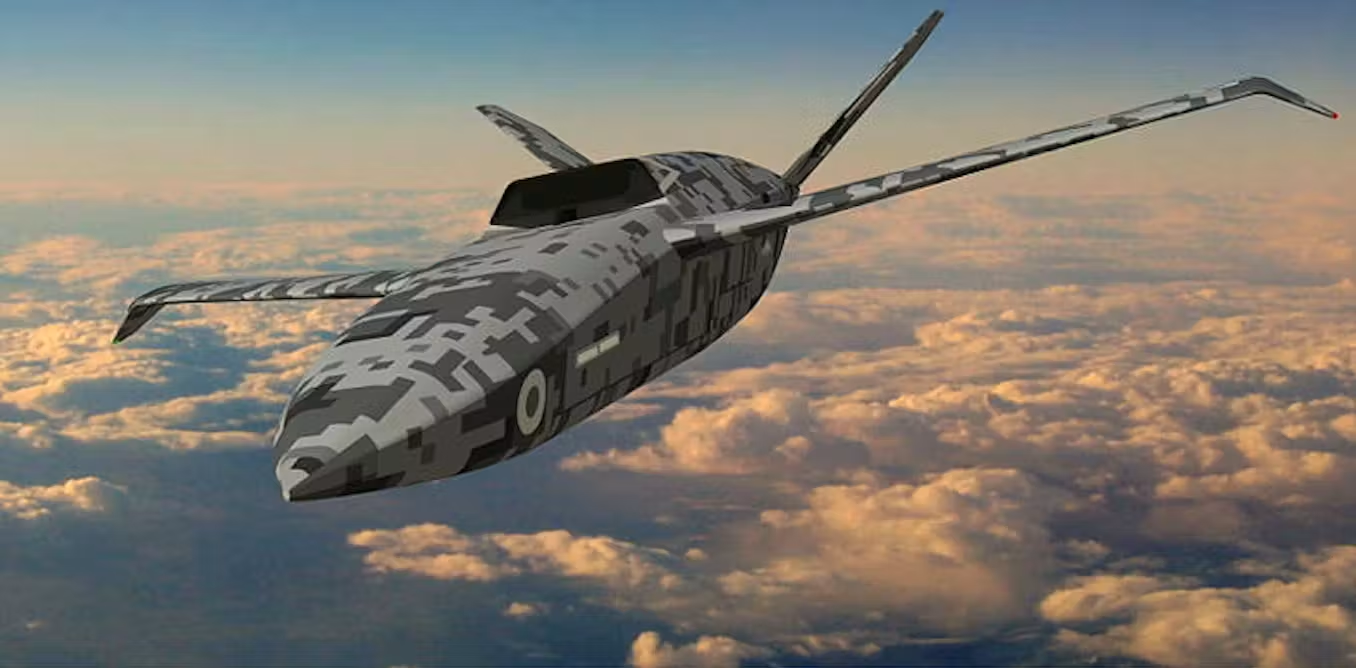
That task is motivating the DIP’s investment in Collaborative Combat Aircraft (CCAs) – uncrewed platforms that will fly alongside the RAF’s Typhoons and F-35s.

Boeing’s MQ-28 Ghost Bat is designed to act as a ‘loyal wingman’ to extend the reach of piloted aircraft.
US Air Force / Senior Airman Adrien Tran

These “loyal wingmen” drones would support crewed aircraft by acting as scouts, decoys, absorbing enemy fire or jamming enemy radars. They could be controlled by the pilot of the combat jet, or work autonomously.

Systems such as the MQ-28 Ghost Bat are at an early stage of development. To be militarily useful CCAs must combine long range, high speed, low observability, resilient data links and meaningful payloads, requirements that quickly approach the complexity, and potentially the cost, of the crewed aircraft they are intended to complement.

Will it be cheaper?

Against these challenges, the government’s headline commitment of £5 billion on these systems therefore seems more like a down payment than the full mortgage. Spread across four years, three armed services and an exceptionally diverse range of programmes, it is less transformative than some may believe, and certainly not on the timelines some think are necessary as tensions continue with Russia.

Advertisement

The unit costs of what will be specialist equipment may remain prohibitively expensive. Take the hybrid Navy as an example. The autonomous systems in question require resilient communications, sophisticated sensors, electronic warfare protection and high engineering reliability, meaning the combined cost of CCVs and their uncrewed flotillas could approach that of the destroyers they replace.

Even if the funding can be found – and there are good reasons to question whether it can – Britain must still demonstrate that its defence industry can deliver this technology-intensive force. Expanding military output requires far more than larger budgets: it demands additional factory capacity, skilled workers, shipbuilding infrastructure and resilient supply chains. This is particularly true for autonomous systems whose military value depends on being produced, sustained and replaced at scale.

The DIP rests on three assumptions: that autonomous systems mature quickly, prove affordable and can be produced at scale. The Sandys Review rightly foresaw the missile age but underestimated the staying power of conventional forces; new technologies reshape warfare but they rarely replace its enduring fundamentals.

If Britain is to bet on autonomy, therefore, it also needs the spending profile to make that bet credible. After all, the most important judgement on the DIP will not be that of future historians, but of the occupant of the Kremlin today.

Advertisement

Source link

Continue Reading

NewsBeat

Take the Independence Day quiz

Published

on

Shootings at school and home in northeastern British Columbia leave 10 dead, including shooter

Independence Day has been an official federal holiday only since 1941, but its origins date back to the Revolutionary War and our nation’s independence from Great Britain.

The quiz below, from the Ashbrook Center at Ashland University in Ashland, Ohio, provides an opportunity for you to test your knowledge of the Fourth of July, which is much more than just a day for picnics and fireworks.

1. The Declaration of Independence wasn’t actually signed on the 4th of July. Which day was it officially signed?

A. July 2, 1776

Advertisement

B. August 2, 1776

C. November 15, 1777

D. March 1, 1781

2. Which monarch reigned over the colonists at the time of the American Revolution?

Advertisement

A. Queen Elizabeth

B. Queen Victoria

C. King George II

D. King George III

Advertisement

3. Who famously said, “I know not what course others may take; but as for me, give me Liberty or give me death!”

A. Nathan Hale

B. Samuel Adams

C. Patrick Henry

Advertisement

D. Paul Revere

4. Which signer has the largest signature on the Declaration of Independence?

A. George Washington

B. Thomas Jefferson

Advertisement

C. Roger Sherman

D. John Hancock

5. Which country assisted the colonists with financial and military aid during the Revolutionary War?

A. England

Advertisement

B. France

C. Canada

D. Netherlands

6. Who was the oldest Signer of the Declaration of Independence?

Advertisement

A. George Washington

B. Ben Franklin

C. Roger Sherman

D. Stephen Hopkins

Advertisement

7. Besides John Adams and Thomas Jefferson, which other president died on the 4th of July?

A. Andrew Jackson

B. Millard Fillmore

C. James Monroe

Advertisement

D. James Buchanan

8. Thomas Jefferson was part of a five-person committee to write the Declaration of Independence, along with John Adams, Ben Franklin, Robert Livingston and Roger Sherman. Which man did not sign the Declaration of Independence?

A. Robert Livingston

B. Roger Sherman

Advertisement

C. Ben Franklin

D. John Adams

9. Which signer of the Declaration of Independence stated that this holiday “ought to be solemnized with pomp and parade, with shews, games, sports, guns, bells, bonfires and illuminations from one end of this continent to the other from this time forward forever more.”?

A. James Madison

Advertisement

B. Thomas Jefferson

C. Ben Franklin

D. John Adams

10. How many signers of the Declaration of Independence were born in the United States of America?

Advertisement

A. 56

B. 48

C. 0

D. 13

Advertisement

Source link

Advertisement
Continue Reading

Trending

Copyright © 2025