

Crypto World
Ethereum Price Prediction: Is $1.5K or $2K Next for ETH?

Ethereum is attempting to recover after defending the $1.5K region once more, but the broader trend remains under pressure. The price is now approaching a major confluence resistance area that could determine whether this rebound develops into a larger trend reversal or remains another relief rally within the prevailing downtrend.
Ethereum Price Analysis: The Daily Chart
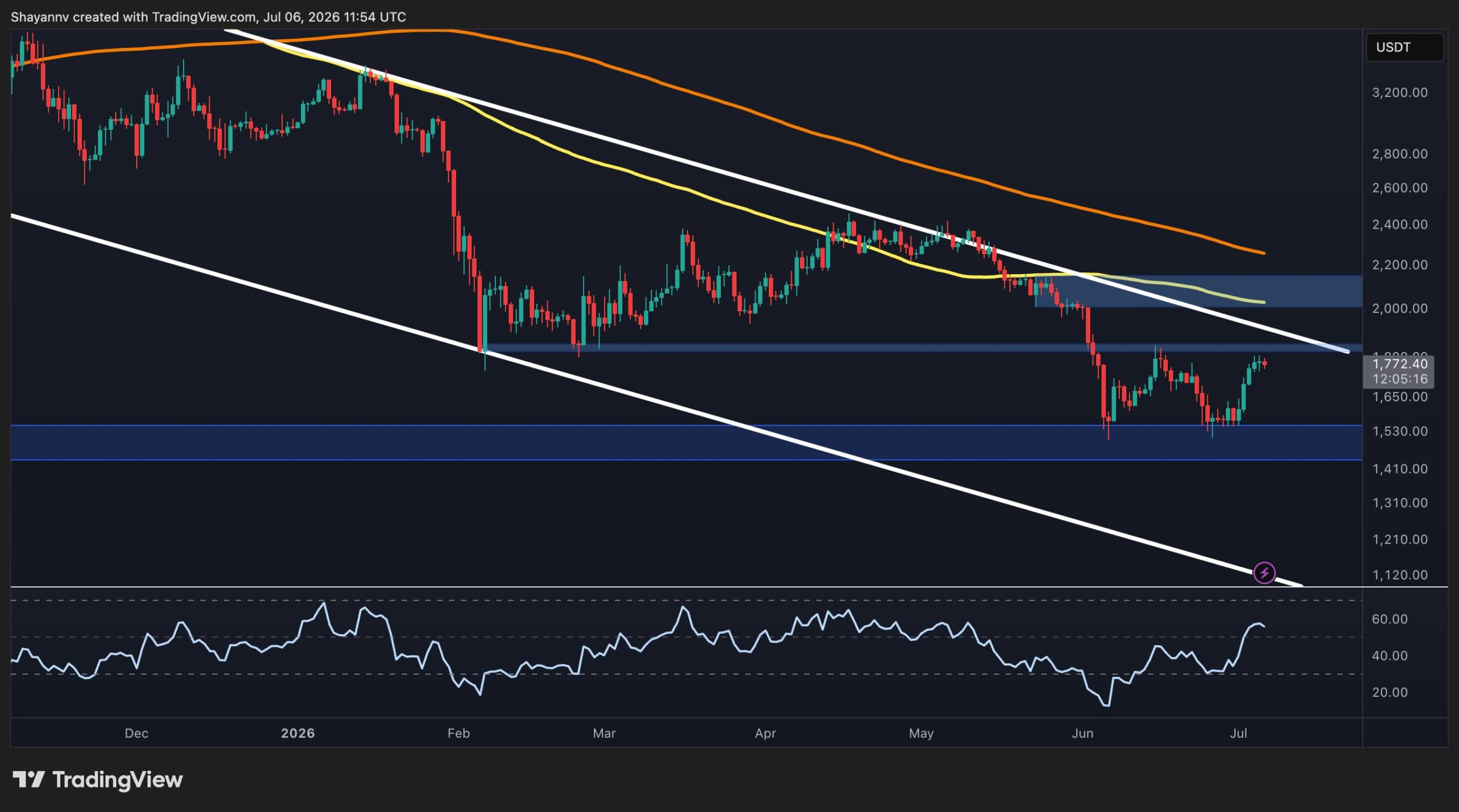
The daily chart continues to reflect a bearish market structure. ETH remains below the descending long-term trendline, as well as the 100-day and 200-day moving averages, all of which continue to slope lower. This alignment suggests sellers still maintain control from a broader perspective.
Following the sharp decline into the $1.5K support zone, buyers managed to trigger a recovery toward the $1.8K resistance area. This level coincides with the previous horizontal support that has now turned into resistance and sits just beneath the descending channel trendline, creating a significant supply zone.
A successful daily close above the trendline and the $1.8K region would be the first meaningful technical improvement and could expose the next resistance around $2K to $2.2K, where another major supply zone and moving average cluster await.
Failure to reclaim the current resistance would likely reinforce the broader bearish structure and increase the probability of another move toward the $1.5K support. Losing that area would pave the way toward the channel’s lower boundary below $1.2K.
ETH/USDT 4-Hour Chart
On the 4-hour timeframe, Ethereum has produced a stronger short-term recovery after defending the $1.5K demand zone for a second time. The rebound has carried the price back toward the upper boundary of the pattern that has entrapped the price since early June.
ETH is now testing the $1.75K to $1.8K resistance while simultaneously confronting the descending trendline. This makes the current area particularly important for short-term direction.
A confirmed breakout above both the trendline and horizontal resistance would invalidate the sequence of lower highs and could accelerate buying toward the $larger $2K to $2.2K supply zone also visible on the daily timeframe. On the other hand, rejection from this region would preserve the existing bearish structure. In that case, the first support remains around $1.7K, followed by the $1.6K area, while the key demand zone continues to sit near $1.5K.
Momentum has also improved considerably during the latest advance, with the RSI climbing toward overbought territory. While this reflects strengthening buying pressure, it also suggests that bulls may need a period of consolidation before attempting a decisive breakout.

On-Chain Analysis
The exchange reserve chart presents one of the more constructive long-term signals for Ethereum. Exchange balances have fallen significantly from above 21M ETH to roughly 15.5M ETH, marking a persistent multi-year decline in the amount of ETH held on centralized exchanges.
This trend generally indicates continued coin withdrawals into self-custody or long-term storage, reducing the immediately available supply for sale. Such behavior often reflects improving investor conviction and tends to provide a favorable backdrop during periods of sustained demand.
Despite Ethereum’s prolonged price correction from the 2025 highs, exchange reserves have continued to decline rather than rise, suggesting that long-term holders have not been aggressively distributing their holdings into weakness.
While on-chain data alone does not guarantee an immediate rally, the persistent reduction in exchange reserves supports the view that selling pressure from spot holders remains relatively limited. If ETH can reclaim the major technical resistance around $2K and attract renewed demand, this tightening exchange supply could become an important tailwind for a stronger medium-term recovery.

The post Ethereum Price Prediction: Is $1.5K or $2K Next for ETH? appeared first on CryptoPotato.

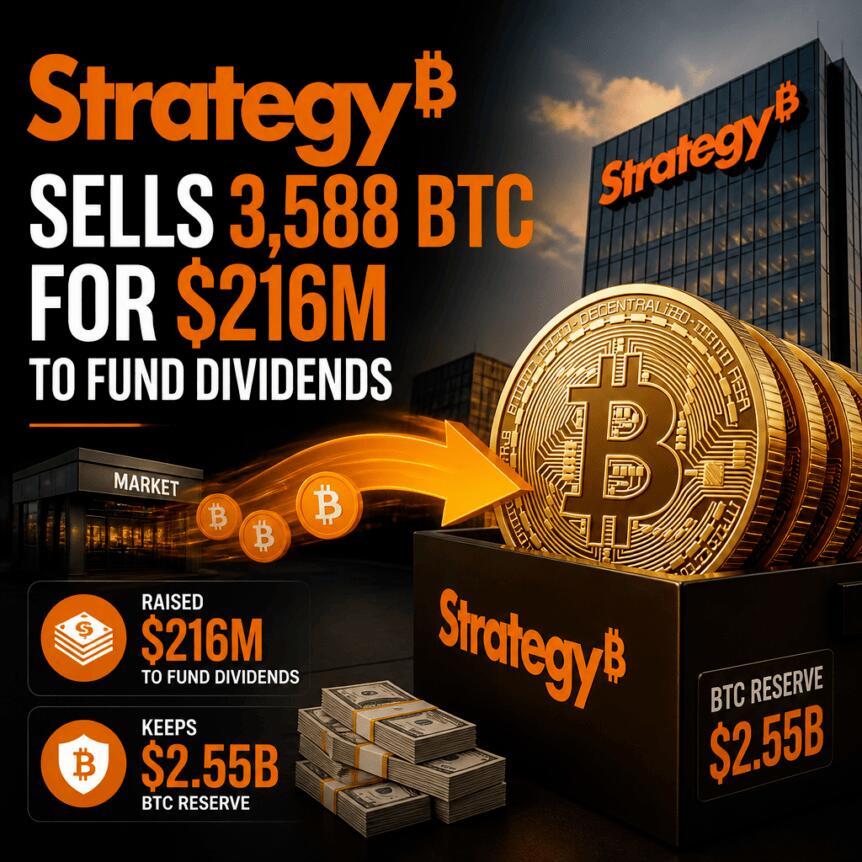
MicroStrategy’s long-time Bitcoin proxy, Strategy (formerly MicroStrategy Incorporated), has again sold a portion of its holdings to fund corporate needs. In a Form 8-K filed with the U.S. Securities and Exchange Commission on Monday, the company said it sold 3,588 Bitcoin for a total of $216 million, trimming its position to 843,775 BTC.
The disclosed sales were completed across multiple days and were priced at two different average levels: Strategy sold 1,363 BTC at an average of $59,256 between last Monday and Tuesday, and 2,225 BTC at an average of $60,773 between Wednesday and Sunday, according to the filing.
Key takeaways
- Strategy sold 3,588 BTC for $216 million, reducing its total holdings to 843,775 BTC, per its Monday SEC 8-K.
- The sales come after Strategy previously reported its first Bitcoin sale in years in early June, following a 2022 tax-related transaction.
- Strategy’s June capital framework ties Bitcoin sales to dividend funding, and it raised its STRC preferred stock dividend rate to 12%.
- Analyst Bernstein said Strategy was unlikely to face forced Bitcoin selling, citing cash coverage for dividend and interest obligations.
Another tranche of Bitcoin sold to support dividends
Strategy’s Monday filing provides the clearest breakdown yet of how its Bitcoin-to-cash conversion is being executed in practice. The company emphasized the total proceeds ($216 million) and the reduced Bitcoin balance that results from the transactions.
While the sale is large in absolute terms, investors have been watching Strategy closely for signals about whether it is merely funding planned payments or shifting toward more sustained liquidation. This latest disclosure follows an earlier, notable break from the company’s long-standing pattern: Strategy had disclosed the sale of 32 BTC in early June, described as its first reported Bitcoin sale since the 2022 tax-loss-related transaction.
That early June disclosure matters because it set expectations that Strategy’s “Bitcoin as reserve” thesis was evolving into a more explicitly managed cash-and-liquidity approach—one that includes periodically monetizing part of its holdings to meet obligations.
June framework links Bitcoin liquidity to capital returns
In its June 29 8-K, Strategy unveiled a capital framework designed to preserve Bitcoin exposure while allowing certain sales to fund dividends. As reported earlier by Cointelegraph, that framework laid out how Bitcoin could be sold to support shareholder returns without abandoning the larger accumulation strategy.
Within that framework, Strategy increased the annual dividend rate on its STRC perpetual preferred stock to 12%. It also disclosed that its U.S. dollar reserve had grown to $2.55 billion in the June filing. Monday’s 8-K, however, indicated that the dollar reserve remained unchanged from the prior disclosure.
In other words, the company used Bitcoin sales even as it reported a stable level of cash reserves—suggesting that the sales are part of the structured dividend-funding mechanism rather than a sign of immediate liquidity stress.
STRC trades below par, raising questions for funding dynamics
Strategy’s dividend funding is closely connected to how STRC performs in the market. During Monday’s pre-market session, STRC traded at $88.70, according to Yahoo Finance data—about 11.3% below its intended $100 par value.
This discount matters because it can affect Strategy’s financing flexibility. If STRC trades below par, the company’s ability to raise additional cash through STRC sales may be less efficient, potentially increasing pressure to keep dividend economics attractive to investors or, alternatively, to rely more on Bitcoin sales to cover obligations.
That dynamic is not speculative in the filing narrative: STRC is described as a key mechanism through which Strategy funds its Bitcoin accumulation and associated capital needs. When preferred shares price-discover below par, the trade-off between issuing equity-like instruments and selling Bitcoin becomes a central variable for investors monitoring Strategy’s capital strategy.
Bernstein: no “forced selling” scenario based on cash coverage
Ahead of the latest sale being disclosed, Bernstein argued that Strategy was unlikely to be compelled into selling Bitcoin. The firm pointed to liquidity and cash reserve coverage supporting dividend and interest obligations.
In the Bernstein report referenced in the article, the analyst estimated Strategy had 17 months of cash available to cover dividend obligations and interest payments. Bernstein also described Strategy as a net buyer of Bitcoin and characterized it as a “balancing force” in a market where other participants—particularly leading U.S. Bitcoin miners—have shifted toward selling rather than accumulating, partly due to their pivot to AI-related strategies.
Bernstein further cited broader market flows, including $5.5 billion of outflows from Bitcoin exchange-traded funds (ETFs) so far in 2026, and suggested Strategy’s buying helped counteract that pressure. The firm also said Strategy’s debt liabilities were about 13% of its Bitcoin collateral value, implying that debt servicing constraints were not dominating the company’s near-term behavior.
According to Bernstein, Strategy’s next principal payment of roughly $1 billion is due in the third quarter of 2028. The timeline is important for investors because it shapes how much of today’s liquidity decisions are about “imminent refinancing needs” versus routine dividend management.
Bernstein maintained a $150,000 year-end Bitcoin price target and reiterated that its long-term outlook on Bitcoin remained optimistic.
What to watch after Strategy’s latest disclosure
Investors will likely focus on whether these Bitcoin sales remain tied to the dividend framework and preferred-stock mechanics, or whether future filings show a larger and more frequent monetization of holdings. The next clue will come from how STRC continues trading relative to par and how Strategy reports its cash reserves and obligations over the coming quarters.


“That’s when the deflationary impulse from falling oil prices should remind everyone that the Fed isn’t going to hike and that – if anything – the next move will be a cut,” Robin Brooks, a senior fellow at the Brookings Institution and former chief economist at the Institute of International Finance, said in a report.
If the currency’s strength is under question, then the barrier to bitcoin rising further also looks weaker. The two are known to be inversely correlated.
Some observers, however, are calling for caution, saying the market is overestimating the impact of oil prices on inflation. Elevated price pressures, they say, are now a structural issue.
“The Fed can’t declare victory simply because gasoline prices move lower. Sticky service-sector inflation is exactly why policymakers are likely to keep rates higher for longer, even if headline CPI continues moderating,” YCC Macro said on X.
Markets betting on aggressive easing may be underestimating how persistent underlying inflation really is,” YCC Macro added. Stay alert!
Read more: For analysis of today’s activity in altcoins and derivatives, see Crypto Markets Today . For a comprehensive list of events this week, see CoinDesk’s “Crypto Week Ahead.”
What’s trending


BitMine Immersion Technologies (NYSE: BMNR), the Ethereum treasury company chaired by Fundstrat's Tom Lee, bought 42,197 ETH worth roughly $73 million over the past week, according to the company's own holdings update posted Monday. The purchase lifts BitMine's total to 5,742,237 ETH, about 4.8% of… Read the full story at The Defiant
Crypto World
Market Highlights: Broadcom’s Apple Deal, SpaceX Nasdaq Entry, and TeraWulf’s AI Breakthrough

Quick Overview
- Broadcom secured a contract extension with Apple for custom chip production lasting through 2031, reinforcing investor optimism
- Chip sector stocks experienced a strong recovery, with notable gains across AMD, Broadcom, and Micron
- SpaceX prepares for Nasdaq-100 inclusion, attracting significant institutional and index fund interest
- TeraWulf announced a massive $19 billion, two-decade AI data center agreement with Anthropic
- Strategy maintained market attention as a leading corporate Bitcoin holder
A wave of significant corporate developments swept through markets today, headlined by Broadcom’s extended Apple collaboration, a semiconductor sector recovery, SpaceX’s upcoming index milestone, TeraWulf’s blockbuster AI contract, and Strategy’s continued cryptocurrency focus.
Broadcom Secures Long-Term Apple Chip Supply Agreement
Broadcom experienced significant stock appreciation following confirmation that its custom semiconductor partnership with Apple will continue through 2031.
This extension solidifies Broadcom’s standing as a critical supplier within Apple’s semiconductor ecosystem. The arrangement provides enhanced revenue predictability for the coming years.
Broadcom delivers specialized silicon components, networking infrastructure, and wireless connectivity technologies essential for modern data center operations. This collaboration strengthens its foothold in the expanding AI infrastructure landscape.
Market participants typically respond favorably to long-duration contract announcements, and Monday’s trading activity reflected that sentiment.
Chip Sector Experiences Strong Recovery
Chipmakers powered the market higher during Monday’s session as capital flowed back into artificial intelligence-focused semiconductor companies following last week’s downturn.
The Philadelphia Semiconductor Index registered substantial gains. Companies including AMD, Micron, and Broadcom delivered impressive performances.
Market observers largely interpreted the previous week’s decline as a temporary consolidation rather than the beginning of a sustained downtrend. Ongoing AI infrastructure investments from cloud computing giants and corporate customers continue supporting sector growth.
The robust comeback indicates market confidence that the AI-driven investment wave will maintain momentum throughout 2026.
SpaceX Approaches Nasdaq-100 Membership
SpaceX is on track to enter the Nasdaq-100 Index, a development anticipated to generate substantial demand from passive investment vehicles.
The addition comes after the company’s transition to public markets and represents another milestone in its financial evolution. Membership in this prominent technology benchmark will introduce the stock to a significantly broader base of institutional capital.
Market watchers are particularly interested in SpaceX’s diversified revenue streams, encompassing Starlink satellite internet services, government defense partnerships, and ongoing Starship rocket advancement.
The enterprise is frequently identified as among the most compelling long-term growth opportunities within the commercial aerospace sector.
TeraWulf Announces Historic AI Infrastructure Partnership
TeraWulf emerged as a major market mover following disclosure of a 20-year, $19 billion arrangement to provide AI computing infrastructure capacity to Anthropic.
Originally focused on cryptocurrency mining operations, the company has strategically repositioned toward high-performance computing solutions for artificial intelligence applications.
This agreement exemplifies the broader industry shift as energy and computing providers reorient to capture explosive AI infrastructure demand. TeraWulf shares surged dramatically as market participants valued the extended revenue visibility.
The partnership ranks among the most substantial AI infrastructure commitments announced by an independent supplier in the market.
Strategy Maintains Bitcoin Market Prominence
Strategy remained in investor focus as a major publicly-traded Bitcoin accumulator.
The company’s equity performance demonstrates strong correlation with Bitcoin price movements, positioning it as a preferred vehicle for traditional investors seeking amplified cryptocurrency exposure through conventional equity markets.
Ongoing announcements regarding its funding approach and Bitcoin acquisition activity have sustained elevated market interest.
Given continued cryptocurrency market volatility, investors are closely monitoring the company’s capital allocation decisions and their implications for long-term shareholder value creation.


Bitcoin miners sold a record 32,000 BTC in the first quarter of 2026 and signed about $70 billion in contracts to help power AI instead, marking the largest desertion by the group in the network’s history.
The exodus triggered Bitcoin’s first hash rate drop in six years, but it absorbed the shock and adjusted its difficulty, with the hash rate even recovering to a new high without missing a single block.
Bitcoin Absorbs Record Miner Exit as AI Pulls Capital Away
In a post published on X on July 6, analyst Shanaka Anslem Perera argued that Bitcoin has just passed one of the biggest real-world tests in its history after public mining companies, such as MARA, CleanSpark, Riot Platforms, Cango, Core Scientific, and Bitdeer, which were facing shrinking margins, sold more than 32,000 BTC in Q1 2026 and redirected that capital to build AI infrastructure.
For them, the math made sense, considering it cost about $80,000 to produce one BTC, a level that the cryptocurrency’s price has been below for most of this year. Meanwhile, they could earn 3 to 5 times that training AI, with multi-year contracts being dished out by the likes of Microsoft and Google instead of the lottery of block rewards.
“They did what any business would,” explained Perera. “BTC miners sold their Bitcoin, more in one quarter than all of last year, more than the industry dumped in the entire Terra collapse, and began converting their power plants into AI data centers.”
Now, remember, it has always been said that Bitcoin’s security depends on the miners who spend real energy to protect it, and with so many pulling out in such a short period, it felt like the system might crash. And for a few weeks, it teetered, with hash rate, the total computing power guarding the Bitcoin network, posting its first drop in six years, going down by around 4% to break a 5-year streak of double-digit growth.
However, according to Perera, the network did what its critics had forgotten it could do. It has a rule in its core that, when miners leave and blocks come slower, automatically makes mining easier and more profitable for those still plugged in.
So, as the deserters powered down, the math handed their reward to those who had stayed and to private operators who rushed in to fill the gap. Difficulty fell by 10% in some adjustments, one of the largest downward moves of the year, which pushed hash price back above $30 per petahash per second.
“The network that was supposed to depend on these miners just proved it never needed them,” the market commentator wrote, pointing out that Bitcoin’s hash rate even recovered to a new all-time high without any interruption to block production.
The lesson in all this, according to him, is Bitcoin’s resilience, absorbing “the single largest exit of its own miners” driven by the opportunity for profit elsewhere and never failing to produce a block every 10 minutes like it was designed to.
“The system was not weakened by desertion,” Perera concluded. “It was tested by it, and it passed.”
Miner Stress Indicator Hits Historic Bottom Zone
Elsewhere, as Perera celebrated BTC’s endurance, pseudonymous analyst Gaah noted that the Miner Cycle Stress Composite, which combines the Puell Multiple and the inverted Miner Capitulation Index, had fallen to new lows for 2026 and was in historically undervalued territory.
Similar readings were reportedly seen in 2018, 2020, 2022, and 2024, during periods of severe miner stress and market bottoms, with the metric’s lowest possible reading of zero recorded in 2015, when BTC dropped by nearly 50%, going from about $300 to around $160 in less than seven days. According to the on-chain technician, the same pattern is now repeating.
The post How Bitcoin Survived Its Biggest Miner Walkout appeared first on CryptoPotato.

Michael Saylor, co-founder and executive chairman of Strategy Inc., speaks during the Bitcoin 2026 conference in Las Vegas, Nevada, US, on Tuesday, April 28, 2026.
Ian Maule | Bloomberg | Getty Images
Bitcoin turned positive Monday after President Donald Trump voiced his support for cryptocurrency.
Earlier in the session, bitcoin dove toward $60,000 after Strategy, a longtime corporate buyer of the token, sold some of its holdings for the second time this year, dealing a blow to the asset once dubbed “digital gold.” The flagship cryptocurrency was last trading at $63,624.44, up 1.5% on the day. Earlier, it was down more than 2%.
“Well … I’ve become a big crypto guy,” Trump said in a news conference on Monday, responding to a question about whether bitcoin might be added to recently launched Trump Accounts.
The tax-advantaged 503A accounts went live over the holiday weekend, and they are aimed at allowing children to build long-term savings over their lifetimes. The accounts are expected to drive inflows into U.S. equities, as people can select to invest in a range of broad-market exchange traded funds.
Trump’s comments were a welcome boost for crypto investors on Monday. A stunning strategy shift by the bitcoin evangelist Michael Saylor has weighed on market sentiment in recent weeks, according to Barclays.
Strategy sells more bitcoin
Strategy disclosed Monday in a regulatory filing that it made multiple sales of bitcoin worth a combined $216 million, marking a further reversal of the Saylor-led company’s earlier promises to never sell its bitcoin.
“Strategy’s entire investment thesis was built on a public promise never to sell,” Barclays analyst Ajay Rajadhyaksha said Monday in a note to clients. “When they sold — even a minuscule amount — and then announced a new policy framework allowing further sales for ‘capital allocation purposes,’ it was a significant hit to sentiment.”
Strategy sold roughly $80.8 million worth of bitcoin at an average price of $59,256 per token between June 29 and 30, according to its regulatory filing. Then, an additional $135.5 million of bitcoin was sold in a separate series of transactions from July 1 to 5.
That brings its holdings to 843,775 bitcoin worth around $52.1 billion as of writing time. The company’s average cost-per-token now sits at $75,476.
Strategy first announced its shift to a corporate policy that would enable it to sell some of its bitcoin in May. It reported the sale of more than $2 million in bitcoin on June 1, marking its first sale since 2022.
Since then, bitcoin has largely traded in the range of $60,000 to $70,000. On June 24, the asset briefly dipped to roughly $59,000, or its lowest level since Oct. 10, 2024.
‘Center of gravity’
Shares of Strategy rose 1% on Monday, while its preferred stock, STRC, gained almost 3%. Even with the bump, the preferred stock is trading below its $100 par level.
Cantor analyst Ramsey El-Assal sees Strategy’s sale of bitcoin as effort to shore up its perferred stock, which he called the company’s “center of gravity,” not a commentary on the cryptocurrency.
“We fully expect the company to do whatever it takes to lift STRC to par, and we believe the Street should expect frequent, periodic actions,” El-Assal said in a note to clients.
The company has to balance three constituencies, preferred stockholders, common stockholders and bitcoin investors, according to El-Assal. However, protecting one of these three groups may hurt the other, he said.
“The company rightly understands something that bears miss: where STRC goes, MSTR common shares follow,” the analyst said.
Crypto World
Strategy selling hundreds of millions worth of bitcoin raises question about its capital-allocation playbook


Interestingly, after a series of buys and sales over the past few weeks, the company is left with a net increase of only 69 bitcoin despite deploying roughly $20 million in additional capital, a crypto trader, KALEO, said on X. Because the company sold coins below the prices it had recently paid, the implied average cost of those additional holdings exceeded $289,000 per bitcoin, KALEO added.
Strategy now holds 843,775 bitcoin purchased at an average price of $75,476, maintaining its position as the largest publicly traded corporate holder of the cryptocurrency.
Despite the losses, today’s move to sell millions of dollars’ worth of bitcoin will likely signal to investors that Strategy will go to whatever lengths necessary to protect its dividends on its high-yielding preferred stock, Stretch (STRC), whose dividend now stands at 12% after a recent 50 basis-point increase.
Indeed, while bitcoin and Strategy’s common stock, MSTR, are lower on Monday, STRC continues to rebound from last week’s low below $75, rising another 2.1% to just shy of $90.
The ‘strategy’
Given the zigzags in strategy over the past few weeks, the company’s near-term capital allocation has become harder for investors to predict. Assuming relatively stable prices for BTC, MSTR, and STRC, it’s probably safe to say that bitcoin buys are off the table for the foreseeable future.
Crypto World
Palo Alto Networks (PANW) Stock Surges to New Peak as AI Security Concerns Drive Growth

Key Highlights
- PANW reached a record peak of $358.31 on July 6, 2026
- Year-to-date gains stand at 94%, with a 77% increase over 12 months
- The stock has surged 32% since mid-June, powered by AI-driven cybersecurity needs
- CNBC’s Jim Cramer endorsed PANW as a buy in January 2026, praising CEO Nikesh Arora’s leadership
- Multiple Wall Street firms including FBN Securities, Cantor Fitzgerald, and William Blair maintain optimistic outlooks
Palo Alto Networks stock climbed to an unprecedented high of $358.31 on July 6, 2026, marking a 2.71% gain for the session. The cybersecurity giant’s valuation now stands at $289 billion.
Palo Alto Networks, Inc., PANW
The stock has delivered remarkable returns this year, posting a 94% advance year-to-date. Looking back twelve months, shares have appreciated 77%, while the half-year performance shows an impressive 87% jump.
The momentum has been particularly strong in recent weeks. From June 10 through the current session, PANW has rocketed 32% higher.
This latest surge correlates with heightened enterprise investment in sophisticated cybersecurity solutions as artificial intelligence-enabled attacks grow increasingly sophisticated. Industry observers note that organizations are ramping up expenditures on platforms like Palo Alto Networks’ offerings as AI-powered threats become more elaborate and dangerous.
The journey hasn’t been without turbulence. On March 27, shares tumbled 6% following reports that AI systems — including technology from Anthropic — might be leveraged to identify software vulnerabilities, raising questions about the long-term outlook for cybersecurity firms.
However, the market’s concerns proved short-lived. The prevailing sentiment has since reversed dramatically: AI-related threats are now viewed as catalysts for increased cybersecurity investment rather than risks to security vendors.
Wall Street’s Perspective
The analyst community has embraced an overwhelmingly positive stance. FBN Securities lifted its price objective to $330 while maintaining its Outperform designation. Cantor Fitzgerald reaffirmed its Overweight rating alongside a $340 target, highlighting that both revenue and NGS ARR exceeded projections.
William Blair upgraded its fiscal 2026 free cash flow projection to $4,225 million, modeling a 37% free cash flow margin. This forecast aligns closely with the company’s own guidance regarding cash generation capabilities.
PANW’s latest quarterly results showed revenue surpassing consensus forecasts by 2%, representing an improvement compared to previous reporting periods.
It’s worth noting that InvestingPro analysis indicates the shares are presently trading above their Fair Value calculation, a consideration given the stock’s rapid appreciation.
Cramer’s Endorsement and Institutional Backing
In January 2026, CNBC personality Jim Cramer designated PANW as a buy opportunity, emphasizing CEO Nikesh Arora’s proven execution abilities. This represented a significant shift, as Cramer had previously maintained a more reserved stance on the security firm.
“Palo Alto’s a terrific company. I think it is a buy,” Cramer stated during his endorsement.
Brown Advisory’s Large-Cap Growth Strategy revealed a PANW holding in its first quarter 2026 shareholder communication. The investment firm disclosed that it established the position during a market weakness period triggered by AI disruption anxieties and concerns about acquisition integration challenges. Brown Advisory characterized these worries as exaggerated.
The investment manager emphasized Palo Alto Networks’ strategic emphasis on platform consolidation, where corporate customers aggregate multiple security products under a single vendor relationship, as a critical expansion opportunity. The fund also underscored robust free cash flow generation and dependable operational performance.
Shares are currently changing hands just 1% beneath the 52-week peak established during today’s trading session.
Bitcoin miner TeraWulf, moving deeper into AI infrastructure, signed a 20-year data center lease with Anthropic expected to generate about $19 billion in contract revenue.
The company also announced Monday that it is selling a majority stake in a separate AI data center joint venture to reinvest in wholly owned projects.
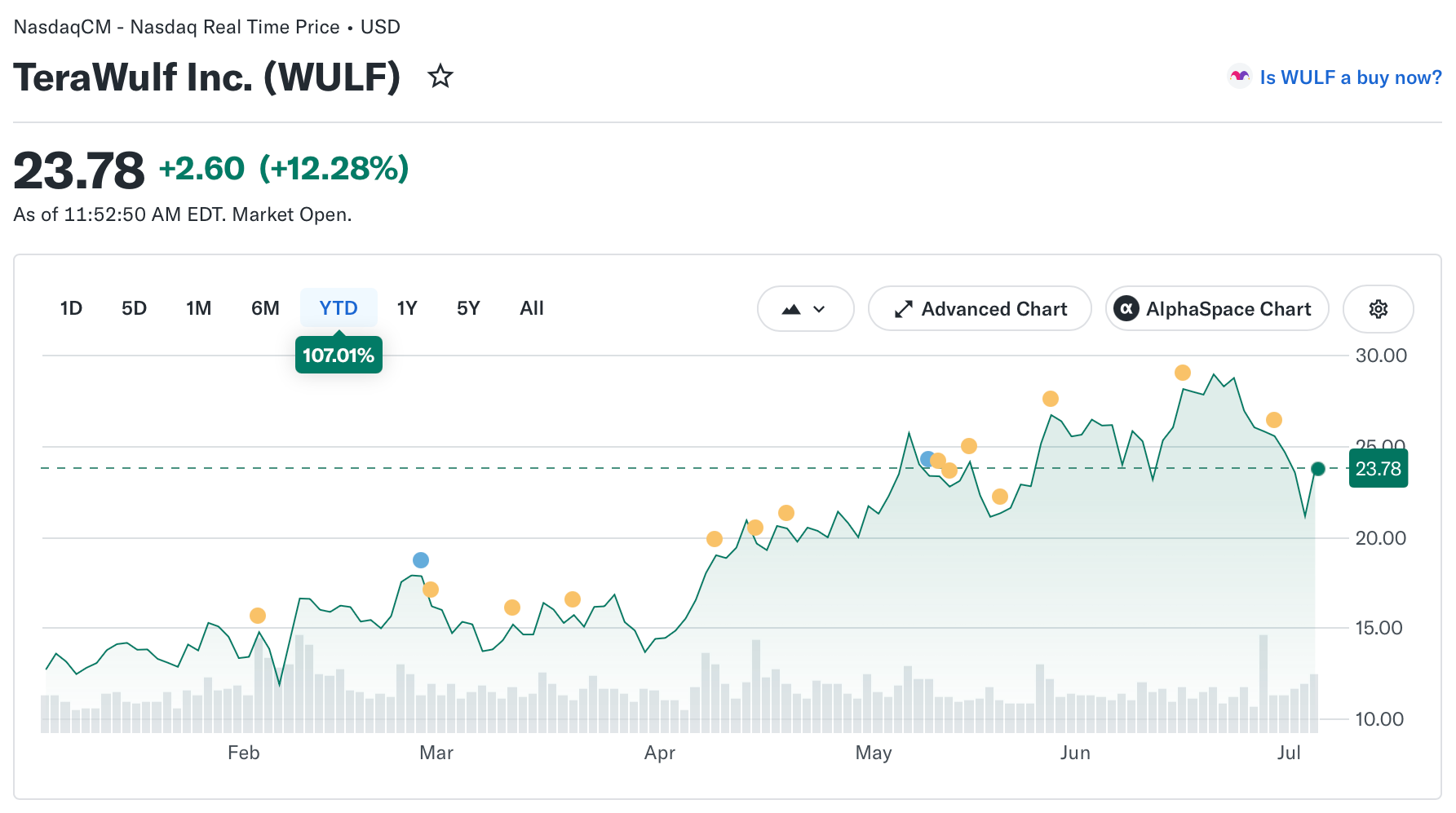
The company’s shares rose about 12% in Monday morning trading following the announcement, extending a roughly 107% year-to-date gain, according to Yahoo Finance data at the time of writing.
TeraWulf stock price. Source: Yahoo Finance
Under the agreement, Anthropic will lease a purpose-built AI data center campus at TeraWulf’s Justified Data site in Hawesville, Kentucky. Acquired in February, the facility is designed to support 401 MW of critical IT capacity, with initial operations expected in the second half of 2027 and full buildout targeted for early 2028.
Separately, TeraWulf agreed to sell its 50.1% stake in the Abernathy joint venture, an AI data center project in Texas, to an investor group led by partner Fluidstack. The company said it expects the sale to return its roughly $450 million investment which it plans to reinvest in AI infrastructure projects that it owns outright.
Related: Strategy sells 3,588 Bitcoin for $216M to fund dividends, keeps $2.55B reserve intact
AI demand reshapes Bitcoin mining industry
The announcement comes as demand for AI infrastructure outpaces available computing capacity. Training and running large AI models requires data centers with high-performance chips, advanced cooling systems and access to large amounts of reliable electricity, making power-rich campuses increasingly valuable.
That has created an opportunity for several Bitcoin miners, which already own sites with grid connections, power agreements and other infrastructure needed for energy-intensive computing. While AI data centers use different hardware than crypto mining operations, the overlap has prompted several miners to diversify into AI and high-performance computing (HPC).
However, the pivot comes with significant costs. Blocksbridge Consulting estimated in June that public Bitcoin miners pursuing AI infrastructure may need roughly $50 billion in near-term capital, as AI data centers require far greater investment than traditional Bitcoin mining facilities.
Last month, HIVE Digital signed a three-year, $220 million agreement to provide GPU cloud infrastructure for AI startup Cohere through Bell Canada’s AI Fabric, while IREN acquired Spanish data center developer Nostrum Group, adding about 490 MW of secured, grid-connected power as it entered the European AI market.
Magazine: AI is banking the unbanked in Africa… faster than crypto

Solana News: SOL closed Q2 2026 with $5.77 billion in tokenized asset spot volume, a quarterly all-time high confirmed by data analyst Sam Schubert on July 1, a figure that exceeds the entire $775 million generated across the second half of 2025 by more than seven times.
The result cements Solana’s position as the dominant settlement layer for on-chain equities and signals a structural shift in how institutional capital is moving on-chain through tokenization.

Discover: The Best Crypto to Diversify Your Portfolio
Solana News: Raydium Leads as On-Chain Volume Breaks Records Across June
Raydium emerged as the primary venue for tokenized equities on Solana throughout the quarter, with its own announcement on July 1 describing it as “the #1 venue for tokenized asset spot volume on Solana.”
The protocol’s concentrated liquidity pools host the majority of xStocks trading pairs, and the final billion in Raydium’s cumulative tokenized equity volume was added in a single month, a pace that directly shaped the quarter’s headline figure.
The quarter’s peak months were heavily weighted toward June. Solana processed $1.298 billion of the $1.324 billion in global weekly tokenized stock volume during the week of June 15–21, a 95% share. On June 24, daily tokenized equities trading hit a $644 million record, surpassing memecoins as a share of Solana spot volume for the first time.
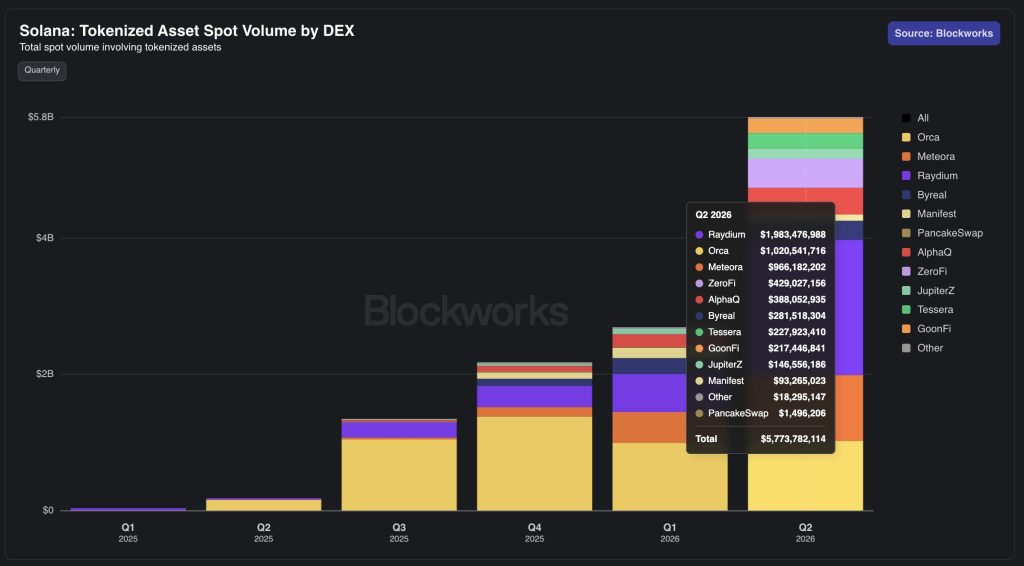
June alone generated over $2 billion in monthly tokenized stock volume, the highest figure ever recorded for any single month on any chain.
The final week of Q2 set a weekly all-time high of $1.42 billion before Schubert published the full quarterly tally. That weekly figure alone exceeds several prior monthly totals, illustrating how compressed the acceleration was into the quarter’s close.
Don’t Miss Out on Our $1,000 USDT Airdrop on ByBit
Solana’s 97% RWA Market Share Reflects Structural, Not Cyclical, Dominance
The Solana Foundation’s May 2026 ecosystem roundup placed Solana’s share of cumulative on-chain tokenized equity spot trading volume at 97%, a figure that had been building for over a year before the Q2 breakout.
Data, noted Solana’s tokenized equity lead had held for 54 consecutive weeks. The chain’s sub-second finality and low per-transaction fees are the structural reasons liquidity has concentrated here rather than on Ethereum or competing L1S.
The broader RWA picture on Solana supports that reading. The May 2026 roundup also reported $2.8 billion-plus in total RWA value on-chain and $1.2 billion in RWA lending deposits, a context that explains why BlackRock deployed a $255 million institutional liquidity fund on Solana and Ondo holds $176 million in tokenized yield exposure on the network.
These are not speculative positions; they represent regulated capital seeking the execution quality that DeFi infrastructure on Solana now provides at scale.
Cross-chain monthly tokenized equity trading hit $5.3 billion in May 2026, up 44% from April per Crypto Briefing – and Solana accounted for the overwhelming majority of that figure.
The remaining chains are not closing the gap. As Solana continues to mature its on-chain governance and network infrastructure, the pipeline of new tokenized equities, SPYx, QQQx, NVDAx, and additional xStocks instruments points to further volume concentration rather than dispersion.
Don’t Miss Out on Our $1,000 USDT Airdrop on ByBit
What Raydium Targets After the Q2 Record
0xINFRA, a member of Raydium’s leadership roster, framed Q2’s achievement as a foundation rather than an endpoint: “The focus for Q2 shifts from resilience to conversion: broadening LaunchLab distribution beyond concentrated partner channels, sustaining CLMM-led liquidity depth, and translating tokenized-asset share gains into repeatable monetization.”
0xINFRA said. The protocol views volume share as a prerequisite, not the goal; fee generation and sustainable liquidity depth are the next tests.
The regulatory backdrop matters here. Bitwise has argued that the passage of the U.S. CLARITY Act news would accelerate the tokenization wave and position Solana as one of the primary beneficiaries. That legislation remains pending, but the market is not waiting for it – $5.77 billion in Q2 on-chain volume happened before any such framework existed.
If CLARITY passes, the addressable market for tokenized stocks expands materially, and Raydium’s current infrastructure advantage compounds. Solana price forecasts for the remainder of 2026 increasingly treat this RWA momentum as a primary input rather than a secondary narrative.
Discover: The Best Token Presales
The post Solana News: Solana Hits $5.77B Tokenized Asset Volume in Q2 2026 All-Time High appeared first on Cryptonews.

Belgium’s Folarin Balogun appeal REJECTED by FIFA, clearing path for USA star to play World Cup game after Trump’s intervention

Senco Gold shares soar 6% as Q1 business update highlights 60% revenue growth

Strategy sells 3,588 BTC for $216M to fund dividends, keeps $2.55B reserve


-

 Fashion3 days ago
Weekend Open Thread: High Hopes
-

 Politics3 days ago
The House | “Reframing the debate from a binary discussion of winners and losers”: Yuan Yang reviews ‘We Are Not Machines’
-

 Crypto World7 days ago
Strategy authorizes up to $1.25B in Bitcoin sales under new capital plan
-

 News Videos6 days ago
How to Build INSANE Live Financial Dashboards With Claude
-

 Tech7 days ago
Anonymous researcher drops 0-day ‘exploitarium’ repo
-

 Business7 days ago
Australia treasurer says alleged access of prime minister’s bank data ’incredibly concerning’
-
 NewsBeat2 days ago
Taylor Swift and Travis Kelce wedding staffer hilariously struggles to keep her cool while checking in megastars
-
Crypto World5 days ago
Airdrop Registration Becomes Key Focus For Remittix As RTX Launch Updates Approach
-

 Sports5 days ago
Broncos roster: OL Ben Powers (No. 74) entering final year of contract
-
 Business7 days ago
The AI boom won’t burst all at once. It will pop in ‘rolling bubbles’: Macquarie
-

 Crypto World4 days ago
Binance stock trading tops $1B in first month after launch
-

 NewsBeat6 days ago
Presenter Caroline Flack’s brother Paul Flack dies aged 55
-

 Crypto World5 days ago
Alibaba-affiliate Ant Group enters the humanoid robot market with 12 deals
-

 Crypto World3 days ago
Standard Chartered Secures MiCA License as ESMA Adds 37 New Crypto Firms
-

 Crypto World1 day ago
South Africa proposes crypto tax guidance under existing rules
-
 NewsBeat4 days ago
New exhibition reflects five decades of movement between island of Ireland and GB
-

 Tech1 day ago
Lenovo laptops are now shipping with YMTC SSDs, a sign of Chinese NAND entering the mainstream
-

 Business5 days ago
Meta Platforms Stock Jumps 7% Today as Bloomberg Reports Company Plans to Enter the Cloud Business
-

 Business4 days ago
What a 10 Percent Drop Means for Buyers, Sellers and Renters
-

 News Videos5 hours ago
Avoid entering in FOMO #bitcoin #cryptocurrency #trading #scalping
You must be logged in to post a comment Login