

Crypto World
Paradigm leads M1X Global seed round as funding reaches $8.5M



Paradigm has led an oversubscribed seed funding round for sovereign financial infrastructure firm M1X Global, bringing the company’s total funding to $8.5 million just 14 weeks after its public launch.
Summary
- Paradigm has led M1X Global’s oversubscribed seed round, bringing the sovereign financial infrastructure firm’s total funding to $8.5 million.
- M1X Global said its blockchain based sovereign bond USDM1 is being deployed for institutional use and supports regulated 24/7 financial markets.
- The investment adds to Paradigm’s recent backing of blockchain payment and sovereign infrastructure projects beyond traditional crypto venture funding.
According to a press release shared with crypto.news, the round also attracted participation from Breed VC following M1X Global’s earlier angel raise. The company said the funding comes as regulatory clarity and institutional interest continue driving adoption of blockchain-based financial infrastructure.
M1X builds blockchain infrastructure for sovereign markets
Working with governments on digital financial systems, M1X Global has concentrated on sovereign financial instruments issued on blockchain networks. Its flagship partnership with the Republic of the Marshall Islands led to the launch of USDM1, which the company described as the first U.S. dollar-denominated secured sovereign bond issued natively on a public blockchain.
M1X Global said it coordinated the issuance with Cleary Gottlieb, Stellar Development Foundation, Anchorage Digital Bank, Guidepost, Inca Digital and Crossmint. According to the company, USDM1 was created to expand access to government aid and financial services across the Pacific while introducing a blockchain-native sovereign instrument for institutional markets.
The company said USDM1 combines the legal and economic structure of fully collateralized U.S. dollar sovereign debt with programmable digital asset features, enabling T+0 settlement, enforceable legal protections and programmable transfers. It added that the instrument qualifies as eligible sovereign collateral for regulated 24/7 markets and has already featured in institutional working groups involving Bank of America, Citadel Securities, Virtu Financial, Tradeweb, and DTCC.
According to M1X Global, the bond has also been structured to remain bankruptcy remote while supporting look-through to high-quality liquid assets and inclusion in legal netting sets used for collateral.
“Paradigm’s investment is an important milestone for M1X Global, strengthening our ability to scale the infrastructure behind sovereign financial instruments and to accelerate the build-out of systems that can support their use across regulated markets. This support advances our capacity as we continue to see strong onboarding demand and institutional adoption of USDM1, “ M1X Global Chief Executive Officer Mark Lurie said in an accompanying statement.
Jordan Goldman, president and chief operating officer of M1X Global, added that institutional deployment of USDM1 has demonstrated how sovereign digital assets can support both public services and financial markets.
According to Goldman, the assets can “deliver meaningful impacts in both domestic and institutional contexts” by improving access to government services while providing new sources of high-quality collateral for institutions operating in around-the-clock markets.
The investment continues Paradigm’s recent expansion beyond traditional crypto venture funding.
In June, the firm led a $9 million Series A round for Latin American payments platform El Dorado, supporting its stablecoin-powered cross-border payment network operating across 12 countries. It has also partnered with Stripe on the Tempo Layer 1 blockchain and participated in U.S. stablecoin policy discussions, including urging regulators not to restrict third-party stablecoin reward programs.

Key Takeaways
- South Korea’s benchmark KOSPI index plummeted 4.9%, activating circuit breakers for the sixth occasion in 2025
- Samsung projected a 19-fold surge in Q2 operating profit, yet its stock price declined nearly 7%
- Market experts suggest AI-related earnings projections have become unsustainably elevated
- Individual traders capitalized on the downturn, snapping up 3.2 trillion won worth of stocks
- SK Hynix unveiled a $28 billion American share offering, attracting preliminary investor attention
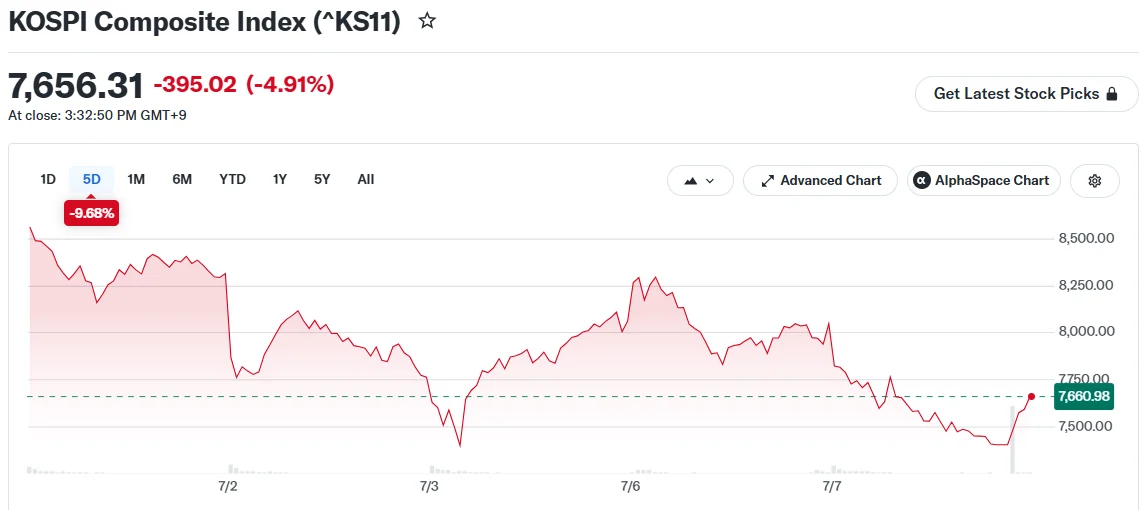
Tuesday proved turbulent for South Korea’s equity markets. The KOSPI benchmark concluded trading down 4.9%, settling at 7,656.31. During intraday trading, the index had plummeted more than 8%.
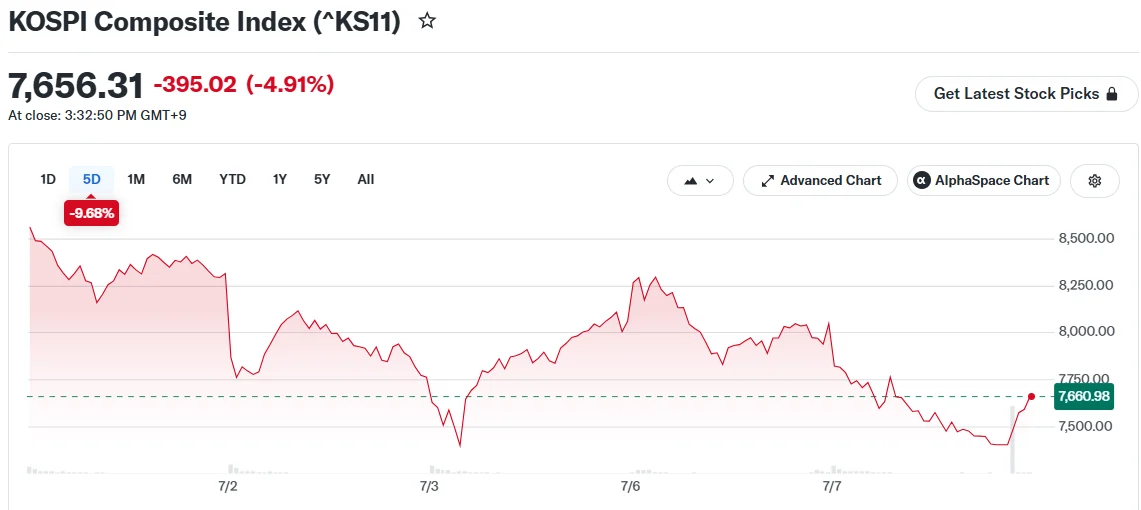
Trading halts were activated through circuit breaker mechanisms. This marked the sixth such interruption in 2025 amid semiconductor stock turbulence.
Record Samsung Results Meet Market Skepticism
Samsung Electronics found itself in the eye of the storm. The tech giant projected second-quarter operating profit at 89.4 trillion won, approximately $58 billion. This represents a nineteen-fold expansion compared to last year’s corresponding quarter and marks its third consecutive record-breaking period.
Yet Samsung’s shares tumbled nearly 7% during the session. Intraday declines exceeded 10% at their worst.
Market observers indicate these impressive figures had already been priced into valuations. Seo Sang-young from Mirae Asset Securities noted, “Market expectations have grown too high to be raised further.”
Competitor SK Hynix declined 6.1%. Japan’s memory chip manufacturer Kioxia experienced losses surpassing 10%.
The KOSPI had more than doubled year-to-date before reaching an all-time peak in late June. Since that milestone, approximately 20% has evaporated.
Changing Dynamics in AI Investment Sentiment
The market’s response indicates a transformation in investor attitudes toward artificial intelligence stocks. Throughout recent months, semiconductor companies enjoyed rewards merely for exceeding earnings projections. That pattern now appears to be evolving.
Charu Chanana of Saxo Markets observed, “Strong earnings are no longer enough.” She emphasized that investors now demand robust earnings, optimistic guidance, and evidence of sustainable pricing advantages.
Albert Yong from Petra Capital Management suggested the sharp decline reflects investor attention shifting toward the memory cycle’s long-term trajectory rather than immediate quarterly results.
International investors offloaded 2.9 trillion won in Korean equities Tuesday. Domestic retail traders countered by purchasing 3.2 trillion won, moderating the index’s early steep losses.
AI Investment Activity Continues Despite Volatility
Not every development suggested retreat from artificial intelligence exposure. SK Hynix initiated an American share issuance targeting approximately $28 billion, generating initial enthusiasm from significant institutional investors.
Broadcom extended its semiconductor supply agreement with Apple through 2031, alleviating worries that Apple might internalize additional chip production.
Wall Street advanced overnight. The Dow increased 0.29%, the S&P 500 rose 0.72%, and the Nasdaq gained 1.12%, buoyed by optimism surrounding AI-powered earnings performance.
Additional Market Developments
LG Energy Solution fell 6.4% following its projection of a 77% operating profit decline attributed to softening electric vehicle demand.
Hanwha Ocean crashed 22.7% after Canada selected German submarines over South Korean alternatives.
Crude oil prices advanced following a tanker incident near the Strait of Hormuz. US crude climbed to $68.92 while Brent reached $72.34.
Investors remain attentive to the upcoming Federal Reserve meeting minutes release, the inaugural publication under new Fed Chair Kevin Warsh.



Binance has introduced a product for bitcoin holders looking to earn extra yield on their investment without selling any of it, joining the likes of BlackRock in helping them maximize returns.
The product, BTC Yield, is available inside Binance Earn and is designed exclusively for people who already hold bitcoin.
Users deposit their bitcoin into the product and receive an internal position called BTCY, which tracks their share in the strategy. Everything remains denominated in BTC, and the product cannot be funded with stablecoins or other assets.
Binance holds the deposited bitcoin as collateral while systematically selling BTC call options, that is, it writes insurance against price rallies in BTC. The call seller, or writer, gets compensated with a premium. Binance collects those premiums and shares most of them with participants.
This covered-call approach, common in crypto and traditional finance, has typically required deep options knowledge to execute. Binance’s version makes it accessible to regular traders by handling everything behind the scenes.
Two types of return
The product generates potential returns in two ways.
First, a portion of the collected premiums is converted to bitcoin and distributed to users’ spot accounts every Friday as a possible weekly payout.
Ethereum traded near $1,777.49 at the time of writing, up 0.5% in the past 24 hours, according to crypto.news market data.
Summary
- Ethereum must close above $1,800 to strengthen the short-term bullish setup, analysts say.
- Binance liquidity has improved, but rising exchange reserves still pose selling pressure near $2,000 resistance.
- MACD and RSI support recovery, while $1,750 remains the key level for bullish invalidation.
The token had a 24-hour low of $1,732.10 and a high of $1,819.88, while daily trading volume stood near $17.08 billion.
The move kept ETH close to the $1,800 area, which traders now view as the main short-term resistance zone. The token has recovered from the sharp June selloff after buyers defended the $1,500 to $1,600 area.
The current setup has turned attention to a daily close above $1,800. Analysts say that level could decide whether ETH builds a stronger recovery or stays trapped in a range above $1,700.
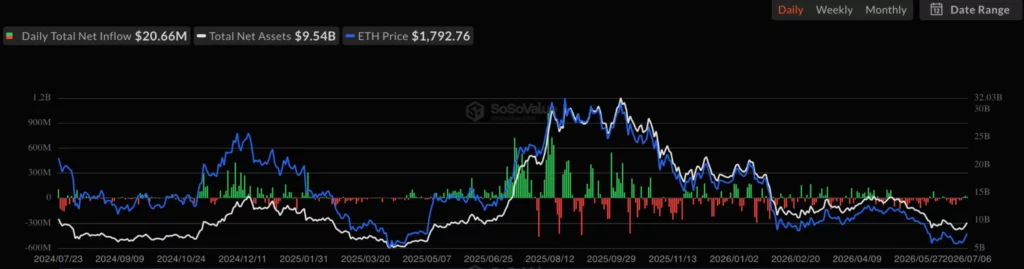
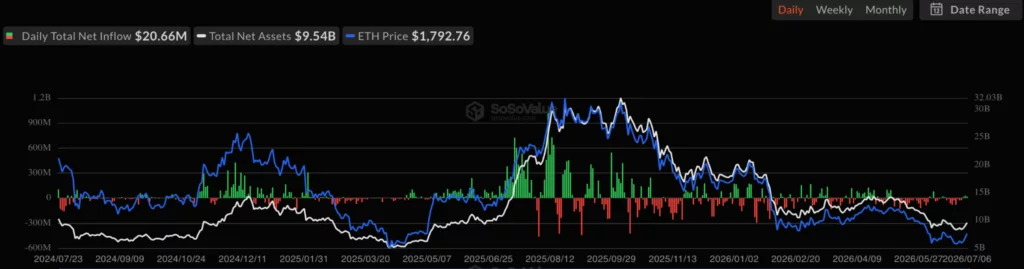
Ethereum climbed about 12% from July 1 as weaker U.S. jobs data and renewed spot ETF inflows brought buyers back into the market. According to SoSoValue data, on July 6, Ethereum spot ETFs recorded a total net inflow of USD 29.082 million, led by BlackRock’s ETHA with USD 29.742 million in single-day net inflows.
Analysts watch $1,800 and $1,844
Analyst Ali Charts said Ethereum is testing the 0.8 MVRV Pricing Band near $1,796. He said the same area aligns with the TD Sequential resistance trendline, making it a key technical level for traders.
Ali said a daily close above $1,796, followed by a hold as support, would strengthen the bullish case. He added that a move through the TD risk line at $1,816 could open the way for a test of the channel resistance near $1,844.
“A break above both $1,796 and $1,816 could trigger a bullish breakout,” Ali said in his Ethereum setup. He placed Ethereum’s realized price target near $2,245 if buyers clear those levels and hold momentum.
Daan Crypto Trades also pointed to $1,800 as the level that matters most on the current timeframe. “If bulls can get a daily close over $1,800, that’d be the first sign of strength for me,” he said in an X post.
The lower level remains clear. Daan and Ali both pointed to $1,750 as the support that bulls must defend. A loss of that level would weaken the current setup and could return focus to the $1,700 area.
Indicators support short-term recovery
The ETH/USDT daily chart shows a recovery from the June low. ETH bounced from the $1,500 to $1,600 range and moved toward $1,800 before cooling slightly.
Momentum indicators support the rebound. The MACD histogram is positive near 31.83, while the MACD line sits near -4.67 and above the signal line near -36.50. This shows improving momentum, though the MACD line still needs to move above zero to confirm a stronger trend shift.
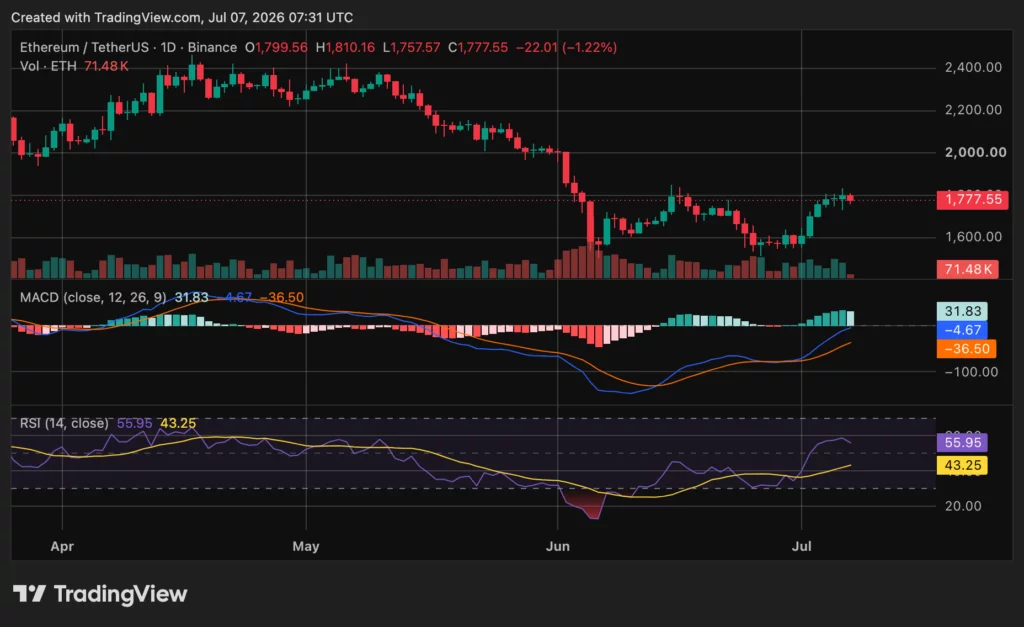
The RSI is also improving. It sits near 55.95, above its moving average near 43.25. That places RSI above the neutral 50 level, which shows buyers have short-term control without pushing the token into overbought territory.
As previously reported, Ethereum had already shown a rare TD buy signal while spot Ethereum ETF inflows returned.
Binance liquidity improves, but reserves raise risk
On-chain data gives a mixed view. CryptoQuant analyst Arab Chain said the ETH Binance 30-day exchange liquidity ratio rose to about 5.22. The reading was based on about 20.32 million ETH in 30-day trading volume and around 3.8 million ETH in Binance reserves.
That means each ETH held on Binance turned over more than five times during the period. The reading points to active trading and better use of available exchange liquidity. It also suggests that Binance can support strong ETH trading activity without a large rise in reserves.
Still, rising exchange supply remains a risk. CryptoQuant analyst BorisD said Binance held about 3.893 million ETH, while Bitfinex held 2.2 million ETH, OKX held 1.18 million ETH, and Bybit held 314,000 ETH. He said ETH inflows into Binance and OKX could add selling pressure if demand fails to absorb the extra supply.
Moreover, Binance users had already increased their ETH balances by 10.17% to about 4.14 million ETH in its June proof-of-reserves snapshot. Larger user balances can reflect deposits, purchases, internal transfers, or account activity, so the data does not show one clear reason.
The next test sits near $1,800. A clean daily close above that level could push ETH toward $1,844, then $2,060 and $2,245. A rejection, or a break below $1,750, would keep Ethereum in a choppy range and raise the risk of another move toward $1,700.
Disclosure: This article does not represent investment advice. The content and materials featured on this page are for educational purposes only.

Key Takeaways
- Sixteen months have passed since Trump’s executive order establishing a Strategic Bitcoin Reserve, yet implementation remains stalled
- A jurisdictional battle between Treasury and Commerce departments has created operational paralysis
- DOJ involvement seeks to clarify which agency possesses legitimate legal oversight
- Two congressional bills—the BITCOIN Act and ARMA Act—aim to provide statutory framework for the reserve
- America’s current Bitcoin holdings total 328,372 BTC, valued at approximately $21 billion
A bureaucratic turf war between federal agencies has thrown a wrench into the Trump administration’s ambitious plan to establish a Strategic Bitcoin Reserve.
In March 2025, President Trump issued an executive order designating the Treasury Department as the custodian for this digital asset reserve. The directive also called on additional federal entities to contribute to the stockpile through confiscated assets.
However, more than a year later, the initiative has yet to materialize. According to a Bloomberg report, the Commerce Department has now positioned itself as an alternative candidate for managing the cryptocurrency holdings.
The central dispute revolves around regulatory jurisdiction. Concerns have surfaced regarding Treasury’s legal capacity to manage Bitcoin, with some citing the cryptocurrency’s inherent price fluctuations as a complicating factor.
The Department of Justice has entered the fray, collaborating with both competing agencies to determine viable legal pathways forward.
The White House has maintained neutrality in this inter-agency conflict. Press Secretary Liz Huston stated the administration is “continuing to evaluate the best structure” for implementing the reserve.
Legislative Efforts to Establish Legal Framework
Congressional lawmakers have introduced two separate bills designed to provide statutory legitimacy to the reserve concept. Both the BITCOIN Act and the ARMA Act, filed in May, propose accumulating up to one million Bitcoin over a five-year timeline using fiscally neutral mechanisms.
White House cryptocurrency advisor Patrick Witt characterized ARMA as “Version 2” of the BITCOIN Act. He noted that significant White House resources have been dedicated to examining the legal complexities surrounding reserve establishment.
ARMA includes provisions requiring any Bitcoin deposited into the reserve to remain untouched for a minimum of two decades, with the sole exception being sales to offset the national debt, which is nearing $40 trillion.
Neither bill has advanced to passage. Should Republicans forfeit their House majority in upcoming midterm elections, the probability of legislative success would diminish substantially.
America’s Existing Bitcoin Position
The US government presently controls 328,372 Bitcoin, with a market value hovering around $21 billion. This position establishes the United States as the world’s largest sovereign Bitcoin holder.
That said, segments of these holdings have been liquidated periodically through judicially mandated sales.
At the time Trump signed his initial executive order, Bitcoin was trading near $93,000. The price has subsequently declined to approximately $64,000, representing a roughly 33% decrease.
Despite the delays and price volatility, some industry observers maintain optimism. Tim Kotzman, host of the Bitcoin Treasuries Podcast, suggested the reserve legitimizes “an entirely new category of capital allocation.”
On a global scale, 15 nation-states maintain Bitcoin holdings. El Salvador stands alone as the only country to have formally institutionalized a Bitcoin reserve program with regular acquisition protocols.
According to his latest financial disclosure documents, Trump personally holds Bitcoin assets exceeding $50 million.
Meta Platforms disclosed that four US states want $1.4 trillion in penalties over claims it built Facebook and Instagram to addict teenage users.
California, Colorado, Kentucky, and New Jersey filed the demand ahead of a federal trial in Oakland this August. Meta called the figure unsupported by the evidence.
A Penalty That Nearly Matches Meta’s Market Cap
The demand sits just below Meta’s market capitalization of roughly $1.5 trillion. In other words, the four states want almost everything the company is worth.
The tech giant revealed the number in a court filing that responded to the states’ proposed penalty math. The company argued that no consumer protection case in US history comes close.
“A sanction of that size has no analog in the history of consumer protection enforcement.”
The disclosure caps a bruising year. The stock already saw $175 billion wiped off its market capitalization in one April session after a $145 billion AI spending outlook rattled shareholders.
How the States Calculated the Fine
The states’ filings remain sealed. However, they told the court in June that they multiplied estimated violations against young users by fine amounts set in state law.
The August trial covers far more than four states. Overall, 29 states accuse Meta of collecting children’s data without parental consent under the Children’s Online Privacy Protection Act (COPPA).
Judge Yvonne Gonzalez Rogers rejected Meta’s bid to cancel the trial last month. Meanwhile, the teen mental health debate around the company keeps growing louder.
Meta denies the claims. It argues that social media addiction is not an established psychiatric condition, so its safety statements could not mislead anyone.
A further 14 states will press similar claims at a second trial in February. Therefore, the Oakland case only opens a much longer legal fight.
Meta Stock Shrugs Off the Trillion-Dollar Threat
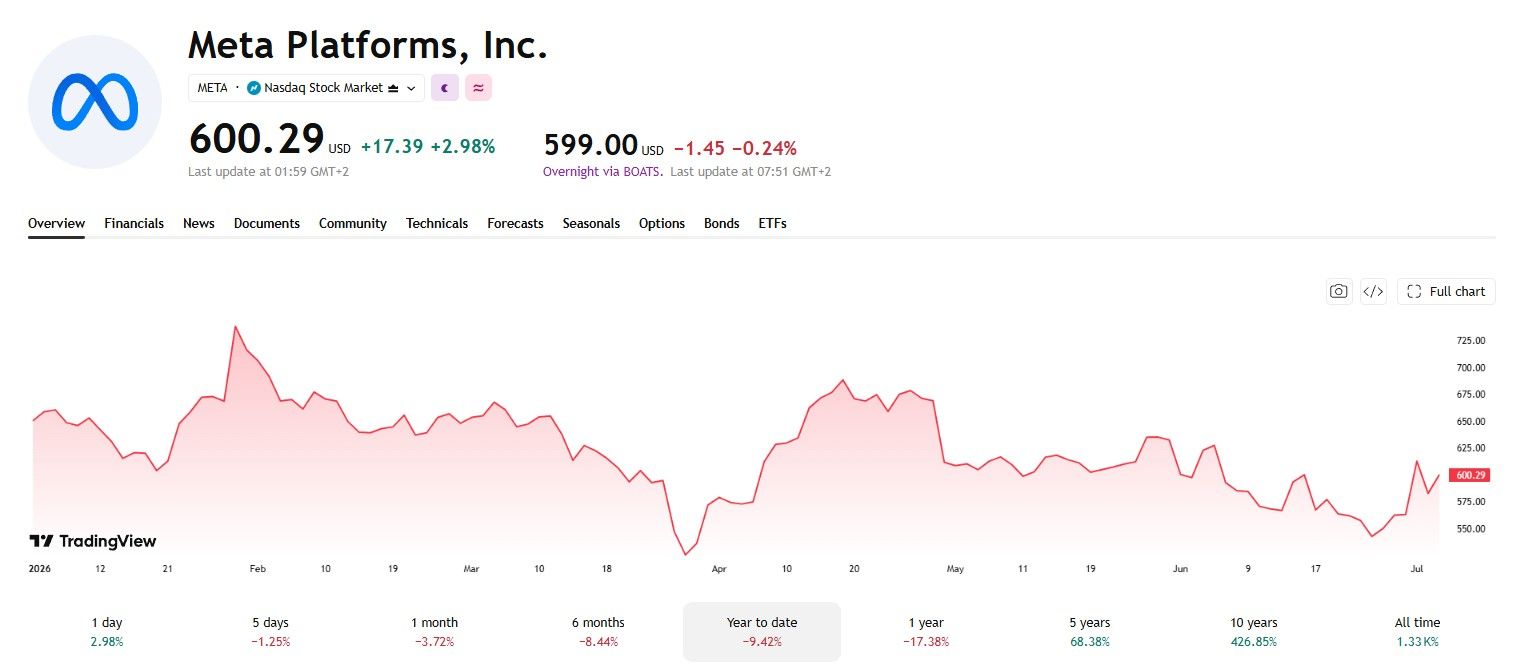
The stock closed near $600 on July 6, up almost 3% on the day. Investors clearly treat the $1.4 trillion figure as an opening bid rather than a likely outcome.

Still, the shares have dropped about 10% in 2026, and large funds keep rotating into Google stock. Polymarket traders also bet on rising tech layoffs as Meta employee morale craters.
New Mexico offers a warning, though. A jury there ordered Meta to pay $375 million in March for misleading consumers about child safety.
The Oakland verdict will show how far state consumer laws can stretch against Big Tech. Meta also faces a separate class action over data sharing, so its courtroom calendar stays full into 2027.
The post Meta Faces $1.4 Trillion Penalty Demand in US Youth Safety Lawsuit appeared first on BeInCrypto.
Gold is attempting to break its medium-term trend, with the latest US labour market data acting as the main catalyst. The US employment report released on 2 July came in noticeably weaker than expected, with the pace of hiring slowing to its lowest level in several months. This may have dampened expectations of a near-term Federal Reserve rate hike, while the minutes of the Fed’s June meeting, due to be released on 8 July, could provide further insight into how long this pause in the central bank’s rhetoric is likely to last. For now, markets are pricing in a more dovish scenario, supporting safe-haven assets such as gold.
Technical Analysis
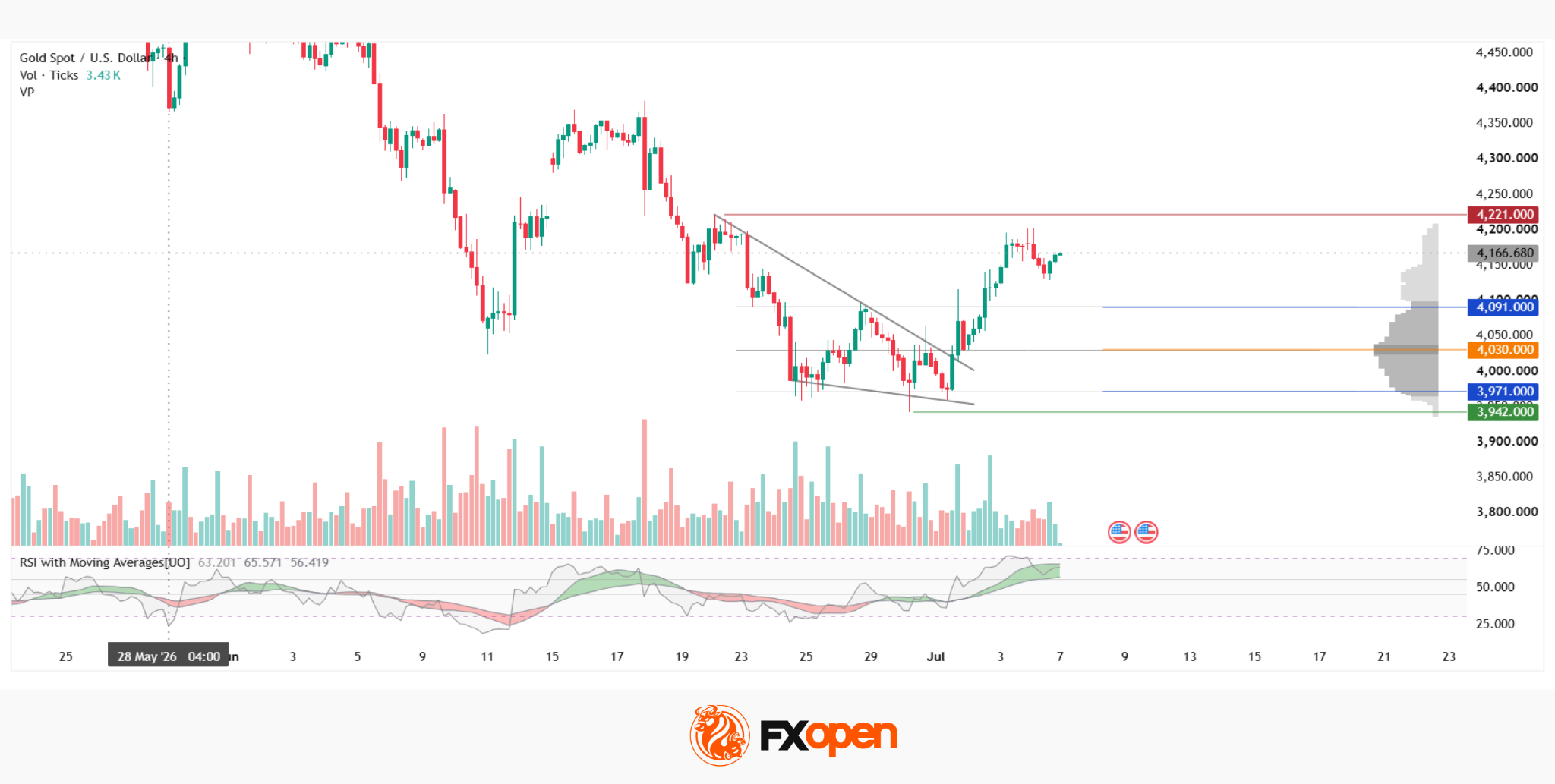
On the four-hour chart, XAU/USD declined from the $4,221 area in late June to around $3,942, where a recovery began. The decline formed a descending wedge, with its lower boundary attracting strong buying interest. This resulted in a sharp rebound, accompanied by a decisive breakout above both the pattern and the current market profile.
On 2 July, price closed above the upper boundary of the market profile at $4,091 and, if the rally continues, could target the base of the wedge. Should the market reverse, price is likely to retest the profile’s high-volume area, while the Point of Control (POC) at $4,030 and the lower profile boundary at $3,971 could provide support for buyers.
The RSI + MAs indicator currently stands at 62, 65 and 55. All three lines remain above the neutral level and continue to point higher, while the moving averages are still signalling bullish momentum. However, it is worth noting that the RSI has already entered overbought territory, suggesting that expectations for a substantial continuation of the rally should remain cautious.
Key Takeaways
The breakout from the descending wedge may have been interpreted by market participants as the beginning of a local trend reversal. However, a move towards the red resistance zone and a test of that area remain highly uncertain, particularly ahead of the release of the Federal Reserve’s June meeting minutes, which could significantly reshape market expectations.
Trade over 50 forex markets 24 hours a day with FXOpen. Take advantage of low commissions, deep liquidity, and spreads from 0.0 pips (additional fees may apply). Open your FXOpen account now or learn more about trading forex with FXOpen.
This article represents the opinion of the Companies operating under the FXOpen brand only. It is not to be construed as an offer, solicitation, or recommendation with respect to products and services provided by the Companies operating under the FXOpen brand, nor is it to be considered financial advice.
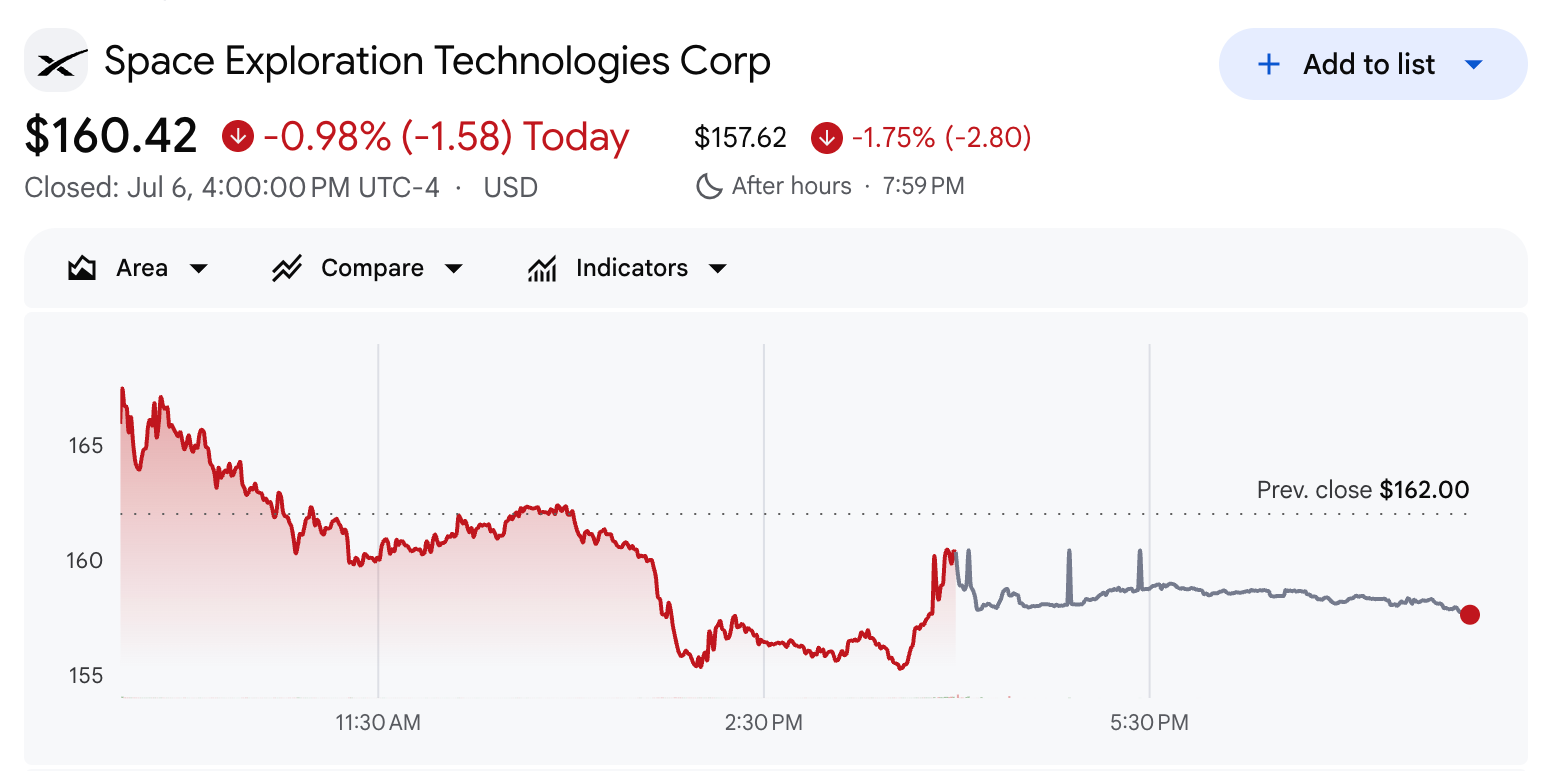
SpaceX stock (SPCX) enters the Nasdaq-100 before US markets open on Tuesday. The move lands as SPCX trades roughly 29% below its recent peak.
Nasdaq confirmed on June 26 that SPCX would join, less than a month after its June 12 listing.
SPCX Stock Gives Back Its Post-IPO Gains
Space Exploration Technologies Corp went public on June 12, reaching a valuation of nearly $2 trillion. The shares opened near $150, well above the $135 IPO price.
The initial rally carried the SPCX stock to an all-time high of $225.64. However, the stock has since retreated sharply.
SPCX has fallen roughly 29% over the past few weeks. The stock closed at $160.42 on Monday, down -0.98%.

What the Inclusion Means for SPCX
Index-tracking funds must buy SPCX to match the benchmark. That demand can lift a stock, though the effect depends on its weight.
Follow us on X to get the latest news as it happens
JPMorgan estimates SpaceX will carry about a 1.3% weight, ranking near 21st, behind names like Nvidia, Walmart, Intel, and Tesla.
“But the smaller the percentage weighting within the index that any given constituent holds, the less stock anybody trying to track that index is going to have,” Mike Khouw, chief strategist at OpenInterest.PRO, told CNBC. “Make no mistake, this is still very high volatility.”
Volatility also remains a concern. JJ Kinahan, senior vice president at Cboe, urged caution over near-term swings.
“We know volatility is high. There’s a sense volatility may increase. Are you comfortable with a $20 expected move over the next 11 days?” he said.
Meanwhile, expiring lockups could work against the buying. Insider restrictions lift in tranches between 70 and 135 days after the June 12 IPO. Shares held by Elon Musk and other large backers stay locked for 366 days.
Susquehanna analyst Charles Minervino called the schedule a near-term overhang for the stock, since fresh supply may hit just as index demand builds. The next sessions will test whether index buying can offset that overhang.
Subscribe to our YouTube channel to watch leaders and journalists provide expert insights
The post SpaceX Joins Nasdaq-100 Tuesday as SPCX Drops Roughly 29% appeared first on BeInCrypto.
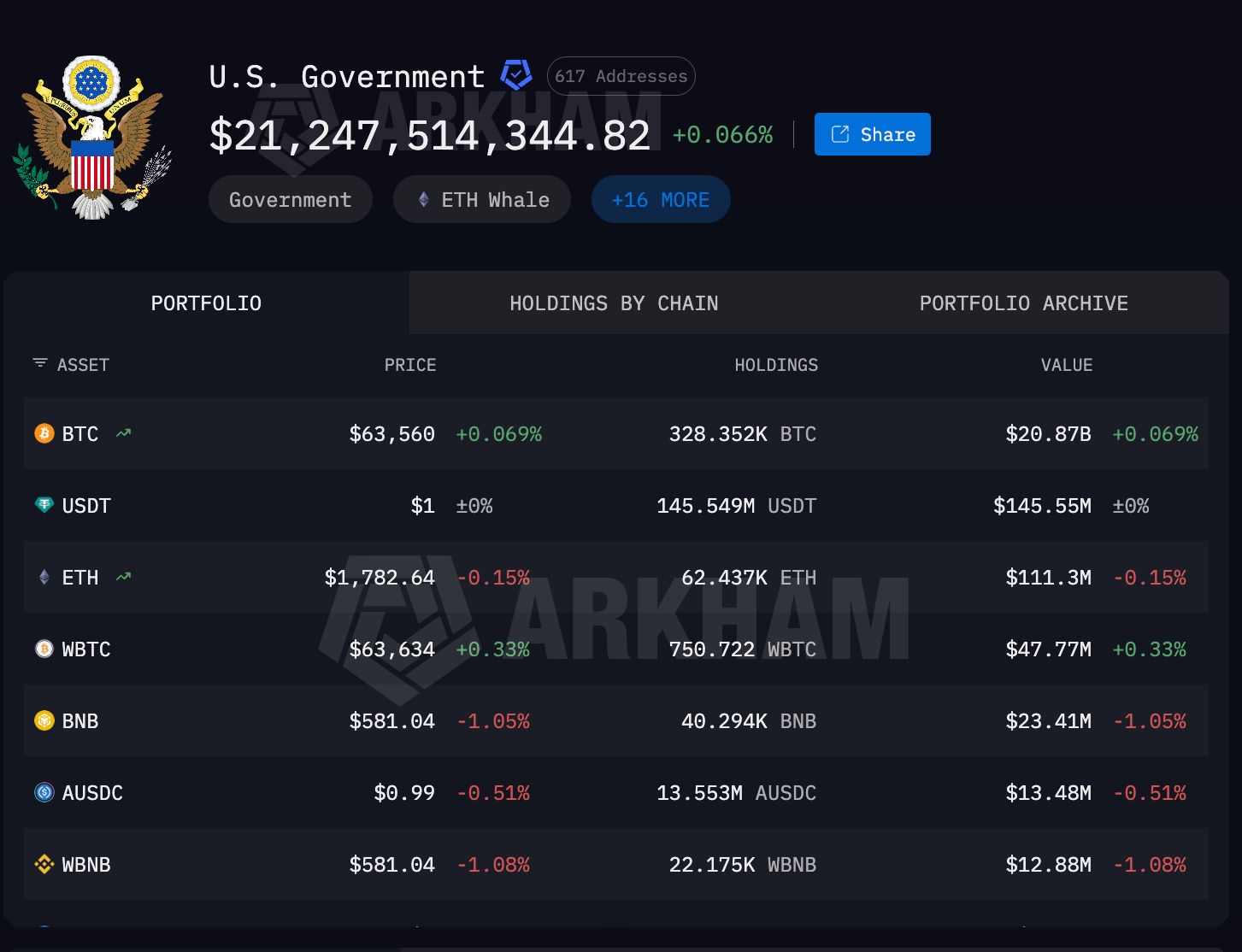
Legal questions over which federal department can lawfully manage a national crypto trove have complicated President Donald Trump’s Strategic Bitcoin Reserve, more than a year after he ordered its creation.
Trump directed the reserve into existence last year as part of his pledge to make the United States “crypto capital of the world.” The plan has since run into a structural problem.
Which Agency Can Legally Hold America’s Bitcoin Remains Unresolved
The order intended the reserve to sit inside the Treasury Department. Bitcoin (BTC) would come from federal asset seizures. The order also empowered the Treasury and Commerce secretaries to design budget-neutral ways to buy more Bitcoin, provided the purchases cost American taxpayers nothing.
Concerns then surfaced over whether Treasury could legally manage the assets, Bloomberg reported, citing people familiar with the matter. Housing the reserve inside the Commerce Department is now one option.
Another open question is whether Bitcoin can be held indefinitely, as the order intended, given its price swings.
Follow us on X to get the latest news as it happens
The Justice Department’s Office of Legal Counsel is working with both departments to “determine legally available options to accomplish the president’s policy of establishing a strategic Bitcoin reserve.”
White House spokesperson Liz Huston addressed the matter in a statement shared with BeInCrypto. She said the administration was still working out the right setup for the reserve.
“President Trump campaigned on a vision of cementing America as the global capital of cryptocurrency and other cutting-edge technologies,” Huston said. “To deliver on the president’s vision, the Trump administration continues to evaluate the best structure for a Strategic Bitcoin Reserve and U.S. Digital Asset Stockpile.”
The US government ranks among the largest holders of Bitcoin worldwide. Its holdings exceed $20 billion at current prices, according to Arkham Intelligence.

How the administration resolves the authority question will determine whether one of its signature crypto commitments takes shape or stays on paper.
Subscribe to our YouTube channel to watch leaders and journalists provide expert insights
The post Whose Bitcoin Is It? The Legal Fight Stalling Trump’s $20 Billion Reserve appeared first on BeInCrypto.


Naver Financial has postponed the completion of its all-stock share swap with Dunamu for a second time, extending the closing date to Dec. 31 as regulatory approvals remain pending.
Summary
- Naver Financial and Dunamu have delayed their planned share swap for a second time, with completion now expected on Dec. 31.
- The deal remains subject to multiple regulatory approvals and could face further delays or cancellation if those processes are not completed.
- Dunamu said South Korea’s proposed Digital Asset Basic Act could still influence the structure or outcome of the transaction.
According to a regulatory filing disclosed by Dunamu, the planned comprehensive share exchange with Naver Financial has been rescheduled from Sept. 30 to Dec. 31, following an earlier postponement that moved the timeline from June 30 to September.
Share swap awaits regulatory approvals
The filing kept the exchange ratio unchanged at 2.5422618 Naver Financial shares for every one Dunamu share. It also repeated that completion of the transaction depends on approvals from South Korea’s Fair Trade Commission, clearance for changes in major shareholders under the Credit Information Act, and notifications required under the Act on Reporting and Use of Specific Financial Transaction Information.
Dunamu said in the filing that delays in those approval processes could push the schedule back further or even prevent the share exchange from being completed. The company also noted that ongoing discussions around South Korea’s proposed Digital Asset Basic Act could affect the transaction depending on the final form of the legislation once it is enacted and implemented.
The latest delay comes after Naver Financial previously postponed the transaction in March, when it moved the expected completion date from late June to Sept. 30 while citing regulatory approval procedures and legal developments.
At the time, the company said the deal remained subject to several government approvals and could face additional delays or cancellation depending on the outcome of those reviews.
Merger continues under regulatory scrutiny
Regulatory oversight has also intensified since the transaction was first announced. In April, South Korea’s Financial Supervisory Service ordered Dunamu to correct omissions in its disclosure related to the merger after identifying missing or inaccurate information concerning future corporate restructuring plans and other matters important to investors.
The regulator’s review came as lawmakers continued debating the Digital Asset Basic Act, with local reports indicating that proposed limits on major shareholders of virtual asset exchanges could affect Naver Financial’s plan to acquire full ownership of Dunamu. Dunamu has previously stated that it intends to proceed with the transaction despite the legislative uncertainty.
The all-stock deal, confirmed in late 2024, values Dunamu at around $10 billion and is expected to bring the operator of Upbit under Naver Financial. The companies have also outlined plans to cooperate on digital asset services, including the development of the Silk Pocket stablecoin wallet alongside blockchain investment firm Hashed and the Busan Digital Exchange.


U.S. spot bitcoin ETFs pulled in $265.69 million on Monday, the largest daily inflow in over a month and the second in three sessions after July 2 broke a long run of outflows, per SoSoValue data. Ether ETFs added $20.66 million the same day, led by BlackRock’s ETHA at $23.29 million.
BlackRock’s IBIT absorbed $209.40 million of the bitcoin total, with ARKB taking in $32.98 million and Grayscale’s mini BTC fund adding $42.25 million. GBTC shed $44.45 million, the only fund in the red.
The daily turn has not fixed the weekly picture yet. Spot bitcoin ETFs still lost a net $526.6 million over the shortened holiday week, an eighth straight week of negative flows. Ether ETFs lost $13.7 million on the week.
Total bitcoin ETF assets climbed back to $77.32 billion from a June 30 low of $70.95 billion, helped by both the price recovery and the returning bid. Bitcoin traded near $63,200 as the data landed, per CoinDesk data.

The Biggest Lie About Saving Money. #finance #psychology #moneymindset

Brit, 20, fighting for life after devastating lads’ holiday quad bike crash in Zante

Freedom Holding Corp. Takes Investing To a New Level of Personalization and Real-Time Intelligence


-

 Fashion4 days ago
Weekend Open Thread: High Hopes
-

 Politics4 days ago
The House | “Reframing the debate from a binary discussion of winners and losers”: Yuan Yang reviews ‘We Are Not Machines’
-

 Fashion16 hours ago
Open Thread: What Great Books Have You Read Recently?
-
 NewsBeat2 days ago
Taylor Swift and Travis Kelce wedding staffer hilariously struggles to keep her cool while checking in megastars
-

 News Videos7 days ago
How to Build INSANE Live Financial Dashboards With Claude
-
Crypto World6 days ago
Airdrop Registration Becomes Key Focus For Remittix As RTX Launch Updates Approach
-

 Sports6 days ago
Broncos roster: OL Ben Powers (No. 74) entering final year of contract
-

 Crypto World5 days ago
Binance stock trading tops $1B in first month after launch
-

 NewsBeat6 days ago
Presenter Caroline Flack’s brother Paul Flack dies aged 55
-

 Crypto World5 days ago
Alibaba-affiliate Ant Group enters the humanoid robot market with 12 deals
-

 Crypto World4 days ago
Standard Chartered Secures MiCA License as ESMA Adds 37 New Crypto Firms
-

 Crypto World2 days ago
South Africa proposes crypto tax guidance under existing rules
-

 News Videos17 hours ago
Best Time to Enter Small Caps Right Now? Another Bull Run? | Financially Free
-

 Business5 days ago
Meta Platforms Stock Jumps 7% Today as Bloomberg Reports Company Plans to Enter the Cloud Business
-
 NewsBeat5 days ago
New exhibition reflects five decades of movement between island of Ireland and GB
-

 Tech2 days ago
Lenovo laptops are now shipping with YMTC SSDs, a sign of Chinese NAND entering the mainstream
-

 Business4 days ago
What a 10 Percent Drop Means for Buyers, Sellers and Renters
-

 Crypto World4 days ago
Binance Re-Enters Philippines As EU MiCA Rules Restrict Access
-

 News Videos20 hours ago
Avoid entering in FOMO #bitcoin #cryptocurrency #trading #scalping
-

 News Videos4 hours ago
Whats Hidden Inside This Cash Register? #treasure #reselling #money
You must be logged in to post a comment Login