
Crypto World
SpaceX Joins Nasdaq-100 Tuesday as SPCX Drops Roughly 29%

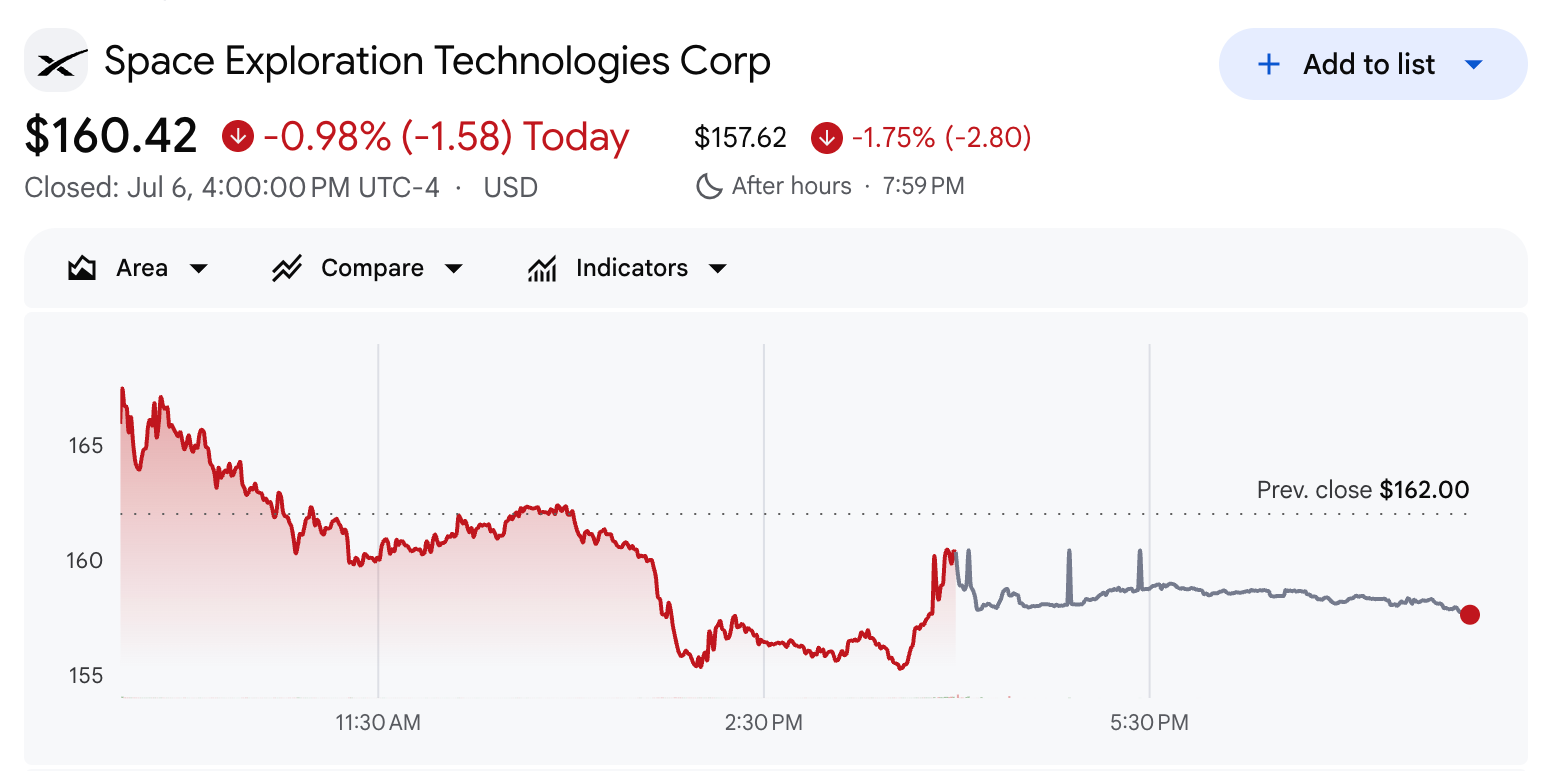
SpaceX stock (SPCX) enters the Nasdaq-100 before US markets open on Tuesday. The move lands as SPCX trades roughly 29% below its recent peak.
Nasdaq confirmed on June 26 that SPCX would join, less than a month after its June 12 listing.
SPCX Stock Gives Back Its Post-IPO Gains
Space Exploration Technologies Corp went public on June 12, reaching a valuation of nearly $2 trillion. The shares opened near $150, well above the $135 IPO price.
The initial rally carried the SPCX stock to an all-time high of $225.64. However, the stock has since retreated sharply.
SPCX has fallen roughly 29% over the past few weeks. The stock closed at $160.42 on Monday, down -0.98%.

What the Inclusion Means for SPCX
Index-tracking funds must buy SPCX to match the benchmark. That demand can lift a stock, though the effect depends on its weight.
Follow us on X to get the latest news as it happens
JPMorgan estimates SpaceX will carry about a 1.3% weight, ranking near 21st, behind names like Nvidia, Walmart, Intel, and Tesla.
“But the smaller the percentage weighting within the index that any given constituent holds, the less stock anybody trying to track that index is going to have,” Mike Khouw, chief strategist at OpenInterest.PRO, told CNBC. “Make no mistake, this is still very high volatility.”
Volatility also remains a concern. JJ Kinahan, senior vice president at Cboe, urged caution over near-term swings.
“We know volatility is high. There’s a sense volatility may increase. Are you comfortable with a $20 expected move over the next 11 days?” he said.
Meanwhile, expiring lockups could work against the buying. Insider restrictions lift in tranches between 70 and 135 days after the June 12 IPO. Shares held by Elon Musk and other large backers stay locked for 366 days.
Susquehanna analyst Charles Minervino called the schedule a near-term overhang for the stock, since fresh supply may hit just as index demand builds. The next sessions will test whether index buying can offset that overhang.
Subscribe to our YouTube channel to watch leaders and journalists provide expert insights
The post SpaceX Joins Nasdaq-100 Tuesday as SPCX Drops Roughly 29% appeared first on BeInCrypto.

The latest earnings week has handed investors a clear shortlist of US stocks to watch in August. Three of the market’s largest companies just reported, and Wall Street split its verdict between reward and punishment.
The divide came down to one test, which AI spender could prove that customers are paying for the build. It left the winners with strong setups and one laggard facing a cautious road into August.
Microsoft (NASDAQ: MSFT)
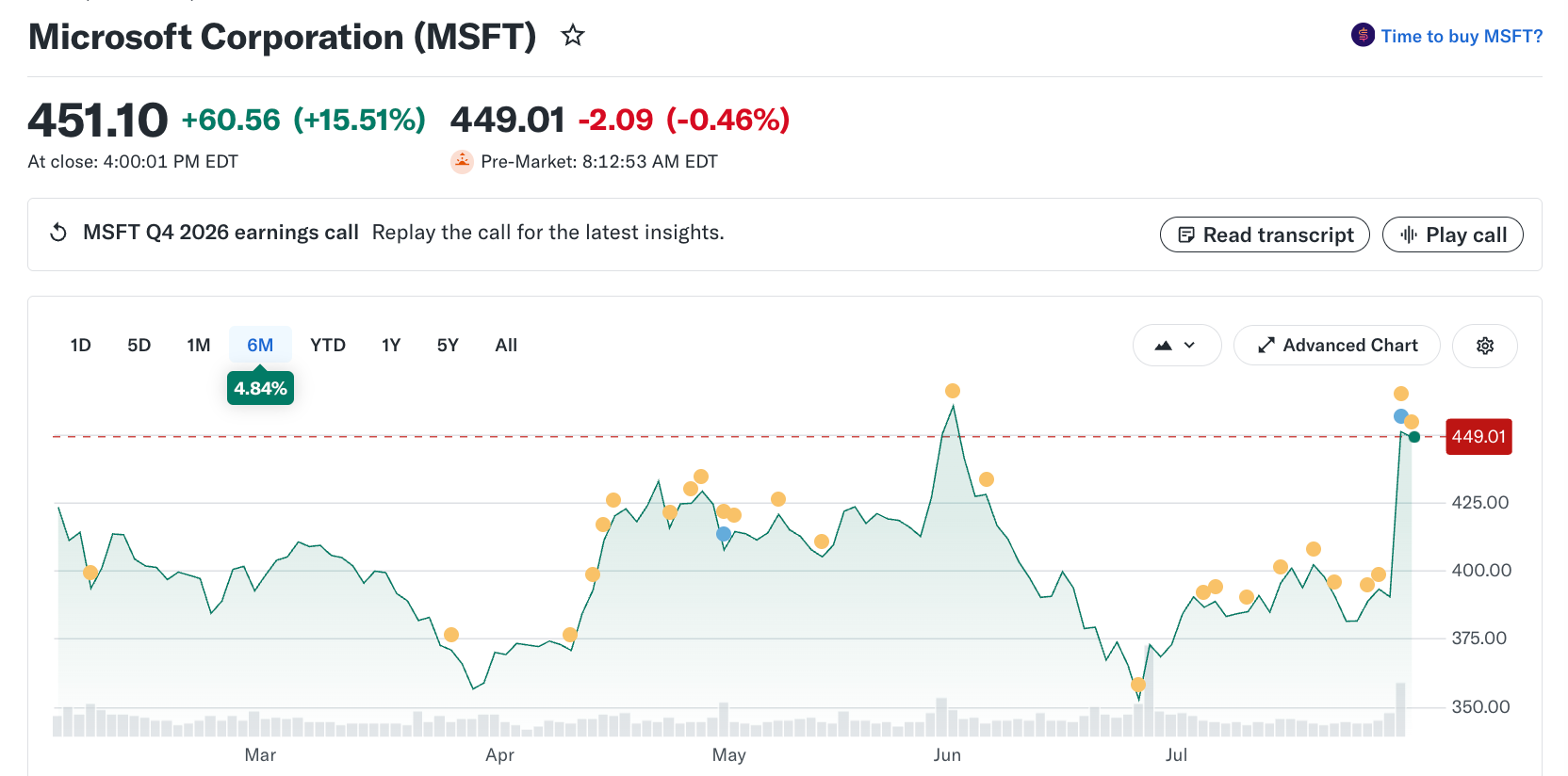
Microsoft soared about 15% to near $451 after its July 29 results, its biggest jump in months. Trading volume, the number of shares changing hands, hit its highest since June 22, which shows strong conviction behind the buying.
Want more insights like this? Sign up for Editor Harsh Notariya’s Daily Newsletter here.
Yet the rally is not fully convincing. That volume still sits below the heavy selling of late June, so buyers have not fully overpowered sellers.

The Chaikin Money Flow (CMF), a gauge of whether institutional money is flowing into or out of a stock, shows the same doubt. It nearly turned negative before earnings, then rose to 0.04 as big investors reacted. It still sits below its July 24 peak, and it must reclaim that level to confirm institutions are truly buying.

The fundamentals explain the jump. Microsoft spent $41 billion on capital expenditure, the cost of building AI data centers, but backed it with a $678 billion book of signed customer contracts. That locked-in demand proves the spending is funded by real orders, which is the bullish case. It also guided Azure cloud growth toward 45%, and faster growth at that scale points to rising future revenue.
Wall Street agrees. The stock holds a Strong Buy rating, with 24 of 25 firms on Buy, signaling broad expectations of more upside.

Only Barclays trimmed its target, a lone caution that matches the soft volume.
Amazon (NASDAQ: AMZN)
Amazon carries the strongest analyst support of the three, making it one of the more bullish US stocks to watch into August. All 28 covering firms rate it Buy, with none on Hold or Sell, and every major desk raised its price target after earnings. That rare unanimity gives Amazon the cleanest bull case of the week.

Options positioning backs that optimism. The put-to-call volume ratio, which compares bearish bets against bullish ones, fell from 0.74 to 0.54 into the print, meaning traders bought far more calls and leaned bullish.

The open interest ratio, the standing option contracts already in place, held steady at 0.66. That shows longer-term money has not fully committed yet, which leaves room for new buyers to lift the stock in August.
The business explains the confidence. Amazon Web Services, its cloud arm, reaccelerated, and the company disclosed a $496 billion backlog of signed customer demand. When Alphabet and Meta raised their AI spending, investors sold both stocks, fearing spending with no proven payoff. Amazon raised spending too, but its backlog proved customers had already agreed to pay, so the stock rose instead.
There is a catch worth knowing. Amazon’s headline $5.75 per share reads like a huge beat, but most of it came from a one-time paper gain on its Anthropic stake, not from the core business. Strip that out, and profit still rose a healthy 43%, so the bull case holds. The real pressure is cash, because heavy AI spending has pushed free cash flow, the money a company keeps after building, into the red over the past year.
Meta Platforms (NASDAQ: META)
Meta is the outlier among the top US stocks to watch. The stock fell about 8% to near $539 and now sits roughly 23% below its mid-July high.

The problem is cash, not sales. Revenue grew 28%, but free cash flow collapsed to $784 million from $8.55 billion a year earlier. Capex nearly swallowed all the cash the business generated, so Meta leaned on about $25 billion of new debt to keep funding its dividend, which unsettles investors.
Unlike Microsoft and Amazon, the other two US stocks to watch, Meta disclosed no backlog of signed demand, so it cannot yet prove the AI build will pay off. Its core apps also earned less, as Family of Apps operating income, the profit from Facebook, Instagram and WhatsApp, slipped to $23.4 billion from $25 billion. The strongest ad engine on earth delivered a weaker bottom line.
The chart warns of more risk. Meta’s CMF trended lower even as the price climbed from early June to mid-July, and a deep correction followed. It still has not cleared the 0.05 line that would confirm buyers are back, so the same bearish drop could repeat.

Analysts stay loyal but nervous. Meta keeps a Strong Buy, yet at least ten firms cut price targets overnight, including Citi to $800 from $850.

That lower ceiling with unchanged ratings signals near-term caution even from believers.
The post 3 US Stocks To Watch In August 2026 After Big Earnings Week appeared first on BeInCrypto.
Fundstrat’s Tom Lee says the artificial intelligence (AI) trade is not finished. He argues the next leg runs through crypto payment rails built for software agents rather than people.
Veteran macro investor Jordi Visser argued the opposite this week. Lee also chairs the largest corporate holder of ether, which gives his version of the thesis a direct financial stake.
Why Lee Says Chips Were Only the First Leg
Lee, co-founder and head of research at Fundstrat, made the case on a panel hosted by the firm. He covered mobile phones as an analyst in the early 1990s.
Motorola and the infrastructure suppliers led that cycle early. The larger winners arrived later, namely the tower companies spun out of the carriers, and Apple.
Lee expects the same shape now, with financial services as the downstream market. He has already called AI capital spending fears a bullish market tell.
The Four Reasons Banks Cannot Bank Agents
Lee listed trust, proof of funds, lending, and tax collection as the reasons people built commerce around banks. Agents need none of those, he argued.
“It’s a mistake to think that this is going to be built on traditional financial rails,” Lee said.
Bank ledgers must settle in a single national currency. Money is becoming code, according to Lee, so equities, gold, and tokens could all clear as payment.
Part of that rail already exists on paper. ERC-8183, a proposed Ethereum standard filed on Feb. 25, locks an agent’s payment in escrow until a designated evaluator signs off.
Ethereum Foundation researcher Davide Crapis co-authored it with three Virtuals Protocol engineers. It carries Draft status, so nothing about it is final.
Where Tom Lee and Visser Split on the AI Trade
Visser leads AI research at 22V Research and spent two decades at Weiss Multi-Strategy Advisers, latterly as chief investment officer. He says AI’s easy money is over.
He now expects roughly 30% a year instead of the seven or eight times investors once chased. Lee reads the same compression as rotation.
The two converge on the destination. Both expect fee-earning networks to absorb the flow, and both name Ethereum.

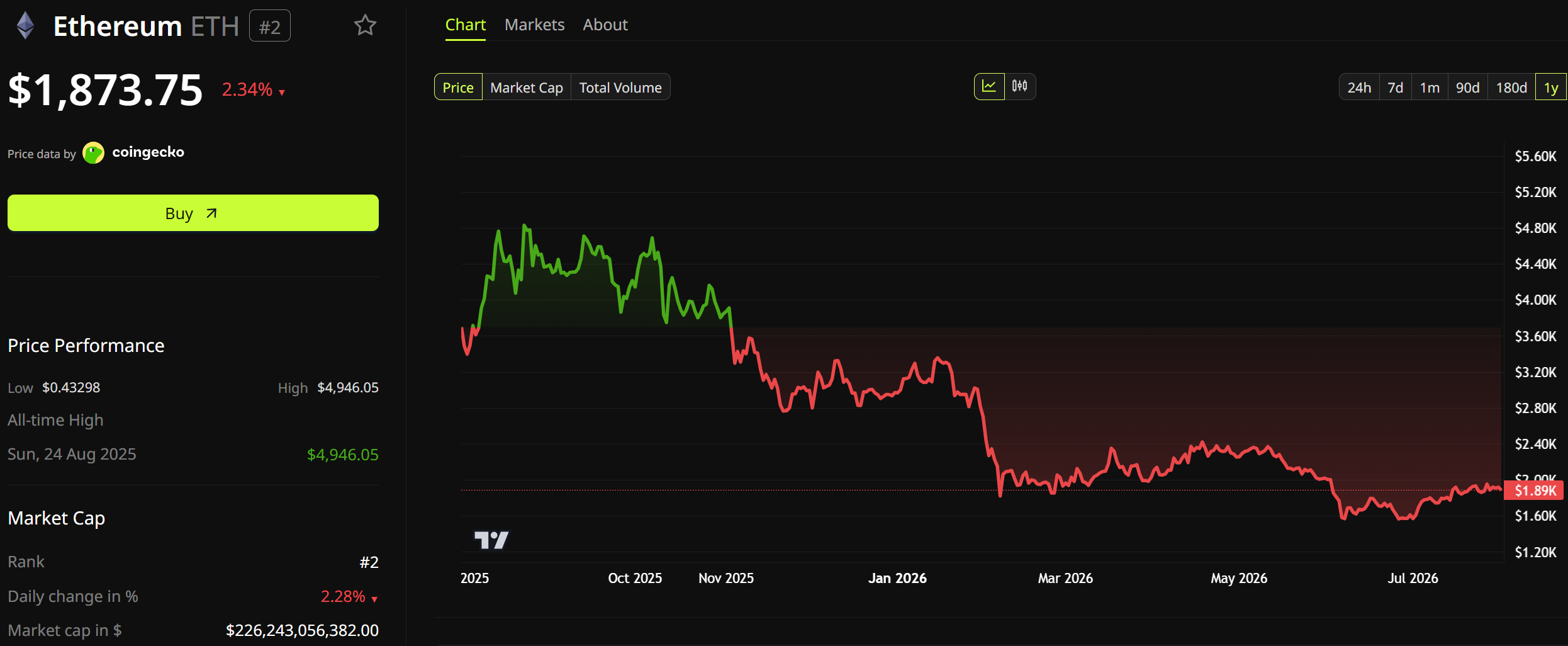
Ethereum trades near $1,873 after gaining 19.7% over 30 days. It still sits 51% lower across 12 months, and just over 2% below its trading price the previous day.
Follow us on X to get the latest news as it happens
Lee’s $11.8 Billion Reason to Prefer Ethereum
Lee chairs BitMine Immersion Technologies, the largest corporate holder of ether. The company disclosed 5.79 million ETH on July 27, close to 4.8% of circulating supply.
Crypto and cash holdings reached $11.8 billion. BitMine states the dependency plainly in its own investor materials.
“So our future price for Bitmine stock is heavily dependent on the future price of Ethereum,” Lee said in the July chairman’s message.
Lee puts the correlation between BitMine shares and ether at 90%. Anyone weighing his agent thesis is also weighing that balance sheet, which rallied this month on its ETH treasury bet.
The Numbers Do Not Match the Story Yet
Jansen Teng, co-founder and chief executive of Virtuals Protocol, shared the panel with Lee. His platform lets agents hold wallets and pay each other onchain, and his figures undercut the timeline.
Teng said the launchpad for agent tokens has cleared about $15 billion in trading volume. Agent-to-agent commerce has settled roughly $500 million in a year.
Speculating on agents is therefore some 30 times larger than agents transacting. Both figures are company-reported and have not been independently verified.
Teng said the agents kept $2.5 million in profit, and that the product has not reached product-market fit (PMF). Virtuals commissioned the Fundstrat research and is a client of the firm.
Its VIRTUAL token trades near $0.56, down 89% from a January 2025 peak, even after agents started trading tokenized stocks onchain.

So the question is not whether the AI trade ended. It is whether machine payments arrive before the balance sheets betting on them need the story to work.
The post Tom Lee vs Jordi Visser on the AI Trade: Both End Up at Ethereum appeared first on BeInCrypto.
Coinbase said it captured a record 10.3% share of global crypto trading volume during the quarter, its third consecutive quarterly gain. Analysts at Benchmark, Oppenheimer, Clear Street and Cantor all highlighted the figure as evidence that trading activity is consolidating onto larger regulated exchanges during periods of market stress.
Several also pointed to derivatives, where Coinbase reported flat trading volumes despite management saying the broader derivatives market declined by double digits.
Diversification shows progress, but isn’t enough
Analysts viewed Coinbase’s push beyond spot trading as encouraging, even though the newer businesses remain too small to offset weakness in core trading revenue.
The company is trying to diversify through prediction markets, derivatives, subscriptions, stablecoins and its Base blockchain. Prediction markets surpassed a $100 million annualized revenue run rate, while Coinbase One topped one million paid subscribers. Its Circle partnership for USDC also renewed on existing terms, removing a key concern for investors.
Still, there was broad agreement that diversification has not yet become large enough to replace lost trading revenue.
Clear Street noted new businesses continue gaining traction but remain “optionality” rather than meaningful earnings contributors. Barclays was more critical, arguing prediction markets and retail derivatives “did not” provide the boost they offered last quarter. Compass Point similarly said emerging businesses “barely moved the needle.”


“This is by far the biggest Iranian illegal gambling network ever discovered and one of the biggest in the world,” said John Wojcik, a former researcher at Infoblox and now senior analyst at TRM Labs, who spent seven years investigating illegal gambling for the United Nations Office on Drugs and Crime.
It is also one of the largest Iranian sanctions-evasion networks discovered since 2016, when the U.S. broke up a roughly $20 billion IRGC gold-for-oil operation based in Turkey. Separately, the U.S. seized $1 billion in crypto from Iran in May.
“It’s an IRGC operation, and that’s plain as day,” Rich Sanders, an independent blockchain researcher and investigator focused on Iran, said of Shelbit. Reuters said it could not determine whether the IRGC directly controlled Shelbit or the gambling network.
The IRGC, founded in 1979, is the country’s most powerful and influential military, political and economic institution that answers directly to the country’s supreme leader, Mojtaba Hosseini Khamenei.
Shelbit also interacts directly with Iran’s central bank, wallets linked to the IRGC by the Israeli government, and Nobitex, an Iranian exchange that the U.S. government sanctioned earlier this year after a Reuters investigation revealed its ties to the government. Some of the crypto flowing to Shelbit came from what the two investigative firms described as an Iranian bitcoin mining operation that creates new digital coins.

European support for Ukraine remains strong, and governments suffering from higher prices are more likely to blame Moscow than Kyiv. But Putin is now so anxious for battlefield wins that he will stay the course even without a clear-cut victory. Nor should we expect a revival of the agreement brokered by the United Nations in July 2022 that restored safe maritime traffic to and from Ukrainian ports.
Just as the standoff in the Strait of Hormuz has sent neighboring countries scrambling for new ways to move oil out of the Persian Gulf, Ukraine may be able to move grain through the Danube, via Romanian ports, and by rail, as it did in the war’s early days. But as before, diversions are costly and logistically complicated.
For all these reasons, the shape of Russia’s war on Ukraine will continue to shift as each side searches for new ways to break the battlefield stalemate in its favor. And the economic damage, felt well beyond Ukraine and Russia, will continue.


Traders have no way to react to events after markets close on TradFi venues. Perps on the other hand run 24/7. The Iran conflict was reflected in oil perps on Hyperliquid before CME reopened. Perps offer a continuously running, efficient market in a simple interface. Futures and options come with expiry dates, complicated greeks and interfaces. Perps remove all of that while keeping the speculative upside potential intact.
Martin Lee is Market Insights Lead of DWF Labs, one of the most active market makers and investors in digital assets.
Derivatives always outgrow spot
Derivatives volumes always outgrow their underlying spot market. It’s what we see in equities, commodities and crypto. RWAs are following the same trend. Equity perp volume on Hyperliquid ran 13-20x tokenized equity spot volume between March and May 2026.
You could argue that the number of traders matter more, a metric that spot usually wins out across most markets (except commodities). Looking into the numbers, tokenized equities have the bigger base: 180,845 wallets against 24,378 for equity perps. But perp holders are compounding at roughly 33% a month against spot’s 17%. Even in the domain where spot dominates, perps are rapidly closing the gap.
Perps innovate faster
The biggest factor driving the acceleration is the rapid rate of experimentation that RWA perps are able to have. Launching tokenized assets takes much longer and is more legally complex than launching a new perp market. The ease of launching perp markets creates opportunities for novel synthetic markets to be spun up. Markets that unlock fresh opportunities that didn’t exist before. A true 0 to 1 moment.
The team behind Pi Network set a deadline for its next big upgrade, while Solana’s native token risks plunging to as low as $50.
Bitcoin (BTC) may also head south, but interestingly, some analysts believe such a move could actually benefit the bulls.
Pi Network’s Announcement
The Core Team has been on a tear since the start of 2026, unveiling several major ecosystem improvements. The latest was the migration to protocol version 25, which was supposed to be deployed earlier this month.
Pi Network’s team did not disclose the move on X or on its website, yet multiple users claimed that it was in effect. The project has now shifted its attention to the next protocol update (version 26), setting August 11 as the deadline.
“All Mainnet note operators must complete the upgrade before the deadline to remain connected to the network,” the post reads.
The team also shared additional details about its Pi Launchpad model. It explained that in this ecosystem, projects issue tokens as tools to acquire users for their applications and integrate those coins directly into product functionality, such as rewards, payments, access, and governance.
“Instead of being taken by the issuing project, the proceeds of Pi from their token launch go to a liquidity pool with the ecosystem token, which bootstraps a healthy liquidity foundation from the start,” the team added.
PI, which was bleeding heavily prior to the aforementioned announcements, managed to rebound and now trades at around $0.08. Still, it remains down roughly 97% from its all-time high of $3 registered last year.
SOL at Risk
Solana’s native cryptocurrency has slipped by 3% over the past week, currently trading at around $73.50. This means that it has plunged below the $73.75 mark, which the popular analyst Ali Martinez recently described as a “make-or-break” level.
He believes that a sustained close under this key zone might trigger further selling pressure and result in a collapse to $60 and even $50 in the near future.
However, not all are pessimists. X user Crypto Zenkai argued that buying SOL below $80 is like investing in Bitcoin (BTC) in 2010, while Lucky told his nearly 2 million followers that the asset’s plunge under $75 might represent a “juicy dip.”
BTC Needs to Fall?
As of press time, the primary cryptocurrency is worth approximately $63,800, a 2.5% decline on a weekly basis. And while bulls eagerly await a resurgence, Martinez claimed they should actually welcome a potential drop to $60K.
He believes that a plunge to that level would validate the formation of a classic inverse head-and-shoulders pattern that is typically seen as a precursor to a rally. The analyst opined that completing the setup, combined with a confirmed breakout above $66,500, could set the stage for a rally to a two-month high of $74K.
Not long ago, Martinez predicted that BTC’s bear market (assuming the 4-year cycle holds) may conclude between October 6 and October 16. Until then, many industry participants expect the asset’s price to plunge below $50,000 and even $40,000. The most bearish forecast came from X user BATMAN, who claimed that BTC’s recent performance mirrors that of the autumn of 2022, which was followed by a giant collapse to roughly $16,000.
The post Recent Pi Network (PI) Updates, Solana (SOL) Warning, and More: Bits Recap July 31 appeared first on CryptoPotato.


Someone likely used AI to drain almost 600 BTC, worth $38 million, from roughly 500 dormant wallets yesterday as part of a seed phrase exploit targeting Coldcard hardware wallets.
The attack took just 25 minutes to move the BTC from 500 single-signature addresses into a single address, and reports suggest the exploit will likely continue.
Coindesk reports that the affected BTC was dated between 2021 and 2026, and much had remained dormant for years. Of the 594 coins stolen, 562 remain in the same address at the time of writing.
Coldcard maker, Coinkite, confirmed hours after the exploit that seed generation within its Mk3 wallet, and its subsequently updated versions beyond March 2021 (version 4.0.1), may not have been random at all.
Coldcard initially claimed that its Mk3 devices were at risk, and that the Mk4, Q, and Mk5 are “not affected based on our early analysis.”
Read more: Credit default swaps forecast AI bankruptcies
Block, formerly known as Square, found different results in its published analysis while one of its team members, Max Guise, found flaws between Mk2 and Mk5 Coldcard models.
The payments company traced the bug to a mis-written compile-time check. The newer devices, Block found, carry a smaller, but real, version of the same flaw.
Coinkite believes AI was used to discover exploit
Coinkite’s recent analysis deduced that, because Coldcard’s source code is open and public, someone likely used AI to exploit it.
It said that a few weeks before the attack, it couldn’t spot the bug even with Coinkite’s use of “the best available AI models.”
It added, “Both attackers and defenders have the same AI tools, but today it did not help us, and only helped the bad guys.”
Pseudonymous owners of Bitcoin.org website, Cobra, also expressed that they have “very bad feeling AI was involved,” and noted, “For whatever reason some addresses are only being partially drained despite the private key being compromised. Strange.”
Read more: Apple threatens Sparrow bitcoin wallet dev with App Store termination
Crypto developer Stephen DeLorme claims he was able to use AI model Claude Opus 5 to sniff out the Coldcard vulnerability after cloning the firmware’s repository.
“All our software is insecure, and we’re painfully figuring that out in realtime with AI agents,” DeLorme said.
The technicalities behind the Coldcard BTC theft
BTC wallets need genuinely random numbers to generate an unguessable private key. Coldcard’s firmware was supposed to pull that randomness from a hardware generator built into its STM32 chip.
According to Block, a codebase check tested only whether a macro called MICROPY_HW_ENABLE_RNG was defined, not what value it held.
Coinkite’s software build set that macro to zero on purpose. Because the character was set to zero, and not a variable symbol, the check was flawed.
Despite this, the flawed check passed anyway during software operations. Firmware fell back to Yasmarang, a MicroPython pseudo-random number generator never meant for real-world cryptographic protection.
Read more: The number of BTC wallets holding more than 0.1 BTC hasn’t grown in two years
Bitcoin Core developer Gregory Sanders reproduced the attack using setup button-press counts, and confirmed its impact on Mk3 and Mk2 models. His own response to his findings was, “Sorry, this is the time to panic.”
Sanders first wrote, “confirmed. Mk2/3 vuln, I don’t think mk4 is but can’t be certain,” before following up an hour later with “mk4 is probably not much better.”
Got a tip? Send us an email securely via Protos Leaks. For more informed news and investigations, follow us on X, Bluesky, and Google News, or subscribe to our YouTube channel.
The post Coldcard attack: 25 minutes, 500 wallets, $38M in BTC gone appeared first on Protos.
XRP (XRP) gained over 3.8% in July, snapping a two-month losing streak. The token still trailed other large caps, with Bitcoin (BTC) adding about 9% and Ethereum (ETH) around 20%.
As August begins, two on-chain signals point to fading sell pressure. However, the month has historically offered XRP little support, and institutional demand through ETFs remains thin.
XRP Exchange Data Shows Sellers Stepping Back
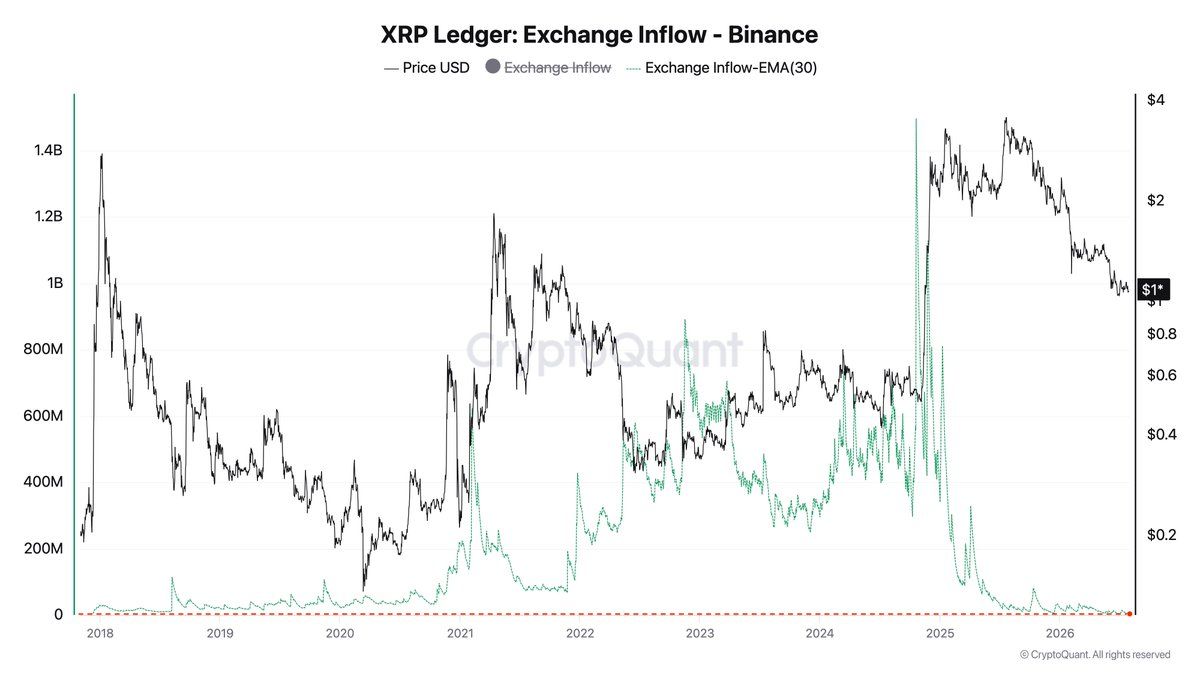
In a post on X, analyst Darkfost noted that XRP inflows to Binance have fallen to a record low. According to the analyst, average monthly inflows to the exchange have dropped to roughly 3.6 million XRP.
While the figure remains significant in absolute terms, it marks the lowest monthly inflow ever recorded. Darkfost said the trend suggests that XRP holders are showing little willingness to move tokens onto exchanges for sale, pointing to an exhaustion of selling pressure.
He added that the reduced pressure could help XRP establish stronger price support above $1.
“What remains to be seen is whether a genuine rebound in demand will follow this lull on the sell side, a condition that appears necessary to spark a sustainable bullish trend,” the analyst added.

Follow us on X to get the latest news as it happens
Meanwhile, another on-chain analyst reported a sharp increase in XRP withdrawals from exchanges. Withdrawal transactions accounted for 55.6% of XRP activity on Binance over the past seven days as of July 31, the highest share since February 2021.
Across all centralized exchanges, the figure reached 54%, confirming the shift extends beyond a single venue.
Deposit transactions moved the opposite way. Binance’s deposit share slipped to 44.3%, while the market-wide figure fell to 45.95%. Both readings mark multi-year lows.
The metric tracks transaction counts rather than XRP volume or net flows. It signals a structural change in exchange behavior but does not, on its own, confirm accumulation.
August Seasonality and ETF Flows Cloud the Setup
Yet, history gives buyers less comfort. August is XRP’s flattest month on record, averaging returns of just 0.43%, and it has closed red for four straight years. That seasonality contrasts with July, which XRP has closed green every year since 2020.

Institutional appetite offers little counterweight. Spot XRP ETFs attracted only about $19.6 million in net inflows across July’s 21 trading days, according to SoSoValue data. Flows registered zero on 11 of those days, while July 1 and July 8 saw outright outflows.
The on-chain picture suggests sellers have largely stepped aside above $1. Whether dormant ETF desks and a historically quiet month allow demand to return will define XRP’s August.
Subscribe to our YouTube channel to watch leaders and journalists provide expert insights
The post XRP Flashes 2 Bullish On-Chain Signals Heading Into August appeared first on BeInCrypto.

Quantum Solutions more than doubled its authorized Ethereum (ETH) sale cap to 4,375 ETH on July 30, as subsidiary GPT Pals Studio sold another 1,000 ETH at $1,903 per token.
The sale generated $1.9 million in proceeds and is expected to result in an accounting loss of approximately JPY 17 million ($100,970). The proceeds will fund the group’s AI Infrastructure Data Center (AIDC) business.
Why Quantum Solutions Is Selling Its ETH Holdings
The Tokyo Stock Exchange-listed firm first approved sales of up to 1,875 ETH on June 4. It cited funding needs for data center usage agreements, GPU equipment, and business launch preparations.
GPT Pals Studio sold 904 ETH on June 16, leaving just 971 ETH available under the original policy. The board therefore added 2,500 ETH to the cap through a written resolution on July 30.
The group has now sold 1,904 ETH since June, cutting its holdings to 4,764.80 ETH. However, 3,050 of those tokens have remained pledged to a Singapore-based lender as collateral since April. That leaves only 1,714.80 ETH in GPT’s trading account.
The July sale resulted in an expected accounting loss because the sale price of $1,903 per ETH was below the carrying value of $2,003.97,
“As a result of the sale, the Company expects to recognize a loss on sale of approximately JPY 17 million during the second quarter of the fiscal year ending February 2027, calculated based on the carrying value following the mark-to-market valuation conducted at the end of the first quarter of the fiscal year ending February 2027,” the firm said.
Follow us on X to get the latest news as it happens
Crypto Treasuries Feed the AI Trade
Quantum Solutions joins a widening group of public companies chasing the AI trade. Bitcoin (BTC) miners show the trend most clearly.
IREN, TeraWulf, and Core Scientific have redirected their energy-heavy facilities from mining rigs to high-performance computing (HPC) and AI workloads.
In fact, public miners offloaded 32,000 BTC in the first quarter of 2026, exceeding their disposals for all of 2025. Squeezed margins, heavy debt loads, and AI infrastructure shift drive the exodus.
Subscribe to our YouTube channel to watch leaders and journalists provide expert insights
The post Tokyo Firm Liquidates Part of Ethereum Treasury to Fund AI Data Centers appeared first on BeInCrypto.

3 Netflix Masterpieces to Binge This Weekend (Aug 1-2)

3 US Stocks To Watch In August 2026 After Big Earnings Week

‘People like me living with dementia deserve respect, compassion and humanity right to the very end’


-

 Fashion7 days ago
Weekend Open Thread: Brooks Brothers
-
 Sports5 days ago
Commonwealth Games boxing: Jadumani Singh seals dominant 5-0 win over Pakistan’s Sumama Rehman to enter quarter-finals | Commonwealth Games News
-

 Business2 days ago
Why Trees Belong on the Risk Register
-

 Tech5 days ago
Intel is reversing course and bringing hyper-threading back to its server chips
-

 Crypto World6 days ago
Ripple bought a bank in pieces. The $4 billion audit
-

 Politics4 days ago
Luke Littler dismantles Gerwyn Price to retain title in Blackpool
-
 Entertainment7 days ago
A New Post-Apocalyptic Gundam Anime Series Blasts Into SDCC
-

 Politics3 days ago
The Part of the Electric Transition Nobody Wants to Discuss
-

 News Videos5 days ago
BITCOIN JUST ENTERED THIS CRITICAL ZONE…
-

 Business2 days ago
Major shareholder moves on Canyon
-

 Crypto World5 days ago
XRP Ledger adds $2.6B as RWA inflows rank second
-

 News Videos1 day ago
Bitcoin Enters the 3rd Stage of the Bear Market
-

 Politics5 days ago
Spain sweeps the board at 2026 World Cup with individual awards
-
 Entertainment3 days ago
‘Stargate’ Creator’s New Sci-Fi Series Returns for Season 3 Tomorrow
-

 Entertainment6 days ago
Sara Gilson Killed By Husband After Viral “Pedophile” TikTok Video
-

 Crypto World3 days ago
Kraken Enables Retail Access to Jersey Mike’s IPO via Tokenized Shares
-

 Tech6 days ago
Anthropic launches Claude Opus 5, a cheaper AI model for coding, agents and enterprise workflows
-

 News Videos3 days ago
Claude: Build Financial Dashboards in Minutes (2026)
-

 Tech4 days ago
New macOS Sequoia & Sonoma security updates for older Macs
-

 Politics21 hours ago
Luke Littler’s dominance sparks GOAT debate
You must be logged in to post a comment Login