Security teams log 54% of successful attacks and alert on just 14%. The rest move through your environment unseen.
The Picus whitepaper shows how breach and attack simulation tests your SIEM and EDR rules so threats stop slipping by detection.





Japanese telecommunications giant KDDI revealed that millions of people had their email addresses and passwords exposed after attackers breached an email platform used by five internet service providers (ISPs) in the country.
KDDI is the second-largest mobile telecommunications provider in Japan, with 45,000 employees and annual revenue of $32.4 billion.
The company disclosed last month that it blocked the attackers’ access and implemented defensive measures after discovering the incident on June 17, and revealed that the breach impacted the STNet, JCOM, Chubu Telecommunications C, NIFTY Corporation, and BIGLOBE ISP operators.

KDDI added that the incident may have exposed the email addresses and passwords of up to 14,22 million current and former customers, as well as those belonging to inactive accounts. It also noted that some passwords were stored in hashed and/or encrypted form (making them harder to use for account hijacking), but did not specify how many accounts had passwords stored in plaintext or what type of encryption was used.
In a July 6 update, KDDI revealed that the attackers breached the platform on May 16 after exploiting a zero-day vulnerability in a third-party software.
“As a result of our investigation, as of June 17, 2026, the date of our confirmation, this vulnerability was not recognized by the software vendor,” KDDI said. “The software vendor has reported this vulnerability to public authorities and is working toward disclosing the information.”
The telecom giant is now working to secure affected email accounts after attackers gained access to the email addresses of 12,233,087 people and the passwords of 7,616,173 others.
“We are currently working to change the passwords of affected customers’ email accounts. To date, many customers, primarily those who regularly use email services, have already changed their passwords,” it said.
“In addition, to ensure the security of customers who do not frequently use email services, we are working to have ISP providers complete mandatory password changes within one or two days.”
Since the attack, KDDI has also deployed Endpoint Detection and Response (EDR) software to help detect future breach attempts and said that, on June 23, a forensic audit confirmed that the exploited vulnerability had been addressed and that the systems aren’t affected by other security issues.
KDDI also notified Japan’s Personal Information Protection Commission and the Ministry of Internal Affairs and Communications after discovering the breach, and is currently working with affected ISPs to implement security measures to mitigate the risks arising from this exposure.

Security teams log 54% of successful attacks and alert on just 14%. The rest move through your environment unseen.
The Picus whitepaper shows how breach and attack simulation tests your SIEM and EDR rules so threats stop slipping by detection.

For over a decade, a particular argument keeps resurfacing from well-meaning progressives: the rise of authoritarianism around the globe is a good reason to pass laws suppressing speech. The idea is that somehow, magically, without free speech, authoritarians and fascists would never come to power in the first place. This is historically illiterate. It’s also stupid. As we’ve argued for many, many years, speech suppressing laws are always eventually used by the powerful to suppress the speech of their critics.
The latest example comes from Mexico, where the current leadership has played up “press freedoms,” but at the same time, powerful politicians are using laws ostensibly passed to protect the marginalized… to imprison journalists instead. The New York Times piece makes the pattern concrete in a way that should be eye-opening to many.
Take, for example, the situation with politician Mara Chama Villa. She used a law that was passed to stop “gender-based political violence.” That sounds good, right? Most good folks would agree that “gender-based political violence” is bad. But in this case, Chama Villa claimed that a satirical radio skit mocking her for being a nepobaby candidate violated the law:
It started with a one-minute audio cartoon. Three siblings asked their influential father to buy them candidacies for the upcoming 2024 elections, squabbling over who got to run for which party.
The satirical spot broadcast on Radio Teocelo, the local community-run radio station that also produced the ad, did not mention names, actual political parties or locations.
But Mara Chama Villa, who was running to represent the area in Congress with Mexico’s Ecologist Green Party — and whose father had been the mayor of Teocelo, a coffee-producing town in the state of Veracruz, the deadliest for journalists — felt targeted. She filed a complaint against Radio Teocelo and reporters from other outlets who had previously covered her failed attempt in 2021 to succeed her father as mayor.
Their coverage, she argued in legal filings reviewed by The New York Times, minimized her career and hurt her chances to win the election.
In April 2025, a federal court found five reporters guilty of gender-based political violence because they had “minimized” Ms. Chama Villa “by subordinating her to a male figure with political power,” the court said in its ruling.
The impact of being found guilty — again, for making a satirical radio spot that would be common all over the globe — was pretty massive:
The penalties were sweeping: fines exceeding a month’s salary, mandatory public apologies, the deletion of the radio spot and all denounced articles and placement on a national registry of gender-violence offenders.
Oh, and some more chilling effects, just for fun. If you criticized the ruling? Well, you got added to a follow-on legal process:
When journalists, analysts and organizations across Mexico criticized the outcome, the dispute ballooned into a nationwide case targeting about 70 people.
This is, quite obviously, the opposite of freedom of the press or freedom of speech. And I’d argue it does not do anything positive towards stopping “gender-based political violence.” It’s just become a tool for a powerful political family to punish journalists who produced a bit of satire.
And this isn’t a one-off, as the Times highlights other cases using the same law to target activists as well:
Earlier this year, a court sanctioned Miguel Alfonso Meza, an anti-corruption activist, for gender-based political violence against Silvia Delgado, a lawyer who represented the notorious drug lord Joaquín Guzmán Loera, best known as El Chapo. Mr. Meza had called her a “narco lawyer” when questioning her candidacy for a criminal judgeship in Mexico’s first-ever judicial election.
When the court later partly revoked the penalties on Mr. Meza, Ms. Delgado said that she would appeal that ruling. Her goal, she added in an interview, was “not to silence anyone, but to fight for dignity.”
“By describing my candidacy as highly dangerous and comparing me to other candidates investigated for drug trafficking,” she said, “he unleashed excessive attacks against me.”
The article also describes a crime reporter who was accused of “terrorism” because his reporting on local drug cartels “caused public panic” leading him to being dragged from his car and arrested (he thought he was being kidnapped). He now admits that he’s stopped chasing stories he used to chase.
The chilling effects in such a system are unavoidable.
Mexican politicians can defend these laws all they like. No one supports gender-based political violence or terrorism — and that’s exactly what makes the laws so useful to the people abusing them. A law nobody can be seen opposing is a law nobody can stop. And so a community radio station gets fined a month’s salary over a one-minute cartoon, an anti-corruption activist gets sanctioned for calling El Chapo’s lawyer a “narco lawyer,” and a crime reporter stops chasing the stories that made him a crime reporter.
This is how it always goes. Every time you hand the state a tool to punish “bad” speech, the people who end up wielding it are whoever holds power — and they get to decide what counts as “bad.”
If that still sounds like a worthwhile trade — speech restrictions now to keep the fascists out later — consider that we ran this exact experiment a century ago. Weimar Germany had hate speech laws. Prosecutors used them against Nazis, including Julius Streicher, the publisher of Der Stürmer, who was convicted and jailed more than once for incitement against Jews. The laws did not stop the Nazis. Indeed, the Nazis used these prosecutions as yet more “evidence” that they were being prosecuted for their beliefs. Then, the Nazis took power, inherited those very tools, and turned them on everyone else. Streicher walked out of the courtroom a martyr and into the Reichstag. The speech laws meant to stop authoritarians became the authoritarians’ speech laws.
So here’s the only test that matters before you back a law like this: imagine the politician you distrust the most holding the pen. Because eventually, they will. And anyone who answers “with this law on the books, they’ll never get into power” is indulging in childishly naive wishful thinking — the same wish that has been losing to authoritarians for as long as there have been authoritarians.
You don’t keep bad people from power by handing the office a weapon and hoping good people get there first. You keep them out with stronger elections, stronger institutions, and an educated public that can see through them.
Not by deciding which speech to outlaw — and then praying you’re always the one holding the pen.
Filed Under: free press, free speech, gender-based political violence, mara chama villa, mexico
Companies: radio teocelo

Level Infinite has opened pre-registrations for Gangstar Mirage City, the newest game in Gameloft’s long-running Gangstar series. Indian players can now enroll on the official website before the game’s soft launch in August 2026. Players who register for the game will receive rewards upon its release. There will be mission stories and open-world gameplay. According to the developer, player choices will influence certain missions and gameplay events.
Gangstar Mirage City brings together open-world exploration, racing, and action in a single experience. In addition to story missions, players can explore different parts of the city, collect vehicles, and compete in street races. The game also includes cooperative heists, allowing friends to complete missions together.
Building a criminal empire is yet another important aspect of the game. Capturing territories can help players enhance their influence and generate revenue. They can also personalize their weapons and vehicles according to the requirements of specific missions and fights. If you are one of those people who like competitive gaming, you can join the team fights, vehicle fights, last-man-standing games, and PvP-based objective games. The developers have also confirmed that more arenas and multiplayer content will arrive in future updates.

Players who have already signed up for Gangstar Mirage City can participate in the Global Vault Heist campaign, scheduled prior to the game’s soft launch. This campaign offers rewards available only to early participants. More rewards will become available to those who are signed up for the event as more people sign up. Participants can also invite up to three friends to join the campaign. Each successful invitation unlocks extra bonuses, allowing groups to start the game with additional rewards when the soft launch begins.
The pre-registration campaign also lets players join one of four in-game factions before launch. Each group has its own background and role in the game’s world. The Family focuses on power and influence, while O-Rage represents a more rebellious approach. The Ghosts are known for underground street racing, whereas Jersey Boyz control the city’s supply chain. Choosing a faction also unlocks a unique avatar reward for launch.
Gangstar Mirage City will begin its soft launch on August 20, 2026, and will be available on Android and iOS. There will be nine language options in the game, allowing gamers from various regions to play in their preferred language. Those interested can already complete the pre-registration process through the official website.
For a while there, you might remember how giant telecom monopolies, running out of new subscribers, all decided to get into the media business. But because terrible telecom monopoly executives can’t innovate and generally don’t know how competition works, it never really goes that well.
The various Yahoo/Tumblr/Verizon/AOL exploits were a legendary mess, only outshined by AT&T’s disastrous mergers with DirecTV and Warner Brothers. Then there’s the Comcast NBC Universal tie up (Peacock saw a $432 million loss in the first quarter), which now appears on the cusp of being unwound after seeing its stock drop 54% in the past five years.
Last week, Comcast execs stated they’re now formally unwinding NBC Universal from the Comcast telecom properties. Comcast CEO Mike Cavanagh says the company simply “changed its mind” about being a monolithic giant that dominates both media and physical internet access:
“We’ve simply now changed our mind. We’ve now concluded that future success for each of our businesses will depend on focus, speed and strategic flexibility that this separation will unlock. This is the right move to put each company in the strongest position to create value, fully monetize its assets, and aggressively pursue its own organic growth strategies.”
Yadda yadda yadda.
Comcast had already spun off its cable TV network portfolio (except for Bravo) into a new company named Versant Media earlier this year. Comcast executives insist that they’re “definitely not” looking to sell NBC Universal off as part of the broader U.S. media merger madness, but amusingly nobody inside or outside of Kabletown believes them:
“The collective eye roll [on management’s denial] was almost audible,” former NBC Studios president Tom Nunan told TheWrap. “I thought that their recent effort to go after Warner’s was a sign that there was still gas in the tank, that they really still wanted to be among the big media players left standing. When that didn’t work out, they suddenly go, in my view, from a buyer to a seller.”
Unsaid by the trade mag coverage is that telecom giants routinely demonstrate they have absolutely no idea what they’re doing when it comes to Hollywood and content. They’re endlessly just chasing their own tail and shuffling the cards around in the hunt for the next merger, tax break, or giant executive compensation package. None of these deals work out, because the kind of execs birthed in the bowels of telecom monopolization aren’t really competent or competitively/innovatively battle tested.
Normally Wall Street rewards this kind of mindless consolidation chasing by men out of original ideas, but both ends of Comcast’s business are facing headwinds. On one side traditional broadcast TV is dying and Peacock requires a ton of money to remain competitive; on the other Comcast’s steadily losing broadband subscribers due to increased competition from cheaper 5G wireless or community-owned fiber.
Selling the whole thing was likely too much for any suitor to chew. Splitting off NBC Universal makes it a more digestible target for Netflix, Amazon, Disney, or Apple, leaving traditional Comcast time to focus on its core agenda: buying up smaller telecom companies and dismantling U.S. broadband competition.
Comcast’s problem is NBC’s journalism has historically made our mad idiot king cry, so they’ll have to be extra fawning and subservient to gain favor from the administration’s fake antitrust regulators.
Filed Under: cable, consolidation, kabletown, media, mergers, monopoly, streaming, telecom, video
Companies: comcast, nbc, nbc universal


The organisation also announced it is actively expanding the robotics team and is looking to recruit talented research scientists and engineers.
France’s Mistral AI has announced the launch of a new robotics navigation model, as the company further expands in the physical AI space, following deals with a number of key players in Europe’s industrial and manufacturing sector, such as Airbus SE and BMW.
The new 8B model, Robostral Navigate, allows robots to autonomously move around in complex environments via a single RGB camera and basic language prompts. Combining pointing-based navigation with continuous learning elements, the hardware is also agnostic meaning it can be deployed across any robotics fleet.
Mistral claims that the model, prompted by a single instruction, can complete the entire task on its own, moving through a live space full of people and obstacles it was never shown, adapting to any setting. Spaces in which it can be used includes offices, residential and commercial buildings and outdoor settings.
In a post announcing the launch, Mistral said, “We leverage our knowledge of post-training LLMs at scale, using online reinforcement learning, to boost the performance of Robostral Navigate. After the supervised training stage, we further improve the model’s performance using CISPO, an online reinforcement learning algorithm.
“This enables the model to learn from trial and error, recover from failures, and acquire exploratory behaviours, effectively mitigating the distribution shift issue of vanilla behaviour cloning. This alone improved the success rate by 3.2pc. We are not seeing any plateauing, so we are confident that more training and more experiments will continue to push this number up.”
A leader in Europe’s AI space, Mistral is also positioned as a key rival for US counterparts, such as Anthropic and OpenAI. In March of this year, the company raised $830m in its first debt financing, with the intention of funding a new data centre near Paris.
It was announced that the deal, which was supported by a consortium of seven global banks, would pay for Nvidia Grace Blackwell infrastructure with 13,800 Nvidia GB300 GPUs at the “cutting-edge” centre, bringing powered capacity to 44MW.
Previously commenting, Arthur Mensch, the CEO of Mistral AI, said, “Scaling our infrastructure in Europe is critical to empower our customers and to ensure AI innovation and autonomy remain at the heart of Europe.”
Mistral is also looking to recruit, with plans to expand the robotics team. Currently it is aiming to hire additional research scientists and engineers.
Don’t miss out on the knowledge you need to succeed. Sign up for the Daily Brief, Silicon Republic’s digest of need-to-know sci-tech news.

Early talks have already taken place between the BBC and Channel 4.

In 1852, Marx wrote that historical events play out twice, the first time as tragedy, the second as farce. Sadly, he failed to countenance that some organizations need a third or fourth go around. Apropos of which, the Financial Times is reporting that, once again, the BBC has engaged in talks with Channel 4 with the aim of building a British alternative to Netflix. This “sovereign platform,” would pool content from the UK’s two major public service broadcasters on a single outlet. Of course, given that we’ve already seen aborted attempts to do this back in 2007 and 2017, history’s now repeating itself for a third time.
New BBC boss Matt Brittin told the government the BBC has “had a discussion with Channel 4” about some sort of streaming merger. Or, at the very least, bringing some Channel 4 content over to be shown on BBC iPlayer. Talks are at an early stage and there are an “array of commercial, audience, public service and technical issues” which would need to be addressed.” But Brittin stressed the need for the UK’s media players to team up to avoid being swept away by their larger American counterparts. He said Netflix, TikTok and YouTube have shown the importance of being big enough to survive. It’s one of the big reasons Sky is buying ITV to help grow its footprint to help lure viewers who would otherwise be lured away by the temptations of the infinite scroll.
Of course, this sort of thing seems to happen once a decade, and may likely continue until the heat death of the universe. Back in 2007, the BBC, Channel 4 and ITV developed Project Kangaroo, a Netflix-like service showing 10,000 hours of on-demand content from the trio’s vast back catalogs. Unfortunately, regulators stepped in to shut the project down, fearful that it would elbow out other names in the market. Then, in 2017, the BBC and ITV tried again, launching BritBox (initially overseas), only for ITV’s eternal turmoil to kill of the brand and pull its own content under the ITVX banner in 2024. If this third attempt doesn’t somehow wind up equally bungled, then we’ll see you all back here in 2036 or so for the fourth.
In the brief history of AI security, the prompt injection has quickly become the top threat. Large language models are inherently unable to distinguish between legitimate instructions provided by users and malicious ones sneaked into emails, source code, and other third-party content the models are processing. This makes it trivial to surreptitiously inject malicious commands that the LLM readily follows.
With no way to enforce this crucial boundary between trusted and untrusted sources, AI engine developers are left to erect elaborate guardrails designed to mitigate the damage rather than solve the root cause.
To date, most prompt injections have fallen into a class known as push, in which each potential victim is targeted. For example, the adversary injects malicious instructions into an individual email or calendar invitation. Because the injection must then be sent (or pushed) to each specific target, the scale of the attack is limited, hampering mass exploits that hit the Internet at large.
Meanwhile, pull-based attacks, in which an LLM actively seeks out the adversarial prompts planted on websites, remain limited. With no way to lure large numbers of LLMs to a malicious site, these sorts of attacks don’t scale either.
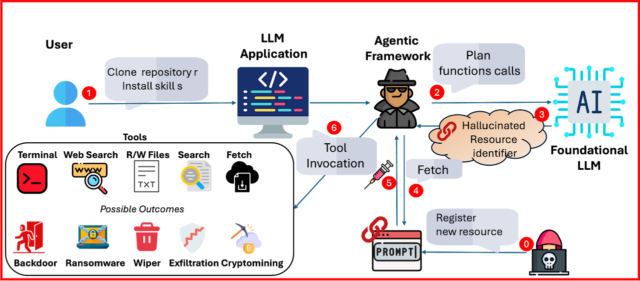
Now, researchers have devised a pull-based attack that changes all that. A new attack the researchers have named HalluSquatting has the potential to assemble massive botnets, perform large-scale DDoSes, and infect devices at scale, a first for prompt-injection attacks. The attack works against AI coding assistants and agents, including Cursor, Cursor CLI, Gemini CLI, Windsurf, GitHub Copilot, Cline, OpenClaw, ZeroClaw, and NanoClaw, which are all susceptible. In the normal course of performing day-to-day activities, these assistants and agents routinely pull code and other resources from repositories and registries.
Credit:
The HalluSquatting threat model. Spira et al.
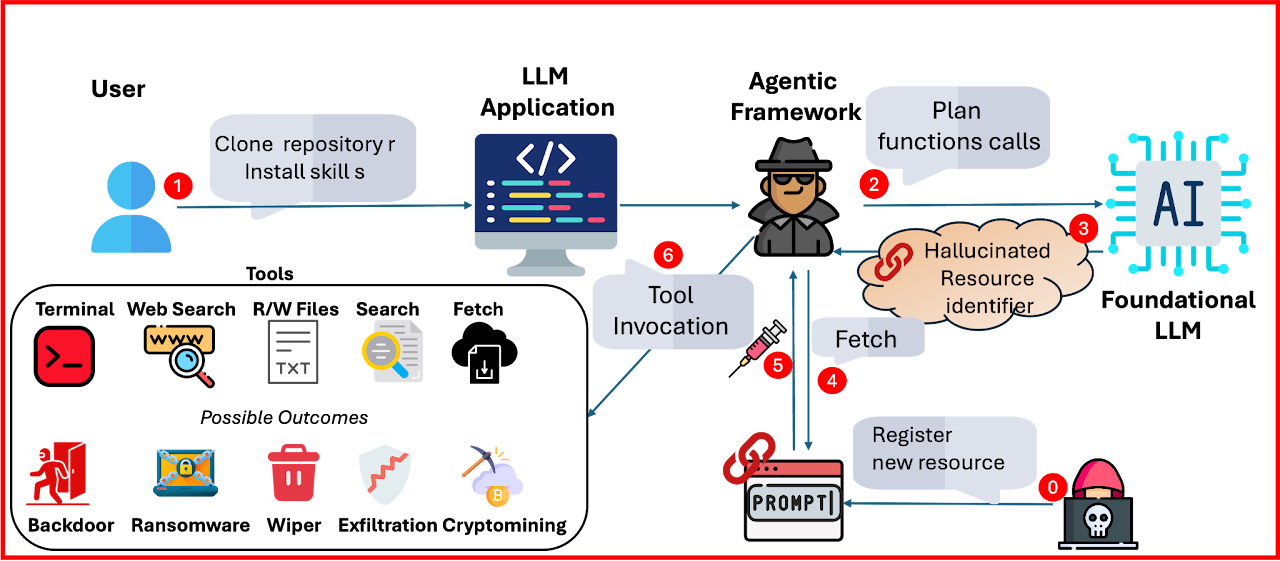
The HalluSquatting threat model.
Spira et al.
Credit:
Short for adversarial hallucination squatting, HalluSquatting is built on an LLM’s inherent tendency to hallucinate the resource identifiers hosted in repositories and registries. It works against coding agents and assistants, which commonly access high-privilege command lines to run code from third-party resources. By predicting the identifiers LLMs are most likely to hallucinate and then registering and seeding them with instructions to install reverse shells or other malicious wares, the attack can indiscriminately infect massive numbers of devices without having to target each one.

When you ask people when they knew Covid was going to be a huge deal, they give a range of answers. “When Tom Hanks got sick” is a popular one. So is “when the NBA suspended the season.” The most plugged-in people will sometimes cite early rumblings from Wuhan in December 2019/January 2020.
For me, the turning point came on March 17, 2020, when Republican Sen. Tom Cotton proposed sending every American checks from the government.
To be clear, at this point, my then-employer Vox had already sent everyone to work from home indefinitely, and it was clear something dramatic was happening. But I hadn’t yet internalized that the Overton Window in American politics had shifted dramatically.
True, there were some Republican Senators who, by 2020, were expressing more openness to safety net programs, and rethinking Reagan-style laissez-faire economics. Tom Cotton, though, was not one of these senators. I didn’t think he really had strong economic policy opinions at all; he was a defense and culture war guy. He cared about defeating China and, secondarily, defeating Woke. Universal cash handouts were not his bag. And yet here was Cotton, not just calling for near-universal cash payments, but also for welfare work requirements to be suspended and for big block grants to states to expand unemployment insurance.
This turned out to be an early indication of the actual policy the US would pursue. Within a couple of weeks, with the US unemployment rate fast headed for what would be a record high of 14.7 percent in April, a Republican Senate and president had signed off on the CARES Act, which included payments of up to $1,200 per eligible adult, $2,400 for eligible married couples, and $500 per qualifying child, along with a $600 per week unemployment insurance and a massive business bailout program. The Senate vote was unanimous, and the House approved the final Senate amendment by voice vote.
If you had told me literally any of that would happen in February 2020, I would have laughed at you. But the normal rules had stopped applying. All that was solid had melted into air. Much, much bigger things were, suddenly, possible.
I’ve been thinking about that moment a lot as advanced AI models grow more and more capable, and more and more central to many businesses’ strategies. As of May, Anthropic is reporting an annualized revenue rate of $47 billion, equaling the likes of Coca-Cola and exceeding Netflix. That’s up from $30 billion a month earlier. If their revenue keeps growing at 56.7 percent a month, they will outpace Amazon, currently the highest-revenue company in the world at $717 billion a year, by late November or early December. The AI boom is already unfolding faster than the internet or mobile booms before it and may yet speed up even further. The debate over whether this tech is real and valuable is, essentially, over. The only question is what, and how large, its effects on our lives will be.
This is happening unbelievably fast, and it seems likelier and likelier that we will face a moment, like that in March 2020, when the speed and disruption of AI progress begins to constitute an emergency that policymakers will be willing to take surprisingly large risks to confront. There will likely be a moment of unusual policy freedom and flexibility, a moment which is brief — but could enable large changes for the better.
The US is currently not ready for that moment. But we need to get ready, fast. And we need your help. My colleagues at the Center for Shared AI Prosperity, a new DC-based research group, are attempting to collect a menu of detailed policy ideas that can meet this moment. In fact, we have an open Request for Ideas with funding that can go to the best proposals people submit for how to set up the tax code and safety net in a way fit for the AI era. Now is the time to act.
I sometimes talk to friends in the tech world who assume that the power and economic impact of advanced AI will permanently shift our politics, and that the policies necessary to keep everyone afloat (like, say, a guaranteed income, or a sovereign wealth fund) will materialize without much effort. After some 17 years as a journalist covering US politics and policy, I think this is overly optimistic, so say the least. Congress is like jello: flick it and it will shake, but it eventually settles back to normal.
Take Covid. Within a couple of months, the apparent consensus had evaporated, and Republicans were back to resisting safety net expansion. By May, Cotton had pivoted to pushing the No Bailouts for Illegal Aliens Act, which “amends the CARES Act to prohibit sending future funds to states or municipalities until they certify they aren’t issuing stimulus checks or other payments to those in the United States illegally.” By August he had a bill to deny virus-related federal employment funds to people convicted of federal offenses because of “riots.” The pandemic was still raging but the policy emergency, and the bipartisan window for much larger-scale action, had mostly closed.
The 2008 financial crisis offers another example. There, the window was open somewhat longer. At the very beginning of the recession, in February 2008, the Bush administration went against its normal laissez-faire commitments and supported a stimulus package championed by then-Speaker Nancy Pelosi built around per-person checks to nearly all Americans, including many of those not owing income tax. In July, President George W. Bush signed a bailout of Fannie Mae and Freddie Mac in the face of strong opposition from fellow Republicans in the House, but having mostly won over his party in the Senate.
In September, when Lehman Brothers collapsed and the possibility of a cascade of massive bank failures seemed very real, Bush demanded a sweeping $700 billion bailout that proposed purchasing toxic assets from at-risk banks (the “Troubled Asset Relief Program,” or TARP). As the subsequent years would demonstrate, bailing out banks failing due to their own irresponsibility was not exactly a popular position in the general public. Members of Congress are not stupid, and they realized this at the time. On September 29, the House voted down the proposal, with huge numbers of both parties defecting from Bush and Pelosi’s position. That led to a large stock sell-off that terrified lawmakers. That experience, some last-minute tweaks, and truly herculean lobbying from the administration, the Fed, and others led the House to switch course and pass the bill on October 3, though within weeks of its passage, Treasury abandoned asset purchases in favor of buying equity stakes in the banks directly.
The full course of 2008 shows the value of, and power inherent in, being prepared. The February 2008 stimulus package was very roughly improvised. It worked a little bit, but proved nowhere near big enough. If Pelosi and Bush had had a more thought-through proposal on hand, perhaps one that automatically repeated and scaled the checks depending on where the unemployment rate went, then the recession would have been much less severe and the 2009 stimulus might not have proven necessary.
TARP was an example of a case where some key actors were prepared. The structure of the program came from the “Break the Glass Plan,” a proposal put together by Bush Treasury officials Neel Kashkari and Philip Swagel in April 2008 explicitly designed as a “just in case” plan for the extreme situation where the whole financial sector needed recapitalization. That case, of course, came to pass, and because Kashkari and Swagel had a plan, there was something for Congress to quickly pass. That was good — TARP played an important role in preventing the financial crisis from worsening.
But it also meant that the plan reflected Kashkari, Swagel, and their boss Hank Paulson’s overall conservative worldview. One could imagine a plan like that which saw the US government instead outright nationalizing major banks, or imposing strict capital requirements on them in perpetuity as a condition of the bailout money, or banning them from owning hedge funds or doing speculative trading. A different administration with different views might have designed a different emergency plan — and because it was genuinely an emergency, that plan would likely have passed, with very different consequences over the next few years.
One way to think of the project of AI economic policy in 2026 is as designing the equivalent of the Kashkari-Swagel plan: something detailed, opinionated, and actionable that can be deployed quickly when the situation gets dire. What that plan looks like will, of course, depend on one’s values and commitments; the America First Policy Institute’s emergency plan will not look like the AFL-CIO’s.
The Center for Shared AI Prosperity was founded with an aim to produce plans of this nature designed to make sure any economic windfall from AI is widely shared, and that workers and low-income Americans are not left behind in the transition. We were also founded out of a frustration at the inadequacy of the proposals we were seeing from two ends of the AI policy debate.
On the one side are ideas from the AI labs themselves. These tend to be ambitious — indeed ambitious enough to seem like plausible answers to a problem of the magnitude of AI completely reshaping the economy — but woefully unspecific. They more closely resemble dorm-room philosophizing rather than legislative drafting.
OpenAI’s “Industrial Policy for the Intelligence Age” from this past April, is one such example, laying out a number of very broad ideas: taxing capital more, a sovereign wealth fund invested in the AI economy, portable job benefits. It’s light on the specifics: What kinds of capital taxes? How big a hike is too big? How do you make health benefits portable without disrupting people’s current plans? How does the sovereign wealth fund get its money? Anthropic’s Economic Policy Framework is somewhat more specific, offering paragraphs per idea where OpenAI has a sentence or two, but still nowhere near the level of detail necessary to actually write legislation.
On the other side are proposals from within the DC policymaking world, which are firmly rooted in what seems politically viable right now but would be woefully inadequate in the face of the likely economic disruption that’s coming. Former Commerce Secretary Gina Raimondo and her group RAISE US have centered employee retraining; Raimondo’s recent New York Times op-ed centered ideas like new credentials from community colleges and expanded apprenticeship programs as the answer to mass AI unemployment. These are sensible tools for ordinary labor-market churn, but they are mismatched to a transition that could displace whole categories of work on a compressed timeline. The dawn of machine intelligence will demand more from our leaders than certificate programs.
The best case for this kind of caution is that ideas on the scale of the labs — sovereign wealth funds, universal capital accounts for all Americans, permanent relief funds for the long-term unemployed — are dead in the water in DC. Which might be true — now, at least.
But this is where Tom Cotton’s brief love of cash transfers becomes relevant. We should not overindex on the way the politics look right now. The world is about to become very strange, and we may be surprised by the scale of change in response that can earn even bipartisan support.
Indeed, it’s notable that both the 2008 relief measures and the 2020 CARES Act came under Republican presidents with Democrats controlling at least one chamber in Congress, which is also the likely situation after the midterms this year. Democrats are always willing to vote for big new safety net programs to protect unemployed and low-income people. But Republicans are often willing to compromise their usual anti-welfare stances when they’re the party in the White House, and their approval ratings depend on the country’s basic economic health.
What action they might take in a 2027 or 2028 featuring massive AI-based economic disruption is still unclear. But right now, we all have an opportunity to help shape it. The Center for Shared AI Prosperity is running a request for ideas, seeking proposals for shared AI ownership, new AI-related taxes and revenue raisers, and new safety net programs to share the gains widely. We want ideas from economists and think tanks, of course — but also from the labs, from independent researchers and academics, and from ordinary citizens with an interest in where this technology is going.
Stocking the shelves is hard work, and we don’t have all the answers. But you just might, and we’re going to need all the help we can get if the US is going to emerge from the AI transition as a prosperous, functional nation.

When people think of vinyl records today, they often think of a niche hobby making a comeback. But Singapore’s relationship with vinyl runs much deeper.
Long before collectors were flipping through crates in neighbourhood record stores, Singapore was one of Southeast Asia’s biggest record-manufacturing hubs. By 1970, at least four major pressing plants were operating here, producing up to a million records a month before changing technologies and shifting consumer habits pushed the industry into decline.
But today, vinyl has returned—not as a manufacturing powerhouse, but as a thriving culture.
Around the world, sales have grown for 19 consecutive years, surpassing US$1 billion in the United States alone. And in Singapore, a new generation of collectors, independent record stores, and curious first-time buyers are rediscovering what streaming can’t offer: the experience of owning music.

Singapore’s vinyl scene reflects the broader resurgence across Asia-Pacific, where the market was worth an estimated US$518 million in 2024.
But while the numbers tell one story, the revival is perhaps best seen on the ground.
Spend a weekend afternoon in Haji Lane or Joo Chiat, browse a flea market, or wander into one of the country’s independent record stores, and you’ll find people happily flipping through crates of vinyl, admiring album artwork, and chatting with fellow collectors.
Singapore has quietly become, as Curated Records founder Tremon Lim puts it, “one of the vinyl-hunting stop-bys for travellers.”
We speak to Tremon, 42, who founded the business in 2014, and Warren Choo, 31, who started Cherry Lane Records on Carousell before opening a brick-and-mortar store in Joo Chiat in 2024, about how Singapore’s vinyl scene has evolved—and why records continue to resonate in the streaming age.

Tremon left a six-year career in publishing to fulfil his dream of opening a record store, launching Curated Records in a small Tiong Bahru space in 2014 before relocating to its current North Bridge Road premises in 2021. Today, the two-storey shop carries more than 2,000 records.
Warren’s path into vinyl retail was more gradual. He began by selling records from his personal collection before setting up stalls at the Katong Flea Market. After falling in love with Joo Chiat’s “vintage and warm” atmosphere, he opened Cherry Lane Records there in 2024.
Despite their different journeys, both owners have witnessed the same shift: more people are walking through their doors than ever before.
For Tremon, the biggest sign of vinyl’s resurgence is how records have moved beyond specialist stores. Cafés, electronics retailers and even musical instrument shops now stock vinyl, whether as décor or merchandise. He also believes nostalgia has played a role, as more people seek out physical objects in an increasingly digital world.
Warren, meanwhile, has watched a new generation discover older music through pop culture.
“Queen or Michael Jackson become entry points for younger listeners who may not have grown up with that music directly,” he said. “And younger collectors are not only buying old pressings from the ’70s to the ’90s, but many are also interested in new releases from current artists.”

That crossover between contemporary pop culture and vintage collecting is something both owners recognise.
Cherry Lane specialises in Southeast Asian heritage releases, jazz and classic rock, though it also carries selected new releases. Warren acknowledges that the recent boom in vinyl sales—driven in part by artists like Taylor Swift—has benefited independent record stores too.
Someone buys their first record because of a current artist, then they start digging deeper, and eventually they end up for hours in a shop like ours.
Warren Choo, founder of Cherry Lane
Tremon agrees. Having spent more than a decade in the business, he has watched vinyl evolve from what was once a fringe hobby into what he calls a “mature niche,” with enthusiasm today surpassing even the resurgence of the late 2000s.
Singapore has also become a destination for collectors from overseas.
“Singapore is one of the vinyl-hunting stop-bys for travellers,” he noted. The city’s mix of local pressings, Southeast Asian records, and well-curated vintage stock has made it worth a detour for collectors passing through.

On paper, the economics of vinyl can be difficult to justify.
A brand-new record typically starts at around S$38 in Singapore, with limited editions costing even more. Add an entry-level turntable—starting at around S$110—and it’s easy to argue that a S$12 monthly Spotify subscription offers far better value, giving listeners access to millions of songs at their fingertips.
But for most collectors, it isn’t a choice between vinyl and streaming. Instead, they’re embracing both.
Tremon notes that most vinyl collectors still subscribe to a streaming service. Streaming is where they discover new music and listen on the go, but vinyl is what they buy after deciding an album deserves a permanent place on their shelf
Streaming offers convenience. Vinyl offers an experience.
For Warren, that experience begins long before the music starts. Playing a record requires choosing an album, removing it from its sleeve, placing it on the turntable and lowering the needle. That ritual encourages listeners to slow down and give an album their full attention in a way streaming rarely does.
He believes part of the appeal also lies in the thrill of discovery.
Once a record walks out the door, there is no guarantee you will ever see that same copy again. Part of the appeal is that each record feels like something you have actually found. It is not just a file or a link. It has a history.
Warren Choo, founder of Cherry Lane

There’s also the question of ownership.
Warren recalled a friend once telling him that owning a vinyl record feels permanent in a way streaming never can. Digital libraries can change as licensing agreements expire or platforms evolve, but a record on your shelf remains yours.
For many collectors, especially those buying newer releases, the appeal extends beyond the music itself. Coloured and transparent vinyl, limited editions and artist-exclusive pressings have turned records into collectible objects as much as listening formats.
Tremon noted that many of these releases are produced in limited quantities, making them highly sought-after by collectors. For some buyers, the artwork, packaging and rarity are just as much a part of the experience as the album itself.

Both owners see vinyl as part of a broader wave of nostalgia that has also revived interest in film cameras, mechanical watches and printed books.
Warren believes what ties these hobbies together is that they demand participation. “You cannot be passive with a record the way you can with a digital playlist.”
That sense of intentionality, he believes, is increasingly valued in a world optimised for speed and convenience.
Far from being a passing trend, both owners believe vinyl has found its place in the modern music landscape.
Tremon, in particular, argues that vinyl is no longer experiencing a revival but has matured into a permanent niche. “Unless another music format comes along that’s even more fun than playing and collecting vinyl,” he reflected.
History has repeatedly declared vinyl obsolete—when the LaserDisc arrived, when CDs took over and when streaming appeared to remove the last reason to own physical music. Yet it has survived every technological shift.
“There must indeed be something special about it that humans just collectively, and implicitly, agree on,” Tremon said.
For now, in many homes and shops, the needle drops, and the music plays.
Featured Image Credit: Cherry Lane Records/ Curated Records

In this economy, it only makes sense to preserve surplus food, whether it’s seasonal produce (grown yourself, foraged, or bought on sale), wild game, or even fish. You can always can or freeze your extras, but these methods require a lot of time and space. Quick to use and compact to store, a food dehydrator can also broaden your food-preservation horizons, setting you up with vacuum-sealed beans, herbs, vegetables, fruit leathers, and even entire dehydrated meals for backpacking.
I’ve always loved having a food dehydrator on hand to make bags of my own apple and kale chips, beef jerky, and dried citrus rounds for cocktail garnishes. (A mandoline slicer is a must-have if you’re getting into dehydrating.) WIRED contributing reviewer Lisa Wood Shapiro, meanwhile, is into dehydrating sweet potatoes to make natural, organic dog treats. Between the two of us, we dried, crisped, and jerked our way through dozens of pounds of produce and meats to bring you the best food dehydrators for every space and budget.
For more self-sufficiency, check out our head-to-head comparison of gravity-fed water filtration systems and guides to the Best Indoor Gardening Systems and Best Portable Power Stations.
Jump to Section

Excalibur
Excalibur is the OG name in food dehydrators, known for its commercial and professional units. But the company also makes a series of consumer dehydrators that offer large-tray capacities at low prices. This eight-tray, 7.2-cubic-foot model has all the modern features you’d expect: stainless steel trays (note that they’re not dishwasher-safe), a light to monitor the process, mesh and fruit-roll (which are solid) sheets, French doors, and a digital timer. You can also pause the time to add minutes if need be, and there’s a free digital recipe book (“Preserve It Naturally”) accessible via a QR code on the side of the unit.
I tested the Excalibur with fruit, tomatoes, beef, and marinated salmon, and the machine dried everything in nearly half the time as my old bargain-basement round Nesco Snackmaster (see Others Tested) did with plastic trays. Best of all? The 700-watt motor is strong but not loud. I ran it in an open-concept kitchen/living room and clocked it at 40 decibels, which didn’t even require turning up the TV. I wish the warranty were a bit longer than one year, but this is still an extremely user-friendly dehydrator that just about any casual user would be happy with.
.jpg)
Photograph: Lisa Wood Shapiro
Cosori
This old-school style Cosori dehydrator features stackable plastic rings and a fan in the base. WIRED contributing reviewer Lisa Wood Shapiro thought it produced consistent results for the price. She especially loved Cosori’s library of dehydrated food recipes, which were among the best she’s ever tried. (I had to peruse them myself upon this recommendation, and I’m still thinking about the recipe for dehydrating an entire batch of chili.) Drawbacks include its primarily plastic construction—though the plastic is BPA-free—and the fact that the dishwasher-safe trays don’t easily fit in the dishwasher. The cylindrical shape is harder to fit on an already full countertop, but given that it’s not the best-looking model, you’re likely storing it in the garage or basement anyway.
This story was originally published by ProPublica. Republished under a CC BY-NC-ND 3.0 license.
In late November in Jamnagar, India, the scions of two of the most powerful families in the world stood face-to-face. On one side was 30-year-old Anant Ambani, son of one of the richest men in Asia. On the other was Donald Trump Jr. For months, the Trump administration had been on the offensive against the sprawling Ambani energy empire, placing it at the center of an escalating tariff campaign against India. But after Trump Jr. touched down, the two men toured the Ambanis’ private zoo, and at night they performed a Gujarati folk dance, grinning as they moved together to the music.
Four months later, an obscure Texas startup called America First Refining announced that it had received a nine-figure investment from the Ambanis’ company. The deal puzzled numerous energy investors familiar with the project, which aims to build the first major new oil refinery in the U.S. in about 50 years. The company is run by a serial entrepreneur with a history of bankruptcy and lawsuits alleging fraud. After more than a decade of failed attempts to raise money, blown deadlines and rebrands, it had been floundering.
America First Refining’s unexpected breakthrough came after it forged a previously unreported relationship with Trump Jr., who secretly acquired a stake in the startup, according to records and seven people familiar with the company. The new details reveal the role the president’s son has played in a theme of Trump’s second term: overseas investors with interests before the administration putting money into the Trump family’s business interests.
Over the past year and a half, Trump Jr. has amassed a fortune from stakes in companies ranging from crypto startups to a drone business to a firearms retailer. Some firms tied to the president’s son have received contracts or other support from the federal government, part of what critics describe as a run of Trump family self-dealing. In December, Forbes estimated that Trump Jr.’s net worth had rocketed from roughly $50 million to $300 million since the election. But the Forbes figures were based on the investments that have been publicly disclosed. The America First Refining episode suggests there is much about the family business that remains secret.
The size of Trump Jr.’s stake in America First Refining and what he paid for it remain unclear. Top executives at the startup have also said that they speak regularly with Trump Jr., according to a person close to the company. And after the Ambani investment was announced, Trump Jr.’s personal lawyer took credit on social media for playing a part in the deal.
America First Refining has flexed its Trump Jr. connections during pitch meetings with foreign officials. Early last year, Trump Jr. joined the company’s leadership for a meeting in South Florida with potential investors from Saudi Arabia, according to two people familiar with the matter. Another foreign government official pitched on the project told ProPublica that the company’s team emphasized they had backing from the Trump family and suggested that an investment would help with White House access.
The Ambanis’ investment coincided with the family’s securing major U.S. policy wins that their company, Reliance Industries, had been lobbying for. “Reliance Goes From Trump Foe to Friend With Refinery Pledge,” ran the Bloomberg headline after the deal was announced. Reliance’s intent with the deal was to “smooth out” tensions between the U.S. and India, the outlet reported.
A Trump Jr. spokesperson said that Trump Jr. “has no operational involvement in AFR and is simply a passive minority investor in an American company that aligns with his worldview.”
“The entire premise of this story relating to Don is false,” the spokesperson said, adding, “Don does not interface with the Federal Government on behalf of any company that he invests in or advises.” ProPublica did not find evidence Trump Jr. was aware of refinery executives’ suggesting that an investment would help with White House access.
In response to detailed questions, a spokesperson for America First Refining said, “The claims in this story are false,” but declined to specify what they were referring to. The company’s CEO previously denied wrongdoing in the lawsuits against him reviewed by ProPublica, and the suits were either settled or dropped.
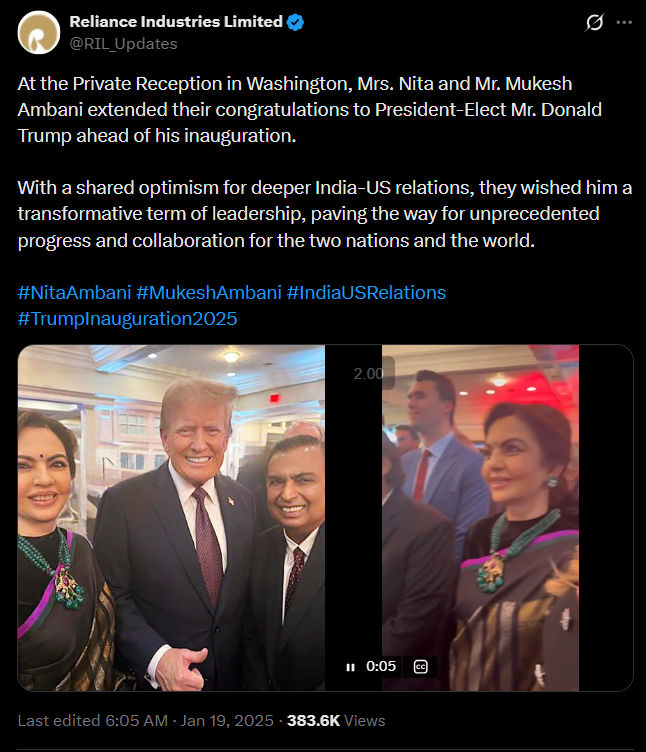
The Ambani family had long been cultivating its relationship with the Trumps. Reliance paid $10 million to the Trump Organization in 2024 as a “development fee” for a project in Mumbai, according to the president’s financial disclosure. (Despite the payment, Reliance has not yet announced a Trump project. Reliance told ProPublica that “the real estate project is real” and “remains under development.”) Ivanka Trump attended Anant Ambani’s wedding party in India that year, where guests were treated to a Rihanna concert. Anant’s father, Mukesh — who is worth an estimated $90 billion and lives in a 27-story home — came to Washington, D.C., for Trump’s second inauguration, posing with the president at a private reception.

But by the summer of 2025, the family was under attack from the White House. Since Russia invaded Ukraine in 2022, Reliance had reportedly made billions in profits by purchasing vast quantities of Russian oil at a discount. In August, as Trump grew frustrated with his administration’s struggles to bring the war to an end, the president doubled his tariffs on India to 50%. The move was explicitly designed to force companies like Reliance to stop buying Russian oil. White House trade adviser Peter Navarro publicly assailed “India’s politically connected energy titans” for “funding Putin’s war machine,” widely read as a reference to the Ambanis.
Amid this tension, Trump Jr. visited Anant Ambani on his November trip to India. At the end of the trip, Trump Jr.’s personal lawyer commented at a business conference in Miami: “I had a nice closing this morning with Don Trump Jr., who’s flying back from India today.” (The following week, the Texas startup — then called Element Fuels — filed paperwork to create America First Refining LLC. In an email, the attorney, John Willding, told ProPublica that there was “no transaction in India or with an Indian company that I was ever involved with.”)
Anant Ambani, who helps run Reliance’s energy business, personally worked on the Texas refinery deal for months before it was announced, a major Indian newspaper later reported.
As the Ambanis quietly finalized their deal with America First Refining, U.S.-Indian relations appeared to warm. In February, the Trump administration struck a trade deal with India, dramatically lowering tariffs, and also reportedly gave Reliance a license to buy Venezuelan oil. When the Iran war broke out and rocked global energy markets, the U.S. gave India a sanctions waiver to buy Russian crude. (The waiver was later expanded to all countries.)
In response to ProPublica’s questions, the White House said that “there are no conflicts of interest.” Reliance did not answer ProPublica’s questions about Trump Jr.’s and Anant Ambani’s roles in the investment deal, but said in a statement that the company did not receive “any unique or preferential treatment” from the U.S. government.
“There is no connection between Reliance’s investment in AFR and any unique measures associated with general U.S. trade, tariff, sanctions or licensing outcomes,” Reliance said. “The investment was evaluated and approved on its commercial merits, strategic fit and long-term value creation potential.”
In March, President Trump personally announced Reliance’s deal with the Texas startup on Truth Social, thanking the Ambani company for its “tremendous Investment.”
After the announcement, Willding, the Trump Jr. lawyer, shared the news on LinkedIn: “Just so proud to have been part of this one.”
Willding rowed back his claim in an email to ProPublica. “I have never worked for or advised AFR and had zero involvement in their deal with Reliance Energy,” he said. “I simply saw the press release and was excited for them.” America First Refining’s spokesperson called Willding’s comment “moronic and false.”
In June 2025, Willding registered a new entity in Wyoming called TX Fuels, LLC, listing the company’s address as Trump Jr.’s mansion in Jupiter, Florida. In his email, Willding said his “only involvement in AFR was handling the legal paperwork” for the Trump Jr. LLC’s investment in the startup.
Trump Jr. first hired Willding in May 2021, according to interviews the lawyer has given. A corporate deal lawyer in Dallas, Willding has referred to himself as “outside business counsel to the Trump family” and has said he talks to Trump Jr. or Eric Trump almost daily. A former Bill Clinton and Barack Obama voter who fell hard for MAGA, the attorney has installed a portrait of President Trump over the mantel in his living room.
Willding’s practice has boomed during the second Trump administration, bringing the lawyer to Argentina, Saudi Arabia and South Korea. “Everybody in the world wants to do business with the United States right now,” Willding said at a conference in June 2025. “Every company wants to do business with the Trump family.”
There are other fingerprints of the Trump world on the refinery deal.
Howard Lutnick’s firm Cantor Fitzgerald — which his sons took over when Lutnick became Trump’s commerce secretary — is working as the financial adviser to America First Refining, including on the Ambani investment deal, Cantor Fitzgerald announced. (Cantor Fitzgerald declined to comment.)
And the Trump administration played a direct role helping America First Refining find potential foreign investors, according to public comments from the company’s CEO, John Calce. “We have received support from the White House,” he told a local news outlet. The National Energy Dominance Council, led by the interior and energy secretaries, has “helped us with, candidly, introducing us and helping us meet some of these people overseas,” Calce said on an industry podcast.
America First Refining has recently explored going public, according to three people close to the company. That could allow its current investors to start cashing out even if the refinery never gets built — a milestone many energy industry insiders still view as a long shot. Reliance made its investment in the startup at a valuation of at least $1 billion, according to America First Refining’s announcement.
Building a refinery at the Port of Brownsville on the Gulf Coast has been Calce’s mission for a decade. A former Yale offensive lineman, he started his career as a high school football coach after an unsuccessful attempt to make the NFL and now describes himself as a “lifelong entrepreneur.”
The project has been serially delayed, out of money, rebranded and trailed by angry former business partners. At one point, Calce’s companies were being sued simultaneously by eight other firms. In 2022, during bankruptcy proceedings for an earlier iteration of the project, the trustee appointed to impartially oversee the case sued Calce too. The trustee alleged that Calce and other insiders had improperly siphoned away cash and other assets. (Calce denied wrongdoing. The case was ultimately settled.)
During the Biden administration, as the company sought financial support from the Department of Energy, it pitched itself as a climate-friendly green project that would also help “people of underrepresented social demographics” in Brownsville, according to records from that period. The company failed to get enough money from outside investors, and the planned construction was delayed.
By the company’s own estimate, building the refinery will take years and cost $3 billion to $4 billion. Even if it’s built, profitability could be hard to achieve. Many energy investors told ProPublica there’s a reason the U.S. hasn’t seen a major new refinery in decades. “Refineries cost a lot of money and essentially make pennies on the dollar,” said Ed Hirs, an energy economist in Houston. “Wall Street is not going to finance a new refinery.”
Even after the start of the second Trump administration, the company was in jeopardy, according to interviews and documents. It laid off workers last year, and, by late 2025, with delays continuing to plague the refinery, officials at the Port of Brownsville believed the project looked to be dead, according to records reviewed by ProPublica.
That has not stopped Calce and his team from making grandiose claims to the public. Earlier this year, a website went live for another Calce company called Brownsville Energy Storage Terminals. It claims to have a far-flung network of oil storage terminals in places like the Netherlands and Singapore, more than 850 employees and a C-suite of experienced energy executives. But ProPublica could find no evidence that the executives are real people or that the storage terminals actually exist. The phone numbers on the website are also currently listed online as the contacts for a Houston baklava caterer, a Dallas-area taxi service and an OB-GYN office. The numbers are dead.
America First Refining’s political ties, though, may have boosted its standing with Texas state regulators. In February, shortly before the Ambani investment became public, the company sought an extension on its permit from the Texas Commission on Environmental Quality.
Inside the state agency, emails obtained by ProPublica show, officials scrambled to approve the request.
“Need to get this one logged and processed asap,” wrote one official.
“You are going to have to do this one. I will explain why in person in a few,” wrote another. “You can guess if you check out the name.”
America First Refining got its approval the next day. A spokesperson for the Texas agency did not address questions about the emails. “This request was processed quickly due to the quality of information provided,” the spokesperson said.
Filed Under: anant ambani, corruption, donald trump, donald trump jr., india, john willding, mukesh ambani, russia, russian oil, tariffs, tx fuels
Companies: america first refining, element fuels, reliance




Weekend Open Thread: High Hopes

Taylor Swift and Travis Kelce wedding staffer hilariously struggles to keep her cool while checking in megastars


Open Thread: What Great Books Have You Read Recently?


Standard Chartered Secures MiCA License as ESMA Adds 37 New Crypto Firms


The House | “Reframing the debate from a binary discussion of winners and losers”: Yuan Yang reviews ‘We Are Not Machines’


Whats Hidden Inside This Cash Register? #treasure #reselling #money

Anthropic’s new “J-lens” reveals a silent workspace inside Claude that mirrors a leading theory of consciousness


AXT Shares Jump Nearly 14% as Semiconductor Materials Maker Rebounds on AI-Linked Indium Phosphide Demand


Joshua Pacio ‘more complete’ ahead of ONE rematch vs Malachiev

ESMA Expands Crypto Register by 37 Firms Following MiCA Transition Period
SK hynix (000660.KS) Stock Dips as $28B Nasdaq ADR Offering Drives AI Memory Expansion


South Africa proposes crypto tax guidance under existing rules


Best Time to Enter Small Caps Right Now? Another Bull Run? | Financially Free


Lenovo laptops are now shipping with YMTC SSDs, a sign of Chinese NAND entering the mainstream


What a 10 Percent Drop Means for Buyers, Sellers and Renters
We have punished the disrespect


Binance Re-Enters Philippines As EU MiCA Rules Restrict Access


Avoid entering in FOMO #bitcoin #cryptocurrency #trading #scalping


Alibaba bans Claude Code over alleged backdoor security concerns


Neuralink Threads Its Way Straight Through the Brain’s Armor



You must be logged in to post a comment Login