
Crypto World
What are L2 sequencers? Ethereum’s centralized chokepoint, explained



Nearly every transaction on Ethereum’s layer-2 networks passes through a single machine, run by a single company, called a sequencer. It orders trades, sets the pace of the chain, earns the fees, and can go dark or say no. This guide explains what sequencers actually do, why the most decentralized ecosystem in crypto runs its fast lanes through central operators, what can and cannot go wrong, and the roadmaps racing to fix it.
Summary
- Ethereum layer 2 networks rely on centralized sequencers that order transactions, collect fees, and can temporarily halt network activity during outages.
- Sequencers cannot steal user funds because Ethereum secures transaction validity, but they can influence transaction ordering, censorship, and network availability.
- Rollup developers are working toward decentralized sequencing models to reduce reliance on a single operator while preserving Ethereum’s security and scalability.
Here is an uncomfortable fact about the scaled, modern Ethereum: when you swap on an Arbitrum exchange, mint on Base, or pay on Optimism, your transaction is received, ordered, and confirmed by one machine, operated by one company. That machine is the sequencer, and it occupies a position of quiet, enormous power: it decides which transactions enter the chain and in what order, it collects the network’s fee revenue, and when it stops, as major sequencers have during outages, the entire network simply pauses, every app frozen at once.
The layer-2 rollups are how Ethereum scaled, moving execution off the congested base chain while inheriting its security, and they now carry a majority of the ecosystem’s activity. That success makes the sequencer the most consequential piece of centralized infrastructure in an ecosystem whose founding promise is decentralization, and the tension is not a secret; it is an engineering roadmap, with every major rollup publicly committed to fixing it and none finished. Meanwhile the base layer itself is being redesigned around adjacent ideas, with the coming Glamsterdam upgrade enshrining proposer-builder separation into the protocol, which will reshape the environment sequencers operate in.
This guide covers the sequencer honestly: what a rollup is and what job the sequencer does inside it, the specific powers a centralized sequencer holds and their real-world failure record, the crucial distinction between what a sequencer can and cannot do to your funds, the economics of sequencing and why operators are slow to give it up, the decentralization designs, shared sequencing, based sequencing, sequencer sets, competing to replace the single machine, and how to evaluate any L2’s actual trust profile today.
Rollups in one section, and the sequencer’s job
A rollup is a blockchain that executes transactions on its own fast, cheap environment, then posts compressed records of everything it did to Ethereum, inheriting the base chain’s security for its history. Optimistic rollups post results and allow a challenge window for fraud proofs; validity rollups post cryptographic proofs that the results are correct. In both designs, Ethereum is the court of final record, and the rollup is a high-throughput execution venue whose state can always, in principle, be reconstructed and verified from the data it posts down below.
Someone, though, has to run the fast venue in real time: receive the flood of incoming transactions, decide their order, execute them, hand users instant confirmations, and batch the results down to Ethereum. That someone is the sequencer. It is best understood as three roles fused: the mempool and matching engine that orders the flow, the block producer that executes it, and the shipping department that posts batches to the base chain. The ordering role is the powerful one, because in any financial system, transaction order is money: who gets the arbitrage, whose liquidation lands first, who buys before the price moves. On Ethereum’s base layer that power is fragmented across thousands of validators and an entire adversarial supply chain built to capture it; on almost every major rollup today, it belongs to one operator, appointed by the team, running the official sequencer.
Why did the most decentralization-obsessed ecosystem in software ship its scaling layer this way? Because centralized sequencing is fast, simple, and safe to bootstrap: one machine gives instant confirmations, no consensus overhead, clean upgrade paths, and a single throat to choke during the inevitable early bugs. The architects’ wager was that sequencing could be centralized temporarily because the rollup design strictly limits what the sequencer can do, a wager the next two sections examine from both sides.
What the sequencer can do to you, and what it cannot
The sequencer’s powers are real, and enumerating them precisely matters more than the usual hand-waving in either direction.
What it can do. It can censor: refuse to include your transaction, whether by policy, error, or legal compulsion, and regulated operators have compliance obligations that make selective exclusion more than hypothetical. It can order: place its own or favored transactions ahead of yours, extracting the value that ordering confers, invisibly and profitably; most major operators publicly forswear this, and the forswearing is a policy, not a protocol guarantee. It can stop: sequencer outages have repeatedly frozen major rollups for hours, halting every application simultaneously, a failure mode with no analogue on the base chain, where thousands of validators mean the chain simply does not stop. And it can set the pace and price of inclusion, since it is the sole gateway to the network’s blockspace in real time.
What it cannot do, and this is the rollup design’s genuine achievement: it cannot steal. The sequencer cannot forge a transaction spending your funds, because every transaction requires your signature and the fraud or validity proofs posted to Ethereum would expose any invented state. It cannot rewrite settled history, because the history lives on the base chain. And, critically, it cannot permanently trap you, because well-built rollups include an escape hatch: a mechanism to force-include transactions directly through Ethereum, bypassing the sequencer entirely, so that even a fully censoring or dead sequencer can only delay users, not imprison their funds. The delay is real, force inclusion is slow and clumsy, but the distinction between a chokepoint that can inconvenience you and a custodian that can rob you is the entire difference between the rollup model and a centralized exchange, and it is why the ecosystem tolerated centralized sequencing at all. The trust profile resembles a bridge with a strong trust-minimized design rather than a multisig one: concentrated operationally, constrained cryptographically.
The honest risk summary, then: your assets on a major rollup are secured by Ethereum; your access, timing, and fair ordering are secured by one company’s machine, policies, and legal situation. For a casual user the distinction rarely bites. For a trader whose profits live in ordering, for a protocol whose execution quality depends on fair ordering and whose liquidations must land on time, and for anyone in a jurisdiction a compliant operator might be told to exclude, the sequencer is the trust assumption that matters most and is audited least.
The outage record: what centralization has actually cost
The sequencer risk is not theoretical, and the incident record is the best syllabus for what single-operator infrastructure means in practice. Every major rollup has suffered sequencer downtime: hours-long halts from surging inscription traffic, stalls from software bugs in batch posting, freezes during upgrades that went sideways. The pattern across incidents is consistent and instructive. Funds were never lost, the base-chain security model held every time, and the networks resumed with their histories intact, which is the design working as promised. What stopped, each time, was everything else: trading froze mid-move, liquidation engines could not reach positions as prices moved, arbitrage broke against live markets elsewhere, and users learned that force-inclusion, the theoretical escape hatch, was in practice too slow and too technical to matter inside an incident measured in hours.
The subtler lessons sit in the second-order effects. During one prominent outage, the network’s applications discovered their own emergency procedures assumed a working sequencer: pausing markets, updating oracles, and even communicating with users all routed through the machine that was down. During another, the resumption itself became a trading event, as hours of queued transactions landed in a burst against stale prices, a miniature of the reconciliation dynamics every gap-prone market knows. And across all of them, the operator’s incident response, status pages, engineer availability, post-mortems, was the de facto governance of a multi-billion-dollar economy for the duration, performed by a company under no protocol obligation to perform it well.
The record’s summary is fair to both sides of the argument: the constrained-power design has truly protected funds through every failure, and the single-machine design has just as surely imposed correlated, economy-wide halts that a decentralized system would not, which is precisely the trade the roadmaps exist to unwind.
It is also worth placing the sequencer inside the rollup’s full trust stack, because it is the most visible dependency but not the only one. A rollup’s security rests on three legs: the data it posts to Ethereum, which is what makes reconstruction possible and which the blob-fee era made radically cheaper; the proof system, fraud or validity, that polices state correctness, several of which still run with training wheels, security councils and permissioned challengers standing in for mature proofs; and the sequencer, which governs liveness and ordering. Independent frameworks grade rollups across all three, and the grades routinely surprise users who assumed the marketing: networks celebrated as trust-minimized frequently carry upgrade keys and council powers that outrank the sequencer question entirely. The sequencer is the right place to start reading an L2’s trust profile. It is the wrong place to stop.
The economics: why giving it up is hard
Sequencing is not just power; it is revenue, and the revenue explains the pace of decentralization better than any technical obstacle. A sequencer collects the difference between what users pay for L2 transactions and what it costs to post their data to Ethereum, a margin that widened dramatically when Ethereum’s blob-based data pricing collapsed posting costs, plus whatever ordering value it chooses to capture or auction. For a major rollup this is a nine-figure annual business, and it currently flows to the operating company or foundation, funding development and, in several cases, constituting the primary revenue behind the network’s token.
Decentralizing the sequencer means distributing exactly this revenue, and the designs on the table are, among other things, proposals about who gets paid. That is not cynicism; it is the correct lens for evaluating the roadmaps, because a decentralization plan that never specifies where sequencing revenue goes is a plan that has not confronted its hardest question. It also frames the user’s side of the bargain today: centralized sequencing quietly subsidizes the networks users enjoy, the same revenue-and-token linkage question running through every fee-generating protocol, and every step toward neutrality redistributes a pie someone currently owns.
The numbers behind the revenue argument are worth one concrete paragraph. An L2’s gross margin is the spread between user fees collected and data costs paid to Ethereum, and the blob-fee era transformed that spread: posting costs for major rollups collapsed by orders of magnitude while user fees, though lower, fell less, leaving the large networks operating at gross margins that most software businesses would envy. Public dashboards track the arithmetic in real time, revenue in, data costs out, and the residual accrues today to whoever runs the sequencer. That residual funds engineering, subsidizes user fees during growth pushes, and, for token-bearing networks, constitutes the cash flow every valuation argument ultimately references.
Decentralization designs must answer where it goes: to a staked sequencer set as yield, to a shared network as service fees, to Ethereum validators under based sequencing, or to users as rebates, and each answer creates and destroys different constituencies. The engineering of neutral sequencing was largely solved on whiteboards years ago; the political economy of its revenue is the part still being negotiated, which is the single most clarifying fact about why the timelines are what they are.
The fixes: three roads to a neutral sequencer
Three families of designs compete to replace the single machine, each trading different things.
The first is the sequencer set: replace one operator with a permissioned or staked committee running consensus among themselves, rotating leadership, so that censorship requires collusion and outage requires correlated failure. It is the incremental path, and its critics note that a small committee of known entities is a smaller improvement than it appears, particularly against legal compulsion, which scales to committees easily.
The second is shared sequencing: independent networks whose business is providing decentralized ordering as a service to many rollups at once, with the added promise of atomic cross-rollup composability, transactions that execute across multiple L2s together or not at all, recreating some of the seamlessness the multi-rollup world fractured. The trade is a new external dependency and, again, the revenue question: a shared sequencer wants paying customers, and rollups guard their margins.
The third and most Ethereum-native is based sequencing: hand ordering back to Ethereum itself, letting the base chain’s validators sequence L2 transactions as part of block production. It maximally inherits Ethereum’s neutrality and censorship resistance, at the cost of Ethereum’s pace, confirmations at base-layer speed rather than the instant feel users have learned, though pre-confirmation designs aim to restore the speed. Based sequencing’s fortunes are entangled with the base layer’s own evolution: the Glamsterdam upgrade’s enshrined proposer-builder separation restructures exactly the block-production pipeline that based rollups would plug into, which is why sequencer roadmaps and Ethereum’s core roadmap now read as one document with two authors.
No major rollup has completed any of the three. The public commitments are real, staged plans, published designs, testnets, and the timelines have slipped for years, because the current arrangement works, earns, and only embarrasses its operators when something breaks. The realistic forecast is a long middle period of committees and hybrid designs, with full neutrality arriving network by network, unevenly, this decade.
A note on terminology prevents one common confusion: the sequencer is not the prover, and decentralizing one does nothing for the other. The prover, in validity rollups, generates the cryptographic proofs of correct execution; the sequencer orders and executes. A network can decentralize sequencing while proving remains one machine, or the reverse, and the two roles fail differently: a dead prover delays finality on Ethereum while the chain keeps running, a dead sequencer halts the chain while finality of past batches stands. Roadmap language blurs the roles constantly, and reading which one a decentralization milestone actually addresses is a small skill that pays for itself.
How to read an L2’s actual trust profile
For a user or builder choosing among rollups today, the sequencer question compresses into a practical checklist. Who runs the sequencer, and under what legal jurisdiction? Does the network have working force-inclusion, and what is its delay, the number that bounds worst-case censorship? What is the outage history, and did funds ever depend on the operator’s goodwill during one? Is there a published ordering policy, first-come-first-served, private mempool, auction, and any mechanism enforcing it beyond reputation? What stage is the decentralization roadmap actually at, running code versus blog post? And where does sequencing revenue go, because that answer predicts the roadmap’s pace better than the roadmap does.
The sequencer is the honest asterisk on Ethereum’s scaling triumph: the rollup ecosystem genuinely extended the base chain’s security to vastly more activity at vastly lower cost, and it did so by concentrating, temporarily and by design, the one power the base chain had most successfully dispersed. The asterisk is shrinking, slowly, under public pressure and published plans, and until it is gone, the single most useful thing a user can know about any L2 is exactly what its one important machine can and cannot do to them.
The wider stakes deserve a closing frame, because the sequencer question is Ethereum’s decentralization thesis meeting its scaling success, and the resolution will define what the ecosystem actually is. If the rollup era ends with a handful of corporate sequencers ordering most on-chain activity, then Ethereum will have rebuilt, at the execution layer, the intermediated structure it was designed to replace, with the base chain reduced to a settlement court for private venues. If the decentralization roadmaps deliver, based sequencing, credible committees, shared networks, then the scaling will have been genuine: more activity, same neutrality, the original promise kept at a hundred times the throughput. Both futures are still open, the incentives lean toward the first and the culture toward the second, and the outcome will be decided not by white papers but by the unglamorous engineering and revenue negotiations described above, network by network, over the next several years. Users are not spectators to that contest: the trust profiles are public, the alternatives are one bridge away, and where activity settles is the only vote the operators have ever reliably counted.
A practical postscript for builders, finally: sequencer risk is inherited. An application deployed on a rollup imports its sequencer’s outage record, censorship surface, and ordering policy as silent dependencies, and the mature practice, visible in how serious protocols now deploy, is to treat chain selection as a security decision, document the force-inclusion path in the runbook, and design liquidation and oracle machinery to fail safely through a halt. The sequencer is infrastructure, and the first rule of infrastructure applies: it is invisible until the day it is the only thing that matters.
The reader’s shortlist for following the story: the independent rollup-risk frameworks that grade each network’s sequencer, proofs, and upgrade keys; the networks’ own decentralization roadmap pages, read with dates, not adjectives; the outage post-mortems, which teach more per paragraph than any documentation; and the base-layer upgrade calendar, since Glamsterdam-era changes to Ethereum’s block pipeline reshape what based sequencing can offer. The chokepoint is well documented by everyone except the marketing, and the documentation is where the truth lives.
If one image should survive this guide, make it the geometry: Ethereum scaled by turning one broad, slow, neutral road into a system of fast toll lanes, each with a single operator at the booth. The lanes carry the traffic, the operators are competent, and the toll revenue is building better booths. But the map of who can stop which cars, and where, is now the most important map in the ecosystem, and every reader of this piece can pull it up for any network in about five minutes. Do that, once, for wherever your funds live. It is the highest-yield five minutes in crypto self-custody.
Disclaimer: This article is for educational purposes only and does not constitute investment advice. Network designs and roadmaps described are current as of July 9, 2026, and change frequently. Always do your own research.
Frequently asked questions
What is an L2 sequencer in simple terms?
A sequencer is the machine that runs a layer-2 rollup in real time: it receives transactions, decides their order, executes them, gives users instant confirmations, and posts compressed batches of the results to Ethereum. On nearly every major rollup today, the sequencer is a single server operated by the network’s founding company, making it the most centralized component in Ethereum’s scaling stack.
Can a sequencer steal my funds?
No. The sequencer cannot forge transactions from your account, because everything requires your signature, and it cannot fake results, because the rollup’s proofs posted to Ethereum would expose invalid state. Its powers are limited to ordering, delaying, censoring, and halting. Well-designed rollups also include force-inclusion mechanisms that let users push transactions through via Ethereum directly, so even a hostile sequencer can delay but not permanently trap funds.
What happens when a sequencer goes down?
The network effectively pauses: no new transactions confirm, and every application on the rollup freezes simultaneously until the operator restores service. Major rollups have suffered such outages lasting hours. Funds remain safe throughout, secured by Ethereum, but access stops, which matters greatly for time-sensitive positions like loans near liquidation.
Why are sequencers centralized if Ethereum is decentralized?
Because centralized sequencing was the pragmatic way to launch: one operator provides instant confirmations, simple upgrades, and clean incident response while the technology matured. The rollup design constrains what the operator can do, and every major network has published a decentralization roadmap. The trade-off was consciously temporary; its length is the controversy.
What is based sequencing?
Based sequencing hands transaction ordering back to Ethereum itself, letting the base chain’s validators sequence the rollup’s transactions during block production. It gives the rollup Ethereum’s full neutrality and censorship resistance, at the cost of slower confirmations, which pre-confirmation designs aim to offset. It is the most Ethereum-aligned of the decentralization paths.
What is a shared sequencer?
A shared sequencer is an independent network that provides decentralized transaction ordering as a service to multiple rollups simultaneously. Beyond decentralization, its selling point is atomic cross-rollup composability, the ability for transactions to execute across several L2s together, which single-rollup sequencers cannot offer.
Do sequencers extract MEV from users?
They can, since ordering power is exactly what MEV extraction requires, and a sequencer sees every transaction before it lands. Major operators publicly commit to neutral policies like first-come-first-served ordering, and some route ordering value into public goods or auctions. These are policies rather than protocol guarantees, which is a core argument for decentralizing the role.
How do I check how centralized a specific L2 is?
Ask five questions: who operates the sequencer and where; whether force-inclusion exists and how long it takes; the network’s outage history; the published ordering policy; and the actual stage of the decentralization roadmap. Independent trackers grade major rollups on these dimensions, and the grades differ far more than the marketing does.

The Clarity Act is widely viewed as the crypto industry’s most important piece of U.S. legislation, with supporters arguing it would establish clear rules for digital assets, reduce regulatory uncertainty and unlock broader institutional adoption. Analysts say passage would improve market sentiment by giving banks, asset managers and exchanges greater confidence to invest in blockchain infrastructure and expand crypto products.
Bernstein’s analysts said they expect regulators to move more quickly on token classifications, decentralized finance (DeFi) guidance, self-custody rules and innovation exemptions for token issuance, while continuing to support tokenization, crypto derivatives and prediction markets.
The Clarity Act remains strategically important because it would provide permanent regulatory certainty, encourage banks, broker-dealers and exchanges to invest in blockchain infrastructure, clarify the division between securities and commodities oversight and establish a long-term framework for decentralized finance and digital assets regardless of future political administrations, the report said.
Even if the legislation stalls, the broker expects the crypto industry’s political influence to remain strong ahead of the U.S. midterm elections and sees the current downturn ending in late third or early fourth quarter, helped by the prospect of further White House policy support.
For listed companies, failure to pass the bill would preserve the status quo for stablecoin regulation.
Introduction
For much of its history, cryptocurrency has been associated with one thing: speculation. Headlines focused on soaring prices, dramatic crashes, meme coins, and traders chasing the next 100x opportunity. While speculation fueled early adoption and liquidity, it also overshadowed blockchain’s true potential.
Today, that narrative is changing.
The crypto industry is steadily transitioning from a market driven primarily by price movements to one powered by real-world utility. Institutions, governments, businesses, and millions of everyday users are beginning to leverage blockchain technology for payments, financial services, identity, supply chains, gaming, artificial intelligence, and countless other applications.
The next chapter of crypto isn’t about buying low and selling high—it’s about solving global problems.
Between 2017 and 2024, the cryptocurrency market experienced explosive growth largely driven by speculation.
Characteristics of this period included:
- Retail investors chasing rapid gains
- Meme coin booms
- NFT hype cycles
- Leveraged trading
- Frequent market bubbles
- Extreme volatility
Although these cycles attracted millions of new users, they also created the misconception that crypto had little purpose beyond trading.
Ironically, speculation played an important role by funding innovation. Capital flowed into blockchain startups, decentralized applications (dApps), infrastructure providers, and developer ecosystems that are now laying the foundation for real-world adoption.
Instead of asking:
“Which coin will 100x?”
The market is increasingly asking:
“Which blockchain solves real problems?”
This shift marks one of the biggest transformations in crypto’s history.
Utility creates sustainable demand because people use blockchain regardless of market conditions.
Examples include:
- Cross-border payments
- Stablecoin settlements
- Decentralized finance (DeFi)
- Tokenized real-world assets
- Digital identity
- Gaming economies
- Supply chain verification
- Machine-to-machine payments
- AI infrastructure
- Decentralized cloud computing
These applications generate economic activity independent of speculative trading.
Perhaps no crypto product demonstrates utility better than stablecoins.
Millions of users now rely on stablecoins to:
- Send money internationally
- Protect savings from inflation
- Pay freelancers
- Trade digital assets
- Access dollar-denominated finance
- Settle transactions instantly
Businesses increasingly prefer blockchain settlements because they reduce costs while operating 24/7.
Stablecoins have quietly become one of crypto’s most practical and widely adopted use cases.
Decentralized Finance has matured far beyond yield farming.
Modern DeFi enables:
- Lending
- Borrowing
- Decentralized exchanges
- Prediction markets
- Bond issuance
- Treasury management
- Derivatives
- Cross-chain liquidity
- Automated investment strategies
Rather than replacing banks overnight, DeFi is becoming an open financial layer that anyone with an internet connection can access.
For regions with limited banking infrastructure, this represents a major leap toward financial inclusion.
Another major catalyst is the tokenization of real-world assets (RWAs).
Assets such as:
- Government bonds
- Stocks
- Real estate
- Commodities
- Private credit
- Carbon credits
- Intellectual property
can increasingly be represented as blockchain-based tokens.
Benefits include:
- Fractional ownership
- Instant settlement
- Greater transparency
- Lower administrative costs
- Global accessibility
- Improved liquidity
Tokenization is bridging traditional finance and decentralized infrastructure rather than forcing them to compete.
For years, critics argued that crypto was too slow or volatile for everyday payments.
That is changing rapidly.
Modern blockchain networks now offer:
- Near-instant settlements
- Low transaction fees
- Global interoperability
- Mobile wallet integration
- Merchant payment solutions
- Stablecoin-based transactions
Consumers may soon use blockchain without even realizing it, much like most people use the internet today without understanding TCP/IP.
The technology becomes invisible while the experience improves.
Blockchain utility extends beyond finance.
Decentralized identity solutions allow users to control their digital credentials without relying entirely on centralized platforms.
Applications include:
- Educational certificates
- Medical records
- Professional licenses
- Voting systems
- Identity verification
- Digital passports
Privacy-enhancing technologies like Zero-Knowledge Proofs (ZKPs) and Fully Homomorphic Encryption (FHE) are enabling secure verification without exposing sensitive personal information, making blockchain more practical for enterprises and governments alike.
Artificial intelligence increasingly requires decentralized infrastructure.
Blockchain provides:
- Verifiable data
- Transparent payments
- Permissionless marketplaces
- Decentralized compute networks
- Incentive systems
- Trustless coordination
Meanwhile, AI can improve blockchain through:
- Smart contract auditing
- Fraud detection
- Governance analysis
- Automated trading
- Personalized financial tools
Together, AI and blockchain form a powerful foundation for the next generation of digital services.
Institutional adoption has accelerated significantly.
Major financial institutions are exploring:
- Tokenized funds
- Digital asset custody
- Stablecoin infrastructure
- Blockchain settlement systems
- Asset tokenization
- Digital securities
Meanwhile, governments are experimenting with blockchain for:
- Public records
- Tax reporting
- Supply chain management
- Digital identity
- Land registries
- Central Bank Digital Currencies (CBDCs)
The conversation has shifted from “Should we use blockchain?” to “How do we integrate blockchain responsibly?”
Despite significant progress, challenges remain.
The industry must continue improving:
- User experience
- Wallet security
- Regulatory clarity
- Cross-chain interoperability
- Scalability
- Consumer protection
- Education
- Developer tooling
Mass adoption will depend not only on technological breakthroughs but also on making blockchain products simple enough for everyday users.
The future of crypto will likely be measured less by token prices and more by real-world impact.
Success won’t come from speculation alone, but from building systems that people rely on every day.
As blockchain becomes embedded in payments, finance, commerce, AI, gaming, healthcare, and digital identity, users may interact with crypto-powered services without ever thinking about the underlying technology.
That’s often the hallmark of transformative innovation: it fades into the background while making everyday life more efficient.
Final Thought
Crypto is evolving beyond its speculative roots into a global utility layer for the digital economy. While market cycles and price volatility will always be part of the ecosystem, long-term value is increasingly being created through practical applications that improve how people move money, verify identity, access financial services, and exchange value across borders.
The transition won’t happen overnight, but the direction is becoming clear. The next wave of blockchain adoption will be driven not by hype, but by usefulness. And as more industries embrace decentralized technologies, crypto’s greatest achievement may not be creating the next billion-dollar token—it may be quietly becoming the infrastructure that powers the world’s digital future.
REQUEST AN ARTICLE
Last week, hackers discovered a five-year-old bug in Coldcard software and used it to drain over 1,158 BTC worth over $72 million from over 2,600 addresses.
By Sunday, the tally rose to 1,359 BTC and continues to rise today.
A rudimentary dashboard is charting the rising number of thefts, with many security experts warning of additional waves of attacks.
The essence of the bug is that, despite claims by Coldcard’s manufacturer and documentation, many of its devices didn’t actually use a true random number generator (RNG) with sufficient entropy to protect users trusting the device to generate private keys and seed phrases.
Instead, the device used a fallback, a pseudo RNG, with far lower entropy.
Unfortunately, trivial amounts of computation can guess these low entropy seed phrases generated by Coldcard devices.
Once in possession of these private keys, a quick scan of the blockchain reveals associated public keys holding BTC, and hackers then steal those funds.
The bug has existed since March 2021, but security researchers only publicly discovered it last week. As theft transactions began, customers and members of the community began to track the horrifying timeline of events.
As brute-force attacks continue to crack private keys, here’s a summary of the series of events that led up to the ongoing catastrophe.
Read more: Crypto wallet seeds crackable with gaming PC via this security flaw
Timeline of the Coldcard hack
6 years ago
November 18, 2020, 19:19 UTC: There are disputed histories and allegations about Coldcard maker Coinkite’s motivation during this time to end its commitment to free and open source software (FOSS).
In any case, by late 2020, Coinkite announced its intention to restrict commercial use of its firmware (on-device software), and by early 2021, the company began migration to a new software license.
It would develop a proprietary library called “libNgU.”
5 years ago
March 1, 2021, 14:03 UTC: Coinkite commits code titled “First pass w/ libNgU,” its final step away from FOSS and moving Coldcard firmware (on-device sofware) onto its proprietary library, libNGU.
5 years ago
March 29, 2021, 19:27 UTC: Firmware 4.0.1 reaches owners as the first public build with the flaw. Coldcard devices shipping with or upgrading to this new firmware would begin generating insecure seed phrases.
The bug of pseudo RNG on versions 4.0.1 and later would persist on Coldcard software for over five years from March 29, 2021 through July 30, 2026.
5 days ago
July 30, 2026, 01:10 UTC: Bitcoin block 960,183 includes the first Coldcard hack transactions from a hacker.
4 days ago
July 30, 2026, 13:19 UTC: A user posts the first widely read account to Reddit, “Full panic — one of my wallets was drained.”
4 days ago
30 July 2026, 17:35 UTC: Kevin Loaec, a BTC security researcher, asks his followers to check their balances. “I’m hearing a potential issue with some Coldcard wallets being drained,” he wrote. “I will not FUD, but would like to get at least reports of trusted people.”
4 days ago
30 July 2026, 18:58 UTC: Less than 90 minutes later, Loaec drops the hedge. “Alright I’m convinced THIS IS NOT A DRILL.”
4 days ago
30 July 2026, 22:50 UTC: The official Coldcard social media account publishes a Mk3-only advisory that has since drawn more than two million views.
It would claim “Mk4, Q and Mk5 are not affected based on our early analysis,” which would later turn out to be false.
On its website, Coinkite formally discloses the vulnerability and quickly publishes a bug patch via firmware 4.2.0.
3 days ago
July 31, 2026, 01:49 UTC: A Block engineer circulates its independent analysis of the incident, which identifies the root cause.
“COLDCARD firmware contains an RNG integration error that causes ngu.random to use MicroPython’s deterministic Yasmarang fallback instead of the STM32 hardware RNG.”
3 days ago
July 31, 2026, 04:54 UTC: Block 960,345 inclues additional theft transactions, which would continue for another four hours.
3 days ago
July 31, 2026, 06:46 UTC: Coinkite posts a technical disclosure widening the scope to its Mk4, Mk5, and Q Coldcard devices.
3 days ago
July 31, 2026, 08:36 UTC: Block 960,369 carries another drain of funds alongside 250 others.
3 days ago
July 31, 2026, 13:19 UTC: Kevin Loaec, another security researcher, warns that more theft transactions are underway.
3 days ago
July 31, 2026, 13:43 UTC: Coinkite releases Mk3 firmware 4.2.0. It emphasizes that the update will fix new private key generations but cannot repair a past, compromised seed phrase.
3 days ago
July 31, 2026, 15:42 UTC: Coinkite co-founder and chief executive Rodolfo Novak apologizes in an open letter. “We take full accountability for the firmware bug and we offer our sincere apologies to those affected.”
3 days ago
July 31, 2026, 16:30 UTC: Bitcoin Core contributor Antoine Poinsot tells his followers the scope is wider than Coinkite initially admitted.
“Coldcard MK3, MK4, MK5 and Q are being drained. A bug lets attackers find your seed phrase without any action on your part.”
3 days ago
July 31, 2026, 16:39 UTC: Coinkite concedes that seed phrases from compromised firmware carry “about 72 bits of entropy rather than the expected 128 bits.”
3 days ago
July 31, 2026, 17:42 UTC: Block engineering lead Clay Garrett claims that an attacker queried source addresses through a paid account at a blockchain data provider, raising the possibility that customer records from the company might assist law enforcement.
“Their internal logs matched the suspected workflow with extraordinary specificity, including the number, timing and sequence of requests.”
4 days ago
July 31, 2026, 18:27 UTC: Chainalysis, a US government contractor and forensic blockchain service, said, “Our team is actively monitoring the exploiter wallet and a consolidation address.”
3 days ago
July 31, 2026, 23:17 UTC: A developer launches a vibe-coded webite as a free dashboard counting the drained BTC. The website is helpful yet incomplete.
2 days ago
August 1, 2026, 12:29 UTC: Security researcher Loaec confirms that hackers are draining newer models. “It’s happening. Mk4, Mk5, Q are now actively drained,” he notes while publishing a detailed incident analysis.
2 days ago
August 1, 2026 18:38 UTC: Galaxy Research estimates ongoing losses from the Coldcard hack exceed 1,367 BTC from 4,585 addresses.
Coldcard contained a true RNG generator that was never properly switched on, so its physical entropy didn’t actually matter for the majority of customers over five years.
Devices fell back to a pseudo RNG generator and produced seed phrases that merely appeared to be secure.
The largest consolidation address belonging to the hacker(s) holds 562 BTC and had not spent outputs. That’s the only good news due to the possibility of that inaction indicating a potential law enforcement apprehension of the perpetrator(s).
Many victims have filed police and FBI reports or similar law enforcement submissions around the globe.
Got a tip? Send us an email securely via Protos Leaks. For more informed news and investigations, follow us on X, Bluesky, and Google News, or subscribe to our YouTube channel.
FIFA President Gianni Infantino has reportedly asked the Trump administration to help him keep his job, arranging a call with Secretary of State Marco Rubio, the New York Post reported Monday.
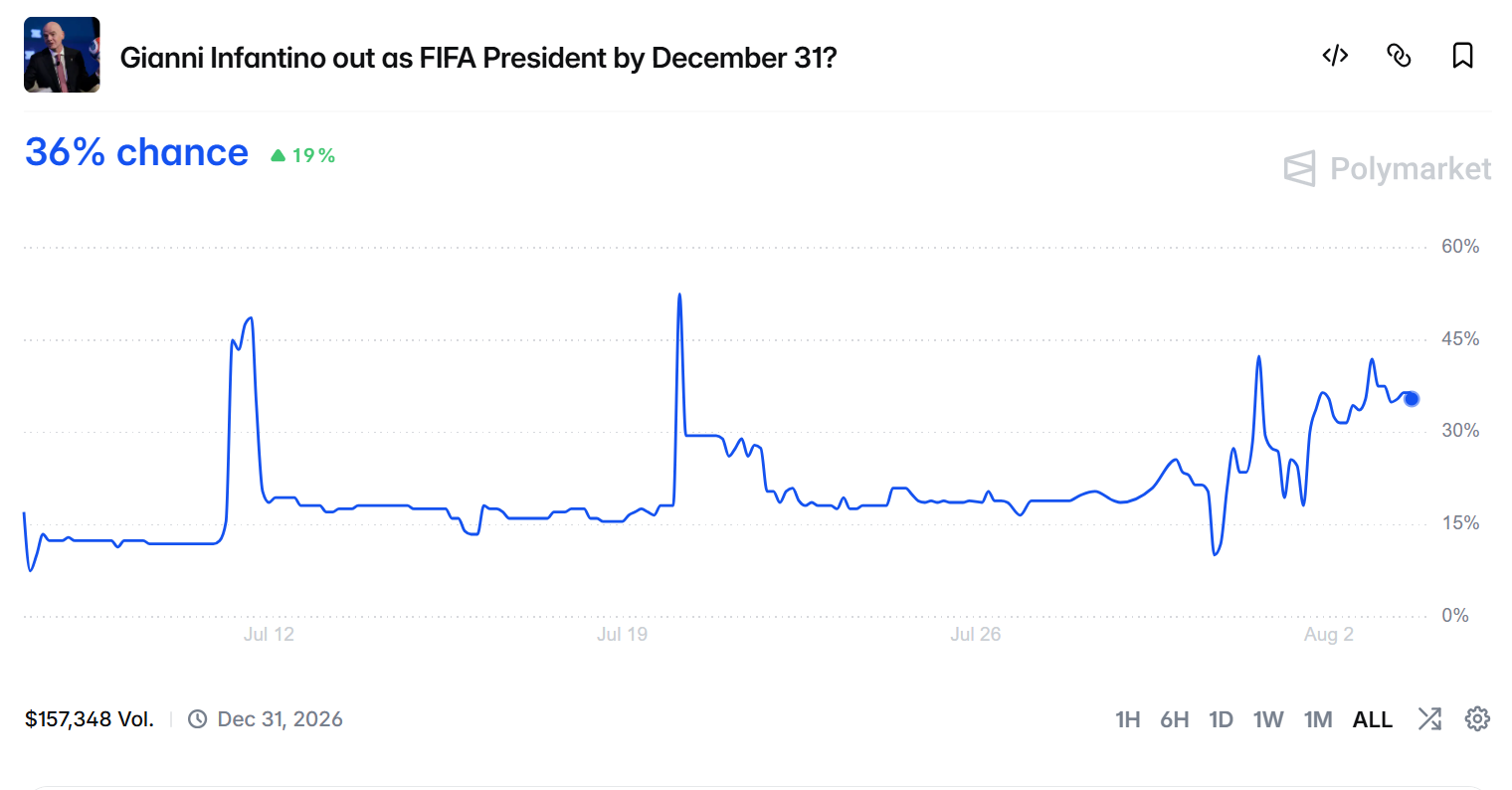
Polymarket traders price his exit by December 31 at 36.5%, up from roughly 19% a week ago. Almost all of the contract’s lifetime volume arrived in the past seven days.

Why Infantino Thinks Trump Owes FIFA a Favor
The reported ask lands four weeks after FIFA handed the White House a win. Its disciplinary committee cleared Folarin Balogun for Belgium, suspending the striker’s automatic red card ban on probation.
Trump had pushed for the reversal and claimed credit for it publicly.
“Thank you to FIFA for doing what was right, and reversing a great injustice!” Trump wrote on Truth Social.
Rubio is not a cold call. He sat in the Oval Office with Trump and Infantino last November. The occasion was a task force meeting on the World Cup.
FIFA’s bridge into that room is now gone. Carlos Cordeiro, the former Goldman Sachs banker who represented FIFA on the task force, resigned Friday over the sale plan. He had joined Infantino on repeated White House visits.
BeInCrypto could not independently verify the Rubio call, which the Post attributed to two people familiar with it.
Polymarket Traders Price the Fallout
The market read the revolt faster than the headlines did. It still traded near 20% on the afternoon of July 30. That was when all 55 UEFA member associations unanimously backed a boycott.
It broke above 40% the following day, once Infantino’s own executives turned on him. Chief operating officer Kevin Lamour told the Associated Press that staff had been deceived.
“It is the project of one person,” Kevin Lamour, chief operating officer of FIFA, in a statement to the Associated Press.
Follow us on X to get the latest news as it happens
Volume backs the repricing. The contract has handled $156,400 since it opened on July 6, and $151,700 of that traded in the past week. Open interest sits near $76,000.
The expiry date shapes how traders read it. The contract pays out only on a departure before December 31, while FIFA’s election falls next March. Challengers have until November 18 to declare, so the market is pricing resignation rather than defeat.
The asset in dispute is large. Cordeiro put FIFA’s revenue at $15 billion over the World Cup cycle. Josh Kushner’s fund offered $4.2 billion for 20% of a new FIFA subsidiary.
Crypto already has a claim on that value. The tournament drove $20 billion in World Cup prediction volume, Chainalysis found. FIFA’s own collectibles platform cleared at least $6 million in fees.
Whether Rubio’s call buys Infantino anything should show up in the odds before it shows up in a FIFA statement.
The post Infantino Wants to Collect on Trump’s World Cup Favor but Polymarket Says He’s 36% Out appeared first on BeInCrypto.

Miller’s previous controversies
Before being elected to the House in 2022, Miller spent six years in the Marine Corps Reserve. He also previously served in Trump’s first-term Administration, including as a senior advisor to the President.
Politico and the Washington Post have previously reported on Miller’s run-ins with the law as a young adult, including charges, which were later dismissed, for underage drinking, assault, disorderly conduct, and resisting arrest.
From 2019 to 2020, Miller dated Stephanie Grisham, a White House press secretary during Trump’s first-term Administration. Grisham has also accused Miller of abuse: she wrote in a 2021 op-ed for the Post and in a memoir the same year, without naming Miller, that her relationship with a White House staffer had “turned abusive” and that she had told Trump himself about her former partner who had “anger issues and a violent streak.”
The partner was later identified as Miller, who then sued Grisham for defamation, though he voluntarily dropped the suit in 2023 as part of a confidential settlement agreement.


BlackRock, the world’s largest asset manager, has expanded its tokenized cash platform, introducing a couple of new tokenized money market products, the firm said on Monday.
Back in May of this year, BlackRock filed for the new products with the U.S. Securities and Exchange Commission (SEC).
BlackRock is offering onchain shares of the BlackRock Select Treasury Based Liquidity Fund (BSTBL), a tokenized share class on Ethereum for an existing BlackRock money market fund. In addition, a new BlackRock Daily Reinvestment Stablecoin Reserve Vehicle (BRSRV) has also been unveiled with daily dividend reinvestment and access across multiple blockchains, said BlackRock in a press release.
Both funds intend to qualify as eligible reserve assets for permitted U.S. payment stablecoin issuers under the GENIUS Act, the asset manager said.
The move deepens BlackRock’s push into tokenized finance, blockchain-based representations of traditional financial assets such as funds, bonds or equities. Advocates say the technology can speed up settlement, enable round-the-clock trading and improve transparency.


Crypto exchange Bitget will stop accepting new registrations from Japanese users, announcing a phased exit that culminates in forced position closures by December 31, 2026.
The withdrawal comes as Japan tightens its licensing regime and grapples with severe currency turbulence.
The Timeline Japanese Users Now Face
The announcement, dated August 3, sets a clear timeline. Accounts flagged as potentially Japanese must complete that verification by November 1, 2026. Failure triggers restrictions. Users who miss the deadline face phased limitations from that date, with any remaining open positions forcibly closed by the end of December.
The exchange will email withdrawal instructions to affected users, framing the decision as part of its ongoing commitment to regulatory compliance.
The regulatory backdrop explains the move. Japan requires crypto service providers serving local residents to register with the Financial Services Agency under the Payment Services Act.
Follow us on X to get the latest news as it happens.
Enforcement risk is real for unregistered platforms. The agency issued warnings to Bitget and other overseas exchanges in November 2024. Consequences followed. Bitget’s app was later removed from Japan’s App Store, though web and Android access remained available to existing users.
Few jurisdictions demand more. Providers must meet capital, custody, consumer-protection, and anti-money-laundering standards to operate legally.
How Japan’s Yen Turmoil Compounds the Regulatory Burden
The timing coincides with acute currency pressure. The yen slid toward a 40-year low near 164 per dollar in late July, driven by rate differentials and carry-trade activity. Japan responded aggressively, with estimates suggesting authorities spent tens of billions of dollars buying yen to halt the decline.
“They have a weakening yen, and they wanted a little bit of help. And we’re always there for Japan,” US President Donald Trump told reporters on Sunday.
Washington then joined the effort. Both countries conducted a rare coordinated intervention, the first in 15 years, targeting excessive volatility and disorderly movements. The response was immediate, with the yen rebounding sharply and briefly reaching 155 per dollar.
Officials signaled more could follow. Finance Minister Satsuki Katayama and US Treasury Secretary Scott Bessent confirmed the operation and indicated readiness for further action.
The two pressures compound each other. Strict licensing raises fixed costs, while currency volatility complicates pricing and treasury management for offshore operators.
Bitget’s exit illustrates a broader pattern. Platforms must either invest heavily in registration or leave markets where regulatory barriers make operations uneconomical.
Japanese users still have room to act, with the transition window running until year-end before restrictions take full effect.
Subscribe to our YouTube channel to watch leaders and journalists provide expert insights.
The post Bitget Withdraws From Japan Amid Tightening Crypto Rules and Yen Turmoil appeared first on BeInCrypto.
Bithumb has published a formal Bithumb IPO timeline. The plan targets a public listing by 2028.
South Korea’s second-largest exchange framed the listing as a trust-building step. Executives tied each phase to a specific governance target.
A Roadmap Shaped by Past Delays
Bithumb’s listing ambitions have shifted before. The exchange once targeted a debut in the second half of 2025. Management pushed that date back as new obligations piled up.
Shareholders backed CEO Lee Jae-won’s reappointment in March 2026. The vote came weeks after a Bitcoin (BTC) balance-display glitch drew a record fine.
The exchange also operates in a tougher home market. South Korean trading volume recently fell to a two-year low during a Kosdaq market crash. A new 22 percent crypto tax takes effect in 2027. That is the same year Bithumb plans to file its listing review.
The Bithumb IPO Timeline, Stage by Stage
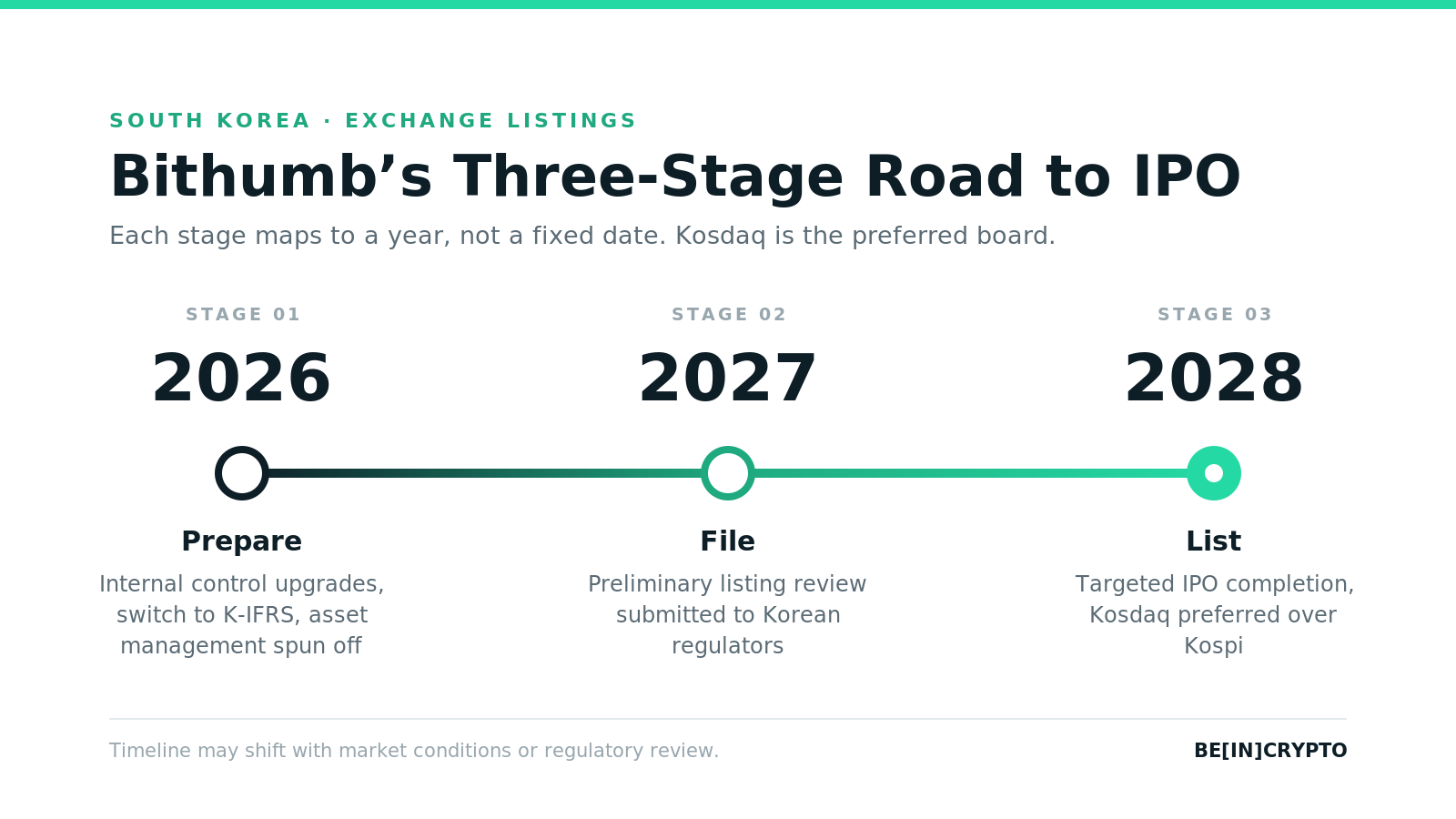
The Bithumb IPO timeline runs in three stages. Each stage maps to a single year rather than a fixed date. Stage one covers 2026. It focuses on internal control upgrades and a shift from domestic accounting rules to the global K-IFRS standard.
Bithumb has also restructured internally, spinning off its asset management unit as a separate entity, Bithumb Asset. The company said the split separates responsibilities and reduces potential conflicts of interest ahead of a listing review.
Stage two opens in 2027. Bithumb plans to file for a preliminary listing review with Korean regulators that year. Stage three targets IPO completion in 2028. However, the notice cautions that the schedule could shift with market conditions or regulatory review timelines.
The exchange has indicated a preference for South Korea’s Kosdaq board. A listing on the larger Kospi market remains possible if conditions change.

The notice also spelled out promises to customers. Bithumb pledged a more transparent governance structure and stronger internal controls.
It also promised better investor protection, more frequent information disclosure, and a sustainable growth foundation as it moves toward institutional-level, global-standard management. The company said these steps aim to show it can operate like a listed company well before shares actually trade.
The plan lands as Japan and South Korea explore a broader digital asset framework. That regulatory shift could smooth Bithumb’s path toward institutional-grade compliance.
Meanwhile, the exchange keeps growing its trading business. Upbit and Bithumb listings sent one small-cap token up nearly 30% in July. That activity shows daily operations continuing alongside the listing push.
Whether Bithumb reaches 2028 on schedule may depend on more than internal readiness. It will also hinge on how regulators respond to a shrinking, more heavily taxed market in the years ahead.
The post Bithumb Lays Out a 3-Stage Path to Its South Korea IPO appeared first on BeInCrypto.
MicroStrategy added 37 bitcoin between May 26 and July 26. Last week it sold 1,638 in seven days. The company now holds less Bitcoin (BTC) than it did in spring.
Michael Saylor says Strategy expects to stay a net buyer. Its own filings show the buying stopped months ago.
The Stack Is Going Backwards
Strategy reported 843,738 BTC on May 26. Two months later, on July 26, it reported 843,775. That is a gain of 37 coins.
Then came Monday’s filing. It shows 842,138 BTC as of August 2.
The company is now 1,600 coins below where it stood in May. Ten weeks have passed with no net buying at all.
Saylor addressed the question directly on August 1, when he shut down a viral sale claim.
“We have never had a “never sell” policy. The program does not require any BTC sale, and we expect to remain a net buyer of Bitcoin over time,” the MicroStrategy chair stated.
Follow us on X to get the latest news as it happens
A $400 Million Dividend Bill
The MicroStrategy Bitcoin sale last week was not opportunistic. It paid a bill.
Strategy owes cash to holders of its preferred shares. Those pay a fixed dividend every quarter.
That cost reached $400.7 million in the second quarter. A year earlier it was $49.1 million. The bill is more than eight times larger.
Dividends and interest now run roughly $1.76 billion a year.
So the coins go out the door. Strategy sold $218.4 million of bitcoin this year through July 26. Last week added $104.7 million more.
Almost a third of the year’s selling happened in that one week.
Selling at a Loss to Buy at a Discount
Here is the trade. Strategy sold bitcoin at $63,957 a coin. Its average cost is $75,419. That is a loss of about $11,500 each.
It used half that cash to buy back 912,143 STRC shares. STRC is a Bitcoin-backed preferred share that pays 12% a year.
Each share is meant to be worth $100. Strategy paid $89.02.
So the company took a loss on bitcoin to capture an 11% discount on its own debt-like shares. Every share retired cuts the dividend bill for good.
It also sold 3,011,361 of its own ordinary shares, raising $290.6 million. Meanwhile a $1 billion approval to buy those shares back sits unused. That is the trade-off MSTR investors face.
“Strategy is evolving from one-way capital issuance to active capital management,” Phong Le, president and chief executive of Strategy, in the June 29 release
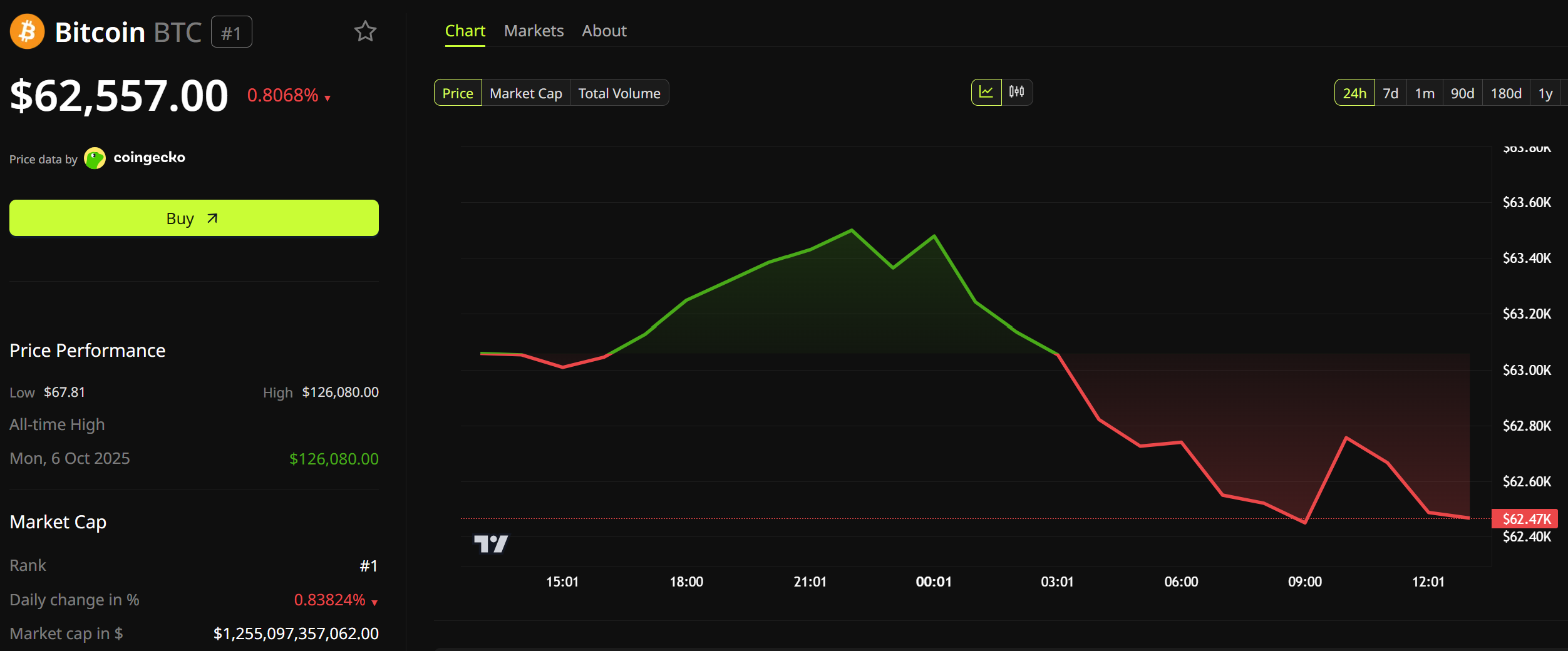
Bitcoin trades near $62,468, roughly half its October record. Strategy still owns more of it than any other company.

But the direction has changed. The next filing lands in a week.
The post MicroStrategy Added 37 Bitcoin in Two Months. Then It Sold 1,638 in One Week appeared first on BeInCrypto.
Michael Saylor’s Strategy sold 1,638 Bitcoin between July 27 and August 2, marking the year’s second-largest Bitcoin sale for the company.
Strategy sold 1,638 Bitcoin (BTC) at an average price of $63,957 for a total of $104.7 million, according to a Monday 8-K filing with the Securities and Exchange Commission. Of the proceeds, $52.4 million was used to fund dividend payments on Strategy’s STRC preferred stock, while another $52.3 million was used to repurchase STRC.
The company now holds 842,138 Bitcoin bought at an aggregate cost of $63.5 billion.
Strategy sold 3,588 Bitcoin for about $216 million on July 6. It also disclosed the sale of 32 Bitcoin in early June, its first reported Bitcoin sale since the 2022 tax-loss transaction.
Strategy bolsters USD reserve to $4 billion, repurchases STRC stock
Strategy also reported selling $290 million in MSTR shares during the same period. About $250 million of the proceeds was used to increase the USD Reserve to $4 billion, $28.9 million to fund additional repurchases of STRC stock and $11.7 million was added to Strategy’s cash balance.
In total, Strategy repurchased $81 million worth of STRC stock and increased its USD runway by 57 days to 2.3 years, announced Strategy founder and chairman Michael Saylor in a Monday X post.
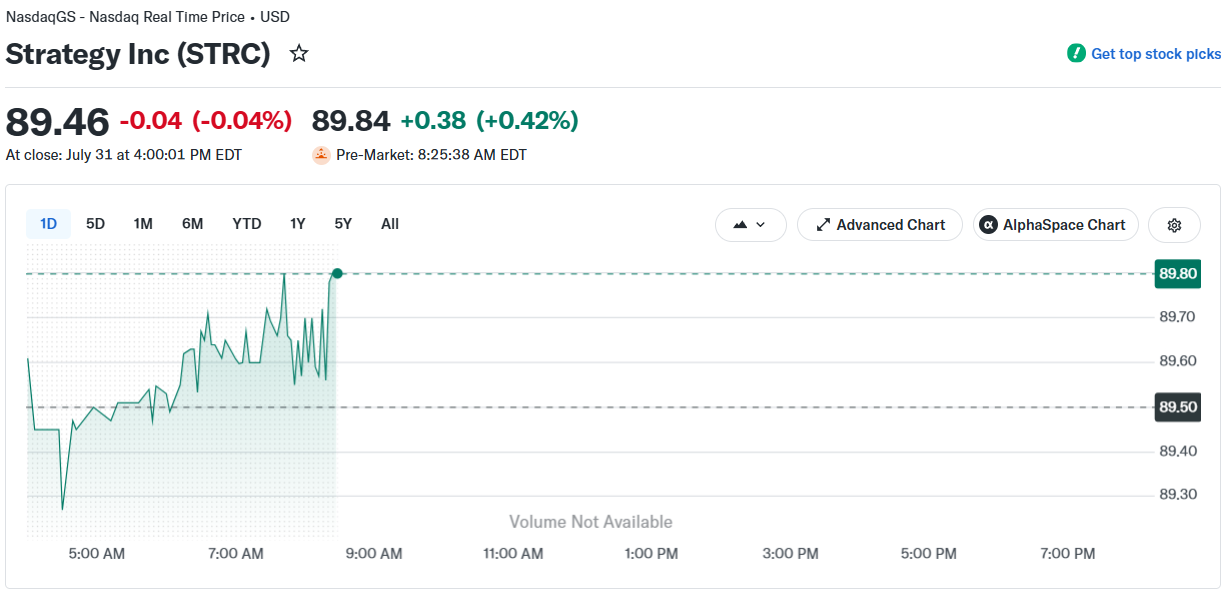
Strategy’s perpetual preferred stock, STRC, traded at $89.4, or 10.6% below its $100 intended par value, during Monday’s pre-market trading session, Yahoo Finance data shows. The company’s MSTR stock also declined 0.9% in pre-market trading on Monday.
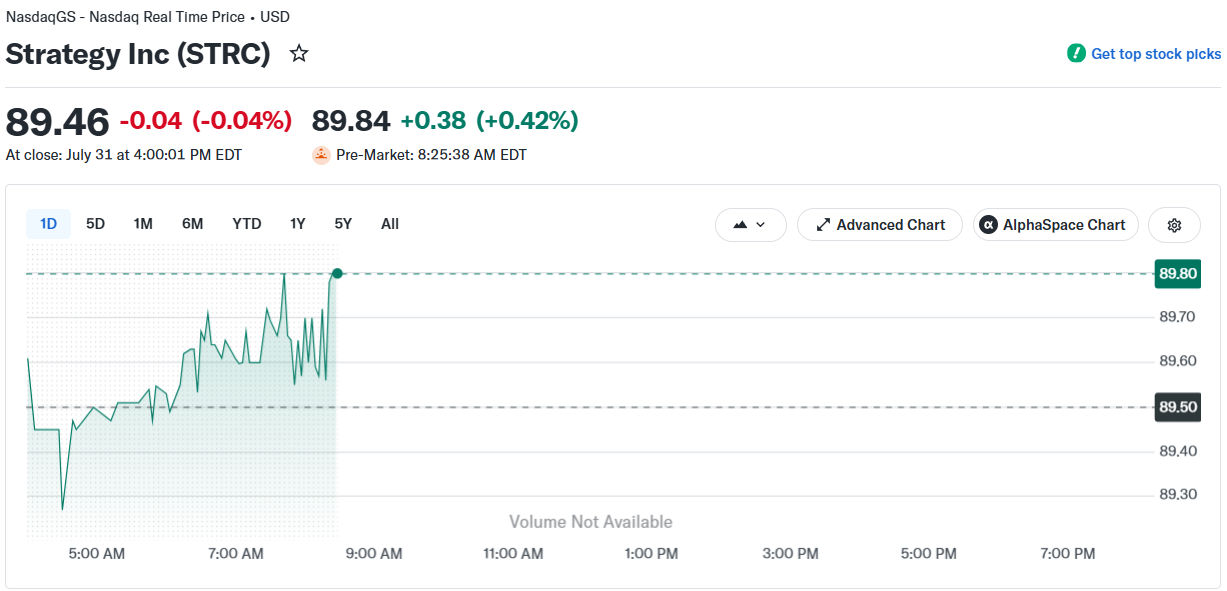
STRC stock price, 1-day chart. Source: Yahoo Finance
STRC is one of Strategy’s main mechanisms to fund its Bitcoin accumulation. Trading below par limits Strategy’s ability to raise funds through STRC sales. It may also force the company to further increase its nominal dividend rate to attract buyers and protect STRC’s price.
Related: CLARITY Act failure could send crypto valuations lower: Bernstein
On June 24, CryptoQuant CEO Ki Young Ju said that Strategy should pause Bitcoin purchases and replenish its cash reserve, after the company’s dividend coverage fell to 14 months from seven years.
“They should pause Bitcoin purchases, rebuild cash reserves, and adopt a systematic framework for purchase timing,” wrote Ju in a June 24 X post.
In its June 29 8-K filing, Strategy unveiled a capital framework allowing Bitcoin sales to fund dividends, increased the annual dividend rate on its STRC preferred stock to 12%, and disclosed that its US dollar reserve had grown to $2.55 billion.
Magazine: Bitcoin adoption metrics say one thing, price action says another

Christopher Nolan Says There’s A ‘Flaw’ In Film Criticism

Infantino under growing pressure after FIFA scraps World Cup investor proposal – Sports

What to expect from Apple for the rest of 2026


-

 Business5 days ago
Why Trees Belong on the Risk Register
-

 Fashion3 days ago
Weekend Open Thread: Wit & Wisdom
-

 Politics3 days ago
Meta enters AI-training agreement with far-right ‘propaganda rag’ Newsmax
-
 Entertainment6 days ago
‘Stargate’ Creator’s New Sci-Fi Series Returns for Season 3 Tomorrow
-

 Crypto World2 days ago
MicroStrategy Post-Earnings CLARITY Act Push Could Add New Catalyst for Its Stock
-

 Politics6 days ago
The Part of the Electric Transition Nobody Wants to Discuss
-

 Business5 days ago
Major shareholder moves on Canyon
-

 Crypto World2 days ago
XRP Ledger v3.3.0 brings five institutional features
-

 News Videos4 days ago
Bitcoin Enters the 3rd Stage of the Bear Market
-

 Crypto World6 days ago
Kraken Enables Retail Access to Jersey Mike’s IPO via Tokenized Shares
-

 Tech7 days ago
New macOS Sequoia & Sonoma security updates for older Macs
-

 Politics4 days ago
Luke Littler’s dominance sparks GOAT debate
-

 News Videos6 days ago
Claude: Build Financial Dashboards in Minutes (2026)
-

 Business6 days ago
Johnson & Johnson agrees to $5.5B settlement over talc cancer claims
-

 Sports4 days ago
Seema Kaliramna Wins Discus Throw Bronze, Takes India’s CWG Medals Tally To 17
-

 Crypto World1 day ago
Crypto PAC spending tops $2M in Michigan House race
-

 Business3 days ago
Trump Announces Hamas Disarmament Agreement as Iran Strikes Kuwait Air Base and US Attacks Pause Overnight
-

 Tech5 days ago
Gemini can now summarize the messiest comment threads in Google Docs
-

 Crypto World3 days ago
New York sues Kalshi over prediction market gambling
-

 Tech1 day ago
ESET tracks rise in malicious AI skills and adaptable malware
You must be logged in to post a comment Login