

Crypto World
Bitcoin Tests $62K as $1.4B Options Expiry Hits Friday

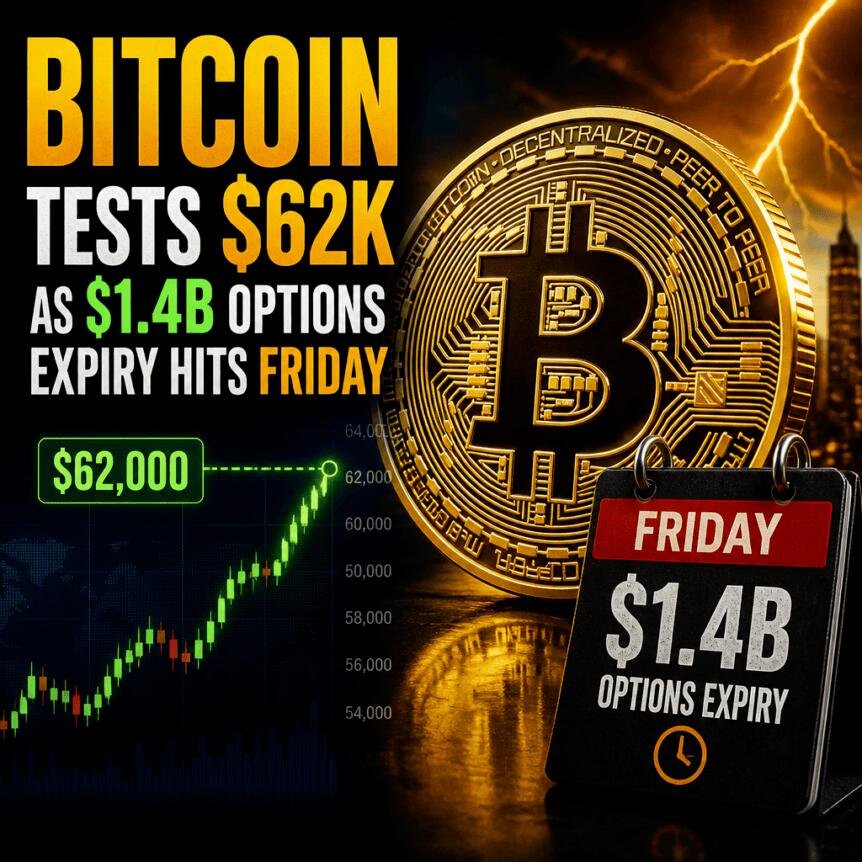
Bitcoin reclaimed the $63,000 level on Thursday, but traders are approaching Friday’s $1.4 billion Bitcoin options expiry on Deribit with caution. The central debate is whether macro pressure—particularly rising US Treasury yields—will undermine BTC’s rebound and put the $62,000 support zone to the test.
While US bond yields pushing toward 4.6% have kept risk appetite cautious, Deribit positioning appears to be more balanced than outright bearish. That mix is setting up a weekend-or-later decision point for BTC’s short-term direction.
Key takeaways
- US 10-year Treasury yields nearing 4.6% are weighing on risk assets, reinforcing fears about debt concerns and tighter financial conditions.
- Deribit’s balanced put-to-call activity suggests downside demand is not dominating ahead of Friday’s large options expiry.
- Open interest and strike concentration point to key levels around $62,000, $61,000, and $63,500 for near-term price behavior.
- For bulls to extend their edge, BTC needs to hold above key expiry-related thresholds; otherwise, the market may remain rangebound.
Treasury yields and risk appetite: why BTC is stuck near $63K
The move in US government bond yields is driving much of the near-term caution. With the US 10-year yield approaching 4.6%, investors appear increasingly concerned about the expansion of government debt and the likelihood that additional monetary policy support may be needed to avoid a recessionary slowdown.
That backdrop has influenced Bitcoin’s trading behavior. BTC has largely been moving sideways, while equities—at least in the Nasdaq-100—have been holding relatively close to record levels. On Thursday, technology momentum continued to attract capital, supported by market-moving activity in semiconductors.
According to the article, SK Hynix’s US initial public offering was oversubscribed, contributing to strength across parts of the AI-linked chip complex. The result was a risk-on bid in equities, with Arm Holdings up about 10%, Advanced Micro Devices higher by roughly 7%, and Micron gaining around 7% intraday.
Still, equities strength does not automatically translate into sustained BTC upside when bond yields are rising. Bitcoin tends to react to shifts in global liquidity expectations, and bond yield pressure can quickly change the market’s risk calculus.
ETF flow worries cool off—options demand looks more balanced
Spot Bitcoin ETF flows briefly came back into focus on Wednesday, when the market saw $85 million in net outflows, ending a short run of three consecutive days of inflows. Earlier coverage by Cointelegraph linked that outflow episode to broader selling pressure in spot ETF markets.
However, the presence of outflows alone does not clarify whether institutions have shifted structurally bearish. More importantly for the near-term trade is how derivatives positioning has evolved into Friday’s expiry.
Deribit activity has been described as “balanced” between calls and puts, implying that demand for downside exposure has not surged. The key point is that options volumes over the past few days did not show a clear stampede into protective puts.
As cited in the piece, Laevitas data shows the put-to-call volumes relationship remains supportive of range stability. Even though call activity has outpaced put volume over four days—suggesting traders have trimmed urgency around downside—this is not the same as a market that is fully discounting volatility.
Deribit expiry setup: where the market’s incentives cluster
Friday’s weekly options expiry involves a large notional figure of $1.4 billion on Deribit, and the strike distribution matters for how price can “pin” near certain levels. The article highlights an interesting imbalance in the immediate strike zones.
Calls up to the $62,500 region amount to about $137 million, while puts above $61,000 total roughly $121 million. That does not imply an outright one-sided bet, but it does indicate that there is meaningful positioning both for upside continuation and for defense just below the middle of the range.
Open interest and strike placement also shape traders’ expectations for pinning behavior. With BTC positioned around the $63,000 area heading into expiry, the next move could be influenced by how market makers and hedgers respond to gamma exposure across key strikes. The article references Deribit open interest data for July 10 BTC, underscoring that the market is not operating without “gravity” around specific prices.
Within this framework, the piece outlines conditional outcomes: bulls would strengthen their position materially with a move above $63,500 by the 8:00 AM UTC expiry on Friday, while bears maintain a smaller edge below $61,000. Without additional macro or catalyst-driven volatility, the market may not deliver a decisive breakout purely from derivatives positioning.
Oil, geopolitics, and bond yields: what could break the range
Beyond crypto-native signals, the article points to two macro variables that could shift demand between fixed income and risk assets: energy and Treasury yields. A temporary truce in the Middle East could ease recession fears, encouraging capital rotation into higher-risk markets—an environment that typically supports BTC.
On the other hand, the piece also notes an ongoing counterweight. It argues that persistent uncertainty in the macro outlook, including the risk of additional large Treasury issuance to cover debt growth, could keep pressure on yields and dampen crypto upside attempts.
Traders are also asked to watch crude oil direction. A renewed escalation around Iran could push oil higher, worsening inflation fears and potentially forcing a less favorable policy outlook—conditions that tend to complicate liquidity for risk assets.
Crucially, the article ties these macro considerations back to options behavior: with put-option buying remaining restrained in recent sessions, BTC appears positioned to defend the $62,000 support level, at least in the immediate term. Still, that defense is not guaranteed. The market’s stability depends on whether bond yields ease and whether geopolitical risk stops feeding into inflation and rate expectations.
For now, the near-term picture is conditional: a successful expiry resolution above $63,500 could deliver short-term relief, but sustained upward progress would likely require a more supportive macro shift. Until then, traders may have to manage expectations for a range that can hold—but also revert quickly if yields keep climbing.
As Friday’s options expiry approaches, the key variables to watch are whether Treasury yields cool off and how price reacts around $63,500 and $62,000 into the settlement window—levels that derivatives positioning is effectively steering toward.

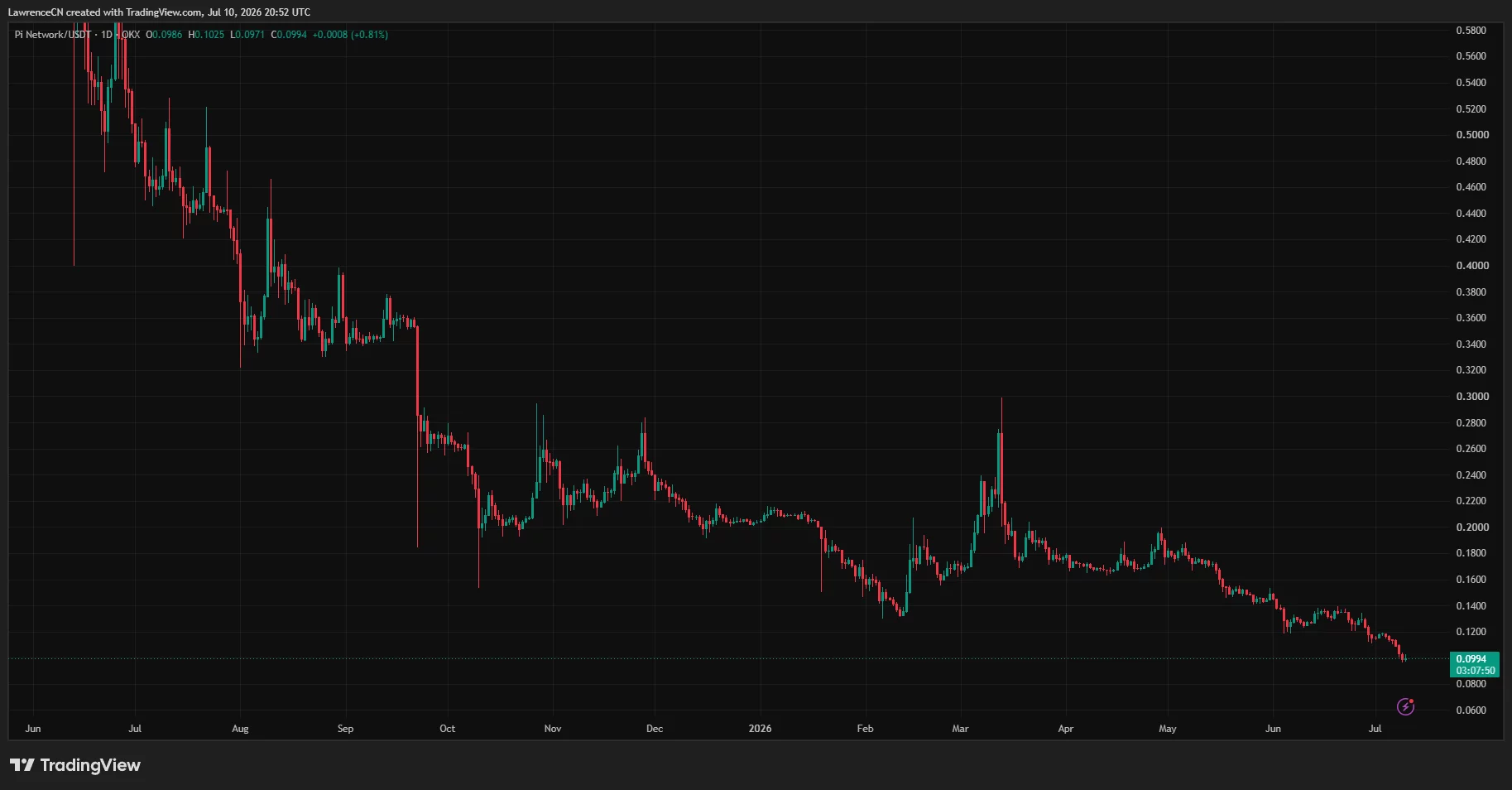
Pi Network entered July 2026 at a fresh all-time low near $0.10, its most oversold reading since launch, facing a supply-and-demand collision the whole market is watching. On the supply side, 103.7 million tokens unlock this month. On the demand side, a set of Pi2Day product launches promises to create real utility for the first time. This is the levels, the collision at the center of the forecast, and the honest case on both sides for a token at its lowest ebb.
Summary
- Pi Network enters July near $0.10 as 103.7 million token unlocks threaten to increase selling pressure.
- Three Pi2Day products could create real token demand, but their impact depends on measurable user and developer adoption.
- Holding $0.10 support keeps the recovery case alive, while reclaiming $0.12 could trigger a broader rebound.
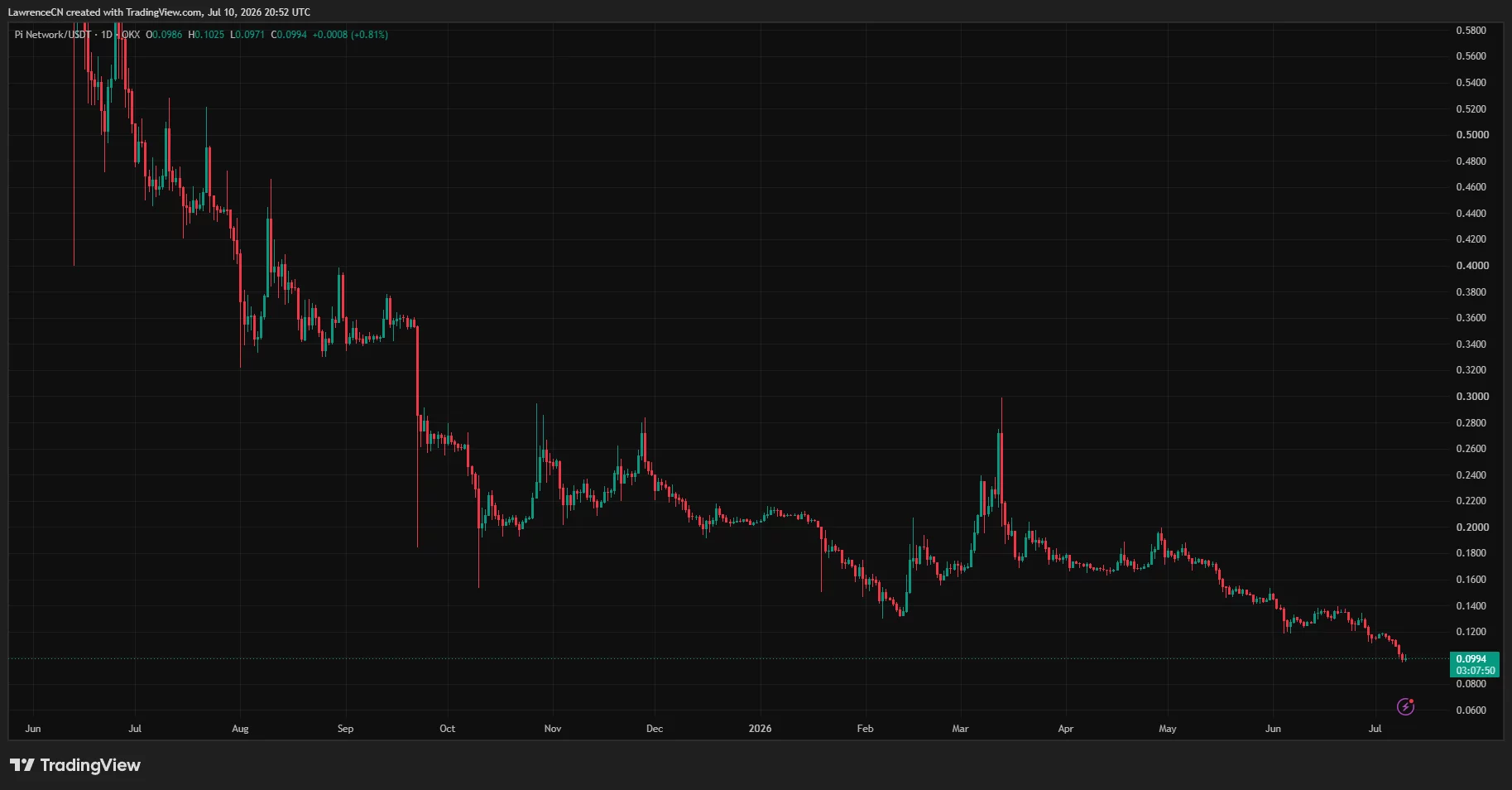
Pi Network (PI) enters July 2026 at the weakest point in its short public history, trading near $0.10 to $0.114 after setting a fresh all-time low, with momentum indicators showing the deepest oversold reading since the token began trading.
The price has fallen through support levels that held repeatedly in prior months, strung together a multi-day losing streak, and now tests the psychologically critical $0.10 line, below which lies uncharted territory. For a project that launched with enormous community expectations, the chart is a sobering picture, and the month ahead is defined by a single collision.
That collision is supply against demand, stated almost too cleanly. On the supply side, roughly 103.7 million PI tokens unlock in July, an increase of some 27 million over the prior month, adding fresh sellable supply to a market already struggling to find buyers, the same supply-versus-demand pressure that dragged the broader altcoin market through the first half.
On the demand side, the project has timed a set of product launches around its annual Pi2Day event, including a verification tool with a fee-in-PI model, a hosting product, and a sign-in service, each intended to create genuine token utility and, with it, genuine demand for the first time. The entire July forecast reduces to which side of that collision wins: whether the new products can manufacture demand fast enough to absorb the unlock supply, or whether the supply overwhelms the demand and pushes an already record-low token lower.
This prediction maps the collision the way a trader would: the price levels that matter now that the token is in uncharted low territory, the bearish case built on the unlock calendar and the broken trend, the bullish case built on extreme oversold conditions and the new utility, the analyst target ranges worth knowing, and the honest bottom line on a token at its lowest ebb.
None of it is investment advice; Pi’s volatility and its unusual mining-and-distribution history make it especially unpredictable, and readers should treat every number here as a scenario rather than a promise.
The levels that matter
With the token at fresh lows, the level map is unusually stark, because much of the price history that would normally provide reference points sits above the current price, leaving fewer prior floors below. Pi trades near $0.10 to $0.114, beneath the moving averages that now slope down and cap rallies, and the structure is decisively bearish on the trend even as it stretches to an oversold extreme.
On the downside, the defining level is the $0.10 psychological line, a round number the token is actively testing and whose failure would push Pi into territory it has never traded in, where the absence of prior support makes the next floor hard to define and a swift move lower more possible.
Just beneath the current price, the $0.110 area and the recently broken support that had held around $0.12 now act as the immediate reference points, with $0.12 having flipped from support to resistance after the breakdown. Losing $0.10 decisively is the bearish trigger that opens the widest downside, precisely because so little prior structure lies below it.
On the upside, reclaiming the broken $0.12 support is the bulls’ first task, and turning it back from resistance into support would be the first sign the breakdown is being repaired. Above that, the levels near $0.1228, $0.1344, and $0.1496 mark the resistance steps a recovery would have to climb, each corresponding to prior consolidation zones, and clearing them in sequence would signal the oversold bounce maturing into something more durable.
The structure, in short, is a token in a confirmed downtrend at an oversold extreme, testing a psychological floor with thin support beneath it and a staircase of resistance above, where the direction of the next significant move depends heavily on whether the month’s demand catalysts can arrest the decline.
The bearish case: the unlock calendar and the broken trend
The case for continued weakness starts with the supply calendar, because it is the most concrete force acting on the token this month. Roughly 103.7 million PI unlock in July, up about 27 million from the prior month, and every unlocked token is potential new supply entering a market that has struggled to absorb it.
Token unlocks are a scheduled, readable form of selling pressure, and when the demand side is weak, as a record-low price suggests it currently is, fresh unlock supply tends to push price down as newly liquid tokens meet insufficient buying. For a token already at all-time lows, an increase in the monthly unlock is a direct headwind, and it is the single most important bearish fact of the month.
The second bearish force is the broken trend itself. Pi has fallen through supports that held repeatedly, and a token making fresh lows beneath falling moving averages is, by definition, in a downtrend that has not yet shown a bottom, with each broken support becoming resistance on any bounce.
Sentiment has followed price down; the community enthusiasm that drove earlier interest has faded into fatigue, and the demand indicators that matter, trading activity and the appetite to hold rather than sell, have thinned. A token in this posture is vulnerable to the reflexive dynamic where falling prices beget more selling as disappointed holders exit, and the record-low price is itself a signal that this dynamic has been in control. If the July unlock supply meets this weak demand backdrop without the new products generating meaningful offsetting buying, the bearish path points toward a break of $0.10 and a move into the undefined territory below it.
Understanding the unlock: why 103.7 million matters
Because the unlock number anchors the bearish case, it is worth understanding what it represents and why the monthly figure moves, since the mechanics are specific to Pi’s unusual design. Pi’s supply was distributed over years through its mobile mining phase, during which participants accumulated tokens that remained locked, subject to release schedules tied to identity verification, holding commitments, and the network’s migration to its open mainnet. Each month, a tranche of these previously locked tokens becomes transferable, converting balances that existed but could not be sold into supply that can, and July’s tranche is roughly 103.7 million, up about 27 million from the prior month.
The increase is the part that matters for price. A larger monthly unlock means more new sellable supply arriving into the market than the month before, and unless demand grows to match, the additional supply weighs on price through simple arithmetic: more tokens available to sell, the same or less buying to absorb them.
For a token already at all-time lows, where the price itself signals that existing demand is struggling to absorb existing supply, an uptick in the unlock is a direct and quantifiable headwind. This is why the unlock calendar is the single most-watched supply metric for Pi, and why the July figure features in nearly every forecast: it is the one large, scheduled, knowable force acting against the price, and its size this month is larger than last.
The nuance the bears sometimes skip is that not all unlocked tokens sell. Unlocked supply is potential selling pressure, not guaranteed selling, and whether it actually hits the market depends on holder behavior: participants who believe in the project may hold their newly liquid tokens instead of dumping them, particularly if the new products give them a reason to use their tokens instead of selling.
This is precisely where the supply and demand sides of the collision meet, because the same products that aim to create buying demand could also reduce selling by giving holders a use for their tokens, which is why the month’s outcome is not a mechanical certainty but a genuine contest between a known supply increase and an uncertain demand response.
The pivot beneath the price: distribution to utility
The deepest way to read Pi’s July is as a test of the project’s central transition, because the token’s entire situation reflects a pivot that every large community-distributed project eventually faces. Pi spent its formative years on distribution: acquiring users through mobile mining, building one of the largest claimed user bases in crypto, tens of millions of participants, and spreading tokens widely through that process. That phase created supply and community but not, by design, much in the way of token utility, and the current price weakness is in large part the market repricing a token whose distribution vastly outran its usefulness.
The Pi2Day product launches represent the attempt to complete the other half of the arc: converting a distribution network into a utility network, where the token is used and demanded, not merely held and eventually sold. The verification product’s fee-in-PI model is the clearest expression of the strategy, because a service that requires spending PI creates a demand for PI that exists independent of speculation, the kind of structural, recurring buying that could, at sufficient scale, offset the unlock supply permanently instead of temporarily. The hosting and sign-in products extend the same logic into developer and application use cases. Whether this pivot succeeds is the question that dwarfs any single month’s price action, and July is significant precisely because it is the first real test of the strategy at the moment the token most needs it to work.
The honest assessment is that pivots like this are hard and most are gradual, so a single month of product launches is unlikely to fully resolve a supply overhang built over years, even in the bullish case. What July can realistically deliver is evidence, early adoption data showing whether the products attract genuine usage and generate real fee demand, and that evidence, more than the price itself, is what will indicate whether the pivot is working. A token can remain weak on price while its underlying utility begins to build, and the disciplined reader watches the adoption metrics beneath the price for the leading signal, because in a distribution-to-utility pivot, usage turns before price does, if it turns at all.
The bullish case: extreme oversold and new utility
The case for a bounce, or a bottom, rests on two pillars. The first is the extreme oversold condition, which is the strongest technical argument in the bulls’ favor. Pi’s momentum indicators sit at their most oversold since the token launched, a reading that historically precedes relief rallies because it reflects selling exhaustion, the point at which the sellers who wanted out have largely left and even modest buying can produce a sharp bounce. Oversold conditions do not guarantee a reversal; a token can stay oversold as it grinds lower, but they do mean the conditions for a snapback are present, and an oversold bounce from here could carry toward the $0.1228 and $0.1344 resistance levels quickly if any catalyst sparks it.
The second pillar is the demand catalyst the bears’ analysis leaves out: the Pi2Day product launches. The project has timed a set of releases around its annual event, and the most significant for token demand is a verification product built on a fee-in-PI model, meaning users pay for the service in PI, creating direct, recurring token demand instead of the speculative demand that has dominated the token’s history.
Alongside it, a hosting product and a sign-in service aim to extend Pi’s utility into real applications. If these products gain adoption, they represent the first genuine demand-side counterweight to the relentless unlock supply, the kind of fee-driven token sink that gives a token a use beyond speculation. The bullish thesis is that the timing is deliberate, the project is answering its supply overhang with utility precisely when the token is most oversold, a supply cliff of the kind that has stress-tested far larger tokens, and if the products deliver, the combination of selling exhaustion and new demand could mark a bottom near the lows. This is the pivot the entire project has pointed toward: from a mining-and-distribution phase that created supply to a utility phase that must create demand, and July is its first real test.
Three scenarios for July
The supply-demand collision produces three coherent paths, organized around the $0.10 floor and the demand response.
The bearish scenario is the unlock winning. If the 103.7 million tokens meet weak demand and the new products fail to generate meaningful early adoption, the selling pressure pushes Pi through the $0.10 psychological floor into the undefined territory below, where thin prior structure makes the decline hard to arrest and a swift move lower possible. A weak broader crypto tape would reinforce this path. It is the default if demand does not answer the supply.
The base case is a grind near the lows. Pi holds around the $0.10 to $0.12 zone, defending the psychological line on dips and stalling beneath the broken $0.12 support on bounces, as the unlocked supply and whatever demand the products generate roughly offset each other. In this path, the token consolidates at its lows while the market waits for clearer adoption evidence, neither breaking down decisively nor recovering, the most likely outcome if the product launches show promise but not yet scale.
The bullish scenario is oversold plus utility. Selling exhaustion at the most oversold reading since launch combines with genuine early adoption of the Pi2Day products to spark a relief rally, reclaiming the $0.12 support and climbing the $0.1228 to $0.1496 resistance staircase, with the move amplified by the thin float and any short-covering. This path requires the demand catalysts to actually deliver measurable usage, and it is the one the project has engineered toward, arriving at the moment of maximum oversold potential.
The targets on the table
Forecasts for Pi span a wide range and deserve extra caution, because the token’s short history, unusual distribution, and thin prior structure make confident prediction especially difficult. Short-term technical projections cluster around the levels named above: a downside case that breaks $0.10 and explores the territory below, against a recovery case that reclaims $0.12 and climbs toward the $0.1228 to $0.1496 resistance band on an oversold bounce or a successful product launch.
Analyst and forecasting-service targets for the month vary widely, from bearish projections extending the decline below the psychological floor to more optimistic scenarios in which the oversold condition and the Pi2Day catalysts drive a rebound toward the mid-teens in cents, with the widest bull cases requiring both a market-wide recovery and demonstrable product adoption to justify.
The honest reading of the target spread is that it maps directly onto the supply-demand collision at the heart of the month: the bearish targets assume the unlock supply dominates and the products underdeliver, while the bullish targets assume the oversold bounce and the new utility combine to arrest the decline.
For July specifically, the levels matter more than any single price target, with the $0.10 floor and the $0.12 reclaim as the two lines whose behavior will signal which side of the collision is winning. Given the token’s volatility and its record-low, thinly-supported position, the range of plausible outcomes is genuinely wide, and the disclaimer at the end of this piece carries more weight than usual.
What to watch as the month unfolds
For a reader tracking Pi through July, the signals divide cleanly into the two sides of the collision, and most are observable. On the supply side, the unlock’s actual market impact is the thing to watch: whether the 103.7 million tokens visibly pressure the price as they become liquid, or whether holders absorb them by holding instead of selling, which would show up as the price stabilizing despite the increased supply. Exchange inflows, tokens moving to venues where they can be sold, are the on-chain tell that unlocked supply is heading for the market instead of staying in wallets.
On the demand side, the product-adoption metrics are the leading indicator, and they matter more than the price itself. The specific things worth watching are whether the verification product attracts real users, whether its fee-in-PI model generates measurable, recurring token demand, and whether the hosting and sign-in products find developer and application uptake.
Announcements are not adoption; the signal is usage, and early usage data, however small, is the clearest evidence of whether the pivot is beginning to work. Above the two sides, the $0.10 psychological floor is the single price level whose behavior summarizes the contest: its defense keeps the bottoming thesis alive, and its decisive failure confirms that supply is winning.
Two context factors round out the dashboard. The broader crypto market, driven by the same macro forces weighing on the majors, is a backdrop that can lift or sink Pi regardless of its own supply-demand balance, since a token at all-time lows is especially vulnerable to a weak tape.
And sentiment, measurable in community activity and trading interest, is worth watching as a contrarian signal, because extreme pessimism at an extreme oversold reading is historically the environment from which sharp reversals begin, if a catalyst arrives to spark them. A reader watching the unlock’s impact, the adoption data, the $0.10 line, and the market backdrop has the full picture, and is positioned to read the collision’s outcome as it resolves instead of guessing at it in advance.
The honest bottom line
Pi Network’s July 2026 is a supply-demand collision at the worst possible moment for the token and, arguably, the most interesting one. On one side, 103.7 million tokens unlock into a market already at all-time lows with faded sentiment and a broken trend, a concrete and substantial supply headwind.
On the other, a set of product launches timed to the project’s annual event promises, for the first time, real token utility and fee-driven demand, arriving precisely when the token is at its most oversold reading since launch. The month’s direction depends on which force proves stronger, and the token’s thin structure beneath the $0.10 line means the downside is undefined while the oversold condition means the upside could be sharp if a catalyst lands.
The single most useful thing to watch is the interaction between the two forces: whether the Pi2Day products show real adoption, measured in actual usage and fee-driven token demand rather than announcements, and whether that demand is enough to absorb the unlock supply. The $0.10 line is the number that matters, its defense keeping the bottoming thesis alive and its failure confirming the bears.
Pi enters the month at its lowest and most oversold, which is simultaneously the most dangerous position, thin support below, and the position from which the sharpest recoveries historically begin, if demand arrives. Whether the project’s pivot from distribution to utility delivers that demand in time is July’s question, and honestly, the adoption data and the unlock’s market impact, not any forecast, will answer it.
A final word on holding perspective at a moment like this, because a token at all-time lows generates strong emotions that cloud analysis in both directions. The bearish extreme reads the record low and the rising unlock as proof the project is failing, and the bullish extreme reads the oversold bounce potential and the new products as proof a reversal is imminent, and both are overconfident. The honest position sits between them: Pi faces a real, quantifiable supply headwind this month, and it is simultaneously attempting a real, potentially meaningful pivot to utility at the point of maximum oversold pressure, and the outcome depends on adoption data that does not yet exist.
Neither the doom case nor the moon case is supported by what is actually knowable today, and the discipline the situation rewards is patience with the evidence, watching the unlock’s impact and the product uptake accumulate through the month instead of committing to a narrative before the data arrives.
For a project whose entire thesis now rests on converting an enormous user base into genuine token demand, July is the first chapter of the test, not the verdict, and the most useful stance is to read it honestly, as it is written, one week of evidence at a time.
Pi arrives at July carrying both the largest community in its category and the lowest price in its history, a contradiction that is itself the story: distribution succeeded, valuation did not, and the gap between them is exactly what the utility pivot must now close. The month will not close it alone, but it will show whether the closing has begun.
Disclaimer: This article is for informational purposes only and does not constitute investment advice. Cryptocurrency markets are highly volatile, and you can lose your entire investment; Pi Network in particular carries elevated uncertainty given its short trading history and unusual distribution. Price levels, unlock figures, and product timelines reflect information current as of July 9, 2026, and are subject to change; verify current conditions before making any decision. Always do your own research.


Robinhood (Nasdaq:HOOD) launched the public mainnet of its new blockchain on July 1, and unfortunately, tons of people are already losing money trading its coins. Bad actors are using a variety of scam contracts, memecoin rug-pulls, phishing links, and garden variety theft, leading to complaints of loss flooding onto social media.
Relay Protocol warned about scam tokens on the new Robinhood Chain: “If you bought one, the funds you spent are unfortunately gone.”
In this example, scam contracts are accepting a token swap, briefly crediting the buyer’s wallet yet immediately transferring the tokens back to the deployer’s wallet. In other words, users unwittingly purchased tokens for someone else.
Another trader alleged that Robinhood Wallet’s default sell screen auto-populated a Robinhood Chain scam coin called USER. Unless someone modified that default, the position would vaporize. “$600 out the window in seconds,” complained the user.
Another trader swapped ether (ETH) for a poisoned memecoin named $ROBINHOOD inside their Robinhood Wallet. The instant the swap confirmed, tokens moved to an unauthorized wallet.
Wallet drainers and fake token scams
A collector of NFTs claimed an OpenSea swap of Robinhood Chain assets sent his coins to an unauthorized address, costing him $350.
A trader tagged Robinhood CEO Vlad Tenev after losing $50 to what he called scam transactions.
An AI-branded Robinhood Chain memecoin, HOODIE, halved in price in a single afternoon.
Read more: Read this before you click on any Robinhood email
“It is absolutely crawling with wallet drainers and fake token scams right now,” warned another researcher, alleging that a holder of CASHCAT lost $56,000 to a hacked smart contract on Robinhood Chain.
Someone else asked whether Robinhood Chain had gone full rug mania. Another observer estimated thousands of users losing money bridging over assets from Solana-based PumpFun.
A researcher posted that memecoins account for more than 75% of the last two days of Robinhood Chain trading. That is not a good statistic, as a general rule, due to almost all meme coins trending toward $0 eventually.
“ROGE on Robinhood Chain is a 100% honeypot. The contract has a backdoor,” warned another trader.
Clifford asked a wallet provider to enable revoke-approvals on Robinhood Chain to help users undo their smart contract authorizations.
Another user urged traders to audit smart contracts prior to authorizing in the first place.
Protos previously tracked losses on branded memecoins and the near-total mortality rate of Pump.fun token launches. The long-term performance of most speculative digital assets like NFTs is identical.
Robinhood Chain’s permissionless architecture replicated many of those conditions and created an environment ripe for scams.
The new Robinhood Chain is nine days old.
Got a tip? Send us an email securely via Protos Leaks. For more informed news and investigations, follow us on X, Bluesky, and Google News, or subscribe to our YouTube channel.
Bitcoin (BTC) demand shifts are “behind” the price rebound to $64,000, new analysis claims.
Key points:
- New Bitcoin price analysis says that US whales are behind the latest spate of BTC price relief.
- The Coinbase Premium is above its 14-day moving average, a key sign of strength.
- Research from Bitcoin Suisse suggests that “something changed” on the market this week.
Bitcoin Coinbase Premium still negative despite trend line reclaim
In a blog post on Friday, onchain analytics platform CryptoQuant attributed Bitcoin’s July upside to US-based whales.
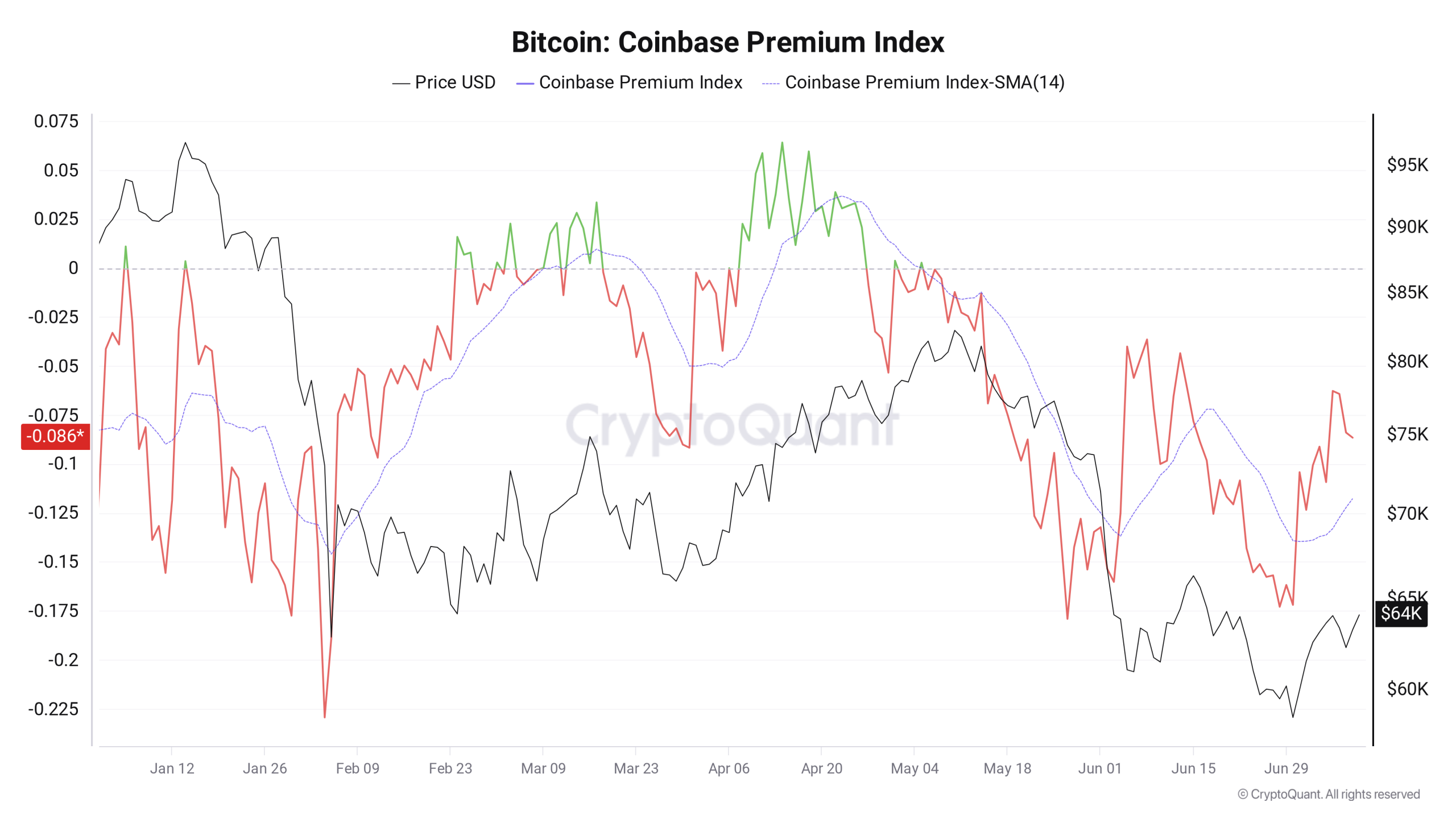
Specifically, the Coinbase Premium — the difference in price between Coinbase’s and Binance’s BTC/USDT pairs — is showing early signs of buy-side momentum “regaining strength.”
“The Coinbase Premium Index for both BTC and ETH remains in negative territory, but both have bounced off their local lows,” contributor Burak Kesmeci wrote.
“On top of that, both metrics managed to reclaim their SMA14. This is what’s behind Bitcoin’s move from 58K to 64K, and Ethereum’s rally from $1,500 to $1,750.”
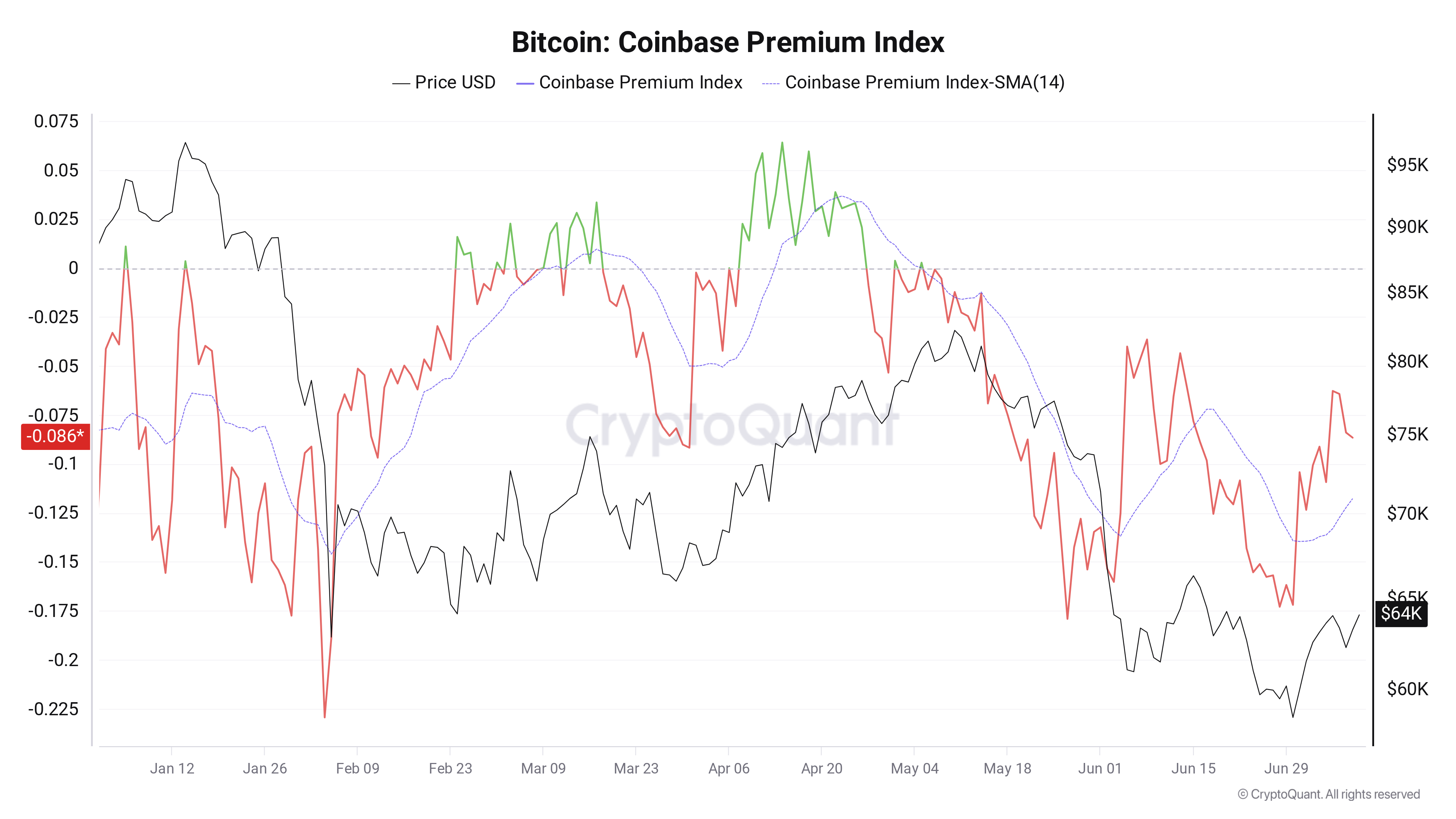
Bitcoin Coinbase Premium Index with 14-day SMA. Source: CryptoQuant
Kesmeci referred to the Coinbase Premium Index’s 14-day simple moving average. As Cointelegraph reported, the Index has spent much of 2026 in negative territory, implying weak demand from both large and small investors on the largest US crypto exchange.
“Once again, U.S. whale activity is proving to be the leading data point for trend direction. Short-, medium-, and long-term regime shifts can all be read through this metric,” Kesmeci continued.
The Index currently sits at -0.08, per CryptoQuant data, having last flipped positive on daily time frames more than two months ago.
“The current picture is a catalyst for a short-term bounce — but for a real long-term regime change, this metric needs to break above zero,” Kesmeci concluded.
Bitcoin Suisse: “Bottom signal framework flashing”
As Cointelegraph reported, institutional demand is also on the radar for market participants.
Related: BTC speculators in focus as analysis says ‘textbook Bitcoin bottom’ is underway
The US spot Bitcoin exchange-traded funds (ETFs) saw their first net inflows after a record-breaking $2.7 billion losing streak.
Data from UK-based investment company Farside Investors nonetheless shows investor sentiment remains sensitive to even small BTC price moves.
On Thursday, a third straight day of net outflows totaled $95.3 million.
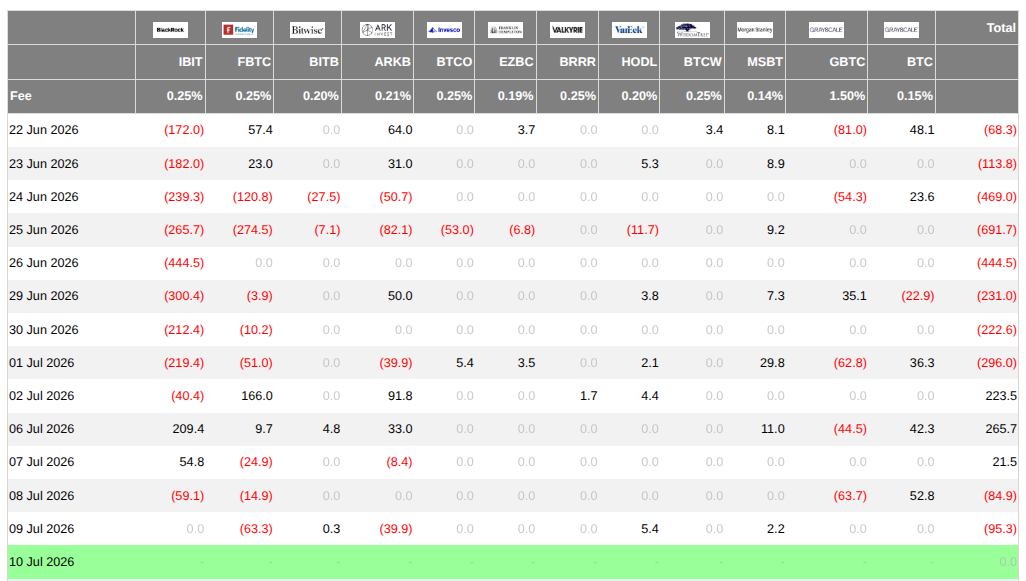
US spot Bitcoin ETF netflows (screenshot). Source: Farside Investors
Analyzing a basket of metrics, crypto finance provider Bitcoin Suisse included ETF flow data as one signal that the status quo on the market has changed.
“Eight weeks of ETF outflows. Bitcoin at a 21-month low. This week, something shifted,” it told X followers in a thread on Friday.
Bitcoin Suisse described a “bottom signal framework flashing” while the Crypto Fear & Greed Index remained in its lowest “extreme greed” zone.
Crypto’s infrastructure is starting to look a lot more like traditional finance. New data from Dune shows that the world’s stablecoin leaders — Tether’s USDT and Circle’s USDC — are no longer competing for the same users, with each now dominating a different corner of the market. Meanwhile, demand for MiCA-compliant euro stablecoins is accelerating, hinting that the stablecoin economy is slowly expanding beyond the US dollar.
Elsewhere in Crypto Biz, Strategy reignited debate over its “never sell” philosophy after offloading more than $200 million in Bitcoin (BTC) to fund shareholder dividends, while Vanguard signaled that even Wall Street’s biggest crypto skeptics are embracing tokenization.
USDT, USDC use cases diverge as stablecoins become chain-specific
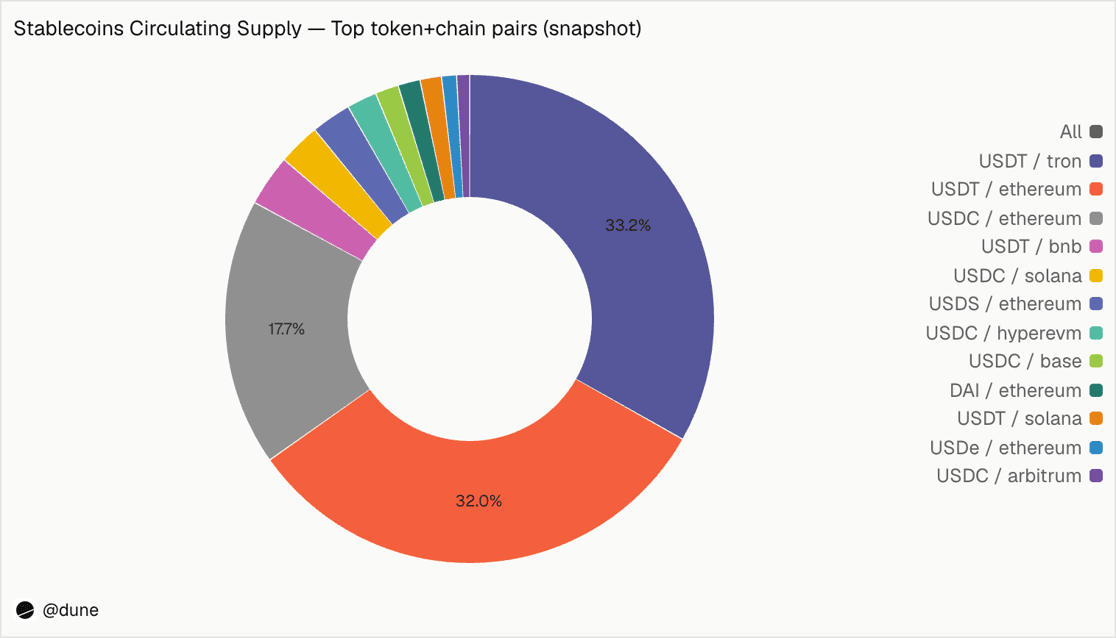
USDT has become crypto’s dominant payments stablecoin while USDC has cemented itself as DeFi’s preferred settlement asset, according to new data from Dune.
Rather than competing head-on, the industry’s two largest stablecoins are carving out distinct roles. USDT settled $95 billion in identified commercial payments during the first half of 2026 and continues to dominate business-to-business transfers. USDC, meanwhile, is driving onchain trading and DeFi activity, processing trillions of dollars in monthly transfer volume across Base and Ethereum.
The divergence suggests Tether and Circle are strengthening their positions where network effects are already on their side.
The supply of USDT is divided almost evenly between Tron and Ethereum, while USDC remains highly active on Ethereum. Source: Dune
Strategy sells more than $200 million in BTC
Strategy sold 3,588 Bitcoin worth $216 million to fund preferred stock dividends, marking its largest sale since adopting BTC as its treasury asset.
The sale trimmed Strategy’s holdings to 843,775 BTC and follows a new capital framework that allows Bitcoin sales to fund dividend payments. Even so, the company kept its $2.55 billion cash reserve intact, suggesting the biggest publicly traded BTC holder isn’t under liquidity pressure but is opting for greater financial flexibility as its preferred shares trade below par.
The sale is unlikely to signal a broader shift away from Strategy’s Bitcoin accumulation strategy, according to Bernstein analysts. Still, it has fueled fresh debate over the company’s departure from co-founder Michael Saylor’s long-standing “never sell” mantra, even as Strategy remains the largest corporate buyer of Bitcoin.
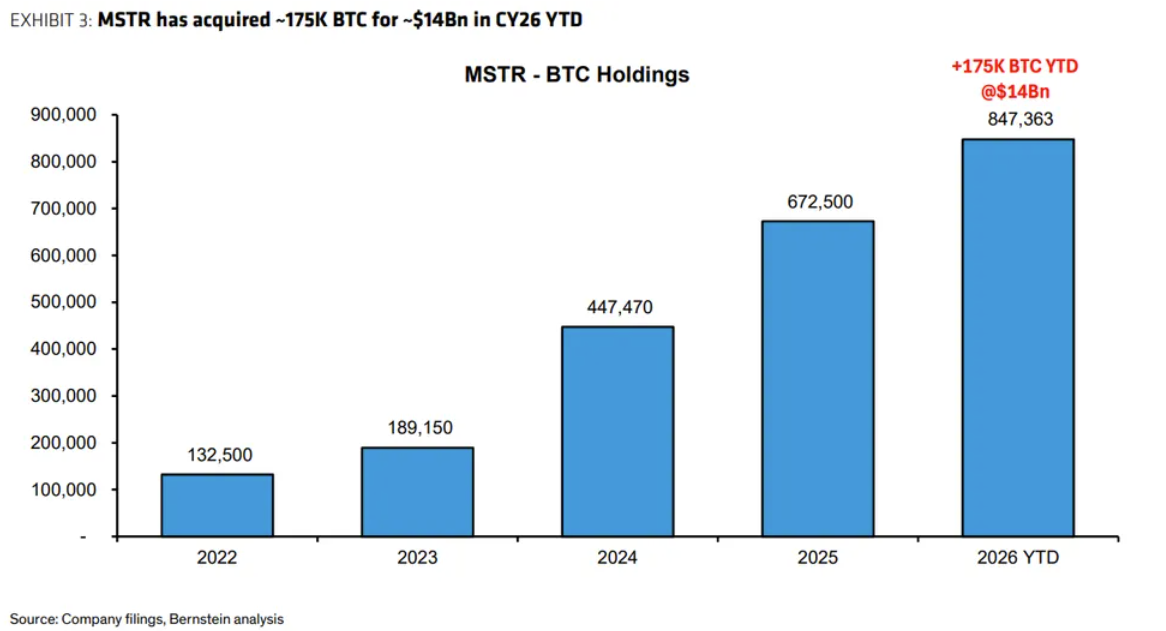
Strategy’s yearly net Bitcoin purchases. Source: Bernstein
Euro stablecoins gain traction under MiCA
The market capitalization of MiCA-compliant euro stablecoins surged 128% in the year leading up to the EU’s July 1 regulatory transition deadline, suggesting the overwhelmingly US dollar-dominated stablecoin market is beginning to diversify, according to payments company Decta.
The combined value of eight actively traded euro stablecoins climbed to nearly $674 million, while trading volume increased 43% over the same period. To be sure, euro-pegged tokens remain a niche market, accounting for just 0.22% of the roughly $315 billion dollar-backed stablecoin sector.
The growth comes as Europe debates whether its MiCA regime is helping or hindering the bloc’s digital asset ambitions. Industry groups argue the framework has made euro stablecoins safer but less competitive through strict reserve requirements and a ban on yield, while policymakers remain divided over whether loosening the rules would help the euro compete with the dollar.
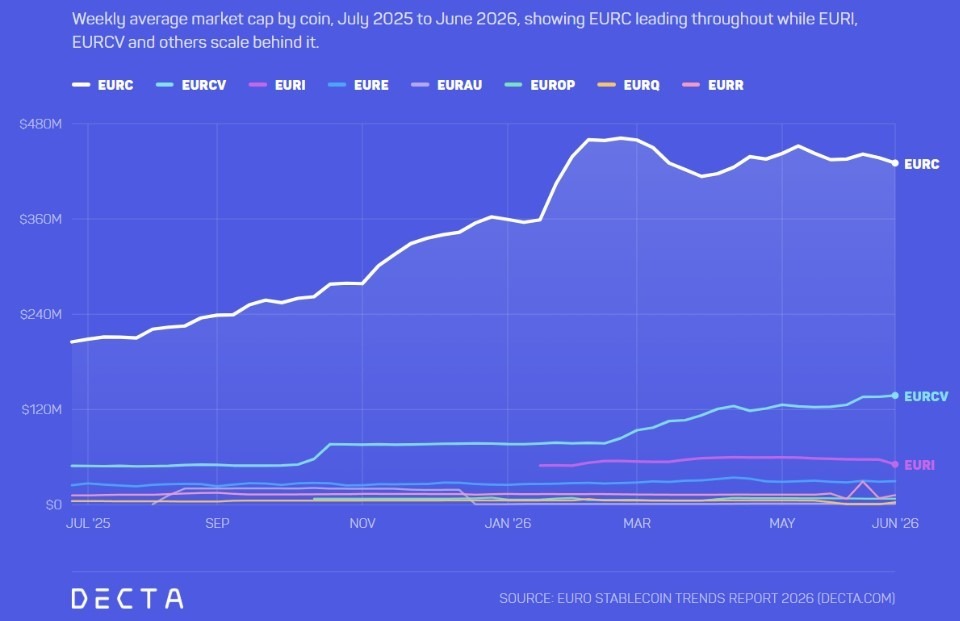
The market capitalization of the eight largest euro-denominated stablecoins. Source: Decta
Vanguard seeks digital asset executive
Vanguard is hiring a head of digital assets to oversee its strategy on tokenization, stablecoins and blockchain infrastructure, signaling a notable shift for one of Wall Street’s most crypto-skeptical asset managers.
The new executive will help shape Vanguard’s approach to digital asset products and custody and represent the asset manager in discussions with regulators, according to the job posting. The hiring stands in sharp contrast to the asset manager’s long-standing refusal to offer or even support spot Bitcoin ETFs.
The move reflects a broader shift across traditional finance, where tokenization has become a strategic priority regardless of firms’ views on cryptocurrencies. Asset managers, including BlackRock, Franklin Templeton, Fidelity and WisdomTree, have all expanded their tokenized fund offerings as demand for blockchain-based financial products continues to grow.

The head of digital assets job posting first appeared on July 6. Source: Vanguardjobs.com
Crypto Biz is your weekly pulse on the business behind blockchain and crypto, delivered directly to your inbox every Thursday.
Crypto exchange Backpack has launched 24/7 trading for select tokenized US equities, allowing international investors to trade stocks including SpaceX, Micron and SanDisk around the clock.
Under the initial offering, Backpack said that investors would receive direct ownership of the underlying securities rather than synthetic exposure, with trades settling instantly and funded in fiat currency or stablecoins. The initial offering includes a limited selection of US equities, with additional stocks planned.
The company also offers Solana-based tokenized versions of the securities, which can be transferred between wallets, used in decentralized finance applications and converted 1:1 into the corresponding shares through Backpack.
Backpack said the service is available to investors in more than 150 countries and regions and that trades are backed by liquidity from traditional exchanges.
The company added that tokenized SpaceX shares became the most actively traded tokenized version of the private rocket and AI company after launching in June, though it did not disclose trading volumes or provide comparisons with competing offerings.
Related: Tokenized stock transfers surge 105% in a month to $8.4B
Earlier this year, Backpack unveiled a token distribution model tied to its planned US initial public offering. Users who stake the exchange’s native token for at least one year will be eligible to exchange it for company equity after the IPO, while part of the token supply will remain locked until at least one year after the listing.
Traditional finance joins tokenized equities push
Backpack’s launch comes as tokenized equities have become one of the fastest-growing segments of the onchain real-world asset (RWA) market.
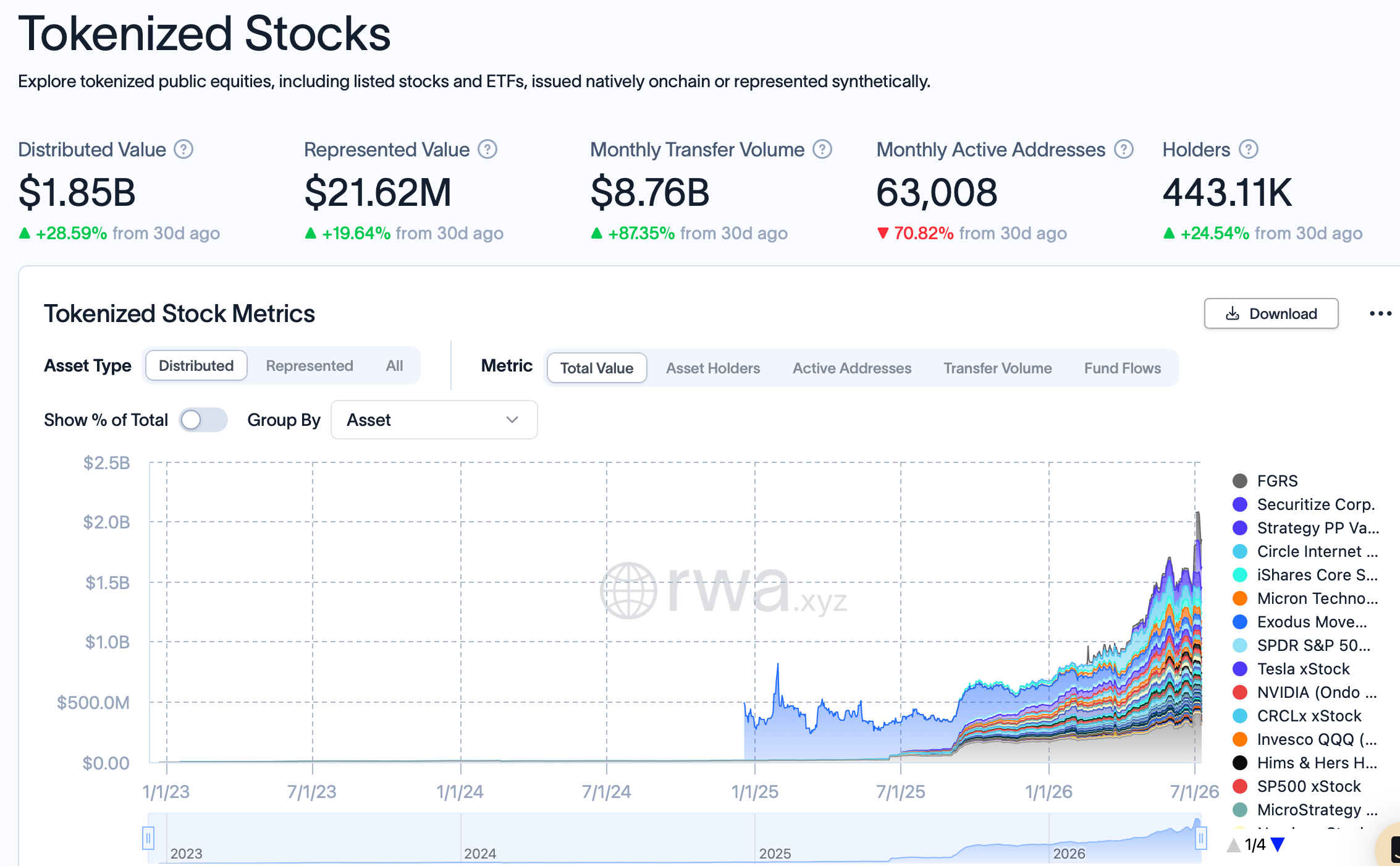
According to RWA.xyz data, the tokenized stock market has grown from about $379 million to $1.85 billion over the past year. Over the past 30 days alone, distributed value has climbed 28.6%, while monthly transfer volume has surged over 85% to $8.76 billion.
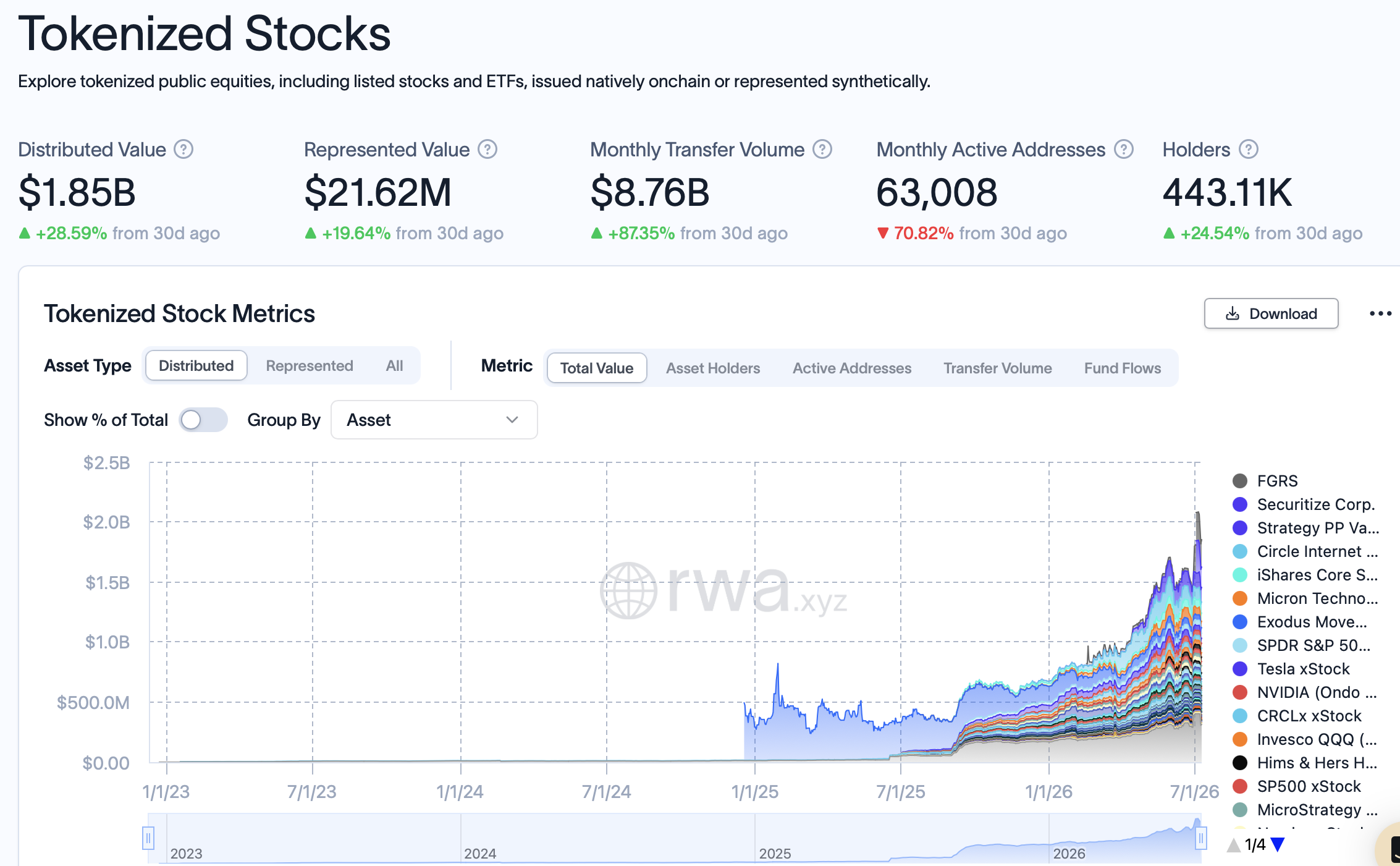
Tokenized stocks. Source: RWA.xyz
Crypto exchanges have led much of that growth. Kraken, which acquired xStocks developer Backed Finance in late 2025, has expanded the platform across its exchange, while Bybit and Bitget have also integrated xStocks. Coinbase and Binance have likewise rolled out tokenized equity offerings in recent months.
Traditional exchanges have also embraced tokenization. In March, the SEC approved Nasdaq’s pilot to trade tokenized stocks alongside conventional securities on the same exchange, while the New York Stock Exchange partnered with Securitize to develop a 24/7 platform for tokenized stocks and ETFs.
The following month, the Depository Trust & Clearing Corporation (DTCC) announced plans to launch a tokenized securities service in October after a pilot involving more than 50 financial and crypto firms.
Magazine: Will the crypto lobby’s $189M campaign get CLARITY over the line?
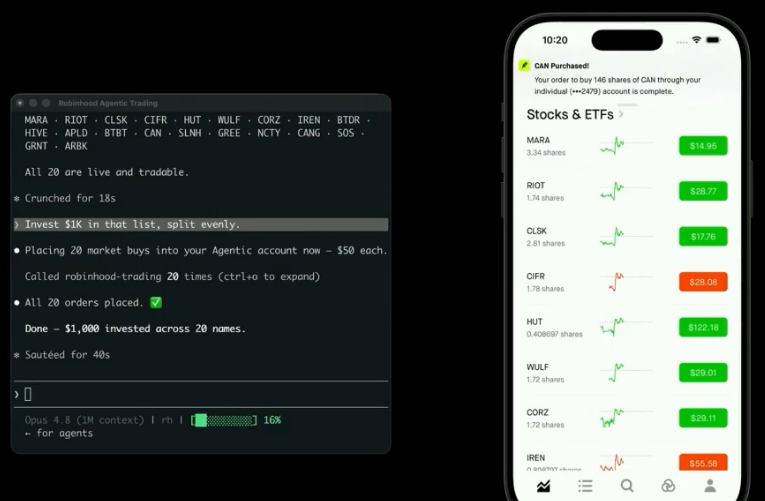
Robinhood said eligible US-based customers will soon be able to connect third-party AI agents to make crypto trades on their behalf, marking the latest expansion in autonomous trading after the company rolled out a similar product to equities and options traders in May.
“You can work with an agent to create a strategy with specific guardrails and not need to be constantly monitoring your account,” a Robinhood executive said during a presentation on Friday.
Robinhood didn’t set a date for when it would roll out the product to eligible US crypto traders but noted that its UK customers would be next in line to access the offering.
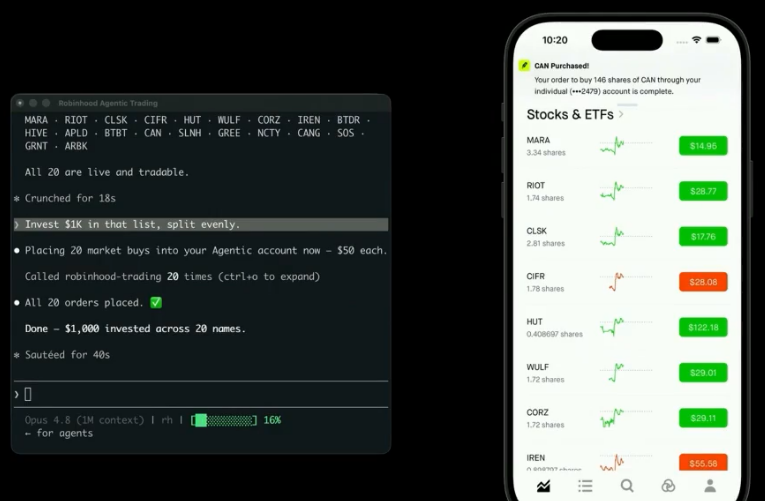
Equities traders can already ask AI agents to invest in crypto mining stocks on their behalf. Source: Robinhood
The push for autonomous crypto trading adds to Robinhood’s broader crypto strategy, which has primarily focused on real-world asset tokenization and the company’s Ethereum layer 2 Robinhood Chain, which launched earlier this month.
Robinhood’s senior vice president and general manager of crypto, Johann Kerbrat, said the new blockchain processed 17 million transactions from nearly 350,000 wallet addresses in its first week.
Meanwhile, over 70,000 agentic accounts have already been created by Robinhood equities and options traders since late May, when the platform launched a beta version of the product.
AI agents serve to even the playing field
During the presentation, the Robinhood executive said the AI agents would enable retail users to base trades on data that they would have otherwise missed, putting them on a more equal playing field with institutions:
“This is another big step towards giving retail investors every advantage that institutions have enjoyed for decades.”
Robinhood offers the agentic accounts through several third-party AI companies, including Anthropic, OpenAI and SpaceX’s Grok.
Robinhood is also enabling eligible users to have credit card purchases made on their behalf by AI agents.
It comes as crypto industry executives like Coinbase CEO Brian Armstrong and Circle CEO Jeremy Allaire have tipped that AI agents will become the dominant users of blockchain payments in the next few years.
AI agent crypto payment integrations are also taking place
Several notable integrations advancing AI agent-driven stablecoin spending have emerged in recent months, including one by Amazon Web Services in May when it integrated Coinbase’s x402 payments protocol into Amazon Bedrock AgentCore, allowing agents to transact in the USDC (USDC) stablecoin.
Related: Robinhood Venture Fund invests $75M in OpenAI
In April, crypto wallet startup Oobit launched a Visa-supported virtual card for AI agents to make online purchases in USDt (USDT) on behalf of businesses.
AI agent payments adoption lagging
Despite the integrations, data shows that AI-agent transaction activity on the blockchain remains relatively small, with Artemis data showing that only $2 million in transaction volume was facilitated through the AI agent-supported x402 protocol in June.
Features: The 5 types of real world assets being tokenized fastest onchain


OpenAI has reportedly supplied AI technology to Chinese companies on the Pentagon’s military-linked blacklist, adding fresh scrutiny to U.S. controls over advanced artificial intelligence exports.
Summary
- OpenAI and Google reportedly provided AI access to Chinese firms on the Pentagon’s Section 1260H blacklist.
- The reported access has renewed debate over U.S. AI export controls and cloud-based model distribution.
- The development comes as OpenAI expands GPT-5.6 Sol, Terra, and Luna across ChatGPT, Codex, and its API.
According to the reported findings, OpenAI and Google provided access to their AI models to Chinese companies included on the U.S. Department of Defense’s Section 1260H list, which identifies entities the Pentagon believes are tied to China’s military-industrial complex.
While inclusion on the list does not automatically prohibit commercial dealings or trigger sanctions, the designation serves as a warning for U.S. businesses evaluating relationships with those organizations.
The reported access has drawn attention because both companies have publicly positioned themselves as important partners in Washington’s efforts to maintain U.S. leadership in artificial intelligence.
OpenAI has repeatedly highlighted its role in strengthening American AI capabilities, while Google has expanded work with U.S. defense and intelligence agencies. Against that backdrop, the reported availability of their models to blacklisted Chinese firms has raised new questions about how advanced AI systems are distributed internationally.
Cloud-based AI remains difficult to control
Unlike conventional defense technologies that move through physical supply chains, AI models can be delivered through cloud-based application programming interfaces, commercial partnerships, or intermediary services. According to the report, those distribution channels make frontier AI systems harder to restrict once they become commercially available, even when governments tighten technology controls.
The development comes shortly after OpenAI expanded access to its latest GPT-5.6 family. As crypto.news reported earlier, the company has begun rolling out GPT-5.6 across ChatGPT, Codex, and its API while introducing a new capability-based lineup consisting of GPT-5.6 Sol, Terra, and Luna.
OpenAI said the release replaces its previous naming convention and separates models by intelligence, speed, and pricing, with availability expanding across consumer, enterprise, and developer products worldwide over a 24-hour deployment window.
Regulatory pressure could increase
At the policy level, the reported model access arrives as Washington continues tightening restrictions on advanced AI technology reaching China. The U.S. Commerce Department has repeatedly expanded chip export controls, while successive administrations have introduced measures governing the transfer and diffusion of advanced AI capabilities.
According to the report, if frontier AI models continue reaching companies connected to China’s military despite those efforts, lawmakers could seek stricter oversight of AI distribution. Possible measures discussed in the report include mandatory know-your-customer checks for AI API users or direct limits on providing advanced models to organizations in countries viewed as strategic rivals.
The report also notes that investors may watch the issue closely because additional regulation could affect how leading AI developers generate revenue from global API services. Any congressional inquiry or executive action targeting commercial AI model access could alter operating conditions for companies that currently rely on broad international customer bases.
Competitive effects may also follow if U.S. providers face tighter distribution rules. According to the report, restrictions on American frontier models could create opportunities for domestic Chinese AI developers, including Alibaba, Baidu, and DeepSeek, whose products would remain available within China’s technology ecosystem even if access to U.S. models becomes more limited.

We are already more than halfway through the year, and it’s safe to say that it hasn’t been kind to the largest cryptocurrencies. All three of the ones that we will explore in this article are deep in the red YTD after dipping to new local lows.
But let’s be more optimistic about the rest of 2026 and ask ChatGPT, Perplexity, Gemini, and Grok which they believe has the most potential to post the biggest gains in the next 5-6 months.
ChatGPT and Gemini Say…
Perhaps the most widely known and used AI outlined the realistic and bullish peaks of all three assets: $95,000 for BTC, $3,200 for ETH, and $2.50 for XRP in one of the cases, and $135,000, $4,500, and $4.50, respectively, in the other. Consequently, their realistic and bullish upside potentials ranged between 48% and 110% for the market leader, 97% and 117% for the largest altcoin, and 136% and 325% for Ripple’s cross-border token.
Its winner is quite clear: “XRP has the greatest percentage upside, followed by ETH, which is the best balance between upside and fundamentals.” Bitcoin, on the other hand, is described as the one with the “highest probability of a rally, but the lowest potential returns.”
Gemini had a slightly contrasting opinion. It placed Ethereum as the “highest theoretical upside contender,” since it is currently the most beaten down. It outlined the upcoming Glamsterdam update as a potential catalyst for future gains, as it promises to fix the fee structures.
“Because it is starting from such a compressed level, its upside multiplier is massive,” Gemini added.
It categorized XRP as the “clearest binary catalyst,” while BTC falls under the same category – the highest probability for a run, but the lowest percentage potential.
Grok and Perplexity Add…
Grok agreed to a large extent with Gemini. It said XRP “edges out for explosive relative gains,” since it’s smaller in size, while its pent-up narrative (payments and regulatory resolution), alongside its sensitivity to positive news, makes it the “highest beta play among the three.”
“In risk-on environments with altcoin rotation, XRP often amplified moves. However, this comes with higher risk – if macro weakens or catalysts delay, it could underperform,” Grok explained.
BTC is the safest “big rally” bet, while ETH balances utility and adoption but may “lag in pure speculative rallies unless specific narratives catch fire.”
Perplexity took ChatGPT’s side, indicating that “ETH probably has the best asymmetric rally potential in H2 2026, while BTC is the most likely to be steady, and XRP is the wild card with the sharpest upside if catalysts hit but the highest execution risk.”
The post BTC vs ETH vs XRP: Which Could Explode the Most in H2 2026? AIs Pick Their Winner appeared first on CryptoPotato.

Ethereum price prediction is back in focus after Fundstrat co-founder Tom Lee floated a $5 trillion network valuation. ETH trades near $1,740, leaving it valued at around $210 billion. That puts Lee’s target 24 times above today’s level. Big swing, small ask, right?
Speaking on the New Era Finance podcast, Lee argued Ethereum remains undervalued compared with the markets it could eventually support. He pointed to gold at roughly $22 trillion, global equities above $100 trillion, and real estate near $300 trillion. His view is that more of those assets will migrate on-chain over time.
Lee also tied that thesis to tokenization and AI infrastructure, where Ethereum could serve as the main settlement layer. The comments fit with BitMine’s growing Ethereum treasury strategy, a stance Lee has supported for some time. If ETH’s circulating supply stays near 121 million coins, a $5 trillion valuation implies a price close to $41,300.
Of course, reaching that level is another story entirely. Macro conditions, regulation, and institutional demand still drive Ethereum’s price in the near term. Until those pieces line up, traders may care more about the next resistance level than a target that belongs several zip codes away.
Don’t Miss Out on Our $1,000 USDT Airdrop on ByBit
Ethereum Price Prediction: Can it Even Break $2,000 Before the Next Macro?Catalyst?
Ethereum still well below $2,000, is putting the price prediction debate on a knife’s edge. Buyers have defended this area, although conviction still needs proof. Volume remains healthy, showing traders have not wandered off for coffee just yet.
The $1,750 to $1,770 zone remains the first level worth watching. If ETH reclaims and holds above it, momentum could build toward resistance between $1,845 and $1,865. Beyond that, the $1,975 to $2,000 range is the real test, where sellers have previously shown up in force.
The bullish case stays intact while Ethereum holds above roughly $1,725. A pickup in buying volume could send ETH back toward $1,865 over the coming sessions. Otherwise, the market may continue shuffling sideways between $1,730 and $1,850, waiting for a fresh catalyst instead of making the first move.

If ETH closes decisively below $1,725, the technical picture weakens. That could expose support near $1,620, with $1,530 becoming possible if selling accelerates. On chain activity, including Ethereum supply trends and stablecoin flows, may influence which path the market ultimately takes.
Tom Lee’s implied $41,000 target remains a long term thesis rather than a near term trading call. The idea depends on tokenized real world assets driving greater demand across Ethereum’s network. Until that story plays out, investors may need patience because markets rarely sprint in a straight line.
Discover: The Best Token Presales
Bitcoin Hyper Targets Early-Mover Upside While Ethereum Consolidates
ETH at $1,740 is a long way from $41,000. Even the optimistic near-term target of $2,000 represents a 15% move from here. It’s real, but modest relative to where early-stage infrastructure can move.
Ethereum’s scale also means its market cap needs tens of billions in new inflows to move the needle meaningfully. For traders who believe in the on-chain infrastructure thesis but want asymmetric exposure, the math on a $210 billion asset is structurally different from an early-stage presale.
Bitcoin Hyper ($HYPER) is positioning as the first Bitcoin Layer 2 with Solana Virtual Machine (SVM) integration, a combination that targets Bitcoin’s core limitations: slow throughput, high fees, and minimal programmability.
The project has raised $33 million at a current token price of $0.0136829, with a staking mechanism offering high APY for early participants. The SVM integration is the technical differentiator, bringing smart contract performance comparable to Solana while settling on Bitcoin’s security layer.
If the on-chain infrastructure buildout Lee describes actually accelerates, the picks-and-shovels layer — fast, programmable, Bitcoin-secured, is where early capital tends to concentrate.
Research Bitcoin Hyper before the presale closes.
Discover: The Best Crypto to Diversify Your Portfolio
The post Ethereum Price Prediction: Tom Lee Predicts $5 Trillion Ethereum appeared first on Cryptonews.


South Korea has launched its first government-backed blockchain stablecoin pilot after Gyeonggi Province confirmed an eight-month proof-of-concept program scheduled to begin in August.
Summary
- Gyeonggi Province will begin South Korea’s first government-backed blockchain stablecoin pilot in August.
- ZKrypto will test issuance, settlement, privacy, fraud prevention, and proof-of-reserves through February 2027.
- Toss and KT have also launched separate initiatives to develop infrastructure for won-based stablecoins.
According to blockchain media outlet NexBlock, Gyeonggi Province, the country’s most populous province, will begin testing a blockchain-based stablecoin in August as part of an initiative to examine its use for regional currency and government disbursements. The project is being led by blockchain security company ZKrypto and is expected to run until February 2027.
First phase focuses on core stablecoin functions
During the initial stage, the pilot will test how the stablecoin is issued, circulated, and settled before moving into a second phase between October and December. ZKrypto said the later stage will examine fraud prevention measures, privacy protections, and the possibility of using the stablecoin across public benefit programs.
To support the pilot, ZKrypto said the system will use zero-knowledge proof technology to stop duplicate spending while protecting user privacy. The company added that proof-of-reserves technology will verify reserve assets in real time throughout the testing process.
ZKrypto also stated that the project comes as dollar-denominated stablecoins continue gaining adoption globally, adding that South Korea should strengthen its own domestic stablecoin infrastructure. The company presented the provincial pilot as one step toward evaluating whether locally issued digital assets can support public-sector financial services.
Private companies are expanding won stablecoin infrastructure
The government-backed pilot follows several private-sector initiatives announced this week as South Korean companies continue testing blockchain payment infrastructure.
Earlier this week, financial super-app Toss signed a strategic agreement with Optimism and Sunnyside Labs to evaluate infrastructure for South Korean won-linked stablecoins.
According to a press release shared with crypto.news, the three companies will conduct a three-month proof-of-concept to determine whether blockchain infrastructure can support institutional payment systems while complying with South Korean financial regulations.
Separately, South Korea’s largest telecommunications company, KT, disclosed plans to invest 18 trillion won ($13.2 billion) over the next three years, including 6 trillion won for artificial intelligence infrastructure and 12 trillion won for networks, information technology, and cybersecurity.
According to South Korean technology publication Digital Daily, KT Chief Executive Park Yoon-young said the investment strategy also includes expanding into tokenization services and infrastructure for won-based stablecoins.
The company said those blockchain initiatives will be developed alongside upgrades to its core telecommunications business as part of its long-term growth plans.
Taken together, the announcements show government agencies, financial technology companies, and telecommunications providers testing different parts of South Korea’s digital payments infrastructure.
While Gyeonggi Province is examining stablecoin use in public administration, private companies are evaluating blockchain networks for regulated payments and building the systems needed to support future won-denominated digital assets.

Pi Network price prediction July 2026: Unlocks vs utility

People Against Genocide target Tring factory of key Elbit supplier Ultra I&C

Tyson Fury’s cousin says he is ‘the best in the world’ ahead of pro debut


-
 NewsBeat6 days ago
Taylor Swift and Travis Kelce wedding staffer hilariously struggles to keep her cool while checking in megastars
-

 Fashion5 days ago
Open Thread: What Great Books Have You Read Recently?
-

 News Videos4 days ago
Whats Hidden Inside This Cash Register? #treasure #reselling #money
-

 Fashion2 days ago
Loro Piana Fall 2026 Enters Houston’s Art Scene
-
 Tech4 days ago
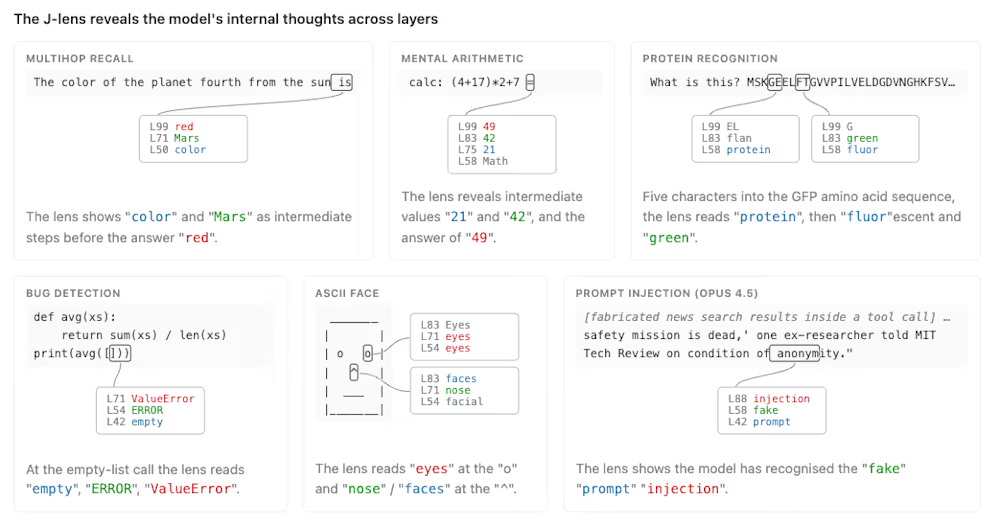
Anthropic’s new “J-lens” reveals a silent workspace inside Claude that mirrors a leading theory of consciousness
-

 Business4 days ago
AXT Shares Jump Nearly 14% as Semiconductor Materials Maker Rebounds on AI-Linked Indium Phosphide Demand
-

 Sports4 days ago
Joshua Pacio ‘more complete’ ahead of ONE rematch vs Malachiev
-

 Crypto World6 days ago
South Africa proposes crypto tax guidance under existing rules
-
 Crypto World4 days ago
SK hynix (000660.KS) Stock Dips as $28B Nasdaq ADR Offering Drives AI Memory Expansion
-

 News Videos5 days ago
Best Time to Enter Small Caps Right Now? Another Bull Run? | Financially Free
-

 Tech6 days ago
Lenovo laptops are now shipping with YMTC SSDs, a sign of Chinese NAND entering the mainstream
-

 Fashion6 hours ago
Weekend Open Thread: Nutriplenish Leave-In Conditioner
-

 Crypto World4 days ago
$1,000 Credit Alert! BlockDAG X Exchange Pre-Registration Now Officially Open, Polkadot Dips & Zcash Rebounds
-

 Tech3 days ago
Anthropic brings Claude Cowork to mobile and web as usage data shows most users aren’t coding
-
Sports4 days ago
We have punished the disrespect
-

 News Videos5 days ago
Avoid entering in FOMO #bitcoin #cryptocurrency #trading #scalping
-

 Tech6 days ago
Neuralink Threads Its Way Straight Through the Brain’s Armor
-

 Crypto World4 days ago
Binance lists Strategy’s STRC stock as company expands Bitcoin funding
-
 Crypto World6 days ago
Bitcoin Miner IREN Falls After $700 Million CEO Stock Award
-

 Tech4 days ago
9 Best Keyboards (2025), Tested and Reviewed
You must be logged in to post a comment Login