
Crypto World
Coinbase Chief Legal Officer to Transition to Advisory Role on July 31

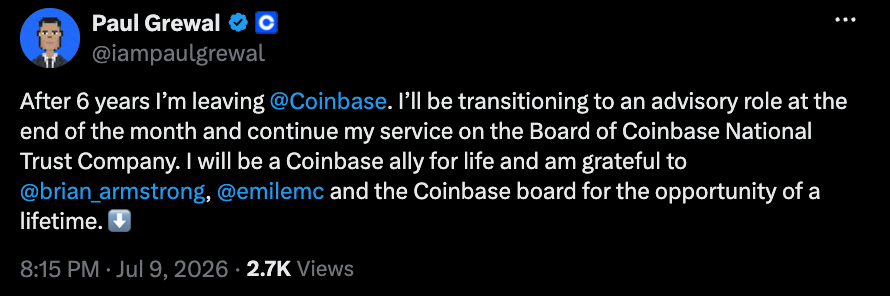
Paul Grewal, who has served as Coinbase’s chief legal officer since 2020, announced that he would transition to an advisory role at the exchange starting on July 31.
In a Thursday X thread and LinkedIn post, Grewal said Coinbase’s legal vice presidents Molly Abraham and Ryan VanGrack would step into new roles as general counsel and vice chair, respectively, following his departure at the end of the month. Abraham said that she would “take the helm” at the exchange’s legal team.
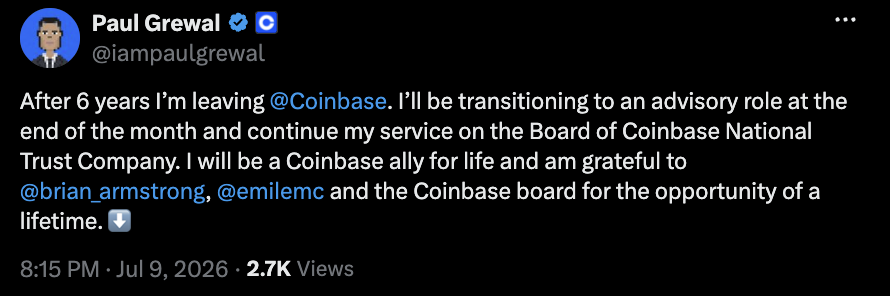
Source: Paul Grewal
Whoever steps into Grewal’s shoes as the exchange’s next chief legal officer would likely have significant influence over crypto policy and regulation in the US. As CLO, Grewal led the exchange’s legal team through the US Securities and Exchange Commission’s 2023 enforcement action that alleged it had been operating as an unregistered securities exchange, broker and clearing agency.
Since the 2023 lawsuit, which was later dismissed under the Trump administration, Coinbase and its executives have established strong relationships with the White House and lawmakers favoring crypto policies. The company is one of the top contributors to the Fairshake political action committee (PAC), which funds media supporting politicians it considers “pro-crypto,” and CEO Brian Armstrong has met with US President Donald Trump in addition to advocating for crypto-related legislation in Congress.
Related: CLARITY Act markup could happen as early as next week: Coinbase exec
Grewal added that he would announce a potential new position “in due course.” Cointelegraph reached out to Coinbase for additional details on Grewal’s departure, but did not receive an immediate response.
Coinbase will continue to push for US crypto market structure
Many Coinbase executives, including Armstrong, have been pushing lawmakers in Congress to pass the Digital Asset Market Clarity Act (CLARITY), which is expected to largely shift oversight and regulation of digital assets from the SEC to the Commodity Futures Trading Commission.
The US Senate is on a state work period until Monday, when lawmakers will return and potentially take up a vote on the bill.
Magazine: How AI became crypto’s favorite reason to cut staff

Bithumb has published a formal Bithumb IPO timeline. The plan targets a public listing by 2028.
South Korea’s second-largest exchange framed the listing as a trust-building step. Executives tied each phase to a specific governance target.
A Roadmap Shaped by Past Delays
Bithumb’s listing ambitions have shifted before. The exchange once targeted a debut in the second half of 2025. Management pushed that date back as new obligations piled up.
Shareholders backed CEO Lee Jae-won’s reappointment in March 2026. The vote came weeks after a Bitcoin (BTC) balance-display glitch drew a record fine.
The exchange also operates in a tougher home market. South Korean trading volume recently fell to a two-year low during a Kosdaq market crash. A new 22 percent crypto tax takes effect in 2027. That is the same year Bithumb plans to file its listing review.
The Bithumb IPO Timeline, Stage by Stage
The Bithumb IPO timeline runs in three stages. Each stage maps to a single year rather than a fixed date. Stage one covers 2026. It focuses on internal control upgrades and a shift from domestic accounting rules to the global K-IFRS standard.
Bithumb has also restructured internally, spinning off its asset management unit as a separate entity, Bithumb Asset. The company said the split separates responsibilities and reduces potential conflicts of interest ahead of a listing review.
Stage two opens in 2027. Bithumb plans to file for a preliminary listing review with Korean regulators that year. Stage three targets IPO completion in 2028. However, the notice cautions that the schedule could shift with market conditions or regulatory review timelines.
The exchange has indicated a preference for South Korea’s Kosdaq board. A listing on the larger Kospi market remains possible if conditions change.

The notice also spelled out promises to customers. Bithumb pledged a more transparent governance structure and stronger internal controls.
It also promised better investor protection, more frequent information disclosure, and a sustainable growth foundation as it moves toward institutional-level, global-standard management. The company said these steps aim to show it can operate like a listed company well before shares actually trade.
The plan lands as Japan and South Korea explore a broader digital asset framework. That regulatory shift could smooth Bithumb’s path toward institutional-grade compliance.
Meanwhile, the exchange keeps growing its trading business. Upbit and Bithumb listings sent one small-cap token up nearly 30% in July. That activity shows daily operations continuing alongside the listing push.
Whether Bithumb reaches 2028 on schedule may depend on more than internal readiness. It will also hinge on how regulators respond to a shrinking, more heavily taxed market in the years ahead.
The post Bithumb Lays Out a 3-Stage Path to Its South Korea IPO appeared first on BeInCrypto.
MicroStrategy added 37 bitcoin between May 26 and July 26. Last week it sold 1,638 in seven days. The company now holds less Bitcoin (BTC) than it did in spring.
Michael Saylor says Strategy expects to stay a net buyer. Its own filings show the buying stopped months ago.
The Stack Is Going Backwards
Strategy reported 843,738 BTC on May 26. Two months later, on July 26, it reported 843,775. That is a gain of 37 coins.
Then came Monday’s filing. It shows 842,138 BTC as of August 2.
The company is now 1,600 coins below where it stood in May. Ten weeks have passed with no net buying at all.
Saylor addressed the question directly on August 1, when he shut down a viral sale claim.
“We have never had a “never sell” policy. The program does not require any BTC sale, and we expect to remain a net buyer of Bitcoin over time,” the MicroStrategy chair stated.
Follow us on X to get the latest news as it happens
A $400 Million Dividend Bill
The MicroStrategy Bitcoin sale last week was not opportunistic. It paid a bill.
Strategy owes cash to holders of its preferred shares. Those pay a fixed dividend every quarter.
That cost reached $400.7 million in the second quarter. A year earlier it was $49.1 million. The bill is more than eight times larger.
Dividends and interest now run roughly $1.76 billion a year.
So the coins go out the door. Strategy sold $218.4 million of bitcoin this year through July 26. Last week added $104.7 million more.
Almost a third of the year’s selling happened in that one week.
Selling at a Loss to Buy at a Discount
Here is the trade. Strategy sold bitcoin at $63,957 a coin. Its average cost is $75,419. That is a loss of about $11,500 each.
It used half that cash to buy back 912,143 STRC shares. STRC is a Bitcoin-backed preferred share that pays 12% a year.
Each share is meant to be worth $100. Strategy paid $89.02.
So the company took a loss on bitcoin to capture an 11% discount on its own debt-like shares. Every share retired cuts the dividend bill for good.
It also sold 3,011,361 of its own ordinary shares, raising $290.6 million. Meanwhile a $1 billion approval to buy those shares back sits unused. That is the trade-off MSTR investors face.
“Strategy is evolving from one-way capital issuance to active capital management,” Phong Le, president and chief executive of Strategy, in the June 29 release
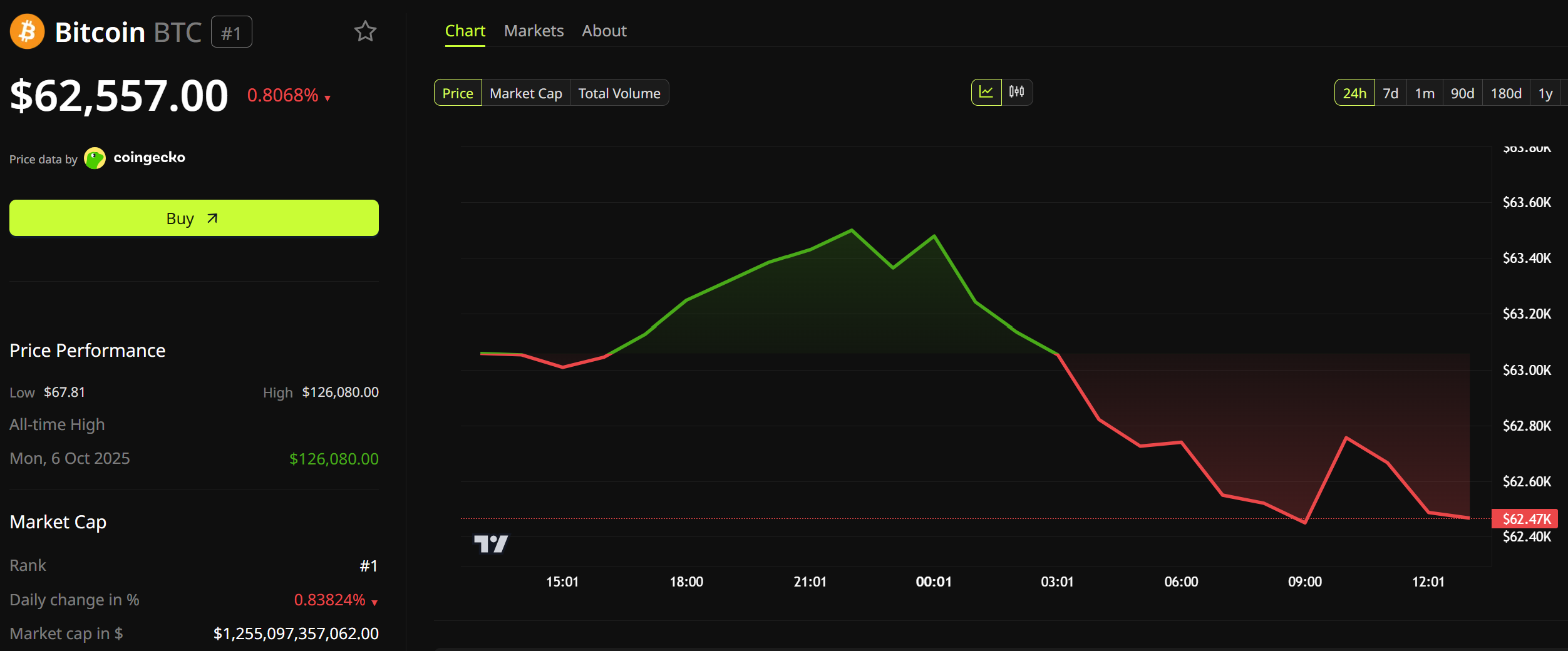
Bitcoin trades near $62,468, roughly half its October record. Strategy still owns more of it than any other company.

But the direction has changed. The next filing lands in a week.
The post MicroStrategy Added 37 Bitcoin in Two Months. Then It Sold 1,638 in One Week appeared first on BeInCrypto.
Michael Saylor’s Strategy sold 1,638 Bitcoin between July 27 and August 2, marking the year’s second-largest Bitcoin sale for the company.
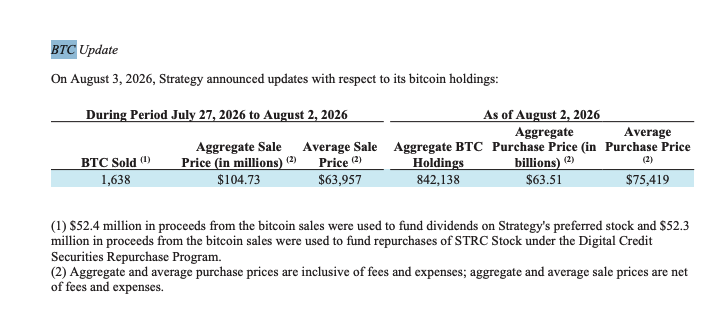
Strategy sold 1,638 Bitcoin (BTC) at an average price of $63,957 for a total of $104.7 million, according to a Monday 8-K filing with the Securities and Exchange Commission. Of the proceeds, $52.4 million was used to fund dividend payments on Strategy’s STRC preferred stock, while another $52.3 million was used to repurchase STRC.
The company now holds 842,138 Bitcoin bought at an aggregate cost of $63.5 billion.
Strategy sold 3,588 Bitcoin for about $216 million on July 6. It also disclosed the sale of 32 Bitcoin in early June, its first reported Bitcoin sale since the 2022 tax-loss transaction.
Strategy bolsters USD reserve to $4 billion, repurchases STRC stock
Strategy also reported selling $290 million in MSTR shares during the same period. About $250 million of the proceeds was used to increase the USD Reserve to $4 billion, $28.9 million to fund additional repurchases of STRC stock and $11.7 million was added to Strategy’s cash balance.
In total, Strategy repurchased $81 million worth of STRC stock and increased its USD runway by 57 days to 2.3 years, announced Strategy founder and chairman Michael Saylor in a Monday X post.
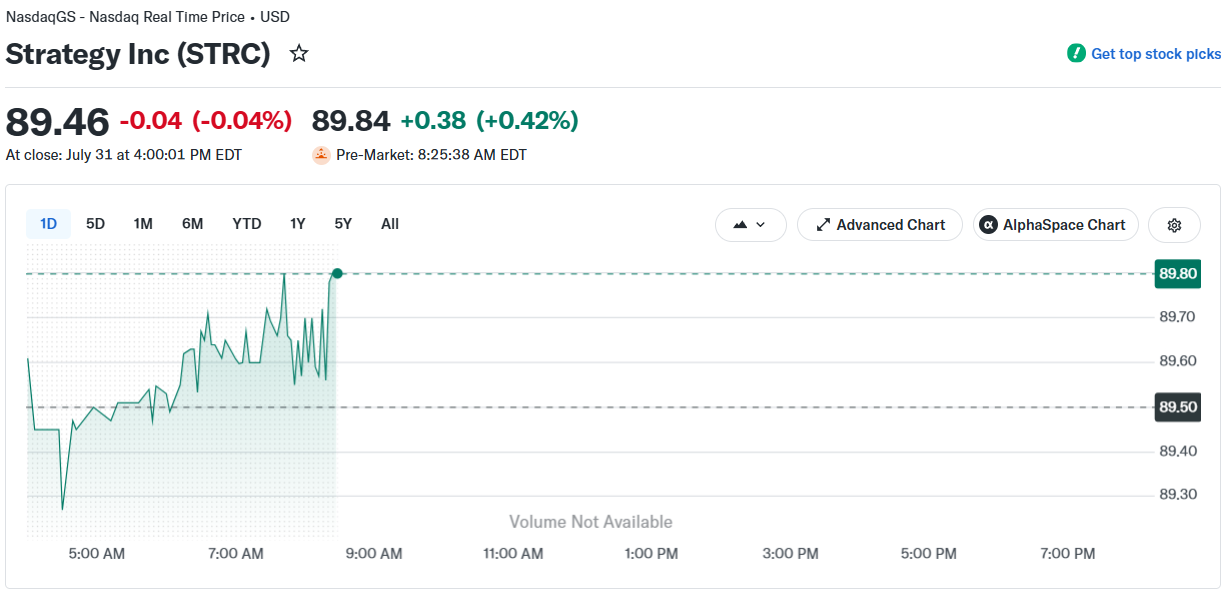
Strategy’s perpetual preferred stock, STRC, traded at $89.4, or 10.6% below its $100 intended par value, during Monday’s pre-market trading session, Yahoo Finance data shows. The company’s MSTR stock also declined 0.9% in pre-market trading on Monday.
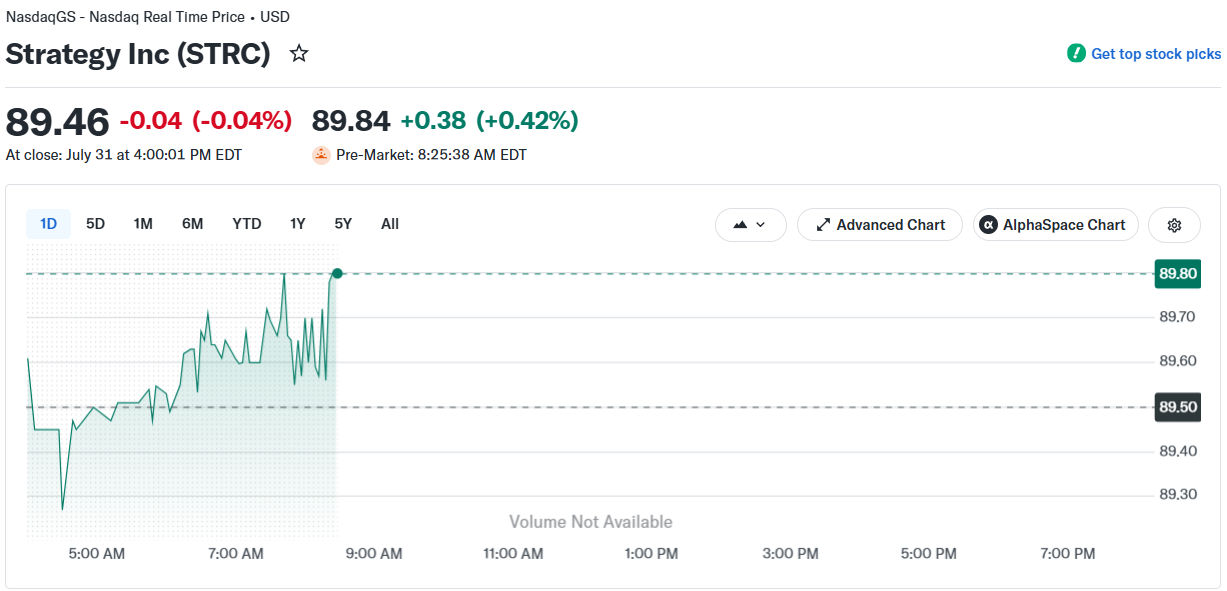
STRC stock price, 1-day chart. Source: Yahoo Finance
STRC is one of Strategy’s main mechanisms to fund its Bitcoin accumulation. Trading below par limits Strategy’s ability to raise funds through STRC sales. It may also force the company to further increase its nominal dividend rate to attract buyers and protect STRC’s price.
Related: CLARITY Act failure could send crypto valuations lower: Bernstein
On June 24, CryptoQuant CEO Ki Young Ju said that Strategy should pause Bitcoin purchases and replenish its cash reserve, after the company’s dividend coverage fell to 14 months from seven years.
“They should pause Bitcoin purchases, rebuild cash reserves, and adopt a systematic framework for purchase timing,” wrote Ju in a June 24 X post.
In its June 29 8-K filing, Strategy unveiled a capital framework allowing Bitcoin sales to fund dividends, increased the annual dividend rate on its STRC preferred stock to 12%, and disclosed that its US dollar reserve had grown to $2.55 billion.
Magazine: Bitcoin adoption metrics say one thing, price action says another
Strategy has increased its US dollar reserve and expanded its preferred-stock repurchases. The otherwise Bitcoin-focused company is moving to strengthen its balance sheet.
The firm added $250 million to its cash reserve, bringing the total to $4 billion. It also repurchased approximately $81 million worth of its Variable Rate Series A Perpetual Stretch Preferred Stock (STRC).
Strategy increased its USD Reserve by $250M and repurchased $81M of $STRC. This increased USD Duration by 57 days to 2.3 years and tightened STRC’s BTC Credit by 5 bps. As of 8/2/26, we hold ₿842,138 in our BTC Reserve and $4.0B in our USD Reserve. $MSTR https://t.co/t7bGZJ8Q3o
— Michael Saylor (@saylor) August 3, 2026
The transaction builds on the firm’s recently introduced Digital Credit Capital Framework. The company intends to use its dollar reserve primarily to cover preferred-stock dividends and debt interest, reducing the need to sell Bitcoin during periods of market stress.
What Saylor failed to mention in the tweet was that the firm also sold some 1,638 BTC for approximately $105 million between July 27 and August 2 at an average price of $63,957 – according to the official filing.
The post Strategy Sold Over $100 Million in Bitcoin, Buys Back More STRC appeared first on CryptoPotato.
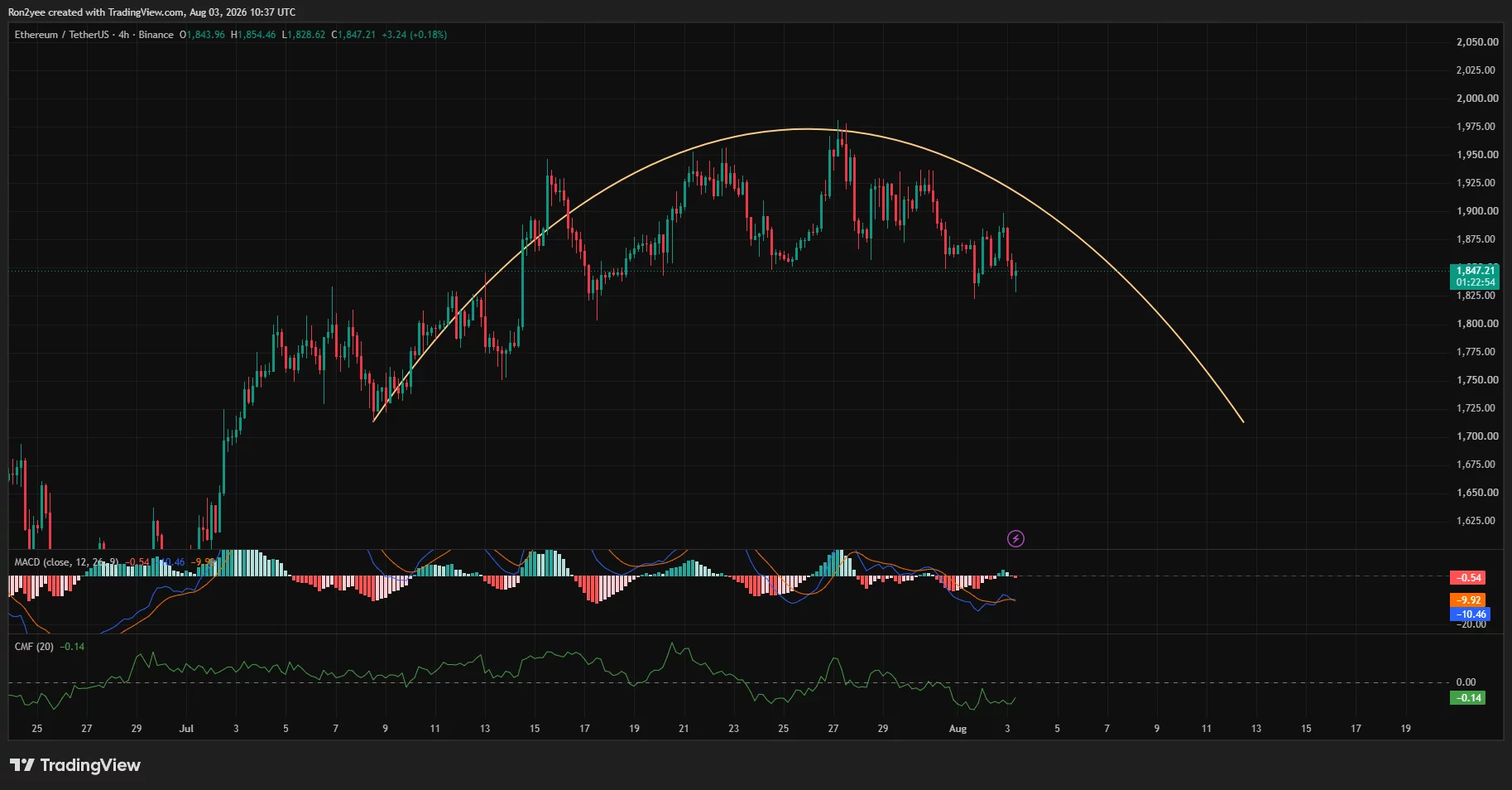
Ethereum price fell 2% to around $1,847 on Aug. 3 after another rejection near key moving averages left the $1,800 support zone exposed.
Summary
- Ethereum price fell 2.04%, reaching an intraday low of $1,828.
- ETH remains below its 50-day and 100-day moving averages at $1,889 and $1,927.
- 4-hour MACD and Chaikin Money Flow readings show weak momentum and continued selling pressure.
- A break below $1,800 could bring $1,785 and $1,700 into focus.
ETH slides after failing to reclaim $1,900
According to data from crypto.news, Ethereum (ETH) price traded at $1,847 at the time of writing, down 2.04% over the previous 24 hours. The token moved between an intraday high of $1,886 and a low of $1,829 on Binance.
The decline extended ETH’s retreat from its July 27 high near $1,975. Buyers have now failed several times to sustain a move above the resistance zone between $1,950 and $1,975.
ETH briefly rebounded after touching $1,828, but the recovery stalled around $1,850. That left the token near the lower end of its recent trading range and inside the closely watched $1,800–$1,850 support area.
The broader daily structure also remains defensive. Ethereum trades below its 50-day simple moving average at $1,889, its 100-day SMA at $1,927, and its 200-day SMA at $2,089.
Weak liquidity deepens Ethereum’s sell-off
The immediate pressure came from Ethereum’s failure to reclaim the moving-average resistance between $1,889 and $1,927. Sellers entered after the latest attempt faded, pushing ETH below $1,850 and toward its Aug. 3 low.
The 4-hour chart shows the price rolling over after forming a broad curved top below $1,975. Lower highs since late July suggest that buying demand has weakened, although ETH must still break below $1,800 to confirm a larger bearish continuation.
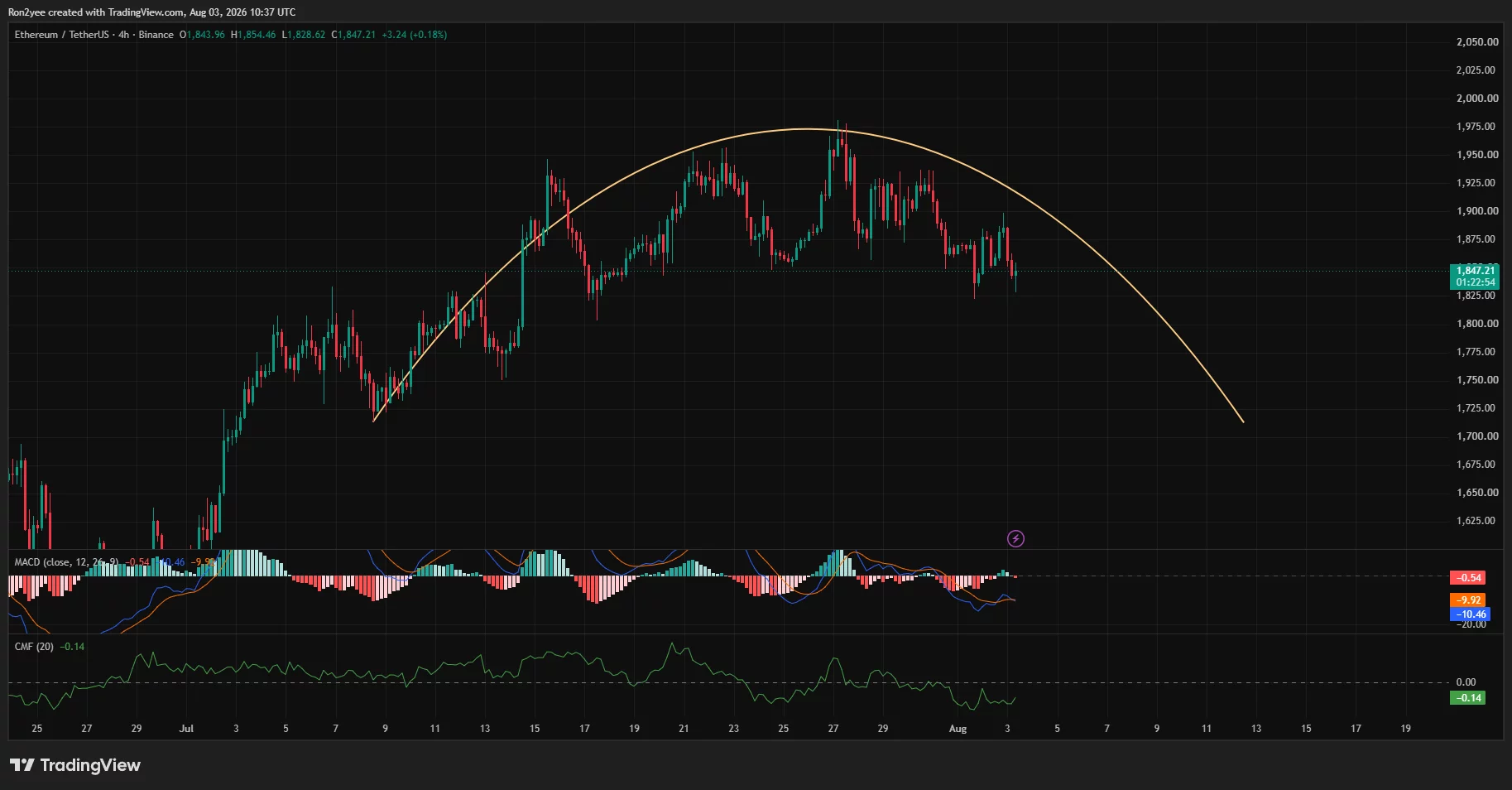
Momentum indicators support the cautious outlook. The 4-hour Moving Average Convergence Divergence remains below zero, with the MACD line near -10.46 and the signal line at about -9.92.
Chaikin Money Flow stands at -0.14. The negative reading indicates that selling volume has outweighed buying volume over the indicator’s measurement period.
Ethereum also faces broader liquidity pressure. A sharp weekly decline in Binance stablecoin netflows suggests less immediately available capital is entering the exchange, potentially reducing the buy-side liquidity available during market declines. However, exchange flows can change quickly and do not determine price direction alone.
Longer-term concerns include weaker institutional demand for Ethereum products relative to Bitcoin and lower mainnet fee revenue as activity shifts toward Layer-2 networks. These factors have weakened Ethereum’s investment narrative, but the current move remains primarily tied to the chart rejection and wider risk-off positioning.
Losing $1,800 could expose ETH to $1,700
The first support range sits between $1,828 and $1,800. ETH has already attracted buyers near the upper part of that zone, but repeated tests could weaken the remaining demand.
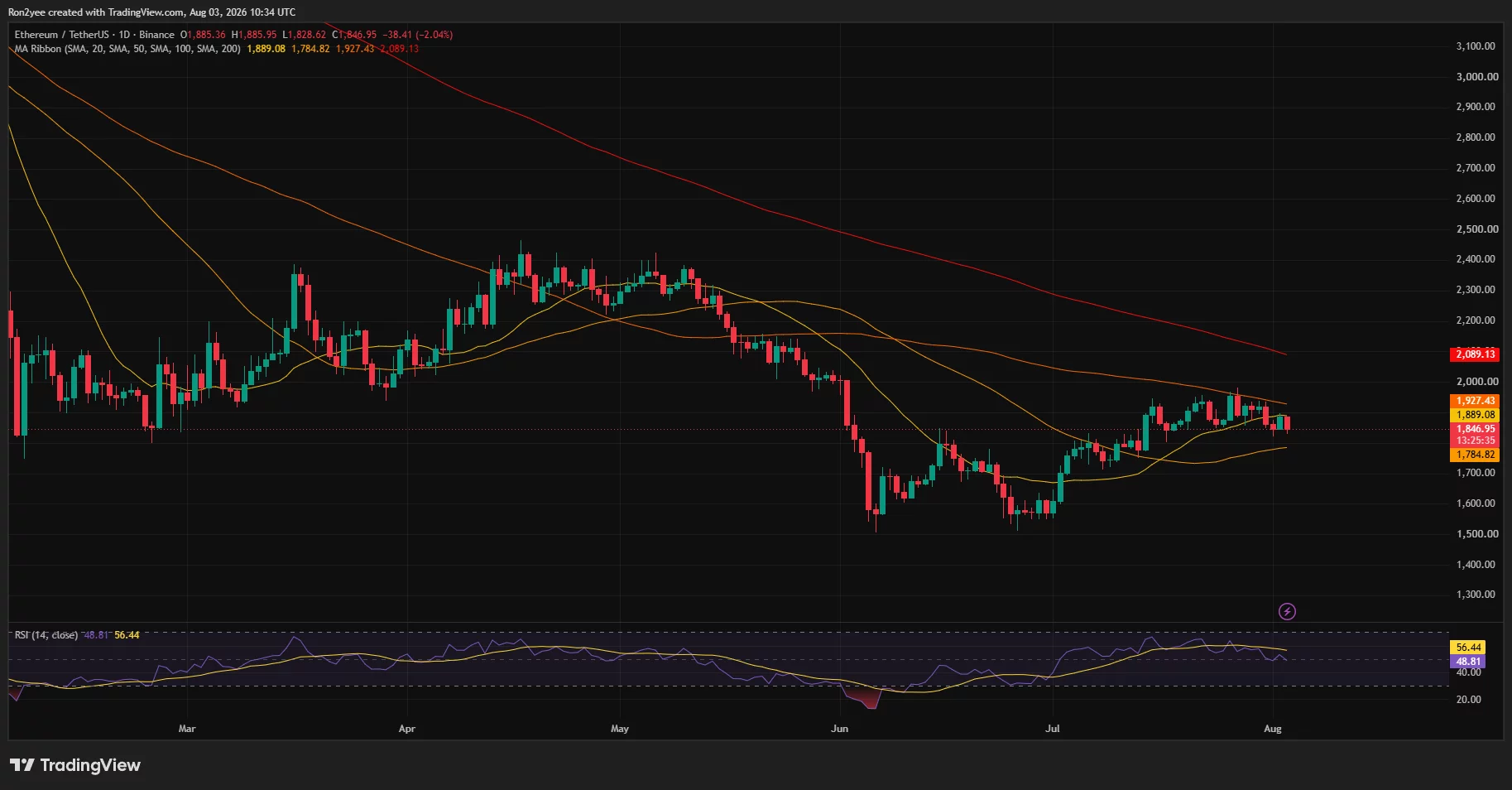
Ethereum’s lower daily moving-average ribbon stands near $1,785. A daily close below that level would strengthen the bearish setup and expose $1,700, followed by the June accumulation region around $1,550–$1,600.
CoinGlass’ 24-hour liquidation heatmap shows nearby leveraged-position clusters around $1,840, $1,820 and $1,810. A move through those levels could liquidate leveraged long positions and accelerate short-term volatility.
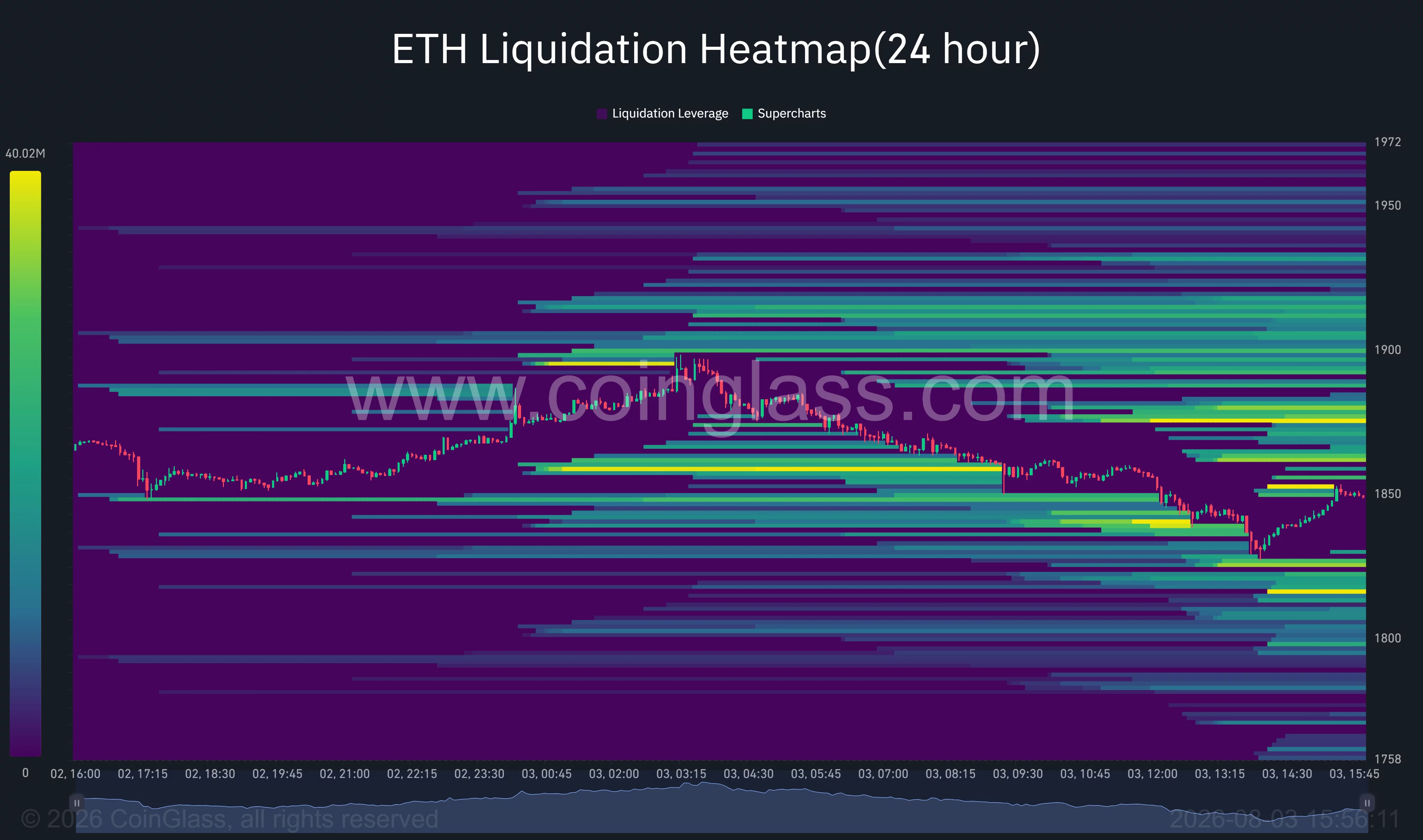
The map also shows overhead liquidity around $1,860–$1,875. If ETH rebounds above that range, short liquidations could help drive the price toward $1,890 and $1,920.
On the upside, Ethereum must first reclaim its 50-day SMA at $1,889. A daily close above the 100-day SMA at $1,927 would improve the setup, while a breakout above $1,975 would invalidate the current sequence of lower highs and place $2,000 back in focus.
The daily Relative Strength Index stands at 48.81, below its signal average of 56.44. The reading points to weakening momentum but remains well above oversold territory, leaving room for further selling if $1,800 fails.
Analyst sees Ethereum at a critical support zone
Crypto analyst Ted Pillows described the current support range as decisive for Ethereum’s next move.
“ETH is currently in the $1,800–$1,850 support level,” Pillows said. “This is very crucial for Ethereum to hold, or else it could drop towards $1,700.”
His chart presents two potential paths. Holding the current zone could allow ETH to recover toward $1,950 and then $2,050, while a confirmed breakdown could send the price toward $1,700.
The forecast aligns with the support levels visible on the daily chart, but the $1,700 target would require ETH to lose both the psychological $1,800 level and support near $1,785.
Fed outlook adds pressure on US crypto investors
Changing expectations for US monetary policy remain an additional risk for Ethereum and other speculative assets. Higher Treasury yields and a stronger dollar can reduce investor demand for crypto by increasing the relative appeal of dollar-denominated assets.
Slower-than-expected Federal Reserve rate cuts would keep financial conditions tighter and could limit institutional risk-taking. Ethereum may therefore remain sensitive to upcoming US inflation, employment and Fed policy signals.
For US investors, the near-term setup depends on whether ETH can defend $1,800 as macro liquidity remains constrained. A recovery above $1,927 would improve the technical outlook, but a daily close below $1,785 would shift attention toward $1,700.
Disclosure: This article does not represent investment advice. The content and materials featured on this page are for educational purposes only.
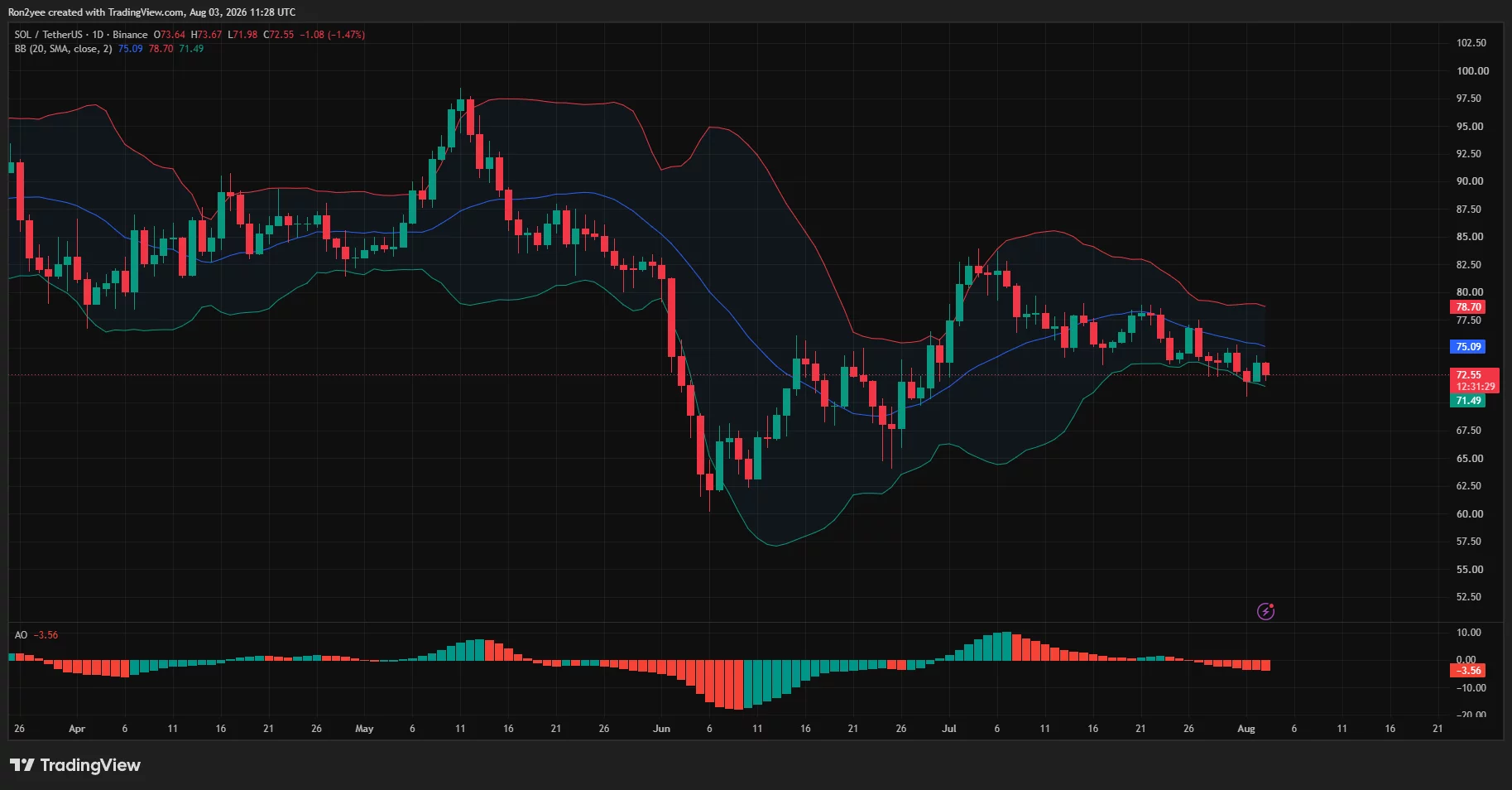
Solana price slipped below $73 on Aug. 3 as weak spot demand and sustained capital outflows raised the risk of a drop toward $70.
Summary
- Solana price fell 1.47% to $72.55, placing the token near its daily lower Bollinger Band.
- The 4-hour chart shows SOL below all four tracked moving averages, with the 200-period SMA at $76.79.
- Chaikin Money Flow dropped to -0.17, indicating that selling pressure continued to outweigh buying demand.
- Liquidation liquidity is concentrated near $73.50–$74.50, making that zone the first major upside test.
Solana price extends its decline below $73
According to data from crypto.news, Solana (SOL) price traded at $72.55 on Aug. 3, down 1.47% on the daily chart after moving between an intraday high of $73.67 and a low of $71.98.
The decline extended a broader pullback from the July high near $82.50. SOL has formed a sequence of lower highs since that peak, with sellers defending rebounds around $78 and then $76.
Price has now fallen below the daily Bollinger Band midpoint at $75.09. This level previously acted as support but has turned into the first major resistance area.
SOL briefly moved below the lower Bollinger Band at $71.49 before recovering above $72. That reaction shows buyers remain active around $71.50–$72, but the limited rebound suggests they have not regained control.
The Awesome Oscillator stood at -3.56, with its red bars expanding below zero. That reading points to strengthening bearish momentum on the daily timeframe rather than an immediate trend reversal.
Flat spot demand weakens SOL’s recovery
Solana attempted to rebound after falling toward $71 on Aug. 2, but spot demand failed to recover alongside price.
Analyst Ted Pillows described the divergence as a sign of weakness.
“$SOL is bouncing back. But spot demand is flat. Sign of weakness.”
The 4-hour Chaikin Money Flow reading supports that view. CMF fell to -0.17, meaning more capital was leaving SOL than entering it during the measured period.
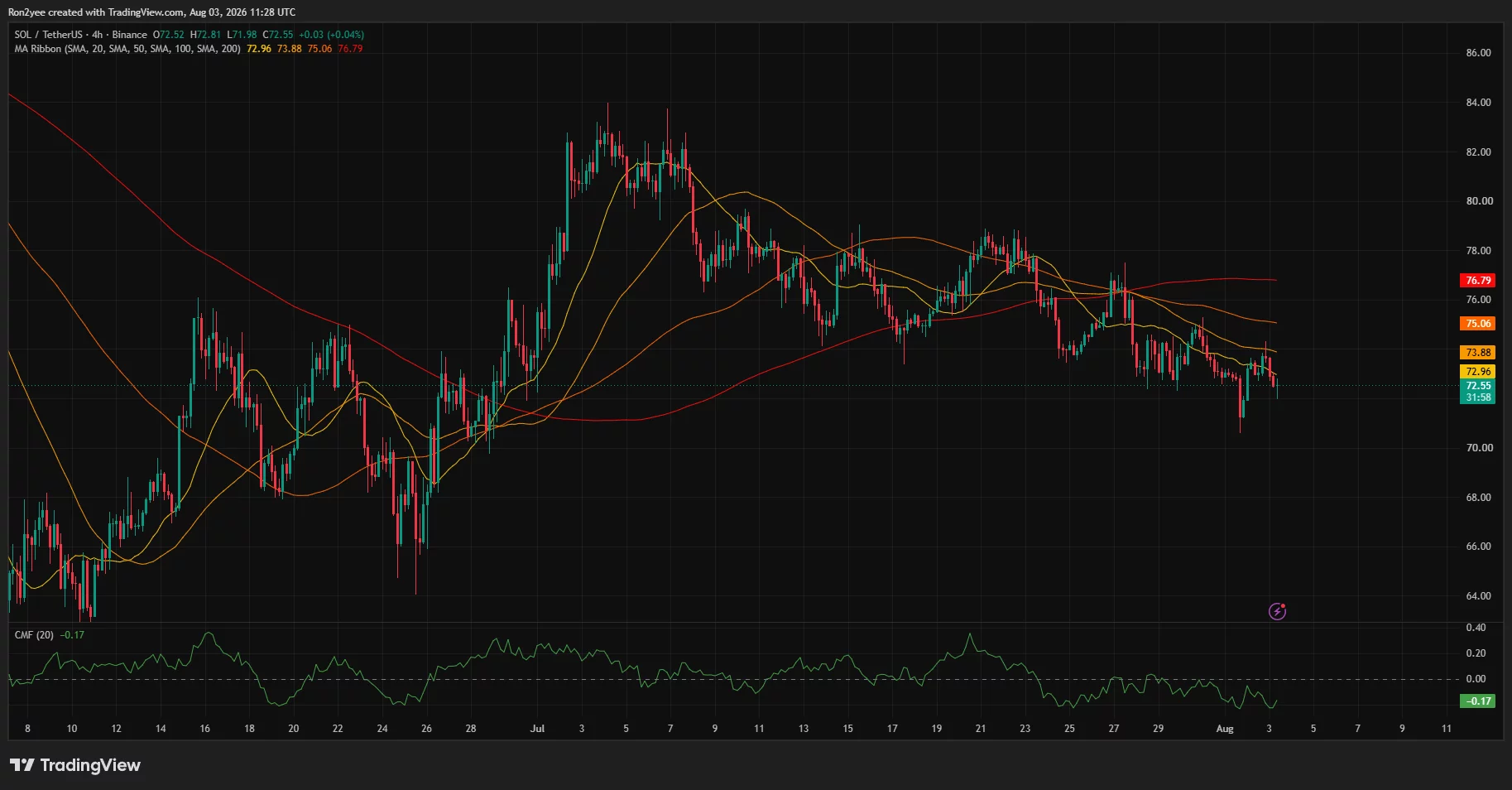
Declining spot participation can leave a rebound dependent on leveraged derivatives positions. Such moves are more vulnerable to reversals because they lack the direct buying pressure needed to absorb new selling.
The weakness also comes as activity tied to speculative Solana tokens cools from previous peaks. Lower decentralized exchange activity and weaker fee generation would reduce one source of demand for SOL, which traders need to pay network fees and interact with on-chain applications.
Four-hour indicators keep sellers in control
Solana remains below every major moving average displayed on the 4-hour chart. The 20-period SMA stands at $72.96, followed by the 50-period SMA at $73.88 and the 100-period SMA at $75.06.
The 200-period SMA, currently near $76.79, represents the strongest overhead technical barrier. SOL would need to reclaim that level to weaken the current sequence of lower highs.
The moving averages are also bearishly ordered, with each shorter-term average sitting below the longer-term measures. That structure suggests the decline is established across several trading horizons.
A move above $72.96 could open a retest of $73.88. The $73.88–$75.06 range is particularly important because it combines two moving averages with liquidity visible on the three-day liquidation heatmap.
Failure to reclaim that area would leave SOL exposed to another test of $71.50. A daily close below the lower Bollinger Band could bring $70 into focus, followed by the June support region near $67.50.
Liquidation clusters could increase volatility
CoinGlass’ three-day liquidation heatmap shows the largest nearby concentration of leveraged positions above the current price, particularly around $73.50–$74.
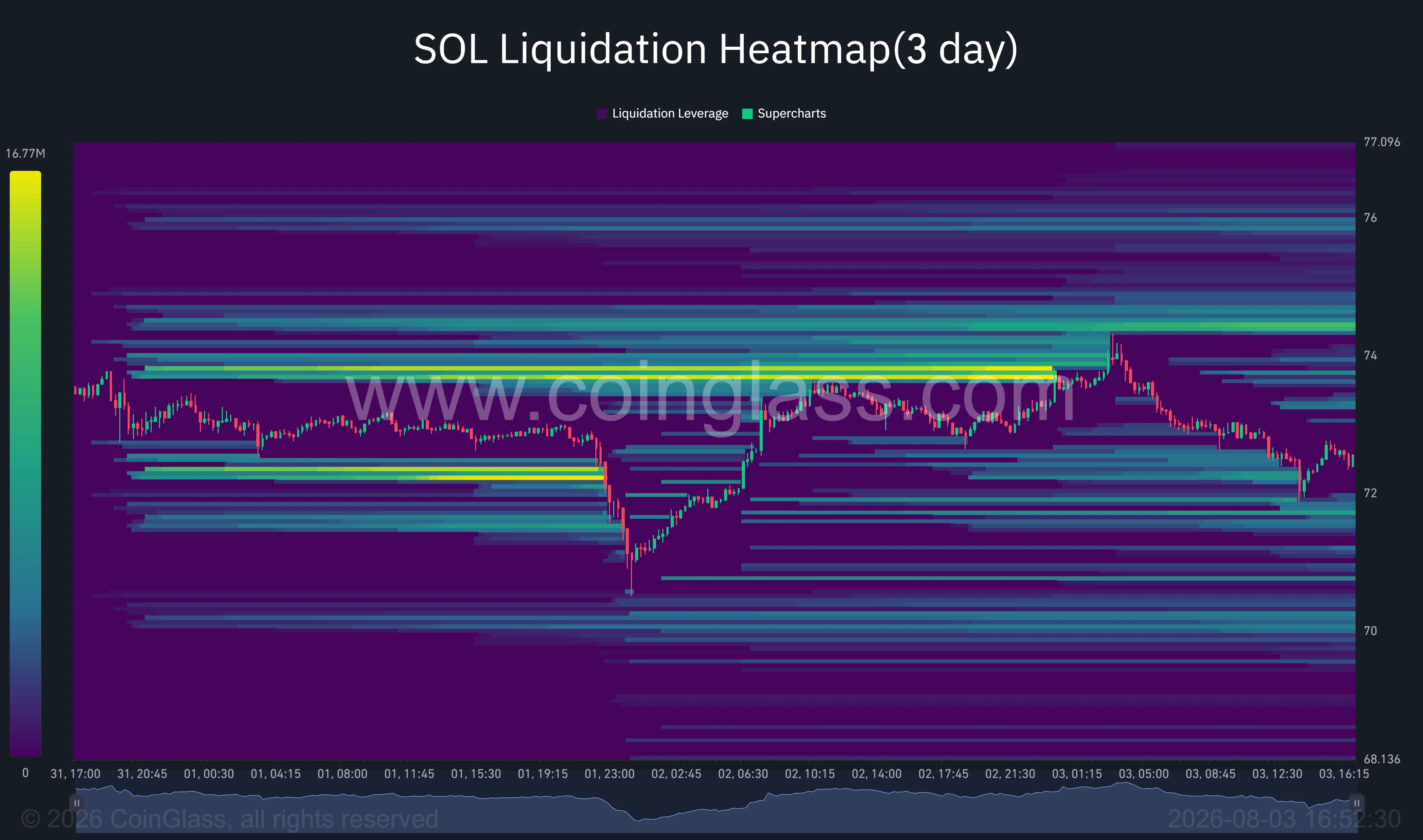
Additional liquidity appears near $74.50 and $76, creating potential targets if SOL begins a short-covering rebound. A move into these clusters could force bearish traders to close positions, accelerating the recovery.
However, liquidity also appears below the market around $71.50 and $70. These clusters could attract price if support near $72 fails.
This leaves SOL between competing liquidity zones. The closer upside concentration could produce a short-term bounce, but the weak CMF reading and bearish moving-average structure suggest any recovery must be confirmed by stronger spot buying.
Fee-burn vote offers Solana a potential catalyst
SolanaFloor reported that proposals addressing Solana’s fee burn and token disinflation were set to enter an initial vote on Aug. 3.
According to the report, the measures would double annual disinflation to 30%, remove about $1.36 billion in projected token issuance over six years and increase daily burns from roughly 650 SOL to 9,000 SOL.
Those figures remain projected outcomes rather than confirmed changes. The proposals must progress through governance before they can alter SOL’s supply dynamics.
For US investors, the immediate backdrop also remains tied to broader risk appetite. High-beta tokens such as SOL can face added pressure when elevated Treasury yields make lower-risk dollar assets more attractive. A shift in Federal Reserve expectations or US yields could therefore affect whether buyers return at the current support zone.
The short-term outlook remains bearish below $75.06. Reclaiming that level would improve the setup and expose $76.79, while a confirmed break below $71.49 would increase the risk of a move toward $70.
Disclosure: This article does not represent investment advice. The content and materials featured on this page are for educational purposes only.
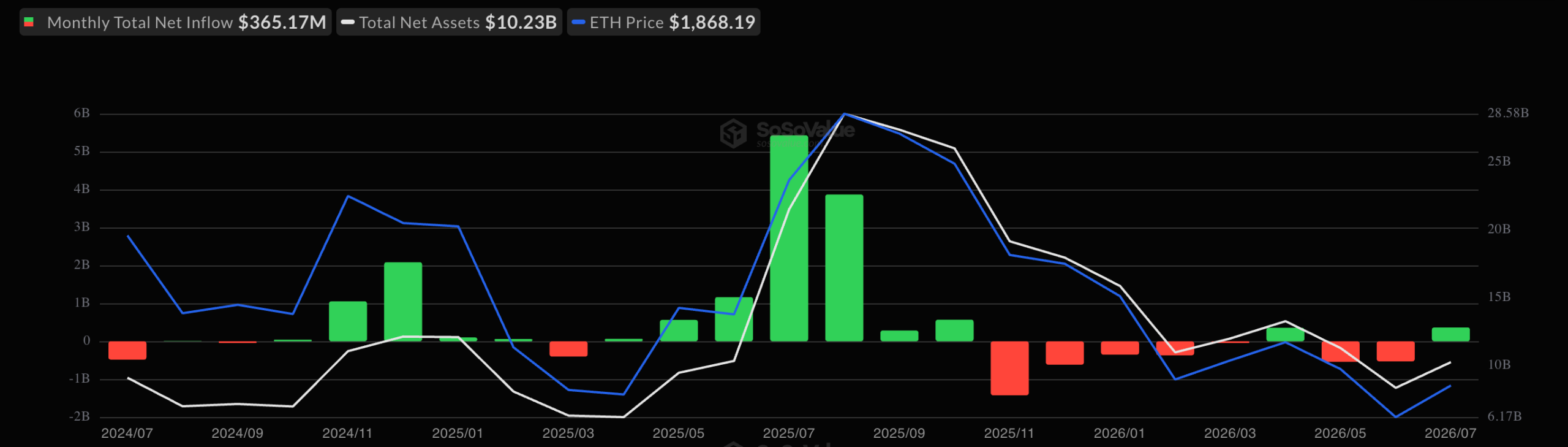
Ethereum (ETH) spot ETFs recorded their strongest month since October 2025. Yet the ending week of July raises concerns about whether institutional appetite is already fading.
Inflows dropped 74% in the final week as the Federal Reserve held rates steady. The pullback raises a key question over whether the demand will carry into August.
Ethereum ETF Inflows Hit 9-Month High Before Buyers Retreat
Ethereum funds attracted $365.17 million in July, their best showing in 9 months, per SoSoValue. The total came after back-to-back redemptions of $540.88 million in May and $528.99 million in June.
Follow us on X to get the latest news as it happens

The recovery lost steam fast, though. Weekly inflows collapsed from $103.9 million to $27.42 million in the week ending July 31.
Price action offered little help. ETH touched $1,967 on July 27, its highest level in nearly two months, before sliding to about $1,863 by Friday, CoinGecko data shows.
Demand also slowed across other ETF products. Bitcoin (BTC) funds shed $61.53 million during the week, snapping three straight weeks of net buying.
Hyperliquid (HYPE) products bled for a third consecutive week, losing $14.75 million. XRP (XRP) ETFs added $14.86 million, pushing cumulative inflows past $1.5 billion.
Fed Hold and Hike Odds Put August Demand in Question
Macro caution appears central to the retreat. The Federal Reserve voted 9-3 on July 29 to keep the interest rate at 3.50%-3.75%.
Three regional presidents, Beth Hammack, Neel Kashkari, and Lorie Logan, dissented in favor of a hike with inflation still above target. Markets now price in a 64% chance of a quarter-point hike in September, keeping tightening risk alive for risk assets.
“I want to stress, of course, that decisions by this committee matter a great deal, and where necessary and appropriate, we will not hesitate to act,” Fed Chair Kevin Warsh said.
If investors stay risk-off into August, the late-July slowdown may extend and erase the month’s progress. However, a revival in demand would confirm July’s rebound as the start of a broader recovery rather than a one-month bounce. The Fed’s Jackson Hole symposium in late August may offer the next signal.
Subscribe to our YouTube channel to watch leaders and journalists provide expert insights
The post Ethereum ETFs Post Best Month Since October 2025 but Fed Hold Chills Demand appeared first on BeInCrypto.
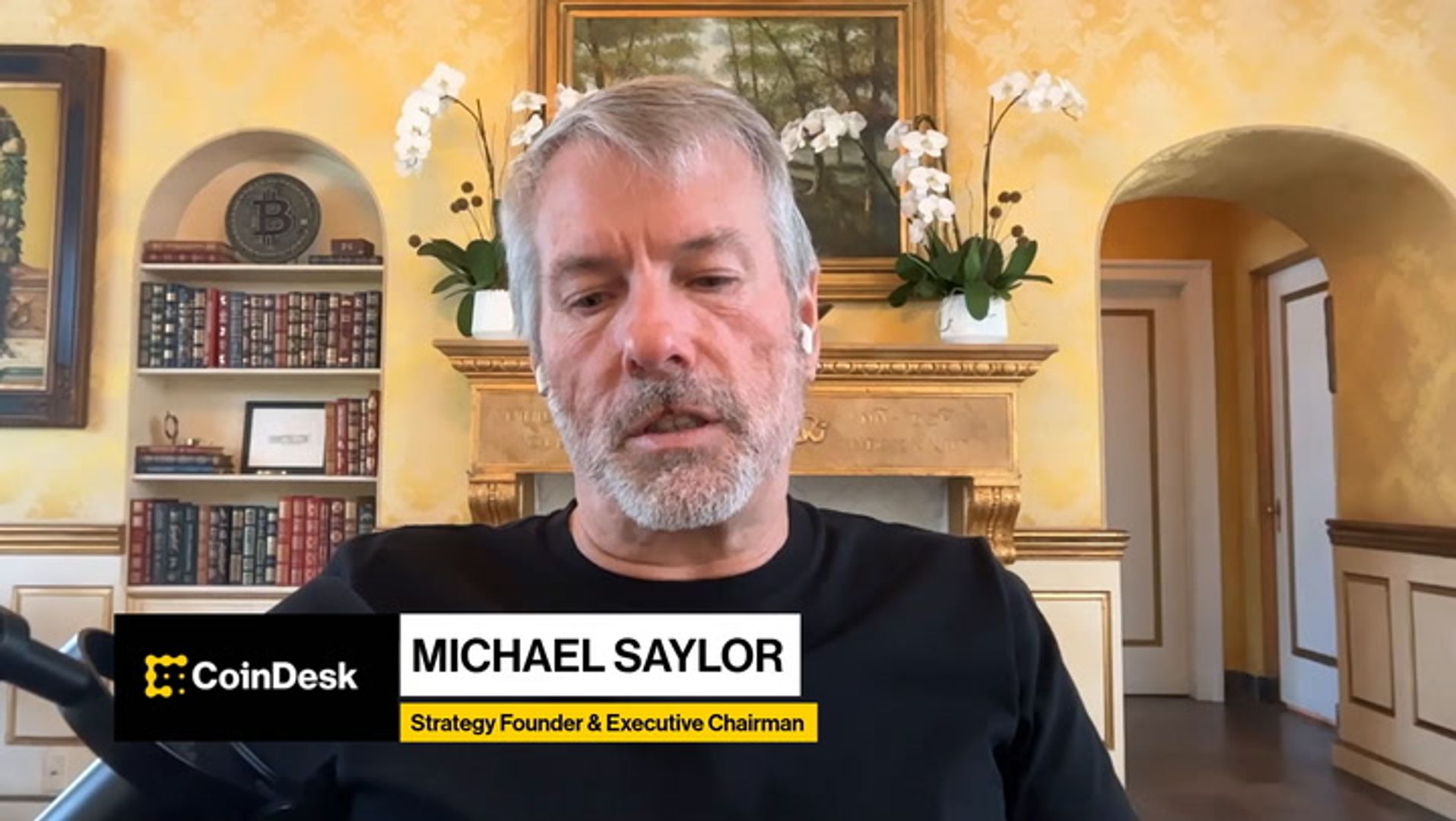
Strategy (MSTR) raised $104.73 million last week with the sale of 1,638 bitcoin, and raised an additional $290.6 million via the sale of common stock.
Alongside, the company repurchased 912,143 shares of its high-yielding preferred stock STRC for $81.2 million, according to an SEC filing Monday morning.
The bitcoin sales reduced Strategy’s holdings to 842,138 BTC, acquired for $63.51 billion at an average price of $75,419. The company lifted its USD reserve by $250 million.
The company announced over the weekend that it would maintain STRC’s annual dividend rate at 12%, saying it does not intend to recommend a reduction until the shares trade consistently near their stated $100 value.

In XRP news today, the XRP Ledger released xrpld 3.2.1 on July 31 after a validator manifest flood was detected hitting nodes that same day, with Ripple Director of Engineering Vijay Khanna issuing an urgent call on August 1–2 for all node operators to upgrade immediately.
The ledger continued closing normally throughout the incident, with no confirmed fund losses and no consensus failure, but unpatched nodes remain exposed to resource-exhaustion risk until operators complete the two-step upgrade process.
This news dropped as XRP USD fell 1.5% from $1.10 to $1.06 over the past 24 hours, with daily trading volume of $791M. This follows a worrying trend in which Ripple has crashed -4% over the past seven days.
XRP News: What the Manifest Flood Actually Did
The attack exploited a structural gap in how XRPL nodes handled validator manifests: before the patch, nodes would accept, cache, and rebroadcast an unlimited number of manifests tied to unknown validator keys with no ceiling on volume or storage.
An attacker could generate junk manifests at scale, forcing nodes to burn memory, disk space, and bandwidth processing data they would never act on.
The mechanism is closer to a denial-of-service resource drain than a consensus attack; the network’s transaction processing was never disrupted, but the exposure was real for any operator running unprotected infrastructure.
The development team confirmed the problem was specifically tied to how XRPLF nodes handled validator manifests, though as of publication the root cause and full exploitation details have not been publicly disclosed.
A technical post-mortem is forthcoming from XRPL Operations, which should clarify attacker behavior, traffic volumes, and any additional hardening steps.
For those tracking broader blockchain security vulnerabilities and attack vectors, the manifest flood fits a pattern where unbounded auxiliary data channels become leverage points even when consensus logic holds.
— Crypto Michael
 Urgent XRPL Update: Node Operators Told to Install Critical Fix
Ripple engineering director Vijay Khanna is urging XRP Ledger node operators to upgrade to **xrpld version 3.2.1**, which includes a hotfix designed to prevent a manifest flood attack observed on the network.…
 Dinarian888 (@Dinarian888) August 2, 2026
Discover: The Best Crypto to Diversify Your Portfolio
Four Safeguards Introduced in the Hotfix
The hotfix introduces four discrete protections targeting different points in the manifest handling pipeline. Oversized manifests are now rejected outright before full decoding. Incoming manifest batches per network message are capped.
The volume of manifest data shared with new peers is limited. And the unknown-key manifest cache is hard-capped at 100 entries, preventing unbounded growth from unrecognized validator identities.
Beyond those four caps, unknown validator manifests are no longer written to disk. That change means any pre-patch flood data is cleared on restart rather than persisting in storage, which is precisely why the upgrade requires a specific two-step sequence.
Firstly, install 3.2.1, let the server run for one to two minutes, then perform a second restart to purge any manifests retained from before the patch. Skipping the second restart leaves stale flood data in place. Operators should also verify their systems trust Ripple’s current GPG signing key, rotated February 18, 2026, or automatic upgrades may fail silently.
Trade XRP on Bybit and Get a Chance to Win Our $1,000 USDT Airdrop
Who Needs to Act and Why It Matters Now
—
 $XRP's momentum fades, but the bullish structure holds firm: price is drifting back into 6YR support that guided all breakouts since 2020 — each green-arrow marked previously triggered expansion; compression within a falling wedge is setting the stage for a major repricing
  pic.twitter.com/Es1Mae0poz
 ChartNerd
  (@ChartNerdTA) August 3, 2026
In other XRP news, exchanges, custodians, wallet back ends, data providers, and any business running its own XRPL server must complete the node upgrade. Ordinary XRP holders do not need to move funds or change keys.
The urgency is compounded by upgrade adoption lag: xrpld v3.2.0, the larger June 15 release that renamed the reference server and required infrastructure config change, spread faster among validators than across the broader node network, meaning a cohort of operators may still be running older versions that are now doubly exposed.
The network security response here was operationally sound: a targeted hotfix, clear operator instructions, and a pending post-mortem that signals the team is treating this as a formal security incident rather than routine maintenance.
In the broader XRP ecosystem, the incident comes as the ledger scales; the network added nearly 490,000 new accounts in the first half of 2026, per supplementary data from Coinpaper, pushing total accounts past 8.4 million.
That growth trajectory makes robust infrastructure hardening a structural necessity, not an edge-case concern. Institutional developments, including Aviva’s tokenized liquidity fund on XRPL and growing enterprise adoption, raise the stakes for any operator still delaying the patch.
Discover: The Best Token Presales
The post XRP News: xrpld 3.2.1 Hotfix Patches Manifest Flood Draining XRPL Node Resources appeared first on Cryptonews.


Trump-linked Bitcoin miner produced a record 932 BTC in the second quarter, lifting mining revenue 8% as its net loss narrowed from the previous quarter.
Bithumb Lays Out a 3-Stage Path to Its South Korea IPO

Olivia Rodrigo x LEGO Is The Collab Fans Won’t Want To Miss

Ex-Jackson State cornerback Levi Wyatt dead at 23

Renter of Home in Anne Heche Crash Denies Settlement With Son

No Jackpot Winner as $257 Million Prize Rolls Over to $269 Million Monday Draw

Weekend Open Thread: Staud – Corporette.com

Nightcore – MONEY ON THE DASH (Soft Rock Version) (Lyrics)

JIO FINANCIAL SERVICE NEWS | JIO FINANCIALS LATEST NEWS | Market support

How much money would the rich have to lose to fall below the top 1% of wealth? #money #politics
-

 Business5 days ago
Why Trees Belong on the Risk Register
-

 Fashion3 days ago
Weekend Open Thread: Wit & Wisdom
-

 Politics3 days ago
Meta enters AI-training agreement with far-right ‘propaganda rag’ Newsmax
-
 Entertainment6 days ago
‘Stargate’ Creator’s New Sci-Fi Series Returns for Season 3 Tomorrow
-

 Crypto World2 days ago
MicroStrategy Post-Earnings CLARITY Act Push Could Add New Catalyst for Its Stock
-

 Politics6 days ago
The Part of the Electric Transition Nobody Wants to Discuss
-

 Business5 days ago
Major shareholder moves on Canyon
-

 Crypto World2 days ago
XRP Ledger v3.3.0 brings five institutional features
-

 News Videos4 days ago
Bitcoin Enters the 3rd Stage of the Bear Market
-

 Crypto World6 days ago
Kraken Enables Retail Access to Jersey Mike’s IPO via Tokenized Shares
-

 Tech7 days ago
New macOS Sequoia & Sonoma security updates for older Macs
-

 Politics4 days ago
Luke Littler’s dominance sparks GOAT debate
-

 News Videos6 days ago
Claude: Build Financial Dashboards in Minutes (2026)
-

 Business6 days ago
Johnson & Johnson agrees to $5.5B settlement over talc cancer claims
-

 Sports4 days ago
Seema Kaliramna Wins Discus Throw Bronze, Takes India’s CWG Medals Tally To 17
-

 Crypto World1 day ago
Crypto PAC spending tops $2M in Michigan House race
-

 Business3 days ago
Trump Announces Hamas Disarmament Agreement as Iran Strikes Kuwait Air Base and US Attacks Pause Overnight
-

 Tech5 days ago
Gemini can now summarize the messiest comment threads in Google Docs
-

 Crypto World2 days ago
New York sues Kalshi over prediction market gambling
-

 Tech1 day ago
ESET tracks rise in malicious AI skills and adaptable malware
You must be logged in to post a comment Login