

Crypto World
Senate Democrats Demand National Security Probe of Trump Crypto Holdings


Senate Democrats have demanded committee hearings into the national security risks posed by President Donald Trump’s crypto holdings, citing new disclosures that unnamed third parties hold a stake in his family’s crypto firm.
The July 10 statement was issued by the ranking members of five Senate committees. They asked their respective panels to examine whether the United Arab Emirates or unknown investors hold influence over the President’s decisions.
Trump’s Crypto Holdings Disclosures Fuel Fresh Oversight Push
The lawmakers are Elizabeth Warren, Richard Blumenthal, Gary Peters, Dick Durbin, and Ron Wyden. Each serves as the top Democrat on a committee with jurisdiction over finance, security, or the judiciary.
Their statement responded to Trump’s latest federal financial disclosures. The senators said that the Trump family’s crypto ventures generated about $1.4 billion in the first year of his second term.
BeInCrypto’s report showed Trump’s meme coin earned roughly $636 million, while World Liberty Financial (WLFI) added about $515 million from token sales and $65 million from equity.
The senators noted that the filing listed unnamed “Third Parties” holding a WLF stake. That detail followed reports of a UAE-linked vehicle buying a 49% stake for roughly $500 million.
Follow us on X to get the latest news as it happens
Democrats Link Holdings to Policy Moves
The senators argued the disclosures deepen concerns about Trump shaping crypto policy while profiting from the sector. They pointed to legislative pushes and moves to ease oversight of digital assets.
The lawmakers also cited the disbanding of the Justice Department’s National Cryptocurrency Enforcement Team. They framed that step as evidence of weakened enforcement.
“We call on our respective Committees to hold hearings to investigate the national security implications of President Trump’s cryptocurrency holdings, including the influence of the UAE or unknown third parties on President Trump’s actions,” the statement read.
The demand builds on a June request from the same senators regarding World Liberty Financial’s reported ties to Abu Dhabi. In a statement shared with BeInCrypto, the White House denied any link between its UAE artificial intelligence agreement and the crypto firm, saying that Trump’s assets are held in a trust run by his children.
Whether Republican committee chairs grant the hearings will determine if the dispute advances beyond statements.
Subscribe to our YouTube channel to watch leaders and journalists provide expert insights
The post Senate Democrats Demand National Security Probe of Trump Crypto Holdings appeared first on BeInCrypto.



Pakistan Virtual Assets Regulatory Authority Chairman Bilal bin Saqib has called for continued discussion on digital assets under Islamic law. His statement followed a meeting with scholar Mufti Taqi Usmani on July 11. Saqib said both sides shared one aim: protecting Pakistanis from fraud, exploitation, and financial harm.
Summary
- Pakistan’s crypto chief seeks technical and Shariah reviews instead of one broad digital asset ruling.
- Mufti Taqi Usmani’s ruling rejects crypto purchases because tokens allegedly lack recognised Shariah wealth status.
- Pakistan continues licensing crypto firms while religious concerns add another layer to its regulatory rollout.
In his public statement, Saqib said blockchain, stablecoins, tokenized real-world assets, and other digital assets cover different technologies and uses. He said they require “careful technical assessment alongside rigorous Shariah examination” instead of one broad judgment. He also called for further engagement among scholars, regulators, and industry specialists.
Religious ruling rejects purchases made with crypto
The meeting followed an Islamic legal ruling issued by Darul Ifta at Jamia Darul Uloom Karachi. Mufti Usmani and five other scholars signed the ruling, dated June 10, 2026. It said purchases made with cryptocurrency, including USDT, were not permitted under their reading of Islamic law.
According to Dawn’s report, the scholars said current research did not establish crypto as recognised property or wealth. The ruling described it as “merely the recording of fictitious numbers in an account.” Saqib did not directly reject that finding. He instead asked for separate reviews of different digital asset categories.
Pakistan continues building a licensed crypto market
The exchange comes as Pakistan moves ahead with a regulated virtual asset sector. The Virtual Assets Act 2026 created PVARA as the body responsible for licensing and supervising virtual asset service providers. PVARA also opened a public consultation on rules covering exchanges, custodians, brokers, token issuers, and other providers.
On April 15, the State Bank of Pakistan allowed banks to open accounts for firms licensed by PVARA. The central bank circular requires banks to verify licences, perform due diligence, monitor accounts, and keep customer money separate from company funds. Banks cannot use their own capital or customer deposits to trade or hold virtual assets.
A previous report shows that the policy ended an eight-year restriction on banking services for regulated crypto firms. The report said banks must still follow foreign exchange, anti-money laundering, and counterterrorism financing rules. Suspicious activity must be reported to Pakistan’s Financial Monitoring Unit.
Stablecoins and tokenization remain part of policy plans
Pakistan has also explored stablecoins and tokenized assets through agreements with international companies. In December 2025, the government signed a nonbinding agreement with Binance to study the tokenization of up to $2 billion in state assets. Crypto.news coverage linked the plan to government bonds, Treasury bills, and commodity reserves.
A separate January 2026 agreement involved studying the use of the USD1 stablecoin in cross-border payments. Crypto.news reported that the work would involve Pakistan’s finance ministry and central bank. These projects remain subject to regulation, technical review, and formal approval.
The dispute over crypto payments now adds a religious review to Pakistan’s regulatory process. PVARA has not announced any change to licensing rules after the meeting. Saqib’s statement leaves the discussion open while the regulator continues drafting operating standards. The ruling did not change state licensing rules, while licensed firms remained bound by the Virtual Assets Act and central bank controls.

Empery Digital’s shares jumped after the company disclosed it has been steadily trimming its Bitcoin treasury to support new funding needs. According to an 8-K filing with the U.S. Securities and Exchange Commission, the NASDAQ-listed company sold nearly half of its Bitcoin holdings over the past two months and used the proceeds to back an AI data center project and reduce debt.
The news lands at a time when some investors appear increasingly skeptical of corporate “treasury” strategies that treat Bitcoin as a long-term balance-sheet asset without an obvious liquidity plan. Empery’s decision—and the market’s initial reaction—highlights how quickly corporate crypto strategies can shift when capital priorities change.
Key takeaways
- Empery Digital sold 1,400 Bitcoin at an average price of $62,200 per coin, raising about $87.1 million, per its SEC 8-K filing.
- The company said proceeds were used partly for its 25% stake in a Hunt Properties-affiliated venture targeting an industrial site conversion into an AI data center.
- Empery also allocated about $10 million of the proceeds to pay down outstanding debt.
- The sale reduced Empery’s Bitcoin holdings by about 48% to 1,514 BTC, according to the disclosure.
- Shareholders who had pressured Empery to change its Bitcoin strategy previously demanded leadership resignations tied to its treasury approach.
What Empery disclosed in its SEC filing
Empery Digital said it sold 1,400 BTC over the past two months. In the filing referenced by the company, the sales were executed at an average price of $62,200 per Bitcoin, resulting in gross proceeds of roughly $87.1 million.
The company linked that liquidity move to two key corporate priorities. First, it directed part of the funding toward an equity position: Empery said it used proceeds to maintain a 25% stake in a venture affiliated with Hunt Properties. That venture, according to the disclosure, is acquiring an industrial site intended to be converted into an AI data center.
Second, Empery indicated that it used proceeds to strengthen its balance sheet by paying off $10 million in outstanding debt. While the filing’s focus is primarily on the capital allocation, the combined effect is clear: the firm treated Bitcoin holdings as a source of funding rather than solely a long-duration investment.
Shares react as the Bitcoin treasury thesis faces scrutiny
Following the disclosure, Empery shares rose early in Friday’s trading. The article notes that the stock gained about 4.2% to $3.95 within the first 35 minutes and later narrowed to a $3.86 close, up roughly 1.58% for the day.
That initial upside suggests investors interpreted the sale as a pragmatic adjustment—one that may reduce the risk of capital being locked up in a treasury asset while the business pursues other needs. The timing also matters. The move comes amid broader pressure on corporate Bitcoin holders, where some investors have questioned whether “hold and never sell” approaches are realistic when companies must fund operations, pay debts, or finance new growth initiatives.
For Empery, the filing also shows how much of the Bitcoin position was affected. The company’s sales trimmed its holdings by about 48%, leaving it with 1,514 BTC. At current prices referenced in the report, that remaining position is described as worth about $97 million.
Pressure from a major shareholder preceded the sales
Empery’s Bitcoin reduction did not occur in a vacuum. Earlier reporting highlighted a shareholder dispute involving Tice P. Brown, who holds nearly 10% of the company. According to earlier coverage from Cointelegraph, Brown urged Empery to abandon its Bitcoin-buying strategy and called for changes in leadership, demanding the CEO and the board resign.
Cointelegraph’s prior account described Empery’s pivot to a Bitcoin-centric treasury plan that began around mid-2025, when Bitcoin was rallying toward its all-time high of $126,080 set in October. The latest disclosure indicates that—at least for now—the company is shifting away from adding to that position at the same pace, and instead monetizing part of it to fund other priorities.
Empery previously held a peak of 4,081 BTC before offloading some holdings in March and April. The Friday disclosure therefore appears to be part of a broader trend rather than a one-off sale.
The wider corporate Bitcoin pattern: Strategy’s earlier exit adds context
Empery’s actions echo a larger corporate debate about whether Bitcoin should be treated as an operational liquidity tool or as a purely long-term reserve. Earlier this month, Cointelegraph reported that Strategy—described as the largest corporate Bitcoin holder—sold 3,588 Bitcoin, worth about $216 million, after having taken the market-facing stance of “never sell your Bitcoin.” The company’s rationale, per the report, was tied to funding dividend payments for investors in its top perpetual preferred stock offering, Stretch (STRC).
That sale came as investors were already watching signals that Strategy’s dividend structure could be under stress. Cointelegraph referenced that STRC had broken below its $100 par value and was trading below $75 last month, raising concerns about the sustainability of the dividend model. In that context, Strategy’s willingness to sell some Bitcoin—despite its earlier messaging—illustrates how quickly capital management decisions can override long-held narratives when cash needs and investor obligations intensify.
In practical terms, Empery’s disclosure reinforces the same theme: when companies face debt payments or new investment opportunities, Bitcoin can function as a financial source rather than only a hedge against market cycles. The difference is that Empery’s stated end uses are directly tied to an AI data center initiative and debt reduction—two needs that investors often view as tangible business drivers rather than passive treasury management.
Going forward, market watchers will likely focus on whether Empery pauses further Bitcoin trimming or continues to rebalance toward cash-generating projects. The next tell will be how much of its remaining 1,514 BTC stays untouched while the AI data center stake and other obligations progress—and whether shareholder pressure resurfaces if the company’s treasury strategy diverges further from what investors expected.

Shares in Empery Digital moved higher on Friday after the company disclosed that it has sold a large portion of its Bitcoin holdings to support an AI-focused expansion and reduce debt.
According to an 8-K filing with the U.S. Securities and Exchange Commission, Empery Digital sold 1,400 Bitcoin over roughly the past two months at an average price of $62,200 per coin, raising about $87.1 million. The disclosure helped trigger an early jump in the company’s stock, with shares rising about 4.2% to $3.95 within the first 35 minutes of trading before later trimming gains.
Key takeaways
- Empery Digital said it sold 1,400 BTC at an average $62,200 per coin, generating about $87.1 million.
- Management attributed the proceeds to funding a 25% stake in a venture tied to an AI data center project and to debt reduction.
- The sale reduced Empery’s Bitcoin holdings by 48% to 1,514 BTC, currently valued around $97 million based on prevailing market prices.
- The immediate market reaction suggests some investors are viewing treasury de-risking as a more credible use of Bitcoin than continual accumulation amid AI capital allocation.
- Earlier investor pressure from a near-10% shareholder had demanded the company stop buying Bitcoin and seek leadership changes.
What Empery Digital disclosed in its filing
In its SEC filing, Empery Digital detailed how it financed part of its operational and strategic plans through Bitcoin liquidation. The company said it sold the 1,400 BTC at an average price of $62,200, totaling approximately $87.1 million. The transaction, executed during the past two months, represents a meaningful shift for a business that previously leaned heavily on a Bitcoin treasury strategy.
The company also said it deployed a portion of the proceeds toward its AI data center ambitions. Specifically, Empery disclosed that some funding went to its 25% stake in a Hunt Properties-affiliated venture. That venture is acquiring an industrial site intended to be converted into an AI data center.
In addition to the AI-related investment, Empery said it used $10 million of the proceeds to repay outstanding debt, aligning the sale with a balance-sheet objective rather than only reinvestment into new assets.
Investor pressure and a changing Bitcoin treasury narrative
Friday’s share reaction comes against a backdrop of growing skepticism around corporate Bitcoin accumulation strategies. Empery’s Bitcoin sales followed months of pressure from Tice P. Brown, a shareholder who holds nearly 10% of the company. Brown publicly urged Empery to abandon its Bitcoin-buying strategy and even demanded the resignation of the CEO and the entire board.
Empery had shifted toward a Bitcoin-centric treasury posture in mid-2025, a period when Bitcoin was rallying toward its all-time high of $126,080 set in October. However, the new disclosure signals that the company’s approach may be evolving—from treating Bitcoin as a long-term, uninterrupted accumulation vehicle to using liquidity from Bitcoin sales for broader corporate priorities.
While Empery’s stock initially rose on the news—suggesting that investors may have preferred a sale framed around funding and debt reduction—shares subsequently eased. According to the report, the stock retraced to $3.86 and closed up 1.58% on the day.
Holdings trimmed nearly in half
Empery’s sale cut its Bitcoin exposure by a substantial amount. The company said the transaction reduced its holdings by 48% to 1,514 BTC. The filing also described the value of the remaining holdings as roughly $97 million at current market prices.
Empery previously held a company-high 4,081 Bitcoin before selling some holdings earlier in March and April. The latest liquidation therefore appears to continue a pattern of reducing exposure over multiple periods rather than a one-off exit.
For traders and investors, the key question is whether this marks the beginning of a more systematic treasury strategy—one that treats Bitcoin as an asset to rebalance capital between corporate needs and long-term holdings—rather than an all-or-nothing bet on perpetual accumulation.
Corporate Bitcoin sales are not unique
Empery’s move comes as other corporate Bitcoin holders have also faced pressure to justify “treasury-first” frameworks. Earlier in the month, Even Strategy—described as the largest corporate Bitcoin holder—sold 3,588 Bitcoin worth $216 million and broke from its previous stance of not selling Bitcoin. In that case, the company said the sale was intended to cover dividend payments for investors linked to Stretch (STRC), which had fallen below its $100 par value to under $75 last month, raising concerns about dividend durability.
Cointelegraph previously noted the market reaction to Strategy’s approach as investor uncertainty grew around whether its dividend model could be maintained. That broader context helps explain why Empery’s disclosure may have been interpreted positively by some shareholders: using Bitcoin sales to meet financial obligations and fund other growth plans can look like a pragmatic response to cash-flow constraints, even if it runs counter to earlier accumulation messaging.
What to watch next is whether Empery’s remaining Bitcoin balance stabilizes or continues to decline as the AI project progresses and as debt obligations are addressed—especially given ongoing scrutiny from major shareholders who have already challenged the company’s Bitcoin-focused direction.
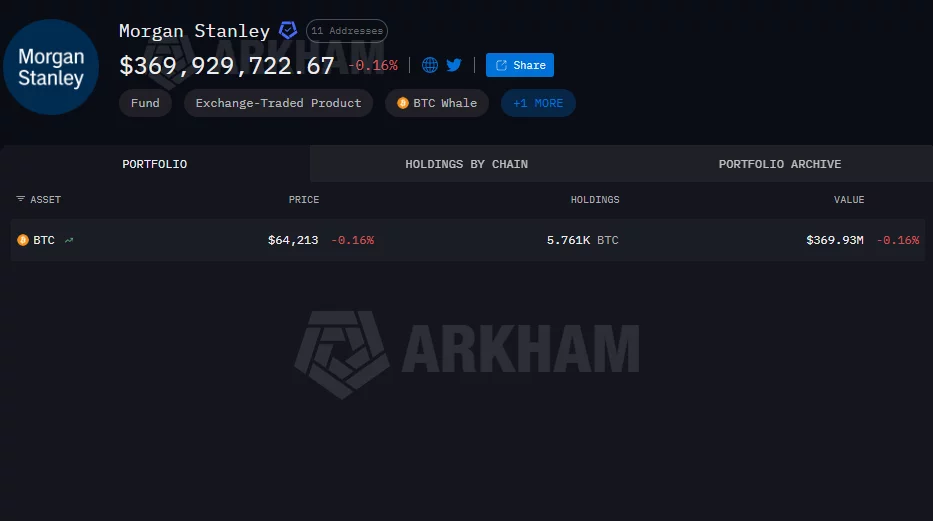
Morgan Stanley has increased its Bitcoin holdings by nearly 1,000 BTC over the past two weeks, lifting its tracked balance above 5,700 BTC, according to on-chain data.
Summary
- Morgan Stanley added nearly 1,000 BTC over the past two weeks, pushing its tracked holdings to 5,761 BTC.
- Arkham data shows the accumulation came through multiple large transfers from Coinbase Prime rather than a single purchase.
- The latest buying follows Morgan Stanley’s June crypto expansion with Galaxy Digital, allowing eligible clients to convert crypto into spot investment products.
According to blockchain intelligence platform Arkham, the investment bank continued adding Bitcoin through its spot Bitcoin investment product during the recent market pullback. Arkham’s latest portfolio data shows Morgan Stanley now holds 5,761 BTC worth roughly $369.9 million, making it one of the larger institutional Bitcoin holders tracked on the platform.
The latest increase follows a series of transfers recorded over the past two weeks instead of a single purchase. Arkham’s transaction history shows several large inflows from Coinbase Prime wallets, including transfers of 495.8 BTC, 171.9 BTC, 166.2 BTC, 154.8 BTC, 143.3 BTC, 126.1 BTC, 120.4 BTC, and another 34.4 BTC within the last 14 hours. The activity also includes minor operational transfers and a 1 BTC movement back to Coinbase Prime, leaving the firm’s net increase at roughly 1,000 BTC.
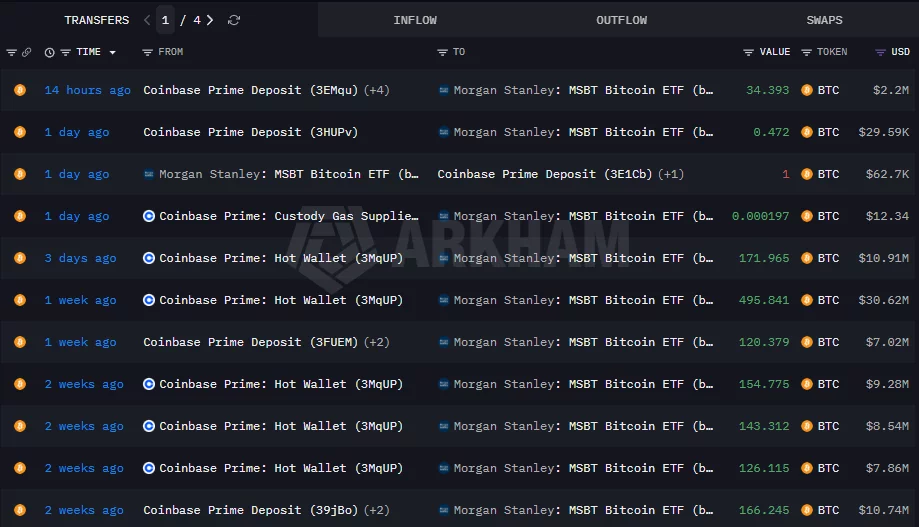
Latest purchases have come through multiple large transfers
Recent Arkham data indicates Morgan Stanley accumulated Bitcoin in stages rather than executing a single large transaction. Most of the recorded inflows originated from Coinbase Prime custody and deposit addresses, suggesting institutional settlement activity linked to its Bitcoin investment product.
At current market prices shown on Arkham, the firm’s Bitcoin holdings are valued at nearly $370 million. Arkham also classifies the entity as a fund, an exchange-traded product, and a Bitcoin whale, while linking the portfolio to 11 tracked wallet addresses.
The latest buying extends a pattern of adding exposure during price weakness. Although Arkham describes the activity as another instance of Morgan Stanley “buying the dip,” the platform does not disclose whether the transactions represent direct purchases, client subscriptions, or other operational inflows into the investment vehicle.
Crypto investment services have expanded for wealthy clients
The recent accumulation follows Morgan Stanley Wealth Management’s June announcement that it had expanded its digital asset offering through a referral arrangement with Galaxy Digital.
Under the program, eligible high-net-worth clients can lend cryptocurrencies including Bitcoin, Ether, and Solana to Galaxy Digital and receive shares in spot crypto investment products, including the Morgan Stanley Bitcoin Trust. According to the companies, the structure allows investors to move crypto exposure into regulated investment vehicles without first selling their digital assets.
Morgan Stanley and Galaxy Digital also said the arrangement can reduce in-kind crypto-to-exchange-traded product onboarding times by as much as 75%, making transfers into regulated investment products faster than conventional processes.
The expanded client offering and the latest on-chain accumulation come as institutional participation in spot Bitcoin investment products continues to grow. While Arkham’s wallet data tracks assets associated with Morgan Stanley’s Bitcoin product, the platform does not identify the underlying investors or distinguish between firm-owned holdings and assets managed on behalf of clients.


The Cambridge Centre for Alternative Finance has estimated Ethereum’s annual electricity consumption at 7.87 gigawatt-hours. That equals a continuous power demand of about 0.90 megawatts. The study places Ethereum near the lower end of energy intensity among major proof-of-stake blockchains when researchers adjust electricity use for market value. Cambridge also estimated annual emissions of about 2.37 kilotonnes of carbon dioxide equivalent.
Summary
- Ethereum ranks second-lowest in market-value-adjusted energy intensity among the major proof-of-stake networks Cambridge studied globally.
- Cambridge measured 8,522 nodes and calculated electricity demand of roughly 105 watts per node.
- The Merge cut Ethereum’s power demand by over 99.9%, leaving grid sources to drive emissions.
Ethereum used more electricity in absolute terms than most networks included in the comparison. Solana ranked highest at about 13.48 GWh each year, while Ethereum ranked second. However, Ethereum consumed about 33 kilowatt-hours for every $1 million of market value. That was the second-lowest rate measured, behind BNB Chain. Solana recorded about 283 kWh per $1 million, or roughly 8.5 times Ethereum’s rate. The networks in Cambridge’s top-tier PoS comparison used 38 GWh combined. NEAR, Tron and TON ranged from 3.6 to 5.1 GWh, while Cardano and BNB Chain stayed below 1 GWh.
Direct node tests shape the estimate
Cambridge built the estimate from direct power measurements rather than applying one assumed figure to every node. Researchers tested 20 combinations of Ethereum’s main execution and consensus software clients on two hardware setups. A lighter residential system drew a median of 18 watts. A workstation used for professional deployments drew about 152 watts. The study calculated a network-weighted average of roughly 105 watts per node.
The researchers identified 8,522 discoverable full nodes. Around 36% operated on residential hardware, while 64% ran in cloud or enterprise data centers. The United States hosted 31% of the nodes, followed by Germany at 16%, Finland at 8%, and France at 6%. Cambridge said those four countries together accounted for nearly 62% of the full-node network measured.
Grid mix now drives Ethereum’s emissions
Ethereum’s electricity sources now shape most of its remaining carbon footprint. Cambridge estimated that renewable energy supplied 39.4% of the network’s power and nuclear energy supplied 17%. Together, those sources accounted for 56.4%. Fossil fuels supplied the remaining 43.6%, with natural gas representing the largest single source at 27.7%. The final emissions estimate depended on the electricity grids serving each node location.
Alexander Neumüller, research lead at Cambridge’s digital assets energy program, said, “Under Proof-of-Stake, electricity is no longer the price of security.” Ethereum replaced proof-of-work mining with validators during the Merge on September 15, 2022. Cambridge estimated that continuous power demand fell from about 2.4 gigawatts before the transition to 0.90 megawatts afterward, a reduction of more than 99.9%.
Crypto.news coverage tracks the PoS shift
Related crypto.news coverage has described proof-of-stake as a lower-energy alternative because validators secure networks through staked assets instead of competitive mining. A January 2026 report also quoted Ripple CEO Brad Garlinghouse saying proof-of-stake systems use about 99.9% less energy than proof-of-work networks. The new Cambridge figures provide updated hardware and hosting data for Ethereum several years after its transition.
The report does not claim that Ethereum uses the least electricity among all proof-of-stake networks. Its annual total remains higher than most peers studied. Its stronger ranking appears only after researchers divide energy use by market value. Cambridge also avoided a per-transaction estimate because about 92% of Ethereum ecosystem transactions now settle on scaling networks, making a mainnet-only calculation incomplete. Cambridge said lighter stateless verification could lower hardware requirements, but wider node participation could offset those savings. The report treats future demand as uncertain rather than assuming efficiency gains will reduce total use.

There used to be a time when the cryptocurrency community became accustomed to receiving BTC hints from Michael Saylor on Sunday, only for him to announce a major bitcoin acquisition on Monday. Sometimes, those purchases were in the billions of dollars.
It became such a recurring development that the bitcoin bulls started to take it for granted. However, it all changed recently when the largest corporate holder of the asset made a couple of sales in the span of a few months. Now, Saylor’s hints on X are taken with a grain of salt.
Buy or Sell?
Perhaps the most shining example came last week. On Sunday, Saylor published a post on X, indicating that “Bitcoin Is Digital Energy.” He included a graph of all the orange dots used to demonstrate his company’s countless BTC purchases, and the community speculated that another acquisition is about to be announced.
However, Saylor and his company shocked almost everyone on Monday when, instead of spending millions of dollars to buy more bitcoin, they announced the third-ever and largest-to-date sale. Strategy disposed of 3,588 BTC for $216 million, bringing their total holdings down to 843,775 – still a whopping number, but the perception has changed.
Saylor went on X again today with another picture of all the orange dots from his company with the text that they “tell only part of the story.” Naturally, the community is hopeful again that the firm has started reaccumulating, but could that be another misleading conclusion?
Actual Meaning
Lacie Zhang, Research Analyst at Bitget Wallet, spoke to CryptoPotato about the potential impact of Strategy’s sales. She believes they look “less like a genuine disagreement and more like a difference in time horizon. In the near term, the case for optimism holds up. The sale was disclosed in advance, small relative to the company’s holdings, and ETF demand absorbed it within the same day.”
MSTR’s shares went up after the news was disclosed, with Zhang adding that the new framework announced by the company a few weeks ago will address a “real liquidity gap around its preferred stock dividends.”
“Structurally, however, the more cautious view carries more weight. The dollar figure is trivial, but the precedent is not. Strategy has moved from a one-way accumulator to a company willing to sell Bitcoin whenever liquidity requires it. That marks a shift in how the market should price MSTR’s and Bitcoin’s demand profile going forward, even if it isn’t bearish today,” she explained.
Meanwhile, Bitfinex told us that it was a positive development that BTC’s price remained above $60,000 even after Strategy’s largest sale. Their analysts believe this isn’t a complete bottom yet, as long-term holder loss realization had climbed to 43% of realized value on July 1, with daily losses peaking at $280 million – the highest since December 2022.
“This is textbook late-cycle transfer from weak to strong hands, with large entities under real stress, Strategy among them.”
The post Michael Saylor Hints at Another Bitcoin Move for Strategy: Buy or Sell? appeared first on CryptoPotato.

Pakistan’s virtual-asset regulator is urging continued dialogue with Islamic scholars over how digital assets should be treated under Shariah principles—following a religious ruling that declared certain crypto-based purchases impermissible. Pakistan Virtual Assets Regulatory Authority (PVARA) chairman Bilal bin Saqib said his meeting with prominent scholar Mufti Taqi Usmani focused on blockchain technology, digital assets, stablecoins, and tokenized real-world assets (RWAs), along with the need to protect the public from fraud and financial harm.
While Saqib did not directly dispute the specific religious claim, he emphasized that different categories of digital assets should not be judged through a single framework. The comments land at a sensitive moment for Pakistan, where regulators are building a licensing regime for crypto, but religious views could meaningfully influence broader public acceptance.
Key takeaways
- PVARA chairman Bilal bin Saqib called for continued discussions with scholars after Mufti Taqi Usmani supported a ruling against crypto-funded purchases.
- Saqib argued that digital assets, stablecoins, and tokenized RWAs require separate technical and Shariah review rather than one blanket assessment.
- The religious controversy comes as Pakistan expands its regulated crypto sector after the Virtual Assets Act 2026 and new banking access rules.
- Pakistan’s regulator says public protection from fraud and exploitation remains central to its approach.
Religious ruling targets crypto-based purchases
According to Pakistani newspaper Dawn, Usmani and five other scholars signed an Islamic legal ruling issued by Jamia Darul Uloom Karachi. The reported decision said purchases made with crypto—including stablecoins such as USDT—are impermissible under the scholars’ interpretation of Islamic law.
Dawn reported that the ruling centers on the view that digital tokens do not qualify as recognized property or wealth. In other words, even when a token is used in a purchase transaction, the scholars argued that its status under Islamic legal reasoning does not meet the relevant criteria.
Saqib, in his remarks, did not directly challenge the ruling’s conclusions. Instead, he called for ongoing engagement among scholars, regulators, and industry participants, suggesting that distinctions across asset types—and their underlying functions—should be part of the evaluation process.
Why Saqib’s “different categories” stance matters
In a Saturday post on X, Saqib said his discussion covered blockchain technology and the spectrum of digital assets, including stablecoins and tokenized real-world assets. He also pointed to an operational concern: ensuring Pakistanis are protected from fraud, exploitation, and other forms of financial harm.
Crucially, Saqib argued that the “different categories of digital assets” warrant “careful technical assessment alongside rigorous Shariah examination, rather than being viewed through a single lens.” That framing implies two practical points for Pakistan’s regulatory trajectory.
First, it signals that Pakistan’s regulators may be preparing for a segmented approach in which religious review and compliance efforts consider how particular tokens are structured and used—rather than treating all virtual assets as identical. Second, it highlights a likely tension between market building and public acceptability: a licensing framework can formally enable regulated services, but religious objections—especially those targeting consumer-facing behaviors like purchases—could still shape adoption.
Those sensitivities are amplified by Pakistan’s demographics. The article notes that about 231.7 million people, or 96.35% of the population, identified as Muslim in Pakistan’s 2023 census, citing the National Census Report 2023. When religious rulings become salient for everyday commerce, regulatory progress can face additional hurdles beyond enforcement and licensing mechanics.
Pakistan’s regulatory shift: from restrictions to licensing
The religious discussion is unfolding as Pakistan continues its pivot from years of restrictions toward a formally regulated virtual-asset industry. In April, the State Bank of Pakistan allowed banks to open accounts for virtual asset service providers (VASPs) licensed by PVARA. The move ended an eight-year restriction on regulated institutions dealing with crypto, according to earlier coverage by Cointelegraph.
That banking update followed the passage of Pakistan’s Virtual Assets Act 2026 in March, establishing PVARA as the statutory body responsible for licensing and oversight of virtual asset activities, again per earlier reporting from Cointelegraph.
For investors and businesses, this regulatory expansion increases the importance of how digital assets are categorized—not just legally, but culturally and religiously. A stable regulatory environment can reduce operational risk for compliant firms, yet consumer comfort with using certain tokens may still depend on religious rulings and interpretations.
Saqib’s comments appear aimed at keeping that bridge intact: fostering dialogue that could reduce friction and clarify how scholars and regulators view the role of different blockchain-based instruments.
What to watch next: dialogue outcomes and compliance implications
The immediate uncertainty is whether religious authorities will revisit their position if technical distinctions between token types—such as the difference between “stablecoins” and other digital assets, or the way tokenized RWAs function in transactions—are examined more thoroughly. Saqib’s stance suggests he expects those distinctions to matter.
Meanwhile, market participants should watch how PVARA structures licensing guidance and consumer protection efforts as Pakistan builds out its regulated sector. The regulator’s stated emphasis on preventing fraud and financial harm suggests compliance priorities may expand alongside licensing—potentially influencing what kinds of services become viable in practice.
For now, the key signal is that Pakistan’s crypto roadmap is not only a legal and banking story—it is also an interpretive question about how digital assets fit within Islamic legal reasoning. The next developments will likely hinge on whether continuing scholar-regulator engagement produces clearer, category-specific frameworks that both regulators and the public can follow.
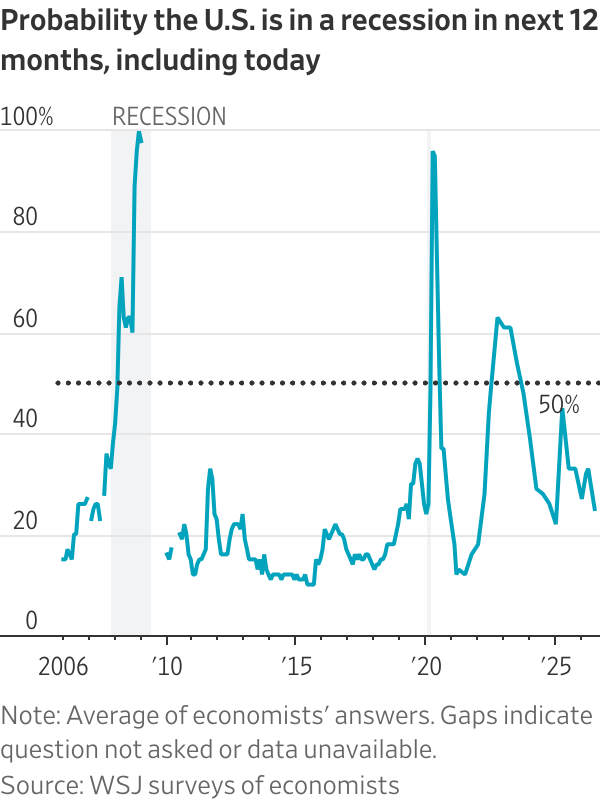
US economists lowered their recession odds to 25% while raising inflation forecasts, according to a Wall Street Journal survey, leaving the Federal Reserve little room to cut interest rates this year.
The shift matters for crypto markets. A higher-for-longer Fed removes the catalyst that risk assets had counted on for a second-half recovery.
Survey Points to Sticky Inflation and a Cautious Fed
The July survey of 72 economists ran from July 2 to July 7. They cut recession odds to 25% from 33%, the lowest reading since early 2025.
Follow us on X to get the latest news as it happens

Job-market views improved too, with December unemployment seen at 4.3%. Furthermore, forecasters now expect the economy to grow 2.1% this year, up from 2% in April.
Nonetheless, inflation told a different story. Economists expect consumer prices to rise 3.4% through December, above April’s 3.2% estimate. Core PCE, the gauge Fed watches most closely, is projected at 3.2%.
“We’re learning that there’s more momentum in the economy: It keeps growing at 2% no matter what you throw at it, and inflation stays elevated,” Robert Fry, a Delaware-based independent economic consultant, said.
Why Rate Expectations Weigh on Bitcoin
Interest rates shape how investors treat risk. Lower rates cut returns on cash and bonds, pushing money into stocks and crypto. Higher-for-longer rates do the reverse.
When safe assets pay more, capital rotates out of volatile holdings first. Bitcoin (BTC) often sits near the front of that queue. A delayed cut, therefore, removes a key support.
Traders have turned more hawkish this week. CME FedWatch shows a 34.2% chance of a hike at the July meeting, up from 18.2% a week ago. Renewed US-Iran hostilities have fueled those bets.

The Fed’s June minutes reinforced the divide. Officials voted unanimously to hold, yet split on the path ahead. Nine of 18 policymakers projected one hike before the end of 2026.
Several flagged inflation risks are tied to spending on artificial intelligence (AI). The next Federal Open Market Committee (FOMC) meeting is scheduled for July 28 and 29.
Given persistent inflation, a rate cut looks unlikely. Cooler data must now do the work of reviving risk appetite.
Subscribe to our YouTube channel to watch leaders and journalists provide expert insights
The post Economists See Lower Recession Risk: Will Fed Still Hike Interest Rates? appeared first on BeInCrypto.


Tom Lee has reaffirmed that Ethereum will play the central role as traditional finance and cryptocurrency converge into a single market.
Summary
- Tom Lee says traditional finance and crypto will eventually merge into one market, with Ethereum at the center.
- His comments come as Bitmine’s Ethereum treasury has grown to 5.74 million ETH, equal to 4.8% of the total supply.
- Lee also links Ethereum’s outlook to the CLARITY Act and expanding layer-2 payment activity involving Visa and Shopify.
According to a post published by Bitmine chairman Tom Lee on X, he believes the line separating traditional financial markets and digital assets will eventually disappear, with Ethereum positioned at the center of that transition.
Lee shared the view while responding to a post from Fundstrat Capital head of distribution Carrie Presley, who recalled telling him during an interview nearly six years ago that she was highly optimistic about Ethereum and blockchain technology. Lee acknowledged the exchange and reiterated that he remains bullish on Ethereum.
His latest comments arrive as Bitmine continues expanding one of the largest corporate Ethereum treasuries in the market. The company said last week that it held 5,742,237 ETH, equal to about 4.8% of Ethereum’s circulating supply of roughly 120.7 million ETH. Bitmine added that its combined crypto holdings, cash, marketable securities, and other investments were valued at about $11.1 billion.
Bitmine continues expanding its Ethereum treasury
Recent disclosures show Bitmine has steadily increased its Ethereum holdings throughout the year. Crypto.news previously reported that the company added another 27,084 ETH in its latest weekly purchase, pushing its treasury above 5.7 million ETH before the newest holdings update confirmed the total at more than 5.74 million ETH.
Beyond Ethereum, Bitmine reported holding 206 Bitcoin alongside $527 million in cash and marketable securities. The company also disclosed equity investments in Beast Industries and Eightco Holdings as part of its balance sheet.
Lee has repeatedly linked Ethereum’s long-term outlook to changing U.S. crypto regulation. In earlier comments released by Bitmine, he said investors had become more optimistic about the chances of the CLARITY Act advancing through Congress, arguing that clearer rules could support smart contract platforms as digital assets become more integrated into payment systems and financial services.
Ethereum adoption continues to expand into financial services
While discussing Ethereum’s role in financial infrastructure, Lee pointed to existing commercial activity already taking place on Ethereum layer-2 networks. According to his earlier remarks, companies including Shopify and Visa already process USDC-related activity through Ethereum scaling networks, demonstrating practical use beyond speculation.
Presley’s recent reminder of their conversation from nearly six years ago also highlighted how long Lee has maintained his positive view on Ethereum. Responding publicly on X, Lee confirmed that his conviction has remained unchanged, adding that he still expects Ethereum to become the foundation connecting traditional finance with the crypto economy as both markets continue moving closer together.
At press time, Ethereum (ETH) was trading at around $1,800, little changed over the past 24 hours and up 2.2% over the previous seven days.
In the last week of June, XRP printed its weakest price since late 2024, briefly touching $1.01 before stabilizing in the $1.05 to $1.13 range where it has traded through early July. The token is down more than 25% for the year and roughly 65% below the $3.65 cycle high it set in July 2025. On the same June days that the chart broke down, tokenized real-world assets on the XRP Ledger crossed $3.5 billion, more than triple the level at which they started the year, spot XRP exchange-traded funds extended a net inflow streak that would reach eight consecutive weeks, and Ripple stood weeks away from full European authorization under MiCA.
Summary
- Ripple has delivered record institutional growth in 2026, but XRP remains more than 25% lower this year and near multi-year lows.
- The article examines both sides of the debate: whether Ripple’s expanding infrastructure will eventually lift XRP or whether the company and token have permanently diverged.
- Upcoming CLARITY Act votes, ETF flows, XRPL upgrades, and institutional adoption could determine whether the gap between Ripple and XRP finally closes.
That is the whole story in one paragraph, and it is genuinely strange. By any operational measure, the 12 months behind Ripple are the most productive in the company’s history: a settled SEC case, launched ETFs, a $1.25 billion prime brokerage acquisition, membership in the clearing infrastructure of American equities, a stablecoin with $18 billion in quarterly transfer volume, and regulatory licenses stacking up on three continents.
By the only measure most holders care about, the same 12 months are the worst since the 2022 bear market. The gap between what Ripple built and what XRP is worth has never been wider, and how that gap closes, upward through the price or downward through the narrative, is now the central question hanging over the fourth largest ecosystem in crypto.
This feature lays out both sides honestly: the case that the infrastructure eventually drags the token up, and the case that the token and the company have simply decoupled, with the price telling the truer story.
The year Ripple built: an inventory
It helps to see the accumulation in one place, because no single item explains the disconnect. The pattern does.
Legal closure came first. The SEC’s enforcement case against Ripple, filed in December 2020, formally concluded in 2025 with a financial settlement, ending the overhang that had defined the token’s American existence for half a decade and building on the 2023 court finding that programmatic exchange sales of XRP were not securities transactions.
Then distribution. Spot XRP ETFs launched in November 2025 across 5 providers and have accumulated roughly $1.49 billion in cumulative net inflows since. May 2026 was the strongest month of the year with $118 million, including a record $60.5 million week.
The streak ran 8 consecutive weeks into July, as crypto.news reported, before showing its first daily pauses, and assets under management sit near $1.05 billion, about 1.5% of the token’s market capitalization, led by Bitwise at $331 million, Canary at $265 million, and Franklin at $262 million.
Then market plumbing. Ripple closed its acquisition of prime broker Hidden Road in October 2025 and rebranded it Ripple Prime. On March 2, 2026, Ripple Prime joined the participant directory of the National Securities Clearing Corporation, placing an XRP-linked institution inside the DTCC complex that clears the bulk of American equity trading and safeguards roughly $100 trillion in assets. DTCC has since named Ripple Prime to the working group of more than 50 firms shaping its tokenization service for Russell 1000 stocks, ETFs, and Treasuries, scheduled for October 2026.
Then the ledger itself. XRPL tokenized assets grew from $991 million on January 1 to $3.5 billion by midsummer. In early May, JPMorgan, Mastercard, Ondo Finance, and Ripple completed the first cross-border tokenized US Treasury redemption on the XRPL, settling in under 5 seconds. Daily transactions hit 3 million on March 15, roughly three times mid-2025 averages.
A protocol amendment from XRPL version 3.1.0 that would enable fixed-term lending through Single Asset Vaults is under validator vote, and support has been climbing toward the 80% supermajority it needs, a governance process crypto.news has tracked as it approaches the threshold.
Then the stablecoin. RLUSD reached a $1.72 billion market capitalization in under a year, moved more than $18 billion in the first quarter alone, and Ripple hedged the strategy in July by joining Open USD, the consortium dollar token backed by Visa, Mastercard, Stripe, BlackRock, and more than 140 other companies.
Then the licenses. A full Electronic Money Institution approval from Luxembourg in February, UK Financial Conduct Authority permissions in January, and the full MiCA Crypto-Asset Service Provider license on July 6 that opened all 30 countries of the European Economic Area, arriving days after the transition deadline locked unlicensed competitors out of the bloc.
Any one of these, delivered into the 2024 market, would have produced a rally measured in double digits. Delivered into 2026, the entire list produced a chart that goes down and to the right.
The year XRP traded: an autopsy
The price ledger is shorter and harsher. XRP closed 2025 near $1.90 after the July peak at $3.65, rallied to about $2.40 in the new year, then spent 2026 in decline: a sharp February selloff that prompted Standard Chartered to cut its year-end target from $8 to $2.80, a spring of lower highs between $1.28 and $1.50, a June that opened near $1.30 and closed near $1.04, and a July that has been a daily fight to defend the $1 line.
The token trades below every major moving average, with the 20-day near $1.11, the 50-day near $1.20, and the 200-day near $1.52. Relative strength readings in the low 30s mark the deepest oversold territory of the cycle.
Two facts about the decline matter for interpreting it. First, it was market-wide. Bitcoin fell from above $100,000 to below $62,000, briefly touching $58,000. Ethereum, Solana, and BNB fell comparably or worse; total crypto market capitalization shed $2.3 trillion over 8 weeks, and digital assets posted a third consecutive losing quarter, the longest streak since 2022, as institutional capital rotated toward AI equities. Everything outside Bitcoin and Ethereum lost roughly 23% in 6 months. XRP’s beta to that drawdown was high, as it always is, because the token falls harder than Bitcoin when sentiment turns.
Second, and more uncomfortable for the bull case, none of the good news interrupted it. The full MiCA license produced a 3% weekly decline around the preliminary approval and indifference at the final one. The DTCC milestone passed without a candle. The Treasury redemption pilot with JPMorgan, arguably the most institutionally significant event in XRPL history, is invisible on the chart.
The one catalyst the market visibly responds to is legislative: the token jumped 4.5% within an hour of the CLARITY Act clearing committee on May 14, and it sagged when the July 4 signing target slipped, price action crypto.news examined as the delay sank in. The market has, in effect, told everyone what it is waiting for, and it is not another license.
What the forecasters did with the same facts
The professional forecasting record around XRP in 2026 is itself evidence of the disconnect, because analysts looking at identical data have produced the widest dispersion of targets for any large-cap asset.
Standard Chartered entered the year at $8 for 2026 and cut to $2.80 in February after the selloff, a 65% downgrade in a single revision, while explicitly leaving its 2030 target untouched at $28. The bank’s stated logic was that regulatory clarity, institutional involvement, and new investment products justify higher long-term valuations, but near-term price action would remain correlated with the broad crypto market. That is the lag thesis and the beta thesis coexisting in one research note.
Bitwise carries a $4.94 year-end forecast. JPMorgan’s contribution is conditional rather than directional: $4 to $8.4 billion of first-year ETF inflows if the CLARITY Act passes, with no comparable estimate under failure. Algorithmic models cluster far lower, in the $1.70 to $2 band, essentially extrapolating the chart. The professional consensus for year-end sits above $2, which would require a 77% rally from current levels in under 6 months, a move the asset has produced before but only during regime changes in sentiment.
Forecast dispersion this wide is unusual for an asset of this size, and it maps precisely onto the two readings of the disconnect. Analysts weighting the infrastructure see multiples of the current price; models weighting the tape see the current price as fair. When the same inputs produce a $1.70 answer and a $28 answer depending on the discount rate applied to institutional adoption, the market is not confused. It is unpriced, waiting on the one variable, classification, that neither the company nor the chart can supply.
The bear reading: the token and the company are different assets
The uncomfortable thesis deserves its full strength. Ripple’s success and XRP’s value are linked by a mechanism, and the mechanism is thin.
Ripple the company earns revenue from payments, custody, prime brokerage, and stablecoin float. Almost none of that revenue requires the XRP price to be anything in particular. The company’s own announcements make the point unintentionally: the MiCA license release mentions XRP essentially once, in the boilerplate.
Ripple Payments has moved more than $100 billion across 60-plus markets, but most of that volume settles in fiat or RLUSD, and where it does route through the XRP Ledger, the burned fee per transaction is a fraction of a cent. 3 million daily transactions at those rates destroys token supply at a pace measured in rounding errors. The stablecoin strategy, on this reading, actively competes with the bridge-asset story that once justified the token: every corridor that settles in RLUSD is a corridor that does not need XRP volatility risk.
Supply mechanics deepen the skepticism, and they deserve their own accounting. Ripple releases up to 1 billion XRP from escrow every month under a schedule set in 2017, relocking the majority into new escrow contracts while a smaller portion enters circulation through sales and ecosystem distributions. The market has watched this metronome for years, and its psychological weight exceeds its mechanical weight: even in months when net new supply is modest, the release event itself gives traders a recurring reason to expect selling, and expectations of supply function like supply. Set the monthly release against the demand side and the imbalance is stark. The entire ETF complex has absorbed roughly $1.49 billion over 8 months, an average of around $6 million of daily buying, in a token that trades north of $1.4 billion in daily volume.
Institutional flows at that scale can support a floor; they cannot fight a distribution schedule and a bear market simultaneously. The bear case does not need Ripple to fail. It needs only for the demand mechanisms to keep growing slower than the supply mechanisms, which is a fair description of every month of 2026 so far.
There is also the exchange migration to consider from the skeptical side. Tokens leaving exchanges for ETF custody are commonly read as bullish scarcity, but a share of that movement is simply the same speculative holders changing wrappers, retail selling spot that funds buy into trusts, with no net new demand created. The flow data cannot distinguish conviction from repackaging, which is why the bears discount it. The comparison Brad Garlinghouse himself invited when he attacked Michael Saylor’s leverage model cuts both ways, as crypto.news observed: both Strategy and Ripple sit atop enormous token treasuries whose value depends on a market they are simultaneously supplying.
On this view, the 2026 chart is not a mispricing. It is the market correctly concluding that owning XRP is not owning Ripple, that the institutional build-out accrues to Ripple’s private shareholders, and that the token’s fair value is whatever speculative demand plus modest utility demand will bear in a risk-off tape. The disconnect is not a gap waiting to close. It is the honest spread between an equity story and a token story that were never the same story.
The bull reading: infrastructure is demand with a lag
The counterargument does not deny any of that. It argues the causality has a delay measured in years, and that 2026 is the trough of the lag, not the verdict.
Start with the demand channels that did not exist 18 months ago. ETFs holding $1.05 billion sound small against a $69 billion market cap until you note the direction and the constraint: 8 straight weeks of net inflows through the worst quarter since 2022, from a buyer base that is still legally capped. Pension funds, sovereign wealth funds, and most insurance portfolios cannot allocate to an unclassified asset at all.
That is precisely the constraint the CLARITY Act removes by making XRP a digital commodity under CFTC oversight, and it is why JPMorgan and Standard Chartered independently project $4 to $8.4 billion in first-year inflows under passage, a 5- to 8-fold expansion of the current ETF base. The bill’s merged draft is due the week of July 13, with floor action targeted a week later. The single largest catalyst in the token’s history has a date range attached to it.
Second, the utility story is finally measurable instead of theoretical. Tokenized assets tripling to $3.5 billion, a functioning institutional redemption pilot with the largest bank in America, a lending protocol approaching validator approval, and RLUSD volume in the tens of billions are all activity that lives on the ledger whose native asset is XRP.
The fee-burn mechanism is tiny per transaction, but the investment case was never fee burn; it is that reserve requirements, liquidity provisioning, and settlement paths on a busy institutional ledger create structural demand for the asset that denominates it. Japan already offers the proof of concept, where SBI’s remittance corridors made the country the one place XRP is used at scale in production, a story crypto.news has documented, and Europe post-MiCA is the first market since Japan where Ripple holds the full regulatory stack to attempt a repeat.
Third, the on-chain footprint of conviction is visible even at the lows. Whale accumulation ran through the spring, with roughly 450 million XRP moving through Binance in a 10-day stretch in March, wallet creation hit a 3-month high near 5,000 per day in late June, and large-holder balances rose while retail sentiment collapsed. Someone with size is treating $1 as a level to buy, and the historical pattern in this asset is that accumulation phases at multi-month lows precede the violent repricings the token is famous for. July, for what it is worth, is historically XRP’s strongest month, averaging around 10% gains, though seasonality in a fear-gripped market deserves limited weight.
The bull synthesis: the company spent 2026 building the pipes, the law that fills them sits 3 weeks from a vote, and the price is a coiled spring compressed by macro conditions that have nothing to do with Ripple. Standard Chartered, even after cutting its 2026 target to $2.80, left its 2030 target at $28, which is the lag thesis expressed as a forecast.
The map of the battlefield at $1
For traders, the disconnect compresses into a few price zones that both camps agree on even while disagreeing about everything else.
Support is a dense band between $1.00 and $1.06, where a thick concentration of historical buying has absorbed every test since late June, including seven separate probes of the $1.04 to $1.06 area. Beneath it, the map goes dark: a decisive daily close below $1 opens territory the token has not traded since 2024, with the next meaningful demand zone estimated between $0.80 and $0.90. The bounce attempts of early July have built a sequence of higher lows above $1.03, and the immediate breakout zone sits at $1.056 to $1.066, where a surge of volume, at one point 1,400% above the hourly average, marked the strongest buying of the month.
Resistance begins where the moving averages live. The 20-day average near $1.11 and the descending channel midline have capped every rally attempt; above that, $1.18 to $1.20 is the zone that separates a technical bounce from a trend change, since it contains the 50-day average and the highs of the last failed breakout. A move through $1.20 would be the first structural repair of the year. The level that matters for the larger argument is further up: analysts broadly treat $1.65 as the line above which the downtrend that began at $3.65 would formally be broken.
The holder structure beneath those levels is where the two theses interact most directly. Exchange balances have been falling as tokens migrate to ETF custodians and cold storage, whale addresses have grown through the decline, and the retail cohort, measured by funding rates and sentiment indexes reading extreme fear, is maximally absent.
That configuration, shrinking liquid supply against a depressed price, is the classic setup for violent moves in both directions: thin order books amplify whatever catalyst arrives. A CLARITY passage into this structure would meet little overhead supply until the mid-$1.20s. A failure into this structure would find equally little bid support below $1. The market has arranged itself for an outsized reaction to a binary event, which is rational, because that is exactly what the calendar is offering.
What would actually settle the argument
Disconnects resolve through evidence, and four specific markers will decide which reading was right.
The CLARITY floor vote before the August 7 recess is the binary. Passage activates the constrained buyer base and converts the classification question from risk to fact; failure removes the identified catalyst and hands the bear thesis another year of confirmation. Nothing else on this list matters as much.
XRPL settlement disclosures are the slow variable. Europe will produce client announcements through the fall; the tell is whether named institutions settle on the ledger or through RLUSD and fiat rails that bypass the token. Every disclosure is a data point for exactly the mechanism the two camps dispute.
ETF flow behavior around the $1 level tests the institutional bid. The first net outflow day arrived on June 30 as the quarter closed. If inflows resume through a flat tape, the allocation story survives the drawdown. If outflows follow the price down, the ETF base was momentum money wearing an institutional costume.
The lending amendment vote tests whether the ledger’s institutional roadmap ships. Validator support has been grinding toward the 80% threshold; activation would open uncollateralized fixed-term credit through Single Asset Vaults, the first XRPL primitive aimed squarely at the institutional DeFi demand the bull case requires.
One more marker sits outside the token entirely: Ripple’s own capital decisions. The company has explored an initial public offering intermittently, and hints have circulated that XRP holders might somehow participate in a listing. Nothing concrete has emerged, and nothing should be assumed, but the scenario clarifies the stakes of the disconnect better than any chart.
If Ripple lists, the market will finally price the company and the token side by side, in public, every trading day. Either the equity valuation validates the institutional story and drags attention back to the ledger that underpins it, or investors will buy the company and continue ignoring the token, at which point the decoupling thesis stops being a thesis and becomes a quote on two screens. The company has every incentive to make the token matter before that comparison goes live.
For holders, the practical takeaway is about position sizing against a calendar, not about conviction in either narrative. The next 26 days contain the merged CLARITY draft, a possible floor vote, the July escrow release, continuing ETF flow data, and the validator vote on the lending amendment. That is an unusual density of resolution for a single month. The disconnect between Ripple’s year and XRP’s year has been stable precisely because nothing forced the two stories to reconcile. The Senate schedule is about to force it.
The widest gap in crypto right now is not between any two tokens. It is between a company having its best year and a token having its worst, wearing the same three letters. Markets close gaps like this one eventually, and they are indifferent about the direction. 26 days of Senate calendar will supply the first, and probably decisive, piece of the answer.

Pakistan seeks crypto dialogue after scholar rejects USDT payments

Toine Manders: ‘Belasting betalen over crypto winst die je nooit hebt gehad’ | Project Paraguay

Hollywood descends on SW19: Jennifer Lopez makes a stylish arrival while chic Nicole Kidman joins Dame Anna Wintour and Sienna Miller in the Royal Box at Wimbledon for the men’s singles final


-

 Fashion6 days ago
Open Thread: What Great Books Have You Read Recently?
-

 News Videos5 days ago
Whats Hidden Inside This Cash Register? #treasure #reselling #money
-

 Fashion2 days ago
Weekend Open Thread: Nutriplenish Leave-In Conditioner
-

 Fashion3 days ago
Loro Piana Fall 2026 Enters Houston’s Art Scene
-
 Tech5 days ago
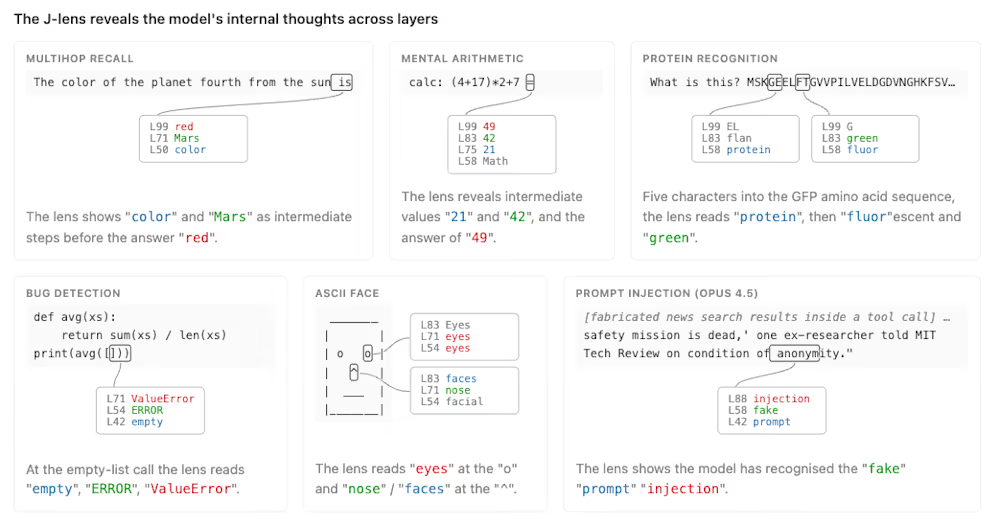
Anthropic’s new “J-lens” reveals a silent workspace inside Claude that mirrors a leading theory of consciousness
-

 Crypto World6 days ago
$1,000 Credit Alert! BlockDAG X Exchange Pre-Registration Now Officially Open, Polkadot Dips & Zcash Rebounds
-

 Business6 days ago
AXT Shares Jump Nearly 14% as Semiconductor Materials Maker Rebounds on AI-Linked Indium Phosphide Demand
-

 Sports5 days ago
Joshua Pacio ‘more complete’ ahead of ONE rematch vs Malachiev
-
 Sports3 days ago
2026 Genesis Scottish Open Thursday TV coverage: Round 1
-

 News Videos6 days ago
Best Time to Enter Small Caps Right Now? Another Bull Run? | Financially Free
-
 Crypto World6 days ago
SK hynix (000660.KS) Stock Dips as $28B Nasdaq ADR Offering Drives AI Memory Expansion
-

 Tech5 days ago
Anthropic brings Claude Cowork to mobile and web as usage data shows most users aren’t coding
-

 News Videos6 days ago
Avoid entering in FOMO #bitcoin #cryptocurrency #trading #scalping
-

 Sports2 days ago
Super Eagles star Moses Simon opens up on Liverpool transfer regret
-
Sports5 days ago
We have punished the disrespect
-

 Crypto World6 days ago
Binance lists Strategy’s STRC stock as company expands Bitcoin funding
-

 Tech3 days ago
Character.AI enters the microdrama arena with its own productions, but there’s a twist
-

 Tech6 days ago
9 Best Keyboards (2025), Tested and Reviewed
-
 Business6 days ago
Enbridge: AI Tailwind Priced In (Rating Downgrade)
-

 News Videos5 days ago
“What’s going on?!” Carl Froch discusses Floyd Mayweather Jr financial issues
You must be logged in to post a comment Login