

Business
Sebi tightens ethics rules for current, former employees


The regulator also extended investment restrictions to employees’ family members, the notification, published on Saturday, said.
The Securities and Exchange Board of India had decided to review its rules after former chief Madhabi Puri Buch faced conflict of interest allegations from the now-shuttered Hindenburg Research.
Buch had denied the allegations and was cleared by India’s anti-corruption body last year.
The new rules, including the voluntary adoption of a stricter code of conduct for senior officials at the regulator, were approved by SEBI’s board last month.

The rules, effective Monday, require SEBI officials to recuse themselves from matters involving family members, close associates and former professional relationships, and to disclose negotiations for future employment within 30 days.
Officials must also liquidate or freeze equity holdings before joining SEBI and refrain from trading while in office.The regulator, in a departure from its 2008 code of conduct, extended restrictions on investments by employees’ family members, including spouses and dependent children, with limited exemptions for employee stock option plans and pooled investment vehicles.
The rules also cap exposure to products offered by a single SEBI-regulated fund manager, including mutual funds, portfolio management services and alternative investment funds, at 25% of the employee’s total investments.


The chief executive of the German car giant Volkswagen Group has confirmed it is looking to cut up to 100,000 jobs – twice as many as previously stated.
The group, which includes Porsche, Audi, Seat and Skoda as well as the VW brand, had previously said it would axe some 50,000 posts in Germany by 2030.
It suffered a steep decline in profits last year – the result of falling sales in key markets, as well as increasing competition from Chinese brands moving into Europe.
In a widely-reported memo to staff, chief executive Oliver Blume said the Group’s costs were 20% higher compared to rival businesses, and it would need to reduce its outgoings even further.
This, he said would mean a theoretical loss of 50,000 jobs worldwide.
“We are currently assessing across all brands, companies and regions how many adjustments are actually necessary and feasible,” he said.
“We need to become more efficient, more robust and simpler. We must reduce our costs.”
He added the company had been “unable to confirm” alternative uses for four factories in Germany which have previously been threatened with closure.
Two of the plants, in Zwickau and Emden, are used for electric car production. But along with other factories in Hanover and Neckarsulm, they are seen as expensive to run.
VW’s profits have fallen sharply in recent years. In 2023, it made an operating profit of €22.6bn ($25.8bn, £19.3bn). This dropped to €19.1bn in 2024, and then to just €8.9bn last year.
The group has been badly hit by a fall in sales in China, once one of its most lucrative markets. In the first six months of the year they were down 26% compared to last year.
In the US, sales fell more than 7%, in part due to the impact of tariffs on car imports introduced by the Trump administration.
Meanwhile Chinese brands have been moving aggressively onto international markets, introducing new technologies while benefitting from lower production costs than European rivals.
This has added to the pressure on established brands to keep their own costs under control, and slashed profit margins.
In late 2024, after threats of mass strikes, VW reached an agreement with the German trade union IG Metall to cut 35,000 jobs at its namesake brand by 2030, in a “socially responsible manner”, with another 15,000 jobs to go at its other brands.
The plans now under discussion appear to go much further.
Last week saw widespread protests at Volkswagen sites across the country, ahead of a meeting of VW’s supervisory board, which includes labour representatives as well as company managers.
Some industry analysts suggested to Agence France Presse that Volkswagen had deliberately publicised the number of 100,000 as a negotiating tactic, and that the final figure of cuts is likely to be lower.

Revvity: Overvalued On Sentiment

Rep. Buddy Carter, R-Ga., joins ‘Varney & Co.’ to sound off on Republicans defying President Donald Trump over Obamacare subsidies and defend legislation to denaturalize and deport immigrants convicted of fraud.
A new government watchdog report warns that stronger safeguards against fraud are needed in the Obamacare exchanges to prevent bad actors who serve as agents and brokers in the federal marketplace from making unauthorized plan enrollments and changes to get compensation from health insurance providers.
The Government Accountability Office (GAO) on Monday released a report showing that the number of consumer complaints about unauthorized plan enrollments and changes grew more than fourfold from 2023 to 2025, rising from a combined 66,548 to 299,604 in that period.
The review found that the Centers for Medicare and Medicaid Services (CMS), which maintains the federal Obamacare exchange, had insufficient controls to protect consumers from unauthorized activity by unscrupulous agents and brokers.
Among the issues it identified were weak processes to ensure consumer consent for agent or broker actions, a lack of restrictions ensuring that only the agent or broker associated with a consumer’s enrollment can access the consumer’s exchange records, and CMS not informing consumers of all actions taken by agents and brokers.
OBAMACARE PRICES ARE SET TO SPIKE – HERE’S WHY

The GAO found the federal Obamacare exchange run by the Centers for Medicare and Medicaid Services lacked consumer safeguards. (Kayla Bartkowski/Getty Images)
GAO recommended stronger security controls, including one-time passcodes to verify consumer authorization, restricting access to the broker of record, and notifying consumers when brokers take actions on their accounts.
Some agents and brokers switched consumers into different Obamacare plans without their knowledge or consent, according to the GAO. The unauthorized changes can force Americans to change doctors, lose coverage for medications and pay higher out-of-pocket costs, the report found.
The report also warns that consumers could be hit with unexpected tax liabilities if inaccurate income or eligibility information was used to obtain federal premium tax credits, while taxpayers could end up footing the bill for subsidies paid to ineligible enrollees.
Many consumers do not discover the unauthorized changes until they seek medical care or receive an IRS notice during tax season, according to the GAO.
VANCE TURNS UP HEAT ON STATES WITH FEDERAL CASH THREAT OVER MEDICAID FRAUD CRACKDOWN

President Trump has made rooting out fraud, waste and abuse a cornerstone of his agenda. (Anna Moneymaker / Getty Images)
Separately, the Trump administration has made health care fraud enforcement a major priority.
A 2024 CMS enrollment-data review identified 2.8 million Americans potentially enrolled in multiple Medicaid, CHIP or subsidized Affordable Care Act exchange plans.
The administration has also targeted Medicaid fraud, putting all 50 states on notice to identify improper enrollment activity and develop fraud-prevention plans.
Fox News Digital reached out to CMS for comment.
Fox News Digital’s Peter D’Abrosca contributed to this report.

Why is Deckers Outdoor stock gaining today?


New formats and flavors are starting to add new opportunities.

- A fire at a Bangkok music pub in the early morning hours killed at least 27 people and injured 73 others, with officials warning the death toll could rise as dozens remained in critical condition. Eyewitness footage showed patrons fleeing the burning venue as flames spread rapidly through the packed establishment.
- Thai authorities have launched an investigation into potential safety violations, including emergency exit accessibility, occupancy limits, and fire suppression systems. The incident has prompted broader scrutiny of nightlife venue safety standards and may lead to stricter regulatory enforcement across Thailand’s entertainment and hospitality sectors.
The Tragedy Unfolds
A devastating fire broke out at a music pub in Bangkok in the early hours, claiming the lives of at least 27 people and leaving dozens more injured, according to multiple international news outlets including AP News and the BBC. The blaze occurred late at night when the venue was reportedly packed with patrons enjoying live music, transforming a night of entertainment into a scene of chaos and tragedy within moments.
Officials confirmed that the death toll could rise further as rescue operations continued, with reports indicating 22 to 25 people in critical condition, according to updates from Reuters and DW. The severity of injuries among survivors has raised concerns about the final casualty count, as medical teams work to stabilize those who suffered severe burns and smoke inhalation.
Scenes of Panic and Escape
Eyewitness accounts and video footage captured the terrifying moments as flames engulfed the popular nightspot. Footage widely circulated on social media and news platforms showed survivors frantically running out of the burning building, desperately trying to escape the rapidly spreading fire, as reported by People.com. The chaotic scenes underscored the speed at which the fire consumed the structure, leaving many with little time to react.
According to CNA, the fire ultimately injured 73 people, a figure that reflects the scale of the disaster and the number of patrons present at the time. The Guardian also released video footage showing people fleeing the scene as flames erupted from the building, illustrating the panic that ensued when the fire first broke out.
Investigation into Possible Negligence
In the aftermath of the tragedy, Thai authorities have launched a formal investigation to determine the cause of the fire and whether negligence played a role in the high death toll. Police are examining potential safety violations, structural issues, and whether proper fire safety protocols were followed at the venue, according to reporting from CNA’s live updates on the incident.
This investigation comes amid broader scrutiny of nightlife venue safety standards in Thailand, a country with a significant entertainment and tourism sector. The probe will likely examine building codes, emergency exit accessibility, and whether the venue had adequate fire suppression systems in place. Given the packed nature of the venue at the time of the fire, questions have also emerged regarding whether occupancy limits were exceeded.
Historical Context of Fatal Fires in Thailand
This incident is not isolated in Thailand’s history of tragic fires at entertainment venues. The Guardian compiled a list of significant fatal fires in Thailand, highlighting a pattern of similar disasters that have plagued the country’s nightlife and public venues over the years. These recurring incidents point to systemic challenges in enforcing fire safety regulations across commercial establishments, particularly in densely packed urban entertainment districts like Bangkok.
The pattern of such tragedies raises important questions about regulatory oversight and enforcement mechanisms within Thailand’s hospitality industry. Historical fires have often been linked to overcrowding, inadequate emergency exits, flammable building materials, and insufficient fire suppression equipment—factors that safety advocates argue require more rigorous government intervention.
Impact on Thailand’s Business and Tourism Sectors
Beyond the immediate human tragedy, this incident carries significant implications for Thailand Business News and the broader hospitality sector. Bangkok’s nightlife industry is a critical component of the country’s tourism economy, attracting millions of international visitors annually. Incidents like this can potentially undermine consumer confidence and prompt increased regulatory scrutiny that may affect how nightclubs and pubs operate going forward.
Thai authorities may face pressure to implement stricter enforcement of existing fire codes or introduce new regulations specifically targeting entertainment venues. Such regulatory responses, while necessary for public safety, could impose additional compliance costs on business owners in the hospitality sector, potentially affecting profit margins for smaller establishments already operating on thin margins.
Moving Forward
As Thailand grapples with the aftermath of this devastating fire, the nation faces difficult questions about balancing economic vitality in its entertainment sector with adequate safety protections for patrons. The investigation’s findings will likely shape future policy discussions around building codes, venue licensing requirements, and emergency preparedness standards.
For families of the victims, the coming days will bring the painful process of identification and mourning, while survivors face long recovery journeys from their injuries. The broader Thai business community, particularly within hospitality and tourism, will be watching closely to understand how this tragedy might reshape regulatory frameworks and public perception of venue safety standards moving forward.
This incident serves as a somber reminder of the critical importance of stringent fire safety measures in commercial venues, particularly those hosting large crowds in enclosed spaces during nighttime hours when visibility and quick evacuation can be most challenging.
Source : Google News – Search
Other People are Reading

NEW YORK — Shares of Space Exploration Technologies Corp., known as SpaceX, fell 5.46 points, or 3.76 percent, to 139.84 on Monday, extending recent weakness in the newly public aerospace and satellite company as investors navigated post-IPO volatility and a limited public float.
The decline came as the stock, which debuted in June in the largest U.S. initial public offering on record, continued to trade below its early highs. SpaceX raised approximately $75 billion to $86 billion in its IPO, pricing shares at $135 and achieving a massive initial valuation. However, the publicly tradable float remains small relative to the company’s overall market capitalization, amplifying price swings.
SpaceX’s shares have been highly volatile since listing. They surged in the immediate aftermath of the IPO before pulling back sharply from peaks above $225. Monday’s trading reflected ongoing adjustments as early investors and funds respond to the company’s debut and subsequent index inclusions.
The company joined the Nasdaq-100 index earlier in July, triggering buying from passive funds tracking the benchmark. While such inclusions typically support prices through mandated purchases, the thin float has led to exaggerated moves in both directions.
Analysts have highlighted the stock’s sensitivity to supply dynamics. Lockup expiration schedules allow certain early investors and employees to sell shares over time, potentially adding selling pressure. The limited public availability of shares has contributed to rapid price fluctuations since trading began.
SpaceX, led by Elon Musk, operates in multiple high-growth areas, including reusable rockets, satellite internet through Starlink and commercial space services. The company has secured major contracts, including deals with xAI and others for satellite and computing infrastructure, providing revenue visibility.
Despite operational momentum, valuation concerns have emerged. The stock trades at high multiples relative to current revenue, reflecting expectations for future expansion in AI-related data services, satellite constellations and launch capabilities. Some observers note that profitability may remain elusive in the near term as the company invests heavily in ambitious projects like Starship development.
The Monday session occurred against a mixed broader market backdrop. Technology shares faced pressure from profit-taking in semiconductors, while energy stocks advanced on oil price gains tied to Middle East developments. SpaceX’s movement aligned with volatility seen in other high-profile growth names.
Trading volume remained elevated compared to pre-IPO levels, consistent with interest in the high-profile listing. Options activity also reflected active positioning around potential catalysts, including upcoming launches and contract announcements.
SpaceX’s business fundamentals include a growing Starlink subscriber base and a robust launch cadence. The company has achieved multiple record booster reuses with its Falcon 9 rockets, demonstrating cost efficiencies that competitors struggle to match. Starlink has crossed significant customer milestones, contributing the majority of revenue in recent periods.
Longer-term growth drivers include expansion of satellite internet services to new markets, potential deep-space missions and integration with artificial intelligence infrastructure. Partnerships and government contracts provide additional tailwinds, though regulatory and competitive risks persist in the space sector.
Wall Street coverage has been generally positive, with several firms initiating coverage post-IPO. Price targets vary widely, reflecting differing views on execution of ambitious plans and the company’s path to sustainable profitability.
The stock’s post-IPO journey highlights challenges for newly public companies with concentrated ownership. Musk retains a substantial stake, and early investors hold much of the remainder, limiting immediate liquidity for public shareholders.
Index inclusions, such as the Nasdaq-100 addition, have provided technical support through passive inflows. However, the overall float constraints continue to influence trading dynamics.
Investors monitoring SpaceX will watch for updates on Starship test flights, Starlink deployment milestones and quarterly performance metrics as the company transitions to public reporting requirements. The quiet period following the IPO has limited detailed commentary, but upcoming earnings and operational disclosures could provide further clarity.
The aerospace sector has seen increased interest amid commercial space growth and government partnerships. SpaceX’s leadership position in reusable launch technology and satellite communications positions it uniquely, though execution risks and capital intensity remain key considerations.
Monday’s decline contributed to a broader pullback from recent peaks. The stock remains above its IPO price in some sessions but has experienced significant swings, underscoring the speculative nature of early trading in high-profile listings.
Broader market participants continue to assess SpaceX’s role in emerging industries. Its Starlink service has potential to bridge connectivity gaps globally, while launch capabilities support both commercial and scientific missions.
As trading progresses, the balance between growth optimism and valuation discipline will likely shape investor sentiment. SpaceX’s ability to deliver on operational targets and monetize its technologies will be central to sustaining its market valuation.
The session’s activity reflects typical post-IPO adjustment phases, where initial enthusiasm meets reality of public market scrutiny. SpaceX’s unique position in the space economy ensures ongoing attention from investors worldwide.

California, 11 states suing to block Paramount’s $110 billion Warner Bros deal
I once spent three weekends building a meal-planning template in Notion- color-coded, beautifully organized, genuinely useful. I priced it at $19. I sold four copies. Two were to my mom, who I’m fairly sure just felt bad for me.
So no, digital products are not automatically passive income, and anyone telling you otherwise is usually selling something. What they are is one of the lowest-overhead ways to build a real side income, if you pick the right product for the effort you’re actually willing to put in. Below are 20 of them, ranked honestly by how much work they take versus what they tend to pay.
Digital products are intangible goods like ebooks, templates, online courses, presets, and other downloadable files, that are created once and sold repeatedly online with no inventory, shipping, or per-unit production cost. That “create once, sell many times” model is what makes the margins good, but it doesn’t make the creation effortless — that part still varies wildly by product type.
20 Digital Products to Sell, Ranked by Effort vs. Payoff
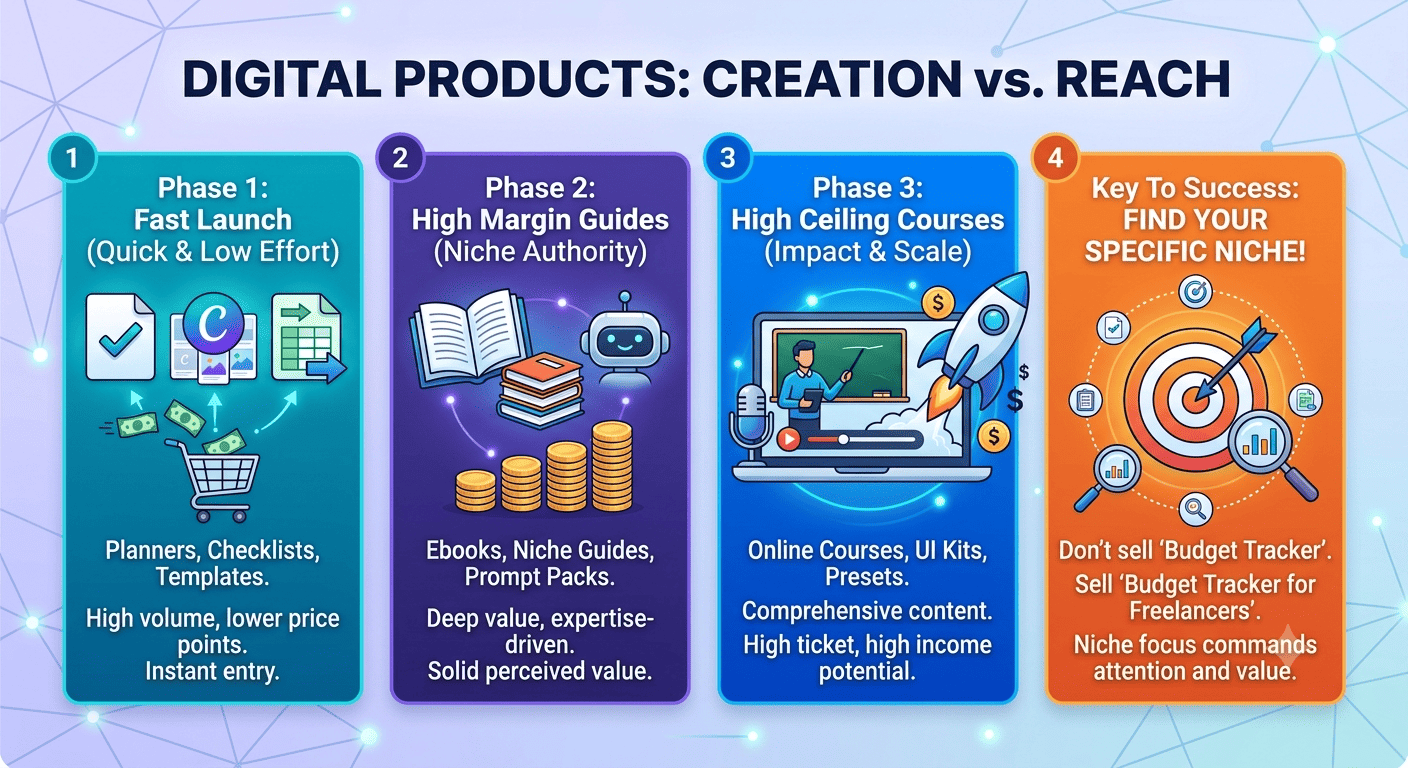
Fastest to Launch
1. Printables (planners, checklists, wall art) — Low effort, quick to design in Canva or Illustrator. Price: $2–$15. Sells well on Etsy in home, wellness, and organization niches.
2. Canva and social media templates — Build one style, duplicate, swap colors and text. Price: $5–$30 for a set. Strong demand from small businesses and creators who want a consistent look without hiring a designer.
3. Notion templates — Currently one of the fastest-moving categories, popular for project management, finances, and content planning. Price: $10–$50.
4. Niche spreadsheets and trackers — Budget trackers, habit trackers, debt payoff planners. Solve one specific problem, which is exactly why they sell. Price: $5–$25.
5. SVG and craft cut files — For the Cricut/Silhouette crowd. Low production time once you’ve built a style. Price: $2–$10 each, often bundled.
Best Margins for the Effort
6. Ebooks and niche guides — General nonfiction sits around $2.99–$9.99; specific, specialized topics (“budgeting for freelancers” vs. generic money advice) command $4.99–$19.99. Time investment is the main cost — there’s no printing or shipping to eat into margin.
7. AI prompt packs — Curated, tested prompts for a specific use case (content writing, coding, design). Cheap to produce, currently high perceived value given how many people are still figuring out how to use AI tools well.
8. Done-for-you business templates — Contracts, intake forms, onboarding guides, SOPs. Service providers pay well for these because they save hours and make a new business look established fast. Price: $15–$75.
9. Done-for-you email flows — Pre-written welcome sequences, abandoned cart flows, or nurture sequences for a specific niche. Less common than the other categories, which is part of the appeal. Price: $25–$150.
10. Workbooks (CBT-style, journaling, goal-setting) — Structured, printable, often paired with an ebook. Price: $9–$25.
11. Mini-courses and frameworks — Condensed versions of a bigger topic: a checklist, a short video walkthrough, a repeatable process. Buyers want a fast, specific win. Price: $19–$79.
Higher Effort, Higher Ceiling
12. Online courses — The highest-ticket common digital product, and the one that takes the most upfront time to build well. Short single-topic courses run $10–$20; comprehensive multi-module courses run $99–$499. Justifies the price if the outcome is genuinely high-value for the buyer.
13. Website themes and UI kits — Requires real design/dev skill, but sells to a market (other creators and small businesses) that’s willing to pay for something that saves them dozens of hours. Price: $30–$150.
14. Lightroom presets and video LUTs — Niche but proven — some creators have built six-figure businesses almost entirely around a signature editing style. Price: $10–$40 per pack.
15. Stock photo and video packs — Higher production effort (you’re the one shooting), but reusable across many buyers once built. Price varies widely by license type.
16. Simple software, plugins, or automation scripts — Highest technical bar on this list, but often the least competitive category because fewer people can build it. Price: highly variable.
Fastest-Growing in 2026
17. Guided meditation and breathwork audio — Short 5–20 minute sessions, sold individually or bundled. Low production cost, strong repeat-purchase rate. Price: $4.99–$19.99.
18. Audiobook versions of existing ebooks — If you already have written content, this reaches an audience that reads less and listens more. Price: $9.99–$19.99.
19. Children’s audio stories — A genuinely underserved niche — parents actively search for screen-free entertainment. Price: $2.99–$9.99.
20. AI-personalized products — Personalized children’s books, custom workout plans, tailored templates generated per buyer. Newer category, growing fast, though it leans on tools and workflows that are themselves still evolving.
How Do You Pick the Right One for You?
Looking at that list, the honest filter isn’t “which one is most profitable” — it’s three narrower questions:
- What do you already know or make, that someone else would pay to skip learning? The sellers who succeed fastest usually aren’t inventing a new skill for the product — they’re packaging one they already have.
- How much upfront time can you actually give it? A printable set is a weekend. A comprehensive course is realistically a multi-month project, even working part-time.
- Is there a specific buyer, or a vague one? “A budget tracker” is vague. “A budget tracker for freelancers with irregular income” is specific — and specific is what sells, because it tells a stranger scrolling past thirty other listings that this one was made for them.
If you can’t answer the third question yet, that’s the actual first step — more important than picking a format off this list.
Are Digital Products Actually Worth It in 2026?
Worth it, yes — automatically passive, no. The “low overhead” part is genuinely true: no inventory, no shipping, no per-unit cost eating your margin. What doesn’t show up in that pitch is that low overhead doesn’t mean low effort — it just moves the effort earlier, into the creation and marketing, instead of into ongoing fulfillment.
The other honest caveat: the obvious niches (generic budget planners, generic productivity templates) are genuinely saturated. The products that still do well tend to be specific rather than broad — which is a theme you’ll notice repeats throughout this whole list.
Where Should You Actually Sell Digital Products?
| Marketplace (Etsy, Creative Market) | Dedicated platform (Gumroad, Sellfy, Payhip) | Your own site (Shopify, WooCommerce) | |
|---|---|---|---|
| Built-in traffic | Highest — buyers are already browsing | Low — you bring your own audience | Lowest — entirely your own traffic |
| Fees | Listing + transaction fees | Monthly or per-sale fees | Platform/hosting cost, generally lower per-sale |
| Control over branding | Limited | Moderate | Full |
| Best for | New sellers with no existing audience | Creators with some following who want more control | Established sellers who already drive their own traffic |
Most sellers starting from zero audience do best on a marketplace first, then migrate to their own platform once they have proof a product sells and don’t want to keep paying marketplace fees on repeat buyers.
What Mistakes Tank Digital Product Sales?
Picking a saturated niche with no differentiation. “Another budget tracker” competes with thousands. “A budget tracker for wedding planners” doesn’t.
Weak previews and mockups. Buyers can’t hold a digital product before purchasing — the preview images are doing all the trust-building work a physical product gets for free.
Pricing based on hope, not research. Check what comparable, specific products in your niche are actually charging before picking a number.
Launching with zero validation. Posting in a relevant community, running a small pre-sale, or just asking your existing audience what they’d pay for costs nothing and prevents building something nobody wants.
How Much Can You Realistically Make Selling Digital Products?
Here’s where most guides on this topic get misleading — they lead with one creator’s standout number ($50,000, sometimes six figures) presented as typical. It isn’t. Outcomes vary enormously based on three factors: how specific the niche is, how large an audience you already have (or can reach), and price point.
A realistic range for someone starting from scratch, building one solid product, and doing their own marketing: modest supplemental income in the first several months, with growth from there tied directly to how much ongoing marketing and product expansion happens — not something that keeps compounding on autopilot.
The Bottom Line
The products on this list that tend to work are the specific ones, built by someone who already had the underlying knowledge, sold to a buyer they could describe in one sentence. Everything else on the list- the platform you choose, the price you set- matters less than getting that part right first.

Business owners bracing for a Burnham premiership have been offered a rare note of reassurance from one of the City’s most respected voices. Jim O’Neill, the economist and former Treasury minister, says the probable next prime minister will not arrive in Downing Street with a fresh round of punishing tax rises.
Speaking on The Rest Is Money podcast with Robert Peston and Steph McGovern, O’Neill said the biggest risk to confidence would be a new government talking the country down all over again.
“If something can be done to change the mindset of consumers and businesses, and make them think, ‘Hang on a second, we don’t have to worry as much about the next few years as we have been doing, effectively on and off since the financial crisis,’ then I think the human instincts and the natural juices would start to flow – so long as you don’t have an incoming government repeating what Keir did: ‘Oh, well, it’s actually way worse than we thought. Sorry, we’re going to tax the hell out of you. Life’s going to be miserable.’ That is definitely not the nature of our probable incoming leader.”
It is a message that will land well with the eight in ten SME owners who fear what a Burnham premiership would mean for their business.
But the reassurance comes with a hard edge. O’Neill argues the UK can no longer duck politically toxic “sacred cows”: the pension triple lock, a root-and-branch overhaul of welfare, replacing council tax and stamp duty with a fairer system of land and property taxation, and a credible long-term framework for infrastructure investment.
On the triple lock, whose mounting long-term cost the Office for Budget Responsibility has repeatedly flagged, he was blunt. “I think the triple lock needs to be dealt with. And I suspect, once the right person is bold enough to do it, it’s going to be pretty hard for any major political opposition to disagree. It’s also very unfair from an intergenerational perspective, with all these young people who can’t afford to buy or rent in some parts of the country being expected to pay more and more tax for a lot of people who own their own homes and still get a very nicely protected pension increase all the time.”
He was equally scathing about Sir Keir Starmer’s tinkering with Britain’s welfare bill. “I do think one of the many mistakes that Keir Starmer presided over was effectively trying to play around with small amounts of savings in welfare, purely to meet what one might regard objectively as an arbitrary fiscal rule or fiscal space. Whereas, if you’re really going to do it, you’ve got to have a systematic reform of everything that connects to the various welfare payments that are going on.”
His call to replace council tax and stamp duty echoes the open letter from economists urging Burnham to scrap both in a radical shake-up of the tax system, which O’Neill signed.
The stakes, he warned, are being set daily in the bond markets. “You’ve got, lurking in the background every second of every day, the financial markets. They are not charging the UK a premium on its borrowing for nothing. They are expecting that, at some point, somebody is going to be bold enough to take on some of these so-called sacred cows and put us on a more sustainable path for debt.”
For SMEs, the practical takeaway is focus. O’Neill argues markets could support higher borrowing for growth-enhancing projects, provided decisions are independently assessed, and he wants far greater devolution of skills, education and employment support, though he cautions the Greater Manchester model cannot simply be copied elsewhere.
His advice to the man who has already signalled room for movement on tax and a business rates cut for high street firms is characteristically direct. “Andy needs to figure out exactly what his key priorities are, communicate that to everybody and then actually stick with them. He then needs to choose the people around him who can deliver them.”
O’Neill stresses he holds no formal role with Burnham. The sacred cows, though, now have a very public list of names against them.
“Watch or listen to The Rest Is Money wherever you get your podcasts.“

Amy Ingham
Amy is a newly qualified journalist specialising in business journalism at Business Matters with responsibility for news content for what is now the UK’s largest print and online source of current business news.

Abhishek Sharma The Target Of Social Media Users Using AI To Spread Rumours, Delhi High Court Says This

What Size Chainsaw Do You Need To Cut Trees? Here’s What You Should Know

Grade 11 Gen Math | Application of Sequence and Series Financial Problem First Term (Term 1) Week 5


-

 News Videos7 days ago
Whats Hidden Inside This Cash Register? #treasure #reselling #money
-

 Fashion4 days ago
Loro Piana Fall 2026 Enters Houston’s Art Scene
-

 Fashion3 days ago
Weekend Open Thread: Nutriplenish Leave-In Conditioner
-

 Crypto World7 days ago
$1,000 Credit Alert! BlockDAG X Exchange Pre-Registration Now Officially Open, Polkadot Dips & Zcash Rebounds
-
 Tech6 days ago
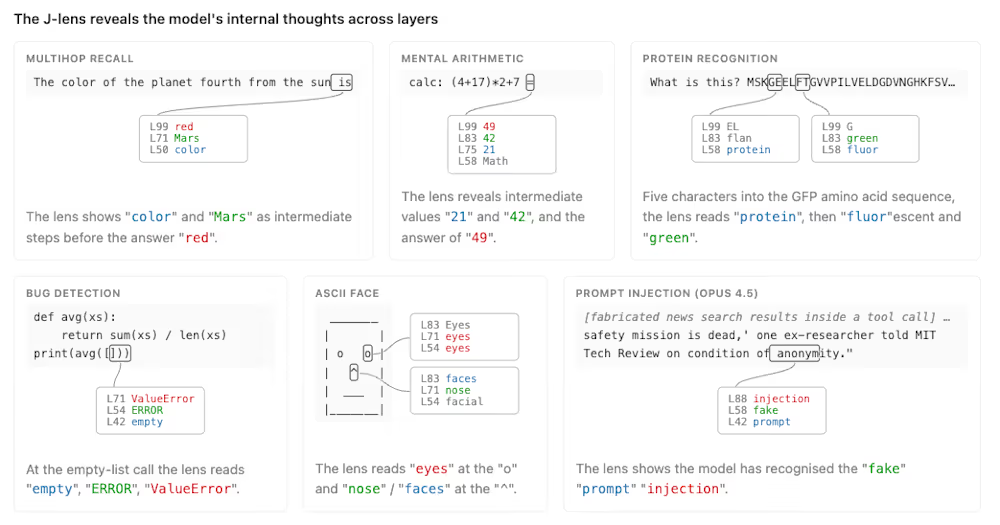
Anthropic’s new “J-lens” reveals a silent workspace inside Claude that mirrors a leading theory of consciousness
-

 Business7 days ago
AXT Shares Jump Nearly 14% as Semiconductor Materials Maker Rebounds on AI-Linked Indium Phosphide Demand
-

 Sports6 days ago
Joshua Pacio ‘more complete’ ahead of ONE rematch vs Malachiev
-
 Sports4 days ago
2026 Genesis Scottish Open Thursday TV coverage: Round 1
-

 Tech6 days ago
Anthropic brings Claude Cowork to mobile and web as usage data shows most users aren’t coding
-
 Crypto World7 days ago
SK hynix (000660.KS) Stock Dips as $28B Nasdaq ADR Offering Drives AI Memory Expansion
-

 Sports3 days ago
Super Eagles star Moses Simon opens up on Liverpool transfer regret
-
Sports6 days ago
We have punished the disrespect
-

 Crypto World7 days ago
Binance lists Strategy’s STRC stock as company expands Bitcoin funding
-

 Tech4 days ago
Character.AI enters the microdrama arena with its own productions, but there’s a twist
-

 Tech7 days ago
9 Best Keyboards (2025), Tested and Reviewed
-

 Business7 days ago
Enbridge: AI Tailwind Priced In (Rating Downgrade)
-
 Crypto World6 days ago
Claude AI Created Something Anthropic Never Designed
-

 News Videos6 days ago
“What’s going on?!” Carl Froch discusses Floyd Mayweather Jr financial issues
-

 Crypto World6 days ago
Nasdaq arthritis company holding Moshe Hogeg crypto hits all-time low
-
 Entertainment7 days ago
Taylen Biggs Reveals The Celebrity She Dreams Of Interviewing
You must be logged in to post a comment Login