
Business
Digital Products to Sell: 20 Ideas Ranked by Real Effort vs. Payoff

I once spent three weekends building a meal-planning template in Notion- color-coded, beautifully organized, genuinely useful. I priced it at $19. I sold four copies. Two were to my mom, who I’m fairly sure just felt bad for me.
So no, digital products are not automatically passive income, and anyone telling you otherwise is usually selling something. What they are is one of the lowest-overhead ways to build a real side income, if you pick the right product for the effort you’re actually willing to put in. Below are 20 of them, ranked honestly by how much work they take versus what they tend to pay.
Digital products are intangible goods like ebooks, templates, online courses, presets, and other downloadable files, that are created once and sold repeatedly online with no inventory, shipping, or per-unit production cost. That “create once, sell many times” model is what makes the margins good, but it doesn’t make the creation effortless — that part still varies wildly by product type.
20 Digital Products to Sell, Ranked by Effort vs. Payoff
Fastest to Launch
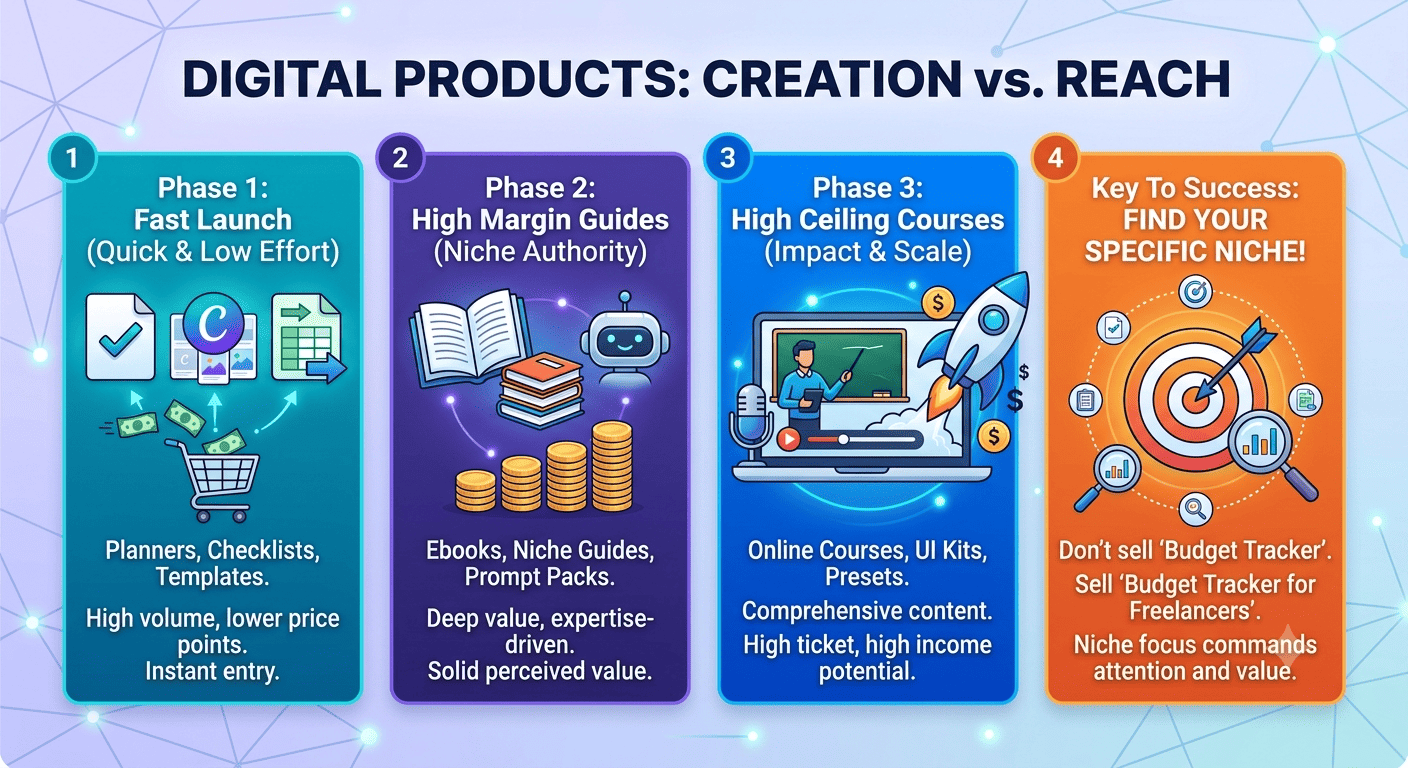
1. Printables (planners, checklists, wall art) — Low effort, quick to design in Canva or Illustrator. Price: $2–$15. Sells well on Etsy in home, wellness, and organization niches.
2. Canva and social media templates — Build one style, duplicate, swap colors and text. Price: $5–$30 for a set. Strong demand from small businesses and creators who want a consistent look without hiring a designer.
3. Notion templates — Currently one of the fastest-moving categories, popular for project management, finances, and content planning. Price: $10–$50.
4. Niche spreadsheets and trackers — Budget trackers, habit trackers, debt payoff planners. Solve one specific problem, which is exactly why they sell. Price: $5–$25.
5. SVG and craft cut files — For the Cricut/Silhouette crowd. Low production time once you’ve built a style. Price: $2–$10 each, often bundled.
Best Margins for the Effort
6. Ebooks and niche guides — General nonfiction sits around $2.99–$9.99; specific, specialized topics (“budgeting for freelancers” vs. generic money advice) command $4.99–$19.99. Time investment is the main cost — there’s no printing or shipping to eat into margin.
7. AI prompt packs — Curated, tested prompts for a specific use case (content writing, coding, design). Cheap to produce, currently high perceived value given how many people are still figuring out how to use AI tools well.
8. Done-for-you business templates — Contracts, intake forms, onboarding guides, SOPs. Service providers pay well for these because they save hours and make a new business look established fast. Price: $15–$75.
9. Done-for-you email flows — Pre-written welcome sequences, abandoned cart flows, or nurture sequences for a specific niche. Less common than the other categories, which is part of the appeal. Price: $25–$150.
10. Workbooks (CBT-style, journaling, goal-setting) — Structured, printable, often paired with an ebook. Price: $9–$25.
11. Mini-courses and frameworks — Condensed versions of a bigger topic: a checklist, a short video walkthrough, a repeatable process. Buyers want a fast, specific win. Price: $19–$79.
Higher Effort, Higher Ceiling
12. Online courses — The highest-ticket common digital product, and the one that takes the most upfront time to build well. Short single-topic courses run $10–$20; comprehensive multi-module courses run $99–$499. Justifies the price if the outcome is genuinely high-value for the buyer.
13. Website themes and UI kits — Requires real design/dev skill, but sells to a market (other creators and small businesses) that’s willing to pay for something that saves them dozens of hours. Price: $30–$150.
14. Lightroom presets and video LUTs — Niche but proven — some creators have built six-figure businesses almost entirely around a signature editing style. Price: $10–$40 per pack.
15. Stock photo and video packs — Higher production effort (you’re the one shooting), but reusable across many buyers once built. Price varies widely by license type.
16. Simple software, plugins, or automation scripts — Highest technical bar on this list, but often the least competitive category because fewer people can build it. Price: highly variable.
Fastest-Growing in 2026
17. Guided meditation and breathwork audio — Short 5–20 minute sessions, sold individually or bundled. Low production cost, strong repeat-purchase rate. Price: $4.99–$19.99.
18. Audiobook versions of existing ebooks — If you already have written content, this reaches an audience that reads less and listens more. Price: $9.99–$19.99.
19. Children’s audio stories — A genuinely underserved niche — parents actively search for screen-free entertainment. Price: $2.99–$9.99.
20. AI-personalized products — Personalized children’s books, custom workout plans, tailored templates generated per buyer. Newer category, growing fast, though it leans on tools and workflows that are themselves still evolving.
How Do You Pick the Right One for You?
Looking at that list, the honest filter isn’t “which one is most profitable” — it’s three narrower questions:
- What do you already know or make, that someone else would pay to skip learning? The sellers who succeed fastest usually aren’t inventing a new skill for the product — they’re packaging one they already have.
- How much upfront time can you actually give it? A printable set is a weekend. A comprehensive course is realistically a multi-month project, even working part-time.
- Is there a specific buyer, or a vague one? “A budget tracker” is vague. “A budget tracker for freelancers with irregular income” is specific — and specific is what sells, because it tells a stranger scrolling past thirty other listings that this one was made for them.
If you can’t answer the third question yet, that’s the actual first step — more important than picking a format off this list.
Are Digital Products Actually Worth It in 2026?
Worth it, yes — automatically passive, no. The “low overhead” part is genuinely true: no inventory, no shipping, no per-unit cost eating your margin. What doesn’t show up in that pitch is that low overhead doesn’t mean low effort — it just moves the effort earlier, into the creation and marketing, instead of into ongoing fulfillment.
The other honest caveat: the obvious niches (generic budget planners, generic productivity templates) are genuinely saturated. The products that still do well tend to be specific rather than broad — which is a theme you’ll notice repeats throughout this whole list.
Where Should You Actually Sell Digital Products?
| Marketplace (Etsy, Creative Market) | Dedicated platform (Gumroad, Sellfy, Payhip) | Your own site (Shopify, WooCommerce) | |
|---|---|---|---|
| Built-in traffic | Highest — buyers are already browsing | Low — you bring your own audience | Lowest — entirely your own traffic |
| Fees | Listing + transaction fees | Monthly or per-sale fees | Platform/hosting cost, generally lower per-sale |
| Control over branding | Limited | Moderate | Full |
| Best for | New sellers with no existing audience | Creators with some following who want more control | Established sellers who already drive their own traffic |
Most sellers starting from zero audience do best on a marketplace first, then migrate to their own platform once they have proof a product sells and don’t want to keep paying marketplace fees on repeat buyers.
What Mistakes Tank Digital Product Sales?
Picking a saturated niche with no differentiation. “Another budget tracker” competes with thousands. “A budget tracker for wedding planners” doesn’t.
Weak previews and mockups. Buyers can’t hold a digital product before purchasing — the preview images are doing all the trust-building work a physical product gets for free.
Pricing based on hope, not research. Check what comparable, specific products in your niche are actually charging before picking a number.
Launching with zero validation. Posting in a relevant community, running a small pre-sale, or just asking your existing audience what they’d pay for costs nothing and prevents building something nobody wants.
How Much Can You Realistically Make Selling Digital Products?
Here’s where most guides on this topic get misleading — they lead with one creator’s standout number ($50,000, sometimes six figures) presented as typical. It isn’t. Outcomes vary enormously based on three factors: how specific the niche is, how large an audience you already have (or can reach), and price point.
A realistic range for someone starting from scratch, building one solid product, and doing their own marketing: modest supplemental income in the first several months, with growth from there tied directly to how much ongoing marketing and product expansion happens — not something that keeps compounding on autopilot.
The Bottom Line
The products on this list that tend to work are the specific ones, built by someone who already had the underlying knowledge, sold to a buyer they could describe in one sentence. Everything else on the list- the platform you choose, the price you set- matters less than getting that part right first.


Baxter International: The Gains Can Continue, But Should Slow

Despite The Headwinds, Earnings Are Exploding To The Upside

Aino Health reports Q2 sales decline on project delays

Yes. Corporate subscriptions are available for teams and organisations, with discounted rates as user numbers increase. Pricing starts from $1,625 + GST per user.
Get in touch
to discuss the right option for your organisation.
Business News subscriptions are used by executives, investors, consultants and professionals who need to stay informed and make better decisions about the WA market. When you subscribe you’ll get
- Unlimited access to WA’s most trusted business journalism
- Data & Insights — detailed profiles of WA companies, people, projects and deals
- MyBN — a personalised feed based on the companies, people and sectors you follow
- Special publications and industry reports
- Daily and weekly email newsletters
Data & Insights is a research tool built specifically for the WA market. It draws on more than 30 years of Business News reporting, updated regularly to reflect what’s happening now. Use it to:
- Look up detailed profiles of WA companies, including financials, directors and ownership
- Find decision-makers and track their career movements
- Research live and completed projects across WA industries
- Monitor deals, appointments and market activity
- Access industry rankings and league tables
Data & Insights is updated daily by our dedicated research team, which uses the latest announcements, ASX filings and editorial coverage to keep our person, company, list and project records up to date.
Business News welcome all opportunities to make our dataset accurate, complete and current, so if you have an update request, please email the team at
general@businessnews.com.au, and we’d be happy to assist.
MyBN
is part of every subscription. It’s your personalised view of Business News. You can follow the companies, people, sectors and projects that matter to you, and get a news feed and alerts tailored to your interests. You can save articles to read later and retain only what you need.
Only subscribers have full access to all content on the Business News website.
If staying informed about the WA economy is part of your job, and/or you’re looking for networking opportunities in WA, Business News is built for you.
Business News subscribers are:
- Executives and directors tracking competitors, clients and market movements
- Investors and advisers researching companies, deals and industry trends
- Consultants and professionals staying across sectors relevant to their clients
- Business owners looking for leads, context and market intelligence
Most Business News publications cover national or global markets. Business News is focused entirely on Western Australia, which means the journalism, the data and the intelligence are all built around WA companies, people and projects — not adapted from a national feed. Data & Insights, included with every subscription, combines more than 30 years of WA-specific editorial research with live business data. There’s no comparable product for the WA market.
The Morning Digest Email provides a comprehensive wrap of the major headlines, relevant to WA business, and includes with a snapshot of the overnight news covering oil, gold and ASX-listed companies.
The Afternoon Wrap Email focuses on the news covered by our team of journalists during the course of the working day, including exclusive stories and analysis, all of which relates to WA business and the local economy.
The BN Weekender Email contains a wrap of the Business News from the week that was, highlighting the top stories in each area of WA business.
Sign up for free.
We’re happy to help.
Get in touch
and our team will come back to you.
Business
Blue Dart Express shares surge 7% after Q1 results. Here’s why Nuvama retains Buy, raises target

The company’s consolidated net profit jumped 79.6% year-on-year (YoY) to Rs 88 crore in Q1FY27, compared with Rs 49 crore in the corresponding quarter last year. Revenue from operations increased 15.1% YoY to Rs 1,658 crore, from Rs 1,441 crore in Q1FY26.
The strong quarterly performance was supported by higher revenue traction, improved operational efficiency, and expansion in operating margins. Blue Dart’s EBITDA margin improved significantly, reflecting better cost management and disciplined execution despite a challenging business environment.
Commenting on the results, Balfour Manuel, Managing Director, Blue Dart, said, “Our Q1FY27 performance reflects focused execution, disciplined network management and continued customer confidence in the Blue Dart brand. Despite a challenging operating environment and higher operating costs, we delivered strong profit growth while maintaining our commitment to reliability, speed and service excellence.”
He added that the company remains focused on enhancing productivity, strengthening its integrated air and ground network, accelerating digital adoption, and investing in sustainable capabilities to create long-term value for stakeholders.

Nuvama remains bullish, raises valuation outlook
Brokerage firm Nuvama maintained its ‘Buy’ rating on Blue Dart Express, citing strong quarterly execution and the company’s positioning in the growing e-commerce logistics segment.
According to Nuvama Research, Blue Dart delivered a robust Q1FY27 performance, with revenue growth of 15% YoY, ahead of estimates. The brokerage highlighted that EBITDA margin expanded by 220 basis points YoY to 15.8%, while profit before tax (PBT) margin improved to 7.2% from 4.6% a year ago, reaching the company’s guided medium-term range of 7–8%.
The brokerage noted that profit after tax (PAT) surged 81% YoY to Rs 88.5 crore, significantly exceeding its estimates and consensus expectations. Following the strong quarter, Nuvama raised its FY27E and FY28E earnings per share (EPS) estimates by 4% and 2%, respectively.
Nuvama has retained its ‘Buy’ recommendation, valuing Blue Dart at 38x June 2028 earnings, and revised its June 2027 target price to Rs 7,350 from the earlier Rs 6,900.
The brokerage believes Blue Dart is well positioned to benefit from the ongoing consolidation in the e-commerce parcel market, which contributed around 30–31% of revenue in FY26. At the current market price, the stock trades at approximately 28x FY28E earnings.
With improving margins, sustained revenue growth, and a strong logistics network, Blue Dart remains a key beneficiary of India’s expanding express delivery and e-commerce ecosystem.
(Disclaimer: Recommendations, suggestions, views and opinions given by the experts are their own. These do not represent the views of The Economic Times)

Air travel across the Middle East continues gradually stabilizing more than five months after the outbreak of the U.S.-Iran conflict severely disrupted one of the world’s busiest aviation corridors, though several major hubs remain constrained by damaged infrastructure, safety advisories and ongoing regional hostilities.
The Iran war triggered widespread airspace closures beginning Feb. 28, when U.S. and Israeli strikes on Iran plunged the region into conflict, grounding tens of thousands of flights and severing key global transit hubs connecting Europe, Asia, Africa and North America. According to travel platform Wego, the resulting grounding of flights and temporary isolation of mega-hubs like Dubai and Doha represented the most disruptive systemic shock to global aviation since the COVID-19 pandemic.
Several major hubs are now operating close to normal levels. The United Arab Emirates, home to Dubai and Abu Dhabi, is described as fully open, according to Wego’s most recent assessment. Saudi Arabia, Qatar, Bahrain and Oman are all described as largely open, though each continues to carry some operational caveats depending on the specific airport and airline involved. Dubai International Airport is running flights across all three of its terminals, and Qatar Airways confirmed earlier this summer that it had restored flights to 85% of its pre-crisis schedule levels.
Kuwait represents the clearest ongoing exception to that broader recovery. Kuwait’s main airport remains not fully operational, according to Newsweek’s assessment of the current situation, with key infrastructure still damaged and some terminals remaining closed. Foreign airlines continue to face restrictions at the airport, and while portions of Kuwaiti airspace have reopened, international routes into and out of the country remain limited compared with pre-conflict levels. Terminal 1, the airport’s primary international facility, has remained closed since suffering significant structural damage, including a partial roof collapse, during a strike in early June, with Kuwait Airways and Jazeera Airways instead operating out of Terminals 4 and 5.
Even in airspace that is technically classified as open, aviation safety advisories tied to earlier missile, drone or military activity continue to shape how airlines operate throughout much of the region. Regulators and airlines have continued flagging elevated risk across Iran, Iraq and broader Gulf airspace, according to aviation safety tracking service safefly.aero, with some carriers selectively avoiding certain flight paths or reducing service frequencies even where no formal airspace closure remains in place.
The European Union Aviation Safety Agency has maintained some of the most cautious guidance among international regulators. EASA’s Conflict Zone Information Bulletin, most recently extended through Aug. 31, instructs EASA-regulated airlines to avoid flying within the airspace of the UAE, Bahrain, Kuwait and Qatar at any altitude, along with a defined portion of the Gulf of Oman, citing continued risk tied to missile, drone and combat aircraft activity linked to the region’s unstable security situation. That advisory has led numerous major international carriers, including British Airways, Singapore Airlines, Air Canada and members of the Lufthansa Group, to extend their own suspensions of Middle East routes well into the autumn, even as UAE-based carriers such as Emirates, Etihad Airways and flydubai continue operating the substantial majority of their networks.
Other pockets of restriction persist across the broader region as well. Four airports in southern Saudi Arabia were closed by NOTAM earlier this summer after a Houthi missile and drone attack, part of a broader pattern of intermittent strikes and closures that has continued affecting specific airports even as most of the region’s major hubs have returned to largely normal operations. Air traffic routing through the middle of the Gulf has also remained complicated by Kuwait’s ongoing limitations, forcing many international operators to route flights around the country via either a southern corridor through Egypt, Saudi Arabia and Oman, or a more northerly path, according to aviation monitoring group OPSGROUP.
Airlines have continued a gradual, staggered process of restoring previously suspended routes throughout the summer. British Airways resumed flights to Dubai and Doha beginning July 1, while Gulf Air has steadily rebuilt its network following Bahrain’s airspace reopening, restoring service to cities including London, Dubai, Istanbul and Riyadh, with additional routes continuing to phase in through the summer months. Iraqi Airways has similarly resumed both domestic and international operations as part of a broader phased return to service across the region’s national carriers.
Given how frequently conditions have continued shifting throughout the conflict, travel monitoring services consistently advise passengers to verify their specific flight status directly with their airline before heading to the airport, rather than relying solely on general regional status updates, given how quickly individual route restrictions, terminal closures and safety advisories have continued changing across different countries and airlines throughout the ongoing conflict.
With Kuwait’s main airport still working through infrastructure repairs and several international regulators maintaining cautious advisories through the end of August, the broader Middle East aviation sector appears likely to continue its gradual, uneven recovery in the weeks ahead, even as the region’s largest hubs in Dubai, Doha and Abu Dhabi have largely returned to something closer to their pre-conflict operating tempo.

Seeen’s 2025 revenue jumps 65% as EBITDA loss narrows

A minor earthquake shook the city of Hawthorne, California, on Sunday evening, according to the U.S. Geological Survey, though no damage or injuries were reported in connection with the tremor.
The magnitude 2.6 quake struck at 8:30 p.m. local time, with its epicenter located less than a mile from the neighboring communities of Gardena, Inglewood and Westmont, all situated within the greater Los Angeles area. Seismologists recorded the earthquake’s origin at a depth of 6.5 miles below the surface, according to USGS data.
Earthquakes of this magnitude are common across Southern California, a region crossed by numerous active fault systems, including segments of the broader San Andreas Fault network that runs through much of the state. The USGS estimates that Southern California experiences thousands of earthquakes each year, though the vast majority are too small to be felt by residents without sensitive seismic instruments. Quakes in the magnitude 2.5 to 3.0 range, like Sunday’s tremor near Hawthorne, are generally on the threshold of what a person standing near the epicenter might notice, often described as a brief jolt or vibration rather than significant shaking.
Hawthorne and the surrounding South Bay area of Los Angeles County have experienced similar small earthquakes in the past without resulting in damage. The USGS operates a real-time earthquake monitoring system that tracks seismic activity across the country, publishing data within minutes of a quake’s occurrence and inviting residents who felt shaking to submit reports through its “Did You Feel It?” online tool, which helps researchers map the extent and intensity of ground motion associated with a given event.
Sunday’s earthquake was one of several recorded across California in recent days, part of the routine background seismicity that characterizes the state. In the weeks prior, the USGS logged a magnitude 4.3 earthquake near California City on July 13 and a magnitude 4.1 quake near Frazier Park on July 12, both considerably stronger than Sunday’s Hawthorne tremor but still within the range of earthquakes that typically cause little to no damage. Larger, more damaging earthquakes in the magnitude 5.5 and above range remain comparatively rare events, though seismologists have long cautioned that Southern California remains overdue for a major rupture along sections of the San Andreas Fault, based on historical recurrence intervals.
No tsunami warning was issued in connection with Sunday’s earthquake, and the USGS did not report any immediate aftershock activity following the initial tremor. Local emergency services in Hawthorne and the surrounding communities did not report receiving calls related to damage or injuries stemming from the quake.
Residents throughout the greater Los Angeles area are routinely encouraged by California emergency management officials to maintain basic earthquake preparedness measures, including securing heavy furniture, keeping emergency supplies on hand, and staying familiar with the standard “drop, cover and hold on” response recommended during shaking, given the region’s ongoing exposure to both minor and, less frequently, more significant seismic activity.


Dhierin-Perkash Bechai is an aerospace, defense and airline analyst.
Dhierin runs the investing group The Aerospace Forum, whose goal is to discover investment opportunities in the aerospace, defense and airline industry. With a background in aerospace engineering, he provides analysis of a complex industry with significant growth prospects, and offers context to developments as they occur, describing how they might affect investment theses. His investing ideas are driven by data informed analysis. The investing group also provides direct access to data analytics monitors.
Learn more.
Analyst’s Disclosure: I/we have no stock, option or similar derivative position in any of the companies mentioned, and no plans to initiate any such positions within the next 72 hours. I wrote this article myself, and it expresses my own opinions. I am not receiving compensation for it (other than from Seeking Alpha). I have no business relationship with any company whose stock is mentioned in this article.
Seeking Alpha’s Disclosure: Past performance is no guarantee of future results. No recommendation or advice is being given as to whether any investment is suitable for a particular investor. Any views or opinions expressed above may not reflect those of Seeking Alpha as a whole. Seeking Alpha is not a licensed securities dealer, broker or US investment adviser or investment bank. Our analysts are third party authors that include both professional investors and individual investors who may not be licensed or certified by any institute or regulatory body.


I’m a passionate investor from the Netherlands with 12 years of stock market experience. My articles usually contain a good overview of important investment criteria. A stock for my portfolio is of interest to me if the company has the following characteristics:1. Companies that are growing in both revenue, earnings and free cash flow.2. Companies that have excellent growth prospects.3. Stocks with favorable valuations.I prefer steadily growing companies with high free cash flow margins, dividend stocks and stocks with generous share repurchase programs.Disclaimer: My articles do not provide financial advice, they reflect my own findings and insights.
Analyst’s Disclosure: I/we have no stock, option or similar derivative position in any of the companies mentioned, and no plans to initiate any such positions within the next 72 hours. I wrote this article myself, and it expresses my own opinions. I am not receiving compensation for it (other than from Seeking Alpha). I have no business relationship with any company whose stock is mentioned in this article.
Seeking Alpha’s Disclosure: Past performance is no guarantee of future results. No recommendation or advice is being given as to whether any investment is suitable for a particular investor. Any views or opinions expressed above may not reflect those of Seeking Alpha as a whole. Seeking Alpha is not a licensed securities dealer, broker or US investment adviser or investment bank. Our analysts are third party authors that include both professional investors and individual investors who may not be licensed or certified by any institute or regulatory body.

Politics Home Article | Dame Prue Leith: living and dying well

Jamshedpur FC Players Make Emotional Appeal As Owners Look To Dismantle Senior Team

How new Bake Me Home cake shed in Darlington is thriving


-

 Business4 days ago
Why Trees Belong on the Risk Register
-

 Fashion3 days ago
Weekend Open Thread: Wit & Wisdom
-

 Politics2 days ago
Meta enters AI-training agreement with far-right ‘propaganda rag’ Newsmax
-
 Entertainment5 days ago
‘Stargate’ Creator’s New Sci-Fi Series Returns for Season 3 Tomorrow
-

 Politics7 days ago
Luke Littler dismantles Gerwyn Price to retain title in Blackpool
-

 Crypto World2 days ago
MicroStrategy Post-Earnings CLARITY Act Push Could Add New Catalyst for Its Stock
-

 Politics6 days ago
The Part of the Electric Transition Nobody Wants to Discuss
-

 Business5 days ago
Major shareholder moves on Canyon
-

 Crypto World2 days ago
XRP Ledger v3.3.0 brings five institutional features
-

 News Videos4 days ago
Bitcoin Enters the 3rd Stage of the Bear Market
-

 Crypto World5 days ago
Kraken Enables Retail Access to Jersey Mike’s IPO via Tokenized Shares
-

 Tech6 days ago
New macOS Sequoia & Sonoma security updates for older Macs
-

 News Videos5 days ago
Claude: Build Financial Dashboards in Minutes (2026)
-

 Politics4 days ago
Luke Littler’s dominance sparks GOAT debate
-

 Business5 days ago
Johnson & Johnson agrees to $5.5B settlement over talc cancer claims
-

 Sports3 days ago
Seema Kaliramna Wins Discus Throw Bronze, Takes India’s CWG Medals Tally To 17
-

 Crypto World21 hours ago
Crypto PAC spending tops $2M in Michigan House race
-

 Business3 days ago
Trump Announces Hamas Disarmament Agreement as Iran Strikes Kuwait Air Base and US Attacks Pause Overnight
-

 Tech5 days ago
Gemini can now summarize the messiest comment threads in Google Docs
-

 Tech1 day ago
ESET tracks rise in malicious AI skills and adaptable malware
You must be logged in to post a comment Login