Connect with us

Business

Why a 70:30 India-global portfolio makes sense in a changing world, Subho Moulik decodes

Published

on

Why a 70:30 India-global portfolio makes sense in a changing world, Subho Moulik decodes
As Indian equity markets delivered modest returns in 2025 compared with stronger gains in global markets, the debate around portfolio diversification has moved sharply into focus. With currency depreciation, evolving global growth drivers, and transformative themes like AI, defence, and quantum computing reshaping investing opportunities, sticking to a purely domestic strategy may no longer be enough.

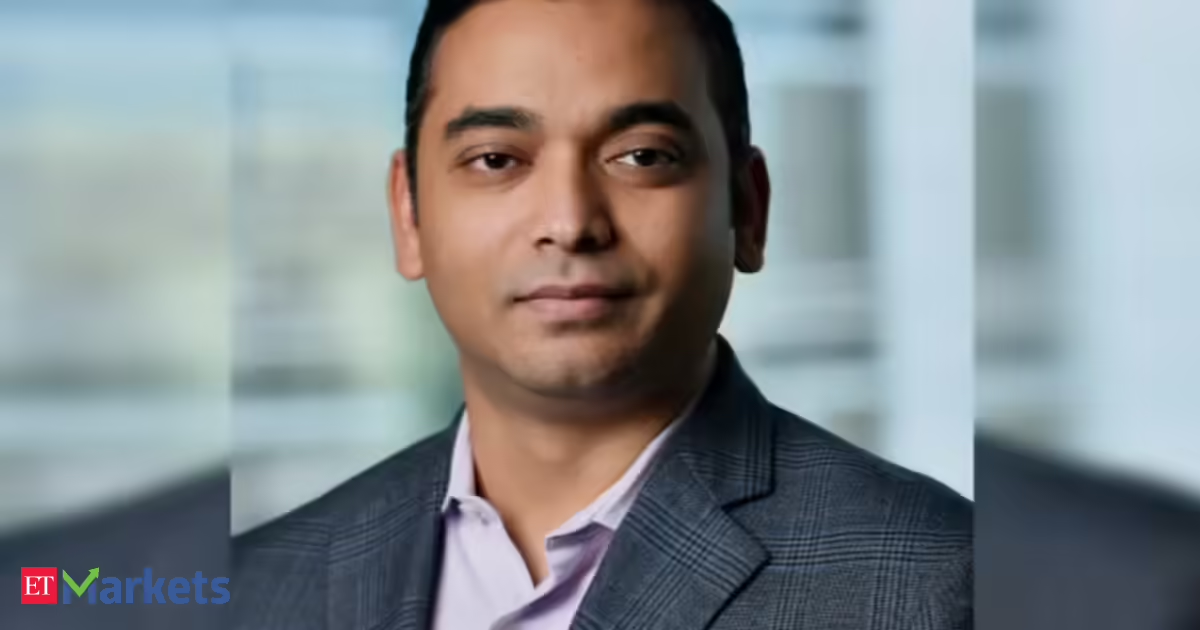
In this context, a balanced approach that combines home market familiarity with global exposure is becoming increasingly relevant. Speaking to Kshitij Anand of ETMarkets, Subho Moulik, Founder and CEO of Appreciate, explains why a 70:30 India–global portfolio can help investors improve risk adjusted returns, reduce concentration risk, and participate in the world’s most powerful long term growth trends in a rapidly changing global landscape.

Kshitij Anand: If you look at the data for 2025, the Nifty delivered around 10%, while US markets were well ahead with returns of about 16%. Do you think some Indian investors may have felt they missed the rally? And if you look at returns in dollar terms, which are slightly worse for Indian investors, what are your views on that?


Subho Moulik: If you are an Indian investor with no diversification, you essentially saw your portfolio go up by about 10%, while the US market delivered almost double that when you include currency, roughly around 22%. The rise in US portfolios is not a one year story. If you look at the past few years, they have been bumper years for US investors.For full disclosure, my portfolio is about 70 to 80% global and around 20% India. And of course, we are in the business of democratising global investing, so I do have a bias. But if you look at the numbers, it is a very rational decision for Indian investors to allocate money not just to India, but also globally.

Advertisement

On timing, I think there is still plenty of room left in the rally. Historically, the average bull market since World War II lasted about seven to eight years. There have also been bull markets that ran for as long as 15 to 16 years. The current bull market is well short of those durations. No one knows when a bull market will end. Anyone who claims they do, well, best of luck to them. I certainly do not know. But if you look at historical averages and current fundamentals, there should still be room for this bull market to continue.So, I do not think timing is the issue. The real question is about themes. What are you investing in, and why you did not diversify earlier. Let me ask you a question. We are all aware of the Nifty 50. If I told you the Nifty 50 exists, but you can only invest in two Nifty 50 stocks for the rest of your life, how would you react?

Kshitij Anand: In that case, I think that may have worked two decades ago, but things are changing now. No company survives indefinitely, and even within the Nifty 50 there is constant churn. If I take your point, yes, if I pick a Nifty 50 stock today, there is always a possibility it may not be part of the index six months down the line.

Subho Moulik: Exactly. If someone told you there are 50 stocks, but you can only invest in two, your first reaction would be why would I only invest in two stocks? You would want more choice. This ties back to the point you made earlier. India is a very important market from a future perspective, but it still represents only about 4%, or even less, of the global market. Therefore, as an investor, the rational choice is to think about diversification. How to allocate capital in a way that improves returns while reducing overall risk. That is what investors should be doing.

I do not think timing is an issue at all. In fact, if there is a sudden crash, say something completely unexpected happens in the next month and markets correct sharply, that would be a fabulous time to buy.

Kshitij Anand: Absolutely. We have seen that happen multiple times in the past.

Subho Moulik: Exactly.

Kshitij Anand: In fact, there is another dilemma Indian investors might be facing. In terms of GDP growth, India is likely to deliver around 7% in 2026–27, while global growth is expected to be around 2.5 to 3%. However, the scale of the economy differs significantly between the US and India, and even a 2.5 to 3% growth rate for the US is considered quite strong. Still, many Indian investors tend to focus on the headline numbers, 7% versus 3%. Could you help investors understand how to translate this into portfolio decisions, especially when investing abroad?

Subho Moulik: I will address that. This comparison is a fallacy, a red herring, and I will explain why. When you invest in the US, you are not investing only in US focused or US centric companies. Let us take an example from beverages. Whether or not you believe that the beverage market in India will grow rapidly, let us assume for a moment that it grows in line with GDP. It is a mass consumer segment and should broadly follow the economic cycle. Now, who do you think benefits from the growth of India’s beverage industry?

Advertisement

Kshitij Anand: US companies.

Subho Moulik: Coca Cola and Pepsi.

Kshitij Anand: Pepsi, and they are all US based companies.

Subho Moulik: Exactly. They are all based in the US. So, when you invest in US stocks, you are not necessarily investing in the US economy. Today, most global multinationals are listed in the US, and therefore, investing in US markets is effectively a bet on global growth.

What investors should increasingly think about is which sectors to invest in and where the global leaders in those sectors are located. To continue with the beverage example, if you believe beverages are a compelling investment theme, the global leaders in that space are listed in the US. If we move to a more realistic example, the leaders in semiconductors, companies like Nvidia, are also listed in the US. The leaders in genetics are largely in the US as well, with some presence in Europe and China. In defence, the dominant players are again largely US based. In emerging areas like quantum computing, which could become as exciting as, or even more exciting than, AI, there is once again a strong presence in the US and China.

So, while India has strong growth prospects, as an investor you already carry significant home country risk. You live in India, your home is in India, and your job is in India. From a portfolio perspective, diversification is important so that if something goes wrong domestically, at least part of your investments is insulated.

Advertisement

Another important point is how different markets react to shocks. Twenty years ago, if the US market moved up by a certain amount, India would usually follow. Over time, the correlation between the two markets has been declining, and we expect this trend to continue. That actually increases the benefits of diversification.

Finally, there is also the comfort of investing in markets where the rule of law is well established and investors have confidence in capital protection and repatriation. So, the real question is not about 2% GDP growth versus 7% GDP growth. The real question is where are the pockets of the highest growth in the world, and how can investors access them?

Kshitij Anand: Absolutely. In fact, I recall the saying: if the US sneezes, India catches a cold. If you correlate that here, earlier any movement in the US used to impact India. That has not been true recently because much of the rally has been driven by DIIs rather than FIIs. FIIs have taken a bit of a backseat, and DIIs are running the show. But yes, if you go back five to seven years, you could definitely say that if the US sneezed, India caught a cold. So, when you talk about the bull run and say there is plenty of room left, can we say the party continues on Wall Street as well, and not just on Dalal Street?

Subho Moulik: If you look at the current US bull run, there are a couple of common fears. One is that a large portion of returns has been concentrated in seven, eight or ten stocks; second, that forward earnings multiples are at all-time highs, making the market look bubbly and frothy; and third, that this is all speculation and will come crashing down. Let me address these one by one.

I do not think the data supports the view that the US market is becoming more concentrated. On a relative basis, if you look at gains over the last three years, 2025 was the lowest in terms of concentration. The Magnificent Seven contributed about 55% of gains in 2023 and around 42% in 2025, which shows a declining trend. You may still ask why seven stocks contribute around 40% of gains, but that is because these companies are expected to drive disproportionate disruption through what they are doing.

Advertisement

The second concern is about valuations. The S&P 500 is trading at around 22x forward earnings, while the Magnificent Seven trade at about 29–30x forward PE. The historical peak has been closer to 40x, so we are still below those levels. Another important point is that a few years ago, small caps—represented by the Russell 2000—were not delivering returns. That has now changed, and the Russell 2000 has delivered reasonable returns. It typically underperforms the S&P 500 slightly and does not suffer from the same concentration issues.

So, I think economic performance is much more broad-based than what headlines suggest. Clickbait headlines are easy to consume, but deeper analysis often gets missed. That does not mean returns are perfectly democratic across all 5,000 stocks, but around 500–600 companies are delivering returns. Unlike episodes such as the Tulip bubble or the dot-com bubble, there are real earnings backing this rally. One can debate the quality of earnings or whether there is circularity among a few players, but these are real earnings driven by disruptive technology, particularly AI.

If you look at what is emerging—the combination of quantum computing, expanding AI use cases, and even progress towards viable fusion energy—each of these reinforces the other. There is an energy challenge, a computing power challenge, and a question of how quickly AI use cases can become real. As these factors interact, a very interesting virtuous cycle could emerge, though it may or may not play out.

Because of this, I am less worried about an imminent collapse of the bull run. Even if the bull market ends due to a black swan event—say China invades Taiwan, another pandemic emerges, or some other unforeseen crisis occurs—markets will crash. No one predicted COVID before it happened. Black swans are, by definition, unpredictable.

Advertisement

But even in such scenarios, the right approach is to buy the dip. Dumb money buys at the peak; smart money buys on corrections. If you are fortunate enough to have cash during a market crash, invest it. A 25% correction is a good opportunity. Do not try to time the exact bottom—buy the dip.

Kshitij Anand: Another fear in the minds of Indian investors is currency risk. We have just touched 90 against the US dollar and are hovering around that level. There are headlines asking whether we are heading towards 95 or even 100. How should investors think about this?

Subho Moulik: It is very hard to fight basic economics. There will continue to be an inflation differential for some time. Even when the US was concerned about inflation, it was around 4%. The Fed will continue to focus on keeping inflation in check. India’s inflation is likely to remain higher, and as long as there is an inflation differential—and therefore an interest rate differential—I do not see the currency moving in any direction other than gradual depreciation.

If there were a structural economic shift where inflation and interest rate differentials reversed, then currencies would move the other way. I do not think that is likely over the next decade, though I could be wrong. Over the past three decades, the pattern has been consistent, and the next decade is likely to follow a similar trend. A 3–5% annual currency depreciation is quite plausible.

This is why I keep coming back to the point of diversification. Do not limit yourself to a narrow set of choices. Of course, back your own economy—you understand it well and there are many good opportunities in India—but do not put all your eggs in one basket. Diversify.

Advertisement

Diversification also gives you access to sectors that simply do not exist in India, not because there is anything wrong with India, but because markets develop differently. Whether it is AI, defence, genetics, rare earths, or exposure to regions like Latin America, there are many themes where India has limited or no exposure. I can name 40 such themes.

By diversifying globally, you get exposure to the themes you believe in and also reduce the impact of currency depreciation. If you look at historical data over the past 20 years, a simple allocation of 70% India and 30% global equities—pure equity, not debt—would have outperformed either market individually. That is because of better risk-adjusted returns and lower correlation. When one market suffers a shock, the portfolio holds up better.

The reasons to diversify keep piling up. The biggest hurdle is inertia.

Kshitij Anand: And the first step is to start doing it.

Subho Moulik: Exactly. Start doing it. Kshitij, what is your global exposure?

Advertisement

Kshitij Anand: My global exposure; well, it is not that much.


Subho Moulik:
So, less than 10%?

Kshitij Anand: Absolutely, less than 10%.

Subho Moulik: Then you need to move closer to 30%. After this, we can talk about how to do that. If you look at the average Indian investor’s portfolio—say, someone invested in Indian mutual funds or stocks—the average international exposure is probably less than 1%. So, there is a massive opportunity simply to reach a basic level of diversification.

Kshitij Anand: One point you mentioned earlier was the concentration of the rally. Another concern Indian investors often have is the lack of research available beyond the Magnificent Seven. How can investors address this gap and gain confidence to invest in US small and mid caps, especially when even Indian markets sometimes lack adequate data?

Subho Moulik: I have three responses to that. First—and I will briefly plug what we do, since it is relevant—if you use an app that specialises in global stocks, like Appreciate, you get access to analyst ratings such as buy and sell calls, consensus views, financial ratio snapshots, and stock-specific news and perspectives. The US is a data-rich market. If you go to the right partner, app or platform—and we are one of the leading providers of global stock access—there is a wealth of information available, much more than in India, because the market is more mature.

Second, before you start actively trading, it is better to begin with broad-based bets. For example, you could invest in an index like the S&P 500 or take sector-level exposure. Before saying, “I have enough conviction to buy stock X and sell stock Y,” it makes sense to start with index or sectoral investments, which are easier to understand and form a view on.

Advertisement

Third, and this is something we plan to launch in the coming financial year, is AI-based investing advice and automated transactions. We are building a research engine with zero human analysts—completely AI-driven—that pulls insights from anywhere between 5 and 32 sources, monitors markets 24×7 (often in real time), distils that information, and provides recommendations that can be executed automatically. Investors can opt into such a plan, monitor performance, and continue only if they are comfortable. This is entirely optional. We believe we will be among the first Indian players to offer truly AI-based portfolios, and this will increasingly become another avenue for investors.

So, there are multiple ways for people to educate themselves. You can take a highly sophisticated route or a simpler one, but lack of information should not be a barrier.

Kshitij Anand: That is a smart approach, because lack of information and apprehension about where to start often keeps investors away. Most people only know a handful of global companies; Pepsi, Coke, as you mentioned, or the Magnificent Seven. Beyond that, unless a company makes headlines in Reuters or other global media, it tends to stay off the radar. It is good that you mentioned AI, because my next question is about that. Has the AI story moved from narrative to earnings?


Subho Moulik:
Let us break the AI story into three parts: the infrastructure required for AI, general-purpose use cases, and AGI, or artificial general intelligence. The infrastructure story is very real. Data centre build-outs, energy consumption, and chip manufacturing are all happening at scale. Right now, this infrastructure is being built to support use-case development, and as those use cases see wider adoption, usage will increase, further driving infrastructure demand. Most of the earnings-driven value creation so far has been on the infrastructure side.

In terms of use cases, some are already seeing broad adoption, especially content-related applications. For example, AI-generated videos and creative content are becoming mainstream, and creative companies are increasingly exploring how to use these tools. As a small example, a large portion of advertising content today is already AI-generated.

Advertisement

Then there is AGI, which depending on who you listen to, is either imminent within the next five years, far away, or imminent but manageable. The debate there is more about governance and safeguards. Markets are not really pricing this in yet, because it is almost impossible to predict the timeline or outcomes.

So, there is a fair amount of reality in the AI story. The key question is whether a quarter of weaker-than-expected performance, due to slower scaling of use cases or a temporary dip in infrastructure demand, derails the theme, or whether investors look through it, recognising that this is a long-term, disruptive technology. In my view, AI is here to stay.

Kshitij Anand: AI is here to stay, that is…

Subho Moulik: AI is here to stay. Now, what form it will take, I do not know. I think we will see various avatars, no pun intended, over the next 2, 3, 5, 7 or even 10 years. If you think about it logically, and I may sound a bit philosophical here, if we take the idea of diversification and apply it to humanity as a planet, our best bet is to diversify onto other planets. I do not think we get there without some level of AI in space and related technologies. So, there are multiple reasons why I see AI continuing to evolve.

Another area where AI is clearly here to stay is defence. It is a genie that has been let out of the bottle and is not going back in. We are likely to see more autonomous systems and weapons of various kinds, and there is no reversing that trend. So, space and defence are other key use cases—some driven by utilitarian or altruistic motives, and others, quite frankly, driven by the objective of maximising efficiency in warfare because that is where money is made.

Advertisement

Kshitij Anand: You mentioned Elon Musk, and his companies have also diversified into India—Tesla is now in India. And in fact, most US companies are diversified not just into India but across the globe. That is really the core point. That is what makes them special, and that is why investing in US markets is not just a bet on the US, but on global growth.

Subho Moulik: That is right.

Kshitij Anand: Another theme that has been getting a lot of attention from investors is Trump’s policies, especially on tariffs. Could that derail the US bull market story?

Subho Moulik: I think tariffs are primarily being used by Trump as a negotiating tool. This is not crystal-ball gazing; it is quite evident. As negotiations progress, the extreme tariffs, like 300% tariffs, tend to get walked back, and what remains is a more reasonable, lower-level tariff regime. I think that is likely to persist.

People and companies are also adapting. Supply chains are being reconfigured. Earlier, companies manufactured where it was cheapest—Mexico, China, or elsewhere. Now, when they look at landed costs including tariffs, they reassess and move production accordingly. In some cases, production may return to the US; in others, it may shift to different locations.

I do not think inflationary effects from tariffs have fully played out yet. As they do, that itself becomes a pressure point for tariff rationalisation, because inflation is a very sensitive domestic issue. Tariffs have not turned out to be the market destroyer many feared, largely because each time markets approached a tariff cliff, Trump often stepped back and extended timelines. That is consistent with his style, announce something drastic, then revise it. Markets have learned to partially price this in and then wait for clarity.

Advertisement

So, I do not see tariffs as a doomsday scenario. Over time, tariffs are more likely to come down, especially if they start feeding meaningfully into inflation. There are also legal challenges in the US questioning whether tariffs have been imposed through entirely legal mechanisms.

Kshitij Anand: For investors, the key takeaway is not to focus only on headlines but to look deeper. Tariffs are there, but as you said, they need not dominate investment decisions in US stocks. Another geopolitical concern that has come up is the recent military action in Venezuela. There could be more such events. Does that hurt the US investment story?

Subho Moulik: There are multiple geopolitical flashpoints, Ukraine, Israel, Iran, parts of Africa, Venezuela, and potentially Taiwan. Among these, Taiwan is uniquely sensitive because of its role in global semiconductor supply and existing defence commitments. In most other cases, history shows a short-term disruption, usually a week or so, after which markets stabilise.

There are always winners and losers. I am not commenting on the legality or morality of actions, it has happened. Some companies lose, some gain. From a market perspective, the net impact is usually limited. In conflicts involving energy, oil companies tend to benefit. Defence companies almost always benefit. As long as shipping and logistics are not severely disrupted, markets move on.

Taiwan is the exception. But broadly, despite political turbulence and debates, such as discussions in the US around executive powers—markets tend to look through these events. As strange as it may sound, most of these developments turn out to be non-events from a market perspective.

Advertisement

Kshitij Anand: Absolutely. Even historical data suggests that. Now, let us move to specific sectors. We have spoken about AI, and investors have already made significant gains in AI-led sectors, as well as in clean energy and healthcare. Are there specific sectors you believe investors should focus on in 2026 and beyond, from a long-term perspective?

Subho Moulik: I will start with the more pessimistic view and move toward the optimistic. Defence spending is going to rise globally, as a percentage of GDP. I would invest in defence. I would also invest in space. Defence companies will increasingly look at space-related opportunities, not just launch systems but allied businesses. Space is a compelling long-term theme.

AI remains interesting, perhaps a bit bubbly, but still compelling. I am also very bullish on quantum computing. To put it in perspective, it took about 30–35 years to go from supercomputers to personal computers. I believe the first quantum supercomputers could emerge within the next 10 years. That implies that over the next half century, we could potentially see quantum personal computers. That would be a game changer in processing power and applications. The last time fundamental physics translated into real-world applications on this scale, it changed the world, think transistors or nuclear technology.

Energy is another major theme. Rare earths are in focus because of their importance to renewables like solar. Hydrogen could be a disruptive force. Fusion energy, though longer-term, could reshape the entire debate around energy generation. Whether these innovations come from new energy companies or existing ones reinventing themselves is an open question, but energy remains a very interesting space.

Healthcare and life sciences are equally exciting. Drug discovery timelines are collapsing due to AI and computational advances. We are likely to see more biosimilars and breakthrough therapies. Longevity science is advancing rapidly, there are already claims that someone alive today could live to 300. Treatments for Alzheimer’s, obesity, and other conditions are evolving at an unprecedented pace.

Advertisement

Much of this progress comes from deep, foundational scientific research that eventually leads to these breakthroughs. Which countries will lead that research? Will the US continue to maintain its edge? These are important questions. But in the near to medium term, these are the sectors I would focus on.

Kshitij Anand: The next question usually revolves around choosing between global ETFs and individual stocks. How should one take that call?

Subho Moulik: As I mentioned earlier, ETFs have a lot going for them. They give you sectoral or index exposure, they are relatively low-cost, and they allow you to invest in a basket of stocks in an efficient and inexpensive way. I would definitely say that global ETFs are far better than Indian mutual funds that invest in global ETFs, because the expense ratios tend to be much higher in the latter. It is usually better to own global ETFs directly.

Between ETFs and stocks, it really comes down to how comfortable you are making individual stock bets versus investing in a basket or a theme. It depends on your confidence level as an investor and where you are in your investment journey. Typically, I would suggest having a mix—some ETFs and some individual stocks. There is no magic formula.

Kshitij Anand: Absolutely, a mix-and-match approach works well. Also, there are certain barriers Indians face when investing in the US. How is Appreciate tackling those challenges? You spoke about data availability and how the app makes it seamless for Indian investors to make informed choices, with rankings and easy transactions for buying and selling.

Subho Moulik: Let me address that. First, we have worked very hard to simplify onboarding. This is a regulated space, so Appreciate is a registered broker-dealer with integrations across multiple banks. We go through rigorous information security processes, audits, and compliance checks, and we partner with trusted global brokers to ensure safety.

Advertisement

All investments are covered by SIPC insurance in the US—up to $500,000—not for market losses, but for broker or custodian failure. Assets are held with a custodian, not by us. So safety and trust are key pillars. We also partner with mainstream banks and operate within a fully regulated framework. These are basic hygiene factors.

Onboarding itself is very simple—PAN, Aadhaar, and basic profile information. While we ensure all regulatory requirements are met, the process typically takes about two minutes before you can start investing.

On remittances, we know how painful the traditional process can be, filling out A2 forms, visiting bank branches, submitting documents, and answering queries. By the time all that is done, the stock you wanted to buy may have already moved significantly, and the opportunity—and excitement—is gone.

Kshitij Anand: And the excitement is gone as well.

Subho Moulik: Exactly. What we enable is seamless, fully digital remittance that happens quickly. From the investor’s perspective, there is ample research available on the platform. We are also introducing AI-based recommendations, which we discussed earlier. Essentially, we remove the operational friction so that you can focus on portfolio performance and investment decisions, and leave the rest to us.

Advertisement

We also make tax compliance easy. You can download everything you need for tax filing and share it with your CA. We try to eliminate all the usual stress points so that investors can focus on making the right decisions.

Kshitij Anand: You mentioned upcoming sectors earlier. How is Appreciate helping investors identify or track these themes? Is there something within the app that allows investors to go overweight on certain emerging sectors?

Subho Moulik: We are doing this in two ways. First, we are launching access to global thematic portfolios. We scan global markets and work with some very interesting asset managers, evaluate past performance, and curate a set of around 30–35 thematic portfolios. These cover themes such as energy, AI, genetics, country-specific themes, and commodities versus equities.

These will be available at the beginning of the new financial year. Investors can choose from these themes, or even request a bespoke portfolio, provided they meet a minimum investment threshold.

Second, we are launching AI-based recommendations with automated execution. The idea is simple—no individual investor can realistically track 30-plus data sources, monitor real-time markets, interpret signals, and execute trades continuously. Our AI engine does exactly that, delivering a package of automated buy and sell decisions. Investors simply authorise participation in the programme and then assess performance. If they are comfortable, they continue; if not, they can opt out.

Advertisement

We believe these two offerings are strong differentiators, allowing investors to use their time more effectively—deep-diving into areas of interest and leaving the rest to us.

Kshitij Anand: Another concern for investors is regulatory compliance and taxation. How does Appreciate make that seamless?

Subho Moulik: From a compliance perspective, we are very strict about being fully compliant. We are a SEBI-registered investment adviser, a registered broker-dealer, and we are launching our own payment service provider to enable fully regulated remittances. We comply with all relevant Indian and US regulations, and investor assets are protected under SIPC insurance.

We work with leading banks in India and have undergone extensive due diligence, so this is a safe, mainstream, and well-regulated space—not a fringe asset class.

On taxation, we provide a simple solution. With the click of a button, you can download your complete tax package and hand it over to your CA. That makes the process very seamless.

Advertisement

Kshitij Anand: Absolutely. All of this helps Indian investors step out of their comfort zone and invest beyond borders. Any advice for investors heading into 2026?

Subho Moulik: I will take a cue from your first question. It is never too late to make the right investment decision. If you are already investing, you are doing something positive for your financial health. The question is how to make it better.

I strongly believe in a 70–30 portfolio—keep 70% in India, which you understand well, and allocate 30% globally. If you are unsure how to do this, you can come to Appreciate, reach out to us on social media, or even use another platform. The key point is diversification.

After diversifying, focus on disciplined investing. Very few individual investors successfully time the market. Invest regularly and focus on buying during corrections, which add far more value in the long term than chasing rallies.

Do not worry too much about timing. Systematic investing works. As you gain confidence, you can start taking sectoral or specific stock bets—but not necessarily at the very beginning. We have published several articles on this, and as you know, a diversified portfolio with systematic investing delivers better outcomes over time.

Advertisement

Do not rely on tips, they do not work. Focus on fundamentals, whether you are investing in India or abroad.

Kshitij Anand: Whether India or abroad.

Subho Moulik: Exactly. Stay the course, and you will be fine.

(Disclaimer: Recommendations, suggestions, views and opinions given by the experts are their own. These do not represent the views of The Economic Times.)

Advertisement
Continue Reading
Click to comment

You must be logged in to post a comment Login

Leave a Reply

Business

Health Officials Confirm Locally Acquired Dengue Fever Case in Miami-Dade Amid Peak Mosquito Season This Year

Published

on

Australia Records Its First Suspected Mass Bird Flu Die-Off as

The Florida Department of Health in Miami-Dade County has confirmed a locally acquired case of dengue fever, issuing an advisory as officials begin coordinating surveillance, prevention and mosquito control efforts in South Florida.

According to the advisory, the confirmed case involved transmission of the virus within the local area, rather than a case in which someone contracted the disease while traveling abroad and later returned to Florida. Health officials have not disclosed the exact neighborhood or specific location where the local transmission likely occurred, though the department said it has begun coordinated surveillance, prevention and mosquito control efforts in the area in response to the confirmed case.

Dengue is a viral illness spread primarily through the bite of Aedes aegypti mosquitoes, though the related Aedes albopictus species can also transmit the virus and is present in Florida as well. The disease typically presents as a flu-like illness, with symptoms that can include fever, severe muscle aches, joint pain and, in some cases, a skin rash. Symptoms of dengue generally appear within 14 days of being bitten by an infected mosquito and typically last anywhere from four days to a week once they develop.

Dengue fever is not considered contagious between people under normal circumstances and is rarely fatal, though the illness can be severely uncomfortable, having earned the nickname “breakbone fever” in some medical literature because of the intensity of the muscle and joint pain it can cause. In more severe cases, the disease can also cause gastrointestinal symptoms such as vomiting and diarrhea, along with symptoms like eye pain and, in rare instances, bleeding complications.

Advertisement

Miami-Dade’s confirmed local case comes during what public health officials have identified as the most active period of the year for dengue transmission in Florida, driven by the combination of summer heat, humidity and standing water that creates favorable breeding conditions for Aedes mosquitoes. The Centers for Disease Control and Prevention has reported a significant national rise in dengue activity over the past year, with federal surveillance data showing a 359% increase in reported U.S. dengue activity compared with historical averages, even as the large majority of cases nationally continue to be linked to international travel rather than local transmission.

Florida has recorded locally acquired dengue cases every year in recent years, with the state reporting 62 locally acquired cases in 2025, spread across Brevard, Hillsborough, Miami-Dade and Pasco counties. Miami-Dade County alone accounted for 25 of those 2025 cases. In 2023, Florida recorded an even higher total of 154 locally acquired dengue cases, with Miami-Dade County responsible for 139 of them, reflecting the county’s position as one of the state’s most consistent hot spots for local dengue transmission given its dense population, tropical climate and extensive history of international travel connections. Separately, the Florida Department of Health in Hillsborough County reported the state’s first locally acquired dengue case of 2026 in that county earlier this summer.

Currently, no dengue vaccine is approved for use among the general adult population in the United States. The one FDA-approved vaccine, Dengvaxia, is authorized only for children ages 9 to 16 who have laboratory-confirmed evidence of a prior dengue infection and who live in dengue-endemic U.S. territories such as Puerto Rico, and its manufacturer has announced plans to discontinue production of the vaccine in 2026. For the vast majority of Florida residents and mainland U.S. travelers, preventing dengue infection depends entirely on avoiding mosquito bites in the first place, since no widely available vaccine or specific antiviral treatment currently exists for the general population.

Public health officials have outlined several practical steps residents can take to reduce their risk of exposure to dengue-carrying mosquitoes. Using insect repellent registered with the Environmental Protection Agency remains one of the most effective preventive measures, alongside wearing long sleeves and pants during outdoor activities, particularly during the daytime hours when Aedes mosquitoes, unlike many other mosquito species, are most actively biting. Eliminating any standing water around homes and properties is also considered essential, since Aedes mosquitoes require only small amounts of stagnant water, such as that collecting in flowerpots, discarded containers, clogged gutters or unused tires, to breed successfully.

Advertisement

Miami-Dade has faced elevated mosquito-borne illness activity beyond dengue in recent months as well. The county confirmed its first locally acquired case of chikungunya, another mosquito-borne viral illness, in December, and the broader South Florida region has continued monitoring for both diseases throughout 2026 given the area’s consistent risk profile for Aedes-transmitted infections. Chikungunya, like dengue, is transmitted primarily by Aedes mosquitoes and causes symptoms including high fever and often debilitating joint pain, typically appearing within three to seven days of a bite from an infected mosquito.

With Florida now entering the height of its summer mosquito season, health officials in Miami-Dade and across the state are expected to continue closely monitoring both human case counts and mosquito surveillance data throughout the coming months, using that information to guide targeted mosquito control efforts and public health messaging in areas where infected mosquito populations or additional human cases are identified.

Continue Reading

Business

(VIDEO) Three Killed and Several Wounded in Shooting at Idaho In-N-Out Restaurant, Police Say Gunman Is Dead

Published

on

King Charles III

Three people were killed and at least seven others were wounded in a shooting Saturday afternoon at an In-N-Out restaurant in Twin Falls, Idaho, local authorities said, with police confirming the suspected shooter was found dead at the scene.

The shooting unfolded before 2:30 p.m. local time at the restaurant, located within a shopping center in the southern Idaho city. Social media video obtained by CBS News showed people fleeing the shopping center’s parking lot as multiple gunshots could be heard, with one clip showing a person carrying what appeared to be a firearm outside the restaurant before opening the doors of a parked sedan.

Twin Falls Police Chief Matthew Hicks confirmed during a news conference Saturday night that fatalities had occurred but said he could not immediately confirm an exact death toll. Joshua Palmer, a Twin Falls city spokesperson, initially told CBS News that at least three people had been killed and two others wounded, before later telling the Associated Press that the number of people injured had risen to at least seven.

Advertisement

Hicks said a number of people injured in the shooting were being treated at St. Luke’s Magic Valley Medical Center, a local hospital. The hospital posted a message to its own social media account urging the public to stay away from the facility unless facing a separate emergency. “Due to the active shooter incident occurring in Twin Falls, please avoid going to St. Luke’s Magic Valley unless it is an emergency,” the hospital wrote.

Hicks confirmed that the suspected gunman was dead but did not provide details on how the person died. “The suspected shooter in this incident is deceased,” Hicks said. “He was nearby on the scene there, and we are working to try to ascertain his identity and the motivations behind that.” As of Saturday night, authorities had not released the identity of the suspected shooter or any information about a possible motive.

Twin Falls resident Haley Dodaro, 43, described witnessing the chaos unfold while she and her mother were at the restaurant for lunch. Dodaro told the Associated Press that while the pair was waiting in the drive-thru line, they saw people running across the road and restaurant employees fleeing the building. She said she initially suspected a fire might have broken out, until a man directing traffic in a reflective vest told her there was an active shooter nearby. “So that’s when we knew there was a shooting,” Dodaro said in a text message to the AP. “People were running out crying and screaming. It was very scary.”

Hicks said investigators were working to interview a large number of witnesses who had been in the vicinity of the restaurant at the time of the shooting. “We have literally hundreds of people that were in some way, shape or form in the area of this restaurant at the time that are being interviewed right now,” Hicks said, underscoring the scale of the response and investigation underway in the shooting’s immediate aftermath.

Advertisement

Police shut down surrounding roads and a nearby bridge during the response to the shooting and asked residents in the area to stay away while officers worked the scene. An FBI spokesperson confirmed to CBS News that bureau agents were on site assisting local authorities with the investigation.

Twin Falls is located in southern Idaho, roughly 120 miles southeast of Boise. The city, home to a population of roughly 50,000 people, is known regionally as a commercial hub for south-central Idaho.

The shooting adds to a string of mass-casualty shootings that have drawn national attention in recent months, with local and federal law enforcement continuing to investigate the circumstances and motive behind Saturday’s attack. As of Saturday night, officials had not released additional details about the specific sequence of events inside or around the restaurant, nor had they confirmed the exact number of people killed beyond the initial reports of three fatalities.

Authorities said the investigation into the shooting remains active and ongoing, with police continuing to process the scene and interview witnesses well into Saturday night. No additional public updates on the identities of the victims or the suspected shooter had been released as of early Sunday morning.

Advertisement

Given the scale and violence of Saturday’s shooting, this is a distressing story for many readers, particularly those with connections to the Twin Falls community or who may have been near the restaurant at the time. Anyone personally affected by the shooting who is experiencing distress is encouraged to reach out to local crisis or mental health resources, and Idaho residents seeking immediate support can contact the 988 Suicide and Crisis Lifeline by calling or texting 988.

Continue Reading

Business

Elon Musk Jokes He’s a “Former Trillionaire” as Tesla and SpaceX Declines Erase $750 Billion in Wealth

Published

on

Elon Musk, who had shown growing signs of frustration with the obstacles faced by his so-called Department of Government Efficiency (DOGE), has parted ways with Donald Trump

Elon Musk has jokingly referred to himself as a “former trillionaire,” poking fun at a dramatic decline in his estimated net worth following sharp valuation drops in both Tesla and SpaceX, a remark that has reignited broader discussion about the nature and volatility of billionaire wealth.

Musk made the comment in a post on X on July 24, writing “(Former) Trillionaire,” in an apparent reference to the extraordinary reversal in his fortune since briefly becoming the world’s first trillionaire following SpaceX’s blockbuster stock market debut in June. At its peak, Musk’s estimated net worth reached roughly $1.45 trillion, according to tracking from outlets including Forbes and Bloomberg. His fortune has since fallen to approximately $695.7 billion, according to Forbes, marking a decline of roughly $750 billion from that June peak.

The joke is notable in part because Musk has never officially sustained trillionaire status for an extended period; his brief crossing of the $1 trillion threshold came almost entirely as a result of SpaceX’s initial public offering. SpaceX shares priced at $135 in the IPO and initially surged as high as $225.64 before reversing sharply. As of late July, the stock had fallen roughly 50% from that all-time high, trading around $109 to $112. SpaceX’s decline has been driven by several factors, including two delayed Starship test launches, a $60 billion all-stock acquisition of AI coding company Cursor that diluted existing shareholders ahead of an August 6 lockup expiration, and a valuation that analysts say leaves little room for error. Starship’s 13th test flight succeeded on July 25, but the stock hit a new low regardless.

Tesla shares have also weighed heavily on Musk’s overall fortune, falling roughly 25% over the past month as of late July. The stock erased a full year of gains in a single session earlier in the summer, when shares fell 18% after Tesla reported second-quarter operating profit of $400 million, well below Wall Street’s expectations of $1.72 billion. Roughly $116 billion of the overall decline in Musk’s estimated net worth stems from a separate adjustment, after Forbes removed certain Tesla stock options from its calculation based on new vesting conditions Musk agreed to with the automaker.

Advertisement

Despite the scale of the paper losses, Musk remains by far the wealthiest person in the world, ranking well ahead of Google co-founders Larry Page, whose net worth is estimated at roughly $268.5 billion, and Sergey Brin, estimated at roughly $270.6 billion, as well as Amazon founder Jeff Bezos, estimated at roughly $252.6 billion.

Musk’s comment also carried a note of irony given remarks he made just weeks earlier. Around the time of SpaceX’s IPO, Musk told XPRIZE founder Peter Diamandis that “money will stop being relevant at some point in the future,” arguing that once artificial intelligence and robots begin producing more goods and services than the money supply can account for, currency will lose much of its practical purpose. Diamandis noted the irony of that statement at the time, given that Musk had just become the world’s first trillionaire.

Financial experts generally describe the kind of decline Musk has experienced as a “paper loss,” reflecting a change in the market valuation of assets rather than any actual cash leaving his accounts. Because the overwhelming majority of Musk’s wealth is tied to his ownership stakes in companies including Tesla, SpaceX, xAI, Neuralink and X, rather than cash or other liquid holdings, his estimated net worth can swing by tens of billions of dollars in a single trading session without him selling a single share. When Tesla or SpaceX shares fall, his estimated wealth falls in proportion; when the shares recover, the estimated wealth reappears in the same way. Unless the underlying shares are actually sold, any gains or losses remain unrealized on paper.

Dramatic swings in Musk’s fortune are not unprecedented. His net worth jumped by more than $60 billion in a single day on June 29, and he added another roughly $30 billion on Oct. 24 after Tesla reported stronger-than-expected results, illustrating how quickly his estimated wealth can move in either direction depending on market sentiment toward his companies.

Advertisement

Despite the recent decline, SpaceX remains widely viewed by analysts as one of the strongest assets in Musk’s business portfolio. The company continues to dominate the commercial rocket launch market, operates the rapidly expanding Starlink satellite internet network, and holds major contracts with NASA and the U.S. government. Even so, some Wall Street analysts have expressed caution about the company’s near-term trajectory. Morgan Stanley analysts wrote in late July that if SpaceX shares fell below $100, it would imply that investors see no meaningful value in the company’s artificial intelligence-related business, with some analysts already assigning “zero or negative value” to that segment given the company’s accelerating spending on space and connectivity infrastructure and what the analysts described as largely uncertain economics.

Musk’s overall fortune has continued to reflect the broader volatility characteristic of modern billionaire wealth built primarily on technology company valuations rather than traditional industrial or cash-based assets. A single earnings report, product announcement or shift in investor sentiment can add or erase tens of billions of dollars from his estimated net worth within days, a dynamic that has repeated throughout 2025 and 2026 as Tesla and SpaceX shares have moved through several distinct cycles of sharp gains followed by steep pullbacks.

Continue Reading

Business

Johnson Outdoors Deserves To Catch Some Upside (Rating Upgrade)

Published

on

Johnson Outdoors Deserves To Catch Some Upside (Rating Upgrade)

Johnson Outdoors Deserves To Catch Some Upside (Rating Upgrade)

Continue Reading

Business

Sheriff Says “We Are Never Giving Up” as Nancy Guthrie Investigation Marks Six-Month Milestone Today

Published

on

Hartsfield-Jackson Atlanta Airport

Pima County Sheriff Chris Nanos said he believes meaningful progress is being made in the investigation into the disappearance of Nancy Guthrie, speaking as the case reached the six-month mark since the 84-year-old mother of “Today” show co-anchor Savannah Guthrie was abducted from her Tucson home.

Saturday marked six months since Guthrie’s abduction. Nanos sat down with KOLD anchor Mary Coleman to discuss the state of the investigation, emphasizing that progress continues even without a publicly named suspect. “I believe we are. I think that based on what we’ve learned from the scene and all the evidence we’ve removed from there, to include the DNA, the video analysis, all that work and all the tips. Yes, I think we continue to work further and further along,” Nanos said. “We’re not where we need to be or want to be, but progress is being made.”

Nanos also acknowledged the frustration many in the public have expressed over the pace of the investigation and the limited details authorities have released. “We have gathered a lot of evidence in this case, and I wish you knew it. I wish the community could know all of the evidence, but that’s just not how investigations work,” Nanos said. “Whether it’s this case or any case. We have an obligation, we have a duty and a responsibility, to protect that case and its integrity.”

Nanos was direct in rejecting any suggestion that the case has gone cold despite six months passing without a public arrest. “Nancy Guthrie’s case is not cold,” he said. “We are not giving up. We never will.”

Advertisement

The sheriff’s comments came two days after the Pima County Sheriff’s Office publicly released two ransom notes that Guthrie’s family received following her abduction. According to KOLD, the station received both letters through an anonymous email news tip line and immediately forwarded them to the Pima County Sheriff’s Office, which in turn shared the documents with the FBI.

Savannah Guthrie shared another emotional public appeal for information on Saturday, directly asking anyone with knowledge of her mother’s disappearance to come forward. “We are begging for help. We are desperate. We need someone to come forward. Someone knows something. Someone suspects something. Someone recognizes the writing in the ransom demand notes,” Guthrie wrote on Instagram, alongside a photo of her mother.

Guthrie’s appeal specifically addressed anyone who might be protecting information out of fear, loyalty or personal conflict. “Someone has noticed something different, strange, troubling or just unusual — perhaps with someone they deeply love,” she wrote. “Perhaps they are afraid to come forward. Perhaps they are conflicted. Perhaps they are angry or upset for being in this situation. There is a way out — to tell what you know.” Guthrie said her family’s goal remains learning what happened to her mother so they can properly honor her life. She said the family “wanted to find out what happened to her, so that we can give her the dignity of a proper goodbye — a celebration of her remarkable life that she so deserves.”

The case has remained an active joint investigation involving both the Pima County Sheriff’s Department and the FBI since Guthrie’s disappearance was first reported on Feb. 1. Authorities have said they believe Guthrie was forcibly taken from her home in the Catalina Foothills neighborhood in the early morning hours, after she failed to appear for a scheduled Sunday church livestream. The investigation has involved extensive forensic work, including DNA analysis collected from the scene and review of surveillance footage, alongside the recently released ransom notes, which investigators believe may have been sent from the same source based on shared characteristics between the two letters.

Advertisement

Authorities continue to ask members of the public to closely review the wording, handwriting style and other distinctive characteristics of the released ransom notes in hopes that someone might recognize details that could help identify the sender or senders. Investigators have not confirmed whether the individual or individuals who wrote the notes were directly responsible for Guthrie’s abduction, leaving open questions about the notes’ ultimate significance to the broader case even as authorities continue treating them as important evidence.

Anyone with information related to Guthrie’s disappearance is asked to contact the FBI directly at 1-800-CALL-FBI, or 1-800-225-5324, or to call the separate tip line at 88-CRIME. Tipsters may remain anonymous, and a reward remains available for information leading to a resolution in the case. As the investigation moves past the six-month mark without a named suspect, both law enforcement officials and Guthrie’s family have continued publicly emphasizing that the case remains a top priority, with Nanos reiterating that investigators have no intention of slowing their efforts as the search for answers continues.

Continue Reading

Business

Air Jordan 17 Returns in a New Black Patent Finish for the First Time Ever, Set for August 8 Release

Published

on

Air Jordan 17 Returns in a New Black Patent Finish

Jordan Brand is bringing back the Air Jordan 17 in a glossy new “Black Patent” colorway, marking the sneaker’s first appearance in a patent leather finish and adding to a broader wave of renewed attention for the brand’s often-overlooked post-Air Jordan 13 silhouettes.

The Air Jordan 1 through 14 have historically been Jordan Brand’s most popular and most frequently reissued models, but the company appears to be shifting some of its focus toward later silhouettes in its catalog, including an upcoming “Black Pack” collection and this new spin on the Air Jordan 17 Low.

The Air Jordan 17 Low was first released in 2002 in a smooth black leather build. The new “Black Patent” version retains that original model’s blacked-out color blocking and chrome hardware details, but swaps the standard leather construction for a sleek patent leather finish across most of the upper. The tongue area is the one notable exception, featuring perforated leather rather than the croc-embossed patent material that appeared on the original 2002 release.

A similar version of the Air Jordan 17 Low is also set to appear as part of Jordan Brand’s upcoming Black Pack collection, scheduled for release this holiday season. That broader collection will include the Air Jordan 17 Low alongside the Air Jordan 14 Low, Air Jordan 15 and Air Jordan 16, with each sneaker in the pack featuring premium materials, including a stingray leather treatment specifically on the Air Jordan 17 Low included in that release.

Advertisement

Beyond the Black Patent colorway and the Black Pack collection, Jordan Brand has additional plans in place for the Air Jordan 17 model in the coming months. The silhouette is expected to receive its first-ever reissue in its original College Blue colorway in February, timed to coincide with NBA All-Star Weekend, a launch window Jordan Brand has frequently used in the past to release notable retro colorways tied to the league’s midseason showcase event.

The Air Jordan 17 is not the only previously overlooked model receiving renewed attention from Jordan Brand this year. The Air Jordan 16 is separately set for release this month through a collaboration with Ghanaian streetwear brand Free the Youth, part of a broader pattern of the company revisiting and reworking silhouettes from later in Michael Jordan’s playing career that have historically received less retro attention than the more widely reissued earlier models in the line.

The Air Jordan 17 Retro Low SP Black Patent will launch in Europe on Aug. 8, priced at $245 under style code IV7640-001. A broader global release for the sneaker, arriving in the same Black/Black/Metallic Silver colorway, is expected to follow in the near future, though Jordan Brand has not confirmed an exact date for that wider rollout.

The Air Jordan 17 originally debuted during the 2002-03 NBA season as part of the signature line built around Michael Jordan, who wore versions of the sneaker during the final stretch of his playing career with the Washington Wizards. The model was notable at the time of its original release for its distinctive design, which departed from the more traditional silhouettes of earlier Air Jordan models in favor of a sleeker, more minimalist aesthetic that drew comparisons to luxury dress shoes, a design choice that made the model a somewhat divisive release among sneaker enthusiasts when it first launched.

Advertisement

Jordan Brand’s continued interest in reissuing and reworking the Air Jordan 17, alongside similar recent attention paid to the Air Jordan 14, 15 and 16, reflects a broader trend within the sneaker industry of brands mining deeper into their historical catalogs for new release opportunities, as widely reissued earlier models increasingly saturate the market and collectors and consumers look for fresher takes on less commonly seen silhouettes from a brand’s back catalog.

With the Black Patent colorway confirmed for its European debut on Aug. 8 and additional Air Jordan 17 releases, including the Black Pack version and the College Blue retro, already planned for later this year and into early 2026, sneaker collectors are likely to have multiple opportunities over the coming months to add fresh interpretations of the once-overlooked silhouette to their collections, as Jordan Brand continues expanding its retro release calendar beyond its historically dominant early-numbered models.

Continue Reading

Business

Is now the time to buy European equities?

Published

on


Is now the time to buy European equities?

Continue Reading

Business

Regeneration of Sunderland Dewhirst site completes with final two retail units

Published

on

Business Live

The edge-of-town development is said to have attracted a lot of interest since planning permission was secured in 2022

UK Land Estates secured planning permission for the site in 2022.

UK Land Estates has redeveloped the former Dewhirst factory site in Sunderland.(Image: UK Land Estates)

Work has finished on the regeneration of a key former factory site in Sunderland.

The final two retail units have opened to the public at the former Dewhirst site in Pennywell, which has been transformed by North East developer and landlord UK Land Estates. The two drive-thru units for Greggs and Starbucks at Pennywell Industrial Estate are now open to the public.

Standing adjacent to the already completed Wickes, Aldi and KFC, the two units mark the completion of the final phase of the edge-of-city retail scheme. It comes more than two decades after the closure of the clothing manufacturer’s site, which was a household name through the 20th century and had roots in the city dating back to the 19th century.

Dewhirst employed hundreds of people at its peak, before its Leechmere site closed in 2002 and its Pennywell factory ceased production a year later. The site then stood largely vacant until 2022 when UK Land Estates was granted planning permission to develop a new retail park on the edge of the city.

Advertisement

Tim Witty, development director at UK Land Estates, said: “We’ve seen a real surge in demand for well-connected, out-of-town retail parks over recent years and the redevelopment of the former Dewhirst site is a prime example of this. As soon as we were granted planning permission in 2022, we were inundated with queries from parties looking to capitalise on the site’s prime location, so it is fantastic to finally see it complete and bearing fruit.

“In Wickes, KFC, Aldi, Starbucks and Greggs we have been able to attract five national and global brands to the site, creating dozens of jobs for local people while providing a major lift to the city’s economy. It has been a fantastic project to be involved in and I’m sure as we look ahead to 2026, there will be yet more sites to follow as we seek to capitalise on the seemingly increasing popularity of the North East as a great place to invest and do business.”

The Pennywell Dewhirst factory once made menswear jackets, trousers, waistcoats and top coats for M&S. At the time of its closure, Dewhirst relied on M&S for around 90% of its sales and bosses said it was not ‘sufficiently profitable’ to keep the Pennywell factories open.

UK Land Estates was granted planning permission in 2022 to develop the seven-acre site, with investment there thought to have exceeded £10m. UK Land Estates is one of the largest owners of commercial property in the North East of England and has three main estates including Team Valley, Teesside Industrial Estate and Tyne Tunnel Industrial Estate, alongside a portfolio of other assets.

Advertisement
Continue Reading

Business

Microsoft: The Turnaround Is Finally Accelerating (NASDAQ:MSFT)

Published

on

Microsoft: Cloud Is Going To Be A Winner In 2026 (Rating Upgrade)

This article was written by

JR Research is an opportunistic investor. I was recognized by TipRanks as a Top Analyst, and also by Seeking Alpha as a “Top Analyst To Follow” for Technology, Software, and Internet, as well as for Growth and GARP. I identify attractive risk/reward opportunities supported by robust price action to potentially generate alpha well above the S&P 500. My picks have consistently demonstrated market outperformance over time. My approach combines timely and sharp price action analysis with fundamentals as my foundation. I also tend to avoid overhyped and overvalued stocks while capitalizing on battered stocks with significant upside recovery possibilities. I run the investing group Ultimate Growth Investing which specializes in identifying high-potential opportunities across various sectors. My main ideas revolve around stocks with strong growth potential, and also well-beaten contrarian plays. I designed the group for investors seeking to capitalize on growth stocks with solid fundamentals, robust buying momentum, and appealing turnaround plays to generate alpha consistently. Learn more

Analyst’s Disclosure: I/we have a beneficial long position in the shares of MSFT, META, AMZN, GOOGL either through stock ownership, options, or other derivatives. I wrote this article myself, and it expresses my own opinions. I am not receiving compensation for it (other than from Seeking Alpha). I have no business relationship with any company whose stock is mentioned in this article.

Seeking Alpha’s Disclosure: Past performance is no guarantee of future results. No recommendation or advice is being given as to whether any investment is suitable for a particular investor. Any views or opinions expressed above may not reflect those of Seeking Alpha as a whole. Seeking Alpha is not a licensed securities dealer, broker or US investment adviser or investment bank. Our analysts are third party authors that include both professional investors and individual investors who may not be licensed or certified by any institute or regulatory body.

Advertisement
Continue Reading

Business

Solar Eclipse and Perseid Meteor Shower Peak Set to Collide on the Same Day, August 12 in North America

Published

on

A sliver of the sun is seen just before the total solar eclipse as seen from Piedra del Aquila, Argentina on December 14, 2020

Skywatchers across North America and Europe are set to experience two distinct celestial events within a single day on Wednesday, Aug. 12, as a partial solar eclipse crosses much of the region before darkness brings the annual peak of the Perseid meteor shower under an especially dark, moonless sky.

The solar eclipse will unfold first, during daylight hours. A partial solar eclipse will be visible from Alaska, eastern Canada, 26 U.S. states, and most of Europe, though the moon’s darkest umbral shadow, the portion of the eclipse that produces total darkness, will miss North America entirely. A narrow path of total solar eclipse will instead pass through eastern Greenland, western Iceland and northern Spain, where the moon will completely block the sun for up to 2 minutes and 18 seconds.

Within North America, the deepest partial eclipse will occur in far northern Canada, while Alaska and the northeastern United States will offer the best viewing opportunities within the country. Fairbanks, Alaska, will see approximately 37% of the sun covered by the moon at around 8:27 a.m. Alaska Daylight Time. Within the contiguous United States, Presque Isle, Maine, will experience the largest partial eclipse, reaching roughly 28% coverage at approximately 1:50 p.m. Eastern time. Boston will see about 16% of the sun covered around 1:53 p.m., while New York City will experience approximately 10% coverage at roughly 1:54 p.m. Eastern time. Because the sun will be positioned high in the sky during the eclipse, viewers will not need to seek out any particular vantage point, with even an ordinary city sidewalk offering adequate viewing conditions.

The eclipse will be considerably more dramatic across the Atlantic. Beyond the narrow path of totality crossing Greenland, Iceland and Spain, much of the rest of Europe will experience a deep partial eclipse. London will see approximately 91% of the sun covered, while Paris will see roughly 92% coverage. Madrid and Barcelona both fall outside the path of totality, but will still experience a partial eclipse covering approximately 99% of the sun.

Advertisement

Proper eye protection remains essential throughout any stage of a partial solar eclipse, since it is never safe to view the sun directly without protection during a partial phase. Certified eclipse glasses meeting the ISO 12312-2 international safety standard are required for safe direct viewing, while any binoculars, cameras or telescopes used to observe the event need securely mounted solar filters attached to the front of their optics. Eclipse glasses saved from the total solar eclipse that crossed North America on April 8, 2024, remain usable, provided they show no scratches, pinpricks or other damage. Skywatchers are advised to check their glasses for damage by shining a flashlight through the lenses to confirm no light passes through, and to replace any glasses in question, purchasing only from reputable manufacturers listed on the American Astronomical Society’s official directory of safe solar viewers and filters.

Once the eclipse concludes, skywatchers willing to stay outside after sunset will be rewarded with the second major celestial event of the day. The same new moon responsible for the eclipse will also leave the night sky free of moonlight as the Perseid meteor shower reaches its annual peak overnight between Aug. 12 and 13. That combination of a dark, moonless sky and the meteor shower’s peak activity has generated particular excitement among astronomers this year, since bright moonlight typically washes out fainter meteors during peak viewing periods in other years.

Under exceptionally dark, rural conditions, observers could see as many as 60 to 100 meteors per hour during the Perseids’ peak, though a more typical rate under good conditions generally falls between 30 and 50 meteors per hour. Even observers in suburban areas with moderate light pollution should still enjoy a steady, visible stream of shooting stars throughout the night. The best viewing window for the Perseids generally falls after midnight, when Earth’s rotation carries observers directly into the densest part of the debris stream left behind by Comet 109P/Swift-Tuttle, the parent comet responsible for the annual meteor shower.

Location plays the single biggest role in determining how many meteors a given observer will ultimately see. Traveling away from the light pollution of towns and cities significantly improves visibility, with national parks, designated Dark Sky Places, DarkSky Preserves and rural coastlines all offering considerably darker skies capable of revealing far more faint meteors than typical suburban neighborhoods. Locations of that kind tend to become crowded during the Perseids’ peak each year, so anyone planning to camp overnight at a dark-sky location is advised to book accommodations well in advance. Once situated at a viewing location, allowing at least 20 minutes for eyes to fully adjust to the darkness, and avoiding phone screens during that adjustment period, significantly improves an observer’s ability to spot fainter meteors. While Perseid meteors appear to radiate outward from the constellation Perseus, individual meteors can actually appear anywhere across the night sky.

Advertisement

Beyond the eclipse and the meteor shower itself, Aug. 12 offers additional celestial sights for those willing to spend the full day and night observing the sky. The Milky Way will arch prominently across the southern sky from sufficiently dark viewing locations, offering one of the year’s best opportunities to observe the galaxy’s structure with the naked eye. Venus will also reach a point in its orbit known as dichotomy, appearing extremely bright to the naked eye while showing only half-illumination when viewed through a small telescope, as the planet continues moving closer to Earth in its orbital path.

Continue Reading

Trending

Copyright © 2025