

Crypto World
HTX H1 2026 Performance Report: Nearly $900 Billion in Trading Volume

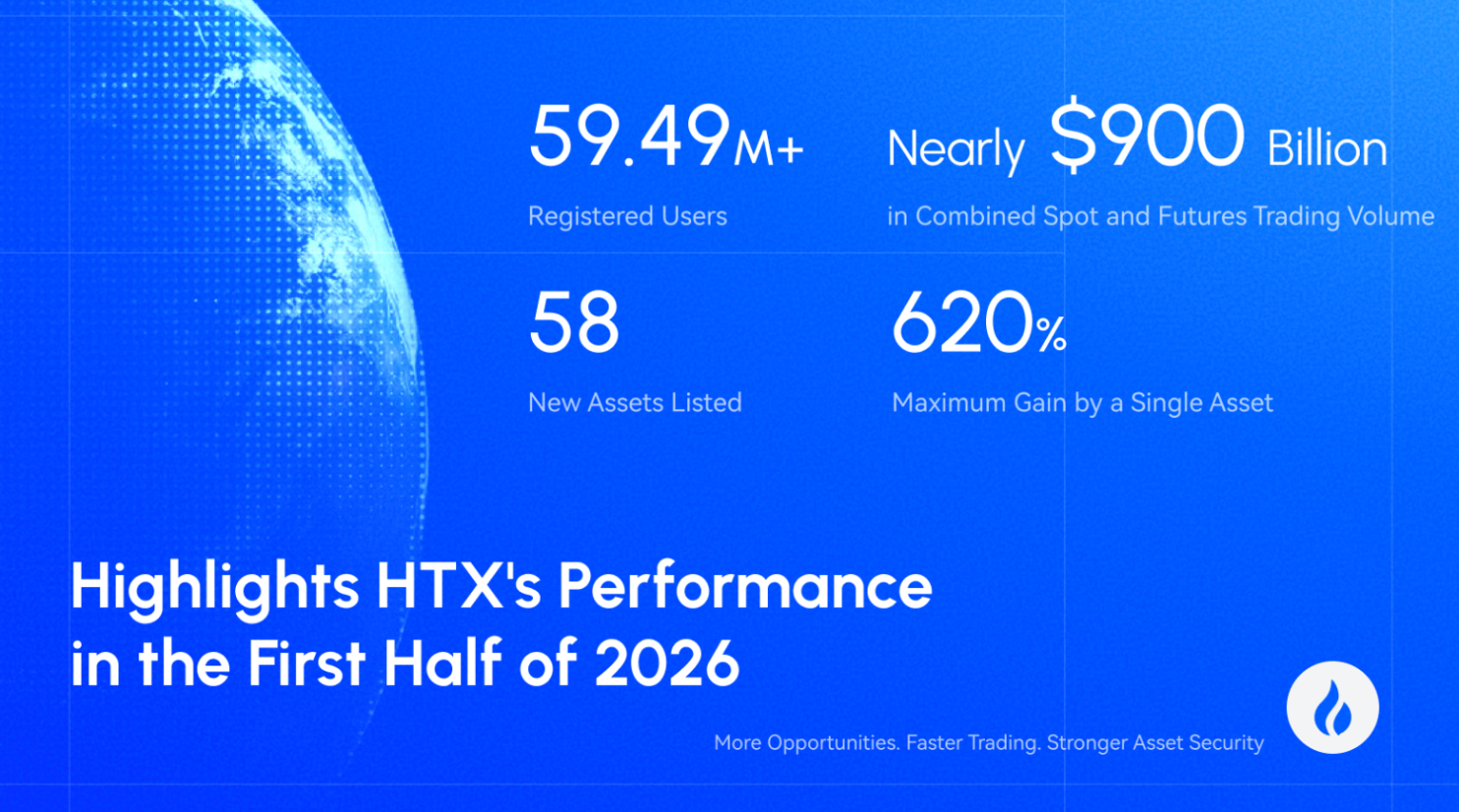
The first half of 2026 has concluded. It was a turbulent six months for the crypto market, marked by rapid sector rotations across AI, RWA, stablecoins, and TradFi. As market opportunities shift rapidly and narratives rise and fall, traders and investors are asking one key question:
Which platform can identify emerging trends first while remaining secure and reliable enough to earn their trust?
For over 59.49 million registered users worldwide, HTX has delivered a compelling half-year performance report. According to DeFiLlama data, HTX repeatedly ranked at the top of the industry for daily and weekly net capital inflows. Concurrently, the platform has continued to advance its global compliance footprint and secured prestigious international accolades, including Best P2P Platform of the Year and Best Web3 Venture Capital Institution of the Year, further strengthening its brand influence. Behind these numbers lies a clear trend: an increasing number of users are choosing HTX as their platform for managing assets, trading, and investing.
Spot Trading Nearing $400 Billion as Trending Assets Deliver Outsized Wealth Effects

For retail investors, the defining characteristic of the market this year has been the accelerating pace of sector rotations. Meme coins give way to AI; AI yields to RWA, BTCFi, stablecoins, and TradFi — with some projects delivering multi-fold returns in a matter of days.
In the first half of the year, HTX carefully selected and listed 58 new assets aligned with market trends, spanning almost every high-conviction sector, including meme coins, AI, RWA, BTCFi, and stablecoins. Guided by the principle of listing what the market demands, HTX rigorously vetted projects to curate high-quality assets with strong wealth creation potential. The Chinese-culture-inspired meme coin “老子” surged 573% after listing, while “我踏马来了” gained 412%. In the AI sector, ELSA delivered an exceptional peak gain of 620%, while BNKR and RIVER climbed 162% and 282%, respectively. For many users, HTX was the first venue where they discovered and purchased these trending tokens.
Equally important has been HTX’s first-mover advantage in listing multiple top-tier assets. Following its joint listing debut, Billions Network (BILL) surpassed a $2 billion market capitalization, delivering a 141% gain. After HTX became the first platform to list CHIP, multiple major exchanges quickly followed. Meanwhile, the jointly launched RWA project BTW recorded a peak gain of 388%, while ZEST climbed 131% after listing. By Q2 2026, as the market’s focus shifted toward narrative-driven sectors such as RWA, AI computing, and stablecoins, HTX stayed ahead of the curve by listing RWA leader RE (up 145%), AI computing project OpenGradient (OPG, up 118%), and MegaETH ecosystem stablecoin CAP, capitalizing on every major market trend. HTX has consistently enforced its delisting mechanism, removing tokens with insufficient liquidity or inactive development teams. This market-based selection approach continuously enhances asset quality, helping direct users’ capital toward projects with genuine value and strong liquidity.
The spot trading data tells an even clearer story. In H1 2026, more than 420,000 users traded spot, generating $379 billion in trading volume. HTX now supports over 612 spot trading pairs, spanning mainstream assets, trending sectors, and high-potential new projects. With deep liquidity, fast execution, and robust security, HTX continues to provide a trusted trading platform for users worldwide. Furthermore, HTX launched its “Predict FIFA World Cup 2026 Matches” campaign and continued to host its flagship Trading Championship series, engaging tens of thousands of active participants. These initiatives transformed trading from a simple execution process into an interactive, reward-rich experience.
Beyond Buying Crypto Assets, HTX Earn Turns Idle Assets Into Continuous Yield

A growing number of users recognize that active trading alone does not maximize capital efficiency. In the first half of the year, HTX Earn saw its subscription user base exceed 120,000, with cumulative subscription volume breaking past $4.1 billion.
Stablecoins remain the most sought-after vehicle. Flexible Earn products for USDT, USDC, and USDD delivered maximum APYs of up to 10%. For trending assets, the platform launched 50 fixed and flexible Earn products offering maximum APYs of 20%, drawing over $500 million in cumulative subscriptions from more than 50,000 participants. For high-net-worth users, HTX introduced the VIP Flexible product, initially offering up to 9% APY on USDT. Combining premium yields with flexible subscription and redemption, it enables large capital allocations to achieve greater capital efficiency. For many long-term holders, assets are no longer left idle waiting for price appreciation — they are generating daily passive income.
Futures traders can also keep their capital actively utilized. Following its upgrade, SmartEarn reached a peak APY of 7.21% and has maintained an average APY of around 2.5% in recent months. More importantly, deposited assets can still be used as margin for futures trading, allowing users to earn yield without missing trading opportunities. In addition, USDD SmartEarn offers an exclusive fixed APY of 4%.
HTX Leads TradFi Integration While AI-Powered Tools Redefine the Trading Experience
A structural trend is taking shape in 2026: crypto-native users increasingly want unified access to both digital assets and global traditional financial instruments. HTX has positioned itself as a first-mover in the TradFi tokenization sector.
In H1 2026, HTX futures trading volume approached $500 billion, while the number of supported trading pairs surpassed 350. Within this lineup, the TradFi sector alone generated over $1.5 billion in trading volume, spanning 129 assets across high-growth sectors such as AI, gold, commodities, U.S. equities, ETFs, aerospace, and new energy. In May 2026, HTX took the lead in listing highly anticipated Pre-IPO assets, including SpaceX, OpenAI, and Anthropic, providing users with a vastly diversified investment suite. Earlier in H1, the platform successfully timed market movements driven by geopolitical tensions and energy constraints, capturing significant volume in cyclical commodities like crude oil, base metals, and natural gas.
Meanwhile, the Futures system has also undergone a comprehensive infrastructure upgrade, introducing new features such as enhanced capital efficiency for Cross Margin, independent leverage for Isolated Margin, Smart Copy Trading, AI Lead Trader Recommendations, Trailing Grid, and Auto-Deposit Margin. These enhancements enable users to trade with greater flexibility and efficiency. For regular users, highly complex strategies are now executed automatically by the product itself. The copy trading division exhibited counter-cyclical growth in H1: the number of lead traders surged 53% quarter-over-quarter, driving lead trading volume up 74%, while follower trading volume jumped 44% over the same period. For users who prefer a hands-off approach, Futures Grid bots recorded $1.18 billion in trading volume in the first half of the year. With Trailing Grid set to launch in early July, the grid will automatically adjust as the market moves, allowing users to trade more efficiently without monitoring the market every day.
In the first half of this year, nearly every core product in the HTX suite received an upgrade. Following app startup speed optimizations, launch speeds improved by over 55% on iOS and approximately 44% on Android, making app opening wait times nearly imperceptible. The platform also introduced professional modules such as the TradFi Market Leaderboards, Tokenomics Displays, and expanded K-line indicators. Most notably, the official launch of the HTX Holo, the platform’s AI-powered trading assistant, has dramatically lowered the barrier to market information. Capable of interpreting market charts, summarizing news feeds, and actively recommending tailored Earn products, it effectively functions as an institutional-grade research assistant embedded directly within the app. Furthermore, a unified Event Center and fully revamped live-streaming rooms were rolled out across the half-year, allowing users to easily participate in platform events.
Global Expansion Continues as HTX DAO Ecosystem Growth and Deflationary Mechanics Advance in Parallel

HTX Research and HTX Ventures continue to serve as the exchange’s strategic watchtower over the digital-asset industry. In the first half of 2026, the team published a total of 6 major research reports centered on core topics such as AI, RWA, stablecoins, TradFi, geopolitics, and the linkage between these themes and the crypto market. These include 2025 Annual Review: Crypto Assets Move Toward Mainstream Adoption, The Rise of Yield-Bearing Currency: How Crypto Neobanks Are Challenging the Traditional Banking Model, RWA Perps: A New Frontier in the On-Chain Expansion of Global Financial Markets, and the Q3 forward-looking report Liquidity Defines Crypto: A New Crypto Order Under Global Liquidity Repricing. The team has not only continued to deliver in-depth research content, but has also built the long-term content brand HTX DeepThink, publishing 73 market insight articles in the first half of the year, along with weekly market reviews to help users establish a clearer investment framework amid complex market conditions.
On the offline front, HTX organized and prepared 17 distinct brand events across the first half of the year, targeting key regions such as Southeast Asia and Turkey. Through industry summits, high-end VIP gala dinners, and regional strategic partnerships, the platform steadily deepened its global brand footprint. Meanwhile, the platform has also won numerous international awards, including Best P2P Platform of the Year and Best Web3 Venture Capital Institution of the Year, further enhancing its brand credibility and industry recognition.
Throughout H1 2026, HTX DAO actively drove the expansion of the $HTX ecosystem while reinforcing its long-term value framework through an open, transparent token deflation mechanism. Official disclosures confirm that HTX DAO successfully completed two major $HTX token burns on January 15 and April 15, 2026. This brings the cumulative total of $HTX burned and pledged to 110.32 trillion tokens to date, representing over 11% of the total token supply and establishing an annualized deflation rate of approximately 5.5%. This persistent mechanism makes $HTX one of the very few governance tokens in the industry to execute a transparent, large-scale, and long-term public token burn strategy. Concurrently, HTX DAO expanded its utility use cases and optimized its community governance framework. This included upgrading membership benefits, broadening yield opportunities, exploring AI × Web3 ecosystems, maintaining community consensus, and fostering developer networks through the Genesis Program, Hackathons, and Grants—effectively connecting developers, protocols, and the community to bolster long-term holder confidence.
45 Consecutive Months of PoR Disclosures, Establishing Security as a Core Competitive Edge

For many users new to the crypto market, security is the top priority, not returns. HTX continuously enhances platform transparency through Merkle Tree Proof of Reserves (PoR). The latest data shows that as of July 1, 2026 (UTC), the reserve ratios of major assets on the platform, including BTC, ETH, TRX, USDs, HTX, XRP, DOGE, and SOL, have all remained above 100%. HTX is committed to a strict 1:1 reserve principle, ensuring user assets can be traded and withdrawn at any time. Crucially, HTX has now publicly disclosed its PoR data for 45 consecutive months, making it one of the earliest and most consistent platforms in the industry to normalize routine reserve disclosures. This framework allows users to view reserves transparently, verify individual assets, and trade with complete peace of mind.
HTX has also pushed forward its global compliance architecture. In H1 2026, HTX advanced its licensing efforts in Kyrgyzstan. Following the acquisition of a No Objection Certificate (NoC) from the Pakistan Virtual Assets Regulatory Authority (PVARA), the platform proceeded with local corporate registration and the application process for a Virtual Asset Service Provider (VASP) license. Meanwhile, HTX continued to align its operations with Dubai’s Virtual Assets Regulatory Authority (VARA) framework, further strengthening its global regulatory foundation.
Evolution from “Trading Exchange” to “Global Digital Asset Service Platform”
A review of the first half of 2026 demonstrates that HTX’s strategic focus extends far beyond mere volume growth. From listing high-potential assets early and maximizing capital efficiency through Earn products to expanding access to global investment opportunities via TradFi, empowering AI-assisted trading, and strengthening global compliance and security, HTX is building a one-stop digital asset service platform spanning trading, Earn, research, asset management, and global investment opportunities.
For users, these developments converge into a tangible improvement in their daily experience: more opportunities, better products, stronger asset security, and more efficient investing. As AI, RWA, stablecoins, TradFi, and other emerging narratives continue to evolve in the second half of 2026, the crypto market will present new growth opportunities. HTX remains committed to anchoring this growth by providing its global user base with richer asset classes, fully optimized product suites, and an expanded international presence.
Markets will always change. But for HTX, the true measure of the road ahead lies in its ability to seize every emerging opportunity while safeguarding users’ assets. That commitment will define HTX’s next chapter.
About HTX
Founded in 2013, HTX has evolved from a virtual asset exchange into a comprehensive ecosystem of blockchain businesses that span digital asset trading, financial derivatives, research, investments, incubation, and other businesses.
As a world-leading gateway to Web3, HTX harbors global capabilities that enable it to provide users with safe and reliable services. Adhering to the growth strategy of “Global Expansion, Thriving Ecosystem, Wealth Effect, Security & Compliance,” HTX is dedicated to providing quality services and values to virtual asset enthusiasts worldwide.
To learn more about HTX, please visit https://www.htx.com/ or HTX Square , and follow HTX on X, Telegram, and Discord. For further inquiries, please contact glo-media@htx-inc.com.
The post HTX H1 2026 Performance Report: Nearly $900 Billion in Trading Volume appeared first on BeInCrypto.



ARK Invest has challenged a16z crypto’s view that traditional financial institutions will mainly adopt controlled blockchain systems rather than decentralized finance.
Summary
- ARK argues public blockchains will win institutional adoption as tokenized assets increasingly connect with DeFi.
- A16z expects banks to adopt blockchain primitives while keeping compliance, governance and operational control centralized.
- Standard Chartered forecasts mature DeFi protocols could capture much of the future tokenized asset activity.
ARK director of research Lorenzo Valente called the argument “overly bearish and simplistic” in a response on X. He argued that public blockchains have already gained more traction than earlier private blockchain projects and that institutional finance will increasingly depend on infrastructure created by crypto-native companies.
A16z sees institutions choosing control over open access
The debate began after a16z crypto published an essay titled “TradFi doesn’t want DeFi. It wants blockchains.” The firm argued that banks and asset managers will adopt blockchain features when they reduce costs, improve settlement or expand distribution without giving up control.
Under that model, institutions may use tokenization, programmable money and atomic settlement while limiting open access and pseudonymous participation. A16z described the emerging system as “programmable financial infrastructure” built around regulatory, risk and governance requirements rather than today’s fully permissionless DeFi model.
The firm did not argue that open networks will disappear. Its thesis says institutional blockchain systems and crypto-native DeFi can develop in parallel, with open networks continuing to create technology that regulated firms later adopt.
ARK argues public networks have already proved their value
Valente’s counterargument centers on adoption already taking place on public blockchains. Tokenized funds, stablecoins and other financial assets increasingly operate on networks such as Ethereum rather than isolated private systems.
As previously reported, tokenized real-world assets had crossed $29 billion by April 2026. Tokenized US Treasury products alone reached about $13.4 billion, while more than 40 major financial institutions had launched or developed products using public blockchain infrastructure.
That growth supports part of ARK’s case, although institutional projects are not purely permissionless. Products can use public networks while placing restrictions on investors, wallets, custody and transfers. This allows firms to use shared blockchain infrastructure without adopting every feature associated with open DeFi.
DeFi protocols are gaining institutional connections
Recent institutional activity also shows that the dividing line between DeFi and traditional finance is becoming less clear. Standard Chartered has forecast that $4 trillion in stablecoins and tokenized assets could move onchain by the end of 2028, with established DeFi protocols handling much of that activity.
As reported by crypto.news, the bank identified Aave, Compound and Morpho as potential beneficiaries as institutions move more assets onto blockchain networks. BlackRock’s BUIDL fund has also gained DeFi utility by serving as collateral and connecting with onchain markets.
Other blockchain ecosystems are adding controls directly to decentralized infrastructure.However, XRP Ledger developers have been working on permissioned trading and lending features designed for regulated institutions while maintaining onchain settlement.
Permissioned networks remain a competing model
Traditional finance is also putting capital into systems designed specifically around institutional privacy and control. Canton Network has attracted banks and market infrastructure companies by offering permissioned access and privacy-focused settlement tools.
A crypto.news analysis previously examined the growing competition between Canton’s institution-focused model and Ethereum’s open infrastructure. The two approaches show that financial firms are testing both controlled systems and public blockchain rails rather than following one clear model.
The dispute between ARK and a16z therefore centers less on whether traditional finance will use blockchain and more on which infrastructure will carry the activity. A16z expects institutions to reshape blockchain technology around existing controls. ARK argues that public networks and DeFi protocols have already built liquidity and infrastructure that financial firms will find increasingly difficult to avoid.
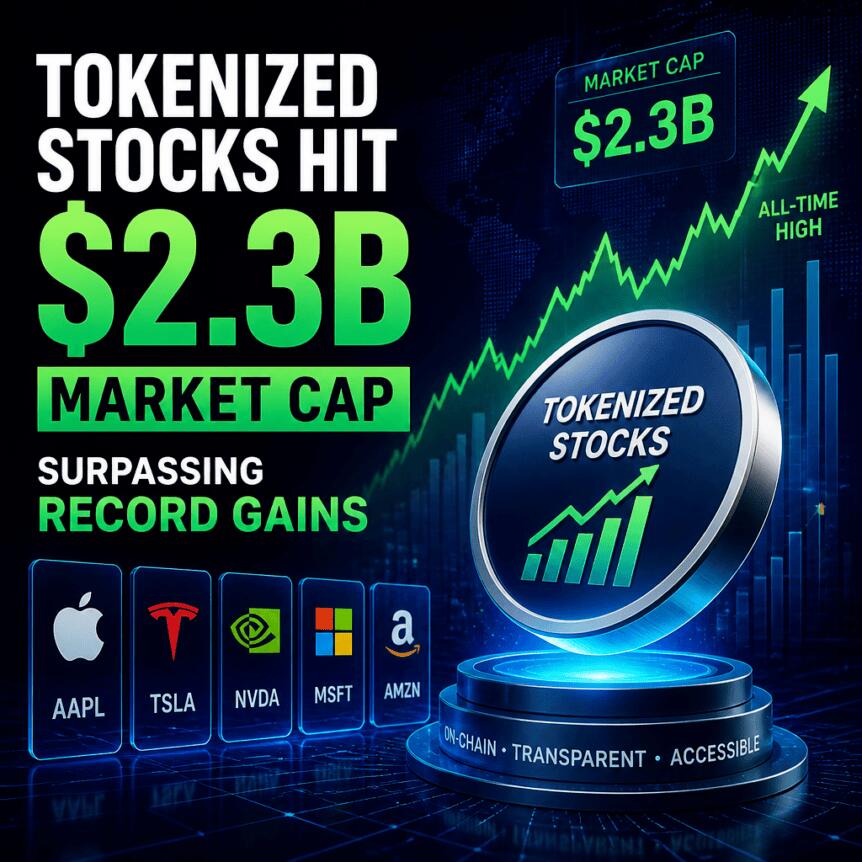
Tokenized stock products are continuing to gain traction even as wider crypto markets fluctuate. According to data aggregator Token Terminal, the total market capitalization of tokenized stocks climbed to a record $2.3 billion on Wednesday, reflecting renewed demand for blockchain-based access to equities.
The Ethereum ecosystem led the distribution of tokenized-stock market value with a 34% share, followed by BNB Chain at 30% and Solana at 23%, Token Terminal said in an X post. As more platforms expand “multi-asset” offerings, the shift highlights how tokenized equities are increasingly being treated as a mainstream bridge between traditional finance and onchain infrastructure.
Key takeaways
- Tokenized stocks reached a record $2.3 billion market capitalization, signaling stronger institutional-style exposure to equities onchain.
- Ethereum remains the largest venue for tokenized stocks by share (34%), with BNB Chain (30%) and Solana (23%) close behind.
- Kraken’s xStocks and Binance’s bStocks are among the biggest contributors to tokenized-stock market value, while Ondo Finance remains the top issuer.
- Despite rapid growth in tokenized real-world assets (RWAs), stocks still represent only about 5.5% of the overall tokenized RWA market.
Tokenized stocks hit a new high as access expands
The record figure—$2.3 billion—adds to a broader pattern of capital moving into tokenized versions of traditional financial instruments. Token Terminal’s breakdown points to a multi-chain race for distribution, with Ethereum still setting the pace for market share.
The issuer landscape also shows where liquidity is concentrating. Token Terminal data indicates Ondo Finance is the largest tokenized stock issuer, with $955 million in onchain equities. Two other large products—Kraken exchange’s xStocks and Binance’s bStocks—account for substantial portions of tokenized-stock market value, at $507 million and $334 million respectively, according to Token Terminal’s figures.
For investors, the practical appeal of tokenized stocks is often tied to two features: fractional ownership and the potential for faster, more continuous trading compared with traditional market schedules. For platforms and developers, these same characteristics support a broader product strategy—bringing familiar asset classes onto blockchain networks without requiring users to interact directly with settlement layers.
Which chains and products are driving tokenized-equity adoption
Token Terminal’s chain-level shares show a distribution that is increasingly difficult to ignore. Ethereum’s 34% share underscores that tokenized equities still find deep liquidity on the network with the longest track record for onchain asset issuance and trading. However, BNB Chain’s 30% share indicates that large centralized exchange ecosystems are successfully positioning themselves as distribution channels for tokenized financial products.
Solana’s 23% share suggests that speed and low fees—often associated with the network’s design—remain a meaningful part of the user experience for tokenized assets. Together, the three networks account for 87% of tokenized stock market share in Token Terminal’s dataset, implying that competition for tokenized-equity flows is currently concentrated rather than fragmented across dozens of chains.
On the product side, Kraken and Binance stand out for the scale of their tokenized equity offerings. Token Terminal’s numbers place Kraken’s xStocks as the largest single category contribution ($507 million), ahead of Binance’s bStocks ($334 million). These figures reinforce how exchange-led distribution can materially accelerate adoption by lowering friction for retail and active traders.
Push toward traditional assets keeps widening the onchain map
The tokenized-stock surge sits inside a larger expansion of crypto platforms adding regulated-style investment products to blockchain rails. Binance, for example, has been moving toward a multi-asset platform model. Earlier coverage noted that Binance opened zero-commission trading for eligible users in tokenized stocks—covering more than 7,000 US tokenized stocks—beginning June 1, as part of that strategy.
Coinbase has also signaled its intent to compete in traditional asset access. The exchange rolled out commission-free US stock and ETF trading with 24/5 availability in December 2025, according to its own update on its system changes. While these developments differ in implementation details from tokenized onchain equity products, they contribute to the same competitive direction: mainstream crypto platforms seeking to offer familiar “traditional” instruments in an exchange-like experience.
Kraken’s progress has likewise been rapid. Earlier reporting described Kraken launching access to 11,000 US-listed stocks and ETFs through xStocks in April 2025, positioning it as one of the first major crypto-native platforms to do so. That reporting also stated that cumulative xStocks trading volume exceeded $25 billion within about eight months of launch—an indicator of how quickly demand can build when liquidity and product choice meet user access.
Beyond stocks, tokenization efforts are showing up in other asset classes tied to traditional finance. For instance, in April, Bitget launched a proxy offering related to the pre-initial public offering phase of Elon Musk’s SpaceX. In January, Bitpanda outlined plans to expand its offering to include roughly 10,000 stocks and exchange-traded funds (ETFs). Earlier coverage from Cointelegraph also documented these moves as part of the broader push to bring traditional exposure onto blockchain-connected platforms.
Tokenized RWAs keep growing, but stocks are still a minority
Even with tokenized stocks hitting new highs, broader tokenized real-world assets (RWAs) remain dominated by fixed-income and cash-like instruments. Binance Research, in a June report, found that the tokenized RWA market surged 589% from early 2025 to June 2026. The growth was led by government bonds and money market funds.
In the same period, tokenized precious metals reportedly attracted about $1.5 billion in value, rising 39% during the timeframe. Those figures point to an increasingly diversified tokenized-assets landscape rather than a market focused exclusively on equities.
Still, stocks are a small piece of the total pie. The source data indicates that stocks account for roughly 5.5% of the $34 billion tokenized RWA market capitalization. In other words, tokenized stocks may be expanding quickly, but most tokenized RWA capital continues to flow into categories such as US Treasury debt.
According to RWA.xyz data cited in the report, about $15 billion in tokenized US Treasury debt is the largest segment—44% of the RWA market. Tokenized commodities represent a smaller share at $4.5 billion (13%). For readers, this matters because it helps explain why tokenized-stock headlines—while important—should be interpreted within a market where fixed income and cash-management-style products are currently the primary growth engines.
Going forward, investors should watch whether tokenized stocks can convert broader RWA growth into more sustained equity share, and whether chain distribution changes as exchanges scale their product offerings. The key unknown is how quickly tokenized equities can expand from a niche slice of RWAs into a larger allocation category without running into liquidity fragmentation or regulatory friction across jurisdictions.
Cryptocurrency markets struggled broadly in the second quarter of 2026, with declines across stablecoins, spot trading and derivatives, but prediction markets reached record highs.
Spot trading volume across the top 10 centralized exchanges (CEXs) fell to $1.95 trillion in the second quarter of 2026, a 27.9% drop from $2.7 trillion in Q1, according to CoinGecko’s latest Crypto Industry Report published Thursday.
CEX perpetual futures volume also declined 10% to $12.7 trillion, while the stablecoin market slipped 1.6% to $305.1 billion. In contrast, prediction markets recorded their strongest quarter on record with $113.8 billion in notional volume.
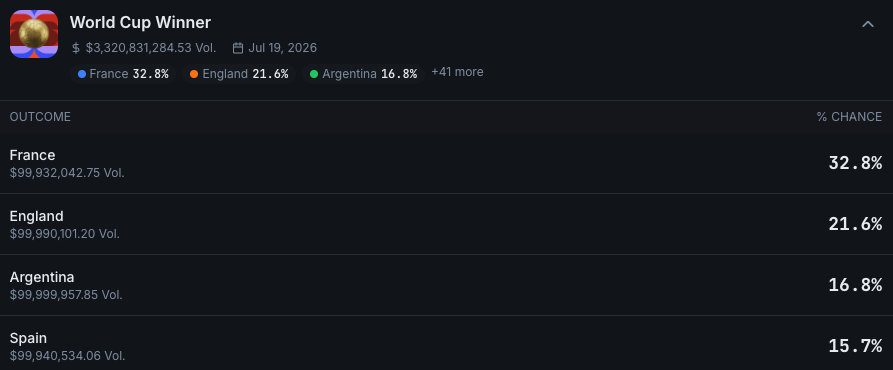
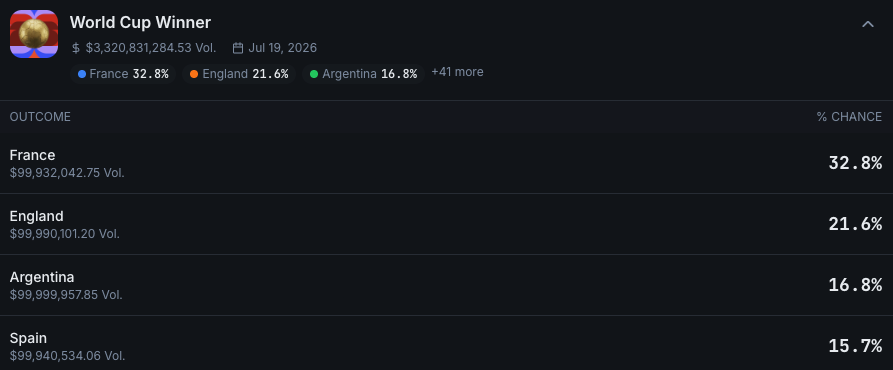
The divergence highlights the growing role of prediction markets, with sports and politics emerging as the sector’s biggest drivers. Polymarket’s World Cup winner market alone has attracted more than $3.3 billion in trading volume, while contracts tied to the 2028 US presidential election rank among the platform’s largest markets, according to Polymarketscan data.
Source: Polymarketscan
Binance extends dominance despite bear market as DEX activity falls
Despite the bear market, Binance extended its dominance, with a 38.7% market share in Q2. In contrast, MEXC saw the biggest slump among spot CEXs, with trading volume more than halving from $275.2 billion in Q1 to $121.2 billion in Q2.
DEX activity also weakened during the quarter, with the top 10 spot DEXs processing $408.9 billion in volume, down from $556.4 billion in Q1. Uniswap strengthened its position as the leading DEX, holding a 41.2% market share despite a 21.4% drop in volume to $168.5 billion.
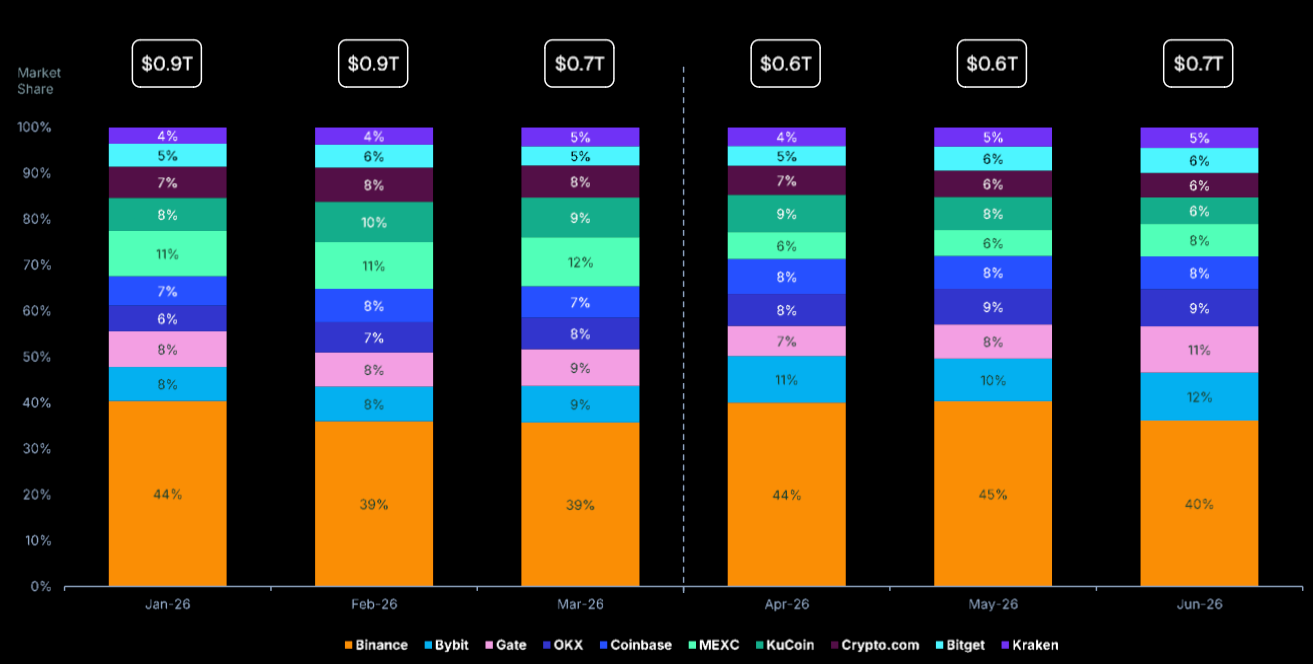
Source: CoinGecko
The declines came as the broader crypto market weakened, with total market capitalization falling 12.6% to $2.1 trillion during the quarter. April also marked a record month for hacks in decentralized finance (DeFi), highlighting ongoing security concerns across decentralized platforms.
Kalshi holds lead as prediction markets expand
Prediction market activity peaked in June, coinciding with the start of the FIFA World Cup, as monthly notional volume — the total value of all contracts traded — reached an all-time high of $50.7 billion, up 91.9% from the average of the previous five months.
Kalshi, the largest prediction market platform, maintained its lead over the quarter with a 58.9% market share, while Polymarket lost share from 35.8% to 30.2%. Robinhood-backed Rothera Markets climbed to fourth place.
Related: Czech Republic tells ISPs to block Polymarket after gambling blacklisting
The growth has drawn regulatory attention. In the US, regulators and states have clashed over whether prediction markets should be treated as financial markets or gambling platforms, with lawsuits involving platforms such as Kalshi escalating in 2026.
Authorities in other jurisdictions have also moved to restrict prediction markets, citing concerns including gambling rules, market integrity and potential insider trading risks.
Magazine: Has Bitcoin bottomed for this cycle? Analysts say ‘not yet’

Introduction
Credit is one of the most important pillars of the global economy. It enables individuals to buy homes, businesses to expand operations, and entrepreneurs to turn ideas into reality. Yet traditional credit markets remain slow, expensive, and often inaccessible to billions of people worldwide due to geographical limitations, rigid banking requirements, and outdated infrastructure.
Blockchain technology is transforming this landscape by introducing decentralized, transparent, and programmable credit markets. Instead of relying solely on banks and centralized financial institutions, blockchain enables borrowers and lenders to connect directly through smart contracts, creating a more efficient and inclusive financial ecosystem.
As decentralized finance (DeFi) continues to mature, blockchain-based credit markets are emerging as one of the most promising innovations capable of reshaping how capital flows across the globe.
What Are Blockchain-Based Credit Markets?
Blockchain-based credit markets are decentralized platforms where users can lend, borrow, or access credit using blockchain technology instead of traditional banking systems.
These platforms automate lending agreements through smart contracts, removing many intermediaries that typically increase costs and processing times.
Borrowers can access liquidity by providing collateral or, increasingly, through reputation-based lending models. Lenders earn yield by supplying digital assets into lending pools, where capital is allocated automatically based on transparent rules.
Everything—from interest calculations to loan repayments—is recorded on-chain, providing unprecedented transparency.
How They Work
A typical blockchain credit market follows a simple process:
1. Capital Providers Supply Liquidity
Investors deposit cryptocurrencies or stablecoins into lending pools.
2. Borrowers Request Loans
Users borrow assets by locking collateral or meeting protocol-specific credit requirements.
3. Smart Contracts Execute Loans
Instead of paperwork or manual approval, smart contracts automatically manage:
- Loan issuance
- Interest calculations
- Repayment schedules
- Liquidation rules
- Risk management
4. Lenders Earn Yield
Interest payments are distributed automatically to liquidity providers based on their contributions.
Why Blockchain Credit Markets Matter
1. Global Financial Inclusion
Traditional banks reject millions of borrowers due to geography, lack of documentation, or limited credit history.
Blockchain allows anyone with an internet connection and a crypto wallet to participate in global lending markets.
This opens financial opportunities for underserved populations worldwide.
2. Faster Loan Processing
Traditional loans can take days or even weeks.
Blockchain loans can be issued within minutes because smart contracts automate approvals and settlements.
3. Lower Costs
Removing intermediaries significantly reduces:
- Administrative fees
- Processing costs
- Cross-border transfer expenses
- Settlement delays
This benefits both borrowers and lenders.
4. Transparent Risk Management
Every transaction is recorded on-chain.
Investors can verify:
- Outstanding loans
- Pool liquidity
- Collateral levels
- Historical repayments
Transparency reduces information asymmetry that often exists in traditional finance.
5. Programmable Finance
Loans can include automated conditions such as:
- Dynamic interest rates
- Auto-repayment mechanisms
- Revenue-sharing agreements
- Milestone-based funding
- Tokenized collateral
This flexibility enables entirely new financial products.
The Rise of On-Chain Credit Scoring
One of the biggest challenges for decentralized lending has been undercollateralization.
Most DeFi loans today require borrowers to deposit more collateral than they borrow.
However, blockchain-native credit scoring is beginning to change this.
Protocols are developing reputation systems based on:
- Wallet history
- Repayment behavior
- On-chain transaction activity
- Governance participation
- Identity attestations
- Verifiable credentials
Instead of relying solely on traditional credit bureaus, future lending decisions may increasingly be based on verifiable blockchain activity.
Institutional Adoption Is Growing
Major financial institutions are beginning to recognize blockchain credit infrastructure.
Tokenized treasury products, real-world assets (RWAs), and on-chain lending protocols are creating bridges between traditional finance and decentralized finance.
Institutional lenders can now deploy capital more efficiently while benefiting from transparent risk monitoring and automated settlement.
As regulatory frameworks mature, institutional participation is expected to accelerate.
Challenges Still Ahead
Despite rapid innovation, blockchain credit markets face several obstacles:
Regulatory Uncertainty
Many jurisdictions are still developing rules for decentralized lending and digital assets.
Smart Contract Risks
Software vulnerabilities can expose lending protocols to exploits if not properly audited.
Identity and Reputation
Building secure, privacy-preserving decentralized identity systems remains an ongoing challenge.
Market Volatility
Crypto collateral can experience significant price fluctuations, increasing liquidation risk.
User Experience
Simplifying wallets, onboarding, and risk management remains essential for mainstream adoption.
The Future of Blockchain Credit
Several trends are likely to define the next generation of blockchain lending:
- AI-assisted credit risk assessment
- Zero-knowledge identity verification
- Cross-chain lending markets
- Tokenized real-world collateral
- Reputation-based unsecured lending
- Decentralized business financing
- On-chain corporate credit markets
- Embedded DeFi lending inside fintech applications
Over time, blockchain credit markets may evolve beyond crypto-native users and become foundational infrastructure for global digital finance.
Conclusion
Blockchain-based credit markets are redefining how capital is created, distributed, and managed. By replacing manual processes with transparent smart contracts, they make lending faster, more efficient, and more accessible to people around the world.
While challenges such as regulation, security, and identity remain, innovation is advancing quickly. As decentralized identity, tokenized real-world assets, and AI-powered risk assessment continue to mature, blockchain credit markets are poised to become a key component of the future financial system.
The evolution of credit is no longer limited to traditional banks. It is moving on-chain—where transparency, programmability, and global accessibility are creating a more open and inclusive financial ecosystem.
REQUEST AN ARTICLE


Ledger said is bringing its hardware security model to the fast-growing world of AI agents with the launch of Ledger Agent Stack, an open-source toolkit that allows autonomous software to interact with crypto wallets without ever controlling private keys.
The toolkit lets AI agents read wallet balances, analyze portfolios, prepare transactions and propose payments, but requires every sensitive action to be explicitly approved on a Ledger hardware device before it can be executed.
This is the first product release under Ledger’s 2026 AI roadmap, as the hardware wallet maker bets that human oversight will become a critical security layer as AI agents take on increasingly complex financial tasks.
“Agents propose. Humans approve,” the team wrote in their press release shared with CoinDesk. “Crypto wallets have protected billions on this standard for years,” said Ian Rogers, Ledger’s chief human agency officer, in the press release. “Ledger Agent Stack allows your agent to use these wallets just as easily as humans.”
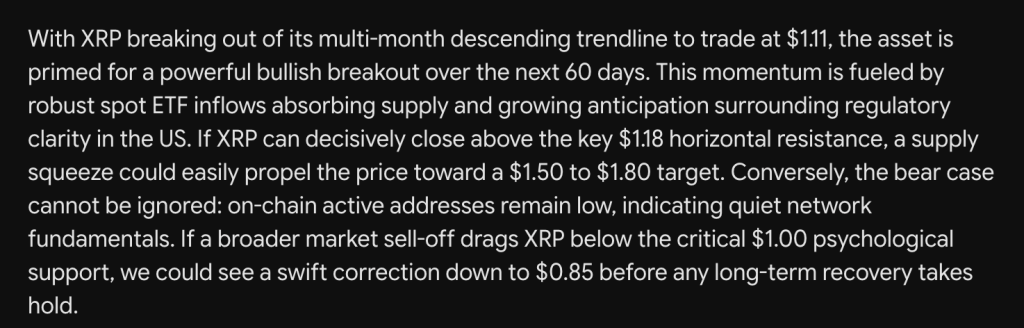
Google Gemini AI predicts and sees the XRP trendline break at $1.11; the model also predicts a $1.50 to $1.80 move sitting 60 days out.
The trigger is specific rather than vague. Gemini wants a decisive close above $1.18.
Clear that level, and the thesis is a supply squeeze, not a slow grind. Spot ETF inflows are already absorbing float. Regulatory clarity in the US keeps building as a background tailwind.
Put those together, and a close above $1.18 stops being a technical footnote. It becomes the spark for the whole move.

Gemini does not skip the weak spot in its own thesis either. On-chain active addresses remain low, which is the model’s own words for a network that is quiet under the hood.
Price can break a trendline and still lack real usage behind it. That gap between chart action and network activity is exactly what the bear case leans on.
If a broader market selloff drags XRP under the $1.00 psychological floor, Gemini sees a fast correction to $0.85 before any real recovery resumes. That is not a mild pullback scenario; it is a specific air pocket with a specific number attached.

Trade XRP and Don’t Miss Out on Our $1,000 USDT Airdrop on ByBit
The $1.18 Ceiling XRP Has Not Touched Since May
The chart backs up why $1.18 is the number everyone keeps circling. XRP closed at $1.11517, up 0.38%, with the session ranging between $1.09823 and $1.12895.
Zoom out, and this coin has been sliding since a September 2025 top near $3.20. February brought the real damage, a gap down through $1.60 that reset the entire structure.
Since February, the price has lived in a tightening range between roughly $1.30 and $1.60, then slipped under $1.20 in June. That June breakdown is the low Gemini that quietly betting has already printed.
Support sits at $1.05, then the psychological $1.00 line Gemini flagged directly. Resistance stacks at $1.18 first, then $1.30, then the May shelf near $1.60.
RSI reads close to 44 with the signal line just under it, near 42. That gap just turned mildly positive, meaning short-term momentum is finally leaning up instead of down for the first time in weeks.
It is an early signal, not a confirmed reversal. Gemini’s entire bull case rides on that flicker of momentum surviving contact with $1.18.
Clear it decisively, and the squeeze thesis gets real. Fail there again, and XRP goes right back to living below $1.
Don’t Miss Out on Our $1,000 USDT Airdrop on ByBit
Discover: The best crypto to diversify your portfolio with
Here is what Gemini AI Predicts For LiquidChain’s near future
Every cycle has a moment where waiting becomes the most expensive decision you can make. That moment is now.
Bitcoin, Ethereum, and XRP are all pinned under the same resistance they have been testing for weeks. The macro unlock is perpetually one data point away. The institutional money keeps arriving next quarter. Large-cap traders waiting for a breakout are queuing for a decision that belongs to someone else entirely.
Gemini AI has identified what experienced cycle traders already act on. Capital that registers as statistical background noise at Bitcoin’s market cap can completely reprice a small, undiscovered project. The asymmetry is not complicated. It lives in the distance between what something is genuinely worth and what the market has currently assigned it. The moment that distance gets noticed, it collapses. Before that moment, it is fully open.
Cross-chain fragmentation has been quietly taxing every DeFi participant since the first bridge went live. Bitcoin, Ethereum, and Solana were engineered independently with zero shared infrastructure and no design intent to communicate. Every transaction crossing those ecosystem boundaries absorbs the cost of that decision in fees, failed execution, and slippage that hits before settlement even begins. The bridge industry did not fix this problem. It built a business model on top of it.
LiquidChain removes the business model entirely. Three networks unified inside a single execution layer. One deployment reaches all of them simultaneously. No cross-chain tax is extracted from any interaction anywhere.
Gemini AI predicts it as a worth watching coin. The presale sits at $0.01454 with just over $860,000 raised.
Execution is unproven. Adoption is an open question. Established assets offer a smoother path toward a ceiling that the entire market can already see. LiquidChain is the entry point that stops existing once the market finds it.
The post Google Gemini AI Predicts XRP Price Will Surprise Everyone in the Next 60 Days appeared first on Cryptonews.


President Donald Trump said in January he had no plans to pardon Bankman-Fried. He has cleared Binance founder Changpeng Zhao and Silk Road creator Ross Ulbricht, along with other white-collar offenders.
Bankman-Fried ran two companies at once. FTX was a crypto exchange, which holds customer money the way a broker does and is not supposed to touch it. Alameda Research was a trading firm he also owned. He moved billions of dollars in FTX customer deposits to Alameda, which spent the money on trades, venture investments, political donations, and Bahamian real estate, while FTX’s software exempted Alameda from the rules that would have forced it to cover its losses like any other trader.
The facade was blown open after CoinDesk obtained Alameda’s balance sheet in November 2022 and found that most of what the firm counted as assets was FTT – a token FTX had created itself and could issue at will.
The collateral propping up Alameda was, in effect, something its sister company had invented. Further cracks emerged after the prominent exchange Binance said, days later, it would sell its FTT holdings, leading to a rapid collapse in FTT prices.
Customers rushed to pull their deposits, and FTX could not return the money because it was no longer there. The exchange filed for bankruptcy on Nov. 11, 2022, just over a week after the story ran.
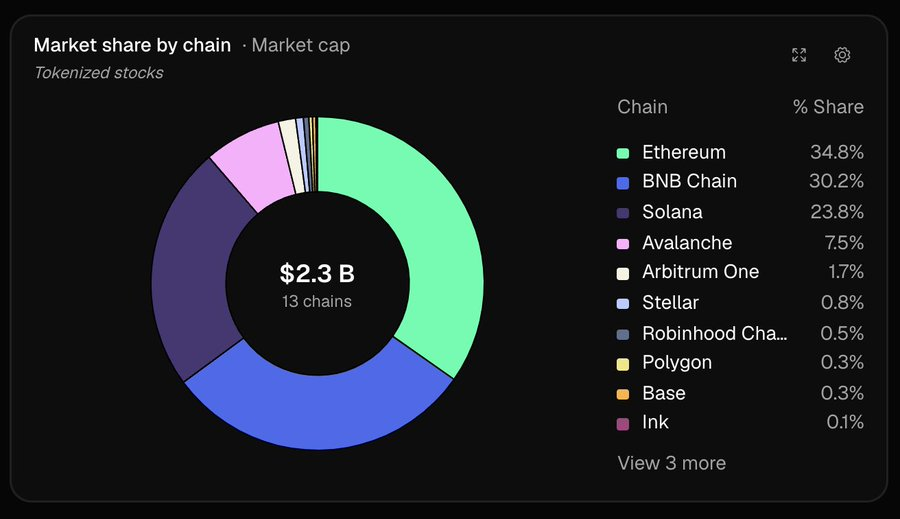
The global market capitalization of tokenized stocks rose to a record $2.3 billion on Wednesday, as more investors sought exposure to blockchain-based equity products.
The Ethereum network boasted the largest market share, at 34%, followed by BNB Chain with 30% and the Solana network with 23%, data aggregator Token Terminal shared in a Wednesday X post.
The largest increase came from Kraken exchange’s xStocks, which accounted for $507 million worth of tokenized stocks and Binance’s bStocks, with $334 million. Ondo Finance remained the largest tokenized stock issuer with $955 million in onchain equities, according to Token Terminal data.
More crypto platforms are bringing traditional investment products onto blockchain rails, in many cases opening up assets to investors outside of the United States. Tokenized stocks can also provide investors with fractional ownership and around-the-clock trading.
The world’s largest crypto exchange, Binance, opened zero-commission trading to over 7,000 US tokenized stocks for eligible users on June 1, as part of its strategy to become a multi-asset platform. Coinbase rolled out commission-free US stock and ETF trading with 24/5 availability in December 2025.
Source: Token Terminal
In April, crypto exchange Bitget launched a proxy offering tied to the pre-initial public offering (IPO) phase of Elon Musk’s aerospace manufacturing and space transportation company, SpaceX.
In January, Vienna-based crypto exchange Bitpanda shared plans to expand its offering to include about 10,000 stocks and exchange-traded funds (ETFs).
Kraken launched access to 11,000 US-listed stocks and ETFs through xStocks in April 2025 as one of the first major crypto-native platforms. The cumulative trading volume of xStocks exceeded $25 billion within about eight months of launch.
Related: NYSE parent ICE pushes ‘level playing field’ for 24/7 onchain perps
Tokenized RWAs surge despite crypto market pullback
The market for tokenized real-world assets (RWAs) surged 589% from early 2025 to June 2026, led by government bonds and money market funds, according to a June report from Binance Research.
Tokenized precious metals also attracted about $1.5 billion in value, rising 39% during the period.
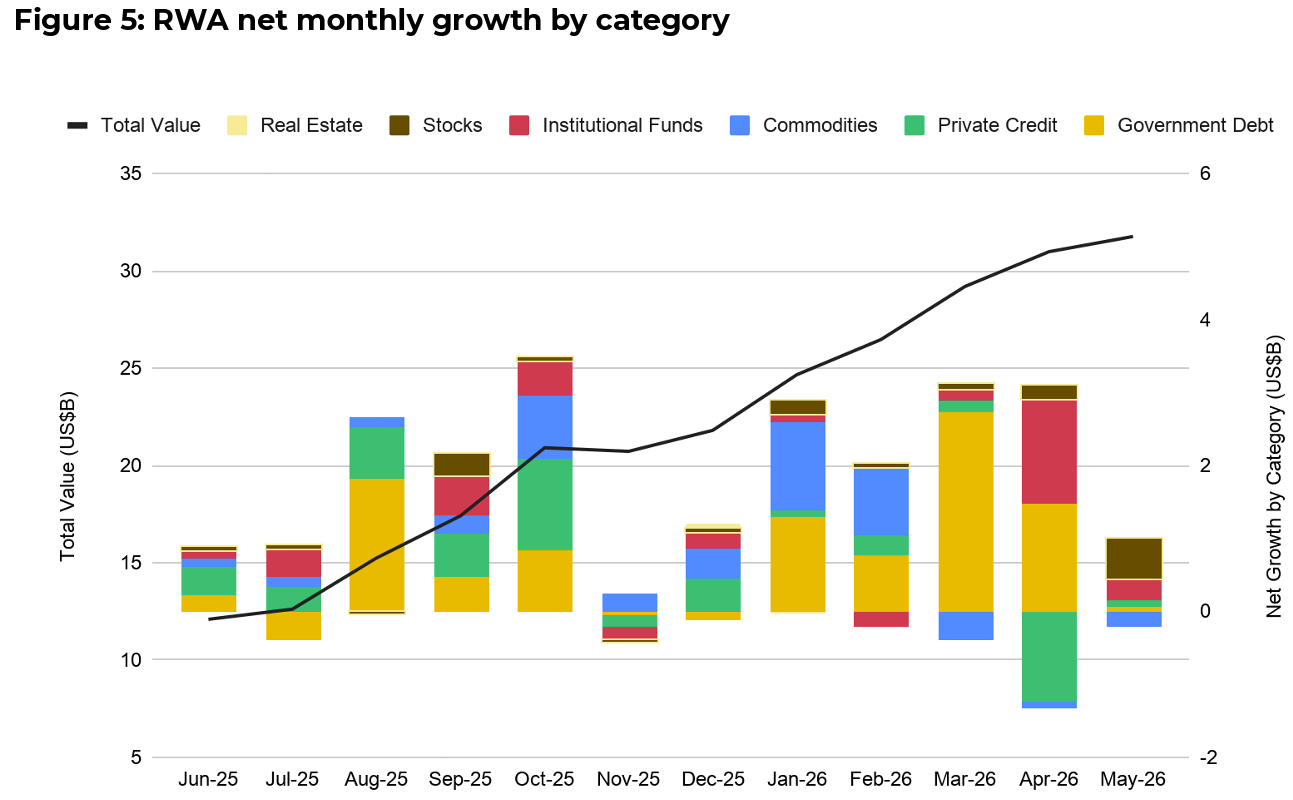
The market for tokenized RWAs is becoming more diversified.
Source: Binance Research
However, stocks remain a small fraction of the broader tokenized RWA market, accounting for only about 5.5% of the $34 billion RWA market capitalization.
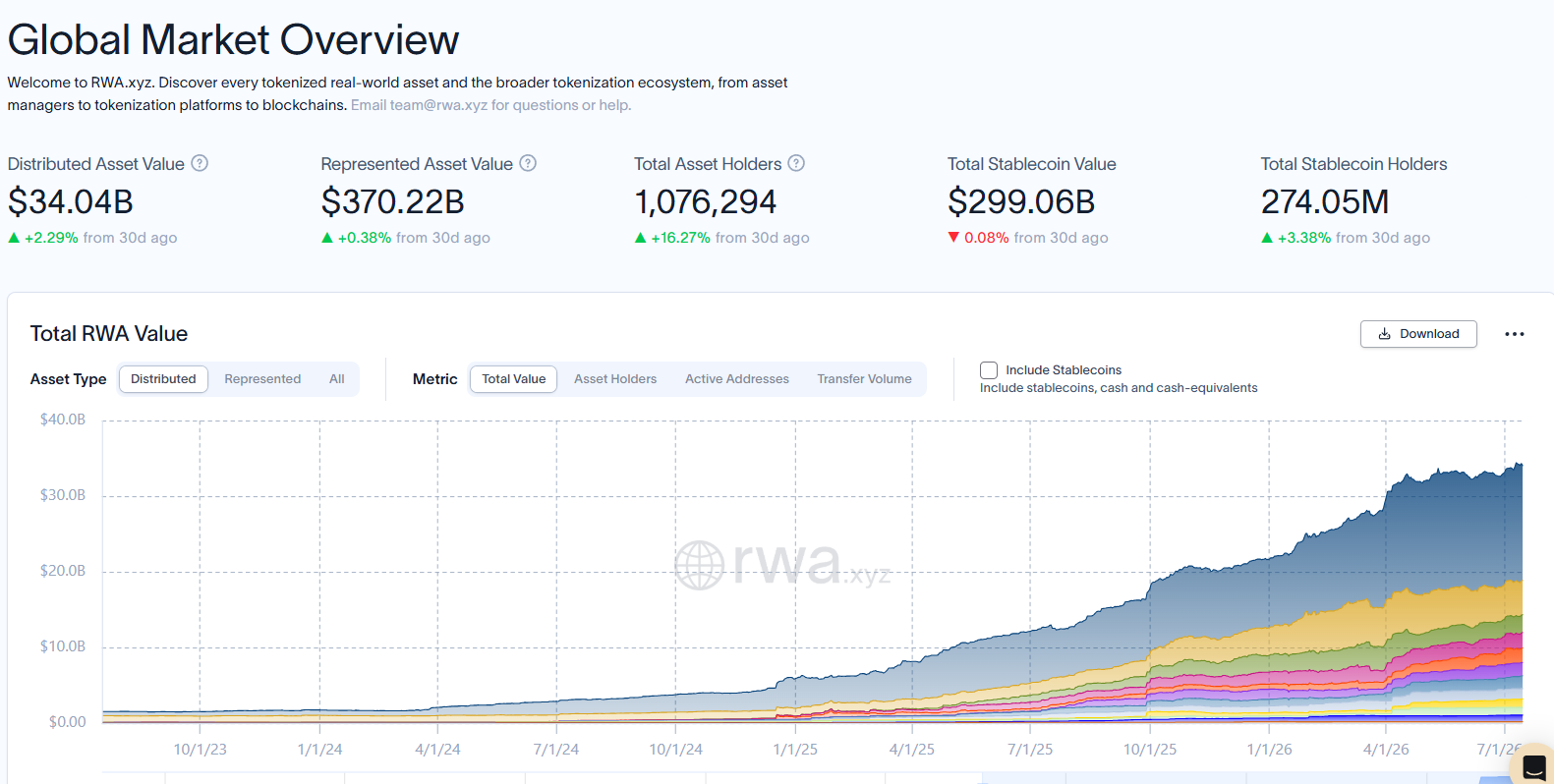
Tokenized RWA market overview, all-time chart. Source: RWA.xyz
About $15 billion in tokenized US Treasury debt represents the largest segment, or 44%, of the RWA market, followed by $4.5 billion in tokenized commodities, accounting for 13%, according to data provider RWA.xyz.
Magazine: The 5 types of real world assets being tokenized fastest onchain

AI agents are starting to change how payments need to work, and Visa is warning that the world’s card rails were never built for the transaction volume, speed, and cost sensitivity required by machine-to-machine commerce. In a joint report released this week with investment thesis platform Artemis, Visa argues that AI-driven micropayments demand near-zero fees and faster settlement to become commercially viable.
The report links the timing to a capability shift: it says AI agents crossed a key threshold in mid-2025, enabling them to discover unfamiliar APIs, assess pricing, and make autonomous payment decisions. That capability, Visa and Artemis say, is pushing commerce toward an agentic model—while existing infrastructure gaps continue to limit mainstream adoption.
Key takeaways
- Visa and Artemis say traditional cards are optimized for low-frequency, human-paced payments, making them poorly matched to high-frequency AI micropayments.
- The report frames 2025 as a turning point for “agentic” payment automation, driven by AI agents’ ability to autonomously evaluate and execute transactions.
- Visa and Artemis propose convergence: cards remain useful for proxy purchases inside merchant networks, while stablecoins fit machine-native micropayments.
- Some machine-payment standards are already gaining momentum, including Coinbase’s x402 protocol, which the report cites as reaching sharply higher monthly transaction counts in late 2025.
Why AI agents stress existing payment rails
Visa and Artemis describe the underlying mismatch as structural. Cards were designed for human commerce—where transactions tend to be less frequent and costs can be amortized across larger purchase sizes. AI agents, by contrast, are expected to generate many more micro-transactions, often on short time horizons and with different cost constraints.
For agentic micropayments to scale, the infrastructure must support payments with extremely low per-transaction overhead and settlement that enables rapid decision-making loops. The report suggests that without these properties, the economics of autonomous “machine-to-machine” payments remain unfavorable—even if the AI itself can now carry out the payment decision.
The report also warns that infrastructure gaps aren’t just theoretical. It frames current limitations as a direct brake on adoption, arguing that the shift from experimenting with agent capabilities to using them in everyday transactions depends on payment networks that can keep up.
x402 shows demand for machine-native transaction patterns
While Visa and Artemis emphasize the broader need for new infrastructure, they also point to early signs that some agentic payment designs are gaining usage. The report cites the x402 payment protocol developed by Coinbase as an example of standards beginning to attract real transactional volume.
According to the report, x402 processed $15 million in adjusted volume across more than 109 million adjusted transactions since its May 2025 launch. It also highlights a significant acceleration in October 2025: the monthly transaction count reportedly increased from 40,000 to 3.8 million, resulting in 38 million transactions processed in October alone. The report attributes this momentum to the growing practicality of the protocol for machine-style payments.
Stablecoins as an on-ramp to agentic micropayments
A central claim in the Visa-Artemis report is that stablecoins could play a key role in enabling machine-native micropayments without forcing all commerce to migrate away from cards. Rather than positioning stablecoins and card networks as direct competitors, the report argues for a convergence model.
“The trajectory points toward convergence rather than competition: cards for proxy purchases inside existing merchant networks, stablecoins for machine-native micropayments, and hybrid flows where both are used within the same workflow.”
This framing matters for investors and builders because it implies that payment interoperability—not replacement—will likely define near-term strategy. In practice, an AI agent workflow may still need cards for certain merchant-bound transactions, but stablecoins (or other crypto rails) could be better suited for the agent’s “background” actions that require very low fees and fast settlement.
The report adds that a single machine-payments framework could support both stablecoin-based flows and traditional card transactions. Visa says this creates a path for card networks to plug into agentic payments over time, rather than treating agent commerce as a separate universe.
Protocols and tooling: connecting onchain and fiat through tokens
Visa and Artemis point to a broader effort to unify payment approaches using shared payment tokens and machine-payment protocols. The report says Tempo’s Machine Payment Protocol (MPP) now spans both onchain crypto payments and fiat payments through shared payment tokens.
Visa also states that its Card Specification SDK was built to extend the protocol into card-based agent commerce. It further notes that Tempo and Visa’s crypto division launched AI-related tools in March, with different focal points: Visa’s tooling is described as enabling same-day payments for AI agents, while Tempo’s Machine Payments Protocol is designed to make it easier for AI actors to send and receive money.
While the report doesn’t spell out new performance benchmarks for every component, it does make one clear point: adoption depends on interoperability across rails and token frameworks. If AI agents can consistently route payments through a machine-friendly layer, then the difference between stablecoin settlement and card settlement becomes a routing and workflow decision—not a structural barrier.
For readers watching the space, this suggests a practical trend: payment infrastructure will likely evolve through standards, SDKs, and shared protocol logic that allow agentic workflows to move between fiat and crypto settlement depending on cost, speed, and merchant coverage.
Going forward, the key question is whether agentic micropayment demand keeps accelerating fast enough to force mainstream payment networks to meet machine-level cost and settlement requirements. Buyers of payments infrastructure, developers integrating agent payments, and traders tracking adjacent stablecoin usage should watch how quickly token-based frameworks and machine payment standards—like x402 and MPP—translate early transaction growth into consistent, scaled deployments.
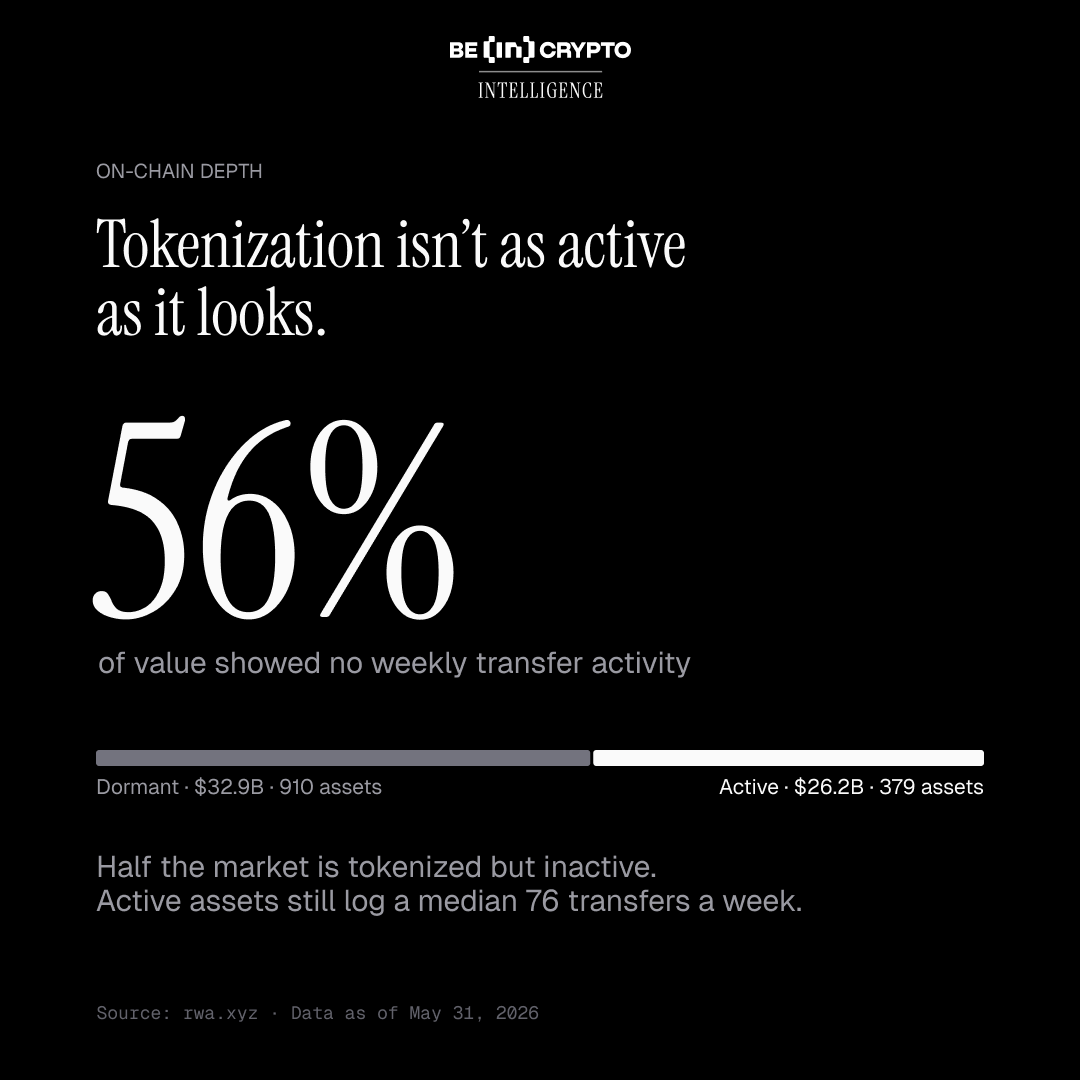
The tokenized real-world asset market has reached more than $60 billion, but most of that value remains concentrated, restricted, or inactive on-chain.
BeInCrypto Intelligence’s Real State of Tokenization in 2026 report, built with market data from RWA.xyz, tracked more than 7,000 products across 12 asset classes. It found that just 62 assets hold 88% of the market value, while five products account for roughly half.
The activity gap is even sharper. Of 1,289 tokenized assets worth more than $100,000, only 910 assets representing $32.9 billion recorded zero weekly transfers.
Meanwhile, 97% of the market remains outside US retail access. BeInCrypto asked members of its Expert Council what these findings reveal about the state of tokenization.

Archax: Institutions Should Not Have to Choose a Chain
Graham Rodford, CEO and Co-Founder of Archax, said blockchain fragmentation is making institutional adoption harder than necessary.
“The fragmentation problem is real and it’s not going away,” Rodford said. “Every major asset manager we speak to is dealing with the same operational question: which chain do I pick, and what happens when the next one emerges? The honest answer is that they shouldn’t have to pick.”
Rodford argues that institutions need a regulated layer above individual networks. It would handle issuance, trading, custody, and settlement without tying firms to a single blockchain.
He also rejected the idea that public blockchains are automatically unregulated.
“What determines regulatory safety isn’t the chain – it’s the gateway.”
Theo: Dormant Assets Show a Half-Built Market
Iggy Ioppe, CIO of Theo, said the $32.9 billion in dormant value does not prove tokenization has failed. Instead, it shows that much of the market has stopped at representation.
“Wrapping an asset and parking it is ‘tokenization theater’. The real work is making tokens usable – as collateral, in DeFi, in live settlement.”
The report distinguishes between Distributed assets, which can move across public blockchain rails, and Represented assets, which mainly use blockchain as a digital record.
Around $27 billion of the dormant value came from Represented assets. Many were designed for recordkeeping and institutional settlement rather than public trading.
Still, Ioppe said the next stage will depend on whether tokenized assets can move, earn yield, settle around the clock, and connect to wider financial infrastructure.
“The assets are on-chain; the next phase is making them work.”

Sygnum: Regulation Could Create Regional Liquidity Silos
Fabian Dori, CIO of Sygnum Bank, said the market risks splitting into isolated pools as jurisdictions develop different rules and standards.
“A regulated asset bank can help prevent tokenized markets from hardening into isolated regional liquidity pools by acting as a compliant interoperability layer rather than trying to force one universal token across all jurisdictions.”
The report found that EU-regulated products account for only $3.3 billion, or 6% of the core market.
Dori’s argument is that regulated platforms must connect issuers and investors across chains while preserving local legal and compliance requirements.
WAODAO: Tokenized Assets Need a Liquidity Network
Aleksandr Cryptoved, Founder of WAODAO, said the report exposes the difference between putting an asset on-chain and creating a functioning market around it.
“The report’s $32.9B in assets with zero weekly transfer activity highlights the gap between tokenized existence and tokenized market activity.”
He proposed a “liquidity graph” in which tokenized assets connect through multiple smaller trading pairs rather than relying on one deep market against a stablecoin.
“In my view, the missing layer is a liquidity graph.”
Such a structure could generate activity through rebalancing, arbitrage, collateral movements, and institutional portfolio management.
Tokenization’s Next Test Is Usefulness
The experts differ on why so much tokenized value remains inactive.
Rodford points to blockchain fragmentation. Ioppe sees a market stuck at digital representation. Dori focuses on regulatory silos, while Cryptoved argues that tokenized assets need better liquidity connections.
Their conclusions converge on one point: issuing more tokens will not solve the market’s structural gaps.
The next phase depends on whether tokenized assets can move across networks, meet regulatory requirements, reach investors, and plug into real financial workflows.
The market has proved that assets can be recorded on-chain. It has not yet proved that most of them can function as active markets.
Read the full BeInCrypto Intelligence report.
The post Is the RWA Boom an Illusion? BeInCrypto Expert Council Reacts to Stagnant Tokenization appeared first on BeInCrypto.
Ivanhoe Electric stock hits 52-week low at 8.43 USD

ARK challenges a16z over whether TradFi really needs DeFi

Sydney Roosters vs Melbourne Storm Tips, Odds, Teams & Predictions – NRL Round 20 2026


-

 Fashion6 days ago
Weekend Open Thread: Nutriplenish Leave-In Conditioner
-

 Tech7 days ago
Character.AI enters the microdrama arena with its own productions, but there’s a twist
-
 Sports7 days ago
2026 Genesis Scottish Open Thursday TV coverage: Round 1
-

 Sports6 days ago
Super Eagles star Moses Simon opens up on Liverpool transfer regret
-

 Politics1 day ago
Young campaigners urge incoming PM to act on outdoor junk food ads
-

 News Videos2 days ago
XRP BOMBSHELL… XRP OMBOARDED FOR TRANSACTIONS!!!
-

 Tech2 days ago
Get Your ESP32 Sunny Side Up With This Solar Dev Board
-

 Tech2 days ago
Dark Secrets Emerge When Jailbreaking LLMs
-
 Entertainment21 hours ago
Disney’s Most Ambitious Failed Star Wars Attraction Is Coming to SDCC
-
 Sports16 hours ago
New Cornerback Enters Vikings Trade Rumor Mill
-

 News Videos3 days ago
how to make coin bank box with cardboard #scienceproject #money #diy #shorts
-
 Tech3 days ago
Cloudflare Precursor Watches Your Mouse and Keyboard To Decide If You Are Human
-

 Crypto World13 hours ago
CFTC blocks Kalshi from unwinding Michigan trades after court order
-
 Entertainment19 hours ago
Vicki Gunvalson Defends Discussing Heather Dubrow’s Money
-
Crypto World2 days ago
Ripple, Coinbase, Circle Join Linux x402 Foundation to Help Shape AI Payments
-

 NewsBeat16 hours ago
Watch: Is Donald Trump facing a popular backlash on immigration?
-

 Sports14 hours ago
Michigan officials not expected to discuss AD Warde Manuel at Thursday meeting
-
 NewsBeat16 hours ago
Firefighters issue update on Dovestone moorland blaze as fire enters fourth day
-

 Business2 days ago
ACCC warns AI could lift insurance costs in risk-prone areas
-

 Entertainment3 days ago
Hollywood’s Biggest Director Just Called Out AI, And It’s Glorious
You must be logged in to post a comment Login