

Politics
Whittome calls for ‘safe and legal’ asylum routes for Sudan and Eritrea

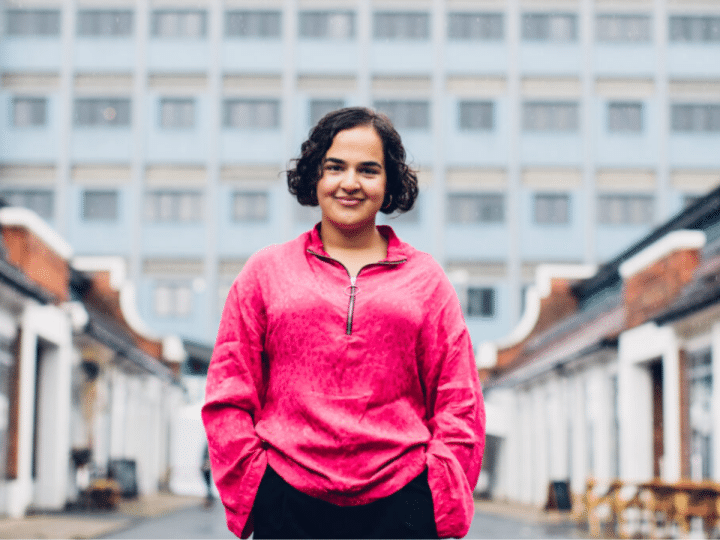
On 15 July, Labour MP Nadia Whittome posted an impassioned plea to social media, urging the UK government to establish safe, legal routes for Eritrean and Sudanese asylum seekers to come to the UK. Currently, and in contrast to similarly war-torn Ukraine, no specific refugee initiatives target those fleeing the two countries.
Whittome accompanied the post with a video of herself speaking during the second reading of Labour’s Immigration and Asylum Bill. Voting against the racist policy, she argued that the bill would “punish those seeking sanctuary” and “weaken vital protections” for people fleeing persecution.
‘Safe and legal routes’?
On 15 July, Whittome posted to social media:
When 94% of Eritrean and 99% of Sudanese asylum seekers are ultimately granted refugee status, the government should establish safe and legal routes for these countries, or at the very least, fast-track their asylum applications.
These high rates of asylum acceptance are unsurprising, given the turmoil that grips the two African states.
Sudan is currently locked in a viscous civil war with a genocidal UAE-backed Sudanese militia, the Rapid Support Forces (RSF). The Northeast African country recently convicted the head of the RSF, Mohamed Hamdan Dagalo (aka Hemedti) guilty of war crimes, crimes against humanity and genocide.
Meanwhile, Eritrea teeters on the brink of war with neighbouring Ethiopia. The UK’s Foreign Office currently advises against all travel to Eritrea, or even within 25km of its land borders.
Whittome continued on to state that:
Student refugee visas and community-support/business-support schemes cannot be the only safe routes for refugees. We should not be offering asylum protection based on qualifications, but on the level of need for sanctuary. A person fleeing war is not more deserving of safety because they can “contribute” more.
Asylum-seeking and small boats
Of course, the generic global resettlement scheme and the (recently diminished) family reunion route are also available to all refugees. In fact, the government acknowledges Sudan as one of the primary beneficiaries of the former, along with Eritrea for the latter.
However, the resettlement scheme involves long periods of dangerous waiting in one’s own country or nearby. Likewise, whilst asylum seekers with family in the UK can seek reunion, this doesn’t solve the problem of getting to the UK in the first place.
As such, asylum seekers frequently have to brave the deadly crossing to the UK via small boat. These small boats have dominated recent debate on immigration — being mentioned no less than 36 times in the 13 July Immigration Bill reading alone.
Ukraine and Sudan — contrasting reactions
Speaking during that debate, Labour’s Catherine West mentioned the Homes for Ukraine scheme, which home secretary Shabana Mahmood seized on as an example of a ‘safe and legal’ route for asylum seekers. However, as Whittome pointed out:
The reason we do not see Ukrainians crossing the channel on small boats is because, rightly, we have a safe and legal route. Why not expand those safe and legal routes to places like Sudan and Eritrea, because obviously if an asylum claim comes from those countries, at the very least they should be fast-tracked? That would help to clear up the backlog, so would she support that?
Today, 16 July, happens to mark Keir Starmer’s final visit to Ukraine as the departing PM. Back in 2022, then-PM Boris Johnson announced the creation of a Ukraine-specific refugee scheme within one month of the outbreak of Russia’s war on the Eastern European country.
Whilst this reaction from the UK is right in itself, it’s hard not to notice the difference in the treatment of Ukraine and Sudan. Likewise, we can’t ignore the fact that Sudan’s population is made up predominantly of Black Muslims, rather than the white-European Christians of Ukraine.
The war in Sudan broke out in 2023. In February 2026, the UN declared that the RSF’s actions bore the “hallmarks of genocide”. However, to date, the UK has created no scheme targeting asylum seekers from Sudan.
‘Needlessly cruel’
Ultimately, Whittome voted against Labour’s Immigration and Asylum Bill. She explained that it was:
needlessly cruel and will divert resources into an unfair, unsafe and unworkable system. Not only will the government’s proposals punish people for seeking sanctuary and lock out many refugees from obtaining settled status by charging them for the support they receive, but they will also weaken vital protections for those who have fled war, torture and persecution. We need an immigration and asylum system rooted in compassion and human rights.
Increasingly, Labour’s immigration policies have resembled a watered-down version of far-right Reform UK. Whittome has long been a voice of reason and fairness within her party — but, gradually, she’s looking more and more lonely in that regard.
Featured image via the Canary
By Grace


The Durham Miners’ Gala – ‘the big meeting’, as locals still call it – took place last week. Once, every coalfield had its gala. Now Durham’s is the last great survivor. But survival is not the same as relevance.
In recent years, the question hanging over the ‘big meeting’ has become harder to avoid: what is it for, and who does it now belong to? That question became sharper still after County Durham, long impregnable Labour country, turned into something much closer to a Reform UK stronghold in last year’s local elections.
The gala itself remains organised around a politics that belongs to another century. It is caught between three worlds: the culture of the old industrial working class, the socialist politics of the 20th century and the activist liberalism of the contemporary left. Add to that the visible support for Reform among the families and descendants of Durham colliers, and the contradiction becomes impossible to ignore. The big meeting can no longer pretend that these tensions are merely background noise.
Over the past few years, the Gala has become less a living expression of working-class politics and more a stage for the narrow concerns of the Corbynista activist class. A clip from this year’s event made the point brutally. The ‘Palestine Bloc’ – around 30 (mostly white) activists carrying Palestine flags and wearing the keffiyeh uniform of the modern protester – moved through Durham behind a few dancers in traditional Palestinian dress. They shouted ‘free, free Palestine’. Some in the crowd clapped. Others booed. John Cleese posted a video of it on X, with the observation that it would not be out of place in a Monty Python sketch. He’s right.
This wasn’t the first time the gala has embarrassed itself. The flashpoint last year was the invitation to Husam Zomlot, the Palestinian ambassador to the UK. It seems that every year the gala is dragged into another controversy because the activist left insists on making it speak the language of identity politics and middle-class luxury beliefs. As a result, the working class has been turned into a costume, a backdrop, a set of banners and brass bands to lend moral weight to causes that often have little to do with the people whose history is being borrowed.
I know what these galas meant because I grew up with them. As a child, I went with my family to the local gala at Berry Hill in Mansfield. It was a great occasion, not a seminar in radical theory. Families from across the Nottinghamshire coalfields met, talked, drank, listened to brass bands and watched the banners pass. It was social, cultural and political all at once.
Yes, there were speeches from trade-union leaders and Labour MPs. But coalfield Labour was not the same thing as metropolitan leftism. Mining communities were often Labour by loyalty and history, but conservative in instinct: rooted in family, place, work, respectability and belonging. The banners could be radical, with muscular miners, Keir Hardie, sometimes Marx and Lenin, and slogans such as ‘Unity is Strength’ and ‘Our Future We Build From the Past’. But the life around them was ordinary, local and deeply communal. There were Coal Queens, baking competitions and vegetable competitions, with miners spending the year cultivating giant onions and leeks.
That was not an embarrassment. It was part of the texture of working-class life. The politics were housing, healthcare, education, jobs, wages, family and the cost of living. They were not abstract performances staged for the approval of graduate activists.
That is why this year’s gala felt less like a celebration than a warning. The British left still wants the imagery of the industrial working class, but it no longer knows how to speak to the people who inherited it. Their politics are too awkward: patriotic, communal, anti-authoritarian, loyal to family and place, suspicious of elites, and often far less liberal than the people who claim to champion them.
The ‘neu-left’, as I call them, want the banners, the brass bands, the flat caps and the moral inheritance, but not the actual working class, with all its complications. If one image captures the absurdity of the contemporary left, it is this: Palestine activists marching through Durham, and Angela Rayner looking down from a balcony like visiting royalty, the crowd clapping loudly enough to try to drown out the boos, and Reform sitting in the council offices.
Lisa McKenzie is a working-class academic.
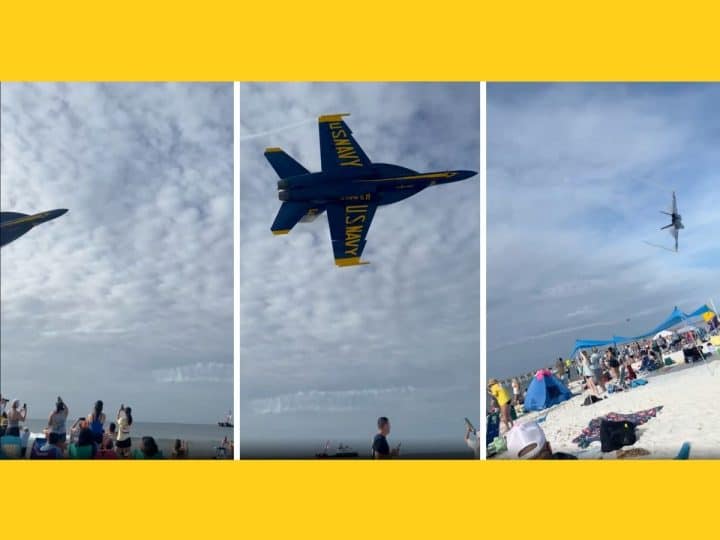
In an absolutely wild clip, an individual has recorded the US Blue Angels performing a recklessly low fly by over a beach full of people. And when we say low, we mean low. When we say ‘reckless’, we mean the subsequent air currents caused chaos:
There's a reason the FAA banned jets from flying over crowds at airshows.
Pete Hegseth's tiny dick is going to get someone killed. pic.twitter.com/3haZj5oXWW
— Cuckturd (@CattardSlim) July 15, 2026
Blue Angels: Sonic BOOM
In the clip above, a fighter jet is seen passing over the sea in the distance. Moments later, a second jet shoots over head, passing mere metres away from a nearby hut. Seconds after, the wind currents catch up, and people begin to cover their ears — dust blowing everywhere as beach furniture gets knocked down and blown away.
Watching the clip, it’s easy to imagine an older or disabled person being seriously injured. Unsurprisingly, then, the Blue Angels (equivalent to the UK Red Arrows) are reviewing what happened, stating:
During an arrival maneuver, an aircraft flew lower than standard profiles, resulting in a disturbance on the beach that affected civilian chairs and umbrellas
The US Navy group added:
The safety of our hometown community, spectators, and our pilots is our highest priority. Team leadership is reviewing the circumstances surrounding the maneuver and conducting a thorough safety review to ensure all operations adhere to strict Navy and FAA safety standards.
Confirming this pass was out of the ordinary, one of the beach goers said:
I’ve been coming for 10 years and I’ve never seen a pass like that in my life
High T
As the commenter at the top noted, this could be linked to the tendencies of US war secretary Pete Hegseth. Giving you an idea of how insecure the guy is, Maddison Wheeldon reported the following on Hegseth in March this year:
US Defence Secretary Pete Hegseth announced in an address to US citizens that “dumb, politically correct wars of the past” are the “opposite” of the intentions of the US administration.
That’s right; the guy thinks the invasion of Iraq was ‘woke’. And he presumably he thinks this to excuse the years of failures the US suffered as a result of its foolish and illegal decision to overthrow a sovereign government.
In a further sign of his insecurity, Hegseth is currently urging his soldiers to pump themselves full of testosterone. Apparently, you’re not a real man unless the hormone is literally dripping from your knuckles:
Once you realize people like Hegseth are losers who only dream of warmongering and abject cruelty, everything they do makes sense. Everything being done is to just maximize how of a perceived threat we can be, even though America is the biggest threat already to the entire world https://t.co/fPkTbPMN7l
— song (@song0fmidnight) July 15, 2026
Hegseth struggling with a low weight for a man his size, but he has some pecs when he's shirtless to boast his NSDAP tats.
Does he just have cosmetic pec implants for gender affirmation?
And wtf @ the uncontrolled leg spasm–damage from gym cocktails interacting with liquor? — S.A. Barton (@Tao23) July 15, 2026
 https://t.co/rGHR0o67Jr
This won’t come as a surprise, but Mr Testerone has a horrible record when it comes to his interactions with women, with his own mother writing the following to him:
You are an abuser of women – that is the ugly truth and I have no respect for any man that belittles, lies, cheats, sleeps around, and uses women for his own power and ego
She also said:
You are that man (and have been for years) and as your mother, it pains me and embarrasses me to say that, but it is the sad, sad truth
Blown away
Hegseth is someone who constantly needs to prove his masculinity. And now, his macho, anti-woke nonsense is spreading.
Expect things to get even more embarrassing from here on out.
Featured image via the Canary
By Willem Moore
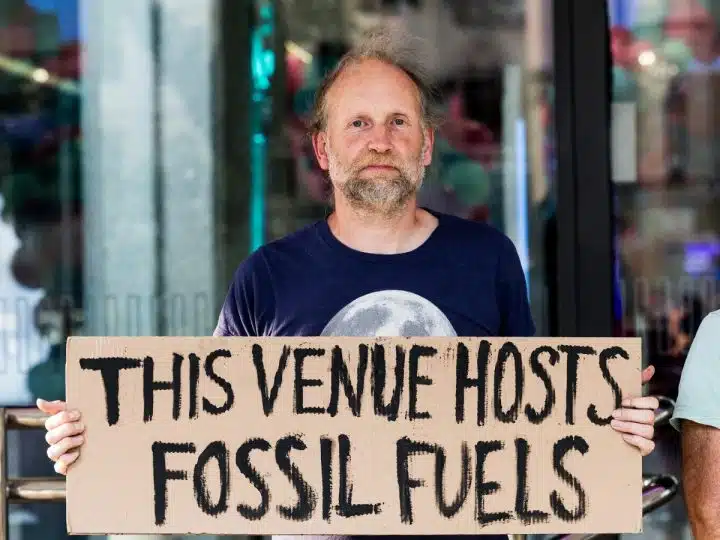
Amidst the third heat storm of this year, campaigners demanded an end to London venues hosting events for fossil fuel companies.
Fossil Free London campaigners disrupted inside the QEII Centre in Westminster while the venue hosted its annual Summer Showcase. This is an invitation-only event marketed to the events industry where companies can find suitable locations for their corporate events.
In protest over London venues hosting oil and gas events, five campaigners entered the 40th birthday party event at the QEII Centre and disrupted the event. They requested to give a birthday speech within the DJ booth when they said:
Did you know the QEII Centre is one of the biggest hosts of the fossil fuel companies in London? They line the pockets of the oil and gas industry. They have blood on their hands and their pockets are lined with oily money.
This is a climate crisis. people are dying. They host Shell, Exxon, as well as the weapons manufacturing companies. Their pockets are lined with oily money. Shame on them… Shame on you!
They were dragged out by security while chanting:
London’s calling, London’s burning! Don’t host oil!
The QEII Centre hosts a variety of fossil fuel events. In February 2026, it hosted International Energy Week, a three-day oil and gas conference organised by the Energy Institute and attended by companies including Shell, BP, Equinor and TotalEnergies.
London consistently brings together oil majors, national oil companies, commodity traders, financiers, consultancies, law firms, diplomats, regulators and policymakers at global conferences. These include Energy Intelligence Forum, World Energy Capital Assembly and Africa Energies Summit.
And the capital’s role in these conference circles is growing: the Middle East Petroleum & Gas Conference relocated from Dubai to London in June.
Campaign highlights fossil fuel – far right link
The protest comes as the start of a new campaign by the climate justice group, that demands London venues stop hosting ‘oil and hate’. The group intends to draw attention to the city’s enabling of the fossil fuel industry and the far right. And it will disrupt venues that host the fossil fuel industry event including when the venue is not currently hosting an oil or gas event.
In June, Kensington Olympia in London hosted the Alliance for Responsible Citizenship conference. This brought together climate deniers, far-right figures including Nigel Farage and Big Oil executives. Between 2019 and 2024, Reform UK received more than £2.3m from fossil fuel interests, polluters and climate deniers. That made up 92% of the party’s donations in that period.
The campaign emerges as a growing number of venues have already refused to host such events. In February 2025, the London venue OMEARA cancelled an unofficial afterparty for the Alliance for Responsible Citizenship (ARC) conference following a Fossil Free London campaign.
In July 2026, the Powerscourt Hotel in County Wicklow, Ireland, cancelled a conference by Dialog, an invitation-only group co-founded by tech billionaire Peter Thiel, after a public campaign.
Robin Wells, director for Fossil Free London, said:
London is cooking and this is London calling, and we’re calling time on the venues that host oil and hate.
Every day in our city, Big Oil meets and colludes behind closed doors in air conditioned rooms, to cause fossil-fuelled heat storms like this one, the third of this year.
They meet in hidden conferences, private ballrooms and exclusive drinks receptions, plotting to set fire to our safety and security and collude with the politicians, thinktanks and far-right forces to strip back our rights.
Venues hand fossil fuel actors the space and the secrecy to burn our house down, while lining their own pockets. And the screams of those who live in that burning house are only getting louder right now.
From North London, where we personally know four people who died in a fire in the last heat storm, to China and Taiwan, as millions face a super typhoon tearing through their windows and tearing up their lives.
The people are sweating: in this fossil-fuelled extreme heat, and in fear of the avalanche of racism and climate denial currently being perpetuated inside our city’s private venues. It’s time for these city’s spaces need to make the moral choice. Venues have already kicked out far-right actors, proving it can be done.
This city belongs to all of us. We are resolving to make it impossible for destruction and violence on a mass scale to continue to thrive here in London. No room for oil. No room for hate.
Featured image via Fossil Free London
By The Canary
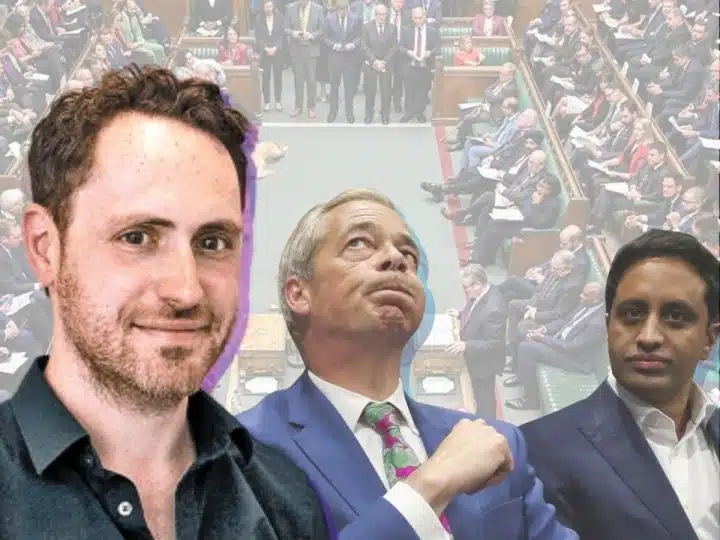
As we’ve reported, several establishment outlets have put an enhanced focus on Reform UK and Nigel Farage. Perhaps most notably, this has seen the investigations team at Rupert Murdoch’s Times newspaper revealing all sorts of financial scandals. It’s not just the investigative reporters who are diving in two feet first, though; the columnists are also at it:
Reform can’t have it both ways on ‘hurty words’ https://t.co/nR0dR8tiHE
— Times Politics (@timespolitics) July 15, 2026
Security
Because his father was a minister in the governments of Margaret Thatcher and John Major, Rifkind has some experience of the security politicians receive. This is relevant right now, because Reform politicians have made some wild and false claims about the security they receive from parliament.
In his piece, Rifkind notes:
Yesterday, Reform’s party chairman, Zia Yusuf, demanded round-the-clock protection for all 650 MPs. Aside from the expense, the obvious flaw here is that this wouldn’t have helped Widdecombe, who wasn’t one, any more than it would Yusuf himself, who isn’t either. It also only deals with a symptom of the real problem.
Elsewhere, Rifkind described Yusuf as “increasingly wild”. It’s a fair thing to note, especially because Yusuf keeps making false claims, and making costly and unworkable proposals which won’t fix the problems he’s identifying. This is also why people are accusing Reform of using this event and others (especially the Clacton by-election) to distract from Farage’s ongoing financial scandals:
As I said yesterday. Reform’s supporters are moving from trying to suppress any scrutiny of Nigel Farage’s £5m donation to trying to suppress any scrutiny or criticism of Reform at all. https://t.co/C39dbG4z5N
— (((Dan Hodges))) (@DPJHodges) July 16, 2026
Reform are now piling in on Kemi Badenoch because they say it was bad taste for her to make a quip about Count Binface whilst the party are in mourning. But apparently the death of a dear colleague wasn’t enough to cancel your summer party 48 hours later?
The usual selective… pic.twitter.com/tXL9CaJPeS — Sam (@SamCKx) July 16, 2026
Political blowback for Reform
The key argument Rifkind makes is that Reform is being hypocritical in how it expects others to treat them. It’s a point others have made too:
https://t.co/DvdMy4HL5Z pic.twitter.com/Q5Xfbishcm
— NJ (@NoJusticeMTG) July 15, 2026
Here, though, Reform is on tricky ground. Yesterday Yusuf also hit out at rival politicians for “equating us to murderous regimes that butchered tens of millions of people”, on the basis that it might incite violence. I agree with him. I’m not sure he agrees with himself.
Reform, remember, is also the party that put Lucy Connolly on stage, introducing her as “Britain’s favourite political prisoner” after she called for asylum hotels to be firebombed. For two years they led, with sneers, the argument that mere “hurty words” hurt nobody. Meanwhile, Farage has accused Richard Hermer, the attorney-general, of “hating our history and our country” and accused plenty more of plenty more. This very week, Yusuf himself, who seems to be growing increasingly wild, hit back at the former Tory MP Harvey Proctor — who mildly chided Farage for politicising Widdecombe’s death — by publicly denouncing him as “depraved” for a historic gay sex offence that today wouldn’t be illegal. He is also still telling his followers that the Tories “destroyed Britain” and that Andy Burnham is about to destroy it even more. And on, and on.
As Rifkind notes, Reform UK politicians are relentlessly inflammatory in their rhetoric. At the same time, they’re incredibly comfortable with bad things happening to other politicians:
Given Reform's Press Conference today about MP safety, worth revisiting this clip of sitting Reform MP Sarah Pochin, and Reform supporter Jeremy Kyle laughing on TV at the firebombing of the Prime Minister's house… https://t.co/9Fi3PbWehH
— andy twelves (@andytwelves) July 15, 2026
All so very predictable, Reform…
In closing, Rifkind noted that Reform would have called him a “snowflake” in the past for suggesting political rhetoric can have consequences. He also said:
Either this matters, or it doesn’t. Either maniacs are inspired by incendiary language or they are not. Personally, I think the link is diffuse, but I also think it pretty damn obvious that the more violent and condemnatory our discourse, the more likely it becomes that various maniacs will find focus for their mania.
We made similar points on 13 July, writing:
If you’re going to label people ‘traitors’ — as Zia Yusuf has — then people are going to get angry. If you’re going to claim successive governments have overseen an ‘invasion’ — as he has — then tensions are going to rise.
Politicians who stoke fear and division think they can ride the wave, but hatred is more like a fire than a sea. And people who play with fire get burned.
Scrutiny
The alleged murder of Ann Widdecombe is a grave event that needs to be taken seriously. It’s questionable if Reform politicians are treating it seriously, though, because they’re using it to argue we should treat them with kids gloves while donning knuckle dusters themselves.
Voters see through this sort of stuff. And Reform politicians aren’t going to make themselves popular by constantly attacking everyone for sometimes attacking them.
Featured image via the Canary
By Willem Moore
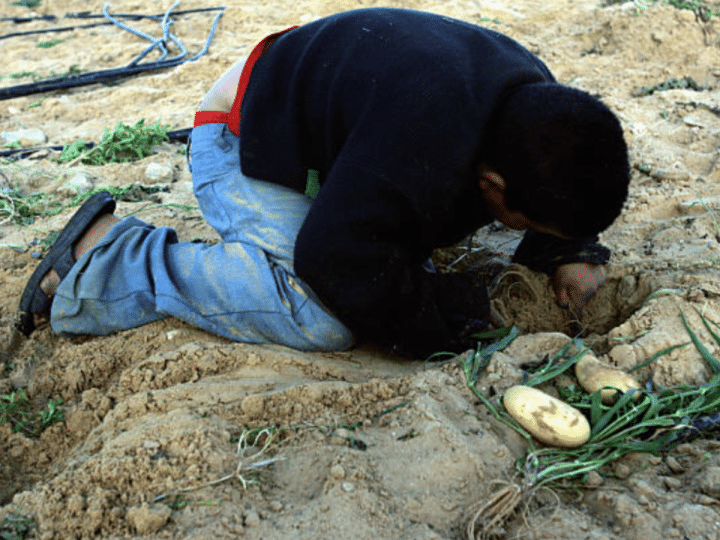
According to a statement from the Palestinian Ministry of Agriculture Israel has inflicted “unprecedented devastation” on Gaza. In the almost three years since the genocide began Israel have repeatedly carried out damage to Palestinian infrastructure.
Gaza: agricultural losses estimated in the billions
Damage exceeded 85 percent across most agricultural sub-sectors, resulting in a near-total collapse of the agricultural production system. Losses were estimated to be worth around £2.6 billion.
More than 87 percent of agricultural land used for growing crops was damaged, so local food production severely declined, Around 8,700 agricultural water wells were also rendered inoperable. The agricultural irrigation system was hard hit too, with approximately 8,700 wells completely inoperable. Around 3,820 agricultural reservoirs were also damaged, and more than 1370 km of water transmission networks destroyed.
Overall losses in Gaza’s livestock sector reached more than 90 percent. A total of 5450 cattle, sheep, and goat farms were damaged, and 70,000 died. While about 2,300 poultry farms were damaged and nearly 2.8 million birds died during this time. 28,400 beehives were also damaged.
Gaza’s fishing sector was also severely affected by the genocide. The Strip’s only fish hatchery was destroyed, while almost 1,675 fishing vessels and fishing assets, seven aquaculture farms, and around 450 dual-use ponds were damaged.
‘Catastrophic damage’
The genocide also caused “catastrophic damage” to agricultural infrastructure. More than 90 agricultural nurseries, nearly 20 hatcheries, and almost 135 agricultural cold storage facilities were destroyed. Alongside this was the widespread destruction of government agricultural facilities, experimental stations, water treatment facilities, and veterinary laboratories.
According to the Palestinian Ministry of Agriculture, this unprecedented devastation has had severe consequences. The agricultural production system is almost at a complete standstill. There has been a sharp deterioration in food security across the Gaza Strip. And, at the same time, thousands of families have also lost livestock. These factors have led to a dramatic increase in the number of Palestinians in Gaza depending on humanitarian aid.
The Ministry is calling for urgent and immediate action to be taken, and is calling on donor institutions, UN agencies, and the international community to show their support. The recovery, rehabilitation, and reconstruction of the agricultural sector need to be supported, to enable farmers and fishermen to resume production.
Israel have purposely attacked any means that support Palestinian life. That includes water supplies, energy supplies, and the ability for Palestinians to feed themselves. If — or when — the international community continues to ignore, the longer Israel’s genocide on Gaza will continue.
Featured image via the Canary
By Charlie Jaay
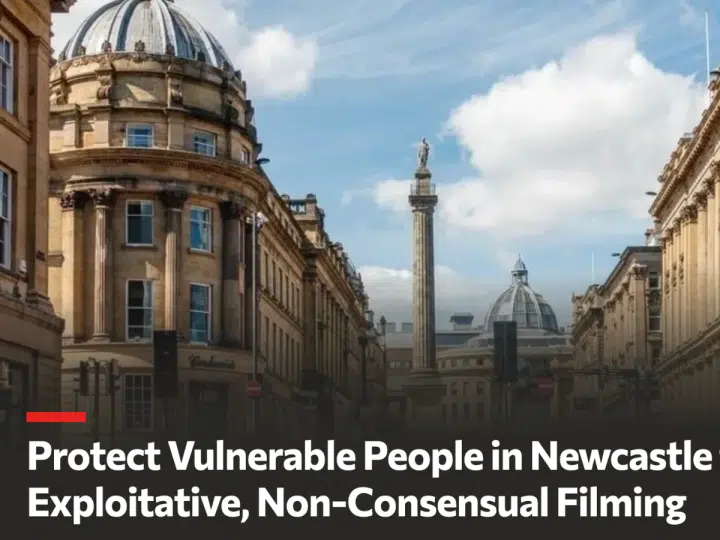
A petition has been launched calling on Newcastle City Council, Northumbria Police and social media platforms to do more to protect vulnerable people from being exploited by content creators in the city.
Petition calls out public humiliation for clicks
The petition explains:
Recently, content creators such as ‘Tin Tin’ and ‘Michael Ballymore’ have been repeatedly recording people who are homeless, struggling with addiction, or otherwise vulnerable (often without consent) for the purpose of online attention and engagement. This behaviour is harassing, dehumanising, and dangerous.
One look at these social media channels shows videos people with mental health problems, learning disabilities and homeless people being made fun of without their knowledge. In others, homeless and disabled people are accused of being frauds. Others show rough sleepers blamed for the “state” of the city centre.
Some of these videos have hundreds of thousands of views, and all are posted without the consent of the subject.
The petition continues:
No one should be filmed while in distress, intoxicated, sleeping rough, or experiencing a mental health crisis. These individuals deserve safeguarding, privacy, and dignity. Not public humiliation for entertainment.
Meta AI enabling harassment and exploitation
The videos appear to be filmed on AI glasses, meaning those involved don’t even know they’re being filmed. There have been concerns raised recently about how the rise in tech like Meta Glasses in enabling harassment and indecent filming without consent. This comes after Meta partnered with Kylie Jenner in an attempt to girlboss the glasses, ignoring the fact that they can be used to film women without their consent.
Last year, a Reform Councillor in Essex, Sam Journet was arrested for stalking and harassing other elected officials and council staff. This came after he used Meta Glasses to film all interactions with staff, councillors and members of the public. Journet also received backlash after he filmed a disabled man and alleged he was ‘dangerous’.
Campaigners replaced billboards near Meta’s London HQ with ‘honest ads’ of Jenner wearing the glasses, declaring:
Meta: We’re always watching
And it’s not just the glasses we have to worry about with Meta’s insidious use of AI. Just this week, 26 Meta employees filed a lawsuit against the company, alleging that they used AI against those on sick leave to target them for redundancy.
How you can help
The petition asks for stronger enforcement of existing laws around harassment and non-consensual filming, as well as ‘clear public guidance’ from the council about filming vulnerable people in public.
It also wants Community Protection Notices assessments to be carried out on those who continue to film others in public to exploit them. The petition also suggests that there should be better collaboration with outreach teams to support those being exploited.
Lastly, it calls on social media platforms to remove content that encourages harassment, exploits vulnerable people or violates privacy.
As the petition concludes:
Newcastle is a city known for compassion, community, and solidarity. Exploitative filming does not represent us. We urge local authorities and online platforms to act now to protect those who cannot easily protect themselves.
You can sign the petition here.
Featured image via the Canary


Argentina booked their place in the 2026 World Cup final with a dramatic 2–1 comeback win over England on 15 July at Atlanta Stadium, keeping their hopes of defending the title alive. They will now face Spain in Sunday’s final in what promises to be a blockbuster showdown.
It was another unforgettable night for football fans, with Lionel Messi once again proving why he’s one of the greatest players of all time. The Argentina captain inspired his side to a second consecutive World Cup final, playing a decisive role as they turned the match around in the closing stages of one of the tournament’s most gripping semi-finals.
Argentina fight back to reach the final
England looked on course for a place in the final after taking the lead, but Messi stepped up when it mattered most. The veteran playmaker produced two brilliant assists to complete Argentina’s comeback.
His first pass found Enzo Fernández, who fired home the equaliser, before Lautaro Martínez finished off another Messi setup to score the winner and send Argentina into the final. The dramatic victory sparked huge celebrations among the Argentine players and supporters.
The reigning champions are now just one win away from defending their crown as they prepare for a mouth-watering final against Spain.
Messi adds more records to his incredible legacy
As if leading Argentina to another World Cup final wasn’t enough, Messi also added several more milestones to his remarkable career.
His two assists against England took his total to 12 World Cup assists, extending his record as the tournament’s all-time leading assist provider.
The Argentine superstar also became the player with the most goal contributions in World Cup knockout matches, adding yet another record to his already extraordinary legacy.
Featured image via the Canary
By Alaa Shamali

Throughout the NHS, there has been increasing concern raised by clinicians over recent years that due to budgetary pressures, clinicians are having to use unlicensed products when preparing skin for surgery putting patient safety at risk. As a result, a group of senior clinicians have written to the Department of Health and Social Care and MHRA to push them to provide greater clarity and leadership on the topic to help improve patient outcomes.
Preet Kaur Gill MP
The use of unlicensed products for perioperative skin preparation
14th July

MDU warns Chancellor clinical negligence system ‘not fit for purpose’

Northern Ireland RE curriculum is ‘indoctrination’ – Supreme Court
Dear Minister,
As clinicians working across the NHS, we are writing to express concern about the continued use of unlicensed products for perioperative skin preparation within some NHS organisations.
Preventing surgical site infections (SSIs) is a fundamental component of safe surgical care. Patients should be able to have confidence that products used before surgery have been appropriately assessed, authorised, and regulated for their intended purpose. However, we understand that some NHS Trusts are procuring unlicensed biocidal products in place of licensed medicinal products specifically approved for perioperative use.
While such decisions may be driven by short-term cost pressures, they risk creating unintended consequences for both patients and the wider NHS. The use of unlicensed products raises important questions regarding patient safety, clinical governance, informed consent, and accountability. It also introduces variation in practice across the health service at a time when consistency and quality of care are key priorities.
The implications extend beyond patient outcomes. Surgical site infections can lead to prolonged hospital stays, delayed recovery, and increased demand on NHS services. Any procurement savings must therefore be weighed against the potentially significant costs associated with avoidable complications, additional treatment, and litigation.
We are therefore calling on the MHRA and the Department of Health and Social Care to provide greater clarity and leadership in this area, including:
- Clear national guidance on the use of licensed and unlicensed products for perioperative skin preparation;
- Greater transparency regarding regulatory oversight and enforcement;
- Improved monitoring of patient outcomes and adverse events associated with unlicensed products; and
- Support for procurement decisions that properly reflect patient safety, clinical effectiveness, and whole-system costs.
At a time when the NHS is seeking to improve productivity, reduce waiting lists, and enhance patient safety, it is essential that procurement decisions support these objectives. Patients deserve confidence that the products used in their care meet the highest standards of safety, quality, and regulatory scrutiny.
Yours sincerely,
Mr Andrea Bille
Thoracic Surgeon
Guy’s Hospital
Mr Aziz Momin
Consultant Cardiac Surgeon
St George’s Hospital
Mr Giles Bond-Smith MBBS BSc FRCS
Consultant HPB, AWR & Emergency Surgeon
Clinical Director for Surgery, Women’s and Oncology (SUWON)
Lindsay Keeley RN BSc Hons
Clinical, Patient Safety & Quality Lead
The Association for Perioperative Practice
Oliver Tierney
President and Director
The Association for Perioperative Practice
Climate denying politicians love to moan about the cost of ‘Net Zero’; what they hate discussing is the cost of not solving climate change. And as we’re seeing, the costs are in the billions already:
Once again – the cost of inaction.
Investing in tackling the climate crisis is vital for our national security and an important opportunity to invest in our communities.
At the very least, the Government should stop making things worse! https://t.co/Kpe9JEadle — Zack Polanski (@ZackPolanski) July 16, 2026
Heating up
Polanski was drawing attention to a study from the Verdant thinktank, which describes itself as follows:
To address these new times requires new thinking and a new approach. We will work collaboratively, bringing citizens and experts together to design the next chapter of progressive politics in the UK. We will draw on expertise across the environment, social, and economic justice movements, conducting deep, future-facing research to develop practical and ambitious policy proposals. …
Our aim is to make bold, inclusive policy the foundation of a fair, flourishing and sustainable Britain.
The co-directors of Verdant include Deborah Doane and James Meadway, who we’ve interviewed before:
There are plans to build a data centre in Brick Lane, we hear from economist James Meadway
— Canary (@TheCanaryUK) June 4, 2026
 @financialeyes Ranjan Balakumaran pic.twitter.com/kht5bFQaOx
The cost
In the intro to their latest report, Verdant write:
June 2026’s record-breaking heatwave, which saw temperatures top 37 degrees in parts of the country, has had an estimated, direct economic cost of at least £2.36bn. This is the result of reduced productivity due to the well-documented effect of all work becoming harder at higher temperatures, and that infrastructure and equipment overheat and fail. For each one degree Celsius temperature increase above 30 degrees in Europe, a 3% reduction in average output per hour has been observed. In a prolonged heatwave, these impacts add up to become significant economic losses. This is only the direct economic cost from productivity losses, and excludes the knock-on effects of increased energy demand, for example.
If heatwaves continue to worsen at the same pace as the previous decade, we should expect cumulative losses from each summers’ heatwaves of at least £25bn by 2030. This is likely to be an underestimate of their true cost, since it is recording only the direct impact on productivity. Further impacts on the costs and supplies of electricity, and the wider macroeconomic effects will add to this baseline cost. We are, in addition, not counting the dreadful human cost in health and mortality.
To reduce the economic losses of heatwaves, and to better protect those in work, we recommend a national maximum working temperature; the introduction of national heat insurance to protect incomes of those unable to work during heatwaves; and investment in active cooling and urban redesign, including greening urban spaces, to reduce the impact of extreme heat itself.
We’ve also reported on the call for the national maximum working temperature; most recently when Green MP Hannah Spencer discussed introducing a bill on the topic in parliament.
"From bus and train drivers sweltering in their cabins to bakers working in over 40 degrees, and builders whose workplaces offer no respite from the heat – the government has a duty to protect all of us."
Today Hannah Spencer is tabling a maximum workplace temperature bill. pic.twitter.com/0ofCXCDx4M
— The Green Party (@TheGreenParty) July 13, 2026
Denial
It’s important to be aware of the costs of not solving climate change — especially because the deniers only focus on the costs of switching to renewables. And this isn’t the only trick they pull.
In a video titled, You’ve been lied to about Net Zero, documentarian Simon Clark explains that deniers create misinformation around Net Zero as follows:
So these are the five steps of the anti-Net Zero playbook. Inflate the costs, ignore the cost of business as usual, ignore the operational savings, ignore the co-benefits, and most egregiously, ignore the costs of inaction. Not getting to Net Zero is going to cost the world much, much more
Clark also highlights that when people target the ‘cost’ of switching to Net Zero, they ignore the costs of not switching.
The second step often is to pretend that we can just carry on with business as usual and it won’t cost us anything. Let’s say we’re talking about decarbonising transport. And then people say, “Oh, but you know, an EV that’s going to cost like £40,000. You know, that’s a huge investment. That’s expensive, right?” You know, and you add that up over all of the cars in the country and you suddenly get a big scary number.
Again, let’s say we just carry on with petrol cars. Petrol cars aren’t free, right? Okay, maybe you own a petrol car now, so you don’t have to buy a new one, but that won’t last forever. So, that’s step two is you basically pretend that the existing system, which we’ve already built and paid for, can just carry on forever and won’t ever need replacing.
Follow the money
It’s obvious why many climate-denying politicians talk down the impacts of climate change; it’s because they’re in the pocket of the fossil fuel industry.
Decades of inaction have already cost us billions, and further dawdling will cost us trillions. In other words, it’s time to treat this issue as the crisis it so obviously is.
Featured image via the Canary
By Willem Moore
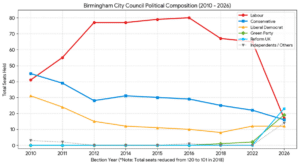
Matthew Lloyd analyses the recent local election results in Birmingham and the lessons they hold for Andy Burnham as Prime Minister.
Birmingham is the largest local authority in Europe. Like many local authorities, it struggled financially and by 2023 it had joined the list of local authorities which had been declared bankrupt. Before the local elections the city was seen as a Labour stronghold, but after heavy Labour loses, Birmingham has its first ever Liberal Democrat council leader who is supported by a cross-party coalition.
Labour faced multiple electoral threats from pro-Gaza independents, Reform and the Greens, who all threatened different parts of its electoral coalition. Though local politics did have an impact on Birmingham’s local election results, they also offer a snapshot of the electoral dilemma Labour faces across the UK.
If the Labour Party is to rebuild its electoral coalition for the next set of local elections, and ultimately the general election, then lessons must be learnt from what happened in Birmingham.
Labour had run the council since 2012, but at this election the party lost 48 seats, relegating it to the third-largest party. Labour suffered two defections a month after the local elections reducing it to the fourth largest party.
Source: Author generated using electoral data – Changes in number of Birmingham City Council seats between political parties 2010-2026
Reform UK came in as the largest party, gaining 23 seats. The Greens gained 17 seats, becoming the second largest party. The Lib Dems remained even at 12 seats. The Conservatives declined from 22 to 16 seats and the independents, among whom many campaigned specifically on the issue of Gaza, gained 13 seats. The Workers’ Party of Birmingham gained 1 seat.
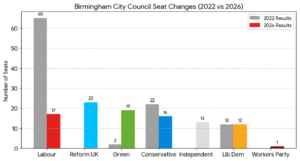
Source: Author generated using electoral data – Changes in number of Birmingham City Council seats in the 2022 and 2026 local elections.
Reform UK’s growing strength in Birmingham did not emerge overnight. It reflected a combination of local and national factors. Birmingham’s financial crisis, declining public services and the prolonged bin strikes created a sense that the city was no longer working. Reform was able to channel that frustration.
At the same time, national debates around immigration, identity and patriotism became increasingly prominent. It was no coincidence that last summer’s flag flying campaign originated in Birmingham. The campaign reflected a growing confidence among Reform supporters and demonstrated that questions of identity had become politically salient well before the local elections. Rather than creating Reform’s success, it revealed a political mood that the party would later convert into votes.
At the other end of the political spectrum, Starmer’s initial handling of the party’s response to Israel’s war in Gaza was used in the Green Party’s and Birmingham independents’ literature, with both opposing the government’s stance (see leaflet graphics below). These local elections revealed Labour’s worst nightmare, as residents in areas such as Kings Heath and Stirchley who had resisted the ‘flaggers’ turned to the Greens as progressive alternative to Reform UK.
Supporters of both Reform UK and the Green Party appeared united around their dislike for Starmer, even if this opinion is grounded in different reasons. Both parties battled to be seen as the party that could ‘stop Labour’ or ‘defeat Starmer’ (see leaflet graphics below).
Nigel Farage claimed that this same anti-Starmer tactic was used in the recent Makerfield by-election, but was less effective as Labour’s candidate and potential future leader, Andy Burnham, was also able to claim he would seek to remove Starmer from Number 10. This provides hope for Labour that a new leader could somewhat recover its electoral appeal.

Source: Author generated and collected from leaflets handed out to Birmingham residents during the 2026 Birmingham council elections
Local factors also meant Birmingham Labour always faced a difficult fight. Birmingham’s equal pay crisis arose because successive administrations failed to resolve longstanding pay disparities and bonus arrangements across the workforce. Some local agreements in male-dominated services, including refuse collection, contributed to those liabilities. The council also faced equal pay claims triggered in 2021 partly due to alleged inflated pay, the creation of new roles and new practices such as ‘task and finish’, which were part of settlements to avoid strikes by refuge workers.
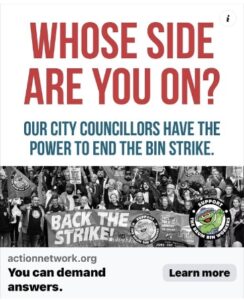
Source: Facebook Ad by ‘Unite for a Workers’ Economy’ Group during the Birmingham Local Elections
Equal pay claims coupled with the costs of a botched implementation of a new IT system contributed towards the council being declared bankrupt and the now infamous bin worker strikes that have meant Birmingham residents have not had their recycling collected since Christmas 2024.
Birmingham’s local elections should be seen as a warning for Labour rather than an exception. The party is losing different parts of its electoral coalition for different reasons. Reform appealed to voters frustrated by economic decline and declining public services. The Greens and pro-Gaza independents appealed to progressive voters who felt Labour no longer represented them.
While local factors made Labour’s position worse, the underlying trends are national. One lesson is that Andy Burnham’s argument for deeper English devolution deserves renewed attention. Giving mayors and local leaders greater powers over economic development, transport, housing and public services would allow places like Birmingham to respond more directly to local challenges and rebuild trust in politics. If Labour is serious about renewing its electoral coalition, it will need to combine a national vision with a stronger model of local government.
By Matthew Lloyd, PhD candidate, Queen Mary University of London and political strategy consultant.

G Money – Sabiduria Ft @TrampaBillone (Video Official)

EMI grant reporting simplified: HMRC to scrap notifications

England fans claim team ‘deserved to go out’ after car crash celebrity Wonderwall


-

 Fashion6 days ago
Weekend Open Thread: Nutriplenish Leave-In Conditioner
-

 Tech7 days ago
Character.AI enters the microdrama arena with its own productions, but there’s a twist
-
 Sports7 days ago
2026 Genesis Scottish Open Thursday TV coverage: Round 1
-

 Sports6 days ago
Super Eagles star Moses Simon opens up on Liverpool transfer regret
-

 Politics1 day ago
Young campaigners urge incoming PM to act on outdoor junk food ads
-

 News Videos2 days ago
XRP BOMBSHELL… XRP OMBOARDED FOR TRANSACTIONS!!!
-

 Tech2 days ago
Get Your ESP32 Sunny Side Up With This Solar Dev Board
-

 Tech2 days ago
Dark Secrets Emerge When Jailbreaking LLMs
-
 Entertainment20 hours ago
Disney’s Most Ambitious Failed Star Wars Attraction Is Coming to SDCC
-
 Sports16 hours ago
New Cornerback Enters Vikings Trade Rumor Mill
-

 News Videos3 days ago
how to make coin bank box with cardboard #scienceproject #money #diy #shorts
-
 Tech3 days ago
Cloudflare Precursor Watches Your Mouse and Keyboard To Decide If You Are Human
-

 Crypto World13 hours ago
CFTC blocks Kalshi from unwinding Michigan trades after court order
-
 Entertainment19 hours ago
Vicki Gunvalson Defends Discussing Heather Dubrow’s Money
-
Crypto World2 days ago
Ripple, Coinbase, Circle Join Linux x402 Foundation to Help Shape AI Payments
-
 NewsBeat16 hours ago
Watch: Is Donald Trump facing a popular backlash on immigration?
-

 Sports14 hours ago
Michigan officials not expected to discuss AD Warde Manuel at Thursday meeting
-
 NewsBeat15 hours ago
Firefighters issue update on Dovestone moorland blaze as fire enters fourth day
-
 Business2 days ago
ACCC warns AI could lift insurance costs in risk-prone areas
-

 Entertainment3 days ago
Hollywood’s Biggest Director Just Called Out AI, And It’s Glorious
You must be logged in to post a comment Login